




Abstract
This study provides a descriptive analysis of police intervention as a response to student behavior in New York City public schools. We find that between the 2016–17 and 2021–22 academic years, arrests and juvenile referrals decreased while non-detainment-based and psychiatric police interventions increased. However, Black students, especially those enrolled in schools located in predominantly white police precincts experiencing a shrinking white student population, experienced disproportionate rates of arrests, juvenile referrals, and police-involved psychiatric interventions. Schools serving more Black students experienced higher rates of interventions relative to schools with fewer Black students, but these higher rates of intervention are not explained by differences in observable student behavior and characteristics. Instead, differences in teacher characteristics and resources contribute to the excess use of police interventions in predominantly Black schools.
Keywords
Introduction
In the 2017–18 academic year, schools referred over 220,000 students nationwide to law enforcement (Civil Rights Data Collection [CRDC], 2018). In New York City alone, police intervened in public schools over 11,000 times in 2019 and in 2022 intervened over 13,000 times (Pendharkar, 2023). While public school student enrollment has declined in New York City, policing interventions taking place on school grounds have increased over time, with interventions nearly doubling since 2017 despite decreasing enrollment (see Figure A1). Despite their prevalence, police intervention in schools is a highly contested phenomenon. In 2020, the “Defund the Police” movement gained traction in implementing reforms targeted at removing and lessening police presence in schools. Yet, school staff’s reports of difficulties managing student behavior in the post-COVID era have incited movements to return to zero-tolerance disciplinary practices and reinstate those school resource officers (SROs) who were removed in 2020 (Arango, 2023).
Motivated by the rise in police interventions occurring in schools and drawing on the both the research literature documenting the inequitable use and effects of SROs on public school students as well as the literature exploring the role of police broadly in shaping juvenile outcomes, we examine the degree to which certain public schools and students are subjected to police interventions in New York City. In this paper, we examine the prevalence of traditional police interventions in schools, a literature that is relatively limited. The work that does exist on this topic relies on data from 911 calls and centers itself on understanding responses to emotionally disturbed persons, as well as understanding the events precipitating a call to 911 (Green et al., 2023a, 2023b). Here, we are interested in the distribution of different types of police interventions. We leverage unique data on police interventions in schools from the New York Police Department (NYPD) pursuant to the 2011 Student Safety Act (SSA), which requires the NYPD to report all police interventions occurring in New York City Public Schools (NYCPS). We combine these data with aggregated school-level data on suspensions and infractions, student and staff demographic characteristics, and the School Safety and Educational Climate (SSEC) school violence index, which measures a school’s prevalence of violent behavior.
We find that, on average, arrests, summonses, and juvenile reports occurring in schools decreased over time; however, NYPD substantially increased their use of less legally severe interventions in schools (i.e., psychiatric and non-detainment-based interventions), despite declines in district-wide student enrollment. Results also show that police interventions disproportionately involve Black students for all intervention types, especially in schools with fewer Black students. Predominantly Black schools experience the most interventions per student. Differences in reported student behavior and other observable characteristics fail to explain these higher rates of intervention. However, teacher characteristics, especially the percent of teachers who are Black within a school, explain the disproportionate rates of police intervention. Importantly, this does not necessarily mean that Black teachers themselves are requesting police intervention, as any school staff within schools with both predominantly Black students and teachers may be initiating these calls. Further, this covariate may also be proxying for other omitted variables that are unavailable in our data. Principal and other support staff characteristics fail to provide additional explanatory power indicating the importance of teachers in determining police involvement in schools. We suggest that addressing inequities in staff capacity and training across schools may be a promising recourse to reduce racial disparities in police involvement in schools. We provide recommendations for programmatic and policy reform that may assist in achieving this objective.
Related Empirical Literature on the Policing of Youth
The literature that exists regarding police in schools centers on the role and impact of SRO presence in schools. Importantly, and in contrast to the present study, this research does not directly observe what forms of school-based intervention are taking place that involve any police officer—SRO or otherwise. Existing research shows that an SRO functions as a “third administrator” within schools (Viano et al., 2023) and assumes a variety of roles as a law enforcer, counselor, mentor, and teacher (Finn et al., 2005; Holloway, 2021; Kupchik et al., 2020; Travis III & Coon, 2005). However, prior studies have found that SROs predominantly spend their time on law enforcement (Travis III & Coon, 2005), with their role extending into the area of counseling, mentoring, and teaching depending on various factors such as the size of the school (Finn et al., 2005).
School-based police have become increasingly prevalent in public schools throughout the US, but their prevalence is not equally distributed, nor are their roles consistent, across schools. At the national level, school-based police are more commonly found in schools with higher shares of white students, especially at the elementary level (Gleit, 2022). Yet, school-based police in schools with higher shares of students of color tend to intervene more regularly than schools with lower shares of students of color, and more frequently carry out punitive and exclusionary forms of discipline (Gleit, 2022). At a localized level, Allen and Noguera (2023) find that arrests by school police officers in Los Angeles are concentrated in low-income, segregated Black neighborhoods and are legitimized by “preemptive criminalization” of students by both school and police actors.
Examination of the effectiveness of SROs has also been a focal point in the literature, yielding mixed results. Scholars have utilized various methodological approaches, with some finding that the presence of SROs is associated with significant reduction in criminal activity taking place at the school (Jennings et al., 2011; Johnson, 1999; E. G. Owens, 2017; Theriot, 2009, 2016) while others found no reduction in crime or even an increase in the recording and reporting of crimes and use of exclusionary discipline (Brady et al., 2007; Devlin & Gottfredson, 2018; Jackson, 2002; Javdani, 2019; Na & Gottfredson, 2013; Sorensen et al., 2021, 2023; Zhang, 2019).
The link between school-based police officers, delinquency reporting, and the racial makeup of schools is inconsistent in the literature, with some finding weaker delinquency reporting in contexts with more Black and Hispanic students (Na & Gottfredson, 2013; E. G. Owens, 2017) and others finding that police presence in schools and arrest rates was stronger for Black students (Homer & Fisher, 2020; Weisburst, 2019). However, a recent nationally representative study by Sorensen et al. (2023) presented evidence from a fuzzy regression discontinuity design that the effect of SROs on criminal activity in schools varies based on the form of infraction, as SROs effectively reduced some forms of violence in schools but did not prevent gun-related incidents. They also found that SROs increased the use of suspension, expulsion, police referral, and arrest, particularly for Black students, male students, and students with disabilities.
A wider body of literature has examined the broader impacts of policing on youth, particularly outside of schooling contexts. That which does exist in schooling context documents the prevalence of calls to 911 in Boston schools, finding that midday calls were most common and increased in the spring (Green et al., 2023b) and were also often for student-related violent behavior and language or dysregulated behavior (Green et al., 2023a). Other studies outside of the schooling context found that youth stopped by police were more likely to report school disengagement, psychological and emotional distress, and post-traumatic stress symptoms (Del Toro et al., 2022; Jackson et al., 2019; Jindal et al., 2022), with more adverse emotional and mental health responses manifesting if youth were stopped by police in school (Jackson et al., 2019). Simply witnessing a police stop as a bystander has been found to be associated with higher levels of depression and anxiety among youth (Jackson et al., 2022). The effects of police stops may also extend to child performance in school—police stops are associated with lower school grades, attendance, and test scores as well as higher probability of high school dropout (Gottlieb & Wilson, 2019; Legewie & Fagan, 2019; Tebes & Fagan, 2022). Youth stopped by police are also more prone to engage in subsequent delinquent behavior and drug use (Del Toro et al., 2022; Dong & Krohn, 2020; McGlynn-Wright et al., 2022; Wiley & Esbensen, 2016; Wiley et al., 2013).
In addition to police stops, exposure of youth to the juvenile justice system may have collateral consequences for the juvenile including negative impacts on education and long-term life outcomes. Sorensen et al. (2025) found that, even for similar forms of offenses, relative to students only punished within a school, students referred to the juvenile justice system experienced lower academic achievement, increased absenteeism, and were more likely to encounter the juvenile system in the future. Aizer and Doyle (2015) find similar results using quasi-experimental randomization in judge assignment, with being assigned a more punitive judge substantially reducing high school completion rates and increasing rates of adult recidivism, including for violent offenses.
Juvenile diversion initiatives have emerged as a method to reduce youths’ involvement in the justice system. However, diversion initiatives can be designed in various ways—the simplest form being “warn and release” policies that occur before arrest. More structured programs target youth post-arrest, but prior to adjudication, that require further action and monitoring of compliance over time
Importantly, our study is primarily concerned with less legally severe interventions, referred to as “mitigated” or “child in crisis” interventions. Any evidence regarding the impact of these practices on youth or students and by police is next to non-existent. Mitigated interventions are perhaps closest to “warn-and-release” interventions but are unique in that they do not simply release a student without consequence. Instead, the student is released from police custody, but still punished by a different entity (the school). Child-in-crisis interventions are perhaps most like mental health interventions or a 5-1-5-0 involuntary hold process. There is limited research on the impacts of these interventions on youth generally, and that which does exist is limited to qualitative evidence suggesting that most youth who experienced involuntary holds from police viewed the experience as “criminalizing,” “dehumanizing,” and “shameful” (Jones et al., 2022).
Other literature focuses on redefining the police’s role in responding to individuals in mental health crisis. Specifically, the use of Crisis Intervention Teams (CITs) has become more common, including in New York City, and holds promise in training officers to respond in less severe ways to individuals in crisis (Kane et al., 2018). However, there is limited evidence as to whether these programs do indeed reduce arrests, the use of force, or safety of those involved in the intervention (Rogers et al., 2019; Taheri, 2016). There is also limited evidence regarding their impact on youth, although one study suggests that officer’s efficacy at responding to youth in crisis improved (Kubiak et al., 2019).
Conceptual Framework
To understand how the use of police may differentially occur in schools, we draw upon theories from a variety of disciplines, which we conceptualize as racialized theories of school discipline and control. Specifically, we draw on racially territorial policing (Boddie, 2022), racial threat and racial control (Blalock, 1967; Irwin et al., 2022), and racialized institutions (Ray, 2019). Racially territorial policing and racial threat originate within the crime and legal literature, racial control as a critique and extension of applications of racial threat in education research, and racialized institutions within theories of organization. Through combining theories from a variety of fields, we arrive at a more nuanced understanding of where and why policing manifests in school settings.
We understand which schools rely on police for behavioral management in the context of Boddie (2022)’s theory of racially territorial policing, which suggests that space itself determines the use of police in a neighborhood. We apply this theory to the environment of schools, observing the schooling space as subject to similar biases, constructs, and constraints as the broader neighborhoods in which policing is often examined. Racially territorial policing defines two primary actors within a common space: police and the policed (e.g., individuals) within a neighborhood. Police’s perceptions of an individual in a space are defined by the composition of the space itself. Boddie suggests that a neighborhood that is composed of primarily Black residents is perceived as a “Black neighborhood,” allowing for racial stereotypes to become salient when a space becomes racialized. In the case of policing, a Black neighborhood may be stereotyped as disorderly, giving police a seemingly viable reason to overpolice the area. “Conscious or unconscious assumptions about who is supposed to be in a particular space leads those with power to create and maintain boundaries that control access to it or micromanage movement within it” (Boddie, 2022, p. 479).
A similar logic may be applied to schools. In the case of a school where students are predominantly Black, that school may be seen as a “Black school.” Adults in these schools may thus be more susceptible to unconscious or conscious biases when interacting with students in these schools that are presumed to be “disorderly” due to biases surrounding the demographics of the space. Put simply, “police not only criminalize Black people, but also criminalize Black spaces” (Boddie, 2022, p. 477) in our case, Black schools. Irwin et al. (2022)’s theory of racial control is also relevant in understanding where interventions take place and presents a similar conclusion: “As the percentage of students of color in a school increases, the school will increasingly be constructed as a criminalized space” (p. 1084).
Racial threat (Blalock, 1967) also suggests, to an extent, that punitive practices in schools are likely to be concentrated in schools with a large Black population. One of the primary critiques, however, of the use of racial threat in education research is the fact that the mechanism of racial threat relies on the potential for the Black population to exert social, economic, or political power. The ability for Black K–12 students to do so is much more limited than Black adults. As such, Irwin et al. (2022) also propose a more nuanced view of racial threat specifically within the school setting—“racial control.” Racial control suggests a similar result as racial threat: “As percentage of students of color in a school increase, punitive control will also increase” (Irwin et al., 2022, p. 1082), which, and of interest to this study, may take the form of police interventions. Importantly, racial control suggests a linear relationship between Black student population and punitivity instead of a non-linear relationship as suggested by Blalock (1967).
Racially territorial policing, racial threat, and racial control help us understand across school disparities in policing (i.e., which types of schools experience more police interventions), whereas we understand within-school racial disparities (i.e., which schools experience greater within-school disproportionality in police interventions) simply through lenses of racial threat (Blalock, 1967) and racial control (Irwin et al., 2022).
Racial threat theory facilitates an understanding of how within-school racial disparities may arise depending upon the demographic context of a school. For example, in a majority white school, especially one in which there is a shrinking white population, Black students may be perceived as a threat or “out of place” (Ferrandino, 2015; Gelman et al., 2007), thus creating a greater perceived need to control these students. Indeed, numerous empirical studies have found that when Black students are in the minority or amidst a shrinking white population, schools suspend students more often (Chin, 2021) and have disproportionate rates of special education classification (Chin, 2021; Elder et al., 2021; Fish, 2019; Stiefel et al., 2024). Insofar as police interventions in schools serve a similar purpose of control, we would expect similar results: Black students in schools predominantly serving white students will experience disproportionate police interventions relative to Black students in schools predominantly serving Black students. A key assumption of this theory, however, is that the Black population must exert economic or social power, which may be unlikely in the context of schools and juveniles. Racial control ameliorates the need to assume, as is the case with racial threat theory, that the Black student population must exert a form of power to warrant control. As such, and slightly in contrast to racial threat, we may expect the greatest disparities in intervention rates in schools with a more balanced racial composition as these schools represent a salient threat to white supremacy: racial integration.
In addition to the importance of student ethno-racial composition, the composition of teachers and other school staff is likely important in the use of and reliance on police intervention. Prior literature examines these patterns in relation to office discipline referrals and suspensions. These studies have shown that when students are exposed to same-race teachers, they are less likely to experience exclusionary discipline, such as suspensions, with this relationship being most significant for Black students (Blake et al., 2016; Hayes et al., 2023; Lindsay & Hart, 2017; Redding, 2019; Rodriguez et al., 2024; Shirrell et al., 2023). Similar patterns exist with school leaders, where Black students are less likely to receive suspensions when enrolled in schools with Black administrators (Edwards et al., 2023; Welsh, 2024). These trends persist even when controlling for differences in student behavior and developmental status (Blake et al., 2022), suggesting that staff behavior—whether shaped by implicit bias or active representation—plays a key role in reducing exclusionary discipline practices for students of color (Grissom et al., 2015; Wymer et al., 2022). In a similar vein, the composition of school staff may also influence the likelihood and nature of police interventions in school settings, highlighting how systemic under-resourcing and racial dynamics work together to shape the school experience for minority students.
Although Boddie (2022), Blalock (1967), and Irwin et al. (2022) allow us to understand where prevalence and disproportionality in police interventions are most likely to occur, these theories do not provide explanations other than implicit bias as to why police interventions may occur. Importantly, Irwin et al. (2022) do suggest that systemic racism is a primary contributing factor to this utilization of punitive practices in predominantly Black schools, but Ray (2019)’s theory of racialized institutions provides potential resource-oriented, systems-level explanations. Put simply, structural manifestations of under-resource in predominantly Black and Brown schools result in unequal outcomes—“Organizations help launder racial domination by obscuring or legitimating unequal process” (Ray, 2019, p. 35). In our case, under-resource in tools to manage complex student behavior results in unequal reliance upon police in schools in which under-resource is most pronounced, that is, predominantly minority-serving schools.
Taken together, stereotypes arising from defining a school that serves predominantly Black students as “Black” may create increasingly “vulnerable decision points” (McIntosh et al., 2014) for teachers or staff that have the power to involve police and, further, the severity of the interventions that are employed by police upon being called. 1 We also expect that the under-resource in predominantly Black schools may further exacerbate staff’s susceptibility to vulnerable decision points—when a space is defined as “disorderly” and, further, there are less resources to deal with this perceived disorder, these vulnerable decision points become even more likely to occur. As such, we expect that predominantly Black schools would experience the most interventions, driven primarily by under-resource, whereas predominantly white schools would experience the greatest disproportionalities in police interventions.
NYC Context
NYCPS is the largest school district in the United States, serving approximately 1 million students each year and deploying approximately 4,400 “school safety agents,” hereafter referred to as SROs (Donaldson, 2021). Similarly, the NYPD is the largest police department in the US, employing approximately 34,000 sworn officers (New York Police Department [NYPD], 2024). During our period of analysis (2016–17 to 2021–22), NYCPS underwent a variety of discipline reforms, and the NYPD began quarterly reporting of all forms of police interventions occurring on the grounds of any New York City public school. These interventions include both those from NYPD-employed school-based police, as well as police that are not stationed at school but called onto and entering school grounds.
The use of SROs fell under the purview of the NYPD until 2020, when Mayor Bill de Blasio began to transfer the oversight of SROs to NYCPS. This, however, did not eliminate non-SROs from intervening in schools (Donaldson, 2021) and, eventually, this decision was reversed by Mayor Eric Adams in February of 2022 (Martin, 2023). Further, the presence of SROs has decreased by over 1,000 positions between 2020 and 2023 (Martin, 2023). 2 NYCPS recommends that police only be called in “the most extreme of situations, when kids pose an “imminent and substantial risk of serious injury” to themselves or others” (Kramer, 2023). However, there are instances in which police are called to address students in emotional distress (child in crisis interventions), which can result in students being restrained before being transferred to a hospital for psychological evaluation. Other interventions are used when students commit an arrestable or citable offense, but instead of producing an official police record, are returned to the purview of the school (mitigated offenses). These actions may be taken by SROs or by patrol officers who are called by school staff or SROs (Zimmerman, 2017). Mitigated and child in crisis interventions are less legally severe than other police responses of arrest, juvenile referral, or summonses. 3 In 2021, the NYPD also launched precinct-level pilots to implement the use of Mental Health Teams, which would exclusively respond to mental health crises (NYC Office of the Mayor, 2020).
Lastly, in 2019, NYCPS, NYPD, and the City of New York entered into a memorandum of understanding that mandated the use of warn and release diversion for minor offenses occurring on school grounds. These offenses would otherwise amount to criminal offenses (e.g., low-level marijuana possession, disorderly conduct, trespass, harassment, or graffiti), but are instead met with light-touch intervention by police officers before releasing the student to NYCPS for administration of disciplinary consequences.
Other forms of discipline and control in NYCPS include the use of suspension and office discipline referrals. The use of these options follows a similar pathway as the use of police in schools: a disciplinarian observes a student’s behavior and must decide whether to handle the behavior in class (and administer a non-exclusionary response) or refer the student to the office, where the student will likely receive exclusionary disciplinary consequences (Rodriguez & Welsh, 2022). In NYC, reliance on exclusionary discipline has become less common, pursuant to the 2012 ban on suspension as a response to low-level misbehavior, a De Blasio-era push for restorative justice programming and mental health supports, and restrictions on the length of suspensions (Rodriguez & Welsh, 2022). Many of these reforms were already implemented prior to when our study begins (2016–17 academic year).
Data
We draw on unique data from the NYPD, NYCPS (via the Research Alliance for New York City Schools [RANYCS]), and the SSEC to probe the relationship on average and across time between traditional police interventions in schools and a school’s racial demographic composition, viewing schools as sites of racially territorial policing. We use publicly available data from the NYPD that reports on distinct categories of police interventions in schools on a quarterly basis beginning in the 2016 calendar year. We aggregate this quarterly data to the academic year level, defining an academic year as beginning in July of year
We use police interventions that are reported at the school level and aggregated to academic years to determine the total number of interventions by type from 2016–17 through 2021–22 academic years. This data, pursuant to the School Safety Act of 2011, includes only interventions occurring in schools. 6 As a result, we can match this school-based intervention data to key student and school characteristics. We exclude the pandemic year of 2020–21 when most schools were completely remote, resulting in near zero instances of police interventions in this year. The school-level data does not provide demographic information and only the name of the school and type of intervention that took place. We use a school name to school identification number crosswalk from The City—a non-profit news organization focused on accountability reporting in NYC—to match interventions to school-level characteristics constructed from student-level data provided by RANYCS and school-level data from the SSEC, which contains information on violent incidents and student enrollment. 7 See the supplemental data appendix for a detailed description of the data matching process for both school and precinct-level files.
We proxy for characteristics of the context in which an intervention occurred by examining differences in student characteristics, teacher characteristics, and principal and support staff characteristics. Specifically, we proxy perceived student behavior and responses to this behavior through student suspension rates, office discipline referrals (ODRs), and a school violence index. It should be noted that these measures are imperfect insofar as they do not capture the “true” behavior of a student—instead, ODRs represent reported student behavior, meaning that some behavior may not be accurately captured by ODRs. We proxy staff (either teacher, principal, or support staff) under-resource through staff to student ratios, average years of experience, percent that are new to a school, and the percent that are Black. We consider the percent of staff that are Black as a proxy for under-resource given the proposition that predominantly Black institutions often receive fewer resources. Further, we understand that Black teachers often take alternative pathways to certification that have fewer opportunities for student teaching (Carver-Thomas & Darling-Hammond, 2017), which may influence their ability to manage behavior in the classroom. We do not have access to data regarding teacher preparation.
Descriptives
Figure 1 depicts the total number of interventions by student age group, race, and sex and Table A1 reports corresponding counts. Across all years, most interventions (out of 51,873 total interventions) are for children 12 years old or older (typically middle school or high school aged students), but police still intervene over 8,000 times with students under 12 years old. Most interventions for elementary aged children are mitigated (2,635) or child in crisis interventions (5,509) and are concentrated among Black and Hispanic male students. Female students under 12, regardless of race, have lower rates of intervention than male students.

Total Interventions by Student Age Group, Race, and Sex–Pooled (2016–17 to-2021–22).
For those students older than 12 years old, Black girls and Black boys experience similar levels of child in crisis and mitigated interventions, but Black boys were nearly 3 times as likely as Black girls to experience an arrest. These patterns were similar for Hispanic boys relative to Hispanic girls. White boys experience 5 times the number of arrests, nearly 3 times the number of juvenile referrals, and over 2 times the number of mitigated interventions relative to white girls. Black students, regardless of gender or age, persistently dominate the number of police interventions. Black students comprise 53.3 percent of interventions, despite composing only 28.4 percent of student enrollment. White students comprise 13.0 percent of student enrollment, but only experience 5.6 percent of interventions. Hispanic students make up 43.4 percent of enrollment, but only 35.5 percent of interventions.
Table A2 presents summary statistics for all variables included in our analyses by whether a school is in the top quartile of Black, Hispanic, or white enrollment. Notably, schools in the top quartile of Black enrollment experience approximately 6 times the number of interventions per 100 students than those schools in the top quartile of white enrollment; schools in the top quartile of Hispanic enrollment experience about 2 times the number of interventions. Schools in the top quartile of white enrollment, have higher attendance rates, lower suspension rates, fewer free and reduced-price lunch (FRPL) eligible students, and fewer transfer students. Schools in the top quartile of Hispanic enrollment and Black enrollment are largely similar in these characteristics.
Teachers and principals in schools in the top quartile of Black or Hispanic enrollment had similar years of experience to schools in the top quartile of white enrollment, but predominantly Black or Hispanic schools have more teachers and principals that are new to a school within a given year. Teachers, principals, and support staff at predominantly Black or Hispanic schools are also more likely to be Black relative to schools in the top quartile of white enrollment.
Figure 2 displays density plots of the percent of students in a school who are either Hispanic, Black, or white. There are no schools that exclusively serve white or Black students, but there are schools that serve exclusively Hispanic students. Most schools in our sample serve very few white students, whereas there is a relatively even distribution in terms of the percent of students in a school that are either Black or Hispanic.

Kernel Density Plots of School-Level Student Demographic Characteristics.
Across School Differences in Police Interventions
We begin by documenting raw patterns in rates of police intervention in relation to the racial composition of a school. Figure 3 displays the number of interventions per 100 students enrolled across the distribution of the percent of a school that is Black or Hispanic as predicted by local polynomial estimation. We observe that the prevalence of interventions is highest in schools serving greater percentages of Black students. Notably, we observe a slight kink in the distribution when Black students comprise approximately 50 percent of students within a school: there is a marked increase in the rate at which incident prevalence increases as schools serve greater percentages of Black students. 8

Interventions per Total School Enrollment by School Demographic Composition.
Regardless of the percent of Hispanic students, interventions per 100 students remain relatively stable, apart from mitigated interventions, which are less prevalent in those schools serving the highest proportion of Hispanic students. In NYCPS, Hispanic students are the dominant group—43 percent of NYCPS students are Hispanic.
We also observe heterogeneity by a school’s grade structure (Figure 4). We observe that the majority of mitigated police interventions occur in high schools (grades 9–12) and the fewest occur in elementary schools (grades K–5). Notably, regardless of a school’s grade structure, more interventions occur in predominantly Black schools relative to schools with a lower proportion of Black students.
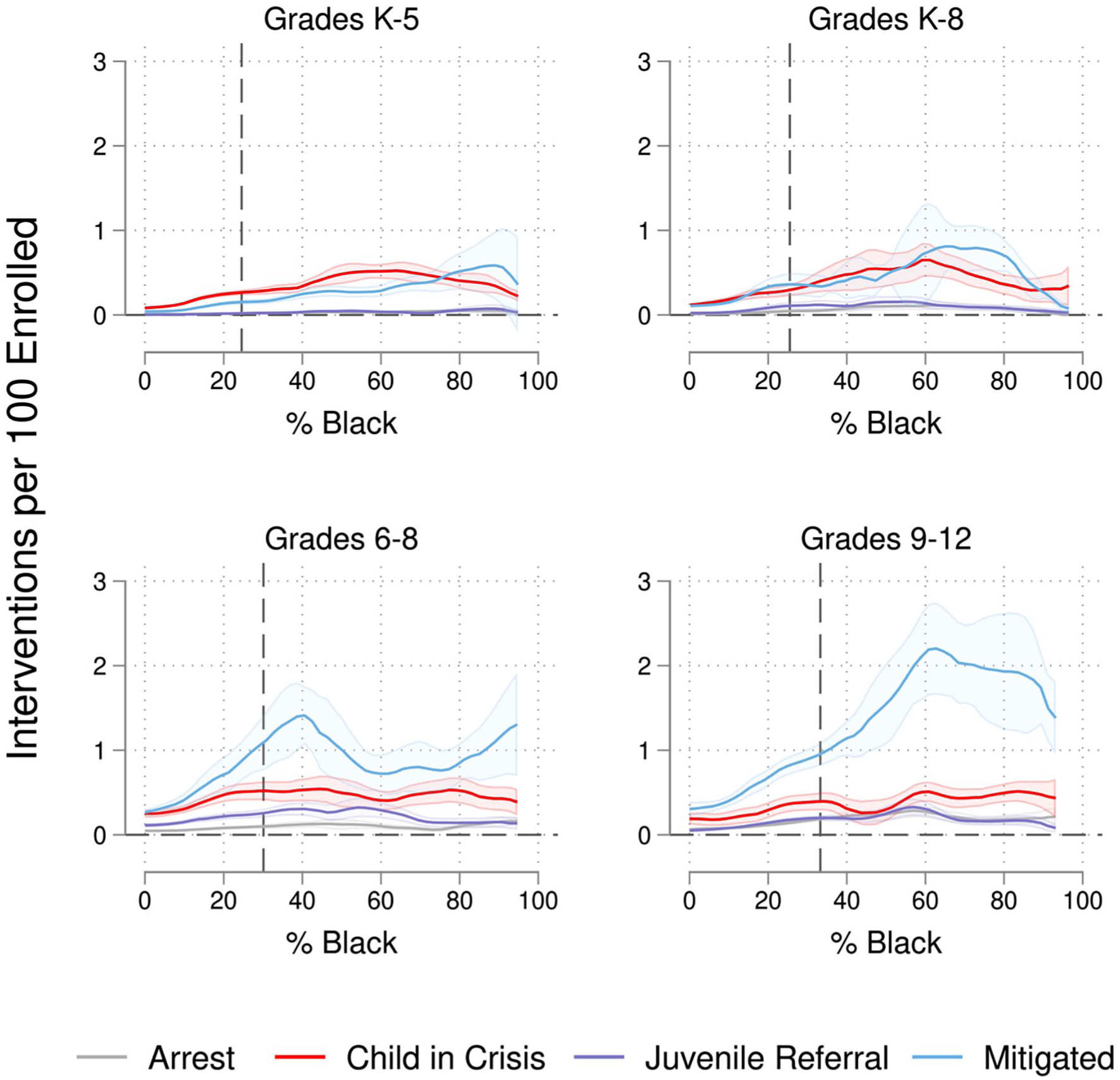
Interventions per Total School Enrollment by School Demographic Composition: Heterogeneity by School Grade Level.
We also examine heterogeneity across time (Figure 5). Given that we observe a major increase in interventions upon returns to in-person learning (Figure A1, Panel A), we examine how interventions in 2022 compared to interventions prior to the beginning of the COVID-19 pandemic. The growth in interventions that we observe in Figure A1 is driven almost entirely by schools with above average proportions of Black students. Again, the general pattern holds in both time periods: as the proportion of Black students within a school increases, so does the incidence of mitigated interventions. It should be emphasized that these patterns are based on only one year of data.

Interventions per Total School Enrollment by School Demographic Composition: Heterogeneity by Pre-2021 and Post-2021.
Within Precinct Disparities in Interventions
Having established that intervention prevalence is most common in predominantly Black schools, we turn to examine how within school disparities vary across school racial composition. Given our data, we are unable to directly observe interventions disaggregated by race at the school level. Consequently, we rely on precinct-level data and precinct-aggregated school characteristics. Our estimates therefore better reflect within precinct disparities in police interventions in schools. From this data, we construct adjusted risk differences (ARDs) for arrests, juvenile referrals, child in crisis, and mitigated interventions between Black and white offenders at the precinct level, where:

A positive ARD indicates that Black students in a given precinct-year (pt) had a higher risk of receiving an intervention of type n than white students.
As shown in Figure 6, Panel A, we find that racial disproportionality in arrests, juvenile referrals, and child in crisis interventions is concentrated primarily in precinct areas with schools that serve a lower percentage of Black students. In precinct areas with schools serving the fewest Black students, Black students are 2 percentage points (pp) more likely than white students to experience a child in crisis intervention, and approximately 0.5pp more likely than white students to experience an arrest or juvenile referral. Notably, these disparities are approximately 3 times smaller in precincts that serve an above average percentage of Black students. However, there are minimal differences in the risk difference between Black and white students for mitigated interventions. Regardless of the student racial composition in a precinct, Black students are approximately 1pp more likely than white students to experience a mitigated intervention.

Average Risk Difference Between Black and White Students Across Precinct Demographic Composition.
We conduct a supplementary analysis to examine interventions across terciles of the percent of a precinct’s schools that are white. 9 Table 1 presents mean Black-white ARDs for each tercile and intervention type and p-values for differences across terciles and Figure A3 provides a visual representation. 10 We observe that precincts in the third tercile of white student enrollment experience the largest ARDs in all intervention types, and all differences in ARDs between low- and high-percent white precincts are statistically significant at the 5 percent level. For all interventions except child in crisis, we observe a monotonically increasing relationship between ARDs and tercile, in line with the phenomenon of Black students being disproportionately criminalized in predominantly white schools with a growing Black student population (Irwin et al., 2022).
Differences in Intervention ARDs by Tercile of White Enrollment

Note. Estimates represent the adjusted risk differences for each intervention type by the tercile of White enrollment. “Low” indicates the first tercile, “Medium” indicates the second tercile, and “High” indicates the third tercile. P-values for the difference between each tercile and intervention type are provided.
We also examine how changes in a precinct’s white student population are related to Black-white ARDs in interventions, finding results in line with the phenomenon of greater racial disparities occurring in the whitest areas. We construct a three-year moving average of the year over year change in the proportion of white students within a precinct and plot these compositional changes against Black-white ARDs, disaggregated by whether a precinct’s composition of white students is above or below average. 11 Figure 6, Panel B, presents these relationships. We find that in precincts in which the white student population is shrinking that ARDs in mitigated interventions are larger. This finding is exceptionally pronounced in areas that have above average white student enrollment and less so in areas with below average white student enrollment. 12
Adjusted Differences in Reported Police Intervention Patterns
There are at least three reasons as to why police interventions are occurring in predominantly Black schools. First, it may be the case that schools with high levels of interventions have lower staff capacity, forcing a reliance on other actors (i.e., police) for behavioral management. This concentrated under-resource is especially prevalent in NYCPS, where schools are still racially and socio-economically segregated and efforts to integrate have been largely stymied (Shapiro, 2019). Second, racial biases of police in schools, teachers, or other administrators may manifest as a greater reliance on traditional police to manage the behavior of students of color, which is often perceived as more severe relative to the same behavior of white students (Barrett et al., 2021; Liu et al., 2022; Okonofua & Eberhardt, 2015). Moreover, while predominantly Black schools on average experience greater rates of exclusionary interventions (Welsh &Little, 2018), within-school racial disproportionalities in severe disciplinary actions are higher in predominantly white schools in the context of integration (Chin, 2021) as well as in our data as outlined in the prior section. Lastly, it may be the case that Black students engage in more misbehavior than white students, which leads to a greater incidence of police intervention, dominated by predominantly Black schools.
To examine the roles of student behavior and school resources, we turn to the school-level NYPD files merged with RANYCS data to explore the characteristics of schools that have above or below expected rates of interventions conditional on other characteristics. Given that child in crisis and mitigated interventions experience the most variation in prevalence across schools, we focus on these intervention types for the remainder of our analyses. We use a two-stage residuals analysis, first estimating the following equation:

where
We specify three additional models to describe the role of resource in the use of police interventions in schools. The first model includes the aforementioned student characteristics and adds in teacher characteristics (pupil-teacher ratio, percent of teachers new to a school, average years of teacher experience, percent of teachers who are Black). The second includes student characteristics and the number of principals per student and assistant principals per student and relevant principal and assistant principal characteristics (percent new to a school, average years of experience, percent who are Black). The third includes student characteristics and the number of social workers, school psychologists, and guidance counselors per student as well as relevant characteristics for each support staff type (percent new to a school, average years of experience, percent who are Black).
For each model, we use predicted values to then construct residuals as:

then use local polynomial regression to plot
The Role of Student Behavior
We find that differences in reported student behavior and observable characteristics fail to explain differential rates of intervention across schools (Figure 7). Despite controlling for key student behavioral measures, schools with a higher percent of Black students still experience greater than predicted rates of mitigated interventions. These higher than predicted rates dissipate at the schools with the most Black students. The slight overrepresentation of child in crisis interventions in predominantly Black schools is, however, explained by differences in student characteristics and behavior proxies.

Residuals From Each Regression Model by the Percent of School Enrollment That Is Black or Hispanic.
Schools with a below average share of Hispanic students tend to have more than expected interventions, conditional on student characteristics and proxies for student behavior. However, schools with above average shares of Hispanic enrollment tend to have less than predicted rates of police intervention. This may be attributable to the fact that Hispanic students are the largest share of students within New York City, meaning that theories regarding the distribution of exclusionary and harsh interventions within schools (e.g., racial threat hypothesis) may not apply within this context.
The Role of Teachers, Principals, and Support Staff
Upon controlling for a variety of teacher characteristics, we find that expected and predicted values of both mitigated and child in crisis interventions are roughly equal across the distribution of the percent of Black students and the percent of Hispanic students in a school (Figure 7). We find that teacher characteristics are singular in this regard—the explanatory power of principal or support staff characteristics on their own only slightly reduce, but do not eliminate the disparate use of police interventions in predominantly Black schools. More specifically, analyses of individual teacher covariates suggest that the percent of teachers in a school that are Black uniquely drives the reduction in the overrepresentation of police interventions in predominantly Black schools. It is important to note that this variable is likely proxying for a variety of omitted variables for which we are unable to control, such as differences in pre-service teacher training. Further, it is important to note that we are unable to observe who is initiating the involvement of police—it may be the case that white or non-Black teachers in schools with more Black students and more Black teachers are those who are initiating these interventions.
Sensitivity Analyses
Lastly, we also conduct a robustness check, modeling intervention rates non-parametrically as a function of indicators for quartiles of school demographic composition and observe how these coefficients of interest change when controlling for student, teacher, principal, and support staff characteristics. Specifically, we estimate the following model:

where the coefficients of interest are
We also conduct a robustness check using deciles of a school’s Black student enrollment as our key moderating variable instead of the actual school composition (Figures A5 and A6). We conduct this robustness check because our primary results that use actual student composition forces an exceptionally small sample size at the top of the distribution (and commensurately large confidence intervals). There are only 19 unique schools in our sample with 90 percent or more Black students. As such, our finding of a concave relationship between racial composition and police interventions may be driven by this small sample.
Using deciles, we find our results largely unchanged, with student characteristics and behavior proxies failing to explain the overuse of mitigated interventions, whereas teacher characteristics hold more explanatory power. Importantly, these results differ slightly in that they present a more linear relationship instead of a concave relationship as suggested by racial threat theory in which interventions ultimately decrease in areas with the largest Black population (Blalock [1967] suggests this relationship specifically for economic threats, which may be less applicable in the school setting). This is likely because using deciles anchors all schools relative to another, meaning that a school in the top decile of Black enrollment does not mean that school has the greatest Black enrollment—it simply has the greatest relative Black enrollment.
Heterogeneity Analyses
We examine heterogeneity by a school’s grade structure and time period. We re-estimate all models on our sub-samples of interest (i.e., grades K–5, K–8, 6–8, 9–12, pre-pandemic, post-pandemic). We detect slight heterogeneity by the grade structure of a school (Figure A7) as well as the time period (Figure A8). Student characteristics and composition matter more so for schools that serve grades 6–8, but less so for high school and elementary schools. 16 This is perhaps consistent with the fact that disciplinary incidents or office referrals are most common at the middle school level in New York City. Despite this phenomenon, teacher characteristics still hold additional explanatory power regardless of the grade structure of a school.
Next, we examine heterogeneity by time period (Figure A8). We find similar patterns, with teacher characteristics being uniquely salient in the period prior to the pandemic’s onset. Post-pandemic, student characteristics carry more explanatory power relative to pre-2020, yet teacher characteristics, as well as principal and support staff characteristics, mediate the concentration of mitigated interventions in predominantly Black schools. 17 Importantly, these estimates are much less precise given the single year of data on which we are estimating (2021–22 academic year) and we interpret these estimates with caution.
Discussion
We provide evidence of disproportionate involvement and exposure of Black students in school-based police interventions in New York City. Our analysis suggests that differential student behavior or characteristics do not account for this disproportionality. Consequently, efforts to change student behavior—through suspension or increased policing—are unlikely to reduce these elevated rates of intervention. Instead, we find that differences in teacher characteristics, specifically the ethnoracial composition of a school’s teaching staff, help to explain the disproportionate use of police intervention in schools predominantly serving Black students.
This disproportionate representation may reflect broader structural dynamics tied to the unique racialized history of Black communities in the US. The legacy of anti-Blackness, as shaped by centuries of racial discrimination, continues to influence both educational and criminal justice systems (Bell, 2017; Sobti & Welsh, 2023). In contrast, while the Hispanic population is also racialized, the diverse ethnic and racial makeup of this group, including Afro-Latinos, Indigenous individuals, and white-passing Hispanics (Busey & Silva, 2021), may lead to different experiences in school discipline and policing. Moreover, given that Hispanic students represent the largest proportion of the student population in NYCPS, they may be perceived as the “norm,” which could reduce their racialization relative to smaller minority groups within the schooling system. As such, the Hispanic population complicates a uniform pattern of exclusionary practices among a minoritized group, which may account for the divergent findings observed in our study.
Several prior studies have provided evidence that increased exposure to same-race school staff is associated with reduced suspension of Black students (e.g., Blake et al., 2016, 2022; Grissom et al., 2015; Lindsay & Hart, 2017; Shirrell et al., 2023; Welsh, 2024). Our study reveals a finding in which the percent of Black teachers (or a characteristic that this variable is proxying) is a variable that uniquely explains the use of police interventions in predominantly Black schools, which may contradict prior findings regarding student-staff race match. Again, it should be noted, however, it may be the case that non-Black teachers in predominantly Black schools are initiating these calls, perhaps in line with the phenomenon of Black communities more broadly (i.e., both Black teachers and students being the dominant group) being overpoliced.
Some literature, however, does suggests that Black teachers, particularly Black male teachers, are often relegated to disciplinary roles and responsibilities (Bristol & Mentor, 2018; Brockenbrough, 2015) or may be more inclined to apply more punitive discipline practices to Black youth as a way to enforce conformity with white middle class behavioral standards (Blake et al., 2022). If it is the case that Black teachers in predominantly Black schools are initiating police interventions, our finding may align with the literature that documents this phenomenon.
Implications for Policy, Practice, and Research
Given that student characteristics or within-school responses to student behavior do not explain the overpolicing of predominantly Black schools, we suggest that it may be efficacious to address structural factors that likely affect a teacher’s decision to call police. For example, ensuring that Black teachers have sufficient support from administrators and equitable resources commensurate with the higher need population that predominantly Black schools tend to serve may prove fruitful. As shown in Table A2, predominantly Black schools in NYC have higher rates of violent incidences, above-average share of students who are FRPL eligible, and have a more mobile student population. The relationships between these characteristics may arise potentially through NYC’s history of “de facto education redlining” (Holzman, 2012) in which neighborhood characteristics, disinvestment, and segregation may largely coincide with differences in educational opportunity and resource (Aaronson et al., 2023), despite the choice-rich environment of NYCPS. Despite having a higher needs population, the resources that these schools are provided (e.g., as measured by pupil-teacher ratios; principals, teachers, and support staff mobility; and years of teacher, principal, and support staff experience) are the same or less than schools on average and markedly less than predominantly white schools. Equal distribution of resources amid inequal needs prohibits equitable outcomes from being realized. Given the emergence of rollbacks to suspension and police reforms across the US (Pendharkar, 2022; Sparks, 2023) and the NYC context of budget cuts to education yet maintenance of funds to police (Beeferman & Touré, 2023), the evidence provided in this study suggests that these funding changes are likely not an optimal strategy to promote student (or teacher) success.
Functionally, increasing supports could occur at a variety of stages throughout a teacher’s career beginning from pre-service training through employment. It could be of interest to address differences in teacher preparation programs. Some quantitative evidence suggests that Black teachers often enter the workforce without any student-teacher experience, have less access to mentorship, and are more likely to express concerns regarding lack of resources (Carver-Thomas & Darling-Hammond, 2017). Indeed, Black teachers “give more, receive less, and burn out sooner” (Mobley, 1992, 20 via Samuels et al., 2021). Broadly, we suggest that policy could focus on improving teachers’ capacity—especially Black teachers’ capacity—to address student behavior without relying upon other agents such as police.
Ensuring pre-service training and sufficient resources could also be accompanied by incorporating explicit training in classroom management and relationship building (Welsh, 2023), which many teacher preparation programs lack (Perera & Diliberti, 2023). These efforts may be helpful for teachers who disproportionately serve predominantly Black schools that may be under-resourced, especially for non-Black teachers in predominantly Black schools (in terms of both teachers and students) whose implicit bias may become especially salient in a racialized space.
Although we propose that improving teacher capacity is a potential strategy by which reliance on police in schools may be reduced, we also suggest that alternative policies regarding the management of student misbehavior, such as “warn and release,” may be beneficial. NYPD’s use of mitigated interventions represents a unique form of “warn and release” interventions in which the student is released back to school staff for the administration of consequences instead of receiving a juvenile referral or arrest. These programs are helpful in that they eliminate the creation of a legal record for students, yet, as we show, they do not eliminate the disproportionate representation of Black students and schools in these interventions.
Schools (as well as police departments) may wish to focus on adjudicating between behavior that is indicative of a juvenile referral or arrest, which requires police intervention, versus what would eventually be a mitigated intervention, in which school staff ultimately determine consequences. This may come in the form of implementing processes and policies like threat assessment. Although threat assessment has been used primarily to determine threats of major violence (e.g., school shootings or protection of public figures), these strategies may be helpful in the prevention of student behavior that could ultimately result in the use of police in schools and other “reactive practices” (Maeng et al., 2020).
Directions for Future Research
Although we have provided potential directions for policy, we are limited in that our data is unable to account for omitted variables that may simultaneously be correlated with the racial/ethnic composition of a school’s teaching staff and with police interventions. We suggest a role for qualitative research especially in addressing these potential mechanisms. This phenomenon suggests that teachers in predominantly Black schools—whether Black or white teachers— may be using police interventions in a unique way. As such, conceptualizing reliance on police interventions in schools in the same way as suspension, SRO interventions, or other disciplinary measures is unlikely to paint a full picture. Further research is needed to understand this process, especially when these officers are primarily responding with mitigation. This understanding comes at a critical point of federal rollbacks to progressive disciplinary policy (The White House, 2025) that are legitimized through returns to in-person learning that were accompanied by an explosion of police interventions in schools and the COVID-19 pandemic’s exacerbation of already prevalent inequities (Supovitz & Manghani, 2022; Supovitz et al., 2023).
Further research into understanding the phenomenon of incredible disproportionality in policing interventions is essential given that disproportionate police presence may indeed harm not only students, but also staff and families who are subjected to—or simply tangential to—these practices. Prior research suggests that exposure to police broadly especially harms Black youth and exposure to SROs harms student academic and health outcomes broadly, especially Black students’ outcomes (Aizer & Doyle, 2015; Del Toro et al., 2022; Jackson et al., 2019; Jindal et al., 2022; Perryman et al., 2022; Sorensen et al., 2025). We can expect that these effects may also spillover to families and staff, further exacerbating the vicious cycle of discipline and criminalization of Black youth and spaces. Indeed, the relationship between schools and families are salient in the school disciplinary process (Rodriguez & Welsh, 2024), which may replicate and extend to the case of police interventions in schools. It may indeed be the case that the documented negative effects of police generally and SROs may extend to traditional police in schools, even if they arise through different mechanisms.
Supplemental Material
sj-docx-1-ero-10.1177_23328584251375038 – Supplemental material for Overpoliced? A Descriptive Portrait of School-Based Targeted Police Interventions in New York City
Supplemental material, sj-docx-1-ero-10.1177_23328584251375038 for Overpoliced? A Descriptive Portrait of School-Based Targeted Police Interventions in New York City by Jo R. King and Luis A. Rodriguez in AERA Open
Footnotes
Acknowledgements
We are grateful to the Research Alliance for New York City Schools for providing access to the administrative data from New York City Public Schools (NYCPS) used to draw the conclusions in this paper. We are indebted to the New York University Education Policy Work in Progress group for helpful feedback as well as participants at the 2024 Society for Research on Educational Effectiveness and Association for Public Policy and Management annual conferences.
Declaration of Conflicting Interests
The authors declared no potential conflicts of interest with respect to the research, authorship, and/or publication of this article.
Funding
The authors disclosed receipt of the following financial support for the research, authorship, and/or publication of this article: This work benefitted from Institute for Education Sciences Grant R305B200010.
Open Practices

Notes
Authors
JO R. KING is an assistant professor of Education Policy in the Wheelock College of Education and Human Development at Boston University. Their research examines how schools manage student behavior, whether through suspension, special education classification, or police in schools.
LUIS A. RODRIGUEZ is an associate professor of Educational Leadership and Policy Studies in the Department of Administration, Leadership, and Technology at New York University. His research focuses on the intersections of educator quality, retention, and diversity; school discipline; and school climate.
References
Supplementary Material
Please find the following supplemental material available below.
For Open Access articles published under a Creative Commons License, all supplemental material carries the same license as the article it is associated with.
For non-Open Access articles published, all supplemental material carries a non-exclusive license, and permission requests for re-use of supplemental material or any part of supplemental material shall be sent directly to the copyright owner as specified in the copyright notice associated with the article.
