




Abstract
This study examines College Access (pseudonym), a program which aims to improve English proficiency, access to academic content, and college readiness for middle school students labeled as Long-Term English Learners. Program participants tended to score higher in English proficiency than students in Newcomer English language development (ELD), other ELD, or not receiving designated ELD services. College Access is also associated with higher English Language Arts (ELA) and reading scores relative to students in Newcomer ELD, similar ELA scores and higher reading scores relative to students in other ELD, and lower scores relative to no designated ELD service. These results hold with and without controls for prior-year test scores. Within-year reading growth rates for College Access were lower or similar compared to the other groups.
Keywords
The Every Student Succeeds Act (ESSA) of 2015 mandates the inclusion of English Learner (EL) students in K–12 state accountability systems with the goal of encouraging educators to pay closer attention to all students’ academic progress and outcomes. Despite accountability policies that focus on the academic progress and outcomes of ELs, existing indicators signal that ELs continue to lag significantly behind on a variety of standardized measures of achievement compared to their peers who are fluent or native users of English. For example, ELs have considerably lower high school graduation and college-going rates (ED Data Express, 2019; Johnson, 2019). Some of these disparities are heightened by the reclassification of students who have attained English proficiency, and, in some states and districts, met additional requirements (Saunders et al., 2013); however, ELs who are currently eligible for services continue to face systemic inequities. During the COVID-19 pandemic, ELs experienced larger amounts of learning lags compared to non-ELs (Pier et al., 2021). To better respond to ESSA federal and state policy goals, it is imperative to identify district- and school-level programs and practices that allow ELs to demonstrate English proficiency and academic achievement across core content areas compared to their English-only peers, especially among a subpopulation referred to as Long-Term English Learners (LTELs).
Students classified as LTELs are those who have not gained sufficient fluency in the English language as determined by the state to test out of EL status, even after being enrolled in the U.S. K–12 educational system for 5 to 7 years (Olsen, 2014). Education agencies need to track students who have been classified as ELs for more than 5 years for federal accountability (ESSA, 2015). However, extant research is silent on the effects of specific policies and programs targeting the education of LTELs. We know very little about potential district- and school-level levers that might improve their academic opportunities and outcomes. To our knowledge, only one targeted program exists at a national level that specifically addresses the needs of this diverse student group, so district- and school-level leaders are often unsure of how to evaluate the efficacy of these interventions.
In this study, we examine the effects of such a targeted program—College Access (a pseudonym)—which aims to enable LTELs to succeed in the existing academic system by improving their English proficiency, allowing access to academic core content, and promoting college readiness in middle school. Through a partnership with a large, linguistically diverse school district in California, this study compares test score outcomes between students who participated in the College Access program and those who participated in other designated English language development (ELD) coursework or who did not receive designated ELD (e.g., due to family opt-out). 1
To begin filling gaps in our understanding of district- and school-level programmatic practices that improve LTEL outcomes, we provide correlational evidence for the extent to which program participation is related to (1) English proficiency, (2) reading achievement, and (3) within-year reading growth. We are primarily interested in examining the effects of the program on English proficiency outcomes, given that English language development assessments are a major component for LTELs who remain stuck in the category, but we are also interested in reading outcomes given the state context of our study.
Many states have multiple test-based requirements for reclassification (i.e., exiting EL services) that include both English language development and reading or literacy (Morales & Lepper, 2024). In California, students classified as ELs must meet four criteria to exit EL services: (1) an assessment of English language proficiency, (2) a measure of basic skills relative to English proficient students (a basic skills assessment selected by the local education agency), (3) a teacher evaluation, and (4) a parent consultation (CDE, 2024a). To be considered “sufficiently proficient in English to participate effectively” in the mainstream curriculum, ELs in California must also pass a basic skills assessment selected by the local education agency, often a state or local measure of reading (CDE, 2024a). As English reading achievement is a key indicator of English proficiency in California, we focus on both English language proficiency test scores and reading test scores in this study. Leveraging rich administrative longitudinal data from the district, we ask the following research question: Is participation in a special intervention associated with better English proficiency and English reading outcomes for LTEL students, compared to receiving other ELD services or to no designated ELD at all?
New correlational evidence from this research contributes to the literature in two essential ways. First, to our knowledge, this study is the first to examine an intervention designed specifically for LTEL students. We compare the English proficiency and reading achievement growth of LTEL students in the targeted College Access intervention, delivered at a crucial transition point before high school, to business-as-usual English language services (e.g., ELD classes) and to students who did not receive any designated ELD support. We leverage a unique opportunity to interrogate the efficacies of a large, coordinated program designed and delivered for this student population. Our partner district is one of the largest and most ethnically and linguistically diverse school districts in the nation. In addition to students whose native language is Spanish, the district also enrolls substantial populations of students who speak Cantonese, Mandarin, Vietnamese, Arabic, and Korean at home. Few existing studies include linguistically diverse LTEL populations, so this study context enables us to investigate how a program affects the academic outcomes among a diverse group of multilingual students. The program is currently implemented at eight out of 13 middle schools across the district, and since the 2015–2016 academic year, more than 45 district and school staff participated in the delivery of the intervention. This expansive program is exceptional, as we have no knowledge of other targeted and differentiated programs specifically designed for LTELs at a national scale.
Second, we add urgently needed descriptive results on the reading achievement and growth patterns of LTELs. Reading is an important component of developing the type of academic literacy needed to access core content in key subject areas (Brooks, 2016; Goldenberg, 2013) and for reclassification, yet the existing research base only provides descriptive information on LTEL demographics, course-taking, and English proficiency levels measured at one point in time. It is essential that we obtain a better understanding of LTEL reading achievement (Brooks, 2015) at crucial academic transitions and growth trajectories over time to identify academic interventions that districts and schools can implement to reduce inequalities in linguistic and academic outcomes for LTEL students.
Our correlational results suggest three main findings. First, on English language proficiency tests, students in the College Access program tended to score higher than those who took other ELD or who did not receive designated ELD. These results generally hold with and without controls for prior-year test scores. Second, participation in the College Access program is associated with higher English Language Arts (ELA) test scores relative to students in Newcomer ELD and lower ELA scores relative to students in no designated ELD services. Third, in English reading, students in the program grew at a slower or similar rate compared to students in other ELD services or no designated ELD. For this reason, we can rule out positive associations between the program and English reading score gains. Based on these findings, we urge researchers to consider further examination into the different mechanisms of program components for targeted LTEL interventions—such as explicit instruction in literacy, oral English language development, and removing stigma and linguistic isolation—to better theorize what strategies relate to improvement in student outcomes with regard to English language development and reading for LTELs.
Theoretical and Empirical Rationale
Who Are LTELs?
Nationwide, ELs comprise about 10% of all students in the K–12 public school system (National Center for Education Statistics, 2024). Although LTELs are not consistently tracked across states, we know they constitute a sizable portion of the EL population in some states (Menken, 2013; National Academies of Science, Engineering, and Medicine (NASEM), 2018). For example, during the 2023–2024 academic year, LTELs constituted 20% of all public K–12 EL students in California, and it is estimated that there are another 130,000 students in the state considered at risk of becoming LTELs because they are not on-track to gain fluency in English proficiency (CDE, 2025). A recent statewide report from California has noted that students who are male, socioeconomically disadvantaged, identified as having a learning disability, and/or Hispanic or Latino/a are also overrepresented among LTEL students compared to those who were never-EL (Price et al., 2024). In a study by the WIDA Consortium, about 13% of all ELs in grades K–2 across 15 states were projected to become LTELs based on their English proficiency scores (Sahakyan & Ryan, 2018).
In California, the LTEL category has become institutionalized in state law and accountability systems to ensure appropriate services for this group of students (Luna, 2020). Yet, it remains a contested label with unresolved tensions, and researchers have continued to call attention to the benefits and drawbacks of the designation (Brooks, 2016; Flores et al., 2015). On the one hand, policymakers explain that the LTEL label allows district- and school-level educators to better monitor services and student progress (Olsen, 2010). However, existing research suggests that the LTEL label overlooks the diversity of academic and language proficiencies within the category (Martínez, 2018; Thompson, 2015), is associated with stigma among students and educators (Martínez, 2018; Thompson, 2015), and can devalue the linguistic assets of students (Flores et al., 2015). In this paper, we use the official state and district terminology to remain in conversation with our research partners, but we acknowledge and want to bring attention to the complex usage of the term.
Prior research attributes students’ becoming LTELs to inadequate or unsuitable language support and/or literacy instruction (e.g., Kim & García, 2014; Olsen, 2010; WestEd, 2016). Although language services are required by law, some ELs receive little support for English acquisition and academic learning (Thompson, 2015). Consequently, students are not able to develop English proficiency, academic skills, or both, at a pace expected for their age-grade, and remain in EL status even as they enter middle school. The process results in a self-perpetuating cycle: school systems fail to provide the necessary and appropriate services for this group of students, and students continue to experience the repercussions of being categorized as LTELs. Furthermore, the limited suite of assessments can make it challenging for district- and school-level educators to distinguish between a disability (e.g., dyslexia) and English language development (e.g., Carnock & Silva, 2019). State adoptions of new English language proficiency assessment and more rigorous content standards in the mid-2010s also made it more difficult for students, especially students in the secondary grades, to reclassify. District- and school-level educators require additional research to help identify promising practices and programs that can address these issues and integrate new approaches that leverage and celebrate the academic and linguistic assets of multilingual students.
Consequences of Being Labeled as LTEL
The consequences of not exiting the EL status can have long-lasting effects. Being classified as LTELs can mean that students will have limited access to mainstream academic content and be unable to meet California’s A–G college entrance requirements (Estrada & Wang, 2018; Jacquet & Fong, 2017). Districts and schools face a challenge in ensuring that LTELs are placed in the proper courses for their language and academic needs—it is undesirable to either exit a student from EL status too soon and take away necessary language supports, or to keep a student in EL status for longer than is necessary (Umansky, 2016a). However, districts and schools are often unable to offer LTELs targeted services due to limited capacity (e.g., shortage of teachers with EL certification/training) or misconceptions about multilingualism (e.g., mistaking developing English language with lack of content knowledge). As a result, LTELs tend to be isolated from monolingual English peers and placed in segregated, low-track core content classes (Flores & Rosa, 2015), or in newcomer ELD courses (Menken & Kleyn, 2010). These types of placements often mean that LTELs interact with peers who have low levels of English proficiency, which, in turn, limits their own linguistic and academic development. In more recent years, educators have begun to explore alternate strategies to better address the needs of LTELs, including cross-departmental collaborations, creation of professional learning communities, and peer support formats (Ferlazzo, 2019)—some curriculum developers have also started acknowledging the need for differentiated strategies for this group of students (Ford, 2024).
Nevertheless, within the EL population, LTELs still face the least access to academic opportunities, such as taking academic content courses and advanced courses. For example, high school students who had consistently needed language services between 1st and 9th grade were 14% less likely to ever take pre-calculus or a higher math class, and 11% less likely to ever take a physics or chemistry class compared to students who were initially proficient in English (Johnson, 2019). All these factors likely hinder LTEL students’ opportunities to develop language and academic skills to their full extent. Indeed, qualitative studies have found that, despite identifying as bilingual, LTELs are often excluded from accessing rigorous academic materials, higher-order academic discourse with peers and teachers, and/or Special Education services (Buenrostro & Maxwell-Jolly, 2021; Kibler et al., 2018; Kim & Garcia, 2014).
In addition, the LTEL label may also harm students’ opportunities and outcomes by creating stigma and lowering expectations among educators and students themselves (Kibler et al., 2018; Thompson, 2015). Students may stay eligible for language services from year to year for a variety of reasons. In states like California, students must meet multiple criteria to exit EL status and language services, including an English language proficiency test score, scores on the state’s English language arts standardized test, teacher recommendation, and parent approval. Many LTELs remain in EL status after 5 or more years despite having met some of these requirements, albeit non-simultaneously (Thompson, 2015). Without nuanced interpretations of multiple data points tracked over time, it is possible for educators to overlook students’ linguistic and academic strengths (Kibler & Valdés, 2016). Students can also respond to these diminished expectations by internalizing their status as low-proficiency learners of English (Flores et al., 2015; Thompson, 2015).
Increasingly, LTELs have attracted policy attention because their progress stagnates at intermediate levels of academic English while in middle school or high school (Callahan & Shifrer, 2016; Umansky, 2016b). As a result, this student group is underrepresented in college preparation pathways in high school and has substantially lower college enrollment rates compared to other multilingual students (Johnson, 2019; Olsen, 2014). Many states do not report graduation data separately for LTELs, so evidence is limited to a few contexts (Buenrostro & Maxwell-Jolly, 2021). In Arizona, for example, the 4-year graduation rate for LTEL students was only 49%, compared to 85% for students who were never ELs (WestEd, 2016).
Coupled with ESSA requirements demanding college and career readiness for all and the institutionalization of the LTEL category at the state level in California (Luna, 2020), educators are increasingly being held accountable for providing students with the appropriate supports to advance, both linguistically and academically. Although schools have legal obligations to foster their language acquisition and academic achievement, ELs who receive inadequate, mismatched, or no services often see their English proficiency and ELA test scores stagnate and, as a result, remain in EL status year after year. In addition, ELs who have a disability that impacts their listening, speaking, reading, or writing may face additional barriers to meeting the test-based criteria for reclassification. This is evidenced by the large proportion of LTELs who have disabilities, such as in our sample described below. Policymakers and educators often remain unsure of what district- and school-level practices are most appropriate for improving both English proficiency and academic achievement for this student group (Estrada, 2014).
Improving English Language and Academic Outcomes for LTELs
Attention among policymakers has primarily been focused on a few areas of targeted policy change: (1) Prevention—for example, by providing elementary-school EL students with high quality education to prevent students from being classified as LTELs via teacher training, improved curriculum, and new state standards that simultaneously promote English language and academic content proficiency (Buenrostro & Maxwell-Jolly, 2021); and (2) Classification Practices—for example, by establishing consistent district- and school-level classification practices that allow ELs more opportunities for redesignation (e.g., by providing more testing windows, automating EL classification, etc.; Estrada & Wang, 2018). While these areas of focus contribute to improving broader policy systems that help us achieve ESSA goals for ELs, educators and policymakers also need information about effective interventions that can help support students who are in the LTEL category once they get to middle school.
Despite the increasing demand for more knowledge on the topic, research on what instructional programs, practices, or academic interventions may benefit adolescent LTELs is extremely limited. Likewise, theories about the development of LTEL English language and academic literacy that can guide the design of interventions or programs are contested, emergent, and developing. This dearth of research is related to the fact that: (1) most districts and schools are not mandated to keep track of the LTEL student category in state accountability systems, so data accuracy can be challenging across state, district, and school contexts 2 ; and (2) few district- and school-level programs exist that specifically articulate and target the needs of LTELs. Given these circumstances, it is not surprising that the most prominent studies on LTELs employ research designs that involve case studies and interviews with small student samples (Brooks, 2015, 2016; Thompson, 2015).
Disagreements in the field about how to best serve these students can make it difficult for district or school leaders to determine what types of programs or strategies might be most effective in terms of providing both English language development and reading supports for students labeled as LTELs. LTELs may bring linguistic assets and translanguaging skills that are not captured by existing literacy assessment practices (Brooks, 2015; Flores et al., 2015). In the majority of district- and school-level contexts, however, LTELs do not receive instruction or literacy assessments in their primary language, so researchers lack extensive data to further investigate how this theory may apply or extend to a diverse group of LTELs in middle school. Currently, promoting biliteracy is largely considered a best practice among EL educators, but we also need more information about how programs with biliteracy supports affect English language acquisition for LTELs and other students from diverse linguistic backgrounds.
Similarly, debates about the development of academic literacy create challenges for determining the best types of interventions to address the needs of LTEL students in reading. Some researchers have pushed for a deeper examination of the role of reading practices among ELs (Goldenberg, 2013) and LTELs (Brooks, 2016). Although research on reading has expanded vastly in the past few decades, most such studies were conducted on younger students. Additional research is needed to advance the knowledge base on literacy development for adolescent ELs.
Other researchers have contested and problematized the differentiation between English language development and academic language (García & Solorza, 2021), pointing to how this distinction largely excludes the linguistic capabilities of students labeled as LTEL. A descriptive study examining LTEL subdomain scores on California’s English assessment (i.e., English Language Proficiency Assessment in California [ELPAC]) suggested that LTELs perform better on measures of listening and speaking in English than reading and writing (Rhinehart et al., 2024); yet, additional research is needed to better serve and provide more targeted support to this group of students.
College Access: Targeted LTEL Intervention
To address structural disadvantages that occur via local policies (e.g., tracking and placement practices, lack of access to rigorous academic content, lack of proper ELD, lack of administrator and educator training), it is crucial to investigate district- and school-level programs and services that integrate ELD with academic content and college and career preparation (WestEd, 2016). The targeted LTEL intervention, College Access, is a newly popular type of holistic college access program designed specifically for supporting middle school LTEL success and key areas of focus via (1) English language acquisition, (2) literacy, and (3) college preparation.
The College Access program incorporates a district-level partnership approach. Based on material shared with the research team, the program relies on four key principles to support improved academic outcomes and college readiness for students: (a) teaching and professional learning, (b) school mindsets about biliteracy, (c) engaging families, and (d) sequence of coursework. For the teaching and professional learning principle, the program aims to ensure systemic change by providing district leaders with the training and tools to implement and sustain the program districtwide. Program staff provide intensive coaching support to the partner district for 2 years. Additionally, they require the participation, involvement, and training of College Access teachers, school site College Access administrators, and content-area teachers to ensure consistency across schools. The program also strongly recommends that College Access teachers have a background in ELA and/or ELD. College Access also encourages districts, school sites, and educators to celebrate biliteracy as an asset and to provide biliteracy education, if possible. Furthermore, they promote the building of relationships with students, creating generative and supportive classroom settings (e.g., print-rich environments) to promote a culture of accountability and high expectations for students. The curriculum integrates culturally relevant lessons and honors students’ linguistic backgrounds and supports for biliteracy. Additionally, College Access engages parents to share strategies for improving literacy at home and preparing for college. Lastly, College Access strongly encourages students to participate in the full course sequences, which include two summer program opportunities (before 7th and 8th grade) lasting 2 weeks, in addition to 2 year-long College Access courses during the academic year (7th and 8th grade, respectively). 3 An optional element is peer tutoring that can support participating students’ academic development.
The College Access curriculum provides explicit instruction in ELD, academic language, and college readiness skills. More specifically, the curriculum centers on academic language acquisition and student empowerment across six domains: (a) reading, (b) writing, (c) oral language, (d) academic vocabulary, (e) study skills, (f) self-determination and leadership. A key goal is to encourage the implementation of routines that create consistency within and across schools in the district for LTELs. To promote improvements, the program aims to create an environment in which students feel safe to take academic risks. The program’s multi-pronged approach seeks to address the academic outcomes and college readiness of LTELs by: (a) providing supports for the development of English proficiency and biliteracy; (b) increasing students’ academic literacy, which can result in eventual access to rigorous academic content in high school; and (c) engaging teachers and families to create a support system that fosters academic self-efficacy and postsecondary aspirations, which may have compounding effects for language and academic growth. However, it is important to note that from our interviews with program staff, there was no clearly defined theory of action tying the specific intervention elements to English language development to reading outcomes or acceleration.
Nonetheless, this program differs from most forms of traditional designated ELD, which solely focuses on English proficiency and may not always explicitly or consistently integrate supports for college and career preparation in partnership with school communities and families. Additionally, this program differs in being specifically for LTEL students rather than newcomers or other types of ELs.
To our knowledge, no other nationwide programs exist targeting the specific needs of LTELs at the district or school level. In qualitative interview data, policy briefs, and news articles, LTEL students report benefiting from participation in programs that specifically target their needs (Olsen, 2010, 2014; Thompson, 2015), yet few studies have rigorously examined the effects of this kind of intervention on language and academic outcomes of interest. Investigating these potential differences in programs is essential to understanding what aspects of the intervention may be helpful or not for improving academic and language outcomes among a linguistically diverse population of LTELs. Importantly, in California, being able to demonstrate growth on measures of English language development and reading is essential for exiting EL services.
Study Context
Our partner district is a large, urban school district located in California and enrolls about 60,000 students annually in Grades K–12. Just under 30% of the students in the district are classified as ELs in a given year and eligible to receive language support services. Half of the EL students in the district are Spanish speakers, another quarter Cantonese or Mandarin speakers, and the rest speakers of other languages such as Korean, Vietnamese, and Arabic. To serve this large and diverse student population, the district offers a variety of programs and services targeting ELs, both during the school year and over the summer. These include—but are not limited to—dual language education, designated ELD courses, summer credit recovery, and dual enrollment.
Based on California’s LTEL definition at the time (i.e., requiring language services after having attended a U.S. school for 6 or more years), there were about 1,500 LTELs in Grades 6–8 and another 1,500 enrolled in Grades 9–12 every year in the district. Support services for LTELs in middle schools vary across sites. Some students are enrolled in dual language programs and spend a part of their day learning academic content in their home language; some attend designated ELD classes (including the College Access program intervention); others receive pull-out instruction; still others are educated in general education classes or receive a mix of services described above.
College Access Intervention in the District
The College Access program was first implemented in the district in 2015–2016. Roll-out was gradual. In 2021–2022, eight of the 13 middle schools in the district were offering yearlong College Access for 7th and 8th grade students, with one or two classes (20–40 students) at each school attending (see Appendix Table A1 in the online supplemental material for an overview of participation). Rather than an elective, College Access is offered as an ELD class. This means that middle school LTEL students in the district might receive their English language service through College Access or other designated ELD course options, or might not receive designated ELD at all (e.g., if their families opt out of these services). Since the College Access course supplants traditional designated ELD, students are no longer required to take the class after they exit EL status. However, students who attain fluent English proficiency and reclassify at the end of 7th grade can choose to take College Access again as an elective in their 8th grade year.
Teachers who teach College Access are either self-selected or referred by their school principal or colleagues. In compliance with California teacher licensing procedures, to teach designated ELD (including College Access), teachers needed a single-subject credential and an authorization in Cross-Cultural, Language, and Academic Development (CLAD) prior to 2014; starting in 2014, a single-subject credential to teach ELD is required. Prior to teaching College Access, teachers participate in 2.5 days of training offered by the College Access organization. Additionally, the district provides College Access teachers with a supplemental 3-day professional development training on academic vocabulary. The district pays all training costs using central office funds and gives the teachers a stipend for attending. According to district leaders, this is one of the few paid professional development summer opportunities in the district, and teachers perceive the training to be a strong incentive to teach the College Access course.
In addition to the College Access course, students in the program receive peer tutoring services. Peer tutors are students at nearby colleges recruited by College Access. Most tutors are multilingual and/or students of color; many attended high school in the district. Tutors attend College Access courses and serve as aides, helping students one-on-one or in small groups. To the extent possible, district administrators try to schedule two tutors for each College Access class meeting.
According to district leaders, they selected the College Access program to address the unique strengths and needs of LTEL students. Although the district offers a variety of English language development services through both designated classes and integrated courses with academic content, most of the existing programs were designed to meet the needs of newcomer, immigrant, and dual-language learner students. In some schools, LTELs were placed in the same courses as newcomer ELs because the groups of LTELs and newcomers were too small to create separate courses. Recognizing the distinct needs of LTEL students, many of whom were U.S.-born and have used English all their lives, the district leaders acknowledged that LTELs were not well-served by existing ELD offerings. Placing LTELs in the same classroom as recently arrived immigrant students with low English proficiency was, in the district leaders’ words, “dehumanizing.” The district leaders were particularly attracted to the College Access program because they wanted an intervention that incorporated an asset-based approach to LTEL education, which included culturally relevant material, celebration of biliteracy, and family involvement to improve LTEL students’ academic self-concept.
In addition to creating a space to address the distinct linguistic and academic needs of LTELs, the district also wanted to improve and expand college preparation opportunities for this student group. Most programs and services that help students develop college-going goals are designed for native or fluent English users, and LTELs have often been excluded from participation. Through College Access, the district was looking for a program that integrated ELD with other course components to support overall academic success, organizational skills, academic self-concept, and goal setting, as well as access to peer role models. In setting up College Access for 7th and 8th grade LTEL students, the district intends for the students to transition to other College Access classes offered throughout high school.
In 2017 and 2018, the first author piloted a survey study in the district to explore the perceptions of LTEL students who participated in the program. The following main results were found based on responses from 44 students across three middle schools. LTEL students in College Access reported high levels of aspiration and of expectation for postsecondary education, as well as improvements in English proficiency as a result of the class. About 83% of the students reported perceiving themselves as the kind of person that would be successful in college; 85% of the students reported a desire to pursue a 2-year, 4-year, or graduate degree; 73% expected to complete a postsecondary degree. In terms of English proficiency, 80% of the students reported feeling more confident about their academic English skills after taking the College Access class; 88% reported that their English reading and writing improved because of College Access; and 88% reported that their English listening and speaking improved because of College Access. In addition, 90% of the students reported that they learned useful information about college and career from College Access. These survey results suggest that the program may be having a positive impact on students. However, academic outcomes need to be analyzed to see if the effects are consistent with students’ self-reported perceptions. To address this question, district administrators and the research team collaboratively designed the current study to examine English proficiency and English reading outcomes as measured by test scores.
Data and Sample
The data for this study came from the district’s administrative records between school years 2012–2013 and 2021–2022. Data fields included students’ (a) demographic characteristics (e.g., gender, race/ethnicity, home language); (b) annual eligibility and participation in EL and Special Education services; (c) type of designated ELD service received and courses taken, including College Access; and (d) academic assessment scores (described below).
We retained data for students who were ELs at any time in 7th or 8th grade in the analytic sample (N = 8,608). Of the students in the sample, 5,224 were LTELs in either 7th or 8th grade, meaning they had been ELs for at least 5 years, or since 2nd or 3rd grade, respectively. We used a descriptive analysis to compare the English proficiency test scores, reading test scores, and reading test score gains of College Access participants (“College Access”) to other EL students. As alternatives to College Access, some EL students (including LTEL students) were enrolled in Newcomer ELD (“NewcomerELD”) or other designated ELD (“OtherELD”); others did not receive any designated ELD (“NoELD”). Table 1 shows the percentage of students in the sample by ELD enrollment and grade, for all ELs and for LTELs. Among all 7th and 8th grade ELs, 15% and 12% participated in College Access, respectively; among LTELs, 19% and 17% participated in College Access. LTEL students comprised 81% of 7th grade College Access participants and 76% of 8th grade participants (not shown in Table 1). Of the students who had both 7th and 8th grade data, 32% of ELs and 29% of LTELs had different ELD course types between the 2 years. The results we report for 8th grade students should not be interpreted as the cumulative effect of enrolling in the same ELD type for two consecutive years.
English Learner Participation in College Access and ELD

Note. Data are pooled over 2012–2013 to 2021–2022. All ELs are students eligible to receive services during the corresponding grade. LTELs are students who have been ELs for 5 or more years prior to the corresponding grade. Students were able to opt out of service. Some students are represented in both 7th and 8th grade data. Percentages apply to each row, with the denominators being the total number of ELs and the total number of LTELs in each grade.
Measures of English Proficiency and Reading Achievement
We focused on English proficiency and English reading achievement and growth as the primary outcomes of this study because two of the main goals for EL services and for College Access are to support students to develop English proficiency and English reading skills. Furthermore, in California, ELs must pass both an English language development assessment and a measure of basic skills. If the program is more effective than other ELD programs or more effective than no designated ELD at achieving these goals, we would expect to see higher test scores for College Access students during each year and grade, as well as higher within-year growth for English reading, which is measured multiple times a year.
To measure English proficiency, we used scores from two assessments: (1) for academic years 2018–2019 to 2021–2022, the English Language Proficiency Assessment for California (ELPAC), and (2) for academic years 2012–2013 to 2017–2018, the California English Language Development Test (CELDT). Meanwhile, to measure English reading achievement, we used scores from two assessments for all academic years of study: (1) Smarter Balanced English Language Arts (SBAC-ELA), and (2) the Scholastic Reading Inventory (RI). These outcomes and measures were chosen collaboratively by the research team and the district leaders. The CELDT, ELPAC, and SBAC-ELA are the required summative standardized tests for the State of California. The RI is an additional local assessment chosen by the district to administer to students in Grades 3–10 to monitor their reading achievement and progress. At the district’s request, we used scale scores for all analyses. We provide a detailed description of these four assessments below.
English Language Proficiency Assessments for California (ELPAC)
Starting in 2018–2019, the ELPAC replaced the CELDT to be the required state test for English language proficiency in California for students whose primary language is one other than English (California Department of Education, n.d.). The test is aligned with the 2012 California English Language Development standards and is given to students in Grades K–12. There are two ELPAC assessments, one for measuring initial English proficiency as students enter school, and another summative assessment given annually to identify students’ English language proficiency level and progress. For the purpose of this study, we used ELPAC annual summative assessment overall scores as measures of English proficiency for students in middle school during and after the 2018–2019 academic year.
California English Language Development Test (CELDT)
CELDT was the formal assessment of English language proficiency in California from 2000–2001 to 2017–2018, before being replaced by the ELPAC (California Department of Education, n.d.). Its purposes, use, and score reporting were similar to the ELPAC. For this study, we used CELDT annual summative assessment overall scores as measures of English proficiency for students in middle school before and during 2017–2018.
Smarter Balanced – English Language Arts (SBAC-ELA)
The SBAC, referred to as the California Assessment of Student Performance and Progress in California, is an online summative assessment designed to show student performance relative to the Smarter Balanced Assessment Consortium content standards and also aligned to the Common Core State Standards (CDE, 2021). Students in Grades 3–8 and 11 are assessed each spring in ELA and math. As ELA is of primary interest to the districts’ implementation of the College Access program, we only focused on ELA scores.
Scholastic Reading Inventory (RI)
The RI is a computer-adaptive assessment of reading comprehension level for students in Grades 1–12 (Scholastic, 2007). The test has two purposes: to assess reading comprehension level and to match students with appropriate reading texts. Test scores are reported in a Lexile measure, which is vertically scaled and ranges from below 0L for beginning readers to 2000L for advanced readers (Lexile Framework for Reading, n.d.). The Lexile measures on the RI are highly correlated with scores on other standardized tests such as the Stanford Achievement Tests Ninth Edition (.92), the Stanford Diagnostic Reading Test Version 4.0 (.91), and TerraNova CTBS/5 (.92; Scholastic, 2007). Scores from the RI provide a valuable supplement to SBAC-ELA scores because the RI is administered multiple times a year, which allows for examination of within-year growth. In the district, the RI is administered two or three times a year in the fall, winter, and spring to students in Grades 3–10 (test schedules varied by year).
Due to school closures during the COVID-19 Pandemic, assessments were not administered in Spring 2020, so scores are missing for all students in Spring 2020. We excluded these missing scores from all analyses. For growth analysis using RI scores, we focused on only Fall and Winter scores and growth between those terms.
Appendix Table A2 shows the test scores and demographics of students by designated ELD enrollment and test participation. There were no notable patterns between current-year test scores by the availability of prior-year test scores. Across all assessments and grade levels, students in College Access, Newcomer ELD, and No ELD were very similar in terms of gender. Although there is some variation by test, Asian students tended to comprise a larger proportion of Other ELD students compared to the other three groups. While students in College Access and Newcomer or Other ELD were similar in terms of the proportion eligible for Special Education services, a much higher percentage of students with No ELD were eligible for Special Education services. This suggests that students in the No ELD group were different from the students enrolled in any designated ELD, including College Access. It is possible that some of these students received Special Education services in lieu of (rather than in addition to) designated ELD.
Analysis
Starting in the 2015–2016 academic year, LTELs in 7th and 8th grade have been generally required by schools that implemented College Access to enroll in the program as part of their ELD instruction. However, they can opt out and receive no designated ELD instruction. Since there was no random assignment into College Access, and students could self-select out of the program, we were not able to identify a research design that supports credibly causal conclusions. Accordingly, we applied multivariate regressions to examine the association between program participation and each of the four assessment outcomes, controlling for student and school characteristics. This analysis provides us with an understanding of how College Access participation is related to test scores after taking important student and school characteristics into account. Our model is below. For student i in middle school j in cohort k: Y is the test score; OtherELD, NewcomerELD, and NoELD are indicator variables for participating in services alternative to College Access (e.g., 0 = no participation; 1 = participation);

As a sensitivity check, we ran the same model without controlling for prior-year scores for the same test and saw similar results. We acknowledge that even after controlling for student and school characteristics including the prior-year test score, the regression model will yield results that are unlikely to support causal inference. Students may sort into College Access based on unobserved or unobservable characteristics that are correlated with their test scores. Due to this potential selection bias, we carefully interpret our regression estimates as associations rather than causal impact. In other words, we draw descriptive conclusions for whether students who participated in College Access performed higher or lower on English proficiency and English reading tests than their peers in other services, not whether the program led to those score differences. Given the lack of research on the LTEL student group, however, this analysis still provides a glimpse into targeted interventions that can motivate additional research.
To estimate within-year reading growth as measured by RI, we used a multilevel model (e.g., von Hippel et al., 2018). RI is administered three times a year, which enables us to examine changes within the academic year in addition to across years. Within-year growth is valuable because schools have the most impact on students’ learning while they are exposed to instruction. Although the district does provide some limited summer learning opportunities at the middle school level for the general student population, overall student participation rate is very low, and even fewer LTELs participate. Thus, the most powerful levers schools have are likely to be those applied during the school year, such as support and celebration of biliteracy, academic literacy development, and cultivating study skills and leadership. Our multilevel model has test scores nested within students. The model estimates students’ score gains as a linear function of the time of testing (Fall = 0, Winter = 1, Spring = 2). At level 1, we estimated growth in reading achievement during the academic year. At level 2, participation in OtherELD, NewcomerELD, and NoELD is included as predictors (with College Access being the reference group), as well as a random intercept to allow starting score to vary by student. Cross-level interactions identify additional growth made by students in Other ELD, Newcomer ELD, and No ELD, above and beyond growth by College Access students. To explore heterogeneity of College Access effects on growth, we include student covariates


Models were estimated using full-information maximum likelihood estimation by calling HLM (Version 8) from Stata (Version 16; Raudenbush et al., 2019). This approach uses all available test scores in estimation, whether or not a given student was observed in all waves. As with our regression model above, we interpret the estimates as associations rather than causal impact. Our parameter of interest,
Results
Overall, we found that participation in the College Access program is associated with higher English language proficiency but the results for ELA are mixed. On English language proficiency tests, College Access students tended to score higher than the other three groups. Additionally, participation in the program is associated with higher ELA test scores relative to Newcomer ELD courses and lower scores relative to No ELD.
Appendix Tables A2 and A3 show the unconditional means and standard deviations for each assessment by EL service participation, for LTELs and for all ELs. Findings for unconditional mean scores for reading were mixed. For example, for SBAC-ELA, College Access 7th grade ELs with prior-year same-test scores scored above students in Newcomer ELD but below Other ELD and No (designated) ELD. College Access 7th grade LTELs with prior-year scores had SBAC-ELA scores lower than the other three groups. College Access 8th grade ELs with prior-year scores had SBAC-ELA scores that were higher than the other three groups; College Access LTELs, on the other hand, scored lower than Newcomer and Other ELD but higher than No (designated) ELD. For ELPAC and CELDT, College Access students scored higher or similar to Newcomer ELD and consistently higher than the other two groups. For both waves of RI, College Access students, on average, scored higher than students in Newcomer ELD or Other ELD, but lower than students who had No (designated) ELD.
Regression estimates for the association between program and test scores are shown in Table 2, with College Access as the omitted category and including prior-year same-test score controls and school fixed effects. Two columns are shown for each test: one model with only program indicators as predictors and the other additionally controlling for student covariates. Results are similar to the unconditional mean comparisons. Panel A presents the results for LTEL students. For SBAC-ELA, there is suggestive evidence that LTELs in Other ELD scored higher than College Access students while Newcomer ELD students scored lower than College Access students, but these estimates are not statistically significant. LTELs in No (designated) ELD scored significantly higher than LTELs in College Access for 7th grade but not 8th grade. For English proficiency tests, ELPAC and CELDT, 7th grade LTELs in Other ELD, Newcomer ELD, and No (designated) ELD tended to score lower than College Access students. Eighth grade LTELs in Newcomer ELD scored higher than College Access students (significant for CELDT but not ELPAC). There is also suggestive evidence that 8th graders in Other ELD scored lower and Newcomer ELD higher than College Access LTELs.
Estimated Associations Between Program and Test Scores, Controlling for Prior-Year Scores (LTELs)

Note. Robust standard errors in parentheses. EL = English Learner. ELD = English language development. SBAC-ELA = Smarter-Balanced English Language Arts. ELPAC = English Language Proficiency Assessments for California. CELDT = California English Language Development Test. College Access is the omitted category. Student covariates are sex, race/ethnicity, home language, Special Education eligibility, prior years as EL, and year attended 6th grade. Model additionally includes school fixed effects. Sample includes all EL students who have been eligible to receive services for five or more years, took each assessment during school years 2012–2013 to 2021–2022, and had prior-year test scores.
p < .01, **p < .05, *p < .1.
Estimated Associations Between Program and Test Scores, Controlling for Prior-Year Scores (All ELs)

Note. Robust standard errors in parentheses. EL = English Learner. ELD = English language development. RI = Reading Inventory. SBAC-ELA = Smarter-Balanced English Language Arts. ELPAC = English Language Proficiency Assessments for California. CELDT = California English Language Development Test. College Access is the omitted category. Student covariates are sex, race/ethnicity, home language, Special Education eligibility, prior years as EL, and year attended 6th grade. Model additionally includes school fixed effects. Sample includes all EL students who were eligible to receive services, took each assessment during school years 2012–2013 to 2021–2022, and had prior-year test scores.
p < .01, **p < .05, *p < .1.
The results for all EL students, presented in Table 2 Panel B, are similar to these results for LTEL students. On SBAC- ELA, Newcomer ELD students in both 7th and 8th grade scored lower than College Access students. Seventh grade students in No (designated) ELD scored higher and 8th grade students scored similarly compared to their College Access counterparts. There is suggestive evidence that students in Other ELD also scored lower than students in College Access. On ELPAC, all other groups scored lower than students in College Access. Results for CELDT were mixed. Seventh grade students in No (designated) ELD scored significantly lower than their peers in College Access, while 8th grade students in Other ELD scored significantly higher than their peers in College Access.
Removing controls for prior-year test scores (Appendix Table A4), the patterns reported above generally hold for both LTELs and all ELs. However, some estimates become statistically significant (though keeping the same sign), likely due to gains in power associated with larger sample size.
Table 3 shows results from the two-level models that estimated RI score gains within the school year. Scores were modeled as a linear function of the number of months spent in school. The intercept is interpreted as the predicted score students would have received had they taken the test on the first day of school in the fall. The main effects for Other ELD, Newcomer ELD, and No (designated) ELD show the difference in this baseline score between College Access students and the other three groups. Here, we see that Other ELD and Newcomer ELD students had significantly lower starting scores compared to College Access students, and No (designated) ELD students had significantly higher starting scores. The estimates for “Months” represent the monthly growth rate, in Lexile points, for the reference group (i.e., College Access students). For example, in the model that does not control for student covariates, 7th grade LTEL students in College Access grew about 7.7 Lexile points per month during the school year (Column 1). Interaction terms (e.g., NewcomerELD × Months) represent the additional growth experienced by students in that group relative to College Access students. These estimates across all models and student groups are either positive and significant or non-significant, which means that College Access students grew slower or at a similar rate compared to students in other designated ELD services or no designated ELD. Thus, we can rule out positive associations between College Access and reading score gains as measured by RI.
Estimated Reading Inventory Score Gains
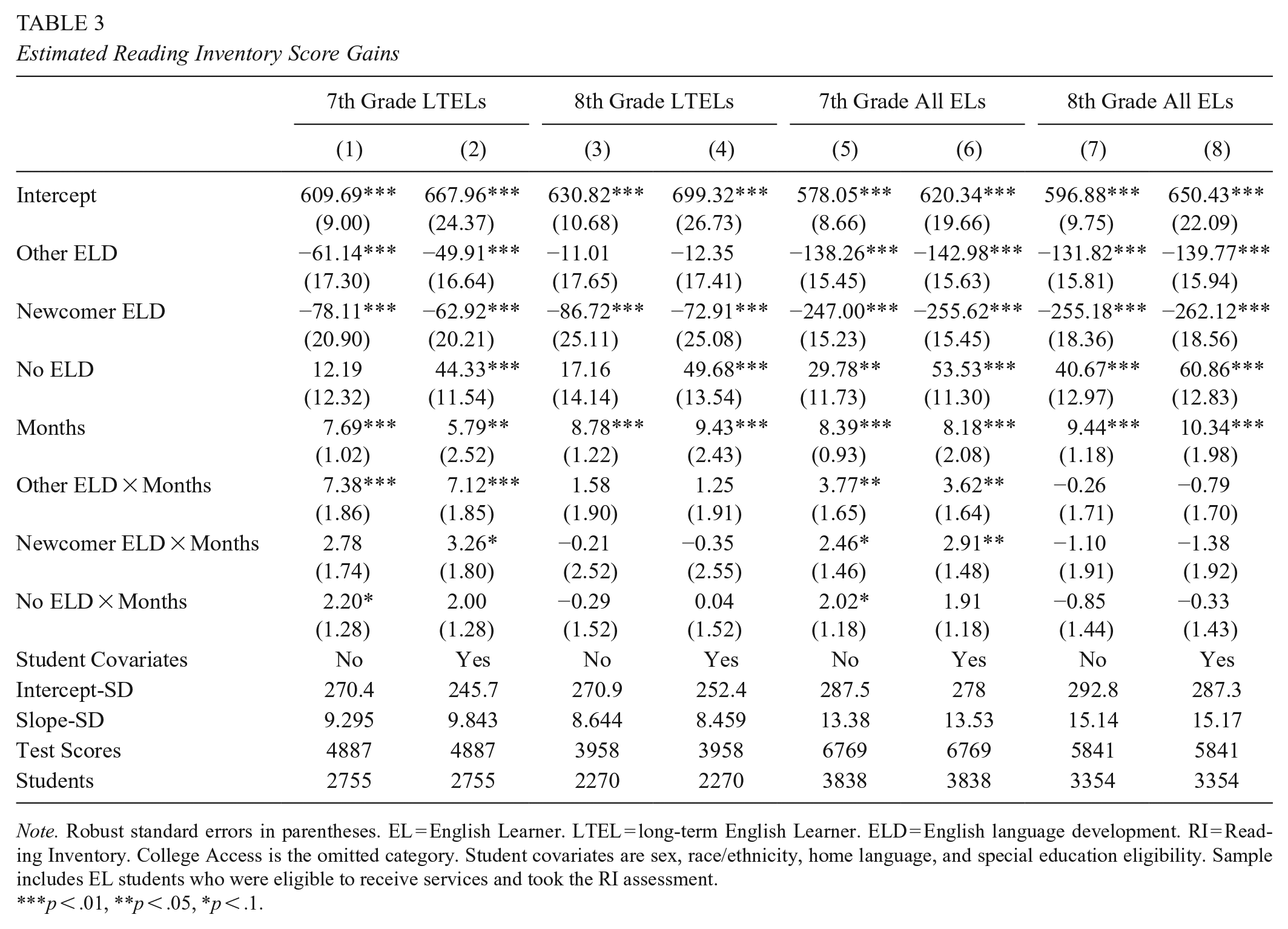
Note. Robust standard errors in parentheses. EL = English Learner. LTEL = long-term English Learner. ELD = English language development. RI = Reading Inventory. College Access is the omitted category. Student covariates are sex, race/ethnicity, home language, and special education eligibility. Sample includes EL students who were eligible to receive services and took the RI assessment.
p < .01, **p < .05, *p < .1.
Discussion
Our descriptive results imply that LTEL students enrolled in the College Access program tend to score higher on measures of English language development (e.g., CELDT/ELPAC) than students in the other course offerings: newcomer ELD, other ELD, or no designated ELD. However, these same gains are not observed with regard to reading—although students enrolled in College Access demonstrate higher ELA test scores compared to those enrolled in newcomer ELD, they generally do not perform better than students enrolled in other ELD or no designated ELD. Additionally, within-year reading growth for students enrolled in College Access is slower or comparable to students in the other course groups. In sum, our correlational analysis may suggest that the College Access program is moving the needle on English language development for LTELs, but not necessarily on reading compared to the other program offerings in the district. These findings are important given that LTELs in California must meet both English language development and basic skills criteria to reclassify and exit the EL category. Below, we explore some possible explanations for these results in greater detail.
English Language Development
College Access incorporates support for biliteracy, with an underlying assumption that development of literacy in the primary language can transfer to students’ second language (Umansky & Reardon, 2014). However, existing research remains unclear on how supports for biliteracy affect the academic literacy skills of LTELs, such as reading (Brooks, 2016). Based on our descriptive results, we cautiously hypothesize that program supports for biliteracy may translate to improvements in English language development more so than improvements in reading, at least as captured by the existing standardized measures used in this study. Since biliteracy was only one component of the College Access program and we were not able to observe the implementation of this component, further research could examine more targeted biliteracy interventions and their relationship to English language development versus reading growth for adolescent LTELs, especially treatments that only provide limited opportunities for biliteracy (e.g., programs like College Access that do not include multiple years of dual language instruction and are only able to provide a light touch of biliteracy support).
Another unique feature of the College Access program that could have influenced improvements in English language development is its emphasis on college aspirations, leadership, and self-empowerment. Research suggests that LTELs are affected by the stigma of the designation (Estrada & Wang, 2018; Thompson, 2015). In selecting ELD course offerings, district leaders were attuned to the social-emotional obstacles associated with the LTEL experience (e.g., the stigma of being enrolled in courses with newcomer EL students despite being orally proficient in English) and aimed to provide a more targeted experience to address the social-emotional learning obstacles commonly faced by LTELs in their learning contexts. Existing work suggests that exiting the EL status via reclassification improves academic self-efficacy (Lee & Soland, 2023), but the reverse has not been studied in equal measure (i.e., is academic self-efficacy related to improvements in English language development?). Some research has instead looked at the relationship between EL students’ self-efficacy and academic performance in math and reading (Soland & Sandilos, 2020), but not English language development. Currently, few programs exist to support the English language development of adolescent LTELs in a way that is developmentally appropriate and motivating; instead, as the district leaders noted, most ELD interventions are targeted towards younger students in elementary grades or adolescent, immigrant newcomers. College Access’ focus on creating a welcoming but academically rigorous environment for LTEL students to develop English language stands in sharp contrast to ethnographic and interview data reported from students receiving regular ELD services, which typically do not promote college aspirations, leadership, or self-empowerment (Buenrostro & Maxwell-Jolly, 2021; Kibler et al., 2018; Kim & Garcia, 2014). Although we were not able to capture any measures of student growth on academic self-efficacy or college aspirations across the various course settings to disentangle these effects or the mechanisms via which they may operate, our descriptive findings point to the fruitfulness of continuing to examine the relationship between social-emotional components and English language development among LTELs more closely.
Reading
Our analysis suggests that LTELs enrolled in College Access score higher on measures of reading (e.g., SBAC/RI) compared to students enrolled in newcomer ELD, but not because of higher rates of within-year reading growth. In other words, although LTELs in our sample had higher baseline reading scores (perhaps by virtue of being in the country longer than newcomer ELs), their within-year reading growth rate was not higher. It is not surprising that students with lower English language proficiency scores grew faster, since other work has shown a similar trend (e.g., Cook et al., 2008; Dadey & Briggs, 2012; Umansky et al., 2022). One explanation for our results is that LTELs in the intervention were better able to understand the SBAC/RI assessments because they had improved English proficiency. Since SBAC/RI are administered in English, it stands to reason that students with higher English language proficiency scores (such as those enrolled in College Access) would perform better than students with lower English language proficiency scores. Although the SBAC allows for designated supports, such as glossaries and translations for ELs, it is unclear what type of supports are available for ELs on the RI; therefore, these findings might simply underscore the fact that English proficiency is a barrier for ELs on standardized measures of achievement—lower English language proficiency would therefore be associated with lower SBAC/RI scores.
Meanwhile, LTELs in College Access did not perform better than those in no designated ELD. This may be due to differences in the instructional foci of College Access versus mainstream ELA classrooms. As an intervention designated for LTELs, the College Access curriculum targeted all four domains of English proficiency: listening, speaking, reading, and writing. In contrast, traditional ELA classrooms are more likely to focus instructional time on reading and writing. Thus, students in the no designated ELD group may have had more exposure and practice with English literacy than College Access students. It is also important to note that students’ families had the choice to opt out of designated ELD services, so perhaps there are some unobservable characteristics of students who opted out that we were not able to capture in our analysis. For example, students in “No (designated) ELD” had higher starting scores than College Access students. There was also a much higher proportion of students who were also eligible for Special Education services in the “No (designated) ELD” group. It is possible that placing EL-Special Education dually-identified students in less linguistically segregated environments benefits their reading development but not their English language proficiency. Although we controlled for differences such as prior same-test scores and Special Education eligibility, there may be other characteristics that we were not capturing, such as level of motivation, persistence, academic self-concept, and classroom composition (Kieffer & Weaver, 2023), and so forth, which may also help to explain these observed patterns. Additionally, emerging research on adolescent bilingual students points to the important connection between executive functions (e.g., higher order cognitive abilities, such as “inhibitory control, attention shifting, and working memory” p. 3) and reading comprehension (Kieffer et al., 2021)—elements that affect reading growth which we were not able to evaluate in this study.
Even though some researchers have begun examining reading comprehension among adolescent linguistically diverse and/or bilingual learners (Kieffer & Weaver, 2023; Logan & Kieffer, 2021), the field is still developing a deeper understanding of LTEL students’ reading difficulties and strengths (Brooks, 2016). Debates around the science of reading have identified core tenets of best practices from the National Reading Panel (e.g., explicit instruction in fluency, phonics, phonemic awareness, text comprehension, and vocabulary; National Institute of Child Health and Human Development, 2000), but policymakers have noted that additional research is needed to clarify how the needs of LTELs may differ from those of newcomer ELs or English-only students (Council of the Great City Schools [CGCS], 2023), especially given the policy context with regard to reclassification in states like California. Our findings highlight the difficulty in teasing out associated strategies. A key limitation of our study design is that we were not able to observe classroom settings to better understand the variability across classes and schools and fidelity of implementation to the College Access program model. Nevertheless, our findings provide valuable insights about improving English language development and reading outcomes for a population of students that is not widely studied: Results on English language development point to further inquiry into leveraging biliteracy and social-emotional elements, whereas results on reading suggest closer attention to assessments as well as to the alignment between course content, standardized measures, and unexamined factors in this study (such as executive functions, word knowledge; Kieffer et al., 2023; Logan & Kieffer, 2021).
Conclusion
The College Access program aims to address the challenges that LTELs face during key transition years in which they have limited time to acquire English language proficiency while preparing for high school and beyond. This study contributes to the research base on multilingual students in important ways. First, to our best knowledge, there is no existing research, causal or descriptive, on the effects of a targeted intervention on LTEL students’ academic outcomes. This study provides the first evidence for the relationship between the program and students’ test scores. Second, there is very limited research on any EL students’ reading growth during middle school, much less LTEL students’. Although reading achievement growth during these grades has been studied for general education students (e.g., Kuhfeld et al., 2021), ELs and especially LTELs have largely been overlooked. Supported by within-year growth data, our study offers critical, novel evidence of a targeted program for LTELs. We found that College Access was associated with higher English language proficiency test scores, but the findings for English reading achievement and growth were mixed.
Conducted in a research-practice partnership, this project is leveraged to immediately inform both education policy and district practice. Multiple departments in the district are using the results from this study to guide programmatic decisions related to EL services and college and career readiness. Additional research can be conducted on programs similar to College Access to gain a deeper understanding of which program components are associated with improvements in a variety of LTEL student outcomes. For example, qualitative studies could be conducted to understand the implementation of similar programs via classroom experiences with biliteracy, academic language instruction, and the cultivation of self-efficacy. Analyses that focus on specific student groups, including LTEL students with interrupted formal schooling and students who are also eligible for Special Education services, would provide additional critical evidence. Furthermore, given the association with improvements in English language development, more analysis could be conducted on the effects of the program on other longer-term and college-related outcomes, such as time of reclassification and 9th grade course placements. When more cohorts of data become available, policies and programming could be informed by analyses of high school course-taking and credit completion, access to and results on PSAT, SAT, and AP exams, and, ultimately, high school completion and college enrollment.
Supplemental Material
sj-docx-1-ero-10.1177_23328584251362747 – Supplemental material for Targeted Intervention for Long-Term English Learners’ English Language Development and Reading Outcomes
Supplemental material, sj-docx-1-ero-10.1177_23328584251362747 for Targeted Intervention for Long-Term English Learners’ English Language Development and Reading Outcomes by Angela Johnson and Diana Mercado-Garcia in AERA Open
Footnotes
Acknowledgements
We are grateful for the partnership and support from the anonymous school district.
Declaration of Conflicting Interests
The authors declared no potential conflicts of interest with respect to the research, authorship, and/or publication of this article.
Funding
The authors received no financial support for the research, authorship, and/or publication of this article.

Notes
Authors
ANGELA JOHNSON is an instructor at Oregon State University. Address: 1500 SW Jefferson Way, Corvallis, OR 97331. Email:
DIANA MERCADO-GARCIA is the Associate Director of Research Practice Partnerships at California Education Partners. Address: 1 Lombard Street Suite 305, San Francisco, CA 94111. Email:
References
Supplementary Material
Please find the following supplemental material available below.
For Open Access articles published under a Creative Commons License, all supplemental material carries the same license as the article it is associated with.
For non-Open Access articles published, all supplemental material carries a non-exclusive license, and permission requests for re-use of supplemental material or any part of supplemental material shall be sent directly to the copyright owner as specified in the copyright notice associated with the article.
