




Abstract
Schools where principals and teachers collaborate to develop a culture of distributed leadership provide the best environments for teaching and learning. However, the alignment between principals’ and teachers’ perceptions of distributed leadership and association with teacher outcomes requires further investigation. Using TALIS 2018 data, this study explored how the (mis)match of principal and teacher perceptions of distributed leadership may be associated with levels of teacher work satisfaction and teacher autonomy. Hierarchical linear modeling and polynomial regression with response surface analysis were employed for data analysis. Findings indicate that principals and teachers had different views on distributed leadership, and these differences were associated with levels of teacher autonomy. When principals overestimated distributed leadership compared to teachers, teacher autonomy declined. Moreover, teachers’ perceptions of distributed leadership were the strongest predictors of work satisfaction. These findings highlight the importance of understanding perceptual gaps between principals and teachers to develop leadership strategies.
Keywords
Introduction
The changing context of society, technology, and student demographics poses significant challenges for today’s teachers in accommodating individual student needs. Additionally, the external reform agenda increases teacher accountability for advancing student learning. In such a demanding environment, autonomy and workplace satisfaction are crucial for teachers to develop their professional careers. Effective assistance for teachers requires school leadership to be a shared endeavor, involving contributions from both administrators and teachers (Harris & DeFlaminis, 2016). Decades of research have demonstrated that an individual, or even a small team of administrators, cannot provide the leadership capacity necessary for a school to thrive and provide the learning opportunities students deserve (Fletcher & Käufer, 2003; Lindahl, 2008; Pearce & Conger, 2003). This understanding of leadership has given rise to a focus on teacher leadership (York-Barr & Duke, 2004; Wenner & Campbell, 2017). Teacher leaders are those teachers who support other teachers and engage in meaningful leadership within and beyond their own classrooms (Wiens, Metcalf, & Skousen, 2024). The need for teacher leaders was born out of the research and theory around distributed leadership (DL), which is relational (Fletcher & Käufer, 2003) and can be seen as an organizational quality rather than an individual attribute (Ogawa and Bossert, 1995). DL encompasses a collective performance of leadership that arises when teachers work together with colleagues and participate actively in school-wide processes (Harris, 2008; Spillane, 2006).
The perspective of person-environment fit implies a reciprocal influence between individuals and their environments, suggesting that “people are both producers and products of social systems” (Bandura, 1997, p. 6; Frese et al., 2007). Aligned with this understanding, it can be assumed that when teachers perceive leadership practice as co-constructed, they may experience a stronger sense of autonomy, which in turn promotes job satisfaction. Although studies on the specific qualities of leadership related to teacher autonomy and job satisfaction are limited, existing research has provided empirical support. An increasing amount of research suggests that shared and collaborative leadership approaches can convey trust and respect for teachers, leading to greater empowerment and commitment (Bogler & Nir, 2012; Lee & Nie, 2014; Sebastian et al., 2016). Additionally, various studies consistently demonstrate an association between distributed leadership and both teacher autonomy (Lin, 2022; S. Liu, Keeley, et al., 2021) and job satisfaction (Hulpia et al., 2009; Y. Liu, Bellibaş, et al., 2021; S. Liu, Keeley, et al., 2021; Torres, 2019). However, most of these studies rely on teachers’ perceptions of distributed leadership, which assumes that leadership is a function of followers’ perceptual expectations. In the rare studies subsuming principals’ perceptions, principals report higher levels of DL than teachers (Shen et al., 2025; Torres, 2019; Wiens, Beck, et al., 2024). The discrepancy between principals’ and teachers’ perceptions of other leadership styles within the same school is also identified (Goff et al., 2014; E. Goldring, Craven, et al., 2015; Park & Ham, 2016; Urick & Bowers, 2014). Further exploration is needed to understand the potential associations between these perceptual discrepancies and teacher satisfaction and autonomy.
The utilization of multisource feedback for analysis has a history in organizational studies, with applications spanning various sectors such as the navy and business. Research in these domains has demonstrated that individuals categorized as in-agreement/good raters and under-estimators (those who rate themselves less favorably than how others rate them) often display a positive correlation with leader effectiveness (Atwater & Yammarino, 1992; Fleenor et al., 1996). Interest in multisource feedback has subsequently expanded to the field of education, particularly in the 2010s, with a growing exploration of the alignment between principals’ and teachers’ perceptions of leadership practices. Some studies have delved into the discrepancies between how teachers and leaders perceive instructional leadership (E. Goldring, Cravens, et al., 2015), while others have unveiled the motivation to change practices stemming from misalignment between leader and teacher perceptions (E. B. Goldring, Mavrogordato, et al., 2015). Furthermore, certain studies have scrutinized the alignment or misalignment between teacher and leader perceptions of instructional leadership to elucidate the various qualitative dimensions of leadership contexts in schools (Goff et al., 2014; Urick & Bowers, 2014). Nevertheless, there has been limited research specifically investigating the effect of perception congruence on teacher outcomes. One exception is the study conducted by Park and Ham (2016), which indicates that discord between principals and teachers regarding principal leadership practices has an adverse effect on teacher collaboration.
Contrasting self-assessments with feedback from others can disrupt behavioral patterns and inspire reflection on behavior and its consequences for others. Moreover, analyzing perceptual discrepancies between a leader and their subordinates concerning leadership practices prompts exploration into methods to more effectively capture analytical dimensions of leadership (Kim & Yukl, 1995). It is crucial to gather more empirical evidence on the agreement between raters. We posit that effective leaders possess the self-awareness to understand how they are perceived by others, leading to more accurate self-assessments. The alignment of principals’ perceptions with those of teachers is expected to yield more favorable teacher outcomes since teacher perceptions better predict teacher outcomes than principal perceptions (Torres, 2019).
Given the limited systematic examination of the associations of congruent or incongruent perceptions between principals and teachers regarding DL in school settings, our research seeks to explore how this perception alignment (or lack thereof) relates to teacher job satisfaction and perceptions of autonomy. At the same time, we also investigate the effects of teachers’ and principals’ perceptions separately. Specifically, the research questions we seek to pursue are as follows:
To what degree are principals’ and teachers’ perceptions of distributed leadership aligned?
How much are principals’ and teachers’ perceptions of distributed leadership associated with teachers’ work satisfaction and teacher autonomy?
To what extent are matching perceptions of distributed leadership associated with teachers’ work satisfaction and teacher autonomy?
For teachers with mismatched perceptions of distributed leadership from their principals, how is the direction of mismatch associated with work satisfaction and teacher autonomy?
Literature Review and Theoretical Framework
Distributed Leadership
Distributed leadership is a central tenet of teacher leadership (Blasé & Blasé, 2001; Fitzgerald & Gunter, 2008). This model of leadership moves away from mythic notions of an individual, heroic leader (Fletcher & Käufer, 2003; Lindahl, 2008; Pearce & Conger, 2003; Spillane, 2005) and instead posits that school reform can best be achieved when administrators and teachers lead collaboratively (Lindahl, 2008; Lovely, 2005). However, DL is a concept that lacks a consensus definition. Some endorse the “leaders plus” perspective, which entails multiple leaders sharing responsibility in schools. Others differentiate themselves from other theoretical approaches to educational leadership studies by emphasizing leadership as a practice (Gronn, 2002; Spillane, 2005). From this standpoint, leadership involves action, not a role or task, and is interactive (Harris & DeFlaminis, 2016), including both “peer” and “hierarchical influence” (Pearce & Conger, 2003, p. 1).
DL also involves temporality because the leader within a given group shifts depending on an individual’s influence and knowledge, as well as on the needs of the group at any given time (Pearce & Conger, 2003). It can be characterized by schools where teachers and staff are frequently included in important school decisions (Spillane, 2004). Additionally, schools have a culture where all stakeholders have a shared responsibility for school issues (Harris, 2003). Finally, professional collaboration and mutual support among teachers and administrators are a crucial component of DL (Harris, 2009). These components are measured in the OECD’s Teaching and Learning International Survey (TALIS) (Ainley & Carstens, 2018).
Harris and DeFlaminis (2016) warn that this leadership model is not a cure-all and much depends on how leadership is “shared, received and enacted” (p. 143). Others note there are numerous barriers to implementing DL (Lovely, 2005; Printy & Marks, 2006; Thornton, 2010). Principals should be neither too authoritarian nor too hands-off; instead, they need to actively support teacher leaders and help everyone understand how they help meet the school’s shared goals (Johnson & Donaldson, 2007). How principals, who are typically hemmed in by hierarchical roles and school structures, attempt to share leadership when working with teacher leaders both sets the tone for whether distributed leadership will thrive in a school and determines how successful teacher leaders will be. The role of the principal is important in nurturing DL in their school (Harris, 2003, 2005). Although this study does not focus on investigating principal practices of DL (Bektaş et al., 2022; Pan & Chen, 2024), it considers principal perceptions of DL alongside teacher perceptions and examines how the alignment of these perceptions is associated with important teacher outcomes.
Distributed leadership within school communities has many benefits for principals, teachers, and students. Innovation and positive school change are more likely to occur in schools with institutionalized distributed leadership and teacher leadership structures and even occur more readily in schools where teacher leadership is informal but present (Printy & Marks, 2006). Meanwhile, both teachers and students learn more in environments that prioritize distributed leadership (Thornton, 2010). Teachers value their autonomy, and principals who distribute their leadership have been shown to increase teachers’ sense of autonomy and increase their job satisfaction (Strong & Yoshida, 2014). Communication is an important factor in involving teachers in decision-making (Harris & DeFlaminis, 2016), but how this communication occurs in the context of teachers’ instruction is a key question to examine in relation to teacher satisfaction and autonomy.
The association between distributed leadership and both teacher autonomy and satisfaction has been well-established in the literature (Hulpia et al., 2009; Y. Liu, Bellibaş, et al., 2021; S. Liu, Keeley, et al., 2021; Torres, 2019). Researchers have relied on teachers’ perceptions for the investigation. However, there is evidence that principals and teachers have different perceptions of the levels of distributed leadership in their schools (Shen et al., 2025; Torres, 2019; Wiens, Beck, et al., 2024). This study adds to the literature by examining whether principals and teachers have similar perceptions of distributed leadership in their schools and whether these differences are associated with the important teacher variables of satisfaction and autonomy.
Teacher Work Satisfaction
Teacher work satisfaction refers to an individual’s “sense of fulfillment and gratification” (Ainley & Carstens, 2018, p. 43) that they experience from their professional work. Teacher satisfaction can be analyzed through either a facet-specific approach or more holistically (Moe et al., 2010). However, understanding specific facets of a teacher’s work is complicated by the fact that individuals value different facets; therefore, we follow Skaalvik and Skaalvik’s (2011) lead in using a holistic approach to understanding satisfaction. Teacher satisfaction is primarily influenced by intrinsic rewards of teaching, outside-of-school factors, and school-based factors (Dinham & Scott, 1998; Skaalvik & Skaalvik, 2011). One school-based factor that has been linked to teacher satisfaction is principal support (Grissom, 2011; Olsen & Huang, 2019).
The importance of teacher satisfaction to schools and student learning has been made clear by the literature. Teacher satisfaction has been linked to teaching performance (Renzulli et al., 2011) as well as effort and self-efficacy in teaching (Caprara et al., 2003; Tschannen-Moran & Hoy, 2007). Satisfaction has also been linked to teacher retention (Ingersoll, 2001; Kardos & Johnson, 2007; Klassen et al., 2009). Teacher satisfaction can be improved through school factors—particularly where teachers feel a sense of professional relationships and autonomy (Stearns et al., 2015). Teacher satisfaction is also associated with situations where principals provide teachers with leadership opportunities and autonomy (Price, 2012; Stearns et al., 2015). Previous research also points to the fact that teachers tend to be more satisfied with their professional teaching work than with aspects of support such as working conditions, stress, and salary (Ainley & Carstens, 2018). In this study, we focus on teachers’ general feelings of satisfaction in their current school.
Teacher Autonomy
The study of teacher autonomy is situated in the self-determination theory, which posits that autonomy is necessary for emotional well-being and effective professional performance (Deci & Ryan, 2008). Teacher autonomy is defined as “the capacity to make informed decisions and/or act independently” (Worth & Van den Brande, 2020, p. 5). While the United States—where this study is situated—has a highly decentralized educational system, teachers have little input on important decisions and limited autonomy within individual schools (Ingersoll & Collins, 2019). However, increased teacher autonomy is associated with reduced teacher stress (Pearson & Moomaw, 2005) and increased teacher innovation (Nguyen et al., 2021).
Teachers have autonomy to the extent that they “(a) make autonomous decisions, (b) base the decisions on deliberations about purpose and value, (c) act in light of their decisions, and (d) bring about changes in their practice” (Molla & Nolan, 2020, p. 72). While teacher autonomy within classrooms is important, when considering teacher autonomy from a teacher leadership lens, teachers’ decisions and actions should be geared toward school improvement and decision-making. Teacher autonomy is highly affected by context, including school leadership, teacher relationships, school organization, and school culture (Jenkins, 2020; Min et al., 2022). It is something that is constructed over time as the result of positive experiences and trust that teachers have related to autonomy (Paradis et al., 2019). Teachers’ autonomy is continually constructed through dynamic interactions with their professional community while being a useful buffer against professional stress (Pyhältö et al., 2015). As such, positive teacher autonomy is associated with higher rates of retention (Bieler et al., 2017; Yost, 2006).
Teacher autonomy, thus defined, can be considered as part of teacher professionalism. Teachers desire their leaders to respect their professional knowledge and allow them the ability to make professional choices (Deci & Ryan, 2008). This idea has also been considered closely related to effective distributed leadership (Timperley, 2005). Teacher autonomy has also been linked to teacher satisfaction (Pearson & Moomaw, 2005; Worth & Van den Brande, 2020). Collectively distributed leadership, teacher satisfaction, and teacher autonomy have all been linked both theoretically and empirically. However, as DL is a shared endeavor between principals and teachers, more needs to be understood about how different perceptions of this concept may be associated with teacher autonomy and satisfaction.
Principal’s Role in Distributed Leadership and the Congruence of Principal-Teacher Perception
The building-level principal plays a very important role in developing a climate of distributed leadership, and by extension, supporting teacher leadership (Wenner & Campbell, 2017; York-Barr & Duke, 2004). Smylie and Eckert (2018) point out that teachers can become leaders in three ways: being appointed by a principal, teacher self-initiative (at times in spite of principal leadership), or systematic development of teachers. The literature has largely focused on encouraging principals to share leadership by involving teachers in decision-making and building teacher capacity (Bryk et al., 2010; Leithwood & Louis, 2012; Spillane, 2006). In addition to benefiting students and teachers, principals who foster distributed leadership in their schools receive personal benefits such as reduced stress and burnout (Marks & Printy, 2003).
As principals distribute leadership, they can take many forms, including advocacy for teacher leadership, providing resources, and creating supportive organizational structures (Smylie & Eckert, 2018). However, building a culture of distributed leadership may be challenging for principals. In some situations, principals may even find resistance to distributed leadership. Boardman (2001) found in a study in Tasmania that principals were more committed to distributed leadership than teachers who were skeptical. Distributed leadership must be supported by effective communication where teachers trust that their views will be honored by administrators (Rice, 2006). Specifically, teacher leaders value principals who seek out their opinions and listen to their problems (Beachum & Dentith, 2004; Gigante & Firestone, 2008; Gordin, 2010). Principals can also provide support by providing organizational support such as (re)arranging teaching schedules, providing time and space for collaboration (Chesson, 2011; Chew & Andrews, 2010), and creating cultural norms supportive of teacher leadership (Beachum & Dentith, 2004). Finally, research supports the need for principals to establish a shared vision with teachers (Chamberland, 2009; Muijs & Harris, 2006; Podjasek, 2009).
While the need for distributed leadership is clear, it can only be found inconsistently in schools (Hallinger & Heck, 2010). Meanwhile, there is some evidence that principals and teachers may have different perceptions of the presence of distributed leadership in their schools (Shen et al., 2025; Torres, 2019; Wiens, Beck, et al., 2024). This variance in perception may be attributed to the fact that individuals within an organization often possess distinct implicit theories of leadership and process information differently (Barnett & McCormick, 2004; Nielsen & Daniels, 2012). Bass and Yammarino (1991) noted that individuals tend to rate their own leadership behavior more positively compared to how subordinates rate them, but successful leaders are less likely to exhibit this tendency. In school settings, it has been observed that principals rate their own performance higher than teachers rate them (E. Goldring, Craven et al., 2015). Some argue that subordinates provide more accurate descriptions of leader behavior than leaders themselves (Kim & Yukl, 1995).
Studies on self-other rating agreement typically categorize individuals into three groups: over-estimators (those who rate themselves higher than others), in-agreement raters (those who rate themselves similarly to others), and under-estimators (those who rate themselves lower than others) (e.g., Atwater & Yammarino, 1992, 1997; Fleenor et al., 1996). The findings indicate that in-agreement/good raters and under-estimators generally achieve positive organizational or individual outcomes, such as leader effectiveness and job satisfaction, whereas over-estimators and in-agreement/poor raters tend to experience negative outcomes (Fleenor et al., 1996; Park & Ham, 2016). In research on disparities between principal and teacher perceptions, the focus often revolves around instructional leadership, identifying factors predicting perceptual gaps, exploring the motivation for change arising from perceptual incongruities (E. B. Goldring, Mavrogordato, et al., 2015), or outlining conducive school contexts for aligning perceptions. However, the majority of the literature has not investigated the association of these perceptual mismatches with teacher outcomes. A rare exception is the study by Park and Ham (2016), which found that disparities between principal and teacher ratings of principal instructional leadership tended to diminish teacher collaborative practices.
The person-environment fit theory contends that individuals must continuously make conscious efforts to maintain an acceptable fit over time. This ongoing, dynamic adjustment process enables individuals and organizations to achieve and maintain better correspondence with one another (De Cooman & Vleugels, 2022). Hence, we hypothesize that teacher perceptions of DL are associated with their perceptions of autonomy, which in turn enhances work satisfaction. As leadership is inherently a perceptual process involving various organizational members (Northouse, 2004), using multisource data offers insights into the efficacy of leadership residing within shared experiences rather than relying solely on one source (Bowers et al., 2017; E. Goldring, Craven, et al., 2015). This study incorporates both teacher and principal perceptions of DL. We contribute to the existing literature by further investigating whether principals and teachers share congruent perceptions of distributed leadership within their schools and whether these shared or differing perceptions might be linked to teacher outcomes. Examining the discord between these perceptions implies the effectiveness of principal leadership, a crucial aspect deserving attention, as it holds greater significance than solely exploring teacher or principal perceptions. Moreover, it is of paramount importance for shaping leadership development strategies. Self-other ratings can potentially result in individuals misconstruing their managerial strengths and weaknesses, which can, in turn, have a detrimental effect on their effectiveness as leaders. Hence, it is essential to meticulously examine and address any discrepancies in ratings to bolster overall leadership performance.
Methods
Participants and Procedures
Data for this study were derived from the 2018 Teaching and Learning International Survey (TALIS), which was a large-scale data collection of educators from the Organisation for Economic Co-operation and Development (OECD) countries. Our study focuses on middle school teachers and principals from the United States who responded to the TALIS questionnaires. They included 2,560 teachers and 165 principals from 165 schools, with a range of 2 to 20 teachers per school. Sixty-seven percent of teachers were female, 33% were male, and less than 1% did not provide a response. Thirty-seven percent of principals were female, 61% were male, and 2% did not provide a response. Less than 1% of teachers received less than a vocational (ISCED 2011 Level 5) degree, 38% received a vocational degree, 60% received a bachelor’s degree, and 2% received higher than a bachelor’s degree. One percent of principals received a vocational degree, 84% received a bachelor’s degree, and 14% received higher than a bachelor’s degree. Teachers responded to the TALIS teacher questionnaire (Organisation for Economic Co-operation and Development [OECD], 2018a), including items for perception of DL, work satisfaction, and teacher autonomy. Principals responded to the principal questionnaire (OECD, 2018b), which included matched items for perception of DL as teachers.
Measures
The instruments utilized in this study were sourced from TALIS 2018 and encompassed distributed leadership, teacher work satisfaction, and teacher autonomy. These instruments were all designed with a Likert scale (1 = strongly disagree to 4 = strongly agree).
Perception of Distributed Leadership
Both teachers and principals responded to matching three items related to DL from the school climate subsection. Since this study focused on the linkage of DL and teacher perceptions of autonomy and work satisfaction, the other two items regarding parents’ and students’ roles in school decisions were excluded. Items in the teacher and principal questionnaires include:
This school provides staff with opportunities to actively participate in school decisions.
This school has a culture of shared responsibility for school issues.
There is a collaborative school culture that is characterized by mutual support.
The teachers’ scale has a Cronbach’s alpha of .87 and the principals’ scale .71.
Teacher Work Satisfaction
Work satisfaction was measured with TALIS scaled scores for Job Satisfaction with Work Environment (T3JSENV), which were derived from four items (TT3GT53C, E, G, J). The Cronbach’s alpha is .88 for these items. The four items used are as follows:
I would like to change to another school if that were possible.
I enjoy working at this school.
I would recommend this school as a good place to work.
All in all, I am satisfied with my job.
Teacher Autonomy
Teacher autonomy was measured with TALIS scaled scores for Satisfaction with Target Class Autonomy (T3SATAT), which were derived from five items. Teachers answered the stem question: How strongly do you agree or disagree that you have control over the following areas of your planning and teaching in this target class? The five items used in our analysis included (TT3GT40A-E): determining course content, selecting teaching methods, assessing students’ learning, disciplining students, and determining the amount of homework to be assigned. The Cronbach’s alpha is .97.
Teacher and School Demographics
Demographic data used were also collected from TALIS. Teacher demographic data included gender (0 = female, 1 = male) and teaching experience (in years). School demographic data included the percentage of students from socio-economically disadvantaged homes (0 = none to 4 = more than 60%), percentage of language minority students (0 = none to 4 = more than 60%), school size (0 = under 250 students to 4 = 1,000 or above), and school type (0 = private, 1 = public).
Data Analysis
To answer the first research question, we followed the procedure from Fleenor et al. (1996) and Shanock et al. (2010) in which we standardized DL scores for teachers and principals. Following Shanock et al. (2010), teachers who had DL scores more than half a standard deviation above or below the principal’s score were considered as having discrepant scores.
For the second research question, hierarchical linear modeling (HLM) with random effects was used to account for the expected correlation of residuals and heteroskedasticity due to teachers being nested in schools. Teachers’ and principals’ perceptions of distributed leadership were specified as focal predictors of teacher satisfaction and autonomy, with teacher- and school-demographic variables specified as covariates. Standardized scores were used for teachers’ and principals’ perceptions of distributed leadership as well as teachers’ work satisfaction and autonomy; thus, the size of reported effects can be estimated (Fritz et al., 2012). During preliminary analyses, both random intercepts models with intercepts allowed to vary randomly between schools and random coefficients models with both intercept and slope parameters allowed to vary were examined. Likelihood ratio test (LRT) results showed that the random intercepts and random coefficients models yielded significantly different log likelihood estimates for both outcomes, which supported the use of a more complex random coefficient model (for work satisfaction model:
To answer the third and fourth research questions, we conducted polynomial regression with response surface analysis. Polynomial regression is an appropriate analytic strategy because our research questions center on the idea of congruence, or the match between teachers’ versus principals’ perceptions of DL and how it is associated with teacher-level outcomes. Polynomial regression is an innovative approach to examine congruence, outperforming the often-used method involving difference scores. Regressions with difference scores (e.g., X minus Y) as a predictor of an outcome (e.g., Z) suffer from disadvantages, the primary of which being the assumption that the relationship between X and Z is equal in magnitude but opposite in sign compared to between Y and Z (Z = b0 + b1(X – Y) = b0 + b1X – b1Y; Edwards & Parry, 1993). In contrast, polynomial regression allows for direct testing of congruence without such assumptions. Edwards and Parry (1993), as well as Shanock et al. (2010), have pioneered a systematic way of making sense of polynomial regression results as applied to testing of congruence, utilizing response surface analysis (RSA).
According to best practices, our regression model takes the form of:

where TDL represents teachers’ perceptions of distributed leadership, and PDL represents principals’ perceptions (Edwards and Parry, 1993; Shanock et al., 2010). Both TDL and PDL were mean-centered to reduce multicollinearity and enhance interpretations (Aiken & West, 1991; Shanock et al., 2010 ). This equation corresponds to a three-dimensional surface, where TDL and PDL combinations are independent variables predicting the outcome. Rather than inspecting the coefficients individually, we conducted RSA by examining the following parameters:
a. Slope along line of congruence:
b. Curvature of line of congruence:
c. Slope along line of incongruence:
d. Curvature of line of incongruence:
These parameters allow us to answer crucial questions related to how congruence between teachers’ and principals’ DL is related to the outcome. Specifically, the slope and curvature of the line of congruence (i.e., when TDL = PDL) can help us understand how agreement between teachers and principals in terms of DL is related to teacher-level outcomes, answering the second research question. Additionally, the slope curvature of the line of incongruence (i.e., when TDL = –PDL) can help us understand how the degree and direction of discrepancies between teachers’ and principals’ DL are related to the outcome, answering the third research question.
Moreover, polynomial regression and the associated response surface analysis can be extended to multilevel data structures (Nestler et al., 2019). Polynomial regression was conducted within the hierarchical linear modeling (HLM) framework, with random effects specified for teachers nested within schools. Again, random coefficients models were specified, in which the intercept and slope parameters were allowed to vary randomly between schools. We fitted models with teacher work satisfaction and autonomy in turn, with teacher- and school-level demographics specified as covariates.
Results
Descriptive analysis showed that teachers had lower average perceptions of DL than principals. Specifically, the average teacher DL score was 2.83, whereas the average principal score was 3.23 on a scale of 1 to 4. Teacher scores also exhibited a larger range, with the minimum score of 1 indicating that some teachers responded “strongly disagree” to distributed leadership items. Teacher and principal DL perceptions were significantly and positively correlated, although the correlation strength is weak (Table 1; r = .12, p < .001). Teacher DL was also positively correlated with their work satisfaction and teacher autonomy at r = .52 and r = .19, respectively (p < .001). Intraclass correlation analysis showed that 17% of the variance in teacher DL was at the school level, whereas 15% and 5% of the variance in work satisfaction and teacher autonomy were at the school level, respectively. Teachers also exhibited a large range of work satisfaction and teacher autonomy, ranging from around 3 to 15. This means that some teachers responded with strongly disagreed on most items related to work satisfaction and teacher autonomy, whereas other teachers responded with strongly agree on most items.
Descriptive Statistics and Pearson’s Correlations

p < .001.
For research question 1, we found that only 18.9% of teachers had DL perceptions that were in agreement with their principal (Table 2). That is, their standardized scores were within half a standard deviation above and below the principals’ standardized scores. The majority of teachers (50.4%) had standardized scores that were higher than those of their principals, and about a third of teachers (30.7%) had lower standardized scores. These results show that although teachers’ raw average DL was lower than principals’, about half of the teachers had higher standardized DL scores than principals when data is examined at the individual teacher level. These teachers had higher DL scores compared to their peers, whereas their principals may have lower DL scores compared to other principals. This finding could be related to the lower dispersion (i.e., lower standard deviation) on this variable for principals compared to teachers. Taken together, the data suggest that teachers and principals may evaluate distributed leadership in different manners; principals tended to have higher and more similar DL perceptions amongst themselves, and teachers tended to have lower and more diverse DL perceptions. Moreover, more than 80% of teachers have mismatched DL agreements with their principals. That is, teachers with high DL perceptions relative to other teachers are often not in schools with a principal who also indicated high DL perceptions relative to other principals. In reverse, teachers with low DL perceptions relative to other teachers are often not in schools with a principal who similarly indicated low DL perceptions.
Frequencies of Distributed Leadership Agreement
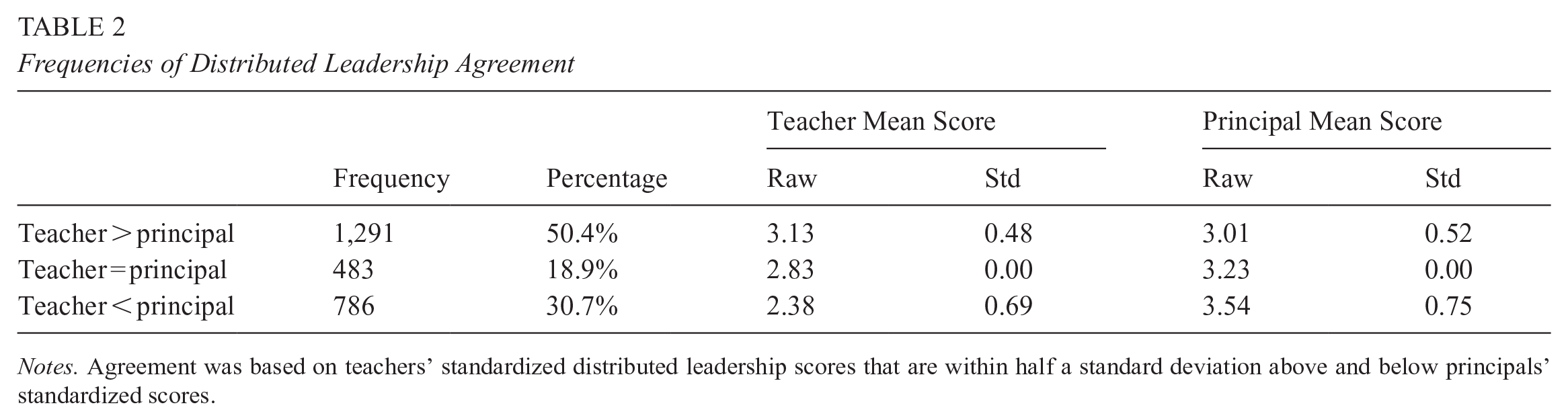
Notes. Agreement was based on teachers’ standardized distributed leadership scores that are within half a standard deviation above and below principals’ standardized scores.
For research question 2, as illustrated in Table 3, HLM results showed that teachers’ perception of distributed leadership was a strong predictor of their work satisfaction, controlling for teacher- and school-level covariates,
HLM Regressions of Work Satisfaction and Teacher Autonomy

Notes. DL = distributed leadership, SES = socioeconomic status, LM = language minority. HLM models were conducted with teacher DL, principal DL, work satisfaction, and teacher autonomy standardized. Covariates were kept in their raw metrics.
p < .05, *p < .01, ***p < .001.
For research questions 3 and 4 related to the outcome of teachers’ work satisfaction, results show that
Polynomial Regression and Surface Response Analysis

Note. Teacher’s gender, teaching experience, school SES, school language minority composition, school size, and school type (public vs. private) were included as covariates in the model.
p < .05, ***p < .001.

Response surface plot of (in)congruence in perceptions and work satisfaction
The slope along the line of incongruence
Moreover, all curvature parameters were not significant, indicating that congruence or incongruence on its own was not associated with teacher outcomes. Rather, the direction of departures between teachers’ and principals’ scores was predictive of teacher work satisfaction. Teachers with the highest levels of work satisfaction were those who had the highest self-perceived DL and lowest principal DL, since the highest point in the graph was when TDL = 3 and PDL = −3. In contrast, teachers with the lowest levels of work satisfaction were those who had the lowest self-perceived DL and highest principal DL, with the lowest point in the graph being when TDL = −3 and PDL = 3. That is, the mismatch and its association with work satisfaction depended on the direction; teachers were more satisfied when the direction of mismatch was such that they rated DL as high, and principals rated DL as low. However, it should be noted that work satisfaction seemed to be mostly dependent on teachers’ own distributed leadership perceptions. The degree of difference contributed by their mismatch with principals’ is slight. For example, among teachers with TDL = 3, those whose principal also scored high on SL (PDL = 3) were predicted to have a work satisfaction score of 16.94, whereas those whose principal scored low on DL (PDL = −3) were predicted to have a work satisfaction score of 19.19. This is a difference of only about one standard deviation in work satisfaction over the whole range of principals’ DL scores. About one standard deviation in work satisfaction also separates teachers with low TDL from those with high versus low PDL.
Related to teacher autonomy, similar results were found with positive slopes along the lines of congruence and incongruence (Table 4;
Examination of the response surface plot (Figure 2) shows that for teachers with high DL, increasing principal DL is associated with better teacher autonomy (e.g., positive slope along line TDL = 3). However, for teachers with low DL, increasing principal DL is associated with worse teacher autonomy (e.g., negative slope along line TDL = −3). Correspondingly, those with the lowest level of teacher autonomy were those with low self-perceived DL but high principal DL. In reverse, the teachers with the highest level of teacher autonomy were those with high self-perceived DL and high principal DL. The contribution of principals’ DL also appeared to matter more for teachers with low self-perceived DL. As a reference point, for teachers with TDL = 3, those with principals scoring low on PDL at −3 were predicted to score 14.60 on teacher autonomy, whereas those with high PDL = 3 were predicted to score 17.19. This difference of about one standard deviation spanning the range of principals’ scores mirrored those found for work satisfaction. In contrast, for teachers with TDL = −3, those with low PDL = −3 were predicted to score 14.72 on teacher autonomy, whereas those with high PDL = 3 were predicted to score 8.34. This difference equates to almost three standard deviations in teacher autonomy between the two mismatch extremes. These results suggest that principals’ PDL—and the mismatch with teachers’ own DL perceptions—exerts a larger influence on teacher autonomy for teachers whose self-perceived TDL were low.

Response surface plot of (in)congruence in perceptions and teacher autonomy
Discussion
The increasing complexity of schools has made it impossible for individual administrators to effectively create robust learning environments for all schools (Fletcher & Käufer, 2003; Lindahl, 2008; Pearce & Conger, 2003). The most effective schools are those where leadership is shared among many members of the organization (Harris & DeFlaminis, 2016). Teacher leadership has arisen as one way to conceptualize distributed leadership in schools (Pan et al., 2023) and has been shown to be important to teacher and student outcomes, such as teacher satisfaction (Wiens, Beck, et al., 2024) and student achievement (Wenner & Campbell, 2017). The role of the administrator, or principal, is important in creating a conducive environment for teacher leadership (York-Barr & Duke, 2004). However, how principals and teachers perceive the levels of teacher leadership within their organization may not match (Wiens, Beck, et al., 2024). Using TALIS 2018 data from the United States, this paper examined how principals’ and teachers’ perceptions of distributed leadership are associated with teachers’ work satisfaction and autonomy, as well as how the degree to which teachers’ and principals’ distributed leadership matched may also be associated with these teacher outcomes. Our HLM results showed that teachers’ distributed leadership perception was the main driver of their work satisfaction and autonomy. On the other hand, principal perception of distributed leadership had a small and negative predictive association with teacher outcomes when teachers’ own perception was controlled. The innovative analytic strategy featuring polynomial regression and response surface analysis also revealed additional complexity above and beyond the direct relationship between teachers’ vs. principals’ distributed leadership perceptions and teacher outcomes. Our study found that principals and teachers frequently have different perceptions of DL and that the mismatch in perceptions was associated with different levels of teacher work satisfaction and autonomy.
Previous research has shown teachers and principals may have different ideas about the importance of DL in schools (Boardman, 2001; Rice, 2006). While studies in the navy have revealed that self-ratings are often higher than subordinate ratings of leadership (Bass & Yammarino, 1991), there is only limited empirical evidence that principals and teachers have differing perceptions of DL within their schools (Wiens, Beck, et al., 2024). Analysis in this study supports previous research by showing a high level of disagreement in how teachers and principals evaluate DL. While weakly correlated (r = .12, p < .001), principal (M = 3.23, SD = .42) and teacher (M = 2.83, SD = .65) scores had a difference of .5 on a five-point scale. Given the importance of the principal in creating a climate of DL (Wenner & Campbell, 2017; York-Barr & Duke, 2004), it is concerning that principals may be misinterpreting the levels of DL in their schools. However, it is also plausible that teachers and principals simply have differing definitions of what DL is and how it may be practiced.
Individuals interpret situations and communicate with others through perceptual processes (Spillane et al., 2002). They rely on cognitive schemata to understand and react to leadership behavior (Epitropaki & Martin, 2005). As a result, there is a need to clarify within schools in terms of what distributed leadership is and how it could be achieved. Effective leadership hinges on good communication and relationships between leaders and members. High levels of DL are achieved through action and open communication (Fletcher & Käufer, 2003; Harris & DeFlaminis, 2016). This mismatch of perceptions of DL may indicate a lack of communication between principals and teachers. Principals need professional development in how to build DL through effective communication practices with teachers while also accurately understanding the extent to which teachers feel a sense of DL.
With the understanding that principals and teachers have systematically different perceptions of the levels of DL in their schools, we next wanted to understand if these differences were associated with changes in teacher work satisfaction and autonomy. Due to the importance of satisfaction to many key outcomes (e.g., Caprara et al., 2003; Ingersoll, 2001; Kardos & Johnson, 2007; Klassen et al., 2009; Renzulli et al., 2011; Tschannen-Moran & Hoy, 2007), we focused on DL first. Principal support is an essential contributor to teacher satisfaction (Grissom, 2011; Olsen & Huang, 2019). In this study, we also showed that the misalignment of perceptions of DL between principals and teachers is associated with differing levels of work satisfaction. Teachers who reported the highest work satisfaction were those with the highest self-perceived DL and the lowest principal DL, while those with the lowest work satisfaction were those with the lowest self-perceived DL and the highest principal DL. These findings align with prior research, which indicates that leaders who are in agreement with their subordinates or underestimate their own leadership tend to be perceived as more effective, in contrast to those who overestimate themselves (Fleenor et al., 1996; Park & Ham, 2016; Van Velsor et al., 1993). However, the misalignment found in this study only had minimal associations with teacher work satisfaction. Likewise, principal perceptions of DL had only a small association with teacher work satisfaction. The most significant predictor of teacher work satisfaction was teachers’ perceptions of DL. This finding supports similar research that has linked teacher satisfaction and aspects of DL (Pietsch et al., 2019; Price, 2012; Stearns et al., 2015). To boost satisfaction, schools might consider practices that outline what DL practices are being implemented and how these goals are met to boost teachers’ own perception of DSL.
Teacher perceptions of autonomy are important because they can predict retention (Bieler et al., 2017; Yost, 2006) and serve to reduce stress (Pyhältö et al., 2015). Teacher autonomy can be affected by many components, including school leadership, teacher relationships, school organization, and school culture (Jenkins, 2020; Min et al., 2022). However, in the United States, teachers often have limited levels of autonomy (Ingersoll & Collins, 2019). In this study, we examined how the (mis)alignment of perceptions of DL between principals and teachers may predict teachers’ feelings of autonomy. A combination of teacher and principal DL seemed to matter for teacher autonomy. Teachers perceived the highest autonomy when both teacher and principal ratings of DL were high. In reverse, it is detrimental for teachers who perceive low levels of DL to have principals with high perceptions of DL in terms of teacher autonomy. The mismatch hurts low DL teachers’ sense of autonomy the most. Principals who overestimated DL (self-rating higher than subordinates’ ratings) were found to be less effective in promoting teacher autonomy. These findings are consistent with previous studies (Park & Ham, 2016), highlighting the negative impact of discordant perceptions of DL. To enhance perceived teacher autonomy, there might need to be a calibration process to help get teachers on the same page as principals to understand the nature of the DL culture at the school.
This study is the first that we are aware of that examines the mismatch between principal and teacher perceptions of DL and its relationship to work satisfaction and autonomy. It is interesting that teachers’ work satisfaction is largely driven by their own perceptions of DL. This also showed the highest correlation of any two variables examined in this study (r = .52). However, teachers’ perceptions of autonomy were more susceptible to influence from the incongruence between teacher and principal perceptions of DL. While work satisfaction in this study was measured by fairly general concepts, autonomy focused on specific areas of teacher control. This may indicate that teachers’ feelings of control over certain areas of their professional lives are more influenced by the extent to which they agree with principals on how well teachers have professional autonomy in the school.
Conclusion and Implications
There are limitations in this study, which stemmed from measurement and methodological constraints. First, the constructs of distributed leadership, work satisfaction, and teacher autonomy were measured with self-reports. Self-report bias may be present when teachers and principals report their perceptions and behaviors (Greene, 2015). However, we utilized a large-scale, self-report dataset offered through TALIS. The sample size offered an opportunity to examine these perceptions for a large number of US teachers and principals, balanced against the potential self-report bias. We also note that we focused on teachers’ and principals’ perceptions of distributed leadership as they are associated with psychological outcomes for teachers, which could only be meaningfully measured via self-reports of internal processes. Future studies may consider corroborating our results with other measures of distributed leadership, such as through observations and analysis of school policy documents. Secondly, hierarchical linear modeling and polynomial regression with response surface analysis were used as analytical tools, as they provided the means to account for the nesting structure of our dataset as well as to understand how the match in teachers’ and principals’ distributed leadership perceptions was associated with teacher outcomes. However, these methods do not allow for the explicit modeling of measurement error, as would be the case with confirmatory factor analysis or structural equation modeling. While our measures showed a satisfactory degree of reliability, future research may be able to take into account measurement errors that may exist by leveraging other types of analytical methods.
Analyses in this study confirm the importance of teachers feeling a sense of DL to their satisfaction (Ahmad & Batool, 2019). Beyond that, this study also shows that perceptions of DL frequently differ between teachers and principals in the same schools. Additionally, in the case of teacher autonomy, the best-case scenario involved teachers and principals having similar perceptions of DL. School leaders need to be trained to understand how to effectively assess the levels of DL in their school and how improperly assessing the climate in the school can have negative consequences for teachers and students.
The findings have implications for both practice and research. One practical implication is that the study can aid in leadership development by identifying potential issues in principal leadership cognition and practice. For instance, principals who overestimate their abilities may establish unrealistic goals for themselves and their staff, leading to adverse effects. Furthermore, over-estimators may not feel compelled to enhance their performance as they believe their performance level is already satisfactory. To address these issues, program developers can use these insights to develop strategies that promote principals’ self-awareness. Secondly, principals can promote more transparent communication with members of their school. One way to do this is by delegating leadership roles and responsibilities to multiple teachers, empowering teachers to communicate effectively with the principal. Moreover, principals can gather feedback from teachers and analyze any differences between their own evaluations and those of the teachers. This provides an opportunity to discuss the causes and consequences of these discrepancies and work toward resolving them. Thirdly, future research can compare various methods of assessing self-other rating agreements. By categorizing the agreement groups according to different sources of ratings (self, subordinate, and superior), future studies can compare individual and organizational outcomes in these different groups. Finally, in order to account for the inherent perceptual biases of both principals and teachers when collecting data for leadership studies, further research is necessary to investigate the validity of principal-teacher discrepancies. This can help address the methodological challenges of accurately assessing principal leadership performance.
Footnotes
Declaration of Conflicting Interests
The author(s) declared no potential conflicts of interest with respect to the research, authorship, and/or publication of this article.
Funding
The author(s) received no financial support for the research, authorship, and/or publication of this article.
Open Practices
Data for this study were derived from the 2018 Teaching and Learning International Survey (TALIS), which was a large-scale data collection of educators from the Organisation for Economic Co-operation and Development (OECD) countries. The data can be accessed through the TALIS 2018 database at https://www.oecd.org/en/data/datasets/talis-2018-database.html. The analysis file for this article can be found at  .
.
Authors
PETER D. WIENS is an associate professor of teacher education in the Department of Teaching and Learning at the University of Nevada, Las Vegas; 4505 S. Maryland Pkwy, Las Vegas, NV 89135, USA;
VANESSA VONGKULLUKSN is an associate professor in the Department of Educational Psychology, Leadership, and Higher Education at the University of Nevada, Las Vegas; 4505 S. Maryland Pkwy, Las Vegas, NV 89135. She is the associate director of the UNLV Office of Learning Analytics;
HUI-LING WENDY PAN is a Distinguished Professor of the Department of Education and Futures Design at Tamkang University; 151, Yingzhuan Rd., Tamsui Dist., New Taipei City 251301, Taiwan;