




Abstract
This exploratory online experimental study examined the role of implicit racial and gender biases in school discipline disparities impacting American Indian and Two-Spirit youth. Using a mixed factorial design, I investigated public perceptions regarding the justifiability of school disciplinary actions involving hypothetical scenarios of preschool student misbehavior. Participants, oversampled to include American Indian individuals, evaluated incidents varying by the student’s race (American Indian vs White American) and gender identity (Two Spirit vs cisgender). Contrary to expectations, no significant differences were found in the evaluations of school personnel performance, perceived threat level of students, or perceived prejudice across conditions. These findings suggest the potential mitigating impact of bureaucratic representation, wherein demographic alignment between school personnel and students may reduce discriminatory outcomes. Implications emphasize the importance of enhancing representative bureaucracy in educational institutions to address systemic biases and reduce the school criminalization of marginalized populations, underscoring the need for further research on structural interventions.
Keywords
In 1513, Vasco Nuñez de Balboa, a Spanish conquistador, fed 40 American Indian persons accused of dressing as women to his hunting dogs (Mogul et al., 2011). Their dismemberment, memorialized in the engraving by Theodore De Bry in Figure 1, is the first recorded punishment for sodomy in America.

Image of invaders killing Two-Spirit people for cross-dressing.
At least four points are worth noting in this story. First, the Quaraca, who were American Indian peoples, were not participating in acts of sodomy. Instead, Balboa accused them of a violation of gender norms (i.e., dressing as women). This tragic massacre is part of a larger system of dominance wherein conquerors and colonizers punish/mutilate/kill Indigenous peoples for not subscribing to European gender norms. Since 1513, a great many instances of sodomy and subsequent violence toward Indigenous bodies have centered on gender, not sexual, deviance (Mogul et al., 2011). This is a critical distinction because (a) it confirms how American society has long since criminalized Indigenous gender identities (an act worthy of death since America’s inception), and (b) it sets the stage for gender criminalization of Native America persons today in schools and society at large.
Second, long before the creation of sexual orientation constructs (e.g., LGBTQIA+) in modern-day America, there were Two-Spirits (Hunt, 2016; Pruden, 2022). Although this term was not coined until 1990 at the third Native American and First Nations gay and lesbian conference, the notion of the sacredness of multiple, expansive genders is old (Hunt, 2016; Pruden, 2022). American Indian persons revered the niizh manidoowag (“Two-Spirits”), who were understood to connect with multiple energies, including those categorized today as feminine and masculine, typically spiritual healers, teachers, and visionaries (Jacobs et al., 1997). Third, one cannot understand gendered or Indigenous criminalization without recognizing both. There is an intrinsic symbiotic relationship between Indigenousness and gender—best understood through criminalization processes in the United States, which date back to first contact of European colonizers with a selection of the Indigenous peoples of America, American Indians. Last, the policing and criminalization of Indigenous peoples are part of a larger narrative of colonization, mass genocide, and enslavement. Researchers must situate any research on gender or Indigeneity in colonization because for three centuries European colonizers punished Indigenous peoples for what they considered to be gender deviance. This criminalization set the tone for subsequent U.S. laws, cultural norms, and practices that impact American Indian persons today. This criminalization process, I argue, begins in schools.
What does 1513 have to do with school criminalization today? There is a long history of American society and schools treating American Indian children brutally (Coleman, 1993; Reyhner & Eder, 2004). Evidenced as early as 1879, White American schoolteachers have punished American Indian children frequently and disproportionately compared with White American schoolchildren (Coleman, 1993; Healey, 2013, 2014; Reyhner & Eder, 2004). Today, not much has changed (Cruz et al., 2021; Gion et al., 2018; Healey, 2014). For example, Whitford et al. (2019) showed that schools suspend and expel American Indian and Alaska Native schoolchildren disproportionately more than their White American peers. Although American Indian and Alaska Native schoolchildren combined represent <1% percent of the population, they represent 2% of the children suspended and 3% of the children expelled (Civil Rights Data Collection [CRDC], 2014). Although research on American Indian children and school criminalization is limited compared with other racial groups, nascent research has concluded that school personnel are more likely to suspend, expel, beat, and arrest American Indian schoolchildren over White American schoolchildren for subjective infractions (e.g., defiance-only infractions vs fighting) indicating some level of bias (Healey, 2013; Whitford, 2017; Whitford et al., 2019). Nascent research also has suggested that American Indian children are overpoliced and criminalized in schools (Quijada Cerecer, 2013), which reflects larger trends in the criminal justice system (Cunneen, 2009).
Indigenous criminalization would not be possible without the gendered control exerted in schools, which is as much a problem today (e.g., American Indian boys fighting for the right to have long hair; Zahniser, 1994) as it was centuries ago (e.g., violent punishments for gendered school dress code violations; Williams, 1992). Reyhner and Eder (2017, p. 5) said it best: “Schooling in American ways was meant to destroy Indian tribal life, rid the U.S. government of its trust and treaty responsibilities, and repay Indians for the land taken from them.” Colonizers—which, at the time, included school personnel—strictly reinforced gender hierarchies and norms between American Indian children on compulsory school enrollment (Dickason, 1992; Haig-Brown, 1988; Hunt, 2016). The effects of stringent binary conceptualizations of gender—specifically as man/woman or boy/girl—have ramifications for Indigenous cultures today. According to Hunt (2016, p. 9), Indigenous communities are still impacted by the imposition of colonial gender and sexual norms, as well as discrimination against gender fluidity and homosexuality. . . . Further, Two-Spirit people struggle to have their lives recognized within dominant policy frameworks both within Indigenous and non-Indigenous contexts, as their lives are not fully accounted for in either current LGBTQ literature or in Aboriginal gender based frameworks.
Cisgender refers to the notion that one’s assigned sex at birth aligns with one’s subscribed gender identity in adulthood (Schiralli et al., 2022). Cisgender is the reference category in society, relegating all other genders (e.g., transgender, gender expansive, Two-Spirit) less moral, less normal, and less worthy of life. School personnel suspend American Indian and Alaska Native cisgender girls (7%) at higher rates than White American cisgender girls (2%) (CRDC, 2014). Whether these trends apply to Two-Spirit youth has yet to be explored. Gender-expansive persons are those who identify in ways that challenge social expectations of gender (e.g., nonbinary, Two Spirit, abinary, gender fluid, gender variant, transgender, etc.; Schiralli et al., 2022). Many people in the American public hold negative perceptions of gender-expansive Americans. As such, gender-expansive Americans are more likely to be subject to harassment than cisgender persons (Schiralli et al., 2022). Similarly, research suggests that public perceptions of American Indian persons are low—with many considering American Indian persons lazy, drunkards, physically weak, and uneducated (Foxworth & Boulding, 2022). These false representations of American Indian and gender-expansive persons date back to the first settlers and their encounters with American Indian people (Usner, 2009).
This exploratory study centers on the (school) criminalization of Two-Spirit and cisgender American Indian students. It asks a simple question: What role do implicit gender and racial biases play in exacerbating school discipline disparities among Two-Spirit and American Indian cisgender youth? To that end, in a mixed factorial design, I explored the effect of implicit gender and racial biases on the public’s justification of school criminalization processes, oversampling American Indian participants. I use Prime Panels, an aggregation of research panels used for online research (Verma et al., 2021), to survey participants from across the United States—including American Indian persons.
This exploratory, experimental study had participants observe and rate school personnel’s performance and a student’s threat level for three hypothetical scenarios:
Five-year-old Emily/Kaymúx̣nit is throwing a tantrum. She/They alternate(s) between lashing out and quietly ignoring her/their teachers’ instructions. Her/Their teacher tries to get Emily/Kaymúx̣nit to clean up her/their mess. When Emily/Kaymúx̣nit refuses, her/their teacher escorts the other students from the classroom and calls the principal.
Emily/Kaymúx̣nit is trashing the classroom, ripping papers off the wall and standing up on her/their desk. The principal removes her/them from the desk twice. Emily/Kaymúx̣nit repeatedly tries to strike the principal, who blocks the blows. The principal calls Emily’s/Kaymúx̣nit’s parents. Her/Their parents can’t come until the end of the school day, so the principal calls the city police.
Emily/Kaymúx̣nit is sitting on a chair quietly. When the officers arrive, she/they begin(s) to scream and run. The officers zip tie her/their hands and escort her/them to their patrol car. When she/they begin(s) kicking at the windows, the officers zip tie her/their feet. When her/their parents arrive, the officers turn her/them over to her/their parents.
Participants were randomly assigned to one of four experimental conditions that alternated the identity of the student as either a Two-Spirit student, an American Indian cisgender girl, a White American gender-expansive student, or a White American cisgender girl based on the student’s name and pronoun use only. If participant bias did not exist, then we should not see any statistically significance differences in personnel performance, student threat level ratings, or agreement that the incident was prejudice across these experimental conditions. Indeed, there was no statistically significant difference in these outcomes across the experimental conditions, even after controlling for levels of “logical racism” (Uhlmann et al., 2010), underscoring the potential power of bureaucratic representation. Bureaucratic representation—the notion that sharing of demographic characteristics between public administrators (such as school personnel) and service populations (such as students and families) improves service delivery while promoting democracy and equity (Meier & Melton, 2014)—could have important implications for American Indian education and (school) criminalization. The oversampling of American Indian persons may have led to less discriminatory outcomes for the American Indian cisgender and Two-Spirit youth. Implications for policy, practice, and research are discussed. I have organized the paper as follows: positionality, literature review, methods, results, discussion, and conclusion.
Researcher Positionality
My name is Da’Shay Templeton, and I am an assistant professor at California Lutheran University, a small Hispanic-serving institution in Thousand Oaks, California. I have three sons aged 7, 6, and 3 years; a wonderful spouse; and a supportive mother. I wrote this piece to contribute to the history of my people—the Taínos of Puerto Rico. I learned about my people in letters from prison. My tío Ricardo would send me letters from San Quentin Correctional Facility about the brave Taíno tribes of Boriken. Growing up, I was exposed to a world where Taínos were warriors stronger than the Aztecs who fought invaders with spears they made from the sacred kapok tree. I grew up believing that the Taíno tribe was populated with women who looked like me—with long, curly brown hair flowing down their caramel-colored backs—who grew and gathered yuca and worshipped the zemi. My favorite story was of Kaymúx̣nit, a brave young woman who saved her people from a hungry giant by lighting his long, black hair afire.
As an adult, I learned that colonists decimated my people, culture, and history. Although my tío still claims an unbroken cultural heritage to the old Taíno peoples and was willing to make up stories to replace the ones we lost, I still struggle. I am uncertain even now if I can identify as Indigenous if Taínos do not have a recognized tribe. I struggle with the tension of growing up hearing about and drawing strength from Taínos while lacking tribal connections because of Spanish colonization, enslavement, and structural erasures.
I conducted this study so that a part of our history is not lost. Researchers routinely remove Indigenous peoples from studies because of White supremacy and issues with small sample sizes (Brayboy, 2005; Walter & Andersen, 2013; Whitford et al., 2019). More than that, quantitative researchers—unlike qualitative researchers—fail to find unique ways to study small samples such as Indigenous or gender-expansive populations (Walter & Andersen, 2013). This study was an attempt to record a small part of the current history of our people in two unique ways. First, American Indian youth are the population under study because two of the fictitious persons who make up the experiment—the American Indian cisgender schoolgirl and the Two-Spirit schoolchild. Second, I oversampled American Indian survey participants from Prime Panels, a participant recruitment platform for online research studies developed by CloudResearch, so that I could capture Indigenous perceptions of select Indigenous concerns. In these ways, I aimed to record some Indigenous topics and concerns in unique—albeit small—ways to combat erasure. Last, I identify as a cisgender woman. Although I am not gender expansive or Two Spirits, I recognize their full humanity and hope to do them justice in this study.
At the intersection of race and poverty, I experienced high mobility in schools. Even still, I was only ever exposed to seemingly White American school personnel save for the seemingly Latin* American janitorial staff. I often felt a sense of comradery and community with the janitorial staff, who looked as though they belonged to the same subculture as me. The career juxtaposition between my people and the majority population signaled that I was destined for manual labor, not academia. I was enrolled in a minority-serving institution in Los Angeles, the first time I had a racially minoritized instructor. She was a Black American cisgender woman. In that course—African American literature—I learned about Black culture and American racism for the first time. The teacher—with whom I shared some belonging—gave me language and conceptualizations for phenomena such as racial segregation in housing and compulsory Whiteness in literature. The professor inspired me to pursue a professorship and began a conversation about racism that I continue today. The theory of bureaucratic representation in education is important to me and my younger self. I wonder how my life, career, and worldview would have unfolded if I had been exposed to Black Puerto Rican instructors during primary school.
This study highlights the importance of the possible intervention of bureaucratic representation in education. It is about the lack of belonging that racially minoritized students face in schools predominately led by White American school personnel (Villegas et al., 2012) and how that misalignment can result in a process that shapes children into criminals as early as preschool—a process called school criminalization (Cremin, 2020). According to the Civil Rights Data Collection (CRDC, 2021), in the 2017–18 school year, Black preschoolers received one or more suspensions 2.5 times greater than their share of total preschool population. American Indian and Alaska Native and multiracial preschoolers received one or more suspensions 1.5 times greater than their share of total preschool population. (p. 1)
My racial background and conceptualization of Indigenous belonging positions me to problematize the system, not the American Indian preschooler, despite evidence that American Indian students are overdisciplined in U.S. schools. I understand school criminalization to be a process that relocates the schoolchild from the classroom to the prison cell not because of their behavior but because of personnel bias.
Frameworks: In-Group Bias
An in-group bias (or in-group favoritism) occurs when people give preferential treatment to other members of their own group (Cadsby et al., 2016). Due to humanity’s tendency to favor in-group members, people may treat others unfairly and perceive the same behavior among different people in qualitatively different ways based on their group. As long as people benefit from one’s individual actions, one may feel justified in committing immoral or dishonest acts against them (Cadsby et al., 2016). Prejudice and discrimination are largely characterized by in-group bias, in which people extend extra privileges to members of their own in-group while denying the same to others (Greenwald & Krieger, 2006). As a result, different groups experience inequitable outcomes. In school justice cases, for example, in-group bias can affect the decision making of school personnel (Gilliam et al., 2016; Simone, 2018). Because this relates to this study, the public may perceive Two-Spirit and American Indian students as more threatening and the use of force and restraint as more justifiable because of in-group bias that impacts implicit bias decisions.
Cognitive bias—which consists of implicit and explicit biases—confers favor or disadvantage to certain groups based on their identities (Chin et al., 2020; Rosette et al., 2008). At once, humans can rationalize and not realize their cognitive biases. This makes cognitive biases difficult to assess, let alone alter. Concomitantly, the biases are invisible and pervasive. These biases are considered normal and are reaffirmed constantly through media, literature, television, policy images, and the like. The ruling majority—in this case White American persons—consciously and unconsciously seek to secure their own privilege by reaffirming and perpetuating biases against minoritized groups—in this case American Indian persons. These biases eventually lead to structural biases that undergird larger systems of oppression such as racism and sexism. These biases are not merit based and not within the beneficiary’s control, but they culminate over time and lead to a cumulative advantage for the ruling majority (Cadsby et al., 2016).
Structural bias undergirds a reward system where advantages, benefits, and rewards are not available to all. Lastly, structural bias is related to social context, and it reflects the degree of similarity to the normative/dominant group one has such that racial groups that behave in ways that are qualitatively different from White American persons experience negative consequences in schools and society (e.g., White property; Harris, 1993). Similarly, gender-expansive Americans who defy gender expectations in the United States will be treated qualitatively differently from cisgender Americans because they violate White norms, especially along racial lines (e.g., Two-Spirits; Lomawaima & McCarty, 2002). White American perceptions of American Indian persons have extremely negative consequences on the life outcomes of American Indian persons. Today, perceptions of American Indian persons as the “red man” and of lower status than White American persons endure (Eason et al., 2021; Foxworth & Boulding, 2022; Wernitznig, 2007).
With structural bias, members of a dominant group—the ruling majority—hold positions of power. In this case, White American persons hold positions of power over American Indian persons through federal, state, and local policies, programs, and procedures (Brayboy, 2005; Brown, 2014; Faircloth, 2021). Likewise, cisgender Americans hold positions of power over gender-expansive Americans (Barrita et al., 2023; Carpenter, 2021) such as Two-Spirit persons (Tatonetti, 2021; Williams, 1992). In education, White American and cisgender persons make up the majority of school personnel, including teachers, principals, and superintendents (Okonofua & Eberhardt, 2015). Moreover, there is a general lack of American Indian representation in education, with researchers finding that there have actually been decreases in American Indian teacher representation (Gershenson et al., 2021). Although overall perceptions of American Indian persons are generally low, there are promising interventions both in and beyond education that seek to disrupt negative stereotypes of American Indian persons, including promotion of Indigenous teacher preparation programs at predominately White institutions (Anthony-Stevens et al., 2020), support for replacing Columbus Day with Indigenous Peoples Day (Eason et al., 2021), and a wide range of education interventions shown to improve the success of American Indian students in college admissions, science, technology, engineering, and mathematics (STEM) degree programs, and nursing programs (Waterman et al., 2023).
In schools and society, White property, cisnormativity, and heteronormativity are associated with intelligence and excellence such that other racial and gender minorities are considered intellectually inferior and lazy (Foxworth & Boulding, 2022; Harris, 1993). In the limited research on school discipline and cognitive bias, explicit and implicit biases affect judgments, decisions, and behaviors automatically and unintentionally (Gilliam et al., 2016; Okonofua & Eberhardt, 2015; Okonofua et al., 2020). Research on bias could compel school leaders and educators to seek improvements and better educational services for this population. The next section will briefly review the literature on the link between school criminalization and in-group bias across various racial and gender groups.
Literature Review
American Indian School Criminalization
Causal research on school discipline bias among American Indian youth (and gender-expansive youth) is limited despite American Indian youth constituting the second largest share of students disciplined according to race after Black American schoolchildren (Whitford, 2017; Whitford & Levine-Donnerstein, 2014; Whitford et al., 2019). In a comprehensive review of school discipline literature and its effects on vulnerable youth, Cruz et al. (2021) found that schools were more likely to exclude and discipline American Indian and Alaska Native students over White American students. Likewise, Bal et al. (2019) found that the likelihood of Black American and American Indian students being disproportionally excluded from school and diagnosed with emotional disturbance was two to three times higher than that of their White American counterparts. Moreover, there were hierarchies of race, gender, socioeconomic status, and language. These hierarchies, coupled with attendance and academic proficiency, were associated with disparities in outcomes. Moreover, Brown (2014) found that American Indian schoolchildren experience disproportionality in discipline referrals and violations-to-action relationships on par with Black American schoolchildren and significantly higher than White American schoolchildren. Likewise, Whitford and Levine-Donnerstein (2014) found that there were higher odds of American Indian students receiving office discipline referrals for defiance, disrespect, and noncompliance (e.g., subjective offenses) than White American, Latin* American, and Asian American students but lower odds than Black American students. Similarly, in their study, Gion et al. (2018) showed a sizable difference in subjective office discipline referrals for defiance, disrespect, and noncompliance between American Indian and White American students at the high school level. As evidenced here, after Black American youth, American Indian youth are more likely to be disciplined than other racial groups across multiple discipline outcomes. Despite this, little research has explored the psychological mechanisms—such as structural sources of bias—that contribute to them, especially among American Indian populations.
Research on the disciplining of Black American students is substantial, rightly so, yet there is a critical need for more research on why schools discipline American Indian students. Brown and Di Tillio (2013) found that school personnel disciplined American Indian youth at ratios similar to that of Black American youth, but American Indian youth receive considerably less attention in science and society. Academic underperformance, increased dropout rates, decreased college enrollment, and increased involvement in juvenile justice are some of the negative consequences of school discipline (Anyon et al., 2014; Jabbari & Johnson, 2020). Nascent research on American Indian populations has painted a disturbing picture of discipline disparities among American Indian populations (Healey, 2013, 2014; Whitford & Levine-Donnerstein, 2014; Whitford et al., 2019). This study seeks to understand whether anti-Indigenous biases drive those disparities.
School Criminalization of Gender-Expansive Youth
Much of the research on gender-expansive youth includes anyone who identifies as gender or sexually variant, such as those belonging to the LGBTQIA+ gender and sexuality groups. Overall, gender-expansive youth are a small portion of the U.S. population (when compared with cisgender youth), which makes them difficult to study in quantitative paradigms. As such, school discipline researchers mostly focus on cisgender youth. However, there is some evidence that gender-expansive youth are punished more severely than cisgender youth. For example, Mallett (2017) found that LGBTQIA+ youth are disproportionately embroiled in the school-to-prison nexus—a complex interlocking system that embroils racially minoritized and socially marginalized students into the criminal justice system—without a clear rationale as to why. Losen (2014) similarly found that LGBTQIA+ youth are disproportionately subject to school discipline compared with their heteronormative peers. Lastly, Templeton (2025) found that the public held anti-gender-expansive biases when the child in a hypothetical school discipline vignette was a Black American middle schooler instead of a White American middle schooler. Templeton (2025) highlighted the importance of race threat theory when considering hierarchies of gender and gendered violence, in this case corporal punishment in schools in Mississippi. Not unrelated, gender-expansive youth are subject to harassment in schools and society (Schiralli et al., 2022). Moreover, evidence suggests that public perceptions of gender-expansive persons are low, which, in turn, negatively affects policies in support of them (Tebbe et al., 2014). This study aimed to find whether there are statistically significant differences in the way Two-Spirit and American Indian cisgender youth are treated compared with White American gender-expansive and cisgender youth. In so doing, I highlight the unique experiences of gender-expansive and Two-Spirit youth in a quantitative paradigm, filling a critical gap in school criminalization literature.
Methodology
Prior Study
This study is an adaptation of an unpublished experiment by Templeton (n.d.). The online survey experiment explored public perceptions of Black American cisgender and gender-expansive schoolchildren. Using Prime Panels, Templeton (n.d.) explored how the public views the school punishment of Black American cisgender and gender-expansive students by manipulating race (Lakisha/Emily) and gender (she/they) across the three misbehaviors (i.e., misbehavior 1, misbehavior 2, and misbehavior 3) of a hypothetical preschooler based on real events (Campbell-Montalvo, 2012). The researcher oversampled Black American persons to see whether bureaucratic representation would reduce racial disparities but found instead that the White and Black American public held similar anti-Black and anti-gender-expansive biases. Instead, the Bayesian Racism Scale, a scale that measures “rational racism,” better predicted behaviors related to race and gender (Uhlmann et al., 2010). Templeton (n.d.) found a statistically significant difference in the justification of punishment for White American females compared with Black American gender-expansive children. This prior study demonstrated the ways the Black American public views their own, suggesting a level of internalized racism. This current study seeks to explore that dynamic but among American Indian persons and does so by oversampling American Indian survey respondents. In this current study of public perceptions of Two-Spirit and American Indian preschoolers, participants were asked to rate the performance of a hypothetical schoolteacher, principal, and sworn police officer in a school discipline incident based on real events involving the school criminalization of a 6-year-old cisgender Black American girl, J’aiesha Scott (Campbell-Montalvo, 2012).
Research Questions and Study Design
What effect do implicit gender and racial biases have on the public’s justification of school criminalization procedures? To answer this research question, I leveraged a 2 × 2 × 3 mixed design: a two (race: American Indian vs White American student) by two (gender: cisgender girl vs Two-Spirit youth) between-subjects by three (misbehavior: first, second, and third) within-subjects design. The main effects are race, gender, and misbehavior. Gender and race are orthogonal (statistically independent), and misbehavior is nested. Performance of school personnel, student threat level, and procedural protocol are the outcomes of interest. I used Prime Panels to access participants for this study. Through Prime Panels, which aggregates dozens of market research platforms, researchers can access tens of millions of participants, including difficult-to-study populations such as American Indian populations (Cheung et al., 2017). I found that White Americans are more likely to complete surveys on Prime Panels, so I paid Amazon’s Cloud Research extra to oversample American Indian participants to ensure equal representation.
Two conditions were randomly assigned to the public using validated racialized names (Emily vs Kaymúx̣nit) to manipulate a target student’s race (Bertrand & Mullainathan, 2004). Participants were then randomly assigned to two levels that manipulate a target student’s gender using gendered pronouns (she vs they; Sanford & Filik, 2007). Participants were randomly assigned to review three misbehaviors of each of the four students, as shown in the introduction. I followed each incident of J’aiesha Scott’s behavior by asking participants to rate the performance of the school personnel, the threat level of the student, and the amount of prejudice in the overall procedural protocol. I asked survey participants to rate the performance of teachers, principals, and officers, as measured by school personnel performance. Participants in the survey rated the threat level of the student after every misbehavior, which measures student threat level across each of the three misbehaviors. At the end of the survey, participants were asked about the procedural protocol, or how prejudiced they would rate the overall procedure. The three misbehaviors reflect each of J’aiesha Scott’s misbehaviors and personnel and city police responses, as seen on the video, which went viral and led to public outcry and prompt policy changes (Campbell-Montalvo, 2012).
In this study, I examined how individuals evaluate the justification for their decisions based on a student’s race and gender. Furthermore, I investigated how race and gender influence the public’s perception of the school personnel’s behavior and decisions. In a replication of Templeton’s (n.d.) study, and based on in-group bias, I hypothesized that the public’s perceptions of student threat level would be significantly higher when the child was a Two-Spirit youth than when the child was White American and cisgender. Likewise, the public’s perceptions of prejudice would be higher when the student was White American and cisgender than when the student was Two Spirit.
Social stratification is the concept that “social groups [are] relationally positioned in a hierarchy of unequal values” (Sensoy & DiAngelo, 2017, p. 228), meaning, in the case of this study, that findings suggest that gender-expansive youth are of less value than cisgender persons, whereas American Indian persons are of less value than White Americans. Because such rankings are used to justify resource distribution among social groups (Sensoy & DiAngelo, 2017), my hypothesis was that implicit biases toward schoolchildren partly cause socially stratified disproportionality among America Indian schoolgirls and Two-Spirit students in schools for disciplinary outcomes.
Results
Description of the Sample
The sample descriptives for all categorical study variables are shown in Table 1. The analytic sample consisted of primarily females (53.0%) compared with males (46.4%). The largest age group in the sample was 35–44 years of age (30.8%), followed by a group that was 25–34 years of age (22.4%). In terms of race/ethnicity, the sample was majority White American or European (52.0%), followed by American Indian or Alaska Native (29.6%). The most prevalent group in the study sample for highest level of education received consisted of those with a high school degree or equivalent (35.2%), followed by those with some college but no degree (24.6%). The group with the highest proportion of household income consisted of those with an income range of <$25,999 (36.4%), followed those in the $25,999–$49,999 range (34.1%). The largest concentration of participants by region of the United States was in the South (41.4%), followed by the West (25.5%). The largest proportion of respondents identified as Independents (36.1%), followed by Republicans (31.8%). The group with the largest political identity was the politically neutral group (45.8%), followed by the moderately conservative (15.3%) and moderately liberal (15.3%) groups—both tied for second. The largest group that was randomly assigned to participants for the experimental condition was the White American gender-expansive group (25.9%) but was generally equally distributed across the entire sample. For the personnel performance rating by the participant in the student chair scenario, the participants rated the school personnel good (24.9%) the most, followed by excellent (22.4%). For the personnel performance rating by the participant in the student tantrum scenario, the participants rated the school personnel good (35.8%) the most, followed by mediocre (29.6%).
Frequencies and percentages of categorical study variables

For the personnel performance rating by the participant in the student trashing the room scenario, the participants rated the school personnel good (32.1%) the most, followed by excellent (22.4%). For the student threat level rating by the participant in the chair scenario, the participants were most likely to somewhat agree that she posed a threat (22.4%). For the student threat level rating by the participant in the tantrum scenario, the participants were most likely to somewhat disagree that she posed a threat (24.0%). For the student threat level rating by the participant in the trashing the classroom scenario, the participants were most likely to strongly agree that she posed a threat (29.6%). A majority of the sample disagreed that the incident was prejudicial (68.2%).
The sample descriptives for all continuous study variables are shown in Table 2. The only continuous variable in the study was the Bayesian Racism Scale (Uhlmann et al., 2010). The scale ranged from a minimum of 6 up to 36, with higher values indicating greater levels of racist beliefs. The mean of the sample was 16.26 (SD = 6.80). An interitem correlation analysis was conducted using the scale items and determined that the scale had moderate to strong reliability (Cronbach’s α = .771). Previous research validates that research data with a Cronbach’s α between .70 and .90 is strong (Bernardi, 1994; Tavakol & Dennick, 2011).
Means and standard deviations of continuous study variables

Balance Tests
To test the effectiveness of the randomization of the participants into experimental groups, balance tests were conducted to ensure that there were no significant participant differences across experimental conditions. Demographic factors and the Bayesian Racism Scale were analyzed with the experimental groups using cross-tabulations (Table 3) and a one-way analysis of variance (Table 4), respectively. The results indicate that none of these demographic factors were statistically significant in these tests (p > .05). Accordingly, none of the demographic variables were included in the analyses to control for this imbalance across the experimental conditions. However, even though the Bayesian Racism Scale was not statistically significant in the balance test, it was included in the primary analysis models due to it being a significant covariate in prior research.
Frequencies and percentages of demographics by experimental conditions

Means and standard deviations of Bayesian Racism Scale by experimental conditions

Personnel Performance Outcome
The personnel performance outcome analysis was conducted using a mixed-effects analysis of covariance (MANCOVA), which controls for both repeated-measures variation (scenarios) and between-subjects variation (experimental conditions and other covariates). The analysis of covariance was implemented to control for continuous covariates, in this case the Bayesian Racism Scale. The outcome was measured as a 5-point Likert scale that captured failing, poor, mediocre, good, and excellent performance, with higher levels indicating better performance. The independent variable for this study consisted of the experimental conditions (Two Spirit, American Indian cisgender, White American gender expansive, White American cisgender) and the scenario (sitting quietly on the chair, throwing a tantrum, or trashing the classroom). The only control variable included in the analysis was the Bayesian Racism Scale. The assumptions tests for MANCOVAs assume normality of the residuals, linearity of the outcome, homogeneous variance of groups, no multicollinearity, and independence of observations (Field, 2013). Effect sizes for the main effects in the model are represented using partial eta-squared (η2 p ). This effect size is interpreted as the percentage of variation in the outcome explained by the factor/covariate in the model, with a small effect defined as η2 p = .01, a moderate effect defined as η2 p = .06, and a large effect defined as η2 p = .12 (Miles & Shevlin, 2000).
The results of the MANCOVA are shown in Table 5. The model results indicate that the main effects of scenario (η2 p = .042; p < .001) and the racism scale (η2 p = .086; p < .001) were statistically significant in the model. However, the experimental condition was not statistically significant (η2 p = .017; p = .135). In pairwise comparisons for the experimental condition, school personnel were rated highest on their performance for the White American gender-expansive student (M = 3.50; SE = .101) compared with lowest for the American Indian cisgender student (M = 3.21; SE = .102; p = .043). For scenario, school personnel were rated highest on their performance for the tantrum scenario (M = 3.49; SE = .059) compared with the chair scenario (M = 3.18; SE = .076; p < .01 for all). All estimated marginal means were evaluated holding the Bayesian Racism Scale at its mean (M = 16.26).
Mixed-effects analysis of covariance testing good performance rating of school personnel by scenario, experimental condition, and political identity, controlling for the Bayesian Racism Scale

SS, sum of squares; MS, mean squares; η2 p , effect size or partial eta-squared
Figure 2 provides the estimated marginal mean ratings of personnel for each of the experimental conditions within each hypothetical scenario while controlling for the covariates in the model. For the participant sitting in the trashing the classroom scenario, the Two-Spirit group (M = 3.62; SE = .134) and White American gender-expansive group (M = 3.64; SE = .134) rated teacher performance significantly higher than the American Indian cisgender group (M = 3.18; SE = .135) and the White American cisgender group (M = 3.21; SE = .14; p < .05 for all). These were the only significant estimated mean pairwise differences in the interaction.

Participant evaluation of school personnel mean performance level by experimental condition within scenario.
Threat Level Outcome
The threat level outcome analysis was conducted using MANCOVA. The outcome was measured using a 5-point Likert that captured disagreement or agreement that the student presented was a serious threat, with higher values indicating greater agreement that the student was a threat. The independent variable for this study consisted of the experimental conditions (i.e., Two Spirit, American Indian cisgender, White American gender expansive, or White American cisgender) and the scenario (i.e., sitting quietly on the chair, throwing a tantrum, or trashing the classroom). The only control variable included in the analysis was the Bayesian Racism Scale. Effect sizes for the main effects in the model are represented using partial eta-squared (η2 p ).
The results of this threat level model are shown in Table 6. The model results indicate that the main effects of the racism scale (η2 p = .042; p < .001) were the only statistically significant effect in the model. Experimental condition (η2 p = .010; p = .353) and scenario (η2 p = .002; p = .484) were not statistically significant. In pairwise comparisons for the experimental condition, the White American gender-expansive student (M = 3.93; SE = .135) was rated more of a threat than the White American cisgender student group (M = 3.21; SE = .102) but was not significant (p > .05). For scenario, the theoretical student was rated a higher threat for the trashing scenario (M = 4.34; SE = .085) than for the sitting in tantrum scenario (M = 3.15; SE = .079; p < .001 for all). All estimated marginal means were evaluated holding the Bayesian Racism Scale at its mean (M = 16.26).
Mixed-effects analysis of covariance testing threat level rating of student by scenario, experimental condition, and political identity, controlling for the Bayesian Racism Scale

SS, sum of squares; MS, mean squares; η2 p , effect size or partial eta squared
Figure 3 provides the estimated marginal mean threat ratings of the hypothetical student for the experimental conditions within each scenario while controlling for the covariates in the model. There were no statistically significant differences between experimental condition groups within scenarios. It should be pointed out that in the trashing the room scenario, the White American gender-expansive group (M = 4.59; SE = .168) was higher compared than the White American cisgender group (M = 4.12; SE = .152) but did not meet the threshold for statistical significance after corrections for multiple pairwise tests (p = .055).
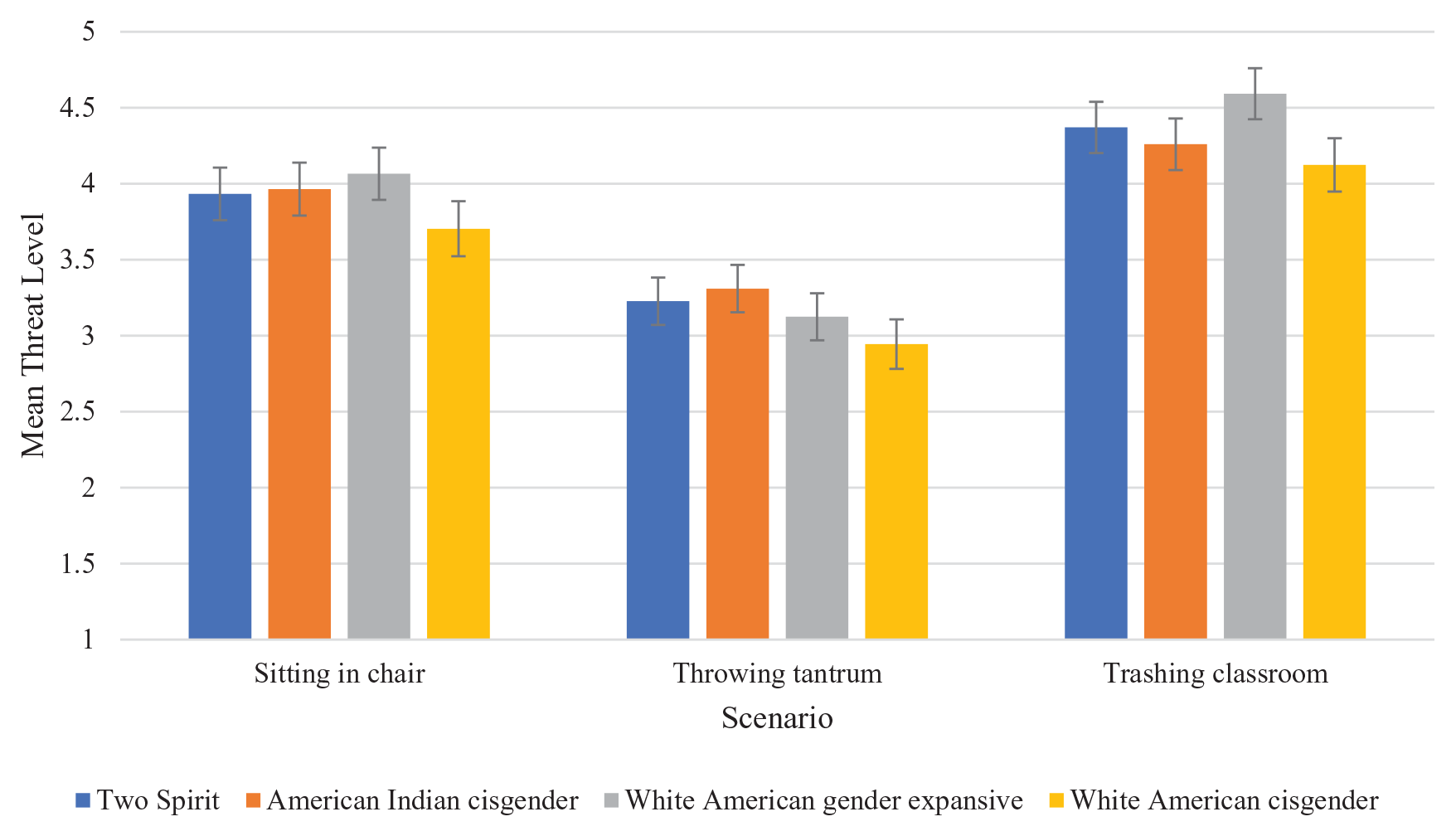
Participant evaluation of hypothetical student mean threat level by experimental condition within scenario.
Procedural Protocol Outcome
The procedural protocol outcome analysis was conducted using analysis of covariance with no within-subjects modeling because this question was not asked with each scenario repeated measure. The outcome was measured as a 6-point Likert scale that captured levels of disagreement to agreement that the treatment of the student was an incident of prejudice, with higher values indicating greater agreement that it was prejudice. The independent variable for this study consisted of the experimental conditions (i.e., Two Spirit, American Indian cisgender, White American gender expansive, or White American cisgender). The only control variable included in the analysis was the Bayesian Racism Scale. Effect sizes for the main effects in the model are represented using partial eta-squared (η2 p ).
The results of this procedural protocol model are shown in Table 7. The model results indicate that the main effects of the experimental condition (η2 p = .013; p = .238) and the racism scale (η2 p = .003; p = .333) were not statistically significant in the model. Figure 4 shows how the estimated marginal mean for the Two-Spirit student was higher than those for the other groups, indicating greater levels of perceived prejudice; however, the mean differences between each experimental condition were too small to establish statistical significance. All estimated marginal means were evaluated holding the Bayesian Racism Scale at its mean (M = 16.26).
Mixed-effects analysis of covariance testing perceived prejudice rating of student by scenario, experimental condition, and political identity, controlling for the Bayesian Racism Scale

SS, sum of squares; MS, mean squares; η2 p , effect size or partial eta squared

Participant evaluation of mean agreement level that the incident was prejudice by experimental condition.
Discussion
This study attempted to find whether school criminalization occurs because of negative public perceptions of American Indian students and Two-Spirit youth (in-group bias) but found that American Indian representation in the public positively impacts criminalization processes of American Indian and Two-Spirit youth (bureaucratic representation). I tested the hypothesis that anti-Indigenous and anti-gender-expansive biases partially drive school discipline disproportionalities between American Indian youth and White American youth as well as cisgender, gender-expansive, and Two-Spirit youth but found that cognitive in-group biases are mitigated by public representation. Findings suggest that public opinion of American Indian and gender-expansive youth is high and that representation is a key driver in disrupting the school criminalization of American Indian and Two-Spirit youth.
In this exploratory experimental study, participants observed and rated school personnel’s performance and a student’s threat level across three hypothetical scenarios based on real events. After being randomly assigned to one of four experimental conditions that alternated the identity of the student as either Two-Spirit, American Indian cisgender girl, White American gender-expansive student, or White American cisgender girl based on the student’s name and pronoun use only, participants were asked about school personnel performance level, student threat level, and overall prejudice levels. If participant bias does not exist, then we should see no statistically significant differences in personnel performance, student threat level ratings, or agreement that the incident was prejudice—across these experimental conditions. This study found that there is no statistical difference in these outcomes across the experimental conditions, even after controlling for levels of Bayesian racism. Drawing from the theoretical framework guiding this study, the results support the idea that American Indian and White American participants did not hold in-group biases toward out-groups, nor did cisgender persons hold in-group biases toward gender-expansive groups. These results are promising, showing a certain warmth toward out-groups instead of clinging to subtle, hard-to-change implicit biases.
In this study, I found that bureaucratic representation may operate as a change lever in mitigating bias. Bureaucratic representation, or representative bureaucracy, is a well-substantiated theory with many contributors; it has been tested and developed across multiple public settings, including education (Keiser et al., 2002; Meier, 1984, 1993; Meier et al., 1999). Still, “further study is necessary given the contextualization of bureaucratic identity, political applications of the theory to lawmakers, strategic choice in the assumption of bureaucratic role, and practice of the theory in comparative settings” (Meier & Melton, 2014, abstract). This theory posits that governing bodies—in both political and administrative positions—should reflect society as a whole, including employing and retaining officeholders and spokespeople from broad social groups (Kingsley, 1944; Mansbridge, 1999). In addition to improving public service delivery, representative bureaucracies also can improve the performance and management of public organizations because a supposed alignment exists between the interests of elected and nonelected bureaucrats and their clients. In fact, research suggests that nonelected officials like most school personnel (e.g., teachers, principals, and school resource officers) and street-level bureaucrats (e.g., those who deal directly with their clients) (Lipsky, 2010) “exercise substantial policymaking power as the implementers of public policy” (Grissom et al., 2015, para 1). Moreover, research shows that bureaucratic representation improves the lives and policy outcomes of both minoritized and nonminoritized groups over time (Meier et al., 1999).
Education bureaucracies with representative structures can create policies that are more inclusive and less discriminatory and can improve the life outcomes of students, families, and communities (Mosher, 1982). For example, Keiser et al. (2002, p. 553) found that passive representation—“an increased access to positions of power”—of women in education led to active representation—“result[ing] in policies that improve[d] the lives of women outside the organization.” Essentially, an increase in the passive representation of women in positions of power within education (e.g., math teachers) led to better outcomes for female students (e.g., math test scores and aspirations of students). In a study of 82 large urban school districts, Meier (1984) found that Black American teacher representation resulted in less “second-generation discrimination” operationalized from many educational outcomes including graduates enrolled in college, assignment to vocational programs, students dropping out of school, students assigned to special education classes, students assigned to educable mentally retarded (EMR) classes, students suspended from school for one day or more, students assigned to gifted programs, and students assigned to enriched, honors, or advanced class. (p. 256).
Lastly, in a study of 12 schools in Florida over 11 years, Meier (1993) found active representation of teachers and, to some extent, administrators, but not principals, positively influenced several educational indicators grouped into three constructs: educational grouping (i.e., classes for the educable mentally retarded, classes for the trainable mentally retarded, and classes for the gifted), student discipline (i.e., corporal punishment, in-school suspensions, out-of-school suspensions, assignments to alternative education for disciplinary reasons, expulsions, and referrals to juvenile court), and student performance (i.e., communications skills and mathematics competency exams) of Latin* American students. It is worth noting that the last two studies focused on school criminalization with markers such as referrals to juvenile court and corporal punishment in addition to academic performance indicators, demonstrating the importance and intrinsic association between discipline and academic performance. Additionally, such a focus highlights the important role bureaucratic representation can have on reducing instances of school criminalization. Bureaucratic representation may be one reason this study adaptation did not replicate previous results found in the study on Black American gender-expansive youth (Templeton, n.d).
Implications
The implications of this study are listed here. First, policy and education stakeholders should consider increasing the bureaucratic representation of unelected officials such as teachers, principals, school resource officers, and sworn police officers, who are each instrumental in meting out discipline. Teachers’ racial perceptions and implicit biases shape how they handle discipline for Black American youth (Bergh et al., 2010; Monroe, 2009), although there is a paucity of research on how those factors influence American Indian students. Teacher’s beliefs about school discipline also influence the degree to which they use punitive punishments or restorative practices (Atiles et al., 2017). Principals approve or deny requests for recommended suspensions and expulsions and greatly influence school culture, which influences discipline (Bayrak et al., 2014). School resource officers and sworn police officers exercise great power and handle most discipline infractions that were once under the purview of the teacher (Simson, 2014). All this is to say that an increase in bureaucratic representation—such as more American Indian or gender-expansive school personnel—could reduce discipline disparities among marginalized youth. States and local governments could incentivize Indigenous teachers to recruit and retain them, such as by canceling out their college debt if they work at Title I schools in states with large populations of Indigenous students such as Alaska and Oklahoma. School districts also could work with local tribes to organize culturally relevant professional development opportunities for all educators but especially Indigenous educators.
Second, education stakeholders should consult local tribes and advocate for self-determination. For example, schools could include local tribes in educational policies, practices, and procedures that impact Indigenous students, such as not using rigid school discipline matrices. Instead, school personnel could leverage culturally responsive approaches or trauma-informed approaches that have proven to be more effective in reducing instances of discipline than rigid formulaic responses (Carter Andrews & Gutwein, 2020; Luthar & Mendes, 2020). Educational stakeholders also should increase funds to support education initiatives driven by tribal education departments. For example, these departments could oversee revising mainstream curricula to include lessons on Indigenous languages, history, and cultural practices, especially in schools with high populations of Indigenous students (Pewewardy & Hammer, 2003). Additionally, colleges and universities could develop teacher and principal training programs to equip school personnel with the knowledge they need on Native cultures to improve Indigenous student success and reduce discipline incidences (Sheley, 2014). Third, the government should allocate more funding to the Bureau of Indian Education schools and tribal education programs more generally. By allocating funding and resources to improve technology, infrastructure, and access to quality education materials, governments in conjunction with tribes could improve the academic success of students and reduce school discipline incidences.
Future Research Directions
We need more research on the impact of varied first responders to discipline issues. Nascent research on the intervention of healthcare staff such as psychiatrists and social workers acting as first responders, instead of or in addition to police, to noncriminal calls is promising (Carroll et al., 2021; Hill, 2021), but there is a lack of research on first responders for school discipline issues. Perhaps teachers and principals should call school support staff such as psychiatrists and social workers before calling school resource officers or sworn police officers. This study was designed to replicate the disciplining of J’aiesha Scott by White American school personnel and city police. In that case, the principal called the city police to handle a 6-year old’s tantrum, but what would have happened if the principal had called in support staff instead? Related, about 14 million students—mostly racially minoritized and poor youth—were enrolled in schools with police officers but no counselors in the 2014 school year largely because schools redistributed funding to support school resource officers instead of school healthcare support staff (Mann et al., 2019). Greater funding and oversight are necessary to ensure that students attend schools with healthcare support staff, and more research is needed on the role these staff can play in deescalating school discipline incidents. Ultimately, more research is needed on which mechanisms propel and dispel disciplinary inequities for American Indian and gender-expansive youth. Moreover, educational researchers can work to improve data-collection procedures and practices to track the opportunity gap and the school-to-prison pipeline. Holistic antideficit Indigenous data can help identify disproportionalities and design interventions meant to address them.
Limitations
The limitations of this study offer promising new research and policy directions. First, it is quite possible that the study focused too much on student behaviors instead of school personnel’s consequential actions such that the null results reflect a behavioral assessment of the youth rather than the consequences of school disciplinary actions. Such a focus could result in null results. The hypothetical scenarios may have been too weak to capture subconscious and unconscious biases because they did not explicitly address anti-Indigenous or anti-gender expansiveness in disciplinary actions. As such, future researchers should consider how they might better capture the subconscious and unconscious biases within school criminalization processes. Second, researchers should consider bias associated with cisgender boys in addition to cisgender girls and gender-expansive students for a more complete handling of gender biases and school criminalization. Moreover, this study focused on preschool disparities because criminalization starts in preschool, but results most likely would differ among different age groups. As such, future researchers should consider varying the ages in replications or adaptations of this study.
Furthermore, this study did not use manipulation checks in terms of race and gender, but there are plenty of studies that showcase how names such as Emily signal Whiteness (Bertrand & Mullainathan, 2004) and gender pronouns such as she signal femininity (Sanford & Filik, 2007). Next, although this study is largely descriptive and exploratory, I focused on comparisons and effect sizes, which then allows subsequent researchers who have more confirmatory projects to improve on what I have done by optimizing the number of hypotheses, which will reduce Type I errors. Additionally, future researchers will know what approximate effect sizes are necessary to determine a large enough sample to power their study. Lastly, this research operationalized school personnel representation as public representation (e.g., similar to researchers who use undergraduate students to represent the public) as a critical first step in lending support to future research on nonselected bureaucratic officials such as school personnel. Capturing public perceptions of American Indian persons and Two-Spirit students more specifically is important to science and society because public perceptions shape the lived experiences of American Indian persons and gender-expansive Americans—often with dire consequences (Foxworth & Boulding, 2022; Schiralli et al., 2022; Usner, 2009). Related to (school) criminalization processes, research on officers—both in society and in schools—and public opinion has become increasingly important to reform. During the second wave of the Black Lives Matter movement, America witnessed the power of public opinion to lead to much-needed police reform (Mourtgos & Adams, 2020). With the steady increase in school resource officers and sworn police officers coupled with a lack of clear regulations on their power (Bleakley & Bleakley, 2018; Cremin, 2020), research on these personnel is crucial to protect the best interests of the most vulnerable racial and gender student groups. Although public opinion does not matter as much as the opinions of elected and nonelected bureaucratic officials (i.e., teachers and superintendents) or their clients (i.e., students and parents), it is still important. As such, educational research should move beyond the insular way schools interact with and judge American Indian persons and gender-expansive Americans by showing a broader picture of how society views both populations. Although this study centered on the unique lived and legal experiences of American Indians—the Indigenous people of America—application to all Indigenous populations is certainly welcome and warranted. Despite these limitations, this study makes several contributions to the literature.
First, this research highlights the perceptions of American Indian persons by oversampling American Indian persons through Prime Panels. This is crucial to preventing their systemic erasure in science and society. Next, the study advances public-policy literature by revealing public opinions, which is essential to understanding both the public and public-policy change. The public can have a tremendous influence on public policy (Burstein, 2003), so it is important to assess their opinions on critical issues like school criminalization. Moreover, the study focused on bureaucratic representation because the “concept and its applications to schooling remain largely foreign to education researchers” (Grissom et al., 2015, para 3). Bureaucratic representation has the potential to act as a change lever for school criminalization disparities among racially and socially minoritized students who make up a growing share of the population with recent increases in racially minoritized students (National Center for Edication Statistics [NCES], 2024), gender-expansive students (Diamond, 2020), and transgender persons (Leinung & Joseph, 2020) in the United States. The “public schooling system is the largest component of the public sector in the United States,” so the impact of bureaucratic representation could have widespread effects (Grissom et al., 2015, para 3).
Of similar importance, this study uniquely captured the experiences of American Indian and gender-expansive school children by placing them in the study as the hypothetical preschooler. In doing so, this study captured the unique experiences and opinions of American Indian persons and, to a lesser extent, gender-expansive Americans. As is too often the case, once a student becomes embroiled in the criminal justice system, it becomes extremely difficult for them to reenter the academic system. For example, schools often will not accept students with prior arrests, so those students must attend underperforming and underresourced alternative schools (Healey, 2013, 2014). Society benefits from an exploration of the role bias plays in school discipline procedures—even with null results. Further, research shows that self-reported attitudes influence policy support across domains (Axt et al., 2021; Lax & Phillips, 2009), so it is important to capture public perceptions of salient issues such as school discipline, American Indian children, and gender-expansive children. Much of the research on self-reported attitudes toward LGBTQIA+ groups has privileged lesbian and gay attitudes and, to a lesser extent, transgender and gender-expansive attitudes (Axt et al., 2021). As such, this study is a crucial step toward capturing public perceptions of gender-expansive youth. Moreover, as a study adaptation that finds dissimilar results, the research advances knowledge by replicating a previous psychological experiment. Lastly, by publishing null findings, the study advances scientific inquiry by combating the positive-publication bias (Cook et al., 2002).
Conclusion
This study explored the psychological mechanisms that may drive increased American Indian and gender-expansive discipline rates. Predicated on in-group biases, I studied whether the public holds anti-Indigenous and anti-gender-expansive biases that influence the public’s justification of school personnel who use force and restraint on American Indian and White American preschoolers as well as cisgender, gender-expansive, and Two-Spirit preschoolers. This study found that the public does not hold anti-Indigenous or anti-gender-expansive biases in this sample of participants, which begs the question of whether anti-Indigenous and anti-gender-expansive biases are lessening in America and promotes bureaucratic representation as a potential change lever to disrupt school criminalization processes. Future research is necessary to ensure that this finding was not due to chance and to tease out the role of bureaucratic representation in dismantling the school-to-prison nexus.
Footnotes
Acknowledgements
I like to thank James Wright, Lara Perez Felkner, Nicolo Pinchak, and Susan Faircloth as well as the anonymous reviewers at AERA Open.
Declaration of Conflicting Interests
The author declares no potential conflicts of interest with respect to the research, authorship, and/or publication of this article.
Funding
This research was funded by a Helping Hands’ Social Justice Award.

Note: This manuscript was accepted under the editorship of Dr. Kara Finnigan.
Author
DA’SHAY TEMPLETON is an assistant professor at a California Lutheran University, a small Hispanic-serving institution in Thousand Oaks, California. As a critical theorist and mixed methodologist, she aims to dismantle the school-to-prison nexus through teaching, research, and service. The populations she centers on in her research are those with whom she shares some belonging, namely Indigenous American, Black American, disabled, gender-expansive, Latin* American, and trans* American youth.