




Abstract
Many public universities have adopted differential tuition policies that charge higher prices for academic majors that are in high demand from students and/or are expensive to operate. I compiled the first comprehensive dataset of differential tuition policies across virtually all public universities over the last two decades to examine the effects on degree completions in business, engineering, and nursing with a focus on racially minoritized groups. Using event study techniques, I found that differential tuition modestly increased the number of engineering degrees awarded and that white students tended to benefit more than other racial/ethnic groups from differential tuition across all three fields of study.
Keywords
Students enrolling in public universities frequently face tuition charges that vary based on their field of study. This practice of differential tuition involves charging higher tuition prices for majors that are popular and/or costly to operate, such as nursing, engineering, and business (Hemelt et al., 2021; Kim & Stange, 2016). The most recent estimate is that 60% of public research universities in the United States used differential tuition in 2015–2016 (Nelson et al., 2017), although prior research has found that differential tuition also exists at less-selective public universities (Cornell Higher Education Research Institute, 2012).
The most common rationale given for offering differential tuition is that by charging higher tuition rates, colleges can expand programs to accommodate more students and provide additional supports to help students succeed. As a result, differential tuition policies have the potential of increasing the access of students, particularly those from racially minoritized groups, to programs with high earnings that have traditionally enrolled a less diverse student body (Carnevale et al., 2016; Zhang et al., 2024). On the other hand, differential tuition policies have the potential to induce students to choose majors without differentials in an effort to reduce the price of their education. Research has found that students are sensitive to tuition increases (Hemelt & Marcotte, 2011), and minority students tend to be more sensitive to tuition increases than white students (Allen & Wolniak, 2019).
The one national study examining differential tuition policies was by Stange (2015), who used data through 2007–2008 for the share of degrees awarded in business, engineering, and nursing at public research universities. He found that differential tuition increased the share of degrees awarded in nursing and decreased the engineering share, with Black students being particularly affected. Several studies focused on Texas, which allowed differential tuition through a tuition deregulation policy beginning in 2003 that included a set-aside for financial aid. Research has found an increase in enrollment of students from low-income families in fields with high earnings following the adoption of differential tuition (Andrews & Stange, 2019), with universities serving more lower-income students setting smaller price increases (Kim & Stange, 2016).
In this research, I build upon prior research on the effects of differential tuition policies in three main ways. First, I compiled a current dataset of three popular fields of study that frequently have differential tuition charges (business, engineering, and nursing) that allows for an examination of financial challenges that universities faced following the Great Recession (Barr & Turner, 2013) and through a period of declining enrollment across higher education in the 2010s. Second, my data include all public universities, which allows differences by institutional type to be considered. Third, I capture adoption over time of differential tuition policies across fields within universities instead of assuming that all majors adopt differential tuition at the same time.
My two main research questions are the following:
(1) Does the presence of a differential tuition policy affect the share and number of total graduates in business, engineering, and nursing?
(2) What are the effects of differential tuition policies by race/ethnicity?
Theoretical Framework
The adoption of differential tuition policies by public universities can be explained by several theories. One key theory is academic capitalism (Slaughter & Leslie, 1997; Slaughter & Rhoades, 2014), which details how institutions are seeking to begin and expand programs and take other steps to increase revenue and enhance prestige. McClure (2016) noted that academic capitalism is driven in part by administrators who are seeking to enhance their own profiles. By adopting differential tuition, institutions have the potential to grow programs or provide more resources to recruit high-quality students and faculty.
Academic capitalism is informed by two other theories that help to explain the conditions under which institutional leaders make decisions. Under resource dependence theory (Pfeffer & Salancik, 1978), organizations are striving to diversify their revenue sources so they are less reliant on a single source. This has occurred within public higher education, where the share of total educational revenue coming from tuition doubled to more than 40% between 1980 and 2021 (Laderman & Kunkle, 2022). An example of a deliberate effort to diversify revenue is the growth in out-of-state student enrollment following cuts in state funding (Jaquette & Curs, 2015). However, pursuing more out-of-state students has resulted in crowding out in-state students at the most selective public universities (Curs & Jaquette, 2017) and a decline in underrepresented minority students from the university’s home state (Jaquette et al., 2016) unless there is a requirement that in-state enrollment remain constant (Orlova et al., 2023). Additionally, the strategy has not consistently yielded increased revenues (Kelchen, 2021).
Academic capitalism is enabled by New Public Management, which encourages public-sector organizations to be entrepreneurial and efficient and has been widely adopted by state governments (Moynihan, 2006; Osborne & Gaebler, 1992). This additional autonomy often comes in exchange for additional accountability, which has been true in public higher education over the last several decades (Kelchen, 2018). An example of this is responsibility center management (RCM), in which revenues and expenditures are pushed down to lower levels of organization and those leaders are held responsible for their performance. There is evidence that RCM policies may result in increased tuition revenue (Jaquette et al., 2018), and advocates have pushed for connecting RCM with performance-based funding policies in an effort to further encourage units to operate more efficiently and effectively (Kosten, 2016). However, RCM models also create tensions within institutions as they encourage duplicative course offerings across units as they compete for student credit hours (Hearn et al., 2006).
Under New Public Management, universities are encouraged to generate additional revenue. However, there is tension between states allowing institutions additional autonomy and trying to keep tuition charges as low as possible for students. States have taken different approaches to tuition-setting, with legislatures in approximately ten states having the statutory authority to set tuition rates for at least one sector of higher education (Pingel & Broom, 2020). In the remainder of states, tuition-setting authority is delegated to state coordinating boards, higher education systems, or individual institutions. Over the last two decades, between 12 and 22 states, boards, or systems have set controls on tuition prices for public universities. Freezes became more common in the late 2010s as concerns about affordability mounted (Kelchen & Pingel, 2024). Research has found that tuition controls are effective in decreasing tuition in the short term (Deming & Walters, 2017; L. Miller & Park, 2022).
Literature Review
Funding mechanisms and institutional practices within public higher education, such as differential tuition, have significant implications for racial equity. Students from historically underrepresented groups are particularly sensitive to tuition increases (Allen & Wolniak, 2019). This may because some students rule out attending institutions based on the sticker price alone (Levine et al., 2023) and the prevalence of loan aversion, particularly among Hispanic students and recent immigrants (Boatman et al., 2017; Goldrick-Rab & Kelchen, 2015).
Institutions serving larger shares of students from historically underrepresented and excluded groups receive fewer resources than predominantly white institutions (e.g., Hamilton & Nielsen, 2021; Harris, 2022). This is in spite of a sizable body of literature that shows a positive relationship between available resources and college completions (e.g., Bound & Turner, 2007; Webber & Ehrenberg, 2010), particularly for Black and Hispanic students (Monarrez et al., 2021). There is a relationship between increased minoritized student enrollment and reduced state funding (Foster & Fowles, 2018), and there is some evidence that the relationship is stronger when Republicans are in political control in states (Taylor et al., 2020).
While academic capitalism would suggest that differential tuition policies are primarily a way to enhance prestige and support overall institutional budgets, an argument in favor of differential tuition is that the extra funds can be used to support increasing access to high-cost and/or high-demand fields of study. Research by Hemelt et al. (2021) found that engineering and nursing are the two most expensive common fields of study for universities to offer. This is due to small class sizes, expensive facilities, and relatively high faculty salaries. Business has slightly higher than average expenses, with large class sizes mostly offsetting high salaries (Hemelt et al., 2021). These facts mean that while differential tuition policies for engineering and nursing may be crucial to expanding these programs, the motive for differential tuition in business may be as much to generate profit as provide additional space or resources.
Although differential tuition policies have been widely adopted nationally, much of the research is focused on Texas’s 2003 tuition deregulation policy that allowed universities to charge differential tuition but also required 15% of the additional revenue to be set aside to support need-based financial aid. The research on Texas’s policy has shown evidence that differential tuition has expanded access to high-demand fields for students from lower-income families (Andrews & Stange, 2019), but that wealthier universities were able to set larger tuition differentials than other universities (Kim & Stange, 2016). Texas, however, has a unique higher education context due to strong state funding, a guaranteed admission plan for students at the top of their high school graduating class, and much more diversity in its student body than most states.
The one national study on the effects of differential tuition by Stange (2015) focused on 50 public research universities that adopted differential tuition for business, engineering, or nursing programs by the 2007–2008 academic year. This analysis assumed that all tuition differentials in place by 2007–2008 were implemented during the same year due to limitations of the dataset used. He found that differential tuition policies adopted before the Great Recession at public research universities increased the share of degrees in nursing but decreased the share in engineering. The difference across fields is surprising because both programs are expensive to operate and capacity constrained.
This study builds upon Stange (2015) in several key ways that represent a substantial contribution to the literature. First, I extend the period of study to go through the early 2020s. This captures a sharp rise in the number of universities with differential tuition in the 2010s as institutions responded to tight state budgets and enrollment challenges by adopting new pricing models, in line with academic capitalism. Second, by capturing the exact date of implementation for each program, I can identify a sizable share of universities that gradually adopted differential tuition across programs. Third, the sample goes beyond research universities to reflect the growing popularity of differential tuition at regionally-focused public universities that are facing stronger financial pressures.
Sample, Data, and Methods
To conduct this study, I compiled the first detailed longitudinal dataset of differential tuition policies in three popular majors across public universities. The following section describes my sample, data, and methods.
Sample
I began with all institutions that operated as state-funded public universities throughout the entire panel of study (2003–2004 through 2022–2023), with the 2021 Carnegie classification being used to identify baccalaureate, master’s, and research universities. Private colleges and universities were omitted due to there being less information on websites about tuition charges and governing board documents largely being unavailable. I excluded a small number of special-focus institutions that primarily granted degrees in limited fields of study (such as the Colorado School of Mines). I also dropped six universities with unclear information on when differential tuition was adopted due to missing data, and I dropped the nursing program at the University of Tennessee, Chattanooga, for the same reason. 1 This resulted in an initial sample of 509 public universities across all 50 states.
I then conditioned my sample on ever having programs in business, engineering, and/or nursing, defined as whether the university ever reported a student completing that program in IPEDS using the Classification of Instructional Programs (CIP) code framework. 2 All but six of the 509 universities had business programs, but 144 did not have engineering programs and 132 did not have nursing programs. As a result, the sample size for each program is different.
Data
The most common data source for institutional tuition charges is the U.S. Department of Education’s Integrated Postsecondary Education Data System (IPEDS). However, IPEDS does not collect data on whether an institution has a differential tuition policy (A. Miller & Clery, 2019). While IPEDS instructs institutions to report an average tuition value that reflects all students, my comparison of reported IPEDS data and institutional websites reveals that institutions frequently exclude all differentials from the reported tuition amount. This means that the only way to examine the effects of differential tuition policies is to collect data from institutions.
I collected institution-level data on the presence of differential undergraduate tuition policies from the 2003–2004 through 2022–2023 academic years. Using Kelchen et al. (2019) as a guide for data collection, I compiled a dataset using the Internet Archive: Wayback Machine, institutional tuition and fee websites, and academic catalogs as my primary data sources. I defined a university as having differential tuition if there was a clearly listed surcharge that applied equally to either all students within a major or all courses within a department or college. In some cases, the terminology “differential tuition” was used. For example, Auburn University listed differential tuition of $776 per semester during the 2022–2023 academic year for engineering students in their sophomore, junior, and senior years. In other cases, it was listed as a supplemental fee, but it was consistent across all offerings. An example of this is Jacksonville State University charging a $50 per semester program fee to all business and industry majors.
Although universities frequently charge additional fees to take particular courses to cover supplies and facilities costs, I did not consider these to be differential tuition if they varied across courses within a department. Additionally, there are often additional charges (and occasionally discounts) for students enrolled in fully online programs. While this is a useful area for additional study, I excluded these programs from my definition of differential tuition.
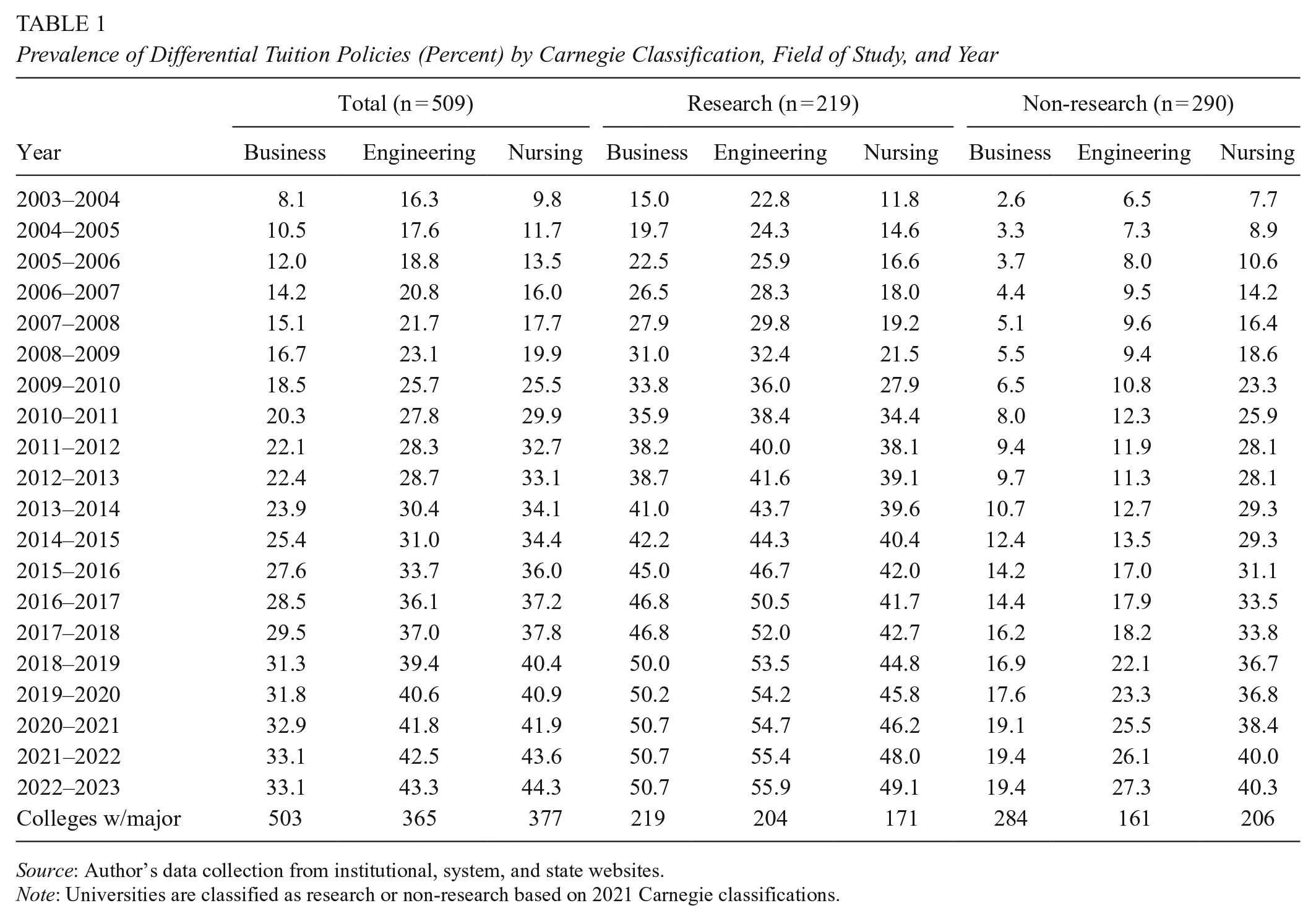
Table 1 contains details on the prevalence of differential tuition policies for each field of study, broken down by research and non-research universities from the 2021 Carnegie classifications. There has been a clear upward trend in the share of programs covered by differential tuition. In 2003–2004, 8% of business programs, 16% of engineering programs, and 10% of nursing programs had differential tuition. These rates steadily increased throughout the panel to 33%, 43%, and 44%, respectively. At research universities, approximately half of all programs in these three fields of study had differential tuition by 2022–2023, with particularly large increases in prevalence for nursing programs immediately following the Great Recession. Less than one-third of all business and engineering programs at non-research universities had differential tuition by 2022-23, but 40% of nursing programs did.
Prevalence of Differential Tuition Policies (Percent) by Carnegie Classification, Field of Study, and Year
Source: Author’s data collection from institutional, system, and state websites.
Note: Universities are classified as research or non-research based on 2021 Carnegie classifications.
Another key descriptive takeaway is that business, engineering, and nursing programs rarely adopted differential tuition at the same time, which is different than the operating assumption in previous work (Stange, 2015). Of the 33 universities with no differential tuition in 2003–2004 that had adopted it in all three programs by 2022–2023, only 13 implemented differentials in all three programs in the same year. An example of the majority of institutions that spaced out implementation is Auburn University, which added differential tuition for business in 2009, nursing in 2010, and engineering in 2016.
My outcomes of interest were the share and number of bachelor’s degrees completed in business, engineering, and nursing, with data coming from IPEDS. I matched Stange (2015) by examining the share of degrees awarded in business, engineering, and nursing awarded in these fields, but using all public universities and more recent data. I then examined the total number of degrees awarded in these fields. About one percent of institution-year observations had missing data or reported zero graduates; missing values were converted to zeroes as these were from small programs that continued operating in future years.
Within each field of study, I examined the number of degrees completed by underrepresented minority (URM) students. I focused on Black, Hispanic, and Native American students because multiracial and Native Hawaiian completions were not reported in the early years of the panel and there were changes to the use of the race unknown category (Ford et al., 2020). As a result, the true number of URM students is undercounted in the data. Nevertheless, this provides a window into how policy changes have affected students from minoritized groups. I analyzed the number of Black and Hispanic completions separately, as well as the number of white and Asian completions. Finally, I ran event study models for total and URM completions separately for research and non-research universities.
As a robustness check to my primary analyses, I also considered two additional programs that are frequently included in differential tuition policies. Economics programs have a separate CIP code (45.06) from business but there is a long history of these programs being located in business schools and/or in social sciences/liberal arts colleges (e.g., Siegfried & Bidani, 1992). Similarly, computer science (CIP code 11) may be located in engineering schools or in other parts of the university. Differential tuition policies often work at the college level, so I included these two programs in with the main programs of interest to see if results changed. Finally, I also included a category for other degrees (total bachelor’s degrees less business/economics, nursing, and engineering/computer science) in selected analyses, defining the timing of differential tuition as the first of the three focal fields to adopt a policy. This serves as a falsification test to examine whether other fields were seeing changes in the number of completions even without having differential tuition policies.
I collected data on a number of other factors that could affect the number of graduates, both overall and by race/ethnicity. Institution-level factors (all from IPEDS) included FTE enrollment, the percentage of students who are undergraduates, the percentage of applicants who are admitted, the racial/ethnic backgrounds of new students, in-state tuition and fees (before differential tuition), per-FTE total revenue, the share of total revenue coming from tuition (tuition reliance), and the share of total revenue coming from state appropriations (state funding reliance). 3
State-level finance factors were the amount of state grant aid per 18–24 year old and the share of aid awarded based on need (from the National Association of State Student Grant and Aid Programs combined with Census Bureau data on age). Three finance factors were at the system level, which accounted for the presence of multiple four-year systems of higher education within certain states. These factors have not been accounted for in prior research, but could potentially affect the decision to adopt differential tuition as well as the number of completions. These included the presence of a funded performance funding policy (Rosinger et al., 2022), the presence of state funding formulas that differentiate by field of study (Kelchen et al., 2024), and the presence of tuition freezes (author’s data collection).
State-level economic and demographic characteristics included per-capita personal income (from the Bureau of Economic Analysis), poverty rates (Census Bureau), and the share of 18–24 year olds who were underrepresented minorities (Census Bureau). 4 To capture state political characteristics, I constructed indicator variables for whether there was unified Democratic or Republican control of the state legislature and governor’s office using data from the National Conference of State Legislatures. I included Nebraska as having unified Republican control throughout the panel in spite of their ostensibly nonpartisan legislature, based on research from Masket and Shor (2015) and my analyses of legislative news coverage. Table 2 shows summary statistics of the dataset between the 2003–2004 and 2019–2020 academic years—the time period included in the analyses—for outcome variables and institutional controls.
Summary Statistics of the Dataset, 2003–2004 to 2019–2020

Note:
(1) All financial variables are adjusted for inflation into 2022 dollars using the Consumer Price Index.
(2) Economics and computer science are presented as separate degree categories because they are frequently included in business and engineering schools, respectively.
(3) URM categories for degrees completed include Black, Hispanic, and Native American students.
(4) Differential tuition and degrees by field are missing if programs did not exist in that year.
Methods
The quantitative social sciences have rapidly moved to adopt event study techniques to study the effects of policies that are adopted at different times across various treated units and thus have different availabilities of pre-treatment observations (Furquim et al., 2020; Goodman-Bacon, 2021). These are preferable to traditional difference-in-differences models with two-way fixed effects for estimating heterogeneous effects over time (de Chaisemartin & D’Haultfoeuille, 2023). This is the case in my analyses, as the effects on completions may develop over time.
I used two event study techniques that use pre-treatment observations in different ways. I present the results from Sun and Abraham (2021)’s technique (eventstudyinteract in Stata), which uses weighted average treatment effects to address pre-treatment observations and I used the year prior to the adoption of differential tuition as the reference period. As a robustness check, I also estimated models using Borusyak et al. (2024)’s technique (did_imputation in Stata), which imputes observations to estimate treatment effects and uses an average of pre-treatment observations as the reference period. As the results were similar, I focus on the Sun and Abraham coefficients in this paper, but the Borusyak et al. coefficients are available upon request.
I used data from within five years before and after the adoption of differential tuition. This provides enough time to examine pre-treatment trends and delayed outcomes while limiting the number of other policies that could potentially confound effects. I controlled for the institution-, system-, and state-level characteristics described above and clustered standard errors at the state level (Cameron & Miller, 2015), although the results are generally robust to excluding institutional controls or using state-by-year fixed effects instead of state-level controls.
The biggest concern with event study models is the existence of pre-treatment trends, although Roth (2022) cautions that these trends should be interpreted alongside knowledge of the context of the study and paying attention to the power of the pretest. With that being said, pre-treatment trends can shed light on the credibility of the causal estimates as well as potential motivations for adopting differential tuition policies. If programs are growing rapidly and about to hit capacity constraints, then there may be a positive pre-treatment trend observed in advance of a differential tuition policy that is designed to increase capacity. It is even possible that positive pre-treatment trends could be followed by null or negative coefficients post-treatment if the goal is to reduce enrollment through higher prices. On the other hand, negative pre-treatment trends could potentially lead to the adoption of a differential tuition policy designed to funnel resources into helping students complete credentials in those fields. This could be particularly true for students from minoritized backgrounds.
Limitations
There are several important limitations to my analyses. The first is that while programs can pursue a range of strategies to generate the revenue needed to cover educational expenses, only some of them fall under differential tuition. This is particularly true in nursing, which has particularly high expenses to cover items such as professional licensure and occupational supplies. While some universities charged higher per-semester tuition prices, others used high fees for particular courses to cover one-time expenses. An example is Southern Illinois University-Carbondale, which charged a fee of over $1,000 in a particular course to cover licensure expenses. As a result, I am likely understating the effects of increased student charges on the number of nursing degrees awarded.
Another limitation is that I was unable to collect complete data on the dosage of differential tuition programs due to missing data for some institutions and the complexity of varied differentials by academic level at other institutions. Some differentials were relatively modest and consistent, such as $500 per year for business majors at the University of Hawaii. Others were larger and varied by year, such as a $1,775 differential for lower-division business majors at the University of Iowa that increased to $3,604 for upper-division majors. Further, there is no publicly available data source for institutional financial aid by field of study. While some states, such as Texas, require that a share of differential tuition revenue be used for financial aid, there is no way to track net prices without relying on state longitudinal data systems.
While business, engineering, and nursing are the three most common fields of study with differential tuition, other fields also have differentials. Architecture, computer sciences, art, music, and honors programs occasionally had observed differentials during my data collection process. An example is Iowa State University, which charges differential tuition for business (upper division), engineering (sophomores through seniors), computer science (upper division), architecture and industrial design, art, animal science (upper division), and experiential learning (upper division). Since some differentials apply to any course taken within those fields of study, the exact differential paid for a given student can be impossible to identify.
Finally, I am unable to identify other institutional policies that could affect enrollment in the three programs of study, particularly for minoritized students. These include minimum grade point average requirements and firm caps on the number of students who are accepted to a program in a given year, and these requirements can have substantial implications for students’ post-college outcomes (Bleemer & Mehta, 2022). It is also possible that these policies changed upon the implementation of differential tuition, which could influence the results.
Results
I then present the results of event study models examining whether the implementation of differential tuition in business, engineering, or nursing affected the share of bachelor’s degrees awarded by public universities in these fields of study. As shown in Figure 1, there is no consistent effect of differential tuition policies in steering a larger share of students into the targeted fields. There are some small decreases in the share of business degrees, but these are essentially identical to pre-treatment trends.

Share of Degrees by Field.
The two panels of Figure 2 show event study results focusing on the effects of business differential tuition on the number of bachelor’s degrees completed in business. Overall, there was no evidence of a statistically significant effect of differential tuition policies on the number of business degrees awarded (Figure 2a), although the confidence intervals are somewhat broad. Notably, the pre-treatment estimates two to four years prior to differential tuition being implemented are negative and significant. This suggests that programs that received the ability to implement differential tuition were growing more slowly than programs without differential tuition, potentially raising questions about whether those programs were at capacity prior to being able to adopt larger tuition increases.

Figure 2a: Business Degrees Awarded (Log).
If we focus on the number of business degrees awarded by race/ethnicity (Figures 2a and 2b), we see that there are negative effects on the number of degrees earned by URM students in the first three years following the imposition of differential tuition. However, there are also negative pre-treatment effects in several years, matching the results for total degrees awarded described above. The negative post-treatment effects are strongest among Hispanic students, where there is no clear negative pre-treatment trend. There are no effects of differential tuition for white or Asian students, although the confidence intervals overlap somewhat with the confidence intervals for Hispanic students. The same general pattern of results holds when including economics degrees with business degrees, although the negative coefficients are slightly larger (Appendix 1).
Figure 3 contains the results of event study models examining the effects of differential tuition in engineering. There is a modest increase in the number of engineering degrees awarded in the first few years following the adoption of differential tuition. There are increases across most racial/ethnic categories, but the estimated coefficients are slightly larger for white students. When including computer science degrees with engineering (Appendix 2), the post-treatment coefficients—particularly for white students—are somewhat larger.
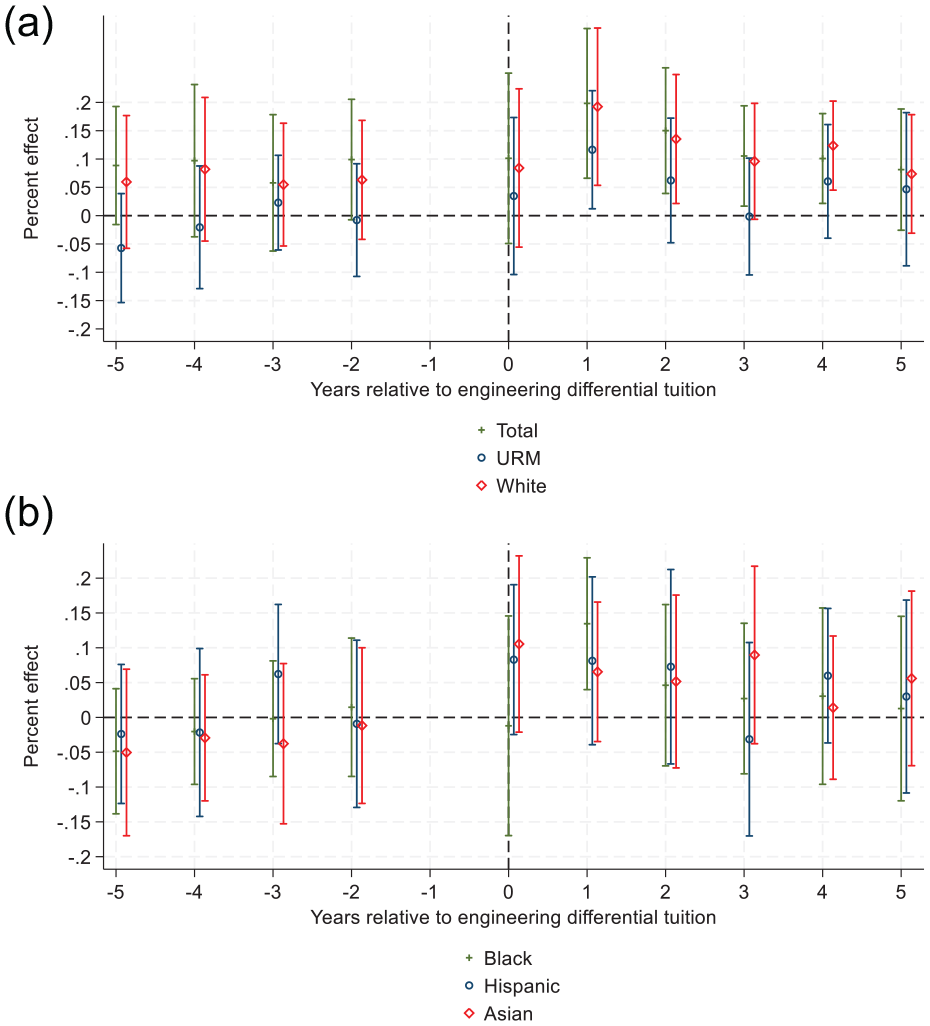
Figure 3a: Engineering Degrees Awarded (Log).
The results for differential tuition in nursing are located in Figure 4. In general, there are imprecisely estimated null effects, although the point estimates slowly increase as more years elapsed since the introduction of differential tuition. Examining results by race/ethnicity shows that white students saw an increase in the number of nursing degrees by five years following the introduction of differential tuition, while all other groups had null effects with confidence intervals that only partially overlapped with the confidence intervals of white students. This suggests that the majority of benefits of differential tuition in nursing—a lucrative field with a high share of female students—likely accrued to white students.

Figure 4a: Nursing Degrees Awarded (Log).
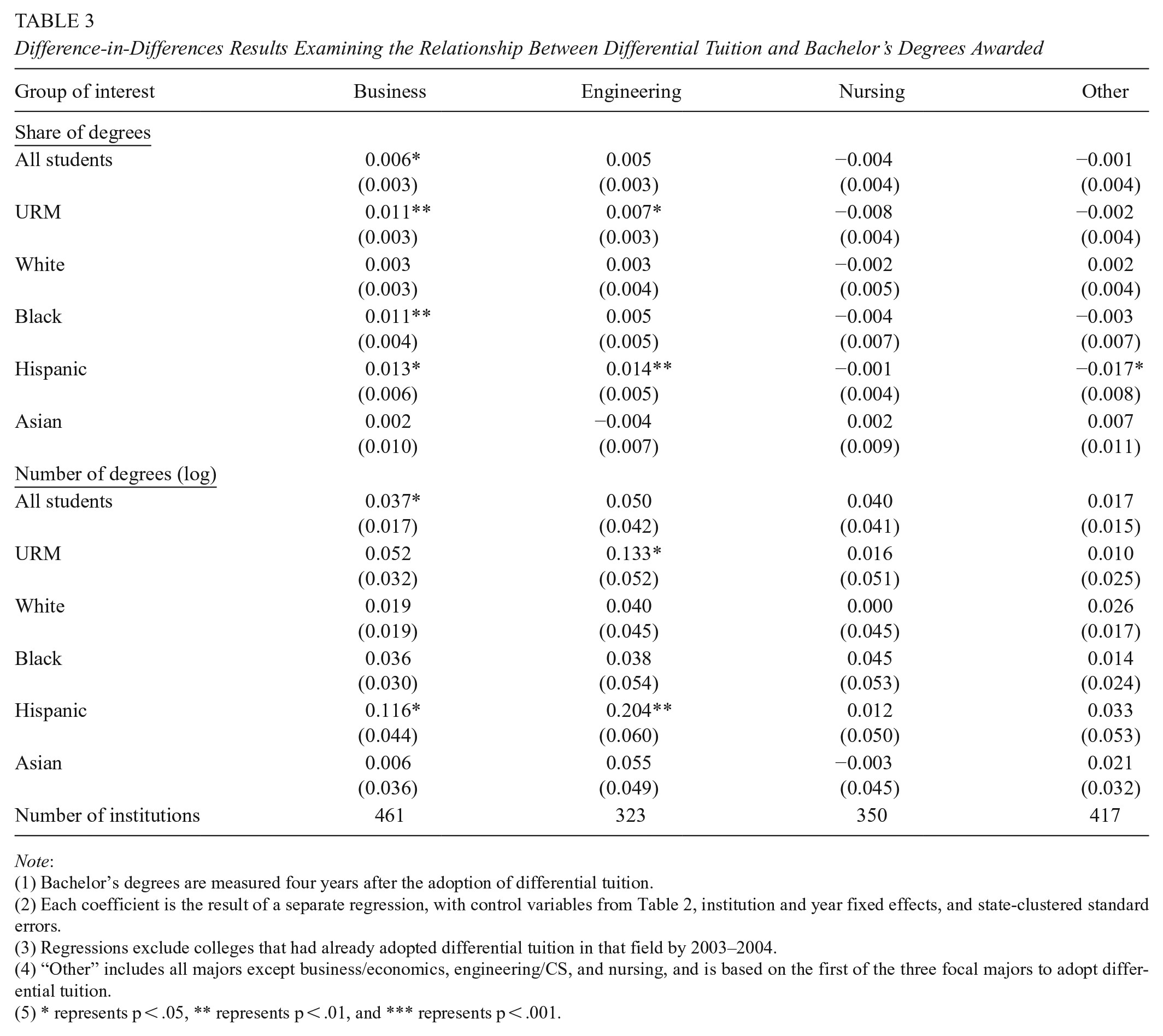
As an alternative specification that is secondary to the event study analyses due to methodological limitations, I show the results of difference-in-differences models with two-way fixed effects that estimate the relationship between differential tuition and the number of bachelor’s degrees awarded in business, engineering, and nursing four years later. As shown in Table 3, there are mixed relationships between the presence of differential tuition policies and the share of students graduating in these three fields. Differential tuition in business increased the share of Black and Hispanic students in particular who earned business degrees, while differential tuition in engineering increased the share of Hispanic students who increased engineering degrees. There was no relationship between nursing differential tuition and completions, while there was little systematic evidence that students switched from other programs of study to the three focal programs.
Difference-in-Differences Results Examining the Relationship Between Differential Tuition and Bachelor’s Degrees Awarded
Note:
(1) Bachelor’s degrees are measured four years after the adoption of differential tuition.
(2) Each coefficient is the result of a separate regression, with control variables from Table 2, institution and year fixed effects, and state-clustered standard errors.
(3) Regressions exclude colleges that had already adopted differential tuition in that field by 2003–2004.
(4) “Other” includes all majors except business/economics, engineering/CS, and nursing, and is based on the first of the three focal majors to adopt differential tuition.
(5) * represents p < .05, ** represents p < .01, and *** represents p < .001.
When we turn to the number of degrees as the outcome, we find that there was a significant increase in the number of students who earned business degrees, driven by Hispanic students. The number of URM students who earned engineering degrees increased (mainly due to Hispanic student), while there was no relationship with the number of nursing degrees awarded. There was not a significant relationship between the initial adoption of differential tuition and the number of completions in fields other than engineering, business, nursing, and closely related degree programs.
Finally, I examined the effects of differential tuition policies on total and URM degree production by Carnegie research university status using event study models (Figure 5). There is no clear pattern of effects across either research or non-research universities for business or engineering degrees, although the point estimates are imprecisely estimated for non-research universities. The only exception is that there was an increase in the number of nursing degrees awarded by non-research universities in later years of the panel, which suggests that differential tuition helped increase the operating capacity of universities that tend to have fewer resources.
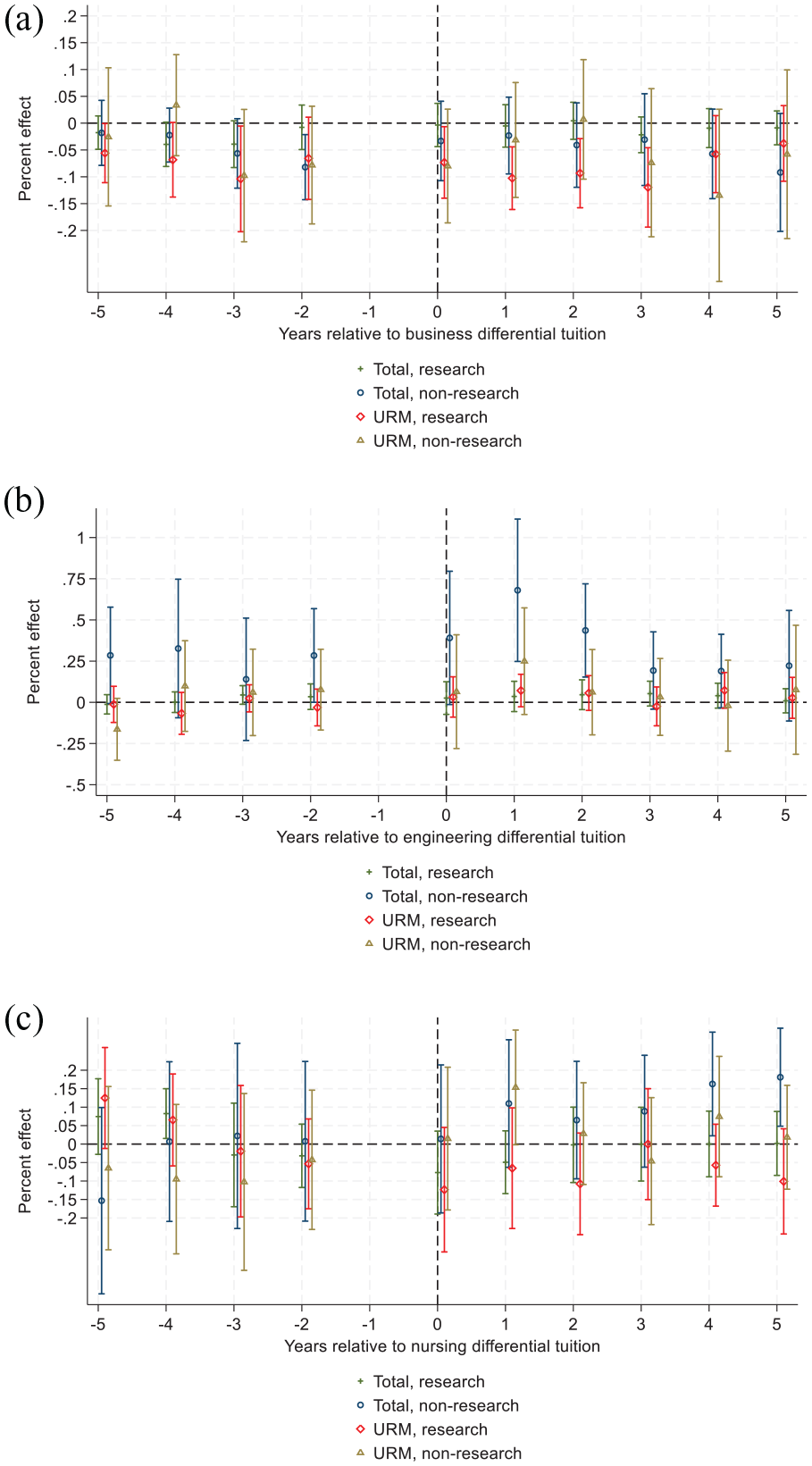
Figure 5a: Business Degrees by Research University Status (Log).
Discussion and Recommendations
Differential tuition policies are an increasingly common way for public universities to garner additional resources, particularly in high-demand fields such as business, engineering, and nursing. Funds generated from differential tuition can be used to expand access to programs that are expensive to operate, and they can also be an additional revenue source to subsidize other majors that are less profitable. The implications for racial equity are unclear, as price sensitivity of minoritized students could outweigh any benefits from additional access to these programs.
My research provides the first examination of the effects of differential tuition policies that includes the years following the Great Recession and associated budget challenges for public universities. I find evidence that differential tuition generated modest shorter-term increases in the total number of engineering degrees awarded, but there were no overall effects on the number of business and nursing degrees. This suggests that either tuition differentials were inadequate to expand capacity in a meaningful way in business or nursing or that the differentials primarily existed to support institutional and/or programmatic budgets (in line with academic capitalism). However, white students benefited as much or more from differential tuition than URM students across each of the fields of study, raising serious concerns about equity.
This pattern of results raises many questions for researchers and policymakers alike to explore. The first key question to explore is whether the findings may differ by the size of the tuition differential, as both the positive and negative aspects of differential tuition could be larger when differentials are larger. My data collection process suggests that the most selective research universities are generally able to charge higher differentials in business and engineering than other public research and comprehensive universities, while nursing differentials appeared to be an effort to cover a portion of the higher operating costs. However, I was unable to comprehensively collect data on the size of tuition differentials over the entire panel. Even if data are collected for only a portion of public universities, an examination of dosage would be a valuable contribution to the body of knowledge.
Another key question is how the additional funds generated by differential tuition are used, as this would provide insights into potential effects by race/ethnicity. The possible uses of funds include increasing the number of available seats, investing in student support, providing financial aid to offset the differential for certain students, and using the money to subsidize other university operations. These strategies have different implications for the potential effects of differential tuition, so case studies examining how different universities are using these additional resources would be valuable.
It is also possible that differential tuition policies induce certain students to enroll in similar programs that do not have the higher price tag. For example, differential tuition within a business school may lead some students to pursue degrees in fields such as economics (within a social science college) or communications. This could result in minoritized students and students from lower-income families choosing less-expensive alternatives that may have lower returns in the labor market. This question could be explored with additional data collection on the location of alternative programs and confirmation that they are not covered by differential tuition.
An assumption underlying differential tuition models is that they encourage students to pursue more lucrative fields of study that institutions are otherwise unable to expand access to. But it is uncertain whether students see a sufficient return on their investment to justify the additional tuition premium. As program-level outcomes data continue to mature in the College Scorecard, the Post-Secondary Employment Outcomes system from the Census Bureau, and state longitudinal data systems, it will become increasingly possible to examine whether differential tuition policies increase earnings enough to cover any increases in student loan debt.
Researchers have examined factors associated with the adoption and diffusion of a range of higher education finance policies (e.g., Cohen-Vogel et al., 2008; Lacy & Tandberg, 2014; Li & Kelchen, 2021). Nelson et al. (2017) examined factors associated with differential tuition adoption at public research universities, focusing on location, size, and tuition as characteristics. An approach including a broader range of institutional and state-level factors would be a valuable contribution to the body of knowledge.
Finally, an important improvement for policymakers, researchers, and the public would be for the federal government to collect data on the existence and amount of differential tuition for some of the most common fields of study. This recommendation has been made to the National Center for Education Statistics in the past (A. Miller & Clery, 2019), and the U.S. Department of Education’s proposed that gainful employment regulations would collect tuition charges for all fields of study regardless of whether they are covered by gainful employment (U.S. Department of Education, 2023). Given the opaque nature of many differential tuition charges, this would potentially allow students, families, and policymakers to make better decisions about the value of differential tuition. But in a period during which the availability of any federal data is an open question, it may be upon the research community to collect its own data to inform the public.
Footnotes
Appendix
Declaration of Conflicting Interests
The author declared no potential conflicts of interest with respect to the research, authorship, and/or publication of this article.
Funding
The author received no financial support for the research, authorship, and/or publication of this article.

Note: This manuscript was accepted under the editorship of Dr. Kara Finnigan.
Notes
Author
ROBERT KELCHEN (