




Abstract
Education researchers have increasingly used speculative design approaches to elevate the transformative agency of local stakeholders to re-mediate oppressive systems constituting harmful contexts of human learning and development. To explicitly redress racism, ableism, and other forms of interlocking oppression, the Indigenous Learning Lab was implemented in a rural high school struggling with persistent racial injustice in school discipline, profoundly affecting American Indian students and families. The Learning Lab methodology is a community-led systemic design process that leveraged local school community members’ histories, cultural assets, and sociopolitical future imaginations toward transformative knowledge production. This article examines how school community members collectively engaged in speculative future-making, amplifying their historicity, everyday resistance, cultural assets, and sociopolitical future imaginations to design a decolonizing, inclusive support system to dismantle a rural high school’s oppressive settler-colonial discipline system.
Keywords
Speculative design has been increasingly used to reorganize learning spaces, centering equity, inclusion, and justice to drive social change (Bang & Vossoughi, 2016; Gutiérrez & Jurow, 2016). Speculative design employs “speculation” about possible futures to envision alternative stories and worlds that do not yet exist (Garcia & Mirra, 2023). In U.S. schooling, the normalized, hence invisible, infrastructure is grounded in settler-colonialism, racism, ableism, neoliberal meritocracy, and other forms of subjugation. This foundation has profoundly shaped the institutional cultures and how learning and teaching activities are organized and embodied to constitute intersectional power and privilege (Apple, 2012; Gutiérrez, 2016).
Speculative design explicitly attends social, historical, political, and economic contexts and the role of race, class, dis/ability, language, gender expressions, and other markers of difference in shaping learning opportunities (Artiles, 2019; Gutiérrez & Jurow, 2016). To reimagine alternative worlds, systems, and stories, this transformative design approach aims to organize expansive learning experiences (Engeström, 2016; Garcia & Mirra, 2023). Expansive learning experiences involve breaking away from taken-for-granted practices, rules, assumptions, artifacts, and identities, leveraging everyday dilemmas and resistance and galvanizing future imaginations as speculative design tools to reshape alternative social relations and material arrangements (Engeström, 2016). Although still in its early stages, speculative design approaches have been utilized in civic education, higher education (e.g., Rogers et al., 2023), teacher education (Lizárraga, 2023), STEM (Arada et al., 2023), and literacy education (Toliver, 2020) to reorganize transformative learning environments with an emancipatory purpose. However, their potential to bring about systemic change to address racial injustice has not yet been empirically explored.
The Learning Lab methodology was developed as a speculative design approach to explicitly address racism, ableism, and other interconnected forms of oppression that create inequitable human learning and development contexts. Learning Lab is a community-driven systemic design process that delves into politicized local contexts—such as the maldistribution of resources in racially segregated neighborhoods and the historical marginalization of families of color in school decision-making processes, bolstering White staff’s control over key policies and perpetuating mistrust—and reimagines an equity-oriented learning environment (Bal, 2011; Bal et al., 2018; Ko, Bal, Lim, et al., 2023b). As an inclusive problem-solving process, local school community members who participated in the Learning Lab collectively “address educational inequities, resulting from the historical legacies of settler colonialism, racism, white supremacy, and anti-Blackness and promote social transformation” (Ko, Bal, & Artiles, 2024, p. 6).
To respond to deeply entrenched inequities in local political contexts, Learning Labs have mobilized transformative theoretical lenses (e.g., critical race theory, critical geography, universal design for learning) to strategically formulate design tools. Examples include structured guiding questions for facilitating critical dialogues among local school community members and historical analyses of racial segregation through geographic information system (GIS) mapping. These design tools foster a historicized and spatial understanding of systemic inequities, such as the lasting impacts of redlining, disinvestment in communities of color, and resource constraints. Furthermore, these tools mediate local school community members’ expansive forms of learning and guide the researchers’ ethical practices in reciprocally working with historically minoritized groups (Bal, 2018; Ko, Bal, Lim, et al., 2023b; Mawene et al., 2024).
In this paper, we introduce the Indigenous Learning Lab as an instrumental case to examine the potential of speculative design for systemic transformation led and owned by the local school community. We present how a rural high school community leveraged their voices and future imaginations as tools for speculative future-making to dismantle a settler-colonial punitive system that disproportionately marginalizes American Indian students. This study focuses on the following research question: How did Indigenous and non-Indigenous members of a rural high school community utilize their speculative future imaginations to design a decolonizing and inclusive support system?
In the following section, we first shed light on the racialization of behavioral problems, emphasizing the settler-colonial discipline system and its profound impact on American Indian youth. We then introduce the speculative design framework and the Indigenous Learning Lab methodology, elaborating on their implementation in collaboration with a rural high school and an Anishinaabe tribal nation. Finally, we present the findings and discussion, illustrating how the school community engaged in the speculative design process and discussing its implications.
American Indian Youth’s Experience in the Settler-Colonial Discipline System
Youth from racially minoritized communities are more likely to face harsher and more frequent exclusionary school discipline (e.g., detention, suspension, expulsion, and referrals to law enforcement) compared to their White counterparts (Skiba et al., 2011). This historical pattern of inequity continues to be perpetuated through toxic racial ideologies (e.g., anti-Blackness, White supremacy), explicit forms of discrimination, subtle forms of microaggression, implicit bias, and color-evasive 1 policies, programs, and practices (Artiles, 2019; Carter et al., 2016; Sobti & Welsh, 2023). Exclusionary school discipline yields adverse outcomes, including loss of instructional time, low academic achievement, high dropout rates, and reduced graduation rates (Losen & Martinez, 2020; Welsh & Little, 2018). These outcomes ultimately contribute to the perpetuation of the so-called school-to-prison nexus by increasing the likelihood of students being involved in the juvenile justice system (Chin et al., 2019).
While existing literature on school discipline and its harmful impacts has predominantly focused on the racialized disciplinary experiences of Black and Latinx students (e.g., Black suffering; Dumas, 2013), it often overlooks the settler-colonial context that shapes the experiences of American Indian youth, who face systemic erasure through exclusionary policies and practices. Like other racialized groups, American Indian youth continue to experience hyper-punishment (Whitford et al., 2019). For example, American Indian students are almost three times more likely to receive a discipline referral and in/out of school suspension compared to their White peers (Brown & DiTillio, 2013). These referrals often stem from subjective reasons, such as defiance, disrespect, and noncompliance, rather than objective reasons, such as bringing drugs or weapons to schools (Gion et al., 2018; Whitford & Levine-Donnerstein, 2017).
The settler-colonial education system in the United States has served as a tool for downward assimilation, aiming to sever the social, cultural, and spiritual ties of American Indian youth with their communities (Lomawaima & McCarty, 2006). It has privileged whiteness and individualism, systematically devaluing and punishing Indigenous ways of being, doing, and knowing (Brayboy, 2005). This settler-colonial logic of erasure—eliminating Indigenous languages, cosmologies, and practices and negating sovereignty claims to displace their presence in the ceded spaces for claiming and owning land and accumulating resources (e.g., learning opportunities)—underpins the construction of the settler-colonial school system, which perpetuates settler-colonial power and interests (Steinman, 2016; Tuck & Yang, 2012). The settler-colonial discipline system operates by patrolling, criminalizing, and punishing Indigenous bodies, minds, and their intersectional identities, therefore erasing their presence from learning spaces. The legacy of cultural genocide, physical abuse, and forced assimilations through boarding schools—where Indigenous youth were mistreated and punished for speaking their languages or practicing their cultures (Grande, 2004; Woolford, 2014)—continues to manifest in today’s settler-colonial discipline system, which often perceives and interprets the behaviors of American Indian students without a deep understanding of cultural, political contexts and the historically sedimented settler-colonial trauma profoundly affecting American Indian youth and their families and communities. Therefore, there is an urgent need to establish a culturally responsive and transformative learning environment for American Indian youth to address and remediate the historical and ongoing harms of the settler-colonial discipline system.
Learning Lab as a Speculative Design Platform Toward Possible Futures
As a speculative design approach, Learning Lab is theoretically and methodologically anchored in cultural-historical activity theory (CHAT), which underscores historicity, cultural transformation, and human agency within the constraints and possibilities of collective activity systems (Cole, 1996; Engeström, 2016). Learning Lab aims to create a dialogic space filled with designing tools, historical narratives, critical dialogues, and participants’ future imaginations. Within this space, local school community members with diverse and often opposing histories and interests form collective agency and collaboratively engage in future-making efforts to develop ecologically valid and action-oriented solutions (Bal et al., 2018; Bang & Vossoughi, 2016; Gutiérrez & Jurow, 2016; Ko, Bal, & Artiles, 2024).
Figure 1 illustrates the speculative design process through the Learning Lab, where local school community members engage in a collective problem identification and design process. This process begins with forming an inclusive systemic design team, ensuring representation from multiple voices within the school community, especially those most affected by the education inequities in the school. Participants reflect critically on their every dilemmas (e.g., racial tensions) indexed in their local history, naturalized artifacts, rules, and habitual practices perpetuating racial disparities. For example, interviews with practitioners primarily serving American Indian youth, family, and community, alongside internal school data on racial disproportionality in behavioral outcomes, can serve as cultural artifacts. These artifacts mediate participants’ empirical and historical inquiries into local contexts of inequity, rendering the invisible systemic problems visible and provoking a collective motive to transform the dysfunctional system (Ko, Bal, Bird Bear, et al., 2023a).

The cycle of Learning Lab (Bal et al., 2018).
Next, participants engage in a systemic analysis to identify and map out often invisible systemic challenges within the current educational system—such as the lack of trust and positive reciprocal relationships with American Indian families and the tribal national government. This step leverages speculative future imaginations to co-develop new cultural models, tools, policies, and practices to transform local educational systems (Engeström, 2016). For example, school community members might envision trauma-informed restorative justice practices to repair historical harms and reduce the re-traumatization induced by punitive disciplinary practices. Through this dialectical process, the historically accumulated and ongoing contradictions within the existing system are critically examined and resolved, leading to the emergence of new activity systems (e.g., culturally responsive family-school engagement strategies to ensure families’ experiences and perspectives inform school policies and practices), thereby facilitating a qualitative transformation (Engeström, 2016).
Decolonizing Methodology as Ethical Guidelines for Speculative Future-Making
Despite being legally recognized as a political minority group, American Indians have been racialized in the United States, built on settler colonialism, capitalism, and racism (Blackhawk, 2009). Although tribal nations possess sovereign political rights, the aspirations, self-determination, and cultural assets of Native American communities are often excluded from decision-making processes in schools, upholding White settler-colonial power and privilege (Brayboy, 2005). To disrupt the oppressive White settler-colonial schooling system, critical Indigenous scholarship has underscored the need to leverage the voices of tribal communities and honor their educational sovereignty (Brayboy, 2005). Elevating perspectives and experiences of tribal youths, families, and communities in settler-colonial realities can help disclose how the historically entrenched material and ideological settler-capitalist colonial power (e.g., dispossession of resources and land, elimination of Indigenous peoples and cultures) results in dehumanizing effects such as academic, social, and emotional injuries of American Indian youth and their communities (Grande, 2004). Furthermore, centering tribal sovereignty can disrupt harmful racial ideologies that serve as ideological artifacts to perpetuate systemic injustice and uphold White privilege within the settler-colonial schooling systems. Tribal sovereignty can be defined as “the inherent right of a people to self-government, self-determination, and self-education” (Lomawaima & McCarty, 2006, p. 9), empowering Indigenous families and communities to assert their universal rights and create a positive learning ecology for their future generations.
To amplify voices and harness the speculative future imaginations of American Indian youth and families, the Indigenous Learning Lab integrated the epistemological and ethical foundations of decolonizing methodology with CHAT. This approach elevates Indigenous people’s everyday resistances and collective endeavors toward tribal sovereignty. It galvanizes “epistemic disobedience” (Mignolo, 2009) against settler-colonial ontology, which pathologizes and criminalizes Indigenous peoples to erase indigeneity. Furthermore, central to this approach is leveraging Indigenous epistemologies, which encompass relationality—recognizing the deep entanglement of settler-colonial structures, historical contexts, and everyday individual practices with shared responsibility—and storytelling. Storytelling involves sharing and listening to collective and individual memories of survival, resistance, loss, and prosperity within the settler-colonial contexts, foregrounding counter-narratives and articulating new stories toward alternative futures (Smith, 2012; Vizenor, 2008). The decolonizing methodology can serve as ethical guidance, promoting university researchers to reexamine assumed positionality as knowledge producers. This critical self-examination helps researchers engage in “role-remediation” (Bang & Vossoughi, 2016), a transgressive movement that transcends the conventional binary relationship in research practice—where the researcher is the epistemic subject and research participants are the epistemic object (Patel, 2016). Role mediation enables researchers to develop a moral sensibility essential for centering the racialized experiences and interests of American Indian communities to divulge the historically accumulating contradictions in the settler-colonial school system (Smith, 2012).
Educational programs, interventions, and practices operating through a colonial gaze have underscored identifying deficiencies, damages, shortcomings, losses, agony, and deprivation among students from nondominant groups (Tuck, 2009; Tuck & Yang, 2014). To counteract the detrimental impacts of such colonial, deficit-oriented practices, speculative design, as implemented through the Indigenous Learning Lab, focused on leveraging the strengths, cultural repertoires, ingenuity, visions, and survivance—a blend of survival and resistance—of tribal communities (Brayboy, 2005; Smith, 2012; Tuck, 2009; Vizenor, 2008).
Present Study
The racialization of school discipline is a situated social problem, with patterns differently deployed across specific historical, social, political, and spatial contexts (Artiles, 2019; Bal et al., 2019; Tefera et al., 2023). Accordingly, addressing racial disproportionality requires context-specific solutions in response to the unique needs, goals, resource availability, racial histories, and dynamics of local school communities (Bal, 2018; Ko, Bal, Lim, et al., 2023b; Mawene et al., 2024). Learning Labs have been implemented in schools and districts across Florida, Kansas, New Hampshire, and Wisconsin, as well as internationally in Brazil, to develop localized solutions to racialized injustices in school discipline and special education placement (Bal et al., 2018; Ko, Bal, & Artiles, 2024; Ko, Bal, Bird Bear, et al., 2023a; Mawene et al., 2024).
Developing situated solutions in specific contexts requires harnessing various theoretical lenses to inform the relationship-building with partnering school communities, diagnosing situated problems, and creating design artifacts (material and ideal) to facilitate a collective co-design process. For example, a Learning Lab at an urban middle school employed the critical universal design (UDL) for learning theoretical framework to co-design a culturally affirming and inclusive schoolwide support system, addressing exclusionary practices such as out-of-school suspensions and expulsions, which profoundly impact the educational opportunities and experiences of Black students with and without disabilities (Ko & Lee, 2023). In this study, the critical UDL framework guided the research team’s approach to creating a co-design space by legitimizing multiple forms of expression (e.g., oral narratives, drawings) to ensure families’ active engagement in the process. A situated solution developed through this process, for example, involved inviting community leaders (e.g., elders, church pastors, and barbershop owners) to monthly staff meetings to share insights on culturally responsive behavioral support and collaboratively address behavioral issues, such as protecting students from gang involvement. Additionally, the process included community visits, such as serving food at local community centers, to learn about students’ informal learning experiences and to build relationships to repair historical mistrust between the school and the community (for additional solutions, see Ko & Lee, 2023).
The Indigenous Learning Lab project represents an epistemological expansion of the existing Learning Lab methodology by incorporating a decolonizing theoretical approach—one that recognizes Indigenous sovereignty to empower tribal members as legitimate co-designers of a new system for future generations and validate Indigenous epistemologies and historical experiences of navigating and resisting settler-colonial systems—tailored to the unique needs of a school community serving American Indian youth. Before initiating the speculative co-design process, the university research team spent two years in the field to build an equity-oriented coalition with a partnering Anishinaabe tribal band and the school. During this period, the research team visited the tribal education department and a K–8 school on the reservation, where students would later be bused to a Northwoods High School located off the reservation. These visits were crucial for understanding the lives and educational experiences of American Indian students on the reservation. Additionally, the team worked to build partnerships with tribal educators, activists, and leaders, learning from their collective efforts toward the survivance of tribal culture and language.
We selected to work with the Northwoods High School community for the following reasons: the tribal nation’s and school’s desire and efforts to restore relationships, address the outcome disparities that American Indian students experienced, and incorporate Anishinaabe cultural practices into school culture. The school leadership acknowledged the community’s experience with intergenerational trauma stemming from the harsh legacies of settler colonialism and the role of the school in the historical marginalization of the Indigenous community. In collaboration with the tribal government, elders, families, and the school’s American Indian Mentors, significant efforts had been made to mend these relationships. As a testament to their commitment, the tribal nation presented an eagle staff to the school—a powerful symbol of encouragement, trust-building, and healing within Native American communities, crafted from eagle feathers under strict cultural protocols. It is placed in the office and presented during the school ceremonies.
In 2017, Northwoods High School attained laudable achievement in closing the graduation gap between White and American Indian students. However, disparities in academic achievement and disciplinary actions continued to hinder the school administrators’ transformative efforts to serve all students better. After meetings with the tribal and school leaders and obtaining their approval and support, we started the Indigenous Learning Lab project in the fall of 2019 to co-design a culturally responsive behavioral support system with the Northwoods High School community.
Methods
Research Context
Historical Trauma of Walleye War
The Walleye War is a collective memory for Anishinaabe tribal peoples, symbolizing their struggle for rights, dignity, and survivance within the U.S. settler-colonial system. Despite the Anishinaabe people’s legitimate exercise of treaty rights for hunting and fishing on their ceded lands, these activities were unlawfully restricted by the state of Wisconsin. A legal decision of the federal court in Chicago in 1983 reaffirmed the reserved rights of Lake Superior Anishinaabe to hunt and fish on the ceded territory, stipulated in 1837 and 1842 treaties between Anishinaabe tribal nations and the federal government. This decision, however, triggered a violent backlash from White settlers against the Anishinaabe people’s spearing fish harvest (Nesper, 2002). Spearfishing became a scapegoat for White resentment during the nationwide economic recession in the 1960s and 1970s, as well as the perceived atrophy of the established settler community. Despite the legal affirmations of their treaty rights, many Anishinaabe individuals were arrested for spearfishing outside the reservation during the 1980s.
White protesters criticized the Anishinaabe practice of spearfishing, claiming it depleted fish populations and harmed tourism in northern Wisconsin during the 1980s and early 1990s. The reservation became the epicenter of tension and antagonism surrounding the Indigenous fishing practice. Tribal community members faced overt racism, with White protestors engaging in physical assaults, shouting obscenities, ramming boats, and hurling racial slurs and taunts (see Figure 2), epitomized by chants such as “Save a walleye, spear an Indian!” An American Indian mentor, who was also a Learning Lab member, recounted how White teachers from the high school openly appeared at boat landings during the Walleye War, shouting racial slurs at tribal families—only to return on Monday to teach the children of those same families.
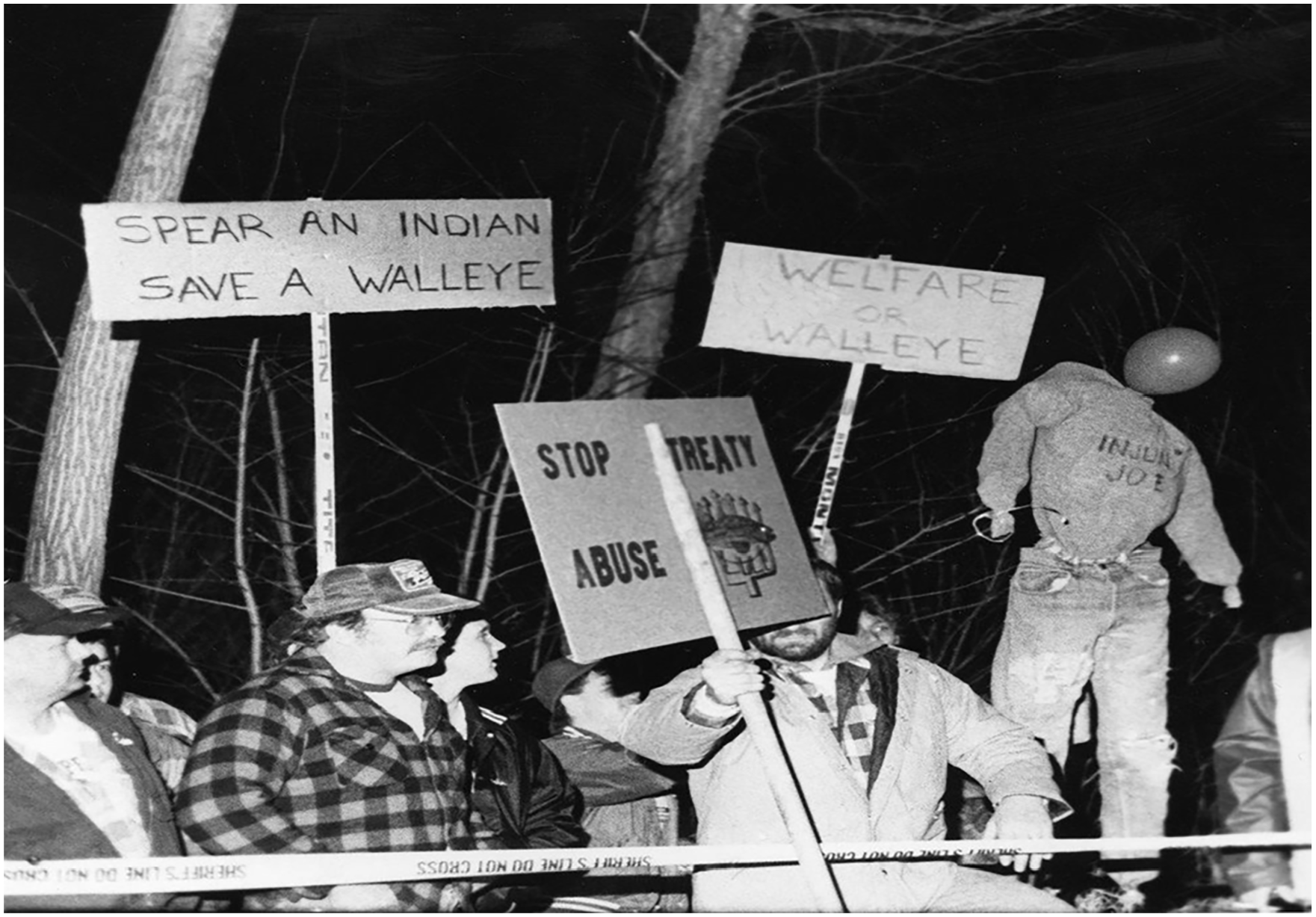
A boat landing in northern Wisconsin in 1989. White settlers gathered by the hundreds to shout-down and intimidate tribal members engaged in spear fishing (Great Lakes Indian Fish & Wildlife Commission, 1989).
The protests began to subside in 1991 after the tribal nation and the state of Wisconsin reached an agreement to forego future legal actions, and a fishery assessment demonstrated that spearfishing did not devastate fish populations such as walleye (Nesper, 2002). As a violent act to eliminate and replace Indigeneity, the Walleye War exemplified how settler colonialism racializes Indigenous peoples—criminalizing tribal cultural practices to dispossess them of lands, resources, and rights (Brayboy, 2005; Wolfe, 2006). The racial animosity and the violence witnessed during the Walleye war over Anishinaabe spearfishing left deep scars, fostering profound mistrust within the tribal community toward Northwoods High School, consequently shaping how students and families perceive and engage with the school.
Northwoods High School
Northwoods High School 2 is located in a small rural city in Northern Wisconsin, the epicenter of the Walleye War. The rural context of the school intensified the historical tensions between the predominantly White settler community and the neighboring American Indian tribal community. Geographical proximity led to unavoidable overlaps in lands and resources. The isolation characteristic of rural areas, combined with a long history of settler-colonial conflict (e.g., the Walleye War), reinforced systemic mistrust and marginalization of the tribal community. This small rural setting often amplified the visibility of racialized interactions and disparities, making them more salient and emotionally charged for American Indian students and their families, who navigated these shared spaces where their presence was hypervisible. Yet, their experiences were often misunderstood or rendered invisible.
As a unified school district, the high school serves students from twelve towns and the reservation of the partnering Anishinaabe tribal band. During the 2019–2020 school year, the school demographic composition was 70.6% White, 21% Native American, 3.2% Hispanic/Latino, 1% Asian, 0.1% Black or African American, and 3.7 % from two or more races (Wisconsin Department of Public Instruction [DPI], 2020). Forty-four percent of students were eligible for free or reduced-price lunch, and 14.9% received special education services (Wisconsin DPI, 2020).
Anishinaabe students attend a K–8 school on the reservation, where American Indian youth predominantly account for the school population. Northwoods High School was the sole option for Native American students to complete their high school diplomas. They were bussed to Northwoods High, where they are the numerical and cultural minority. The state of Wisconsin legislated statutes and rules of American Indian Studies in Wisconsin referred to as Wisconsin Education Act 31. Complying with provisions of Wisconsin Education Act 31, Northwoods High School has provided American Indian studies programs for Native and non-Native students, such as American Indian history, American Indian literature, and Anishinaabe language and culture. These courses cover historical and contemporary issues that American Indian communities encounter, such as assimilation, sovereignty, treaty rights, resistance, and cultural and linguistic heritage loss.
Over the last decade, Northwoods High built a positive relationship with the tribal community. The school hired two American Indian mentors to offer culturally responsive academic and behavioral support for American Indian youth and implemented restorative justice practices to address racial disproportionality. Despite these efforts, stark racial disparities in disciplinary consequences have persisted. Although American Indian students represent only one-fifth of the student body, they accounted for 64.3% of in-school suspensions and 62.8% of out-of-school suspensions during the 2019–2020 school year.
Participants
Since the partnering tribal band did not have an independent tribal institutional review board, we invited an American Indian historian and tribal educators from the Wisconsin Indian Education Association and Wisconsin Department of Public Instruction’s American Indian Studies, along with an American Indian teacher and an American Indian student as advisory board members to develop cultural, political, and historical sensibilities essential to conducting ethically engaged research practices with the tribal community.
From the outset, the Indigenous Learning Lab aimed to establish a transformative participation structure that transcends historically infused power asymmetries to leverage the tribal community’s historical struggles, resistance, ingenuity, and sovereignty (Brayboy, 2005; Vizenor, 2008). Notably, the university research team engaged key figures as school and community liaisons: Kevin, the school principal at Northwoods High School; Jeremiah, an American Indian education mentor; and Lola, a parent and staff member at the Tribal Education Department. The research team and liaisons co-develop specific agendas for each session, including participant recruitment, meal coordination, and meeting space arrangements. While generating a list of potential members with personal experience in discipline incidents and school-family-community relationships, the research team and liaisons also considered sociodemographic balance to better represent existing voices (e.g., race, gender expressions, tribal affiliation, and professional role) within the Northwoods High School community.
The Indigenous Learning Lab sought to transgress the conventional participation structure in educational research, where researchers typically wield overwhelming epistemic power in recruiting participants. Instead, the university research team and liaisons employed a collaborative recruitment strategy, initially identifying a diverse group of eight stakeholders. These initial members, including school staff, community members, and tribal leaders, were then empowered to expand the group in response to their collective needs, goals, and political visions. By the end of the first session, Lab members were encouraged to collaboratively assess whose voices and experiences were missing and identify who should be included in the Indigenous Learning Lab space. Following this discussion, members suggested involving more voices from American Indian students and classroom teachers who encounter and handle behavioral incidents and referrals. As a result, two classroom teachers, Jane and Katie, along with two students, Nick and Andrea, joined the Lab (see Table 1).
Demographic Information of Indigenous Learning Lab Members.

The research team members also participated in the Lab sessions. The principal investigator, Berkin, is a male immigrant faculty of color from Turkey based in the school of education at a local university. The co-principal investigator, Nelson, is an American Indian (Mandan, Hidatsa, and Arikara Nation) male higher education administrator with extensive professional experience in American Indian students’ education issues and university-tribal nation relationships. Alice is an American Indian (Oneida Nation) female graduate student who taught science on a Menominee Reservation. Nelson and Alice brought their experiential knowledge of survivance in the settler colonial systems and expertise in working with Indigenous communities to this partnership project. Despite different tribal affiliations, Nelson’s and Alice’s shared memories of resistance to settler-colonial systems and struggles toward decolonizing futures helped build a political coalition and trust between partnering Anishinaabe community members and the research team. Fay is a White female graduate student with experience in community outreach and coordination of university-community partnerships. Tenaya is a female immigrant doctoral student of color from Indonesia in the special education program and brought knowledge and research experiences that worked with parents of color into the research team. Berkin, Nelson, Alice, Fay, and Tenaya co-facilitated sessions. Other research team members took on the roles of visual ethnographers and participant observers.
Despite our vulnerability and limitations as university-based researchers, the research team participated in Learning Lab sessions with multiple roles. As a group of researchers, we aimed to capture and document complex human interactions, nuanced sociocultural and political local contexts, and the collective social dreaming of possible futures entrenched in speculative systemic design through the Learning Lab. Additionally, we collaboratively developed and refined multiple design artifacts to support members’ critical design activities. As facilitators of critical dialogues, our role in the lab was to ensure that all voices, particularly those from the tribal community, were heard and valued. We facilitated the co-development of inclusive group norms, such as respecting and empowering diverging voices and engaging in honest dialogue while recognizing one’s vulnerability. A key role for the research team was to continuously learn from the participants and each other, helping us critically reflect on our positionality and challenge our own biases and habitual ways of working with people from nondominant groups.
Indigenous Learning Lab Process
We obtained approval from the Institutional Review Board (IRB) and started the study in 2019. The Indigenous Learning Lab sessions began in October 2019 and concluded in May 2020, spanning ten consecutive sessions. After the sixth Lab session, four members (Kevin, Bart, Jeremiah, and Jane) volunteered to form a subcommittee to merge new solutions generated by members. Consent to video and audio recordings of all lab activities was obtained from all participants. The length of the sessions varied between 120 to 180 minutes. Space and power are intertwined through histories and memories (Lefebvre, 1991). Lola, a tribal member, proposed holding the first two meetings on the reservation to ensure American Indian members’ access and disrupt the power differential between school staff and American Indian families. Accordingly, the first two sessions were held at the Tribal Education Department building on the reservation. From the third to sixth meetings, the Indigenous Learning Lab moved to Northwoods High School, where it intended to make a change. Due to the COVID-19 pandemic, members adjusted their medium and conducted the remaining five sessions virtually. Each session followed an agenda collectively determined by the research team members and school and community liaisons. Prior to each session, the research team met with the liaisons to set the agenda and coordinate logistics (e.g., meeting flows). Table 2 outlines the agendas that were purposefully developed to facilitate the speculative systemic design process.
Agendas of Indigenous Learning Lab Sessions.
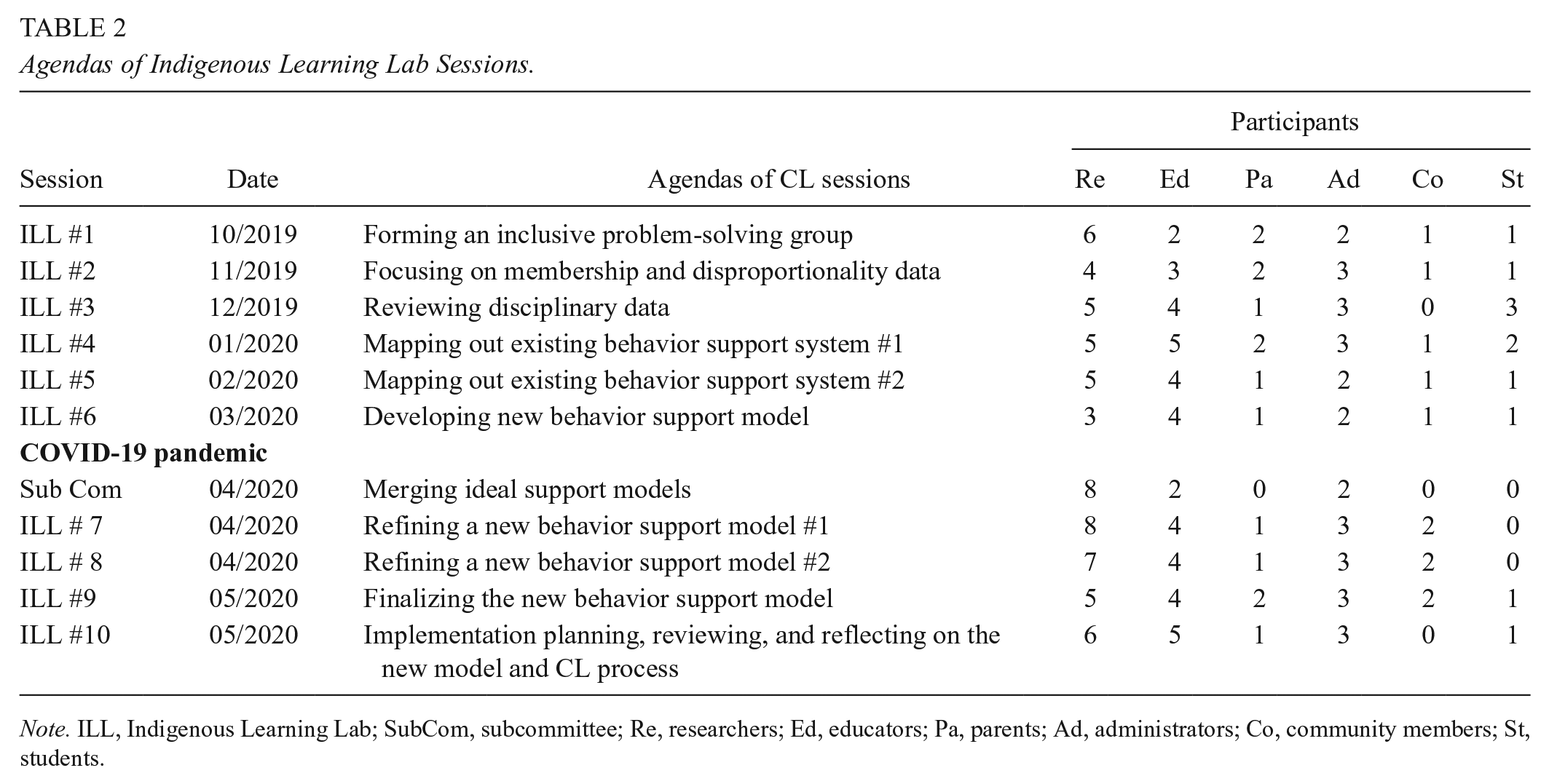
Note. ILL, Indigenous Learning Lab; SubCom, subcommittee; Re, researchers; Ed, educators; Pa, parents; Ad, administrators; Co, community members; St, students.
In sessions one through three, members focused on team formation and trust-building, sharing lived experiences, examining historical contexts, and analyzing academic and behavioral data to develop a contextualized understanding of racial disparities in school discipline. Sessions four and five involved collaborative mapping of the current disciplinary system to identify systemic contradictions and breakdowns. Co-design of new solutions was introduced in session six, where members began generating ideal solutions to address these systemic challenges. This envisioning process continued in sessions eight and nine, during which members refined and concretized their collective designs. Finally, in session 10, members developed an implementation plan and engaged in reflections on their speculative design process.
The Indigenous Learning Lab was intentionally organized to facilitate members’ engagement in speculative systemic design. Supplemental Table 3 presents the speculative design artifacts, task structures, and conversational focuses that enabled Lab members to engage in dialectic speculative design—that is, situated problem identification and the co-design of localized solutions. To facilitate a situated problem identification and unpack systemic contradictions embedded in the existing discipline system, members engaged in multiple activities mediated by design artifacts. Students, families, teachers, and community members shared lived experiences with discipline-related issues, revealing how the existing system disproportionately impacted American Indian students. They also collectively reviewed disciplinary data disaggregated by race, revealing racial disparities in school discipline. This collective conversation with empirical data helped develop a shared understanding of systemic inequities and challenged narratives of neutrality often perpetuated in settler-colonial systems. Members examined the existing behavioral response plan and student handbook to analyze the current support system. Additionally, members collaboratively engaged in mapping the school’s discipline system, creating an interactive map to visualize the discipline system’s structure, procedures, key actors, and systemic breakdowns. The interactive map of the existing system served as a stabilizing artifact and a container of members’ solutions and innovations. The map, along with shared narratives from the problem-identification phase, served as a critical tool for speculative design. Guided by reflective questions such as “How can we create a culturally responsive, proactive, inclusive, positive, and supportive system?” and “Where can stronger support between families and school staff be fostered?” members utilized the interactive map to explore root causes of systemic injustice and collaboratively envision actionable, locally meaningful solutions. These solutions were iteratively refined to address specific challenges across different spaces, including classrooms (e.g., the integration of restorative practices to repair relationships), administrative offices (e.g., trauma-informed responses to handle behavioral incidents), and community settings (e.g., holding parent-teacher conferences on the reservation to rebuild trust), ensuring alignment with the unique needs and historical context of the school community.
Data Generation
Data collection began in September 2019. The research team used three video cameras to capture multiple angles. For virtual sessions, the research team utilized audio and video recording features of online communication platforms. In total, the sessions generated 24.5 hours of video-recorded data. Recordings were transcribed by research team members right after each session. Transcriptions from the previous sessions were used to examine process dynamics in the co-design process (e.g., asymmetrical power relations) and inform the agendas for subsequent sessions.
We employed ethnographic field notes to vividly document physical settings, dialogues, nonverbal interactions, and movements that camera angles cannot take. For example, video cameras could not capture the subtle discomfort of White administrators when addressing racially sensitive topics such as the overrepresentation of Indigenous youth in school disciplinary actions and the gap between American Indian and White youth in ACT scores. Our field notes helped us grab these nuanced emotional changes among participants. During the Indigenous Learning Lab, we observed and recorded physical settings of meetings and members’ actions (e.g., collaboration, decision-making) and interactional dynamics (e.g., nonverbal communication, resistance). Initial field notes taken during the sessions were later fleshed out by additional theoretical or methodological ideas, reflections, questions, and initial analysis of field notes. Preliminary analysis of the field notes helped conduct purposeful observations with focal points in the following sessions. For instance, defensive responses by White administrators (e.g., denying complicity in systemic racism or framing racism as a relic of the past rather than ongoing injustice) observed during the first two sessions helped the research team focus on how members engaged in genuine racial talk beyond the defensive reactions in later sessions. Additionally, we collected multiple forms of artifacts (e.g., visual representation of activity system analyses, existing school discipline policies, codes of conduct, restorative justice implementation policies, and school photographs).
Data Analysis
Data analysis was conducted concurrently with data collection by the first and second authors. Our analysis was grounded in a historicized, spatial, and intersectional lens to avoid oversimplification and decontextualization of the complex human experiences and systemic challenges within the settler-colonial context. This analytic approach was purposefully employed to challenge color-neutral tendencies, which often ignore or erase the intricate histories of racial relations in the United States (Bonilla-Silva, 2006). This framework guided us in coding and interpreting the data, ensuring a nuanced understanding of Lab members’ lived experiences as they navigated, worked within, and resisted the settler-colonial school system.
First, transcriptions were inductively coded using an open coding process. Multiple coding strategies were employed to deepen the analysis. For example, process coding, which uses gerund (the -ing form of verbs, e.g., “amplifying marginalized voices,” “disclosing systemic contradictions”), was utilized to foreground actions, reactions, and interactions, revealed during the co-design process (Saldaña, 2016). In vivo coding was also applied to honor and respect the participants’ narratives by incorporating their verbatim expressions (e.g., “they only follow Native kids”). Additionally, value coding was used to capture participants’ values, ideologies, and attitudes—explicitly or implicitly embedded in their actions, interactions, and utterances (e.g., racial ideologies; Saldaña, 2016). The initial codes and our interpretations were discussed in team meetings to address differences and achieve consensus. Any discrepancies were resolved through dialogue and by revisiting the data within its original context.
In the second round of coding, we conducted a pattern coding strategy to categorize data chunks based on their conceptual similarities and differences (Miles et al., 2019). In the third round, thematic coding was used to organize the categorized data into coherent themes. During the third session, members, for instance, shared their experiences related to school discipline. Andrea highlighted how school is a racialized space in which students experience different treatment along the color line: Andrea (American Indian student): I was pretty pissed. Because I know a fact, they would not do that [office discipline referrals] to some White kids. They would not. They [school staff] would tell them [White students] “oh yeah, you can do better.” They would not suspend a White kid for that.
Using the process coding, we coded Andrea’s remarks as “criticizing different treatment.” Coupled with other coded data chuck including members’ criticizing or problematizing utterances, the coded data were categorized into “analyzing system and historical development of practice to reveal the source of contradiction” in the second round of coding. This categorization was based on how Andrea’s experience revealed the ideological construction of race and its impact on school staff’s disciplinary actions, which ultimately contributes to the emergence and perpetuation of disproportionality. In the final thematic reorganization, these categorized data were grouped under “amplifying voices to divulge settler colonial oppressions.”
To ensure the trustworthiness of our findings, we engaged extensively over three years in various research sites, including the tribal community, a K–8 public school on the reservation, and Northwoods High School. This prolonged engagement allowed us to deeply immerse ourselves in the research context. We employed data triangulation by comparing transcriptions, field notes, and multiple artifacts such as photos, school policies, and student handbooks. Additionally, we validated the initial interpretive accuracy of our interpretations by discussing emerging codes, themes, and theoretical links connections with research team members and receiving their feedback during the team meetings. For instance, two Indigenous research team members—Nelson, the third author, and Alice, a former science teacher on a neighboring tribal reservation—played critical roles in validating and challenging our interpretations. Their feedback encouraged us to revisit and address cultural nuances that had been overlooked in our initial interpretation of data, thereby enriching the depth and accuracy of our findings.
Positionality
As two immigrant scholars of color and an Indigenous scholar affiliated with universities on ceded land, we collectively acknowledge the original sin of the university’s benefits through the erasure of Indigeneity and the production of knowledge that legitimizes settler-colonial power and property. We also recognize that educational research practices have historically been complicit in perpetuating settler colonial marginalization that “often works to collect stories of pain and humiliation in the lives of those being researched for commodification” (Tuck & Yang, 2014, p. 223).
Informed by humanizing research practices (Paris & Winn, 2014), decolonizing methodology (Smith, 2012), CHAT grounded in Marxist historical materialism (Cole, 1996; Engeström, 2016), and Freirean critical pedagogy (Freire, 2000), we collectively embrace a positionality that emphasizes collective human agency and the voices, everyday resistance, and ingenuity of marginalized communities. Through this critical lens, we have engaged in community-driven research projects aimed at counteracting harmful research practices that narrowly focus on developing technical, product-oriented policies, programs, and practices as remedies for addressing historically charged, systemic, and spatially divergent social injustices, often without the deeply considering the historical and politicized contexts of inequities (Ko, Bal, Lim, et al., 2023b). Instead, we prioritize organizing inclusive, dialogic spaces with local school communities to support their speculative future-making efforts—leveraging historical narratives (i.e., past) to bring possible alternative worlds into organizing and acting toward new sociopolitical futures in the present.
Results
In this section, 3 we present how Indigenous and non-Indigenous school community members at Northwoods High School engaged in speculative systemic design to dismantle the punitive school system. Notably, this section will focus on how they leveraged Indigenous knowledge to build a politicized coalition. Additionally, we will detail how the Indigenous Learning Lab amplified the voices, experiences, and cultural knowledge of school community members, enabling them to disclose systemic challenges within the present settler-colonial school system, and how participation in the Lab galvanized their speculative imaginations toward a decolonizing and inclusive future.
Centering Indigenous Knowledge for Building a Politicized Solidarity
Speculative design toward decolonizing futures began by breaking away from conventional knowledge production practices that often exoticize and silence Indigenous voices. A decolonizing theoretical approach served as an ethical guideline for the university research team to build reciprocal partnerships with Indigenous peoples and embrace their historical experiences, cultural knowledge, and worldviews as foundational to speculative systemic design. In preparation for the Indigenous Learning Lab sessions, the research team dedicated two years to developing trust and building a reciprocal relationship with the partnering tribal community.
Nelson, an American Indian member of the research team, suggested a culturally responsive way of relationship-building with tribal communities by offering asema—ceremonial tobacco—to elders and tribal officials as a sign of respect and to seek their permission and support for the project. In many American Indian communities, asema is used to convey respect and gratitude, particularly to elders. The research team presented asema as a gift to open up conversations with tribal community members, inviting their collaboration and active engagement in the Indigenous Learning Lab project. Asema is traditionally smoked in Opwaagan (pipe) ceremonies, where “tobacco is used as a spiritual medicine for the healing of mind, body, and spirit” (Brokenleg & Tornes, 2013, p. 12). It can also be used in smudging practices to energetically cleanse or purify negative thoughts and spiritual harm.
Addressing disproportionality as a racialized injustice requires collaborative problem-solving, collective moral responsibility, and critical dialogue about racism, whiteness, settler colonialism, and sovereignty. However, intergenerational colonial violence and trauma, coupled with the historical negation of tribal sovereignty, resistance, and exclusion of tribal voices in the school decision-making, have deepened the tribal community’s distrust toward the settler-colonial school system. As depicted in Figure 3, members began each session with Opwaagan and smudging rituals to dispel negative thoughts and emotions (e.g., mistrust) and invite positive energy, such as honesty and integrity, into the meeting. Jeremiah, an American Indian education mentor at Northwoods High, led these rituals, lighting traditional herbal medicines to fill the meeting space with healing energy from historical injuries resulting from settler-colonial trauma and racial conflicts, dilemmas, condemnations, and double binds. The use of Opwaagan and smudging rituals represents a reclamation of Indigenous cultural practices and serves as symbolic acts that validate Indigenous presence while creating a healing space from settler colonial harms in places from which they have been historically excluded. Jeremiah’s statement illustrated the profound emotional and cultural meanings of these rituals, particularly in reclaiming spaces marked by settler-colonial harm: Jeremiah (American Indian education mentor): Thank you for letting me do this again. It is an honor to be here. It’s the first in my culture and ever I’ve never thought I would be able to do this in this room here. This was the principal’s room when I went to school here. So, it’s a first for me and it’s an honor to bring these [smudging] items out to a place that never really had good feelings here at school. So, we’re breaking ground and we’re breaking things that need to be done long time ago (Session #3).
Jeremiah’s words emphasize the historical weight of the room itself, once a symbolic space of Indigenous erasure through exclusionary practices, and how these rituals transformed it into a space of healing and empowerment. By leading Opwaagan and smudging rituals, he and other Indigenous members reclaimed spaces and their presence within the school, laying a foundation for trust-building and meaningful collaboration.

Traditional supplies for Opwaagan (pipe) smudging ceremonies.
American Indian members suggested to use the Anishinaabe communities’ “Seven Grandfathers Teachings” as guiding principles for creating a positive and productive problem-solving space in the Indigenous Learning Lab. The Seven Grandfathers Teachings represent Anishinaabe people’s moral or ethical conduct or behaviors toward living others, which is orally passed down through stories or oral narratives. The Seven Grandfathers Teachings include Dbaadendiziwin (humility), Aakwa’ode’ewin (bravery), Gwekwaadziwin (honesty), Nbwaakaawin (wisdom), Debwewin (truth), Mnaadendimowin (respect), and Zaagidwin (love). Before members engaged in racial discussions about disproportionality outcomes, Jeremiah, an American Indian education mentor, presented how the Seven Grandfathers Teachings could serve as an ethical compass to guide the systemic design process. He emphasized how these teachings could support transformative work by helping members navigate difficult conversations with respect and courage. Following this presentation, the American Indian members leveraged these cultural artifacts to acknowledge and appreciate the non-Native members’ bravery and honesty in engaging in genuine forms of racial talk beyond White anger or White guilt—defensive behaviors and emotions (e.g., fear, silence), often witnessed in racial conversations about systemic racism and White privilege. Jeremiah also explicated the historical trauma embedded in the school system and how the collective endeavor through Learning Lab aligned with the wisdom (Nbwaakaawin) of the Seven Grandfathers Teachings: Jeremiah (American Indian education mentor): This school has been broken for many years since I was here. We have a lot of kids, well not kids. But adults here that have gone to school and saw a lot of trauma things here that I never would imagine. . . . We’re building that barrier [Beaver’s dam], so we can stop the bleeding of all the trauma, so that we can make it a lot better. This young lady right here [Jane], being a non-member coming and being accepted for what she does, that’s wisdom [Nbwaakaawin] (Session #5).
The Seven Grandfathers Teachings were leveraged to tap into the communities’ wealth of knowledge and promote an ethical sensibility toward “politized trust” (Vakil et al., 2016)—“establishing trust with community partners, especially in communities that serve students from nondominant groups, requires not only a personal working relationship but also a political or racial solidarity” (p. 199)—which is critical to disrupt the settler-colonial arrangement of power and privilege.
Amplifying Voices to Divulge Settler-Colonial Oppression
To dismantle the ideological, political, and material power of White settler-colonialism, which reinforce and perpetuate racially stratified opportunities to learn and outcome disparities, de-centering settler-colonial ontology and epistemology is a starting point for healing spiritual wounds and addressing the marginalization of American Indian communities (Brayboy, 2005). Within the Indigenous Learning Lab, the voices and lived experiences of Indigenous members within settler colonial reality acted as critical catalysts for revealing (in)visible settler-colonial oppression and marginalization.
The school frequently relied on aggregated academic achievement and discipline data, which often mask racialized disparities in academic and behavioral outcomes. During the initial session of the Indigenous Learning Lab, the principal presented data concerning academic achievement, graduation rates, and disciplinary actions. However, tribal community members pointed out that such aggregated data fail to provide an accurate diagnosis of the current state at Northwoods High School. They criticized this color-neutral approach, emphasizing its inadequacy in unpacking the nuanced realities faced by different racial groups within the school: Kevin (White principal): One hundred ninety-seven students in our school that had one or more disciplinary referrals, this is last year’s numbers, 100 with two or more, 57 with three or more. There are obviously some students who are repeatedly being referred to the office for multiple times by multiple teachers. Diana (parent, tribal community member): About how many of those are Native students? Kevin: You know I didn’t break that slide down . . .
School’s reliance on statistical data, which is not disaggregated by race, may inadvertently reinforce the White logic embedded in color-evasiveness (Gillborn, 2010). Such assumed objectivity of statistics may be used as “the epistemological arm of White supremacy” (Zuberi & Bonilla-Silva, 2008, p. 332). In this context, Diana challenged the administrators’ data use practice, which merely tracked school discipline outcomes for all students collectively. She also urged members to embrace a race-conscious lens to make invisible racial disparities, obscured within the seemingly deracialized statistical data, visible. Responding to tribal members’ requests, school administrators broke down school discipline into disaggregated data by race and grade for the second meeting. Facilitators then used this disaggregated data as a critical tool to unmask materialized forms of racialized opportunity and outcome disparities.
Members drew upon settler-colonial histories of racial tensions and their experiences for critical dialogues about racism, White supremacy, and everyday struggles to develop a situated and historicized understanding of historically evolving challenges within the settler-colonial system. During the first session, Diana, a parent and tribal community member, shared a story about her nephew’s experience, illustrating how racial profiling and systemic racism permeate the broader community and how such racial surveillance profoundly affect the daily lives of Indigenous individuals: Diana (Tribal community member): My nephew moved up here from Zaya. . . . He’s a big brown boy. He moved up here. He got stopped by three cops. They surrounded him. They tried to find a reason to write him a ticket or take him to jail. He never experienced such a thing. He works for the city for their parks in the roads department. They try to say, “Well, the Indians are killing off all the muskies.” Well, there’s still muskies in the lake. They don’t even eat their muskies. But now he’s starting to experience this racism that we experience all the time. (Session #1)
In another session, Hannah, an American Indian teacher at a K–8 public school on the reservation, recounted her personal experiences with racial profiling in everyday settings. Her story underscored the pervasive culture of surveillance and its emotional toll: Hannah (American Indian teacher at K–8 public school on the reservation): I’ve gone into Wall-Mart and have been really watched closely because I’m brown-skinned. I have never stolen anything. . . . It causes anxiety and anger. (Session #3)
Here, Diana’s and Hannah’s experiential knowledge illustrate how the criminalization of Indigenous bodies and the pervasive culture of surveillance in larger society constitutes an inhospitable sociopolitical context of learning and development, leaving American Indian students vulnerable to traumatic experiences perpetrated by everyday racism.
Hyper-surveillance and hyper-punishment have been employed as tools to pathologize and criminalize students who deviate from the assumed, naturalized norms of White able bodies and minds (Annamma, 2018). This carceral logic disproportionately targets American Indian students, creating a hostile learning environment. During the third session of the Indigenous Learning Lab, American Indian students shared their firsthand experiences illustrating this culture of surveillance, which renders them disproportionately hypervisible and hyper-punishable: Andrea (American Indian student): They have hall monitors here. When we’re in class, there’s people walking the halls to see if there’s kids skipping classes. Nick (American Indian student): If you’re walking down the hallway, they’ll see a Native kid. And they’ll be like, “where’s your pass?” Andrea: If they see a non-Native kid, they just won’t say anything. But the second they see a Native kid, then “oh . . . go to the office.” That happened to my sister before. She got suspended. There’s a good reason why she got suspended because she was mouthing off. She was walking the halls. She had a pass. The hall monitor kept following her. She kept saying quit following me like: “Why are you following me?” I have a pass. So, she kept telling him like stop following me. He just kept following her. Then she got mad. She started saying things like “It’s only because I’m Native.” (Session #3)
Nick and Andrea’s narrated experiences reveal how macro-level social structure and racial ideology deeply seated in the broader society—for example, Indigenous bodies’ criminalization fed by racism that favors whiteness—mediates school staff’s perceptions and interpretations of American Indian students’ behaviors in daily interactions and makes Indigenous youth more vulnerable to increased profiling and policing.
Mapping Out Invisible Racialized Infrastructure of Learning
In the Indigenous Learning Lab, members critically analyzed the existing behavioral response plan and student handbook to identify systemic challenges inherent in the present system. Notably, members engaged in mapping out—often invisible—a school system with guiding questions such as: What is the current discipline system? For whom? What is the purpose of the current system (behavioral support vs. punishment)? What is working/not working in the current system? Facilitators used these guiding prompts to catalyze a deeper identification of systemic challenges in educational artifacts (ideal, material), rules, policies, practices, and division of labor within the discipline system, which had functioned as an invisible infrastructure in (re)producing and perpetuating disproportionality.
Figure 4 illustrates a collective epistemic inquiry into systemic contradictions within the Northwoods discipline system. During the fourth session, the research team collaboratively worked on visualizing systemic breakdowns identified by members. This visualization was then used as a tool in subsequent sessions to help members deeply delve into the conflicts and tensions in the existing system.

Collaborative analysis into system mediated by visualized systemic breakdowns.
Members identified a critical systemic challenge: The absence of schoolwide agreed-upon behavioral expectations or clear definitions for minor behavioral infractions (e.g., insubordination, disrespect), which often led to staff exerting subjective judgments. During the fourth session, Jane, a White English teacher, shared her perspective on how these inconsistencies manifested in daily disciplinary practices: Jane (White English teacher): I think teachers react differently to different behaviors. I probably give kids more chances in my classroom. If the kids [are] disrespectful to me, I’m not gonna immediately like boot them. . . . But there are some teachers that I know [who say] kids [are] disrespectful. You’re out, right? I feel like it needs to be more consistent, and teachers need to be more consistent across the board about having conversations. . . . Maybe the teachers [are] sometimes disrespectful to the kid. (Session #4)
Jane’s utterance highlighted how the absence of schoolwide behavioral expectations and ambiguous definitions of minor infractions creates a vulnerable decision-making point. At this juncture, teachers may be susceptible to their implicit biases when interpreting students’ behaviors and making disciplinary decisions (Smolkowski et al., 2016).
A culturally unwelcoming and punitive disciplinary system in response to trauma-induced behavioral infractions may retraumatize American Indian students already suffering from traumatic stress. During session #4, members also recognized the necessity for trauma-informed care and culturally responsive relationship-building efforts to prevent retraumatization through discipline actions that are trauma-insensitive and culturally irresponsive. Jeremiah, an American Indian education mentor, elaborated on how the interplay of historical trauma, school discipline, and racial tensions can escalate negative outcomes for Indigenous students: Jeremiah (American Indian education mentor): Because they have the trauma from history. When you put that those two things [Walleye War and intergenerational trauma] on top of this [school discipline], [it] becomes more resentful. Then the race card comes up. A lot of this when you get into the in the major part with, the first thing a kid says [is], “You’re racist because I’m Indian.” And then the school’s like “whoa, timeout” Then we come into damage control. And we have to reverse a factor explaining ourselves instead of saying okay. (Session #4)
Here, Jeremiah leverages his experiential knowledge and emphasizes a historicized and situated epistemology. He illustrates how historically accumulated contradictions (e.g., cultural erasure, marginalization in employment, health care, and housing) constitute detrimental developmental contexts that leave American Indian youth particularly vulnerable to exposure to historically sedimented traumas. The absence of nuanced analysis of cumulative settler-colonial harms in shaping American Indian youth’s lived experiences and entailing race-neutral reactions (i.e., school discipline) further marginalize youth through retraumatization.
Figure 5 presents systemic breakdowns embedded in the existing discipline system.

Systemic breakdowns as manifestations of systemic contradictions in the existing system identified by Indigenous Learning Lab members.
Galvanizing Speculative Imaginations Toward Decolonizing the Future
Speculative world-making needs concrete, materialized impacts that empower people coming from historically marginalized communities to exercise their agency and sociopolitical future imagination by problematizing the current arrangement of power and re-envisioning justice-oriented and transformative reality (Tuck & Yang, 2012). Members utilized their speculative future imaginations to redress the dysfunctional system.
Indigenous Learning Lab members utilized their speculations to restructure the dysfunctional system. Facilitators encouraged members to envision ideal solutions or innovations without initially considering the practicality and feasibility of these ideas. The system map, created through collective analysis of the system, functioned as a design artifact. The map enabled members to channel their future imaginations, educational aspirations, and perspectives into a dialectical process—turning systemic challenges into collective developmental opportunities for crafting a new, culturally responsive behavioral support system (Bal et al., 2018). To integrate individual members’ solutions and future imaginations into the collective design effort, the Indigenous Learning Lab adopted a working definition of “cultural responsiveness” that is inclusive, positive, preventive, locally meaningful, practical, and honoring the Seven Grandfathers Teachings. The speculative visioning process unfolded iteratively across sessions, with members engaging in envisioning activities beginning in session six and intensifying in the later stages, particularly during sessions seven through nine.
Members recognized the urgent need to restore relationships and rebuild trust between the school and the tribal community, which had been strained by the enduring and harmful impacts of settler-colonialism. As part of the speculative design process, they envisioned strategies to foster meaningful connections and address historical harms. They envisaged active community outreach strategies, such as holding parents/teachers conferences on the reservation and encouraging active family engagement through extra-curricular activities. Jane, a White English teacher, shared her reflections during the sixth session, emphasizing the importance of confronting the school’s negative history and reimagining its relationship with the tribal community: Jane (White English teacher): We talked about increasing teacher community relationships. So, getting out into the community. We talked about taking parent-teacher conferences to the tribal community. So, we are meeting there and we talked a lot about the history of this building and the negative history. . . . But we’re focusing specifically on American Indian relationships and gaps that might be something that we would do consistently and try to future-making some of that and kind of build that trust and that relationship (Session #6).
Jane’s speculation to restore broken relationships illustrates how members employ a historicized lens to reimagine new social relations, essential for counteracting settler-colonial harms such as the mistrust between the school and the community.
During the seventh, eighth, and ninth sessions, members scrutinized the dynamics of new solutions and discussed the need for additional innovations, culminating in the finalization of a newly designed support system. The system, initially envisioned through session six, was further enriched and concretized through collective examination. Members used spaces representing interacting multiple systems as an analytic axis to critically assess and enhance the newly developed system.
The collaborative examination began in the classroom, where students’ behavioral incidents and teachers’ reactive actions mainly take place. Particularly, members emphasized the need for mentoring support for novice teachers, whose lack of culturally responsive classroom management practices could bring about being called “racist” by American Indian students: Carson (White social worker): Unfortunately, we have a tremendous history to overcome. That’s no fault of the new teacher. I feel like we can be more intentional about the conversations that we have with new teachers to support them. Because it can be a very traumatic event when somebody calls you racist in front of a group of students. . . . . Directing challenging our teachers and our departments to have an ongoing dialogue with Ms. Adler or Jeremiah so that they are on the front line when that teacher has that negative experience. So that they can support them in moving forward. (Session #7)
White teachers’ unexamined racial ideologies and color-evasive pedagogical and interactional practices can lead to a struggle to care and can damage relationships with students and their families. Carson’s reflection acknowledges the enduring legacy of settler-colonialism, which continues to shape how American Indian students experience racialized interactions in schools, often culminating in disciplinary situations. Here, Carson envisions mentoring support offered by American Indian education mentors as a mechanism to help White teachers navigate these challenges, develop culturally responsive practices, and cultivate a nuanced understanding of settler-colonial trauma and its lingering impacts. This speculative solution aims to foster positive relationships and mitigate the harms perpetuated by settler-colonial structures on Indigenous students.
The research team identified that members’ problem-identification and problem-solving processes easily become reduced to the development of mechanical or technical solutions if they focused on purely the behavioral system itself without authentic critical dialogues on ongoing historical trauma, struggles for cultural and linguistic survival, and racialized outcome disparities. To promote members toward speculative co-design of solutions that address the harmful legacy of settler-colonial histories (e.g., cultural loss) and honor educational sovereignty of tribal community, Nelson, American Indian co-facilitator, introduced notions of “respect,” “revitalization,” and “reconciliation” as guiding design principles. During session #8, the research team employed three design artifacts: a list of innovations, a classification of systemic challenges by spaces, and a mapped analysis of the Northwoods discipline system. These design artifacts facilitated the critical examination and strengthening of ideal solutions while identifying remaining areas for improvement.
Recognizing the profound effects of historical trauma on American Indian students, members identified the need to adopt a trauma-informed care approach to mitigate the detrimental impacts of historical trauma. Members underscored offering trauma-informed behavioral support training for teachers, which would enable classroom teachers to apply for trauma-sensitive behavioral support on a daily basis. During the eighth session, Gwenwyn, a White director of special education, reflected on her experience with trauma-sensitive school modules and highlighted the urgency of expanding such training to all staff members: Gwenwyn (White director of special education): I’ve had the special ed department doing the trauma-sensitive school modules. We’ve got a social worker who’s been facilitating those meetings and things. As I’ve been going through those modules with them, I think “Oh my gosh, our entire staff needs to go through this because to truly implement a plan, that is sensitive to the needs of our students.” (Session #8)
Gwenwyn drew on her positive past experience to enrich and solidify the initial idea of trauma-informed care, envisioning future training for teachers as a possibility to help teachers build positive relationships and strong connections with students and prevent re-traumatization through the use of a trauma-sensitive lens in their everyday interactions. This focus aligns with the Indigenous Learning Lab’s goal of developing a new support system that attends to the broader historical and cultural contexts shaping students’ experiences.
Since the ninth session focused on addressing the community-school and school-outside agency relationships, members engaged with the following guiding prompts: “What can we do to improve our communication?” “What are some solutions for improving communication?” “How can we use prevention to achieve XYZ?” “What can we do to build better relationships?” These reflexive prompts encouraged members to speculate locally meaningful solutions that could strengthen communication and relationships between the school, the community, and external agencies.
Members’ speculative design involved utilizing community resources—for example, hatcheries, American Indian amphitheater grounds for powwows, tribal community centers, tribal resources departments, and tribal museums—as relationship-building tools to expand the school-family partnership. These resources were also envisioned as a means to educate students about tribal cultural practices (e.g., spearfishing, harvesting) and American Indian history: Jeremiah (American Indian education mentor): I think it also would be a great opportunity to travel to the hatchery department. I mean, being that a lot of our tribal kids are harvesters and [they’re] hands-on, that would be a great opportunity to interact. Again, like just before we were this issue that we’re dealing with is we had talked to the natural resource director, Mr. Robinson, . . . and we were brainstorming on doing some hatchery-based learning where we’d be incubating walleye eggs in [a lake], in the science wing there. (Session #9)
Jeremiah sought to leverage a hatchery on the reservation, which symbolizes historical suffering and resistance, to keep traditional spearfishing (e.g., Walleye War) as an educational resource for future generations. In his speculative future imagination, the collective experiences of the past (e.g., denial of treaty rights on ceded lands) become a source for devising future-oriented tools that promote intergenerational knowledge transfer and foster reconciliation between the school and the tribal community.
Figure 6 depicts the new behavioral support system co-designed by school community members throughout the speculative systemic design process. This model consists of four main components: a preventive support plan, a behavioral incidents response plan, a restorative process plan for post-incident resolution, and a school-community relationship-building plan. The preventive support plan includes actionable solutions to support both students (e.g., peer support groups, providing transition support for the freshman from K–8 school on the reservation) and teachers (e.g., cultural training offered by tribal community members). The behavioral incidents response plan, for example, incorporates multileveled de-escalation strategies, trauma-sensitive administrative disciplinary actions, and the active involvement of mediators during disciplinary situations (e.g., American Indian education mentors for Indigenous youths). The restorative process plan involves restorative justice strategies such as restorative circles and reentry meetings after returning from discipline to repair broken relationships and reintegrate students into the classroom community. Finally, the school-community relationship-building plan focuses on increased community outreach (e.g., holding a parent-teacher conference on the reservation) and strengthening partnerships with the Tribal Education Department. Expanded communication, prevention, and restoring relationships guide the enactment of new solutions as ethical compasses to offset settler-colonial harms such as mistrust and racialized outcome disparities.

New culturally responsive behavioral support system designed by Indigenous Learning Lab members.
Discussion
Building upon a rural school community’s transformative endeavor to dismantle the settler-colonial punitive system, this study aims to showcase the potential of community-driven speculative design led and owned by local school stakeholders. The Indigenous Learning Lab sought a democratizing form of inquiry to leverage the resistance, ingenuity, and sociopolitical imagination of native and non-native stakeholders for decolonizing futures. In this study, the Learning Lab aimed to re-center tribal knowledge systems, sovereignty, cultural resources, and critical historicity to facilitate speculative design efforts by refusing the prevailing metanarrative of damage. Conventional remediation-centered intervention projects on American Indian communities often foreground pain, loss, and a deficit of historically marginalized communities, then impose remedial interventions, programs, and technical assistance developed and owned by external epistemic subjects (i.e., researchers; Tuck, 2009).
In this speculative design process, centering Indigenous knowledge systems started with culturally responsive partnership building. The Indigenous Learning Lab used Anishinaabe cultural knowledge, such as ceremonial tobacco and Seven Grandfather Teachings, as symbolic tools to build a culturally responsive and mutually respectful partnership with tribal community members and educators and to develop “politicized trust” (Vakil et al., 2016) with shared emancipatory agenda among members. In this study, honoring and centering cultural heritage and Indigenous knowledge(s) functioned as a cornerstone upon which nontribal university-based researchers and both tribal and nontribal members further engaged in continual dialogues for developing a long-term commitment and shared visions and goals essential for sustainability and tribal community’s ownership of the transformative project.
In the critical dialogic space, American Indian students, families, and tribal elders used their future-forwarding speculations to craft counternarratives of hope, tribal sovereignty, and sociopolitical future imagination. These narratives helped develop a historicized and situated understanding of settler-colonial educational realities and reimagine transformative future possibilities. Particularly, individual and collective testimonies of American Indian students and families enabled members to develop a historicized lens of the sociocultural and political organization of the learning environment as historical sediments of settler-colonialism. Stories of everyday struggles and resistances served as mirroring artifacts to divulge invisible systemic challenges entrenched in the current system. Furthermore, members’ re-storytelling about possible futures was a driving force to restructure the inequitable learning environment for transformative outcomes dialectically.
More specifically, the historical epistemology and embodied experiential knowledge of Indigenous students and families enabled participants to develop a critical understanding of the current school system as a sociocultural and historical context at the nexus of sociocultural, ontogenetic, and microgenetic planes (Cole, 1996). Behavioral incidents and the corresponding reactions of school staff occurring on a microgenetic (moment-to-moment) plane demands a deep understanding of the developmental histories of students, administrators, and teachers and a critical analysis of how White settler-colonialism has historically formed institutional policies, discipline response tools (e.g., teachers’ classroom management toolbox), and daily interactional practices (e.g., lower expectations and bias). Personal and collective narratives from students, school staff, families, and community members helped both Native and non-Native members to critically reflect on the centrality of whiteness in education (e.g., criminalization of Indigenous bodies and minds). These embodied experiences promoted a historicized, situated understanding of the tribal community’s everyday resistance and resilience. Those critical reflections served as catalysts in speculating alternative stories and futures.
To dismantle well-established ideological and material structures grounded in settler-colonialism, transformative cartographic work must be initiated to pave uncharted terrain by breaking away from the stabilized settler-colonial system and in the Learning Lab, administrators, teachers, students, families, and community members engaged in speculative world making by becoming co-designers of their possible futures. Multiple design artifacts were used to “stimulate involvement, analysis, and collaborative design efforts among the participants” (Engeström, 2016, p. 64). Academic and behavioral data, along with narratives from educators, students, and families, were utilized as a catalyst to promote participants’ speculative co-design. These design artifacts helped members critically reflect and develop diachronic and synchronic understandings of how White-settler-colonial history has dwindled the learning opportunities of American Indian youth through the negation of tribal educational sovereignty, ongoing traumatic experiences in school, and the perpetuation of negative biases and stereotype threats (e.g., low expectation, conflation with special education recipients). The existing discipline system map and student handbook were critical design artifacts to facilitate collaborative analysis into the root causes of systemic contradictions that yield racial disproportionality in exclusionary school discipline. Systemic challenges and solutions generated by members were mobilized as design artifacts through which members envisioned and examined a new behavioral support system, addressing racial disproportionality and creating an inclusive school climate for all students.
Despite collective problem-solving efforts and a shared commitment to transforming the punitive school system and repairing settler-colonial harms between the school and the tribal community, this study reveals the complex discursive dynamics between non-Indigenous and Indigenous members. While White teachers and administrators focused their speculative design on more technical and operational aspects (e.g., improving teacher training and promoting consistent behavioral expectations), these solutions may not adequately address the root causes of the problem. Technical and operational solutions may be practical to address daily manifestations of systemic contradictions. However, they are insufficient and often function as color-evasive tools, further marginalizing students and families who have already been disenfranchised by racialized systems (Annamma et al., 2017; Bonilla-Silva, 2006). Instead, Indigenous members actively drew upon their cultural knowledge and historical narratives of resistance and survivance within settler-colonial systems to foreground the urgent need for healing from historical and ongoing settler-colonial harms, as well as reclaiming the educational rights of their children. This nuanced difference and the dynamics observed during the speculative co-design process underscore the importance of amplifying diverse perspectives within the school community, particularly the voices of students and families from historically marginalized communities. Beyond developing technical and functional solutions, leveraging the strengths and narratives of these communities can help design equity-oriented solutions grounded in deep cultural, historical, and spatial understandings of the root causes of inequities (Ko, Bal, Lim, et al., 2023b).
Limitations
Due to the scope of this paper, the present study did not include the implementation process of the newly designed support system. After the design phase, the Northwoods High School community organized the implementation team to lead and evaluate the implementation process. A principal, a vice principal, an American Indian education mentor, the director of the Tribal Education Department, a school psychologist, a school social worker, a veteran teacher, and two American Indian students participated in the implementation team. Despite implementation barriers that the COVID-19 pandemic triggered, positive changes in repairing historically infused harms have been reported. For the first time in the school’s history, school leaders, for example, deployed school teachers to the tribal community to support students with pandemic-related challenges (e.g., truancy and online learning). Tribal families, students, and community members perceived the school’s active outreach as a positive signal in building reciprocal relationships. In Northwoods High, Indigenous students’ absence from participating in traditional cultural activities (e.g., harvesting wild rice and hunting) had been punished. The school changed the school attendance policy to affirm Indigenous students’ cultural identity and validate Indigenous cultural practices (Ko, Bal, Mawene, et al., 2024).
Students are key stakeholders who can bring their everyday experiences, resistances, and future imaginations to designing a transformative system. While the Indigenous Learning Lab sought to amplify the diverse voices and experiences of all school community members—including three American Indian students—in the co-design process, a limitation emerged in fully incorporating student voices into developing a decolonizing and inclusive support system. As outlined in Table 2, this study also acknowledges the limitation of irregular participation of youth members in the collective systemic design process. Despite a collective effort to create an inclusive space, where all participants engage in critical dialogue and exercise their agency as agents of change, American Indian youth might experience uncomfortable feelings resulting from coexisting with administrators, teachers, and community elders. Irregular participation of youth participants in the Lab meetings may limit the development of innovative solutions that are responsive to daily struggles, resistances, and future imaginations of youth. Future design research needs to create an effective mechanism to tap into youth’s voices and perspectives in restructuring the dysfunctional discipline system. Critical youth research (e.g., youth participatory action research) may be a potential solution to leverage experiential knowledge(s) existing within the student community as mirroring data to disclose inequitable context of human learning and design equity-oriented learning environments in response to the daily needs of youth and ever-changing youth culture (Ali & McCarty, 2020). Future research can strategically incorporate the methodological strengths of critical youth research.
Conclusion
Multiple discipline reform efforts and alternative programs aimed to address racialized outcome disparities in school discipline, including positive behavioral interventions and supports (PBIS), restorative justice practices, social-emotional learning, and trauma-informed approaches (see Gregory et al., 2017). Despite their laudable approaches with positive effects in reducing the use of exclusionary discipline (Welsh & Little, 2018), color-evasive, technical processes, programs, and protocols have limitations in addressing racialized school discipline. Such approaches often lack the deep rumination and genuine racial talks about the role of racial ideologies and corresponding power, intersectional marginalization, and the history of racial relations within specific temporal and spatial contexts (Cruz et al., 2021; Mawene et al., 2024). Furthermore, as indicated by a visualized school system through collective systemic analysis in this study, the local educational context is a messy, complex, and adaptive space where multiple sociocultural, political, economic, and spatial forces clash and merge. Racialized injustice in the school system is a fluid, adaptive systemic challenge that presents kaleidoscopic landscapes in response to local racial histories, racial relations, and ever-shifting political dynamics (Bal, 2017; Ko, Bal, Lim, et al., 2023b). Accordingly, product-oriented equity remedies (e.g., practitioner briefs, checklists, blueprints) delivered by technical assistance centers, external experts, and consultants (e.g., prepackaged implicit bias or “cultural sensitivity” professional development workshops) without a deep understanding of local contexts cannot adequately address complex, situated injustices such as disproportionality. In this sense, addressing racial injustice requires a locally meaningful systemic design approach that responds to the local school community’s needs, goals, and political visions.
Informed by a decolonizing theoretical framework, cultural resources, and tribal educational sovereignty, the Indigenous Learning Lab can serve as a participatory knowledge production platform for developing adaptive solutions to educational injustice through speculative co-design led by the local school community. Involving diverse school stakeholders, particularly those from historically marginalized communities, in the co-design process fosters a collective future-making space where traditional power dynamics can be challenged and reshaped. By leveraging local stakeholders’ cultural and experiential knowledge, interests, goals, and ingenuity, schools can benefit from organizing a speculative co-design space to uncover root causes and develop locally meaningful solutions, addressing the racialization of behavioral problems in schools.
As an equity-oriented speculative design approach, Learning Labs can function as “prisms that refract the contradictions in the systems in which people participate, shining a light on potential sites of collective change” (Gutiérrez, 2018, p. 6). School or district leaderships can creatively appropriate the Learning Lab methodology to reshape inequitable local education systems by mobilizing historicity, cultural and linguistic resources, and sociopolitical solidarity of local stakeholders as sources of transformative momentum for survivance, joy, and hope of students, families, and community members from nondominant groups.
Supplemental Material
sj-docx-1-ero-10.1177_23328584251324152 – Supplemental material for Speculative Design Toward Inclusive Futures: Leveraging Voices and Future Imaginations of the School Community to Transform a System of Punishment and Exclusion
Supplemental material, sj-docx-1-ero-10.1177_23328584251324152 for Speculative Design Toward Inclusive Futures: Leveraging Voices and Future Imaginations of the School Community to Transform a System of Punishment and Exclusion by Dosun Ko, Aydin Bal and Aaron Bird Bear in AERA Open
Footnotes
Declaration of Conflicting Interests
The author(s) declared no potential conflicts of interest with respect to the research, authorship, and/or publication of this article.
Funding
The author(s) disclosed receipt of the following financial support for the research, authorship, and/or publication of this article: This research is supported by the University of Wisconsin-Madison, School of Education’s Grand Challenge Program.

Notes
Authors
DOSUN KO is an assistant professor in the Department of Education at Santa Clara University, 455 El Camino Real, Guadalupe Hall, Santa Clara, CA 95053; email:
AYDIN BAL is a professor of special education at the University of Wisconsin–Madison, 403 Education Building, 1000 Bascom Mall, Madison, WI 53706; email:
AARON BIRD BEAR (Mandan, Hidatsa & Diné - citizen of Three Affiliated Tribes) served as the inaugural director of tribal relations at the University of Wisconsin–Madison from 2019–2023; email:
References
Supplementary Material
Please find the following supplemental material available below.
For Open Access articles published under a Creative Commons License, all supplemental material carries the same license as the article it is associated with.
For non-Open Access articles published, all supplemental material carries a non-exclusive license, and permission requests for re-use of supplemental material or any part of supplemental material shall be sent directly to the copyright owner as specified in the copyright notice associated with the article.
