




Abstract
This study addressed the limited research on advice networks in educational reform by examining structural, relational, and cognitive factors that shape the formation of advice relationships within a districtwide leadership team in the United States. Using stochastic actor-oriented modeling, we investigated a longitudinal set of leadership data at four points in time in one public school district in California during its reform process. Hierarchical triadic structures consistently played a key role in advice relationships. Close friendships and self-efficacy were significant factors throughout the reform. Leaders preferred advice within their workplace level (homophily), but cross-level ties were critical during the reform’s middle phase. This study underscores the importance of fostering both within-level and cross-level advice-seeking relationships, making advice sources visible, and leveraging experienced leaders to guide colleagues, thereby enhancing self-efficacy and supporting cohesive reform efforts.
Introduction
For decades, school systems worldwide have sought to create organizational conditions that support educational change and improvement (Daly & Finnigan, 2016; Finnigan & Daly, 2012; Honig et al., 2017; Leithwood et al., 2020; Spillane, Hopkins, & Sweet, 2018). In the United States, many reform efforts leverage the role of school districts in promoting systemic change, implicating not only district leaders in improvement work but also school principals who lead reform on the front line (Honig et al., 2017). However, these change efforts are often enacted within hierarchical school and district structures, which may inhibit teamwork and reduce communication efficiency and innovation (Daly & Finnigan, 2016).
A growing body of research on school and district reform has emphasized the role of interpersonal relationships necessary for systemic change in overcoming often siloed working conditions (Daly & Finnigan, 2016; Finnigan et al., 2021; Spillane, Hopkins, & Sweet, 2018). Interpersonal networks are powerful tools, capable of redefining work boundaries and supporting change across systems (Daly & Finnigan, 2016; Kilduff & Krackhardt, 2008). They allow leaders to access, disseminate, and mobilize reform-related resources (i.e., knowledge, information, and practice), which are critical to organizational innovation, learning, and adaptation to change (Farrell & Coburn, 2017; Finnigan & Daly, 2012). Therefore, leveraging relational networks that facilitate expertise and knowledge sharing is an important line of inquiry in studies of change.
Understanding the mechanisms that drive knowledge sharing and creation related to change is crucial, and advice-seeking networks are key to these processes (Lazega et al., 2012; Spillane, Shirrell, & Adhikari, 2018; Spillane et al., 2012). This is based on the notion that school districts are knowledge-intensive organizations where expertise is embedded in networks of social relations (Kilduff & Balkundi, 2011). The structure of these networks may support or constrain access to knowledge resources; a better understanding of them may provide leaders with insights into workflows and increased efficiencies (Daly & Finnigan, 2011). Research has suggested that advice networks constitute an important social intellectual system that allows knowledge, information, and practices to be shared, used, and developed within organizations (Cross et al., 2001; Daly & Finnigan, 2011; Lazega et al., 2012). Individuals seek advice from those they perceive as having expertise (Spillane, Shirrell, & Adhikari, 2018); as such, advice relations can be used to identify sources of knowledge and expertise (Daly & Finnigan, 2011). Further, these networks can be mobilized and bridged to increase the amount of knowledge available to a system (Tortoriello & Krackhardt, 2010). Thus, understanding the conditions under which advice relations are established is both conceptually important and potentially valuable to practice.
Much of the network research in education has focused on the conditions or predictors of teacher interactions about instruction, including teachers’ individual characteristics (Spillane et al., 2012) and schools’ physical characteristics (Spillane & Shirrell, 2017). Work also has been done around educators’ social infrastructure, such as grade-level assignment, teacher leadership (Spillane et al., 2012), teacher teams (Wullschleger et al., 2023), and the learning performance of their students (Spillane, Shirrell, & Adhikari, 2018). This inquiry provides fruitful insights into interactions among teachers, with some using exponential random graph models to investigate tie formation from cross-sectional data (Neal & Neal, 2022). However, relatively few studies have focused on network change among educational leaders, particularly leveraging longitudinal data and stochastic actor-oriented models (in RSiena; Snijders et al., 2010) to examine how their networks evolve over time (Daly & Finnigan, 2011). This exposes a research gap in understanding the dynamic nature of leadership networks during educational reform.
We advance understanding of the evolution of advice relations by investigating the structural, relational, and cognitive conditions under which they are more likely to be established over time within a districtwide leadership team, including the district central office and school site leaders. We examined a set of longitudinal advice network data collected at four time points in one midsized school district that was undergoing reform at the time of the study. We aimed to address the following research question: What accounts for changes in the formation of advice relations between members of a districtwide leadership team during reform?
We treated changes in observed advice relations as the dependent variable of interest and assessed the structural pattern of leaders’ advice seeking about reform implementation, the quality of relationships between leaders (relational quality and condition; Frank et al., 2011), and leaders’ self-efficacy (cognitive condition) driving their reform efforts (Bandura, 2006; Spillane, Hopkins, & Sweet, 2018).
This longitudinal study contributes in three key ways. Methodologically, we demonstrate the application of stochastic actor-oriented models to examine the evolution of leaders’ advice networks, expanding on recent research in this area. Practically, our findings provide insights for school districts to manage reform challenges by ensuring that expertise, knowledge, and information flow through the social structures and from leaders perceived as advice providers during change situations. Theoretically, our study adds to the understanding of advice-seeking processes under dynamic and complex organizational environments, contributing to the knowledge-based view of organizational change and leadership practices for reform.
Framework
We first introduce the role of advice networks in organizations, which leads to structural conditions explaining changes in advice relations over time. We then propose relational qualities and conditions as well as cognitive conditions associated with leaders’ advice-seeking behaviors.
Advice Networks in Organizations
Advice relations are the primary social conduits through which instrumental resources, expertise, knowledge, and information flow within organizations, which plays a crucial role in the sharing and use of knowledge, ideas, and innovation in organizations (Kilduff & Krackhardt, 2008; Lazega et al., 2012). These relations tend to be instrumental rather than expressive (e.g., friendship or social support), occurring when advice seekers (egos) encounter a problem or situation (such as reform) for which they lack sufficient experience, knowledge, or confidence to tackle alone (Nebus, 2006). Unlike broadly defined relationships such as general go-to networks or friendship, advice relations involve intentional searches for information, suggestions, or guidance to address nonroutine, complex tasks such as reform implementation (Cross et al., 2001; Nebus, 2006). By gaining useful information, advice seekers integrate different sources of knowledge and expertise to resolve problems (Nebus, 2006). Importantly, advice relations tend to be asymmetric or nonreciprocal (Carley & Krackhardt, 1996) because the seeker of advice often lacks the necessary information or knowledge to complete a given task and intentionally reaches out to others perceived as more knowledgeable and helpful (Cross et al., 2001).
We differentiate between go-to networks and advice-seeking networks. Go-to networks are relationships where leaders seek general guidance or support for various issues, not necessarily specific to reform implementation. In contrast, advice-seeking networks focus on obtaining targeted information or expertise specifically related to implementing educational reforms. This distinction underscores the specialized nature of advice-seeking networks, which are crucial for accessing the specific expertise needed for reform implementation (Daly & Finnigan, 2011; Liou et al., 2022).
Advice relations help engender rich meta-information about the location of knowledge hubs in an organization (Cross et al., 2001), and they broker information among individuals who are otherwise disconnected or from different units (Finnigan et al., 2021). These relationships may change over time depending on the nature, aspects, or depth of tasks that require advice seekers to conduct information searches (Nebus, 2006). These changes in search needs result in ongoing selection of (potential) sources of advice (alters) for the kind of knowledge or information that can inform a given task (Nebus, 2006). Overall, the generation of advice relations is intentional, task driven, asymmetric, and dynamic, involving advice seekers selecting contacts for expertise (tie selection) or maintaining social ties for advice (tie retention; Nebus, 2006). Selection and retention of relational ties are fundamental social processes that explain how organizations evolve and adapt to change (Kilduff & Balkundi, 2011). Decisions about retaining ties also entail dissolving ties with those who are less productive or beneficial to problem solving (Burt, 2007).
In change situations, individuals often need to look for advice; when they do, one obvious option is to ask reliable colleagues—individuals from whom they already seek advice—if they know of other sources of advice (Nebus, 2006). This creates a triadic network structure formed by advisor-of-advisor ties—a mechanism called transitivity (Borgatti et al., 2018). Transitivity usually occurs in two stages in a hierarchical manner. First, an advice seeker initiates an advice relation with an advisor; second, the advice seeker reaches out to the colleague of that initial advisor. This process implies an emergence of social hierarchies in advice relations, meaning that advice seekers who are low in the knowledge hierarchy may seek advice from individuals from whom their advisor also seeks advice (Lazega et al., 2012). In all, contact selection for advice is the seeker’s main step in finalizing their advice network, which is likely to be transitive. Given these dynamics, we propose the following hypothesis:
The selection of ties has to do with an advice seeker’s cognitive judgment about tasks they are involved in and the extent to which they have access to (potential) contacts. Thus, research highlights three types of effects that are associated with advice seeking: relational quality (close friendship), relational condition (homophily), and cognitive beliefs (self-efficacy). We examine these effects more closely in the following sections.
Close Friendship as a Relational Quality
In advice networks, the quality and closeness of relationships significantly influence advice-seeking behaviors (Siciliano et al., 2017). Advice seekers often turn to close friends for guidance because these relationships provide social and emotional proximity, making it easier to seek or offer help (Nahapiet & Ghoshal, 1998). Friendship relationships are crucial in how teachers form ties with peers during reform implementation (Liou & Bjorklund, 2023; Siciliano et al., 2017).
Different types of friendships—close friends, acquaintances, casual friends, and workplace friends—have varying influences on advice relations (Oswald et al., 2004). Close friendships, characterized by trust and frequent interaction, are particularly influential in developing effective teamwork and advice seeking (Pillemer & Rothbard, 2018).
Several qualities of close friendships make them particularly important for advice seeking in organizational settings. They are voluntary (Blieszner & Roberto, 2004) and informal, not dictated by organizational hierarchies (Frank et al., 2011). They foster social, affective, and emotional well-being (Blieszner & Roberto, 2004; Cann et al., 2022); involve high levels of similarity and communal norms (Clark & Mills, 2011); and are built on trust and mutual obligations (Tschannen-Moran, 2009). They are highly accessible, with a greater probability of a response to a request (Nebus, 2006). Close friendships tend to be stable, stronger, and involve more frequent interactions than casual friendships (Oswald et al., 2004). These characteristics enhance the quality of connections and the efficiency of information flow and resource exchange, which are critical to work effectiveness (Pillemer & Rothbard, 2018; Siciliano et al., 2017).
In knowledge-intensive workplaces such as schools or districts, close work friendships are intellectually helpful in achieving instrumental goals because both the seeker and provider of resources or support are familiar with each other’s needs and are willing to exchange critical feedback (Pillemer & Rothbard, 2018). This mutual familiarity and willingness to help make close friendships particularly important for team collaboration and resource mobilization (Pillemer & Rothbard, 2018). Recent network research in education has shown that friendship is a key reason why teachers and leaders reach out to colleagues for advice about instructional matters or reform efforts (Liou & Bjorklund, 2023; Siciliano et al., 2017; Spillane, Shirrell, & Adhikari, 2018). It is therefore reasonable to assume that close friendships among leaders are associated with the formation of instrumental ties.
Relational Conditions in Advice Seeking: Workplace Level and Experience
The formation of advice-seeking ties within organizations is shaped by a combination of relational conditions, including homophily, experience, and opportunities for cross-level interactions. Homophily, the tendency for individuals to form ties with others who are similar to themselves, is a key factor in advice-seeking scenarios (McPherson et al., 2001). There are two distinct mechanisms of homophily: choice homophily, where individuals prefer to form ties with others who share similar traits and characteristics (e.g., gender, race, and years of experience), and induced homophily, which arises from the homogeneity of structural opportunities or proximity of geolocation for interaction (e.g., workplaces, departments, or divisions; McPherson et al., 2001). Interacting with others who are similar in traits or geographic location facilitates the development of trust and mutual dependency (Kolleck et al., 2021), reduces the possibility of cognitive dissonance (Arifovic et al., 2015), and ultimately promotes shared norms (Lazega et al., 2012). In advice-seeking scenarios, there is evidence supporting homophily among educators regarding race and gender (Spillane et al., 2012), years of experience and grade level (Siciliano et al., 2017; Spillane, Hopkins, & Sweet, 2018), professional training events (Spillane et al., 2012), and workplace level (Daly & Finnigan, 2011).
Research on educational leadership and reform has indicated that leaders tend to seek advice from colleagues within their own workplace level (i.e., district and school site similarity; Daly & Finnigan, 2011) due to shared experiences and the specific nature of their work environments. This homophily fosters a better understanding of context-specific challenges and solutions among peers. During periods of uncertainty, individuals are motivated to seek advice from those they perceive as trustworthy and valuable sources of knowledge (Nebus, 2006). This accessibility and willingness to share knowledge are critical during the initial stages of reform, where familiarity and a sense of safety are key for advice seeking. As organizational members develop and strengthen familiarity and trust through repeated interactions, they may continue to seek advice within their same workplace level due to shared experiences and understanding of specific challenges. This tendency is especially relevant in educational reform, where leaders at different levels (e.g., elementary, middle, and high school) face unique issues best understood by their similar peers (Daly & Finnigan, 2011). This is particularly evident at the school level, where leaders might prefer to seek advice from colleagues within their own level due to the specific nature of their work environments and the direct applicability of shared experiences and solutions (Ortega et al., 2020). Hence, homophily may occur at the school level.
Districts may need to facilitate cross-level coordination due to the urgency of change, requiring district leaders to coordinate reform efforts with site leaders and vice versa. This induces heterogeneous ties between district and site levels for districtwide implementation (Liou & Daly, 2019). During organizational changes, maintaining cross-level coordination and communication is crucial because it helps integrate diverse perspectives and ensures that various parts of the organization are aligned and working toward the same goals (Nebus, 2006).
Seniority in terms of years of experience also influences advice-seeking behaviors. Individuals with similar years of experience are more likely to form advice relationships because shared tenure provides common ground and mutual understanding (Parker et al., 2024). During the early stages of reform, less experienced leaders are more inclined to engage in information searches from individuals they think have the necessary knowledge and expertise to help them navigate the uncertainties and complexities of reforms (Parker et al., 2024). As the reform progresses, the focus shifts toward maintaining stability and refining strategies. More experienced individuals, who possess extensive knowledge about their social system, tend to make informed decisions about whom to approach for advice, leveraging their broad networks and influence within the organization (Liou et al., 2022; Mirc & Parker, 2020).
Self-Efficacy as a Cognitive Condition
Individuals are motivated to seek answers and often have a notion of whom to turn to when they need information, discussion, or sense making around an experience (Nebus, 2006). This serves as the impetus for reaching out and making contact, resulting in the selection of relational ties. The selection process may be largely influenced by personal belief systems, which have a long tradition of research emphasizing their impact on human behavior. Human behavior is learned through social interactions and experiences through which individuals assess their cognitive ability to adapt to the surrounding environment (Bandura, 2006). In this sense, individuals’ belief systems are shaped as they assess their abilities and the resources necessary to achieve desired outcomes. This is commonly referred to as self-efficacy, or a person’s belief in their ability to accomplish a given task (Bandura, 2006). Recent education research offers a general definition of educators’ self-efficacy: a belief in one’s capacity to successfully execute academic tasks for educational improvement (Hallinger et al., 2018; Siciliano, 2016).
Research has shown that self-efficacy is not static and can change over time based on experiences and interactions. For example, Tschannen-Moran and Hoy (2007) found that teachers’ self-efficacy can increase with positive experiences such as successful classroom management and supportive professional development, whereas it can decrease with negative experiences such as student misbehavior and lack of administrative support. Similarly, Brouwers and Tomic (2000) demonstrated that teachers’ self-efficacy in classroom management could be influenced by their perceptions of burnout and support from colleagues. These findings suggest that self-efficacy is a dynamic construct that evolves with ongoing professional experiences and social interactions within educational environments.
A recent line of research has attempted to make sense of advice networks as a function of educators’ self-efficacy. For instance, Moolenaar et al. (2012) found that teachers with higher self-efficacy are more likely to seek advice from colleagues, suggesting that their confidence in their abilities drives them to seek additional input to enhance their practice. Siciliano (2016) demonstrated that teachers’ self-efficacy can be shaped by the collective efficacy of peers with whom they have advice relations and the number of contacts they reach out to for advice. This indicates that access to information and support networks is key to teachers’ efficacy belief levels (Neugebauer et al., 2019). Although they did not directly investigate the self-efficacy of teachers, Spillane, Hopkins, and Sweet (2018) suggested a tendency for higher-performing teachers to actively consult experts through advice relations. Because teaching performance is associated with higher self-efficacy (Neugebauer et al., 2019), it is reasonable to assume a positive linkage between advice relations and self-efficacy.
Although these studies have provided important evidence linking advice-seeking ties with teachers’ self-efficacy, research focusing specifically on educational leaders is relatively limited. Leaders’ self-efficacy encompasses their confidence in their ability to perform various leadership tasks effectively, including managing change and implementing reforms. In the context of educational reform, self-efficacy for reform implementation specifically refers to a leader’s belief in their ability to understand, manage, and implement educational reforms effectively. This specific form of self-efficacy is crucial in educational leadership, especially during periods of significant organizational change and reform.
Two studies showed that district administrators and school principals who are more efficacious about their leadership (Daly et al., 2014) or about reform implementation (Liou et al., 2022) were sought by more administrative colleagues for reform-related advice than those with lower levels of self-efficacy. Taken together, these studies suggest that leaders’ self-efficacy significantly impacts their engagement in advice-seeking relationships with school or district administrative colleagues. Self-efficacy for reform implementation is particularly relevant in this study because it influences advice-seeking behaviors within leadership networks. Leaders with high self-efficacy are more proactive in seeking advice to successfully implement reform initiatives, reinforcing the critical role of advice networks in organizational change (Daly & Finnigan, 2011; Spillane, Hopkins, & Sweet, 2018).
Given these dynamics, leaders with higher self-efficacy are more knowledgeable about the location of relevant information in their school or district and are likely to actively seek information and resources from peers, expecting to gain value and benefits from doing so (Daly et al., 2014). This suggests that greater self-efficacy on the part of advice seekers may be associated with a greater degree of seeking advice. Consequently, we propose the following hypothesis:
This study examined the evolution of advice networks among educational leaders during reform. We propose that leaders’ advice networks form triadic structures (H1), close friendships facilitate advice seeking (H2), leaders seek advice from those with similar backgrounds in most cases and facilitate cross-level coordination when necessary (H3), and high-self-efficacy leaders are more engaged in advice seeking (H4). The findings provide insights for districts to foster advice networks, leverage close friendships, encourage diverse advice seeking, and build self-efficacy, enhancing understanding of leadership dynamics during educational reform.
Research Method
Study Design and Context
This study employed a longitudinal survey design with a leadership team in one midsized urban fringe pre-K–12 school district serving nearly 25,000 students in California. During the study period, the student composition was, on average, 15% in special education programs, 25% English-language learners, and almost 60% receiving free or reduced-price lunch. The racial/ethnic distribution comprised 60% Hispanic or Latino/a, 30% White, 4% Black or African American (non-Hispanic), and 4% Asian or Pacific Islander.
Before the arrival of the superintendent under study, the district faced several challenges, including divided leadership and inconsistent policies across schools. Previous superintendents made decisions that were perceived as lacking proper communication, leading to instability and some distrust within the district. With the new superintendent’s arrival in 2014, the district underwent a significant transformation focused on fostering a culture of trust and collaboration. The superintendent aimed to build a cohesive leadership team and promote values-based leadership and innovative instructional practices.
During the first year of the superintendent’s tenure (2014–2015), significant efforts were made in preparation for the upcoming reforms. These efforts included establishing new leadership practices and initiating groundwork for districtwide curriculum reform. The reform itself was initiated in 2015 and fully implemented by 2017, in line with the California Content Standards, to enhance instructional practices and learning outcomes. The superintendent emphasized cross-unit partnerships, encouraging collaboration between departments and school sites to break down silos and promote cohesive reform efforts. Evidence from the district’s Local Control and Accountability Plan and strategic initiatives indicates active engagement from educators in the reform process.
The leadership team, comprising district central office administrators and school principals, met regularly through biweekly strategic planning sessions, weekly team meetings, monthly principal meetings and professional-development workshops, and quarterly districtwide leadership retreats. These meetings allowed leaders to interact and form ties, share leadership practices, and align efforts with the district’s reform goals. The district’s collaborative approach to reform earned several statewide and national recognitions at the time of the study, representing a positive case of joint reform efforts. Understanding the leadership team’s efforts to implement reform is crucial because it provides transferable lessons for other districts focusing on similar approaches or initiatives.
Sample and Data Collection
The sample comprised district central office and school-level certificated administrators from across the district surveyed annually starting in the 2014–2015 baseline year. This period covered different reform stages, including the initial preparation year with new administration and subsequent initiation and implementation years. Our analysis focuses on longitudinal data from 45 leaders representing 56%–68% of the administrative team who responded during the initiation and implementation periods. Of these, 26 leaders had participated since the baseline year when the new superintendent was hired, marking the reform preparation phase. This distinction reflects different starting points: The 45 stayers capture the reform from initiation to implementation, whereas the 26 stayers include the initial preparation year. Both groups were consistently part of the leadership team during the transformation period, enabling us to capture stable patterns of advice-seeking behaviors. The average churn rate during the study period was 13%, ranging from 5% to 26%. Change literature has suggested that when organizations undergo reform, stayers play a crucial role in mentoring newcomers, providing coherence, building trust, and moving the change forward (e.g., Hatmaker & Park, 2014). Given the limited longitudinal network research in educational leadership, understanding reform-related networks between stayers as keys to change is particularly important. Both groups exhibited similar demographics, with the majority being female, holding a master’s degree, identifying as White and non-Hispanic, and having more than 10 years of district experience (see Table 1).
Sample characteristics in the baseline year

Survey Instrument
The survey assessed various aspects of organizational climate and individuals’ attitudes about reform initiatives as well as background information (e.g., gender, workplace, and years of experience) and social relationships.
Social Network Questions
The social network question design was based on previous research that examined advice- and information-seeking relationships and friendship relationships among teachers or leaders (e.g., Daly & Finnigan, 2011; Spillane, Hopkins, & Sweet, 2018; Spillane et al., 2012). Leaders were asked to assess three types of relations: advice, close friendship, and go-to. Advice network data were collected by asking leaders to use a four-point scale that ranged from 1 (“yearly”) to 4 (“weekly”) to indicate frequency of interaction with other leaders to whom they turned for advice concerning implementation of the reform. For the close friendship network, leaders nominated colleagues with whom they had close friendships using a binary scale with a clear prompt explaining the meaning of close friendship. The go-to relation used a binary scale instructing leaders to select colleagues to whom they would go to get things done.
For all network questions, respondents selected names from a complete roster of their administrative colleagues (see Appendix). This bounded approach reduced measurement error and provided a more complete picture and greater reliability (Scott, 2017). Leaders’ advice relations were examined at a more frequent level (monthly to weekly) because such interaction reflects the social infrastructure arrangement (e.g., regular team meetings) designed to support collaborative reform efforts necessary for improvement (Daly & Finnigan, 2016).
Efficacy Beliefs About Reform
The efficacy beliefs scale represents leaders’ beliefs about their ability to implement the reform (Liou et al., 2016; Siciliano et al., 2017). Leaders assessed their efficacy beliefs about reform on a six-point scale ranging from 1 (“strongly disagree”) to 6 (“strongly agree”) using three items: “I am familiar with the reform,” “I have a working understanding of the reform,” and “I am able to implement the reform.” A higher score indicates a more positive view of their ability to carry out reform efforts.
Data Analysis
Because this study examined the process of relationship formation in advice-seeking networks, we performed stochastic actor-oriented modeling (SAOM; Snijders et al., 2010) using the RSiena (Simulation Investigation for Empirical Network Analysis) data-analysis package (Ripley et al., 2020). SAOM is suitable for analyzing longitudinal (whole) network data and can account for the interdependent nature of data. RSiena is appropriate for binary data (1 = tie; 0 = no tie), such as the formation of advice-seeking ties. SAOM estimates parameters based on the observed network at the first time point through a series of simulations (Snijders et al., 2010).
The unit of analysis is the relational ties among our target group of 45 leaders, yielding a total of 1,980 ties, which enabled us to conduct SAOM (Snijders et al., 2010). We analyzed three periods of data with the 45 leaders: year 1–2, year 2–4, and year 3–4. The first and third periods span two consecutive time points, whereas the second period spans from year 2 to year 4 due to model convergence issues. Given the variability in reform efforts during the study period, we chose a parsimonious approach by analyzing tie changes between two consecutive time points in most models rather than examining overarching changes between the first and fourth years, which might obscure nuanced information about organizational change.
Regarding model specification, we estimated the tendency to establish a relationship, net of other processes (outdegree/density), and to form mutual relationships (reciprocity) as well as transitive triplets or transitive reciprocated triplets (Table 2). The cross-network effect of the close friendship network tests whether a close friendship relationship increases the likelihood of establishing an advice-seeking tie. We also controlled for go-to networks as a dyadic covariate to isolate the specific impact of reform-related advice-seeking behaviors. Go-to networks represent general help-seeking behaviors that could encompass a wide range of issues, not just those related to the reform. This helps us better differentiate the specific advice-seeking interactions related to the reform from general help-seeking behaviors.
Structural network parameters used in RSiena models

The exogenous covariates of workplace, years of experience, and self-efficacy are included in the model as ego (sender) effects, alter (receiver) effects, or homophily effects. The ego effect means that the higher the value on the attributes or self-efficacy, the more likely it is that the individual seeks advice; the alter effect means that the higher the value on the attributes or self-efficacy, the more often it is that the individual is approached for advice. The same holds for workplace levels and years in administration. As for homophily effects, we modeled two workplace similarity effects: one capturing the distinction between district and site levels and the other focusing on specific workplace levels (i.e., district, elementary school, middle school, or high school). Finally, we included an interaction effect for self-efficacy (ego self-efficacy × alter self-efficacy) in the model to provide a more nuanced understanding of how these attributes together impact advice-seeking behavior. This was feasible with the larger sample size, which offered sufficient statistical power and model stability for convergence (Steglich et al., 2010). Adding the interaction effect for self-efficacy as an interval scale allowed for a detailed examination of its continuous impact on advice-seeking dynamics (Ripley et al., 2020). This continuous measure provided greater insight into how variations in self-efficacy influence advice-seeking behavior in a more granular way.
Findings
Descriptive Statistics and Network Visualization
Table 3 presents network descriptives for the 45 stayers and 26 stayers over time. Network density varied between 6% and 12% for the 45 stayers and between 12% and 18% for the 26 stayers, indicating a relatively stable number of advice ties. Reciprocity increased over time, from 19% to 21% for the 45 stayers and from 14% to 26% for the 26 stayers, showing more mutual advice seeking. For the 45 stayers, the average number of colleagues from whom advice was sought ranged from 5.22 to 3.60, whereas for the 26 stayers, it ranged from 4.46 to 3.15, indicating higher initial advice-seeking connections for the 45 stayers.
Descriptive statistics of advice-seeking networks by year and group
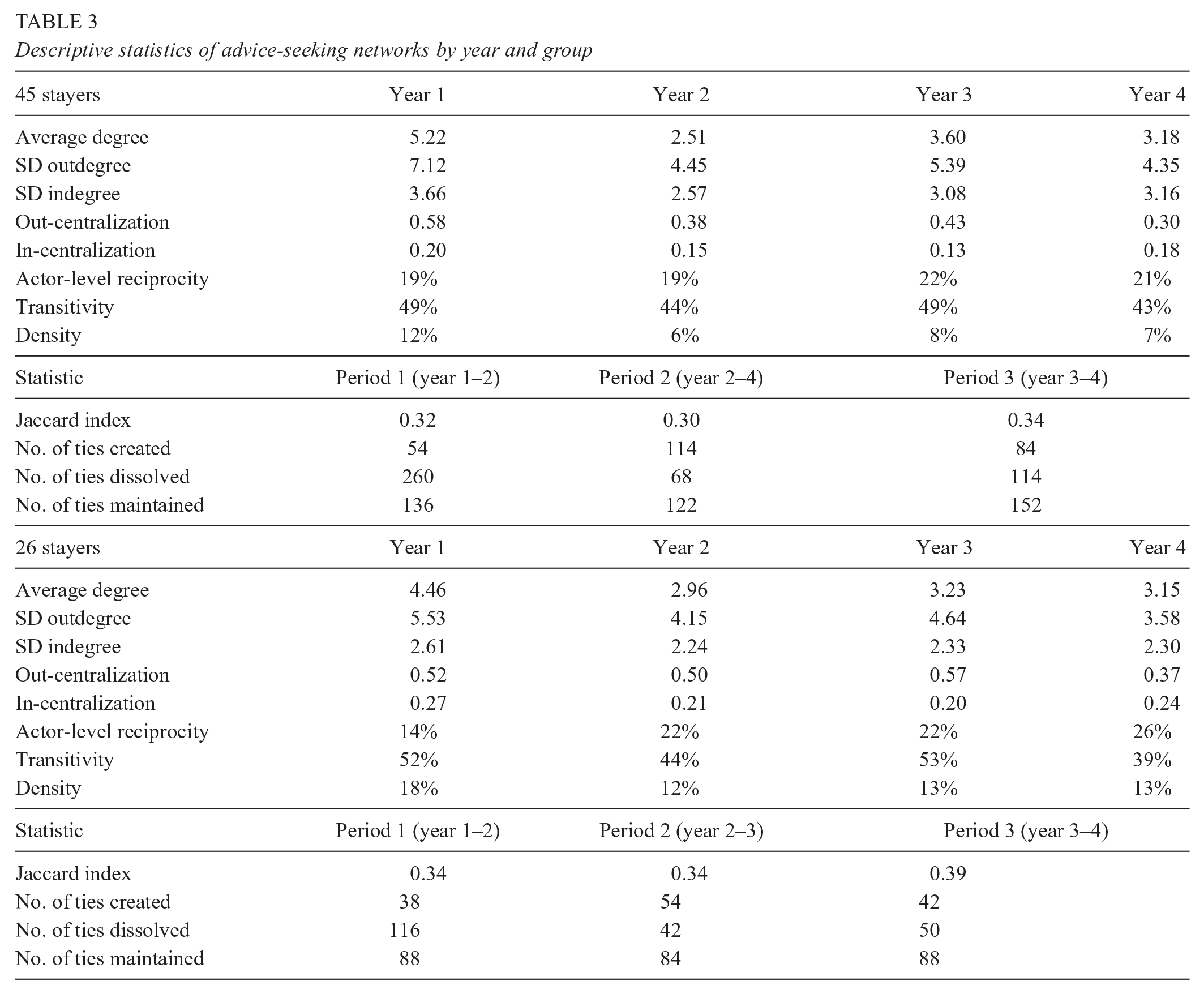
Transitivity, reflecting the tendency for a leader’s advisor’s advisors to become their own advisors, remained high (49% to 62% for the 45 stayers and 39% to 53% for the 26 stayers), suggesting consistently hierarchical advice seeking. Variability in outdegree (i.e., leaders seeking advice) was greater than in indegree (i.e., leaders being sought for advice), reflecting proactive advice seeking by some leaders and more uniformly recognized advice sources. Higher out-centralization than in-centralization, with a decrease in out-centralization over time, indicates a more distributed advice-seeking pattern, whereas consistently low in-centralization suggests nonconcentrated advice-receiving roles. This trend toward reduced centralization, coupled with high transitivity, supports the argument that advice-seeking networks maintained a hierarchical structure while becoming less centralized, facilitating broader access to advice and diverse perspectives. The Jaccard index values, measuring network stability, exceeded 0.30 for both groups, signifying stable advice-seeking relationships—essential for reliable SAOM parameter estimation.
Figures 1 and 2 show the advice networks from year 1 to year 4 for both groups. The upper half shows dynamic node positions, reflecting changes in central and peripheral ties over time. Nodes grew larger for certain leaders, indicating that they were increasingly sought for advice. Clustering of same-color nodes suggests homophily in advice-seeking behaviors. The lower half, with fixed node positions, illustrates changes in individual leaders’ advice ties, showing the evolving nature of these relationships as some ties were maintained and others dissolved over the 4 years. The inclusion of square-shaped nodes for the 26 stayers in Figure 1 highlights their ongoing role in advice-seeking behaviors, distributed throughout the network.

Advice networks of 45 leaders by year.

Advice networks of 26 leaders by year.
Structural Condition for Advice Relationships (Hypothesis 1)
Table 4 presents the SAOM results. The rate parameter indicates the number of opportunities for individual leaders to change an advice-seeking tie. It increased from period 1 to period 2–3 and then decreased from period 2–3 to period 3. This suggests that reform-related advice-seeking behaviors became more dynamic from period 1 to period 2–3 and more stable from period 2–3 to period 3.
RSiena parameter estimates (SE) for the effects on advice-seeking network change for districtwide leadership team, 45 stayers

Note. Overall maximum convergence ratio: 0.24 (period 1), 0.23 (period 2–3), and 0.19 (period 3).
p < 0.10;
p < 0.05; **p < 0.01; ***p < 0.001.
The negative outdegree implies that advice networks were sparsely connected over time. This means that of all possible ties, the proportion of observed advice ties ranged from 6% to 12%. There was consistent positive reciprocity during all periods, indicating that leaders tended to maintain mutual relationships when seeking advice during reform.
Across all periods, significant and positive effects were found for transitive triplets. This indicates a tendency for leaders to form local rather than global districtwide clusters defined by hierarchical triads (an advice seeker’s tie to their colleague’s advisor). A positive transitive triplet effect coupled with a negative transitive reciprocated triplet effect suggests that reciprocity was less likely to be established over time within a local triadic group structure. This aligns with previous research suggesting that advice seeking tends to be hierarchical and directional (Mirc & Parker, 2020), meaning an advisor’s advisor is less likely to seek advice from the seeker. Overall, these structural findings support Hypothesis 1.
The go-to network had varying effects on advice-seeking ties. It was significantly positive only in period 2–3, with limited influence in periods 1 and 3. This aligns with our framework, suggesting that general help seeking is more crucial during the active phase of reform implementation, facilitating advice seeking as leaders navigate new challenges. However, its influence diminishes at the beginning of reform, likely due to uncertainty and a lack of established routines, and stabilizes after reform as specific advice-seeking patterns become established and reliance on general help seeking decreases.
Relational Quality and Conditions for Advice Relationships (Hypotheses 2 and 3)
Corresponding to Hypothesis 2 for relational quality, our analysis indicated that leaders were more likely to seek reform-related advice from colleagues with whom they shared close friendships during all periods of preparing and implementing the reform. As for Hypothesis 3 regarding relational conditions, significant evidence supports several homophily effects and workplace dynamics. Leaders were consistently more likely to form advice relationships within the same workplace level (i.e., district, elementary school, middle school, or high school), supporting Hypothesis 3a. The likelihood of such ties was 74.2% in period 1, 66.6% in period 2–3, and increased to 91.1% in period 3, suggesting a strong and growing preference for within-level advice relationships as the reform progressed. The significant negative parameter for same workplace (district or site) across all periods supports Hypotheses 3c, indicating cross-level, heterogeneous ties between district and site levels. The likelihood of forming such ties was 35.7% in period 1, 42.8% in period 2–3, and 15.7% in Period 3, showing a preference for cross-level coordination that declined over time.
There was no consistent significant homophily effect for years in administration, except a marginal effect in period 3, suggesting limited influence of tenure similarity on advice ties, partially supporting Hypothesis 3b. The sender effect shows that less experienced leaders sought advice more in period 2–3, whereas more experienced leaders did so in period 3, supporting Hypothesis 3d.
Additionally, the 26 stayers showed significant sender effects during period 2–3, with a 58.7% likelihood of seeking advice. This suggests that the 26 stayers, potentially more experienced since the new administration, were particularly active in seeking advice during the implementation period.
Cognitive Condition for Advice Relationships (Hypothesis 4)
Our analysis revealed that leaders with higher self-efficacy were consistently more likely to seek advice across all periods, as shown by the significant and positive ego effects. Specifically, a one-unit increase in self-efficacy was associated with a 57.1% likelihood of forming an advice-seeking tie in period 1, a 68.7% likelihood in period 2, and a 66.1% likelihood in period 3. These findings support Hypothesis 4, suggesting that leaders with higher self-efficacy remained actively engaged in advice-seeking relationships throughout the reform process.
Discussion, Limitations, and Conclusions
This study offers several new insights into the social aspect of educational leadership and reform, especially around the evolution of reform-related advice networks and factors contributing to their shaping, such as leaders’ self-efficacy and close friendships. First, the study addressed an empirical gap by providing longitudinal evidence examining the advice networks of educational leaders. Second, the use of SAOM sheds new light on this growing field of methodologic innovation. Third, the study offers practical insights for school districts to attend to the social side of educational reform. Here we discuss implications for each network condition with respect to forming reform-related advice ties.
Structural and Relational Advantages in the Evolution of Advice Networks
Our analysis indicates several significant network structures in explaining the change in advice relations: reciprocity, close friendships, and transitive (reciprocated) triplets. Consistent with previous research on reciprocity (Daly & Finnigan, 2011), educational leaders in this study tended to establish reciprocal advice relationships during reform, and the likelihood of seeking advice relationships from close friends was high during the first (71.1%) and last (67.7%) periods, with a slightly drop in the middle period (62.4%). Research has suggested that close friends provide high-trust relations with social and emotional support, which help reduce uncertainty during organizational change (Lazega et al., 2012).
Reciprocity was significant during all periods of reform implementation, suggesting that mutual advice relationships were consistently important for leaders as they navigated the complexities from the beginning and throughout the reform process. This might be due to the ongoing need for reliable and trusted sources of advice while addressing continuous changes and uncertainties. During times of high-pressure change, cross-unit advice ties can be further facilitated by reciprocal advice relationships essential for efficient coordination (Parker et al., 2024).
Our findings suggest that both reciprocity and close friendships significantly influence how leaders choose contacts for advice throughout reform periods. District leaders should provide instrumental support during reform and attend to social and emotional support through high-trust ties. These elements complement each other, confirming that expressive ties facilitate instrumental relationship building (Pillemer & Rothbard, 2018).
In addition, our analysis indicates a positive effect of go-to relationships on advice ties, particularly during the intensive implementation phase (period 2–3). This suggests that leaders leveraged existing general help-seeking relationships to form more specific instrumental advice ties, thereby enhancing their ability to navigate the complexities of reform. This underscores the importance of general interactions as a foundation for building more focused and effective advice networks during critical periods of reform implementation. School districts are advised to provide opportunities for leaders to interact regularly, fostering general communication channels that can evolve into reform-targeted advice-seeking networks.
Another important and unique contribution to educational leadership is our finding for the effects of transitive (reciprocated) triplets. Because there has not been prior research in education that reveals and discusses this particular advice network structure among educational leaders, we offer potential explanations based on a study by Siciliano et al. (2017) about teacher advice networks and research on organizational advice network behaviors during change situations (e.g., Mirc & Parker, 2020). Our analysis indicates a positive effect for transitive triplets and a negative effect for transitive reciprocated triplets during all reform periods, suggesting a social hierarchy structure in advice-seeking relations over time. Thus, leaders continue to seek advice from colleagues whom their advisors seek advice from, corresponding to the network structure found by Siciliano et al. (2017).
Individuals who were sought for advice tended to be regarded as more knowledgeable. It is reasonable to assume that those sought by the advisor of the seeker would be considered to have high-quality knowledge and reputation, and over time, they may become more attractive to seekers of advice (Cross et al., 2001). With this knowledge–status hierarchy structure, it is less likely they would nominate down for advice (Ortega et al., 2020). This explains the negative effect for transitive reciprocated triplets. In other words, it is less likely for an advice seeker’s colleague of advisor to mutually seek advice from the seeker.
Perhaps in highly uncertain situations such as this districtwide reform, in which no one has prior experience with implementation, there would be a tendency for leaders to seek advice from those with high social status in terms of holding knowledge or information about the reform (Sarala & Vaara, 2010). This may include individuals from whom many others seek advice or from whom the seeker’s advisor seeks advice. Although those high-knowledge-status recipients of advice ties are not necessarily obliged to share knowledge, giving advice back may increase their status in the social hierarchy (Lazega et al., 2012). Because leaders tend to desire status, it is reasonable to postulate that they would continue to provide advice in situations of uncertainty.
Prior research posits that popular sources of advice will continue to be sought out (Mirc & Parker, 2020), but our analysis shows lower in-centralization and decreased out-centralization over time. This may be due to the district’s focus on building a trusting and collaborative climate, fostering cross-unit interactions. Although the advice networks display a hierarchical structure, highly sought expertise appears to be more distributed. The district’s efforts seem to have mitigated the concentration of advice seeking on a few individuals, promoting a broader distribution of knowledge. This collaborative approach enhances organizational adaptability, supporting the district’s reform efforts.
A key mechanism in forming transitive triplets is the brokerage role that connects the advice seeker and their colleague of advisor. This is called the tertius iungens strategy (Obstfeld et al., 2014), and it describes the phenomenon of the third who connects, bridges, or coordinates individuals by introducing or facilitating coordination between disconnected individuals. Such brokerage is crucial for organizations to engender network activities for knowledge transfer and innovation (Obstfeld et al., 2014). In school districts undergoing change, brokers tend to remain as brokers (e.g., liaison or gatekeeper) without closing the loop (Finnigan et al., 2021); our work suggests that leaders are actually bridging disconnected colleagues by forming transitive structures. School districts may be advised to create social infrastructure to stimulate brokerage activities that connect leaders with complementary and dissimilar knowledge bases to build new ties or bridge potential sources of advice for change to occur (Obstfeld et al., 2014). This support of bridge building can increase the density of the network and create opportunities for a more coherent approach to reform because more individual leaders are better connected to access knowledge.
Homophily, Cross-Level Ties, and Leadership Experience in Advice Networks
Our analysis reveals the interplay between homophily and cross-level interactions during reform. Consistent with some aspects of previous research (e.g., Daly & Finnigan, 2011), our findings indicate nuanced patterns in advice-seeking behavior.
We observed significant homophily effects within specific workplace levels (i.e., district, elementary school, middle school, or high school). Leaders were more likely to form advice-seeking ties with colleagues who shared the same specific workplace level throughout all periods of the reform. This preference suggests that shared experiences and a common understanding of context-specific challenges are crucial for navigating the complexities of reform. This finding aligns with the idea that homophilous ties can provide the necessary support and trust required during periods of uncertainty and change (McPherson et al., 2001).
However, our analysis also revealed significant cross-level interactions, indicating the presence of heterogeneous ties that span different workplace levels (between district and site levels). These cross-level ties were particularly prominent during the middle phase of the reform (period 2–3), with a 42.8% likelihood of forming cross-level ties in period 2–3 compared with 35.7% in period 1 and 15.7% in period 3. The increase in cross-level ties from period 1 to period 2–3 can be attributed to the need for diverse perspectives and coordination during the transition from initiation to implementation of the curriculum reform. This finding supports the notion that heterophilous ties can facilitate the integration of diverse knowledge and foster innovation during organizational change (Perry-Smith & Mannucci, 2017). However, the decrease in period 3 suggests a consolidation of knowledge within more homogeneous groups as the reform progressed. As leaders became more familiar with the reform, they relied more on trusted, similar colleagues, reducing the need for cross-level advice-seeking. While within-level ties provide necessary support and facilitate smoother coordination, the reduction in cross-level ties could risk forming knowledge silos, limiting the breadth of perspectives available for problem-solving in later stages of the reform.
Furthermore, leaders with more years in administration were less likely to seek advice in Period 2-3 (44.8%) but more likely in Period 3 (56.8%). This suggests that as reforms progressed, complexity increased, making experienced leaders more proactive in seeking advice. This shift reflects the need for leaders to leverage their broad networks and influence to navigate later stages of reform. Prior research supports this by emphasizing the advice-seeking behavior of leaders during reform phases (Liou et al., 2022), emphasizing the critical role of experienced leaders in sustaining reform implementation through knowledge transfer and organizational change (Finnigan & Daly, 2012).
Our findings show that workplace homophily, cross-level ties, and leadership experience shape advice-seeking networks during educational reform. Homophilous ties provide trust and familiarity within workplace levels, while heterogeneous ties enable broader knowledge integration and cross-level coordination during critical reform phases. Experienced leaders adapt their advice-seeking strategies to navigate reform complexities. By balancing these relational dynamics—supporting both homophilous and heterophilous ties while leveraging experienced leaders’ expertise—districts can strengthen advice networks, offering leaders the trust and support needed within their workgroups to access diverse knowledge and sustain reform implementation.
Self-Efficacy in the Evolution of Advice Networks
Our analysis reveals the significant role of self-efficacy in advice-seeking behavior across all reform periods. During period 1, leaders with higher self-efficacy were somewhat active in seeking advice, with a 57.1% likelihood. As the reform progressed to full implementation in period 2–3, leaders with higher self-efficacy were more likely to seek advice, with a likelihood of 69.7% in period 2–3 and 66.1% in period 3. This trend reflects the growing complexity of the reform and the need for experienced leaders to leverage their networks to navigate these challenges.
This seeking behavior can be explained by several mechanisms discussed in the literature. Bandura’s (2001) social cognitive theory posited that individuals with high self-efficacy are more likely to engage in behaviors that they believe will lead to successful outcomes. This includes seeking advice to gain the diverse perspectives and knowledge necessary for reform implementation. Leaders with higher self-efficacy believe in their ability to influence and implement changes effectively, which drives their active advice-seeking behavior.
This finding also corresponds to prior research suggesting that leaders’ beliefs about their self-efficacy in implementing reforms positively correlate with their advice-seeking behaviors (Liou et al., 2022). When reform is introduced as innovation characterized by uncertainty, such as this districtwide curriculum reform, employees may feel threatened and/or stressed and associate change with a fear of job loss (Pang, 1998). In this situation, employees tend to seek advice to gather the information and knowledge necessary to help them stay informed and make progress with high-pressure tasks (Mirc & Parker, 2020). The tendency to consistently seek advice may indicate that they know “who knows what” (Cross et al., 2001). Seeking advice allows leaders to access and acquire the means, key contacts, and tacit knowledge necessary to succeed during change (Srivastava, 2015). In uncertain situations, knowing who knows what to locate relevant knowledge in an organization is critical (Cross et al., 2001).
Perhaps it is the seeking that facilitates leaders developing their own meta-knowledge about where to locate information necessary for reform implementation (Lomi et al., 2014), and at a later point their self-efficacy beliefs increase because of their meta-knowledge (knowing who knows best). Other research, while not directly addressing self-efficacy (e.g., Lazega et al., 2012; Lomi et al., 2014; Mirc & Parker, 2020; Ortega et al., 2020), supports the idea that advice-seeking behavior is crucial in managing complex situations. As leaders gain experience and knowledge during the reform process through advice seeking, which is a key mechanism for knowledge transfer and organizational innovation (Finnigan & Daly, 2012), their self-efficacy may increase to sustain reform efforts.
Practical and Research Implications
We offer several practical takeaways from our findings. First, districts may consider making sources of advice and knowledge visible and accessible to foster advice-seeking group structures. This enables leaders to connect with or bridge their colleagues, facilitating the exchange of useful information and resources relevant to reform implementation. Second, creating an environment where leaders can obtain both instrumental and social and emotional support throughout the reform trajectory is crucial. This dual-support system helps facilitate the exchange of work-related resources (advice and knowledge) and mitigates uncertainty (Lazega et al., 2012), thereby deepening trust among leaders. Third, districts may enhance self-efficacy and support the dissemination of knowledge by promoting vicarious experiences and leveraging the expertise of experienced leaders. Providing opportunities for leaders to observe advisors or role models who are knowledgeable about or successful in reform efforts can encourage them to implement changes and support their beliefs. Additionally, encouraging experienced leaders to mentor less experienced colleagues can facilitate the sharing of best practices throughout the organization.
Furthermore, maintaining a core group of experienced leaders provides continuity and stability during periods of reform, which helps preserve institutional knowledge and fosters a supportive environment for advice-seeking behaviors. Finally, it is essential to assess the knowledge within a leadership team and identify opportunities to bridge across the team and leverage complementary and unique knowledge bases. The ultimate goal is to achieve social equity by providing equitable opportunities for leaders to access the knowledge and resources necessary for collective improvement and coherent reform efforts.
We suggest a few directions for future research. While we collected sociocentric, longitudinal network data from leadership team members within a district, the sample size may limit the generalizability of the study findings. Moreover, focusing solely on intradistrict networks overlooks potential collaborative relationships beyond the district. Future research could examine other diverse stakeholder groups involved in reform implementation across different districts. In addition, we focused on the transitive triplets effect in our models. Future studies could examine other types of structural configurations (e.g., clustering, three-cycle) to describe leaders’ advice networks or focus on two-mode networks characterized by a combination of advice ties and leaders’ beliefs in reform or participation in training events. Scholars could investigate various professional ties (e.g., sharing leadership advice or new ideas for change) that support leaders’ reform efforts.
Furthermore, because leaders’ advice ties stretch beyond the group of stayers, future research should explore the impact of churn and knowledge spillover across the leadership team during change efforts. Understanding the mechanisms that shape leaders’ professional relationships can enhance empirical and practical understanding of the social aspect of leadership and reform.
Relational Rhythm of Change
This study sheds new light on the current limited knowledge base regarding how leaders establish advice relations and what accounts for changes in advice relations during reform. We argue that interpersonal interactions are fundamental mechanisms driving leadership and organizational change, with advice relations providing crucial channels for sharing knowledge and practices necessary for reform. Our findings highlight the role of brokerage in bridging sources of advice over time and underscore the importance of instrumental reciprocity and close friendships throughout stages of change. Likewise, promoting leaders’ self-efficacy is crucial during reform because leaders with higher self-efficacy are more likely to seek reform-related advice. The benefit provided by experienced leaders and the core group of 26 stayers is promising for continuity during reform. Accordingly, school districts are advised to build social infrastructure to facilitate the flow of reform-related information, make advice sources visible and accessible, provide instrumental and social and emotional support, and leverage experienced leaders’ expertise. This approach ensures that leaders have the support and resources needed to navigate organizational change, fostering a resilient and adaptive educational system.
Footnotes
Appendix
Acknowledgements
The authors thank the anonymous reviewers and the editorial team for their constructive feedback and thoughtful comments, which greatly helped improve the quality of this manuscript. In addition, we thank all colleagues, participants, and collaborators who supported various stages of this research project.
Declaration of Conflicting Interests
The authors declare no potential conflicts of interest with respect to the research, authorship, and/or publication of this article.
Funding
The research time of Yi-Hwa Liou was supported by the National Science and Technology Council, Republic of China (MOST 108-2410-H-152-029-MY4 and NSTC 113-2628-H-152-002). The research time of Jasperina Brouwer was funded by the Dutch Research Council (VI.Veni.191S.010) since January 1, 2020. The research time of Yong-Shiuan Lee was supported by the National Science and Technology Council, Republic of China (NSTC 112-2115-M-035-007-MY2).

Authors
YI-HWA LIOU is a professor in the Department of Educational Management at the National Taipei University of Education Taiwan. Her research focuses on leadership, organizational change, educational reform, and professional learning communities, with a methodologic emphasis on social network analysis and mixed methods.
JASPERINA BROUWER is an assistant professor in the Faculty of Behavioral and Social Sciences at the University of Groningen, Netherlands. Her research focuses on social networks, social capital, peer learning, learning communities, learning environment, internship experiences, self-efficacy, coping, leadership in school teams (distributed leadership), professional development, professional commitment, well-being versus burnout, stress, healthcare education, educational innovations, and quantitative and qualitative analyses.
ALAN J. DALY is a professor and director of the Educational Leadership Joint Doctoral Program in the Department of Education Studies at the University of California, San Diego. His research focuses primarily on the role of leadership, educational policy, and organization structures and the relationship between those elements on the educational attainment of traditionally marginalized student populations.
YONG-SHIUAN LEE is an assistant professor in the Department of Applied Mathematics at Feng Chia University, Taiwan. Her research focuses on dynamic systems and predictive models, with particular interests in population dynamics, demographic modeling, macroeconomic analysis, statistical methods, machine learning and deep learning.