



Abstract
In this conceptual article, we argue for the need to examine power relations in continuous improvement (CI) in education. Specifically, we contend that examining power in CI requires an examination of practices that constitute the work of CI. Drawing on practice theory, we conceptualize practice and power and use these constructs to examine a CI effort on improving mathematical proficiency in an elementary school. From this case, we draw out three power moves to illustrate how examining power through practice in CI can generate insight into the varied power dynamics in a CI effort. We end by arguing for more examinations into the practice of CI work to understand power relations and the enactment of CI efforts in education broadly.
Keywords
Over the past decade, policymakers and funders have invested substantial financial resources to support continuous improvement (CI) efforts (Feygin et al., 2020). CI is a family of approaches concerned with addressing local problems of practice, engaging practitioners in improvement research, conducting iterative cycles of reflective testing, and spreading improvements beyond single classrooms (Yurkofsky et al., 2020). CI aims to counter the dominant paradigm for improving educational outcomes, where researchers evaluate the efficacy of interventions in controlled environments and scale up those that work (Schoenfeld, 2006). Scholars and practitioners of CI claim to upend these relations by positioning practitioners as equal collaborators alongside researchers and improvement facilitators during improvement efforts. CI has been taken up in a wide variety of educational settings, from statewide teacher preparation program improvement (e.g., Sandoval & Van Es, 2021) to instructional improvement (Cobb et al., 2020; Sandoval & Van Es, 2020).
Despite its spread, whether CI lives up to its promise is unclear. Prior research describes the processes of collaboration and convergence in CI (e.g., Bryk et al., 2015) but says little about unequal relations between individuals and how unequal relations shape CI efforts. Scholars have identified how core tenets of CI—such as leveraging the voices of those closest to the problem—can be appropriated to enable historically marginalized participants to contribute to improvement work (Hinnant-Crawford, 2020; Valdez et al., 2020). However, how equity and justice-centered problems of practice are foregrounded (or not) in CI work is unstated. To unveil how CI efforts shape power relations and how they center (or peripheralize) equity and justice, improvement-focused research ought to examine how educators implement CI initiatives and the role of power relations therein.
We put this article in conversation with improvement research that attends to power and equity in CI. We introduce “practice theory” (Feldman & Orlikowski, 2011) as a framework for examining everyday practice and power in CI. We use this lens to examine power dynamics in an example of a CI effort aimed at improving mathematics instruction.
Existing Research on Continuous Improvement
An emerging body of research on power and equity has begun to identify how equity and justice can be fostered in CI (e.g., Bush-Mecenas, 2022; Campano et al., 2022; Eddy-Spicer & Gomez, 2022; Hinnant-Crawford, 2020; Jabbar & Childs, 2022; Valdez et al., 2020). This research spurs us to ask “Improvement for what?” and encourages the centering of issues related to race, class, gender, and disability in CI (Eddy-Spicer & Gomez, 2022, p. 89). Most relevant to our article, existing CI research has also begun to identify promising practices for doing so, including equity audits, race-conscious cycles of inquiry, empathy exercises, and considering nontraditional measures of success (e.g., Bush-Mecenas, 2022; Hinnant-Crawford, 2020; Valdez et al., 2020).
However, existing research suggests that there is substantial variation in whether educators take up equity and, separately, justice in their CI work and highlights barriers that exist to doing so (Bush-Mecenas, 2022; Valdez et al., 2020). Some research highlights how educators might take up more color-evasive conceptualizations of equity during the CI process (Bush-Mecenas, 2022). Additionally, CI has, generally, taken up equity as reducing disparities in dominant outcomes prioritized by existing systems as opposed to centering values and outcomes rooted in justice, which prioritizes the affirmation, dignity, and agency of nondominant communities (Ishimaru & Bang, 2022).
The field is in need of an analytic and conceptual lens for understanding how educators enact equity or justice in their CI work. This requires explicit attention to power relations because these relations inform whether and how historically marginalized communities get to substantially shape improvement efforts (Jabbar & Childs, 2022). We turn to practice theory, which offers a lens for seeing how seemingly mundane actions produce power.
Conceptualizing Power With Practice Theory
Practice theory conceptualizes social and organizational life as being composed of practices, defined as situated and situating action, where context constrains and enables action and action (re)produces, modifies, or upends context (Feldman & Orlikowski, 2011). Of central concern to practice theorists is the construct of agency, defined as the capacity to do otherwise (Giddens, 1984). Although actions are constrained and enabled by structure, actors (re)produce, modify, and upend structure; thus, insight can be generated into structures and agency by attending to what actors do and what they do not do.
Practice theory highlights how relations between people are unequal and laden with power. In this frame, all exercising of agency is power (Feldman & Orlikowski, 2011). Practice theorists have since refined this practice-focused conception of power, where power is produced by practices that shape practices elsewhere (Watson, 2016). For practice theorists, power is not a currency held by individuals—a dominant conceptualization in the social sciences (Lukes, 2004)—but is constantly produced through situated action. Watson (2016) extended this notion of power in practice by highlighting how some actors are systematically and advantageously positioned to engage in practices that shape others’ practices. Additionally, some practices—whether engaged in by those who are advantageously positioned or not—disproportionately shape other practices. We call these power-laden practices that disproportionately shape others’ actions “power moves.”
We use this lens of power to highlight how seemingly mundane actions shape participation in CI efforts to improve mathematical proficiency among elementary students.
Power in the Continuous Improvement Practices in Mathematics Learning and Teaching
To illuminate power in CI practices, we use the case of Bell Elementary School (Bell ES), which serves a historically Black, working-class community on the East Coast in an urban school district. Bell ES worked with a local, university-based math project to improve mathematical proficiency among its students from 2017 to 2022. The math project—with which the third author of this article was affiliated—supports CI in schools to support equitable math instruction in local schools. Administrators at Bell ES sought out the math project to initiate an effort aimed at improving the percentage of students that demonstrated mastery in mathematics.
To illustrate how power came to be produced in this CI effort, we focus on how staff engaged with student achievement data. Although the project lasted 5 years, we focused on the problem definition phase of a CI project to offer detailed illustrations of practice and power. However, much can be learned from examining how power comes to be produced in other phases of CI work (e.g., iterative testing).
We highlight three power moves that teachers and facilitators engaged in that shaped the direction of CI work. “Power moves” may colloquially refer to intentionally aggressive or hostile acts. We instead use the term “power moves” to refer to practices, ranging from intentional to unintentional, that disproportionately shape and constrain the range of others’ practices.
Data Conversations for Improving Mathematical Proficiency at Bell Elementary School
In 2017, the third author and school leaders at Bell ES began to organize CI work around mathematical proficiency rates, as evidenced by a standardized test. School leaders asked the CI facilitator to lead three sessions in the spring with staff where teachers were asked to review standardized state test results from previous years. The facilitator used displays showing the percentage of students who “demonstrated mastery” on the state test. An example of this display can be seen in Figure 1. Teachers had expressed anxiety about low rates of student achievement on the test. When state results had been released that summer, teachers expressed concern that the results were lower than they had anticipated. Much like they had in years prior, teachers expressed frustration over the results of the state test. Some teachers expressed that they did not feel as if there was anything they could do to improve student performance, whereas others expressed that results did not reflect what they had seen students do.
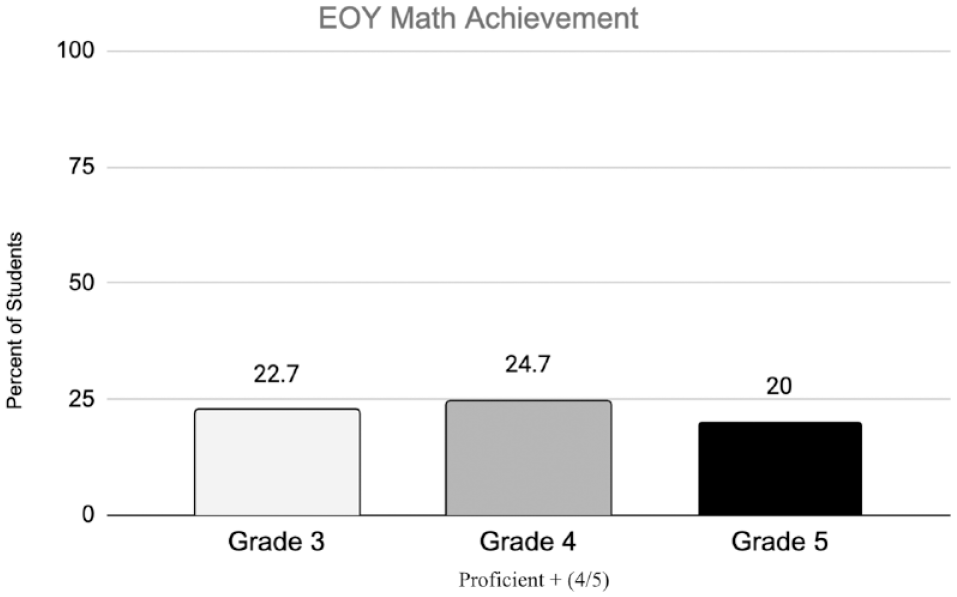
First data display of student test result data.
In response, the CI facilitator and teacher leaders at Bell ES planned a 3-hour session for later that summer focused on reframing staff’s responses to student achievement data. The facilitator then constructed a new version of the data display that grouped students into five levels that represented all students and placed them along a spectrum in relation to their distance from proficiency (Figure 2). The facilitator developed this display to juxtapose it against the original display to shift conversations to be more generative.
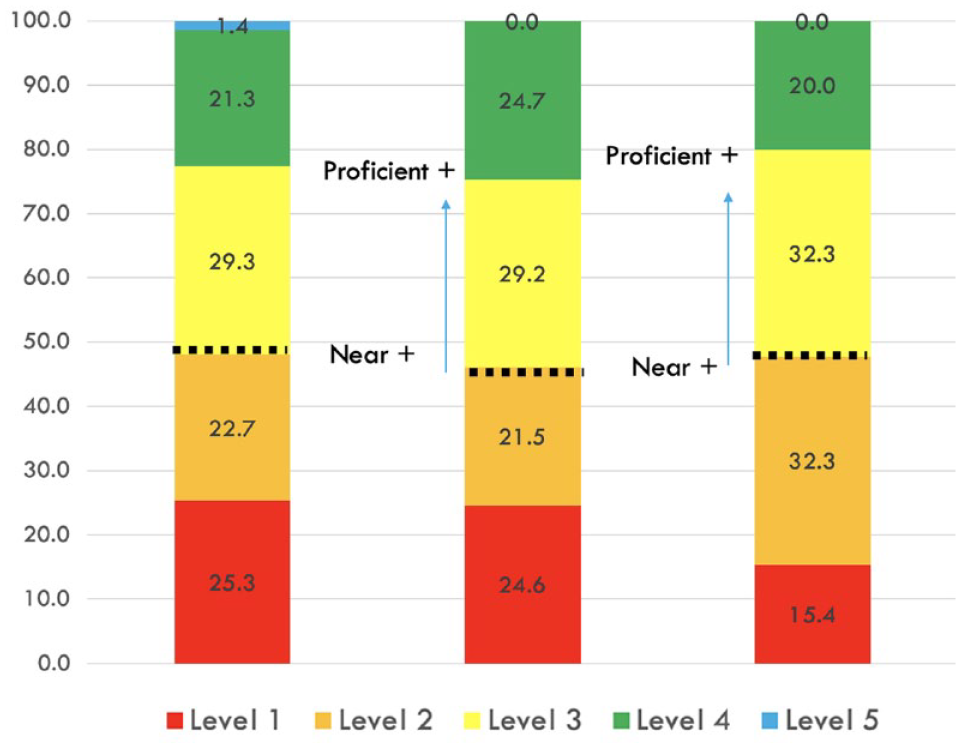
Second data display of student test result data.
During the session, the facilitator first showed the original data display represented in Figure 1 and asked teachers to articulate what they noticed. Noticing that only 20% to 25% of their students were mathematically proficient, teachers expressed how disappointed they were, and others expressed feeling stuck, with one remarking that they did not “know where to go from here.” Following this conversation, the CI facilitator then remarked that the conversation around student test result data ought to focus more on understanding the learning needs of all students. Following this framing, the CI facilitator then presented the second data display, represented in Figure 2, and asked teachers to articulate what they noticed. Teachers expressed surprise at how many students were categorized in “Level 3,” the category of students who were just below proficiency. Teachers also pointed out that around 50% of all students were near or at proficiency level. Some teachers expressed that this characterization of state test result data was more resonant with their experiences, with one remarking that “just about half of my students grasp lessons.” Another teacher remarked that after looking at the second data display, she felt she could begin to think through how to support students at each of the levels. A different teacher expressed that the displays were “more manageable to think about.”
Although teachers had expressed skepticism, they began expressing enthusiasm around addressing low proficiency rates in mathematics. The CI facilitator then engaged teachers at Bell ES in an improvement project oriented around improving these proficiency rates.
We illustrate the potential of focusing on power through practice by focusing on three power moves, each enacted by different stakeholders, detailing how each move shaped, constrained, and enabled others’ actions. We highlight how a focus on practices can generate insight into how power gets produced in improvement efforts.
Power Move 1: Focusing Efforts on Standardized State Test Results
We highlight the power move from school administrators to dedicate professional development time to focus on increasing rates of mathematical proficiency. The action to center standardized test results and mathematical proficiency rates constituted a power move because it shaped how the facilitator engaged teachers. It also shaped what teachers responded to and what they would go on to do in professional development sessions. We viewed the move to focus on standardized test results as an expression of a commitment to focusing on outcomes that are prioritized by existing systems of schooling despite the long-standing harm that focusing on standardized test results has done to students and communities (Cunningham, 2019; Ladson-Billings, 2009).
We draw on the conceptualization of agency as the “capacity to do otherwise” to make visible here that the school administrators could have chosen to focus on something else. The focus of improvement work could have been on an aim that was more justice-focused—for example, improving the affirmation of Black and Brown students’ identities in mathematics (Ladson-Billings, 1995). We also note, however, that structures and context—for example, accountability practices organized around standardized test scores and federal and state mandates to administer standardized tests—most certainly constrained and shaped what school administrators at Bell ES defined as a pressing problem worthy of addressing. School administrators were agentic in dedicating resources and time to improving mathematical proficiency, and this action was simultaneously shaped by systems of schooling that privilege narrow ways of learning and knowing. Our conception of power concerns the capacity for someone to shape others’ practices—we viewed administrators choosing to privilege test scores as a power move because it shaped teachers’ and the CI facilitator’s focus and attention on test scores.
Power Move 2: Changing of the Data Displays
The CI facilitator’s move to construct a new data display served as a power move by shaping how teachers engaged with data and how they engaged in CI work broadly. The facilitator constructed artifacts that enabled teachers to generate certain insights while constraining their ability to generate others. In the original display, teachers were enabled to express skepticism about the state test results or express not feeling agentic in changing proficiency rates. The CI facilitator’s move sought to shift teachers’ data conversation practices. The act, for example, of constructing a data display that highlighted how 50% of students were “at or near proficiency” enabled teachers who felt that the data represented in the original display (Figure 1) did not reflect their experience to engage with data by validating their experiences in their classrooms. By framing the new data display to think about how teachers could support “all students” across a range of levels, teachers began to generate more specific ideas around what they could do for students in each level.
We imagine what the facilitator could have done instead of shifting the data displays to (re)shape teachers’ data conversation practices. For example, the facilitator could have continued to use the existing data display and sought to appeal to teachers’ guilt around the results to mobilize them to engage in CI work. The facilitator could have constructed the new data display without juxtaposing it against the old one and without inviting teachers to think about supports for “all students.” The facilitator could have also disaggregated data by students’ demographics, such as race, class, or gender. We note that any of these courses of action would have changed how teachers engaged with data and whether and how they would have engaged in CI work broadly. By choosing to take this course of action to engage teachers, we argue that the CI facilitator produced power, shaping how teachers participated in discussions around data. The facilitator repositioned teachers and students in reorganizing data displays, which we viewed as a power move due to it shaping how teachers then engaged with data.
Power Move 3: Teachers’ Responses to Data
Teachers’ engagement with data also produced power. Teachers’ expression of anxiety and concern around state test results shaped school administrators’ moves—administrators dedicated resources to addressing low rates of mathematical proficiency at Bell ES. Had teachers ignored the state test results or expressed concern over some other challenge, school administrators may have decided to focus CI work on a different problem entirely. Although teachers were asked to engage with a problem that they did not specifically advocate to be addressed, they produced power through their expression of concern to administrators around state test results.
We used a practice lens to understand power in each of these three instances. We surface these three power moves to illuminate how CI participants produce power and how some are better positioned to do so. We also point out that these power moves are enacted by different interest-holders, all positioned within the school in different ways. In the first power move, we highlighted how school leaders’ decisions about what to improve shaped the trajectory of CI work. In the second power move, we showed how a CI facilitator’s presentation of a new data display shaped how participants engage in CI. In the third power move, we highlighted how teachers’ responses to state test scores shaped school leaders’ decision-making. Through our illustration of these three power moves, we make visible that practices of CI efforts are ideal sites for examining how power comes to be produced in these efforts. Rather than viewing power as static and as currency, we view it as dynamic, highlighting how CI leaders and participants produce power, constraining one another’s actions in the context of CI work.
Discussion
Although CI efforts are not inherently “anti-racist panacea(s),” scholars have begun noting their promise for supporting reflection around inequitable and deeply institutionalized practices (Diamond & Gomez, 2023). We argue that interrogations of CI require explicit attention to issues of power. Building on emerging research on equity in CI, we argue that analyses of power in CI ought to attend to everyday actions and practices in improvement. Attending to everyday practice can enable researchers to gain insight into how improvement efforts come to be enacted in ways that center (or peripheralize) equity and justice. We highlighted how certain moves CI facilitators, school leaders, and teachers made disproportionately shaped how CI work unfolded in ways that shifted conversations from defeated to generative and imaginative but retained a focus on standardized test scores rather than justice-focused outcomes (e.g., the affirmation and dignity of students in math classrooms).
A practice theory lens can extend to other points and events in CI work where facilitators (and others) are likely to influence how others engage in CI, such as developing an aim statement or analysis of root causes; these points set the stage for how the rest of the CI effort centers equity. For example, in Sandoval and colleagues’ (Sandoval, 2023; Sandoval & Van Es, 2021) studies of a teacher preparation improvement network, the authors highlighted how CI facilitators facilitated the convergence of eight teacher preparation programs around a common aim statement, highlighting how improvement facilitation can engage with tension and divergent views.
Studying these moves has implications for practitioners of improvement as well. Much like improvement practitioners aim to engage teachers and school leaders in inquiry around their practice, we see opportunities for improvement practitioners to engage in reflective activities to improve theirs toward equitable and just improvement. In the case we described, we imagine improvement facilitators collecting data on how certain moves constrained and enabled others’ actions, especially those who are less advantageously positioned within these efforts.
Attending to power in CI can enable researchers to examine whether and how improvement efforts come to be equitable and just. Understanding who shapes whose practices, whose perspectives are codified, and whose stories are displaced or made dominant can reveal insight into how Black, Brown, LGBTQ+, working-class, and other marginalized voices come to shape what the work of improvement focuses on (or does not focus on). The field could benefit from research that illuminates how people come to be positioned in systematic and advantageous ways in improvement. Future research might pair practice theory with critical theories to examine how individuals’ identities (e.g., race, class, gender) come to shape their positioning within improvement work. Building on existing scholarship on critical theory and CI (e.g., Diamond & Gomez, 2023; Jabbar & Childs, 2022), future research could examine how power as practice during CI processes are situated within and arise from broader racial and economic systems of inequity. Practice theory could also be paired with organizational and institutional theory (e.g., Woulfin & Allen, 2022) to examine, for instance, how dominant, taken-for-granted logics and ideas in the environment (e.g., school accountability logics) influence who gets to shape other practices in the context of CI.
As CI continues to be taken up in education, closer interrogations to the enactment of CI are needed, similar to how scholars have interrogated the enactment of research-practice partnerships (Penuel et al., 2020; Tanksley & Estrada, 2022). CI work is not apolitical or value neutral. Understanding how educators implement CI in their daily work, with attention to the role of everyday actions in producing power, can help those engaged in improvement be deliberate about equity throughout the entirety of the CI process, including how problems and aims are identified, what and how data are analyzed, and how promising practices are taken up in schools. Taking a practice-focused lens to the work of improvement is closely aligned to the ethos and values of doing improvement. Improvement advocates argue for practitioners to engage in CI to generate equitable outcomes (Bryk et al., 2015). Those responsible for leading improvement ought to engage in efforts to better their practices so they attend more closely to issues of power, equity, and justice.
