




Abstract
This study investigated the effects of the Leader in Me (LiM), a social-emotional learning program implemented in thousands of schools. A mixed-method design included (1) a collective case study in four diverse, high-implementing elementary schools and (2) a post hoc quasi-experiment using propensity score 1:3 matching of 117 LiM and 348 non-LiM schools to compare achievement and discipline incident rates. The case study indicated that participants perceived LiM as improving social-emotional competencies for both teachers and students. Teachers reported being more prosocial, feeling more camaraderie, using more effective discipline, developing better teacher-student relationships, and enjoying teaching more. Students were more prosocial, confident and motivated, and had fewer problem behaviors. School climate improved. Results replicated across four diverse schools. The quasi-experiment supported results of the collective case study. Schools implementing LiM had higher mathematics and ELA, but not science, scores on state proficiency exams and fewer discipline incidents.
Keywords
In a recent survey of U.S. educators, 84% responded that social and emotional learning (SEL) has become more important since the COVID-19 pandemic due to students’ increased distress and decreased confidence and engagement in school; half (56%) said their schools planned to implement an SEL program in AY21-22 (Hanover Research, 2021). Thus, it is important to investigate the effectiveness of popular SEL programs. The Leader in Me (LiM) is a school-wide SEL program that has been implemented in over 5,000 schools in 50 countries and continues to grow. Notably, it is among the few SEL programs that develop teachers’ social-emotional competencies in addition to students’ competencies.
We used a convergent, exploratory mixed-methods design (Creswell & Plano-Clark, 2018) to investigate the effectiveness of LiM, with the qualitative strand being a collective case study of four diverse elementary schools and the quantitative strand being a state-wide quasi-experiment. In a meta-analysis, Corcoran et al. (2018) argued that more qualitative research is needed to “better understand the ‘black-box’ of SEL programs” (p. 69). Case studies paint a rich picture of participants’ perspectives on how and why a program works in specific contexts. Although LiM is widely used, this is one of the first mixed-methods studies examining the effects on both teachers and students in authentic school settings. LiM developers did not conduct the study, nor were the researchers involved in the implementation of the program.
Social-Emotional Learning (SEL) of Students and Teachers
Social-emotional learning refers to programs designed to improve students’ social and emotional competencies (Bergin et al., 2023), which have been defined as developmentally effective competencies in social interaction and emotional regulation (Rose-Krasnor, 1997; Saarni, 1990). SEL programs can reduce students’ behavior problems and emotional distress as well as raise personal happiness, social connectedness, and academic achievement (Domitrovich et al., 2017; Taylor et al., 2017).
Despite the growing popularity of SEL programs for students, there are relatively few that support teachers’ social-emotional competence. Yet, national surveys find that between 26% to 59% of teachers report great occupational stress (Gallup, 2014; Markow et al., 2013), and teacher stress is linked to lower student engagement and achievement (Greenberg & Abenavoli, 2016). When teachers’ own SE well-being increases, teachers can be more supportive to students (Jennings et al., 2017). LiM addresses this need by engaging teachers in building their own social-emotional competencies—typically for a full year—before they engage students in building the same competencies. When teachers internalize a program, it tends to be sustained with positive outcomes (Han & Weiss, 2005). Thus, targeting SEL for both students and teachers is important.
The Leader in Me (LiM) Program
The Leader in Me (LiM) was developed by educators who wanted to teach elementary students the principles in Stephen Covey’s best-selling book The 7 Habits of Highly Effective People (Covey, 1989). Today it is codified by FranklinCovey Education (e.g., Covey et al., 2014). LiM is a universal school-wide SEL program applied to all students and facilitated by teachers and other staff. LiM is not a curriculum, but rather a framework for building positive behavioral habits in individuals and for changing structural aspects of the school (Table 1). Students primarily learn SE competencies through practicing the 7 Habits during regular class activities and during leadership roles at school.
The 7 Habits Applied to Elementary Teachers and Students

Schools have some autonomy to adapt LiM to their own context. Each school forms a team of teachers who decide how to implement LiM at their school. Some schools have a team of students as well. However, LiM asks all schools to (1) have educators and students strive to live the 7 Habits; (2) generate mission statements, set goals at the individual, class, and school levels, and monitor achievement of their goals; (3) give students a leadership role at school based on their personal strengths, such as technology leader, library leader, etiquette leader, and so on; (4) “buddy” partner older with younger students; (5) place murals about the 7 Habits throughout the school; and (6) dedicate time each month for leadership activities, called “leadership day.” See Supplement Table S1 for greater detail. Schools can apply for “Lighthouse” designation by meeting developer-specified standards, such as all students having leadership roles and consistently tracking progress toward goals.
Schools roll out LiM gradually. Typically, the first year focuses exclusively on teachers and other school staff implementing the 7 Habits themselves. The second year focuses on students implementing the same 7 Habits. Teachers and students initially learn the 7 Habits through didactic lessons and then practice the habits primarily through daily interactions with each other (e.g., teachers asking students “Did you seek first to understand?” during a discipline episode, or “Did you achieve your goal?” after a test). A coach from the LiM program visits the school occasionally to provide support during the first two years of implementation. Thus, LiM supports fidelity of implementation (Fixsen et al., 2009). See Supplement for greater detail.
Previous studies of LiM effectiveness have found positive results for both teachers and students. A professional reference librarian conducted a search for LiM studies, which resulted in our reviewing 259 studies. Of these, six focused on elementary classrooms and were published in peer reviewed journals or as reports by reputable institutions. In two qualitative studies, educators perceived LiM as leading to teachers feeling greater collegiality and enjoyment of teaching, and students feeling more happy, confident, motivated, and empowered and having fewer office discipline incidents (Bennett, 2020; Ross et al., 2012). A third study reported increased perceptions of student self-regulation, improved student-led academic achievement, and improved school climate (Gage & Thomas, 2019). In two quantitative studies using state-wide secondary data for matched comparison groups, LiM was associated with reduced discipline incident rate (Schilling, 2018; White, 2018). In a third quantitative study, LiM schools improved science proficiency rates by 6.7% compared to their pre-LiM performance (Pascale et al., 2017). The present study contributes to this growing literature by: (1) using a mixed method design, (2) including multiple stakeholders’ perceptions of LiM outcomes, (3) intentionally focusing on stakeholders with experience in non-LiM schools and (4) addressing achievement and discipline incident rate in a quasi-experiment.
Our study combines qualitative data at four very diverse schools with state-wide quantitative data. We focused on high-implementing schools; three schools had achieved Lighthouse status, and the fourth was applying for it. Each school had been implementing LiM for four to six years when data collection began. This is important because it takes two years for LiM to be established in a school, and impact may increase over time (Ishola, 2016; Ross et al., 2012). Our research questions were (1) How was LiM implemented in four high-implementing LiM schools (qualitative phase)? (2) What were participants’ perspectives of the effects of LiM on teachers and students in their school (qualitative phase)? (3) Do achievement and discipline incident data confirm results for question 2 (quantitative phase)? (4) What components of LiM might explain these changes (qualitative phase) from participant perspectives?
Methods
In our exploratory convergent mixed method design (Creswell & Plano-Clark, 2018), we first used a qualitative collective case study to describe authentic experiences of diverse school communities that were using the Leader in Me program. Second, we used a quantitative, quasi-experiment using state-wide secondary data.
Collective Case Study
Case studies are particularly useful for description, explanation, and evaluation of programs (Yin, 2014). In our study, the cases are schools that implemented LiM. A collective case study is a process whereby general lessons are drawn from multiple case studies. Replication through multiple cases increases the robustness of results (Pashler & Wagenmakers, 2012). We selected schools, and students within each school, for diversity in attributes that might affect outcomes of LiM. Each research question was addressed from the perspective of students, teachers, principals, and parents. We conducted a separate case study for each of four elementary schools during one school year.
Participants
Four K-6 elementary schools (i.e., cases) in different districts were purposively selected for diversity to represent contrasting conditions and maximize variation of context. The schools had chosen to enroll in LiM without district mandate. The schools varied in proficiency rates on state exams, free-or reduced-price lunch percentages, English language learners, ethnicity, and rurality (Table 2). Mixed Elementary is a district magnet school for students with special needs that also serves neighborhood children. Urban Elementary serves a low-SES neighborhood with subsidized housing, high student turnover, and many students learning English. Rural Elementary serves a low-SES rural area that is adapting to an influx of higher-SES families who work in a nearby suburb. Suburban Elementary serves a middle- and upper-class neighborhood outside a large city.
Case Study Elementary School Demographics and Achievement

Note. Proficiency exam data are from the Missouri State Department of Education. Locality is a code used by the U.S. Department of Education. NCER data from https://nces.ed.gov/ccd/districtsearch/. Average school size is from nces.ed.gov/pubs2001/overview/table05.asp. IEP = Individualized Education Program.
NCES defines a school as “high poverty” if 75% or more of students qualify for free- or reduced-price lunch. In this sample, Urban Elementary (School 2) is a high-poverty school.
At the four schools, all principals (4), assistant principals (2), and upper grade teachers (18) participated. Principals (5 of 6) and teachers (15 of 18) were predominantly female. Teachers taught science (n = 4), mathematics (n = 4), English Language Arts (n = 4), special education (n = 1), physical education (n = 1) and multiple subjects (n = 7; 3 teachers selected multiple options).
Within each school, four to six students (sub-cases) were purposively selected based on their having recently moved from a non-LiM school. We asked these transfer students to describe their school experience in their old and new schools. These students were in the upper grades (4th to 6th grade) so that they would be old enough to compare school experiences. Within the small pool of transfer students meeting these criteria, principals selected students for diversity in achievement, behavior problems, gender, ethnicity, and socio-economic status. Students had moved due to parental work, immigration, or change in guardianship. A total of 20 students across four schools participated; 11 were girls, 7 received free lunches, and 5 were learning English. Students were in in 4th (n = 6), 5th (n = 9), and 6th (n = 5) grade. Students were White (n = 10), Latino (n = 4), Black (n = 3), and Asian (n = 3). Their 20 primary parents/guardians were invited to be interviewed, and 14 participated.
Data Collection
Data were primarily based on interviews that were recorded and transcribed verbatim. Principals and parents were interviewed once. Students and teachers were interviewed twice because their interviews could not be completed within a single class period. A total of 94 semi-structured interviews were conducted from January to May. See Supplement for interview protocols.
Data also included researchers’ field notes from six to ten on-site visits, including a “leadership day” at each school. We photographed mission statements, murals, wall-sized graphs of goal data, and leadership day activities. During the student interviews, students shared their leadership notebooks showing their progress toward goals. Students completed a daily diary for five days at the beginning and end of spring semester describing a time that day that they used one of the 7 Habits.
Analysis
Following Yin (2014), we started by analyzing one case using NVivo software. The constant comparative method was used to find patterns in the raw data (Corbin & Strauss, 2007). The unit of analysis was specific comments made by individuals. Four researchers coded 11 interviews independently and then discussed findings until code agreement was reached, creating shared understanding of codes. Coding was inductive, emerging from the data, and deductive, based on constructs in our literature review (see Supplement for greater detail). After arriving at consensus, we independently coded the remaining interviews. Next, researchers worked in pairs to identify major themes. Non-interview data (e.g., photos, field notes, artifacts) were interrogated to support or challenge the themes. Next, we analyzed each of the other three schools separately. Finally, we conducted a cross-case comparison of results from the four diverse schools as a team, guided by an independent qualitative research consultant. A cross-case comparison consists of looking for similarities and differences in the emergent themes across cases.
Secondary Data Analysis
In the quantitative quasi-experiment, we explored differences in outcomes between LiM and comparison schools using available state-wide secondary data. We used propensity score matching to generate a comparison group that met the baseline equivalence requirement of the What Works Clearinghouse (WWC, 2020) standards. Propensity score matching is a statistical process of accounting for factors that might predict whether a school is in LiM or not (Guo & Fraser, 2014). Propensity score matching is commonly used to form equivalent groups in quasi-experiments (e.g., Deguchi et al., 2019; Schaefer & Little, 2020; Shao et al., 2022). In this study, the goal is to create a LiM and a non-LiM group that approximate random assignment, thereby reducing bias in estimates of the effect of LiM.
Propensity Score Modeling
We used data from AY2009–AY2010 as baseline for matching because LiM schools adopted LiM between AY2010 and AY2017. Schools were primarily (78%) elementary, but some middle schools were included. We did not have information regarding whether non-LiM schools were implementing another SEL program. In accord with WWC standards, we only used exogenous covariates to create propensity scores (WWC, 2020). Therefore, the variables used in matching were selected because they were anticipated to be related to student outcomes and adoption of LiM. In addition, these covariates were not affected by the LiM program because the data were from AY2009, before any school adopted the program. We excluded covariates with more than 15% of cases missing. Our final list of 14 covariates is presented in Table 3 (see Supplement for more details).
Variables for Propensity Score Matching

Note. All 14 variables were included as covariates in the propensity score matching. Highly Qualified Educator is a designation in Missouri’s tiered licensing system.
Participant Schools
Compared to other schools in the state, the LiM adoption schools had statistically significantly higher achievement, higher attendance, and lower discipline incidents. We matched 117 LiM schools in 70 school districts to 348 non-LiM schools in 220 school districts in a 1:3 ratio using nearest-neighbor matching and a caliper of 0.15 in the MatchIt package in R (Pan & Bai, 2015). Twenty-three LiM schools were Lighthouse Schools. Matching resulted in baseline equivalence. After matching, the absolute value of the standardized bias among covariates ranged from .01 (White Enrollment PCT) to .21 (Elementary) and the mean difference between LiM and non-LiM schools had an effect size of g < .25 (WWC, 2020). See Supplement Table S.3 for more details. This suggests the LiM and non-LiM schools were similar in demographic and baseline variables after matching.
Secondary Data Source
The Missouri state Department of Elementary and Secondary Education (DESE) provided school-level data with no missing data from AY2010 to AY2017 (eight years) for proficiency rates on state exams and discipline incident rate. The state proficiency exam (Missouri Assessment Program or MAP) assessed English language arts (ELA), mathematics, and science. Four categories (Below Basic, Basic, Proficient, and Advanced) are reported based on each students’ composite scores on 40 to 50 items per subject area (Missouri Department of Elementary and Secondary Education [DESE], 2017). We calculated the school-level proportion of students who scored proficient or advanced for each subject, which were used as continuous variables in the analysis. We did not use the MAP scale scores because score ranges are different for each subject each year, making it difficult to compare scores across subjects and years. Discipline incident rate was the number of disciplinary incidents that resulted in in-school or out-of-school suspension per 100 students.
Analysis
We compared growth trends in LiM and matched non-LiM schools on each outcome. On the MAP, we examined schools’ achievement in each subject area (ELA, mathematics, and science) separately. Due to changes in the state proficiency exam, scores after 2014 are not comparable to prior years’ scores (DESE, 2017). We analyzed data from AY2010 to AY2014 and from AY2015 to AY2017 separately. We used a piecewise growth model to account for exam changes and estimate each time trend separately. We hypothesized that as the number of LiM schools increased and the years since adoption increased for the LiM schools, we would find differences between LiM and non-LiM schools in the outcomes across years. Based on the increased number of LiM schools and increased years of adoption, we are more confident in the causal validity of the second growth rate. The unconditional model is specified below (Model 1):


where




where


where
Results
We address our four research questions next, with implementation first, followed by outcomes, and then participants’ perspectives of why LiM had specific outcomes.
Implementation
Implementation fidelity is challenging, particularly for SEL programs such as LiM that have many components and involve change in teacher behavior (Wanless & Domitrovich, 2015). Teachers used the words “overwhelming” and “daunting” but also “exciting” to describe their initial reaction to LiM. However, eight teachers said they were surprised to discover how easy implementation actually was. A teacher said, in hindsight, looking back, it’s super easy to do and just relate it to everything we’re doing . . . I quickly learned that if you just use [the 7 Habits] all the time . . . it just becomes a part of who you are.
Another teacher said they had a previous SEL program at the school, but it was just “signs that we had on the wall that we would talk about at the beginning of the year, and that was kind of it. The Leader in Me has been much more integrated into everything that we do.” Teachers discussed how the 7 Habits permeate simple daily interactions, such as a teacher saying “Now it’s time to synergize” as students begin a group activity. A teacher described how they infused the 7 Habits into academic curriculum. For example, while reading The Chronicles of Narnia, the teacher said, “When Edmund, Lucy, and Susan, and Peter were synergizing together.” Another teacher said we “just embed the language in everything [we] do.”
All 18 teachers commended the quality of professional development and coaching support provided by the developers (FranklinCovey Education). They described it as engaging and meaningful. One teacher said, “It’s something that I can not only apply to my teaching, but I apply to my own life.” In addition to receiving coaching, the four case schools’ LiM leadership teams visited other LiM schools and shared ideas for implementation.
Five teachers said they were initially skeptical about their students’ capacity to lead and thought, “That’s not going to work. Kids can’t do that.” Another three worried about “giving up control” to students. All eight said that they were surprised to find that the students rose to the leadership demands of LiM.
Despite demographic differences among the four schools, the case studies showed similar implementation. The caliber of implementation was noteworthy given the complexity of LiM, although not surprising because schools were selected for high implementation. Nevertheless, there were some differences among the four schools. First, Suburban Elementary used leadership notebooks whereas Rural Elementary hardly used them. Second, Mixed Elementary had all upper-grade students in school-level leadership roles, whereas at Urban Elementary half the students had classroom-level and half had school-level leadership roles. Other differences that reflect the communities of each school are summarized in Supplement Table S4. These differences in implementation did not result in apparent differences in outcomes.
Student and Teacher Outcomes
Collective Case Study Results
The collective case results are remarkably positive. Participants’ degree of enthusiasm surprised the research team, given how much effort is required to shift behavior and re-organize school schedules to implement LiM. Although we repeatedly asked interviewees to posit rival hypotheses and provide disconfirming evidence, participants made no negative comments about LiM. Eight teachers used unqualified phrases such as “I absolutely love it!” For example, a teacher said, I think it's a great program. I think everybody should have a chance to experience it. I think anybody that’s stepped foot in the program wouldn’t go back to anything else . . . if they saw the outcome it was having on teachers and students . . . We’re just thankful this program came here. It’s changed everybody’s lives.
Eight parents said it is “fabulous” and “what my children needed.” All 20 students said they liked LiM. Students said “it’s fun” and that they liked the assemblies, leadership days, and being in a leadership group. Twelve students said their favorite part was “helping others.”
It is possible that positive perceptions are exaggerated because educators invested substantial time into training for and implementing LiM and may have wanted to justify their efforts. A social desirability effect is also possible such that teachers may have wanted to please researchers, look good, or avoid criticism that might be reported back to principals. We cannot fully rule out such biases, but they were not likely to influence parents and students who also had positive perceptions. Furthermore, researchers repeatedly visited the schools with a critical eye. Our additional data (e.g., photos, field notes, artifacts) corroborate that these schools had a warm, affirming climate. Our analysis respects the voices of these diverse participants, assuming they had accurate insight.
We found that results across the schools converged on five key outcomes: (1) teachers became more prosocial toward students and each other; (2) students became more prosocial, happier, and had fewer behavior problems; (3) students became more motivated, self-directed, and confident learners; (4) teachers found teaching easier and more enjoyable; and (5) school climate improved for both students and teachers. See Figure 1. Table 4 provides a summary of the percentage of respondents who volunteered comments regarding each outcome across all four groups of respondents. The only outcome that some, but not all, teachers conveyed skepticism about was effects on state proficiency exams. We address that in the quasi-experiment.

Key outcomes of The Leader in Me across four diverse schools.
Percentage of Respondents who Volunteered Comments Regarding Each Key Outcome by Respondent Type

Prosocial Teachers
Prosocial behavior is any behavior that benefits others or promotes harmony with others (Bergin, 2018). Ten teachers said that LiM helped them become more prosocial toward each other, using the word “camaraderie” repeatedly. A teacher said she became “closer with other staff” and had a “lot stronger” relationship with the principal through implementing LiM. Another teacher said LiM helped teachers recognize strengths in themselves and each other, such that they viewed each other more positively. Still another teacher said LiM has “brought us all a lot closer together.” A parent said, It’s changed the relationship; the parents and the teachers and the vice principal and principal—the Leader in Me program has changed the relationships between them . . . I mean it’s just a real positive environment here.
Principals at three schools said they did not have to referee teacher conflicts after implementing LiM.
In addition to developing stronger bonds with each other, 15 teachers said LiM helped them develop better relationships with students as they became “nicer” and “more respectful” toward students. They said that trying to live the 7 Habits helped them trust and understand students more and use more positive discipline. A teacher said her discipline strategies are “a lot more focused on the positive than they used to be.”
Prosocial, Happy Students
Three principals and 15 (of 18) teachers said that LiM helped students become more prosocial. All 20 students said their classmates were kinder at their LiM school compared to their previous schools, and 10 said they themselves had become nicer. A student said, “at this school, there’s a lot nicer kids . . . I think I’ve gotten a lot kinder.” One teacher said that in the past she felt she had to carefully arrange groups in advance to avoid putting students together who could not work with one another, but now, because of LiM, students get along better, so she just “randomly” makes work groups. Ten parents and 16 students said that increased prosocial behavior extends to home as well, where students are more helpful with chores and are more cooperative with siblings. For example, a parent said her son is more “thoughtful” at home, and there’s “not as much gripe behind it” when he does his chores.
As student prosocial behavior increased, 13 teachers and four principals said behavior problems, bullying, and office discipline incidents decreased. At Suburban elementary, records showed that discipline incidents went from over 200 per year prior to implementing LiM, to less than 100 after the first year of implementation, to just 26 in the 6th year of implementation. The principal credited LiM with this dramatic reduction. An urban elementary teacher said, “I have not sent a single student to the office all year . . . It’s not needed. The kids know the expectations coming into the room because the habits are there.” However, eight teachers pointed out that students do still occasionally misbehave. The Mixed elementary principal said that LiM “definitely” has reduced misbehavior, but the number of discipline incidents was not as low as she would like.
Three teachers said that when problems do arise, the students work through them faster. They said that students “want to do the right thing” and use the LiM habits to resolve issues so teachers spend less time mediating conflicts. Eleven teachers and three principals also described dramatic effects for specific students. One principal told of students “with huge discipline issues or they were kicked out” of other schools, who came to the LiM school “and they just shine . . . That’s what we aim for is that we’re a family and this is our house and everybody’s welcome.”
Eight teachers, all 14 parents, and 16 students made strong statements about students being happier at school because LiM made the school a more welcoming, positive place. A teacher who had morning bus duty said that before implementing LiM, students got off the bus saying “Ugh,” but with LiM, “the kids come off the bus happy, smiling, eager to get here,” running into the school because its “a much more positive atmosphere.” A student said he feels more welcomed and happier at the LiM school because “people care about each other.” A student said, “I’m just a happier person. I don’t feel so insecure about myself. I used to feel really embarrassed about everything. And then I came to this school, and I just felt like I could be myself more.” One parent at Urban Elementary even said that her child would run away from his old school but is excited to go each day to his LiM school.
Motivated Students
All teachers said LiM helped students “work harder” academically, “take initiative,” have “intrinsic” motivation, take “ownership” for their learning, and become more “goal oriented” and “focused.” One teacher said students “sit down and get started” now instead of waiting to be told what to do because they have learned the Be Proactive habit. Another teacher said that during student-led parent-teacher conferences, “the parents can really see that their kids have a stake in it and that they’re taking ownership of their learning.” Ten parents and 18 students also said LiM helped students become more independent and responsible in their work both at school and at home. Students said they want to work harder and even feel driven to achieve as a result of LiM. A student said, “It has definitely made me work a little bit harder.” Still another student said that the Be Proactive habit helps her “pay attention” in class.
Thirteen teachers, five principals and 10 parents asserted that LiM enhances students’ confidence. A principal said that LiM helps students “see the worth within themselves . . . and no matter who they are and what their abilities or disabilities are, they have something that they can share with others and build on their strengths.” A parent said that LiM helped her child have “more self-confidence” despite the fact that she had moved to a new school, which is a “scary” event.
Perceptions of whether LiM improved proficiency test scores were mixed. Principals at three of the four schools said that proficiency test scores had improved as a result of LiM (at the fourth school, the principal made no comment about test scores). In contrast, teachers were split almost half and half. One teacher said, “I’ve seen test scores go up,” but another teacher at the same school said they had not seen an increase on state proficiency exams although they had seen an increase in other assessments. Similarly, at another school, one teacher said test scores were at their highest level in terms of the number of students reading at grade level. She believed this was because LiM facilitated students’ tracking their own reading progress. But another teacher at the same school said, “I wouldn’t necessarily say that test scores are influenced.” Still another teacher said that “there is some growth in [academics] too [but] not as predominant as the behavior aspect.” All teachers said that LiM led to greater change in behavior compared to test scores.
Re-energized Teachers
Most (15) teachers said that when first introduced to LiM, they worried that it was “one more thing to add to their plate.” Three teachers (all at Suburban Elementary with an especially demanding curriculum) said some aspects of LiM, such as checking students’ leadership notebooks, were “hard to fit in” their schedules. We asked if LiM made their jobs harder. All teachers reported that teaching is easier after implementing LiM; 15 said it is more enjoyable and they are more effective teachers. One teacher said, “If anything, it’s made things easier.” Another teacher said, It’s much more enjoyable to teach with [LiM]. I think it’s made me a better teacher. Because I think it helps . . . not just focusing who they are as a student academically, but . . . focusing on their strengths . . . building relationships with students.
Nine teachers reported feeling more energized about teaching. They used the words “enthusiasm,” “excited,” and “passionate.” Five teachers said you cannot teach the 7 Habits if you are not living them. One said the teachers “improved as human beings” as they tried to live the 7 Habits.
Positive School Climate
Participants from all four schools asserted that The Leader in Me created a more nurturing and positive school climate. Eleven teachers said LiM made the school a “friendlier” place. One teacher said her school is a “very different place” since implementing LiM and that teachers “choose to be here because of the climate that we have.” Another teacher said it has improved the “social climate 100%.” Still another teacher said that LiM makes students “feel welcomed, and it’s warm and fuzzy here.” Similar to teachers, students used the terms “homier” and “like family” to describe the school climate. Four parents told dramatic stories of their children’s adjustment to their new school with LiM; one said that her biracial children cried at their old school where they felt they did not “fit in well,” but at their new LiM school “they actually feel like they belong, they’re a part of something.”
School-level Variation
We found that although the contexts of the four schools varied substantially, outcomes were similar. However, two differences emerged. First, teachers at Urban Elementary focused more on reduction of student misbehavior. All schools discussed this, but it was a central theme at Urban Elementary. Prior to implementing LiM, teachers had felt challenged by defiant student behavior. A teacher said that in the past on a typical day there were “six kids sitting on the [Focus Room] floor in trouble.” Yet, after implementing LiM they were able to eliminate their Focus Room, and behavior referrals had gone “way down.” A behavior specialist teacher said that her job running the Focus Room was no longer needed after implementing LiM. Another Urban elementary teacher said that LiM has helped “98% of the kids” but that the remaining 2% were still defiant. Across Urban elementary’s district, behavior problems are so common that a district-wide behavior management system was implemented (School-Wide Positive Behavioral Interventions and Support). Yet, teachers described non-LiM schools in their district as still having significant behavior issues and bullying. In contrast, their own school was recognized in the larger community and featured on the news for lack of bullying, which the four veteran teachers credited to LiM.
A second difference was that teachers and parents/guardians at Urban elementary told multiple stories of dramatic turnarounds for individual students. One guardian said her child “went from straight Ds and Fs to straight As and Bs, and it’s a complete turnaround.” In another example, one boy that teachers described as “off the chart on impulsivity” was expelled from his previous school for fighting. Yet, after moving to the LiM school, his grades improved, he became a leader of the Lighthouse team, and teachers described him as a “charming,” “eloquent,” “funny” student who “loved, loved school.” Two teachers independently credited his behavior turnaround to LiM. His guardian cried during our interview because she was so happy about his transformation.
Quasi-experiment Results
We confirmed case study results with quantitative data tracked by the state department of education for state proficiency exams and discipline incident rate.
State Proficiency Exam
Following the state’s exam change in 2015, there were state-wide trends of increased ELA and decreased math and science scores (Figure 2). In contrast, LiM schools showed no decrease in mathematics scores. Compared to matched non-LiM schools, LiM schools had a steeper ELA score increase (

Achievement trends for LiM and matched non-LiM schools.
Discipline Incident Rate
Results indicated that LiM schools significantly decreased in discipline incidences over time compared with matched non-LiM schools (
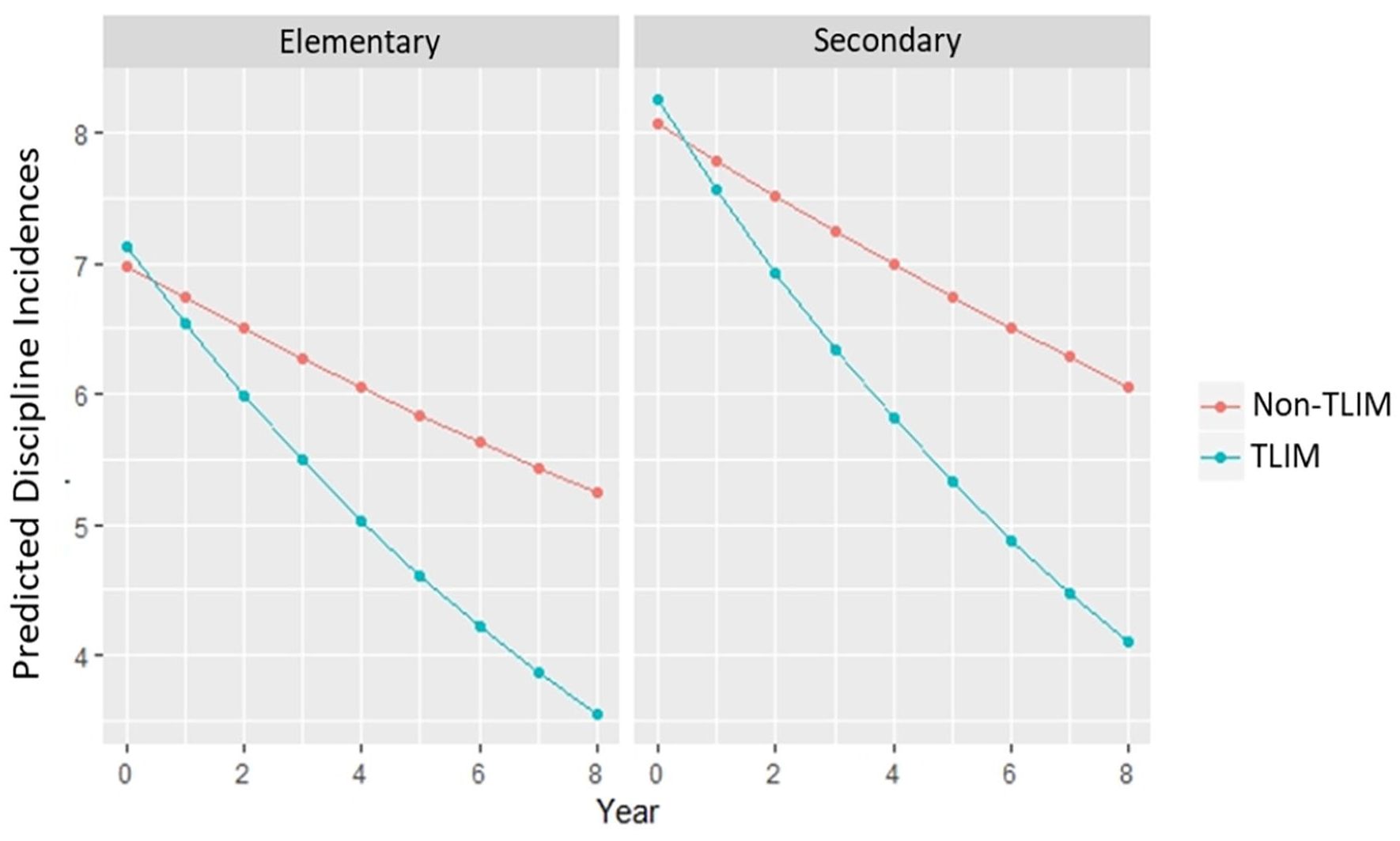
Change in discipline by school type and LiM status.
Participants’ Perception of Causal Components
Figure 1 outlines the five outcomes that emerged in this mixed methods study. How might the Leader in Me promote these outcomes? This is a vital question for practitioners and theorists who need to know which components are crucial to implement in order to achieve the outcomes. It is challenging to identify the crucial components for LiM for two reasons. First, LiM has many components that were implemented across these four schools. Second, it is difficult to isolate causal factors because the 7 Habits intertwine and permeate behavior and activities. As one teacher said, “It just encompasses everything I do and say, from the way my room is decorated, to the way we embed it into our lessons, to the way I speak to students.” However, when participants discussed LiM, they spontaneously drew cause-effect linkages between outcomes and four causal components: goal setting, shared language, students’ leadership roles, and focusing on personal strengths.
Goal setting and Monitoring
Goal setting is a component of the habits Begin with the End in Mind and Put First Things First. Teachers set both personal and professional goals, and students set personal, behavioral, and academic goals. A teacher said LiM asks teachers to “stop and think and kind of reflect about what your mission is and who you are, and why you do what you do.” Teachers and students are coached in best practices around goal setting. That is, goals are to be specific, challenging, divided into subgoals, monitored for progress, committed, and accompanied by implementation plans (Gollwitzer & Oettingen, 2012). Teachers and students have the autonomy to choose their individual mission statements and goals, and they also collaborate in choosing group goals for their class and school.
Ten teachers said that setting and monitoring goals with colleagues gave them a shared mission and sense of purpose, which created “a more positive culture among staff.” Because many mission statements are prosocial in content, teachers said that composing mission statements helps them make a positive ideology for themselves more concrete which improves school climate. LiM may also promote students’ prosocial goals through leadership roles, mission statements, and celebrations of prosocial behavior at leadership assemblies.
In addition, participants perceived goal setting as promoting academic achievement. Sixteen teachers said that when students set academic goals, they plan strategies to achieve their goals and become responsible for their own learning. A teacher said students learn greater “self-responsibility” because “they’re tracking goals, setting goals, learning how to manage their time.” A student said, “I try as hard as I can to make those goals.”
Shared Language
Participants said the shared language of the 7 Habits helps the whole school community share collective values and expectations. They said the language of three habits—Be Proactive, Put First Things First and Begin with the End in Mind—motivate students by helping them plan ahead to get assignments done. A student said he uses the language to remind himself, “I should probably do my homework first, and then I just go out and play.”
Eight teachers also perceived the language of three other habits—Synergize, Think Win-Win, and Seek First to Understand, then to be Understood—to foster prosocial behavior in at least three ways. First, teachers become more prosocial toward each other as they adopt the language to “set norms” for teacher cooperation. During team meetings they asked each other “Are we Synergizing?” They invoked the habit Seek First to Understand, then to be Understood to remind themselves to listen more empathically to one another. Second, the shared language facilitates positive discipline. A teacher said that if she runs into any student in the hall who is “not doing the right thing,” she can say to the student, “‘Are you being proactive?’ or ‘Are you putting first things first?’ . . . And [even kindergartners] know what that means.” She said this simple questioning is often sufficient to change behavior because the question activates a network of information through their shared language. She said using the same language to address behavior across grade levels has unified the school. Third, 16 teachers also said that repeatedly asking students “Did you seek first to understand?” or “Did you think win-win?” promotes self-control and helps students resolve conflict prosocially. A teacher said that the habit Seek First to Understand, then to be Understood is the hardest to live, but that using the phrase has led to greater civility in her classroom. Another teacher said that using the phrases Synergize, Be Proactive, and Think Win-Win helps students become “friendly, polite, and outgoing.”
Student Leadership Roles
Participants said that student leadership roles increase prosocial behavior. Indeed, both teachers and students defined leadership as prosocial behavior. A student said, “Being a leader is helping others.” Regarding buddy time, another student said, “I really help little kids . . . So, that’s why I’m a leader.” A teacher said that as students identify ways they can help others, they “rise up” to become more prosocial. A principal said the leadership roles build student confidence as they “take ownership” of their school. Students develop competence as they learn skills in leadership roles. Two teachers gave the examples that student “technology leaders” or “naturalist leaders” build competence in using technology or creating habitats for animals on school grounds.
Focus on Personal Strengths
Teachers said LiM asks them to focus on students’ strengths in order to help every student find a leadership role that is a good fit. Thirteen teachers said this process helps them better appreciate the whole child and makes it easier to form good relationships with students. A teacher said, “As long as you believe that your students—everybody—has a strength . . . I think it’s boosted morale, boosted self-esteem, and it’s made connections with students and teachers a lot easier to be had.” Participants said students became more prosocial and happier at school as they came to feel valued. Eleven teachers and four parents said this was particularly powerful for students who are not academic stars. A teacher said, “finding their strengths . . . makes kids who are struggling academically or with behavior seem to succeed a lot more and makes them feel that they are valuable.” Another teacher said two new students who were both shy “love it here” at the LiM school partly because having roles in the school helps them feel “like they’re more a part of the school community.” Ten teachers said that in other schools only a small number of high-achieving students become leaders; however, LiM provides a vehicle for all students to be leaders.
Discussion
This study investigated the Leader in Me SEL program using a mixed methods design. We investigated implementation, outcomes, and potential causes of those outcomes. We found that despite the challenge of implementing a multi-faceted program, teachers reported that it was “easy” to incorporate LiM into simple daily interactions. Despite differences among the four schools in our case studies (Table 2), they had similar implementation.
Outcomes
Five outcomes emerged from the collective case study of diverse schools, portrayed in Figure 1. Our outcomes are consistent with the extant qualitative literature on LiM effectiveness. Specifically, teachers feel greater collegiality and enjoyment of teaching; students feel happier, more confident and motivated; and school climate improves (Bennett, 2020; Gage & Thomas, 2019; Ross et al., 2012). Our outcomes are also consistent with the extant quantitative literature. Specifically, there are fewer discipline incidents (Schilling, 2018; White, 2018) and increased achievement (Pascale et al., 2017), although our study is the first to use a quasi-experiment, rather than pre-post design, to address achievement. Two important outcomes not addressed in previous studies are teachers’ and students’ increased prosocial behavior. Thus, this study both confirms and expands the existing literature on LiM.
This mixed method study provides two sources of information to support the premise that LiM has these outcomes: (1) Participating teachers and principals with many years’ experience in non-LiM schools perceived LiM as having these outcomes, as did parents and students who transferred from non-LiM schools, and (2) quasi-experimental analysis of state-wide secondary data provided support for two of the outcomes—discipline and achievement.
The quasi-experiment showed that, compared to matched schools, LiM schools had fewer discipline incidents. This supports case study participants’ perspective that students have fewer behavior issues, and that students are more prosocial and teachers use more positive discipline, which the research literature suggests should lead to a decrease in behavior issues (e.g., Donald et al., 2021). Two other quasi-experimental studies using secondary data also found significant reduction in discipline incidents for LiM schools (Schilling, 2018; White, 2018).
The quasi-experiment also showed that, compared to matched schools, LiM schools had steeper ELA score increases and flatter mathematics score decreases on state proficiency exams. This supports some case study principals’ and teachers’ perspective that LiM increased achievement. It also supports participants’ perspectives that students are more motivated to take responsibility for their learning and are more prosocial. The perceived increase in prosocial behavior is relevant because previous research has found that prosocial behavior is associated with higher grades and test scores (Bergin, 2018; Curlee et al., 2019; Oberle et al., 2022). A study in Florida also found an increase in proficiency rate on the state exam after schools implemented LiM (Pascale et al., 2017). On the other hand, we found no significant difference in ELA scores between LiM and non-LiM schools during the first years of implementation. Perhaps rates of adoption influence the growth trend; between AY2010 and AY2012 there were only 19 LiM schools (15%). Between AY2013 and AY2014, 49 new LiM schools (41.9%) were in their first two years of implementation. This could explain program effect was only detected after AY2014.
Potential Causal Components of LiM
Our study was not a randomized controlled experiment, so we cannot make strong causal claims. Nevertheless, the quasi-experimental design, participant claims, and interviews with educators and students who experienced non-LiM and LiM schools suggest potential causal mechanisms. Participants identified four mechanisms: (1) goal setting and monitoring, (2) shared language, (3) student leadership roles, and (4) focus on personal strengths. Theory and research support these components as predicting the outcomes we identified, with the effects of these components cascading and intertwined, as discussed next.
LiM’s emphasis on goal setting may lead to the increased academic motivation and achievement that participants reported. Extensive research shows that goal setting causes improvement in academic performance (Locke & Latham, 2013). Human thriving is supported by clear personal goals and a focus on them for continuous self-improvement (Ford & Smith, 2007). LiM gives individuals autonomy to set goals, but creates structure for school community members to facilitate each others’ goals. Autonomy support combined with clear structure tends to cause students’ motivation to increase (Jang et al., 2010).
LiM’s emphasis on goal setting may also lead to increased prosocial behavior in both teachers and students. LiM structures school environments to support both academic and prosocial goals (i.e., focused on the well-being of others). Many goals are idiosyncratic, but some core goals are widely shared such as goals for belongingness, social responsibility, and prosocial behavior (Bergin, 2019; Ryan & Deci, 2017). Ford and Smith (2007) refer to these as “social purpose” goals that comprise a “deep motivational well” (p. 167). When students pursue prosocial goals, they tend to behave more prosocially, have fewer discipline needs, and have higher achievement (Bergin, 2019).
Teachers who adopt prosocial goals and behave prosocially create more positive teacher-student relationships (Prewett et al., 2019), which in turn is linked to students behaving more prosocially with classmates (Bergin & Bergin, 2009). Our case study participants indicated that LiM helps teachers achieve prosocial goals by increasing their use of inductive discipline. Induction is a type of discipline in which the teacher listens with the intent to understand and gives students reasons for changing their behavior and principles to guide future behavior (e.g., “Did you seek first to understand, then to be understood?”). Induction contrasts with power assertive discipline, which focuses on punishment for misbehavior. Research has shown that induction can cause internalization of prosocial values, increased self-control, and a more positive school climate (Bergin, 2018; Donald et al., 2021).
LiM’s shared language supports goal setting because shared language helps create a collective value system in which goals are aligned across the school, which makes the goals more powerful (Ford & Ford, 2019). Case study teachers and students reported using the exact phrases taught in LiM. Shared language and mission statements help create a collective identity as students and teachers cooperate to pursue goals (Fiske, 2002). When collective goals are prosocial, not only does the individual thrive but so does the social system (Ford & Smith, 2007), in this case creating a positive school climate.
LiM’s student leadership roles build on the effects of goal setting and shared language by providing opportunity to practice prosocial behavior, because teachers and students defined leadership as helping others. Opportunity to practice prosocial behavior leads to feelings of competence, greater prosocial repertoires, and increased likelihood of engaging in future prosocial behavior (Bergin, 2018). Leadership roles also provide a venue for students to model prosocial behavior to classmates, which leads to classmates becoming more prosocial (Spivak et al., 2015).
LiM’s focus on personal strengths contributes to students feeling valued as teachers give them leadership roles and behave more prosocially toward them. Research has shown that when students believe their teachers value them, they tend to work harder, experience engagement, and have higher achievement (Hughes et al., 2012; Roorda, et al., 2011). Students’ positive emotions from feeling valued by teachers increases their expectation for success and valuing of subject matter (Martin & Dowson, 2009). As students become more prosocial and motivated learners, teachers may find teaching less stressful and have greater job satisfaction (Collie et al., 2012). A primary source of job-related stress or burnout for teachers is students’ misbehavior and low motivation (Camacho & Parham, 2019; Klassen & Chiu, 2011). Additionally, LiM supports a work environment with shared social purpose and camaraderie. Higher-quality relationships with colleagues cause less stress or burnout and greater career satisfaction (Paterson & Grantham, 2016).
In summary, previous research supports the plausibility that the outcomes identified by participants in our case studies and the quasi-experimental data could be caused by the components of LiM that our participants (principals, teachers, parents, and students) identified as causal. Furthermore, existing studies of LiM support our findings regarding the five outcomes identified in this effectiveness study.
Implications for Practice
The results of this mixed-method study have two important implications. First, both the qualitative and quantitative phases support the hypothesis that LiM is effective in promoting the well-being of teachers and students. This was important prior to COVID-19, but is of increased importance because student behavior (National Center for Education Statistics [NCES], 2022) and engagement (Salmela-Aro et al., 2021) have worsened. Furthermore, parents and students perceived that positive effects transferred from school to home despite transfer being notoriously difficult to achieve (Perkins & Salomon, 2012). Thus, the study supports the growing body of evidence that comprehensive SEL programs can be implemented in a way that is effective (Cipriano et al., 2023).
Second, the qualitative phase raises the possibility that effects may be strongest for disengaged students. Our study did not directly address variability in findings across students, but some participants volunteered examples of particularly dramatic turnaround in students who previously disliked school and were unmotivated. Motivation theorists have argued that to support such students, schools should (1) improve teacher–student relationships (2) cultivate mastery-oriented goals, and (3) provide positive role models (Martin & Dowson, 2009), all of which are components of LiM. Previous research has found that when teachers are more prosocial, positive relationships can develop regardless of students’ initial behaviors or risk factors, and positive teacher-student relationships may be especially powerful for such students (Spilt & Hughes, 2015). Similarly, having prosocial classmates may be effective for protecting at-risk peers from developing more behavior problems (Griffith, 2002; Spivak et al., 2015). This is noteworthy because LiM is universally delivered to support students, without specialized staff, without the additional resources needed to identify and target specific at-risk students, and without the stigma involved in such services. However, universal SEL programs, such as LiM, do not replace targeted services for students who would benefit from more intensive services (Bergin et al., 2023).
Limitations and Future Directions
The quasi-experiment, by necessity, relied upon existing state-wide secondary data that have significant limitations. Discipline incident rate has little variation, with most schools hovering near zero, and the data tend to be unstable from year to year. State proficiency exam scores represent a lifetime of opportunity to learn. These limitations of the secondary data would attenuate any relationship between LiM and these outcomes. Thus, the quasi-experiment may underestimate true effects of LiM on discipline and achievement. Furthermore, schools adopted LiM in a staggered fashion. This means that the overall growth trend includes some LiM schools that were not yet treated.
On the other hand, principals and teachers in the case study may overestimate the effects of LiM due to self-selection into the program. Staines and Cleland (2012) argued that in such studies “estimates of efficacy are typically too large because of group differences in pretreatment motivation favoring the treated group over the untreated group” (p. 37).
The possibility of overestimation is contradicted by two sources of evidence. First, parents and students, who did not select the program (except Rural elementary where some parents asked for the program), were strongly positive about the effects of LiM. Second, there is compelling theoretical and empirical support for the components of LiM to cause the positive outcomes found in the collective case study, as discussed above. Thus, we conclude that the teacher and student outcomes identified in the collective case study are reasonable. Nevertheless, this was not an experimental study, which precludes strong claims of causality. Future research using a randomized controlled trial is needed. Furthermore, we note that results may only pertain to effective implementers of LiM in settings similar to participating schools. Future research on schools that struggle to implement LiM is also needed.
Conclusion
This was a mixed methods study of the effectiveness of a school-wide social-emotional learning program, the Leader in Me (LiM). Principals, teachers, parents and students in a collective case study in four diverse elementary schools perceived teachers as becoming more prosocial, using more positive discipline, developing better teacher-student relationships, feeling more camaraderie, and finding teaching easier and more enjoyable. They perceived students as becoming more prosocial, engaging in fewer problem behaviors, developing greater confidence, and becoming more motivated, harder-working learners. Results of the case study were positive, despite our looking for disconfirming evidence and probing participants for alternative views. Case study results were supported by the quasi-experiment using state-wide secondary data which found that LiM schools had fewer discipline incidents and higher scores on the state proficiency exam, despite data limitations that might attenuate results.
An important contribution of this study is that LiM may be effective across diverse schools. This is important because LiM is growing in popularity, which increases the need for effectiveness information and because the extant literature suggests that not all SEL programs are effective (Cipriano et al., 2023; Social and Character Development Research Consortium [SCDRC], 2010; Vincent & Grove, 2012). Outcomes of particular interest are (1) the increase in teacher prosocial behavior, which is key to students’ prosocial behavior (Prewett et al., 2019), and (2) teachers finding their jobs easier and more enjoyable, which may reduce teacher burnout. It is noteworthy that LiM first addresses teacher social-emotional competencies before addressing student competencies. Furthermore, participants perceived four components as contributing to outcomes: (1) goal setting, (2) shared language that create shared values, (3) students’ leadership roles, and (4) focus on personal strengths. These components could be used to support other SEL programs.
Supplemental Material
sj-docx-1-ero-10.1177_23328584241281284 – Supplemental material for Effectiveness of a Social-Emotional Learning Program for Both Teachers and Students
Supplemental material, sj-docx-1-ero-10.1177_23328584241281284 for Effectiveness of a Social-Emotional Learning Program for Both Teachers and Students by Christi Bergin, Chia-Lin Tsai, Sara Prewett, Eli Jones, David A. Bergin and Bridget Murphy in AERA Open
Footnotes
Acknowledgements
We would like to thank Tony Castro for guiding the collective case study methods in this project, Kirsten Pinto for improving the writing from the perspective of a teacher and editor, and Tayla Stephen for carefully preparing data for publication.
Declaration of Conflicting Interests
The author(s) declared the following potential conflicts of interest with respect to the research, authorship, and/or publication of this article: To obviate concerns that funding could influence the objectivity of the research, our agreement with the developer was that any results, whether in the interest of the developer or not, would be freely published. We maintained a stance of informed skepticism based on previous research that suggests that even well-designed SEL programs may have small or no effects (SCDRC, 2010; Vincent & Grove, 2012). We looked for and asked participants about alternative, rival hypotheses. We rotated through a team of four researchers during analysis. The developer was not involved in the study design, collection, analysis or interpretation of data, in writing the article, or in the decision to submit the article for publication. The researchers were not involved in the implementation of the program.
Funding
The author(s) disclosed receipt of the following financial support for the research, authorship, and/or publication of this article: This study was funded by the developer of TLIM, FranklinCovey Education.

Authors
CHRISTI BERGIN is director of the Prosocial Development and Education Research Lab at the University of Missouri, Columbia, MO;
CHIA-LIN TSAI is associate professor at the University of Northern Colorado, Greely, CO;
SARA PREWETT is senior researcher at Aperture Education, Setauket, NY. Her research focuses on interventions to improve teacher-student relationships and social-emotional learning in K-12 schools.
ELI JONES is assistant professor at the University of Memphis, Memphis, TN;
DAVID A. BERGIN is professor emeritus at the University of Missouri, Columbia MO;
BRIDGET MURPHY is data resource coordinator at the University of Missouri, Columbia, MO;
References
Supplementary Material
Please find the following supplemental material available below.
For Open Access articles published under a Creative Commons License, all supplemental material carries the same license as the article it is associated with.
For non-Open Access articles published, all supplemental material carries a non-exclusive license, and permission requests for re-use of supplemental material or any part of supplemental material shall be sent directly to the copyright owner as specified in the copyright notice associated with the article.
