




Abstract
This article delineates the development of a measure to assess teachers’ reported engagement in practices that center on issues of racial equity as part of their SEL instruction. An iterative mixed-method approach included theoretical grounding, literature reviews, content expert evaluation, focus groups, cognitive interviews, and multiple survey administrations. Exploratory and confirmatory factor analyses were conducted using data from three independent samples of fifth- to eighth-grade teachers (N range = 240–260; White = 67–89%; Black = 3–7%; Latinx = 5–23%). Test-retest reliability was assessed in a fourth national sample from the RAND American Education Panels (N = 482; Black/African American = 19.9%, Latino/Hispanic = 16.2%, Asian/Asian American = 2.7%, American Indian/Native American = 1.9%, White = 66.0%, Middle Eastern/North African = 0.6%, and Other = 2.7%). Results suggest (1) evidence of strong internal consistency for the 41-item Racial Equity-oriented Social Emotional Learning (REQSEL) measure; (2) REQSEL scores correlated with multiple relevant measures of teachers’ beliefs and behaviors regarding race, ethnicity, culture, and social justice; and (3) REQSEL scores correlated with teachers’ own ethnic-racial identity beliefs.
Keywords
Social and emotional learning refers to myriad skills and competencies that support success in school, work, and life. These include cognitive skills that help us to focus and pay attention, set goals, and problem solve; social and interpersonal skills that enable us to communicate, collaborate, and resolve conflict; and emotional skills that help us recognize, understand, and manage emotions, demonstrate empathy, and cope with hardship (National Commission on Social, Emotional, and Academic Development, 2019). Practices to support such development for children and youth can occur through multiple mediums, such as the implementation of packaged skill-building programs, pedagogical approaches integrated into academic instruction, and relationship- and school climate–enhancing efforts (National Commission on Social, Emotional, and Academic Development, 2019). Over the past two decades, research and implementation of SEL programs and policies in K–12 settings and other sectors has increased exponentially (Mahoney et al., 2021). Indeed, a recent study of a nationally representative sample of school leaders and teachers tells us that the overwhelming majority of principals at all kinds of schools view SEL as one of their top priorities (Hamilton et al., 2019). In recent years, however, this increased attention has been accompanied by questions about how issues of equity intersect with the study and practice of SEL (e.g., Aspen Institute Education and Society Program, 2018; The Education Trust, 2020). This is a particularly salient issue in SEL facilitation with youth as they move into and through adolescence, as this developmental period is known to be one in which youth engage in deeper meaning-making about identity and racial and immigration injustices (e.g., Rivas-Drake & Umaña-Taylor, 2019; Tatum, 2017). In communities that face daily injustices, it is disingenuous and potentially harmful to engage in SEL without attending to historical and contemporary systems that underlie inequities in education, well-being, and health. SEL practitioners who engage in decontextualized skills training or do not engage with such inequities as they seek to serve youth may be rightfully critiqued for placing the burden of addressing social inequities on youth themselves (Ginwright, 2016; Love, 2019). Indeed, it is possible to engage in SEL in ways that leverage youths’ cultural assets, such as their racial identities or emerging critical consciousness, both of which are shown to promote positive adjustment (e.g., Heberle et al., 2020; Rivas-Drake et al., 2014).
In contrast to color-evasive and power-evasive approaches—that is, when SEL skills are taught without regard to how racism and other forms of oppression play a role in youths’ lives—transformative SEL refers to the integration of an explicit equity and social justice lens into the conceptualization and implementation of social and emotional learning. Jagers et al. (2019) conceptualized it as an approach to SEL that aims to disrupt the reproduction of inequitable educational environments by attending to identity, power, discrimination, and social justice. In practice, transformative SEL work “is a process whereby young people and adults build strong, respectful, and lasting relationships that facilitate co-learning to critically examine root causes of inequity, and to develop collaborative solutions that lead to personal, community, and societal well-being” (CASEL, n.d.).
Although having a conceptual framework for transformative SEL represents a substantive advance in the field, empirical studies lag due to a lack of methods to accurately assess how inequity and injustice are addressed in the realm of SEL instruction. In this article, we delineate the development of a tool that can be used to assess educators’ understanding of their racial equity-oriented SEL practice, in particular. Researchers, evaluators, program developers, and school leaders would benefit from a measure to demonstrate engagement with racial equity-oriented SEL practices. That is, calls to address racial equity have been primarily philosophical or conceptual (e.g., Aspen Institute Education and Society Program, 2018; Jagers et al., 2019), and we do not have abundant empirical understanding of the potential prevalence of such practices. One reason is that existing measures focus on teachers’ beliefs about their own SEL competencies (Brackett et al., 2012) or provide self-reflection of general SEL instructional practices (Yoder, 2014). There is currently no way to systematically assess the extent to which teachers perceive they engage in SEL practices that are aligned with racial equity goals. To advance understanding of how SEL practitioners might view SEL as a context in which to promote rather than hinder racial equity, there is a need to better understand ways they might try to “meet youth where they are” in terms of their social identities and in addressing issues that are important to students and salient to their communities.
How Can Racial Equity Issues Be Addressed in SEL?
Scholars have conceptualized varying forms of asset-based pedagogies (e.g., culturally relevant, sustaining; Matthews & López, 2019; Paris & Alim, 2014) that provide inspiration for considering promising practices for racial equity–oriented SEL. These theories underscore the importance of leveraging youths’ assets, including their cultural background, experiential knowledge, and prior experiences, to make learning relevant to students and to do so with an eye toward justice (Gay, 2018; Ladson-Billings, 2014; Paris & Alim, 2014). By making connections between youths’ school and home experiences, teachers using asset-based pedagogies promote youths’ academic success, cultural competence, and sociopolitical consciousness (Epstein & Gist, 2015; Ladson-Billings, 2014). In particular, scholars have highlighted the importance of creating opportunities for students to engage with their ethnic and racial identities (Byrd, 2017; Matthews & López, 2019; Milner, 2017); reflect critically on and confront racial injustice and xenophobia (e.g., Byrd, 2017; Duncan, 2022; Epstein & Gist, 2015; Kaler-Jones, 2021; Milner, 2016, 2017); navigate interacting with diverse peers (e.g., Dickson et al., 2016); and examine classroom discipline (e.g., Pollock, 2008).
Recent scholarship has examined how school-based SEL instruction can be a context that promotes racial equity. One study indicated that SEL instruction that provided opportunities for students to gain autonomy, reinforced prosocial behavioral routines, and encouraged collaboration was positively associated with adolescent students’ exploration and resolution of their ethnic-racial identities (Rivas-Drake et al., 2020). Rosario-Ramos et al. (2021) identified examples of the ways teachers modify SEL curricular materials and instructional practices to help students identify, understand, and address social injustices, including racial and immigration injustice. Examples included integrating practices that promote school safety and equity by focusing on repairing harm (i.e., restorative justice framework; Morrison & Vaandering, 2012), honoring youths’ perspectives within decision-making processes (i.e., youth voice; Checkoway, 2011; Sprague Martinez et al., 2018), adding readings that reflected students’ lives and experiences, and addressing issues directly related to students’ communities through civic engagement activities. These studies demonstrate the potential for SEL instruction as a context for conversations and experiences that support students’ identity development and their learning about racial and immigration injustice.
In our ongoing work, we have examined the potential of SEL instruction to leverage youths’ emerging understandings of community issues and broader social injustices to promote competencies such as healthy personal and social identities, collective agency, critical analysis of social issues, and community well-being. We recently completed a mixed-method case study drawing on youth surveys; youth, parent, and teacher interviews; and SEL classroom observations in a predominantly Latinx school in a large urban district to illustrate examples of transformative SEL practices (McGovern et al., 2023). We found that although this school employed a traditional SEL curriculum (i.e., did not routinely attend to social justice issues), some teachers adapted their SEL instruction to support students’ development of ethnic/racial identities and their collective agency to examine and interrupt inequities. Our findings illustrated how teachers at this school “stretched” from traditionally social justice-evasive notions of SEL to engage social justice issues more proactively in their SEL implementation in four key ways: connecting through language, connecting to students’ social identities, addressing social issues, and encouraging civic engagement and activism. These findings indicate that it is possible to engage in transformative SEL practices in SEL classrooms.
Current Study
The current study describes the development of a measure of educators’ views of SEL as a context in which they can promote racial equity (i.e., racial equity-oriented social-emotional learning, or REQSEL). Through a series of studies involving focus groups, expert reviews, interviews, and surveys, we delineate the initial development of items, multiple iterative steps taken to revise and reduce items, exploration and extraction of factors, and confirmation of hypothesized factor structure. We then describe the associations of the final set of factors with sources of validity. Specifically, we assessed SEL facilitators’ critical awareness (Matthews & López, 2019), egalitarian views of students (Hachfeld et al., 2011), exploration and resolution of their own ethnic-racial identities (Douglass & Umaña-Taylor, 2015); engagement in social justice behaviors (Flood, 2019); beliefs about the importance of talking about racial issues in the classroom (Milner et al., 2016, 2017); and beliefs about culturally responsive teaching approaches (Siwatu, 2007). We expected that the REQSEL domains would show evidence for validity by being positively associated with educators’ critical awareness, egalitarianism, exploration and resolution of their ethnic-racial identities, social justice behaviors, general beliefs regarding talking about racial topics in the classroom, and endorsement of and sense of efficacy in implementing culturally responsive teaching approaches. To be clear, the goal of this work was not to understand the relation of REQSEL items to the broader concept of SEL but rather how racial equity considerations might manifest within teachers’ approaches to SEL, writ large. The concepts reflected in our validation measures (i.e., non-SEL-specific beliefs about racial equity practices, beliefs about racial diversity and inequality, understanding of one’s own ethnic-racial identity, and non-SEL-specific racial equity-oriented behaviors) thus reflect an important set of teacher cognitions about diversity, identity, and inequality.
Method
Team Description
The author/research team comprises four diverse women scholars committed to educational justice and equity for children of color; our shared beliefs are reflected here. Our critical scholarship examines the complexities of race and ethnicity—and racism and xenophobia—through the study of identity, socialization, discrimination, and sociopolitical development among marginalized communities. Our team benefited from the varied expertise brought by each individual, and these perspectives shaped the interpretation of results. DRD is an established Latina scholar with expertise in socioemotional development; ethnic-racial identity development; and ethnic-racial socialization across home, peer, and school settings. JC is a Black scholar whose research centers on the impacts of parents’ and teachers’ critical consciousness development on the learning experiences of youth of color. GM is a White emerging scholar and former middle school teacher who has expertise in qualitative analysis and whose scholarship focuses on effective teaching practices for fostering social and emotional development in adolescents. BJP is an emerging Latina scholar who has experience in qualitative and quantitative analysis and whose research focuses on how educators can best support the ethnic-racial identity and critical consciousness development among youth of color. Throughout each step of the scale creation, we strove for consensus, discussing our thoughts and taking detailed notes of our conversations. When disagreements occurred, we consulted the extant research literature and reflected on our lived experiences to make a collective decision.
REQSEL Item Development
An iterative mixed-method approach was used to develop this measure following Boateng et al.’s (2018) best practices for scale development and validation. We conducted literature reviews, evaluation by content experts, and focus groups with the target population to inform the development of items and domains. Next, we evaluated validity with reviews by experts in the field and the target population.
Item Creation and Refinement
A substantive literature review was conducted before constructing the REQSEL. Members of the research team collected inspiration for items from literature, prior research, field reports, and existing measures from other contexts related to the development of social and emotional learning, racial/ethnic identity development, and civic engagement. We largely employed a snowball approach; as we located relevant studies and existing measures, we looked for areas of overlap in the research and extended our search using the references provided in these manuscripts. Initial brainstorming resulted in a list of 248 rough phrases, items, and notes. Content analysis of this initial brainstorm and extant literature suggested several themes at this point: engagement with students’ ethnic and racial identities; conversations on structure, power, inequality, injustice, and racism; discipline; awareness of difference; power and community; co-constructing practices; and challenging representations in media and curriculum.
Using a consensus process (see Hill et al., 1997, 2005), we reviewed the brainstormed list to eliminate redundant ideas and to draft items that reflected teaching practice. This process resulted in 150 items in six domains, shown in Appendix A: Engagement with Racial Identity (26 items); Navigating Intergroup Relations (19); Racial Injustice (43); Racially Equitable Discipline (17); Xenophobia (10); and Student Agency, Voice, and Power (35). We consolidated the Co-Constructing Practices and Challenging Representation domains with others when thematically appropriate. For example, we moved items from Co-Constructing Practices to Student Agency, Voice, and Power because many of the practices involved in co-constructing the classroom environment also reflected ways in which teachers might support student agency by elevating students’ voices, thus sharing their power as a teacher. A second iteration of the consensus process focused on refining the item wording to specifically reflect social and emotional learning instruction (e.g., ensuring the item stem reminded respondents to reflect on their experience teaching SEL, writ large) and continuing to eliminate redundancy. This process resulted in fewer items (139) across the same six domains: Engagement with Racial Identity (22 items); Navigating Intergroup Relations (16); Racial Injustice (42); Racially Equitable Discipline (15); Xenophobia (10); and Student Agency, Voice, and Power (34).
We then held two focus groups, each with five middle school teachers who were familiar with SEL. Participants were recruited through a Qualtrics teacher panel. We contracted with Qualtrics to reach a large panel of teachers from across the United States. Qualtrics generates panels with partners who actively manage double opt-in corporate and academic market research panels. Using the client’s survey requirements, Qualtrics selects respondents from these panels using screener questions to guarantee that the population surveyed meets the inclusion criteria. Participation in these panels is voluntary and participants receive monetary compensation from Qualtrics. For this component, as well as the studies described later, Qualtrics limited participants to fifth- to eighth-grade teachers who were familiar with SEL (based on responses to a screener question). Individuals who did not meet these criteria or who taught for fewer than 1 or more than 50 years were eliminated. This panel of eligible participants was used for each of the Qualtrics samples across all the studies reported in this article. Qualtrics further excluded panel members by participation frequency so that our samples were distinct from one another.
In the focus groups, 30% were familiar with SEL and 70% had taught SEL in the past 3 years. Half of the participants taught in a suburban school, 10% at a town school, 30% at a city school, and 30% at a rural school. All the participants were White. Half of the participants reported their pronouns as she/her, and the other half reported as he/him. The focus groups were facilitated by an external collaborator who was not a member of the research team and lasted approximately 53 and 60 minutes in duration, respectively. The focus group protocol asked participants to consider each of the six proposed domains (listed previously) and probed for potential actions that teachers might engage in for each (i.e., “What are the kinds of things that you have done, or you have seen your colleagues do well to address this topic during SEL instruction? What are the practices that work really well when addressing this topic during SEL? What would you look for if you were observing a teacher who was addressing this topic during SEL?”). Transcripts for each focus group were shared with and read in their entirety by the research team. In a debriefing meeting, we discussed the focus group respondents’ utterances with the goal of identifying potential new item content. Feedback from the focus groups did not generate any new items but did confirm the relevance of the preliminary domains.
Sources of Validity
To gather evidence for validity, the 139 REQSEL items were presented to a panel of six content experts that was diverse in terms of racial composition and expertise. Reviewers were selected based on their expertise in the content area of the domain or extensive experience working with school practitioners implementing SEL. Each reviewer was asked to review the domain(s) that aligned with their expertise. We asked them to offer their comments, questions, or wording suggestions on each item assigned with regard to each item’s validity, whether the item would be applicable to all/most classrooms, and whether there were big ideas missing from the domain. The research team then weighed this feedback to further refine and eliminate items. We dropped items that were flagged by reviewers as confusing or vague (e.g., “I select activities that help students figure out who they are becoming” and “I follow students’ leads when discussing issues of injustice”), were focused on student outcomes rather than teacher practices (e.g., “Students form meaningful connections to their own racial/ethnic identities”), or were likely to lack variance due to social desirability (e.g., “I publicly thank students for their contributions to class”). Reviewers also helped us to decide between similarly worded items (e.g., between “I use instructional materials (e.g., books) to help students learn about the lived experiences of different ethnic/racial groups” and “I use textbooks that portray images of people of different ethnic/racial groups”). Other feedback affirmed the inclusion of items that reflected important concepts (e.g., “I validate the emotions students feel in response to issues we discuss”). This resulted in a reduction to 80 items across the same six domains: Engagement with Ethnic/Racial Identity (12 items); Navigating Intergroup Relations (9); Racial Injustice (25); Racially Equitable Discipline (5); Xenophobia (11); and Student Agency, Voice, & Power (18). The Engagement with Racial Identity domain was renamed to also include ethnic identity at this point.
Next, the 80 preliminary items were evaluated by members of the target population (i.e., educators) recruited again through Qualtrics teacher panels. The 80 items were divided across five surveys, each with 16 items. The following domains were kept intact in the survey (due to these domains containing fewer than 16 items): Engagement with Ethnic/Racial Identity, Navigating Intergroup Relations, Racially Equitable Discipline, and Xenophobia. The other two domains—Racial Injustice and Student Agency, Voice, & Power—were divided across two surveys: four items from Racial Injustice were included with all twelve items of Engagement with Ethnic/Racial Identity. Seven items from Racial Injustice were included with all nine items of Navigating Intergroup Relations. Two items from Student Agency, Voice, & Power were presented, with the remaining 14 items from Racial Injustice. A total of 62 teachers (87% had taught SEL in the past three years) provided feedback. Teachers were randomly assigned to one of the five surveys. The evaluators were diverse, including White (52%), Black/African American (28%), Asian American (11%), and American Indian/Native American (11%) educators. They also taught in a range of settings: 45% taught in a city school, 33% at a suburban school, 32% at a town school, and 19% at a rural school. Fifty-eight percent of the participants reported their pronouns as she/her, 27% reported as he/him, 8% reported as they/them, 2% as ze/zir, and 1% preferred not to answer. Thirty-nine percent had a master’s degree, 34% a bachelor’s degree, 18% a professional degree, 6% some college, and 3% graduated from a two-year college. Participants responded to each item, provided feedback on the clarity and relevance of the items, and selected the five items that were most important and least important for addressing issues of racial equity during SEL instruction. Review of this feedback prompted further refinement and elimination of items as well as the separation of Language as a separate domain from Engagement with Racial/Ethnic Identity. This process resulted in a reduction to 73 items across seven domains: Engagement with Ethnic/Racial Identity (7 items); Language (3); Navigating Intergroup Relations (8); Racial Injustice (24); Racially Equitable Discipline (6); Xenophobia (11); and Student Agency, Voice, and Power (14).
With these revisions, the initial REQSEL item set that was used in the subsequent phases (as follows) included 73 items. Each item was preceded by the phrase, “Reflecting on your experience teaching Social and Emotional Learning (SEL), how often does this happen in your classroom?” Respondents were asked to indicate on a scale from 1 to 5 the frequency of the practice, with 1 = never and 5 = always. This text anchor is in line with scales that ask educators to reflect on the frequency of addressing youths’ culture into the classroom (Matthews & López, 2019) as well as scales that ask about students’ perceptions of culturally responsive teaching (Dickson et al., 2016).
REQSEL Scale Development
Four independent samples were gathered for four separate studies that helped to determine the optimal number of factors or domains that fit the REQSEL items. Study 1 was an exploratory factor analysis using the 73-item set, as noted previously. Using the results of this analysis, we further reduced the scale to 57 items. Combined with feedback from cognitive interviews (described later), we then further reduced the scale to 51 items. Study 2 was an exploratory factor analysis that began with the reduced 51-item set and ended with further item reduction based on the results. The final 41-item set was used in a confirmatory factor analysis in Study 3. Study 4 used the final 41-item REQSEL in a test-retest study design. This research was determined to be exempt from institutional review board oversight at the University of Michigan.
Participants
The samples for Study 1 (EFA), Study 2 (EFA), and Study 3 (CFA) comprised fifth- through eighth-grade teachers familiar with SEL recruited at three separate times using Qualtrics teacher panels. The sample for Study 4, recruited through the Rand American Teacher Panel, comprised fifth- through eighth-grade teachers responsible for delivering SEL instruction. Demographics for Study 1–3 samples are provided in Table 1 and for Study 4 in Table 2. Of note, the demographics of participants reflect nationwide trends of the racial makeup of teachers; about one-quarter of all teachers are not White (Gumber & Beckhusen, 2022).
Participant Demographics (Studies 1–3)

Note. EFA = Exploratory factor analysis; CFA = Confirmatory factor analysis; SEL = Social-emotional learning; ELA = English/language arts; BS/BA = Bachelor of science/bachelor of arts; MS/MA = Master of science/master of arts.
Race/ethnicity ALL = Respondents were asked to indicate all that apply, and thus percentages can add up to more than 100%.
Race/ethnicity ONE = Respondents were asked to indicate the group they most feel a part of.
Participant Demographics (Study 4, N = 482)

Note. ELA = English/language arts; ESL = English as a second language.
Race/ethnicity ALL = Respondents were asked to indicate all that apply, and thus percentages can add up to more than 100%.
Race/ethnicity ONE = Respondents were asked to indicate the group they most feel a part of.
Procedure
In studies 1–3, data were collected through an online survey administered via Qualtrics teacher panels (see above for further information about the panels). Response rates for each administration were Study 1, 84%; Study 2, 73%; and Study 3, 78.5%. Qualtrics provided clean, de-identified data sets to the researchers after each administration was completed. In Study 3, in addition to the REQSEL items, seven measures were used to test theoretically relevant associations with critical awareness, egalitarianism, ethnic-racial identity exploration and resolution, social justice behaviors, teacher race talk, teachers’ culturally responsive teaching outcome expectancy beliefs, and teachers’ culturally responsive teaching self-efficacy. All items were randomly presented within subscales, and the subscales were presented in a random order. An error in survey programming resulted in a randomized omission of one validation measure and data that are consequently missing at random. Therefore, although the total sample size for the REQSEL in Study 3 was 260, the sample size for each of the validity measures ranges from 206 to 234.
In Study 4, the 41 REQSEL items resulting from previous steps (Studies 1–3) were used to assess test-retest reliability among teachers in the RAND American Teacher Panel who were currently teaching in elementary and middle schools and were responsible for delivering SEL instruction (RAND American Educator Panels, 2022); these were conducted online, and respondents received a $10 Amazon gift card upon completion. All items were presented in a random order within scales, and the scales were presented in a random order as well. These brief survey administrations (approximately 10 minutes in length each) were conducted at two time points approximately 3–4 weeks apart. RAND provided clean, de-identified data sets to the researchers upon completion of data collection.
Measures
Racial equity-oriented social and emotional learning practices (REQSEL)
As described previously, the REQSEL was designed to measure the extent to which practitioners view SEL as a context in which they can advance racial equity, including their self-reported engagement in practices that would promote awareness of diverse ethnic/racial identities and experiences; acknowledge and address racial injustice; acknowledge and address xenophobia; and support students’ agency, voice, and power. Items were rated on a 5-point scale from never (1) to always (5), and the items were averaged to create scale scores for each domain. In Study 1, the REQSEL contained 73 items; in Study 2, it contained 51 items; and the final version of the REQSEL used in Studies 3 and 4 contains 41 items. All items are listed in Table 4.
Critical awareness
Teachers’ beliefs reflecting critical awareness were assessed using a five-item scale adapted from a measure of professional beliefs about diversity (Matthews & López, 2019). The measure showed an internal consistency of α = .75 among a study of teachers in an urban, southern Arizona school district that was approximately 65% Latino (Matthews & López, 2019). The measure also demonstrated acceptable fit in a confirmatory factor analysis, χ2 = 20.80, df = 4, p < .001, RMSEA = .08 [90% CI 0.05, CFI = .98, TLI = .95, SRMR = .02, .11], and the factor loadings ranged from .52 to .88 in that study. Items (e.g., “Historically, education has been mono-cultural, reflecting only one reality and has been biased toward the dominant [White] group”) were rated on a 5-point Likert scale from strongly disagree (1) to strongly disagree (5), and the items are averaged to create a scale score. In the present study, internal consistency was acceptable (α = .79).
Egalitarianism
In Study 3, the egalitarianism subscale of the Teacher Cultural Beliefs Scale measured how strongly participants focused on cultural similarities and endorsed the belief that all students should be treated equally, regardless of their cultural background (Hachfeld et al., 2011). Internal consistency of α = .81 was demonstrated in a sample of German teacher candidates and educational science students (21% of participants were from an immigrant background; Hachfeld et al., 2011). In that study, the measure demonstrated adequate fit in a two-factor confirmatory factor analysis with multiculturalism as the second factor, χ2 = 70.34, df = 33, RMSEA = .06, CFI = .97, TLI = .95, SRMR = .04, and the factor loadings for egalitarianism ranged from .41 to .86. The four items (e.g., “Schools should aim to foster and support the similarities between students from different cultural backgrounds”) were rated on a 6-point Likert scale ranging from strongly disagree (1) to strongly agree (6). The items were averaged to create a scale score. In the present study, internal consistency was acceptable (α = .74).
Ethnic-racial identity exploration and resolution
Two subscales of the Ethnic Identity Scale–Brief (EIS-B; Douglass & Umaña-Taylor, 2015) were used in Study 3 to assess the degree to which teachers have sought information about their ethnic-racial group (3 items; exploration) and the sense of clarity they have regarding their ethnic-racial identity (3 items; resolution). Items (e.g., “I am clear about what my ethnicity means to me”) were rated on a 4-point Likert scale from does not describe me at all (1) to describes me very well (4). Items from each subscale were averaged to create two scale scores. Regarding psychometric properties, in previous studies, internal consistency has been demonstrated among White, Latinx, East Asian, South Asian, Black, and Middle Eastern university students (exploration α ranged from .79 to .89 across four waves; resolution α ranged from .81 to .87 across four waves; Douglass & Umaña-Taylor, 2015). The measure demonstrated acceptable fit in a three-factor confirmatory factor analysis conducted as a part of Douglass and Umaña-Taylor’s (2015) study, χ2 = 385.12, df = 24, RMSEA = .04, CFI = .99. In the present study, internal consistency was acceptable for exploration (α = .84) and resolution (α = .77).
Social justice behaviors
The Social Justice Behavior Scale was used in Study 3 to assess teachers’ social justice–oriented behaviors (Flood, 2019). This measure was originally designed to assess the social justice behaviors of school leaders. Each of the three subscales encompassing the measure demonstrated adequate internal consistency (School-Specific α = .91; Community-Minded α = .92; and Self-Focused α = .87) in a sample of school principals, which was more ethnically diverse and female than other nationally representative datasets (e.g., 73% White, 58% female; Flood, 2019). The factor loadings for the principal components analysis performed in Flood’s (2019) study ranged from .50 to .82 for School-Specific, −.64 to −.91 for Community-Minded, and .62 to .77 for Self-Focused. We modified the measure for use by teachers by eliminating items that could not directly apply to classroom teaching (i.e., applicable only to leadership practices). The number of items representing each of the three subscales was reduced: School-Specific (originally nine items, reduced to 7 for this study), Community-Minded (7 items), and Self-Focused (originally seven items, reduced to six for this study). Example items include, “I dismantle barriers that hinder the practice of social justice in my school” (school-specific), “I engage in community organizing work” (community-minded), and “I continuously reflect to avoid making unjust decisions” (self-focused). Item responses were based on frequency and ranged from never (0) to every time (6). The items from each subscale were averaged to create three scale scores. In the present study, internal consistency was acceptable for school-specific behaviors (α = .92), community-minded behaviors (α = .95), and self-focused behaviors (α = .85).
Teacher Race Talk
In Study 3, the Teacher Race Talk measure was used to assess teachers’ beliefs about the importance of and their preparedness for talking about race in their classrooms (Milner et al., 2016, 2017). In Milner and colleagues’ research, an exploratory sample of 386 preservice (49%) and in-service (51%) teachers responded to the survey (87% of respondents were White or European American, 6% were Black or African American, 3% were Brown or Latinx, 2% were Asian American, and 2% self-identified as multiracial). Twelve items (e.g., “I believe that teachers should discuss racism and racial discrimination with their students; I feel prepared to have conversations about race in my classroom”) were rated yes (1), no (0), or not sure (2). Participants’ responses were recoded such that no and not sure responses were both given a value of 0. Responses were then summed to generate a total score.
Teachers’ culturally responsive teaching outcome expectancy beliefs
This scale was used in Study 3 to assess teachers’ beliefs about how their implementation of culturally responsive teaching practices will lead to positive outcomes for students (Siwatu, 2007). In a sample of preservice teachers from the Midwest (93% indicated they were White, and 7% were either Mexican American, Asian American, or African American), the measure showed an internal consistency of α = .95 (Siwatu, 2007). The factor loadings resulting from the one-factor principal components analysis performed in Siwatu’s (2007) study ranged from .55 to .75. The 26 Likert-type items (e.g., “Using culturally familiar examples will make learning new concepts easier”) are rated using a probability of success from entirely uncertain (0) to entirely certain (100). Participants’ responses are summed to generate a total score. In the present study, internal consistency was acceptable (α = .97).
Teachers’ culturally responsive teaching self-efficacy
This scale was used in Study 3 to assess teachers’ confidence in their ability to engage in culturally responsive teaching practices (Siwatu, 2007). In a sample of preservice teachers from the Midwest (93% indicated they were White, and 7% were either Mexican American, Asian American, or African American), the measure showed an internal consistency of α = .96 among a sample of preservice teachers (Siwatu, 2007). The factor loadings resulting from the one-factor principal components analysis performed in Siwatu’s (2007) study ranged from .39 to .79. The 40 Likert-type items (e.g., “I am able to identify the diverse needs of my students”) were rated on a confidence scale ranging from no confidence at all (0) to completely confident (100). Participants’ responses to each of the 40 items were summed to generate a total score. In the present study, internal consistency was acceptable (α = .97).
Cognitive interviews
Following the item reduction and factor extraction in Study 1, we conducted five cognitive interviews with the target population to evaluate whether the items were being understood and generating the information intended. The REQSEL was originally designed to assess self-perceptions of engagement practices that are aligned with transformative SEL, in part based on research conducted in urban schools serving students of color. Therefore, our goal was to recruit teachers with experience teaching SEL to students of color in urban school settings. Participants were recruited by sending an email and flier advertising the study to research team members’ contacts. Seven people responded to the request. One was eliminated because they indicated the student population they worked with was more than 50% White, and another was eliminated because they did not teach in an urban setting. All five participants were middle school teachers who had taught SEL in the past 3 years at an urban school and taught primarily students of color (at least 50% of their students are students of color). Five participants were interviewed (3 men and 2 women, 3 White and 2 Asian, 2 Master’s and 3 Bachelor’s degrees, 4 traditional public and 1 charter school). In each interview, participants were read each of the 57 REQSEL items aloud. They answered the item using the provided response scale. Then the interviewer asked two follow-up questions: (1) What do you think this question is asking (i.e., to gauge their comprehension of what the question was meant to ask) and (2) how did you arrive at your answer (i.e., to assess what experiences they were drawing on in response to the question)? After all the individual questions had been discussed, participants were asked to share any general feedback on the measure. Using proactive, standardized probes in this manner reflects a combination of the think-aloud and the probing techniques common to cognitive interviews (Beatty & Willis, 2007).
One research team member conducted all the cognitive interviews and recorded them. All research team members listened to each interview and made notes for each item about whether they felt the participant (a) understood the question and (b) responded based on an example of their practice. In a research team meeting, we went through each item to discuss whether to revise or drop it. Among dropped items were: “I provide opportunities for students to incorporate their own ethnic/racial experiences into their school assignments” because the reference to school assignments might be too specific to a content area; “to the extent possible, I translate conversations for students who are English learners,” because it was too specific to the makeup of the classroom; and “I encourage students to initiate projects to inspire their classmates to work on issues related to racial justice,” because the item was too confusing. Minor wording changes helped to improve the focus of items (e.g., changing “I help students identify strategies to reduce stress from dealing with racism in their lives” to “I help students identify strategies for dealing with racism in their lives” to remove the influence on stress and keep the focus on racism).
Results
Study 1: Exploratory Factor Analysis With Qualtrics Sample 1
An exploratory factor analysis (EFA) was conducted in Mplus (Muthén et al., 2017). Factors were extracted using maximum likelihood methods with an oblique rotational method (geomin) because factors were hypothesized to be related and thus were allowed to correlate with each other. There was no missing data. We examined the fit for models with up to 7 factors using the eigenvalues, percentage of the variation explained, chi-square (χ2), root mean square error of approximation (RMSEA), comparative fit index (CFI), Tucker-Lewis index (TLI), and the standardized root mean square residual (SRMR) as fit indices. For a good fitting model, χ2 should be nonsignificant; however, it may be significant due to a large sample size. Additionally, the RMSEA should be .06 or lower, the CFI and TLI should be .90 or higher, and the SRMR should be .08 or lower (Hu & Bentler, 1999; Kline, 2010; Martens, 2005). We further examined the 7-factor model (ML, oblique rotation, geomin) after determining that it fit the data best. The number of factors for this model was also consistent with our theoretical domains.
We nominated items for elimination using recommended thresholds for inter-item correlations (<.30) and item-total statistics (i.e., <.30). Using the IICs, we selected 25 items as candidates for deletion. Then, we used the factor loadings from the 7-factor model to identify items from this list that had factor loadings of <.32 or cross-loadings with less than a .15 difference from the item’s highest factor loading (Worthington & Whittaker, 2006). We identified and removed 15 items based on these cumulative criteria. This resulted in the elimination of two domains, Language and Racially Equitable Discipline, because they held too few items to constitute a stable factor (Costello & Osborne, 2005).
We entered the resulting 58 items into an exploratory factor analysis and compared the fit results for models with factors ranging from 1 to 5. Using the same model fit indices employed in our initial EFA, we determined that a 5-factor solution was optimal (see final eigenvalues in Table 3). This also aligned with our theoretical domains, having eliminated two during the item reduction phase. In reviewing these findings, we identified four factors. Engagement with Ethnic/Racial Identity and Navigating Intergroup Relations loaded together and were thus collapsed into the first factor, tentatively named Ethnic/Racial Competence for Self and Others. The three remaining factors were tentatively named: Racial Injustice; Xenophobia (awareness); and Student Agency, Voice, and Power. We also dropped one additional item (“To the extent possible, I translate conversations for students who are English learners”) because it loaded by itself on a fifth factor with a few other items that had weak loadings. With this item removed, we examined a 4-factor model. This model yielded four strong factors aligned to our theoretical domains, with a few weaker loadings among four items (“We consider how racial trauma and stress can affect our emotional states,” “I invite my students’ caregivers to share their insights as to the best way to support their child,” “I use my students’ interests as an entry point for learning,” and “I ask students to reflect on how racial jokes or comments may be harmful”). However, we opted to keep these items for the confirmatory factor analysis due to the unique substantive contribution each made to the overall set of items.
Eigenvalues (Studies 1 & 2)

We employed several indices to establish model fit: chi-square (χ2), root mean square error of approximation (RMSEA), comparative fit index (CFI), Tucker-Lewis index (TLI), and the standardized root mean square residual (SRMR). As noted, for a good fitting model, χ2 should be nonsignificant; however, it may be significant due to a large sample size. Also as before, the RMSEA should be .06 or lower, the CFI and TLI should be .90 or higher, and the SRMR should be .08 or lower (Hu & Bentler, 1999; Kline, 2010; Martens, 2005). Model fit indices were as follows: χ2 = 2342.79 (df = 1374), p < .001, RMSEA = .05, (90% CI = .05 - .06), CFI = .91, TLI = .90, and SRMR = .03), suggesting that the 4-factor solution adequately fit the data.
This resulted in 57 items in four conceptually meaningful factors. The loadings for the final 4-factor solution are shown in Table 4. The first factor, tentatively titled Ethnic/Racial Competence for Self and Others, consisted of 12 items that measure self-reported teaching practices that engage students in opportunities to explore their own racial-ethnic identities and the racial-ethnic experiences of others. The second factor, Racial Injustice, consisted of 21 items that measure self-reported teaching practices that engage students in acknowledging and addressing racial injustice in their school, community, and society. The third factor, Xenophobia, consisted of 12 items that measure self-reported teaching practices that engage students in acknowledging and addressing xenophobia and injustices against immigrants in their school, community, and society. The fourth factor, Student Agency, Voice, & Power, consisted of 12 items that measure teachers’ reports that they encourage students to contribute to decision-making in their classroom and school and civic engagement in their community. Study 1 suggests that the REQSEL consists of four distinct factors, each with strong internal consistency. The intercorrelations among the final four retained factors ranged from .44 to .82.
REQSEL: Standardized Exploratory Factor Analyses (EFA) and Confirmatory Factor Analysis (CFA) Loadings
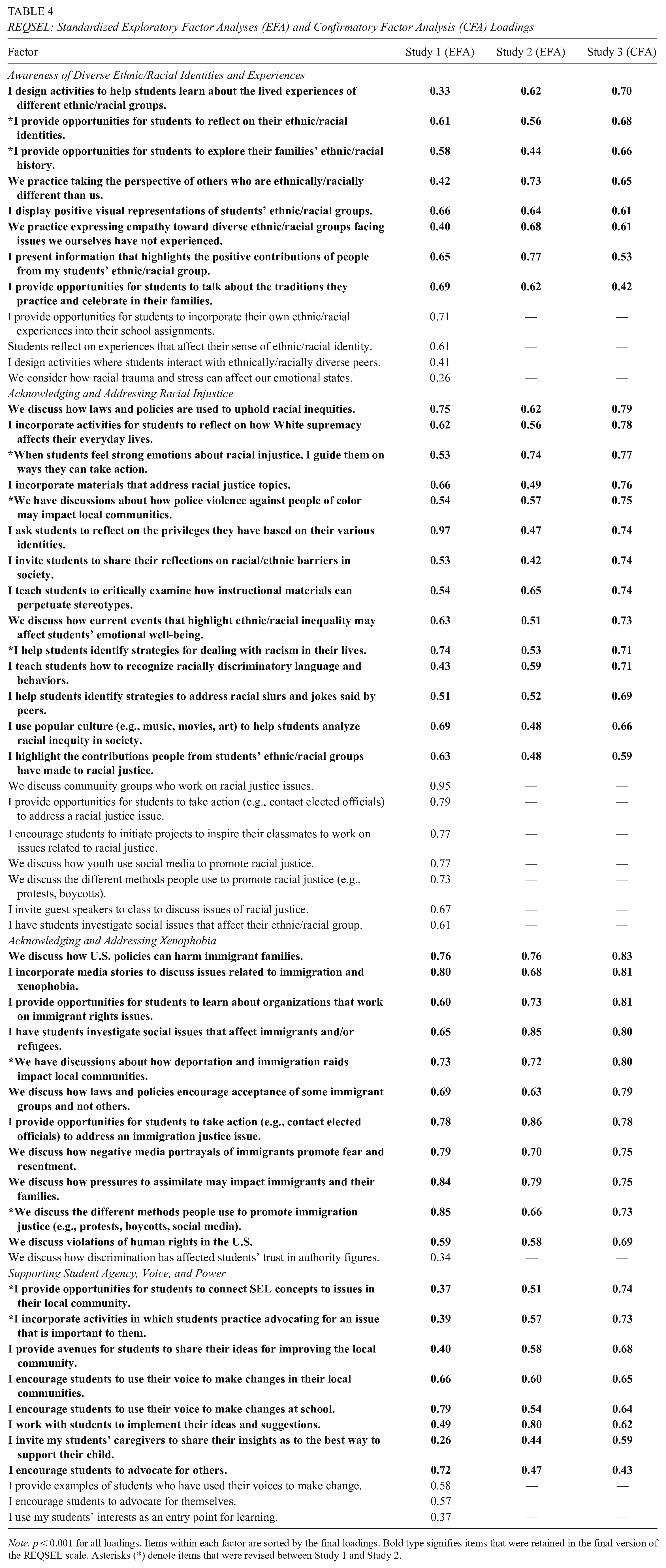
Note. p < 0.001 for all loadings. Items within each factor are sorted by the final loadings. Bold type signifies items that were retained in the final version of the REQSEL scale. Asterisks (*) denote items that were revised between Study 1 and Study 2.
Feedback collected in cognitive interviews with five teachers was analyzed at this stage. The research team first independently and then collectively reviewed the interviews. Discussion of the feedback resulted in 11 items being revised (these items are starred in Table 4) and the REQSEL being further reduced to 51 items in four domains, all tentatively named as follows: Ethnic/Racial Competence for Self and Others (8); Racial Injustice (19); Xenophobia (12); and Student Agency, Voice, and Power (12). It may be important here to note the tradeoffs between modifying the wording of the items based on feedback from a relatively small number of teachers and retaining the wording used in the statistical analyses. Specifically, modifying the wording of items based on participant feedback may add to the clarity of the items and improve measurement by using the qualitative information that could not be provided by statistical analyses alone. However, the modifications are not guaranteed to lead to measurement improvements.
Study 2: Exploratory Factor Analysis With Qualtrics Sample 2
An exploratory factor analysis (EFA) was conducted in Mplus (Muthén et al., 2017) using a new dataset sampled from Qualtrics teacher panels responding to the 51-item REQSEL. Factors were extracted using maximum likelihood methods with an oblique rotational method (geomin) because factors were hypothesized to be related and thus were allowed to correlate with each other. There was no missing data. Based on Study 1, we anticipated a 4-factor solution would be the best fit, so we followed recommendations to begin with a model with one more factor than expected (i.e., five factors in this case; ML, oblique rotation, geomin). The final eigenvalues for this EFA are in Table 3.
The 5-factor model appeared to contain four strong factors aligned to our theoretical domains, but it also contained a fifth factor that contained mostly cross-loadings or loadings below 0.05. Following the same guidelines as in Study 1 (inter-item correlations <.30 and item-total statistics <.30), we flagged seven items for potential removal. Then, as in Study 1, we used the factor loadings from the 5-factor model to identify items from this list that had factor loadings of <.32 or cross-loadings with less than .15 difference from the item’s highest factor loading (Worthington & Whittaker, 2006). This resulted in the removal of seven items (see Table 4).
After deleting these items from the data set, we reanalyzed the data and observed again that the 4-factor solution aligned to our theoretical model cleanly except for a few items. Using the same criteria as previously, we identified three items to drop. We deleted these items from the data set and again generated models with up to five factors. The 4-factor solution aligned to our theoretical model cleanly except for two items, which we flagged but did not remove and instead moved to the confirmatory factor analysis (“I highlight the contributions people from students’ ethnic/racial groups have made for racial justice” and “We have discussions about how police violence against people of color may impact local communities”).
The fit indices employed in Study 1 were again employed for Study 2 (i.e., χ2, RMSEA, CFI, TLI, and SRMR) (Hu & Bentler, 1999; Kline, 2010; Martens, 2005). Model fit indices were as follows: χ2 = 855.74 (df = 662), p < .001, RMSEA = .03 (90% CI = .03–.04), CFI = .98, TLI = .97, and SRMR = .03, suggesting that the 4-factor solution adequately fit the data. This resulted in 41 items in four conceptually meaningful factors, now named: Awareness of Diverse Ethnic/Racial Identities and Experiences (8 items); Acknowledging and Addressing Racial Injustice (14); Acknowledging and Addressing Xenophobia (11); and Supporting Student Agency, Voice, & Power (8). Study 2 suggests that the REQSEL consists of four distinct factors, each with strong internal consistency. The loadings for the final 4-factor solution are shown in Table 4.
Study 3: Validation Analyses With Qualtrics Sample
For Study 3, we collected data from a separate sample of Qualtrics teacher panels (CFA-Validation Qualtrics Sample), and using the 41-item REQSEL from Study 2 and related measures, we investigated evidence for validity.
Evidence for Validity
Using the 41 items remaining after the EFA Qualtrics Sample 2 analysis, we examined the number and nature of factors, specified a priori, as well as recommended thresholds for chi-square, RMSEA, TLI, CFI, and SRMR from a confirmatory factor analysis to determine whether the previously hypothesized structure fits these data well. The model fit indices suggested that the 4-factor solution fit the data well: χ2 = 1128.27 (df = 773), p < .001, RMSEA = .04 (90% CI = .04–.05), CFI = .94, TLI = .94, and SRMR = .05. The Cronbach’s alpha coefficients for each of the four REQSEL domains were also satisfactory (Awareness of Diverse Ethnic/Racial Identities and Experiences α = .83; Acknowledging and Addressing Racial Injustice α = .94; Acknowledging and Addressing Xenophobia α = .94; Supporting Student Agency, Voice, and Power α = .84), suggesting each factor had strong internal consistency.
Means and standard deviations for each REQSEL domain are provided in Table 5. From this descriptive information, we gleaned that teachers reported they engaged in practices across all four domains between “sometimes” and “often,” though there was a significant amount of variation. Further, they tended to report engaging in practices to promote awareness of diverse ethnic/racial identities and experiences and to support student agency, voice, and power in the classroom somewhat more so than those aimed at acknowledging and addressing racial injustice and xenophobia.
Descriptive Statistics and Correlations for REQSEL and Validity Constructs (Study 3)

Note. E-R = Ethnic-racial. *p < .05. **p < .01.
To gather additional evidence for validity, we calculated bivariate correlations (Pearson’s r) between each of the derived factors and 10 measures of theoretically related constructs: critical awareness; egalitarianism; ethnic-racial identity exploration and resolution; school-specific, community-minded, and self-focused social justice behaviors; general beliefs regarding talking about racial topics in the classroom; and endorsement of and sense of efficacy in implementing culturally responsive teaching approaches. This resulted in a total of 40 correlations, which are presented in Table 5. We hypothesized that the REQSEL domains would show evidence for validity by being positively associated with each of the constructs. Of the 40 possible correlations, 36 of them were positive and significant. In support of validity for the Awareness of Diverse Ethnic/Racial Identities and Experiences and the Supporting Student Agency, Voice, and Power domains, all possible correlations with the theoretically related constructs were positive and significant. In support of validity for the Acknowledging and Addressing Racial Injustice domain, 9 out of 10 correlations were positive and significant. Validity for the Acknowledging and Addressing Xenophobia domain was supported, with 7 out of 10 correlations being positive and significant.
Study 4: Test-Retest Reliability in the RAND American Teacher Panel
We evaluated the test-retest reliability of the REQSEL domains with the intraclass correlation coefficient (ICC) in two-way mixed absolute agreement models. The test-retest reliability was moderate or good for all domains (Koo & Li, 2016). Specifically, the ICCs were as follows: Awareness of Diverse Ethnic/Racial Identities and Experiences = 0.82 (95% CI: 0.79–0.85); Acknowledging and Addressing Racial Injustice = 0.86 (95% CI: 0.84–0.89); Acknowledging and Addressing Xenophobia = 0.84 (95% CI: 0.80–0.86); and Supporting Student Agency, Voice, and Power = 0.79 (95% CI: 0.75–0.82).
Discussion
As the implementation of SEL practices becomes more commonplace in schools, questions and conversations surrounding the integration of equity issues in SEL practice have also begun to surface. Some states and school districts have restricted references to race, SEL, and other related topics in the classroom. In fact, during the teacher focus groups that we conducted during the measure development process, we received feedback that some teachers frequently avoid discussing issues of race for fear that their school leadership or their students’ families would seek retribution. This study did not set out to detect the prevalence of these practices; rather, we aimed to develop a measure that could be used to assess the frequency with which SEL educators report they are centering racial equity in their practice. We view this measure as a potential resource for districts and teachers with the political will to engage in social and emotional learning that attends to issues of racial equity.
Stakeholders who value racial equity are becoming more aware of the need to shift from traditional forms of SEL practice, which oftentimes place the burden of navigating racialized experiences on youth of color, to transformative SEL practices, which use SEL as a mechanism for youth as they navigate these issues. The present research provides a step toward assessing teachers’ self-reported racial equity-oriented SEL practice in middle school classrooms (fifth through eighth grades). Results of this study indicate (1) there is evidence for strong internal consistency for four REQSEL domains; (2) REQSEL scores were correlated with a number of relevant measures of teachers’ beliefs and behaviors regarding race, ethnicity, culture, and social justice; and (3) REQSEL scores were correlated with teachers’ own ethnic-racial identity exploration and resolution.
Grounded in theory, previous empirical literature, and several iterative phases of development that included preliminary focus groups, content expert reviews, and cognitive interviews with teachers, we developed a measure that captures teachers’ beliefs about their efforts to implement SEL practices, writ large, in ways that advance racial equity goals. Our analyses suggest that the REQSEL has four reliable domains. Specifically, Cronbach’s alphas for each of the factors demonstrated strong and adequate internal consistency that was well above the acceptable range. In addition, all four REQSEL domains demonstrated moderate or good test-retest reliability based on a 3- to 4-week retest interval. Finally, domains of the REQSEL showed concordance with existing measures of teachers’ critical awareness, social justice behaviors, general beliefs regarding talking about racial topics in the classroom, endorsement of and sense of efficacy in implementing culturally responsive teaching approaches, and egalitarianism.
It is important to consider that the racial/ethnic makeup of the teachers in our samples was predominantly White, reflecting national trends in the teacher workforce. The practices referred to in the REQSEL are intended to create positive experiences for students of color, and we believe that White teachers can successfully implement them. At the same time, research has shown that teachers are more able to discuss concepts related to injustices they have faced themselves (Baily & Katradis, 2016; McDonald, 2008). We anticipated that teachers who had engaged in activities to learn more about their own ethnicity and/or race (exploration) and had a clear sense of their own ethnic-racial identity (resolution) might be more ready to engage students in conversations around race and equity (Lawrence & Tatum, 2004; Utt & Tochluk, 2020). This was supported by the significant and positive correlations of ERI exploration and resolution with each of the REQSEL constructs, respectively.
Notwithstanding the evidence for the validity and reliability of the measure, as well as its associations with teachers’ ethnic-racial identity exploration and resolution, there were some unexpected findings. First, in arriving at the final item set, we found that the items encompassing Engagement with Ethnic/Racial Identity and Navigating Intergroup Relations loaded together and were combined into a single domain. We originally hypothesized these would be separate domains given that they each consist of a set of theoretically distinct actions. Banks (1993) provides insight as to why these two domains may be more related than not. Specifically, the actions encompassing the two domains all fall under the umbrella term of what Banks (1993) considers to be multicultural education, especially in regard to content integration, knowledge construction, and prejudice reduction. Simply put, the practices involved in learning about one’s own culture and learning about the culture of others are interrelated and overlapping. Therefore, in the context of SEL instruction, it is likely that the specific practices involved in promoting multiculturalism (i.e., engaging with ethnic/racial identity and navigating intergroup relations) commonly occur together and thus may become indistinguishable from one another.
Related to this, Language and Racially Equitable Discipline domains were dropped during the first EFA as a result of both domains having an insufficient number of items loading together as a single factor. Although these domains did not surface in the present version of the measure, they are conceptually pertinent and important for practicing SEL through a racial equity lens. Additional item development work in these two areas is needed to develop a more robust set of items that capture the roles of language use and discipline as part of educators’ understandings of their SEL practices.
In addition, the acknowledging and addressing racial injustice and xenophobia domains were uncorrelated with egalitarianism, whereas the awareness of diverse ethnic/racial identities and experiences and supporting student voice, agency, and power were related to egalitarianism. The racial justice and xenophobia-related items in the REQSEL involve identifying the unique experiences of immigrants, refugees, and racially minoritized people in the United States and how people can work for justice on issues these groups face. The measure of egalitarianism used in our study included items related to beliefs about finding similarities and common ground among people; however, an understanding of equity involves recognizing that not all people share the same background or have the same access to fair treatment. Acknowledging this may be entirely independent of seeking common ground. Thus, the lack of a correlation with egalitarianism could be explained by differences in understanding of and beliefs about equity as compared to equality. Indeed, treating everyone as if they have the same experiences and opportunities may, in fact, result in or perpetuate inequality. Perhaps related to this issue, we observed that the level of endorsement of practices related to addressing explicit forms of injustice—xenophobia and racism—was somewhat lower than those that were focused on encouraging identity exploration as well as youth voice and power-sharing. Behaviors and activities that encourage identity exploration and youth voice may be more aligned to those that encourage youth to seek common ground with different others.
A final surprising finding was that the domain pertaining to acknowledging and addressing xenophobia was unrelated to culturally responsive teaching outcome expectancy and self-efficacy beliefs, though the racial (in)justice domain was related to these beliefs. One possible explanation for this is that teachers are less attuned to xenophobia than they are to racial injustice more generally. Greater national attention has been paid to issues of racial injustice in the United States (at least in terms of lip service) since the murder of George Floyd in 2020 and the response it garnered. These recent movements for racial justice may be more salient than the public expressions of xenophobia that surged just four years prior, fueled by the rhetoric of Donald Trump’s first presidential election campaign. It may be the case that teachers receive fewer professional learning opportunities that promote a sense of confidence about and expected outcomes of their ability to engage in culturally responsive teaching practices in response to xenophobia, specifically, vis-à-vis racism more generally. Although they might be aware of and willing to discuss racism and discrimination writ large with their students, including how these affect immigrants and refugees, they may be less aware of specific issues faced by individuals due to their immigrant or refugee status and how to address them in their classrooms in culturally responsive ways. It might also be the case that teachers view immigration as more of a historical rather than a contemporary civics issue (Hilburn et al., 2016).
Limitations and Future Directions
Our study comes at a pivotal moment, providing preliminary evidence for a measure that allows us to assess how topics of inequity and injustice may be addressed within SEL instruction. However, these results must be considered alongside the limitations of this study. In particular, the analyses we present in this article are useful for initial development and validation of the REQSEL but do not demonstrate the relationship of teachers’ reports with their actual practices. That is, we do not yet have evidence to support prediction of behaviors (i.e., actual practice), and as such, the scores should not be interpreted to indicate teachers’ actual current or future practices, only their subjective perceptions of past behaviors. As validation is an ongoing process that does not necessarily have an endpoint (American Educational Research Association, et al. [AERA, APA, and NCME], 2014), the present study provides a preliminary foundation upon which to build. A critically important next step is to assess the extent to which teachers’ self-reports correlate with their externally observed practices. In addition, our item content development phase included two focus groups with teachers (who are the focal population), but these groups did not include teachers of color. It may be the case that a more diverse focus group sample would yield new insights into practices that support racial equity in SEL.
In addition, the final set of 41 items presented in this article are not an exhaustive list of practices that could support racial equity. Studies suggest building youths’ civic and political capacities requires operating from a frame of empowerment (Delgado, 2015). Jennings et al. (2006) highlight that critical youth empowerment requires creating a welcoming and safe environment, engaging youth in meaningful activities, equitable power-sharing between youth and adults, engaging in critical reflection, and developing youths’ sociopolitical processes. While the present measure includes items that may touch upon some of these aspects, like most quantitative measures, it may not capture the nuances or all the ways to support racial equity within a classroom or a school. It further does not capture the self-work of the educator that is needed for these practices to be effective (e.g., reflecting on their own ethnic-racial identity). Relatedly, we prompted teachers to reflect on their experience teaching SEL, and we did not examine how respondents interpreted this prompt. Future work could explore whether teachers respond differently depending on the type of SEL experience(s) they are considering when completing the measure.
Moreover, to fully disrupt inequity in the classroom requires an intersectional approach (Grant & Zwier, 2011). Although this measure provides insight into what practices may be oriented toward racial justice, future work should consider scaling up this work using multiple methods (e.g., mixed methods, qualitative, ethnographic) to explore how teachers might address racial injustice at the intersections of other forms of oppression (e.g., ableism, sexism, etc.). Additionally, our aim was to identify self-reported transformative SEL practices primarily for students of color in urban school settings, and the ways SEL may be a space to address issues of inequity can be different in primarily White classrooms in suburban or rural settings. For example, providing positive representations of White individuals and highlighting their contributions may not be necessary due to the oversaturation of narratives that uplift and center White voices. Future work should explore whether the dimensions we identified apply to these populations or if there are additional topics explored in these classrooms. In particular, for White youths’ anti-racist development, it will be necessary to discuss the ways racism works to the advantage of White individuals and how to intentionally participate in anti-racist efforts. Given the range of potential activities we identified, future work should examine how practices may be implemented to identify where further support may be needed to help educators fully engage in SEL to promote racial equity. Finally, although our dimension of discipline fell out, future work should continue to examine the extent to and ways in which teachers view restorative practices as a form of equity-oriented SEL practice.
Methodologically, reliance on Qualtrics samples presents additional potential limitations. Although Qualtrics employs multiple measures to prevent duplicate participation within a sample, it is not known whether some of the same participants were included across the samples gathered. Moreover, we do not know whether some of the respondents in the Rand American Teacher Panel also may have participated in Qualtrics-coordinated samples. Future work could develop and rely on a single national sample of teachers whose potential participation across samples can be limited and tracked more closely. In addition, the samples across both Qualtrics and Rand American Teacher Panels were predominantly White. Although this reflects the broader teacher workforce, continued work on the development of this measure should explore potential differences in reports of practices between teachers of color and their White counterparts.
Conclusion
Within the last few years, the integration of topics that further racial justice within the classroom has become a point of political contention (e.g., López et al., 2021). Yet, a great deal of research shows the benefits youth experience when they are exposed to pedagogy that centers the experiences of racially marginalized communities and builds youths’ political capacities to challenge social inequity (e.g., Pinedo et al., 2021). For youth of color, in particular, integrating these topics into SEL can serve to validate their lived experiences and provide possibilities for them to imagine and create a radically different and more equitable world. These findings emphasize the urgency in learning more about how educators can leverage SEL spaces to engage youth in ways that build their abilities to critically reflect on and challenge the racial imbalances they see in the world. Researchers have already begun to explore the specialized pedagogical and content knowledge required to teach social justice (Dyches & Boyd, 2017). By providing tools to better understand the practices teachers report they use to integrate social justice topics into their engagement with SEL in classrooms, we open the possibilities to identify best practices as well as areas of growth.
Supplemental Material
sj-docx-1-ero-10.1177_23328584241246717 – Supplemental material for Preliminary Development of the Racial Equity-Oriented Social-Emotional Learning Practices Measure
Supplemental material, sj-docx-1-ero-10.1177_23328584241246717 for Preliminary Development of the Racial Equity-Oriented Social-Emotional Learning Practices Measure by Deborah Rivas-Drake, Jozet Channey, Gina McGovern and Bernardette J. Pinetta in AERA Open
Footnotes
Acknowledgements
The views expressed are those of the authors and do not necessarily reflect the views of the Spencer or William T. Grant Foundations. We are grateful to the participating educators, research assistants, research staff, and collaborators for their contributions to the research process.
Funding
The author(s) disclosed receipt of the following financial support for the research, authorship, and/or publication of this article: This research was made possible by grants from the Spencer Foundation (Grant #10033035, PI: Deborah Rivas-Drake, co-PI: Gina McGovern) and William T. Grant Foundation (Grants #188925 and #OR-202890, PI: Deborah Rivas-Drake).

Authors
DR. DEBORAH RIVAS-DRAKE is the Stephanie J. Rowley Collegiate Professor in the Combined Program in Education and Psychology at the University of Michigan; 610 E. University, Ann Arbor, MI; email:
DR. JOZET CHANNEY is a Research Area Specialist in the Office of Diversity, Equity & Inclusion at the University of Michigan; 251 Galleria, Ann Arbor, MI; email:
DR. GINA MCGOVERN is an assistant professor of Human Development and Family Studies at Central Michigan University; 1200 S. Franklin St., Mt. Pleasant, MI; email:
DR. BERNARDETTE J. PINETTA is a Chancellor's HSI Fellow in the Department of Social Welfare at UCLA; 3250 Public Affairs Building, Los Angeles, CA; email:
References
Supplementary Material
Please find the following supplemental material available below.
For Open Access articles published under a Creative Commons License, all supplemental material carries the same license as the article it is associated with.
For non-Open Access articles published, all supplemental material carries a non-exclusive license, and permission requests for re-use of supplemental material or any part of supplemental material shall be sent directly to the copyright owner as specified in the copyright notice associated with the article.
