




Abstract
In this qualitative study, researchers used critical race theory to examine the experiences of social studies standards committee members in 18 states and the District of Columbia. They found that while many participants articulated goals of increasing the teaching of race and racism in their state’s social studies standards, at least in part, numerous silent covenants and structural barriers existed to maintain the status quo through race-evasive standards. A smaller group of participants generally avoided advocating for race and racism topics altogether due to their perceived controversial or political status, while others did not mention race or racism as a priority. Recommendations are made for both the policy and practice related to state standards creation, and questions are raised about the ability of social studies standards to foster a racially just social studies curriculum.
Introduction
We begin this article with a vignette based on data from a group of educators serving on a standards committee in one northeastern U.S. state. These educators discussed volunteering for the committee to ensure that the state’s social studies standards better reflected the racial and ethnic diversity of their students’ backgrounds. Early in the almost two-year process, the state education agency (SEA) social studies specialists made clear to the panel that they would start with the previous version of the state standards, and the committee would be unable to make substantial changes in content from that prior document. This worried some of the members of the panel, who described the previous standards as Eurocentric and lacking a satisfactory level of representation for Black, Indigenous, and People of Color (BIPOC) histories or experiences. Collectively, a group of committee members attempted on multiple occasions to ensure the inclusion of more race- and racism-related events from the more recent past, especially beyond the more traditional events (such as colonization of the Americas, enslavement, and the modern Civil Rights Movement) that were already included in the previous standards. During their work sessions, they would suggest numerous historical events be included in the draft that would help students understand that issues of racism have existed in American history since the arrival of European settler-colonists and persist in the present. Yet, when they attended the group’s meeting during the following month, they would find that little to nothing had changed related to these race- and racism-related events from the previous draft.
Next, several committee members wrote e-mails to SEA officials overseeing the writing of the standards asking that certain key race- and racism-related events be added to the draft; again, none of their suggested changes were adopted. Finally, at the state’s board of education meeting, one of the committee members spoke during public comment, focusing on the need to include race- and racism-related content from the more recent past, stating, While this revised framework better represents the diversity of the people of [this state], the United States, and our world, it does not include a discussion of race relations after the 1970s. It may leave students with an impression that the Civil Rights Movement ended 50 years ago, and that the election of Barack Obama is the last race-related event. (State Artifact)
1
The committee member went as far as proposing adding this line to a standard about Barack Obama’s presidential election to address this concern: “Analyze major events related to race relations in the United States, including the 1992 Los Angeles Riots, the government response to Hurricane Katrina, the Black Lives Matter Movement” (State Artifact). The next month, the board voted to adopt the revised state social studies standards without any language related to these events. Another member of the standards committee said of this vote, As we were trying to really put pressure or extend the depth on—sort of on Black Lives Matters, on police brutality. . . . You know we were really trying to extend the depth in those spaces, and we just really couldn’t get there. I think we’re able to get some of those pieces into sort of the supplemental and optional areas of the standards, but really weren’t able to get there, in my opinion, in terms of the requirements. (Participant 25-D)
2
Despite a collective will to ensure that students learn about race and racism in the state social studies standards, ultimately, the structure of how the standards were written in this state prevented any meaningful change in this regard. The experience of these committee members may not be unique; in this study, we uncovered other similar stories from participants in several other states.
While the example that begins this paper illustrates how the inclusion of race- and racism-related topics may be prevented despite committee members’ wishes, this study also occurred during a period when states were actively passing laws that prohibited the teaching of topics related to race and racism (data were collected from committees convened between 2013–2021; interviews were conducted in fall 2021). These so-called divisive concepts or anti–critical race theory laws, which were passed or introduced at the state or local level in 49 states through at least 670 bills (CRT Forward, 2023), have set out to ban curriculum content and classroom discussions related to race and racism—but also to gender identity and sexual orientation—and require teachers to not depict the United States or its founding in a negative way (Grice, 2022; Gross & Sachs, 2022; Kim, 2021). To be clear, these bills are attempts to legislate white 3 supremacy (Smith & Stitzlein, 2023). Moreover, they use the law to prevent teachers from teaching historically accurate and honest portrayals of our collective past.
Initially, this research team set out to understand how state standards committee members did or did not have the commitment, but also the ability, to enact social studies standards that center race and racism. However, as we collected data, we also began to seek an understanding of how educators involved in state standards committees did their work while facing covert and overt maintenance of white supremacy and racial erasure within their state’s mandated standards. We asked the following research questions: (1) Were participants who served on state social studies standards committees committed to making the standards more racially just? (2) If so, to what extent were they able to enact change related to race and racism in state standards? (3) What were the barriers that existed in creating state standards that center race and racism? As we will discuss, we found that silent covenants and structural barriers often prevented racial justice–oriented committee members from including race- and racism-related social studies standards. Specifically, the use of procedural maneuvers, a culture of whiteness on committees, and people with power acting as racial gatekeepers made enacting change related to race and racism in the standards difficult in most states. Moreover, a smaller group of participants generally avoided advocating for race and racism topics altogether due to their perceived controversial or political status, while others did not mention race or racism as a priority.
Literature Review
A number of studies have examined how race is included or excluded in social studies standards. For example, researchers have analyzed the content of national and state social studies standards (e.g., Engebretson, 2014; Grant et al., 2002; Harris & Girard, 2020; Shreiner, 2020) with several examining the ways in which race, racism, and BIPOC communities are portrayed in the standards (e.g., An, 2016; Anderson, 2012, 2013; Anderson & Metzger, 2011; Bryant-Pavely & Chandler, 2016; Busey & Walker, 2017; Conner, 2021; Jones, 2022; Journell, 2008, 2009a, 2009b; Sabzalian et al., 2021; Shear et al., 2015; Sleeter, 2002; Vasquez-Heilig et al., 2012; Warner, 2015). Using a critical race theory framework, Vasquez-Heilig et al. (2012) analyzed Texas U.S. history standards and found that, although the standards appeared to include content pertaining to race and racism, in-depth analysis revealed that such content was limited, deceiving, and presented as peripheral to mainstream U.S. historical narratives. The authors described the standards as having an “illusion of inclusion” (p. 410) in which BIPOC experiences, particularly Asian Americans and Indigenous peoples, were minimally included. From an AsianCrit perspective, An (2016) found that “Asian Americans seem to have almost no place in the story of the United States told by the reviewed standards” (p. 259) and, when mentioned, Asian Americans are portrayed as a monolithic group of victimized, permanent immigrants.
Scholars have also looked at the ways in which Indigenous peoples and histories are represented in state standards. Journell (2009a) found that standards largely consign Indigenous histories to periods prior to forced removal in the 1830s and place “little emphasis on cultural contributions, modern issues, or personification of American Indian groups” (p. 24). Similarly, using a postcolonial framework, Shear et al. (2015) determined that in most state standards, Indigenous peoples are primarily relegated to pre-1900 historical periods and essentially disappear from history after 1900. The authors found that Indigenous peoples are portrayed as historical outsiders who were discriminated against long ago, cooperated and had conflicts with European Americans, and whose forced removal was “inevitable” (p. 83). This erasure and Eurocentric depiction of Indigenous peoples in standards disrupted student learning opportunities of Indigenous experiences, cultures, and the contemporary issues Indigenous peoples face (Shear et al., 2015). Furthermore, relying on TribalCrit, Sabzalian et al. (2021) examined the ways in which civics and government standards either incorporate or ignore Indigenous sovereignty. When Native peoples and their nations are not mentioned in standards, it leads to their further racialization and erases their status as political and sovereign entities. The authors determined that more than half of states either omitted or provided limited information on Indigenous sovereignty in their standards and “that the erasure of Indigenous nationhood was almost as frequent as its inclusion with 386 standards that could have included Indigenous content but did not” (Sabzalian et al., 2021, p. 332).
Other scholars sought to investigate the ways in which Black people were portrayed in social studies standards. For example, Busey and Walker (2017) used a Black critical patriotism framework to analyze elementary social studies standards and found that the standards’ portrayals of Black critical patriotism were either nonexistent or minimized, distorted, and largely restricted to the Civil Rights Movement. Likewise, Anderson (2013) examined K–12 standards across nine states with a focus on the Civil Rights Movement and found that the standards “deemphasize rigorous historical thinking about the antecedents and consequences of the [Civil Rights Movement] and . . . promote non-conflictual narrative perspectives” (p. 117).
Recently, scholars have focused on addressing the inclusion of whiteness and white supremacy in social studies standards. Dozono (2020) employed critical discourse analysis to closely examine how white supremacy is upheld through “discursive grammars of violence” (p. 1) in New York State’s world history standards. Likewise, using a critical whiteness studies approach, McClure (2021) examined fifth- and eighth-grade social studies standards in New Mexico and Texas and found a “silent schooling of whiteness” (p. 10) within the coded language and historical themes. The author identified themes of race-evasiveness, interest convergence, cultural racism, minimization of racism, and more in the standards. Identifying the destructive inclusion of whiteness in standards and other instructional materials is a critical step toward teaching racial justice (McClure, 2021). Finally, Ward and Buchanan (2022) found that North Carolina’s state standards sustain both racism and whiteness through language choice and the memorializing of racial violence.
Despite this significant research on the social studies standards themselves, there are only a handful of studies that examined the experiences of state standards committee members who write and review these standards (e.g., Cuenca & Hawkman, 2019; Fogo, 2015; Fore, 1998; Placier et al., 2002); however, none of these studies used critical race theory as a theoretical lens. Each of these studies focused on the experiences in one state, and although none fully centered on issues of race and racism in standards writing, each included some issues related to race and racism.
Fore’s (1998) study of the writing of the Virginia social studies standards included a discussion of members of the Republican governor’s team wanting to water down or remove standards related to the Civil Rights Movement and other social movements connected to historically minoritized peoples in order to combat “politically correct liberalism” (p. 566). Fogo’s (2015) study of the 1998 California social studies standards writing process found that this time, the standards writing committee did heed to some degree expert reviews of early drafts, finding there was not enough inclusion of “minority and non-western perspectives” in the history standards (p. 753).
In Placier et al.’s (2002) study of the writing of the Missouri social studies standards, the author noted that, due to worry about conflicts over “multiculturalism” that had happened in other states, politicians involved with the process advised writers to remove mention of terms such as “diversity.” The final standards were framed as “neutral” but were not value-free, as they “portray[ed] students as future citizens and workers who conform to the dominant values of society and the workplace” (p. 301).
Cuenca and Hawkman (2019) later studied the 2014–15 revision of the Missouri social studies standards using a common sense theoretical framework. The first author was a participant in the standards revision process. The authors were particularly interested in how common-sense assumptions might have worked to preserve the “neoliberal/neoconservative status quo” (p. 57). They found three areas where common sense led to the preservation of the status quo: “(1) the composition of the committee; (2) the process of writing standards for schools; and (3) maintaining decorum during decision-making” (p. 62). As one example, in regard to the composition of the committee, the authors describe how Republican state legislators appointed other Republicans to 9 of the 10 “partisan” seats on the committee. The authors provided an example of how a proposed standard on the “impact of slave labor on economic development of the United States” was withdrawn after one member of the Republican bloc raised objections that the standard would place blame on the United States and the other members gave tacit approval of the objections. Due to these actions, the authors wrote, “history was whitewashed regarding the economics of slave labor and the status quo was sustained through curricular silence” (p. 62). The authors also found that the common-sense goal of compromise in the name of civility led to ideological constraint, again maintaining the status quo of the previous standards.
Theoretical Framework
In this study, we used critical race theory (CRT; Ladson-Billings & Tate, 1995; Tate, 1997). With its roots in legal studies (Bell, 1992; Crenshaw et al., 1995), CRT is a theory that helps us explain how racism is built into social structures, including education systems. As Ladson-Billings and Tate (1995) argued, CRT is built around three core assumptions. First, race is and continues to be a significant factor in determining inequity in the United States. Second, U.S. society is based on property rights. Third, the intersection of race and property creates an analytic tool to help us understand social inequity. In many of the states where the current study took place, politicians have intentionally distorted what CRT is, including in the passage of legislation that would prohibit its use in education and the teaching about race and racism more broadly. For this reason, CRT helped us understand how racial inequity and injustice were embedded within the structures and processes of state standards committees.
Using the work of Solórzano and Yosso (2002), Navarro and Howard (2017) outlined several core CRT components that should guide research on educational equity and racial justice as it relates to social studies education:
Centrality of race and racism: centralizes race and racism, including how they intersect with other forms of oppression, including sexism, classism, and lack of citizenship status.
Challenging the dominant perspective: challenges dominant white narratives and recenters BIPOC narratives.
Commitment to social justice: motivated by a social justice agenda.
Valuing experiential knowledge: builds on the oral traditions of the many global Indigenous communities while attempting to understand social inequality.
Being interdisciplinary: acknowledges the world is multidimensional and research should reflect multiple perspectives.
These core components guided our analysis of state social studies standards committee members’ beliefs, actions, and experiences; this included how the committee members advocated for (or did not advocate for) content and other components in their state’s standards to center race and racism and narratives and knowledge from nondominant racial groups that have been often marginalized or missing. Those using critical race theory lenses do not seek to simply replace dominant narratives with nondominant ones but rather better understand how power and privilege frame all narratives. Thus, we sought to better understand how committee members were attempting to have groups’ experiences portrayed more authentically in the standards while also helping students see that interpreting the past and present must involve analyses of power dynamics.
In addition, rooted in CRT, we used Bell’s (2004) concept of silent covenants to explain additional ways that white supremacy operated in the creation of state standards. Bell described the purpose of silent covenants as the use of social policies to “increase profit, promote harmony, or eliminate discomfort for whites” (p. 46) at the expense of BIPOC rights and way of life. He created the term because white supremacist practices are often enacted not by law or formal contracts within the legal system but by social practice (sometimes in direct violation of civil rights laws). For instance, Bell used examples of a business not hiring Black employees for fear of upsetting white patrons, renters violating the Fair Housing Act and not renting to Black or Latinx tenants to avoid angering white residents, and car dealers negotiating higher prices for Black customers. Over time, these practices become unspoken covenants maintained by white people in power to oppress others. These practices become normalized to the white people who benefitted from them and are often maintained in subliminal ways through social practices (such as the neighborhood a white person may choose to live in or preferring white applicants to applicants of Color without realizing their bias). Bell explained that, ultimately, silent covenants are part of the larger principle of interest convergence, where Black people are most likely to receive racial equity when their interests converge with those of white people in policy-making positions. Moreover, even when there is interest convergence, racial remedies will often be avoided or ended when white policymakers fear the superior social status of whites may be potentially diminished. As a result, Black people, and we would expand this to include other People of Color, are not necessarily willing parties to these commitments. Rather, these are unspoken agreements enacted to serve white peoples’ policy needs and are a tool used by white people to disguise their social power.
Moreover, as Bell (2004) argued, legal racial remedies are often incremental so as not to upset white people’s status. As such, they might never lead to a fully realized social change. As a component of interest-convergence, white people are often interested in only incremental steps toward racial justice because it preserves their power and does not significantly upset the social arrangements from which they benefit (Delgado & Stefancic, 2012; Sleeter, 2017). Yet, BIPOC do not have the luxury of waiting or incrementally dismantling the systemic racism that maintains their oppression. Additionally, race-evasiveness is an important part of silent covenants. As Lipsitz (2019) has argued, in the legal and policy realms, race neutrality and race-evasiveness are part of a longstanding white political project “emanating from Indigenous dispossession, colonial conquest, slavery, segregation, and immigrant exclusion” (p. 25) and continues to the main systems of oppression today by often denying white supremacy exists.
Applying these legal concepts to education policy-making, including the creation of state standards, we sought to understand how committee members challenged or upheld silent covenants and race-evasiveness, as they can serve as devices to protect white power and maintain white comfort. On standards committees, racism can be overt, such as state’s passages of so-called divisive concept (or anti-CRT) laws that curtail the teaching of race and racism (ensuring white people’s experiences are centered), or through more nuanced methods, such as ignoring the recommendations of educators for greater inclusion of race- and racism-related topics in standards (perhaps out of fear that it may make white students or parents uncomfortable or diminish the significance of Eurocentric topics traditionally included in standards). Ultimately, this leads to the erasure of BIPOC, which, in turn, maintains white domination through the curriculum. As Dozono (2020) has argued, through these methods, “White supremacy functions as the underlying force shaping the rules (or grammars) of the game, determining who/what is important in the history . . . and the relations between those entities worthy of mention” (p. 1). Silent covenants, incrementalism, and race-evasiveness are key vehicles that allow the current racial status quo to be maintained through education policy decisions.
Method
Participants
In this study, we recruited 31 K–12 classroom teachers, district social studies supervisors, university-based teacher educators, and state social studies supervisors who served on recent (2013–2021) state standards committees from 18 states and the District of Columbia. We posted on social studies professional organization listservs and social media sites (e.g., the National Council for the Social Studies, social studies special interest groups in the American Educational Research Association) and also engaged in snowball sampling. Following the guidance of Creswell (2014), we aimed for a diverse sample by purposely selecting participants from states in different geographic regions and with varying dominant political ideologies. We strove for racial and gender diversity among our participants but, during recruitment, found that state standards committees tended to be overwhelmingly white- and man-identifying (our sample matches those demographics). Table 1 displays participant demographic information.
Self-reported Participant Demographic Information (N = 31)

Note. Demographic data was collected via an online questionnaire that participants completed before the interviews.
Data Collection
As part of a larger study (cf. Harris et al., 2024) on standards committees, this article reports an analysis of the same data set using a CRT lens. The data for this study primarily included semi-structured, in-depth interviews (30–60 minutes) collected in fall 2021. However, to triangulate the interview data, we also used state artifacts as described later.
Before the interviews, participants completed a questionnaire with eight questions about their backgrounds and basic details of their service on standards committees. The interviews were conducted by the first two authors via videoconferencing. The interviews included 12 questions focused on the work of the standards committees, participants’ goals in serving on the committees, and the barriers they might have faced in reaching those goals. Some of the questions involved general topics that were then analyzed using CRT. For example, participants were asked, “Going into the social studies standards review/writing process, did you have any specific goals that you wanted to achieve?” and “Were there any methods or strategies that were useful in enacting change as an individual on the panel?” If participants’ responses included any references to race or ethnicity/racism or racial injustice, we analyzed them using the aforementioned framework from Navarro and Howard (2017). Other questions that specifically focused on race and racism included: “Do you feel any events have changed how teachers understand or use them—for instance, some states have passed anti-CRT legislation, anti-1619 Project legislation, etc.?” When participants indicated that racial equity or racial justice was an important reason for serving on the standards committee, interviewers asked additional ad hoc questions to further probe their stances. The third and fourth authors reviewed all the automatically generated full transcripts produced by the videoconferencing tool and corrected any errors. As a research team, we also wrote initial memos (Emerson et al., 1995) during data collection and transcription to capture emerging ideas.
To triangulate interview data, we drew on state artifacts collected for our larger study (c.f., Martell et al., 2023). The fifth author led the document search process by collecting all known publicly available SEA documents related to the standards committee processes (yielding 25 standards and guidance documents/testimonies). For media reports, the first author used a search engine to locate any available media reports on the standards committee processes (yielding 246 media reports).
Data Analysis
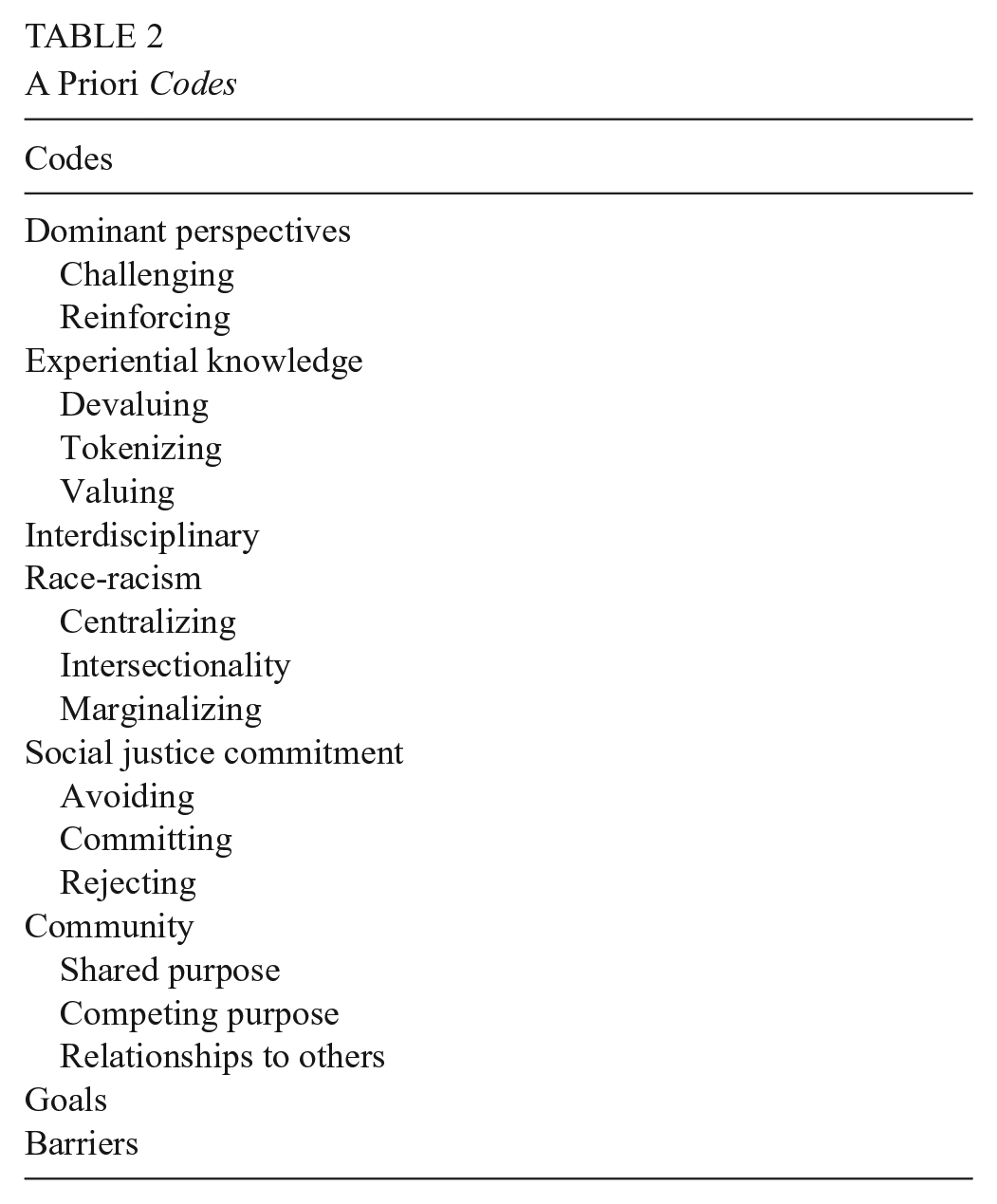
Next, we engaged in qualitative analysis by coding the interviews using an interpretivist approach (Miles et al., 2020). Based on our research questions and CRT framework (Navarro & Howard, 2017; Solórzano & Yosso, 2002), we created 8 main and 14 sub a priori codes (see Table 2) and systematically categorized the data using qualitative software. We also created 4 in vivo codes that were generated from what the participants said about their experiences. These included: So-Called “Divisive Concepts” and Anti-CRT Laws, State Culture and Politics, The Public/Community Reaction, and Committee Demographics. The initial coding was done by the first two authors, with the other authors serving as secondary coders. The first author coded any interviews conducted by the second author, and vice versa. To increase inter-coder reliability, the first two authors each coded one interview first and then met with the team to discuss and adjust codes, with additional meetings to discuss and work through any disagreements on coding. Any disagreements were resolved through discussion. Throughout the coding process, we wrote analytic memos (Emerson et al., 1995). At the end of this process, we engaged in holistic analysis (Miles et al., 2020) related to the level of commitment that each participant had to centering race/racism in their standards committee work. The first, second, and fifth authors then engaged in a content analysis of the standards committee documents and media reports to add context to the interview data.
A Priori Codes
We recognize that there may be some limitations related to our data collection. We wanted participants from a wide range of states. As such, we used listservs and social media instead of contacting educators listed in state standards documents (additionally, several states do not list contributors in their standards documents or related websites). However, members of the professional organizations that we contacted may not be fully representative of the people who served on the writing committees in the states under study. To build trustworthiness in our analysis, we engaged in both individual coding and regular team meetings where we discussed how multiple researchers had analyzed the same data.
We also considered our positionalities and how they related to our interpretation of the data (Lather, 1992; Milner, 2007). Our research team included five former and current K–12 teachers. Christopher Martell is a white man and a social studies teacher educator at a large urban public university where BIPOC students are the majority. Lauren McArthur Harris is a white woman and a history/social studies teacher educator at a large public university. J’Shon Lee is an Indigenous woman who taught middle school social studies and is an education doctoral student at a large public university. Jennifer P. Chalmers is a white woman middle school social studies teacher and education doctoral student at a large private university. Jami Carmichael is a white woman and education doctoral student at a large public university. Both Martell (Massachusetts) and Harris (Arizona and Michigan) have served on state standards committees. In this study, we made every effort to consider our own racial experiences and how they relate to the participants, their students, and the communities where they live and work; since four of the five researchers identify as white, it was essential that we listened carefully to BIPOC participants in this study and interrogated our own perspectives in relation to their lived experiences. It is also possible that white participants were more comfortable discussing their experiences on standards committees with the two white interviewers; despite this, we did sense a level of openness and honesty in the BIPOC participants’ interview responses.
Findings
Varying Views of the Inclusion and Centrality of Race and Racism in the Standards
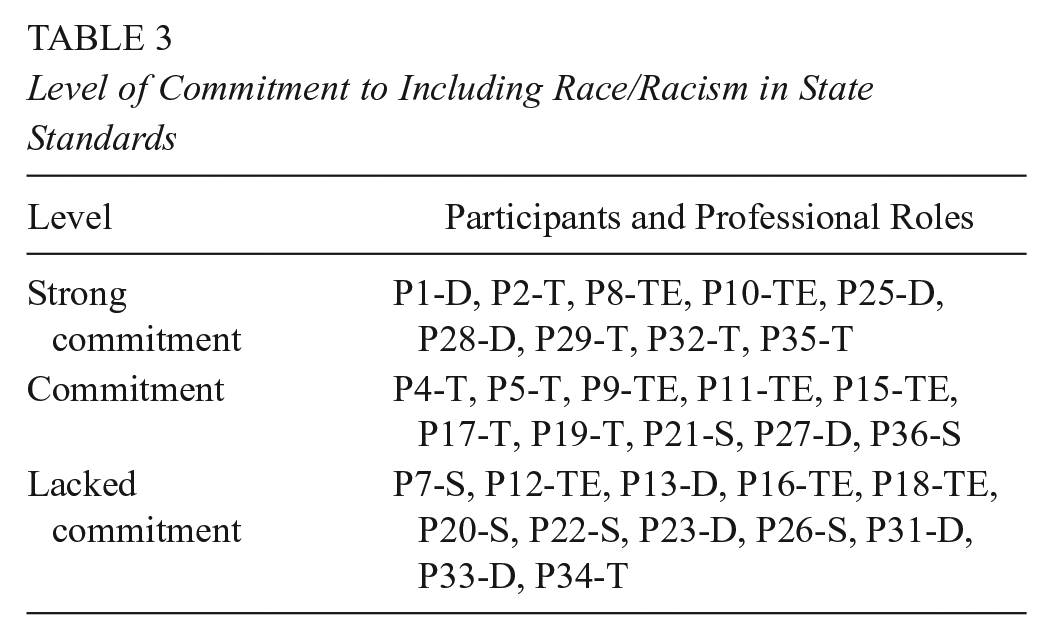
There were substantial differences in the committee members’ commitment to including race and racism in their state standards. Of the 31 participants (see Table 3), 9 had what we identified as a strong commitment (it was one of their main goals for serving on the committee), 10 had a commitment (they expressed that it was an important part of their work, but not the main goal), and 12 lacked commitment (they did not mention it as a goal or framed adding diversity in racially problematic ways). We acknowledge that some participants were not clearly in one category, and they may have traversed two categories; we did our best to locate participants in the category that most represented their level of commitment. Participants with strong commitments were almost all classroom teachers or district supervisors. Most state-level social studies specialists were identified as having no commitment. The nine BIPOC participants were all identified as having either a strong commitment or commitment.
Level of Commitment to Including Race/Racism in State Standards
Of the participants with a strong commitment or commitment to including race and racism in their state standards, nine expressed a need to do so for the students they (or their preservice teachers) served, or as BIPOC themselves, or to correct state standards that had underrepresented BIPOC communities. For example, Participant 29-T mentioned, “One of the things that I felt very strongly about was making sure that we had the language that represented all diverse populations.” Participant 27-D pushed his committee to not only include a more accurate description of how Filipino people experienced American imperialism but also attempted to ensure that BIPOC were more authentically represented in the standards. Participant 28-D noted, I think my goal was to bridge that gap [theory and practice] a little bit and essentially make us less content-oriented and more skill-based and then less focused on whiteness and men and war and be more broad . . . but still prioritizing traditionally marginalized voices.
Similarly, Participant 8-TE said, Personally, what I was interested in was trying to build in space to the standards so that we were nudging or directing teachers to select content that would be culturally relevant, culturally sustaining, for their communities and for the state.
Here the participant mentioned two related racially affirming pedagogical concepts: culturally relevant pedagogy and culturally sustaining pedagogy, with these concepts being also used by four other participants as they discussed their goals for standards work. These participants directly connected to Navarro and Howard’s (2017) argument that curriculum should attend to the centrality of race, commit to social justice, and value students and community member’s experiential knowledge.
For the 12 participants who were identified as lacking a commitment to including race and racism in the standards (all of whom identified as white), in some cases it was because they did not mention having goals of increasing representations of diverse perspectives or social justice in the standards. Instead, they focused on broad goals, including six who focused exclusively on incorporating inquiry into the standards and/or aligning with the College, Career, and Civic Life (C3) Framework for Social Studies State Standards, a national framework intended to inform state standards that evade mention of race and racism (see An, 2016; Au, 2013; Busey & Walker, 2017; King & Chandler, 2016; Sabzalian et al., 2021). Five participants expressed a perception of topics related to race or racism being controversial or too “liberal” for their politically conservative state. Three participants described that it was not their goal to include race and racism in the standards, but if a teacher wanted to teach those topics, they could. For example, Participant 16-TE said, “Those people who want to [teach the dominant narrative] are going to still continue to do that, but those people who want to be more inclusive and teach everybody’s history are going to be able to.”
Four white participants made comments during the interviews that were race-evasive or tokenized BIPOC. For example, Participant 13-D mentioned that during the writing process, he spoke to someone who was either a member of a native tribe or knew people enrolled in a tribe (he was not sure which) and suggested that one person adequately represented all native people. In some cases, participants who had expressed a commitment to including race and racism in the standards did so in problematic ways. Participant 11-TE discussed how their state had removed mention of an Indigenous language from the standards and commented, “[the department of education’s] argument is because they want to promote all cultures, not just one, which I can buy into that. However, I don’t think it’s also a bad idea for the one diverse group in [our state] to get a nod.” This participant seemingly agreed with the race-evasiveness of the department of education while also undercutting the importance of inclusion of the language with the phrase “get a nod.” Moreover, by erasing native people and their nations in the standards, it further essentialized their depiction in the standards as a monolithic group, rather than many Indigenous nations with separate sovereignties and cultural/linguistic differences.
Race and Racism Content Through Incremental Change
Among the 19 participants who wanted greater inclusion of race and racism in the social studies standards, 5 expressed that their impact only resulted in moderate changes—albeit important ones (this group included BIPOC and white people). For example, Participant 4-T discussed how they worked with others to embed BIPOC in topics that were often seen as race-neutral, [We included] Central America, U.S. involvement in some of the dictatorial regimes that we’re trying to put down communist movements. . . . So that’s great because that allows, if I am teaching in [a local community], and I’ve got a lot of students from El Salvador, well, I’m going to just pick like the Central America case study and develop that, rather than try and do 10 million different things.
Similarly, Participant 2-T said, I was there to definitely push and center social justice [and] antiracism. . . . For me, particularly, as someone who identifies as Chicano, increasing Latinx representation across the curriculum was huge. . . . I wanted to be able to kind of wield whatever power I had to try and make social studies a vehicle for social change in our state.
Yet, both participants also described the standards generally falling short of the amount of inclusion that they thought the standards should have.
Ten participants described their standards committee processes using what may be labeled an “add diversity and stir” approach (Noddings, 2001; Martell & Stevens, 2021) to diversity, where specific BIPOC histories or topics were added in a way that did not problematize the preexisting dominant narratives (Navarro & Howard, 2017). Some participants mentioned working with this approach as a discrete way that they could increase diverse representations in the standards. For example, one participant described tweaking a standard to signal race and racism without actually using the terms “race” or “racism” but successfully getting the words “oppression” and “stereotypes” listed: We had a standard that said, “critique multiple perspectives of American identity in terms of diversity, inclusion and exclusion.” And so, then we went back, and the change became “critique multiple perspectives of American identity in terms of oppression, stereotypes, diversity, inclusion and exclusion.”
Some participants described this approach as the only possible tactic to include race and racism in their standards. Yet, while this may have been seen by participants as progress, this method also places BIPOC in the margins or essentialized their experiences and does not more authentically center their experiences (Navarro & Howard, 2017). At the same time, the participants may have been intentionally acting in subversive ways to make change (as we will discuss).
The Role of Silent Covenants and Structural Barriers in Determining the Content of Standards
Standards committee members who wanted greater inclusion of the BIPOC histories and experiences often faced structural barriers that prevented them from including race and racism in the social studies standards, which we describe through the concepts of procedural maneuvers, cultures of whiteness, and racial gatekeepers. These structural barriers worked simultaneously with what Bell (2004) labeled silent covenants, as they rarely involved direct conversations of the prohibition or marginalization of race and racism-related topics. Yet, the process, as planned activities or through social practices, ensured that race and racism were included only through white perspectives, had a nominal role in the standards, or were not included altogether. It is important to note that procedural maneuvers, cultures of whiteness, and racial gatekeepers were generally employed simultaneously, which allowed white supremacist systems to maintain the status quo.
Procedural Maneuvers
Twenty participants, including BIPOC and white participants, described various procedures that SEA leaders established for writing and reviewing standards that ensured that race- and racism-related content would either not be included or would be portrayed in a way that would be more acceptable to white people. These procedures included: (a) requiring that participants could only modify (and not replace) previous standards that were Eurocentric in their composition or portrayed racism as a solved issue of the past; (b) allowing members of committees or subgroups to reject race- or racism-related content that they found objectionable or prohibit content that SEA officials assumed would not be supported by the bodies that approve standards (usually elected or appointed state board of educations or legislatures); (c) having a hierarchy of review that allowed for fewer racial justice-oriented educators (and BIPOC educators) to be responsible for the content of standards as it progressed through the process; and (d) allowing public comment, which was often easily influenced by special interest groups with anti-racial justice agendas, to influence the removal of race- or racism-related topics.
Participants supplied numerous examples where certain race- or racism-related terms were not allowed to be included in standards by SEAs or where a proposed race or racism topic was not included in final drafts. Two participants described certain topics as being explicitly prohibited. For example, one participant spoke of the “banned words” that their committee was told they could not use.
We were explicitly putting things in [the standards] about slavery, race. And I’ll tell you this. There were words we were told we couldn’t use when we started this process. And we had you know, there [were] some words we were able to tell the writers y’all got to stay away from them. We’ve been told we can’t use it. Sometimes these were directions that came from people in political power.
This participant named “institutional discrimination,” “institutional racism,” and “gender identity” as among the words that were banned during the writing process. Media reports from this time confirmed the removal of terms such as these from early state standards drafts.
Participant 2-T explained that group leaders were focused on monitoring language that would satisfy the state legislature at the expense of listening to the expertise of the educators on the standards committee. They said, There were quasi-leaders of each of our pods. You know our seventh grade had a leader, and that leader had to do more intensive work kind of like in between, they were kind of the point person, so they played a role in that as well. But other than that, you know, the suspicion on my end is that they were probably worked on, you know with the two social studies coordinators in the state to try and make something that would appease the assessment folks . . . and then, right, eventually the legislature.
These participants explained how the prohibition of certain words, usually explained as necessary because they could prevent the standards from being approved later, showed how language could be policed to prevent content related to race or racism. Even when words were not specifically banned, SEA officials could use the political perspectives of politicians to encourage a level of self-censoring among standards committee members, as was the case when Participant 1-D said, The other barrier would be knowing that our elected officials were going to push back if we were too bold, I guess. So, always knowing that in the back of your head, “Oh, there’s this one person in particular. What would this person say? What would this board member say if we said it like that?” We had to do role-playing, like, “What might she say?”
The fear was that the standards might not be approved or that the professional reputations of the standards committee members influenced decisions about race and racism-related content.
Additionally, three participants described situations where single individuals would object and remove a race and racism-related standard, or a standard would be removed at some point between the drafting and final stages (often when drafts were being reviewed by SEA officials or political bodies). Participant 11-TE described a process where the governor assigned a special committee to make changes to the standards based on public comment. They said, [In our state,] teachers have been really upset about them because there was a special committee that rewrote a lot of the standards that were written by the teachers. They’re pretty upset. . . . [Then,] there are public hearings because the idea is the public is the one that theoretically is supposed to be approving this or not approving this. . . . This committee is chosen among—I actually am not sure how they’re chosen. No one seems to know. They’re chosen to take the public comments, revise them based off any public comments. . . . They changed the document. There’s complete standards that have been removed or revised, standards that teachers thought needed to be gone, had been put back. Pretty much in all cases, those revisions are very nationalistic . . . Some language around Native people has been removed.
This participant’s experience was supported by numerous media reports and the final standards approved in that state (State Artifact). In this case, these changes were made very publicly because not including race and racism in state standards was a political promise the politician had made. Other SEA officials or politicians would use techniques that would lead to less popular or media attention. Participant 25-D explained a process where race- and racism-related standards were removed by those above them in the hierarchy of review that included no educators: As we finished the drafts, they would feed them up for [the SEA official] for review. They’d come back down with comments. Then we’d sort of rework, you know what I mean? . . . Then eventually once we thought it was final, we had to come back and make a final presentation to vote for their approval before, ultimately, I believe, sending it off to the state secretary of education [and] see if the governor would sign off on it.
Finally, Participant 31-D, who we did not identify as having a commitment to including race and racism in the standards, expressed that certain members of the committee were chosen specifically due to their conservative political views. They said, “So there were local school board leaders, community leaders, so they weren’t necessarily elected political people, but they definitely were people that were chosen because they held a certain point of view.” Whether it was built into the committee member selection process or done after their committee’s work concluded, procedures could be used to reduce race- and racism-related content in the produced standards. Although many standards committee members were committed to including race- and racism-related topics in their standards, the standard creation procedures put in place by SEAs or legislatures, in some cases, essentially presented a “rigged system” that made it very difficult for them to enact any significant positive race-related changes to standards. Moreover, some standards committee members also expressed a level of self-censorship or pressure from colleagues to avoid standards that might center on race or racism, especially if they did not present it in a way that aligns with white comfort.
Culture of Whiteness
Another barrier to increasing the representation of race- and racism-related topics was the overwhelmingly white composition of standards committees, which was especially mentioned by BIPOC committee members. In all but three states, white people made up the vast majority of committee members. Many participants generally attributed the lack of racial diversity on the committees as a result of their states having a majority white population (albeit sometimes ignoring that their states still had large percentages of BIPOC educators in certain areas of their state). However, from our standards committee document analysis, 10 states had the SEA agency or state board of education chosen based on application or appoint committee members (the remaining states had no publicly available information about their committee selection). For most standards committees, this created a culture of whiteness that made it easy to uphold silent covenants. As Participant 28-D described their committee, “A lot of white women, who were like ‘Oh yes, we should add this or like let’s take a look at civics,’ but not through an ethnic studies lens or talking about who is included and who isn’t included.” Since there were few BIPOCs on most of the standards committees, there was a lack of BIPOC perspectives and experiences. As Participant 12-D described, as a result of the overwhelming whiteness of the committee, “I mean there was still a lot of unintentional, unconscious pushing of that white man’s narrative.” Some committee members expressed that a shared culture of whiteness among most standards committee members resulted in a substantial level of race-evasiveness embedded in the standards, including their fellow white committee members’ inability to recognize problematic white narratives. In contrast, Participant 8-TE, who was on one of the three panels with racial diversity, said in consideration of the people who were on the panel, “You know, there was strong consensus that we wanted to incorporate language about white supremacy and analyzing whiteness,” and while other barriers resulted in their language being softened, the committee was able to make their standards more racial-justice oriented. At least seven states had specific language in their standards documents expressing that their standards were to include multicultural or diverse perspectives or be representative of the diversity of their state’s populations.
Multiple participants described the influence of whiteness or race-evasiveness on the standards that were created. For example, Participant 1-D, a white person, said, “There were definitely teams that I sat in on more intimately, because they just kept getting in that whiteness rut and I was trying to do more to push it, their thinking.” Participant 15-TE noted, “To be clear, we were predominantly white because our state is 80 percent white. Just odds are you’re going to have mostly white folks [on the panel],” and described that while the few BIPOC committee members had an important impact, he wished there was more racial diversity to challenge the whiteness of the standards. Participant 35-T, a BIPOC teacher serving on a predominately white standards committee, said, We got into some headbanging and clashing of ideas, particularly with regard to the question of race. Those were a little bit frustrating. In that, there are lots of dimensions about race, as you know. There are lots of impacts race has—well, Du Bois said it 100 years ago that it’s the problem of the 20th century. Little did he know it would keep on going. There’s a lot of what is actually sort of paternalism passes for, what am I trying to say, passes for racial understanding. Does that make sense? . . . When I would bring that up sometimes gently, and sometimes not gently, people simply didn’t understand. I mean, they just weren’t there. . . . Yeah. It was difficult because I didn’t view them as being openly hostile to the idea. I viewed them more as being not familiar with all of the nuances of racism, then they viewed me as being somewhat condescending, about that. It took a while to get to understand.
Participant 1-D said, We were a very homogenous group of teachers racially . . . and so, I think that’s always a barrier, because you have blind spots that you can’t see if you don’t have people from different groups kind of illuminating that for you no matter how well intended you are. So, I think that’s one and it’s really—I don’t want to say it’s kind of unavoidable, because we do have teachers of Color, but finding them is really hard.
As Hawkman (2021) has written, “White folks often choose not to see whiteness, but it surrounds them, and they struggle to live beyond it. Yet, for Black, Indigenous, and People/Person(s) of Color, whiteness is a visible and ever-present challenge to their humanity” (p. 404). At the same time, the few BIPOC committee members also experienced what we label a form of “racial taxation” or additional required labor that they must engage in to support white colleagues who struggled to grapple with issues of race and racism. This seemed to be the case for the people serving on standards committees. BIPOC, as well as white people working in solidarity, continually faced a pervasive culture of whiteness in their work, which expelled a significant amount of energy dedicated to explaining and making cases for inclusion of race and racism-related topics that could have been dedicated to writing adequately equitable standards. A culture of whiteness usually contributed to race-evasive standards, as white people’s perspectives were dominant in the writing and reviewing process. This is how white supremacy operates—by centering whiteness in the process, it makes it more difficult to make any significant racial progress in the standards. These findings directly align with Bell’s (2004) “two rules” of interest-convergence that indicate racial equity will only be enacted in policy when it intersects with the interests of whites, and when interest-convergence results in a racial remedy, it will be evaded if it begins to threaten white privilege and power. In this case, there may have been what Vasquez-Heilig et al. (2012) called the “illusion of inclusion,” but it was done in ways that did not threaten white dominance.
Racial Gatekeepers
Finally, another barrier was the existence of racial gatekeepers, who were usually SEA officials or state-level politicians that directly prohibited or altered the creation of race- and racism-related standards. In many cases, standards committee members described situations where these officials were able to ensure the standards continued to have embedded white supremacy. They supplied examples where items or topics were included or removed in standards to portray white superiority or U.S. exceptionalism. In one state, for instance, a significant amount of content related to Indigenous histories and experiences was removed by SEA officials at the demand of politicians (Media Report). In another state, a new governor, who ran partly on a platform of undoing the more racially inclusive social studies standards of his state, replaced the standards committee (Media Reports). Nevertheless, participants sometimes noted that SEA officials and politicians could also serve in a helpful role when it comes to ensuring that standards include race- and racism-related topics. In one state, SEA officials signaled clear support from their state government through recent laws requiring increased racial representation in standards (Participant 28-D). In another state, standards committee members were specifically told that one of their goals was to increase content related to BIPOC (Participant 35-T).
Eight participants described a structure where SEA officials or politicians had the final say over the content of the standards as a major barrier. These statements were corroborated by the fact that four of the six state social studies specialists we interviewed did not express a commitment to including race or racism. As described in the introduction, in one state, the SEA prevented recent historical events related to race and racism from being included. Similar racial gatekeeping was mentioned in other states. For example, Participant 10-TE said, You were almost like working knowing that someone was looking [over] our shoulder, so I think there was a hesitancy to kind of really chart out those big [race-related] movements, knowing that they would just get gotten rid of. . . . People were just in general, trying to avoid controversy.
Similarly, Participant 2-T said, Two individuals that were the state coordinators of social studies, and they were the spokespeople, right? They were the people that had outlined the work plan, that had outlined the steps for us, that had put the team together. There wasn’t a whole lot of transparency into any of this process, and so, when they came back to us, . . . they were kind of like, “We can’t do these things, right?” So, they were the ones that kind of communicated to us that different stakeholders’ right were going to have a different plan for us [around topics of race and racism]. They were rather intentionally vague about what and who those directives were coming from.
Participant 8-TE said when attempting to add content related to race and racism in their state standards, So, there were some political considerations in there as well. We have a Democratic governor, and our Democratic governor selects all the members of the state board of education. But, that said, those board members reflect the political diversity of democrats within the state, so there are, you know, there are [city] Democrats and then there are rural Democrats and everything in between. So, you know, in some instances, the pushback was a bit more political about, “This is what we think would be acceptable to different constituencies as reflected in the different board members there.”
Participant 1-D said, The state person would tell us if we used that language, they won’t get approved and then he would name the board members that he knew were going to vote against it. Even after all that massaging, there were still two board of education members, which were the two he predicted, who still voted against it.
In some cases, such as this one, when SEA or politician gatekeepers used these tactics, it led to an erasure of race and racism-related topics in the standards, but the politicians they were aimed at rejected the standards, nonetheless.
Participant 28-D said that some committee members, who were advocating for more ethnic studies to be included in the state standards, were feeling very frustrated and kind of used as tokenism. . . . saying I’m on the committee, but you’re not listening to me, and so that led to the tension that existed and mistrust. So, that led it to the outside facilitator, and they had some separate “healing sessions,” where people could speak their truth about the process.
Ultimately, this participant resigned from the committee over the removal of race- and racism-related content; they did not want their name on the standards. So-called “divisive concept” or anti-CRT laws were just beginning to be proposed and passed in spring 2021 (see Pendharkar, 2022) during the period when some participants were working on state standards, but most of the participants worked on the standards before that time. Based on our data, then, we suggest that states were already politically targeting concepts of race and racism in the social studies curriculum through state standards long before formal laws were passed.
Racial gatekeepers are a key component in upholding what Bell (2004) called silent covenants as they relate to the embedded white supremacy of state standards. In both policy and practice, they were able to eliminate suggested race- and racism-related topics that would potentially be discomforting for white people but also ensured that white narratives, perspectives, and historical figures were centered. In some states, they also openly removed content related to race and racism as an intentional act of BIPOC erasure in the school curriculum. Much like Bell’s example of the landlord who quietly avoids renting to Black or Latinx tenants for fear of angering white residents, SEA officials and politicians can use similar tactics to ensure white people’s comfort is the priority, despite them leading to BIPOC marginalization in state standards. However, it was apparent from the participants’ experiences in this study that the SEA officials or politicians can also very publicly express their white supremacy by campaigning for Eurocentric standards or standards that portray racism as a solved issue of the past, as it might lead to increased political support from conservative voters. In this case, they are not silent covenants but instead very much “loud covenants.”
Discussion and Conclusion
This study illuminates the limited ability of state standards committees, within contexts that do not acknowledge or work against silent covenants, to be spaces for racial justice work. Even in the states that had explicit charges to diversify the composition of their standards panels or content of their standards, committee members often faced significant structural barriers. In many more states, conservative politicians or SEA officials prevented a substantial inclusion of race- and racism-related topics in state standards. These findings align with previous studies of work on social studies standards (e.g., Cuenca & Hawkman, 2019; Fore, 1998; Placier et al., 2002) that have found significant political interference in the process that has hampered work toward social justice and perpetuated the status quo. Additionally, we found the study participants (teachers, district supervisors, teacher educators, and state supervisors) involved in the writing and revising process had varying levels of commitment to increasing race and racism in the standards, with some not discussing the topics, some discussing them but not as their main goal, and others clearly centering the topics and working as activists on their committees.
To undo the pervasive white supremacy embedded in state standards, we argue that educators serving on standards committees, as well as members of the public, must serve as activists for racial justice around the creation of state standards. Within the reality that SEA officials and political actors may hold a disproportionate amount of power over the standards creation process, grassroots movements will need to serve as disruptors of the status quo. We also acknowledge that the ways in which activists do their work will look different across contexts. Based on the work of Agarwal-Rangnath et al. (2016) and Mitsakos and Ackerman (2009), Martell and Stevens (2023) have argued that educators may need to use subversive and/or renegade tactics to influence educational change in the classroom. We argue that the same is true of their work on standards committees. In places where educators have community support for greater inclusion of race- and racism-related topics, they should “go public.” This means, in some cases, vocalizing and advocating not only in committee meetings but publicly the ways in which standards can be anti-racist. In the case of one of our participants, it may involve publicly quitting a committee that is openly racist. In other places, where this work may be more politically difficult, it means working more subversively to pursue anti-racist goals, as several of our participants described. It means understanding the social norms of a community and doing this work in ways that can result in the most racial progress. It also means doing this work in groups, as there is more safety in numbers.
The participants in this study offer several ways that standards committee members can effectively engage in racial justice work. First, understanding the pervasive whiteness that guides many of these panels, it is important for them to realize that white committee members’ discomfort is to be expected but also not something that should prevent challenges to the embedded white supremacy that appears in standards drafting. As Hawkman (2021) explained, white people have long used emotional responses to maintain whiteness, but people should react by questioning why there is such an emotional attachment to certain content or concepts. Additionally, the participants illuminate the need to challenge racial gatekeepers directly. Several of the examples our participants referenced when discussing successes in making their standards more racially just were the results of subversive or renegade tactics. Whether they included important racial justice ideas in the curriculum but used language that would be more acceptable to critics (subversive), or challenged SEA officials or politicians when they omitted certain content (renegade), or testified in front of political bodies, or publicly quit a panel that prohibits race- and racism-related content (renegade)—as was the case with participants in this study—the actions that committee members can take, especially collectively, can have important influence.
In addition to this work within states, more conversation and collective activism needs to happen across states. Professional organizations are one place where this work can happen. For example, the National Council for the Social Studies (NCSS) recently released a “Developing State and Local Social Studies Standards” position statement (National Council for the Social Studies, 2021). The statement highlights the importance of forming writing committees that include K–12 educators from diverse backgrounds but stops short of advocating for anti-racist standards. There is one mention of “equity/diversity” as a criterion for high-quality standards but very limited explanation about what that might look like in social studies standards documents. Nevertheless, NCSS has put forward a statement in support of including race and racism in the curriculum in light of anti-CRT legislation in some states (see National Council for the Social Studies, 2022). Moreover, a group within NCSS recently called for social studies professional organizations to join together “to dismantle oppression” and “work with local organizations and K12 educators to support and amplify acts of resistance, hope, and healing that are already underway” (College & University Faculty Assembly of the National Council for the Social Studies, 2023, p. 5)—we see collective activism to disrupt white supremacy and improve how social studies standards address race and racism as an important aspect of that work.
There is a long history of education activists making positive changes to the educational status quo. For instance, in several states (e.g., California, Connecticut, and Washington), there has been legislation ensuring better inclusion of topics of race and racism, as well as support for ethnic studies (Asmelash & Sturla, 2020; Orr, 2021; Smith, 2021). The final composition of state curriculum standards is not predetermined. These standards writing and review committees, while limited by structure, can result in better inclusion of race- and racism-related topics. We hope this article offers potential pathways for improving the process and ways that educators can influence change even when those processes attempt to stop them.
Footnotes
Declaration of Conflicting Interests
The author(s) declared no potential conflicts of interest with respect to the research, authorship, and/or publication of this article.
Funding
The author(s) disclosed receipt of the following financial support for the research, authorship, and/or publication of this article: This study was funded in part by a grant from the Mary Lou Fulton Teachers College at Arizona State University.

Notes
Authors
CHRISTOPHER C. MARTELL is an associate professor of social studies education in the College of Education and Human Development at the University of Massachusetts Boston. His research examines teacher education across the career-span, with a specific focus on social justice pedagogy and inquiry-based instruction in the history classroom.
LAUREN MCARTHUR HARRIS is an associate professor of history education at Arizona State University with a joint appointment in the Mary Lou Fulton Teachers College and the School of Historical, Philosophical and Religious Studies. Her work focuses on representations of history in curricular resources and investigates how teachers teach history in schools.
J’SHON LEE is a doctoral student in the Mary Lou Fulton Teachers College at Arizona State University. Her research seeks to understand the extent to which social studies teachers apply land education elements and Indigenous ways of knowing while problematizing settler colonialism when teaching about the land.
JENNIFER P. CHALMERS is a middle school social studies teacher and curriculum coordinator in Massachusetts, and she earned her doctorate in curriculum and teaching at Boston University. Her research seeks to understand teaching and learning about race and racism in the social studies classroom.
JAMI CARMICHAEL is a former community college and high school history teacher who is currently a doctoral student in the Mary Lou Fulton Teachers College at Arizona State University. Her research pursues equity and justice in social studies education by exploring how social studies educators teach about race/racism, center counter histories, honor diverse ways of knowing, and raise their students’ critical consciousness.