




Abstract
The ambitious goals of standards-based reform call for both technical and adaptive leadership to address problems of practice involving the technical and adaptive alignment of teachers’ instruction to the standards. Thus, standards-aligned curriculum implementation necessitates both types of strategies; otherwise, adaptive challenges will persist. In this study, we analyze case studies of four districts where new English Language Arts and math curricula were recently adopted to help align teachers’ practice with their state’s English Language Arts and math standards. We draw from interviews with district leaders, principals, instructional coaches, and teachers to illustrate how mostly technical strategies for curriculum implementation do little to address the adaptive challenges that prevent teachers from fundamentally shifting their practice to be more aligned to the standards and to meet the needs of all learners. We conclude with a set of insights and implications for educational leaders approaching curriculum implementation in both technical and adaptive ways.
For the past several decades, proponents of standards-based reform (SBR) have argued that with the proper implementation of rigorous academic standards, aligned curriculum, and accountability measures, teacher practice will become more rigorous and student achievement will rise (Clune, 2001; Ogawa et al., 2003). This theory of change has been the cornerstone of state and federal policy since at least 2001 when No Child Left Behind was passed. As SBR enters its third decade, there is rising dissatisfaction with the quality of standards implementation (Edgerton & Desimone, 2018) and impact of the standards movement on student achievement and long-standing performance gaps (Loveless, 2020; Polikoff, 2020). In response to this dissatisfaction, and with the enhanced flexibility of the Every Student Succeeds Act (Edgerton, 2019), educational leaders, foundations, and researchers have recently returned to focus on curriculum as a major lever for standards implementation (Polikoff, 2018).
Curriculum is typically conceptualized in three distinct ways (see Kurz et al., 2010), as it moves closer to the classroom. The intended curriculum refers to a system-wide official curriculum, such as academic standards. The enacted curriculum refers to how teachers bring that content to life in their classroom. The attained curriculum refers to the understanding students actually gain during a lesson. Some conceptions also include the written curriculum (e.g., textbooks and supplementary materials; see Tarr et al., 2006). This study is grounded in the intended curriculum of English language arts (ELA) and math standards, the written curriculum adopted to align with the intended curriculum, and its influence on teachers’ enacted curriculum. Many scholars agree that high-quality curriculum materials aligned to the standards can help translate standards to practice (Polikoff, 2015, Smith & O’Day, 1991) by focusing teacher practice on standards-based content and strategies.
Despite the promises of standards-aligned curriculum, there are a number of barriers that prevent these materials from positively influencing instruction. Polikoff (2018) summarizes the barriers, focusing on three areas: determining which materials are high-quality, getting schools and districts to adopt those high-quality materials, and getting teachers to use those materials effectively. There are also professional learning barriers, such as providing the time to understand and implement the new curriculum and how it connects to other district or school goals (Allen & Penuel, 2015; Obara & Sloan, 2010; Penuel et al., 2011).
These barriers reflect the presence of both technical and adaptive challenges to curriculum implementation (see Heifetz et al., 2009). Technical challenges are those that can be solved through the application of existing solutions, procedures, tools, and expert guidance. The barrier of identifying high-quality curricular materials reflects the technical challenge of determining curricular alignment, which leaders may solve by applying existing, expert-driven procedures and tools (e.g., alignment rubrics). These differ from adaptive challenges (e.g., learning how to get teachers to use curriculum materials effectively), which require leaders and stakeholders to collaboratively experiment with new procedures, norms, or beliefs to address problems of practice with unknown solutions.
Many of the barriers to SBR represent adaptive challenges, given that the task of making “major adjustments to the content teachers teach and the rigor by which they teach it is uncharted territory for classroom instructors and for school and district leaders to support” (Supovitz, 2015, p. 8). However, most of the district and school leadership strategies documented in the educational reform literature tend exclusively toward technical approaches to change (Theoharis, 2007; Trujillo, 2013), which have limited impact on issues that require adaptive attention. While these technical considerations are necessary, curriculum implementation requires a blend of technical and adaptive approaches that come with learning to lead complex curricular reform efforts.
In this study, we demonstrate how the application of an adaptive leadership framework (Heifetz et al., 2009), developed in the fields of business, nonprofits, and government, can be applied to curricular problems of practice facing educational leaders. We focus on educational leaders (e.g., district administrators, principals) as they are among those who can strategically mobilize people, resources, policies, and procedures in support of a well-managed vision for instructional change (DeMatthews 2014; Leithwood et al., 2004; Ylimaki, 2012). Yet educational leaders are largely invisible from the curriculum literature, which has focused on (a) teachers’ enactment of the curriculum (e.g., Ball & Cohen, 1996; Ogawa et al., 2003; Remillard, 2005), (b) the quality of the materials and their effects on student achievement (Bhatt et al., 2013; Polikoff, 2015), and (c) professional development (PD) to support teacher learning and implementation of curriculum (Anglum et al., 2020; Crowley, 2017; Desimone & Hill, 2017; Penuel et al., 2011).
In the following literature review, we first outline the role of educational leadership in the context of curriculum implementation, as well as the leadership challenges that have complicated this role. We then provide an overview of how these challenges reflect adaptive issues that warrant adaptive approaches to leadership. We ultimately illustrate how the use of technical strategies for leading curriculum implementation often results in unintended adaptive challenges, which might have been mitigated had they been viewed adaptively from the onset. In positing that adaptive leadership may bridge the gap between the goals of SBR and the curriculum offered to meet those goals, we conclude with insights for educational leaders.
Curricular Leadership Context
District and school leaders are faced with the task of adopting or developing curriculum materials, and then supporting teachers’ implementation of these materials through learning, coaching, and supervision (Bryk et al., 2010; Pak & Desimone, 2019). Often called instructional leadership, this role asserts educational leaders’ influence over teaching and learning (Boyce & Bowers, 2018). Instructional leaders provide resources such as model curriculum units, guidelines for instructional methods, and professional learning routines that enable teachers to analyze the standards, curriculum, and related policy instruments (Clune, 2001; Coburn & Russell, 2008; Penuel et al., 2007). This role is important given that educational leaders are often teachers’ main sources of knowledge on standards-based instruction (Supovitz et al., 2016) and set the tone for the type of culture around curriculum use (Ylimaki, 2012).
Leading curricular reform is no easy task, however. One persistent hurdle is the lack of reliable access to high-quality curriculum (Koedel et al., 2017), which was highly apparent during the No Child Left Behind era. The birth of the Common Core State Standards, adopted by over 40 states, offered the opportunity for the development of high-quality materials that could be shared among states in a nearly national market (Harris, 2012; Porter et al., 2015). Yet this transition generated a new set of leadership challenges. Common Core State Standards demanded instructional shifts that emphasized the conceptual over the procedural, disciplinary content expertise, and the comprehension of complex texts (Floden et al., 2017). While traditional textbook companies started producing curricular materials that were purportedly aligned to the standards, early analyses suggested these alignment claims were overstated (see Polikoff, 2015).
Other leadership hurdles involved leaders’ own misunderstandings of the standards, mixed messaging, and lack of PD time to calibrate implementation. When leaders attempted to develop their own materials instead of relying on published materials, they often misinterpreted the intentions of the standards, resurfacing the same issue of misaligned curricular resources (Hill, 2001; Spillane et al., 2006). Furthermore, leaders’ inconsistent messaging about the goals of previous waves of SBR led to unintended consequences: Teachers either found ways to fit new curricula into their traditional teaching paradigms or focused too much on the messaging of the accountability system and narrowed the curriculum to target tested content (Coburn et al., 2016). Finally, while research suggests that teachers need ongoing, contextualized opportunities with their leaders to deeply learn the connections between the curriculum, the standards, and the leadership goals (Allen & Penuel, 2015; Remillard, 2005), leaders often end up relying on external PD providers to provide these opportunities without supplying much input on the messaging shared (Morel & Coburn, 2019).
Finally, educational leaders also encounter issues of equity when faced with curriculum implementation decisions. For one, less rigorous curriculum is sometimes implemented for students who are believed to lack the ability to handle more challenging expectations. As Standholtz et al. (2004) illustrated, for example, when one district created three tiers of learning through the curricula (i.e., minimum, essential, accelerated), these stratified expectations unintentionally encouraged teachers to overemphasize the lowest tier based on lowered expectations of their students’ ability levels. The New Teacher Project (2018) similarly revealed that 38% of classrooms with mostly students of color lacked grade-level assignments, and classrooms with students with higher income backgrounds spent twice as much time on grade-level work. Deficit beliefs about students’ learning capabilities have indeed been shown to mediate the implementation of district curricula (Harris, 2012).
Situating Curricular Leadership Challenges Within Adaptive Leadership Theory
We argue that the leadership challenges associated with standards implementation and curricular reform can be better understood through the adaptive leadership framework developed by Heifetz et al. (2009). Adaptive challenges have four key features: They (a) highlight a gap between espoused values and actual behaviors, (b) demonstrate competing commitments, (c) call for speaking the unspeakable, and (d) tackle issues of work avoidance (Heifetz et al., 2009). 1 These are not challenges that can be solved with technical strategies (e.g., creating and executing a project management plan)—instead, adaptive challenges require leaders working with, and learning from, various stakeholders to iteratively develop fundamental changes to the status quo (Carter et al., 2020).
The first adaptive challenge feature reflects the difficulties that occur when there is a gap between values that are espoused by an organization and values that dictate the realities within that organization. In the context of the curricular reform, we reframe “values” as the pedagogical expectations embedded in the written curriculum compared to those intended in the standards. As described above, there are often profound alignment gaps between the curricula offered to teachers and the actual intent of state standards. The adaptive leadership challenge in this instance is to determine how to close that gap without it causing too much disruption (Heifetz et al., 2009).
The second feature commonly occurs in educational systems, where pressures from multiple levels (e.g., legislatures, governors, teachers’ unions, and parents) all converge on educational leaders (Wirt & Kirst, 2009). It is therefore common for leaders to make curricular decisions that appear to be conflicting as they navigate these various pressures (Coburn et al., 2016). The adaptive leadership challenge is identifying how to make choices that sometimes serve competing goals (Heifetz et al., 2009) so that curricular programs coherently “mesh with the prevailing pedagogical perspective and stance” on instruction in the district (Remillard & Taton, 2015, p. 56).
The third feature is the avoidance of “nondiscussables” (i.e., issues that people tend to avoid discussing) that are often thought about privately but not publicly confronted. The leadership goal is to surface these difficult conversations to move organizations forward, despite the likelihood of such conversations generating conflict (Heifetz et al., 2009). A nondiscussable that emerges throughout curriculum implementation processes is deficit-oriented beliefs about students, typically impoverished students of color, English learners (ELs), and/or special education students (Singleton, 2014; Valencia, 2010). Even though SBR intended to provide more equitable learning opportunities for historically marginalized populations, this has often not been realized in practice (The New Teacher Project, 2018).
The last feature, work avoidance, reflects adaptive challenges that seem so threatening to the process of change, that the response is to deliberately avoid addressing the challenge. In these cases, leaders sometimes redefine the problem as a technical issue, oversimplify the nature of the problem, deny the problem’s existence, overemphasize maintaining the status quo, or circumvent the problem by externalizing the enemy or delegating the work (Heifetz et al., 2009). Sometimes, how curricular reform is discussed or approached suggests an oversimplification of the immensity of the challenge underlying the process of changing the instructional core. For example, Chingos and Whitehurst (2012) argue that designing high-quality instructional materials is easy, quick, and inexpensive; changing instructional practice, however, requires far more than getting high-quality materials in the hands of teachers.
In sum, adaptive curricular challenges frequently manifest for leaders seeking to develop a curricular infrastructure to support teachers’ implementation of the standards due to the difficulties inherent in creating, adopting, and enacting new curricula on a large scale (Koedel et al., 2017; Polikoff, 2018; Remillard & Taton, 2015). We offer insights into several key adaptive leadership challenges in the context of standards-based curriculum implementation, and how they might benefit from adaptive, in addition to technical, approaches to curriculum leadership.
Research Design
We collected qualitative case study data as part of a larger research study conducted by the Center on Standards, Alignment, Instruction, and Learning (C-SAIL), a federally funded center that investigated how policymakers and practitioners approached the implementation of their state’s ELA and math standards. C-SAIL examined standards implementation with a focus on curricular reform, PD, assessment and accountability, and supports for students with disabilities (SWDs) and ELs from 2015 to 2020 (see Desimone et al., 2019).
In years 2018–2019, the research team undertook an embedded multiple case study (Yin, 2017) in four districts, one district in four of the Center’s partner states—California, Massachusetts, Ohio, and Pennsylvania. The purpose of the embedded multiple case study was to gain an in-depth understanding of the challenges and innovations related to standards implementation from the perspective of school-based professionals as they pertained to our Center’s key focus areas. Our embedded multiple case study reflects Yin’s (2017) design, where our interviews with district officials in each state provided the context for the study, each school was a case, and our embedded unit of analysis was school-level actors (principals, teachers, and instructional coaches).
The districts within each state were purposefully chosen from a random sample of districts identified for a parallel survey study conducted by the Center (see c-sail.org). District selection criteria for our case study included (a) one rural district, two suburban districts, and one urban district; (b) a balance of affluent and economically disadvantaged districts; (c) relatively high populations of SWDs and ELs compared to other districts in the state; and (d) active engagement in reforming their curricula to align with recently revised state standards.
We traveled to these four districts and spent a week interviewing general education teachers, SWD teachers, EL teachers, principals, instructional coaches, and district leaders (e.g., curriculum directors, SWD directors, EL directors, and superintendents or their designees) using semistructured, 30- to 45-minute interview protocols that included questions about their experiences with using the standards to design and deliver lessons, their district’s curricular reform efforts, PD opportunities, assessment and accountability, and supports for SWDs and ELs. The total number of interviews conducted in each district varied based on district urbanicity, which influenced the number of schools that participated. For example, our rural district had only three district level administrators involved in standards implementation, with only one elementary school and one high school in the district. In our two suburban districts, we were able to interview three to six district leaders and visit four schools in each district. In our urban district, we were able to recruit four elementary and two high schools. Table 1 contains the number of study participants across the four case study sites. District names have been anonymized, and the pseudonym chosen for each district matches the state name, for ease of interpretation.
Study Participants
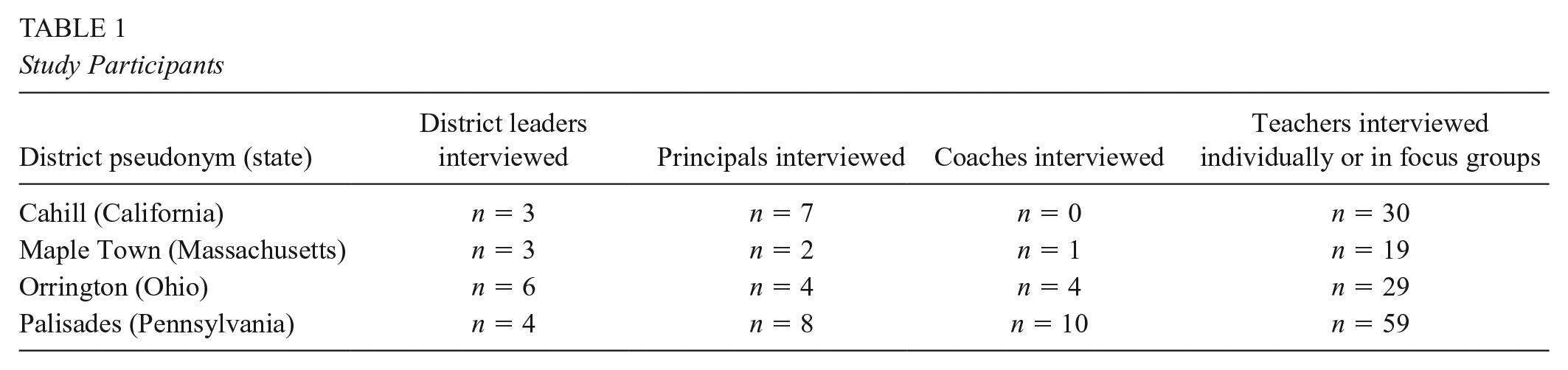
Each interview was recorded and transcribed verbatim. A research team of graduate students, which achieved at least 80% interrater reliability after coding transcripts together in at least five sessions, coded the data using a standard code list developed in the first 2 years of the study. The code list (see Table 2) included the descriptive categories of SBR that aligned with the interview questions and that emerged from the study.
List of Descriptive Codes

Note. ESSA = Every Student Succeeds Act.
When analyzing data for this study, we first conducted an unstructured read through of each of the district leaders’, principals’, and coaches’ transcripts to get a sense of the leadership contexts, vision, and strategies. We then read through the descriptive codes and applied the framework of the four features of adaptive leadership challenges to understand the adaptive barriers to implementing curricula. We triangulated leaders’ perspectives of the adaptive challenges with those of their teachers, whose perceptions shed light on the underlying reasons behind these implementation challenges, and areas of curriculum implementation that seemed promising or successful. We used a matrix format to organize district, principal, coach, and teacher perceptions of curriculum implementation across the four features (see Miles et al., 2014).
Using this matrix, we analyzed patterns within and across each adaptive domain. Within each domain, we also looked for variability of patterns based on district context. Patterns became themes when a relatively high number of district leaders, principals, coaches and teachers in the majority of the districts referenced a particular adaptive leadership challenge, or when the themes spoke to the connections between challenges or to the variabilities of district contexts. These themes were strengthened in multiple dialogic engagement sessions with the writing team and the broader Center, where individuals asked probing questions, reflected differently on the issues, and presented alternative hypotheses (see Ravitch & Carl, 2016).
Adaptive Curriculum Challenges
Our analyses of the data revealed four types of adaptive curriculum challenges that emerged when leaders approached curriculum implementation in technical ways. When leaders adopted new curricula to encourage shifts in ELA and math instruction, those that primarily relied on technical resources (e.g., materials, curriculum publishers’ PD) contributed to two adaptive challenges: (a) limited opportunities to build teachers’ capacity to identify and bridge gaps between the standards and curriculum themselves and (b) teachers struggling to negotiate the competing messaging of previous and current curricular reform efforts. Moreover, some of this technical reliance (c) diverted responsibility away from fixed mindsets around student ability levels and cultural responsiveness and (4) oversimplified the inherent complexities of differentiating instruction.
Table 3 contains a list of the technical strategies found across the districts, as well as the adaptive strategies demonstrated most prominently in Cahill, and in a few schools in Maple Town, Orrington, and Palisades. Our data analyses highlight a selection of these strategies.
Curricular Implementation Across Case Study Districts
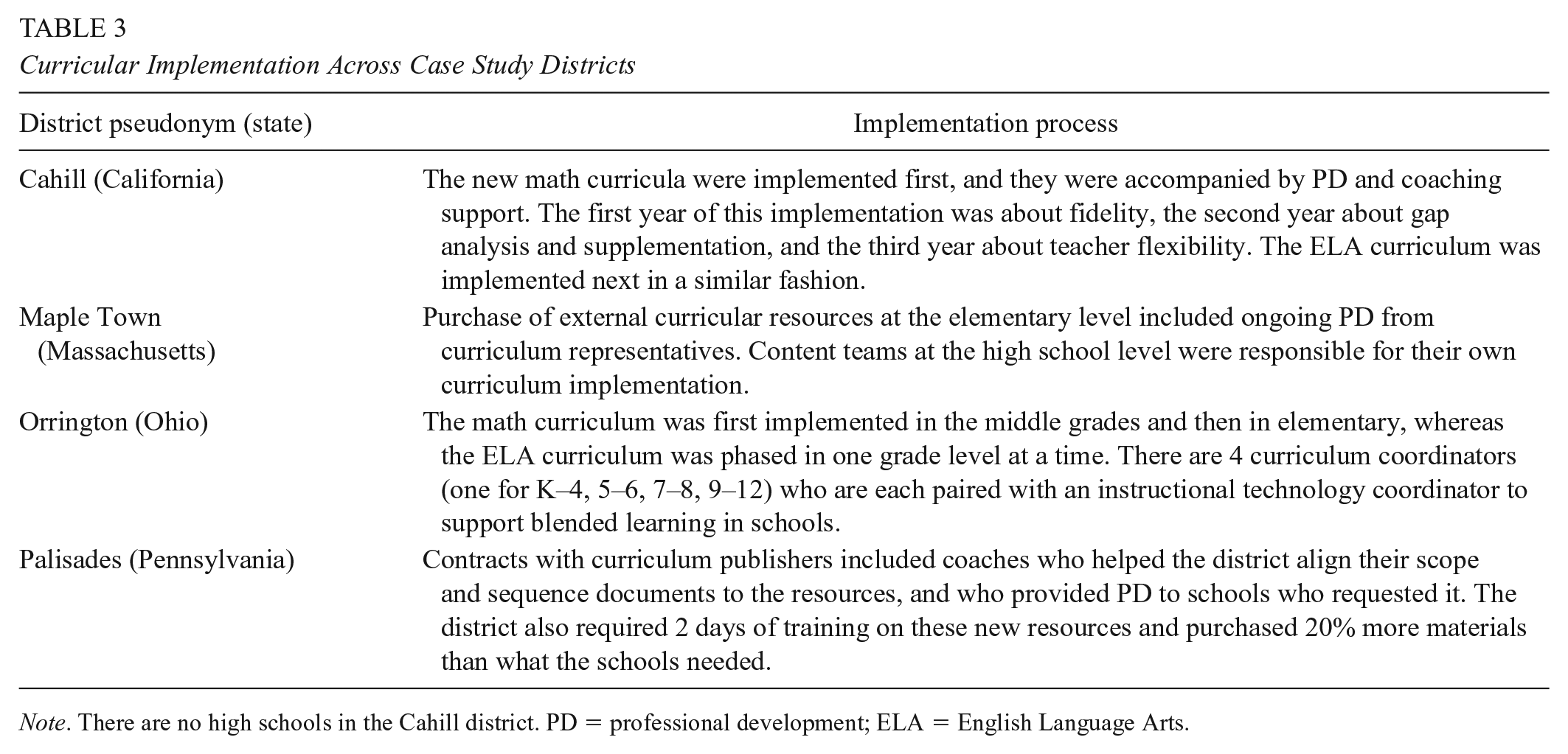
Note. There are no high schools in the Cahill district. PD = professional development; ELA = English Language Arts.
Critical Gap Analysis in the Context of Competing Values
Each of our districts chose to adopt externally developed math and ELA curricular programs, where many implementation decisions aligned with the technical approach of solving a problem by using existing resources and procedures. When this technical approach was the primary strategy used by educational leaders, issues related to the first and second features of adaptive challenges—the gap between values and competing commitments—emerged and persisted.
In all four case study districts, the elementary schools were provided with published math and ELA curricular programs, and in two districts, the high schools also received externally developed curriculum. Once these external materials were adopted, district leaders worked with their principals to offer PD workshops to expose teachers to the elements of their new curricula; this was a major element of each district’s implementation strategy. An overview of the districts’ curriculum implementation process is outlined in Table 4.
Technical and Adaptive Strategies Across Four Districts

In Maple Town, Orrington, and Palisades, the PD provided by the curriculum publishers was primarily leveraged to support teachers’ enactment of the new materials. Teachers were required to attend PD from the publishers that “focused more on curriculum with the [math] series and with [ELA] . . . as opposed to looking at the standards” (teacher interview, Maple Town). In Palisades, teachers were additionally encouraged to utilize the supplementary curricular resources housed in their district’s online platform as a secondary implementation strategy. Thus, our conversations with leaders and teachers mostly focused on training on the technical resources (i.e., materials and PD) themselves, with a nascent focus on adaptive approaches to cultivating the professional skills that teachers needed to effectively (or selectively) utilize the curriculum.
One of the most challenging issues raised as a result of this technical approach was the unintended consequence of teachers not learning how to critically analyze gaps between the written curriculum and espoused values of the intended curriculum, and to effectively supplement these gaps themselves. While the expectation for teachers generally was to implement the curriculum provided to them so that students can benefit from the exposure to common instructional language and pedagogy across classrooms and schools (principal interview, Orrington), educational leaders in Palisades, Maple Town, and to some extent, Orrington struggled with building their teachers’ capacities to deviate from the curriculum to adapt to students’ needs.
Successful curriculum implementation is marked by a process of dynamic interactions between teachers’ interpretations of their resources, the standards, student needs, and contextual constraints (Remillard, 2005). Yet interview data suggest that this dynamism may be lacking given some of the assumptions about the curriculum, as articulated by an Orrington coach: “I just assumed any curriculum I was given was properly aligned . . . that was where my standards knowledge was coming from.” When this coach identified curriculum misalignments due to recent revisions to the Ohio state standards, she realized that the staff did not have the skill set to “critique the curriculum and make the appropriate adjustments so that it’s fitting the current standards.” Observations of misaligned curriculum were frequent in Palisades as well, where one principal remarked that even if teachers implement the math curriculum with fidelity, they will still be teaching only 50% of the standards. This principal therefore found a separate curriculum for their teachers to use and disregarded the district resource.
Several leaders and teachers speculated that their district’s decision to provide new standards-aligned curriculum before teachers developed a strong pedagogical foundation for standards-based instruction handicapped teachers’ development to analyze gaps between the curriculum and the standards. There was an acknowledgement that teachers had not received PD to identify when students master the standards and what mastery looks like (teacher focus group, Maple Town). Several teachers in a focus group in Orrington similarly expressed that the “downside of having the programs” is not really having to “look at standards” and ask “what does this standard mean? What are all the little pieces that lead up to that?” As summarized by one Palisades principal, So when you give teachers this workbook, you kind of give them this wheelchair and all of a sudden you’re not teaching them actually how to walk, you’re just kind of scooting around in this wheelchair and their muscles are atrophying.
He and others believed that while the curriculum resources are useful, they cannot be the “crutch” upon which teachers rely for standards-based instruction. Still, there were a few examples of individual leaders establishing adaptive techniques to specifically target this challenge. One instructional coach in Palisades described revising her role to include modeling lessons based on the text, yet adapted to better suit the students, to show teachers “how not to take the book at face value,” in the hopes of encouraging teachers to critically analyze the curriculum. However, these school-based leadership interventions may only be Band-Aids to systemic challenges with curriculum implementation if they are not implemented district-wide.
Exacerbating this issue is the second adaptive challenge of competing messaging around the instructional values promoted by the district. The work of analyzing gaps in the curriculum and supplementing with their own instructional planning is rendered more difficult when teachers receive mixed messaging around the types of instructional practice needed to meet the demands of the standards. When different values converge on teachers over time (e.g., the value of prescriptively following curricula versus constructing learning experiences that are responsive to student needs; Supovitz, 2015), then it can be difficult to keep track of fluctuating professional requirements.
Concerns over these shifting values emerged in Maple Town and Palisades, the two districts in this study where a newly adopted curriculum replaced previously adopted curricula with conflicting values. As one principal in Maple Town acknowledged, their previous reading curriculum was intentionally unscripted to allow the integration of student engagement strategies. In contrast, the new curriculum was quite prescriptive, emphasizing direct instruction more so than student engagement. This principal noted that teachers, rather than striking a balance between the two approaches, followed the prescriptiveness with high fidelity, leading to the omission of student engagement strategies developed in prior years (reflected in lower classroom observation scores). As this principal remarked, Last year we had a walkthrough in February and May, and what we were looking for, the indicators really went up. And yesterday they went down. It was like, “Oh, my god.” It was surprising. Is this because of the [new ELA] program? And they feel like they can’t bring their own choice into it. It is scripted.
A teacher in this same school illuminated this tension further, saying that in the past, the district significantly invested in professional learning on interactive read-alouds in early literacy classrooms, yet the new curriculum neither includes nor makes time to include the interactive read-aloud strategy.
Contradictory expectations between prescriptive and constructivist curriculum implementation were also prevalent in Palisades. Even though district administrators believed that the messaging was, “Here are our grade level expectations, here are the resources, but if you want to use other resources, make sure those are best for your kids and you,” this messaging had become convoluted across the six schools in the study. One reason for this is the nested layers of leadership in this district. Where other districts have a direct line of communication between the curriculum office and the schools, in this district, communication is rerouted through an additional layer of district administrators who interface directly with their networks of schools. In one network, teachers are not allowed to construct their own resources and have to “sneak stuff in” (teacher interview, Palisades) due to their regional leader’s mandate to follow the adopted curriculum with fidelity. In other schools, the principal is the one to allow teacher autonomy and flexibility. In addition to these differing edicts, teachers also know that the implementation strategy has shifted back and forth between prescriptiveness and constructivism as central district leadership changed hands, making it difficult to know where the current strategy stands. Several teachers in Palisades alluded to this history of the curricular resources oscillating from scripted to unscripted: We went from being told exactly what we had to say, when we had to say it, how many minutes we had to say it, to like, all right, it’s a free for all . . . Or we’re not sure if we’re gonna get in trouble for not doing certain . . . It’s causing a lot of stress and teachers to feel like we’re burnt out . . . But it’s like we’re scared to do certain things. (Teacher interview, Palisades)
This context has understandably contributed to teachers’ confusion and decreased sense of efficacy as they face new curricular materials.
Mindsets About Student Abilities and Differentiation
The second major way in which curriculum implementation was approached from a technical standpoint was when the technical materials and intervention programs were primarily relied upon to provide demanding, engaging, and differentiated instruction. It certainly helps teachers to have access to curricular resources that offer opportunities for rigor and differentiation. It also helps to adaptively uncover some of the root causes behind teachers’ issues with these technical resources, as some of these root causes address teachers’ mindsets about student ability and cultural interests (i.e., the adaptive challenge of speaking the unspeakable) and the labor of differentiation (i.e., the adaptive challenge of oversimplifying complex problems).
Most of the district and school leaders across the four districts touted the rigors of their curriculum, the engaging nature of the materials, and the built-in intervention components of their curriculum as characteristics that would support changes to teachers’ practice. The curriculum challenged teachers to raise the rigor of their instruction. It allowed students to engage with the texts either by providing personal booklets for annotation or by providing technology-based, blended-learning opportunities. The curriculum also offered leveled texts, accommodations, or translated texts to help differentiate students’ access to, and learning of, the curriculum.
While there were teachers across all districts who appreciated the rigor of the provided curriculum for exposing them to the demands of the standards, there were also teachers who expressed that their students did not have the “prerequisite skills, prior knowledge, or background experience to keep up with the pacing” in the curricula (teacher interview, Orrington). Statements such as this reflect the fixed mindset that students’ intelligence levels are static, rendering them unprepared to take on academic challenges (Dweck, 2007). Other concerns stemmed from the belief that reading passages, excerpts, and short stories were inauthentic or unengaging modalities for literacy instruction. The curriculum in Cahill received some criticism from teachers in at least two schools who found the reading passages to be “extremely long and kind of dry,” or for only showcasing short excerpts from longer novels where students had “no idea where the character was coming from” because they had not read the whole novel. Palisades teachers similarly found fault with curricular texts specifically tailored to meet the standards, as they incorporated “snippets of text . . . that [drove staff] nuts because our kids are not getting the whole story behind it . . . especially kids who are below level.” While it was important for district and school leaders to make these technical resources available to teachers, those who believed the curricula surpassed their students’ ability levels dismissed the resources as ineffective. Influencing some of these beliefs may have been the unstated culture of low expectations that are typically reserved for students of color, low-income students, and SWDs, expectations that are considered “nondiscussables” in education (Barth, 2002). These expectations directly relate to the third adaptive challenge of leaders needing to foster the conditions for speaking the unspeakable in order to address the root causes behind implementation challenges (Heifetz et al., 2009).
When teachers were asked to reflect on how they made the curriculum more engaging for students given these challenges, particularly for students of color who might be more engaged in culturally relevant curriculum, some of the responses indicated problematic beliefs either about what constitutes cultural responsiveness or about fixed student ability levels. In one focus group in Palisades, a teacher used “poverty” and “gangs” as an example of culturally relevant curricular topics for their mostly African American students. This statement reflects the reinforcement of negative stereotypes of Black communities in the United States. In Orrington, two teachers in a focus group engaged in conversation about their students “not [being] as smart as they used to be,” as they have “gotten dumber in math” because the curriculum failed to provide sufficient practice opportunities for mathematical skills. Another teacher in Orrington also stated that because “this generation of kids” is more prone to “ADHD [attention deficit hyperactivity disorder],” with a lot more “that are a little bit on the spectrum,” they are “not ready” for the rigors of their curriculum.
These concerns represent adaptive challenges facing educational leaders, who need to help teachers be “creative with the standards” if they feel that their curriculum is not “always exciting or unengaging to the kids” (teacher interview, Palisades) rather than faulting the curriculum for their own unengaging instruction. These conversations often have to involve difficult discussions about implicit biases and growth mindset about what students can accomplish, which puts the onus on teachers, not the curriculum, to reframe their thinking about students. Part of this challenge is that when implementing new curriculum, education leaders may too easily overemphasize the importance of implementing curriculum with fidelity and omit the importance of building relationships with students, understanding the impacts of trauma, and fostering student engagement through socioemotional learning (teacher focus group, Orrington).
This narrow emphasis on the technical implementation of curriculum is also related to technical mindsets about differentiation, which may be the result of oversimplifying a highly complex skill. Differentiation is an intricate process, where teachers have to present different content, learning processes, learning products, and learning environments based on individual student goals, levels, and interests (Tomlinson & Moon, 2013). Because of the time, skill, and attention it takes to differentiate effectively, many leaders and general education teachers described resorting to the intervention programs such as Lexia, iReady, or Corrective Reading as their differentiation strategies, despite the fact that these programs do not differentiate the general education curriculum. In Orrington, where blended learning was a priority for the district, all principals referred to the intervention programs available on their students’ one-to-one devices as mechanisms for differentiation: “We were using a program for a while where you could take the same article and it looks identical but it’s at different Lexile levels” (principal interview, Orrington). General education teachers also frequently described randomly “Googling resources” (teacher interview, Cahill) for differentiated worksheets or “mak[ing] it up as we go along” (teacher interview, Palisades) because they lack the time or guidance to do otherwise. Yet, as one leader in Palisades described, this approach frequently results in diluting the learning for students rather than providing them with the grade-level experiences they deserve: What we really don’t like and what we tell principals what they shouldn’t see is the ESL [English as a second language] teacher just kind of finding random worksheets, like from Teachers Pay Teachers, that they say, “Oh, but it’s aligned to the standards.” Well, it’s not. That’s what we’re really trying to get away from, and I think that that’s been for a long time. It’s still, principals’ kind of think, “Well, I don’t know this. You’re the ESL teacher, I trust you. You know what you’re doing.
Differentiation cannot be implemented effectively through the technical provision of these extra resources exclusively. One principal in Palisades was described as moving his staff away from this mindset by modeling guided reading instruction during one school-based PD, where he showed teachers how to integrate differentiation through various questioning techniques, the use of visuals, and intentional comprehension checks. This type of adaptive work should be more widespread, ongoing, and directly tied to the root causes of the challenges that cause teachers to rely too much on technical resources for differentiation. These causes may be attributed to technical mindsets about the medical model of disability, where learning differences are seen as deficiencies that can be “fixed” with clinical interventions (Baglieri et al., 2011). Or these causes may be attributed to incoherent communication channels and how differentiation expectations are filtered through to teachers. Once educational leaders understand these causes, they can adaptively explore solutions that will more effectively enable differentiation in its ideal form.
Potential Practices for Adaptive Curricular Leadership
The iterative work of adaptive leadership involves the threefold process of (a) observe, (b) interpret, and (c) intervene (Heifetz et al., 2009; Wolfe, 2015). In the observation stage, leaders are diagnosing the technical or adaptive challenges in their system, collecting these data by “getting on the balcony” to obtain a bird’s-eye view of the issues, and ensuring that diverse stakeholders closest to the problems are represented in this process. Once the problems are appropriately diagnosed, the interpretation phase involves positing various hypotheses that may explain trends in the observations. The intervention represents the adaptations to organizational behaviors, norms, or practices based on these interpretations, where stakeholders collaborate with the leaders in taking ownership over these actions, and where leaders maintain a steady focus on prioritizing these adaptations until the original challenge is alleviated (Heifetz et al., 2009). Throughout these processes, there is learning-focused communication through a feedback loop between leaders and their stakeholders, frequent opportunities for PD focused on improving pedagogy, and site-based support to facilitate on-the-ground adaptations (Carter et al., 2020).
In our data analysis thus far, we focused on observations of challenges related to curriculum implementation, as well as interpretations of why adaptive challenges persisted. While we did not explicitly ask district or school leaders to describe how they adaptively addressed curriculum implementation challenges, we identified two potential adaptive leadership interventions based on these interpretations.
Curriculum-Focused Coaching as an Adaptive Intervention
There was widespread understanding among Cahill principals and teachers that the district’s curriculum implementation strategy involved an intentional, multiyear process of learning how best to support teachers’ curricular practices. As at least three principals noted, when the new curricula were first introduced, teachers felt “forced” to implement curricula that they were not comfortable with but changed their mindsets when they saw how the district’s instructional department adapted to provide the support that teachers needed (principal interview, Cahill). One such support was the district’s newly established coaching positions, which seemed to focus on helping teachers shift from identifying as technical to adaptive users of the curriculum. In the first year of implementation, which was called a “learning year” (principal interview, Cahill), district leaders, principals, and these new coaches worked with their teachers on building their technical understanding of the adopted curricula. The second year was devoted to supporting teachers’ analyses of the gaps in the curricula and supplementing those gaps themselves. The third year supported teachers’ flexible enactment of the adopted curricula.
These 3 years were buoyed by the instructional coaching infrastructure developed by the district superintendent, where the coaches were specifically tasked with supporting curriculum implementation. When district and school leaders first noticed that teachers were too rigid in following the curriculum page by page, they asked the coaches to work with teachers on identifying the priority standards for each grade level and content area. Teachers were then supported in focusing on the priority standards when engaging with the curriculum, resulting in shifting beliefs regarding the curriculum implementation process. This district also hired part-time curriculum specialists to learn how to provide the instruction that filled these gaps, with one principal calling the teachers the “doctors” while these curriculum specialists collaborated with them as the “nurses.” By revamping the district infrastructure to incorporate new coaching practices that iterated over time based on what they learned to be teachers’ curriculum needs, Cahill leaders demonstrated an adaptive mindset.
Co-Teaching for Differentiation as an Adaptive Intervention
Co-teaching refers to the dual instruction of one general education and one SWD or EL teacher in an inclusion class, and these co-teachers can employ several methods for differentiating instruction (Scruggs et al., 2007). While co-teaching is not a new vehicle for differentiating instruction in inclusive classrooms, for the educational organizations that have not yet restructured their systems, structures, and beliefs around co-teaching models, shifting to this paradigm represents an adaptive shift. Orrington leaders have recently started to promote and support co-teaching teams to better provide differentiated instruction to their special needs students.
Interview data from two co-teaching teams in Orrington suggest how they have been able to improve their design and execution of their differentiation strategies over time, as their principals have allowed them to work as a team for at least 3 years. One element that these co-teachers have deemed to be important, which their principals and districts were learning to prioritize, is the development of collaborative relationships. At the start of the co-teaching relationships, teachers questioned “when to insert myself” when planning differentiated instruction, and it “took a couple years” to forge teamwork norms and adapt to each other’s collaboration styles (teacher interview, Orrington). As a result, these teachers believed that their administrators were starting to pay attention to the need for more collaboration time. Second, co-teaching teams shared how they learned to flexibly adapt the district’s guidelines for curriculum implementation if they “think there are changes that need to be made to what we’ve done in the past or what decisions have been made in the past,” and then document these learnings “every year as a teacher team” (teacher interview, Orrington) to benefit both themselves and others in the future. While their principals still described differentiation in technical terms, they also acknowledged the flexible differentiation occurring in these teachers’ rooms and the benefits that come with stable co-teaching teams, which is the type of learning expected of adaptive leaders. Orrington leaders’ nascent efforts to learn from these co-teachers about relying less on technical interventions and more on their experimentation and reflections demonstrates an adaptive mindset.
These adaptive leadership examples might in turn cultivate a curriculum culture that is adaptive in nature. Culture is the shared pattern of espoused beliefs, underlying assumptions, and artifacts found across an organization (Schein, 2010), and it dictates the ways in which individuals behave with regard to reform initiatives. Curriculum culture would more specifically include the beliefs, assumptions, and artifacts associated with curriculum implementation. If leaders act in primarily technical ways, the curriculum culture of their district or school will mostly espouse technical behaviors while adaptive challenges simmer under the surface. If leaders leverage adaptive strategies that include experiments with new coaching and co-teaching structures, then their curriculum culture will also start to incorporate adaptive behaviors, where leaders and educators work together to continuously improve standards-aligned instruction in service of enhancing student achievement.
Limitations
Several limitations of our study should be noted. We do not directly observe leader behavior but instead obtained information about leader behavior through interviews with a range of respondents in each district. Given our qualitative design and the small number of districts in our sample, we are unable to draw causal links among leadership activities, teachers’ instruction, and student learning. Rather, we view our findings as suggestive of important patterns and hypotheses to be explored and tested in larger samples and in other settings. Finally, while our data suggest the importance of adaptive leadership behaviors in these districts, the districts—and the leaders in them—of course vary along many dimensions that might also explain differences in outcomes.
Discussion
A solely technical view of curriculum implementation would suggest that high-quality curricular resources, technical PD on how to use the curriculum, and traditional methods to manage the implementation process will lead to improved student learning outcomes. We argue instead that curriculum implementation should integrate both technical and adaptive approaches to better support teachers’ enactment of the new demands of the state’s content standards. The goals of our case study analysis were to disentangle the adaptive elements of curricular problems of practice that educational leaders typically approach from a mostly technical perspective, and to highlight some promising adaptive curriculum leadership strategies.
In the context of standards-based curriculum reform, educational leaders faced adaptive challenges as they encouraged teachers’ adoption of the written curriculum in technical ways. Through the reliance on standards-aligned curriculum and PD provided by these curriculum publishers, educational leaders sought to shape teachers as technical users of the curriculum. While this technical knowledge helps to support teachers’ enacted curriculum, it is equally important to proactively address the adaptive issue of learning how to help teachers bridge critical gaps between the expectations of the intended curriculum (i.e., espoused values) and the expectations in the district’s written curriculum (i.e., actualized values), which is not always aligned to the standards (Polikoff, 2015). The second adaptive issue concerned the conflicting messaging around instructional practice when new curricula complicated teachers’ sense-making of previous instructional practices promoted by district administrators and principals. Because curriculum representatives who are traditionally in the position of providing PD to teachers do not have the authority to help shape the coherence of this messaging, educational leaders need to proactively craft this coherent messaging for their teachers (Penuel et al., 2007; Porter at al., 2015). Thus, educational leaders must explore new ways of adaptively providing PD associated with the curricular resources so that teachers are developing the skills of analyzing and responding to these curricular gaps, and so they come to understand the alignment of new curriculum with existing standards-based initiatives.
Other adaptive leadership challenges were particularly salient in the context of educators’ overreliance on the technical curricular resources as the primary vehicles for engaging instruction and differentiation. The majority of the educational leaders and teachers in this study agreed that their district curriculum was academically rigorous, yet there were also critiques of the curriculum for being perhaps too rigorous and unengaging for their student populations. Some of these reflections were couched in problematic mindsets about student ability levels and what they counted as culturally relevant and engaging instruction, with little to no acknowledgement of the role that teachers, not curricular resources, play in adapting the curriculum so that it is accessible, engaging, and relevant (Remillard, 2005). These data reflect prior trends where educators hold students and curricular programs responsible for low student achievement levels rather than teacher- or school-based practices (Desimone, 2013; Harris, 2012; Ylimaki, 2012). Relatedly, leaders and teachers alike described differentiation as providing students with technical intervention programs and resources, with little mention of teachers taking the time to individually understand students’ interests and needs and leveraging this knowledge when designing the learning environment (Salend, 2015; Tomlinson & Moon, 2013). To tackle these challenges adaptively, educational leaders need to surface some of the root causes behind educators’ mindsets around student ability levels and differentiation; invite conversation around the “nondiscussables” such as implicit biases; collaborate with their educators on designing new systems, structures, and beliefs that better support rigorous and differentiated instruction; and stay focused on this adaptive learning instead of turning the work over to technical programs.
We also showcased some of the adaptive leadership interventions found in two districts, where leaders worked with their instructional coaches and teachers to learn how to better support teachers’ enactment of the written and intended curriculum for all learners. The presence of these adaptations may in turn foster the development of an adaptive curriculum culture, where stakeholders are encouraged to experiment with new strategies that may strengthen teachers’ implementation and differentiation of the curriculum. Such an adaptive culture should also seek to understand and address teachers’ experiences with the standards environment around curriculum reform, which is often different than school or district leaders’ own (Edgerton & Desimone, 2019).
Neither are we suggesting that these are the only challenges and interventions relevant to educational leaders implementing new written curriculum, nor are we positing that these adaptive features and strategies apply across all leadership contexts. Instead, we are showing one example of how to apply adaptive leadership theory, which is widely used in sectors outside of education, to a lingering problem of practice in education—how to effectively support teachers’ practice using externally adopted curricula as their framework for teaching and learning.
Implications for Adaptive Leadership
Educational leaders facilitating curricular reform efforts have to strategically identify what needs to change, how it should change, and the process for change, including how stakeholder expertise is leveraged throughout all three stages of reform (DeMatthews, 2014). This improvement journey requires a blend of technical and adaptive leadership, given the technical and adaptive aspects of the challenges that educators experience when learning to implement the standards. Because adaptive processes necessitate ongoing learning and reflection, educational leaders should embed multiple, curriculum-focused learning opportunities throughout the implementation process, rather than accepting the conventional practice of allocating fewer than 4 days of curriculum-focused coaching and PD (Kaufman et al., 2019) We therefore integrate findings from this study with prior conceptualizations of adaptive leadership behaviors (Carter et al., 2020; Heifetz et al., 2009; Wolfe, 2015) into a set of recommendations that focus on this ongoing learning, and that address the four curricular challenges described (see Table 5). While it may be appealing to efficiently fix an adaptive challenge with only technical solutions in the short term, in the long term, these challenges will emerge again and again until leaders also institutionalize the adaptations that organizations need to make to fundamentally address these challenges.
Leveraging Adaptive and Technical Leadership to Address Curricular Challenges

Because these implications for adaptive curriculum leadership and its influence on the development of an adaptive curriculum culture are nascent concepts for the field, we suggest future studies that operationalize and evaluate these promising strategies. Adaptive leadership is a theoretical framework that is embraced in many leadership sectors, though with little empirical evidence to solidify its claims (Dugan, 2017). We believe that much can be learned from evaluations of educational leaders who recognize the adaptive complexities of curriculum reform and proactively seek to alter their leadership behaviors to account for these complexities (Wolfe, 2015).
Footnotes
Funding
The author(s) disclosed receipt of the following financial support for the research, authorship, and/or publication of this article: This research was supported in part by Grant R305C150007 from the Institute of Education Sciences in the U.S. Department of Education to the University of Pennsylvania. The content is solely the responsibility of the author and does not necessarily represent the official views of the Institute of Education Sciences or the U.S. Department of Education.

Notes
Authors
KATIE PAK is a postdoctoral researcher at the University of Pennsylvania Graduate School of Education. Her research includes policy implementation, educational leadership, school improvement, and leadership for critical social change.
MORGAN S. POLIKOFF is an associate professor of education at Rossier. He studies the design, implementation, and effects of standards, assessment, and accountability policies.
LAURA M. DESIMONE is director of research in the College of Education and Human Development at the University of Delaware and a professor in the School of Education in Educational Statistics and Research Methods and in the Joseph R. Biden, Jr. School of Public Policy & Administration. She studies how state-, district-, and school-level policy can better promote changes in teaching that lead to improved student achievement and to closing the achievement gap between advantaged and disadvantaged students.
ERICA SALDÍVAR GARCÍA is a clinical assistant professor of TESOL, bilingual, and foreign language education in the Steinhardt School of Culture, Education, and Human Development at New York University. Her areas of research include the bilingualism and biliteracy of multilingual youth, raciolinguistic and literacy ideologies, and language education policy.