




Abstract
Despite the common title of “coach,” definitions of high-quality coaching vary tremendously across models and programs. Yet few studies make comparisons between different models to understand what is most helpful, for whom, and under what circumstances. As a result, practitioners are left with many options and little evidence-based direction. This is exacerbated by the literature’s focus on more abstract features of coaching practice (e.g., building trust), leaving practitioners to figure out what concrete discourse strategies support these goals. This article begins to address these challenges by introducing a taxonomy of coaching “moves,” parsing the concrete details of coach discourse. While the taxonomy is informed by the literature, it highlights conceptual possibilities rather than providing a list of empirically grounded or “evidence-based” strategies. In doing so, this taxonomy may serve as a common language to guide future work exploring how coach discourse shapes teacher development, synthesizing across studies, and supporting coach practice.
Keywords
Over the last three decades, coaching conversations have become a regular fixture in schools around the world (Domina et al., 2015; Kraft et al., 2018; Lochmiller, 2021). Literacy coaches suggest and provide feedback on instructional techniques to support student literacy (Deussen et al., 2007). Data coaches help teachers interpret and act on their students’ achievement data (Marsh et al., 2010). When a new curriculum is introduced, coaches may support teachers with using the new materials (Cohen et al., 2023). Increasingly, schools and districts are incorporating one-on-one instructional coaching as a central component of their approach to supporting teachers at all career stages with a wide variety of professional development needs (Galey, 2016; K. Johnson, 2016; Neufeld & Roper, 2003). As these examples illustrate, there are many different kinds of coaching conversations. Nonetheless, they share a common theory of action: that engaging in purposeful dialogue about the day-to-day details of a teacher’s classroom and instruction with another education professional can spur improvements in teachers’ instruction and student learning.
One reason coaching is so widespread is the growing evidence it can enhance teachers’ instruction and improve student learning, unlike most other forms of professional development (Kraft et al., 2018; Ronfeldt & Reininger, 2012; Ronfeldt et al., 2018). This kind of personalized support is also highly valued by teachers (Gross, 2010; Ronfeldt et al., 2020). Together, this makes coaching one of the most promising levers for ensuring that all students have access to high-quality instruction (Alston et al., 2018; Hiebert & Morris, 2012; Kloser et al., 2019).
Yet realizing this promise is not straightforward. The school and district leaders and coaches responsible for implementing coaching programs face a dizzying array of different coaching models and ideas about what coaches can do in their interactions with teachers to support their development. J. Knight’s (2009) edited volume on coaching alone introduces seven different types of coaching, including instructional coaching, cognitive coaching, and content coaching. While studies exploring the effects of specific models abound, few studies make comparisons across different models of coaching to understand what coaching practices are the most helpful, for whom, and under what circumstances. Furthermore, synthesizing across studies is complicated by the lack of a common language for describing the practices coaches use. This makes it difficult to identify patterns across studies in how coaching practice supports teacher development. As a result, coaches and school and district leaders are left with many options and little evidence-based direction for how to select among them (Galey, 2016; Gibbons & Cobb, 2016). These challenges are further exacerbated by the literature’s focus on more abstract features of coaching practice, with limited attention to the concrete discourse strategies coaches can use to achieve these aims. For example, there is broad consensus about the need for coaches to build trusting relationships with their teachers, but little evidence-based guidance that highlights what coaches can say to build such relationships. Thus, coaches and school and district leaders are left largely on their own to identify specific discourse strategies (i.e., patterns of talk), such as validating a teachers’ emotions, that can help them reach these goals.
Rather than relying on school and district leaders to recruit coaches with strong “people skills,” or placing the onus on practitioners to “figure it out” on their own, we need a systematic program of research designed to identify effective coaching discourse strategies across contexts and program models. To do so, we first need a coherent framework that can provide a common language for describing coaching discourse strategies and outline potentially promising strategies that warrant further investigation. This article therefore introduces a taxonomy of concrete coaching discourse moves or questioning and feedback strategies coaches may use in their interactions with teachers as the foundation for a framework of coaching practice (Boerst et al., 2011; Heineke, 2013; Robertson et al., 2020). While the taxonomy is informed by the literature, it highlights conceptual possibilities rather than providing a list of evidence-based strategies.
This work reflects the structure of published frameworks of teaching practice, which have helped researchers refine their understanding of high-quality teaching practice and are shaping teacher education (Boerst et al., 2011; Cohen, 2015; Grossman & McDonald, 2008; Grossman et al., 2009; Lampert & Graziani, 2009). Contemporary frameworks of teaching practice use a nested structure, beginning with high-level practices and instructional purposes that are successively decomposed into ever more detailed and specific components, culminating in concrete discourse moves. These frameworks are built on decades of research identifying specific discourse strategies, like wait time and revoicing student contributions, that contribute to student learning (M. C. O’Connor & Michaels, 1993; Rowe, 1986; Tobin, 1987). Similar foundational work has yet to be conducted for coaching practice.
This article, and the taxonomy it introduces, focus specifically on coaching discourse, by which I mean the functional patterns of language that coaches use during their coaching conversations with teachers (Boerst et al., 2011; Gee, 2014; Heineke, 2013; Robertson et al., 2020). I further define a coaching conversation, to which the coaching moves taxonomy applies, as a dialogue between two education professionals, where
one participant is a pre-service or in-service classroom teacher, and the primary focus of the dialogue is on this teacher’s classroom, this teacher’s current teaching practice, and/or opportunities for the teacher to improve or change their teaching practice; and
a different participant—the coach—serves as the facilitator to maintain focus on these topics with the ultimate goal of improving student learning and well-being by supporting the teacher’s instructional practice (Bean et al., 2010; J. Knight, 2009; Kochmanski, 2020).
This definition is purposely broad to be applicable to a variety of coaching models and contexts.
I focus on coaching discourse for two reasons: first, it is underexplored in the literature; and second, it likely influences teacher learning. While the coaching literature is filled with discussions of high-level coaching practices and purposes, such as building trust and supporting teacher self-reflection, there is a dearth of analogous research on how concrete coaching discourse strategies support teacher development (Heineke, 2013; King et al., 2004; L’Allier et al., 2010; Obara, 2010; Robertson et al., 2020; Sisson & Sisson, 2017; Walpole et al., 2010). Yet there is good reason to believe that coaching discourse strategies matter for teacher development. Given the substantial evidence of the role of teacher discourse in student learning, it seems unlikely that teacher learning would not also be influenced by coach discourse (Demszky & Hill, 2022; M. C. O’Connor & Michaels, 1993; Rowe, 1986; Tobin, 1987). Additionally, the limited available literature provides suggestive evidence of the importance of coach discourse strategies (Heineke, 2013; Hunt, 2016; Robertson et al., 2020; Sims & Fletcher-Wood, 2020). Finally, though the existing literature does not focus on discourse moves as the unit of analysis, examples and descriptions of coaching discourse are frequently used in both academic and practitioner literature to illustrate how coaches can implement these practices (Aguilar, 2013; Ippolito, 2010; J. Knight, 2019). This suggests a widespread belief in the importance of coaching discourse for teacher development and for differentiating between different approaches to coaching.
In developing the taxonomy, I conduct a conceptual, qualitative literature review to identify potential discourse moves. Instead of following a systematic review process, I strategically sample several kinds of resources, including academic research and practitioner resources to understand the nature and breadth of potential coaching discourse. In this way, the methods that I use are more akin to those used to develop qualitative codebooks (Miles et al., 2014).
In introducing a taxonomy of coaching discourse moves, this article makes three primary contributions. First, the taxonomy can serve as a conceptual framework for future empirical research, providing a common language for describing coaching discourse and articulating aspects of coaches’ interactions with teachers that warrant further investigation. Second, the taxonomy can provide a practical toolkit and technical vocabulary for coaching practitioners, synthesizing our existing knowledge of coaching discourse into a flexible repertoire of discourse strategies that can be used to reflect on and plan for coaching conversations. Third, in serving as a common language for coaching research and practice, the taxonomy can foster greater integration between coaching research and practice. A shared framework and language for describing coaching discourse will facilitate the systematic accumulation, synthesis, and application of new knowledge about coaching (Boerst et al., 2011; Charalambous & Praetorius, 2020; Hiebert & Morris, 2012; Kloser et al., 2019; McDonald et al., 2013). Currently, studies of coaching include a wide variety of programs, defined and operationalized in different ways, and described in varying levels of detail with inconsistent terminology. This requires authors of reviews and meta-analyses to dedicate substantial energy to making sense of these differences and developing a common coding scheme to enable comparison across studies (Kraft et al., 2018). However, when individual studies use a common language for describing coaching, identifying patterns across studies and conducting meta-analyses will be considerably easier. Furthermore, when coaching practitioners use the same language as one another to discuss their work, they will be better able learn from and support each other. Finally, when researchers and practitioners use the same language, it will be easier for researchers to communicate their insights to practitioners and for practitioners to act on these insights in their daily practice.
In the sections that follow, I review the literature on coaching, describe my methods for developing the taxonomy, describe the taxonomy’s structure and content, and illustrate how the taxonomy may be used by researchers and practitioners.
Background
Like many popular educational interventions and innovations, how coaching is operationalized and implemented is highly variable. Indeed, a nontrivial portion of the literature focuses on defining and categorizing specific approaches to coaching. Any discussion of coaching, therefore, must begin with a discussion of what coaching means.
Defining Coaching
In their foundational work, Joyce and Showers (1981) describe coaching as ongoing cycles of “observation and feedback” (p. 170) where a coach aims to help improve a teacher’s implementation of new instructional strategies introduced as part of professional development workshops or other programming. Later work introduces additional conversational structures and distinguishes between different kinds of coaching.
In attempt to identify potentially productive coaching activities, Gibbons and Cobb (2017) describe 19 structures coaches can use in their interactions with teachers. In addition to observation and feedback cycles, they include structures like coteaching (where the coach and teacher together plan and teach a lesson), modeling instruction (where the teacher observes the coach’s or another teacher’s instruction and then debriefs the observation with the coach), lesson planning (where the coach and teacher plan a future lesson together), examining student work, and facilitating opportunities for a teacher to rehearse new instructional practices and receive feedback.
Other work focuses on more nuanced features of coaches’ interactions with teachers to distinguish among different coaching approaches. Several scholars, for example, reference the distinction between responsive coaching, where the coach allows a teacher’s self-reflections and goals to guide the content of coaching, and directive coaching, where the coach draws on their own expertise to provide directive suggestions about what a teacher should change (Deussen et al., 2007; Dozier, 2006; McGatha, 2017). Several specific models of coaching are also defined by expectations about how coaches should interact with teachers. J. Knight’s (2007) Instructional Coaching approach, for example, highlights seven partnership principles, including collaborating with teachers as equal partners and promoting teacher choice and decision-making. Whereas Instructional Coaching emphasizes the coach’s role as a partner that works together with the teacher, Cognitive Coaching emphasizes the role of the coach as a facilitator whose goal is to help teachers exercise self-direction without offering their own judgment or advice (Costa & Garmston, 2002).
Other types of coaching are differentiated by the goals of the support provided. Literacy coaches, for example, are expected to work with students and teachers to promote student literacy, while mathematics coaches are expected to support teachers with developing students’ mathematical skills (Obara, 2010; Toll, 2009; West, 2009). Some coaching programs focus on specific professional skills such as classroom management or data analysis (Marsh et al., 2010; Means et al., 2010; Reinke et al., 2009). Still other coaching programs look beyond individual teachers’ practice to foster school or district-wide instructional reform (Woulfin, 2018; Woulfin & Rigby, 2017).
Approaches to coaching are also sometimes differentiated by who coaches and teachers are rather than what they do in their interactions. Ackland (1991), for example, distinguishes between expert peer coaching, where a more accomplished teacher supports the development of a less accomplished teacher, and reciprocal peer coaching, where teachers of similar skill levels work together. Other models rely on accomplished teachers who leave the classroom to focus primarily on supporting other teachers (Coggins et al., 2003; Kane & Rosenquist, 2019; J. Knight, 2007). Additionally, while some authors include conversations between a facilitator and multiple teachers as a form of coaching, others define coaching as one-on-one meetings between a single teacher and coach (Gibbons & Cobb, 2017; Kraft et al., 2018).
It is notable that few of these definitions are mutually exclusive. A coaching program in which teachers of similar skill levels coach each other on instructional strategies for mathematics reflects elements of both peer-to-peer coaching and mathematics coaching. Similarly, one can imagine a variety of different content-specific coaching programs that might rely on different structures and coaching practices. Coaches may even draw on multiple types of coaching within a single conversation. Existing work suggests, for example, that coaches may draw on both directive and responsive strategies even within a single coaching conversation (Ippolito, 2010).
With all this overlap, how to synthesize findings across studies is not at all clear. Can findings about effective strategies for building relationships in a mathematics coaching program generalize to other kinds of programs? Can we combine evidence on peer coaching with evidence on literacy coaching to create peer literacy coaching? Or does the evidence on literacy coaching only apply when coaches are literacy experts, as literacy coaching typically requires? Without a common language for differentiating between coaching programs and describing how coaches’ interactions vary, we cannot develop a systematic understanding of coaching. In the meantime, coaches and school and district leaders are left to muddle through this complexity on their own.
Supporting Teacher Development Through Coaching Conversations
The literature offers a range of ideas about how coaches’ interactions with teachers can support teachers’ professional development and instructional practice. Common theories are summarized in Figure 1. Many scholars, for example, highlight the job-embedded nature of coaching interactions as a key mechanism that makes coaching conversations valuable for teachers. Because coaching conversations are grounded in the details of teachers’ day-to-day instruction, content, and students, they are responsive to teachers’ needs and provide authentic opportunities for teachers to make connections between theory and the practical details and challenges of instruction in the context of their daily work (Collet, 2012; Croft et al., 2010; Koh & Neuman, 2006; Putnam & Borko, 2000; Terehoff, 2002).

Summary of the prevailing theories about the mechanisms that explain how coaching conversations support teacher development.
Coaching conversations can also be conceptualized as active learning opportunities where, instead of serving as only passive recipients of information, teachers actively participate in tasks such as self-reflection, problem-solving, data analysis, lesson-planning, and practicing instructional strategies (Desimone & Pak, 2017; Shernoff et al., 2015). Active participation necessitates a deeper level of mental engagement than that required by more passive activities and provides opportunities for teachers to construct new knowledge in collaboration with the coach (Lieberman, 1995; Niemi et al., 2016). Coaches can also use their time with teachers to help them make sense of the many competing pressures and challenges they face (e.g., district priorities, content standards, principal priorities, student needs) and determine how to navigate and respond to them (Desimone & Pak, 2017). In this way, coaches can help create coherence and alignment between what teachers are working on with their coach, what teachers have previously worked on, other expectations placed upon them outside of coaching, and teachers’ own viewpoints and beliefs (Coburn & Russell, 2008; Coggins et al., 2003; Lowenhaupt et al., 2014; Swinnerton, 2007).
Whether teachers implement and maintain the practices discussed in coaching conversations depends in large part on teachers’ motivation to participate in coaching and develop a particular area of their practice (Gorozidis & Papaioannou, 2014; Hill et al., 2021; Kennedy, 2016a; Power & Goodnough, 2019). One way that coaches do this is by helping teachers recognize the potential benefits and purposes of a particular instructional goal or strategy (e.g., through explaining the research base, describing benefits for students, or modeling the strategy and asking the teacher to observe the impacts) (Gibbons & Cobb, 2016; Sims & Fletcher-Wood, 2020). Self-determination theory (Korthagen, 2017; Ryan & Deci, 2000) highlights several other routes through which coaches may support teacher motivation. First, coaches can help support teachers’ feelings of competence by orchestrating mastery experiences, providing encouragement, and drawing teachers’ attention to their own professional growth, strengths, and positive impacts on students (Collet, 2012; J. Knight, 2009; Kurz et al., 2017). Second, coaches can help support teachers’ feelings of relatedness by building a strong relationship of mutual respect, trust, and support (Lowenhaupt et al., 2014; Power & Goodnough, 2019; Shernoff et al., 2015). Third, coaches can help support teachers’ autonomy by creating opportunities for teachers to express their views and exercise choice and influence over what happens in the coaching session and its implications for their classroom instruction (Kennedy, 2016a; J. Knight, 2009; Power & Goodnough, 2019).
In addition to supporting teacher motivation and commitment to developmental goals, asking authentic questions that provide opportunities for teachers to express their own views, interpretations, and ideas also serves as a scaffold to support teachers’ reflection and problem-solving skills (Collet, 2012; Heineke, 2013; Koh & Neuman, 2006). Coaches can help teachers develop professional expertise and judgment through strategic questioning that requires teachers to analyze and reflect on classroom events, their students’ responses and needs, their own instruction, and their goals for future lessons (Barnhart & van Es, 2015; Denton & Hasbrouck, 2009; Hiebert & Morris, 2012; Santagata & Angelici, 2010; Teemant, 2014; Winch et al., 2015).
Some scholars also highlight the coach’s role as a source of instructional expertise to scaffold teachers’ instructional practice and decision-making. As an expert other, coaches can provide teachers with valuable feedback, instructional ideas, and support with implementing new ideas based on the coach’s assessment of teacher and student needs (Bean et al., 2010; Coburn & Woulfin, 2012; Cohen et al., 2020; Collet, 2012; Heineke, 2013). In providing feedback on prior instruction, coaches can help teachers understand their strengths and weaknesses and identify problems, challenges, and manageable goals for improvement (Blazar & Kraft, 2015; Cassidy et al., 2008; Hunter & Springer, 2022; Kurz et al., 2017; Tung et al., 2004). Coaches also bring additional knowledge of content and pedagogy, which they can use to identify and suggest ideas and strategies that teachers may not have been able to identify on their own (Joyce & Showers, 1981; J. Knight, 2009; Reddy et al., 2019). Coaches can demonstrate how they use this knowledge in action by modeling their thinking processes and how a particular instructional strategy can be implemented in practice (Joyce & Showers, 1981; J. Knight, 2009; Kurz et al., 2017; Reddy et al., 2019). Finally, coaches can help teachers successfully enact new practices (Kennedy, 1999) by facilitating opportunities for rehearsals and other kinds of deliberate practice (Cohen et al., 2020; Ippolito, 2010; Reddy et al., 2019).
Of course, what coaches say during coaching conversations is not the only thing that influences teacher development. Coaches’ activities outside of these conversations, including how coaches plan for their interactions with teachers, collaborate with school and district leaders, and analyze the lessons they observe also matter (Bean & DeFord, 2012; Gibbons & Cobb, 2016; Walpole & McKenna, 2012; Woulfin, 2018). Coaches’ relationships with the teachers they coach are also influenced by prior experiences, coach reputation, interactions outside of coaching conversations, and perhaps even coach characteristics such as race and gender (Anderson et al., 2014; Blazar et al., 2021; S. Johnson et al., 2018; Tschannen-Moran, 2004). Other literature highlights the role of additional coach characteristics and features of the broader context, including coach expertise, the nature of coaches’ job responsibilities, school leadership and culture, and local policy context (Blazar & Kraft, 2015; Booker & Russell, 2022; Deussen et al., 2007; Gallucci et al., 2010; Lowenhaupt et al., 2014; Marsh et al., 2012).
Coaching Discourse Strategies
Despite the substantial attention to how coaching can support teacher development, literature exploring the nature and effects of coaches’ discourse strategies is comparatively limited (Gibbons & Cobb, 2016; Kurz et al., 2017; Robertson et al., 2020). While only a handful of studies specifically focus on identifying coaching discourse strategies, descriptions and examples of coach discourse are often included in the literature. Combining these examples into a coherent framework of coaching discourse is not straightforward, however, because of the different approaches used to describe and distinguish between different strategies. Discussions of coaching discourse vary especially along three dimensions: grain size, framing, and normativity. Below, I define each of these features and provide examples of how they play out in the literature.
Grain Size
Grain size refers to the level of specificity and concreteness used to describe the components of coaches’ interactions with teachers (Boerst et al., 2011; Kennedy, 2016b). Existing studies of coaching tend to identify components of a relatively large grain size, offering only glimpses into the concrete details of coaching discourse. For example, many studies highlight broad conversational activities such as providing feedback based on an observation, setting goals, modeling, or planning for future instruction. Studies also highlighted specific conversational topics, such as content-specific instructional strategies, and specific conversational goals, such as developing a trusting and equal partnership, that can support teachers (Gibbons & Cobb, 2017; Hunt, 2016; Marsh et al., 2015; Matsumura et al., 2013; Teemant, 2014).
What is largely unspecified, however, are the concrete details of what coaches can say and do to achieve these aims. A handful of qualitative studies have begun to investigate features of coach dialogue, such as coach versus teacher talk time, the use of open-ended questions, and patterns of interaction (Collet, 2012; Heineke, 2013; Shernoff et al., 2015). Robertson et al. (2020), for example, highlight three patterns of coach-teacher interaction observed in coaching interactions and associated with teachers’ uptake of the instructional ideas discussed. Though some of these studies include some attention to specific kinds of utterances or coaching moves, such as “affirms an action or statement made by the teacher” (p. 412), such granular-level detail is not the primary focus.
Resources designed by practitioners for practitioner audiences, however, often describe specific coaching moves and provide exemplar coach dialogue to illustrate how coaches can achieve the broader coaching styles these resources aim to inspire. For example, in addition to describing the purpose and idea behind active listening during coaching conversations, Aguilar (2013) explains that one strategy coaches can use to achieve this is to “repeat back or paraphrase what the other person says” (p. 153). Researcher-created handbooks designed to guide coaches in implementing researcher-designed coaching models provide similar concrete suggestions (J. Knight, 2007; L’hospital et al., 2016). Unfortunately, because of the lack of attention to this small grain size in the research literature, there is little empirical evidence to support the suggestions made in these resources (Cornett & Knight, 2009; Gibbons & Cobb, 2017).
Framing
Framing refers to the extent to which the literature describes the observable discourse content (i.e., what teachers and coaches say) versus the intended outcomes or purposes behind the discourse (i.e., why coaches and teachers say it) (Forzani, 2014; Kennedy, 2016b). This is sometimes correlated with grain size. For example, the coaching strategy of building a strong coach-teacher relationship describes both an intended outcome and is at a large grain size. At the same time, providing positive praise both describes an observable action and is at a smaller grain size.
This is also evident in the coaching literature, where discussion of more granular coaching discourse strategies tends to highlight observable coaching actions, such as suggesting an instructional strategy, rather than goals and purposes, such as drawing a teacher’s attention to a specific instructional strategy (Heineke, 2013; Hunt, 2016; Robertson et al., 2020). However, many of the discussions of coaching interactions at larger grain sizes also describe what coaches do rather than why they do it, as seen in the discussion of conversational activities and topics highlighted above. Practitioner-facing resources, on the other hand, tend to describe both observable actions and purposes (Aguilar, 2013; L’hospital et al., 2016).
Normativity
Normativity refers to whether the identified components of coaching discourse are intended to reflect high-quality coaching practice that coaches should use or simply describe observed coaching practice (Goe et al., 2008; Kennedy, 2016b). In general, the coaching literature, practitioner-created resources, and coaching handbooks tend to provide normative guidance for what coaches should do based on an underlying theory of how coaching can influence teacher development (Aguilar, 2013; Desimone & Pak, 2017; Gibbons & Cobb, 2017; Sisson & Sisson, 2017). However, several descriptive studies illustrate how withholding normative judgment enables the development of new, empirically grounded ideas about what may constitute high-quality coaching practice. For example, drawing on a descriptive analysis of how coaching practice varied among 20 Reading First coaches, Bean et al. (2010) identifies qualities of coaches’ practice that are more and less valued by the teachers with whom they work. Similarly, Robertson et al. (2020) draws on a descriptive analysis of patterns in coach and teacher discourse to identify patterns of interaction that are associated with teacher learning.
Methods
Phase 1
I began by searching the literature on coaching using a broad search of the Google Scholar (scholar.google.com) database to identify an initial set of empirical and conceptual studies that could provide insight into the nuances of coach-teacher interactions. I supplemented my review of the academic literature with an exploration of the limited body of researcher- and practitioner-developed literature that focuses on the nuances of coach dialogue. In this way, I aimed to ensure that the resulting coaching moves taxonomy would be grounded in our existing understanding of the discourse strategies coaches might use.
Because I aimed to identify possible coaching moves rather than generate a list of evidence-based or high-quality moves, my search methods were more akin to those used to develop qualitative codebooks (Miles et al., 2014) than to conduct systematic reviews. Rather than attempting to identify all studies meeting specified criteria, I aimed to strategically sample several kinds of resources, including academic research and practitioner resources, to understand the nature and breadth of observed coaching discourse. Search terms included references to coaching, references to coaching discourse, and references to components of coaching (e.g., moves, activities, strategies). In reviewing these initial results, I discarded studies that did not include any discussion of coaching discourse, only keeping studies that included at least one example of coach dialogue or description of coaching conversation content. I also identified additional studies of interest from the citations included in the initial search results. Because of the limited literature on coaching discourse, many of the studies included in my review primarily attend to other aspects of coaching, such as coach time use. In describing or quoting coach dialogue, however, they provide indirect clues about what coaches could say, thereby providing important information about possible discourse strategies. Additionally, though my search began with literature focused on coaching, I also included literature focused on teacher learning in noncoaching contexts when such literature (a) was cited by a paper on coaching and (b) offered ideas about possible discourse strategies that might also be relevant for teacher learning in the context of coaching conversations.
Phase 2
First, I read and coded the retained studies and practitioner resources to develop an initial list of potential coaching moves. In doing so, I employed an inductive coding approach, developing in vivo codes to describe the moves illustrated in the literature, while preserving each author’s language and approach (Miles et al., 2014). This process resulted in a list of hundreds of potential coaching moves. I continued reviewing additional literature and adding to my list of coaching move codes until I ceased identifying distinct moves. This approach is akin to the method of saturation in qualitative coding (Glaser & Strauss, 1967; Hennink et al., 2017).
Phase 3
In the third phase, I focused on shaping the long list of potential coaching moves into a coherent and well-organized framework. First, I grouped the moves by grain size, framing, and normativity. I then compared the moves in each group to identify where there was conceptual overlap. Where gaps were present, I created additional moves to ensure that each group included the full breadth of concepts I identified in the literature. In this way, I was able to compare the different approaches to defining coaching moves and think through their affordances and constraints. Ultimately, I selected the approach that would maximize the level of detail, clarity, and practical relevance of the moves, while also ensuring that the moves could be flexibly grouped in many ways to reflect the different coaching models, approaches, and purposes. I discuss the details of and rationale for my chosen approach in the Results section, below.
Phase 4
I also engaged in three additional steps to ensure the taxonomy could describe a wide range of coaching practice and that the definitions and theoretical underpinnings for each move were clear. First, I compared the moves in my taxonomy with literature I had not yet read and revised the moves as needed to accommodate gaps. I continued this process until I stopped identifying additional revisions. Second, I drew on the literature from my review, as well as other literature where needed, to connect each move to potential theories for how the move might support teacher learning. Third, I hired four undergraduate students to pilot the framework by applying it as a coding scheme to a random sample of coaching transcripts from a previous study of coaching (see Cohen et al., 2021). In each round of piloting, several coders coded the same set of transcripts, then met to discuss their codes and identify adjustments to the taxonomy that would improve the clarity, reliability, and face validity.
After several rounds of piloting and revision, I shared the framework with five well-respected coaching researchers to ensure content validity. These experts offered feedback on ways to improve the clarity of the taxonomy, better distinguish between closely related moves, organize the moves into groups based on conceptual themes, and highlight additional elements of coaching discourse to consider incorporating into the taxonomy. I then engaged in several additional rounds of revision and piloting with undergraduate coders to implement the feedback I received.
Results
Here, I present the final taxonomy of coaching discourse moves. First, I describe the grain size, framing, and normativity of the taxonomy. Then I introduce the 45 moves that make up the taxonomy. Finally, I use stylized vignettes to illustrate how the taxonomy can be used by researchers and practitioners to enhance our understanding of coaching discourse.
Grain Size, Framing, and Normativity
The final taxonomy describes what coaches do at the highly granular level of moves (Boerst et al., 2011; Heineke, 2013). As I discovered in Phase 3 of my analysis, discourse moves can be defined in many ways. While some descriptions focused on individual coach utterances or turns of talk, others focused on broader sequences of dialogue. There was also variety in the level of detail used to describe their structure, with strategies as general as questions (Aguilar, 2013) and as specific as affirming a teacher’s prior instructional decision (Collet, 2012). Finally, while some strategies were defined in terms of their structure and function (e.g., asking for clarification [Robertson et al., 2020] or asking the teacher to justify a claim [Gibbons et al., 2018]), others were defined by the object or subject to which a coach was referring (e.g., asking questions about student thinking [Gibbons et al., 2018]).
In the final taxonomy, coaching moves are defined as individual coach utterances characterized primarily by their structure and function, with limited reference to the objects or subjects included in an utterance. Thus, the move labelled Cause & Effect is defined as “questioning that explicitly asks the teacher to reflect on the effect(s) that stemmed from a particular cause and/or the cause(s) that led to a particular effect” without specifying whether the cause or effect mentioned relates to teacher actions, student actions, or something else. This approach is purposely modeled after prior work on teaching moves, especially moves used to lead classroom discussions (Chapin et al., 2003; C. O’Connor & Michaels, 2019).
The moves included in the final taxonomy also describe the observable content of coaches’ discourse rather than the purposes such discourse may serve. This approach to framing aims to address the limited attention to what coaches can say to support teacher development in the existing coaching literature. Defining the Cause & Effect move by purpose, which might sound like “drawing the teacher’s attention to cause and effect relationships,” creates considerable ambiguity as to what a coach should say to enact such a move. Rather than prioritizing coaching purposes and leaving coaches to determine the specific discourse strategies they can use to achieve them, the coaching moves taxonomy instead prioritizes core discourse techniques, leaving coaches to determine the purposes they may serve and how they may be combined to achieve broader goals that facilitate teacher development (Hiebert et al., 2002; Reisman et al., 2019; Winch et al., 2015).
One potential criticism of this approach to framing is that it may reduce coaching practice to a disconnected set of rote discourse techniques that belies its complex, integrated, and context-specific nature and may encourage coaches to apply these techniques in mechanical and potentially inappropriate ways (Forzani, 2014; Grossman & McDonald, 2008; Kennedy, 2016b; C. O’Connor & Michaels, 2019). I agree that this is a potential danger. For example, borrowing from Aguilar (2013) and the MTP + 4Rs Coaching Handbook (Morningside Center for Teaching Social Responsibility, 2012), I define the mirroring move as “repeating or rephrasing what a teacher has just said.” Repeated, rote use of this move every time a teacher speaks is unlikely to be helpful. Instead, mirroring is one tool, among many, that coaches can draw on to help teachers feel heard, build a strong coach-teacher relationship, and support teacher motivation (Aguilar, 2013; Hunt, 2016).
Mirroring may also serve other purposes. Hearing one’s own ideas repeated back may support teachers with analyzing and reflecting on their own beliefs or interpretations of a particular situation (Ippolito, 2010; M. C. O’Connor & Michaels, 1993). Of course, not all teachers will benefit from the mirroring move or be spurred to question their own beliefs because of it. This reinforces the contextual nature of coaching, where the same moves may be used for different purposes and different moves may be necessary in different contexts to achieve the same purpose (Russell et al., 2020). This does not diminish the value of mirroring as a discourse strategy coaches may use. However, it does make it challenging to define or group moves together by purpose. For this reason, I organize the taxonomy based on the content and structure of the moves. However, I also incorporate attention to purpose by highlighting potential mechanisms for teacher development (Figure 1) each move may serve. In this way, the taxonomy recognizes the dynamic nature of coaching discourse, while still providing a common language for describing and operationalizing these details across studies and contexts.
Finally, while I connect each move included in the taxonomy to existing literature on coaching and the mechanisms they may serve, the taxonomy is not designed to provide a normative vision of what high-quality coaching practice should look like. Instead, the taxonomy is purposely designed to provide a descriptive view into the breadth of possible coaching moves given the lack of prior research focused on the granular details of coaching practice and its effects on teachers.
The Coaching Moves
Moves are grouped into six larger categories (Figure 2) to reflect structural distinctions between them, with 5 to 10 moves per group. In Tables 1 to 6, I list the corresponding moves, their definitions, exemplar coach dialogue to illustrate each move in action, the potential purposes they may serve, and supporting literature for each group. The citations included for each move are illustrative rather than exhaustive and were chosen to highlight sources for both the move itself and the potential purposes it may serve.

Organization of the coaching moves taxonomy.
Asking & Backward-Facing (AskBack) Moves (Group 1)

Telling & Backward-Facing (TellBack) Moves (Group 2)

Asking & Forward-Facing (AskForward) Moves (Group 3)

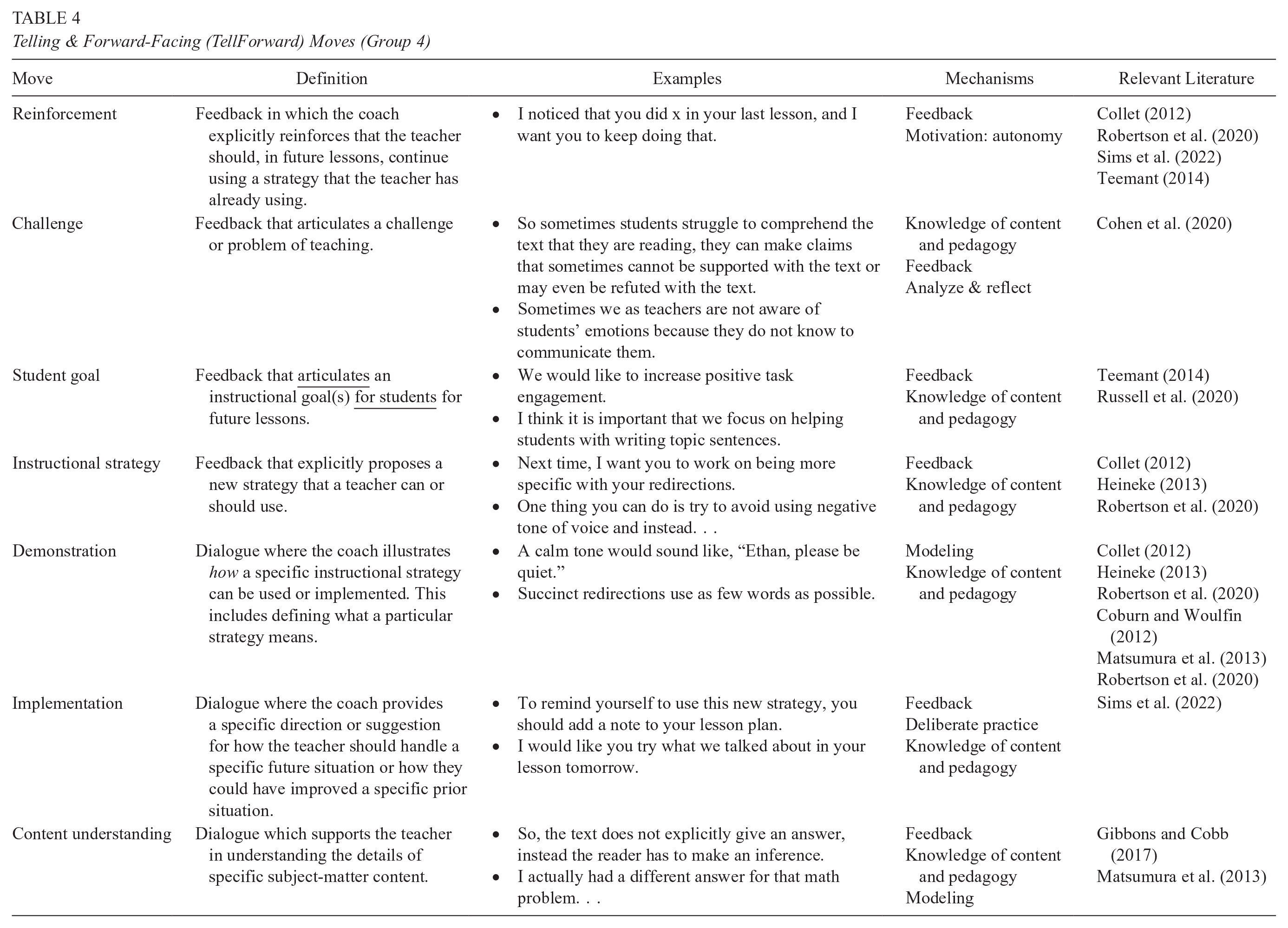
Telling & Forward-Facing (TellForward) Moves (Group 4)
Activities (Group 5)

Note. These activities are often accompanied by moves from the first four categories that serve to facilitate teacher analysis and reflection about the activity or the materials used in the activity or provide feedback on the teachers’ engagement in the activity.
Rapport Moves (Group 6)

I first distinguish between asking moves, in which coaches pose open-ended questions that may prompt teacher reflection, analysis, and sense-making (Collet, 2012; Desimone & Pak, 2017; Heineke, 2013; Koh & Neuman, 2006; Shernoff et al., 2015); and telling moves where the coach provides the teacher with information and more directive feedback (Bean et al., 2010; Coburn & Woulfin, 2012; Ippolito, 2010; Kurz et al., 2017; Reddy et al., 2019). I also distinguish between backward-facing moves, which focus on processing and providing feedback on what has previously occurred; and forward-facing moves, which focus on planning for future lessons and changes to instruction (Hattie & Timperley, 2007; Sisson & Sisson, 2017).
The first four groups consist of all possible combinations of these labels. Group 1 (Table 1) consists of moves that are asking and backward-facing (aka AskBack moves). By virtue of their structure as questions, I hypothesize that these moves may support teacher analysis and reflection and embody active learning principles. In focusing on prior instruction, these moves help ensure that coaching conversations are also job-embedded. Specific moves may also serve additional purposes, as noted in Table 1. Group 2 (Table 2) consists of moves that are telling and backward-facing (aka TellBack moves). By virtue of their structure as more directive statements, I hypothesize that these moves may serve as important sources of feedback and may also serve to scaffold teachers’ analysis and reflection, among other move-specific purposes. As with the first group, these moves also contribute to ensuring that coaching conversations are job-embedded. Group 3 (Table 3) consists of moves that are asking and forward-facing (aka AskForward moves) and may provide a job-embedded, active learning opportunity while also supporting teacher analysis and reflection. Finally, Group 4 (Table 4) consists of moves that are telling and backward-facing (aka TellBack moves), which may allow coaches to communicate feedback and share their knowledge of content and pedagogy.
The remaining two groups focus on moves that fall outside of the four groups above, but may nonetheless be used by coaches for important purposes. The fifth group (Table 5) consists of moves in which the coach facilitates a structured activity, such as analyzing student data or reviewing curricular materials. In addition to providing an opportunity for active learning, each activity may address other coaching mechanisms as illustrated in Table 5. The final group (Table 6) consists of moves that may not directly support teachers’ instruction or professional knowledge but may promote a stronger coach-teacher relationship and teacher motivation more broadly through building rapport (J. Knight, 2009; Lowenhaupt et al., 2014; Power & Goodnough, 2019; Shernoff et al., 2015).
Applying the Taxonomy
Scholars and practitioners face several choices when using the taxonomy in practice, including whether to use the taxonomy as a whole or focus just on one part of it. I detail the key decision points below. I then use stylized vignettes inspired by the coaching literature to illustrate how these decisions may play out in research and practice.
Key Decision Points
Purpose
There are two main ways scholars and practitioners might use the taxonomy in practice. First, it might be used retrospectively to analyze coaching discourse. Second, it might serve as a prospective tool for planning coaching conversations or articulating the components of a particular approach to coaching.
Scope
For either purpose, scholars and practitioners must also decide whether to consider all 45 moves included in the taxonomy or focus on only one part of the taxonomy. While considering all 45 moves ensures that any analysis or planning addresses the breadth of coaching discourse in great detail, it also necessitates substantial time investment to understand and consider all 45 moves. In cases where this is not feasible or where the focus of the analysis or planning is more limited, scholars and practitioners may subset the taxonomy in two ways.
First, users may choose to focus on a limited set of moves. One way to define the set of interest would be to select all moves that fall under a certain group(s) in the taxonomy, such as Group 5: Activities. Alternatively, scholars and practitioners may create their own groupings based on their particular interests. For example, coaching practitioners may focus only on the set of moves that align with their program’s existing coaching model. Similarly, a researcher might choose a subset of moves that reflect other coaching constructs, such as providing feedback or eliciting teachers’ self-reflections (Kochmanski, 2020). In these cases, users retain a focus on the concrete details of coach discourse for a small part of the taxonomy.
Second, users may focus their analysis or planning at a higher level of the taxonomy, prioritizing breadth over depth. For example, scholars and practitioners may focus only on the six move groups used to organize the taxonomy instead of considering individual moves. Users can also combine both approaches to focus, for example, only on distinguishing between backward-facing and forward-facing discourse or distinguishing between asking and telling discourse.
Method
In the case of retrospective analysis, scholars and practitioners must choose whether to systematically analyze the occurrence of moves (or move groups) using, for example, qualitative coding methods or whether it is sufficient to engage in more informal reflection and thematic analysis. For researchers interested in conducting systematic coding, we provide a sample coding protocol in Appendix A and a sample coded transcript in Appendix B.
Illustrative Vignettes
Coaching moves in research
Rebecca is a mixed methods researcher interested in how coaches discuss their observations of teachers’ lessons during coaching conversations. To explore this question, Rebecca partners with a professional learning organization to obtain transcripts of coaches’ conversations with teachers. To structure her analysis, she decides to use the coaching moves taxonomy as a coding scheme for the transcripts. Because of her specific interest in how coaches discuss their observations of teachers’ lessons, Rebecca chooses to code transcripts using only the backward-facing moves in Tables 1 and 2 instead of using all 45 moves. Because of the large number of transcripts (about 100), Rebecca decides to use quantitative methods to descriptively explore patterns in the moves coaches use. To facilitate this analysis, Rebecca transforms the coded data into variables that capture the number of times each move was used in each transcript.
In analyzing the coded data, Rebecca notices two interesting differences between the moves used by less experienced coaches and those used by more experienced coaches. First, Rebecca notices that more experienced coaches often described their observations of the connection between a particular cause and effect (TellBack: connection) and/or asked teachers to reflect on the link between a particular cause and effect in the lesson (AskBack: cause and effect). Less experienced coaches, on the other hand, rarely used these moves drawing teachers’ attention to the causal link between events. Less experienced coaches also tended to use a series of asking and backward-facing moves to open the conversation about the teacher’s previous lesson and then shift to using a series of telling and backward-facing moves. For example, the coach might begin by asking the teacher to reflect on the success of their lesson (AskBack: self-assessment), then ask the teacher to justify their reflections (AskBack: justification) or ask the teacher to recall a particular moment in the lesson (AskBack: noticing). Then, the coach might transition to explaining their understanding of the lesson by describing what they observed (TellBack: observation), providing positive praise (TellBack: positive evaluation), and identifying a moment in the lesson or element of the teacher’s instruction that was less successful (TellBack: observation, negative evaluation). More experienced coaches, on the other hand, tended to intersperse both asking and telling moves throughout the conversation, asking a question about the previous lesson, and responding with their own observations and interpretations before moving onto a second question.
In follow-up interviews with the coaches, Rebecca learns that all coaches were cognizant of following the school’s provided coaching protocol, but that more experienced coaches had tweaked their use of the protocol over time, as they observed how teachers reacted to different moves. More experienced coaches typically described the desire to ensure that coaching conversations felt like a lively dialogue with the teacher as the key reason for interspersing asking and telling moves.
Interested in understanding how these different discourse patterns affect teacher development, Rebecca designs two follow-up experiments. In the first, half of the coaches are told to intersperse asking and telling moves and the other half are told to first use a series of asking moves and then shift to a series of telling moves. In the second, half of the coaches are told to make sure to use the cause & effect and connection moves, and the other half are told to avoid those moves. For each experiment, Rebecca compares teacher observation scores across the two coach groups. Rebecca also uses the coaching moves taxonomy to code transcripts from a subset of the conversations conducted as part of the experiment to confirm that coaches complied with their assigned protocol.
Coaching moves in practice
Lacy is a full-time middle school literacy coach. Recently, she has noticed that one teacher she works with, Sarah, has seemed resistant during coaching conversations (Jacobs et al., 2018). When Lacy identifies an instructional challenge or suggests something she can change in the next lesson, Sarah tends to push back, offering alternative interpretations of the instructional challenge and offering reasons why Lacy’s suggestions will not work (Ippolito, 2010). The conversations always seem to end with Lacy imploring Sarah to at least try what she suggested and Sarah reluctantly agreeing. Lacy knows that little progress will be made if Sarah and Lacy cannot establish agreed-upon goals for instructional improvement (Kochmanski, 2020), but she is not sure how to establish those goals with Sarah.
While searching for coaching resources that might help her with this problem, Lacy comes across the coaching moves taxonomy. She does not have time to read through all 45 moves in detail, but she is drawn to the distinction between telling and asking moves. As Lacy thinks about her previous conversations with Sarah, she realizes that she primarily uses TellBack and TellForward moves, providing few opportunities for Sarah to express and process her own ideas. Lacy wonders whether it would help to incorporate some asking moves that solicit Sarah’s views about her instructional challenges and how they might be addressed before Lacy offers her own ideas and suggestions. She decides to look first at the AskBack moves (Table 1) from the taxonomy for some concrete ideas. Lacy decides to start her next coaching conversation using the AskBack: self-assessment move to elicit Sarah’s own views about the key instructional challenges she is facing before Lacy provides any feedback of her own. Lacy also plans to look through the AskForward moves (Table 3) for additional ideas after her next conversation with Sarah.
Discussion
Though coaching programs have demonstrated effects on teachers’ instruction and student learning (Kraft et al., 2018), they require a cadre of highly skilled coaches who can meet regularly with teachers. This makes coaching logistically complex and resource intensive, especially compared to more traditional forms of professional development (D. Knight, 2012). We need to provide coaches with a concrete understanding of effective coaching strategies to ensure that this commitment of resources will make a difference for students. This article provides a key tool for addressing this challenge. To my knowledge, this is the first framework of coaching discourse that is applicable across coaching models and approaches, provides concrete and clear explanations of how coaches can use questions and feedback to support teacher development, and is grounded in the available empirical research.
In serving as a tool for analyzing coaching dialogue, the taxonomy can support researchers in systematically investigating both the causes and effects of coaches’ discourse strategies to answer questions such as, What discourse strategies help facilitate improvements in teacher instruction? What supports help coaches learn to skillfully use evidence-based discourse practices? And what hiring processes help school and district leaders select skilled coaches? Furthermore, as more studies using the coaching moves taxonomy are conducted, researchers will be able to aggregate findings through conceptual reviews and quantitative meta-analyses with relative ease.
As illustrated in the vignettes above, the taxonomy may be used flexibly for both qualitative and quantitative analysis. Qualitative researchers can use the taxonomy, or parts of it, as a coding scheme to identify themes in coach discourse and explore questions such as how and why coaches use specific moves and how teachers perceive them. At the same time, quantitative researchers can use the taxonomy to generate quantitative data about patterns in coaching discourse at scale. Currently, this requires qualitatively coding coaching transcripts and then transforming those data into quantitative variables such as counts of the number of times a move is used. Work is currently underway, however, to develop an automated, Natural Language Processing–based approach for identifying moves that will reduce coding costs and increase efficiency. Because the moves are of a small grain size and defined by discrete, low-inference structural features, they are likely easier to automate than more holistic, high-inference frameworks like most teacher observation rubrics (Liu & Cohen, 2021). While I hope to eventually be able to identify all 45 coaching moves, I am currently working in partnership with coaching practitioners to identify a subset of moves to prioritize for automation.
The taxonomy also provides a key tool for supporting coaches in their daily work. For coaches, the taxonomy may serve as a valuable framework for guiding professional practice. It can serve as a technical language for reflecting on patterns in their current practice, identifying ways to improve their practice (e.g., by trying out new moves or altering the order in which moves are used), and planning for future coaching conversations (Lofthouse & Hall, 2014). Those who support and develop coaches may also use the taxonomy to develop their own curricula for supporting coaching practice. However, it is important to reiterate that while the moves included in the taxonomy are grounded in the academic research, we do not yet know the extent to which each move may support teacher development. While the taxonomy can be a useful tool for professional reflection, it therefore cannot yet serve as direct guidance for what constitutes high-quality coaching.
Finally, the taxonomy can help support coaches with incorporating existing and future research insights about the features of high-quality coaching into their daily practice. It is only when practitioners can understand the concrete implications of research for their daily practice that research can even begin to have an impact. Creating this understanding is infinitely easier when researchers and practitioners use the same language to describe what coaches do and say in their interactions with teachers. The coaching moves taxonomy can provide this shared language. In future work, I plan to share the taxonomy with coaching practitioners and empirically explore its affordances and constraints.
Of course, the taxonomy does not capture every variation or characteristic of coaching practice that may influence teacher learning and development. Future work can move beyond the frequency and patterns with which moves are used to understand how the quality of these moves may vary across contexts. Additional frameworks can also be created to capture additional elements of coaching practice, including tone-of-voice or coach planning. Finally, as our understanding of coaching practice and its effects on teachers develops, we may ultimately be able to create multilayered frameworks that provide a vision of high-quality coaching practice and articulate the purposes behind different techniques (Boerst et al., 2011; Grossman & Dean, 2019; Kennedy, 2016b).
Footnotes
Appendix A
Appendix B
Acknowledgements
I am grateful to Kylie Anglin, Julie Cohen, Vivian Wong, Allison Atteberry, Beth Scheuler, Lynsey Gibbons, Heather Hill, Kavita Matsko, Abby Reisman, Josh Goodrich, and Nicholas Kochmanski for their helpful feedback on earlier versions of the taxonomy and article.
Declaration of Conflicting Interests
The author(s) declared no potential conflicts of interest with respect to the research, authorship, and/or publication of this article.
Funding
The author disclosed receipt of the following financial support for the research, authorship, and/or publication of this article: The research reported here was supported by the Institute of Education Sciences, U.S. Department of Education, through Grant #R305B140026 and Grant #R305D190043 to the Rectors and Visitors of the University of Virginia, the National Academy of Education/Spencer Foundation post-doctoral fellowship, the Jefferson Trust through Grant #DR02951 and the Bankard Fund through Grant #ER00562. The opinions expressed are those of the authors and do not represent views of the Institute or the U.S. Department of Education.

Author
ARIELLE BOGUSLAV is a senior research associate at the Annenberg Institute at Brown University, Box 1985, Providence, RI 02912;