




Abstract
Federal law defines English learner (EL) eligibility differently for Indigenous, compared to non-Indigenous, students, allowing for broader entry into the EL category, along with its accompanying resources and services. We interviewed EL leaders from 25 state departments of education to learn about their level of understanding of the differentiated definition and their work to interpret and implement it. Drawing upon and expanding recent conceptual frameworks, we explored how EL leaders’ knowledge about and engagement with EL constituents influence their ability to interpret and implement policy in equity-expansive ways. We found that many EL leaders had little understanding of the federal law and weak engagement with Indigenous Tribes and communities, both of which limited their work. In states where leaders had deeper knowledge and engagement, they were more actively interpreting and implementing federal law, particularly with the aim of increasing Indigenous EL-classified students’ access to heritage language and culturally-sustaining programs.
Keywords
The education of Indigenous 1 students is a shared responsibility of Tribes, the federal government, and state governments; and Indigenous students from federally recognized Tribes maintain special status due to their unique treaty-based legal standing (Reinhardt et al., 2020). One area in which Indigenous students are uniquely identified in federal law is Title III of the Every Student Succeeds Act (ESSA, 2015): “Language instruction for English learners and immigrant students.” Specifically, while non-Indigenous students must have a primary language other than English in order to be identified and served as an English learner 2 (EL) in school, Indigenous students must only have exposure to a non-English language that influences their English language development. This differentiated definition, advocated for by Indigenous leaders, responds to the pattern of forced linguistic and cultural imposition among Indigenous students in the United States that has resulted in widespread loss of Indigenous language use (Sims & Blum Martínez, 2023).
The federal EL definition for Indigenous students allows for broader eligibility compared to non-Indigenous students. In theory, broader EL identification enables more students to access financial and educational resources linked to EL classification. Yet only four—Montana, North Dakota, Washington, and Wisconsin—of the 50 U.S. states have policies in place that allow for the implementation of a differentiated EL identification process among Indigenous students (Umansky et al., 2022). As a result, states are likely out of compliance with federal law, and many potentially eligible Indigenous students may not receive EL resources. A compounding issue relates to whether EL services, which center on English language development (ESSA, 2015), are fundamentally at odds with the educational interests of sovereign Tribes and individual Indigenous students and families, who, by and large, speak English as their sole or dominant language (Rampey et al., 2021). EL services may perpetuate linguistic assimilation and undermine Indigenous efforts toward language revitalization (McCarty et al., 2021; National Indian Education Association [NIEA], 2020).
With the majority of states’ education policies not accounting for the federally differentiated EL definition, and foundational questions regarding the appropriateness of EL education for Indigenous students, this article sought to understand how state education agencies (SEAs 3 ), and state EL leaders specifically, understood and implemented ESSA’s Indigenous EL definition. States play an outsized role in the education of Indigenous students, as an estimated 90% of Indigenous students are enrolled in state-run schools (National Congress of American Indians, 2020). State EL leaders are critical stakeholders through their role as policy intermediaries (Hamann & Lane, 2004; Hopkins et al., 2022; Mavrogordato & White, 2020)—interpreting state and federal law into guidance, policy, and technical assistance. Their work, we argue, has a large effect on whether, and under what circumstances, Indigenous students are classified as ELs. Further, their guidance and oversight can influence whether EL identification advances the educational interests of Indigenous students and their families through additional funding for linguistically and culturally relevant supports, or whether it perpetuates assimilationist schooling (Brayboy & Lomawaima, 2018; NIEA, 2020).
Prior work has identified EL leaders’ policy knowledge, their approach to policy implementation, and their institutional contexts as factors influencing their work as policy intermediaries, with implications for how EL education plays out for students and communities (Hopkins et al., 2022; Mavrogordato & White, 2020). In this article, we both apply and extend this conceptual framework, positing that EL leaders’ knowledge and understanding of the social, historical, educational, and linguistic contexts around their multilingual student populations is an additional critical factor influencing their work, as is the depth of their engagement with the communities and populations they serve. We interviewed state EL leaders in 25 states to explore the following two research questions:
1) To what extent do state EL leaders know and understand federal and state EL identification policies for Indigenous students? How do leaders’ levels of understanding influence their implementation of Indigenous EL identification policy?
2) To what extent do state EL leaders (a) have knowledge of the context of schooling for Indigenous populations and (b) engage with Indigenous stakeholders in their state? How do these factors influence their work around Indigenous EL identification?
Education for Indigenous Students
Assimilationist Schooling
Formal government schooling for Indigenous children began as an attempt for colonizers to impose linguistic, cultural, and religious assimilation on Indigenous peoples. Classroom instruction was delivered in English and centered on Western culture and Christianity (Brayboy & Lomawaima, 2018; NIEA, 2020; Reyhner & Eder, 2017). Many missionary and government day/boarding schools enforced a strict English-only policy barring the use of any Indigenous languages, in some cases with brutal punishment (Ahler, 2007; Reyhner & Eder, 2017). As a result, students lost linguistic and cultural connections with their Tribes and suffered trauma, negatively impacting Indigenous communities across generations (Adams, 2020; Hirshberg, 2008; Reyhner, 2018).
The linguistic ramifications of assimilationist schooling have been dire (T. Lee & McLaughlin, 2001). The 2006–2010 American Community Survey showed that an estimated 87% of American Indian/Alaska Native youth spoke only English at home. In the 2019 National Indian Education Study, just 17% of fourth-grade and 9% of eighth-grade American Indian/Alaska Native students self-reported that they could speak an Indigenous language well (Rampey et al., 2021). Some Indigenous communities and individuals speak forms of English that are informed by ancestral languages in their communities (Ball & Bernhardt, 2008; Sims & Blum Martínez, 2023). These whole and complete non-standard Englishes have heritage language-influenced grammatical, speech, and/or pronunciation patterns (Leap, 2012; Wassink & Hargus, 2020).
Assimilationist educational practices continue to dominate state-run schooling of Indigenous students today. Exacerbated by standardized curriculum and testing, Standard American English is privileged at the cost of heritage languages, and education policy decisions continue to devalue Indigenous knowledges and cultures (Brayboy & Lomawaima, 2018; Jester, 2002).
Educational Sovereignty and Language Revitalization
Lomawaima and McCarty (2006) define sovereignty as “the inherent right of a people to self-government, self-determination, and self-education” (p. 9). Though fundamentally inherent, Tribal sovereignty is also rooted in Tribal governments’ unique historical and political agreements with the U.S. government (Brayboy et al., 2015), including an estimated 147 treaties containing educational provisions (Reinhardt et al., 2020). As a primary means of Tribal identity formation through learning ways of knowing and being, educational self-determination is critical to Tribes’ sovereignty and thrivance (Hermes et al., 2012; McCarty et al., 2021). Today, Tribes seek to align schooling with their educational and community goals while navigating complex government-to-government relationships with local, state, and federal agencies (Brayboy & Lomawaima, 2018; Lomawaima & McCarty, 2006; Mackey, 2017). A core goal of many Indigenous communities is the revitalization of their Indigenous languages as a foundational piece of culturally-sustaining education (McCarty et al., 2021). As such, many Tribal and inter-Tribal education principles center language revitalization (e.g., Alaska Native Knowledge Network, 1998) as is evident in NIEA’s (2020) statement: “Policy and resources are needed to restore and preserve Indigenous languages and cultures before it is too late” (p. 30).
Tri-Lateral Responsibility
Educational sovereignty is a fundamental and undeniable right, but Indigenous education is not the sole responsibility of Tribes. Instead, the federal government holds joint responsibility, as do states, which over time have been delegated the primary role of education providers within the United States. As such, Reinhardt et al. (2020) have described a tri-lateral system of responsibility in which states hold an increasingly disproportionate level of responsibility because they serve the vast majority of Indigenous students. Relationships between these governments are complex, with many commitments to Tribes woefully unfulfilled. SEAs, for example, are required by ESSA (2015) to “collaborate with Indian tribes” (20 U.S.C. §6151 (3)), yet there exist widespread critiques of the degree and depth to which Tribal consultation exists, and concern over the near absence of Tribal sovereignty in state-run schools (Mackey, 2017).
Public state-run schooling does not release the federal government from their treaty-based obligations to Indigenous education. A set of more recent laws, including the Indian Education Act of 1972 (IEA), the Indian Self-Determination and Education Assistance Act of 1975, and the Native American Language Act of 1990, affirm the federal governments’ commitment to culturally and linguistically appropriate self-determined Indigenous education (Lomawaima & McCarty, 2006; Reyhner & Eder, 2017). Yet again, very few Indigenous students receive this guaranteed education. The 2019 National Indian Education Study found that only 3% of schools serving large Indigenous populations offered Indigenous language immersion programs. The study went on to acknowledge that “heritage language learning is inextricably intertwined with varying local and state policies and practices around English language learning,” an intertwining they describe as “complex and challenging” (Rampey et al., 2021, p. 40) and which we turn to next.
EL Education and Indigenous Students
EL Education
Paralleling Indigenous education, the history of formal government schooling for immigrant students and those learning English in school is a history of imposed cultural and linguistic assimilation (Spring, 2016). Indeed, efforts to create mass public schooling are rooted in goals to assimilate immigrant populations into an English-speaking, Protestant culture (Bandiera et al., 2019; Nasaw, 1979).
A series of lawsuits in the later 20th century sought equal educational rights for immigrant-origin students (Callahan et al., 2019; Gándara et al., 2004). Most foundationally, in the Supreme Court case Lau v. Nichols (1974), Chinese-origin students accused the San Francisco school district of failing to address their language needs. The court ruled in favor of the students, determining that the district violated the Civil Rights Act of 1964, which banned discrimination on the grounds of national origin. The Equal Educational Opportunities Act of 1974 and related court cases clarified that SEAs must monitor local implementation of educational programs that address students’ language and academic needs (Hopkins et al., 2022).
Today, Titles I and III of ESSA (2015) are the primary chapters of federal education law that deal specifically with students learning English. Together, they specify that states are responsible for identifying and monitoring students learning English, and for providing them with instruction in the English language as well as accessible and equitable instruction in grade level curriculum. More specifically, the required elements of EL education are the following: First, local education agencies (LEAs 4 ) must identify who, among incoming students, may be an EL, following the federal EL definition. Most typically this is done through a home language survey which asks parents/guardians about incoming students’ language practices and exposure. LEAs must then determine the English proficiency level of each student who falls among the pool of possible ELs, using a state-determined English proficiency assessment. Students who score below a state-established threshold on that assessment are to be identified as ELs (or a comparable label). Identified students must then be provided with both English instruction and accessible core content instruction, although the form of these services can be determined by the LEA or school, following state rules. The prevalence of bilingual education has waxed and waned, driven by political winds, but is widely considered one of the main language programs used to meet EL service obligations (Gándara et al., 2010). Finally, EL-classified students must be assessed annually toward exiting—or reclassifying—out of EL status.
Intersection of Indigenous Education and EL Education
The 1978 reauthorization of the Elementary and Secondary Education Act was the first to explicitly state that Indigenous students were eligible for EL services, a rule that has remained in federal law ever since (Wright, 2005). ESSA (2015) provides a definition of EL eligibility, the relevant portion of which is:
[A student] (i) who was not born in the United States or whose native language is a language other than English;
(ii) (I) who is a Native American or Alaska Native, or a native resident of the outlying areas; and (II) who comes from an environment where a language other than English has had a significant impact on the individual’s level of English language proficiency; or
(iii) who is migratory, whose native language is a language other than English, and who comes from an environment where a language other than English is dominant; (ESSA, 2015, 20 U.S.C. §8101 (20) (C)).
This definition indicates that while non-Indigenous students must speak a language other than English or be from outside the United States to be eligible for Title III EL programs, Indigenous students are only required to “come from an environment” where a heritage language has had a “significant impact” on their English language proficiency. There is no federal guidance related to this differentiated eligibility, however, and as a result, Indigenous students’ right to participate in EL programs remains ambiguous and highly variable across states (Umansky et al., 2022).
While Indigenous students make up a small portion of ELs nationally (National Center for Education Statistics, 2021), roughly 1 in 10 Indigenous students in the United States is classified in school as an EL with even higher proportions at lower grade levels (Office of English Language Acquisition [OELA], 2019; OELA, 2022a; Rampey et al., 2021). There is wide local variation in the presence of Indigenous EL-classified students ranging from districts and states where the majority of ELs are Indigenous students (e.g., Montana and Alaska), to those with few or no Indigenous EL students on record (Umansky et al., 2022).
Little research and data exist around Indigenous EL-classified students. Due to a combination of the context of language “shift” to English (Romero-Little et al., 2007) in many Indigenous communities, paired with the alternative EL definition for Indigenous students in ESSA, many, if not most, Indigenous EL-classified students speak English as their dominant language (Sims & Blum Martínez, 2023). Indeed, English is the third most common home language among EL-classified students nationally (Irwin et al., 2023), and English dominant EL-classified students face uniquely discriminatory school settings, being perceived in school as “languageless,” that is, lacking proficiency in both English and their home language (Flores et al., 2020, p. 629).
The failure to identify Indigenous students as ELs who meet the federal definition may be a violation of students’ rights, yet the efficacy of EL identification among Indigenous students is an open question. On the one hand, EL identification typically comes with significant funds, allowing for specialized services, resources, and educators (Sugarman, 2021). While the most prevalent EL service is English development instruction, many LEAs take alternative approaches to EL supports including bilingual programs and community and family involvement practices (OELA, 2017). In settings in which Indigenous EL-classified students are supported through heritage language immersion programs or other linguistically and culturally sustaining services, EL identification may provide needed resources to support the self-determined interests of Indigenous communities (Brayboy & Castagno, 2009; National Academies of Sciences, Engineering, and Medicine, 2017; Smallwood et al., 2009). Targeted supports in developing academic or Standard English may also be beneficial for speakers of non–standard Englishes (Bilagody, 2014; Carjuzaa & Ruff, 2016). While limited, there is evidence that some LEAs tailor EL programs for their Indigenous EL students, for example using community-based heritage language instruction (Aguilera & LeCompte, 2007; Smallwood et al., 2009; WIDA, 2014).
In many other places, such efforts appear nonexistent, with EL services being shaped to serve the needs of immigrant-origin students learning English as a new language (Carjuzaa & Ruff, 2016), or involving placement of Indigenous EL students into remedial classes instead of EL services (Sims & Blum Martínez, 2023). In these settings, EL services likely do not meet the needs or interests of Indigenous EL-classified students. English instruction has been shown to crowd out access to academic content, while the EL label can pathologize students, resulting in weakened self-esteem and teacher bias (Johnson, 2020; M. G. Lee & Soland, 2022; Umansky & Dumont, 2021). Remedial coursework, similarly, reduces students’ exposure to rigorous and engaging content, and negatively impacts learning and self-efficacy (Oakes, 2005). Further, EL identification has been shown to be more detrimental among nonimmigrant students and those with higher English language skills, both of which describe the Indigenous EL population (Callahan et al., 2010).
Further, the focus of EL services on English development aligns with assimilationist schooling that has been imposed on Indigenous communities and has already resulted in tremendous language loss. One study found negative effects of EL classification on Alaska Native students (Umansky et al., 2024). In this context, the identification of Indigenous students as ELs is, indeed, “complex and challenging” (Rampey et al., 2021, p. 40), making the influence of SEA EL leaders in determining who, amongst Indigenous students, should be identified as EL, and what services they should receive, critically important.
The Role of the State in EL Education
States play a central role in K–12 education, including as intermediaries between federal law and local educational practices (Sampson, 2019; Spillane, 1998). Federal law allocates significant autonomy to states in policy decisions and implementation (Duff & Wohlstetter, 2019). State legislatures have a primary role of creating state-level education laws, while SEAs are primarily responsible for enforcement, monitoring, and technical assistance related to the implementation of federal and state laws (Wirt & Kirst, 2009).
In the context of EL education, ESSA positions states to make critical decisions about EL identification and service provision, rules that are often described in state ESSA plans and administrative code (ESSA, 2015, 20 U.S.C. §3113 (b); Hakuta & Pompa, 2017; Villegas & Pompa, 2020). States’ ESSA plans are typically developed by SEAs in consultation with state governors (ESSA, 2015, 20 U.S.C. §8302). State administrative code, by contrast, is state law voted on by legislatures. Some states’ administrative code outlines specific elements of EL education; while in others states, administrative code simply authorizes the head of SEAs to determine the specifics of EL education. Of importance for this study, neither federal nor state policies typically provide many of the details that comprise EL education (Callahan et al., 2022). Instead, it is SEA staff members who interpret federal and state policies, translating them into practice at the local level.
State EL Leaders’ Role
In state schools, the education for EL-classified students is a shared responsibility of all state and local education staff members. However, SEAs typically have an administrative unit that oversees EL-related matters. While staffing of these units differs widely by state, ranging from one individual to a large team, we refer to members of the leadership in such a unit as state EL leaders. State EL leaders have complex roles, marked by both impact and limitations (Hopkins et al., 2022). On the limitations side, state EL leaders are typically not involved in the development of major state EL policies in administrative code. Nor do state EL leaders typically write the Title III section of state ESSA plans. Further, state EL leaders, with their focus on traditionally underserved populations, are often siloed or marginalized within SEAs, further limiting the scope of their impact (Hamann et al., 2005).
Yet state EL leaders play an important role in shaping how state and federal policies are understood and implemented at the local level (U.S. Department of Education & U.S. Department of Justice, 2015). For example, state EL leaders write nonregulatory statewide guidance documents on EL education to communicate policies with districts and schools. These guidance documents detail topics including EL identification procedures, instructional models, and reclassification procedures (Linquanti, 2014).
Research examining how state policy and guidance instantiated ESSA’s differentiated EL definition for Indigenous students found that only 1 of all 50 states had a differentiated procedure for identifying Indigenous students as ELs in formal policy (Montana’s ESSA plan). By contrast, three states—Washington, Wisconsin, and North Dakota—had clearly differentiated procedures; and another seven had vaguely differentiated procedures, described exclusively in their state EL guidance documents as written by state EL leaders (Umansky et al., 2022). Thus, differentiated procedures for identifying Indigenous students as ELs appear to be driven, in all cases except one, by state EL unit leaders, not by state legislators, governors’ offices, or other SEA leadership, underscoring EL leaders’ immense importance in this area.
In addition, state EL leaders provide training, one-on-one consultation, and professional development opportunities to help district and school administrators and educators understand EL education policies and implement them effectively (Linquanti, 2014). For example, many EL leaders organize EL education conferences or offer templates for program planning. Further, state EL leaders provide monitoring and oversight of LEAs’ implementation of state and federal EL policy, intervening when districts fail to meet expectations (Linquanti, 2014). In sum, EL leaders’ development of nonregulatory guidance as well as their technical assistance and monitoring activities are highly influential with regard to EL education and likely critical to the identification of Indigenous students as EL-classified students.
Conceptual Framework: Factors Influencing EL Leaders’ Impact
With increasing evidence of the role of leaders and administrators in shaping the experiences and outcomes of EL-classified students (Dentler & Hafner, 1997; Hamann et al., 2005), recent research has begun to identify factors that influence the work of these leaders. Mavrogordato and White (2020) examined school leaders’ implementation of state EL reclassification policies, finding that the degree to which leaders implemented policy in equity-enhancing ways was influenced by two primary factors: (a) leaders’ understanding of policy and (b) their approach to policy implementation. Specifically, leaders were able to implement reclassification policy in ways that expanded equitable opportunity when they had a deep rather than perfunctory understanding of policy. Deep understanding involved understanding the intent behind policies, the nuances of policies that allowed for local flexibility, as well as being alert to policy changes. Similarly, leaders implemented reclassification policy in equity-expanding ways when they took a transformative versus a technical approach to policy. A transformative approach actively used policy as a mechanism to advance equity and opportunity for students. This contrasts to a technical approach to implementation in which leaders saw their role as passive implementers of a set policy.
Hopkins et al. (2022) applied Mavrogordato and White’s (2020) framework to state-level EL leaders’ work upholding and advancing the civil rights of EL-classified students. They added an important organizational analysis—examining how structural, cultural, and political factors at the state level influenced state EL leaders’ work. In particular, they found that structural constraints, such as teacher shortages; cultural characteristics, such as SEA leadership’s beliefs about the centrality of EL education in state priorities; and political constraints, such as local control or bilingual education bans, all influenced the degree to which EL leaders were able to advance civil rights for EL-classified students.
Together, these studies identify critical factors that shape the degree to which EL leaders advance equity for EL-classified student populations. In our study, we sought to both apply and advance this framework. Given the risks and opportunities inherent in EL identification for Indigenous students, the idea of equity for Indigenous students in EL education merits unpacking. Educational equity is often understood as providing education in ways that meet students’ individual needs and interests and result in equalizing access to educational and social outcomes (Jordan, 2010). For EL-classified students, equity, then, implies a balance between providing students with full access to educational content and opportunities, while also ensuring that access is meaningful both with regard to linguistic accessibility and substantive import.
Equity for Indigenous EL students exposes different and important considerations. What language services are appropriate for dominant English speakers whose communities are working to combat the effects of imposed English on their heritage languages? What is equity in academic access if much of schools’ academic content marginalizes Indigenous ways of knowing and being? How can state schools provide equitable education when, for many, they have been and continue to be a place of cultural, linguistic, and personal harm? In this study, we do not take a position regarding whether more or less identification of Indigenous students as ELs is equitable. Instead, we hold that Indigenous EL identification is complex and must be considered in conjunction with the self-determined interests of students, families, and Tribes. Further, we hold that Indigenous EL identification must be considered alongside the services and supports provided to Indigenous EL-classified students.
With these considerations in mind, we sought to extend the framework regarding factors that shape EL leaders’ equity impacts (see Figure 1). While the factors identified thus far are critical, they do not consider EL leaders’ knowledge of, or engagement with, the EL-classified populations that they serve. As such, we propose two new factors: (a) the depth of state EL leaders’ knowledge of the populations they serve, including the linguistic, educational, and cultural contexts of those populations; and (b) state EL leaders’ level of engagement with those communities. For Indigenous EL identification, we propose that in order to interpret and implement EL policy in equity-enhancing ways, state EL leaders must understand the larger social contexts and populations in which EL education operates, in this case, specifically, the context of imposed assimilationist education among Indigenous families and communities and the interests and efforts of Indigenous families and Tribes toward culturally and linguistically relevant education. Further, leaders must meaningfully engage and work with EL stakeholders, in this case Indigenous students, their families, communities, and Tribes, in order to uphold educational sovereignty and advocate for and enact their interests in EL education.
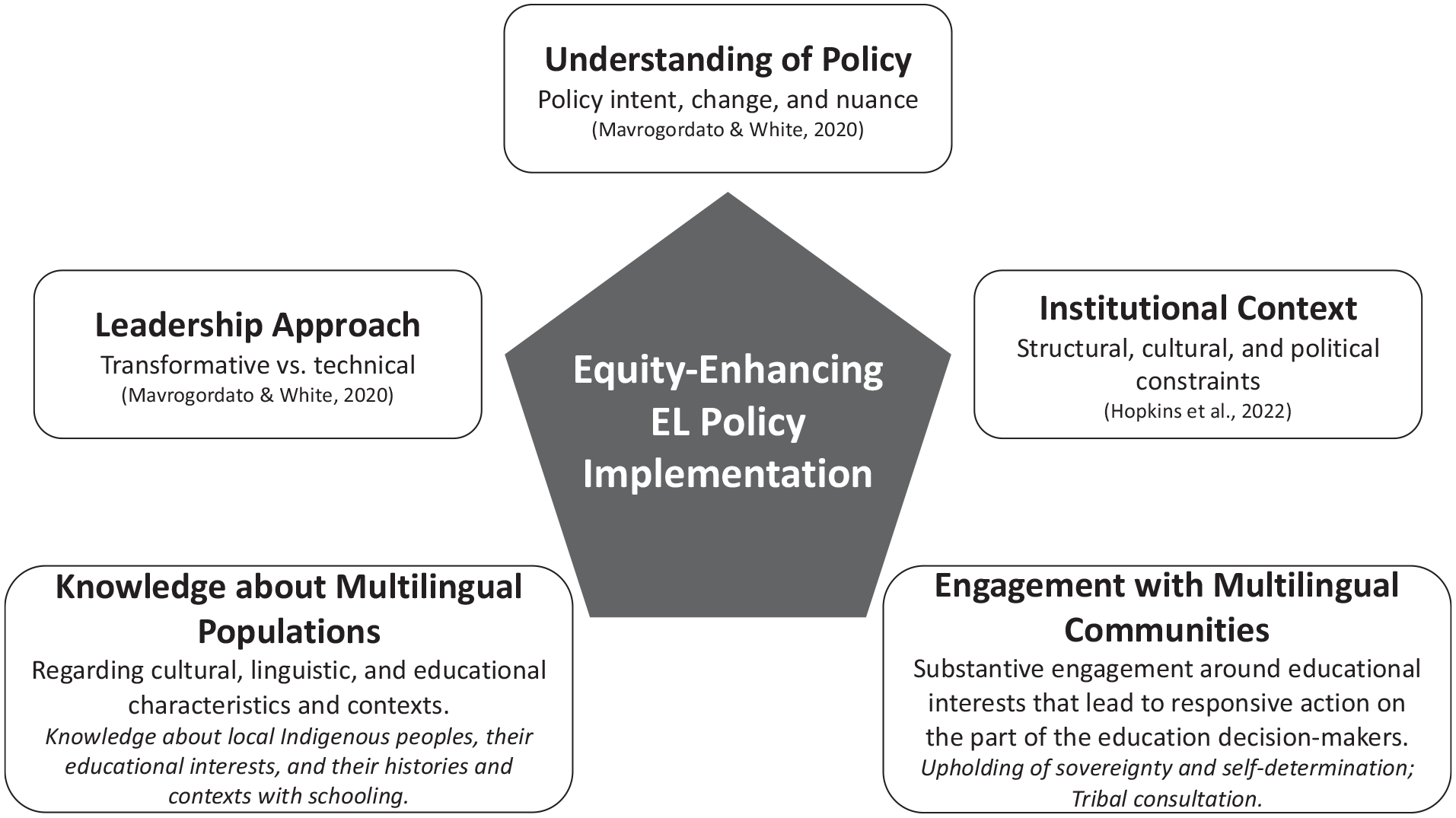
A proposed model of factors influencing EL leaders’ impact on equity enhancing EL policy implementation, building from Mavrogordato and White (2020) and Hopkins et al. (2022) , with a focus (in italics) on Indigenous EL identification.
Method
This study forms part of a larger investigation into state policies regarding the identification of Indigenous students as ELs. In the first phase of the project, conducted in 2020 and 2021, we collected and reviewed state-level policy and guidance documents, analyzing all 50 states’ approaches to Indigenous EL identification, and creating a typology of state approaches (Umansky et al., 2022). In the second phase of the project, we sought to understand the why and how behind states’ varying approaches to Indigenous EL identification.
Interview Protocol and Recruitment
Our data source for this study was interviews with state EL education directors and staff members. We recruited interviewees during a presentation of first phase results to the Council of Chief State School Officers’ (CCSSO) English Learner Collaborative. To complement this approach, we compiled a list of state EL leaders through a web search of SEA websites, typically identifying multiple EL leaders in a given state. We sent interview requests via email to all 50 states, and leaders from 25 states agreed to be interviewed (AK, AR, CA, CO, CT, DE, IN, LA, ME, MD, MI, MN, MS, MO, MT, NE, NY, OR, PA, RI, TX, UT, VT, VA, WA). We invited EL leaders to bring any colleagues who they thought would be appropriate to participate in the interview. We held one interview per state, with roughly half of the 25 state interviews including more than one interviewee (sometimes more than one person from the same EL unit, sometimes individuals from other units within the SEA such as assessment or research units). Four states (CO, MI, MT, WA) brought their colleagues from state Indigenous education units. Interviews were conducted via video call and lasted between 30 and 90 minutes. All interviews were recorded and transcribed for analysis. After drafting the study, we reached back out to interviewees with the opportunity to review and provide feedback or corrections. In reporting findings, we identify the state but not the individual interviewee or their specific role within the SEA. We purposefully omit state names in specific instances. Further, we use the pronoun they when referring to either one or more than one interviewee. We take these steps to protect participant confidentiality.
Our interview protocol (see the appendix in the online version of the journal) focused on both procedural information and interviewees’ knowledge/perceptions around Indigenous EL identification policies (Tavory, 2020). It included questions related to (a) knowledge and interpretation of the federally differentiated EL definition for Indigenous students; (b) knowledge and interpretation of the goals, origins, and implementation of their state’s EL identification policy, including any differentiation for Indigenous students; (c) knowledge of Indigenous communities and stakeholders in the state, including their input into and perceptions of EL identification policies and services; (d) knowledge of the characteristics and interests of Indigenous students and their families in their state; (e) perceptions of the degree to which EL services were tailored to meet Indigenous EL students’ interests; and (f) opinions about what was and was not working well about the state EL identification policy with regard to Indigenous students. Interview protocols were tailored to each interview based on each state’s approach to EL identification among Indigenous students.
Analytic Strategy
We designed this study toward what Tavory (2020) calls open context analyses, in which we can cautiously use what interviewees tell us to make inferences about situations outside of the interview. In other words, our primary analyses assume that if an interviewee tells us that they struggle with understanding the intent of the differentiated EL definition, that they do, indeed, struggle with that understanding. We attempted to structure our interview protocol in ways that supported a more open analytic process, for example, by asking “how” questions and following up with prompts for more details. In taking this approach, we recognize that data from interviews is informed by the interviewer’s and interviewee’s positionalities, the ways in which they interact with each other, and larger contextual factors such as interviewees’ tendency to give socially desirable responses. As such, we understand that interview data speak to contexts outside of the interview in “refracted” ways (Tavory, 2020, p. 449), and we approach inferences with caution and interviewee statements with curiosity. We recognize that another analysis might focus more on the positionality of leaders or the underlying belief systems embedded in their responses. This study, however, will bend toward a more direct interpretation of leaders’ responses.
Based on the notes we took during interviews, an initial scan of all transcripts, and two rounds of pilot coding, both authors collaboratively developed a data-driven codebook consisting of major themes (DeCuir-Gunby et al., 2011; Saldaña, 2011). While open to emergent themes, our coding scheme was, at root, informed by the major theoretical and conceptual topics described above: assimilationist schooling, Indigenous educational sovereignty, native language revitalization, and factors that influence the role of state EL leaders. We were particularly attuned to the intersection of these areas, developing codes related to EL leaders’ engagement with tensions around assimilationist schooling, and efforts to support educational sovereignty through Tribal engagement. Examples of codes included English language focus, Indigenous stakeholder involvement, impact of schooling on Indigenous communities, and concerns about compliance with law.
With this codebook, we coded all transcripts in a mixed-methods software, Dedoose (Version 9.0.17; SocioCultural Research Consultants, LLC, 202), double-coding an initial set of interviews and meeting weekly to review the coding process and discuss discrepancies or questions for improved coder reliability. We made small changes to the codebook as necessary throughout the coding process, refining and adapting definitions and groupings. With all interviews fully coded, we reviewed our codes and developed overarching thematic groupings related to our two research questions. We created a memo template for each parent theme to systematically describe their characteristics (Miles et al., 2013). The template included themes and patterns within each constituent child code, as well as overarching themes and patterns across child codes within the theme. Memos were developed collaboratively. The results of our analyses emerged from the analytic memos, referring back to individual transcripts as necessary throughout the process.
Author Positionality
As authors, we conducted this study from the perspective of policy researchers and educators. Below, we briefly describe each author’s positionality, as these positionalities informed the manner in which we approached our research topic, interviewed state EL leaders, and conducted our analyses.
Ilana Umansky, the granddaughter of Eastern European Jewish immigrants to the United States, is an associate professor at the University of Oregon’s College of Education, where she studies how education policies influence the experiences of multilingual students. She began learning about EL policies and services in the context of Indigenous students, families, and communities roughly 5 years ago through a project with Alaskan school districts. Currently partnering with the National Indian Education Association, she aims to support Indigenous-led efforts for educational equity, excellence, and self-determination.
Taiyo Itoh, a former teacher from Japan, immigrated to the United States and is currently pursuing a doctoral degree at the University of Oregon’s College of Education. His master’s degree studies at the University of Alaska Fairbanks focused on Alaska Native education. As an advocate for culturally responsive, place-based pedagogy and an ally to Indigenous peoples, he works on education research projects by and with Alaska Native students.
Study Limitations
With this study’s focus on state EL leaders, we did not actively recruit other individuals that may play key roles in the identification of Indigenous students as ELs. This includes leaders from state Indian education and Title VI divisions, the Bureau of Indian Education, district and school leaders, and most importantly, Indigenous communities. Similarly, we relied on state EL leaders’ willingness to participate and missed out on voices from several states with large Indigenous EL populations (e.g., New Mexico). Had we interviewed these additional constituents, we would have been able to learn more about Indigenous stakeholders’ educational interests with regard to EL education as well as EL identification practices in local sites. In addition, as described above, we took an open approach to analysis, understanding leaders’ statements to be applicable to the policy context we were asking about and without focusing on the positionalities of our interviewees or the dynamics of our interviews. We recognize these study limitations and hope that this study prompts further examination of this critically important, “complex and challenging” (Rampey et al., 2021, p. 40) topic—one that puts into relationship Indigenous sovereignty, assimilationist education, tri-lateral responsibility, English learner education, and the role of state education leaders. In particular, we hope this study helps catalyze more community-based projects with Indigenous-led research agendas (Smith, 2012) and desire-based, rather than damage-centered, frameworks (Tuck, 2009) that highlight diverse experiences of Indigenous communities with EL identification and explore how EL education can be transformed to advance Indigenous linguistic and educational interests.
Findings
State EL Leaders’ Gaps in Understanding and Policy Disengagement
Our first research question examined state EL leaders’ level of understanding of ESSA’s differentiated EL definition for Indigenous students as well as their understanding of their own state’s approach to this law. We found that understanding of both topics was limited. Further, we found that leaders’ lack of understanding led to inaction, with little to no steps to articulate, implement, guide, or monitor a meaningfully differentiated identification procedure.
Leaders from 13 of the 25 states (AK, CO, DE, IN, LA, ME, MI, MO, MS, NE, PA, RI, VA) directly stated that they did not know if their state was interpreting and enacting law correctly because they had little information or knowledge of how to interpret ESSA’s Indigenous EL definition. Nearly all of these states had no differentiated policy or guidance for Indigenous EL identification. These statements were more frequent in states with smaller Indigenous populations, but they were not limited to low-population states. Statements indicating Indigenous EL identification and education as a “blind spot” (Texas) were widespread in our interviews and included statements, such as a Maryland leader’s admonition: “I think it’s good that we’re talking about it, but I really cannot speak about it because I don’t really have any experience in working with those groups of students within the EL population.”
Many state leaders indicated that they either were not aware of the differentiated definition, or, if they were, the lack of federal guidance on how to interpret and implement it meant that it largely went ignored. A Connecticut leader, when asked about familiarity with the definition, for example, responded, “I was aware that it was there. But beyond that, I guess I probably haven’t pondered it much.” The true level of unfamiliarity with ESSA’s differentiated definition may have been higher than 13, as leaders may have felt uncomfortable making this admission (Bergen & Labonté, 2020).
In each of these 13 state interviews, leaders indicated that the interview itself, or our CCSSO webinar on the first stage of the study, had catalyzed leaders’ awareness of this topic and desire to begin state-level discussions. A Rhode Island leader, for example, stated, “Before you reached out for the interview, we had . . . initiated a conversation internally about it following up on a [CCSSO] presentation.” State leaders indicated a desire to learn more while acknowledging that their lack of understanding had led to a gap in action. A Nebraska leader, for example, stated, “We should perhaps take a closer look at differentiating for identification. I guess I would say we’re at this stage right now where we’re developing an awareness of a need.”
In addition to a lack of understanding of the ESSA law, many leaders described limited understanding or access to data regarding Indigenous EL students in their states. Some leaders indicated that the small number of Indigenous students in their state had led to neglect of Indigenous interests. A Connecticut leader stated, I wonder if potentially, this issue has not arisen or been brought to the forefront because of there being just such a small [Indigenous EL] population. . . . If we had a much larger Indigenous population, I wonder if we’d be doing something different.
Other state leaders referred to limitations in their state data systems. A key limitation related to whether and which Indigenous languages were available in the home/primary language field. A Rhode Island leader explained that the state required that each EL student have a documented home language but that many Indigenous languages were absent from the language field: A lot of the language codes don’t reflect these Indigenous languages. . . . What we use for our state system is the coding that the federal government is sending us. . . . It brings up a broader conversation because if we cannot even, like, signal that that language exists, we are just, like, having languages die, where we completely ignore or do not even know about them.
This leader is articulating how the federal government contributes to the erasure of Indigenous languages and peoples by omitting them from the federal list of possible home languages.
A Washington leader explained that it is not always simple to identify who, among students, are Indigenous. Some families will select American Indian or Alaska Native for the race/ethnicity field on intake forms, but many Indigenous students come from multiracial families and their families may identify the student as multiracial or by a race or ethnicity other than American Indian or Alaska Native. This leader estimated that only one third of Indigenous students could be identified through the state’s race/ethnicity data field. Relatedly, in many states the individual responsible for flagging a student for English proficiency screening would not know if the student was Indigenous.
Many state leaders had specific questions related to Indigenous EL identification. A first core confusion described by four states (CO, RI, VT, WA) related to who was included in the term “Native American or Alaska Native, or a native of the outlying areas.” Specifically, state leaders wondered if students needed to be Tribally enrolled to be eligible, and also if students needed to be members of federally recognized Tribes. A Colorado leader, for example, felt that there may be contradiction between eligibility of Indigenous students in ESSA’s Title III and Title VI: It would be really hard to say, “Okay, for Title VI, you have to really identify and have these forms, but then we really want to focus on the EL Indigenous identification.” So that would probably bring up a lot of questions.
Other state leaders reiterated the lack of clear access to data on EL students’ Indigenous languages as well as racial/ethnic identity. As a result of these core questions around who counts as an Indigenous student, and whether that information is available to the people in charge of EL identification, state leaders indicated that it was often difficult to know whom the federal law applied to.
Another central area of confusion related to the meaning of two central eligibility concepts in the ESSA Indigenous EL definition: “significant impact” and “who comes from an environment.” Several state leaders articulated confusion and dissatisfaction with the concept of a language exposure having a “significant impact” on a student’s English development. An Oregon leader, for example, stated, We don’t want to call them out solely based on their ethnicity to identify [as EL]. We really want that significant impact, but we don’t have a state definition of it. And I have yet to find a good definition of what is “significant impact”. . . . It’s the worst part of that definition of trying to determine who’s an English learner . . . and what is significant to me may not be significant to the administration in the next building over or the next cube over.
Similarly, a leader in Pennsylvania described how their state had purposefully decided there was no way to define “significant impact.” When asked about defining the term, the leader responded, “We started off down that road. And it was determined pretty quickly that it’s impossible to define with a checklist. . . . We have to rely on people’s interpreting of an interaction with another human being.”
Leaders also expressed confusion over what was meant or intended by the idea of a student coming from an “environment” with a non-English language impact. An Alaska EL leader stated, I think the term “environment” is kind of a gray area. And so, we have, I think, some districts who might define environment as the whole village or the whole area, where I can also see some people calling that just the home, thinking that’s just the actual home. So, I think there is a lot of wiggle room there for districts to make their own interpretations.
Environment is a broad and vague concept, leaders claimed, leading to widely varying interpretations of core questions about the source of a language exposure. As a result of these questions surrounding “significant impact” and “environment,” there were different interpretations as well as many questions around who was included in the ESSA definition and what kinds of language practices and contexts confirmed students’ EL eligibility.
Related to these topics was a central question regarding whether Indigenous students who were monolingual English speakers could be eligible for EL status, and under what circumstances. This was an area where some state leaders clearly stated no, others clearly stated yes, and still others were unclear or varied in their understanding of this core question. Six state leaders (AR, CT, LA, ME, OR, VT) explicitly stated that monolingual English speakers, whether Indigenous or not Indigenous, would not qualify for EL screening. This was true for Standard American English speakers and speakers of non–standard Englishes. A Louisiana leader, for example, explained, “If they don’t have another language and they’re Native American, leave them alone. . . . They’re not going to be EL.”
Meanwhile another seven state leaders (AK, CA, MD, MT, PA, TX, WA) stated that monolingual English speakers could be screened as ELs. The rules around eligibility varied across these states, with variation around whether these rules applied only to Indigenous students or to speakers of non–standard English varieties. A California leader, for example, described how monolingual English-speaking Latinx students could be eligible: East Los Angeles, South Central Los Angeles. . . . Even if the child is speaking English, the quality of the English in the environment in and around them is so limiting
5
that the student easily is identified as an English learner. . . . We cannot overlook supporting that student with EL services.
In Montana, eligibility of English speakers was understood specifically in the context of Indigenous language loss, as expressed by this leader: The inclusion of so many Indigenous students in the English learner program in Montana comes from that desire, that goal, of saying, “We want to recognize that English is not that Native language to these students, that English is forced upon these communities, but now is in many ways the dominant language.” . . . And so, there was sort of this recognition there of wanting to acknowledge that, sort of the foreignness of English.
This leader’s statement speaks to the federal trust obligation to Indigenous students. Indigenous English-speaking students are eligible for EL resources, they stated, because Indigenous language loss is the direct result of linguistic imposition; and as such, even though English may be the dominant language, it is not students’ true home language.
Still other state leaders did not have any clear rules around whether Indigenous English-speaking students could be screened as ELs. A leader from Alaska, for example, spoke of varied interpretations across districts and schools, variation that some state leaders described as the result of local control. Colorado’s leader stated, “It’s in our state constitution, and so we have to set policy that’s flexible enough that meets the federal requirements, but then flexible enough for districts to put that into practice within their own context.” A Connecticut leader expressed that this decision needed to be left to families: “I wouldn’t probably screen if the family is saying, ‘Listen, we speak English. You don’t understand my English. You don’t understand it, but this is our language. It’s the same as yours.’ My guidance would be to not screen.” While not referencing educational Indigenous self-determination explicitly, this statement indicates the leader’s position that the ultimate authority rests not with the state, but with the Indigenous family.
Several leaders expressed concern over whether their state’s policies and practices were in compliance with federal law. A leader from Montana described walking “that fine line between our ESSA plan that lays out [EL] identification at a very individualized level but then communities where it is recognized that there is a community-side language of impact.” Questions around compliance circled around several issues: the eligibility of non–standard English speakers, whether students needed to be Tribally enrolled, the eligibility of Native and heritage language services as EL supports, the interpretation of “significant impact” and “environment,” the degree of allowable local control, and how to record students’ home languages.
In sum, a confluence of factors led to widespread confusion and disparate interpretations of Indigenous student EL eligibility. As a result, many state leaders were not actively engaged in Indigenous EL identification practices in their states. Some felt woefully underequipped to develop guidance around the topic, having little to no familiarity with the ESSA definition; others did not want to advance until they had more clarity from federal or state leadership and input from Indigenous stakeholders; while still others were concerned about a misstep that would jeopardize their compliance with law. Questions about policy interpretation and variation in implementation, however, were by and large not driven by meaningful engagement; nor were decisions taken in conjunction with Indigenous stakeholders, a topic we turn to next.
Leaders’ Limited Knowledge and Engagement Influenced Their Actions
We now turn to our second research question, which sought to extend existing frameworks on the factors influencing EL leaders’ work by positing the role of leaders’ knowledge around the context of schooling for their populations and their meaningful engagement with those populations as stakeholders.
Leaders’ Generalized Knowledge of Assimilationist Schooling Led to Concerns
In 12 of the 25 interviews that we held (AK, MI, MN, MO, MS, MT, NY, OR, RI, UT, VT, WA), state EL leaders articulated that Indigenous students and EL identification could not be examined without addressing the context of educational, social, and military assaults on Indigenous peoples, cultures, and most specifically, languages. Seven state leaders (AK, MI, MO, MT, OR, UT, WA) highlighted that EL identification policies had to consider the widespread language loss experienced by Indigenous Tribes due to assimilationist schooling. State leaders spoke about the relatively recent history of Indigenous children being taken from families and placed into boarding schools (MI, OR), the punishment students experienced for speaking their languages in school (UT), the removal of Tribes from their ancestral lands (MO), and the devastating effects these abuses have had on Indigenous languages (AK, MT, WA).
For state EL leaders, this context, and its resulting effects on current-day language practices, underscored an immense care that needed to be taken in identifying Indigenous students as ELs so as not to repeat or exacerbate these wrongs. A Washington leader stated, I think there’s an acknowledgment here that there’s been damage done by the educational system in the United States to Native families. And testing a student for their English skills, especially on an assessment that really is designed for non-native English speakers, can feel, again, like a system imposing itself and determining what that student needs and doesn’t need.
EL status, which, by definition, places importance on a student’s English skills and assumes the need for English proficiency, is akin to assimilationist efforts to impose the English language, some leaders felt. Similarly, a leader from Michigan stated, “If we look at Indigenous languages as being a barrier or something prohibitive of a student being successful in the English language, that could be problematic . . . and that’s where I have concerns even about the ESSA definition.” Here, the leader is pointing out that the idea underlying the differentiated definition: that students’ English is somehow damaged by exposure to an Indigenous language, is fundamentally assimilationist.
In some states, this understanding of the complex and harmful context of education in Indigenous communities led leaders to be reticent to treat Indigenous students differently than non-Indigenous students. Nine state leaders (AR, CA, CT, LA, NY, OR, PA, RI, TX) spoke about equity concerns if students were treated differently solely on the basis of their race/ethnicity. These leaders wanted to avoid any kind of racial “profil[ing]” (Texas) of students. “It doesn’t make sense . . . to create separate identification procedures, and to start trying to define what a significant impact is based off of race or ethnicity,” said a leader in Rhode Island.
In sum, leaders’ generalized knowledge of assimilationist education and anti-Indigenous discrimination in the United States led some state EL leaders to question the value of differentiated EL identification, and the appropriateness of EL services more broadly, in Indigenous communities. Several state leaders indicated that the danger of perpetuating linguistic imposition or treating students differently based solely on race or ethnicity outweighed the potential benefits of expanding EL-related resources for Indigenous students.
Limited Efforts Toward Indigenous Stakeholder Engagement Exacerbated Leaders’ Inaction
While the context of assimilationist schooling and racial discrimination informed many state EL leaders’ thinking about Indigenous EL identification, in most cases this contextual knowledge was generalized, and not based on specific knowledge about or engagement with Indigenous stakeholders’ education interests. We asked leaders who the major Indigenous stakeholders were in their state, and what their interests and perceptions were with regard to EL identification and services. Some leaders had very detailed responses to these questions, suggesting deep and engaged knowledge in their states. These leaders talked about the major Tribes within their states, the major Indigenous language groups and students’ language profiles, as well as Indigenous-led educational efforts. But many other state EL leaders had very limited knowledge. While leaders with less knowledge tended to be in states with smaller Indigenous student populations, we found a clear pattern in which states where leaders had less knowledge about and engagement with Indigenous stakeholders were also less active in the area of Indigenous EL identification.
When asked about Tribes and other Indigenous stakeholders in the state, some leaders were largely unaware, with answers such as “I’m just not aware of any major Indigenous groups in our state to work with”; or “I’m really not sure if we have any Indigenous ELs” (state names withheld). In other cases, leaders expressed a sense that Indigenous students largely attended Tribal schools and were not attending schools under SEA purview. Mississippi’s leader, for example, stated, “I don’t know all of the various American Indian groups in the state. . . . I’m familiar with the Choctaw group and . . . they fall under the Bureau of Indian Education, they don’t fall under the state.” With little knowledge of whether there were Indigenous groups or students to engage with, these leaders had little sense of how EL services were working for these groups, nor what the interests of Indigenous stakeholders were regarding EL education. Responses such as “I do not know enough to be able to answer that question. I’m sorry” (state name withheld) were frequent across many states when asked about Indigenous groups’ interests or perceptions of EL education. These responses were often followed by a dawning concern around who they had been missing in their understanding and assessment of EL education.
Closely related, 15 state leaders (AK, AR, CA, CT, DE, IN, ME, MO, MN, MS, NE, PA, TX, UT, VT) admitted that Indigenous stakeholder involvement was absent or limited with regard to EL policy. “I’m not even sure who I would contact, to be truthful, to involve representatives of those groups” was the admission in Arkansas; while a leader in Vermont stated, “They haven’t been involved in anything related to English learners.” In some states, such as Alaska, leaders expressed that Tribal consultation practices were concentrated at the local level and rarely reached the state. In other cases, like Delaware, the state leader said that there were Indigenous stakeholder efforts at the state level, but they did not encompass EL education. Some state leaders were matter-of-fact about the absence of Indigenous stakeholder involvement, seemingly naturalizing the exclusion of EL education from Indigenous engagement. Others, by contrast, identified it as a missed opportunity. The leader from Maine stated, “On that (EL) advisory council, we do not have representation from any of our Native communities. So I think we would also need to consult with them and make sure that their voices are heard in this discussion.”
Leaders from five states (LA, MT, NY, OR, WA), by contrast, did speak about Indigenous stakeholder involvement in EL education, usually through government-to-government, state-to-state, or formal educational Tribal consultation procedures. Leaders in Washington, in particular, spoke in depth about stakeholder involvement as an element of Tribal sovereignty and families’ and communities’ right to self-determination: “This is another opportunity for us to engage more deeply with our American Indian and Alaska Native families in terms of self-determination as it relates to honoring the sovereignty of each of our students.” A Louisiana leader described using the governor’s existing structure for Indigenous stakeholder engagement to convene a group on EL policy: We did do a committee in 2020, where we pulled in representatives from a few of the different Louisiana Tribes to give their opinion on our EL standards. The governor has an office that handles the Indian affairs and Louisiana Tribes, and so we reached out to that office and that coordinator.
Limited Indigenous stakeholder involvement was linked to leaders’ limited engagement in Indigenous EL identification policy. Many states where leaders had limited knowledge or engagement were largely unfamiliar with the federally differentiated EL definition, had no differentiated procedures in place, and had little understanding of why this was an area where differentiation might be called for. For some of these state leaders, there was a sense that EL education was working “very effectively” (state name withheld) for Indigenous students, indicating an assumption that the status quo for EL education worked well for all students. For others, Indigenous stakeholder input was seen as critical and necessary prior to the articulation of any form of differentiated EL identification policy. A leader from Rhode Island, for example, stated, In our effort to promote equity, I guess that would be the biggest goal: That you would have to consult . . . our local Indigenous communities to determine whether or not they even thought that an alternate identification procedure was appropriate.
This leader is directly addressing the complexity of the notion of equity for Indigenous students with regard to EL education, suggesting that any differentiated policies and practices needed to be determined by Indigenous communities themselves.
In sum, our interviews revealed that while knowledge and engagement varied, many state EL leaders had limited depth of knowledge of the specific Indigenous stakeholders in their states and their interests with regard to EL education. Stakeholder engagement mechanisms were likewise largely absent, and these limitations were linked to limited action and engagement of state EL leaders with Indigenous EL identification policy development or implementation.
Leaders Underscored the Need to Move Beyond Identification to Services
The core of EL education is, of course, not identification but service provision; and for many of the leaders we interviewed, considerations about Indigenous EL identification could not be separated from questions of how to appropriately provide educational services to Indigenous students once EL-identified. While many state leaders noted this connection, expressing concern that differentiated identification likely necessitated differentiated service provision, leaders with deeper knowledge and engagement tended to have more specific ideas or actions regarding the identification-service link.
Leaders from 11 states (AK, CT, LA, ME, MI, NE, NY, RI, TX, VT, WA) expressed concern that many Indigenous ELs were being served exclusively through services designed for immigrant-origin students. These leaders questioned whether this was appropriate, as exemplified by a leader from Nebraska, who stated, “If we identify English learners among these [Indigenous] populations, then how do we best serve them? . . . Does it look differently than serving students who maybe are coming to English from another language? I don’t know.” As with Nebraska, many of these leaders openly admitted that they did not know where to begin to look for how to best serve Indigenous ELs, not being aware of any EL programs or services developed to support Indigenous EL students and feeling at a loss regarding whether Indigenous ELs have unique needs in EL services.
In another group of seven states (CA, CO, MD, NE, NY, PA, VA)—characterized by relatively weak knowledge and engagement—there was a belief that EL services should, fundamentally, meet students’ individual needs, and that the notion of differentiating services for any group of students was inappropriate. A California state leader expressed this when stating, It is, we believe, a better approach to look at the needs. Accept the students for who they are and what they bring. When we have knowledge of a particular skill or a particular background, we celebrate that and see “how can we use that?” That would be probably a more direct response to a student than trying to find, “Okay, well, what group do you belong to, and how does that group function?”
For these leaders, if EL services were working as they should, they would be provided based on students’ individual profiles, and there would be no need to differentiate services specifically for Indigenous students. Furthermore, from equity and asset-based standpoints, some of these leaders hesitated to lump all Indigenous EL students together, considering that this approach would, necessarily, result in stereotypes and other inaccurate and discriminatory assumptions about students.
In a few of the states characterized by little knowledge and engagement, leaders described how Tribes and Indigenous stakeholders were pushing state EL leaders toward language revitalization programs in ways that leaders remained wary or uncertain of. Specifically, EL leaders expressed concern that differentiated services for Indigenous EL students might not be compliant with federal law and guidance. For example, a Michigan leader suggested that Tribes’ interests in dual language programs were not aligned with EL services and indicated that Indigenous stakeholders misunderstood the intent behind EL identification: From the conversations that we’ve had with [Tribes], like I said, part of it is somewhat of a misunderstanding. They would like to be identified, more of the students to be identified as EL, but not so much for the EL, the English language supports, but more for the Native language revitalization type of support.
Similarly, a Colorado leader stated, One of the things that we need to realize is: What is the goal [of EL services]? And that [goal] is [that] students gain English proficiency and students gain access to grade-level content. So that’s very different from language preservation.
These excerpts underscore the tensions many state leaders navigate between Indigenous stakeholders’ interests in Native language revitalization and a stated focus within EL education on English language development.
By contrast, 10 states (AK, CO, CT, MI, MN, MT, OR, PA, TX, WA) where leaders demonstrated deeper knowledge and engagement with Indigenous stakeholders tended to make the case that EL services for Indigenous students could not be the same services provided to immigrant-origin EL students. These states typically made one of two arguments. The first argument was that Indigenous EL-classified students should be served through culturally sustaining services, such as Indigenous language revitalization programs, land-centered instruction, a focus on storytelling, and the inclusion of elders and community members in education. When asked about successful EL services for Indigenous students, a leader from Alaska responded, It’s culturally appropriate . . . getting those sorts of culturally, and even like place-based appropriate types of materials and programs. I think that’s the biggest thing, is finding things that actually make sense and are relevant to those kids in the vast array of environments, cultures, etcetera, that exist up here.
Indigenous language revitalization efforts were the most commonly articulated form of differentiated services for EL-classified Indigenous students. Eight states (CO, LA, MS, MT, NY, TX, UT, WA) spoke of their efforts in this arena, including a Utah leader, who explained, “One of the things that Utah is very committed to is maintaining the Indigenous languages with opportunities on the Navajo reservation to actually have Navajo language classes.” A Washington leader stated, “We’re moving towards dual-language types of models with Tribal languages. That’s really what this is about. It’s about supporting English skills, but also supporting Tribal language skills and that regrowth of Tribal languages here.” These efforts to promote Indigenous languages took different forms, however, and were not all integrated into EL services.
The second core way in which leaders spoke of the need for differentiated services centered around a stated need to support a unique form of English development sometimes referred to as academic English development or instruction in Standard American English. This perspective also emerged more commonly among states where EL leadership had deeper knowledge of and engagement with Indigenous stakeholders but was also present in some states where leaders shared only minimal engagement. “I personally taught students who were English speakers but also English learners. And yeah, absolutely the approach to teaching them English is different than students who speak Spanish,” explained a state leader in Pennsylvania. In total, five states (MI, MN, MT, OR, TX) argued that Indigenous EL students, compared to immigrant-origin EL students, needed differentiated forms of English language development support. Montana’s leader, for example, explained EL service goals as twofold: On the one hand . . . improve English literacy and writing performance for those students to improve their educational outcomes and graduation. But then that is braided and balanced together with a very strong desire and need to reinvigorate Indigenous languages in the state.
A few state leaders used deficit-laden language to describe Indigenous students’ non–Standard American English practices, for example, by calling their English varieties “fossilized” (state name withheld). These leaders ascribed to an assimilationist perspective that the non–standard Englishes spoken by some Indigenous students were inferior and needed correction through Standard American English instruction. Other state leaders approached English instruction from a different stance. These leaders validated the Englishes spoken by students while also recognizing students’ right to learn Standard American English as the language of power, necessary to support social and economic access and opportunity. A Rhode Island leader, for example, stated, “We are now looking at voicing out the fact that Standard English is not the only English, but there are other Englishes that are still valid”; while a Minnesota leader stated, I have had feedback about the need for more resources around language development, both in English language as well as Native language work. So, [EL support] doesn’t look exactly like your typical English language development kind of leveled program.
Inherent in the argument for differentiated services was a belief that traditional EL services—designed to support immigrant-origin students—were inappropriate for Indigenous EL-classified students. Identifying Indigenous students as ELs and providing standard EL services would replicate assimilationist harm: “What I would hate to see is this influx in identification [of Indigenous students] and no services to support that identification, which I think is a real risk” (Alaska). In fact, for some state leaders, this lack of service differentiation led to under-identifying eligible Indigenous students. Better not to identify, the logic went, than to identify and not have appropriate services: “I think there are probably a lot of under-identified Indigenous ELs. So, I think, ideally, it would be two pieces. It would be increasing identification, but also improving services. It would have to be both” (state name withheld).
In summary, state EL leaders clearly voiced the crucial connection between EL identification and EL service provision. For states where leaders had limited experience engaging with Indigenous stakeholders, this connection led many to have questions and concerns about what appropriate services for Indigenous ELs might be, particularly if EL identification criteria were differentiated. Others alleviated this concern by expressing a universal need for EL services to meet the unique needs of individuals students. A different pattern emerged in states where leaders were embedded in deeper relationships with Indigenous stakeholders. These state leaders tended to explain that appropriate services for Indigenous EL-classified students were systematically different than those for immigrant-origin students, centering around Indigenous language revitalizations programs, culturally sustaining programs and practices, and/or approaches to English development for English-dominant speakers.
Discussion
EL identification is a double-edged sword, providing funding and targeted services on the one hand, while emphasizing English over other languages and ostracizing students with a limiting and deficit-oriented label on the other (Flores & Lewis, 2022). This tension is exacerbated in the context of Indigenous students, who have suffered linguistic, cultural, and personal violence and erasure by the state education system (Tuck & Yang, 2021). While neglecting to identify eligible Indigenous students as ELs deprives students of federally guaranteed rights and resources, identification may lead to exacerbated English imposition. States currently have widely varying approaches to this tension, but most simply ignore the federally differentiated EL definition for Indigenous students (Umansky et al., 2022).
With education policy and guidance largely emanating from the state level (Duff & Wohlstetter, 2019; Hopkins et al., 2022), and state EL leaders having a pivotal role in EL identification policy development, implementation, and accountability (Hamann & Lane, 2004), this study set out to explore state EL leaders’ depth of policy knowledge, understanding of the context of Indigenous education in their state, and engagement with Indigenous stakeholders, including how these factors influenced leaders’ work in the area of Indigenous EL identification.
Interviewing EL leaders from 25 states, we learned that many state leaders lack understanding and clarity around the federal Indigenous EL definition. Leaders identified key barriers to implementing the law in meaningful ways, citing contradictions in the ways in which Indigenous students are identified as well as critical gaps in state and federal infrastructure to identify EL-eligible Indigenous students (Indigenous Education State Leaders Network, 2023). This lack of understanding was linked to leaders’ relative lack of proactive involvement in Indigenous identification policy and a likely underidentification of eligible Indigenous students.
These findings echo a prevalent critique that education, more broadly, too often neglects and decenters the experiences and interests of Indigenous students, their families, and their communities (Brayboy & Lomawaima, 2018; Lomawaima & McCarty, 2006; Tuck & Yang, 2021). Such assimilationist educational practices are salient in EL education, where policy discussions have centered around immigrant-origin students (Carjuzaa & Ruff, 2016; Villegas, 2020) and efforts to assimilate immigrant communities into an English-speaking, Protestant nation (Spring, 2016). Many state EL leaders acknowledged their shortcomings in these areas and expressed an authentic desire to work in collaboration and consultation with Indigenous families and Tribes and to push EL policy and practice to better incorporate and serve Indigenous EL students. Yet critical questions remain regarding state leaders’ accountability to Indigenous students and Tribes especially given the prevalence of unfulfilled treaty and other law-based obligations regarding education (Reinhardt et al., 2020).
In states where leaders demonstrated deeper knowledge about and engagement with stakeholders, challenges remained. Alaska leaders spoke about how Indigenous stakeholder engagement was focused at the local level and remained weak at the state level; Washington leaders described staffing challenges that limited adaptations to make EL services appropriate for Indigenous students; a leader from Utah expressed frustration over a lack of SEA support for Indigenous heritage language programs despite robust bilingual program investment; and an Oregon leader described how different Tribes had different perspectives on EL identification, making it difficult to develop a statewide policy. Yet these state leaders also communicated greater clarity around their goals and actions with regard to Indigenous EL identification, namely, to have robust Indigenous voice and presence in EL policy, planning, and implementation; to build and sustain Indigenous language revitalization programs; and to utilize policy in flexible ways so that individual Indigenous students and families had authority over their own educational pathways.
Together, these findings bolster prior work identifying the importance of EL leaders’ depth of policy understanding and provide clear evidence that EL leaders also need to engage with and learn about and from the specific populations they serve. This is challenging work, especially because EL students come from widely diverse contexts and communities, but it is critical in order for EL leaders to be able to support and serve their students in effective ways.
Due to the complexities described above, we, as authors, do not take a position regarding whether or how Indigenous EL identification policy should be enacted or implemented. Instead, our position is that Indigenous EL identification policies should be codetermined with Indigenous stakeholders, upholding Indigenous sovereignty and educational self-determination. In doing so, we uphold a vision of social justice work in EL education that involves leaders’ ability to “use . . . policy as a vehicle to transform education for students” and to be “empowered to engage in actions and make decisions about policy implementation” (Mavrogordato & White, 2020, p. 28). Indeed, we heard leaders’ own commitments to this transformative approach to policy implementation, such as a Nebraska leaders’ statement: “The law requires compliance but we can go over and above that, and we should be going over and above that to best serve all of our students.”
Implications for Policy and Practice
The results of this study have implications for policy and practice. First, our findings indicate that many state EL leaders feel underprepared to lead policy, implementation, and accountability efforts regarding Indigenous student inclusion in EL education. In many states, leaders had little knowledge of the Indigenous groups in their state or of Indigenous students’ language interests. A first implication, therefore, pertains to the greater incorporation of Indigenous students’ and families’ interests in EL policy and planning. Leaders had multiple suggestions around this, including increased Tribal consultation around EL-related topics, more staffing of Indigenous leaders within state EL divisions, greater collaboration with state Indian Education and Title VI divisions, and improved data collection specifically around Indigenous students and their language practices and interests. These efforts are critical in building toward Indigenous educational sovereignty.
A second implication emerges from leaders’ questions around the differentiated EL definition for Indigenous students in ESSA. Our findings suggest that the federal government should issue guidance, perhaps through the OELA or the Office of Civil Rights, on the intent of the differentiated EL definition, how to understand and define key terms such as “significant impact” and “environment,” and promising practices for articulating and implementing the differentiated definition at the state level. Critically, this guidance needs to be developed through government-to-government processes, centering the perspectives and interests of diverse Indigenous constituents (Brayboy et al., 2015). Given the diversity of Indigenous communities, the centrality of Indigenous sovereignty as articulated in federal law, and the different linguistic contexts in which current Tribes and Indigenous communities exist, federal guidance will likely need to be flexible to allow for local Tribal and Indigenous-led adaptation of EL identification and service priorities. These first two implications are undergirded by the understanding of a tri-lateral responsibility for Indigenous education held jointly by Tribal, state, and the federal governments (Reinhardt et al., 2020). These steps will strengthen collaboration between the three types of entities, grounded in Indigenous educational sovereignty, and all toward the purpose of strengthening Indigenous education.
A final implication, as called for directly by the state EL leaders interviewed for this study, is the need to reconsider and broaden the types of supports available to EL-identified students, and Indigenous EL-identified students, specifically. As articulated in prior research, in order for EL education to operate as intended—a support for students to expand linguistic skills and ensure full access to educational content—EL identification must be aligned with EL services and resources (Cimpian et al., 2017). If students are identified as ELs whose skillsets, interests, and needs lie not in developing English as a new language but rather in developing their heritage languages; deepening their connection to family, history, and community; and, for some, developing skills in additional English registers such as Standard American English, then EL services need to pivot for these students away from traditional English language development instruction and remedial content (Delpit, 1995; Sims & Blum Martínez, 2023).
Numerous examples exist of EL services and resources being used toward heritage language revitalization and culturally sustaining pedagogy and content including dual immersion schools such as Lower Kuskokwim school district’s Yup’ik immersion programs in Alaska (Wyman et al., 2010), and Red Lake Band of Chippewa Indians and Red Lake school district’s Ojibwe language and culture immersion program in Minnesota (OELA, 2021). Indeed, the purpose of the federal government’s Native American and Alaska Native Children in School (NAM) grants is “to provide effective instruction and support to Native American students who are identified as English learners” through the “teaching, learning, and studying of Native American languages” (OELA, 2022b, p. 1). Expanding this focus on heritage language revitalization and culturally sustaining services beyond NAM grantees and to all schools serving Indigenous EL students is an important step in aligning EL services with many Tribal education goals and Indigenous students’ linguistic and educational interests (NIEA, 2020).
Supplemental Material
sj-docx-1-ero-10.1177_23328584241263849 – Supplemental material for “We Still Have a Long Way to Go”: How State Education Leaders’ Understanding and Engagement Shapes English Learner Identification of Indigenous Students
Supplemental material, sj-docx-1-ero-10.1177_23328584241263849 for “We Still Have a Long Way to Go”: How State Education Leaders’ Understanding and Engagement Shapes English Learner Identification of Indigenous Students by Ilana M. Umansky and Taiyo Itoh in AERA Open
Footnotes
Acknowledgements
The authors are deeply grateful for the thoughtful and open participation of state English learner leaders and their colleagues in Indian education and research units. Our work further benefited from consultation and feedback from Bryan Brayboy, Teresa McCarty, Jioanna Carjuzaa, Megan Hopkins, H. Gary Cook, Delia Pompa, Kenji Hakuta, Lorna Porter, and Manuel Vasquez Cano. As authors, we take responsibility for any omissions or errors.
Declaration of Conflicting Interests
The author(s) declared no potential conflicts of interest with respect to the research, authorship, and/or publication of this article.
Funding
The author(s) disclosed receipt of the following financial support for the research, authorship, and/or publication of this article: There was a small amount of funding provided for this study in the form of an internal grant from the University of Oregon’s Office of the Vice President for Research and Innovation (OVPRI).
Open Practices Statement

Notes
Authors
ILANA M. UMANSKY is an associate professor in the College of Education at the University of Oregon, Lokey Education Building, Eugene, OR 97403; email:
TAIYO ITOH, a former teacher from Japan, is currently pursuing a doctoral degree at the University of Oregon’s College of Education, Lokey Education Building, Eugene, OR 97403; email:
References
Supplementary Material
Please find the following supplemental material available below.
For Open Access articles published under a Creative Commons License, all supplemental material carries the same license as the article it is associated with.
For non-Open Access articles published, all supplemental material carries a non-exclusive license, and permission requests for re-use of supplemental material or any part of supplemental material shall be sent directly to the copyright owner as specified in the copyright notice associated with the article.
