




Abstract
PhD students’ experiences in graduate school and associated outcomes vary by field of study, learning environment conditions, and support structures. In the context of the COVID-19 pandemic specifically, PhD students’ individual educational trajectories were potentially rendered more uncertain, as disruptive conditions for learning and research have continued over the past several years. We compared the reports of 422 PhD students at 12 U.S. institutions in terms of their experiences of support or marginalization and educational plans from the summer of 2020 with follow-up data gathered during the summer of 2021. We then examined factors related to PhD students’ changes in their estimated times to degree. We found lower, but still on average moderate, levels of depression symptoms compared to the previous year and continued experiences of emotional, financial, educational, and career stressors. Findings point to the importance of institutional material and psychological structural supports over time.
Keywords
Graduate student pathways vary by field and degree program (Austin & McDaniels, 2006; Cassuto, 2015) as well as by students’ own needs and constraints, making it complex to trace how graduate students navigate programs. The context of the COVID-19 pandemic added further complications to examining these pathways, bringing to the forefront stark disparities in experiences, support, and associated outcomes. More than 3 years into the COVID-19 pandemic in the United States, the effects of the early portion of the pandemic on students and postsecondary institutions are becoming clearer. Researchers have highlighted decreased undergraduate enrollment and slightly increased graduate enrollment (National Student Clearinghouse, 2020), negative mental health effects (Healthy Minds Network & American College Health Association, 2020; Soria & Horgos, 2021; Tasso et al., 2021), and exacerbated inequalities in food and housing insecurity, employment conditions, and well-being along race and ethnicity, gender, and income dimensions (Aucejo et al., 2020; Goldrick-Rab et al., 2020; Hunt et al., 2021; Muñiz, 2021; Rudenstine et al., 2021). Much of the postsecondary research on student experiences of the pandemic has focused on undergraduates, although some studies have included certain populations of graduate students (e.g., Chirikov et al., 2020; Gowen et al., 2023; Levine et al., 2021; Ogilvie et al., 2020; Wasil et al., 2021). Further, much of the published work has been concentrated on the earlier part of the pandemic, and few panel studies exist that have followed the same individuals over time to uncover evolving effects.
Although snapshots of graduate students’ current experiences have practical utility, the recent context provides a lens to trace decision-making about time to degree for PhD students in a broad environment of job market shifts, remote work possibilities, and workers’ reassessments of their goals and values (Warzel & Petersen, 2021). Studies have shown that time to degree is a significant factor in PhD degree completion rates, and longer time to degree may negatively affect the efficiency and effectiveness of doctoral education (Groenvynck et al., 2013; Wao, 2010; Wright & Cochrane, 2000). Extended timelines may be related to higher attrition rates from PhD programs (Bair & Haworth, 2004) and may lead to higher financial costs and other negative consequences for students and institutions (Skopek et al., 2022; Wollast et al., 2018). Additionally, observing the number of years graduate students take to complete, “many students, especially the less well off, are discouraged from going to graduate school in the first place” (Cassuto & Weisbuch, 2021, p. 179).
Given the baseline lack of clarity in expectations and indicators of progress and support (Cassuto, 2015), the pandemic has highlighted existing institutional and relational tensions in what “support” consists of and what outcomes such support is associated with for graduate students. Faculty members may or may not adjust expectations or markers of success—and the supports needed to achieve that success—in the context of the pandemic, expectations that already varied by discipline (Gardner, 2007, 2010). As a result, the matrix of supports and goals, at individual and institutional levels, becomes a more complicated calculus, in which what is known about the factors that support timely degree completion may or may not apply. In other words, part of our study was simply to describe how factors that are known to have relationships with PhD degree completion may or may not have had those relationships, or may have had relationships of altered intensity, within this context. For example, PhD students may be supported in particular ways as they adjust research projects and alter their career objectives as part of finishing their degrees more quickly or within an originally targeted time frame. They may also complete quickly to exit toxic environments. Conversely, students may find the financial or mental health support they need to carry on and complete an initially intended project that may now take longer than originally expected. The complexity of multiple potential mechanisms requires baseline descriptive analysis of the relationships between support mechanisms and degree timelines, especially during times of disruption.
We drew on previous studies of U.S. graduate students’ experiences and situated our work within Bronfenbrenner’s (1979, 1994) Person-Process-Context-Time (PPCT) ecological systems model. Given the ways the pandemic has shaped environments within the past several years, we used this model to explore students’ experiences of support or marginalization as processes that occurred between environmental levels when time was especially salient. The purpose of our study was to explore the longitudinal experiences of 422 PhD students at 12 U.S. research institutions, comparing their reports of support and challenges from the summer of 2020 with follow-up reports on the subsequent academic year, gathered during the summer of 2021. Our findings show that average mental health levels improved slightly, but on average, PhD student participants still reported moderate levels of depressive symptoms as they experienced a variety of emotional, financial, educational, and career stressors. We then explored how experiences of challenge and support were associated with changes in students’ degree timeline planning between what they had planned in the summer of 2020 compared to what they planned a year later. We found that institutional structure and process factors, such as field of study, student unionization, health insurance quality, and institutional communication, related to the likelihood of students’ extending their degree timelines between the summer of 2020 and the summer of 2021. Understanding more about PhD students’ experiences after the early part of the pandemic is vital to support graduate students’ well-being, the investments made by individual students and institutions, the career trajectories of highly trained professionals, and the long-term development of research in the United States. Our results highlight the role of institutional environments, structures, and actors in PhD students’ evolving decision-making about their degree timelines.
Environments of Stress and Support in Graduate School
Pursuing graduate study in “typical” times is a challenging intellectual endeavor (Cassuto, 2015). As we detail in the sections below, research has demonstrated that graduate students often face challenges in learning and completing their degrees beyond those that are intellectual in nature, and researchers are near the beginning of understanding how the pandemic may have influenced students’ experiences in the short and long terms. To organize our inquiry, we first discuss what the existing literature has suggested about graduate students’ experiences during “typical” times. The existing strands of literature about graduate students’ experiences have tended to include issues related to institutional support structures, students’ relationships with faculty and peers, and combined environmental influences on students’ mental and physical well-being. The existing literature informed our data collection process. Second, we consider these continually salient experiences within the more recent context of the COVID-19 pandemic, describing what is known to date about graduate students’ experiences. Finally, we introduce Bronfenbrenner’s (1979, 1994) PPCT ecological systems model as the conceptual model we used to structure the present analysis, examining potential relationships between environmental factors and PhD students’ time to degree during the COVID-19 pandemic.
Institutional Structures, Relationships, and Well-Being
In this section, we review the ways institutional environmental structures, marginalization and oppression, and interpersonal relationships with faculty and peers combine over time to produce varied levels of support as students pursue their degrees, pathways that sometimes contain ambiguous success markers (Cassuto, 2015; Gardner & Mendoza, 2010). These environments and experiences can create challenges to mental health and well-being, as researchers have documented pervasive negative mental health conditions among graduate students (Evans et al., 2018).
The Structures of Institutional Environments for Graduate-Level Study
Graduate students often report falling into a liminal category within institutions, being considered inconsistently an employee or a student or not specifically being included when institutional messaging is targeted at either population (Gowen et al., 2023). Relatedly, graduate students’ varying experiences of the structural elements of graduate study—including financial support, access to quality mental and physical health services, and unionization—contribute to students’ perceptions of their institutional environments’ supportiveness and the challenges graduate students face in navigating and thriving within them.
The cost of higher education has risen markedly over the past several decades (Goldrick-Rab & Steinbaum, 2020). Graduate students experience varying levels and sources of institutional financial support, and they consistently report finances to be a significant source of stress (Denecke et al., 2016; Evans et al., 2018; Hodgson & Simoni, 1995). Graduate stipends have not kept pace with inflation (Szkody et al., 2023), and many graduate stipends do not meet the expected cost of living for a single-person home (Glover, 2019). Additionally, disparities in stipend amounts across fields and institutions force graduate students to choose between working outside the university and taking out more student loans (Patel, 2015). Administrators have reported lack of financial resources as a significant barrier in recruiting and retaining diverse graduate student populations (Quarterman, 2008). As debt loads increase among graduate students, Black and Latinx students are more likely to have to borrow for graduate school (Webber & Burns, 2021).
Financial stress is among other health-related stressors that can present barriers to learning (Eisenberg et al., 2009; Kernan et al., 2011). Graduate school is a time associated with high levels of stress, and studies have shown graduate students to be vulnerable to the adverse mental and physical health effects that accompany elevated levels of stress (Hyun et al., 2006; Kernan et al., 2011). Graduate students report access to adequate health insurance as important in reducing stress levels (Oswalt & Riddock, 2007). However, students also report inconsistent access to health services on their campuses, citing “not knowing the service is there, not having easy physical access to campus and not believing student services are equipped to support their needs” (Waight & Giordano, 2018, p. 402) as reasons for not using the services.
Financial and health-related benefits are often axes of graduate student labor union advocacy on campuses where union activity exists. Graduate students possess varied access to and purposes for labor organizing (Julius & Gumport, 2003; Rhoades & Rhoads, 2002), and recent strikes (e.g., Zahneis, 2022) and union organizing attempts (e.g., McGerr, 2022) have highlighted structural issues related to graduate student compensation, health care, and workplace safety. Graduate student union members have reported reduced workloads, improved working conditions, and more formalized methods of handling disputes that led to improvements in their relationships with faculty (Lee et al., 2004). Other graduate students connected to collective bargaining units reported that clearer expectations and employment policies had enhanced their relationships with mentors (Julius & Gumport, 2003). In a study of unionized and nonunionized PhD students in five academic disciplines across eight public U.S. universities, unionized students reported higher levels of personal and professional support and better pay (Rogers et al., 2013).
Marginalization and Oppression in Graduate School Environments
Graduate students with minoritized social identities face further environmental challenges, including negative messages about their belonging in the academy (Posselt, 2018; Truong et al., 2016). Gardner and Holley (2011) have described the work first-generation students must do to navigate tacit institutional systems and have highlighted the processes needed to learn the informal rules and structures of graduate study. For example, students in their study described needing to live in two different worlds, “the world of their upbringing and that of higher education” (Gardner & Holly, 2011, p. 84). They discussed the exhaustion of trying to operate in the space between their backgrounds and their aspirations and the challenges of staying focused on their studies while communicating with family members who did not understand their pursuit of graduate study. For graduate students from low-income backgrounds or who struggle financially, classism shapes their sense of belonging, academic self-concept, and career trajectories (Ostrove et al., 2011).
Researchers have highlighted the ways Latinx and Black doctoral students navigate racism and dehumanizing graduate school environments (Gildersleeve et al., 2011) and how graduate students with racially and ethnically minoritized social identities demonstrate agency in coping with oppressive interactions and environments (Perez et al., 2020). Although students may draw support from peer and faculty allies, these negative experiences mean that they must divert time and energy from their studies to cope, support one another, or expend labor to improve institutions (Gildersleeve et al., 2011; Perez et al., 2020; Porter et al., 2018).
Faculty and Peer Relationships
Faculty and peers can be among the supporters of, or chief roadblocks to, students’ success in graduate programs. Significantly, faculty-student relationships are multifaceted, and graduate students benefit from their relationships with faculty members in myriad ways. These types of support include academic support for acquiring subject matter knowledge, sociocultural support for navigating the tension between conflicting academic and personal demands, and psychosocial support for promoting students’ sense of self within the academy (Cassuto, 2015; Posselt, 2018). Perceived faculty support has been shown to predict training program and overall life satisfaction (Tompkins et al., 2016), as well as graduate student burnout (Clark et al., 2009). Importantly, perceived faculty support may influence students’ motivation to persist in their programs of study (Litalien & Guay, 2015). Faculty as classroom instructors, specifically, influence graduate students’ experiences, as instructor flexibility has been associated with students’ willingness to disclose their academic struggles (Meluch et al., 2022).
Strong, regular, and supportive mentoring relationships between faculty advisors and advisees may have long-term consequences for graduate student success (Evans et al., 2018; Nettles & Millett, 2006). Socialization to programs and fields of study is part of an advisor’s role, and helping students navigate such transitions is important for student program completion and satisfaction (Dericks et al., 2019; Lovitts, 2002). Positive collaborative relationships with advisors have been linked to research productivity and publication (Maher et al., 2013; Paglis et al., 2006), critical aspects of training for graduate students if they are pursuing academic careers. Advisors can also contribute to gendered and racialized patterns in withholding support or actively mistreating students (Burt et al., 2018; Noy & Ray, 2012). Black graduate students have experienced discrimination and isolation from White professors and peers, pointing to the interconnectedness of the social and institutional experiences (Johnson-Bailey et al., 2009).
Graduate student peer cultures can be isolating, discriminatory, and competitive. After the initial transition process, social isolation can increase as students begin working on independent research projects and course demands increase (Oddone Paolucci et al., 2021). Students living off-campus may feel less connected to their home departments and experience greater social isolation than do on-campus students (Irani et al., 2014). For students with minoritized identities who are already underrepresented in graduate study, experiences of various forms of discrimination can contribute feelings of isolation, and Black graduate students at predominantly White institutions have reported racial hostility and feelings of disconnectedness from their institutions and departments (Burt et al., 2018; Johnson-Bailey et al., 2009). Additionally, graduate students experience peer competitiveness in an environment of limited funding and amid pressure to perform academically as having a significant impact on their mental health (Hyun et al., 2006; Posselt, 2021). Conversely, supportive peer relationships may aid in developing a positive educational ethos and promote graduate students’ well-being. Lower levels of program attrition have been linked to graduate students’ positive perceptions of social support (Ali & Kohun, 2006; Lovitts, 2002). Further, peer mentoring relates to graduate student development across academic, social, psychological, and career development domains (Lorenzetti et al., 2019).
Graduate Students’ Well-Being
Multiple stressors contribute to graduate students’ well-being and influence their mental health, many of which we discuss above. The widespread prevalence of negative mental health conditions and experiences among graduate students has been consistently documented (Evans et al., 2018; Kruisselbrink Flatt, 2013; Schwartz & Kay, 2009). Many graduate students have reported high levels of stress, anxiety, and depression (Hyun et al., 2006; Posselt, 2021; Woolston, 2019). In particular, students who experience racism, are lower income, or are LBGTQ are more likely to screen positive for anxiety and depression (Posselt, 2021). Negative mental health symptoms can be detrimental to students’ abilities to concentrate on degree progress, having been connected to lower rates of graduate student persistence (M. A. Cohen & Greenburg, 2011; Hyun et al., 2006) and performance (Hunter & Devine, 2016). Graduate students have consistently reported financial stressors as a significant part of their experiences, including meager stipends and the accrual of significant debt (Grady et al., 2014), and some students have described dealing with food insecurity (Gowen et al., 2023; Soldavini et al., 2019). The demands of rigorous academic work while preparing to enter an employment landscape with bleak prospects (Gould, 2015; Peterson et al., 2012; Waaijer et al., 2017) may add to graduate students’ emotional stresses.
Institutional structures that minimize sources of stress may contribute to graduate students’ sense of well-being. Alleviating financial stresses of graduate study can prove difficult (Cornwall et al., 2019), although programs that are structured to meet the financial needs of students and promote timely completion without necessitating substantial debt, for example, may do much to alleviate the financial stresses of graduate school. Students’ ability to talk with their advisors about mental health issues has been linked to lower anxiety and depression (Posselt, 2021). A recent report from the Council of Graduate Schools has advanced three broad recommendations for ways graduate education leaders at the program and institution levels may work to promote graduate student well-being, including (a) building a culture of shared responsibility for well-being, (b) training early career scholars for healthier disciplinary cultures, and (c) enabling equitable access to varied resources that support well-being (Posselt, 2021).
Graduate Study in the Context of the COVID-19 Pandemic
The conditions described above existed as the COVID-19 pandemic’s onset began in March 2020, forcing postsecondary institutions to switch abruptly to emergency remote instruction. Subsequent federal, state, and institutional policies affected the possibilities for PhD study and research, curtailing the availability of labs and archives and limiting human-subject research and other fieldwork. The institutional decision-making for the 2020–2021 academic year was based on financial and political constraints and local pandemic conditions (Snideman et al., 2022), and the conditions for graduate study thus varied by location and institution. COVID-19 vaccinations became widely available in the spring of 2021, and by the summer of 2021, 90% of our graduate student survey participants reported having received the vaccine.
The Association for the Study of Higher Education released a report that detailed the deleterious effects of the pandemic on all students, specifically pointing to the ways that this disruption in learning amplified existing inequalities in higher education (McClure et al., 2023). The COVID-19 pandemic likely exacerbated some of the challenging conditions of graduate study. Without controlling for other factors, descriptive evidence has shown variation in mental health and educational and career plans by field of study among graduate students broadly (Ogilvie et al., 2020). Research on U.S. undergraduate students’ experiences during the pandemic has shown that they experienced high rates of food and housing insecurity, unemployment, social isolation, and challenging mental health symptoms (A. K. Cohen et al., 2020; Goldrick-Rab et al., 2020). Graduate students navigated new balancing acts, especially if they had children, and faced disruptions and uncertainty in funding, research activity, and degree timelines (Gowen et al., 2023; Levine et al., 2021). One study found that among graduate students, the prevalence of major depressive disorder symptoms was twice as high in 2020 compared to the previous year (Chirikov et al., 2020). Some evidence has suggested that graduate students coped with the pandemic most frequently through avoidance, although they found behavioral activation, such as exercising, more effective (Wasil et al., 2021). Further, students had to navigate choices about how to interact in the world, given their assessments of their personal safety and local norms about social interaction (Brown et al., 2022). Building on perennial concerns in graduate education, graduate school deans identified early-pandemic graduate support priorities, including meeting students’ financial needs, facilitating food and housing security, and providing psychological support (Okahana, 2020). Our study built on this body of work and added an analysis of the relationships of many of these factors to PhD student decisions to extend their degree timelines.
Conceptual Model
Our study drew upon Bronfenbrenner’s (1979, 1994) PPCT ecological systems model to understand graduate students’ experiences during the COVID-19 pandemic. Grounded in developmental psychology, Bronfenbrenner originally created the PPCT model to illustrate how human development occurs as individuals interact across a series of interrelated environments over the course of time. Although the PPCT was originally conceptualized to focus on development, it has also been used to better understand college students’ experiences and what may foster their retention and success, given its attention to the mechanisms (i.e., process) and complex environments that affect them (Kitchen et al., 2021; Renn & Arnold, 2003).
In the PPCT model (Bronfenbrenner, 1979, 1994), person refers to the individual characteristics (e.g., social identities, strengths, experiences) that people bring with them as they enter environments. Context is a series of interrelated, nested environments that shape students’ experiences and, in turn their development and success. Microsystems are most proximal to students and are often easy to identify as sites of engagement (e.g., courses, research teams, cohorts), while mesosystems are interactions between and across microsystems (e.g., advisor-instructor communications). Micro- and mesosystems are embedded within the exosystem, which includes factors that students do not interact with directly but that inform their experiences nonetheless, such as promotion and tenure guidelines and institutional priorities. The macrosystem comprises cultural norms and values, including forms of oppression, that inform the exo-, meso-, and microsystems. Finally, the chronosystem refers to time-bound elements that shape environments, such as social movements or the COVID-19 pandemic. Across environments, Bronfenbrenner (1979, 1994) argued that processes were the mechanisms that affected students’ development and success (e.g., validation, exclusion), which unfolded over the course of time.
We employed the PPCT to frame our study of graduate students’ experiences and decision-making during the pandemic because it was an evolving, pervasive environmental condition that potentially affected every level of the educational ecology and the interactions between them. The person was the graduate student and their goals (including degree completion) and characteristics. The process included how supported graduate students felt by various institutional actors and policies across contexts. The context encompassed factors within various nested environments, including research limitations, mental and physical health services, graduate unionization, institutional and national financial policies, career conditions, and the ways students’ individual and social behavior were shaped by the threat to public health. Finally, in terms of time, the PPCT was well suited to exploring students’ experiences as time passed and conditions shifted because Bronfenbrenner (1979, 1994) was attentive to the implications of the sociohistorical context on development and outcomes.
Given the complexity of the shifting environment during 2020–2021, our study explored the experiences of PhD students, and specifically which personal and environmental factors were associated with the decisions PhD students made from 2020 to 2021 to extend their degree timelines. Accordingly, our study examined the following questions:
How did U.S. PhD students experience the coronavirus pandemic over the course of the 2020–2021 academic year?
Who or what aspects of their institutions did PhD students report as sources of support or marginalization?
Which aspects of PhD students’ experiences relate to changes in their anticipated time to degree between the summer of 2020 and the summer of 2021?
Methods
We designed a mixed-methods cross-sectional study of graduate students’ experiences of the pandemic, gathering first quantitative and then qualitative data during the summer of 2020. In May 2020, we recruited 12 participating institutions via LISTSERV invitations and personal contacts. All the institutions were public and primarily large and research-intensive. The institutions were located in the Northeast, Southeast, Midwest, Southwest, and Mountain West and in states with relatively divergent policy responses to the pandemic. One institution was a Historically Black University, and several were Hispanic-serving institutions. When it became clear that pandemic-related conditions were continuing, we followed up in the summer of 2021 with a subset of the study’s initial quantitative participants. The present analysis used only the two waves of quantitative data.
Data Collection
Institution-based graduate school personnel distributed our first questionnaire in June–July 2020 to all enrolled graduate students (60,247). The questionnaire asked about students’ experiences of the pandemic, mental health, perspectives on a range of policies and practices that their universities put in place during the coronavirus pandemic, and educational and career intentions. Respondents could enter a drawing for $50 gift cards. The response rate was 6.7%, similar to that of other large postsecondary surveys run during that period (Goldrick-Rab et al., 2020). Bias likely existed related to participation in the study in terms of students who had capacity to respond to an online survey in the midst of the pandemic and the contemporaneous social context. Data were collected in the weeks following the events surrounding George Floyd’s murder and associated Black Lives Matter activism, and during July, when U.S. Immigration and Customs Enforcement announced a new rule related to international student enrollment status. Students’ reports of supportiveness and behaviors associated with mental health may, therefore, have been influenced by any number of potentially stressful experiences.
One year later, in mid-June 2021, we directly emailed previous survey participants who had agreed to follow-up contact (2,842) with a second questionnaire. The second questionnaire identically maintained many of the areas of inquiry from the first, with additional questions about advisor support, institutional support, health insurance, unionization, and behaviors and experiences related to COVID-19. We added many of these additional areas of inquiry as the qualitative team conducted analyses of 56 participants’ perspectives shared during 10 virtual focus groups in the summer of 2020. (The focus groups were arranged by degree type and field—seven groups had doctoral students, divided into STEM and non-STEM fields; one group had professional school students; and one group had STEM master’s students.) Survey respondents were again entered in a drawing for gift cards. We received 883 responses across all types of graduate degree programs, a response rate of 31%. Because of variation between institutions in the response rate for the first survey and then again for the second survey, the final sample included disproportionately more students enrolled at the research universities with larger graduate student populations. For this analysis, we focused on the subset of students who indicated that they were pursuing a PhD, yielding a final analytic sample of 422. (See the appendix for a table detailing sample construction.)
Measures
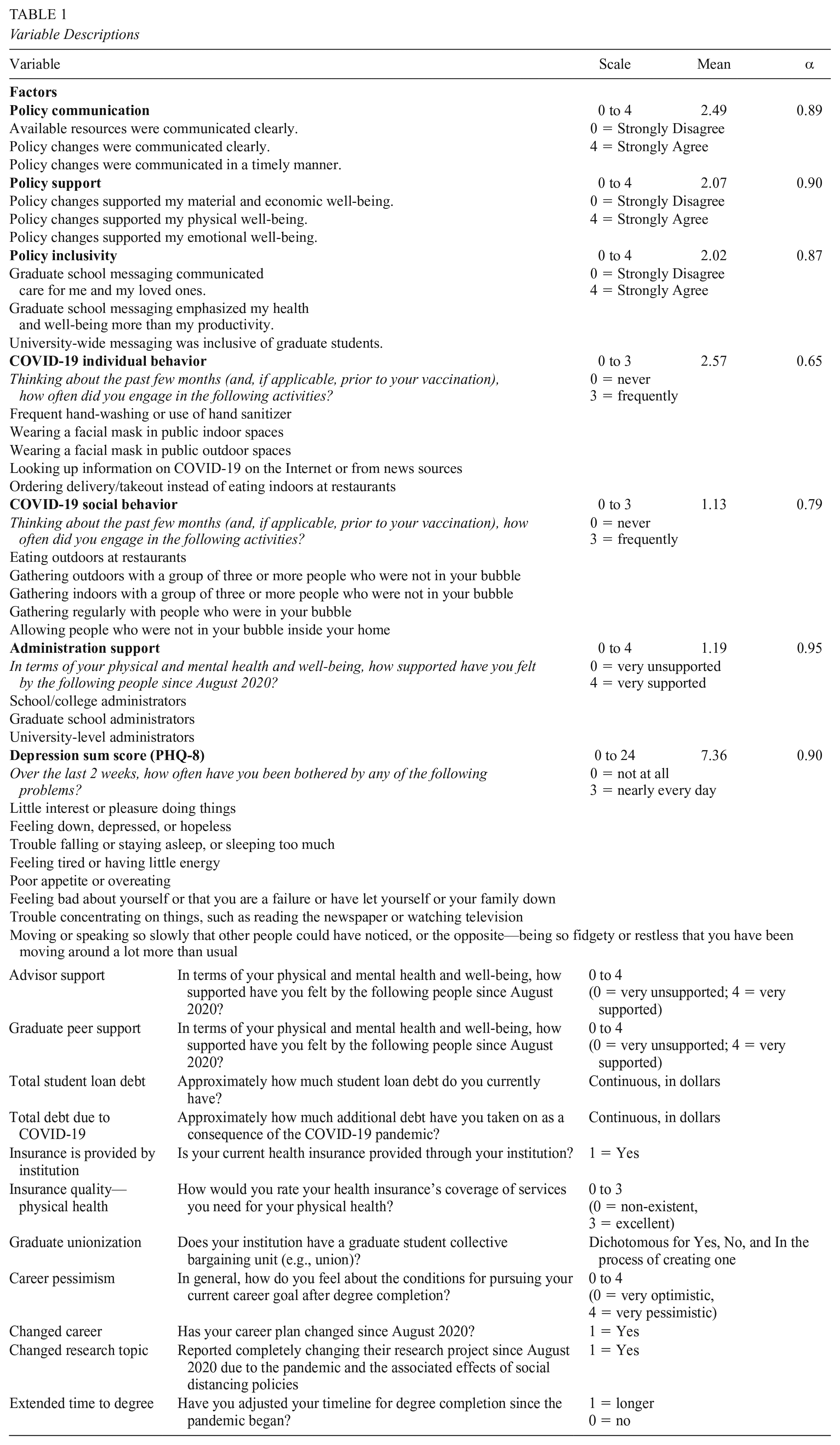
Based on our literature review and conceptual framework, and in response to our research questions, we constructed the following sets of measures, with details summarized in Table 1. We included variables related to student identity and statuses that previous research has demonstrated to be related to students’ experiences of privilege or marginalization in graduate school. For gender, students could choose all that applied or specify their own; based on responses, we constructed three categories for descriptive reporting (cisgender women, transgender/nonbinary/genderqueer, and cisgender men) and two categories for the regression analysis (cisgender men and all others). Participants could also select all that applied from a range of racial and ethnic categories or specify their own. For descriptive reporting of U.S. domestic students, we then constructed categories that included Alaska Native/American Indian/Native American/Indigenous, Asian/Asian American, Black/African American, Hispanic/Latinx, Middle Eastern, non-Hispanic white, and students who chose two or more categories. For the regression analysis, we used two categories (students with racially/ethnically minoritized identities and non-Hispanic White). Students identified whether they were international students (yes/no), first-generation college students (defined as not having a parent with a bachelor’s degree or higher), and their age in years. We categorized students’ fields of study broadly, including STEM fields, education, humanities, and social/behavioral sciences. About half of the students had attained candidacy, meaning that they had largely completed degree coursework. We also asked questions relating to household status, including whether respondents were married or living with a partner, whether they were a parent or caretaker, whether they had low household income (defined here as less than $30,000), and the amount of any student debt and debt that had been taken on due to the pandemic, in dollars. We binarized the income variable because of its distribution in our data—many students were funded through graduate assistantships (generally less than $30,000), while many others were part of dual-income households that had much higher household incomes and full-time worker salaries.
Variable Descriptions
Graduate Student Experiences and Support
Three composite measures were constructed from separate survey questions on students’ perceptions of graduate-level policy; one measure on graduate policy communication, a second on the extent students felt supported by the graduate policy, and a third on graduate policy inclusiveness. Each measure was composed of three survey questions, and we performed exploratory and confirmatory factor analyses to ensure that the items loaded together in consistent conceptual groups (DeVellis, 2017).
Further attitudinal measures included items gauging students’ perception of support for their well-being from various other individuals or groups: their main advisor, their graduate student peers, and the university administration. The administration perception variable was itself composed of three items evaluating students’ perceptions of support from different levels of administration: school/college, graduate school, and university. The three items loaded together well in a confirmatory factor analysis (DeVellis, 2017). We also included items related to institutional supports, including graduate student union status, whether health insurance was provided by the institution, and the quality of insurance coverage for physical health services.
We measured the mental health of students’ by using the eight-item Patient Health Questionnaire (PHQ-8; Kroenke et al., 2009). The PHQ-8 is used as a diagnostic and severity measure for depressive disorders in a wide array of contexts. Results can be analyzed in three ways: (a) as a sum score, ranging from 0 to 24, where higher scores indicate more depressive symptoms; (b) as a dichotomous prevalence indicator for provisional diagnosis; and (c) as a polytomous scale ranging from no depressive symptoms to severe depressive symptoms. We used the sum score in our modeling to focus on symptomatic experiences that could have influenced doctoral study rather than diagnostic criteria, and we used the polytomous scale to characterize average symptom severity levels among respondents in our descriptive analysis.
Pandemic-Related Experiences
To address the potential behavioral changes induced by the COVID pandemic, which may have influenced students’ choices about educational and social activities they could engage in within their mesosystem (and therefore their degree progress), we developed 11 items related to common preventative and social behaviors. We included items based upon the Coronavirus Anxiety Scale (Knowles & Olatunji, 2021) as well as new items meant to gauge individuals’ propensity to socialize with others in different numbers and contexts. Using exploratory and confirmatory factor analyses (DeVellis, 2017), we identified two factors comprising five items each that conceptualized two elements of living in the pandemic: (a) COVID-19 Individual Behavior, which addressed preventative behaviors (e.g., wearing face masks, ordering takeout); and (b) COVID-19 Social Behavior, which addressed gathering in indoor or outdoor settings with groups of people in and out of their social “bubble.” The two factors were negatively correlated, meaning that students who engaged in more COVID-19 individual preventive behaviors were less likely to socialize with more than three people or take part in in-person dining or other face-to-face social activities. These measures were behavioral manifestations of health-based and social reactions to COVID-19 conditions, and we hypothesized that students’ level of “cautiousness” may have related to peer and faculty interaction behaviors (Brown et al., 2022) and, thus, potentially to degree progress in either positive or negative directions.
Educational and Career Plans
Our dependent variable was based on responses to the following question, administered during the second assessment: “Have you adjusted your timeline for degree completion since the pandemic began?” We dichotomized responses into yes (1) and no change or shortened timeline (0). We included their intentions from the same question asked in the summer of 2020 as a longitudinal control. Therefore, the main analytic model examined factors associated with students changing from no planned extension to planned extension between the summer of 2020 and the summer of 2021. We also added items related to PhD candidacy status, whether participants changed the topic of their dissertation research because of the pandemic, students’ sense of pessimism about the conditions for their chosen career outcomes, and whether they changed their career goals during the pandemic.
Participants
The sample included in this analysis consisted of 422 graduate students pursuing PhD degrees in one of 12 U.S. institutions. Participants included students who identified as Alaska Native, American Indian, Native American, or Indigenous (1%); Asian or Asian American (15%); Black or African American (4%); Hispanic or Latinx (4%); Middle Eastern (2%); non-Hispanic white (67%); and who chose two or more categories (8%). International students comprised 17% of the sample. Participants were cisgender women (67%); trans, nonbinary, or genderqueer (4%); and cisgender men (29%). One quarter of students identified that they were first-generation students, and 48% met our threshold of low income. The average age of participants in the sample was 31 years. Just over half of the participants were married or living with a partner, and almost 20% reported being parents or caretakers. Fields of study varied, with broad categories including STEM fields (46%), education (10%), humanities (14%), and social or behavioral sciences (30%). Half of our participants had reached the stage of PhD candidacy.
Analysis
We performed descriptive analyses on the analytic sample of PhD student participants who completed both surveys. For our main analytic model, we employed logistic regression, using Mplus Version 8.4 (Muthén & Muthén, 2017). Our data set contained about 7% missing data overall, ranging from 2%–17% per variable. To avoid listwise deletion, we imputed missing data by using multiple imputation, averaging results across 10 data sets (Allison, 2005). Our analytic sample for the model contained 422 students.
Results
PhD Student Experiences
In terms of educational decision-making, about half of respondents planned to extend their time to degree, and about a third had changed their originally planned research topic. Related to careers, students were generally optimistic, and 28% planned to change their originally intended career paths. PhD students reported an average of 7.36 (out of 24) on the PHQ-8 depression scale. When examining our sample by the polytomous scale, we found that 18% of students reported moderate symptoms, 13% reported moderately severe symptoms, and 3% reported severe symptoms. Our scales of behaviors related to COVID-19 indicated that on average, students were practicing masking and avoiding indoor and larger social situations.
Sources of Support and Stress
Average PhD student reports of their experiences of support and stress as of the summer of 2021 are summarized in Table 2. Students reported getting more support from their peers (M = 2.99) and advisors (M = 3.08) than from middle- and upper-level institutional administrators (M = 1.90). In terms of institutional policies and communication, students rated clear and timely communication (M = 2.49) more favorably than policy supportiveness (M = 2.07) or care and inclusivity (M = 2.02). Three-quarters of students received health insurance through their institutions and rated the quality of physical health insurance as just above adequate (M = 2.19, where 2 = adequate and 3 = excellent). In terms of financial stresses, students reported an average of just over $28,000 in student loan debt, and an average of nearly $1,200 in additional types of debt caused by the pandemic.
Description of PhD Student Study Participants, Summer of 2021 (n = 422)

Factors Related to Anticipated Time to Degree Changes
Table 3 summarizes the results from our logistic regression model predicting PhD student degree completion timeline extension as anticipated in the summer of 2021, including odds ratios. When analyzing results, we employed an alpha threshold of 0.1 to better account for results that may have practical significance in addition to traditional statistical significance. Fit indices for the models were averaged across 10 imputed data sets, with AIC = 442.77, BIC = 576.26, and sample-size adjusted BIC = 471.54.
Logistic Regression Predicting Time to Degree Extension for PhD Student Participants Between the Summer of 2020 and the Summer of 2021 (n = 422)

Note. Fit indices for these models were averaged across 10 imputed data sets: AIC = 442.77; BIC = 576.26; sample-size adjusted BIC = 471.54.
Reference category is non-Hispanic White graduate students.
Reference category is cisgender men.
Reference category is social and behavioral sciences.
Reference category is unsure.
Students pursuing degrees in STEM fields were more likely than their social and behavioral science colleagues to extend their time to degree, by a factor of 1.71 (p < .10). Older students were also more likely to extend their time to degree, being 1.06 (p < .05) times more likely to extend their time to degree for each year increment.
Among our graduate policy perception factors, students who perceived better and timely communication of graduate policy changes by the institution were more likely to maintain their original time to degree (OR = 0.62, p < .05). Perceptions of graduate students’ inclusion in policy and caring about well-being over productivity were unrelated to degree-timeline decisions.
Students’ experiences and perceptions of support had varied relationships with time-to-degree decision-making. Students with a higher score on the PHQ-8, indicating more depressive symptoms, were 1.06 (p < .05) times more likely to extend their time to degree for each increment on the PHQ scale. Yet students who found their insurance to provide high-quality coverage for their physical health were more likely to maintain their time to degree (OR = 0.60; p < .05). Those who perceived positive graduate student peer support were also more likely to maintain their time to degree (OR = 0.76; p < .10). The strongest indicator in our model was the presence of a graduate student union: Students who reported that their institution had a graduate student union were 2.25 (p < .05) times more likely than those who were unsure of their campus’s union status to extend their time to degree.
Limitations
Although our results drew attention to salient factors in U.S. PhD students’ experiences over the past several years, our analyses and the generalizability of findings have limits. Our study design and response rates, although similar to others, meant that important PhD student subpopulations and students at other institutional types or in other geographical areas were not included. Further, data limitations prevented us from including more nuanced characterizations of gender, race, and ethnicity in our regression modeling, limiting our analyses related to sexism and racism. It is likely that our study has underreported the negative experiences of PhD students, given which students had capacity to respond to a survey during a pandemic. To protect respondents’ privacy, we decided to collect data on field of study by general category rather than by specific program or discipline. This broad categorization meant that important variation was likely contained within the categories that was masked by the aggregation. Our study included variable response rates across institutions and waves. Our results also included survivorship bias because students who completed both surveys of their experiences were those still enrolled in their graduate programs (or those who had maintained access to the email address associated with their graduate program) from the spring of 2020 through at least the summer of 2021.
Discussion and Implications
Although average graduate student enrollment may not appear to have been as negatively affected by the COVID-19 pandemic, graduate students’ experiences remained challenging or negatively exacerbated. Using Bronfenbrenner’s (1979, 1994) PPCT ecological systems model to study PhD students’ experiences allowed us to examine individual student experiences within this temporal context while accounting for some of the processes that operated between nested environmental levels that were of clear relevance to graduate students. Our study results drew attention to factors that were associated with PhD students’ decisions to extend their degree timelines between the summer of 2020 and the summer of 2021, given their early-pandemic degree timeline plans. Continued attention paid to PhD students’ degree timelines is important because institutional and interpersonal supports may foster extensions but allow for degree completion. Degree timelines are, therefore, consequential for students personally and financially as well as for institutional planning. In general, we found that meso-level institutional structural factors and processes were related to planned degree timeline changes from initial degree timeline reports, in contrast to more micro-level relational supports from peers and advisors that related to plans for degree timeline extensions early in the pandemic (Ogilvie et al., 2020).
The PhD students in our analysis continued to adjust their educational and career plans since the onset of and initial reaction to the COVID-19 pandemic, and they continued to experience high levels of stressors. About one-third of students reported changing their major research project, and more than half reported planning to extend their time to degree. About 28% of students planned to change their career path. PhD students continued to experience on average moderate levels of depressive symptoms, with 34% of students reporting depressive symptoms consistent with moderate to severe depression. These levels continued to be well above those reported in recent studies conducted during “typical” times (Allen et al., 2020; Posselt, 2021). Respondents also reported an average of nearly $1,200 of debt due to the pandemic, an addition to existing work about graduate student borrowing (Webber & Burns, 2021).
Our examination of factors relating to students’ extensions of their planned times to degree in the summer of 2021, taking into account their original pandemic-related plans reported in the summer of 2020, showed meso-level institutional structural features and practices as salient. As in past work (Austin & McDaniels, 2006; Cassuto, 2015), field of study mattered for students’ experiences, with students in STEM fields more likely to plan degree timeline extensions compared to those in social/behavioral sciences. PhD students who reported that they had a graduate student labor union were more likely to extend timelines. Because unionization often signifies better salaries, protections, and working conditions (Julius & Gumport, 2003), students may have felt supported by those structures to continue in their degree programs, even if completion would take longer.
Environmental conditions for students who were older or experiencing depressive symptoms were related to PhD student degree timeline extensions. Older students may have been juggling family and career responsibilities that were different from those of younger respondents, which may have required targeted support as their workload expanded or became more uncertain (Levine et al., 2021). Mental health also continued to be a factor in degree completion progress and plans, consistent with previous literature identifying concerning levels of negative mental health symptoms among graduate students (Evans et al., 2018; Posselt, 2021; Woolston, 2019).
Although these factors were all associated with increased likelihood in extending degree timelines, students’ perceptions of two institutional features were related to decreasing likelihood of degree timeline extensions. The first was students’ perceptions that institutional communication—in manner and content—included information about available resources and was clear and timely. Studies on organizational communication during a crisis have regularly shown the importance of communication that is timely and consistent (Coombs, 2010, 2020; Marsen, 2020), and our results suggest that continued clear and timely information may have assisted students in keeping to their planned timelines. Second, students’ perceptions that their health insurance was of high quality may have helped support their health and well-being broadly as they completed degree-related tasks. Finally, in terms of interpersonal support, graduate student peer support was associated with degree timeline maintenance, consistent with literature about the importance of fostering supportive climates among graduate student peers (Ali & Kohun, 2006; Lovitts, 2002).
The PPCT ecological systems model (Bronfenbrenner, 1979, 1994) provides a structure for thinking through the practical implications that the results of our study suggest. One implication is that supportive practices may be associated with different decisions about anticipated time to degree for PhD students. Students in particularly affected fields of study and students who are older may need additional support as they navigate extended timelines to degree. People coping with relatively sudden crises often rely on those they have micro- and meso-level relationships with (such as advisors and peers), while navigating longer-term fluctuating and stressful social conditions may require the material support found in middle and outer layers of institutional structures—thus, the process of student support crosses ecological levels. The existence of graduate student unionization on campus and high-quality health insurance were both important after the early pandemic period, but oppositely related to time to degree. Students’ perceptions of institutional messaging were also relevant—timely and clear messages about resource provision were associated with maintaining degree timelines. Taking into account our previous work, the current study suggests that factors of importance to students in degree timeline decisions shift over the course of time and that needs may differ based on student goals. Institutional leaders should provide financial resources and structural changes that will support students who are planning less of a change in time to degree and offer messaging and material support for students’ well-being that may provide assistance for those who plan to stay longer, ultimately supporting degree completion in both cases. More generally, administrators, faculty, and staff should work collaboratively to improve the conditions that produce or exacerbate high levels of graduate student depressive symptoms as well as focus attention on the generation of supportive peer communities.
Taken together, students’ reported experiences suggest the need for mental health resources and career-planning supports, institutional messaging that is timely and clear, and the provision of structural and material supports for degree completion. Our study suggests that institutions assess students’ experiences and well-being over time, as factors in degree completion can fluctuate with social context shifts. Supporting PhD students’ success requires nuanced analysis of more than enrollment and degree completion rates, especially during times of widespread turbulent and stressful social conditions.
Footnotes
Appendix
Sample Construction Process

| Sample description | n |
|---|---|
| Respondents to summer of 2020 survey | 4,036 |
| Respondents to summer 2020 survey who agreed to follow up and received the summer of 2021 questionnaire | 2,842 |
| Respondents to summer of 2021 questionnaire | 883 |
| Respondents to summer of 2020 and summer of 2021 questionnaires who were pursuing a PhD | 422 |
Declaration of Conflicting Interests
The authors declared no potential conflicts of interest with respect to the research, authorship, and/or publication of this article.
Funding
The authors disclosed receipt of the following financial support for the research, authorship, and/or publication of this article: This material is based upon work supported by the National Science Foundation under Grant No. 2030313. Any opinions, findings, and conclusions or recommendations expressed in this material are those of the authors and do not necessarily reflect the views of the National Science Foundation.

Authors
RACHEL A. SMITH is an assistant professor of higher education and student affairs at Iowa State University; email:
GARRETT H. GOWEN is an independent scholar and data analyst living in New York City; email:
ROSEMARY J. PEREZ is an associate professor at the University of Michigan; email:
JENNIFER A. TIPTON is a doctoral student at Iowa State University; email:
CRAIG A. OGILVIE is dean of the graduate school and associate vice president of research at Montana State University; email:
THOMAS R. BROOKS is an assistant professor of psychology at New Mexico Highlands University; email: