




Abstract
Studies persistently show disparities in exclusionary discipline across racial/ethnic groups in U.S. schools. Using administrative data from kindergarteners through fifth graders in Indiana, we examine the effects of student-teacher race/ethnicity matching on disciplinary outcomes. We find that Black students exhibit lower rates of suspension and expulsion when they study with Black teachers—driven mainly by fewer defiance and profanity offenses. By contrast, for Latinx and White students, having a teacher of the same race/ethnicity is not associated with suspension and expulsion. In light of the shortage of Black teachers in the teacher workforce, our findings underscore the vulnerability of Black students to exclusionary discipline in the early stages of schooling.
Introduction
Racial/ethnic disparities in school disciplinary outcomes are evident in contemporary U.S. education. While Black students represented 15 percent of all public school students, they account for 38 percent of students who receive out-of-school suspensions (U.S. Department of Education Office for Civil Rights, 2021). This overrepresentation has prompted a growing concern that disciplinary practices likely contribute to educational inequality (Gregory et al., 2010; Losen et al., 2015; Morris & Perry, 2016). Exclusionary discipline, such as suspension and expulsion, is linked with unfavorable youth outcomes, including lower academic achievement and elevated risks of contact with the criminal justice system (Hwang, 2018; Mittleman, 2018; Monahan et al., 2014; Noltemeyer et al., 2015; Welsh & Little, 2018b). Given that exclusionary discipline has the potential to trigger a downward trajectory for disciplined students, concerns regarding discipline gaps have intensified in recent years (Cruz & Firestone, 2023; Hirschfield, 2008; Mowen & Brent, 2016).
Improving school discipline is an important agenda, as it influences the educational trajectories of students facing disciplinary actions and their peers (Hwang & Domina, 2021; Perry & Morris, 2014). Existing literature offers a valuable framework for comprehending disciplinary disparities, illuminating macrolevel factors—including systemic racism, antiblackness, and school climate (Carter et al., 2017; Elmesky & Marcucci, 2023). Another line of study aims to improve our knowledge of school discipline by delving into microlevel factors—including teacher bias, student behavior, and student-teacher demographic matching (Liu et al., 2022; Rocque, 2010; Welsh & Little, 2018a; Wright et al., 2014).
In this study, we estimate the effects of student-teacher racial/ethnic matching on school disciplinary outcomes to expand the growing literature on student-teacher demographic matching (Holt & Gershenson, 2019; Kinsler, 2011; Lindsay & Hart, 2017). Although student-teacher demographic matching is just one piece of the puzzle, it can offer valuable insights into understanding disciplinary gaps. Given the deeply rooted racial/ethnic stereotypes in U.S. culture that contribute to these disparities (Carter et al., 2017; Cruz & Firestone, 2023), having teachers of the same race/ethnicity who may more easily connect with students and serve as positive role models has the potential to improve school disciplinary outcomes (Villegas & Irvine, 2010). Moreover, as teachers can have a particularly pivotal role for students from underserved populations (Egalite & Kisida, 2018; Hamre & Pianta, 2005; Hwang et al., 2021; Hwang & Kisida, 2022), the effects of having teachers of the same race/ethnicity on school discipline may differ among student subgroups.
Our study contributes to the literature on the role of same-race/ethnicity teachers for student outcomes in a few ways. First, we replicate and extend this line of work in a new state context. Although existing studies highlight the important roles of teacher race/ethnicity for minority students, ranging from positive student behavioral ratings to academic achievement to recommendations for gifted programs (Grissom et al., 2017; Meier & Stewart, 1992; Wright et al., 2017), research that focuses on the effects of same racial/ethnic teachers on school discipline is only available from one state: North Carolina (Holt & Gershenson, 2019; Lindsay & Hart, 2017). Using more recent data from a new context (Indiana), our study provides important evidence regarding the effects of teachers of the same race/ethnicity on school discipline.
In addition to providing evidence from a new context, our study further investigates whether the impact of student-teacher race/ethnicity matching varies by the specific type of student disciplinary infraction. Students receive exclusionary school discipline for various reasons, and certain types of infractions, like defiance and profanity, reflect teacher discretion more than others. This study delves into potential teacher bias in disciplinary outcomes by estimating effects heterogeneity by discretionary infraction (defiance and profanity versus nondefiance and nonprofanity) with data including Black, Latinx, and White students. Our findings thus provide valuable insights into the impact of race/ethnicity match on different types of disciplinary infractions, carrying implications for teacher training and policy.
Finally, given that individual student and school context can moderate the effects of teacher race/ethnicity matching (Byrd & Chavous, 2011; Hwang et al., 2021; Lewis, 2003), we test whether these impacts differ across various student and school characteristics. For instance, the roles of a teacher of the same race/ethnicity may be particularly salient for racial/ethnic minority students who are from low-income families who tend to encounter various obstacles in accessing material and relational resources (Karunanayake & Nauta, 2004; Villegas & Irvine, 2010). Our findings on effect heterogeneity offer useful insights, particularly for historically underserved students frequently experiencing exclusionary school discipline. We address the following research questions: (1) Do Black, Latinx, and White students exhibit fewer or more exclusionary discipline incidents—including suspensions and expulsions—when they are assigned to a teacher of the same race/ethnicity? (2) Do the effects of student-teacher race/ethnicity matching on disciplinary outcomes vary across infraction types (defiance and profanity versus nondefiance and nonprofanity)? (3) Do the effects of student-teacher race/ethnicity matching on disciplinary outcomes vary across student characteristics (e.g., gender, free or reduced-price lunch eligibility, and prior disciplinary records) and school characteristics (e.g., high-poverty school, high-minority school, and lower-achieving schools)?
Background Literature and Empirical Evidence
Same-Race/Ethnicity Teachers and Student Outcomes
Over the past several decades, scholars have argued that racial/ethnic minority students would benefit from increasing the number of same-race/ethnicity teachers (Irvine, 1988; King, 1993; Madkins, 2011; Quiocho & Rios, 2000; Villegas & Irvine, 2010). Cultural congruence is a theoretical framework that explains why a teacher of the same racial/ethnic background facilitates student learning more effectively. For example, cultural continuity between students and teachers enhances the quality of student-teacher interactions and, in turn, promotes positive student outcomes (Delpit, 2006; Henry, 1994; Hollins, 1982; Howard, 2003; Ladson-Billings & Henry, 1990). By contrast, teachers who lack the understanding of students’ cultures may have less favorable perceptions about student behavior (Downey & Pribesh, 2004), and less favorable teacher perceptions may also lead students to misbehave, which may contribute to higher rates of school discipline (Lindsay & Hart, 2017).
A role model effect is another framework that can explain how students benefit from having a racial/ethnic-congruent teacher. If teachers who are of the same race/ethnicity as their students are better candidates as role models for students to emulate, studying with racial/ethnic-congruent teachers likely enhances student motivation, confidence, and effort (Egalite & Kisida, 2018). Teachers of the same race/ethnicity as their students may also serve as adult role models in professional and authoritative positions (Villegas & Irvine, 2010). In this way, same-race/ethnicity teachers become a living example of the promise and benefits of education, inspiring students to strive for educational success, particularly for racial/ethnic minority students (Gershenson et al., 2017).
Unclear Directions: The Effects of Student-Teacher Race/Ethnicity Matching on School Discipline
Cultural congruence and role model effects theoretically help explain why students who are matched with teachers with the same race/ethnicity are likely to exhibit better student outcomes, given that teachers who are familiar with students’ home culture may be in better positions to promote student outcomes (Delpit, 2006; Henry, 1994). However, the direction of the effects of race/ethnicity matching on school discipline is unclear. That is, a teacher of the same race/ethnicity could reduce or increase the probability of receiving suspensions and expulsions.
One prediction is that having a teacher of the same race/ethnicity leads to a lower likelihood of a student receiving suspensions and expulsions because teachers are less likely to have biased perceptions about students of the same race/ethnicity (Bates & Glick, 2013). If teacher biases and perceptions influence the decision to discipline students (Hinojosa, 2008; Skiba et al., 2002), having teachers of the same race/ethnicity who share cultural backgrounds with students may result in lower rates of school discipline. In addition, students may behave better because they feel more connected with teachers who are of the same race/ethnicity, leading to a decrease in exclusionary discipline (Lindsay & Hart, 2017).
Another possibility is that studying with teachers of the same race/ethnicity could lead to an increase in disciplinary actions. Although more frequent disciplinary action seems counterintuitive, some theoretical and empirical studies support this hypothesis (Gilliam et al., 2016; Hale-Benson, 1986; Tyson, 2003). As teachers have higher expectations for students who match with their own race/ethnicity (Fox, 2015; Gershenson et al., 2016), a teacher of the same race/ethnicity may discipline students in a stricter and firmer way. The shifting standards (or shifting expectations) theory suggests that teachers’ care and love result in higher standards and expectations toward students (Biernat, 2003; Gilliam et al., 2016). In other words, tough love may lead to an elevated standard and expectation, which results in more frequent discipline (Cashdollar, 2018; Rasheed et al., 2020). Qualitative studies demonstrate that Black teachers tend to discipline Black students more strictly so as to prepare them for life in the context of a racialized society and punitive criminal justice system that disproportionately punishes people of color (Hale-Benson, 1986; Tyson, 2003). As such, having a teacher of the same race/ethnicity could result in a higher rate of disciplinary actions for Black students.
The Roles of Same-Race/Ethnicity Teachers by Context
The roles that a same-race/ethnicity teacher plays in school discipline are unlikely to be equal across all racial/ethnic students. Given that racial/ethnic minority students often face a cultural discontinuity between home and school (Delpit, 2006), the exposure to a same-race/ethnicity teacher can be more important for students from racial/ethnic minority groups. Because teachers of the same race/ethnicity might better understand students’ home culture and connect with students on a deeper level, they could help students adjust to school culture, ultimately leading to positive student outcomes.
In addition, the roles of same-race/ethnicity teachers in student outcomes can vary across student subgroups. Relationships with teachers are important for all students, yet student-teacher relationships can have greater impacts on students from underserved communities (Egalite & Kisida, 2018; Hamre & Pianta, 2005; Hwang et al., 2021; Hwang & Kisida, 2022). Because high teacher expectations and supportive interactions with teachers can be more critical for some student subgroups, such as male students (Gershenson et al., 2016), students from low-income families (Sorhagen, 2013), and students with disabilities (Klehm, 2014), the effects of race/ethnicity matching may vary across student characteristics.
As school context can play an important role in racial/ethnic identity (Byrd & Chavous, 2011; Lewis, 2003), the demographic composition of schools may moderate the effects of teachers of the same race/ethnicity on school disciplinary outcomes. For Black students, for example, the effects of student-teacher race/ethnicity matching on school discipline may be greater in schools where most students are non-Black. Similarly, for White students, the effects of student-teacher race/ethnicity matching may be greater in schools where most students are non-White.
Existing Empirical Evidence
School disciplinary outcomes capture important aspects of student outcomes and teacher perceptions of students, yet only a few studies investigate the impact that racial/ethnic-congruent teachers have on school discipline. Kinsler (2011) shows that matching between Black students and Black teachers is not associated with suspension outcomes. However, because Kinsler only used data from one year, he was not able to use student and teacher fixed effects, which require multiple observations for students and teachers. As such, the null findings beg for further investigation.
Lindsay and Hart (2017) revisit the same research question with a richer administrative dataset from the same state (North Carolina) for a six-year period (i.e., 2007–08 through 2012–13 academic years) and find that an increase in the proportion of Black teachers was associated with a decrease in the suspension rates of Black students. Lindsay and Hart use an instrumental variable approach with student fixed effects, yet because their key measure is the proportion of Black teachers in a given school year, their estimates may not capture direct exposure to teachers of the same race/ethnicity. Additionally, as the proportion of Black teachers may relate to other confounding effects, such as principals’ propensity to enact more progressive school disciplinary reforms, their findings are susceptible to selection bias.
Holt and Gershenson (2019) directly link student and teacher data from North Carolina and confirm the results from Lindsay and Hart (2017). They use data on kindergarten through fifth-grade students and find that assignment to a racial/ethnic-congruent teacher reduces absenteeism and suspension rates. By applying two-way fixed effects (student and classroom fixed effects), Holt and Gershenson (2019) effectively address the concerns regarding unobservable and unmeasurable differences between students and between classrooms.
Our study follows Holt and Gershenson’s (2019) analytic strategy (two-way fixed effects) and extends their work by using data from a new state: Indiana. Given that some infraction types reflect more teacher discretion than others, and teacher perception can play an important role in disciplinary outcomes (Lindsay & Hart, 2017; Skiba et al., 2002), we further test whether and to what extent the effects of student-teacher race/ethnicity matching vary across infraction types. In light of the importance of individual and school context (Byrd & Chavous, 2011; Hwang et al., 2021; Lewis, 2003), we also investigate the heterogeneous effects of race/ethnicity matching across student subgroups and school characteristics. This study advances our understanding of teacher race/ethnicity and school disciplinary outcomes by focusing on the roles of teacher race/ethnicity across various educational settings.
Data
Data and Sample
We use longitudinal administrative data from the Indiana Department of Education (IDOE) to examine the role of same-race/ethnicity teachers in school disciplinary outcomes. Given that most elementary school students study with generalist teachers who cover main subjects, we focus on students in kindergarten through fifth grade from the 2010–11 to 2016–17 academic years in this study. The data include student demographic characteristics such as gender, race/ethnicity, eligibility for free or reduced-price lunch (FRL), English language learners (ELL), enrollment in special education (SPED) status, and prior disciplinary records. The data also include teacher characteristics, such as gender, race/ethnicity, years of teaching experience, and educational attainment.
Using unique student, teacher, and classroom identifiers, we link students to their classroom teachers. 1 Linking students, classrooms, and teachers allows us to investigate the extent to which student-teacher race/ethnicity matching affects disciplinary outcomes. Because our sample is drawn from students in early grades, the majority of students are in a self-contained classroom with a primary teacher. We link these primary teachers to students for our analyses. For students who study with multiple teachers in a given academic year, we flag one teacher who teaches them the greatest number of classes and links them to that student. Given that reading teachers spend the greatest share of student instructional minutes across subjects for students in early grades, reading teachers are used as a tiebreaker when all else is equal.
Our data, which focus on elementary school students, have two main advantages. First, given that most elementary school students tend to study with one main teacher, our data that directly link students and teachers allow us to estimate the effects of race/ethnicity matching effectively. Unlike prior work that tests the theory of representative bureaucracy by measuring the percentage of racial/ethnic minority teachers in a school (Grissom et al., 2017; Meier & Stewart, 1992; Rocha, & Hawes, 2009), we use measures of student-teacher race/ethnicity matching to examine more direct effects. Second, as racial/ethnic disparities in school discipline emerge even in the early grades (Mendez & Knoff, 2003), and exclusionary school discipline can shape long-term educational trajectories (Mittleman, 2018), focusing on elementary school grades offers useful insights into exclusion for young students.
Indiana’s schools report data on school disciplinary incidents every year. IDOE data thus has school discipline data that indicate students who receive school disciplinary incidents, including in-school suspension, out-of-school suspension, and expulsion. The data also include infraction types, 2 the number of days students receive a given disciplinary action, and the date range of those actions. We merged this student-level discipline data with other student- and teacher-level data to conduct our analyses. Indiana’s suspension rates are higher than the national average, yet like other states, Indiana has made a concerted effort to reduce suspension rates in recent years (Hwang et al., 2022).
In our data, the majority of students are White (75.5%), but students of color make up almost a quarter of the sample. On average, 3.8% of students who are in kindergarten through 5th grade in Indiana receive a suspension or an expulsion in a given school year during our study period. Table 1 shows that student, teacher, and school characteristics across racial/ethnic groups are substantially different. For example, the disciplinary rates for Black, Latinx, and White students are 12.9%, 3.2%, and 2.8%, respectively. The disciplinary rates for defiance and profanity for Black, Latinx, and White students are 4.8%, 0.9%, and 0.9%, respectively. Additionally, FRL rates are higher for Black (80.9%) and Latinx (79.9%) than White (41.7%) students, and ELL rates are higher for Latinx (50.8%) than Black (1.9%) or White (0.8%) students.
Summary Statistics

Notes: FRL = free or reduced-priced lunch eligibility; SPED = enrollment of special education service; ELL = English language learners. These summary statistics are based on student data from Indiana elementary school students between 2010–11 and 2016–17 academic years.
Approximately 96% of teachers in Indiana are White. Only 3% of teachers are Black, and 1% are Latinx. Not surprisingly, the probability of studying with teachers of the same race/ethnicity dramatically varies across racial/ethnic groups. The rates of same student-teacher race/ethnicity matching for Black, Latinx, and White groups are 16.2%, 3.4%, and 98.3%, respectively. In addition, compared with White students, Black and Latinx students tend to study with teachers without graduate degrees and teachers with fewer years of teaching experience.
School characteristics are also different across racial/ethnic groups. Black and Latinx students tend to attend schools with higher rates of students who are eligible for FRL. Black and Latinx students are also more likely to attend charter schools and lower-performing schools.
Measures
To estimate the effects of teachers of the same race/ethnicity on school discipline, we first create a dichotomous dependent variable that indicates whether a student receives any exclusionary school discipline. Exclusionary school discipline includes in-school suspensions, out-of-school suspensions, and expulsions. We code a discipline outcome as 1 if a student is suspended or expelled at least once in a given school year and 0 otherwise.
Next, we use two subsets of exclusionary discipline to test whether the effects of same-race/ethnicity teachers on disciplinary outcomes vary across infraction types. The second dependent variable indicates whether a student receives exclusionary school discipline as a result of more subjective (or teacher discretion) offenses. As we mentioned earlier, IDOE data include detailed infraction types, including defiance and profanity. We group defiance and profanity together and code as 1 if a student receives any exclusionary discipline because of defiance and profanity offenses and 0 otherwise. The final dependent variable indicates whether a student receives exclusionary school discipline that excludes defiance and profanity offenses. We code nondefiance and nonprofanity offenses as 1 if a student receives exclusionary discipline as a result of alcohol, drugs, weapons, handguns, rifles or shotguns, other firearms, fighting, intimidation, tobacco, truancy, destruction of property, theft, sexual misconduct, technology misuse, nondeadly weapon, bullying, and other; otherwise, we code it as 0.
We include a set of time-variant student, teacher, and school characteristics as control variables. For student characteristics, we include FRL, ELL, and SPED status as controls. For teacher characteristics, we include years of teaching experience and whether a teacher has a master’s degree or more. For school characteristics, we include school enrollment, school-level student achievement, percentage of Black students, percentage of Latinx students, and percentage of students who are eligible for FRL in a given school year.
Analytic Approach
Main Analysis
To investigate the role of student-teacher race/ethnicity matching in school discipline, we ran student and teacher fixed effects models. Our primary models follow prior research that estimates the effects of student-teacher assignments on student outcomes (Holt & Gershenson, 2019), enabling us to control for fixed student and teacher attributes (both observed and unobserved). 3 We include student and teacher fixed effects to control for both observable and unobservable time-invariant differences between students, as well as differences between teachers. We estimate that our student and teacher fixed effect approach is based on the following linear probability model (LPM) form:

where
X is a vector of student, teacher, and school characteristics that change over time, including student FRL, ELL, SPED, years of teaching experience, whether a teacher has a master’s degree or more, and a set of school characteristics that change over time (i.e., percentage of Black, percentage of Latinx, school mean achievement, percentage of students who are eligible for FRL, and school enrollment).
Sorting Test
We use student and teacher fixed effects to address threats to internal validity in our study, yet possible differential sorting of students into classrooms could still bias estimates. For example, if highly motivated high-achieving Black students are assigned to study with Black teachers, the estimated positive effects of race/ethnicity matching would indicate the positive selection into matching rather than positive causal matching effects. We conduct sorting tests to examine whether there is a nonrandom assignment of students to same-race/ethnicity teachers. A sorting test allows us to check whether observable Black versus non-Black student characteristics are different in Black versus non-Black taught classrooms.
Following prior studies (Fairlie et al., 2014; Holt & Gershenson, 2019), we first compute the mean value (proportion) of student characteristics, including female, FRL, ELL, SPED, and prior disciplinary record in a classroom for each race/ethnicity group. The race/ethnicity-specific classroom mean values are the dependent variables in Equation 2. We then examine whether the classroom mean values of student characteristics for each race/ethnicity student vary depending on the race/ethnicity of teachers. We conduct our sorting tests based on the following form:

Table 2 shows that there is a nonrandom assignment of students to the same-race/ethnicity teachers. For example, the classroom mean values (proportions) of previously disciplined Black students and Black students who enrolled in special education services are higher for Black-taught classrooms than non-Black taught classrooms. By contrast, the classroom proportions of Black students who are eligible for FRL and Black students who are ELL are lower for Black-taught classrooms than non-Black-taught classrooms. Because we do not find systematically positive or negative selection in same race/ethnicity matching, it is unclear whether our estimates are susceptible to upward or downward bias. Nevertheless, the results of sorting tests suggest that our identification strategy may not completely isolate the matching effects from other confounding effects.
Sorting Tests

Notes: The results of interaction terms are from a separate regression analysis for each race/ethnicity group. FRL = free or reduced-priced lunch eligibility; SPED = enrollment of special education service; ELL = English language learners. *p < 0.05, **p < 0.01, ***p < 0.001.
Results
Student and Teacher Race/Ethnicity Matching Gaps
We first document gaps in student-teacher race/ethnicity matching in elementary school students in Indiana. Our results show that only a small portion of students of color have opportunities to study with teachers of the same race/ethnicity, whereas nearly all White students have same-race/ethnicity teachers throughout their time in school. Table 3 presents the prevalence of race/ethnicity matching between students and teachers overall and across groups. Overall, 71.1% of student-year observations were always matched with teachers of the same race/ethnicity, 10.2% of student-year observations sometimes were matched with teachers of the same race/ethnicity, and 18.7% of student-year observations were never matched with teachers of the same race/ethnicity in kindergarten through grade 5.
Student-Teacher Race/Ethnicity Matching for Overall and by Racial/Ethnic Group

Notes: This table is based on student-year data from elementary school students between 2010–11 and 2016–17 academic year in Indiana.
The prevalence of race/ethnicity matching between students and teachers is considerably lower for Black and Latinx students. For Black students, 2.3% of students were always assigned to Black teachers, 36.0% of students were sometimes assigned to Black teachers, and 61.7% of students were never assigned to Black teachers. For Latinx students, nearly all students lack opportunities to study with Latinx teachers. Approximately 0.3% of Latinx students were always assigned to Latinx teachers, 9.7% of Latinx students were sometimes assigned to Latinx teachers, and 90.0% of Latinx students were never assigned to Latinx teachers. In contrast to Black and Latinx students, a very small percentage of White students (0.04%) were never assigned to White teachers.
Links Between Same Teacher Race/Ethnicity and Exclusionary Discipline
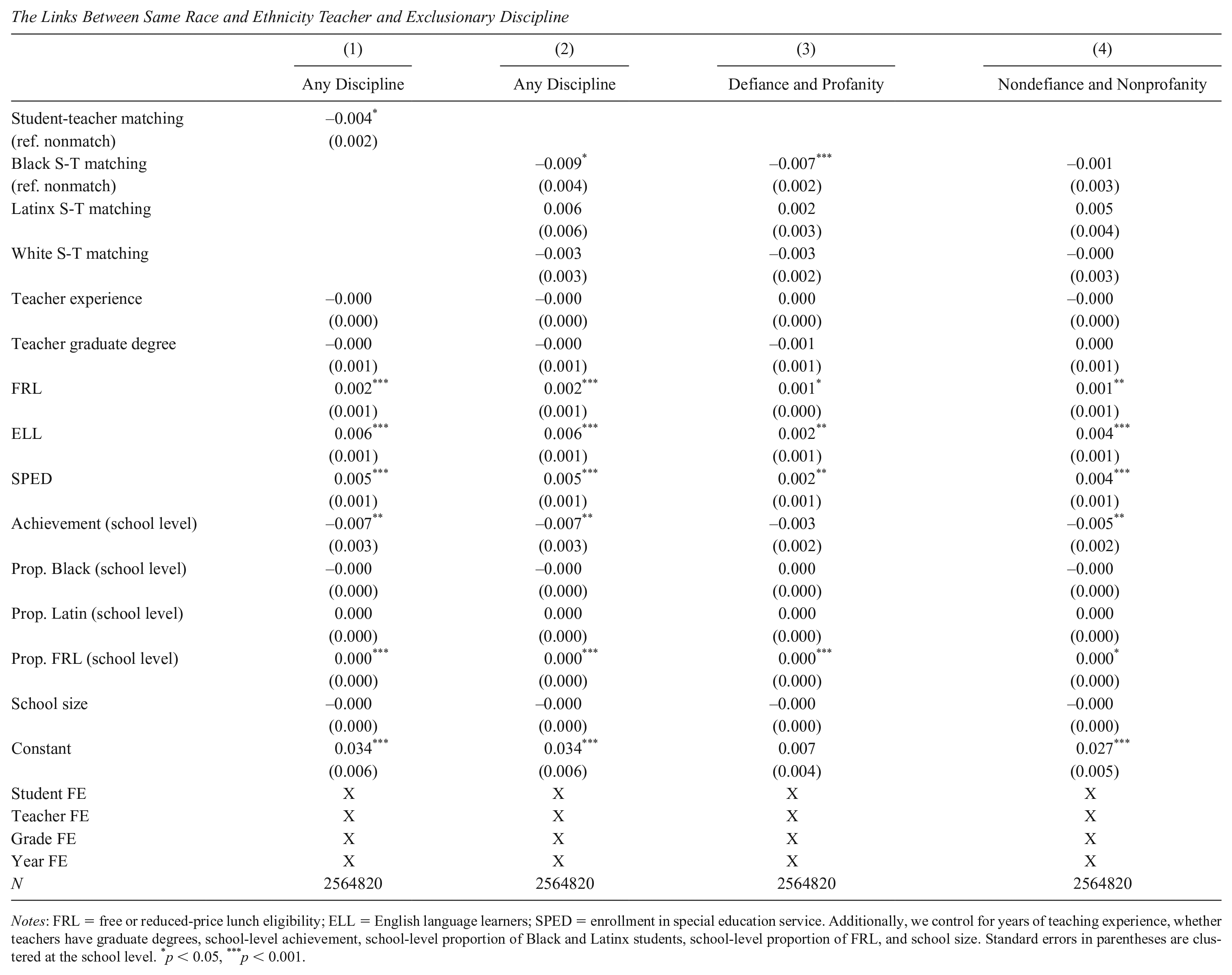
To answer our first research question, we examine the links between student-teacher race/ethnicity matching and school discipline. Column 1 in Table 4, which includes student and teacher fixed effects, shows that students are 0.4 of a percentage point less likely to receive any exclusionary discipline. Results from column 1 are informative, but they assume that the effects of racial/ethnic-congruent teachers are homogenous across racial/ethnic groups. Next, we investigate the links between race/ethnicity matching and school discipline by separating each racial/ethnic group (i.e., Black, Latinx, and White) in the models. Column 2 shows that the probability of receiving exclusionary school discipline is lower for Black students when they are assigned to Black teachers, even after controlling for differences between teachers (0.9 of a percentage point). For Latinx and White students, race/ethnicity matching continues to be not associated with exclusionary school discipline. 4
Associations Between Student-Teacher Race/Ethnicity Matching and School Discipline

Notes: Any school discipline includes in-school suspensions, out-of-school suspensions, and expulsions. All models include student, teacher, year, and grade fixed effects. Additionally, we control for years of teaching experience; whether teachers have graduate degrees, FRL, ELL, and SPED status; school-level achievement; school-level percentage of Black and Latinx students; school-level percentage of FRL; and school enrollment. Standard errors in parentheses are clustered at the school level. *p < 0.05, **p < 0.01, ***p < 0.001.
To answer our second research question, we use a subset of school disciplinary action as an outcome variable. Column 3 in Table 4 shows the links between student-teacher race/ethnicity matching and school discipline exclusively related to defiant and profanity offenses. We find that student-teacher matching is associated with a 0.7 percentage point lower risk of receiving exclusionary discipline related to defiant and profanity offenses. The effect size seems modest, but given that 4.3% of Black students receive exclusionary discipline related to defiant and profanity offenses, a 0.7 percentage point decline would thus equal a decline of 16.3% relative to the current risk for Black students. For Latinx and White students, race/ethnicity matching is not associated with exclusionary discipline related to defiance and profanity. Column 4 in Table 4 shows whether there is a link between race/ethnicity matching and school discipline related to arguably less subjective offenses (nondefiance and nonprofanity). Unlike the model with defiance and profanity, we find that student-teacher race/ethnicity matching is not significantly associated with offenses that are less subjective.
Since the roles of same race/ethnicity matching in school discipline may vary by context, we run models with interaction terms to further examine whether the links between race/ethnicity matching and disciplinary outcomes vary across student and school characteristics (research question 3). Table 5 shows the heterogeneous links between teachers of the same race/ethnicity and school discipline across student characteristics. For example, the links between race/ethnicity matching and a reduction in school discipline are greater for male Latinx students than female Latinx students. Similarly, the links between race/ethnicity matching and a reduction in school discipline are greater for White FRL students than White non-FRL students. We also find that the links between student-teacher matching and a reduction in school discipline are greater for Black and White students who were disciplined in a prior academic year.
Varying Links Between Student-Teacher Race/Ethnicity Matching and School Discipline Across Student Characteristics

Notes: FRL = free or reduced-price lunch eligibility; ELL = English language learners; SPED = enrollment in special education service. Additionally, we control for years of teaching experience; whether teachers have graduate degrees, FRL, ELL, and SPED status; school-level achievement; school-level percentage of Black and Latinx students; school-level percentage of FRL; and school enrollment. Standard errors in parentheses are clustered at the school level.
p < 0.05, **p < 0.01, ***p < 0.001.
As school context plays an important role in disciplining students (Curran et al., 2019), we also investigate whether the effects of race/ethnicity matching on school discipline vary across school characteristics. Table 6 shows that the links between matching and a reduction in school discipline are greater for White students who attend schools with high-minority, high-poverty, low-performing, and high-disciplinary rates. Our findings suggest that the role of teachers of the same race/ethnicity can vary depending on the school context for White students. Conversely, we find little evidence that these links vary by school characteristics for Black and Hispanic students.
Varying Links Between Student-Teacher Race/Ethnicity Matching and Exclusionary Discipline Across School Characteristics
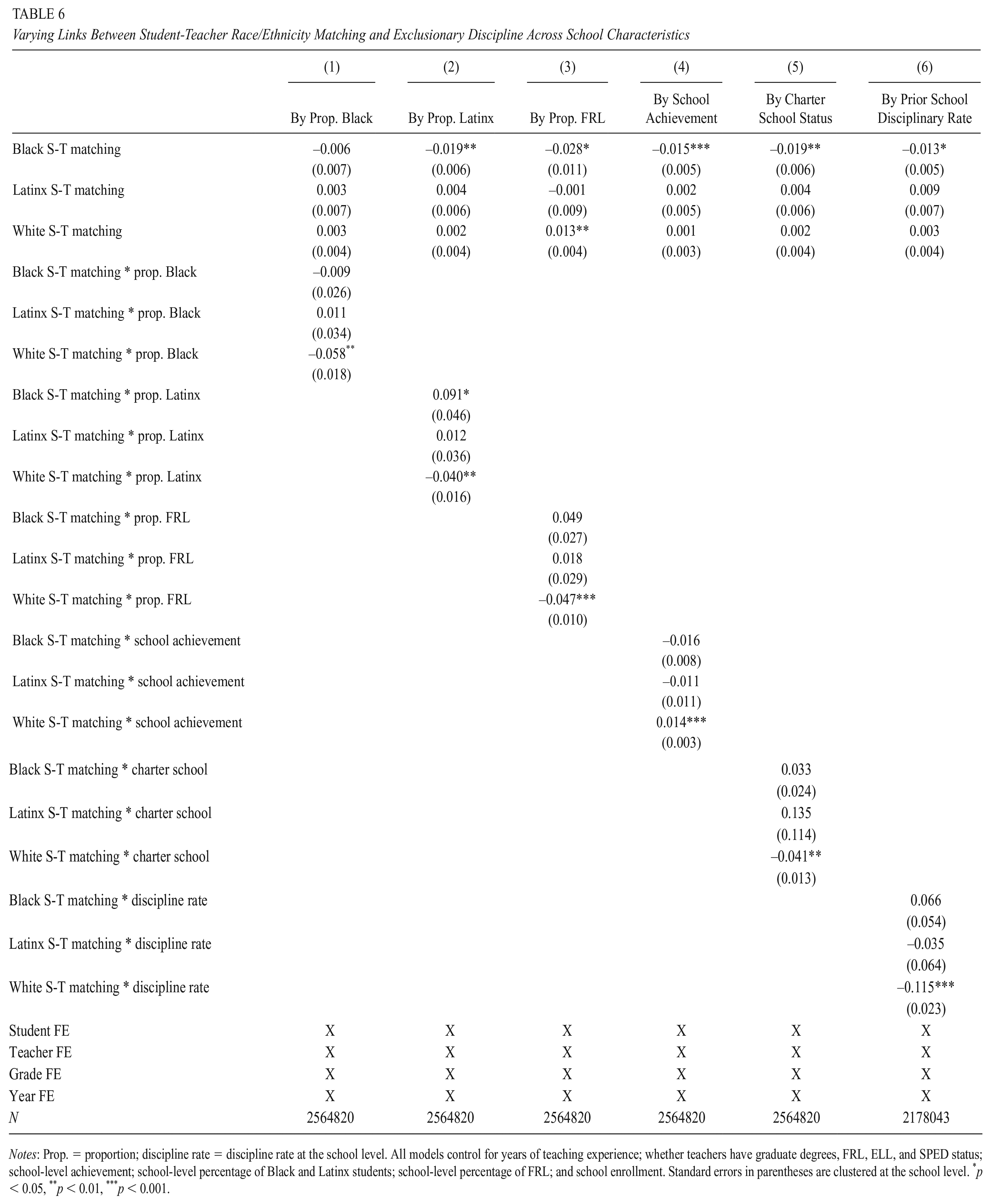
Notes: Prop. = proportion; discipline rate = discipline rate at the school level. All models control for years of teaching experience; whether teachers have graduate degrees, FRL, ELL, and SPED status; school-level achievement; school-level percentage of Black and Latinx students; school-level percentage of FRL; and school enrollment. Standard errors in parentheses are clustered at the school level. *p < 0.05, **p < 0.01, ***p < 0.001.
Discussion
Using seven years of longitudinal administrative data, we find that student-teacher race/ethnicity matching is associated with a lower rate of exclusionary discipline for Black students. This reduction in disciplinary actions for Black students is primarily driven by Black teachers giving fewer exclusionary disciplinary actions to their Black students for more subjective reasons like defiance and profanity. Our results suggest that having a Black teacher can play a critical role in young Black students’ educational opportunities and outcomes (Bates & Glick, 2013; Gershenson et al., 2016; Hwang et al., 2023; Irvine, 1988; Villegas & Irvine, 2010).
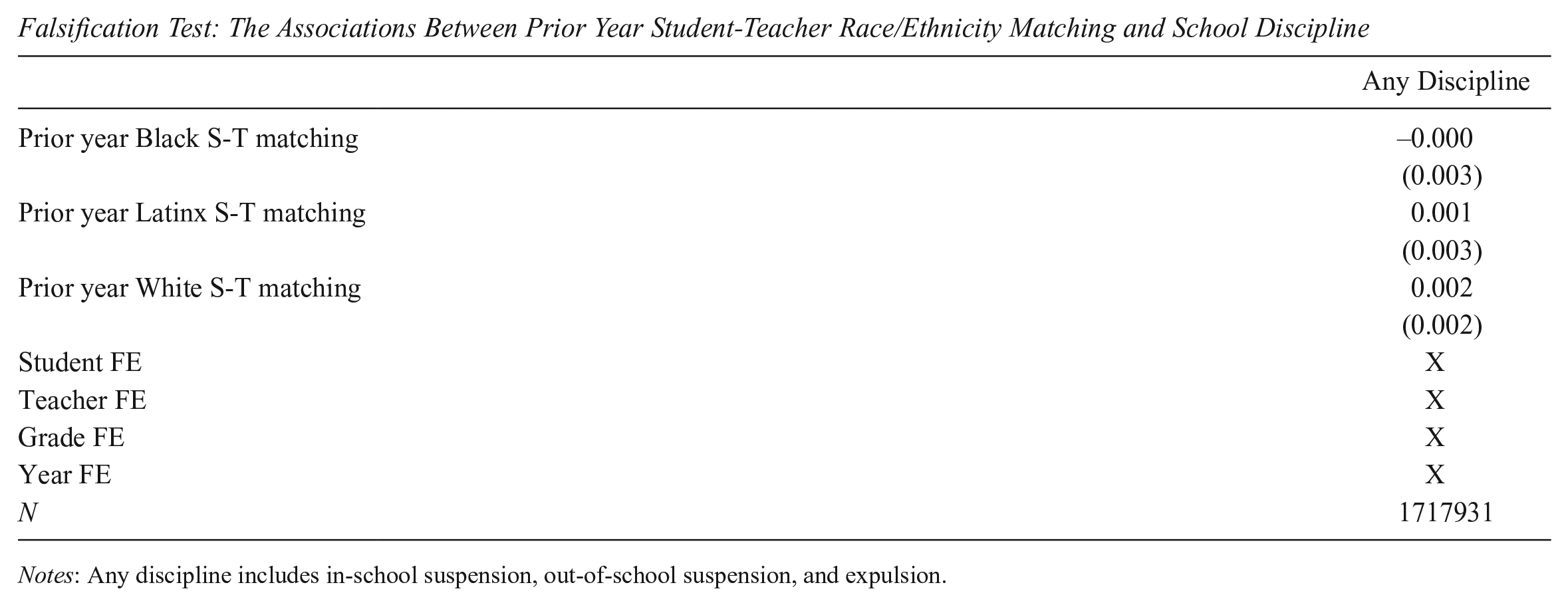
Our sorting tests suggest that some students are more likely to have teachers of the same race/ethnicity matching than others. Nevertheless, potential bias in our estimates may not be a serious concern because we find no evidence of systematic sorting. Additionally, our falsification test in Appendix Table 3 corroborates our main results. While teachers in general are more likely to view Black students as troublemakers (e.g., Okonofua & Eberhardt, 2015), Black teachers tend to have more favorable perceptions toward Black students (Bates & Glick, 2013; Fox, 2015; Gershenson et al., 2016; Monroe & Obidah, 2004). This positive perception may explain how Black teachers influence the disciplinary outcomes of Black students. Additionally, Black students may feel more connected with Black teachers who understand their cultural backgrounds and serve as role models (Delpit, 2006; Henry, 1994; Ladson-Billings & Henry, 1990; Villegas & Irvine, 2010), resulting in better behavior and reduced disciplinary rates. Given the reciprocal relationship between teacher perceptions and student behavior (Downey & Pribesh, 2004), both factors can collectively contribute to disciplinary outcomes.
Our findings imply that one way to improve school discipline is to provide opportunities for Black students to have Black teachers. Given that exclusionary discipline at such a young age could lead to a downward trajectory (Mittleman, 2018), culturally connected teachers, particularly for Black students with disciplinary histories, can be highly beneficial. Increasing the presence of Black teachers can be achieved in two ways: by maximizing the matching rates with existing Black teachers and by increasing the recruitment of Black teachers. In Indiana, nearly 40% of Black students have had at least one Black teacher, despite the limited overall representation of Black teachers at 3%. This high rate of race/ethnicity matching far exceeds what one would expect under random chance conditions. The data indicates the widespread use of the first strategy, though it’s worth noting that this high matching rate may, to some extent, be attributed to segregation. Given this context, even a marginal increase in the representation of Black teachers, even by a few percentage points, could lead to substantial improvements in Black student-teacher race/ethnicity matching rates.
We note that, however, a practice that merely focuses on teachers’ race/ethnicity requires caution (Cizek, 1995; Rezai-Rashti & Martino, 2010; Warikoo, 2004). Solely relying on teachers’ race/ethnicity for student-teacher assignments can potentially result in segregation. Given that interactions with diverse teachers and classmates offer invaluable experiences for all students, student-teacher matching practice can have hidden drawbacks. Additionally, if a school heavily depends on Black teachers to instruct Black students, Black teachers can face extra stress and burdens (Brockenbrough, 2012). Black students often face multiple challenges, including lower academic achievement and limited family resources (Levitt & Fryer, 2004; Loeb & Bassok, 2012; Monnat et al., 2012), which may contribute to teacher burnout and lower retention rates (Fisher, 2011; Geiger & Pivovarova, 2018).
A growing body of evidence suggests that student-teacher familiarity can play a critical role in student outcomes (Hwang et al., 2021; Hwang & Kisida, 2022; Hill & Jones 2018). Interventions and practices that allow all teachers to know and understand students better can be a potential way to improve disciplinary outcomes without concern about the hidden costs of student-teacher demographic matching. Considering our findings that Black student-teacher matching primarily influences teacher discretion infraction, such as defiance and profanity, teacher training that focuses on emphatic mindsets can also improve disciplinary practice (Okonofua et al., 2016, 2020).
For Latinx students, we do not find that racial/ethnic congruence between students and teachers is associated with disciplinary outcomes. Our findings for Latinx students aligned with prior studies that show that having a teacher of the same race/ethnicity leads to neither higher teacher expectations nor better achievement for Latinx students (Downer et al., 2016; Egalite et al., 2015; Hwang et al., 2023; Vinopal & Holt, 2019). One potential explanation of our finding is substantial variation across Latinx groups. Because immigration history, culture, and language can be very different across Latinx groups (Reardon & Galindo, 2009), lumping Latinx students from different backgrounds into a single category may fail to capture the cultural continuity and connections between students and teachers.
It is also plausible that the roles of Latinx teachers in Latinx students’ outcomes may vary across contexts, as qualitative work documents disproportionate criminalization of Latinx male students (Rios, 2011). We show suggestive evidence that the association between student-teacher Latinx matching and reduced disciplinary rates is more pronounced for males than females. This may be because Latinx male students often face stereotypes as troublemakers and place a strong emphasis on male pride (Ponjuan et al., 2012; Rios, 2011), making teachers of the same race/ethnicity more influential for them. Future studies with larger Latinx populations, such as those in Texas and California, are necessary to enhance our understanding of the effects of student-teacher Latinx matching on school discipline.
We find no main effects of race/ethnicity matching on school discipline for White students. However, we show that matching is associated with lower disciplinary rates for White students in high-minority, high-poverty, and underperforming schools. The roles of teachers of the same race/ethnicity may be pronounced when students are in an environment where they greatly need teachers who can play as role models and who understand and connect with them better. These results suggest that an emphatic mindset is valuable for all teachers, as teachers often interact with students from different backgrounds (Okonofua et al., 2016).
This study advances our understanding of the links between student-teacher race/ethnicity matching and school discipline, yet it has limitations. For instance, our models do not incorporate information regarding the use of escalating punishments for repeated minor behavior, which could introduce biased estimates. Additionally, school principals also play roles in exclusionary school disciplinary outcomes (Sorensen et al., 2022), yet our study does not provide insights into the effects of a school principal’s race/ethnicity on school discipline. Future research that addresses these limitations will enhance our understanding of the connections between race/ethnicity and disciplinary outcomes.
Educators’ perceptions and expectations and their interactions with students shape the educational trajectories of students (e.g., Alexander et al., 1987; Jussim, 1989). Because the teacher workforce in U.S. schools is predominantly White (Ingersoll & May, 2011; Kirby et al., 1999; U.S. Department of Education, 2017), Black students have few opportunities to encounter a Black teacher in their classroom. Our findings highlight the importance of focusing on pipelines to the teaching profession to help increase diversity. Moreover, our results underscore that effectively training all teachers to understand and connect with students from different backgrounds is essential to providing a more equitable learning environment.
Footnotes
Appendix Table 1
The Links Between Same Race and Ethnicity Teacher and Exclusionary Discipline
| (1) | (2) | (3) | (4) | |
|---|---|---|---|---|
| Any Discipline | Any Discipline | Defiance and Profanity | Nondefiance and Nonprofanity | |
| Student-teacher matching | –0.004 * | |||
| (ref. nonmatch) | (0.002) | |||
| Black S-T matching | –0.009 * | –0.007 *** | –0.001 | |
| (ref. nonmatch) | (0.004) | (0.002) | (0.003) | |
| Latinx S-T matching | 0.006 | 0.002 | 0.005 | |
| (0.006) | (0.003) | (0.004) | ||
| White S-T matching | –0.003 | –0.003 | –0.000 | |
| (0.003) | (0.002) | (0.003) | ||
| Teacher experience | –0.000 | –0.000 | 0.000 | –0.000 |
| (0.000) | (0.000) | (0.000) | (0.000) | |
| Teacher graduate degree | –0.000 | –0.000 | –0.001 | 0.000 |
| (0.001) | (0.001) | (0.001) | (0.001) | |
| FRL | 0.002 *** | 0.002 *** | 0.001 * | 0.001 ** |
| (0.001) | (0.001) | (0.000) | (0.001) | |
| ELL | 0.006 *** | 0.006 *** | 0.002 ** | 0.004 *** |
| (0.001) | (0.001) | (0.001) | (0.001) | |
| SPED | 0.005 *** | 0.005 *** | 0.002 ** | 0.004 *** |
| (0.001) | (0.001) | (0.001) | (0.001) | |
| Achievement (school level) | –0.007 ** | –0.007 ** | –0.003 | –0.005 ** |
| (0.003) | (0.003) | (0.002) | (0.002) | |
| Prop. Black (school level) | –0.000 | –0.000 | 0.000 | –0.000 |
| (0.000) | (0.000) | (0.000) | (0.000) | |
| Prop. Latin (school level) | 0.000 | 0.000 | 0.000 | 0.000 |
| (0.000) | (0.000) | (0.000) | (0.000) | |
| Prop. FRL (school level) | 0.000 *** | 0.000 *** | 0.000 *** | 0.000 * |
| (0.000) | (0.000) | (0.000) | (0.000) | |
| School size | –0.000 | –0.000 | –0.000 | –0.000 |
| (0.000) | (0.000) | (0.000) | (0.000) | |
| Constant | 0.034 *** | 0.034 *** | 0.007 | 0.027 *** |
| (0.006) | (0.006) | (0.004) | (0.005) | |
| Student FE | X | X | X | X |
| Teacher FE | X | X | X | X |
| Grade FE | X | X | X | X |
| Year FE | X | X | X | X |
| N | 2564820 | 2564820 | 2564820 | 2564820 |
Notes: FRL = free or reduced-price lunch eligibility; ELL = English language learners; SPED = enrollment in special education service. Additionally, we control for years of teaching experience, whether teachers have graduate degrees, school-level achievement, school-level proportion of Black and Latinx students, school-level proportion of FRL, and school size. Standard errors in parentheses are clustered at the school level. *p < 0.05, ***p < 0.001.
Appendix Table 2
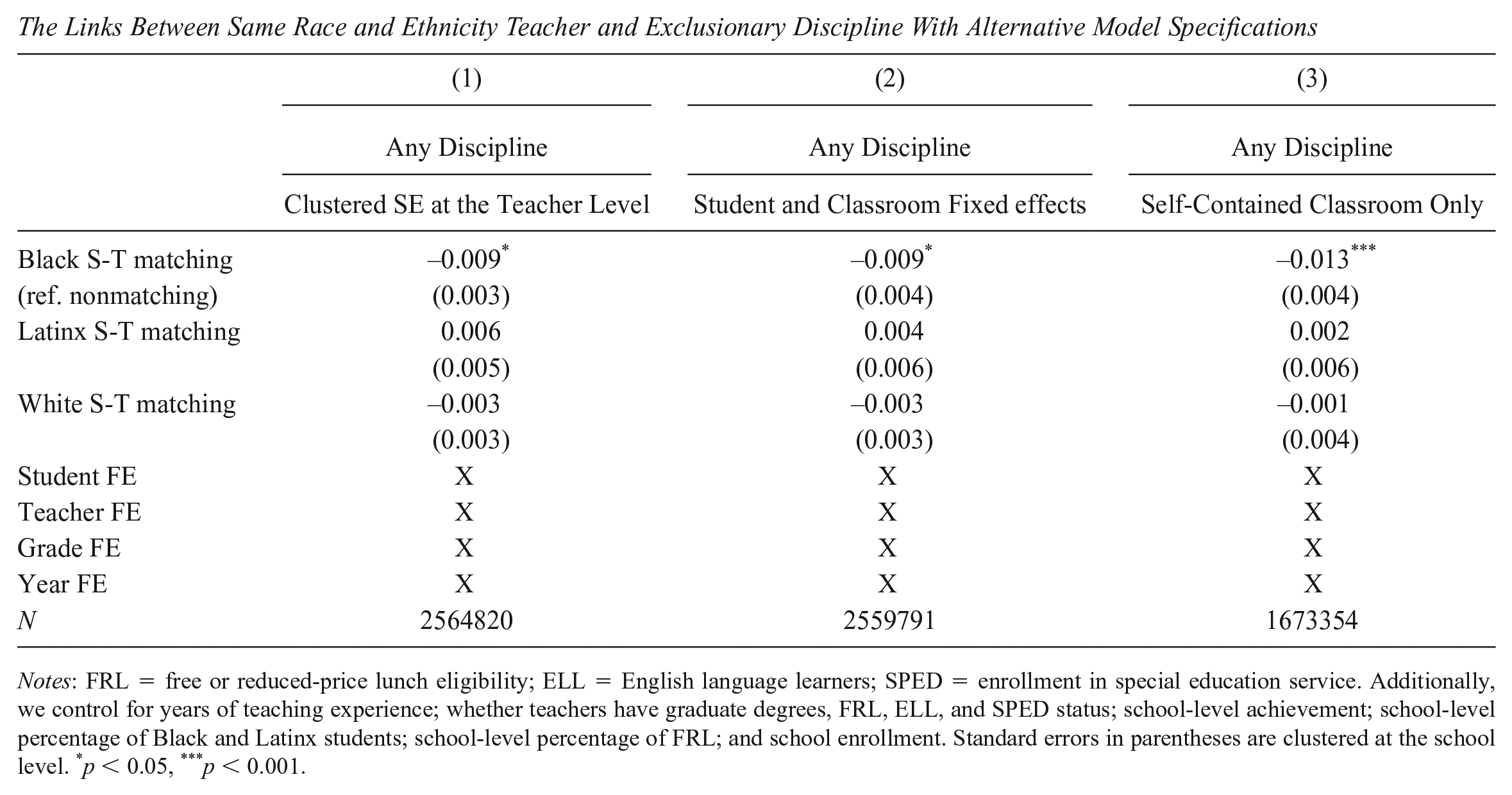
The Links Between Same Race and Ethnicity Teacher and Exclusionary Discipline With Alternative Model Specifications
| (1) | (2) | (3) | |
|---|---|---|---|
| Any Discipline | Any Discipline | Any Discipline | |
| Clustered SE at the Teacher Level | Student and Classroom Fixed effects | Self-Contained Classroom Only | |
| Black S-T matching | –0.009 * | –0.009 * | –0.013 *** |
| (ref. nonmatching) | (0.003) | (0.004) | (0.004) |
| Latinx S-T matching | 0.006 | 0.004 | 0.002 |
| (0.005) | (0.006) | (0.006) | |
| White S-T matching | –0.003 | –0.003 | –0.001 |
| (0.003) | (0.003) | (0.004) | |
| Student FE | X | X | X |
| Teacher FE | X | X | X |
| Grade FE | X | X | X |
| Year FE | X | X | X |
| N | 2564820 | 2559791 | 1673354 |
Notes: FRL = free or reduced-price lunch eligibility; ELL = English language learners; SPED = enrollment in special education service. Additionally, we control for years of teaching experience; whether teachers have graduate degrees, FRL, ELL, and SPED status; school-level achievement; school-level percentage of Black and Latinx students; school-level percentage of FRL; and school enrollment. Standard errors in parentheses are clustered at the school level. *p < 0.05, ***p < 0.001.
Appendix Table 3
Falsification Test: The Associations Between Prior Year Student-Teacher Race/Ethnicity Matching and School Discipline
| Any Discipline | |
|---|---|
| Prior year Black S-T matching | –0.000 |
| (0.003) | |
| Prior year Latinx S-T matching | 0.001 |
| (0.003) | |
| Prior year White S-T matching | 0.002 |
| (0.002) | |
| Student FE | X |
| Teacher FE | X |
| Grade FE | X |
| Year FE | X |
| N | 1717931 |
Notes: Any discipline includes in-school suspension, out-of-school suspension, and expulsion.
Acknowledgements
We thank Brian Kisida, Sabrina Solanki, Roberto Peñaloza, and Francis Huang for their feedback and contributions to this study. This paper was supported by Notre Dame’s Center for Research on Educational Opportunity (CREO) and the Institute of Educational Initiatives, and we express appreciation to CREO members for their comments and suggestions. We are grateful to the Indiana Department of Education for providing access to data. All errors are our own.
Declaration of Conflicting Interests
The author(s) declared no potential conflicts of interest with respect to the research, authorship, and/or publication of this article.
Funding
The author(s) received no financial support for the research, authorship, and/or publication of this article.

Notes
Authors
NAYOUNG HWANG is an assistant professor in the Department of Education at the University of New Hampshire. Her research focuses on the ways educational policies and practices affect student learning and development with a particular emphasis on school discipline, student-teacher relationships, and teacher workforce.
PATRICK GRAFF is a sociology Ph.D. candidate in the Center for Research on Educational Opportunity (CREO) and a Burns Fellow in the Program for Interdisciplinary Education Research (PIER) at the University of Notre Dame. His academic research broadly focuses on educational inequality, teacher turnover, the organizational conditions of K–8 schools, and the characteristics of beginning career teachers.
MARK BERENDS is a professor of sociology at the University of Notre Dame, where he is the Hackett Family Director of the Institute for Educational Initiatives, home to the Center for Research on Educational Opportunity (CREO). His mixed-methods research focuses on how school organization and classroom instruction are related to student outcomes, with special attention to marginalized students and educational policies and reforms aimed at reducing educational inequalities.