




Abstract
School discipline is a significant educational policy and equity issue in K-12 education in the United States due to well-documented racial inequality in students’ disciplinary outcomes and the deleterious effects of exclusionary discipline on academic and adult outcomes. The roles and approaches of school leaders in the production of racial inequality in exclusionary discipline warrant further inquiry. In this qualitative case study, we apply the theoretical lenses of politicized caring and internalized racism to 12 semi-structured interviews with Black principals and assistant principals in an urban emergent district in Southeastern U.S. to examine how Black school leaders make sense of and address racial disparities in school discipline. The findings illustrate that Black school leaders’ disciplinary perspectives and practices are complex with four major themes emerging: (a) deficit thinking and pathologization, (b) internalized racism, (c) politicized care as a disciplinary ideology and (d) politicized care in disciplinary practice. Uplifting the voices of Black school leaders reveals the pervasive nature of racism and the complex ways in which Black educators attempt to dismantle inequitable patterns. The findings highlight the need to create unique support for Black school leaders to enhance their disciplinary practices through mentorship, coaching and professional development.
School discipline is a significant educational policy and equity issue in K-12 education in the United States (U.S.) due to well-documented racial inequality in disciplinary outcomes and the deleterious effects of exclusionary discipline on student outcomes (Little & Welsh, 2022; Skiba et al., 2014; Welsh & Little, 2018a, 2018). The disciplinary experiences of Black students warrant particular attention given that Black students have borne the brunt of the disparities in school discipline—they get suspended the most, lose the most instructional time due to suspensions, and have a higher likelihood of being involved in the criminal justice system due to exclusionary discipline (Bacher-Hicks et al., 2019; Baggett & Andrzejewski, 2021; Davison et al., 2022; Losen & Whitaker, 2017; Welsh, 2021, 2022; Welsh & Little, 2018a, 2018). School leaders and teachers play an important role in the production and disruption of racial inequities in school discipline given their vast discretion to determine disciplinary consequences in response to perceived student misbehavior (Rodriguez & Welsh, 2022; Skiba et al., 2014; Welsh & Little, 2018). The diversity of school personnel may directly influence the interpersonal relationships between students and school staff, which in turn, have implications for how perceived misbehavior is addressed within schools (DeMatthews et al., 2017; Hughes et al., 2020; Lindsay & Hart, 2017).
The majority of studies on the role of educators in the disciplinary process (the organizational process capturing the sequence of events from perceived student misbehavior to disciplinary consequences) in schools have largely focused on teacher-related factors including teacher-student racial mismatch (Blake et al., 2016; Bradshaw et al., 2010; Grissom et al., 2015; Jordan & Anil, 2009; Lindsay & Hart, 2017), and teachers’ perceptions, beliefs, expectations, and bias of students (Atiles et al., 2017; Ferguson, 2001; Gregory & Mosely, 2004; Hines-Datiri, 2015; Okonofua & Eberhardt, 2015; Okonofua et al., 2016). A growing number of studies have investigated the disciplinary practices of principals and assistant principals and highlighted the importance of school leaders in how perceived student misbehavior is addressed (DeMatthews et al., 2017; Golann & Jones, 2021; Gray et al., 2017; Kennedy et al., 2017; Kinsler, 2011; Mukuria, 2002; Shabazian, 2020; Skiba et al., 2014; Sorensen et al., 2019; Wiley, 2021; Williams et al., 2020).
There is an urgent need for further research on the experience of Black school leaders in the disciplinary process and their impact on school discipline policies and racial disparities in exclusionary discipline. Black school leaders in the U.S. function in a social and schooling environment riddled with racialized tensions related to school discipline and safety that likely influence their disciplinary perspectives and practices. There is an increasing political recognition of the manifestations of White supremacy and racialized harm in schools, yet Black educators are still urged to play a key role in the enforcement of education policy that negatively impacts Black students (de Royston et al., 2021). Recent studies illustrate how Black educators positively support Black children through care (de Royston et al., 2017, 2021). Black school principals use culturally responsive practices, engage with surrounding communities, have high expectations and high support for Black students, and in general make a positive impact on the lives of Black students (Gooden, 2005; Horsford et al., 2021; Lomotey, 1989; Tillman, 2004; Walker & Byas, 2003), diversity does not necessarily result in justice, as educators and school leaders of color can also perpetuate systems of oppression, anti-Blackness, and White supremacy (Khalifa, 2015).
Most of the literature on school leadership focuses on White school leaders and lacks the perspective and practices of Black leadership (Gooden, 2005; Horsford et al., 2021). Although prior studies have highlighted the positive impact Black school leaders have on Black students’ lives through understanding, care, relationship building, and developing pathways for greater opportunities (Gooden, 2005; Kinsler, 2011; Lomotey, 1993; Tillman, 2004), little attention has been paid to how school leaders’ race may inform disciplinary practices and outcomes. Given increasing calls for diversifying the teacher and school leader workforce to reduce racial inequality in school discipline (Hughes et al., 2020; Lindsay & Hart, 2017; Shirrell et al., 2017; Welsh & Little, 2018b), a more granular understanding of the dynamic between Black students and Black school leaders in the disciplinary process is salient and timely.
In this qualitative case study, we examine Black school leaders’ perspectives on the disciplinary process, their own disciplinary practices, and the disciplinary experiences of Black students. We use semi-structured interviews with Black principals and assistant principals in a majority Black, “urban emergent” district (Milner, 2012; Welsh & Swain, 2020) in the Southeastern U.S to examine the ways race influences Black school leaders’ decision-making (disciplinary practices) and philosophy (disciplinary perspectives). The analyses are guided by the following research question: How do Black school leaders make sense of and address racial disparities in school discipline?
The resulting findings add to the limited number of empirical studies that problematize how Black educators address the disciplinary needs of Black students in the prevailing racial environment (Baggett & Andrzejewski, 2021; de Royston et al., 2017, 2021; Dumas & Ross, 2016). This study adds to the handful of qualitative studies on Black school leaders and their approach to school discipline disparities (DeMatthews et al., 2017; Goings et al., 2018; Khalifa, 2015). A richer understanding of the beliefs and practices of Black school leaders is of great value to educational leadership and school discipline literature, especially given that Black school leaders are often tasked to lead under-resourced schools serving Black students and families (Tillman, 2004). As such, insights from this analysis may inform the objectives and content of professional development and on-the-job support of school leaders as well as the curriculum of leadership preparation programs.
School Leadership, Race, and School Discipline
Student Behavior and School Leader Discretion
School leaders play an important role in judging whether student behavior is appropriate or warrants exclusion. Principals’ attitudes shape the use of exclusionary discipline (DeMatthews et al., 2017; Heilbrun et al., 2015; Mukuria, 2002; Skiba et al., 2014). What is deemed appropriate behavior is a challenging question given that behavioral norms and expectations are shaped by dominant ideologies (Golann, 2015; Golann & Jones, 2021; Little & Welsh, 2022). There is substantial variation in the disciplinary philosophies of principals within the same school district (Advancement Project, 2000). The race of school leaders may complicate how Black student behavior is viewed and responded to. For instance, it is possible for Black school leaders to deem student behavior appropriate because it cleaves to the norms of White supremacy rather than positive values such as kindness and non-violence.
A growing number of studies have provided insights about principals’ disciplinary practices (DeMatthews et al., 2017; Findlay, 2015; Golann & Jones, 2021; Kennedy et al., 2017; Wiley, 2021). DeMatthews and colleagues (2017) categorized the 10 principals in their study into three different groups when critically analyzing race and their responses to disciplinary infractions among Black students: (a) overt racial justifiers who relied on deficit views of Black children to justify harsh punishment, (b) rigid rule enforcers who used a neutral stance to maintain institutional racism towards Black students, and (c) flexible and cognizant disciplinarians who used discipline as a teaching and learning tool, considered the welfare of the students involved, and were responsive to students’ needs. School leaders also faced multiple dilemmas that made equity-oriented decision-making complex and challenging as school leaders attempted to support and provide safety for all students (DeMatthews et al., 2017). There is growing evidence of bias among school leaders in their disciplinary decisions (Jarvis & Okonofua, 2020; Shabazian, 2020; Sorensen et al., 2019; Wiley, 2021). Wiley (2021) found that principals understood discipline through a punitive framework and used different logics when disciplining Black as opposed to White students—Black students were criminalized by the principal which led to harsher punitive responses towards their behavior.
Black School Leadership
In the face of racism and White resistance, Black educational leaders have courageously navigated systems of White supremacy, anti-Blackness, and classism to advocate and provide for the needs of Black students (Horsford et al., 2021; Tillman, 2004). Cultural, ethnic, and racial connection and alignment influence how Black school leaders build relationships and improve Black students’ experience within schools (Tillman, 2004). Yet, relatively little attention has been paid to the voice and perspective of Black school leaders (Rivera-McCutchen, 2021). Lomotey (1989, 1993) found that African-American school leaders embody two identities/roles when it comes to their relationship with Black students: a bureaucrat/administrative role (developing goals, harnessing energy, facilitating communication, and managing instruction in order to ensure Black students are advancing in their education) and an ethno-humanist role (commitment, compassion, and confidence in Black students and the advancement of Black communities). Black school leaders practice both roles simultaneously, and their professional goals are often also personal in terms of providing an equitable education to Black students through instilling self-esteem, self-reliance, and racial and cultural pride (Lomotey, 1993; Tillman, 2004). Dantley (2009) highlighted the balancing act of African American school leaders in achieving the objectives of the district while dismantling racial discrimination at the school level.
More recent studies provide more intersectional insights into how care may be expressed by Black school leaders depending on gender and cultural practices. Bass (2020) writes that how Black male school leaders express care is often misinterpreted and is rooted in their experience as Black men. Black male school leaders (a) battled with their desire to express care and the societal pressure to mask their sensitivities, (b) expressed care through centering spirituality in their leadership, (c) took pride in their father-like roles in Black students' lives, and (d) practiced a type of “rough love” that is culturally congruent to their students’ experiences in order to gain trust and respect (Bass, 2020). In a literature review of studies focused on Black women principals, Lomotey (2019) finds that Black women principals express mothering, care, and culturally responsive leadership within challenging circumstances and are also grounded in daily spiritual practices. In a study of Black female students, Carter Andrews et al. (2019) found that Black girls had supporting and affirming relationships with Black female teachers who were identified as “othermothers” in that they take on a parental role for the Black female students by going above and beyond to care for their emotional, physical and academic needs as they navigate racialized and gendered inequitable experiences at school. A similar phenomenon may occur with Black female school leaders.
Black School Leaders’ Disciplinary Practices
Black school leaders can also emulate anti-Black beliefs and practices that maintain disparities (Khalifa, 2015). Khalifa (2015) interviewed parents and students about two Black principals in desegregated schools who were accused of being abusive and racist toward Black students. Khalifa (2015) found that the two Black leaders expressed race-neutral arguments to justify disproportionate punishment of Black students, internalizations of White supremacist beliefs pertaining to how Black students should behave, concerns about how White staff perceived them, and an othering of Black students from their own identities as Black men.
Many of the key themes that emerge in the literature on Black school leaders—care, relationship building, cultural congruence, approach to student behaviors, etc.—are related to school discipline; however, few studies examine the complex experiences and perspectives of Black school leaders and their potential impact on school discipline, with particular attention to Black students in the disciplinary process. Research on educators of color highlights the ability of Black and Latinx teachers to challenge, resist, and transform schooling practices (Lustick, 2017; Ross et al., 2016). Lustick (2017) drew attention to the role that non-White staff play in implementing restorative practices and Winn (2020) highlighted the challenge women educators of color face in balancing restorative justice and normal work responsibilities. Golann and Jones (2021) examined how principals in traditional and charter schools balance control and care in school discipline and found that the principals employed different strategies in striking a balance. Goings et al. (2018) suggest that Black school leaders often find themselves in a bind when it comes to school disciplinary decisions involving Black students, and they are forced to make decisions they recognize will harm a Black student by increasing their involvement with the school-to-prison pipeline. This process involves the reality that Black school leaders must understand, examine, and navigate their experience with “double consciousness”—the warring and irreconcilable identities when Black and American as theorized by Du Bois (1903)—within each disciplinary decision. There is a need to deeply investigate the school discipline approaches of Black school leaders within the context of long-standing racial disparities in school discipline outcomes.
Politicized Caring and Internalized Racism
We use the theoretical lenses of politicized caring (de Royston et al., 2017, 2021) and internalized racism (Kohli, 2014) to examine Black school leaders’ role in the disciplinary process in schools, with particular emphasis on their approach to disciplining Black students and addressing inequity in school discipline. Focusing on the experience of Black school leaders with racial discipline disparities requires a theoretical understanding of how Black educators make sense of educational inequity. Combining these two theoretical lenses draws attention to the tensions Black school leaders may grapple with as they navigate the disciplinary process in schools and resists the temptation to conceptualize the experience of Black school leaders with school discipline as monolithic. The combination of politicized caring and internalized racism captures the spectrum of how Black school leaders may resist and/or perpetuate systems of racial inequity and the complexity of Black school leaders’ lived experiences. On the one hand, Black school leaders could pursue politicized care through a deep understanding of and resistance to systemic anti-Blackness and a commitment to care for Black students’ needs. On the other hand, Black school leaders could internalize and perpetuate anti-Black deficit beliefs while practicing discipline in a way that continues to lead to racially disproportionate outcomes.
Politicized Caring
Similar to prior studies analyzing care in school discipline (Beneke, 2021; de Royston et al., 2017), this study frames care as a political act as schools and students are situated within larger systems of oppression and domination characterized by ideologies that foster marginalization. Politicized caring, as conceptualized by de Royston et al. (2017, 2021), draws upon theories of Black feminism and care in education to characterize the actions of “Black educators who were concerned with the vulnerabilities of Black children and how they experience racialized neglect in schools” (de Royston et al., 2021, pg. 74). The framework has four main components: (1) Political clarity, where Black educators express understanding of the institutional nature of oppression, increase awareness of racial injustices, and understand student behaviors within historical and structural contexts, (2) Communal bonds, when educators view students as family, extensions of themselves, and co-members of the classroom, (3) Potential affirming, where educators embrace the cultural practices of students, reject deficit/poverty narratives, and have high expectations of Black students, and (4) Developmentally appropriate, where educators do not adultify Black students but acknowledge their development and understand their vulnerabilities as children within racialized systems (de Royston et al., 2017).
Prior studies have highlighted the work of Black female educators who use politicized mothering, love, and healing to protect Black students from societal harm (McArthur & Lane, 2019). Black educators display a deep understanding of racial stereotypes and structural forms of racism and were able to position themselves in a way that helped Black students thrive in the school environment (de Royston et al., 2017, 2021). We apply politicized caring as an important lens to examine the powerful possibilities of racial congruence between Black educators and students. Expressions of politicized care within school discipline may include advocating for resources and practices that meet the needs of Black students, addressing student behaviors and through a problem-solving approach that identifies root causes of behaviors, expressing an understanding of how systemic and interpersonal racism influences behavior, relationship building, and culturally responsive practices.
Internalized Racism
Huber et al. (2006) define internalized racism as “the conscious or unconscious acceptance of a racial hierarchy in which whites are consistently ranked above People of Color…[and] the internalization of beliefs, values, and worldviews inherent in White supremacy that can potentially result in negative self or racial group perceptions” (pg. 2). Kohli (2013) operationalizes internalized racism among educators of color as: “(1) a phenomenon that, like racism, impacts all communities of color; (2) can be triggered by cumulative exposure to racism; and (3) results in the conscious and unconscious acceptance of a racial hierarchy where the culture, values, and beliefs of the dominant culture are prioritized over the cultural values and beliefs of racial minorities” (pg. 370). Given the endemic nature of anti-Black policing in the United States, relying on the belief that Black students must be controlled or punished in order to alleviate unjust conditions outside of school may also be an example of how racist ideologies and hierarchies are internalized (Kohli, 2013).
Similar to prior studies (Khalifa, 2015), we employ internalized racism to analyze how Black school leaders are enacting and experiencing school discipline. The “tough love” approach to school discipline bears similarities with the ‘no excuses’ behavior management model in some charter schools (Golann, 2015). This study seeks to better understand this possible “double-consciousness” among Black school leaders when making disciplinary decisions or addressing disparities (Goings et al., 2018). We pay close attention to instances where the Black school leaders shared a belief or worldview that conforms to White supremacy, especially in terms of acceptable behaviors in schools.
Data and Methods
Setting
The study employs a single case study of an urban emergent district that provides “useful variation on the dimensions of theoretical interest” (Seawright & Gerring, 2008, p. 296). Peach State School District (PSSD) (a pseudonym) reflects the racial composition and school discipline trends facing urban districts. PSSD has less than 13,000 students enrolled with African American students accounting for 48% of the student population, followed by Latinx (25%), White (21%), Multi-racial (5%), and Asian (2%) students). As in other “urban emergent” districts nationwide (Milner, 2012; Welsh & Swain, 2020), school discipline is an important educational equity challenge in PSSD. Black and Latinx students are more likely to receive suspensions than their peers for similar infractions, and thousands of instructional days are lost to suspensions (Welsh, 2022b, 2022c). This is reflective of national concerns as the disparities in disciplinary outcomes are fairly consistent across all settings and grades indicating a systematic problem that starts as early as preschool (Skiba et al., 2014). In addition to the high prevalence of and disparities in exclusionary discipline, the diversity of school leadership in PSSD makes it an appropriate case to study Black school leadership and school discipline. Nationwide, data from the 2017–18 school year indicates that most principals are White (78%) and female (54%)—only 9% of principals are Latinx and 11% are African American (National Center for Educational Statistics, 2019). In PSSD, roughly half of principals (and assistant principals) in PSSD are African American. Overall, PSSD provides a fertile case to mine analytic generalizations (Yin, 2014) about Black school leaders’ disciplinary practices given that it is majority Black school leaders and Black students in an ‘urban emergent’ district with a high prevalence of disparities in exclusionary discipline.
Data Collection
The primary data source for this study is semi-structured interviews. Interviews allowed participants to share their perspectives on school discipline and their practices within schools and provided a forum for them to share not only their views but also their underlying rationales. We use interviews with Black school administrators to provide a detailed, insider’s perspective of the school discipline practices and processes as well as the challenges and considerations involved in navigating this complex socio-ecological process riddled with disciplinary moments and vulnerable decision points (Girvan et al., 2017; Vavrus & Cole, 2002). Similar to prior studies (Golann & Jones, 2021), we focused on school leaders in the same district that allows for consistency in the district context, and employed maximum variation sampling in order to understand and capture the spectrum of possible approaches to school discipline among Black school leaders across schooling levels, school composition, and the prevalence of and disparities in exclusionary discipline. The sample of participants was restricted to Black principals and assistant principals and represented a variety of contexts and perspectives with school leaders in elementary, middle, and high schools.
The recruitment approach consists of individual formal recruitment emails to selected participants. School principals were recruited via email and phone to confirm school participation. The school leaders in this study were selected based on the following criteria: (a) administrators identified as Black and (b) administrators who worked in schools with over 50% Black students. The participants included: 6 principals (3 elementary schools, 2 middle schools, and 1 high school) and 1 assistant principal (elementary). Almost all the interviewees had or were in the process of obtaining graduate degrees. A total of 12 semi-structured interviews were conducted with 7 participants including initial interviews and a handful of follow-up interviews that delved deeper into emergent themes. Table 1 provides a description of the participants.
Semi-structured interviews were conducted by the principal investigator and one of two research assistants. Interviews were conducted via telephone and each interview lasted between 60 and 90 minutes. Initial interviews were conducted in March 2018 with a few follow-up interviews in June 2020. Although follow-up interviews were conducted after the onset of COVID-19 pandemic, the scope and focus of the conversations remain focused on Black school leaders’ disciplinary practices and clarifying themes identified from the initial round of analysis. In an effort to conduct a quality interview, the following best practices were attended to as suggested by Kvale (1996) and Roulston (2010): (a) the extent of spontaneous, rich, specific, and relevant answers from the interviewee; (b) the shorter the interviewer’s questions and the longer the subjects’ answers, the better; (c) the degree to which the interviewer follows up and clarifies the meanings of the relevant aspects of the answers; (d) the ideal interview is to a large extent interpreted throughout the interview; (e) the interviewer attempts to verify his or her interpretations of the subjects’ answers in the course of the interview; and (f) the interview is ‘self-communicating’ – it is a story contained in itself that hardly requires much extra descriptions and explanations (Kvale, 1996, pg. 145). Similar to prior studies (Welsh, 2021), we acknowledge the limitations of conducting interviews via phone including the absence of significant nonverbal cues signifying responses and the rapport built through in-person interactions. Yet, phone interviews may have alleviated other concerns such as challenges around discussing issues of race given the researchers’ positionality (Welsh, 2021).
A master protocol, was developed and used to guide discussions with respondents. The interview protocol was designed to foster a granular understanding of: (a) educators’ perceptions of the contributors to the rates of and disparities in suspensions, (b) the infractions warranting disciplinary consequences and the process undergirding the response to infractions, (c) the extent of educators’ discretion and accountability in the disciplinary process, (d) available supports for addressing school discipline challenges, and e) the role of race and gender in the interactions among school leaders and teachers in the disciplinary process. Interview questions related to these areas of inquiry included: Why do you think discipline rates differ among schools within the district? If at all, how do you think your race impacts discipline responses/outcomes? If you think it does, can you think of a time when your race worked for you and a time when it worked against you? What types of resources are allocated to address school discipline disparities? How are best practices for behavior management shared within the school? We pay particular attention to the relational dynamics between students and adults. Interviews were recorded and transcriptions of these recordings, along with notes taken during the interview, were used to uncover themes. Given the politicized nature of school discipline, participants were reassured their identities would remain confidential.
Analytic Procedures
Each interview was transcribed using Descript software and then reviewed and edited by a researcher to ensure accuracy. Interviews were coded using Dedoose qualitative software. Analysis of the interview transcripts began with preliminary coding (Saldaña, 2021) by identifying and highlighting salient quotes within the interviews related to race, the discipline process, internalized racism, and politicized care. Two researchers identified quotes through a round of listening and then reading the transcript of each interview. Codes were then assigned for each quote reviewed by the researchers. Both researchers then conducted a second round of coding to come to a consensus on the final code.
Extensive measures were taken to ensure a high degree of intercoder reliability. Using a starting list of codes developed based on prior empirical literature and theoretical reviews (Little & Welsh, 2022; Welsh & Little, 2018b), the principal investigator and research assistant coded several transcripts independently and then compared coded transcripts to ensure consistency in the application of codes. For nearly all the interviews, both researchers (author and research assistant) were present and took notes. These notes were shared and compared after the interviews were completed, which led to multiple ‘‘norming’’ sessions (Glazar & Egan, 2016), used to ensure consistent interpretation and application of codes. Specifically, researchers, using both individual notes and transcripts, highlighted excerpts related to any of the codes in which we were interested. This led to a document wherein excerpts were grouped based on the codes by which they were identified. When there were divergences, transcriptions were revisited, and excerpts re-examined to achieve consensus.
Codes were then categorized based on patterns and similarities observed within and across interviews (Saldaña, 2021), keeping in mind possible patterns based on the characteristics of each interviewee including their gender (as self-identified by participants in interviews) and whether they lead an elementary, middle, or high school. Categories were then compared to distilled themes that reflect the nuanced experience of Black school leaders with race within the school discipline process (Saldana, 2021). The analytic approach of new codes and categories developed iteratively and inductively allowed for capitalizing on the robust data to explore existing notions while allowing new themes to emerge.
Positionality Statement
Dr. Richard Welsh. Bartell and Johnson (2013) noted that “we cannot separate ourselves from whom we are, and we recognize that our worldviews influence the privileges that we see as well as those that we do not see.” As the primary researcher, my positionality has been molded by my identity as a Black, heterosexual male as well as my personal life experiences growing up in Jamaica and living in the U.S. I am a tenured faculty member at a predominantly White institution (PWI) and have received my academic degrees from PWIs. I am a product of educational opportunity, and I am a proponent of the transformative power of education. Thus, my research focuses on equity and improvement, specifically how we can improve the experience, opportunities, and outcomes for traditionally marginalized and underrepresented students and change the trajectory of their lives. My identity as a Black father and researcher in education informs my interest in the disciplinary process and the complex experiences of Black school leaders.
Neha Sobti. My positionality is informed by my experience as an Asian-American, second-generation woman, and my own encounters with racism have led me to advocate for educational equity within my research and practice. As an Asian-American woman studying the experiences of Black school leaders in education, it is important to state that I have not directly experienced the violence of anti-Black racism. My experiences are informed by what Kim (1999) calls “racial triangulation,” a conceptualization of racial dynamics within the U.S. beyond the Black-White binary. Kim (1999) theorizes that Asian Americans are simultaneously valorized as a “model minority” and ostracized as a perpetual “foreigner” to maintain anti-Black racism and White superiority within society. Therefore, it is important that throughout my research, I utilize critical race methodologies and am attentive to how my racial positionality informs my lens and assumptions as I observe and interview those within and outside my race.
Results
The findings illustrate that Black school leaders’ disciplinary perspectives and practices are multi-layered. In many ways, these school leaders are tasked with navigating multiple tensions in their school discipline practices such as enforcing discipline policy in an environment of racialized harm against students of similar race/ethnicity, interacting with colleagues around polarizing issues of school discipline and race, and maintaining high academic standards for all students while also supporting the various social-emotional needs of marginalized student populations. The Black school leaders in this study are also often navigating their own beliefs around racism, school discipline, and their own childhood experiences with schooling. It is important to acknowledge that their opinions are not stagnant or fixed but a growing and developing framework as they reflect on their own internalized racism and ideologies.
Black educators are also not monolithic. Within our participant sample, Black educators’ disciplinary perspectives vary along several dimensions including but not limited to: (a) perceptions regarding contributors to racial inequality and school discipline, (b) responding to Black student behavior that does not align with expectations, (c) perspectives regarding how school discipline should occur, typically a punitive versus non-punitive/restorative viewpoint, (d) perceptions regarding the onus of behavior management and the alignment of behavioral expectations between educators and families, (e) perceptions on being prescriptive versus affording flexibility to address disciplinary infractions in the code of conduct. Below we discuss the four major themes that emerged from the interviews: (a) deficit thinking and pathologization, (b) internalized racism, (c) politicized care as a disciplinary ideology and (d) politicized care in disciplinary practice.
Deficit Thinking and Pathologizing
The findings reveal that some Black school leaders relied on deficit and pathologizing beliefs about Black students to understand racial discipline disparities in their district and school. Some school leaders blamed Black communities, families, and students themselves rather than school discipline practices for racial inequality in school discipline, despite evidence that differential treatment among educators drives discipline disparities (Owens & McLanahan, 2020; Welsh & Little, 2018b). These school leaders pathologize Black communities as experiencing higher levels of mental illness than other communities in order to explain racial inequity in school practices and outcomes. In the school leaders’ characterizations of certain Black students that are most often disciplined, perceived criminal behavior is linked to mental illness and assumed Post-traumatic Stress Disorder (PTSD). Despite occasional nods to systemic inequities, some interviewees’ understanding of Black student misbehavior leaned on an understanding of Black families as generationally criminal and mentally ill.
An African American, female, middle school principal captured this line of thinking when discussing the contributors to the racial disparities in exclusionary discipline: “There’s so many layers to school discipline. I say that because, you know, in this era, we are now faced with a lot of mental illness, and we’re seeing a lot of times what people don’t realize in PSSD is that we have generations of the same type of behavior. I’ve been in PSSD for about 12 or 13 years, and you can go through and see family members with some of the same behaviors, or you can see this progression of behaviors with certain students starting as early as elementary school. And then if you see them through on until adulthood, those are the same students that are committing serious crimes in the community. Now, whether we want to say that that’s a system problem, or whether we want to say that that’s a community issue, it’s hard to say because you can also go back and associate them with, you know, and I guess that’s why some parents don’t feel comfortable because they also had some of the same problems.”
In this school leader’s view, racial inequity in school discipline is linked to factors outside of the school system’s or educators’ control. This perspective relies on the pathologization of Black families and students in the school community–characterizing them as generationally mentally ill–to explain racial disparities in school discipline. Shifting blame for discipline inequity to Black individuals was a common theme throughout some of the interviews. School leaders also identified Black students who were labeled as persistent “troublemakers” as an explanation for racial inequity in school discipline– the belief being that overall disparities are the result of one or two Black students who are repeatedly suspended, shifting responsibility away from the system or school itself and onto students who exhibit behaviors that disrupt the learning environment. This is congruent with recent findings about school leaders’ notions about student misbehavior in schools concentrated on a few repeat offenders (EAB, 2019; Welsh, 2022b; Welsh, 2023). For instance, a survey of district administrators, school administrators, teachers, and support specialists highligthed that “district and school administrators tend to believe the issue is confined to a small percentage of students who have significant behavioral issues and are repeat offenders” whereas “teachers, on the other hand, estimate that nearly one-quarter of their students exhibit disruptive behavior” (p.5; EAB, 2019).
Academic deficits were also seen as a contributor to racial disparities in school discipline. A female middle school principal mentioned academic deficits as a main contributor to discipline disparities, stating, “students aren’t prepared for the work. So, they’re agitated. We’re asking students to present on grade level, work with some scaffolding. So, students know, they know they’re not prepared for what we’re asking them to do.” This argument relies on the deficit belief that inequities in school discipline are driven by higher rates of Black students misbehaving due to their lack of academic motivation and achievement. In fact, studies show that disparities in school discipline are the result of differential treatment to similar behaviors between Black and White students, not differences in behavior, and that the most salient factors driving disparities are school- and classroom-level practices (Skiba et al., 2002, 2014; Welsh & Little, 2018b). Systemic educational inequities leading to gaps in learning opportunities between Black and White students may cause frustration among Black students that can lead to resistant behaviors that are punished within schools (Okonofua et al., 2016). Yet this deficit belief orients the problem and solution of discipline inequities within the abilities and behaviors of Black students, instead of culturally sustaining or preventative practices of educators and school leaders. An alternative interpretation of the above quote encapsulates political clarity and an awareness of some of the intergenerational structural barriers that are ingrained in students’ disciplinary experiences.
Parent accountability versus school accountability in the management of student behavior was also an emergent theme related to deficit thinking about the capabilities of Black families. Participants identified ineffective parenting in terms of an inability to hold their child accountable, an absence of partnering with schools, and a lack of experience and parental background as key contributors to discipline disparities. A Black, female, middle school principal linked inconsistent parenting to persistently referred and disciplined students: “[W]hen I think about certain students and their behaviors, if the parents aren’t taking them for their visit and we are left to deal with the problem. And so that’s where we began to see the progression over years of problems. Because even when I think about some of the more severe behaviors, there was inconsistency with the parents, making sure that the kids were regularly seeing psychiatrists. And then some things too were just learned behavior. This is how we communicate in our home by allowing the siblings to fight each other or cursing each other out and things like that.”
The shifting of blame to families and parenting is consistent with a pathologizing belief that Black youth are more likely to learn misbehavior from their home environments and the deficit belief that Black parents are less likely to support their children adequately. These deficit and pathologizing beliefs lack the political clarity and potential affirming Black students need to thrive, especially in terms of Black students who are perceived as persistent troublemakers.
Internalized Racism
There were also notions of internalized whiteness among some of the Black leaders interviewed. The role of class and socioeconomic status especially among Black school leaders is nuanced. What emerged was the importance of class along with race in terms of cultural congruence, and some school leaders displayed conflict when discussing their own experiences and childhood in the school system. A Black, male school leader in his early 30s poignantly pondered on the role of race and class as more advantaged Black leaders interact with Black, working-class students: “Once you get to a certain level of financial capacity and social capital, as an African American, you may have come from the same hood as some of the kids but you get to this point that the behaviors that you also exhibited as a child now become a negative. Same things I did as a kid but I become this well-standing, citizen-adult because I code switched, I assimilated to what our society says that this is how you act as a Black male in America, you should talk this way, walk this way, then now look at the children who are doing the same exact thing I did as ‘whoa, look at those hood kids.'”
As the above quote illustrates, as Black school leaders, some of their own experience with advancement through the education and work system came with the need to assimilate into White, middle-class values and ways of being. In this way, internalization of whiteness provided safety and a path towards success for Black school leaders. However, this process of class advancement may cause Black school leaders to otherize Black youth from working-class backgrounds as their expectations for proper school behavior have changed throughout their own lives.
Some interviewees suggest that Black school leaders may mete out harsh disciplinary consequences to minority students to prepare them for a tough world. A Black, female principal shared a poverty disciplining belief (Fergus, 2017) that Black students must experience discipline in school in a way that is parallel to law enforcement in public places: “I’m going to have to, and I’ll tell parents, I have to treat this the way the police would treat it at Walmart. It’s a public place. Cause this is a public school. There has to be a consequence. We can’t let this go. Um, if you do it somewhere else in the community where people don’t know you, this is what happens. I know we have a relationship and I know your history and all of that. And that’s important. However, there are some things that you can’t do because if we let this go on, and you think it’s okay, then you do it outside of our school, neighbors may call the police…”
There was a sense among some Black school administrators that exclusion was key to maintaining a chaos-free learning environment. These school leaders placed an emphasis on holding students punitively accountable for their actions, in ways that mirror the inequitable treatment Black youth may experience within the criminal justice system. This logic is supported by the belief that through punitive discipline Black school leaders are expressing care towards Black youth by preparing them for the harsh, racist realities they will face in the real world.
Politicized Care as a Disciplinary Ideology
Some Black school leaders, majority female, expressed an ideology of politicized care towards Black students and school discipline in their school by: (1) Deeply acknowledging systemic inequities and barriers Black students face and (2) Consistently placing the responsibility for inequitable outcomes on schools, school leaders, and educators. Interviews revealed evidence of potential affirming and political clarity among the participants. Some Black school leaders highlighted the need for educators to reject deficit-oriented conceptions of the issues in school discipline. They also had an awareness that racial biases toward Black students among educators are a root cause of discipline disparities. Multiple interviewees discussed that educators have a misperception of Black student behaviors and that there is a lack of understanding and awareness of their own biases toward Black students. For example, a Black, female, middle school principal illustrated political clarity and noted that “We harp way too much on what these kids don’t have.” In demonstrating potential affirming and the importance of racial bias, a Black, female elementary school principal argued that there was “a lack of knowledge, acceptance, [and] awareness of bias and we see it in how your African-American males are viewed by adults in schools and how they choose to respond to behavior.”
A Black, female, elementary school principal who was eventually promoted to the district office highlighted how race and grade-level may be connected to the opposite of developmentally appropriate care: “When you look at PSSD and you hear people talk about students that are so aggressive and they’re physically aggressive, that it’s a danger that they’re scared of them, then you're typically talking about your African-American males, especially once they hit that middle and high school level, then yeah. There’s a level of fear from staff members of being willing to engage and being willing to try and de-escalate situations with them.”
Participants also highlighted the importance of communal bonds. Multiple school leaders interviewed acknowledged that there was a cultural disconnect between students in their county and the teachers being recruited, who were mostly White, female, and not from the district. There was an awareness that systems of teacher recruitment and teacher training were racially inequitable and contributed to conflict and harm toward Black students in the classroom. Black educators not from the district were also observed by the school leaders interviewed as having a disconnect from the students, expanding their understanding of cultural congruence to include race, class, and familiarity with living in an urban emergent environment. A Black, female, elementary school principal noted that, “Their personal feelings are getting in the way of them actually building those relationships and doing what they need in order to meet the needs of our students. A lot of this goes into building their own cultural proficiency and understanding, but then more than anything, you have to first address your biases.” There was a fervent acknowledgment across all school principals that a major contributing factor to school discipline disparities was implicit biases among teachers who had a cultural disconnect from students.
Politicized Care in Disciplinary Practice
Politicized care in the disciplinary process was also manifested in discipline practices and the interactional patterns between Black school leaders and teachers. This included school leaders engaging in conversations with teachers about identifying and unlearning biases and equitable discipline practices rooted in a problem-solving approach that accounted for individual student needs. A Black, female elementary school principal shared how she engages in coaching conversations with White teachers to identify and address their biases in order to create a positive environment for Black students. In a conversation with a teacher, she said, “We need to define what compliance is because I think what our kids present and what you think compliance is two different things. Because if they don’t present the way you want them to present, they are already out of compliance.” Participants highlighted that school discipline disparities are often caused by an incongruence between behavior expectations of educators relying on their own definition of misbehavior and Black students expressing culturally appropriate behaviors. Through these types of conversations, she shared that teachers at her school are taking more responsibility for academic and behavioral disparities.
Another Black female principal described talking to a teacher who often sent Black students to the office, modeling how to approach interacting with the student through the Social Emotional Learning (SEL) protocol utilized by the school: I go back to the essentials, even with the teachers, you know, where did we break down? And then we go through the protocol, did you do everything you were supposed to do before? We got to the place where you need to send them to the office, you know, have you conferenced, have you talked to the parents? Um, and if you’re not doing those things, I can help you do those things and we can do those together. But we’re going to follow the protocol that the school has set in place, kind of to take it back to our system rather than make it personal.”
The school leaders also use a problem-solving approach to discipline that replaces exclusionary measures. Participants seem to ensure communal bonds and political clarity through coaching, mentoring, and fostering non-punitive practices. The process includes collecting information about students and engaging in a problem-solving process with multiple stakeholders to identify the plan of action for the student. When talking to teachers, a Black school leaders notes that, “We provide them with as much information as we know about students. So if we’re seeing things and we’re finding out information and trying to talk to them about the ‘here’s some information that we learned’ or ‘a parent came in and shared this, so let’s talk about what, how this might impact the student and how we would address it’. So we try to be as proactive as possible when we have the information ahead of time. If we don’t, then making sure that they are looking at some underlying issues.”
Politicized care is characterized by the identification of root causes of misbehavior, a proactive stance toward school discipline, collaboration with families, and a willingness to change their own systems and practices in order to meet the needs of Black students. This approach to discipline is a form of potential affirming in that students are not labeled or repeatedly excluded or punished for causing harm but are held accountable through a process that is collaborative and supportive. The clarity the school leaders expressed on their racial equity stance in school discipline allowed them to practice their philosophy with clear alternative systems and consistent reiteration of expectations and support to teachers.
Discussion
This study adds to the robust school discipline literature by focusing on Black school leaders’ disciplinary perspectives, philosophies, and practices. The results add to a growing number of studies illustrating the importance of school leadership in racial inequities in school discipline (DeMatthews et al., 2017; Golann & Jones, 2021; Jarvis & Okonofua, 2020; Sorensen et al., 2019). We find that Black school leaders’ disciplinary perspectives and practices are complex with four major themes emerging: (a) deficit thinking and pathologization, (b) internalized racism, (c) politicized care as a disciplinary ideology and (d) politicized care in disciplinary practice. Uplifting the voices of Black school leaders reveals the pervasive nature of racism and White supremacy, manifesting in the ways that Black school leaders attempt to dismantle inequitable patterns. This study reveals that the pressure placed on school leaders of color, starting from their own youth, to assimilate into White behavioral expectations may create a sense of double consciousness in terms of how they and their students of color should navigate school and work. This may partly explain why Black students are still disciplined at higher rates than their peers in the participating schools despite being served by Black school leaders.
Similar to prior studies (Kennedy et al., 2017; Wiley, 2021), we found that some Black school leaders largely attributed discipline challenges and disparities to so called “frequent flyers”—students who have been repeatedly given an office referral, suspended or expelled. Congruent with insights from Okonofua et al. (2016), the school leaders that leaned on deficit ideologies the most did not express an understanding of the possible interplay between students and teachers that could lead to escalations in behavior. Prior studies highlighted that mostly White educators espoused colorblind and criminalizing beliefs about Black students in school discipline practices (Wiley, 2021). In our study, we find that Back school leaders can also adopt deficit thinking (a tendency to pathologize Black communities and perceive Black families to have low intellectual abilities, lack family involvement, or deprioritize education) and poverty disciplining (focusing on changing or controlling an individual student’s behavior is paramount to changing their inequitable conditions) beliefs that shape how they view the perceived misbehavior of Black students (Fergus, 2017; Gregory & Mosely, 2004). Black school leaders often relied on dominant deficit narratives around Black students, families, and communities involving their perceived lack of academic skill, mental health challenges, and inability to be effective caretakers to explain discipline disparities. This is congruent with prior studies highlighting the disciplinary experiences of Black boys (Dancy, 2014; Ferguson, 2001). This study expands on these findings by revealing the possible ways in which Black school leaders have internalized dominant, anti-Black narratives that facilitate racial disparities in school discipline.
The findings underline the complexity of the disciplinary experiences of Black school leaders. Similar to prior studies on Black principalship in general (Dantley, 2009; Khalifa, 2018; Rivera-McCutchen, 2021; Tillman, 2004; Wilson, 2016), this study suggests that there is notable heterogeneity among Black school leaders’ disciplinary perspectives and practices. Black school leaders’ disciplinary perspectives and practices are not monolithic by any stretch of the imagination. We find that some Black school leaders will be more empathetic and advocate for Black students (Gooden, 2005; Horsford et al., 2021) whereas other Black school leaders will embody “tough love” as a type of normalized anti-blackness in their disciplinary practices that result in racial disparities (Khalifa, 2015). Other Black school leaders may also be somewhere in the middle of the spectrum, either expressing both philosophies in different contexts or expressing their own self-evolution over time. Similar to prior studies (de Royston et al., 2017, 2021), some Black principals and assistant principals in our study combined protection with political clarity on the negative effects of systemic racism and White supremacy on Black students in order to successfully shield Black children from racialized harm and recharacterize them as worthy of care. Interestingly, the majority of these school leaders were female, meaning gender is also a factor in disciplinary approach among Black school leaders. Politicized care manifested among participants as a willingness to identify the root causes of discipline disparities both in engaging in transformational conversations with teachers and replacing exclusionary practices with more inclusive tools. In alignment with prior studies on Black principalship (Dantley, 2009; Tillman, 2004), our findings highlight the balancing of a set of tensions that Black school leaders navigate in the disciplinary process. Our results are congruent with the findings of Golann and Jones (2021) on the difficulties of balancing control and care. Indeed, it is plausible Black school leaders face unique challenges in responding to competing institutional logic.
Implications
The centering of Black educators reveals a few important implications for policy and directions for future research. First, supporting Black educators is a necessary accompaniment to initiatives to diversify the educator pipeline. The diversity of educators is necessary but not sufficient to eliminate racial inequality in education (Hughes et al., 2020; Khalifa, 2015). Rather, the findings highlight the need to create unique support for Black school leaders to enhance their disciplinary practices through mentorship, coaching, and professional development. This support could exist in leadership preparation programs where the internalization of racism could be unpacked in safe supportive ways with leaders of color. Just because educators are Black does not make them perfect superheroes whose support and well-being can be overlooked. As such, diversity efforts should be accompanied by an enhanced focus on on-the-job support, especially for Black and Latinx educators and school leaders who bear unique burdens and responsibilities in addressing student needs. Policymakers ought to focus not only on diversifying the educator pipeline but also providing support to these educators.
Description of Participants.
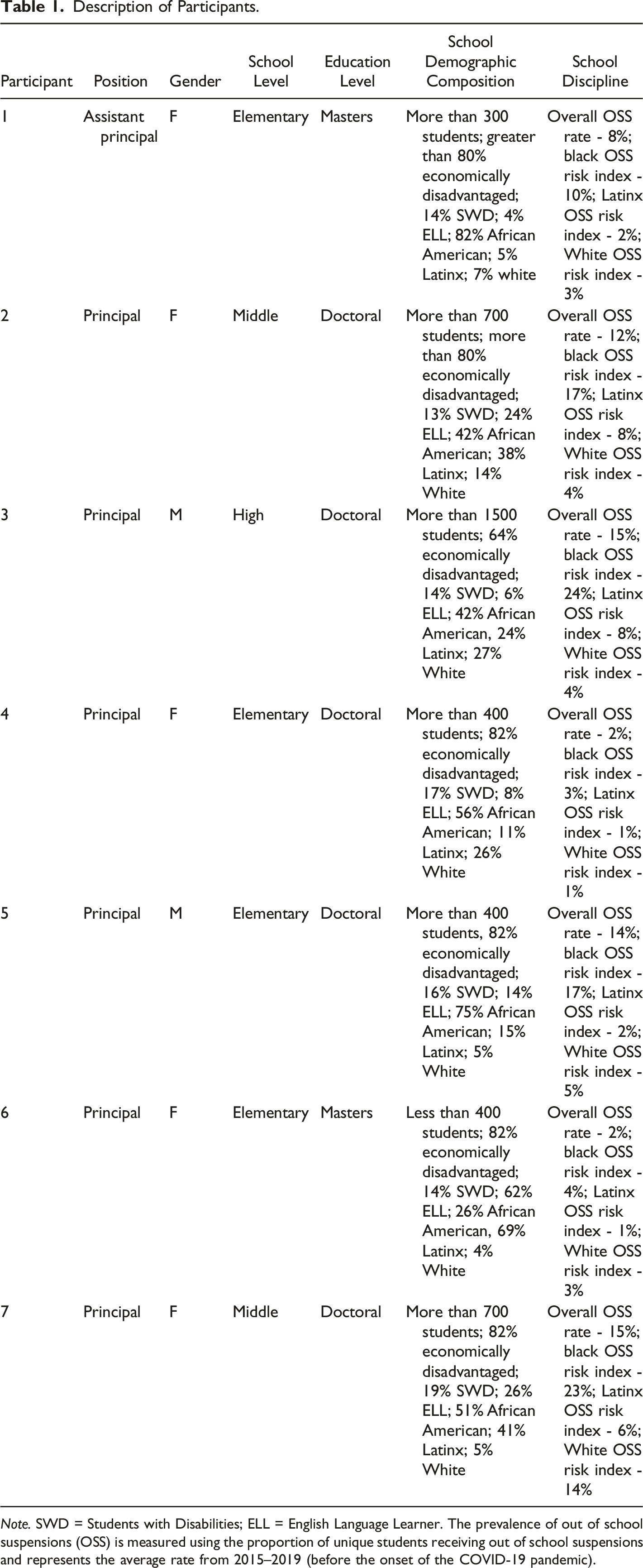
Note. SWD = Students with Disabilities; ELL = English Language Learner. The prevalence of out of school suspensions (OSS) is measured using the proportion of unique students receiving out of school suspensions and represents the average rate from 2015–2019 (before the onset of the COVID-19 pandemic).
Footnotes
Declaration of Conflicting Interests
The author(s) declared no potential conflicts of interest with respect to the research, authorship, and/or publication of this article.
Funding
The author(s) received no financial support for the research, authorship, and/or publication of this article.
