



Abstract
This quantitative study aims to explore the validity of Donohoo et al.’s (2020) Enabling Conditions for Collective Teacher Efficacy Scale (EC-CTES) for fostering collective efficacy in schools and evaluate its relationship to measures of collective teacher efficacy. The instruments used for this study include the EC-CTES, the Collective Efficacy Scale (CES-SF), and the Collective Teacher Beliefs Scale (CTBS). The data were evaluated through confirmatory factor analysis, correlation matrices, and multiple regression models. The findings from this study demonstrate that the EC-CTES is a valid tool. The EC-CTES subscales are positively associated with measures of collective teacher efficacy. We recommend adjustments for the EC-CTES subscales for greater congruence with collective efficacy theory and practical application. Due to the theoretical density of collective teacher efficacy, a modified conceptual framework is proposed to make the enabling conditions theory more accessible to practitioners.
Keywords
More than 2 decades of research have demonstrated that collective teacher efficacy has a significant effect on student learning, and numerous studies have explored environmental variables related to high levels of collective teacher efficacy (Donohoo, 2018; Donohoo et al., 2020; Eells, 2011; Hattie, 2016). After the 2016 Visible Learning Conference, the construct skyrocketed in popularity with educators, including educational leadership because it was cited as the top influence on student learning, outweighing such fixed variables as parental involvement and socioeconomic status by as much as three-fold (Hattie, 2016). Despite the vast array of work that explored variables related to collective efficacy, there was no cohesive framework for conceptualizing these variables, nor was there any indication as to what the prework, or enabling conditions, were for collective efficacy to take root in a school. Donohoo et al. (2020) aim to provide clarity by creating a framework for enabling conditions for collective teacher efficacy. Their corresponding quantitative survey proposes a synthesized framework educational practitioners could implement to foster collective teacher efficacy in their schools. Donohoo and colleagues (2020) develop and test the factor structure of the Enabling Conditions for Collective Teacher Efficacy Scale (EC-CTES) for measuring the presence of the enabling conditions, but prior to the present study, it has yet to be thoroughly validated and compared with other commonly used tools for measuring collective teacher efficacy. Although Donohoo et al.’s (2020) framework for fostering collective teacher efficacy provides a pathway for educational leaders to influence student achievement, no research has yet explored the relationship between collective teacher efficacy and the enabling conditions for collective teacher efficacy. Additionally, given that educational leaders’ time is often divided among multiple demands, if the overall theoretical framework can be made more concise, administrators may be more likely to apply it in their schools. To that end, our study examines the EC-CTES for validity and reliability by confirming its factor structure, calculating the reliability coefficient for its subscales, and examining each subscale in consideration of theory and practice.
Collective Teacher Efficacy
Collective teacher efficacy is “the collective self-perception that teachers in a given school make an educational difference to their students over and above the educational impact of their homes and communities” (Tschannen-Moran & Barr, 2004, p. 190). Collective teacher efficacy finds its roots in social cognitive theory, as it has evolved from studies on individual teacher efficacy. Researchers measure individual teacher efficacy through questionnaires eliciting teachers’ beliefs in their own ability to influence student learning (Tschannen-Moran et al., 1998).
In the early 1990s, collective school efficacy gained currency as a research construct when quantitative studies established it had a statistically strong and independent influence on student achievement over fixed contextual variables (Bandura, 1993). Bandura uses aggregate measures of individual teacher efficacy to examine the relationship among collective teacher efficacy, school-level achievement in reading and mathematics on standardized tests, and other school-level variables through path analysis. He finds that collective teacher efficacy is more predictive of student achievement than other fixed variables, such as student socioeconomic status and teacher longevity.
Collective efficacy theory and its measurement shifted to focusing on each teacher’s perception of the collective capacity of their school to influence student achievement rather than on a school’s combined average of individual teachers’ perceptions of their own teaching efficacy. Goddard and colleagues fashion a new tool for measuring collective teacher efficacy by pivoting item language from individual teacher efficacy perceptions of the future capability to individual perceptions of the group’s capability to execute a course of action to improve student achievement over fixed characteristics (Goddard & Goddard, 2001; Goddard et al., 2000). Researchers maintain that the sources of self-efficacy are the same when shifting from the individual to the collective (mastery experience, vicarious experience, verbal persuasion, and physiological and affective states) for selecting and encoding efficacy sources (Bandura, 1997, 2006; Goddard, 2002b; Goddard & Goddard, 2001; Goddard et al., 2000; Tschannen-Moran & Barr, 2004). In a multilevel analysis, collective teacher efficacy gains traction as a distinct construct from individual teacher efficacy when it is demonstrated to uniquely contribute to student achievement (Goddard & Goddard, 2001).
Most of the research on collective teacher efficacy focuses on identifying school variables that tend to correlate with high levels of collective teacher efficacy, despite the presence of challenging teaching circumstances. Collective teacher efficacy researchers typically measure student achievement by using standardized test scores and socioeconomic status or the proportion of students participating in free and reduced lunch programs as a measure of the degree of adversity in teaching circumstances (Bandura, 1993; Goddard 2001; Goddard et al., 2000, 2015; Tschannen-Moran & Barr, 2004). Twenty years of research have shown that collective teacher efficacy is a significant predictor of student achievement (Bandura, 1993; Goddard, 2001; Goddard et al., 2000, 2004, 2015; Hoy et al., 2002, 2006; Kurz & Knight, 2003; Moolenaar et al., 2012; Tschannen-Moran & Barr, 2004). Researchers have established that strong collective teacher efficacy is associated with enhanced individual teacher performance and influences shared beliefs held by organizational members (Goddard & Goddard, 2001; Goddard et al., 2000, 2004; Hoy et al., 2002; Klassen et al., 2008; Zaccaro et al., 1995). Across many settings, collective teacher efficacy is associated with group-level norms surrounding teachers’ beliefs about influencing student learning and therefore interacts with school culture (Klassen et al., 2008; Lee et al., 2011; Rauf et al., 2012). Schools with higher collective efficacy are also more likely to foster inclusive practices for students with behavioral struggles, students receiving special education services, and English learners (Gibbs & Powell, 2011; Haworth et al., 2014; Lyons et al., 2016; Tschannen-Moran, 2001; Urton et al., 2014). Overall, teachers in collectively efficacious schools tend to regard students as capable of high scholastic attainments as defined by the achievement goals of the school, and teachers are more likely to reward behaviors conducive to intellectual development (Bandura, 1997; Goddard et al., 2004, 2015; Hoy et al., 2002; Kurz & Knight, 2003; Tschannen-Moran & Barr, 2004).
The findings associated with collective teacher efficacy research are promising. However, previous researchers have anchored their findings on when collective teacher efficacy is present in relation to student achievement and myriad other environmental variables, but these studies offer few discernable systematic pathways for how leaders can support high levels of collective teacher efficacy in their schools (Adams & Forsyth, 2006; Klassen et al., 2008, 2011; Ross et al., 2004, Tschannen-Moran & Barr, 2004). Very few researchers have examined how to generate a cohesive framework of the specific conditions that foster collective teacher efficacy.
Instructional and Transformational Leadership
Education research has demonstrated that school leadership matters (Fullan, 2015). School leaders can positively affect teacher collaboration (Meyer et al., 2022), school climate (McCarley et al., 2016), and organizational commitment (Jacobsen & Staniok, 2020). Transformational leaders are those who are perceived as having a clear attainable mission and vision, exude charisma and a strong sense of purpose, provide followers with a sense of hope and optimism, encourage creativity and innovation, and focus on the needs of individuals (Bass & Avolio, 1994). Instructional leaders are those who create shared academic purpose and goals, have knowledge of research-based teaching and learning, encourage continuous learning and high expectations, and facilitate a positive climate conducive to teacher collaboration (Hallinger, 2005). Research over several decades suggests that instructional and transformational leadership can have the greatest impacts on outcomes and, thusly, that all leaders should aspire to espouse transformational and instructional leadership behaviors (Eyal & Roth, 2011; Leithwood & Jantzi, 2005; also see Tan et al., 2022).
Salient to our study, instructional and transformational leadership behaviors can influence collective efficacy beliefs (Goddard et al., 2015; Ross & Gray, 2006a, 2006b). Fullan (2015) suggests that school leaders can leverage collective efficacy as part of meaningful school change by developing a true culture of collaboration rather than collaboration in name only. He further indicates that leaders should avoid superficiality in collaboration (e.g., by merely stating that a school uses professional learning communities on a school website); instead, leaders should focus on truly creating a culture of collaboration through systems transformation. Ross and Gray (2006b) examine the relationship between transformational leadership, teacher commitment to organizational values, and collective teacher efficacy, and their findings suggest that leaders should help teachers identify the cause-effect relationship between teaching behaviors and student achievement to help facilitate a self-correcting mentality toward the teaching task. They also suggest that leaders should assist teachers in outlining mastery experiences by helping teachers set challenging yet manageable goals.
More recently, Goddard et al. (2015) have examined the relationship among instructional leadership, formal teacher collaboration structures, and collective teacher efficacy beliefs. They define instructional leaders as those who have detailed knowledge of classroom practices and promote a positive learning climate. Teacher participants responded to an instructional leadership instrument targeting principals’ behaviors specific to instructional leadership, monitoring of classroom instruction, and openness to sharing leadership. Goddard et al. find that “teacher collaboration for instructional improvement [i]s a strong predictor of collective efficacy beliefs” (2015, p. 525) and that principals who are perceived as strong instructional leaders are more likely to promote formalized collaborative structures that focus on instructional improvement. Therefore, leaders seeking to support collective teacher efficacy beliefs should implement and support formalized collaborative practices.
An examination of Donohoo et al.’s (2020) framework suggests that leadership also matters when creating the conditions for collective teacher efficacy. Characteristics of instructional and transformational leadership are evident in the enabling conditions for collective efficacy. Donohoo et al.’s (2020) construct of supportive leadership behaviors focuses on teachers’ reflections on instructional practices and builds ownership over student achievement (Ahuja, 2007; Ross et al., 2004). Leaders assist teachers in such tasks by providing opportunities to interpret complex data and allowing them enough freedom to generate next steps, which, in turn, develops teachers’ intrinsic motivation and investment to improve student outcomes (Çalik, et al., 2012; Kennedy & Smith, 2013; Ross & Gray, 2006b). Leaders can also ensure that teachers have formalized structures for collaboration focused on instructional improvement (Donohoo, 2018; Goddard et al., 2015). For example, teachers tend to be more invested when leadership is distributed, and they believe that they can influence outcomes in the school (Goddard et al., 2004; Hargreaves & Fullan, 2012; Spillane, 2006). Overly bureaucratic structures tend to hinder teacher empowerment, are detrimental to teacher agency, and fundamentally impair their staff’s collective beliefs in their ability to influence student learning (Adams & Forsyth, 2006; Ross et al., 2004). In addition, leaders are critical for overtly setting the efficacy narrative for the schools they lead by ensuring a focus on sound instruction, limiting other distractions, and using verbal persuasion to encode successes as mastery experiences.
Enabling Conditions
Donohoo et al. (2020) propose the enabling conditions for collective teacher efficacy to describe malleable environmental factors within schools that are theoretically linked to high levels of collective teacher efficacy. This approach marks a pivot from what correlates with collective teacher efficacy to a cohesive theory for how to develop and support collective teacher efficacy. Shortly after collective teacher efficacy became a popular concept with educational leaders, Donohoo (2017, 2018) reviewed and synthesized several variables associated with collective teacher efficacy. In this research, Donohoo seeks to provide educational practitioners a blueprint for directly increasing collective teacher efficacy, which, in turn, could affect student achievement. Donohoo et al. (2020) have released a tool for measuring enabling conditions for collective teacher efficacy, positing that educational leaders could support collective teacher efficacy by focusing their efforts on five malleable antecedents: supportive leadership, empowered teachers, goal consensus, embedded reflective practices, and cohesive teacher knowledge (see Figure 4 in Donohoo et al., 2020). However, each of the enabling conditions exists in reciprocal causality with one another, and each of the conditions is not mutually exclusive from its counterparts, as is typical of self-efficacy theory (Bandura, 1997).
The EC-CTES (Donohoo et al., 2020) acknowledges the importance of leadership and leaders’ corresponding behaviors in systems through two distinct subscales: supportive leadership and empowered teachers. Supportive leadership references the perception that school leaders protect staff from extraneous tasks and distractions as well as recognize staff accomplishments (Donohoo et al., 2020). The EC-CTES also takes a more nuanced approach to leadership through not only the supportive leadership subscale but also the inclusion of the empowered teachers subscale, which gauges evidence of teacher leadership and agency. Researchers have demonstrated that teacher influence over instructionally relevant school decisions, teacher ownership over school processes, and teacher leadership correlate with collective teacher efficacy (Adams & Forsyth, 2006; Derrington & Angelle, 2013; Goddard, 2002b; Goddard et al., 2004; Ross et al., 2004; Ware & Kitsantas, 2007). A partnership among the key actors of school leaders and teachers is implied throughout the items on the Supportive Leadership and Empowered Teachers subscales.
The other three enabling conditions describe school practices. Embedded reflective practices reference “the processes by which teams work together to examine sources of student evidence to help inform their work” (Donohoo et al., 2020, p. 160). When implemented well, teachers habitually reflect on feedback from one another and from students to improve practices. Embedded reflective processes facilitate teachers in thoughtfully examining school data to inform courses of action at the school level and within their classrooms (Goddard et al., 2015; Gray & Summers, 2015; Lee et al., 2011; Ross et al., 2004; Voelkel & Chrispeels, 2017).
Cohesive teacher knowledge is evidenced by the level of awareness and agreement among staff about what constitutes effective teaching practices (Donohoo et al., 2020). To build cohesive teacher knowledge, leaders should sustain opportunities that increase staff interdependence in joint work surrounding current practices and targeted improvements in best practices (Cantrell & Callaway, 2008; Goddard et al., 2004; Gully et al., 2002; Little, 1990; Newman et al., 1989; Schechter & Qadach, 2012). Cohesive teams who share information tend to reach complex goals, leading to more mastery experiences (Locke & Latham, 2006; Ross et al., 2004).
Goal consensus indexes share ownership over processes for establishing direction (Donohoo et al., 2020). Organizations achieve goal consensus when each person understands their role in valuing and supporting efforts to achieve the larger school goals (Kramer et al., 2012; Ross et al., 2004; Young & Smith, 2012). Organizations with high collective efficacy set more challenging goals (Goddard, 2002a; Kurz & Knight, 2003; Tschannen-Moran & Barr, 2004). However, Ciani et al. (2008) caution that focusing solely on performance-oriented goals derived from achievement test scores may weaken teachers’ sense of community and cause teachers to implement more performance-oriented goals in their classrooms, which may undermine collective efficacy.
Donohoo et al.’s (2020) conceptual framework (see Figure 4 in Donohoo et al., 2020) for the five enabling conditions (supportive leadership, empowered teachers, embedded reflective practices, cohesive teacher knowledge, and goal consensus) centers on embedded reflective practices because it provides the platform for teachers to gain agency, strengthen evidence-based instructional practices, and reflect on areas for improvement. Empowered teachers, goal consensus, and cohesive teacher knowledge form a triangle surrounding embedded reflective practices. Empowered teachers is at the apex of the triangle because teacher leadership plays a prominent role in the overall framework through implementing embedded reflective practices, generating cohesive teacher knowledge, and enacting agency through goal consensus. Goal consensus and cohesive teacher knowledge form the base of the triangle. The reciprocal relationships are represented by double-ended arrows among the conditions. Finally, the four conditions described above are not possible without effective school leadership. For this reason, supportive leadership is included as a circle surrounding the relationships among the other four conditions.
Although the enabling conditions framework presents a cohesive description of research-based characteristics that influence collective teacher efficacy beliefs, it is not without its challenges. During Donohoo and colleagues’ (2020) validation study, the confirmatory factor analysis (CFA) demonstrated high intercorrelations among the five conditions, signifying a noteworthy overlap among the subscales. Supportive leadership and empowered teachers evidenced one of the strongest correlations, at .96. Additionally, cohesive teacher knowledge displayed a high level of correlation with embedded reflective practices (.93) and goal consensus (.88). It is not uncommon for self- and collective efficacy components to exist in mutual causality with one another (Bandura, 1997). However, examining the framework further could extrapolate nuances in the relationships among the subscales and uncover opportunities to make it more succinct for application in the field.
The Current Study
Although Donohoo et al.’s (2020) framework for fostering collective teacher efficacy provides a pathway for educational leaders to influence student achievement, more research is necessary to explore the relationship between collective teacher efficacy and the enabling conditions for collective teacher efficacy. Donohoo and colleagues (2020) test the factor structure of the EC-CTES for measuring the presence of the enabling conditions, but it has yet to be thoroughly validated with other commonly used tools for measuring collective teacher efficacy. The current study evaluates the EC-CTES from a practitioner’s perspective while vetting its reliability and validity. Furthermore, our research is a first step in examining how collective teacher efficacy measures relate to the EC-CTES. The two frameworks (collective teacher efficacy and enabling conditions for collective teacher efficacy) are linked together theoretically, but they have yet to be studied in tandem. Additionally, we aim to interpret theory, research, and findings throughout this study through a practitioner’s lens emphasizing educational leadership application in schools. Given that educational leaders’ time is often divided among multiple demands, if the overall theoretical framework can be made more concise and less nuanced, administrators may be more likely to apply it in their schools. The specific research questions guiding our work include the following:
What is the underlying factor structure of Donohoo et al.’s (2020) EC-CTES? Is the EC-CTES a reliable tool?
How does Donohoo et al.’s (2020) EC-CTES relate to measures of collective teacher efficacy?
Methodology
Participants
The researchers recruited participants for this study via email. The researchers sent the email to 2,852 public school principals in Illinois, requesting that they forward the survey to their staff. In total, 434 educators (full-time staff members with Professional Educator Licenses [teachers, administrators, and school support personnel]) participated in the study. There were 411 responses on the EC-CTES, 436 responses on the Collective Teacher Beliefs Scale (CTBS), and 339 responses on the CES-SF after the data were evaluated for completion. A total of 298 participants completed the full questionnaire. The researchers collected the data anonymously; therefore, the response rate for educators who received the survey is unknown. See Table 1 for the demographic characteristics of the sample.
Participant Demographic Characteristics

Instrumentation
The researchers examined the five subscales for the EC-CTES: supportive leadership, empowered teachers, embedded reflective practices, cohesive teacher knowledge, and goal consensus. Also, the researchers examined collective teacher efficacy with two instruments widely used in collective teacher efficacy research: the Collective Efficacy Scale (CES-SF) and the CTBS.
Enabling Conditions for Collective Teacher Efficacy Scale
Donohoo et al.’s (2020) EC-CTES is a 20-item instrument with five subscales measuring the variables of supportive leadership, empowered teachers, embedded reflective practices, cohesive teacher knowledge, and goal consensus. The items are equally distributed among the subscales, with four items representing each subscale. One item from the supportive leadership subscale was eliminated from the survey before distribution. Donohoo et al. (2020) state that the item references the idea that concerned leaders implement systems that support the other four enabling conditions, but the wording of the item references leadership care for staff members. Because the wording conflates “caring” with implementing effective systems and therefore would elicit a different idea of the construct from participants, it was eliminated from the survey. The survey uses a 6-point interval scale ranging from “strongly disagree” to “strongly agree.” There are four positive scale options (somewhat agree, agree, very much agree, strongly agree) and two negative scale options (strongly disagree and disagree).
Donohoo et al. (2020) conduct a confirmatory factor analysis on the proposed factor structure of the EC-CTES and find it to be valid and reliable, with a sample of 438 participants from 42 schools. The results indicate an acceptable fit on various indices. The composite reliability for empowered teachers (0.91), embedded reflective practices (0.84), cohesive teacher knowledge (0.86), goal consensus (0.88), and supportive leadership (0.93) is high. Additionally, Donohoo et al. (2020) argue that the tool has strong validity because of its alignment with previous research on collective teacher efficacy.
Collective Efficacy Scale
Goddard’s (2002b) CES-SF contains 12 items split equally between two subscales: task complexity and group teaching competence. Six items are phrased negatively, and six are phrased positively. Task complexity is defined as “perceptions of the constraints and opportunities inherent in the task at hand. It includes teachers’ beliefs about the level of support provided by students’ home and the community” (p. 100). Group teaching competence is defined as “judgments about the capabilities that a faculty brings to a given teaching situation. These judgments include inferences about the faculty’s teaching methods, skills, training, and expertise” (p. 100). Items are rated on a 6-point interval scale ranging from “strongly disagree” to “strongly agree.”
Goddard (2002b) has conducted a validation study with a sample of 452 teachers from 47 elementary schools from one large midwestern school district to shorten the 21-item CES-SF and finds it to be internally consistent with a Cronbach’s alpha of .94 (Goddard, 2002b). Additionally, researchers find the CES-SF to have criterion-related validity with the original 21-item Collective Teacher Efficacy Scale the CES-SF was derived from (r = .98). The instrument demonstrates predictive validity in multilevel modeling, with collective teacher efficacy as a positive predictor of variation among schools in mathematics achievement.
Collective Teacher Beliefs Scale
Tschannen-Moran and Barr’s (2004) CTBS is a 12-item instrument for measuring collective teacher efficacy by using two subscales: instructional strategies and student discipline. Collective teacher efficacy is defined as “a faculty’s belief about its collective capability to influence student achievement” (p. 198). The instrument elicits responses regarding the school’s capacity for instructional strategies and student discipline. Items are rated on a 9-point Likert scale ranging from “none at all” to “a great deal.” The CTBS has demonstrated high reliability (Cronbach’s α = .97) when validated in a study with a sample of 49 middle schools in Virginia. A multiple regression analysis reveals that the scale has significant positive correlations with student achievement in math, writing, and English. Additionally, collective teacher efficacy measures are uncorrelated with the socioeconomic status of the school, which is theoretically consistent with the construct.
Procedure
The researchers sent an introduction email along with a link to the surveys via a Qualtrics questionnaire to 2,852 public school principals in the state of Illinois. The email asked principals to forward the survey to their staff. Participating educators completed the survey during the COVID-19 pandemic, but most, if not all, schools had returned to in-person learning at the time the surveys were sent. Thus, participants were well positioned to effectively answer these questions. Copyright permission to distribute the surveys was obtained when necessary, and all procedures and survey materials were vetted and approved by a university institutional review board. Participants also gave informed consent upon beginning the survey and were able to exit the study and survey at any time by simply closing their Internet browser.
Results
As mentioned previously, the researchers discarded incomplete cases from all analyses, resulting in a final sample of 298 educators (full-time staff members with Professional Educator Licenses [teachers, administrators, and school support personnel]). See Table 1 for the demographic characteristics of retained participants. Table 2 lists descriptive statistics for the 19 EC-CTES items. Table 3 displays the correlation matrix of the subscales from the EC-CTES, CTBS, and CES-SF.
Descriptive Statistics for EC-CTES Scale Items

Note. Individual item wording redacted due to copyright; item 9 removed from scale. EC-CTES = Enabling Conditions for Collective Teacher Efficacy Scale; M = mean; SD = standard deviation.
Correlation Matrix of Subscales Used in the Current Study

Note. Values along the diagonal indicate McDonald’s ω values (in italics). CES-SF = Collective Efficacy Scale Short Form; CTBS = Collective Teacher Belief Scale; EC-CTES = Enabling Conditions for Collective Teacher Efficacy Scale. All p-values are significant at the p < .001 level.
Confirmatory Factor Analyses
The researchers conducted a series of nested CFAs to test the hypothesized factor structure of the EC-CTES against theoretically meaningful alternatives. Table 4 contains fit indices from the models tested. An initial CFA was conducted with the five subscales of the EC-CTES uncorrelated with each other. This model resulted in a poor fit. A second model allowed the EC-CTES subscales to correlate freely. This resulted in significantly improved fit over the uncorrelated model, χ2(10) = 1287, p < .001, and overall acceptable fit.
CFA Model Fit Indices

Note. BIC = Bayesian information criterion; CFA = confirmatory factor analysis; CFI = Confirmatory Fit Index; df = degrees of freedom; RMSEA = Root Mean Square Residual; SRMR = Standardized Root Mean Square Residual.
As discussed in the introduction, previous research has suggested that the relationship between leaders and teachers is reciprocal. That is, without supportive leadership, teachers cannot feel empowered (Donohoo et al., 2020). Additionally, in the current study and the initial development study of the EC-CTES (Donohoo et al., 2020), the correlations between supportive leadership and empowered teachers are high (r = .96), suggesting that the measures may be measuring the same underlying construct. Supportive leadership and empowered teachers are defined in relation to each other rather than as discrete constructs. As a result, the next CFA model constructed consists of a higher-order factor consisting of supportive leadership and empowered teachers. This model is thus labeled the four-factor model (i.e., higher-order factor, goal consensus, cohesive teacher knowledge, and embedded reflective practice). This model has significantly better fit than the uncorrelated model, χ2(8) = 1277, p < .001, but significantly worse fit than the five-factor correlated model, χ2(2) = 10, p = .007.
Because of the high correlation between the higher-order factor and goal consensus subscales in the four-factor model (r = .85), another CFA was constructed with goal consensus being included in the higher-order factor. That is, this model consists of three factors: the higher-order factor, cohesive teacher knowledge, and embedded reflective practice. This model has significantly better fit than the uncorrelated model, χ2(6) = 1242, p < .001, but significantly worse fit than the correlated five-factor model, χ2(4) = 45, p < .001, and the four-factor model, χ2(2) = 35, p < .001.
Next, the researchers constructed a CFA model with the higher-order factor consisting of empowered teachers, goal consensus, and supportive leadership and a separate higher-order factor consisting of cohesive teacher knowledge and embedded reflective practice. This two-factor model has a significantly better fit than the uncorrelated five-factor model, χ2(6) = 1242, p < .001, but a significantly worse fit than the correlated five-factor model, χ2(4) = 45, p < .001, and the four-factor model, χ2(2) = 35, p < .001.
A CFA was constructed as a final alternative model, with all five subscales of the EC-CTES combined into a single higher-order factor. This model has a significantly better fit than the uncorrelated model, χ2(5) = 1163, p < .001, but a significantly worse fit than the correlated five-factor model, χ2(5) = 124, p < .001, and the three-factor model, χ2(3) = 114, p < .001.
Although the fit for the correlated five-factor model is significantly better than that of the four-factor model, the differences between these models are modest. Because there are no differences between the fit indices (except for χ2 and Bayesian information criterion (BIC) and because of the strong theoretical reasons to consolidate empowered teachers and supportive leadership, the four-factor model was selected as the final model for the EC-CTES. In an absolute sense, the four-factor model has an acceptable fit according to the Confirmatory Fit Index and Root Mean Square Error of Approximation and a good fit according to the Standardized Root Mean Square Residual (see Table 4). Thus, the data in the current study support the factor structure proposed by Donohoo and colleagues (2020). See Figure 1 for the final model path estimates.

Final CFA model with standardized path estimates.
Validity Analyses
Convergent and Divergent Validity
Having confirmed the factor structure of the EC-CTES, we next examined the zero-order correlations between the EC-CTES, the CTBS, and the CES-SF to assess the convergent and divergent validity of the EC-CTES. Based on previous research (Donohoo, 2017, 2018; Goddard, 2001; Goddard et al., 2000, 2004, 2015; Hoy et al., 2002, 2006; Klassen et al., 2008; Kurz & Knight, 2003; Moolenaar et al., 2012; Tschannen-Moran & Barr, 2004), the researchers generated predictions about the interrelationships between the EC-CTES, the CTBS, and the CES-SF (see Table 5). Of the 17 predicted relationships between the EC-CTES and other validity measures, five of these predictions were inaccurate with respect to the strength of their relationships. Of these relationships, four involved the CTBS Instructional Strategies subscale having weaker than predicted relationships with the EC-CTES. This suggests that the CTBS Instructional Strategies subscale does not accurately capture the construct. Future validation work should confirm this with other measures of instructional strategies. In sum, the EC-CTES appears to have good convergent and divergent validity.
Predictions for Convergent Validity Relationships

Predictive Models Using the EC-CTES
Because the EC-CTES subscales are highly intercorrelated, a series of regressions were conducted to determine which subscales predict unique variance in the CTBS and CES-SF subscales. Specifically, the data were randomly split into two samples: a training sample and a testing sample. Because the final model selected contains a higher-order composite factor, we computed a subscale score for this factor (key actors). The three lower-order EC-CTES subscales (cohesive teacher knowledge, goal consensus, and embedded reflective practice) and the higher-order subscale were entered into a stepwise regression for each CTBS and CES-SF subscale, using the training sample. The predictor variables selected by the stepwise regression were then entered in the order suggested by the stepwise regression into a forced entry regression, using the testing sample. All final models have acceptable tolerances (tolerances > .50), suggesting no collinearity in the predictors. Additionally, Durbin-Watson tests suggest no issues with the independence of errors in any of the models, and residual plots suggest homoscedasticity for all models. Results for all models are displayed in Table 6.
Validity Regression Model Coefficients

Note. b-weights represent final regression model estimates rather than initial step estimates; conversely, ΔR2 values represent the variance accounted by each variable when initially entered into the model. CES-SF = Collective Efficacy Scale; CTBS = Collective Teacher Beliefs Scale.
The initial stepwise model contains embedded reflective practice and cohesive teacher knowledge, but further analysis revealed that these do not significantly improve R2. Thus, these variables are omitted from subsequent analyses.
p < .10. *p < .05. **p < .01. ***p < .001.
As displayed in Table 6, the key actors factor is found to be a significant positive predictor of educators’ beliefs in the school’s ability to support student learning (i.e., CTBS Instructional Strategies). Key actors scores are also found to be a significant positive predictor of educators’ beliefs in the school’s ability to manage classroom behaviors and educators’ beliefs about the community and environmental quality of the school with regard to student learning. Finally, embedded reflective practice is found to be a positive significant predictor of educators’ beliefs in the school’s ability to manage classroom behaviors and in the collective competence of the school’s educators concerning student learning outcomes.
Stepwise regressions further demonstrate that the subscales of the EC-CTES (embedded reflective practices, cohesive teacher knowledge, goal consensus, and the composite key actors subscale) have explanatory value for every subscale measurement of collective teacher efficacy (task analysis, group competence, instructional strategies, and student discipline). This finding suggests that school leaders seeking to augment student learning through bolstering collective teacher efficacy can dependably use the enabling conditions for collective teacher efficacy as a pathway to realizing their goal.
Discussion
The purpose of this paper is to examine the EC-CTES for validity and reliability by confirming its factor structure, calculating the reliability coefficient for its subscales, and examining each subscale in light of theory and practice. Using factor analytic techniques, our results suggest that a better theoretical model for the enabling conditions for collective teacher efficacy should combine the subconstructs of empowered teachers and supportive leadership. There is a high degree of overlap between these two subconstructs, and an examination of specific items on the EC-CTES suggests that there may be unnecessary redundancy. From a practical standpoint, the role of supportive leadership is not exclusively reserved for those with formal leadership titles. Distributed leadership research suggests that when formalized leaders share the decision-making responsibilities and create space for others to take on projects within their capacity, the organization benefits from multiple perspectives and increased follower commitment (Heck & Hallinger, 2009; Spillane, 2006). Leadership itself may best be understood as a construct of social and relational influence within an organization (Spillane, 2006). Neither supportive leadership nor empowered teachers are contingent on the job descriptions assigned to those who embody them. They are mutable and dependent on the context-specific relationship that exists among any variety of supporting and empowered stakeholders seeking to improve educational outcomes, including community members, parents, board members, students, colleagues, building and district administrators, and so forth. Teachers may also feel empowered due to a vacuum of leadership or the absence of a leader. This demonstrates that the relationship between teachers and leaders is reciprocal and not necessarily hierarchical, as the absence of one still affects the other. Empowered teachers and supportive leaders are both key actors in enabling collective efficacy; therefore, we propose that this newly combined subconstruct be called “key actors” to emphasize the reciprocal supporting and empowering relationships, or lack thereof, that generate collective efficacy in a school system rather than the formal titles and bureaucratic roles assigned to administrators and teachers.
Shifting the construct language to key actors places the focus on the relationship between leaders and teachers because neither can exist as a mutually discrete variable in support of collective teacher efficacy (see Figure 2 for the adjusted framework). Further, when leadership is effective, it is subtle and often ubiquitous enough not to draw attention to itself, and when teachers are empowered, it is because those with organizational influence and capital have created space for them to be (Adams & Forsyth, 2006; Derrington & Angelle, 2013; Ross et al., 2004). One quality of effective leadership is that when systems are running smoothly, people may not notice or credit the role that leadership plays. This perception may be in part because it is difficult to quantify the critical role supportive leadership plays in inspiring agency in others. Formalized school leaders can be paramount in fostering supportive leadership and an environment conducive to collective efficacy. However, we propose that the EC-CTES framework is more practical for application in schools by shifting the focus away from role-contingent behaviors to the relational reciprocity generated through a context-specific balance of support and empowerment among any mixture of key actors in the school environment. In other words, there is much to be gained from focusing the framework on developing supportive and empowering relationships throughout school systems. Also, it reduces the cognitive load necessary for applying the framework from five components to four.
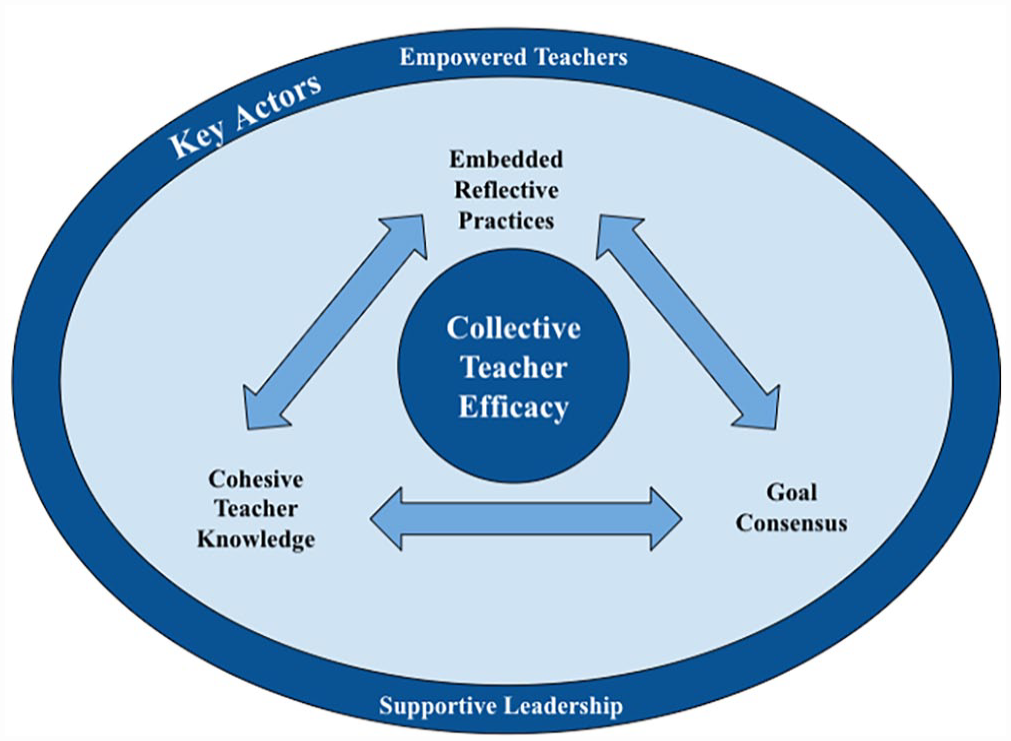
Adjusted framework for Enabling Conditions for Collective Teacher Efficacy Scale.
Associations With Collective Efficacy
The second part of the data analysis for this study examines associations among the four enabling conditions with existing measures of collective efficacy. To our knowledge, this is the first study to examine how preconditions are associated with the desired efficacy outcome.
Several EC-CTES subscales are positively and significantly related to group competence, a measure of collective efficacy. For example, embedded reflective practices, cohesive teacher knowledge, goal consensus, and empowered teachers are all positively associated with participants reporting that teachers in their school can get through to difficult students, can motivate students, can produce meaningful learning, and do not easily give up on students. Because our research is cross-sectional and not longitudinal, it is impossible to know whether collective efficacy and the enabling conditions for such efficacy go hand in hand or whether the enabling conditions do indeed cause the collective efficacy to be higher. Further research is needed to examine these associations.
Goal consensus, embedded reflective practices, and supportive leadership are positively and significantly associated with participant reports that teachers in the school make student expectations clear, can minimize disruptive behaviors, and make all students feel safe and welcome. The relationship among collective teacher efficacy levels as measured by the student discipline subscale and the three identified EC-CTES subscales could possibly be due to greater staff consensus around what behavior management ought to look like in a school and the ability to clearly recognize tangible signs of it in the learning environment. Additionally, a role of supportive leadership may be to help teachers maintain order in their classrooms and assist in de-escalating challenging situations when they occur. Goal consensus surrounding what behaviors are acceptable and conducive to learning creates coherence and positive normative pressure in the school environment. Ongoing embedded reflective practices for reinforcing productive learning behaviors, such as executive functioning, may bolster teachers’ confidence in implementing student discipline. However, further research is necessary to explore this hypothesis and extrapolate the relationship among these subscales.
Empowered teachers and supportive leaders are positively and significantly associated with what is referred to as “task analysis,” although the name of that subscale is a bit misleading. As measured, task analysis refers to participants’ views that students come to school ready to learn, the community supports student learning, and the home environment supports learning. Concerning the results of this study, this means that as teachers feel more empowered and supported by their leaders, they are more likely to view students as well as community and parental support of students in a positive light. Although it is reasonable to think that if students come from supportive environments, then teachers’ jobs are easier in the classroom—and that could be the case here—it is also feasible to consider that because teachers feel empowered and supported within the school, home and community supports, or lack thereof, are not influencing the classroom as much as they might for a teacher who feels less empowered or supported. Additional research needs to be conducted in this area to tease apart potential causal directionality in the correlations present in our study.
Overall, these results demonstrate that the theoretical frameworks that describe the enabling conditions of collective teacher efficacy and collective teacher efficacy are similar, but not synonymous. The relationship seems appropriate, given that the constructs are defined to index two different theories: The enabling conditions for collective teacher efficacy describe contextual variables theorized to be antecedents of collective teacher efficacy, while collective teacher efficacy focuses on teachers’ beliefs about their school’s collective capacity to affect student learning over fixed characteristics of the school and its student population. If the relationships are very strong, it raises a query as to whether the enabling conditions for collective teacher efficacy and collective teacher efficacy are two separate things or simply two ways of conceptualizing and measuring collective teacher efficacy. However, the weak-to-moderate association between the constructs could also indicate that the enabling conditions theory has not yet fully encapsulated all the environmental variables that lead to efficacious schools. Moreover, researchers have suggested for years that room for growth exists in the field for refining measurements of collective teacher efficacy to align better with theory (Henson, 2002; Klassen et al., 2011).
Donohoo et al.’s (2020) theoretical framework has made great strides in synthesizing 20 years of research on collective teacher efficacy. Before the enabling conditions for collective teacher efficacy, most researchers and educational practitioners knew of collective teacher efficacy’s promise for increasing student achievement (Bandura, 1993; Goddard, 2001; Goddard et al., 2000, 2004, 2015; Hoy et al., 2002, 2006; Klassen et al., 2008; Kurz & Knight, 2003; Moolenaar et al., 2012; Tschannen-Moran & Barr, 2004). However, they could identify few tangible strategies for supporting collective teacher efficacy beliefs, leaving it difficult to make actionable for school improvement (Adams & Forsyth, 2006; Klassen et al., 2008, 2011; Ross et al., 2004; Tschannen-Moran & Barr, 2004).
Although the framework proposed by Donohoo et al. (2020) is theoretically sound, it is complex and requires agile leadership to affect collective teacher efficacy by simultaneously considering multiple variables (supportive leadership, empowered teachers, embedded reflective practices, goal consensus, and cohesive teacher knowledge) in conjunction with Bandura’s four sources of efficacy (mastery experience, vicarious experience, persuasion, and physiological and affective states). Now more than ever, leaders are expected to manage multiple roles in a complex environment. The CFA in the present study demonstrates that the five variables are highly related to one another, as does Donohoo et al.’s (2020) original exploratory factor analysis (EFA). Condensing and refining subscales could lead to a conceptual framework that is more easily applied by practitioners and, therefore, more likely to influence student learning. Specifying items to further define and ground the subscales in theory and practice would make the framework more actionable and authentically rooted for educators (Fullan, 2015).
Recommendations for Policymakers and Educational Leaders
Policymakers and district leaders should reexamine top-down school improvement processes that set goals through systems that are removed from teachers’ voices and ownership (Ciani et al., 2008; Fullan, 2015; Skaalvik & Skaalvik, 2023). Research on school turnaround and external accountability efforts aimed solely at the use of sanctions to improve schools’ student achievement metrics may provide short-term gains at the expense of the organizational changes necessary at the local level to create sustainable improvement (Jacob, 2017; Meyers & Smylie, 2017). External accountability reform must be balanced with local responsiveness to address context-specific challenges that require consensus on a shared vision, strategic capacity-building, and ongoing collaboration (Fullan, 2015).
As demonstrated by the EC-CTES framework, empowered teachers can be a catalyst for supporting collective teacher efficacy beliefs that are ultimately related to student learning. Taking the locus of control for improvement out of the teachers’ hands short-circuits their agency and can undermine the improvement process (Adams & Forsyth, 2006; Hoy & Sweetland, 2000; Ross & Gray 2006a; Sinden et al., 2004). Lasting school change is fostered through internal normative pressure derived from a positive school climate, shared meaning, staff ownership and empowerment, and ongoing collaboration (Fullan, 2015; Spillane, 2006). Practitioners seeking to bolster collective teacher efficacy to promote lasting change can reliably focus on developing the reciprocal relationship among supportive leaders and empowered teachers (described in this study as key actors) to improve collective efficacy in their schools.
Educational leaders are overwhelmed (Parveen et al., 2022) yet central to any school improvement initiative. The enabling conditions for collective teacher efficacy nest well with preexisting frameworks for initiating educational change and fostering instructional improvement. The work of Fullan (2015) suggests specific entry points to facilitating change: inclusive and facilitative orientation, institutional focus on student learning, efficient management, and combined pressure and support. Leaders who are mindful of the enabling conditions for collective teacher efficacy when initiating improvement through Fullan’s change framework may be able to better facilitate collective efficacy.
Educational leaders seeking to support collective teacher efficacy in their schools should understand that, above all, supportive leaders build purpose and cohesion among the enabling conditions by setting the collective efficacy narrative and overall direction for the other four antecedents of collective teacher efficacy (empowered teachers, goal consensus, embedded reflective practices, and cohesive teacher knowledge). Once the collective efficacy narrative and direction are set, educational leaders should be supportive and allow teachers to take ownership of the central practices that drive collective efficacy beliefs. Supportive leaders should focus on setting the collective efficacy narrative of the school by assisting teachers in selecting for and encoding experiences within the four sources of collective efficacy (mastery experience, vicarious experience, verbal persuasion, and physiological and affective states; see Bandura, 1997). In line with instructional and transformational leadership theory, if school leaders model selection and prioritization of specific experiences as part of the school’s “success narrative,” then teachers will likely adopt a similar positionality and pattern for what achievement and improvement look like (Goddard et al., 2015; Hallinger, 2005; Ross & Gray, 2006a, 2006b).
School leaders should remember that effective leadership is truly ubiquitous in the school. Supportive leadership is the antecedent by which all the other antecedents are systematically possible. Simultaneously, supportive leadership does not announce itself. It listens, creates space, and encourages those it empowers. It gives credit to its followers when outcomes are good and takes responsibility when systems need support. It builds a school narrative where the teachers are the primary champions of student learning and seeks not to take credit. It understands that some of the biggest undertakings and successes of leadership may go unnoticed.
School leadership sets the tone and narrative of the school. Implicit in the framework for the EC-CTES is a collective teacher efficacy culture that subsists on trust and agency where all practitioners are students of their craft, and they systematically reflect on instructional practices in light of the evidence of learning. The collective efficacy narrative insists that organizational learning as well as student learning are the primary business of the school and that all students can learn, despite the fixed challenges that may present themselves.
Directions for Future Research
The EC-CTES (Donohoo et al., 2020) has now been validated with existing tools for measuring collective teacher efficacy because of the current study. Although this first step is necessary for the construct of enabling conditions, additional research should focus on contextualizing collective efficacy and the EC-TES so that more can be learned about the relationship between collective teacher efficacy, the enabling conditions, socioeconomic status, and student achievement.
It is also important for future research to delineate whether something like the EC-CTES framework is feasible in schools that are under strict external accountability sanctions due to poor performance. Although the reliance on external accountability tactics can cause short-term gains in standardized test scores, a lack of meaningful organizational change leads to the unsustainability of any short-term gains in student achievement (Fullan, 2015; Meyers & Smylie, 2017). Evidence suggests that the focus on increasing test scores alone can hinder a more holistic focus on inputs that augment student learning (Jacob, 2017; Jennings & Bearak, 2014). Overdependence on performance metrics can undercut the development of mastery goals linked to higher levels of collective efficacy (Ciani et al., 2008). Ideally, strong student achievement data are one quality indicator for a constellation of conditions in the school that are conducive to learning and enrichment.
A balance between external accountability and internal accountability mechanisms is necessary for lasting organizational change (Fullan, 2015). External pressure should not be placed on student achievement data without simultaneously creating space and providing the means and support to exert organizational agency to develop internal accountability levers, such as instructional capacity building and collaboration. It would be beneficial for future research to determine the extent to which it is possible to have things like goal consensus and multidirectional empowerment under strict turnaround guidelines where opportunities for teacher involvement in leadership work are limited. Follow-up studies could focus on the relationship among the measures of empowered teachers, collective efficacy, student achievement, socioeconomic status, and schools’ summative designations.
Collective teacher efficacy researchers have typically operationalized student achievement through standardized test scores (Bandura, 1993; Goddard, 2001; Goddard et al., 2000, 2015; Tschannen-Moran & Barr, 2004). However, future studies on collective teacher efficacy and enabling conditions for collective teacher efficacy could consider expanding the definition and metrics for measuring whole-school achievement as a more progressive, multidimensional construct that encompasses many facets of student and school health, such as fostering an equitable, responsive learning environment and students’ socioemotional well-being in addition to more traditional achievement measures. Follow-up studies could include longitudinal, intervention-based designs that measure socioeconomic status, multidimensional measures of student achievement and enrichment opportunities, schools’ summative designations, collective teacher efficacy, and enabling conditions for collective teacher efficacy.
Concluding Remarks
Researchers have found that high levels of collective teacher efficacy exert a substantial influence on student learning, with an overall effect size of 1.57 (Eells, 2011; Hattie, 2016). In practice, this means that high levels of collective teacher efficacy can accelerate student learning by as much as three times the learning growth that students see in a typical year (Hattie, 2016). Educational practitioners have been seeking better ways to support collective teacher efficacy as a pathway for improving student learning and closing the achievement gap. This study builds on previous research that synthesizes variables in the school environment that leadership exerts some influence over, which are theorized to support collective teacher efficacy (Donohoo, 2018, Donohoo et al., 2020). The findings from this study highlight how the enabling conditions of collective teacher efficacy are related to and can support collective teacher efficacy.
Footnotes

Authors
CHRISTINE M. ANDERSON is a high school administrator in the Chicago suburbs; email:
KELLY H. SUMMERS is an associate professor in education administration at Northern Illinois University; email:
RYAN D. KOPATICH is a visiting assistant professor of psychology and neuroscience at Augustana College; email:
WILLIAM B. DWYER is a high school principal in the Chicago suburbs and a former board member of SENG (Supporting the Emotional Needs of the Gifted); email: