




Abstract
In this study, we used data from a cohort of 4,033 Tulsa kindergarten students to investigate the relationship between pre-K enrollment and later college enrollment. Specifically, we tested whether participation in the Tulsa Public Schools universal pre-K program and the Tulsa Community Action Project (CAP) Head Start program predicted enrollment in 2- or 4-year colleges. We used propensity score weighting with multiply imputed data sets to estimate these associations. We found that college enrollment was 12 percentage points higher for Tulsa pre-K alumni compared with former students who did not attend Tulsa pre-K or Head Start. College enrollment was 7.5 percentage points higher for Head Start alumni compared to former students who did not attend Head Start or Tulsa pre-K, but this difference was only marginally significant. Tulsa pre-K attendance was associated with 2-year college enrollment among students from all racial and ethnic backgrounds, but only among Black and Hispanic students did it strongly predict 4-year college enrollment.
D
In this paper, we investigate whether attending a well-established, high-quality universal pre-K (UPK) program in Tulsa, Oklahoma, predicted college enrollment. We asked two key questions: First, were students who participated in Tulsa’s public ECE programs (school-based pre-K or Head Start) more likely to attend college compared with similar students who did not attend these ECE programs? Second, if Tulsa’s ECE programs were linked to college enrollment, were these associations found among students of differing socioeconomic, racial, and ethnic backgrounds? We answered these questions by using data for students who attended kindergarten in Tulsa Public Schools (TPS) in the fall of 2006, including ECE alumni and non-alumni.
Background
The economic value of higher education is clear: In the United States, adults with a bachelor’s degree earn twice as much as those with only a high school degree, while those with an associate degree earn one-and-one-half times as much (Schanzenbach et al., 2017). Even completing college credits without finishing a degree yields economic benefits (Hershbein & Kearney, 2014), and today’s college “wage premium” is the highest it has ever been (Carnevale, 2020). The strong connection between a college degree and positive adult outcomes has motivated researchers and policy-makers to find ways to encourage students to apply to, enroll in, and finish college. Current strategies tend to focus on helping students overcome proximal barriers to college by reducing costs and supporting students through completing college admission and financial aid applications (Castleman & Page, 2016; McKinney & Novak, 2013). However, programs and interventions that are less proximal to college entry may also be effective in boosting college enrollment and completion.
One intervention with the potential to increase college enrollment is ECE. Developmental psychology and human capital theory point to the importance of early development, suggesting that investments in young children’s cognitive and behavioral skills set the stage for later academic success (e.g., Blair, 2016; Duncan et al., 2007). ECE programs offer enriched but developmentally appropriate learning environments, where children learn through self-directed inquiry as well as planned activities, such as joint book reading. A significant body of evidence finds that ECE experiences have immediate and meaningful impacts on constrained skills, such as letter and number knowledge, and often on unconstrained skills, such as vocabulary and executive functioning. This boost in early academic and behavior skills that children experience as a function of ECE programs has the potential to improve their later schooling trajectories. If children enter the formal school system with greater early skills, they may learn more over the course of schooling and ultimately pursue more education than those who did not attend ECE programs. In Heckman’s (2000, p. 50) words, “learning begets learning.”
The long-term effects of ECE programs are not simply about whether early impacts on skills and knowledge persist. Educational attainment is a cumulative process that results from ongoing engagement in learning institutions. As a result, educational attainment reflects the successful mastery of academic skills, such as reading and mathematics, as well as behavioral skills, such as developing positive relationships with teachers and fellow classmates (Alexander et al., 2014; Pungello et al., 1996). As noted by Dupéré and colleagues (2015), much of the empirical research on educational attainment does not theoretically integrate long-term factors that may contribute to disengagement with specific short-term precipitating events. Dupéré et al. argue for a developmental life course approach, which recognizes the underpinning of educational trajectories that begin earlier in life and seeks to better explain how these interact with later-occurring proximal factors.
Theories of language development have differentiated between constrained and unconstrained skills (Snow & Matthews, 2016), and scholars have broadened this approach to include math skills (McCormick et al., 2021; Schneider & Rittle-Johnson, 2015). Put simply, constrained skills are those that are limited and can be fully mastered, such as learning the letters of the alphabet, sounds of letters, or how to count. These skills are directly teachable and easily assessed, and much of elementary schools’ curricula focuses on these constrained skills, which are fundamental to academic progression. In contrast, unconstrained skills refer to a broader set of competencies that develop and that are complex and difficult to assess because they can never be fully mastered (Snow & Matthews, 2016). This category includes such skills as reading comprehension or geometric abstractions. In both cases, the skills are not about knowing the right answer but about understanding problem-solving and critical-thinking approaches that can be flexibly applied to reach an answer. Scholars suggest that although constrained and unconstrained skills are conceptually different, they can be complementary, and that instruction should support both types of skills acquisition. Ultimately, ECE program impacts on constrained skills may be less important, as children who do not attend such programs may be able to quickly learn these skills when they are taught in the early school years. In contrast, if ECE affects unconstrained skills and related problem-solving and critical-thinking skills (Gormley, 2017), this boost can help students learn new material. Under these circumstances, what is being “sustained” may not be the ability to recall facts and formulas but rather cognitive and behavioral patterns that enable successful adaptation to new circumstances and situations. If pre-K attendance results in higher levels of unconstrained skills and behavioral engagement in schools (and this outcome may vary as a function of ECE programs and classes), then it might eventually have impacts on students’ overall educational attainment.
Finally, whether ECE programs do have a lasting impact on academic trajectories likely depends on whether subsequent school environments build on and extend that early learning advantage. These “sustaining environments” enable young people to build on prior knowledge, intellectual curiosity, and ambition (D. Bailey et al., 2017). As in dominoes, a positive chain reaction depends on a series of interlocking experiences, where one positive experience leads to another. Conditions in school can support or impede that progression. Public schools in the United States often lack the resources (Jackson et al., 2016) or the practices (Neal, 2018) to help students maintain positive educational trajectories. Thus, early skills may not beget later skills in subsequent environments that are underresourced or instructionally weak.
Literature Review
Experimental studies of two programs highlight the considerable potential of ECE. The Perry Preschool Program, which served low-income Black children in Ypsilanti, Michigan, in the 1960s, yielded higher high school graduation rates and approximately 1 more year of schooling (Schweinhart, 2004). The Abecedarian Project, which served disadvantaged children in Chapel Hill, North Carolina, in the 1970s, also yielded approximately 1 more year of schooling and a much greater likelihood of graduating from college, despite no difference in high school graduation rates (Campbell et al., 2012). However, these programs were quite small, and they took place at a time when children who were not enrolled in these programs had very little access to alternative ECE programs. Much has changed since the 1960s, including much greater access to ECE programs and various social services for all children, which means that the effects of a contemporary program are likely to be smaller (Feller et al., 2016).
Research on long-term effects of scaled-up ECE programs has focused primarily on Head Start, the federal government’s ECE program for low-income children. Using sibling-based comparisons, Garces et al. (2002) find a link between Head Start attendance, higher high school graduation rates, and higher college attendance rates; Deming (2009), also comparing siblings, finds a positive relationship between Head Start participation and high school graduation rates and college attendance rates. Using a similar research design and a later cohort, Bauer and Schanzenbach (2016) find that Head Start is associated with higher rates of high school graduation, college attendance, and the receipt of a postsecondary degree, license, or certificate. However, a subsequent analysis using Deming’s methodology and a combination of early and late cohorts finds generally null or mixed impacts of Head Start on adult earnings and other adult outcomes (Pages et al., 2020).
Beyond Head Start, a small number of large-scale public pre-K programs has been studied over an extended period of time. Usually, however, these studies have reported only high school graduation outcomes, if that, because the research is still in progress. In a review of 22 high-quality empirical studies conducted between 1960 and 2016, McCoy et al. (2017) find a statistically significant positive association between ECE programs and high school graduation rates, with a Cohen’s d of 0.24. The meta-analysis was unable to look at college enrollment because of a shortage of studies.
In an ongoing study of the Chicago Child-Parent Centers program, operated by the Chicago Public Schools and financed by the federal government’s Title I program, Reynolds et al. (2018) find that ECE attendance is linked to higher rates of receiving an associate degree and higher rates of receiving a bachelor’s degree. Even more substantial benefits flow from an extended program that combines preschool with continuing parental training and support through elementary school. A study of Boston’s UPK program, using admission lotteries to mimic random assignment, finds that students who attended a Boston preschool between 1997 and 2003 were 8.3 percentage points more likely to attend college within 6 months after graduating from high school (Gray-Lobe et al., 2021).
Although increasingly common (Hustedt et al., 2021), UPK programs have thus far generated less long-term research than targeted programs like those of Perry, Chicago, and Head Start. This lack is in part because they have not been in existence long enough to follow students who initially attended the program through to college enrollment or graduation. However, the longitudinal study of a cohort of students in the Tulsa pre-K program has just reached the point where they are old enough to start attending college. Tulsa is a particularly interesting context for ECE programs, because it enables us simultaneously to evaluate a UPK program and a targeted ECE program (Head Start). Its racially and ethnically diverse student body—35% Black, 33% White, 21% Hispanic, and 9% Native American—also permits exploration of whether there are heterogeneous associations across racial and ethnic groups.
Coll and colleagues’ (1996) integrative model for examining developmental differences for racial and ethnic minority and nonminority children provides a useful tool for considering how the school trajectories of marginalized racial and ethnic groups may be affected by ECE programs. Children of color experience “inhibiting and promoting environments” (Coll et al., 1996, p. 1896). In Tulsa, inhibiting environments include historical and persistent racism and discrimination that result in economic and social stratification as well as segregated communities. In contrast, White children in Tulsa enjoy numerous economic and social privileges that further their advantages. These divergent circumstances have the potential to yield different educational outcomes for White students compared with students of color.
Black, Native American, and Hispanic children typically begin preschool or kindergarten with lower levels of school readiness than do White children, as measured by standardized test scores and other indicators. One consequence of this difference is that children of color typically have more to gain from a high-quality pre-K program and favorable K–12 educational settings. However, economic and racial segregation of neighborhoods and communities results in children of color being less likely to attend high-quality schools than are White children (Boschma & Brownstein, 2016). The fact that later schooling environments may not be as enriching for children of color compared to White children could mean that any substantial and positive short-term impacts of ECE on early skills do not persist (D. Bailey et al., 2017). Yet in Tulsa, magnet schools, including lottery-admission magnets and a small number of magnets that take academic achievement and residential neighborhood into account when admitting students, make it possible for highly motivated disadvantaged students to attend relatively good schools. Prior evidence suggests that Tulsa’s magnet schools help students sustain the positive benefits associated with pre-K enrollment (Kitchens et al., 2020). If patterns of enrollment in magnet schools equalize access to quality education across racial groups, then magnet schools may give a sustained boost to students who have historically suffered from racial discrimination and attended weaker public schools.
The evidence to date suggests that Hispanic students, and especially those from Spanish-speaking households, benefit from high-quality preschool as much and sometimes more than do White students. Evidence on short-term effects from rigorous studies in Tulsa (Gormley, 2008), Boston (Weiland & Yoshikawa, 2013), New Mexico (Hustedt et al., 2021), North Carolina (Peisner-Feinberg, 2014), and elsewhere (Yoshikawa et al., 2013) supports this proposition.
Studies of the TPS pre-K program, like other ECE studies, sometimes find bigger positive effects for students from low-income households than for students from middle-class households (Gormley et al., 2018; Yoshikawa et al., 2013). Unlike studies of the Perry Preschool Program and the Abecedarian Project (Anderson, 2008), which find greater long-term benefits for girls than for boys, studies of the TPS pre-K program and other pre-K programs seldom find systematic differences by gender (Amadon et al., 2022; Corrington, 2008; Gormley et al., 2018; Magnuson et al., 2016). Based on that literature, we expect that students from low-income households benefit at least as much and perhaps more from Tulsa’s ECE programs as students from middle-class households, but we expect no differences by gender.
Tulsa’s Educational Landscape
In 1998, Oklahoma enacted a law providing school districts with funding to establish public, universal, school-based pre-K. Although the program is universal, it is not mandatory, and parents choose whether to enroll their 4-year-old children. Pre-K teachers are paid on the same scale as other public school teachers are, student/teacher ratios are 10:1, and teachers are required to have a bachelor’s degree and an early childhood certificate. Pre-K classrooms are located within elementary schools or in separate pre-K-only buildings. School districts receive funding for these programs through the state aid formula. This setup differs from the multiple service provider model that one finds in many other states, effectively privileging school-based pre-K. However, state law also permits local Head Start programs to receive state pre-K dollars if they form a partnership with a local school district, which happened in Tulsa well before our study began. Thus, TPS pre-K classrooms and Community Action Project (CAP) Head Start classrooms receive state funds from Oklahoma’s UPK program.
In Tulsa, as elsewhere, parents with low incomes and parents of children with disabilities can enroll their children in Head Start, provided that space is available. Proximity is a factor in parents’ ECE decisions: Tulsa parents who lived close to a pre-K program were more likely to enroll there, whereas parents who lived close to a Head Start program were more likely to enroll there (unpublished results, available on request). Because the number of school-based pre-K sites substantially exceeded the number of Head Start sites in Tulsa, proximity tended to favor pre-K. Evidence using a cohort of Tulsa children who attended kindergarten in the fall of 2018 supports this assertion. When asked why they enrolled their child in one program rather than the other, 34% of TPS pre-K parents (but only 9% of Head Start parents) said that it was “most conveniently located.” In contrast, 45% of Head Start parents (but only 17% of TPS pre-K parents) said that their chosen program “offered the strongest support for my child’s social development and learning” (Castle et al., 2019). Parents also reported other reasons for making the choice of pre-K versus Head Start, such as the presence of wrap-around services (a plus for CAP Head Start), the presence of siblings in TPS elementary schools (a plus for TPS), and continuity going forward with later TPS school settings (a plus for TPS).
Data from Tulsa’s pre-K program present an unusual research opportunity because Tulsa’s program is school-based and universal. It also was one of the first contemporary pre-K programs to be studied, rendering it more comparable to current state pre-K programs than those in earlier generations of ECE studies, including the Perry Preschool and Abecedarian research projects. The reach of universal programs (i.e., the penetration rate) is almost always higher than that of targeted programs. This reach means that K–12 teachers in UPK communities or states typically have a larger proportion of students who enter kindergarten ready for school, as research in Tulsa has shown (e.g., Gormley & Gayer, 2005), and teachers might therefore shift the pace and content of their instruction to match the students’ higher levels of skills.
Research suggests that a strong K–3 curriculum is a great way to help sustain pre-K effects over time (Claessens et al., 2014). Indeed, it is also advantageous to students who did not attend pre-K. We do not have data on the TPS K–3 pedagogy during this time or how it evolved as the school district’s pre-K penetration rate increased. However, TPS staff members clearly recall that TPS elementary school principals and the TPS central administration were increasingly concerned about early elementary school learning during the difficult No Child Left Behind implementation years (2002–2008), as pressure to improve disappointing test scores mounted from the federal government and the state of Oklahoma (A. McKenzie & J. McKenzie, personal communications, June 1, 2022). 1 During this time, TPS launched a summer workshop for principals aimed at raising their consciousness about ECE and its implications for curriculum alignment and adjustment. Thus, the stage was possibly set for TPS elementary school principals and teachers to increase the effectiveness of their pedagogy during this time period. On the other hand, as would be expected, this push to improve test scores played out differently in different elementary schools, with some schools focusing on the learning needs of children in a flexible way, while others focused on increasing time spent on whole-group instruction, particularly in reading and math, and reducing time spent on other academic content and on nonacademic activities.
Another contextual feature of Tulsa’s public policy setting that is important for studying postsecondary outcomes is free community college. Established in 2007, the Tulsa Achieves program offers free tuition for local high school seniors who wish to enroll in Tulsa Community College (TCC) (Brookey, 2017). The preconditions stipulate that the student must (a) be a Tulsa County resident who attends a public or private high school or is homeschooled, (b) be a U.S. citizen or a legal resident of the United States, and (c) have an overall high school grade point average of 2.0 or better. Tulsa Achieves applies to only one community college, TCC, and is a last-dollar financial aid program (Bell, 2021), meaning that Tulsa’s tuition support kicks in after federal and state aid has been awarded. We mention this factor because a free community college program clearly makes it more feasible for students, especially low-income students, to afford college.
To sum up, prior literature suggests important short-term impacts of ECE programs, including public programs, on children’s early skills. Theoretically, there are good reasons to think that positive impacts on early elementary school skills, particularly if they are unconstrained skills or behavioral patterns, may predict greater overall educational attainment. Yet the existing evidence is thin. To date, only a handful of studies have demonstrated that public pre-K programs are linked to increased enrollment in college. In this study, we used data from Tulsa to test whether two public ECE programs predicted subsequent college enrollment.
Our research questions included the following:
Was Tulsa pre-K attendance (compared with not attending a public ECE program) associated with a higher likelihood of attending a 2- or 4-year college or enrolling in any higher education?
Was Tulsa CAP Head Start attendance (compared with not attending a public ECE program) associated with a higher likelihood of attending a 2- or 4-year college or enrolling in any higher education?
Did associations vary by subgroups, including race/ethnicity, free/reduced lunch, and gender?
We did not intend to directly compare the two programs because they offer different services, have different funding sources, and serve somewhat different populations. A full accounting of their relative effectiveness would require a larger sample of Head Start attendees for greater precision of estimates and a broader set of outcomes to be considered.
Methods
Our sample consisted of 4,033 students who entered the TPS kindergarten program in the fall of 2006. Some of these students (approximately 40%) attended the TPS pre-K program the previous year; others (approximately 11%) attended the CAP of Tulsa County Head Start program the previous year; the rest (approximately 49%) attended neither program, although it is possible that they attended some other type of private preschool or child care center.
Measures
Our measures came from four different data sources: (a) administrative data from TPS on student characteristics and student progress; (b) an August 2006 survey of parents of incoming kindergarten students at TPS; (c) Census Bureau’s American Community Survey data on the neighborhood in which each student lived (as recorded in TPS school district 2006 administrative data); and (d) National Student Clearinghouse (NSC) data on college enrollment for 2019–2020 or 2020–2021. The data directly from TPS and the August 2006 parent survey came from a research agreement with the district and were matched via TPS-assigned student ID numbers.
Treatment
We defined ECE participation based on enrollment in pre-K or Head Start in 2005–2006 and on attendance according to TPS administrative records. To be included in our treatment group, students must have attended pre-K or Head Start for at least 50% of the academic year (90 days or more). The comparison group, therefore, comprised students who were not in TPS pre-K or Head Start or who attended these programs for fewer than 50% of the school days. The 50% threshold was analytically conservative; the inclusion of very low attendance students as part of the control group may have actually underestimated any beneficial impact of the ECE program. About 10% of students who attended some pre-K or Head Start were placed into the comparison group because they attended for less than 50% of the academic school year.
Covariates
TPS provided administrative data for each child enrolled in TPS kindergarten during the 2006–2007 academic year. From administrative records, information was available on school attended, date of birth, race/ethnicity, gender, and school lunch eligibility. The parent survey administered in August 2006 collected the following information: the child’s previous preschool experience, parental marital status, whether the child currently lived with their biological father, the highest level of education attained by the mother, and the availability of Internet access at home. The overall response rate for the parent survey was approximately 64%.
Outcomes
We obtained data on college enrollment (2- and 4-year institutions of higher education) from the NSC in March 2021 to encompass students who enrolled in college during the 2019–2020 or 2020–2021 school year. To identify these records, we supplied the NSC with the name and date of birth of all 4,033 students. If a student’s name changed in our official records over time, we supplied different versions of the student’s name to ensure accurate matches across data sources. We generated three dependent variables from these data: whether a student attended a 2-year institution, a 4-year institution, or any type of college or university. If a student enrolled in a 2-year institution and a 4-year institution, we counted that student as enrolling in a 4-year institution.
When dealing with college enrollment, we faced relatively minor attrition concerns, because the NSC now possesses and disseminates data for approximately 98% of all college-enrolled students. Thus, for our sample (N = 4,033), a reasonable estimate was that about only 80 students attended college but were not included in the NSC data. We had no way of tracking these students, and we had no basis for distinguishing them from non-enrolled students. Therefore, as is standard in research projects using NSC data (Dynarski et al., 2015), we assumed that they were not enrolled in college. We had no reason to believe that ECE alumni were disproportionately represented in this group.
Overall, 39% of the kindergarten entrants in our original sample were listed by the NSC as attending a college or university in 2019–2020 or 2020–2021, slightly lower than the national average of 41% of 18- to 24-year-olds (National Center for Education Statistics, 2020, 2021). Among all students, 19% were enrolled in a 4-year college, 25% were enrolled in a 2-year college, and 6% were enrolled in both types during this time period (i.e., students who switched from a community college to a 4-year university or vice versa).
Analytic Strategy
Students were not randomly assigned to attend pre-K or Head Start. However, we had a set of measures that may have captured important differences between children who attended pre-K or Head Start and those who did not. We used these measures in propensity score modeling to generate weights for analysis to ensure that on observable background factors, the groups of children being compared were analogous. Propensity scores were calculated using the full sample, and regressions were done comparing pre-K to non-pre-K (excluding Head Start) and Head Start to non–Head Start (excluding pre-K).
To facilitate comparison with earlier work, we modeled our analytic strategy on prior analyses of this sample in middle school (Gormley et al., 2018) and high school (Amadon et al., 2022). First, we calculated the probability that a given child would have attended pre-K (or Head Start), given observable kindergarten characteristics. As recommended by Stuart (2010), we used a comprehensive set of covariates to predict whether a student had attended pre-K and used students’ observed covariate values to obtain a predicted probability of attending pre-K. In practice, this calculation meant that we included many variables in generating propensity scores (see Table 1). In contrast, we were more selective and parsimonious in choosing variables to include as covariates for our final weighted regression models.
Descriptive Statistics for Independent Variables, by Treatment Status

Note. Thirteen students had too much missingness to impute covariates; they are omitted above. GED = general equivalency diploma; TPS = Tulsa Public Schools.
From TPS data. bFrom 2006 Parent Survey. cFrom the Census Bureau.
We estimated the average treatment effect on the treated rather than the average treatment effect in our propensity score weighting because pre-K is universally available but not mandatory in Oklahoma. We used boosted logistic regression modeling techniques, which use a machine learning approach, to estimate the propensity scores (specifically, the TWANG package; McCaffrey et al., 2004). We selected iterations, nonlinearities, and interactions to optimize the model and minimize the absolute standardized difference between the treatment and control cases (the difference in means for each covariate divided by the pooled standard deviation). As Appendix A indicates, the absolute standardized difference statistics following propensity score weighting are much lower than they are before weighting.
Estimating the average treatment effect on the treated with propensity scores involves assigning the treated participants a weight of 1 and the control participants a weight equal to the predicted odds of being in a treatment case (Hirano et al., 2003). This weighting strategy up-weights the comparison participants whose observed covariate values best match those of treatment participants and down-weights participants whose observed covariate values are unlike those of treated participants. Other algorithms for propensity score analysis exist (e.g., matching), and there is not a consensus on the single best approach (Guo & Fraser, 2010; Stuart, 2010). Our approach focuses on achieving the best covariate balance (Harder et al., 2010), and weighting by the odds produced well-balanced groups (see Appendix A).
After propensity score weights were generated, we conducted weighted multiple regression with covariates, using the more limited set of covariates mentioned above: race/ethnicity, maternal marital status and education, free lunch status, gender, Internet access at home, neighborhood median income, and living with biological father, all as measured at kindergarten entry. We primarily ran multinomial logistic regressions with no college, 2-year college, and 4-year college enrollments as mutually exclusive categories; multinomial regression resulted in two sets of associations (one for 2-year and one for 4-year enrollments), presenting a more nuanced picture of the relationship between the three mutually exclusive categories. However, in some contexts, the distinction between 2-year and 4-year enrollment was secondary to the overall question of increased college enrollment, in part because both types of enrollments were associated with improved outcomes later in life. Because we were only examining college enrollment in the year or two after high school graduation, we also did not know how many students at 2-year institutions would eventually transfer to 4-year institutions. For these reasons, we also ran binomial regressions with any enrollment compared to no enrollment. Additionally, as a secondary analysis, we ran binomial regressions with any 4-year enrollment versus 2-year or no enrollment and 2-year enrollment versus no enrollment (excluding 4-year enrollments). Finally, we ran the same regressions using subgroups by race/ethnicity, gender, and free lunch status.
Missing data were minimal for our outcome and school administrative variables; however, not all parents completed the parent survey in the fall of 2006, resulting in missing data on some covariates. Per prior work (e.g., Gormley et al., 2018), we generated 40 multiply imputed data sets using Stata’s mi impute chained command prior to estimating propensity scores and conducting multiple regression analyses. For 13 students, too many covariates were missing to properly impute missingness, so these students were dropped from the regression analysis, leaving a sample of 4,020 students. We also investigated whether the data were appropriate for multiple imputation, given expectations for data being Missing at Random (MAR) (Little & Rubin, 2014), and analyses indeed suggested that the missing data were MAR. As recommended by Granger et al (2019), we implemented a within data set approach to apply propensity weights to multiply imputed data; each observation had an imputation-specific propensity weight that was directly used to regress that imputation rather than averaging an observation’s weights across imputations and applying that single mean weight to all imputed data sets.
Results
Our first question asked whether attending Tulsa pre-K was associated with college enrollment (2-year, 4-year, or at all) compared to those who did not attend Tulsa pre-K or Head Start. Bivariate statistics suggested that TPS pre-K and CAP Head Start were associated with college enrollment. Overall, 44% of pre-K alumni and 37% of Head Start alumni enrolled in a college or university, as opposed to 33% of students in the comparison group (Table 2).
Unweighted Descriptive Statistics for Dependent Variables, by Treatment Status

Note. TCC = Tulsa Community College; TPS = Tulsa Public Schools.
Students who had 2-year and 4-year enrollments were counted as 4-year enrollments.
We turned to propensity score weighted regressions to determine whether pre-K attendance was associated with college enrollment, after holding constant differences in the kindergarten characteristics of children and their families. We ran multinomial logistic regressions, where 4-year college, 2-year college, and no college were mutually exclusive categorical outcomes (no college was the referent category). We found that pre-K attendance was significantly associated with increased likelihood of 2-year enrollment (p < .001) and 4-year enrollment (p < .001), relative to not enrolling in college (Table 3). Binomial logistic regressions were similar to the multinomial models (Table 4); attending pre-K was associated with an increased likelihood of enrollment in any higher education (p < .001), in 4-year institutions (p = .025), and in 2-year institutions (p < .001). Because odds ratios are difficult to interpret, we translated results into marginal percentage points, focusing on a hypothetical student with average demographic characteristics. Our calculations indicated that for an average student, the likelihood of enrolling in any college or university was 12.1 percentage points higher if they attended TPS pre-K than if they attended neither TPS pre-K nor Head Start.
Multinomial Logistic Regression Results
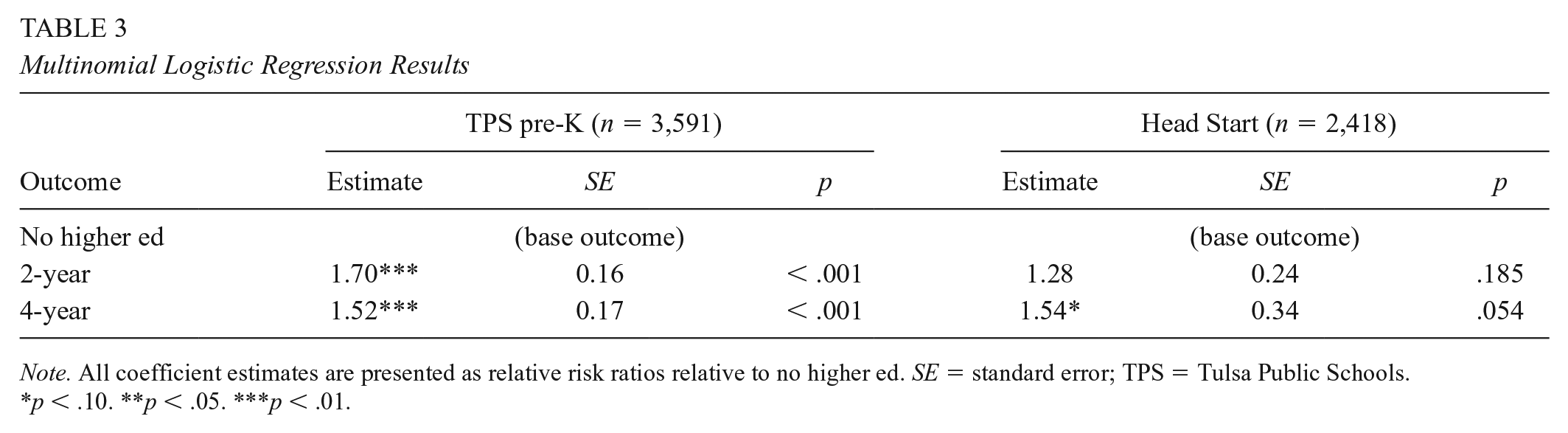
Note. All coefficient estimates are presented as relative risk ratios relative to no higher ed. SE = standard error; TPS = Tulsa Public Schools.
p < .10. **p < .05. ***p < .01.
Binomial Logistic Regression Results

Note. All coefficient estimates are presented as odds ratios. SE = standard error; TPS = Tulsa Public Schools.
Marginal change is presented as percentage point increase in absolute probability seen for an average student with the treatment compared to the same student without treatment.
p < .10. **p < .05. ***p < .01.
The results for Head Start attendees were mixed. In multinomial logistic regression, we found that Head Start attendance was marginally associated with an increased likelihood of 4-year college enrollment (p = .054), but not with an increased likelihood of 2-year college enrollment (p = .185). The likelihood of enrolling in any college or university for an average student was 7.5 percentage points higher if they attended Head Start than if they attended neither TPS pre-K nor Head Start although we caution that the relationship was marginally significant. Binomial logistic model results were similar. It is worth noting that the Head Start sample was between one-fourth and one-third of the size of the pre-K sample, and the standard errors for the Head Start results were generally larger than those for the pre-K results. That said, the resulting estimates were not precise zeros, and all were in a positive direction, so it is not clear whether the lack of statistical significance was due to the small sample size or the small magnitude of the associations between Head Start and college.
We applied Benjamini and Hochberg’s (1995) false discovery adjustments to our results to account for the number of analyses conducted. Even under a strict false discovery rate of 5%, all statistically significant main regression pre-K results remained statistically significant. Under a less strict false discovery rate of 20%, two of three marginally significant main regression Head Start results remained marginally significant (the multinomial 4-year and the binomial any higher education runs), but under a false discovery rate of 15% or less, the results were no longer statistically significant. The binomial 4-year regression for Head Start (p = .096) only remained significant under a false discovery rate of 25% or less.
Subgroup Results
The subgroup findings for multinomial regressions for race and ethnicity are reported in Table 5. In general, we found that students of all ethnic and racial backgrounds were more likely to attend college if they attended pre-K. Among White and Native American students (separately), those who attended pre-K were more likely than the control group counterparts to enroll in 2-year institutions (White: p < .001; Native American: p = .041). On the other hand, among Black students, those who attended pre-K were more likely than control group students to enroll in 2-year institutions (p = .003) and 4-year institutions (p = .005). Among Hispanic students, attending pre-K was associated with an increased likelihood of enrollment in 4-year institutions (p = .034) and marginally associated with an increased likelihood of enrollment in 2-year institutions (p = .094).
Multinomial Logistic Regression Results, by Race and Ethnicity

Note. All coefficient estimates are presented as relative risk ratios relative to no higher ed. SE = standard error; TPS = Tulsa Public Schools.
p < .10. **p < .05. ***p < .01.
For full-price lunch students and students eligible for a free lunch, those who attended pre-K were more likely to enroll in 2-year institutions (full: p < .001; free: p < .001) and in 4-year institutions (full: p = .016; free: p =.003), each relative to no enrollment when compared to control group students (Appendix B). The male and the female students were more likely to enroll in a 2-year (male: p = .010; female: p < .001) or 4-year college (male: p = .003; female: p = .011) versus no enrollment if they attended pre-K, relative to those who did not attend pre-K or Head Start (see Appendix C).
Subgroup analyses for Head Start resulted in a few significant findings. Most notably, in multinomial logistic regressions, among Native American students, attending Head Start was associated with increases in the likelihood of 2-year college enrollment (p = .019) and marginally associated with an increased likelihood of 4-year college enrollment (p = .052), relative to their non–Head Start, non-pre-K counterparts. Among White students, those who attended Head Start were more likely than control group students to enroll in 2-year colleges (p = .020), but not 4-year colleges (p = .631). Among Black students, those who attended Head Start were not more likely to enroll in 2-year colleges (p = .325) but were more likely to enroll in 4-year colleges, compared to Black students who attended neither pre-K nor Head Start (p = .018).
In subgroup analyses by gender, we found that female Head Start alumni were more likely (or marginally more likely) to enroll in 2-year colleges (p = .044) and 4-year colleges (p = .072), compared with no enrollment.
After we applied the Benjamini-Hochberg procedure, 26 of 30 statistically significant pre-K subgroup findings remained statistically significant at a strict false discovery rate of 5%, and the other four results remained statistically significant at a false discovery rate of 10%. For Head Start, 11 of 15 statistically significant subgroup results remained statistically significant under a false discovery rate of 15%, and the other four statistically significant results and five marginally significant results retained significance under a false discovery rate of 20%.
In summary, attending pre-K was linked to college enrollment for nearly all subgroups, while attending Head Start was associated with college enrollment for some racial, gender, or lunch status subgroups, but not others. It is difficult to determine whether these mixed results for Head Start stemmed from true differences in the impact of Head Start or reflected sample size limitations.
Discussion
The results from our analyses suggest that participating in Tulsa’s public ECE programs was associated with an increased likelihood of enrolling in a postsecondary educational institution within 2 years of completing high school. The link between the TPS pre-K program and college enrollment was particularly strong—an increase of nearly 12 percentage points of enrolling in any college compared to a comparable sample of students who did not attend TPS pre-K or Head Start. The largest increases were found for 2-year college enrollment, predominantly at TCC. Among students who enrolled in 2-year colleges, 81% of the TPS pre-K alumni enrolled in TCC, compared to 71% of the control group students. In considering these findings, it is important to keep in mind that this program is one of the oldest UPK programs in the country operating in an urban setting. The school-based pre-K program and the Head Start program employ college-educated teachers who are early childhood certified, and both are paid wages commensurate with those of public school teachers.
If college enrollment is an important societal goal, then this study’s findings suggest that ECE may be one way to promote that goal. But how does Tulsa’s UPK program compare to other distal interventions that focus on ECE or early elementary education? M. Bailey et al. (2021) estimate that from 1965 to 1980, Head Start yielded an 8.5 percentage point increase in college enrollment. Similarly, Gray-Lobe et al. (2021) conclude that from 1997 to 2003, Boston’s UPK program yielded an 8.3 percentage point increase in on-time college enrollment within 6 months after high school graduation. Dynarski et al. (2013) find that smaller class sizes in early elementary school in Tennessee in 1985 and 1986 increased the rate of postsecondary attendance by 2.7 percentage points. Comparing estimates across studies is complicated by differing contexts and populations and sometimes wide confidence intervals. Nevertheless, Tulsa’s UPK program seems to have been at least as effective as some other powerful educational interventions focusing on children’s early years.
In fact, the estimated magnitude of Tulsa’s UPK program’s association with college enrollment was comparable to those of more proximal interventions, such as programs targeting access to college financial aid. A meta-analysis of multiple studies of college access programs and reforms (Career Academies, Upward Bound, Talent Search programs, FAFSA simplification) finds that they yielded, on average, a 12 percentage point increase in college enrollment (Harvill et al., 2012). A free tuition offer to most colleges or universities within the state of Michigan to graduates of a Kalamazoo high school yielded a 7 percentage point boost in college enrollment (Bartik et al., 2021), and the Pittsburgh Promise program, which offers substantial financial aid to attend a Pennsylvania college or university, produced a 5 percentage point boost in overall college enrollment (Page et al., 2019). Potential differences in costs, implementation, and beneficiaries prevent any direct comparison of which approach is most efficient, but it is noteworthy that our estimates of Tulsa’s ECE program effects were relatively strong.
What might generate a link between pre-K and college enrollment? Previous research in Chicago and Tulsa suggests that magnet schools might play a role. In a study of the Chicago Child Parent Centers Program, focusing on students who enrolled in the 1980s, Reynolds and Ou (2011) find a link between pre-K enrollment, magnet school enrollment, and positive outcomes as young adults. In a study of the Tulsa pre-K program, Kitchens et al. (2020) find a positive link between pre-K enrollment and magnet school attendance in middle and high school. They also report a positive relationship between magnet school attendance and standardized test scores and between magnet school attendance and PSAT test scores—a good indicator of students’ ability actively to consider college as an option. By most indicators, Tulsa’s magnet high schools are more successful in laying the groundwork for college enrollment than are Tulsa’s traditional high schools. The Oklahoma Department of Education’s letter grade ratings for Tulsa’s magnet high schools range from C– to A+, while the ratings for traditional high schools range from D to F (Kitchens et al., 2020, p. 11). Advanced Placement enrollment, one sign of college aspirations, ranges from 31% to 70% at Tulsa’s magnet high schools and from 5% to 29% at traditional schools (numbers calculated by authors from niche.com statistics).
Magnet schools in Tulsa originated in the early 1970s as a strategy for coping with the legacy of racial discrimination in public education. In response to a federal court order, TPS established magnet schools that would attract Black and White children. In the absence of such magnet schools (accessible, abundant, superior), Black, Hispanic, or Native American students who attended an ECE program in Tulsa might get a sudden positive boost in test scores or other outcomes, followed by a gradual decline, as these students would be likely to attend lower quality public schools. The presence of magnet schools indicates better opportunities for favorable long-term outcomes for students generally and for students of color in particular (see also Kitchens & Brodnax, 2021). Magnet schools might lead to fewer course failures and more advanced coursework, which in turn might lead to increased college enrollment. In Tulsa, Amadon et al. (2022) do find differences in advanced course taking in high school between pre-K attendees and those who did not attend as well as decreases in course failures in high school among pre-K attendees. In short, Tulsa’s K–12 environment has the potential to reduce the number of “struggling learners” and to increase the number of “excelling learners” among Black, Hispanic, and Native American students (Iruka et al., 2020).
In contrast to our evidence on magnet schools as potential mediators between Tulsa’s UPK program and positive outcomes in adolescence and early adulthood, we can only speculate about the K–3 curriculum as a mediating variable. Although the pre-K penetration rate was high at the time and might have encouraged elementary schools to accelerate or upgrade K–3 course content, we cannot confirm that they did so; indeed, some evidence suggests that elementary schools responded differently to the new realities wrought by UPK. Moreover, this time period was exceptionally challenging for TPS and for schools nationwide due to many ambitious education reforms, including No Child Left Behind and Common Core (adopted by Oklahoma but then later abandoned). There are three different ways to think about this. From one perspective, the increased focus on school accountability and test scores created stressful times for teachers, school administrators, and students. It is remarkable that pre-K alumni were able to maintain their initial momentum during this challenging period. From another perspective, one advantage of ambitious education reforms was that they invited teachers and school administrators to take a fresh look at what they were doing and to try to figure out ways to do it better. Across the nation, kindergarten generally became more challenging between 1998 and 2010. As Bassok et al. (2016) have put it, kindergarten became “the new first grade.” From a third perspective, considerable variety in school practices within the same school district created opportunities for students who experienced a big bounce from pre-K to seek out more challenging and more stimulating school environments, which may have influenced their unconstrained skills. If change and micromanagement made average progress difficult, variety made differential progress more likely.
Findings from earlier work suggest that TPS pre-K alumni were more likely to attend better schools (Kitchens et al., 2020), to take more advanced courses, and to fail fewer courses (Amadon et al., 2022; Gormley et al., 2018). Our latest research suggests a positive, statistically significant relationship between TPS pre-K attendance and on-time high school graduation rates (Amadon et al., n.d.). Prior work by other scholars has also found positive associations between ECE attendance and high school graduation rates (McCoy et al., 2017). Indeed, such studies as that by Gray-Lobe et al. (2021) show that even in the absence of pre-K impacts on test scores in high school, college enrollment is increased through other aspects of school engagement. Although the mechanisms connecting ECE to increased college attendance are still poorly understood, our study adds to the growing literature showing a strong connection between ECE programs and later life outcomes.
Limitations
Although the results are promising, our study is not without its limitations. Our treatment and control group students had strikingly similar demographic characteristics, but the possibility of differences on unobserved characteristics, such as motivation, remains. We also worry about the possibility that the COVID-19 pandemic could have affected some of our students. Luckily, most of our college-bound students enrolled in the fall of 2019, prior to COVID-19. However, about 23% of our students were not in a position to enroll in college at that time because they were retained in grade for 1 year. Although prior work and conventions in research methods recommend keeping grade-retained students in the sample (as grade retention could be a mediator between pre-K and college enrollment), we checked the robustness of our results by excluding grade-retained students. Results suggest that the associations between TPS pre-K and college enrollment for on-track students were of even greater magnitude than the results reported here. Full results are available upon request.
Our primary results defined college enrollment as any enrollment in a college after graduation, regardless of whether that enrollment occurred in the fall following high school graduation. As an additional robustness check, we reran our main regressions using the definition of on-time enrollment that Gray-Lobe et al. (2021) use in studying Boston’s UPK, which measured only enrollment in the fall semester following an on-time graduation. Using this definition, the magnitude of the association of pre-K or Head Start attendance with college enrollment was just as large as that found in our original definition of enrollment (Appendix D).
The context of community college aid in Tulsa County might make our findings less likely to generalize to other communities. The students in our study who graduated from high school and met the minimum grade point average requirements had access to free community college. Undoubtedly, the presence of this program made it easier for students—especially disadvantaged students—to attend college. Although this program might be part of the reason we saw a robust and large impact on 2-year college enrollment, it does not account for the 4-year college enrollment effect for pre-K graduates. Also, treatment and control group students were both eligible for free community college. Thus, it seems unlikely that our findings are due to the Tulsa Achieves (free community college) program. The role of that program is to boost 2-year college enrollment for students generally, not for pre-K alumni in particular. Another role is to keep hope alive, as students progress through middle school and high school, while contemplating their higher-education prospects.
Conclusion
The case for ECE programs is strengthened by evidence that they are positively linked to important life outcomes. College attendance is one of the most important milestones indicating upward mobility and is an excellent predictor of adult earnings. We find that Tulsa’s school-based UPK program is linked to higher college enrollments. We also find that Tulsa’s Head Start program is linked to higher college enrollments for certain subgroups.
The circumstances are favorable in Tulsa: high-quality ECE programs with relatively high levels of instructional support (Phillips et al., 2009); a high pre-K participation rate that enables elementary school teachers to upgrade their pedagogy if they choose to do so; opportunities for students to convert a preschool bounce into subsequent academic progress by attending relatively strong magnet middle schools and high schools; and a free community college program that enables high school graduates to attend the local community college without paying tuition.
Not every community has these practices and opportunities that contribute to educational success in the short and long run, which suggests that a strong pre-K program alone may not be sufficient for replication elsewhere. On the other hand, we find a positive link between pre-K and 4-year college enrollment, so the presence of free community college, although important for the overall picture, is not a sine qua non for long-term educational success.
Our findings for Head Start are more equivocal than our findings for Tulsa’s school-based pre-K program, possibly because of noticeably smaller sample sizes. Nevertheless, we see statistically significant positive associations between Head Start and college enrollment for White, Black, and Native American students. The bottom line is that Tulsa’s ECE programs are helping students from diverse racial and ethnic backgrounds face the challenges of a rapidly changing economy with the confidence that flows from having attended college. In this respect, early childhood education is indeed the gift that keeps on giving.
Footnotes
Appendix A
Acknowledgements
The authors would like to thank the Heising-Simons Foundation and the Smith Richardson Foundation for their generous financial support. They would also like to thank Anandi Gupta and Tanya Grover for helpful research assistance.

1
Andy McKenzie served as TPS early childhood education coordinator, and Janet McKenzie served as a teacher at the Kendall-Whittier Elementary School in Tulsa during this period.
Authors
WILLIAM T. GORMLEY JR. is a university professor and professor of public policy and government at Georgetown University, where he is a co-director of the Center for Research on Children in the U.S. (CROCUS).
SARA AMADON is a senior researcher at Child Trends. She has previously been an assistant professor at the University of West Virginia.
KATHERINE MAGNUSON is a professor of social work at the University of Wisconsin-Madison. She is also the director of the Institute for Research on Poverty.
AMY CLAESSENS is an associate professor of education at the University of Wisconsin-Madison. She has previously been an assistant professor at the University of Chicago.
DOUGLAS HUMMEL-PRICE is a research fellow at CROCUS at Georgetown University.