




Abstract
In their recently renamed theory, situated expectancy-value theory (SEVT), Eccles and Wigfield (2020) emphasized the importance of situations in influencing individuals’ motivational beliefs and academic choices. Adopting a novel approach—network analysis—this study aimed to examine how situations may impact the associations among expectancies, subjective task values, and achievement from a holistic perspective. In this study, situations were operationalized as grade levels (i.e., 6th –9th grade), subject domains (i.e., language arts and math), and countries (i.e., Finland and Germany). Adolescents from Finland (N = 4,062) and Germany (N = 449) were included in the study. Results showed that, overall, the networks are mostly subject bound, yearly varied, and country specific, supporting the situative nature of SEVT. We also found that expectancies were consistently the closest motivational beliefs to achievement, whereas utility values were the least close, implying that expectancies, not utility, might be the most desirable intervention targets for achievement improvement.
Recently, one of the most long-established theories of achievement motivation, expectancy-value theory (EVT) has been renamed as the situated expectancy-value theory (SEVT) by Eccles and Wigfield (2020). One of the main reasons for renaming the theory is that they wanted to make it clear that achievement choices occur in particular situations or contexts; that is, these choices are context bound and reflect the opportunities in a given situation or context. Additionally, Eccles and Wigfield emphasized that the SEVT model is dynamic concerning situational and cultural influences. With the recent elaboration and extension of the model, Eccles and Wigfield (2020) called for the importance of examining more closely the interplay between individuals’ expectancies for success and their subjective task values in various situations, in order to understand the underlying processes. They noted that understanding the interplay better between expectancies for success and subjective task values will have important implications for designing interventions that cultivate and support students’ motivational beliefs.
In the present study, we examined the interplay among students’ expectancies for success, subjective task values, and achievement across different situations using psychometric network analysis. We used this analysis because it offers us a way to understand the associations among these variables as a complex system as opposed to them being noninteractive (Epskamp et al., 2017). In other words, network analysis is an innovative tool to examine SEVT, because it emphasizes the intricate interactions among motivation variables. To examine the situative aspect of the model, we examined networks across grade levels, domains, and countries using two different data sets from Finland and Germany. We chose grade levels, domains, and countries as situations because these are different situations a student might face. 1 We also chose to examine math and verbal domains within countries because these domains can be more differentiated when compared to similar subjects like math and physics, or language arts and history.
SEVT Constructs of Expectancies for Success and Subjective Task Values
Much research using SEVT has focused on the constructs of expectancies for success and subjective task values, especially because they are strong direct predictors of students’ choices, performance, and continued engagement (for review, see Eccles & Wigfield, 2002). Expectancies for success refer to individuals’ beliefs about how well they will do on an upcoming task: “Can I do it?” (Eccles et al., 1983; Wigfield & Eccles, 2000). Although expectancies for success are conceptually distinct from self-concept of abilities, they are difficult to distinguish empirically and thus often treated as one construct; we adopt this view in the current study to use consistent wording with the SEVT (Eccles & Wigfield, 2002; Simpkins et al., 2012; Wang & Eccles, 2013). Subjective task values refer to individuals’ desire for the task: “Do I want to do it?” (Eccles et al., 1983; Eccles & Wigfield, 2002). The model posits four different subjective task values: intrinsic value, attainment value, utility value, and cost. Intrinsic value is defined as the enjoyment an individual gets from doing the task. Attainment value is defined as how central a task is to an individual’s identity. Utility value is defined as how useful a task is to an individual’s short- and long-term goals. Cost is defined as what an individual must give up or lose by engaging in a task.
Grade Level as the Situation: SEVT-Achievement Associations Across Grade Levels
Using the SEVT framework, many researchers have examined the (factor) structure of expectancies for success and subjective task values across grades (Eccles et al., 1993; Eccles & Wigfield, 1995; Gaspard et al., 2017). Using a confirmatory factor analysis, Eccles, Wigfield, and colleagues have documented that expectancies and subjective task value beliefs are empirically distinguishable early on (e.g., Eccles et al., 1993; Eccles & Wigfield, 1995). They found as early as first grade (around seven years old) that students’ expectancies for success and subjective task values are empirically distinguishable (Eccles et al., 1993). By fifth grade, they found that the intrinsic, attainment, and utility aspects of task value were also distinguishable from each other (Eccles & Wigfield, 1995; also see Gaspard et al., 2017, for similar findings).
Although those motivation factors are empirically distinguishable, they also exhibit moderate to high associations. For instance, fifth graders’ subjective task value beliefs (intrinsic, attainment, and utility value beliefs) have been found to be highly correlated with each other: intrinsic and attainment value at .78, intrinsic and utility value at .55, and utility and attainment value at .72 (Eccles & Wigfield, 1995). Similar findings have been documented by Conley (2012) and Gaspard et al. (2017). Wigfield et al. (1997) also demonstrated that the correlations of students’ expectancies, intrinsic value, and usefulness/importance all increased from first to sixth grade. For example, in first grade, the correlation of expectancies for success in math with intrinsic value was .23, expectancies for success with a combined usefulness/importance variable was .10, and usefulness/importance and interest were .22; the only nonsignificant correlation was that of expectancies and usefulness/importance. At sixth grade the same correlations were .34, .52, and .48. In another study with students from grades 5 through 12, Gaspard et al. (2017) found the factor structure underlying task values to be stable across ages. In summary, these results show that (a) expectancies and subjective task values are distinct at least by first grade in the math domain; (b) different components of subjective task values are distinct by fifth grade; (c) subjective task value components correlate among each other and with expectancies; and (d) correlations increase, consistent with the idea that these constructs influence each other across development (see also, Denissen et al., 2007).
Subject Domain as the Situation: SEVT-Achievement Associations Across Domains
Not only have researchers examined grade levels as the situation, but they have also investigated subject domains as the situation when looking at the associations between expectancies for success, subjective task values, and prior achievement (e.g., Bong, 2001; Gaspard et al., 2017, 2018; Wigfield et al., 1997). Domains as the situation are important to explore because the achievement experiences in a particular domain might result in different associations between motivational beliefs and students’ achievements in those domains (Wigfield et al., 2004). However, much of the prior empirical work has focused on how motivational beliefs change over time across different domains rather than comparing within-domain associations. For example, Wigfield et al. (1997) found positive associations between students’ competence beliefs and subjective task values across math, reading, music, and sports. Similarly, Gaspard et al. (2017) found invariant associations between various components of subjective task values across five domains (i.e., German, English, math, physics, and biology). However, based on the same data, Gaspard et al. (2018) also found that the associations between students’ expectancies, subjective task values, and achievements were somewhat stronger in the math and science domains compared with the verbal domains (see also Bong, 2001). The present investigation attempts to more systematically examine whether the patterns of associations among expectancies for success, subjective task values, and prior achievement are the same or not the same for different domains using a network approach.
The Country as the Situation: SEVT-Achievement Associations Across Countries
Country or culture can also act as a situation that determines the associations between motivation and achievement. One strength of SEVT is that it provides a broad overview of the sociocultural determinants of expectancies and subjective task values (Wigfield et al., 2004). Countries or cultures are different in terms of the societal norms and values and of the activities that people are involved in. For example, in a country or culture where physical education is less emphasized, there will likely be fewer opportunities for students to engage in physical activities, which, in turn, can lead to lower attainment and utility value of the physical activity. Thus, the relationships among expectancies for success, subjective task values, and achievement depend on the situation, such as the country or culture. Prior cross-cultural research has found cultural influences on expectancies and subjective task values (for reviews, see Tonks et al., 2018; Wigfield et al., 2004). In general, the factor structure of expectancies and subjective task values tends to be consistent across countries (Gaspard et al., 2020; Guo et al., 2017; Tonks et al., 2018). A universal decline in expectancies and task values across grade levels tends to be observed (Scherrer & Preckel, 2019; Wigfield et al., 2015). However, mean differences between countries have been found, and the associations between motivation and achievement have sometimes been shown to differ between countries or cultures (e.g., Inoue et al., 2021; Li et al., 2021).
In the context of this study, we included students (6th–9th grades) from two European countries: Finland and Germany. We chose those two countries not only because we have available data from them but also because they have similarities and differences. Therefore, it is viable to observe the differences and also the consistencies in the findings. Both countries are industrialized European countries that share Western societal/cultural values, adopt social welfare state policies, and are characterized by high socioeconomic status. However, they also have visible differences in their social and educational systems. Finnish language, given its roots in Uralic languages, has a simpler syllabic structure and a shallower orthographic depth than the German language (Seymour et al., 2003). This may give Finnish children more self-efficacy in language learning. Their educational systems also differ in terms of structure and characteristics (OECD, 2020). Finnish children are typically one year older than German children when they enter primary education. The two countries also adopted different tracked educational systems. German students are tracked into different educational pathways after the 4th grade (~10 years old), whereas Finnish students choose their pathways by the end of 9th grade (~15 years old). Moreover, Finnish students enjoy more flexibility to switch their pathways than German students. Those differences can potentially have a large impact on students’ choice of learning activities, and consequently, their expectancies for success, subjective task values, and achievement.
To date, systematic SEVT research between Finland and Germany is scarce except for research using the Programme for International Student Assessment (PISA) data from 15-year-old students. According to PISA results (OECD, 2013, 2016, 2019), Finnish students generally have better academic performance than German students. However, Finnish 15-year-old youths reported lower self-efficacy/self-concept than German adolescents in the domain of math and reading (OECD, 2013, 2016, 2019). Finnish youths also reported lower math intrinsic value than German youths, but their reading intrinsic value was similar. Moreover, Finnish youths had higher math utility value than German youths. Regarding the associations between motivation and achievement, this large-scale data set suggested that the relation between math intrinsic/utility value and math achievement was higher in Finland than in Germany (OECD, 2013, 2016, 2019). However, the opposite pattern was found for the association between math self-efficacy and math achievement (OECD, 2013). In sum, although research using international comparison assessments (e.g., PISA) has provided a glimpse of the differences between SEVT-related constructs in Finland and Germany, the findings are largely limited to only 15-year-old youths (~9th or 10th grade). The extent to which the associations among expectancies for success, task values, and achievement differ by country before 9th grade is largely unknown.
Network Approach in Educational and Psychological Research
To understand expectancies for success, subjective task values, and achievement that are situated in the subject domain and country over the school years, the present study utilized a novel approach—psychometric network analysis for the SEVT-based literature. Psychometric network analysis (Borsboom et al., 2021; Christensen et al., 2020; Epskamp et al., 2017) is a holistic analytical approach to understanding the associations among a group of indicators. In a network, there are two salient elements. Nodes are the entities to be examined and can be represented on different levels (e.g., items, facets, traits). Edges are the connections among nodes. A network can be directed or undirected depending on whether the connections are to be examined as unidirectional (i.e., causal relation) or bidirectional. In educational and psychological research, both directed and undirected networks have been studied (Lee et al., preprint; Sachisthal et al., 2019; Tang et al., 2022). A network can also be signed or unsigned depending on the nature of the connections. Unsigned networks only allow positive associations, whereas signed networks allow both positive and negative associations. Educational and psychological research mostly have examined signed networks as both positive and negative associations are critical. In addition, most networks in educational and psychological research are weighted so that the thickness of the edges represents the strength of the connections.
As networks present interdependences among variables, they can provide several unique contributions. First, it helps to understand educational and psychological phenomena from a systematic perspective because any given connection between two nodes is conditioned by the existence of other nodes. This means, for motivation research, motivation is examined as a holistic system so that all motivational components are considered simultaneously when connecting with other variables (e.g., achievement). In many studies, motivation variables are examined as independent factors so that the interdependences among them are neglected (e.g., OECD, 2016). Second, once a network has been constructed, the most significant node(s) can be identified to see which one plays a critical role in the network. This provides information about the relative importance of variables as well as the most desirable intervention targets. Moreover, the closeness among variables within a network can be further examined to see which set of variables functions together. This is particularly useful when multidimensional constructs are examined. Third, it can show the contextual nature of educational and psychological phenomena. By having systematic cross-network comparisons, it is possible to see changes in networks due to a certain attribute (e.g., gender, class, grade level, school)—that is, the features of networks may be different in different situations.
Given the aforementioned strengths, network analysis can serve as an ideal tool to further our understanding of motivation as a dynamic and holistic system, a central tenet of SEVT. The dynamic associations among expectancies, intrinsic value, utility value, attainment value, cost, and achievement will then be better understood.
The Present Study
In sum, the present study aimed to understand the associations between expectancies, subjective task values, and achievement systematically under the situation of different grade levels, domains, and countries. Specifically, we wanted to know how those motivation variables and achievements are interconnected across the various situations and what consistent or unique patterns of interconnections can be derived from our networks of achievement motivation. We expected that the networks will be different across the grade levels (6th–9th grade), between the subject domains (i.e., language and math), and between the two countries (i.e., Finland and Germany). However, given the exploratory nature of the network analysis approach, we do not have any specific hypotheses regarding the directions and magnitudes of the differences in the networks.
Methods
Sample
Finnish Sample
In the present study, the data from a Finnish longitudinal study (2013–2016) in Helsinki was used (see Tang et al., 2019). We focused on students’ Finnish language and mathematics motivational self-beliefs in 6th to 9th grade. Thus, the study included 747 students in 6th grade (55.8% female, ages 12–13), 1,296 students in 7th grade (56.4% female), 1,166 students in 8th grade (57.4% female), and 853 students in 9th grade (59.9% female). Those students were from urban schools (school N = 34 in 6th grade, N = 20 in 7th grade, N = 22 in 8th grade, N = 24 in 9th grade) that represent different performance levels in various regions of Helsinki. The questionnaire was administered during school and took about an hour to complete. Participation was voluntary and informed consent forms were collected from both the students and their parents. This project received the approval of the ethics review committee of the home institute.
German Sample
To compare across countries, the data from a German study on students’ motivation in different domains was also used (see Gaspard et al., 2017). The original study design surveyed students’ motivation in five academic domains using a cross-sectional design across 5th to 12th grade in Germany in the fall of 2014. However, in the current study, we focused on students’ German language and mathematics motivational self-beliefs and achievement in 6th to 9th grade in line with the data set from Finland. The study included 116 students in 6th grade, 123 students in 7th grade, 107 students in 8th grade, and 103 students in 9th grade. The questionnaire was administered in 25 classrooms from two academic track schools (i.e., Gymnasium) in southwest Germany (Baden-Württemberg). Students’ participation was voluntary and informed consent was received from both the students and their parents. The project also received the approval of the ethics review committee.
Measures
Expectancies, Subjective Task Values, and Achievement
Expectancies and Subjective Task Value Measures in the Finnish Sample
The domain-specific SEVT scale (e.g., Guo et al., 2018) was used, and we included Finnish language and math in this study. For each subject domain, students were asked to rate how competent/important/useful/interesting/exhausted they are in a subject and the subject is to them with a single item. These items represented their expectancies, attainment value, utility value, intrinsic value, and cost for each subject domain. All items were answered on a 7-point Likert scale, with one indicating “not at all” and seven indicating “very much.” The subjective task values scale was shown to be a reliable measure in prior studies (Cronbach’s α = 0.81–0.85; see Guo et al., 2018).
Expectancies and Subjective Task Value Measures in the German Sample
The domain-specific SEVT scale was used by Gaspard et al. (2017), which included items for the domain of German language and mathematics. Expectancies for success were assessed using two items (e.g., “I am good at . . .”). Intrinsic value was assessed using four items (e.g., “I like doing . . .”). Attainment value was assessed using four items (e.g., “. . . is very important to me personally”). Utility value was assessed using seven items (e.g., “Knowing the contents in . . . has many benefits in my daily life”). Cost was assessed using four items, in particular, effort cost to stay consistent with the Finland dataset (e.g., “Doing . . . is exhausting to me”). All items were answered on a 4-point Likert scale ranging from 1 (completely disagree) to 4 (completely agree). The scale has been shown to be reliable in prior studies (Cronbach’s α = 0.65–0.93; Gaspard et al., 2017, 2018). For expectancies for success and subjective task values in each grade and subject, we conducted a confirmatory factor analysis model to save the factor score for further analyses (see suggestions from Christensen et al., 2020). The model fits for each model were acceptable (CFI ≥ .90, TLI ≥ .90, RMSEA ≤ .08), except for math subject in 6th grade, where the fit was marginally acceptable (CFI = .897, TLI = .88, RMSEA = .077).
Academic Achievement
For Finnish students, their performance grades (4 = fail to 10 = excellent) were obtained from school records during the spring and fall term. We aggregated two terms’ performance for the subject domain achievement (i.e., Finnish and math). For German students, their achievement in the previous school year on a 6-point scale ranging from 1 (very good) to 6 (insufficient) was obtained from the school records. Scores were reverse coded so that higher values indicated higher achievement.
Data Analysis
The networks of expectancies; subjective task values; and achievement per grade, domain, and country were examined using network analysis with R-package qgraph (Epskamp et al., 2012). For each network, it visualizes the connectivity of variables based on the partial correlation information (i.e., any given connection [i.e., edge] between two variables [i.e., nodes], taking all other variables into account). Then that information is processed using regularization techniques to estimate a sparse, more interpretable model (Epskamp & Fried, 2018). The graphical LASSO (i.e., least shrinkage and selection operator; Friedman et al., 2008) algorithm is one of the techniques often used for continuous variables. By default, the qgraph package sets the tuning gamma parameter to .5 using the extended Bayesian information criterium (EBIC; Epskamp et al., 2012). Thus, an absence of a connection between two variables means they are conditionally independent.
Additionally, we ran an exploratory graph analysis (EGA; Golino & Epskamp, 2017; Golino et al., 2020) with R-package EGAnet. EGA is specialized to find potential groups among the nodes within a network using the community detection algorithm. Consequently, through EGA we can find out which motivation variables are close together within the network. The Louvain community detection algorithm was employed as it has shown better performance than the Walktrap algorithm (Christensen et al., 2020).
Next, we conducted network comparison tests (NCT; van Borkulo et al., 2022) to understand the similarity and differences between networks. Both network structure invariance tests (test M; a test of connection strength matrix) and global connectivity invariance tests (test S; a test of the weighted sum of absolute connections) were performed. The tests were done by using R-package NetworkComparisonTest (van Borkulo et al., 2022) with the LASSO regularization. We also tested the individual edge differences between networks in addition to comparing the network in terms of global strength. In other words, the connections between any two nodes were compared. This step allowed us to understand the similarity and differences of networks in detail. Given that multiple comparisons were performed in this step, p-values were adjusted using the Benjamini-Hochberg method (Thissen et al., 2002).
Results
Descriptive statistics (i.e., means, standard deviations, correlations, etc.) for expectancies; subjective task values; and achievement for each grade, subject, and country can be seen in the Supplementary Material (Table S1–S8). In general, for the Finnish sample, expectancies and subjective task values correlated higher (rs = .35 – .67 for Finnish; rs = .36 – .72 for math) within the same subject domain than between subjects (rs = .09 – .42). Expectancies had the strongest correlation with achievement (rs = .40 – .49 for Finnish; rs = .45 – .62 for math) across grades. For the German sample, similar patterns were observed. Expectancies and subjective task values were close to each other in the same domain (rs = .15 – .79 for German; rs = .28 – .82 for math). There were few significant correlations between expectancies and subjective task values across two subjects (rs = -.29 – .43). Again, expectancies were the strongest correlate for achievement (rs = .33 – .44 for German; rs = .34 – .54 for math).
Networks of Motivation and Achievement
The networks per grade level and domain in the Finnish sample can be seen in Figure 1. Network results with the German data can be seen in Figure 2. Across the networks, there are several salient results. First, utility and attainment values were strongly connected. This pattern was similar between Finland and Germany. Second, utility and attainment values showed a weak or null connection to achievement across grade, domain, and country. Third, attainment value in many cases had direct connections with expectancy, but this finding mainly pertained to the Finnish sample and did not show up in the German sample. Also, utility value had some weak connection with intrinsic value in Finland, but not in Germany. Fourth, expectancies had a significant connection with both achievement and intrinsic value; however, there was also a weak direct connection between achievement and intrinsic value. This result was consistent across grades and subjects. For the German data, expectancies tended to be closer to intrinsic value than to achievement, whereas these relations were equally strong in Finland. Fifth, cost had some negative connection with achievement in Finland, but it had no relation with achievement in Germany. We found that the connections among cost, expectancy, and intrinsic value were much stronger in Germany than in Finland. Moreover, cost was generally not related to utility value and attainment value, even though there were a few occasions where cost was connected with utility value (e.g., 7th-grade math in German data).

Network per Subject and Grade in Finland

Network per Subject and Grade in Germany
Results from the exploratory graph analyses (see Supplementary Figures S1 and S2) further indicated that achievement, expectancies, intrinsic value, and cost were typically under the same community (i.e., they were close to each other), whereas utility value was mostly together with attainment value. There were also some exceptions. For instance, no variable community was detected for the network of 8th grade Germany. In other words, all the variables were somewhat connected. Another example was for 6th-, 8th-, and 9th-grade Finnish networks. In those networks, intrinsic value is grouped with utility and attainment value.
Grade Levels as the Situation
To further understand the significant differences between networks, we conducted network comparison tests across grade levels, subjects, and countries. Two network comparison tests, network structure invariance test (test M) and global strength invariance test (test S), were performed. Also, individual edge differences were tested and compared. Given the nuanced differences across grade levels, subjects, and countries, we created a summary table to document the highlighted differences (see Table 4).
Finnish Data: Finnish Subject Across Grades
Across grades, the global strengths of Finnish networks were declining gradually (see Table 1). This led to the 6th-grade Finnish network differing significantly from the 8th-grade network and 9th-grade network. The edge difference results (Table S9) were in line with the global results in that no individual edge differences were observed between 6th-grade and 7th-grade networks, between 7th-grade and 8th-grade networks, and between 7th-grade and 9th-grade networks. But there were several edge differences across grades. For example, for the Finnish subject, the connection between intrinsic value and cost started to disappear from 8th grade. Also, the connection between Finnish expectancies and Finnish utility value started to disappear in 9th grade.
Finnish data: Network comparison test (NCT) for network structure and global strength invariance

Note. Test M is the network structure invariance test; test S is the global strength invariance test.
p < .10, *p < .05, **p < .01.
Finnish Data: Math Subject Across Grade
For math subject networks in Finland, the global strengths increased from 6th to 7th grade, then stayed stable after 7th grade. However, the global strength invariance test indicated that there was no significant difference in global strength across the grade. Network structure invariance tests showed a difference in the pair 6th grade-9th grade, 7th grade-8th grade, 7th grade-9th grade, and 8th grade-9th grade. These indicated that there were some edge differences in those pairs. Table S9 shows these specific edge differences. In summary, for the math subject in Finland, it is suggested that utility value started to become more important in the 9th grade, whereas at the same time, the role of expectancies got weaker.
German Data: German Subject Across Grade
Among the school years, none of the comparisons in the global strength invariance test of German networks showed statistically significant results, although the global strengths showed an inverted U-shaped trend from 2.61 for 6th grade to 2.25 for 9th grade (see Table 2). Network structure invariance tests showed significant differences in the pair 6th grade-9th grade and in the pair 7th grade-9th grade. The edge difference results in Table S10 suggested a few differences among the networks of different grades. In summary, the intrinsic value had more connections with attainment value during 9th grade and fewer connections with expectancy and cost. Attainment value had stronger connections with expectancies during 9th grade. Utility value had positive connections with cost during 7th grade and negative connections with achievement during 8th grade.
Germany data: Network comparison test (NCT) for network structure and global strength invariance

Note. Test M is the network structure invariance test; test S is the global strength invariance test. Ger = German.
p < .10, *p < .05, **p < .01, ***p < .001.
German Data: Math Subject Across Grade
The global strengths of math networks showed an inverted U-shaped trend from 6th to 9th grade, with the global strengths in 7th and 8th grade being significantly larger than those in 6th and 9th grade (see Table 3). Network structure invariance tests showed a difference in the pairs 6th grade-7th grade, 7th grade-8th grade, and 7th grade-9th grade. As shown in Table S10, there were a few edge differences across the math networks in different grades except between 8th grade and 9th grade. In summary, utility value started to connect with expectancies from 7th grade. Utility value connected with cost positively during 7th grade but not in other grades. Intrinsic value had a much stronger connection with attainment value in 8th grade than in other grades. Intrinsic value had a weakened and negative connection with utility value in 8th grade than in other grades.
Finnish data vs. Germany data: Network comparison test (NCT) for network structure and global strength invariance
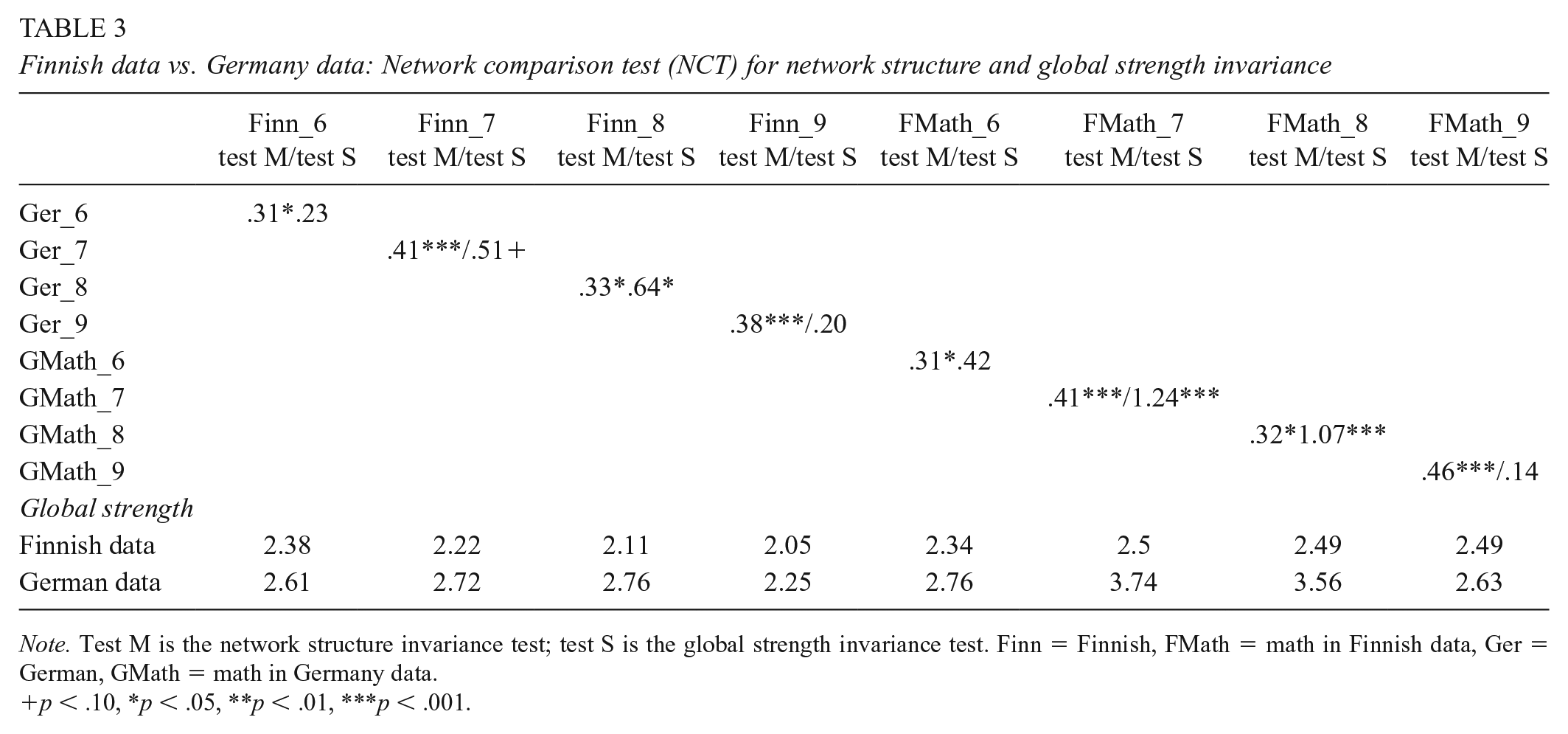
Note. Test M is the network structure invariance test; test S is the global strength invariance test. Finn = Finnish, FMath = math in Finnish data, Ger = German, GMath = math in Germany data.
p < .10, *p < .05, **p < .01, ***p < .001.
Summary table for the network differences

Subject Domain as the Situation
Finnish Data: Finnish Subject vs. Math Subject
The global strength for the 6th-grade Finnish network was 2.38 and for the 6th-grade math network was 2.34 (see Table 1). Thus, no significant differences were observed in two tests (test M and S; see Table 1) between the subject in 6th grade. However, Table S9 showed that there was an edge difference between expectancies and intrinsic value. In other words, although there were no global differences between the Finnish network and math network in the 6th grade, there was a single edge difference on the expectancies-intrinsic value link. As can be seen in Figure 1, the connection between expectancies and intrinsic value is stronger in the math network than in the Finnish network in the 6th grade.
On the contrary, the Finnish network and math network were globally different in the 7th–9th grade (see Table 1). During this period, the results of two global network tests were all significant. It showed that math networks had more connections than Finnish networks (i.e., global strength was higher in math networks). However, the specific edge difference determining the global difference varied across grades. In summary, the network of expectancy, subjective task values, and achievement showed differences between two subject domains (i.e., Finnish and math). Math networks tended to be denser than Finnish networks. In many cases, the differences lay on the edge of expectancies and intrinsic value. Thus, there is also the complexity of domain and grade that is manifested in the network differences of the subject domain.
Germany Data: German Subject vs. Math Subject
Table 3 shows the results for network structure invariance tests and global strength invariance tests between the subjects German and math. No significant differences were observed in the two types of tests between German and math subjects in 6th grade as well as in 8th grade. However, we found significant differences in network structure invariances between the two subjects in both 7th grade and 9th grade. In addition, there was a significant difference in global strength invariances between the two subjects found in 7th grade.
Table S10 shows the edge differences between German and math subjects. For 7th graders, the connection between expectancies and cost was stronger in the math network than in the German network (also see Figure 2). A similar pattern was found for the connections between achievement and cost in 7th grade. For 9th graders, the connection between expectancies and intrinsic value was stronger in the math network than in the German network, whereas the connection between attainment and intrinsic value was stronger in the German network than in the math network.
The Country as the Situation
Finnish and German Data: Language Arts Across Grade
Regarding the comparison between the two countries, the results are reported in Tables 3 and S11. For the language arts motivation and achievement networks, all network structure invariance test results were significant between the Finnish and German data. The global strength invariance tests were significant during 7th and 8th grade. A closer look at the edge difference results (see Table S11) showed that the edge of intrinsic value and cost played an important role in defining the differences. The finding suggested that intrinsic value connected with cost more strongly in the German data than in the Finnish data from 6th to 8th grade. In the 9th grade, the connections of expectancies and cost, and intrinsic value and attainment value, were stronger in the German than in the Finnish data.
Finnish and German Data: Math Across Grade
For math networks between the two countries, all network structure invariance test results were also significant (see Table 3). The edge difference results showed that the connection between math expectancies and math cost was substantially higher in Germany than in Finland at each grade. For the 7th-grade math subject, the edge of utility value and cost, and cost and achievement, were stronger in Germany than in Finland. It is unexpected to observe that the relation between math cost and math achievement was positive in the 7th grade in Germany. Moreover, several more edge differences between a country in the math network were observed in 8th grade. The edge of cost and expectancies and cost and intrinsic value was stronger in Germany than in Finland. On the contrary, the math network in Finland witnessed more connections between expectancies and attainment value, expectancies and achievement, and intrinsic value and utility value. Overall, more network differences between the two countries were observed during the middle of the observed period (7th and 8th grade).
Discussion
Using network analysis, the present study contributes to our understanding of the new SEVT comprehensively. We showed that expectancies for success, subjective task values, and achievement are interdependent in complex ways across grade levels, subject domains, and countries and that there are differences as well as similarities in the networks found among them. Given the rich information on the possible differences across situations (i.e., 6 variables in 4[grades] x 2[subjects] x 2[countries]), it is challenging to discuss all nuanced findings; we, thus, highlight several important findings and contributions.
Situative Nature of Expectancies, Subjective Task Values, and Achievement
Throughout the findings, many situative-specific associations were evident. Within Finland, the connections among expectancies, subjective task values, and achievement were declining for the Finnish subject. Moreover, the declines were more visible in the relationships between intrinsic value and cost (from 8th grade) and utility value and expectancies (from 7th grade). These results suggest that a general disassociation trend was observed among Finnish language motivational factors—meaning that Finnish adolescents gradually started to differentiate the types of motivational experiences in language learning. As students mature, their capability to discern various motivational components grows (Wan et al., 2021; Wigfield et al., 2015). What is special is that the connection between intrinsic value and cost, and utility and expectancies, disappeared since the 7th grade. In Finnish school contexts, the 7th grade marks the start of secondary education. Students then are typically in a more demanding and highly subject-dominant learning environment (Kiuru et al., 2020; Salmela-Aro, 2020). Thus, it is likely that those adolescents acknowledge the usefulness of language studies but also know their own potentially limited competencies when studying (Nurmi, 1993; Watt, 2004). The disassociation between intrinsic value and cost also resonates with prior research that most Finnish students in high schools were either not engaged or not burned out (Salmela-Aro & Upadyaya, 2020). Regarding language-domain networks in Germany, contrary to the declining trend in Finland, results showed a stable trend in global strength. One possible explanation for this finding is that students from Germany may have high motivation (at least in expectancy beliefs) because they are from academic-tracked schools. National representative studies such as PISA also reported higher reading efficacy beliefs for German youth (OECD, 2013, 2016, 2019).
For math subjects in Finland, the global connections were stable over time, and this is mainly because some connections were strengthened whereas others were weakened. Specifically, in 9th grade, math utility value became closer to achievement (though still very weak) and intrinsic value, whereas expectancies became less connected with achievement (still moderately) and cost. In Finland, 9th grade is the final year of compulsory education; afterward, students need to decide to continue their education in academic high school or vocational high school, or go to work (Tang et al., 2021). Thus, at this conjunction point, students possibly revisit the utility value of math and start to associate it with achievement and intrinsic value. Moreover, math is typically one of the most challenging subjects at school; students report most exhaustion experiences in math (Salmela-Aro, 2020). Therefore, math expectancies should have a less pronounced association with achievement, as 9th grade is typically one of the years in which students show the lowest level of motivation (Watt, 2004; Wigfield et al., 2015). For math networks in Germany, an inversed U-shaped trend in global strength was observed in which 7th and 8th grades had stronger interconnections among motivation (particularly the expectancies, utility value, intrinsic value, and cost) than the 6th and 9th grades. This finding is in line with Gaspard et al.’s study (2017) in Germany where math utility value was growing from 5th to 8th grade and then started to drop from 9th to 12th grade. One possible explanation is that German students start to lose fresh interests and gain exhaustion feelings, as the 9th grade marks the start of the second half of secondary education in Germany.
The subject comparison within Finland showed that math networks were denser than Finnish networks, which was mostly due to expectancies being tied closely with intrinsic value in math subjects. Given the challenging status of math (Salmela-Aro, 2020), this finding means that students who feel confident in math were more likely to enjoy math too. Prior research also demonstrated that the associations among expectancies, subjective task values, and achievement were stronger in math and science than in the language arts (Bong, 2001; Gaspard et al., 2018). Subject-domain network comparison results in Germany are in line with the findings in Finland; that is, the math network was denser than the German network. Aligned with prior literature, these findings imply that math is more stable than Finnish or German subjects, perhaps because it is more consistently emphasized throughout the K–12 educational curriculum (Eccles et al., 1989; Lee & Seo, 2021).
When comparing networks directly between Germany and Finland, we consistently see that networks were denser in Germany than in Finland across grades and subject domains. For language-domain networks, connections among expectancies, intrinsic value, and cost were particularly stronger in German than in Finnish. For math networks, expectancies and cost were more strongly related in Germany than in Finland. In the context of this study, German students were from academic-tracked schools where they had been tracked for their academic performance. In contrast, Finnish samples were from a wide range of schools where they were more diverse in their performance and specialties. Moreover, Finnish students were in the pretransition stage when career/education pathways have not been decided yet, whereas German students were in the post-transition stage (OECD, 2020). Given those reasons, it makes sense that German students displayed a stronger sense of expectancies, interest, and lower exhaustion than Finnish students.
Overall, the study suggests that there are more consistencies in the networks within the country than between the countries, though scale differences may also contribute to the findings. In other words, some situations, such as the country are more fundamental than others in determining the associations among expectancies, subjective task values, and achievement. This implies that there might be a hierarchical structure of the situation that is governing the influences of the situation on motivation and achievement. In the bioecological theory of human development (Bronfenbrenner & Morris, 2006), the environment that situates human development is organized in a clustered structure. In the model, family or school are the proximal environments, whereas country or culture are the distal environments. Similar to our findings in this study, the largest differences between networks were observed under the situation of the country, then the subject domain, and then the grade. Consequently, the country as a situation is more fundamental than the subject domain, and the subject domain is more fundamental than the grade level for us to understand the relations between expectancies, subjective task values, and achievement.
In sum, findings suggest that the associations between motivation variables and achievement vary across different situations. More importantly, those situations (i.e., grades, subject domains, countries) are intertwined with each other (i.e., the connection between variable A and B in grade C is potentially different than that of grade D for subject E in the country F). Results echo the propositions from SEVT (Eccles & Wigfield, 2020) that the joint associations among expectancies, task values, and achievement/choice depend on the situation.
Consistencies in the Patterns of Networks Across Grade Levels, Domains, and Countries
Despite the situative-specific findings, our results showed some consistencies across networks. First, findings showed that expectancies had the strongest correlation with achievement across grades and countries. This finding is consistent with prior research that has found expectancies for success (or ability beliefs) relating to more strongly performance outcomes (Pajares, 1996; Tang & Salmela-Aro, 2021) compared to subjective task values (i.e., STVs; intrinsic, attainment, utility, and cost) relating to course-specific intentions and choices or persistence in completing an achievement-related task (e.g., Eccles, 2005). Our findings also showed that expectancies and subjective task values were correlated more strongly within the same domain than between different domains across countries. Consistent with DCT (Möller & Marsh, 2013), students have greater connections between motivational beliefs in the same domain rather than in different domains. A student who has high expectancies for success in math might not necessarily have high expectancies for success in German because of contrast effects (i.e., good performance in one domain leads to lower ability beliefs in other domains; Möller & Marsh, 2013) and opposite ends of the verbal-mathematical continuum (i.e., higher ability beliefs when domains are closer to each other versus farther away on the spectrum; Helm et al., 2016).
Secondly, although expectancies had a significant connection in the network with achievement and intrinsic value across grades and domains, there was a weak direct connection between intrinsic value and achievement. As aforementioned, expectancies for success are more strongly associated with achievement compared to subjective task values, such as intrinsic value (Pajares, 1996; Tang & Salmela-Aro, 2021). Yet, intrinsic value is likely still important to students’ achievement because students will lack the motivation to start something or try hard without interest in a course or achievement-related task (Eccles et al., 1983; Eccles & Wigfield, 2020).
Moreover, we found that utility value and attainment value were strongly connected across countries. A possible interpretation for this finding is that a student who finds something useful for his/her daily life or career goals also identifies highly with being a particular kind of person (e.g., a math person), or vice versa (Eccles & Wigfield, 2020). Even though utility value had a strong connection in the network with attainment value, results showed that utility value and attainment value had a weak connection to achievement across grades, domains, and countries. This finding is consistent with previous work on how subjective task values like utility value and attainment value have a stronger relation with course-specific intentions and choices or persistence in completing an achievement-related task rather than achievement (Eccles, 2005). Alternatively, students may already have a high utility value or attainment value, which in turn, may not affect achievement, especially as math and verbal domains are considered core subjects in school. For example, Hsieh et al. (2021) found that students’ math utility value beliefs were high regardless of the level of their other math motivational beliefs.
Regarding cost, we found that expectancies, intrinsic value, cost, and achievement were typically under the same network community (i.e., have a close relationship with each other) across countries and grades. This finding provides evidence that cost should be considered as part of the other subjective task values rather than being a separate component in the model (see Barron & Hulleman, 2015; Eccles & Wigfield, 2020, for more information on the cost “debate”), at least during the period of early-mid adolescence. Because we also observed that the connections with cost declined over time, it is also possible that cost becomes a distinctive factor in the late school years or afterward. More longitudinal studies are needed to address the unique position of cost.
Limitations and Future Directions
Our study is not without limitations. First, while our paper contributes to the literature by examining SEVT constructs with achievement in various situations (i.e., grades, domains, and countries), future studies should look further at a variety of other situations, such as momentary-level situations, community as the situation, or academic-tracked schools versus vocational-tracked schools as the situation. Understanding the nuances in these different types of contexts can help teachers and administrators better teach students. Second, our study only examined the cross-sectional relations between motivation and achievement. Future studies should also consider looking at the longitudinal associations to create temporal networks to further the knowledge of network dynamics. Third, our study focused only on one type of cost, effort cost, and the items asked across the two different data sets were not the same. However, we chose the items that were most comparable across the two data sets. Like Gaspard et al.’s study (2015) that found the importance of differentiating the various types of subjective task values, we think that future studies should strive to examine whether results hold constant when additional facets of subjective task values are added to the network.
Implications
The current study and findings have several important theoretical and practical implications. First, our study not only provides evidence for the situational nature of SEVT but also implies that some situations are more fundamental than others in determining the interplays among expectancies, subjective task values, and achievement. In other words, situations should be understood and examined in a clustered way rather than in a linear way. This has important implications for theory construction in the future. Second, the situational and dynamic nature of SEVT suggests that future intervention studies should consider situations in their design, implementation, and analysis. Interventions from intelligence beliefs also suggest that a one-size-fits-all intervention is hard to achieve and is probably not the most effective (Yeager & Dweck, 2020). Third, despite the situative nature, we also find some consistent patterns across situations. For example, utility value mostly connects with attainment value, and both subjective task values are rarely associated with academic achievement. This finding cautions us that utility/attainment value might not be the most optimal intervention target for improving academic achievement. Currently, many interventions using SEVT are targeting utility value and have shown positive effects on achievement (Canning et al., 2018; Hulleman et al., 2010). However, our findings suggest that expectancy enhancement and cost reduction might serve as better intervention targets if the aim is to improve achievement (see Rosenzweig et al., 2020). Third, the study has methodological implications for the field of motivation. For a long time, motivation is conceptualized as a complex phenomenon, but most studies have examined motivation as an independent variable without considering the interplay. The current study demonstrated that the complex interplay among motivational variables can be systematically addressed using network analysis. Future motivation research to apply this approach is welcomed.
Supplemental Material
sj-docx-1-ero-10.1177_23328584221117168 – Supplemental material for Situating Expectancies and Subjective Task Values Across Grade Levels, Domains, and Countries: A Network Approach
Supplemental material, sj-docx-1-ero-10.1177_23328584221117168 for Situating Expectancies and Subjective Task Values Across Grade Levels, Domains, and Countries: A Network Approach by Xin Tang, Hye Rin Lee, Sirui Wan, Hanna Gaspard and Katariina Salmela-Aro in AERA Open
Footnotes
Author Note
The Finnish study was supported by the Academy of Finland Grants 308351, 336138, and 345117 awarded to Katariina Salmela-Aro. The German study was funded by the LEAD Graduate School & Research Network [GSC1028], which was funded within the framework of the Excellence Initiative of the German federal and state governments. Xin Tang and Katariina Salmela-Aro were also supported by Business Finland, AI in learning project.
Supplementary material
Supplementary material for this article is available online.

Notes
Authors
XIN TANG is an associate professor at the School of Education, Shanghai Jiao Tong University, China. He also holds the title of Docent (equivalent to associate professor) at the University of Helsinki, Finland. His research interests include motivation and engagement, social-emotional skills (particularly curiosity and grit), and student well-being.
HYE RIN LEE is a Ph.D. candidate at the School of Education, University of California, Irvine. Her research interests include motivation, psychological interventions, role models, academic engagement, and higher education.
SIRUI WAN is a Ph.D. candidate at the School of Education, University of California, Irvine. His research interests include the factors that influence individual educational achievement and career choices, especially those that associate with individual and gender differences in STEM fields.
HANNA GASPARD is a deputy professor at the Center for Research on Education and School Development, TU Dortmund University, Germany. Her research interests include the development of school motivation and interventions to promote motivation in the school context.
KATARIINA SALMELA-ARO is an academy professor at the Faculty of Educational Sciences, University of Helsinki, Finland. Her research interests include motivation, well-being, and educational transitions.
References
Supplementary Material
Please find the following supplemental material available below.
For Open Access articles published under a Creative Commons License, all supplemental material carries the same license as the article it is associated with.
For non-Open Access articles published, all supplemental material carries a non-exclusive license, and permission requests for re-use of supplemental material or any part of supplemental material shall be sent directly to the copyright owner as specified in the copyright notice associated with the article.
