




Abstract
A growing movement suggests that social and emotional learning (SEL) should be integrated into educational experiences in and outside schools. Afterschool programs can be particularly well suited for SEL, and afterschool educators can play an important role in skill development. We interviewed 23 experienced afterschool educators in community-based programs to understand how staff encourage SEL and how program directors support staff in doing so. Findings show that afterschool educators describe integrating SEL into their daily interactions with children by creating and catching teachable moments. Program directors served either as compliance enforcers or partners who supported staff’s autonomy to encourage SEL despite top-down mandates. Findings suggest that educators can develop substantial expertise integrating SEL into their professional work. By recognizing and empowering such expertise, program leaders can support implementation and innovation of SEL practices. Allocating resources toward intentional integration of SEL is an important next step for this work.
Social and emotional learning (SEL) is a growing movement in the United States. Publications about SEL increased sixfold from 2009 to 2020 (see Figure 1), and 18 states now have K–12 SEL standards. In one notable report, From a Nation at Risk to a Nation at Hope, the authors frame SEL as “the substance of education itself” rather than a passing “fad” (Aspen Institute, 2019, pp. 4, 6). Indeed, social and emotional skills (SE skills), such as self-management and social awareness, are essential for humans to navigate life and are associated with prosocial behaviors, academic performance, and mental health (e.g., Durlak et al., 2011; D. E. Jones et al., 2015). Research suggests that SE skills are malleable; that is, they can change through social interactions and programming (e.g., Collaborative for Academic, Social, and Emotional Learning [CASEL], 2013; Domitrovich et al., 2007; Durlak et al., 2011; D. E. Jones & Kahn, 2017; Porges, 2009). Afterschool programs, 1 in particular, are well-suited to support SEL, and afterschool educators 2 often have a wealth of practical SEL knowledge (Futch et al., 2016; Hurd & Deutsch, 2017; Pittman, 2018). However, educational movements typically filter down to afterschool staff, with a “school-like” focus on skills, content requirements, and test-based outcomes (Fusco, 2014; Halpern, 2006). The potential of afterschool to influence the SEL movement has not yet been realized (Afterschool Alliance, 2018; Hurd & Deutsch, 2017). Without an approach informed uniquely by educator expertise, children and youth across the educational landscape may miss essential SEL opportunities.

SEL Citations on Google Scholar.
Developmental researchers have argued for studies investigating how expert afterschool educators encourage SEL in their daily interactions with young people and how program directors support staff in doing so (Duffrin, 2020; Vandell et al., 2015). For the present study, we interviewed 23 experienced afterschool educators—including program directors and staff—to address two main research questions. First, how do experienced afterschool educators describe how they encourage SEL? How do they teach about, plan for, and engage spontaneously with young people in SEL? Second, how do afterschool directors create environments that support staff to encourage SEL? The aim of this research is to build a model describing practices that afterschool educators use to encourage children’s SEL and how directors support staff in this endeavor. Understanding staff expertise and directors’ approaches may help inform policies, grants, research, and the national conversation to ultimately encourage the SEL of young people.
SEL
SEL is an umbrella term that emerged in the 1990s and now reflects a rapidly expanding field (Blyth, 2018). SEL generally refers to the development of social, emotional, and cognitive competencies necessary for self-management, mental health, prosocial behavior, and positive relationships in childhood and beyond (e.g., Domitrovich et al., 2007; Durlak et al., 2011). Researchers and educators increasingly agree that these competencies integrate with traditional academic skills, such as reading or math. However, the field lacks consensus for exact definitions of SE skills and competencies (Wallace Foundation, 2016). SEL has a wide array of categorizations (e.g., character development, 21st-century skills) and more than 100 different frameworks (Berg et al., 2017).
Across all frameworks, SEL competencies are interrelated and rooted in concepts long studied across multiple fields, such as psychology, education, and neuroscience (S. Jones & Bouffard, 2012). In this paper, we use the broad domains categorized by the National Research Council (NRC, 2012) to categorize SE skills, including skills described by the Collaborative for Academic, Social, and Emotional Learning (CASEL). Interpersonal skills are defined as the skills children use to navigate their interactions with others. These include relationship skills (e.g., communicating, listening, negotiating conflict, sharing, and collaborating; Jones & Bouffard, 2012) and social awareness, or an individual’s ability to read social cues, relate to and respect others, show kindness, and take other’s perspectives (CASEL, 2013). Next, intrapersonal skills include managing stress and emotions, controlling impulses, and disciplining or motivating oneself (e.g., self-regulation, effortful control; Eisenberg et al., 2014; McClelland et al., 2015). Finally, cognitive skills are related to thinking and include problem solving (identifying problems, strategizing solutions, implementing complex tasks over time, and reflecting on learning); responsibility, or fulfilling obligations to oneself and others and internalizing accomplishments (e.g., completing homework); and initiative, or one’s capacity to persevere in the face of challenge (Larson et al., 2005).
SEL in Afterschool Programs
Afterschool programs provide a developmental context through which young people may develop SE skills (Durlak et al., 2010; Mahoney et al., 2005). Afterschool programs are defined as supervised programs that meet regularly during the school year and offer diverse activities to groups of children (Lauer et al., 2006; Vandell et al., 2015). Participation in afterschool programs is associated with gains in SE outcomes; this is especially true when programs focus on SEL (Durlak et al., 2010) and create a positive environment through such practices as sharing agency and building strong relationships (Pierce et al., 1999; Pierce et al., 2010). In fact, SEL is a uniquely strong fit for afterschool that goes beyond a deficit to be addressed by afterschool programs instead of other institutions.
Afterschool is well suited to support SEL for many reasons (Devaney & Maroney, 2018; Hurd & Deutsch, 2017; Pittman, 2018; Smith et al., 2016). First, the historical and theoretical roots of afterschool programs have always included SEL. Afterschool programs emerged in the late 19th century when a growing number of children had “idle time” after school resulting from child labor laws and mandatory public education (Mahoney et al., 2009). At their inception, programs were created with the goal of children’s social and academic development (Lee, 1915). As program attendance rose throughout the 20th century, caregivers, educators, and politicians saw that by attending afterschool programs, young people could have opportunities to develop competencies and “stay out of trouble” (Halpern, 2003; Hurd & Deutsch, 2017). In the 1990s, a theoretical framework related to SEL, positive youth development (PYD), emerged and became foundational to afterschool programs. PYD is a strengths-based approach to adolescent development that is used in research and practice (Lerner et al., 2009). This theory posits that PYD emerges when youth’s developmental assets are enhanced (Benson et al., 2006, Gestsdóttir & Lerner, 2007; Lerner et al., 2011). PYD and SEL have some differences (Blyth, 2018): SEL focuses more on competencies and is rooted in early childhood and school-based literature, while PYD is often more youth-centric (e.g., youth agency) and stems from out-of-school research. However, PYD and SEL share many of the same goals. Both approaches recognize the importance of encouraging SEL through experiences and relationships across developmental periods (Blyth, 2018).
Second, programs often have curricular flexibility and are “rich in relationships,” which research shows is key to SEL (Hurd & Deutsch, 2017, p. 96; Pittman, 2018). Afterschool programs typically do not have to prepare children for standardized tests or uphold state-mandated academic standards. Thus, they can focus on integrating content and goals, such as SEL, that align with their mission. In addition, this flexibility gives adults more time to build relationships with young people during interest-based activities or unstructured time. Relationships—adult-child and peer—are perhaps the most cited, and arguably most important, feature of afterschool programs (e.g., Akiva et al., 2020; Halpern, 2003; J. N. Jones & Deutsch, 2011; Roth & Brooks-Gunn, 2017; Vandell et al., 2015), and relationship building emerges across multiple frameworks as a program element important for positive development (e.g., Eccles & Gootman, 2002; Lerner, 2004; Roth & Brooks-Gunn, 2003). Afterschool programs have been described as a “sanctuary” (Akiva et al., 2017; McLaughlin et al., 2001), “home-places” (Deutsch & Hirsch, 2002; Hirsch, 2005), and a “third space” (Fusco, 2014) in which young people have a safe place to build family-like bonds with peers and adults who work there (Eccles, 1999). Given that young people learn SE skills through relationships, this feature of afterschool programming makes the context well suited to encourage SEL. Afterschool educators often incorporate relationships into the fabric of their programming, and many consider relational practice to be the work of afterschool educators (Fusco, 2014).
How Afterschool Educators Encourage SEL
Although more research is needed, some studies have identified practices that afterschool educators use to support SEL (Blyth, 2018; Newman, 2020). These include strategies that are explicitly taught (i.e., direct lessons about SE skills), planned (program features through which SE skills are learned along the way), and spontaneous (practices that respond to SEL “teachable moments”), as depicted in Figure 2.

Educator Supports of SE Skills.
Explicitly Taught Strategies
Afterschool educators might encourage SEL by teaching about the meaning and use of SE skills through explicit lessons (Blyth, 2018; CASEL, 2013; Domitrovich et al., 2007; Durlak et al., 2011; Payton et al., 2008; Rimm-Kaufman et al., 2014). Some programs use evidence-based curricula designed for afterschool (e.g., WINGS, Girls on the Run) or for K–12 school and adapted to the afterschool context (e.g., PATHS, Responsive Classroom). Explicit teaching can also occur through educator-created lessons. In one meta-analysis, Durlak et al. (2010) find that afterschool activities that are sequenced to scaffold skill building, active with opportunities for practice, focused on particular skills, and explicit in their learning objectives are associated with the development of personal and social skills. This finding is replicated in other afterschool studies, which show that age-appropriate scaffolding is associated with SEL (e.g., Pierce et al., 2010; Vandell et al., 2015). The extent to which educators in afterschool programs explicitly teach SEL strategies is less clear, given the many other priorities prevalent in the field.
Planned Strategies
Planned strategies are program features, including activities, supportive relationships, and the program’s culture, through which educators can foster SEL (cf., Durlak et al., 2010; Lerner, 2004; Newman, 2020; Pierce et al., 1999; Roth & Brooks-Gunn, 2003; Vandell et al., 2015). First, afterschool educators can plan SEL supports during structured and unstructured activities, including homework help, enrichment, recreation, and free time (Vandell et al., 2015). For example, an educator might plan to scaffold emotion management skills during a challenging science activity. Second, educators can foster SEL through the supportive relationships they build with young people. Recent research shows that children’s brains can be structured for SEL through positive interactions (Osher et al., 2018; Porges, 2017). In a study of nine afterschool programs, researchers find that when children connected with staff, they showed greater self-control than children without positive adult relationships in the program (Wade, 2015). Although some relationships may occur naturally, many afterschool educators intentionally cultivate them (J. N. Jones & Deutsch, 2011). Finally, program culture, defined as norms or “the way things are done around here,” can be intentionally shifted by educators to encourage SEL (Hemmelgarn et al., 2006, p. 75; S. M. Jones et al., 2017b; Sherer & Spillane, 2007). For example, school-based research shows that educators can set expectations for children to use respectful language and show empathy (Bradshaw et al., 2008; Thapa et al., 2012). Afterschool educators might create a “safe space” by allowing mistakes and reinforcing group norms so that all children feel respected and psychologically safe (Eccles & Gootman, 2002; Fusco, 2007; J. N. Jones & Deutsch, 2011; Pierce et al., 1999 Smith et al., 2016; Wanless, 2016). Afterschool educator training is important for creating a culture that encourages SE skills (Aspen Institute, 2019; Blyth, 2018; Hurd & Deutsch, 2017).
Spontaneous Strategies
Educators may also encourage SEL in responsive ways by “catching” teachable moments and integrating SEL into their daily practices (Blyth, 2018). In their study of SEL in youth programs, Smith et al. (2016) note that afterschool educators at exemplary programs “coach, model, scaffold, and facilitate in real time as challenges occur” (p. 27). Integrating SEL into afterschool programs can sometimes seem challenging, especially at programs with many academic outcome requirements. However, school-based and afterschool educators often use techniques akin to “tools in a toolbox” to encourage SEL (S. M. Jones et al., 2017a). For example, an educator could give a nonverbal transition cue to help a child focus on a cognitive task or prompt a child to breathe and count to 10 to manage emotions. Afterschool educators likely develop more and varied techniques as they gain experience working with children, and they may also consider more nuances of a situation in choosing techniques to employ (K. C. Walker & Larson, 2012).
Afterschool Directors and the SEL Movement
SEL has recently been highlighted in the national conversation, in schools and in afterschool programs. As depicted in Figure 3, the SEL movement, like many educational movements, can evolve from the top-down or bottom-up (Grant & Gilbert, 2018). SEL may be in the spotlight for many reasons: a backlash to high-stakes testing during the No Child Left Behind era, changes in employers’ needs, a desire for a diverse and collaborative society (Hugh & Jones, 2011), or a response to the COVID-19 pandemic.
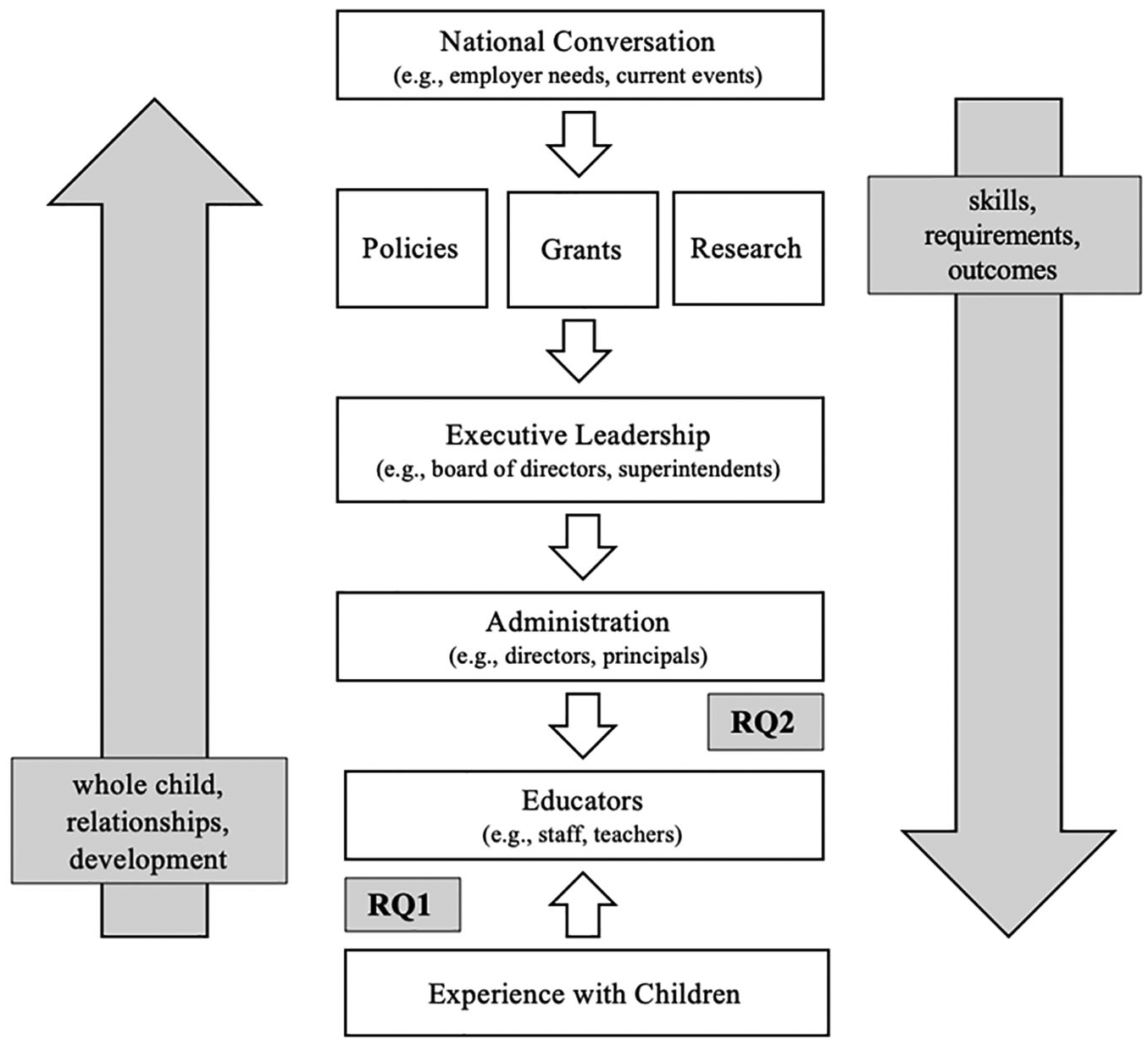
Conceptual Depiction of the Flow of Educational Movements.
In afterschool programs, directors’ approaches to implementing new priorities and goals have implications for how the SEL movement plays out in afterschool programs (Allensworth & Hart, 2018; Aspen Institute, 2019). Directors are essential for supporting staff to encourage SEL in afterschool programs. For example, directors can build staff expertise grounded in a local understanding of children and families (Fusco et al., 2013). Examining how directors navigate top-down and bottom-up influences of educational movements, as depicted in Figure 3, can inform where we place resources and supports to encourage the SEL of children and youth.
The Current Study
As the SEL movement grows, the out-of-school time field has an opportunity to contribute SEL expertise (Pittman, 2018). To inform the SEL movement from the bottom-up, we need more research about how afterschool educators address SEL in their everyday interactions with children (Vandell et al., 2015). Understanding top-down influences, as evidenced by directors’ responses to SEL messages they receive and their approaches to implementing SEL, might also inform how advocates balance the rollout of future SEL initiatives.
For this study, we conducted interviews with experienced afterschool educators to address two research questions, as depicted in Figure 3:
Research Question 1 (RQ1): How do experienced afterschool educators describe how they encourage SEL? a. How do they describe explicitly teaching SEL? b. How do they describe planning to encourage SEL? c. How do they describe spontaneously encouraging SEL?
Research Question 2 (RQ2): How do afterschool directors describe their efforts to create environments that support staff to encourage SEL?
Methods
Sampling
The sample included 23 experienced afterschool educators from five programs in a medium-sized, Mid-Atlantic city in the United States. The city’s population is about 300,000 residents, who are 23% Black and 67% white. A report by the Afterschool Alliance (2014) notes that 28% of children in the surrounding county participate in afterschool programs, a rate about 10 percentage points higher than the national average.
We recruited participants through the local out-of-school intermediary and by contacting afterschool directors. We sought to recruit roughly an equal number of directors and staff. All participants had worked with children for at least one year so they could draw from their experiences encouraging SEL. All participants worked at the Boys and Girls Club of America (BGCA) or the Y, 3 two of the most well-known afterschool organizations in the country, serving a combined 13 million young people. Both have a hierarchical structure, allowing us to compare staff and directors in RQ2, and both serve children in grades K–6, allowing us to investigate SE supports within this developmental period. 4
Sites
Educators worked across five programs in BGCA and the Y. All sites sought funding largely through membership fees and grants. The daily structure for children was similar at both organizations and included homework, snack, enrichment, and free play. Enrichment included such activities as STEM, art, and physical activity, The region’s BGCA programs serve children and youth who are 68% Black and 23% white; 70% of children served receive free and reduced lunch (BGCA, 2021). The Y programs are located in neighborhoods that are 12% Black and 82% white, with 12% of families under the poverty level (U.S. Census Bureau, 2019).
Participants
Table 1 displays demographics of the 23 afterschool educators. Participants were majority white and female, with several years of experience. Educators described their “other” work experiences as teaching in K–12 schools, working at summer camps, and babysitting. Three participants had attended the program at which they now worked. A majority had a bachelor’s or master’s degree. The most common degree of study was education (14 participants), along with psychology, social work, and other areas (e.g., English, biology).
Participant Demographic Information by Role

Educators in this sample were roughly divided across role and organization. Educators fell into role categories based on direct work with children and control over program-wide decisions (see Table 1). Directors described their job responsibilities as completing paperwork, connecting with external partners, and filling in however needed. Staff jobs typically included helping with homework, leading lessons, supervising unstructured time, and playing games.
Almost all directors (90%) and about half of staff (54%) reported that they had some training related to SEL from their program (e.g., webinars, director-created sessions, one-on-one coaching) or outside the program (e.g., higher education, independently sought opportunities).
Data Collection and Analysis
Interviews took place from October 2018 through February 2019. The first and third author conducted all interviews, created the coding scheme, coded interview transcripts, and analyzed data using an iterative process. These two researchers were white and female, and both had previous experience working with young people in out-of-school settings at the staff and director levels.
We conducted 20 interviews in person and three online. We used a semistructured interview protocol, including two main components: a video-based protocol, during which interviewees responded to questions before and after watching two short (1.5-minute) video vignettes, and open-ended prompts about their strategies to encourage SEL. The videos included moments that could be interpreted through an SEL lens but were also broad enough to elicit other reflections (e.g., about academic content). See Appendix A for a full description of interview components and protocol.
We used videos as an elicitation technique to inform RQ1. The video-based protocol was adapted from a K. C. Walker and Larson (2012) study in which afterschool educators describe their response to two vignettes. In this study, we used similar questions to elicit reflection about educators’ SEL strategies. Education research shows that vignettes can be effective for learning about educators’ interpretations of phenomena (Skilling & Stylianides, 2020). Video vignettes can also help educators attend to complexities of in-person interactions, prompt memories of past events, focus interviewee responses, and allow for greater researcher triangulation (Schuck & Kearney, 2006; R. Walker, 2002). In addition, we believed it would be difficult to elicit in-the-moment educator reflection on SEL strategies because it would disrupt authentic adult-child interactions (for example, by interrupting a conversation between an adult and child to ask the adult to reflect on the situation). Finally, using two methods of collecting data (video and open-ended responses) may eliminate some biases of using a single method and help gain additional insight on participants’ SEL practices (Maxwell, 2013).
Our coding scheme (see Appendix B) was inductive and deductive (Miles et al., 2014). To code educator practices, we used themes that emerged from responses to open-ended questions and reactions to watching video vignettes. We also coded for practices identified by the Smith et al. (2016) SEL Curriculum Features. We found that video vignettes provided a prompt for educators to share their own practices. For example, when educators watched the Gardening clip that showed two children arguing, they often talked about the SEL skills they support when handling arguments.
After establishing agreement on the coding scheme, we double-coded all 23 interview transcripts by using Dedoose qualitative software. We segmented data into 846 excerpts that were independent statements or ideas averaging 428 characters each. To analyze data, we used matrices to condense text, make meaning of coded excerpts, and as a heuristic for understanding patterns and comparing educator practices (Miles et al., 2014). For example, we used displays that were descriptive (e.g., participants demographics) and role-ordered (e.g., directors and staff).
Throughout the study, we met regularly to check understanding, agreement, and discrepant codes (Miles et al., 2014). This process of collaborative coding increased reliability (Saldaña, 2013). As a validity check, we consulted an expert in the field of out-of-school time and a researcher from outside the field of education as an external auditor (Creswell, 2014).
Findings
RQ1: How Do Experienced Afterschool Educators Describe How They Encourage SEL?
Three subquestions gave insight into how educators described SEL supports, as depicted in Table 2.
How Experienced Afterschool Educators Encouraged SEL

RQ1a. How Do Experienced Afterschool Educators Describe Explicitly Teaching SEL?
Fifteen educators (65%) described explicitly teaching SEL content depending on their role and program at which they worked. All (100%) directors described explicitly teaching SEL content, whereas only 5 of 13 staff (38%) said this. In addition, many directors stated that one of their primary roles was to create curricula and lessons.
Purchased Curricula
One site at BGCA reported using a packaged SEL curricula. Directors received a grant to purchase PATHS (Humphrey et al., 2016), a scripted curriculum targeting SEL competencies. One director said, “We wanted to make sure that we’re doing it right and doing it in a way that was really going to help these kids.” Another director added that she was “really looking forward to it because our kids definitely, definitely need some SEL—more strategies [for] how to handle things.” Some staff described frustration with curricula requirements when they felt forced to add structured lessons and curricula instead of supporting skills in the moment (this is described more in RQ2 findings).
Educator-Created Curricula
At the other BGCA site, educators created an SEL curriculum for their “Life Skills” class. One staff member and one director created SEL lessons for these year-long courses, in which young people are grouped by gender and age. For example, one staff member described an activity in which children draw strategies they use “to cope when they were feeling like mad, angry, and upset.” Another staff member mentioned weekly discussions of “silly topics” to help children learn “soft skills to have a discussion respectfully with people that are not agreeing with them.” BGCA directors stated a goal of long-term SEL development. One director said, “I mean, we assume that a kid’s going to be with us for 12 years. So, when we develop curriculum, we develop it with that spectrum in mind.” Another director echoed, “Hopefully, that will lead to more deep questions as we go throughout the year. And even with the little ones, by the time they get to be older, they’re comfortable having those conversations.”
One-Off Lessons
Adults from the three Y sites stated that they explicitly taught SEL through individual lessons created to target a specific SEL need or program requirement. One director said, “Staff will try and look up some lessons or an activity that will deal with [an SEL skill] just to help those children.” For example, a staff member might create a lesson on conflict resolution after two children disagree during a kickball game. Educators reported that these explicit SEL lessons were not tied to an overall SEL curriculum.
RQ1b. How Do Experienced Afterschool Educators Describe Planning to Encourage SEL?
Most educators (89%) described intentionally cultivating program features to encourage SEL by planning activities, intentionally building relationships, and shaping program culture.
Activities
Many educators (70%) described planning non-SEL activities during which they expected SEL moments would emerge. For example, one director said, “Those SE skills, those other skills, cooperation and all, are attached to something that’s more of a tangible, planned activity.” They described situations they anticipated to arise—especially during group work, collaborative projects, and games—and then they were ready to jump in and respond to the SEL teachable moment. For example, one staff member said, “So, just giving them a game that they can play where they have to think, ‘It’s okay if I lose, and how will I express myself if I do lose?’ and just being able to work on a team, and so they can take turns and know everybody has a role, and it’s okay to be in that role.”
Building Relationships
All educators (100%) also shared how they intentionally built relationships with children through which they might encourage SEL. Relationships emerged as a main priority of educators. As one educator said, “We really put so much emphasis on relationships.” Relationships were supported by directors in both organizations. For example, a director from the Y said, “We don’t want you to just supervise the kids. . . . We want you to learn about them. We want you to get to know their parents . . . build the relationship with the families and the kids.” Educators described getting to know children during program activities as well as during unstructured time. After watching a vignette of a staff member casually talking with youth, one director commented, “If I am playing ping-pong, I’m also probably talking to the kid about how their day was, and how was school, or why are they tired.” Another staff member similarly said, “To me, that’s one of the most important [SEL] things we can do—is just sit down and listen.”
Creating a Culture
Finally, most afterschool educators (96%) described encouraging SEL through the program culture shaped by program norms and staffing practices. First, educators talked about creating a safe space. Educators said it was important to “see that people can be different, and that’s okay” and to “create an environment that’s going to welcome that [new] kid the first day.” Participants also described providing structure while giving children agency to build SE skills. For example, when afterschool educators responded to the vignettes, many noted norms they aim to implement to proactively support SEL. One educator said that she would “stop everyone and review the expectations again” to prevent future conflicts between children. Another shared a routine she would use to encourage SE skills, as shown in the clip: “I would probably make that conversation they had an everyday ceremony kind of thing. Maybe when they first come in, and everybody can talk about their day.” Descriptions of program norms somewhat differed based on role; 80% of directors talked about structural features (e.g., program rules, regulations, ratios, safety, and expectations), compared to only 62% of staff. Finally, several interviewees wanted to learn more about SEL, although finding time for SEL training was a challenge.
RQ1c. How Do Experienced Afterschool Educators Describe Spontaneously Encouraging SEL?
All 23 afterschool educators (100%) shared responsive practices through which they encouraged SEL. Staff and directors agreed that “spontaneous strategies are constantly taking place,” that they “probably do the spontaneous the best,” and that “it’s easier with kids and SEL to be in the moment and to fix it right then and there.” Spontaneous strategies came up when participants reacted to both vignettes and when they were prompted to reflect on their own strategies. Educators noted how they often spontaneously responded to teachable moments during peer conflicts (e.g., sharing, excluding, bullying, arguing) and when children were upset by situations from home or school. Educators also recalled the following strategies they used to spontaneously teach SEL.
Questions
Educators shared questions they use to get to know children, build relationships, or understand children’s feelings. For example, after watching one vignette showing a staff member welcoming children, one participant stated that asking questions is “typically what I do. [I ask,] ‘So, your day was good. What was good about the day?’”
Individualization
Educators talked about being responsive to children’s individual differences. One director said, “There’s a thousand opportunities for learning if you know their personality, if you know their background, if you know what their strengths and weaknesses are.”
Taking a Break
Educators noted that they suggest that children take a break from a situation to help them calm down or to give them space to process what has happened. One educator described that in her program, children “can have that chance to go with an adult, maybe leave the room, walk down the hallway, or sit on a bean bag chair. . . . [I]f they’re having a really rough day, we’ll pull them aside and let them just get it all out.”
Perspective Taking
Educators described working with children to “figure out what happened, why it happened, and work it out.” This included scaffolding children’s ability and inclination to consider others’ perspectives. For example, one educator shared that they might ask a child, “How would you feel if this was happening to you?”
Leveraging Peers
Educators encouraged children to help one another with SEL-related situations. In response to a vignette that showed a child crying, one participant suggested, “If you’re seeing someone crying, you can even get other kids involved in trying to say, ‘Okay, what’s going on?’ Almost like peer intervention.”
Independent Practice
Afterschool educators talked about encouraging children to use SE skills independently. For example, one staff member created a “friendship bench” where children could go to solve their own challenges. She explained, “We send them to the friendship bench, and they are supposed to work it out on their own. And then we go out after a while, and they will say, ‘Well, we understand why we were fighting, and we’ve all forgiven each other.’”
RQ2: How do afterschool directors describe their efforts to create environments that support staff to encourage SEL?
Two approaches emerged about how directors described their attempts to create an environment supportive of staff and SEL: a “compliance” and a “partnering” approach (see Table 3). Directors’ approaches also seemed associated with how staff described their role in encouraging SEL. Each director in the sample fell into one of these categories.
Director Approach

Compliance Approach
Perceived Director Role
Four directors at two programs (40% of directors) used compliance-focused language when describing how they create an environment to support SEL. These directors described their job as upholding rules and regulations. One director talked about aiming to ensure that “program quality had improved, that our activity plans were being done, and that we were providing a decent program.” With this approach, directors believed that they could support children’s SEL by making sure that staff followed curricula and planned lessons ahead of time and by checking that staff were doing what they said they would do. In other words, if staff complied with planned programming that supported SEL, children would be more likely to learn SE skills.
We saw tension within some of the directors who used compliance language. While directors in this study fell into either category, some directors who took a compliance approach wanted to be able to partner with staff but believed that they could not because of the structures around them. For example, some of these directors shared the pressure they felt from executive leadership to maintain compliance in their role. One shared that she sometimes feels like the “bad guy” when she “comes in as the regional director, and I’m like, ‘We can’t do this, we can’t do this, we can’t do this.’” Compliance-focused directors also described how ratio requirements combined with staffing challenges prevent them from partnering with staff. One director described that when she is responding to daily challenges, she “can’t necessarily help even improve stuff.” Another director shared how she sometimes is not able to visit all her programs because she must cover for absent staff. She said, “I feel like there’s a disconnect between what is really occurring, especially if being short-staffed, if it’s been weeks since I’ve been at a program. So, there’s a huge disconnect there on what’s occurring on a day-to-day basis and what I think is occurring.” Because of this, she could not connect with staff or children in ways that may help support SEL.
Perceived Staff Role
Directors who took a compliance approach used language related to having control over curriculum requirements. For example, one director said, “As soon as I get in, I talk to them and be like, ‘Okay. So, we’re doing this today.’ And then I fill them in if there’s anything they need to know.” At some of these sites, lessons had to be submitted 1–2 months in advance so that directors could check for compliance with program curriculum requirements. Given the pressure these directors described to uphold rules related to other content, we suspect that these directors would enforce regulations about SEL requirements in a similar way.
Staff Attitudes
Staff at these sites also described a disconnect between themselves and their directors. For example, one staff member said, “They come in and they’re like, ‘Don’t do that! Please don’t—sit down! Blah blah blah.’ You guys know nothing about children, but you’re running these programs.” Another similarly commented, “They don’t really understand what it’s like to be . . . on the job, so they give us so much paperwork. . . . What do they actually care about?” Staff at programs with compliance-focused directors also described frustration with academic requirements and lesson plans. One staff member said that planning lessons for a whole month “definitely gets in the way.” These staff members mentioned that they sometimes “just fill [the lesson plan] out to have something to give the regional director.” Another staff member explained, “When the boss walks away, you just do what you know needs to get done. If we did everything that they wanted us to do—if we were able to do, it would be just like an extension of school. But we know what these kids need.”
Partnering Approach
Perceived Director Role
Six directors in three programs (60% of directors) fell into the partnering approach category. They described leveraging their role to create an environment supportive of SEL by taking on challenging tasks so their staff could focus on direct work with children. These directors described being “behind the scenes” so that staff “can just get out there and be with the kids.” For example, a director described how she came early to her program “because it takes a good deal of time to set up, and we have a number of accountability procedures that we have in place.” When staff can focus on their interactions with children, they may be more likely to catch moments to support SEL.
These directors also described supporting staff through challenging SEL situations (e.g., “They might have trouble dealing with either with the families or with the kids.”) One director shared that he believes his role is to bridge the gap between staff and the executive leadership. He said, “I end up being the tie between the boots on the ground and the overarching mission of the organization, trying to balance the budget and the people. . . . I’m more like the ears on the ground but also the ears [up there].”
Perceived Staff Role
Partnering directors often described valuing their staff’s experience and expertise in encouraging SEL. One director talked about how she needed staff buy-in “to really make it part of what we do to serve the whole child.” Other partnering directors described giving staff agency in how they support program goals, such as SEL. For example, one director said:
I can tell [staff], ‘You need to do this, this, this, and these are lessons you’re going to teach.’ Just like the school does. Or you can say, ‘These are what we want the girls to come out of with this stage. Here’s the finish line. It’s your race to run.’
Staff Attitudes
Staff at programs with partnering directors talked about agency in their jobs. Staff described job requirements as planning programming and building relationships; they had flexibility to create time for both in a way that worked for them. For example, one staff member shared that her role was to “plan and implement all the gym classes for everyone and come up with all the games. . . . And then also play with all the kids and really make a point to go to different areas and do different things.” Another said, “If we’re not in a scheduled program that we’re teaching, we’re on the floor talking to the kids, playing games with them, just hanging out. . . . We have the freedom to teach a lot of different things, and I like to think we teach about life . . . and those other things that teachers in schools don’t hit on.” These staff described being “in charge” of programs and using their time with children to build relationships, ultimately enabling them to encourage children’s SEL.
Discussion
In this study, we sought to answer two questions. First, how do experienced afterschool educators describe how they encourage SEL? How do they teach about, plan for, and engage spontaneously with young people in SEL? Second, how do afterschool directors create environments that support staff to encourage SEL? We used these findings and drew from previous research to build a model of the strategies that afterschool educators use to support SEL: explicitly taught, planned, and spontaneous. In this section, we synthesize findings and share implications around integrating SEL into everyday practice and creating space for SEL by supporting the development of practitioner expertise.
Integrating SEL
Findings from this study show that experienced afterschool educators describe using the kinds of SEL-supportive practices that researchers claim are effective and feasible (Aspen Institute, 2019; S. Jones & Bouffard, 2012; S. M. Jones et al., 2017a; S. M. Jones et al., 2017b; S. M. Jones et al., 2019; that is, they integrate SEL into their daily interactions with children by creating and catching spontaneous SEL moments. This extends and supports research in and out of school, emphasizing SEL integration (CASEL, 2021; S. M. Jones et al., 2017a; S. M. Jones et al., 2017b). Afterschool educators’ expertise and descriptions of SEL integration also align with existing research linking educators’ practices with children’s SEL outcomes. For example, Newman (2020) describes how afterschool educators’ SEL practices can support positive youth development.
Educators’ descriptions of “caught” strategies as planned and spontaneous provide empirical evidence for their expertise in practices that researchers link to child SEL outcomes. First, educators’ descriptions of planned SEL strategies are consistent with research about SEL. Integrating SEL opportunities into activities aligns with studies showing that children and youth benefit most from activities that are authentic, challenging, and provide opportunities to build skills (Lerner, 2004; Roth & Brooks-Gunn, 2003). Educators were also intentional about building relationships through which they could support SEL. This aligns with research showing that relationships are perhaps the most important program feature for positive development (e.g., Akiva et al., 2020; Halpern, 2003; J. N. Jones & Deutsch, 2011; Li & Julian, 2012; Roth & Brooks-Gunn, 2017; Vandell et al., 2015). In addition, educators described shaping a program culture and routines to support SEL. Research shows that program norms can create psychological safety and are important for child outcomes, including SE skills (S. M. Jones et al., 2017b; Pierce, 1999; Sherer & Spillane, 2007; Wanless, 2016).
Second, educators shared that spontaneous SEL was “constantly taking place.” This may be the reason that SEL and afterschool programs are so well aligned (Hurd & Deutsch, 2017). Identifying teachable moments takes expertise and can be challenging (K. C. Walker & Larson, 2012), yet educators described real, tangible ways that they do this every day. These teachable moments may build over time, as many children return to the same afterschool program for multiple years. When educators know the children in their program, they can jump in and tailor SEL supports (Fusco et al., 2013). Indeed, educators in this study talked about hoping to encourage children’s long-term social and emotional development.
Balancing the Bottom-Up and Top-Down
This study also offers insight into how we can encourage SEL from the bottom-up based on afterschool educators’ experiences with children. The SEL movement is rapidly expanding, and there is an opportunity to listen to educator expertise, as depicted in the upward arrow in Figure 3. Experienced afterschool educators described, often in great detail, the strategies they integrate into their everyday practices to support SEL, with or without explicit instruction from their organization or supervisor. This aligns with current research about integrating SEL (e.g., Bailey et al., 2019; S. M. Jones et al., 2017a; S. M. Jones et al., 2019). Directors and staff also similarly valued and described many “caught” strategies to encourage SEL. This is promising—as we saw with directors who took a partnering approach, they may be able to implement SEL initiatives by supporting and investing in the expertise of the staff at their programs. If we can learn what educators already do to effectively encourage SEL, we can use this information to shape policies, grants, research, and maybe even the national conversation to encourage more SEL.
However, in this study, educators described how the SEL conversation is trickling down to executive leadership and afterschool directors. This is reminiscent of how educational movements have historically shaped afterschool goals, as depicted in the downward arrow in Figure 3, with a focus on skills, requirements, and measured outcomes (Fusco, 2014; Halpern, 2006). For example, at one BGCA program, directors talked excitedly about how they had just gotten funding for a prepackaged SEL curriculum that they could train their staff to use. Indeed, some study participants described required curricula as burdensome, and they expressed frustration with requirements and regulations imposed by leadership. And, in the case of directors who used compliance-oriented language, they described how requirements from executive leadership sometimes affected their ability to support staff in ways that they believed were optimal. This may be an example of quality being “squeezed” out of afterschool programming due to managerialism (Fusco et al., 2013).
In general, programs put requirements into place for various reasons, and requirements can be useful (e.g., to ensure quality programming). However, even with the best intentions, policies and procedures can feel disconnected from practice and more related to regulations and compliance by the time they get to staff. As one director explained, “Everything up top is easier when it’s black and white . . . but what’s hard is when you take this black and white, now it’s a policy and a procedure, and you give it to the people that are down on the ground. Well, now there’s a million shades of gray.” How directors and staff navigate the tension between top-down mandates and every practice that exists in some programs is worth exploring as the SEL movement grows. Perhaps there are creative ways to balance and respect top-down and bottom-up priorities in how we implement SEL.
Implications
This study raises questions about where to focus resources for encouraging SEL in afterschool and other educational settings. Educators’ descriptions of SEL-supportive strategies diverged from solely curriculum-based SEL interventions. Curricula can be helpful for programs, schools, and educators hoping to explicitly teach SE skills. However, prepackaged curricula can be expensive—a barrier to access for some programs—and may not be tailored to the context of programs or rely on educator expertise. This study shows that SEL does not need to be a separate topic that educators must “jam” into their already busy schedules (S. Jones & Bouffard, 2012). Rather, SEL supports exist in everyday practice and can be strengthened through identifying and creating daily opportunities. Investment in intentional integration is an important next step for supporting SEL.
Our findings also offer insight into professional development that might enhance SEL in afterschool (and likely school-based) settings. Indeed, building educator expertise and professional judgment among afterschool educators is important for high-quality afterschool programming that supports SEL (Fusco et al., 2013). A few models of professional development currently could support SEL integration, such as one-to-one coaching on encouraging SE skills and staff reflection on daily practice (Akiva et al., 2020; S. Jones & Bouffard, 2012). Another strategy is for educators to focus on their own SE skills so they may be better able to encourage children’s skill development (Carlock, 2011; Duffrin, 2020; Jennings & Greenberg, 2009; Maurer & Brackett, 2004; Roeser et al., 2012). Findings from this study can contribute to the field as a promising focus for professional learning. For example, educators might examine the explicitly taught, planned, and spontaneous practices they currently use to encourage SEL that work well in their program. With their colleagues, they might share practices and brainstorm ideas to intentionally integrate SEL supports in their everyday practice. Using a strengths-based approach that highlights what afterschool educators are already doing well may be key to informing the SEL movement from the ground up. Such community-of-practice-based learning strategies (Wenger-Trayner & Wenger-Trayner, 2015) allow educators to define their own domains of competency with regard to their practice.
In addition, the strategies that partnering directors described in this study may offer a model of how to effectively encourage SEL integration at different levels of an organization. Directors play a key role in encouraging children’s SEL by supporting staff. This study shows that when directors used partnering language in their approach, they were able to support the SEL work that afterschool staff were already doing by taking on administrative duties, coaching staff through challenges, and giving staff agency and flexibility. Staff described how this approach from program leadership allowed them to prioritize SEL-supportive practices, such as being present with children to build relationships and to catch SEL moments. This aligns with afterschool research showing that supervisor support can decrease stress of afterschool staff, allowing them the mental and emotional capacity to engage in high-quality work with young people (White et al., 2020). In short, these directors were providing for staff what the staff would ultimately provide for children. Some directors who used compliance language felt limited by the rules and regulations of executive leadership. It would be interesting to study the tension experienced by directors who used compliance language in future research. It is also important to focus on supporting directors rather than prioritizing compliance to rules and regulations that prevent directors from partnering with staff to encourage SEL in the ways that they believe are optimal.
Finally, this work has implications for building back after the COVID-19 pandemic. Many children and families have experienced challenges and trauma throughout the pandemic, affecting mental and physical health. A relational environment with SEL supports may help children with resilience in response to these challenges. As this study shows, afterschool programs hold enormous potential for encouraging SEL, especially through the integration of SEL supports and the building of relationships between educators and young people. Instead of being on the margins of educational systems, afterschool programs can be a rich context through which children and youth can learn valuable, lifelong skills, including those related to SEL; this is only strengthened with the right supports at all levels.
Limitations
This sample is from five programs at two organizations in one region of the United States. This allows for rich descriptions of afterschool educator strategies but limits the generalizability of this study. Also, the main source of data is a semistructured interview protocol; future research that incorporates behavioral observation of educators’ practices could strengthen findings from this study (Creswell, 2014). In addition, it is possible that the two videos used in the protocol may have biased educators’ responses. Replicating the protocol with more or varied video scenarios could improve the validity of these findings. Finally, the sample for this study relies on one interview with 23 educators using two vignettes, which allows us to build our model of SEL strategies (explicitly taught, planned, and spontaneous). We believe that a follow-up study with a larger, national sample; multiple interviews; and more video vignettes is important to validate these findings.
Conclusion
As the authors of A Nation at Hope describe, SEL is “the substance of education itself” (Aspen Institute, 2019, p. 6). Afterschool educators described how SEL is deeply woven into their everyday practice with young people, especially during teachable moments. The SEL practices of staff were strengthened when afterschool directors recognized and respected their expertise and served as partners to empower them. Is it possible to balance the reciprocal movements of SEL practices from the bottom-up and the top-down? How do we ensure that the national SEL conversation is equally informed by educators’ experiences with children and by experimental interventions and program standards and regulations? SEL is essential for children’s well-being, learning, and future success. We should learn from and build on afterschool educators’ expertise as the SEL movement grows across the education landscape.
Footnotes
Appendix A: Interview Measures and Protocol

Funding
The author(s) disclosed receipt of the following financial support for the research, authorship, and/or publication of this article: Thank you to the University of Pittsburgh, The Heinz Endowments, and The Grable Foundation for generous support of this research.
Notes
Authors
ANNIE M. WHITE is the senior research associate at the Fred Rogers Institute at Saint Vincent College. Her research is focused on adult-child relationships, professional development, social-emotional learning, active learning, and out-of-school learning.
THOMAS AKIVA is an associate professor and director of the school-wide doctor of education (EdD) program at the University of Pittsburgh. His research focuses on understanding and improving out-of-school learning program experiences for children and youth.
SHARON COLVIN is an assistant clinical professor at the University of Maryland. Her research focuses on non-familial adults and how they support adolescents and emerging adults, youth worker occupational identity, and authenticity in LGBTQ youth.
JUNLEI LI is a senior lecturer at Harvard University. His research and practice focus on understanding and supporting the work of helpers—those who serve children and families on the front lines of education and social services.