




Abstract
Students, instructors, and policy makers are in need of research-based recommendations for supporting students’ motivation to pursue STEM fields. The present study addressed this need by examining relations between perceived motivational supports, year-long trajectories of expectancy for success and three task values, and grades among students (N = 1,021) in a large, gateway engineering course. Results indicated that students with higher motivation at the beginning of the year tended to perceive their class as more motivationally supportive. Controlling for relations between initial motivation and perceptions, perceived instructional supports for mastery goals, autonomy, and competence predicted more positive trajectories of all three task values. Conversely, higher perceived instructor performance goals negatively predicted grades and the slopes of self-efficacy and interest value. Results contribute key understanding about the interconnectedness of individual motivation and climate perceptions, while indicating the importance students place on certain motivationally supportive practices in promoting students’ STEM motivation trajectories.
Motivational beliefs are essential precursors of achievement-related behaviors and are particularly important during postsecondary education, when students are making career decisions that will shape their future trajectories. However, competitive climates and difficult coursework in university science, technology, engineering, and mathematics (STEM) fields can dampen motivation (Hunter, 2019). Indeed, declines in motivation (Musu-Gillette et al., 2015; Robinson, Lee, et al., 2019) and suboptimal retention rates in postsecondary STEM fields (Chen & Soldner, 2013) suggest that there is a need for greater understanding of how to support motivation in college.
Fortunately, theory and research indicate that instructional contexts can support student motivation and thus boost achievement and retention in STEM fields (Rosenzweig & Wigfield, 2016). Theoretically guided field studies examining mechanisms of motivational change are needed to provide essential empirical evidence for concrete instructional design and policymaking recommendations in real-world STEM classrooms. To this end, we examined longitudinal trajectories of expectancy for success and three task values among first-year engineering students, with motivational climate perceptions as predictors of changes in each motivation construct. Because students’ perceptions of the motivational climate can be quite heterogeneous and reflect their own motivational orientations in addition to contextual factors (Lam et al., 2015; Schenke et al., 2017), we also examined students’ baseline motivational beliefs as predictors of their climate perceptions. By so doing, we tested theoretically integrative principles for supporting key motivational beliefs among students in a formative period for their developing career goals.
Theoretical Framework
In the situated expectancy-value theory (SEVT), Eccles and colleagues (1983; Eccles & Wigfield, 2020) posit that expectancy for success and task value are the most important, proximal predictors of achievement and achievement-related choices. Expectancy for success is a student’s perception of how successful they will be, whereas task value reflects students’ reasons for engaging in academic tasks. Task values are differentiated into multiple components: utility value, or students’ appraisal of the usefulness of the task to their current or future goals; attainment value, or the importance of the task to students’ identities; and interest value, or the inherent enjoyableness of the task. A fourth aspect of task value, perceived cost, reflects the perceived drawbacks of engaging in the task. There is growing research on costs, and it represents an important aspect of SEVT; however, costs were not measured in this study given our focus on supporting positive aspects of motivation. Considerable research supports the importance of expectancy and values for predicting academic achievement and behavior (Wigfield & Eccles, 2020).
Longitudinal research also shows that on average, expectancy and values decline throughout childhood and adolescence (Benden & Lauermann, 2021; Fredricks & Eccles, 2002; Jacobs et al., 2002), undergraduate education (Robinson et al., 2018; Robinson, Lee, et al., 2019), and even within a single semester (Kosovich et al., 2017). Further, each construct shows somewhat unique developmental patterns and relations to correlates (Gaspard et al., 2015; Wigfield, 1994), with varying malleability and responsiveness to external forces (Gaspard et al., 2018; Wigfield & Eccles, 1992). Specifically, within engineering, our prior research has documented average declines in expectancy for success and all three task values during the first 2 years of undergraduate studies, the relative stability of attainment value compared to other forms of motivation, and the importance of each of these constructs for achievement and retention outcomes (Robinson, Lee, et al., 2019). The beginning of college is a key time when the majority of major dropout occurs (Griffith, 2010); thus, it is imperative to understand how instructors can support positive trajectories of motivation, particularly in introductory courses that serve as key gateways for further academic and career pursuits.
Supporting Motivation Trajectories: An Integrative Perspective
Theory and research indicate that instructors’ behaviors in class can support student motivation, and thus boost subsequent achievement and retention in STEM fields. However, theoretically guided research on longitudinal, motivational impacts of specific teaching practices is a developing area of research in need of greater examination (Eccles & Wigfield, 2020; Rosenzweig et al., 2021; Rosenzweig & Wigfield, 2016), particularly in higher education STEM settings. Indeed, citing promising findings from research on brief, student-focused interventions, Eccles and Wigfield (2020) recently highlighted the need for research unpacking the roles of teachers and classrooms in support students’ expectancies and values.
Drawing on broader social-cognitive and situated models, Eccles and Wigfield (2020) described the importance of motivational strategies that crosscut theoretical perspectives. In alignment with recommendations for instructional practice to support motivation using combined evidence from multiple theoretical traditions (Pintrich, 2003; Turner et al., 2014), we focus on three instructional design principles distilled from the motivation literature by Linnenbrink-Garcia and her colleagues (2016), each describing how instructors can optimize opportunities for students to maintain high motivation.
Supporting competence
First, as supported by empirical evidence from a variety of theoretical traditions (e.g., Feng & Tuan, 2005; Usher & Pajares, 2008), students’ expectancies for success can be supported through “well-designed instruction, challenging work, and informational and encouraging feedback” (Linnenbrink-Garcia et al., 2016, pp. 233–234; Turner et al., 2014). This principle highlights the common sociocognitive origins of SEVT and achievement goal theory, as well as self-determination theory’s proposition that challenge and capabilities must be in balance for optimal motivation.
Supporting autonomy
Next, instructors should support autonomy by giving students opportunities for choice and self-direction (Linnenbrink-Garcia et al., 2016). This recommendation arises from the role of autonomy as a necessary condition for intrinsic motivation (similar to interest or intrinsic value) from self-determination theory and from achievement goal theory’s proposition that autonomy is a key ingredient for promoting mastery goals (Ames, 1992; Bardach, Lüftenegger, et al., 2019) and their correlates. In addition to providing choice, autonomy-supportive instruction involves nurturing students’ inner motivational resources by connecting content with students’ interests, normalizing emotions, and providing meaningful rationales that explain why course content is important or useful (Reeve, 2009). Considerable evidence shows that autonomy-supportive instruction promotes competence beliefs (Patall, et al., 2018) and intrinsic motivation (Cheon & Reeve, 2015; Reeve et al., 2004).
Supporting mastery goals
Lastly, instructors who create mastery goal structures, or an environment focused on “learning and understanding and de-emphasiz[ing] performance, competition, and social comparison” (Linnenbrink-Garcia et al., 2016, pp. 233–234), promote the beneficial effects of mastery goals and minimize the negative effects of performance goals (Ames, 1992). To situate these constructs within expectancy-value theory, goals may be characterized as immediate upstream predictors of expectancies and values, or part of the “goals and general self-schemata” (Eccles & Wigfield, 2020) (Figure 1) that comprise the proximal personal mechanisms shaping expectancies and values for a particular task (Hulleman et al., 2008; Pintrich, 2003).

Hypothesized model, modeled separately for self-efficacy, interest value, attainment value, and utility value (GPA not included for self-efficacy).
Mastery goal structures are associated with a variety of positive outcomes (Kaplan et al., 2002; Wolters, 2004) including utility value (K. Lau & Lee, 2008), interest (Church et al., 2001; S. Lau & Nie, 2008; Murayama & Elliot, 2009), and perhaps also expectancies for success (Bardach, Popper, et al., 2019; Murayama & Elliot, 2009; Wolters, 2004). For example, Maehr and Midgley (1996; Anderman, 1996) increased students’ self-efficacy using mastery goal structures, and a few studies demonstrate links between student-reported mastery-oriented teaching and student task values (Lazarides et al., 2018; Schiefele, 2017; Schiefele & Schaffner, 2015). Conversely, some evidence suggests that a classroom emphasis on demonstrating competence relative to others in the class (performance goal structures) can undermine expectancies for success (self-efficacy; Urdan et al., 2002) and task value (De Clercq et al., 2020; Skaalvik et al., 2017). Indeed, competitive climates in STEM courses are often cited as a particularly demotivating factor leading to student attrition (Hunter, 2019).
The Role of Motivational Climate Perceptions
Teaching processes are presumed to shape the development of expectancies and values for particular tasks via students’ interpretations of these experiences as being relevant to their likelihood of future success, interests, goals, or identities (e.g., Dicke et al., 2021; Järvelä & Niemivirta, 2001; Radel et al., 2010). For example, a teacher’s encouragement to students—“You can do it!”—might not have motivational effects for a student who feels this statement does not apply to them, perhaps due to their low confidence, perceived external barriers to success, or low value for the task.
Indeed, students’ perceptions of motivational climate within a course are critical for shaping their subsequent motivation. In alignment with the social-cognitive origins of expectancy-value theory, students’ perceptions are considered to be a product of both personal and contextual factors that lead to students’ situational construal of a given environment (Eccles & Wigfield, 2020; Järvelä & Niemivirta, 2001). Indeed, rather than reflecting objective reports of the classroom, students’ perceptions of motivational climate appear to be colored by their personal motivational beliefs (Schenke et al., 2018). Research suggests that student perceptions of instruction cannot be reliably aggregated at the classroom level but vary considerably within the same classroom and might be most accurately considered as individual-level constructs (Lam et al., 2015; Miller & Murdock, 2007). Indeed, oftentimes the classroom accounts for only a small amount of variance in motivational climate perceptions (Lam et al., 2015; Meece et al., 2006; Tapola & Niemivirta, 2008).
Nevertheless, students’ perceptions provide key information about how the classroom can shape motivational trajectories, indicating the functional significance (Schenke et al., 2018) of instructional attempts to support motivation. Student perceptions are the lens through which classroom experiences are filtered (Wallace et al., 2016), providing vital information about how instructors’ strategies are actually received by students. Indeed, Eccles and Wigfield (2020) indicate that students’ interpretations of their experiences may act as the vital explanatory link between instructor behaviors and students’ motivation trajectories. Prior research has documented the reliability and predictive power of students’ perceptions (Urdan, 2004; see Wallace et al., 2016, p. 1836, for a brief review). For example, Anderman and Midgley (1997) found that students’ declining competence beliefs and mastery goals across the transition to middle school corresponded with perceived increases in classroom performance goal structures. Roeser and colleagues (1996) found that mastery goals in sixth grade positively predicted mastery goal climate perceptions in eighth grade and that climate perceptions predicted students’ subsequent achievement goals, belonging, and self-efficacy. However, aside from these studies, the majority of the research examining personal motivation in relation to climate perceptions has used cross-sectional data, and so it is difficult to disentangle whether personal motivation arose as a product of the instructional climate, or vice versa. Students’ perceptions of the motivational climate and their own personal motivations may in fact be related in a cyclical fashion.
As described above, multiple theoretical perspectives include hypotheses about classroom factors that shape motivational development; however, little research has examined these intersecting hypotheses from a theoretically integrative and longitudinal perspective. Many studies assess motivational climate and student outcomes at the same time point (De Clercq et al., 2020; Lazarides et al., 2018; Skaalvik et al., 2017), a majority of studies assess only one or two motivational climate dimensions (e.g., mastery goals; Lazarides et al., 2018), and most also take place within K–12 settings (Lazarides et al., 2018; Skaalvik et al., 2017; Won et al., 2020). Longitudinal research examining motivational change in relation to key classroom supports can shed light on how college STEM students’ motivation trajectories, and thus their broader success in their chosen field of study, may be shaped by classroom factors.
Present Study
We examined year-long trajectories of expectancy for success and three task values among students initially enrolled in an introductory, gateway engineering course. Our own research examining prior cohorts in this setting indicated that this course, when taken in the first semester rather than in subsequent semesters, served as a buffer for declines in engineering motivation (Robinson, Lee, et al., 2019). To investigate potential mechanisms of these findings, in the present study we drew on an integrative theoretical framework of motivational support to examine how students’ perceptions of the course motivational climate shaped their broader motivational trajectories and academic success in the domain of engineering, controlling for the relations between students’ initial motivation and motivational climate perceptions. Building on prior literature, our aim was to build stronger evidence articulating the mechanisms of motivational change processes in real-world classrooms by examining longitudinal changes in motivation as a function of heterogeneous motivational climate perceptions in a key course.
Our first research question was the following: How do expectancy for success and three task values change throughout the academic year? In alignment with prior research (Kosovich et al., 2017; Robinson, Lee, et al., 2019), we expected to see average declines in all motivation constructs over time, and we expected attainment value to show a pattern of relative stability compared to the other three constructs. Our second research question asked whether initial motivation would predict motivation climate perceptions. Based on prior research on achievement goals and goal structures (Roeser et al., 1996; Schenke et al., 2018), we expected that students with higher expectancy and values would perceive the instructor to be more motivationally supportive.
Third, we examined whether course motivational climate perceptions would predict year-long changes in engineering motivation and whether motivation trajectories and climate perceptions would predict achievement. We expected that higher perceptions of positive motivational support (e.g., support for competence, autonomy, and mastery goal structures) would predict more positive trajectories of expectancy and values, even after the course ended. We also expected that perceptions of performance goal structures would relate to changes in motivation, with higher perceived instructor performance goals negatively predicting values and self-efficacy in alignment with theoretical expectations and prior literature examining cross-sectional relations (De Clercq et al., 2020; Skaalvik et al., 2017; Urdan et al., 2002). However, due to the lack of prior research on performance goals and longitudinal changes in self-efficacy and values, this hypothesis was somewhat exploratory. Overall, we expected that expectancy for success and utility value would be most likely to show relations to motivational climate perceptions, as interest value and attainment value are considered to be less malleable over time and in response to environmental factors (Eccles, 2009; Harackiewicz et al., 2016; Robinson, Lee, et al., 2019; Wigfield & Eccles, 1992). We also expected that more positive trajectories of all four constructs would predict higher grades (Kosovich et al., 2017; Musu-Gillette et al., 2015; Robinson, Lee, et al., 2019).
Method
Participants were undergraduate students enrolled in an introductory engineering course 1 during Fall 2017 (N = 1,021). The two-credit course was designed to provide an overview of various engineering fields and included a focus on team design, careers, equipment, and project management. Students were required to complete this course, along with a series of other prerequisite courses, before being admitted to a specific engineering program (e.g., chemical engineering, computer engineering), and this course aimed in part to help students decide on a particular engineering field to pursue. Students were typically enrolled in this course, along with other prerequisite courses (e.g., calculus, chemistry), during their first semester of university, and it was usually their only engineering course during that semester. Following the first semester, students took varying sequences of courses specific to the various engineering majors.
Participants were 24.9% female; 80.6% first-year students; 13.9% first-generation college students; and 78.4% White, 13.4% Asian/Asian American, 1.9% Black/African American, 3.5% Hispanic/Latino, and 2.8% multiracial. The large, lecture-based course was taught by an engineering faculty member and, in addition to the weekly lecture, also included 24 weekly lab sections of approximately 40 students each taught by one of nine graduate student teaching assistants (TAs). Each graduate TA taught 3 to 4 sections. Lab activities took place in computer and project labs and included brief lecture-style summaries of the main ideas from the previous lecture followed by time for TA-guided individual and group work on homework, quizzes, and projects. Because course labs served as the primary mechanism for assessment, course activities, and students’ interactions with instructors (TAs), we focused on motivational climate in the labs rather than the large lecture.
Participants completed three surveys throughout the academic year (Time 1 [T1]: start of fall semester; T2: end of fall semester; T3: middle/end of spring semester) assessing their self-efficacy and three task values (interest, attainment, and utility) for engineering coursework. At T2, students also completed survey items about their perceptions of the motivational climate in their engineering lab section. Students received a small amount of course credit for completing the first two surveys. The third survey was administered the following semester as part of a larger study following engineering students yearly throughout their university studies. For this third survey, students were contacted through engineering program courses and via email. Students who completed the survey in a course received course credit or extra credit. Students who were not enrolled in the targeted engineering courses received $10 for completing the survey. Across all waves, students who received course credit for completing the survey were able to indicate whether their survey data could be used for research purposes. The study was deemed exempt by the university’s Institutional Review Board (IRB Nos. x12-375e and x17-1070e).
Measures
All survey measures used a Likert-type scale from 1 (strongly disagree) to 5 (strongly agree). A complete list of survey measures is included in the Appendix.
Task value
Students responded to items about their value for engineering. Utility value (four items, α = .78–.90; “Engineering is practical for me to know”), attainment value (four items, α = .78–.87; “Being someone who is good at engineering is important to me”), and interest value (five items, α = .88–.94; “I enjoy doing engineering”) were assessed using scales adapted from Conley (2012) and previously used in Robinson, Lee, et al. (2019).
Academic self-efficacy
As an indicator of expectancy for success, students reported how confident they felt about their ability to complete academic tasks in engineering courses (five items, α = .83–.89; “I can learn the content taught in my engineering-related courses”) using the Patterns of Adaptive Learning Scale (PALS) (Midgley et al., 2000) adapted from Mamaril and colleagues (2016) for engineering.
Motivational climate. 2
Perceived autonomy support (six items; “My [course] TA provides me with choices and options”) and perceived competence support (three items; “My [course] TA praises my efforts and strategies”) were measured near the end of the semester (T2) using scales adapted from Jang and colleagues (2016). Students’ perceptions of TA mastery goals (six items; “My [course] TA thinks trying hard is very important”), performance-approach goals (three items; “My [course] TA tells us how we compare to other students”), and performance-avoidance goals (four items; “My [course] TA tells us that it is important that we don’t look stupid in class”) were also assessed near the end of the semester (T2) using measures adapted from PALS (Midgley et al., 2000) and Koskey et al. (2010). Reliability estimates for the motivational climate measures are reported below in the factor analysis section.
Achievement
Spring semester grades were obtained from the university registrar.
Analyses
To examine changes in task values and self-efficacy across the academic year, we used second-order latent growth curve modeling (see Figure 1), comparing no-growth (intercept-only) models to linear growth models with root mean square error of approximation (RMSEA), confirmatory fit index (CFI), and Tucker-Lewis index (TLI) as the main criteria for model fit (Hu & Bentler, 1999). To address the second and third research questions, we added latent motivation climate variables to the models as predictors of slope, with intercepts of student motivation (T1 levels) predicting motivation climate perceptions. We also added grades to the model, with latent slope, intercept, and motivation climate perceptions predicting grades. Our handling of the nested data structure is explained in detail below. Missing data analyses, correlations, and intraclass correlations were conducted in SPSS version 22, and all remaining analyses were conducted in Mplus version 8 (Muthén & Muthén, 1998–2017).
Results
Preliminary Analyses
Missing data analyses
Students who completed any of the three surveys and consented to participate in the study were included in the study. Of the 1,107 students enrolled in the course, 1,021 (92%) took at least one of the three surveys and consented to participate in the study. In total, 927 students completed the first survey, 752 students completed the second survey, and 701 students completed the final survey. Overall, 516 students took all three surveys, 328 students took two of the three surveys, and 177 took only one of the three surveys.
Missing data rates at the item level ranged from 9% to 33%, with T3 variables typically showing the highest missing rates. To examine whether there were systematic patterns of missing data, we created a variable indicating whether each participant had complete data or any missing items and conducted subsequent analyses examining relations of this variable to demographic characteristics, survey mechanisms, and initial levels of motivation variables. Missing data was not associated with gender, χ2(1) = 1.51, p = .219; or with first-generation college student status, χ2(1) = 0.04, p = .843; however, missing data was associated with students’ racial/ethnic group, χ2(5) = 13.29, p = .02; White students were more likely to have complete data, whereas Black students were more likely to have missing data. Students who completed the T3 survey for a course were also less likely to have missing data compared to students who were paid to complete the survey, χ2(1) = 4.55, p = .03. A multiple analysis of variance (MANOVA) examining levels of T1 motivation variables as a function of missing versus complete data was not significant, Wilks’ Λ (915, 4) = .99, p = .23, indicating that students with lower versus higher initial motivation were not more or less likely to have missing data on subsequent waves.
Measurement invariance
Longitudinal measurement invariance tests (reported in Table 1) enable attribution of observed changes to true change rather than to participants interpreting survey items differently over time (Widaman & Riese, 1997). For each of the four constructs modeled across time (self-efficacy, attainment value, utility value, and interest value), we compared four models. First, the configural model examined whether the same overall factor structure held over all three timepoints. Next, the weak invariance model constrained factor loadings to be equal over time. The strong invariance model assumed item intercepts to be equal over time, and the final, strict invariance model constrained residual variances for observed items over time. Following Cheung and Rensvold (2002), a change in CFI of less than or equal to .01 when comparing successive models was used as evidence for measurement invariance. Results supported strict measurement invariance over time for all four motivation constructs. These invariance constraints (factor loadings, intercepts, and residual variances held equal over time) were used in the subsequent latent growth models.
Results of Measurement Invariance Tests

Note. RMSEA = root mean square error of approximation; CFI = confirmatory fit index; TLI = Tucker-Lewis index; SRMR = standardized root mean square residual.
Factor analyses
For the student motivation variables, a four-factor model of engineering academic self-efficacy and three task values (interest, attainment, and utility) for engineering fit the data acceptably to well at T1, χ2(129) = 565.48, RMSEA = .06, CFI = .94, TLI = .93; at T2, χ2(129) = 790.39, RMSEA = .08, CFI = .94, TLI = .92; and at T3, χ2(129) = 528.89, RMSEA = .07, CFI = .96, TLI = .95.
Factor analyses for the motivational climate variables were somewhat exploratory, as factor structures of many of these variables remain unexamined alone or together in prior research. For example, students may not separately perceive supports for competence and mastery goals, but rather may perceive some instructional practices as part of a broader and connected pattern of motivationally supportive teaching. A confirmatory factor analysis of an initial five-factor model including perceived autonomy support, perceived competence support, TA mastery goals, TA performance-approach goals, and TA performance-avoidance goals factors resulted in a nonpositive definite covariance matrix, with estimated correlations among some variables being close to or higher than one. Follow-up exploratory factor analyses indicated two primary factors. First, it appeared that students viewed TA mastery goals and need support (autonomy and competence support) as nondistinct. Thus, we combined these indicators of climate into a single factor, labeled “TA mastery goals and need support,” which we also refer to below as positive motivational support (α = .97). Second, students did not appear to differentiate between TA performance-approach and performance-avoidance goals. Thus, we combined these two types of perceived performance goal structures into a single factor (α = .93). The resulting two-factor model showed acceptable fit to the data, χ2(242) = 1,125.13, p < .001, RMSEA = .07, CFI = .94, TLI = .93.
Correlations and descriptive statistics
Correlations and descriptive statistics for the study variables are displayed in Table 2. As expected, all motivation variables were positively correlated with one another, as were repeated measures over time. Motivation variables were also positively correlated with TA mastery goals and need support, especially when assessed at the same time point (T2). Aside from utility value, which was negatively correlated with TA performance goals, motivation variables were not significantly correlated with TA performance goals. Perceived TA performance goals and TA mastery/need support were moderately positively correlated with one another.
Correlations and Descriptive Statistics
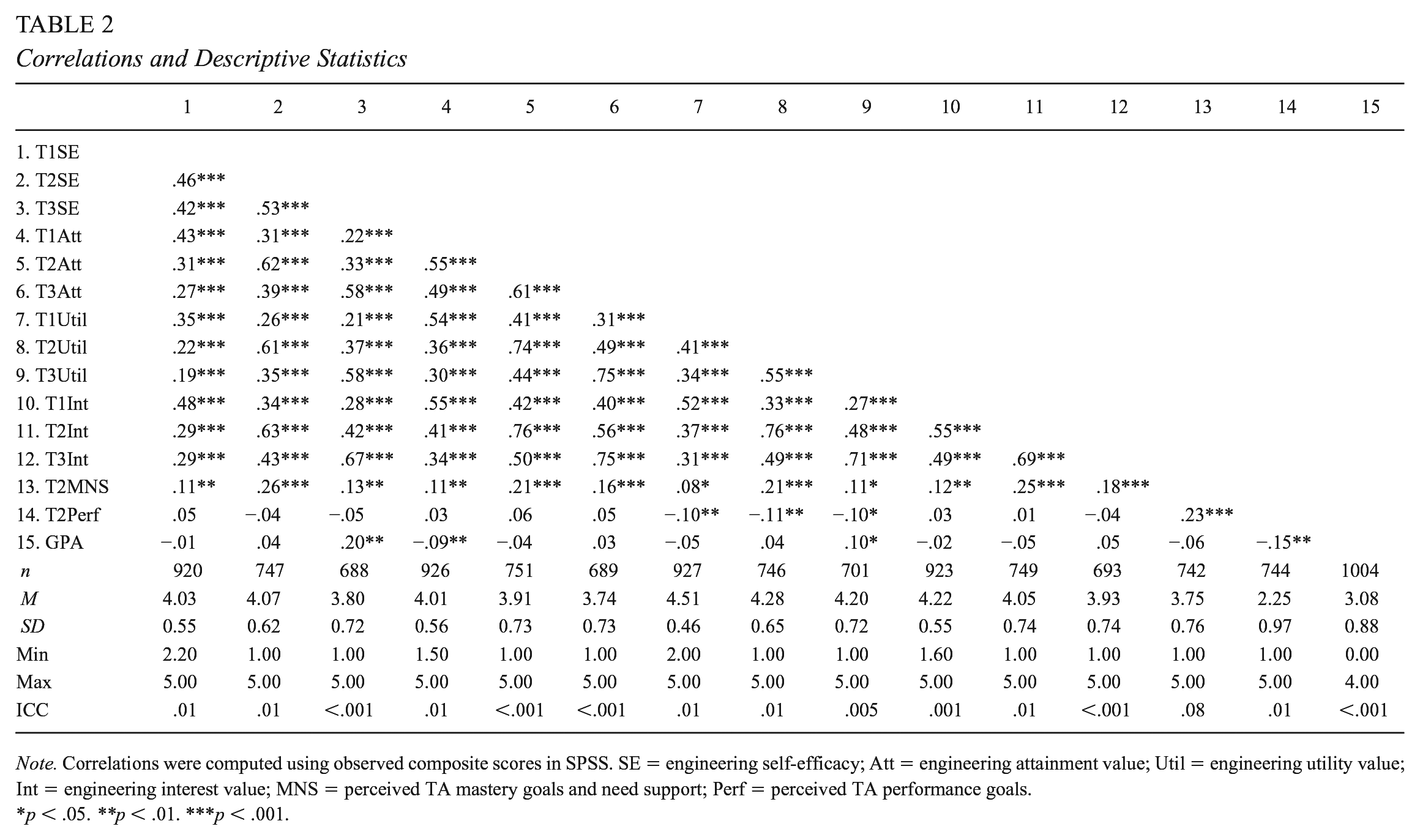
Note. Correlations were computed using observed composite scores in SPSS. SE = engineering self-efficacy; Att = engineering attainment value; Util = engineering utility value; Int = engineering interest value; MNS = perceived TA mastery goals and need support; Perf = perceived TA performance goals.
p < .05. **p < .01. ***p < .001.
Intraclass correlations
Intraclass correlations (ICCs, see Table 2) indicated that for the most part, the course section (N = 24 sections) accounted for very little variance in motivation and perceived motivational climate variables. TA mastery goals and need support exhibited by far the largest ICC at 8%, with the next largest ICC being 1%, and four variables had ICCs lower than .001. Thus, there was not sufficient variability at the course section or TA level to account for nesting within course sections through multilevel modeling or robust standard errors. Instead, dummy variables for TAs were included in the models as predictors of motivation climate perceptions and to account for variance explained by students’ shared experiences of each TA.
Unconditional Latent Growth Models
For all four constructs, linear models fit the data well (see Table 3) and significantly better than the intercept-only models based on changes in CFI > .01. Parameter estimates of the selected models (Table 4, Figure 2) indicated that, on average, students began the academic year with moderate to high expectancy and values for engineering (Mintercept = 3.65 to 4.54), and all constructs slightly but significantly declined across the year (Mslope = –0.11 to –0.17, p < .001). The slope of self-efficacy had a nonsignificant variance, but all other models showed significant variation in the intercept and slope estimates.
Fit Indices for Latent Growth Models

Note. The initial linear interest value model resulted in a nonpositive definite covariance matrix due to a negative residual variance for T3 latent interest. As this variance was small and nonsignificant (var = –.04, p = .211), we fixed it to 0 and this resolved the issue. Bolded rows indicate selected models.
Model Parameters for Unconditional Latent Growth Models

Note. AV = attainment value; UV = utility value; IV = interest value; SE = self-efficacy; CI = confidence interval; LB = lower bound; UB = upper bound. Unreported p values are all p < .001. All parameters are unstandardized except for the intercept-slope covariances, which are presented as standardized estimates to aid in interpretation.

Trajectory plots. Att = attainment value; Util = utility value; Int = interest value; SE = self-efficacy.
Motivational Climate, Motivation Trajectories, and Grades
Next, perceived motivational climate variables were added to the model as outcomes of initial motivation (latent intercepts) and predictors of changes in motivation (latent slope); grades were also regressed on intercept, slope, and climate perceptions (see Figure 1 for conceptual model). The self-efficacy model including grades encountered convergence errors due to a negative residual variance for the grade variable. Thus, we present the self-efficacy model with only the motivational climate variables and no grade outcome. Conditional model fit indices are presented in Table 5.
Model Fit Indices for Conditional Linear Latent Growth Models
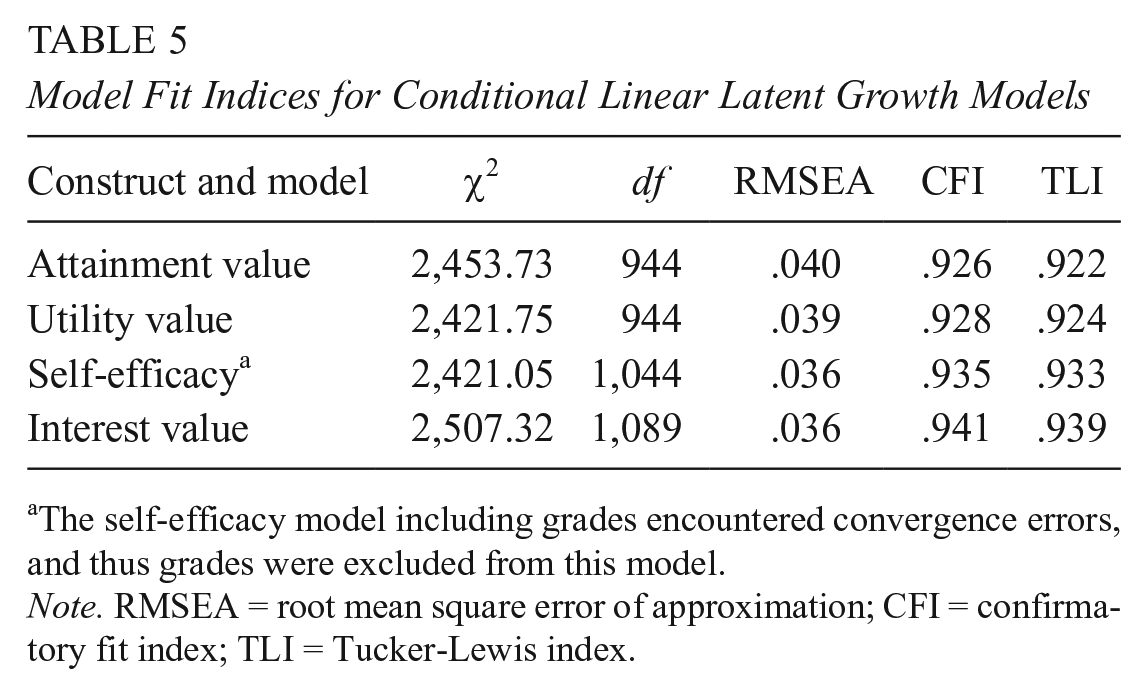
The self-efficacy model including grades encountered convergence errors, and thus grades were excluded from this model.
Note. RMSEA = root mean square error of approximation; CFI = confirmatory fit index; TLI = Tucker-Lewis index.
In all four models, students’ motivation for engineering at the beginning of the semester predicted their midsemester motivational climate perceptions (see Table 6). Students beginning the course with higher attainment value for engineering perceived higher levels of both TA mastery goals/need support and TA performance goals. Students with higher self-efficacy and interest value also perceived higher TA mastery goals/need support, but initial self-efficacy and interest value were not significant predictors of perceived TA performance goals. Lastly, students’ initial utility value positively predicted perceptions of TA mastery goals/need support and negatively predicted perceptions of TA performance goals. Variance in perceived motivational climate variables explained by the model predictors ranged from R2 = .10 to .17 (all p < .001) for TA mastery goals/need support and R2 = .014 to .042 (p = .022–.123) for TA performance goals, indicating small to medium effect sizes. Taken together, these findings indicate that students who value engineering as being important for their identities may be predisposed to perceive both positive motivational support and performance goals, whereas students who value engineering as being useful for their goals may be more likely perceive higher positive motivational support but lower levels of instructors’ performance goals. Students with high self-efficacy and interest may be more likely to perceive only positive motivational support; in other words, higher or lower levels of self-efficacy and interest at the beginning of the semester do not appear to color students’ perceptions of performance goals at midsemester.
Estimates of Motivation Intercepts Predicting Motivation Climate Perceptions
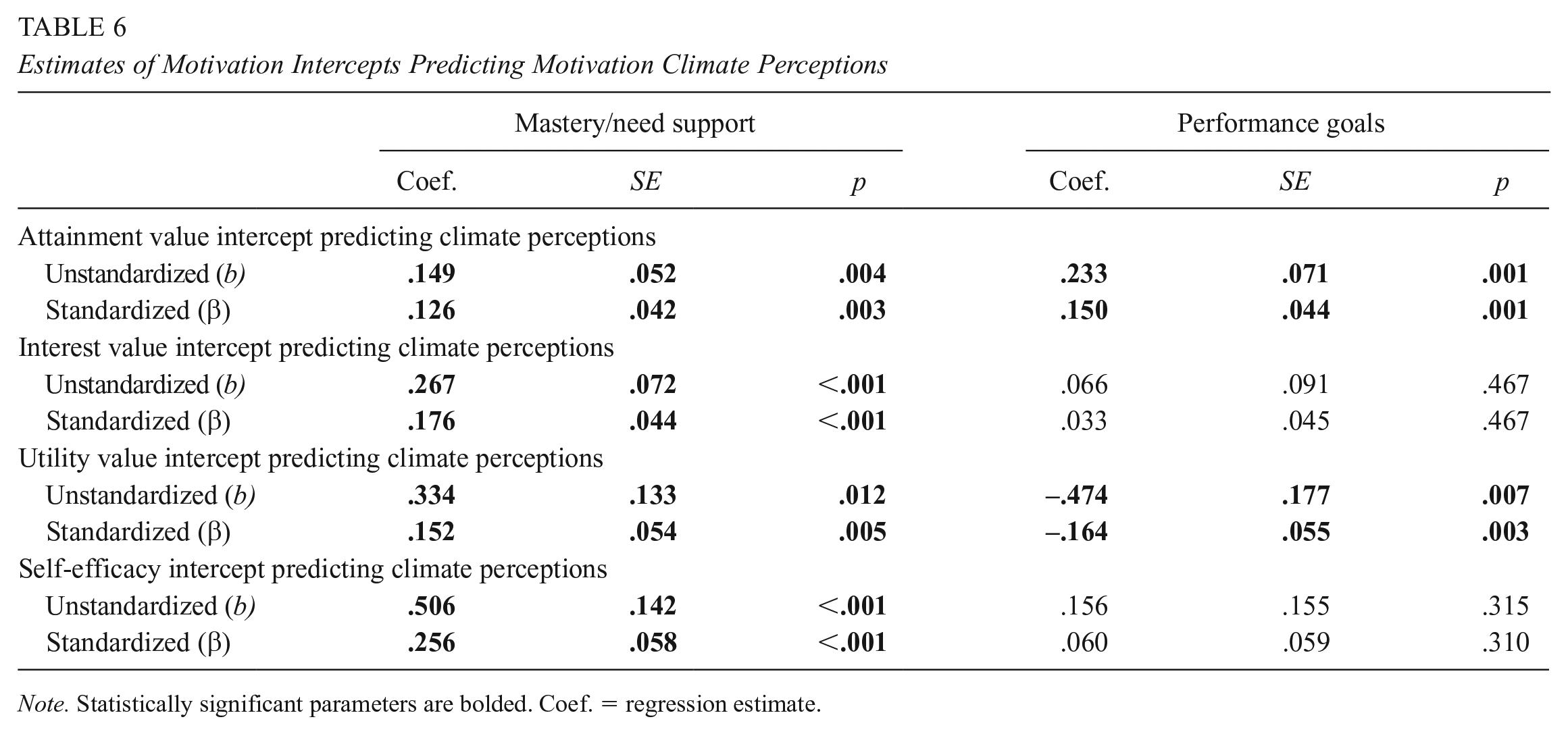
Note. Statistically significant parameters are bolded. Coef. = regression estimate.
Perceived motivational climate also predicted changes in motivation (see Table 7): perceived TA mastery goals/need support significantly predicted more positive slopes (stability or steeper increases) in all three task values, but not self-efficacy. Higher perceptions of instructors’ performance goals predicted steeper declines in interest value and self-efficacy. 3 This means that controlling for students’ initial motivation and relations between initial motivation and climate perceptions, students’ differing perceptions of TAs’ motivational practices predicted differences in how their task values and their self-efficacy changed throughout the first year of college, with positive motivational supports positively predicting task value trajectories and performance goals negatively predicting trajectories of interest value and self-efficacy.
Estimates of Motivation Climate Perceptions Predicting Slopes of Motivation

Note. Statistically significant parameters are bolded. Coef. = regression estimate.
With regard to spring semester grades, perceived TA performance goals negatively and significantly predicted grades in all three task value models (see Table 8). In the utility value model, the linear slope of utility value also positively predicted grades. In the attainment value model, the intercept negatively predicted GPA and the slope positively predicted GPA. In the interest value model, no other variables predicted grades.
Estimates of Motivation Trajectories and Motivation Climate Perceptions Predicting Grades

Note. Statistically significant parameters are bolded. Coef. = regression estimate; AV = attainment value; IV = interest value; UV = utility value.
Discussion
This study investigated motivational climate perceptions as correlates of year-long trajectories of expectancy for success and task values for engineering. In addition to adding unique knowledge about how motivation changes during a key time for students’ evolving career pursuits, this study highlights important interrelations among initial motivation, perceptions, and changing motivation. This empirical evidence about the role of perception in mediating motivational support is a vital step toward increasing the efficacy of interventions and instructional design to maximize opportunities for student success.
First, we identified average declines in all four constructs in alignment with prior research across multiple domains and time periods (Kosovich et al., 2017; Robinson et al., 2018; Robinson, Lee, et al., 2019; Robinson, Perez, et al., 2019). Self-efficacy and attainment value showed the smallest slope estimates. The slow average rate of decline in attainment value aligns with theory and research indicating that identity-related value may be more internally determined and thus slower to change (Eccles, 2009; Robinson, Lee, et al., 2019). The slow decline in self-efficacy was somewhat surprising, as it is considered to be fairly malleable in the short term (Bong & Skaalvik, 2003), and prior research has documented comparatively faster rates of decline across 2 years (Robinson, Lee, et al., 2019). It could be that the supportive gateway course in fact buffered students from declines in self-efficacy during the first year, perhaps because students tended to receive high grades in the class. In accordance with our expectations, utility value and interest value appeared to decline more rapidly, with significantly larger slopes as evidenced by nonoverlapping confidence intervals. As expected, changes in motivation were important for grades, such that more positive trajectories of attainment and utility value (i.e., slower declines or steeper increases) predicted higher grades. However, in alignment with prior research (e.g., Robinson, Lee, et al., 2019), attainment value at the beginning of the academic year actually negatively predicted grades, suggesting students may have poorly calibrated levels of their own motivation when beginning a new academic program.
Further, as hypothesized and aligning with some prior research (e.g., Lam et al., 2015; Roeser et al., 1996), our findings contributed unique, longitudinal evidence that students’ initial motivations appear to color their perceptions of motivational climate. Very few studies have documented this phenomenon to date, and only one study to our knowledge has examined this longitudinally (Roeser et al., 1996). Students with initially high expectancy and values for engineering were more likely to view their instructors as supportive of mastery goals, autonomy, and competence. Interestingly, students with higher attainment value also perceived their instructors as being more performance goal oriented, whereas students with higher utility value indicated lower perceptions of performance goal structures. This is a novel finding that may reflect the different ways that students attend and react to contextual features based on their differing motivational profiles. Thus, students who highly identify with engineering may be more likely to notice social comparisons within their environment, and students who view engineering as useful to their goals may be more likely to disregard social comparisons, whereas differences in self-efficacy or enjoyment of engineering may not matter for students’ attentiveness to such comparisons.
It may also be that instructors behave differently toward students with various levels and qualities of motivation, and this must be considered as an alternative or additional explanation for these findings. Indeed, although our own observations of instruction indicated that individual TAs appeared to interact with their students fairly equitably, students who were highly motivated may have simply interacted with the TAs more often and thereby had more opportunities to receive motivational support. Further, students’ prior motivation explained only some of the variation in their perceptions of their TAs, and thus it is important to remember that other factors, including TAs’ actual behaviors, may be responsible for students’ ratings on these measures. Indeed, students’ perceptions at least partially tend to reflect real teaching behaviors (Dicke et al., 2021), including qualities of the unique dyadic relationships between individual students and teachers (Göllner et al., 2018).
Not only did students’ initial motivations predict their perceptions of the course motivational climate, but even when controlling for these relations, the perceived motivational climate predicted students’ motivational development and grades. Though essentially in line with expectations from theory and prior research, findings extend and add nuance to the largely cross-sectional literature examining similar constructs (e.g., De Clercq et al., 2020; K. Lau & Lee, 2008; Lazarides et al., 2018; Murayama & Elliot, 2009; Skaalvik et al., 2017) and broaden the existing literature in K-12 settings to higher education contexts (Lazarides et al., 2018; Skaalvik et al., 2017; Won et al., 2020). Changes in interest value were related to both perceived TA performance goals and mastery goals/need supportive teaching; attainment and utility value were responsive to perceived TA mastery goals/need support only. In other words, students perceiving their TA as being supportive of mastery goals, autonomy, and competence were more likely to exhibit growth (or stability) in all three forms of task value, while perceptions that the TA focused on social comparisons and demonstrating competence were associated with lower grades and with declines in interest value.
Lastly and somewhat contrary to our expectations (e.g., Urdan et al., 2002), only perceived instructor performance goals predicted changes in self-efficacy, and this significant relationship was true only for the unstandardized coefficient. The relatively large standardized coefficient for TA performance goals predicting changes in self-efficacy lends additional, although tentative, evidence that TA performance goals indeed appear to be detrimental to students’ self-efficacy trajectories. Perceived mastery goals/need support did not significantly predict changes in self-efficacy. The nonsignificant relations between positive climate and self-efficacy trajectories were surprising, although perhaps attributable to the relatively uniform pattern of slight decline in the sample (rather than a large variety of trajectories to be explained by predictors) or the fact that we assessed higher-order self-efficacy for academic tasks across all engineering coursework rather than self-efficacy for a specific task or course. The differing points of reference from predictor to outcome, such that TA mastery goals/autonomy support in one supportive course did not shift self-efficacy for all engineering coursework, may explain this result, particularly as other engineering courses may differ substantially from this supportive course. Indeed, it is quite remarkable that students’ perceptions of TA actions in this one course related to longer-term trajectories of the three values, and that perceived TA performance goals in particular appeared to dampen longer-term trajectories of self-efficacy.
Overall, four motivation constructs showed unique patterns of relations to perceived motivational climate, suggesting the need for careful consideration of students’ unique motivational needs including a diverse range of motivational factors in designing interventions to support STEM persistence. For example, students endorsing high attainment value for the subject matter may be especially vulnerable to performance goal messages from their instructor, and thus instructional design for these students should involve minimizing social comparisons as much as possible. In fact, considering the negative relations between utility value and perceptions of TA performance goals, teachers may consider focusing on boosting utility value for students already endorsing high attainment value, perhaps via relevance interventions (e.g., Hecht et al., 2019). Students endorsing high levels of both utility and attainment value may be less attentive to performance goal messages as compared to students endorsing high attainment value only; however, additional research is needed to test this proposition as well as the proposed intervention approaches outlined above.
Limitations and Future Directions
Student perceptions can be limited as indicators of motivational climate, as considerable evidence suggests that students’ perceptions only partially reflect actual practices in the classroom. However, student perceptions also uniquely contribute to predicting student outcomes over and above actual classroom practices (Lam et al., 2015; Meece et al., 2006). Indeed, in our own study, very little variance in students’ perceptions could be attributed to differences in instructors, suggesting these perceptions had more to do with individual differences rather than instructional differences. Nevertheless, we cannot rule out the possibility that instructors interacted with individual students in different ways, even within the same classroom. To further articulate theorized change processes and make concrete recommendations for practice, it is important for future research to directly examine instructors’ actual practices in addition to students’ perceptions. Such research is needed to trace the specific practices that reliably lead to positive shifts in student motivation via their perceptions and the mechanisms of such effects.
A second limitation concerns the measurement properties of the motivational climate measures, with implications for theoretical integration in studies of motivational supports. We had hoped to examine unique relations of specific aspects of motivational climate with student motivation. However, in alignment with conceptualizations of mastery goal structures and autonomy support as inclusive of similar elements including competence support (Ames, 1992; Bardach, Lüftenegger, et al., 2019; Jang et al., 2016), factor analyses yielded evidence that students do not distinguish among several theoretically and conceptually distinct aspects of motivationally supportive instruction. To make stronger inferences about motivational instruction and student motivation, there is a need for measurement work and validity studies on motivational climate measures, similar to work on broader student perceptions by Wallace and colleagues (2016).
Further building on this prior point, measurement constraints prevented us from considering two important processes considered to be part of motivationally supportive instruction (Reeve, 2009). Specifically, personal relevance (Hulleman & Harackiewicz, 2009; Schmidt et al., 2019) and instructors’ warmth and enthusiasm may be key ingredients for fostering task value and competence via a supportive, personalized, and encouraging environment (Frenzel et al., 2009; Linnenbrink-Garcia et al., 2013). Future research considering all of these processes side by side might uncover a more holistic picture of the motivational supports necessary to foster optimally beneficial patterns of motivation within students.
Considering the timing of measurements and the correlational nature of our research design, we cannot make strong inferences about the causal directions of the observed relations. It is also important to consider the limitations of our modeling approach in that the average trajectory described by each model might not describe any particular student within the sample. As such, these results may be most informative when combined with future research using experimental designs, mixed methods, and mixture modeling (e.g., latent profile analysis, growth mixture modeling) approaches. Such approaches can be used to examine heterogeneity in students’ experiences, documenting specific and general principles for supporting beneficial trajectories of motivation among postsecondary STEM students.
Conclusion
Our study examined relations between undergraduates’ engineering motivation trajectories and their perceptions of the motivational climate in a supportive introductory engineering course. Results provide key evidence that students’ perceptions of instructors vary systematically based on their own motivation, such that students with higher initial motivation perceive their instructor to be more motivationally supportive. Students’ different reasons for valuing engineering might also lead them to differentially attend to performance-focused messages in instruction. Importantly, because it is assumed that students are more likely to view instruction as motivational when it is indeed supportive of autonomy and mastery goals, this work also provides new longitudinal evidence that motivationally supportive instruction may be able to “move the needle” on students’ motivational development, even after the conclusion of the course. Whereas instructors’ perceived performance goals appeared to reduce students’ interest and self-efficacy in engineering, perceived supports for students’ mastery goals, autonomy, and competence were beneficial for longer-term valuing of engineering. Results highlight the utility of examining motivational supports from an integrative theoretical perspective as well as the important role of students’ perceptions in the links between context and student motivation.
Footnotes
Appendix: Full List of Scale Items
Attainment Value
Interest Value
Utility Value
Academic Self-Efficacy in Engineering
TA Mastery Goals and Need Support (Autonomy Support, Competence Support, & TA Mastery Goals)
TA Performance Goals
Funding
The research reported in this article was supported by a grant from the National Science Foundation under award number 1643723 (principal investigator: S. Patrick Walton) and a dissertation completion fellowship from Michigan State University’s College of Education. The content is solely the responsibility of the authors and does not necessarily represent the official views of the National Science Foundation, Michigan State University’s College of Education, Michigan State University’s College of Engineering, or McGill University’s Faculty of Education. Declarations of interest: none.

Notes
Authors
KRISTY A. ROBINSON is an assistant professor in the Department of Educational and Counselling Psychology at McGill University. She studies motivation, identity, and emotions in STEM, with a focus on how educational settings can meet students’ diverse motivational needs.
AMALIA KRYSTAL LIRA is a doctoral candidate in Educational Psychology and Educational Technology at Michigan State University. She is interested in addressing STEM attrition among underrepresented racial and ethnic minority students using motivational frameworks.
S. PATRICK WALTON is the associate chair and C. Robert and Kathryn M. Weir endowed associate professor in the Department of Chemical Engineering and Materials Science at Michigan State University. In addition to his research on the development of novel therapeutic and diagnostic technologies, he is also engaged in studying engineering student persistence and success through the lens of motivation.
DAINA BRIEDIS is a faculty member in the Department of Chemical Engineering and Materials Science at Michigan State University and assistant dean for student advancement and program assessment in the College of Engineering. Dr. Briedis has been involved in several areas of education research including studies in the areas of integration of computation in engineering curricula and in developing comprehensive strategies to retain early engineering students.
LISA LINNENBRINK-GARCIA is a professor of educational psychology in the Department of Counseling, Educational Psychology, and Special Education at Michigan State University. Her research focuses on the development of achievement motivation in educational settings and the interplay among motivation, emotions, and learning, especially in STEM fields.