




Abstract
School principals are facing greater challenges during the COVID-19 pandemic than they have ever faced, which has implications for whether they can conduct their work productively and remain in their jobs over the long term. This article draws on a unique, nationally representative, longitudinal panel of K–12 public school principals across the United States to examine principals’ self-reported resource needs and job demands during the COVID-19 pandemic as well as how those resource needs and demands are related to principals’ dissatisfaction and their intention to leave their job. Although principals’ reported resource needs (which increased over time) and teacher shortages were consistently related to dissatisfaction and intention to leave, various other job demands were predictors of dissatisfaction but not the intention to leave. These results have several implications for supporting and retaining principals as well as the teachers they serve.
Keywords
Good school principals are critical for ensuring a positive school climate, a productive teacher workforce, and robust student learning (Grissom et al., 2021). At the same time, the principal’s job is multifaceted and often highly challenging. Principals are tasked with providing instructional leadership, managing budgets and personnel, ensuring a safe and welcoming school environment, and keeping parents happy—among many other responsibilities. Principals’ responsibilities have become even more numerous and complex over the past few decades as local and state mandates have increased (Grissom et al., 2017), and these changes to their job have been accompanied by higher rates of stress and turnover (Mitani, 2018).
All the responsibilities and challenges that principals face have been amplified during the COVID-19 pandemic, when they have encountered mounting student absences, dramatic shifts in the mode of instructional delivery in most schools across the nation, and rapidly changing health and safety guidelines (Grooms & Childs, 2021; Kaufman & Diliberti, 2021; Santibañez & Guarino, 2021). These new stressors have implications for increased principal turnover, which could affect the teacher workforce and learning outcomes for millions of students at a time when so many other pandemic-related factors are contributing to missed learning opportunities and growing achievement gaps.
This article explores how principals’ reports of job resources available to them and their job demands during the COVID-19 pandemic are related to their job dissatisfaction and intention to leave their current position, using data from a nationally representative panel of principals across the United States. In this paper, we first share principals’ perceptions of their needs for various resources (e.g., high-quality materials, teacher training) and their job demands, as measured through their reports about school budget changes, cost-cutting measures, and staffing shortages. We also compared principals’ reports of their school needs from the spring of 2020 with those from the fall of 2020 to examine shifts in principals’ perceived needs over time. Lastly, we consider how principal-reported school resources and job demands are related to two key outcomes that may be relevant for school performance in the next few years: principals’ dissatisfaction and their intention to leave their current job.
This research is the first of which we know to offer a national picture of K–12 public school needs across the United States during the COVID-19 pandemic from the perspective of school principals and explore how these needs may be related to principals’ dissatisfaction and turnover. This study offers actionable data on how schools and principals could be better supported as they, their students, and their teachers recover from the COVID-19 pandemic and predictions for how current school needs could be affecting principals’ well-being and longevity in their jobs, which have important implications for policy and school system practice.
Review of Relevant Research
The Importance of Good School Leadership
Efficacy of school leadership is notoriously hard to measure, given the nonrandom assignment of principals to schools and to teachers as well as differences in what various measures suggest about effectiveness (Branch et al., 2012; Grissom et al., 2015). Yet despite these methodological challenges, numerous studies over the past several decades have found significant relationships between the work that principals do in schools (e.g., their instructional leadership and work to support teachers) and improvements in student achievement (Brewer, 1993; Eberts & Stone, 1988; Grissom et al., 2013; Sebastian et al., 2016). In their review of rigorous, longitudinal studies on the effects of school principals, Grissom et al. (2021) find that “a 1 standard deviation increase in principal effectiveness increases the typical student’s achievement by 0.13 standard deviations in math and 0.09 standard deviations in reading” (p. xiii).
Effective school leadership has also been linked with lower likelihood of teacher turnover and more positive teacher perceptions of their working conditions (Branch et al., 2012; Burkhauser, 2017). Furthermore, in surveys, teachers have consistently identified good school leadership as a critical working condition affecting their likelihood of staying in or leaving a school (Center for Comprehensive School Reform and Improvement, 2007; Hirsch et al., 2008; Hirsch et al., 2010).
How Principals’ Dissatisfaction and Turnover Are Related to Teaching and Learning
Despite their critical importance to teaching and learning, nearly one in five principals (18%) across the United States leaves their school each year, including those who retire, are dismissed, or choose to leave their school for another position within or outside education (Goldring & Taie, 2018). Researchers have identified many negative impacts on teaching and learning when principals leave, particularly if principals are leaving high-poverty schools with more students of color (Béteille et al., 2012; Kearney et al., 2012; Miller, 2013). For example, Mascall and Leithwood (2010) find a significant relationship between principals’ turnover and decreases in positive school culture. As noted by Levin and Bradley (2019), a principal leaving is typically associated with less favorable teacher reports of school and classroom conditions as well as lowered perceptions of shared purpose and trust. For these reasons, Levin and Bradley (2019) state, “A change in leadership can derail school improvement initiatives, making it difficult to build a school’s capacity.”
At the same time, it is challenging to disentangle the effects of principal turnover from the effects of factors that lead to that turnover (Miller, 2013). Some recent studies have attempted to address these endogeneity issues through quasi-experimental methods. Even in these studies, the relationship between principals’ retention, higher student achievement, and lower teacher turnover generally stands. For example, using a difference-in-difference analysis of personnel data from Tennessee and Missouri, Bartanen et al. (2019) find that school achievement in the year following a principal’s departure was lower by .03 standard deviations, on average, and teacher turnover increased. In another example, Henry and Harbatkin (2019) attempt to address sources of endogeneity that typically bias studies of turnover through various methods, taking into account school- and district-level confounders by using 8 years of administrative data in North Carolina. Similarly to Bartanen et al. (2019), the authors link principals’ turnover with significant decreases in student achievement and higher teacher turnover.
Compared to principal turnover research, fewer studies have been done to understand how principals’ dissatisfaction, stress, and burnout influence teaching and learning in schools. Correlational and qualitative studies have identified relationships between principals’ stress and a range of school conditions, from collegiality and social supports (Darmody & Smyth, 2016) to staff shortages and accountability pressures (Hancock et al., 2019; Mahfouz, 2018). Furthermore, studies focused on teachers rather than principals have identified numerous negative outcomes related to teacher stress and burnout, and employee burnout more generally, including absenteeism, depression, irritability, and helplessness (Ghanizadeh & Jahedizadeh, 2015; Khamisa et al., 2013; Salvagioni et al., 2017). These studies cannot establish causal relationships between principals’ dissatisfaction or stress and school conditions. However, if good school leadership is a critical factor influencing school performance and teacher well-being, as the research literature suggests, then principals’ dissatisfaction and burnout could have damaging effects on student learning. Furthermore, some studies have found significant relationships between dissatisfaction and principals’ departure from the profession (e.g., Grissom & Bartanen, 2019), which suggests that dissatisfaction could be a precursor to turnover and all of its accompanying negative impacts on teaching and learning.
Antecedents to Principals’ Dissatisfaction and Turnover
These data on the potential deleterious effects of principals’ dissatisfaction and turnover underscore a need to understand the antecedents of that dissatisfaction and turnover. Descriptive research suggests that principals’ dissatisfaction, intention to leave, and turnover rates vary by school demographics. Goldring and Taie (2018) find higher rates of principal turnover in urban schools and in schools serving high percentages of students experiencing poverty compared with other schools. Additional research has documented that principals are more likely to be dissatisfied in schools that have more low-income students (Liu & Bellibas, 2018) and that they are far more likely to leave schools that serve low-income and low-achieving student populations (Fuller & Young, 2009; Levin & Bradley, 2019; Papa, 2007; Yan, 2020).
However, these descriptive studies do not tell whether principals are more likely to be dissatisfied and leave because of these demographic characteristics or whether these characteristics may be predictors of other factors driving principals’ dissatisfaction and turnover. Schools serving low-income students, in particular, are typically underresourced in a variety of ways that might influence principals’ job satisfaction and intention to leave. Those schools tend to have smaller budgets, fewer highly credentialed or experienced teachers, and less access to services to address students’ social, emotional, and academic needs (National Academies of Sciences, Engineering, and Medicine, 2019). It is likely that many principals who choose to depart schools in lower-income communities are doing so at least in part due to these other factors that influence their work environment and sense of success. As Levin and Bradley (2019) note, “The root of the problem [in terms of root causes of principals’ turnover] . . . may be the school characteristics—such as low levels of resources, less competitive salaries, and problematic working conditions—that are often concurrent with student disadvantage” (p. 4).
Some studies have attempted to investigate the specific conditions beyond school disadvantage that are associated with principals’ dissatisfaction and turnover. Drawing on the job demands–resources (JD-R) theory (Bakker & Demerouti, 2017; Bakker et al., 2005), Collie et al. (2020) suggest that key conditions driving principals’ well-being and lower stress include job resources, such as collegiality and social supports that support well-being, and job demands that require considerable psychological or physical effort, such as budget issues, an undersupply of teachers, and accountability pressures. Their analyses of survey data from nearly 6,000 school principals from 22 countries indicate that a collegial climate and fewer staff shortages were related to school principals’ satisfaction and their occupational commitment. Furthermore, other JD-R research suggests that such job resources as collegial climates, high-quality relationships with supervisors, and performance feedback may serve a “buffering role” that softens the impact of job demands (Bakker et al., 2005).
Most studies of principals’ turnover do not use the JD-R framework for their investigation. Yet findings of these studies confirm that various factors driving principal turnover on the job demand side, including heavy workload, low-quality working conditions, and declining student performance (Conrad & Rosser, 2007; Levin & Bradley, 2019; Levin et al., 2020), and on the job resource side, including central office supports and training (Johnson, 2005; Levin & Bradley, 2019; Levin et al., 2020).
The pandemic has undoubtedly exacerbated many of these conditions. Principals have faced new and urgent challenges related to public health, inequitable resources, rapid instructional shifts, and student and staff mental health concerns, to name just a few. Principals’ decision-making authority and support for their staff have been complicated by shifting mandates coming from their central offices, public health agencies, and state education agencies (Grooms & Childs, 2021; Kaul et al., 2021). In addition, schools serving more disadvantaged student populations, which already typically experience greater principal turnover, have faced much greater challenges during the pandemic than more advantaged schools, including higher absenteeism, growing achievement gaps, and difficulties in providing the technology necessary for remote instruction (Dorn et al., 2020; Hamilton, Kaufman, et al., 2020; U.S. Department of Education, 2021).
If these and other conditions result in heightened levels of principal stress and increased intentions of leaving, any recovery efforts will be even more difficult than they would be under steady leadership. Federal COVID-19 relief spending for education could potentially ameliorate some of these stresses and, thus, principals’ turnover; some research has found small positive impacts of district spending on principals’ retention (Solano et al., 2010). In addition, at the end of the 2020–2021 school year, a nationally representative survey sample of district superintendents across the country reported roughly similar principal attrition rates to previous years (Diliberti & Schwartz, 2021). However, we do not know whether these rates will remain low as the COVID-19 pandemic persists, given all the stresses that principals are experiencing. Furthermore, we have little understanding of how various potential sources of stress during the pandemic are differentially related to principals’ dissatisfaction and intention to leave their jobs, which could provide policy directives for states and school systems wishing to support and retain principals over the short and long terms.
Our Research Questions
To build a nationwide picture of how school-related pandemic challenges relate to principals’ dissatisfaction and intention to leave their school, this paper uses two waves of unique survey data collected from nationally representative samples of K–12 public school principals in the United States to investigate two research questions:
What job resources and demands did U.S. school principals report during the COVID-19 pandemic, and how did reported resources change over time?
To what extent were principals’ perceived job resources and demands related to their self-reported dissatisfaction and intention to leave their job by the end of the 2020–2021 school year?
Methods
To address these research questions, we drew upon data from two surveys administered via the RAND American School Leader Panel (ASLP)—one in the spring of 2020 and one in the fall of 2020—to nationally representative samples of K–12 public school principals across the United States. The ASLP is the only longitudinal, probability-based sample of U.S. school leaders that has gathered data over multiple time points on principals’ well-being alongside their perceptions of challenges and needs during the COVID-19 pandemic. At the time these surveys were administered, the ASLP included more than 5,000 principals who are periodically invited to participate in surveys about issues of education policy and practice.
Sample
Each survey was administered with the goal of collecting data from 1,000 respondents. Samples of ASLP panelists were drawn using probability-based sampling methods, with oversamples of principals in schools serving higher percentages of students of color and students affected by poverty. Public school principals in schools serving any grades from K–12 were eligible to be sampled, and a screener question was used to ensure that respondents were current public school principals. The ASLP includes only lead principals; assistant principals and other school leaders are not represented in this study.
The spring 2020 survey was fielded in the first few months of the COVID-19 pandemic—between April 27 and May 11, 2020—about a month and a half after nearly all schools in the United States physically closed. Some 3,500 principals were invited to participate in the spring survey, which yielded 957 complete responses, or a 27.3% completion rate (Hamilton, Grant, et al., 2020). The fall 2020 survey was fielded about a month into the 2020–2021 school year, between October 6 and October 18, 2020. For this survey, 3,977 principals were invited to participate, which yielded 1,147 complete responses, or a 28.8% completion rate (Kaufman et al., 2020). Although these response rates are low compared to response rates among teachers in the American Teacher Panel, which range between 50% and 60%, they are comparable to other ASLP surveys and higher than those of many probability-based school principal samples (Hvidston et al., 2018; Madariaga et al., 2017).
After data collection was complete, weights were created separately for each survey to enable estimates of the U.S. principal population. A weight was assigned to each principal’s response by using a model of nonresponse that took into account various individual- and school-level characteristics for the U.S. principal population, including principal-level experience data drawn from the National Teacher and Principal Survey as well as school characteristic data taken from the Common Core of Data (CCD). For more details on the weighting processes, see the technical documentation for the spring 2020 survey (Hamilton, Grant, et al., 2020) and the fall 2020 survey (Kaufman et al., 2020).
Independent samples were drawn for both surveys—that is, the sampling methodology for the fall survey did not consider whether panelists had been sampled (or had completed) the spring survey. However, because each ASLP panelist has a unique identification number that is consistent across surveys, we were able to use this number to identify the principals who participated in the spring and fall surveys; about 43% (or 416) of the 957 principals who completed the spring 2020 survey also completed the fall 2020 survey. Thus, we were able to link spring and fall survey data for these 416 respondents, allowing us to examine patterns in responses over time for the same principals.
We linked all survey data files—including the spring sample, the fall sample, and the overlapping sample—to school-level demographic variables from the 2018–2019 CCD published by the National Center for Education Statistics. From the CCD, we were able to obtain demographic data on respondents’ schools, including the school level, urbanicity, student racial/ethnic composition, school type (traditional public versus charter), and student eligibility for free or reduced-price lunches (FRPLs) through the National School Lunch Program (a proxy for school-level poverty).
In our analyses, we provide descriptive statistics on principals’ reported job resources and demands in the spring and fall of 2020, using each weighted survey data file individually. However, in our analyses conducted with the overlapping sample of 416 principals who completed the spring and fall surveys, we do not use any weights. Therefore, the overlapping sample should be regarded as an exploratory sample of a diverse set of school principals across the United States, but not one that was intentionally designed to be representative of the national population of public school principals. That said, as shown in Table 1, which includes information about the distributions of principals by school characteristics, the unweighted, overlapping sample has similar characteristics to those of the national population of school principals, as well as to our nationally representative spring and fall survey samples. As noted in Table 1, most principal characteristics in the weighted data set are closely aligned with population data, although principals responding in the fall of 2020 came from slightly more affluent schools than respondents in the spring of 2020.
Descriptive Statistics for Survey Samples

Data for the national population are from the 2018–2019 CCD, assuming one lead principal per school.
Survey Items
The spring and fall surveys had an approximate administration time of 10 minutes and asked principals about their experiences navigating their schools through the COVID-19 pandemic. Survey items included those intended to measure principals’ job resources and job demands, which have been documented as factors influencing principals’ well-being (Collie et al., 2020). In both surveys, principals were asked to report areas of resource need on a 6-point scale with the following response options: “No need,” “Very minor need,” “Minor need,” “Moderate need,” “Major need,” and “Very major need.” Items asked about principals’ perceptions of the following eight needs: high-quality materials to support academic instruction, high-quality materials to support social and emotional learning, tools and resources to enable student engagement with counselors or school psychologists, training to support teachers to deliver remote instruction, opportunities to network and learn from other principals, strategies or resources to address loss of students’ opportunities to engage in hands-on learning, lifting of student attendance or instructional time requirements, and lifting of restrictions for the provision of remote instruction (e.g., privacy restrictions).
Using the fall survey data, we conducted an exploratory factor analysis using principal-component factors to determine the extent to which the eight items measuring principals’ resource needs constituted a single factor. Two items—on lifting restrictions or requirements—loaded onto one factor with an eigenvalue of 0.98 that explained 12.2% of the variance, while the remaining six primarily loaded onto another factor with an eigenvalue of 4.34 that explained 54.3% of the variance. This two-factor solution makes sense because the first two items reflect constraints within which educators operate schools, while the second six focus more on principals’ perceptions of local needs and supports within their schools. Based on these results, we retained the six items that loaded onto one factor and used them to create an index of principals’ reported needs (Cronbach’s alpha = .88).
The fall survey contained several additional items intended to further gauge factors that could place greater demands on principals. Specifically, principals were asked whether their schools’ budgets for 2020–2021 were less, approximately the same, or more than in 2019–2020; whether they had made cost-cutting changes; how many teacher vacancies they currently had; and whether their schools had shortages of qualified teachers, qualified substitute teachers, or school administrators or support staff.
To measure principals’ intention to leave their job, the fall survey asked respondents: “What is the likelihood that you will leave your job by the end of the current school year (2020–21), compared to the likelihood you would have left your job before COVID-19?” (Response options: “Likely to leave before COVID-19, but unlikely now”; “Unlikely to leave before, but likely now”; “Likely to leave both before and now”; “Unlikely to leave both before and now.”)
The fall survey also contained a set of five items taken from the National Center for Education Statistics (2020) National Teacher and Principal Survey regarding principals’ dissatisfaction toward their job:
• The stress and disappointments involved in being a principal at this school aren’t really worth it.
• I am generally satisfied with being principal at this school. 1
• If I could get a higher paying job, I’d leave this job as soon as possible.
• I think about transferring to another school.
• I don’t seem to have as much enthusiasm now as I did when I began this job.
Respondents were asked to rate each of these five statements on a 4-point scale ranging from “Strongly disagree” to “Strongly agree.” Our exploratory principal components factor analysis indicated that these items constituted a single factor with an eigenvalue of 2.53 that explained 50.1% of the variance. Given that the results of our factor analysis suggested that these items constitute a single factor, we created an index of principals’ dissatisfaction using all five items. The resulting index had an internal consistency reliability estimate (Cronbach’s alpha) of .75.
Analysis
To address our first research question (“What job resources and demands did U.S. school principals report, and how did reported resources change over time?”), we present weighted estimates of principals’ reported resources and demands in the spring and fall of 2020, and we consider how those resources and demands varied according to different school characteristics. We first used the weighted estimates in these analyses so that results were representative of the entire U.S. population of public school principals. We then used the overlapping, unweighted sample of principals who responded to the spring and fall surveys to examine how the same principals’ responses changed over time. Although these overlapping data are not nationally representative, they reflect responses of a diverse sample of principals across the United States whose characteristics match reasonably well with national principal demographics (see Table 1).
To address our second research question (“To what extent were principals’ perceived job resources and demands related to their self-reported dissatisfaction and intention to leave their job by the end of the 2020–2021 school year?”), we present a series of regression models that we used to investigate the relationship between principals’ self-reports of job resources/demands and outcomes. We focus on two outcomes of interest measured in the fall of 2020: principals’ dissatisfaction (a linear variable that aggregates dissatisfaction reports into an index) and principals’ self-reported intention to leave their job by the end of the 2020–2021 school year (a binary variable, with likely to leave coded as “1” and unlikely to leave coded as “0”).
In all regression models, we controlled for school characteristics (i.e., level, urbanicity, student racial/ethnic composition, charter status, and poverty level) that may be related to principals’ need levels as well as their reported satisfaction and intention of leaving their job. Characteristics of teachers in the schools where principals served were not available for this study. We also controlled for the instructional model (i.e., remote, in-person, or hybrid) that principals said their schools were using in the fall of 2020, which previous reports have shown to be related to principals’ level of need in the fall (Diliberti & Kaufman, 2020).
Results
RQ1: What Job Resources and Demands Did U.S. School Principals Report During the Covid-19 Pandemic, and How Did Reported Resources Change Over Time?
School Principals’ Self-Reported Resource Needs in the Spring and Fall of 2020
When the spring 2020 survey was fielded, between the end of April and beginning of May, U.S. principals—on average—reported somewhere between minor and moderate needs for most of the resources and supports that we asked about (Table 2). Need was lowest for opportunities to network with and learn from other principals and highest for strategies to address lost hands-on learning opportunities and training for teachers to deliver remote instruction.
Weighted Means (SEs) for Principals’ Reported Resource Needs in the Spring and Fall of 2020

indicates that 95% confidence intervals do not overlap.
Note. Weighted estimates for spring and fall were obtained by using the individual survey data files. Need level was measured on a scale from 1–6, where 1 = No need, 2 = Very minor need, 3 = Minor need, 4 = Moderate need, 5 = Major need, and 6 = Very major need. CI = confidence interval.
When another sample of U.S. principals took the survey in October 2020, their average reported need for every support that we asked about in the survey appeared higher than for the sample that took the survey in the spring: closer to moderate need—as measured by our response scale—or between moderate and major need for some resources and supports. 2 Need levels were also consistently higher in the fall than in the spring for schools of all characteristics (except charter schools), including schools with differing grade levels, urbanicity, poverty, and a mostly non-White student population.
Change in Self-Reported Resource Needs Among the Same School Principals in the Spring and Fall of 2020
We now focus on the subsample of principals who responded to surveys in the spring and fall of 2020 (n = 416) to understand how needs among the same principals changed over time. As with the full sample, the subsample of principals who responded to both surveys reported higher levels of need in the fall, on average, than they did in the spring. As can be seen in Table 3, the average increase in need was higher for some supports (e.g., training to deliver remote instruction) than others.
Difference in Resource Needs Over Time Among the Same Principals

Note. Estimates are unweighted. Resource need level is measured on a scale from 1–6, where 1 = No need, 2 = Very minor need, 3 = Minor need, 4 = Moderate need, 5 = Major need, and 6 = Very major need. “Difference in resource needs over time” is measured as need level in the fall of 2020 minus need level in the spring of 2020. Thus, positive numbers imply that need levels increased over time.
While principals’ overall need levels increased on average, there was also a distribution in terms of how principals’ needs changed over time (Figure 1). Although some principals’ needs increased substantially (e.g., from no need to a very major need), principals’ needs commonly moved up 1 point on the response scale (e.g., from minor need to moderate need, from moderate need to major need). As noted through the thickest lines in Figure 1, the most common patterns were shifts from minor to moderate need and moderate to major need or maintenance of the same level of need for those who originally noted moderate or major need. Smaller numbers of principals reported lower needs in the fall than in the spring, as seen through the thinner lines moving from one level of need to a lower level of need.
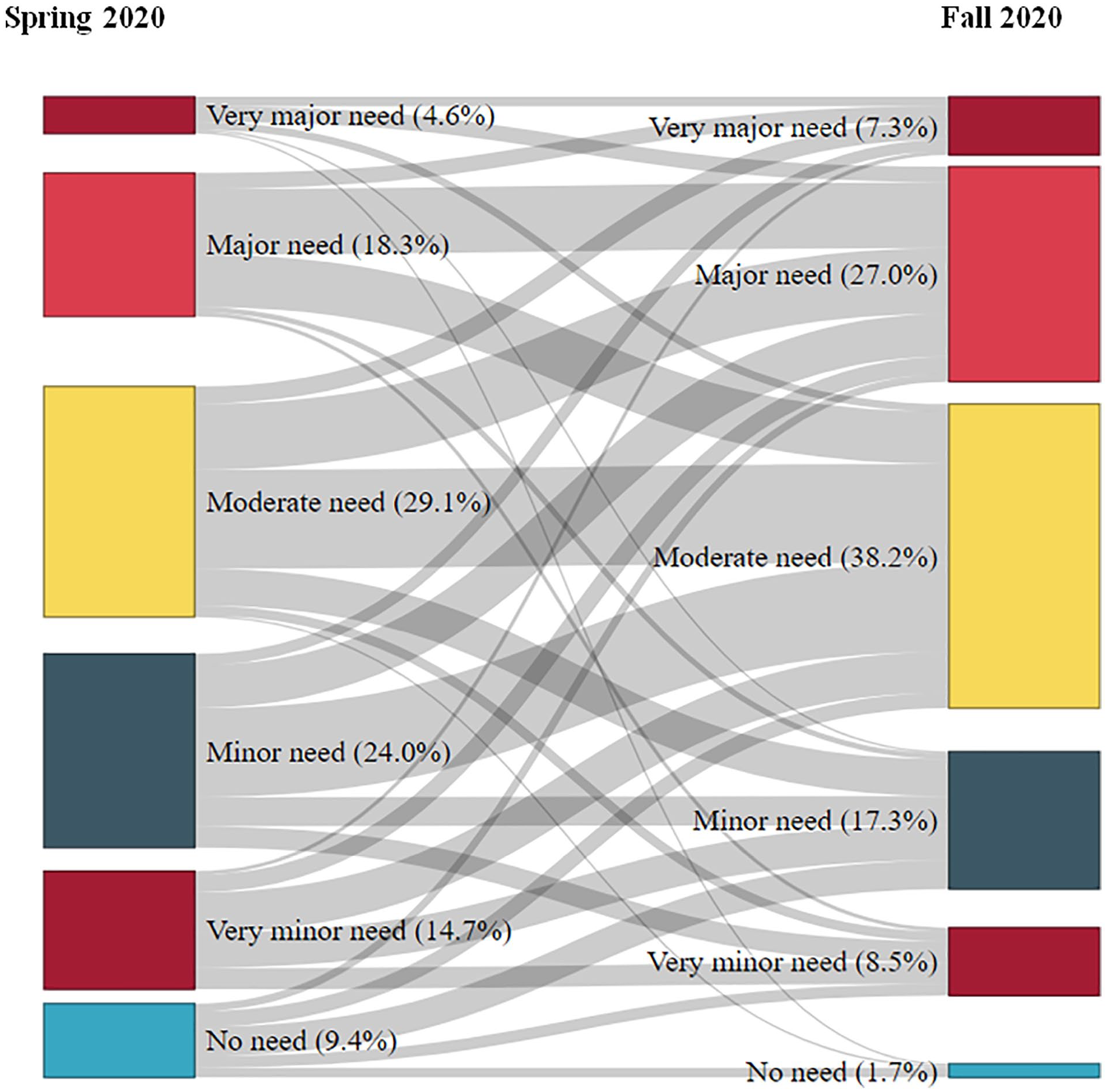
Change in resource needs among the same principals in the spring and fall of 2020.
Overall, these data indicate that principals felt a heightened sense of need for many resources and supports in the fall of 2020 compared to the spring of 2020. However, these data are based on principals’ perceptions and provide no information about what resources and supports were provided. Given the persistence of the COVID-19 pandemic and the cumulative demands and stressors that principals may have been experiencing in the fall of 2020, it is possible that principals’ perceptions were more negatively biased in the fall compared with the spring, regardless of actual need level.
School Principals’ Self-Reported Job Demands in the Fall of 2020
Beyond measuring principals’ needs, in the fall 2020 survey we asked principals about an array of other factors that could place greater job demands on them (items of which were not measured in the spring of 2020), including various budget and staffing challenges. As summarized in Table 4, nearly 40% of principals reported a school budget that was lower in 2020–2021 compared to 2019–2020, and about half of principals reported having made at least one cost-cutting change. While only 17% of principals reported a shortage of qualified teachers, nearly three quarters reported shortages of substitute teachers, and 40% reported shortages of administration or support staff. Lastly, 29% of principals reported at least one vacant teaching position at the time of the fall survey, in October 2020.
Weighted Percentages (SEs) for Principals’ Reported Job Resources and Demands in the Fall of 2020, by School Characteristics

Indicates difference between two categories within a subgroup (i.e., urban vs. non-urban, 75% or fewer students of color vs. more than 75% students of color, etc.) is statistically significant (p < 0.05) in independent t-tests comparing means. Weighted estimates were obtained by using the fall 2020 survey file. N = 1,137.
As shown in Table 4, there were no differences by school characteristics in schools’ budget demands, with the exception that a higher percentage of principals in traditional public schools than in charter schools indicated that their schools’ budgets in 2020–2021 were less than in previous years. There was greater variation by school characteristics in schools’ staffing demands. In particular, lower percentages of urban schools as well as schools with the highest percentages of non-White students and high-poverty students reported shortages of substitute teachers, and these patterns were similar for shortages of administrative and support staff. In contrast, higher percentages of principals of urban schools, high-poverty schools, schools with a high concentration of non-White students, and traditional public schools reported at least one teaching vacancy compared with their counterparts.
RQ2: To What Extent Were Principals’ Resource Needs and Demands Related to Their Self-Reported Dissatisfaction and Intention of Leaving Their Job by the End of the 2020–2021 School Year?
School Principals’ Dissatisfaction and Intention to Leave Their Job in the Fall of 2020
In the fall of 2020, 50% of principals “agreed” or “strongly agreed” that they did not have as much enthusiasm then as they did when they began their job, 43% said that they would leave if they could get a higher paying job, 27% said that the stress and disappointments were not worth it, 21% thought about transferring to another school, and 9% were generally unsatisfied being a principal at their school. On all items, the percentage of principals in our survey who indicated having negative feelings appeared higher than the corresponding percentage of principals who responded to the same questions on a nationally representative federal survey administered in the prepandemic 2015–2016 school year (Goldring & Taie, 2018). For example, compared to the 27% of principals in the fall of 2020 who said that the stress and disappointments were not worth it, only 16% responded the same in 2015–2016. Half of our fall 2020 sample of principals said that their enthusiasm for the job had declined, compared with only 29% in 2015–2016. 3 As noted above, we created a dissatisfaction index by taking the average of these five dissatisfaction items, and that index yielded an average of 1.98 on a scale from 1 to 4, where a higher number indicated greater dissatisfaction.
Furthermore, 21% of principals in our fall 2020 sample said that they were likely to leave their job by the end of the 2020–2021 school year, most of whom said that they had been unlikely to leave their job before COVID-19. We do not know whether these principals planned to move to different principalships in other schools or planned to leave the profession entirely. This proportion is not significantly different from the 18% of principals who reported leaving their current job in a typical, prepandemic school year. That said, these data points suggest that in this pandemic era, principals have higher-than-normal negative feelings toward their job at their current schools, which might translate into higher-than-normal attrition rates in the future, given that dissatisfaction and principal turnover rates are correlated in studies (Grissom & Bartanen, 2019).
Extent to Which Principals’ Resource Needs and Job Demands Predicted Dissatisfaction
We first examined how resource needs and job demands predicted dissatisfaction with linear regression models using the fall 2020 data set only, with the outcome being our dissatisfaction index. Each model included one independent variable intended to serve as a proxy for principals’ resource needs or job demands. These independent variables included (1) the fall needs index; (2) lower school budget; (3) at least one cost-cutting measure; (4) number of teacher vacancies; (5) shortage of qualified teachers; (6) shortage of qualified substitute teachers; and (7) shortage of administrators or support staff. Each model also included a range of other school-level demographics (see Table 5).
Relationship Between Resource Needs/Job Demands and Principals’ Dissatisfaction

Note. Linear regression models are weighted. Robust standard errors are in parentheses.
p < 0.05. **p < 0.01. ***p < 0.001.
As shown in Table 5, most resource needs and job demands were significantly related to principals’ dissatisfaction. For example, a 1-unit change in the resource needs index (e.g., going from minor need to moderate need) predicted a 0.14-unit increase in principals’ dissatisfaction (also an index ranging from 1–4). Similarly, if the principal agreed or strongly agreed that their school had a shortage of qualified teachers or qualified substitutes because of COVID-19, their score on the dissatisfaction index was, respectively, predicted to be 0.23 and 0.18 higher, on average. The only variable that was not a significant predictor of dissatisfaction was the reported number of teacher vacancies.
Aside from our variables of interest, dissatisfaction was also higher among principals in schools that were undertaking fully remote instruction in the fall of 2020 (relative to being fully in person) in most of our models. This might be expected, given what we know about the challenges of remote instruction for teachers and students (Diliberti & Kaufman, 2020). However, these data further confirm the toll that remote instruction may be having on school leaders in addition to teachers and students.
Readers should keep in mind that the total variation predicted by the models (as reflected by the R-squared) was relatively small. Thus, although our models include some important variables related to principal dissatisfaction, we are not capturing the full range of factors that may have driven principal dissatisfaction in the fall of 2020. Other factors could include community COVID-19 rates, parents’ dissatisfaction, and various other factors that are unmeasured in our data.
We also took advantage of our longitudinal data set to examine how changes in resource needs may have been related to principals’ dissatisfaction over time (see Table 6). Given that we measured resource needs in the spring and fall of 2020, we examined whether the need in spring as well as change in need from spring to fall were differentially predictive of dissatisfaction in the fall of 2020. Overall, our findings suggest that a higher starting level of resource need and an increase in needs over time were related to an increase in principals’ dissatisfaction. When taking into account principals’ initial need levels in the spring and how their schools’ needs changed over time, a principal reporting a 1-unit higher need level than another principal on the spring 2020 survey (e.g., a moderate versus minor level of need) was associated with a dissatisfaction score in Fall 2020 that was about 0.09 higher. Additionally, a 1-unit increase in needs between the spring and fall was associated with a little more than a 0.1 increase in dissatisfaction. Thus, a principal articulating moderate needs in the spring but very major needs in the fall would be predicted to have a score on the dissatisfaction index that was roughly 0.5 higher on the 1 to 4 dissatisfaction index than a principal in a school with similar demographic characteristics but with no reported needs in the spring or fall.
Relationship Between Need Levels and Principals’ Dissatisfaction and Intention to Leave

Note. Regression models are unweighted. Models were run on overlapping samples containing respondents who participated in the spring and fall surveys. Robust standard errors are in parentheses. LPM = linear probability model.
p < 0.05. **p < 0.01. ***p < 0.001.
Extent to Which Principals’ Resource Needs and Demands Predicted Reported Intention to Leave Their Job
Lastly, we examined the extent to which need levels were related to principals’ indication that they were intending to leave their schools during the 2020–2021 school year through logistic regression models where the outcome was a binary variable reflecting principals’ reports that they were either likely to leave their job or not likely to leave their job by the end of the 2020–2021 school year. As with our investigation of predictors for dissatisfaction, we first examined how resource needs and job demands predicted intention to leave with regression models using the fall 2020 data set only. Models incorporated the same seven independent variables as were used to predict dissatisfaction as well as the same school-level demographics (see Table 7).
Relationship Between Resource Needs/Job Demands and Intent to Leave (Odds Ratios)

Note. Logit regression models are weighted. Robust standard errors are in parentheses.
p < 0.05. **p < 0.01. ***p < 0.001.
Although budget demands and administrative/staff support shortages were related to dissatisfaction, they did not predict a greater likelihood of principals reporting their intention to leave their job. The factors that were related to an increased likelihood of reporting an intention to leave were principals’ perceived resource needs as well as teacher and substitute shortages. No other demographic or instructional mode factors in our model predicted principals’ intention to leave their job.
As with dissatisfaction, we also examined whether shifts in perceived resource needs from the spring to fall for the same principals predicted a difference in their reported likelihood of leaving their job, as seen in Table 6. As with the models predicting principals’ dissatisfaction, these models indicate that a greater initial perceived level of need and change in need over time were significantly related to principals’ self-reported intention to leave their job by the end of the 2020–2021 school year. Specifically, for every 1-unit increase in need level between the spring and fall of 2020, the odds of a principal saying they were intending to leave their job increased by a factor of 1.5. Said another way, the mean predicted probability of principals saying that they would leave their job by the end of the school year was only 0.08 for those principals with no needs in the fall of 2020 but was 0.23 for those with moderate needs and 0.41 for those with very major needs (see Figure 2). Readers should keep in mind that the confidence intervals around these means increase as principals’ need levels increase, meaning that there is less precision for principals with greater need levels.

Principals’ needs in the fall of 2020 and probability of intent to leave.
Summary and Implications
The COVID-19 pandemic has created significant new challenges for school principals who were already working in a demanding profession before the pandemic began. State and local education agencies have been an important source of support to help principals lead their schools through massive instructional shifts while ensuring the safety and well-being of their students and staff. Nevertheless, prior research suggests that the provision of supports throughout this pandemic has been uneven (Diliberti & Kaufman, 2020; Gross & Opalka, 2020; Hamilton, Kaufman et al., 2020), likely leaving many principals with unmet needs amid increasing job demands.
This study provides the first nationally representative picture of principals’ resource needs and demands over the course of the pandemic and considers what these needs and demands could mean for principals’ well-being (in terms of their satisfaction with their job) and their intention to leave their current job. While we have no way to know the relationship between reported intention to leave and actual job leaving in our sample, studies suggest that intention to leave one’s job is one of the strongest predictors of actual leaving (e.g., Auerbach et al., 2014; Hann et al., 2011). Thus, this study could shed light on the pandemic-related factors that contribute to principals’ turnover. In addition, our data provide important insights regarding the factors that are related to principals’ job dissatisfaction and desire to leave their job, which in themselves are important outcomes that could be proxies for principals’ well-being and their job performance.
Our results indicate that principals’ perceived resource needs generally increased from the spring to the fall of 2020. This is perhaps not surprising, given the compounding nature of the stressors and dilemmas faced by school leaders over the course of the pandemic. Nonetheless, it does imply that early action on the part of federal and state governance, as well as school district leaders to support school needs during crises, is important.
Our study also measured a range of factors that could place greater job demands on principals, including budget and staffing issues. Perhaps surprisingly, given that K–12 schools received approximately $13.2 billion in funding through the CARES Act signed into law in March 2020 (Jordan, 2021), about 40% of principals reported that they had lower school budgets in 2020–2021 than they had had the previous year. It is possible that many school principals had not yet felt the impact of these monies, given that school and district leaders needed to fill out considerable paperwork to receive funds and funding has been used in some states to make up for state budget cuts to education (Belsha, 2020). In addition, some CARES funding was likely not distributed to individual schools but instead was used for one-time and central office purchases, such as technology and facility costs (Lieberman & Ujifusa, 2021). Another factor that may have led to lower budgets among some schools is drops in school enrollment that have been documented across the nation over the course of the pandemic (Hubler et al., 2020), which are directly tied to how much money that individual schools receive.
Although relatively low percentages of principals reported shortages of qualified teachers, nearly three quarters reported shortages of substitutes, which has also been a well-documented issue for the 2021–2022 school year (Romo, 2022). In addition, 29% of principals reported at least one vacant teaching position as of the time of the October 2020 survey, whereas 40% reported administration and support staff shortages.
Interestingly, while our resource needs index—and increased perception of need from spring to fall—was consistently related to principals’ reported dissatisfaction and intention to leave, multiple job demands, including budget issues, cost-cutting measures, and teacher vacancies, were related to principals’ dissatisfaction but not to their intention to leave. Instead, only teacher and substitute teacher shortages were related to this intent. Readers should keep in mind that relationships among dependent and independent variables in all our regression models could be bidirectional. For example, dissatisfaction and intent to leave could influence principals’ perceptions of needs, in that those who are increasingly dissatisfied with their job could perceive greater resource needs, just as resource needs could drive dissatisfaction. Nonetheless, the more concrete measures of job demands in some of our models—such as lower budgets and staffing needs—are less likely to be directly driven by principals’ dissatisfaction and thus could more plausibly be leading to dissatisfaction.
Multiple school-level demographics included in our regression models did not appear to be related to principals’ level of dissatisfaction or self-reported likelihood of leaving their job. However, our models likely exclude some critical variables related to school demographics, school climate, and other factors that may drive principals’ well-being and retention. That said, we did find that principals of schools engaged in fully remote learning in the fall of 2020 were significantly more likely to report higher dissatisfaction (although not a higher likelihood of intent to leaving their job), which might reflect the lower capacity of schools that were unable to provide in-person instruction and/or the well-documented challenges of remote learning during the pandemic (Diliberti & Kaufman, 2020).
Although this study is among the first to examine the changing needs and potential attrition of U.S. public school principals during the pandemic, the data and analyses have several limitations that readers should keep in mind. First, as with all self-reported survey data, principals’ responses to our surveys could be subject to biases stemming from such factors as social desirability. A particular concern is that the context in which this study took place—namely, a pandemic that upended principals’ work and home lives—might have led to more cumulative stress on principals over time, which could have led them to rate their needs and dissatisfaction higher at each time point and over time than actual circumstances would predict or necessarily warrant. Relatedly, principals’ reports regarding their intentions to leave their jobs could also be inaccurate; we do not have a way of determining how well their reported plans in October 2020 matched their later actions. Another limitation is a low response rate to the fall and spring surveys, as is a somewhat smaller and nonrepresentative sample of principals for whom we had data at both time points. These responding principals may not be similar to nonresponding principals in our sample, who may have been more dissatisfied and overwhelmed than those who did respond. In particular, in the fall of 2020, responding principals came from slightly more affluent schools than those responding to the spring 2020 survey and compared to the general population of schools across the United States, which may have biased our results. Moreover, our research design does not permit causal inferences regarding the contributors to principals’ needs or career plans. This study thus provides valuable but incomplete information. Future research that follows principals over time and monitors their career transitions could thus provide more detailed data on their experiences and predictors of their decision to leave the principal profession.
Despite these limitations, these data provide some important implications for federal and state governments, as well as for local education agencies supporting K–12 students during the pandemic and beyond. First, our data make clear that U.S. school principals faced a huge range of resource needs and job demands over the course of the spring and fall of 2020. School principals confronted considerable budget and staffing challenges with feelings of increased and unanswered need, many of which likely carried over to the 2021–2022 school year, given continuing evidence of staffing shortages and budgetary challenges, some linked to lower school enrollment (e.g., Lehrer-Small, 2021; Tadayon, 2021).
In addition, comparisons of principals’ reports on their dissatisfaction in our fall 2020 survey were considerably higher than reported dissatisfaction in previous years, as measured through the same items used in the 2015–2016 National Teacher and Principal Survey (Goldring & Taie, 2018). These higher rates of dissatisfaction are, in themselves, a concern and echo findings from other research on growing dissatisfaction, stress, and depression among U.S. teachers (Steiner & Woo, 2021). These findings imply that districts and states should find ways to support principals’ well-being and encourage higher job satisfaction even in times when budget and staffing demands cannot be met. Interventions found to support employee well-being and job satisfaction more generally—as well as interventions found to support principals and educators—could be useful in this regard, including administrative social support teams within schools (Beausaert et al., 2021) and mindfulness and self-care practices (Wells & Klocko, 2018).
Although our findings do not imply higher-than-normal principal turnover rates in 2020–2021 than in previous years, they do suggest mounting perceptions of resource needs among principals and dissatisfaction. Given relationships between employees’ dissatisfaction and turnover in the research literature as well as evidence of growing teacher shortages that may drive further dissatisfaction, districts may be facing higher-than-normal principal turnover rates in future years and may need to recruit, select, and hire qualified school principals more aggressively than in the past. Past research provides some guidance on approaches that can help districts improve their principal recruitment and hiring strategies by forming deliberate partnerships with preparation programs and even creating some internal mechanisms for preparing school principals adequately to support within-district needs (Gates et al., 2019a; Turnball et al., 2016; Wang et al., 2018). In addition, prior research provides some guidance on the district policies that will support retention of school leaders over time through intensive professional learning, mentoring, and thoughtful supervision, which can reduce principal turnover rates and improve teaching and learning in the long term (Gates et al., 2019b; Turnball et al., 2016). Through such mechanisms, school leaders can be provided with the tools, resources, and supports that will allow them to lead schools effectively.
Lastly, our findings suggest that the factors related to principals’ dissatisfaction are different from the factors connected with principals’ intent to leave, which is also reflected in other research on employer dissatisfaction (Hom & Kinicki, 2001; Wang et al., 2012). Specifically, budget-related job demands were associated with dissatisfaction but not intent to leave, while perceptions of resource needs and teacher/substitute shortages were related to dissatisfaction and intent to leave. Following the JD-R model, it could be that such job demands as budgetary issues create dissatisfaction among principals but are sufficiently buffered by resource needs so as not to tip the balance and lead to principals’ desire to leave their job, whereas staffing shortages do tip that balance. If this is the case, then recent reports of growing staffing shortages may be a harbinger of more school principals’ turnover. For these reasons, efforts to address staffing shortages may be another important step to stemming additional principals’ attrition. As with the research on principals’ dissatisfaction and turnover, initiatives to assess and support educators’ well-being and build more robust teacher pipelines (e.g., Carver-Thomas & Darling-Hammond, 2017; Gonser, 2021; Regional Educational Laboratory Pacific, n.d.) could improve teachers’ retention and, at the same time, keep principals from leaving schools and the school leader profession.
Footnotes
Acknowledgements
This article is based on research funded by the Bill & Melinda Gates Foundation. The findings and conclusions presented are those of the authors and do not necessarily reflect positions or policies of the Bill & Melinda Gates Foundation.

Notes
Authors
JULIA H. KAUFMAN is a senior policy researcher at the RAND Corporation, where she codirects the American Educator Panels. Her research focuses on how states and school systems can support high-quality instruction and student learning.
MELISSA K. DILIBERTI is an assistant policy researcher at RAND and a doctoral candidate at the Pardee RAND Graduate School. Her research interests include domestic and international education policy.
LAURA S. HAMILTON is an associate vice president of research centers for ETS, overseeing the organization’s foundational research on a number of cross-cutting domains to help inform decision making and advance the science and practice of learning and assessment. Hamilton’s own research has focused on producing evidence-based guidance to inform K–12 education policy and practice, particularly in the areas of social, emotional, and civic learning.