



Abstract
The two studies presented here examine the effects of teachers’ enhanced sense of meaning at work (SOM) on their burnout and engagement. In the first study, 41 teachers in two Arab schools were randomly assigned to a meaning-induction group—in which they were prompted daily to acknowledge meaningful incidents at work for 2 weeks or to a control group. Qualitative analyses focused on teachers’ daily experiences of meaningful incidents, reflecting their contribution to others. In addition, one-way repeated measures analyses of variance indicated that teachers that acknowledged these incidents reported decreased burnout and increased engagement. In Study 2, the sample comprised 60 Arab and Jewish teachers who completed daily surveys for 12 workdays. Hierarchical linear modeling analyses showed that teachers’ daily SOM was associated with increased engagement on the following day and somewhat increased stress. Thus, the studies highlight teachers’ SOM as a resource that contributes to engagement and can be enhanced intentionally.
Teacher burnout, reflecting physical, emotional, and mental exhaustion (Pines & Aronson, 1988), has been widely studied in the past few decades (Ghanizadeh & Jahedizadeh, 2015). Research has consistently shown that teachers suffer from high burnout rates, similar to or greater than those in other social professions (Hakanen et al., 2006; S. Johnson et al., 2005; Schaufeli & Buunk, 2003). Furthermore, researchers have found that one of the variables shown to be consistently negatively associated with burnout was work engagement—a state of vigor, dedication, and absorption (Halbesleben, 2010; Schaufeli et al., 2006). Teacher work engagement is viewed as a fulfilling, positive, work-related experience and state of mind (Bakker & Bal, 2010; Schaufeli & Bakker, 2004). It has been positively associated with good health, positive work affect (Sonnentag, 2003), and better teacher performance (Bakker & Bal, 2010).
Building on contemporary literature, in the present research, I propose that teachers’ sense of meaning at work can serve as a potential psychological resource that may mitigate their job burnout and enhance their work engagement. This proposition is rooted in the job–demands–resources framework, which focuses on job demands and resources’ effects on employees’ burnout and engagement (e.g., Bakker & Demerouti, 2007). In the framework, job demands are defined as elements of the job that can be costly, physically or psychologically (e.g., work pressure, role conflict, or ambiguity). Job resources are aspects of the job that can help deal with job demands and promote achievement and growth (e.g., autonomy, organizational, and supervisor support) (Bakker & Demerouti, 2007; Cao et al., 2020; Kim et al., 2021). Job demands typically increase burnout, while job resources mitigate this effect and increase engagement (Lesener et al., 2019). These effects were validated in numerous cross-sectional and longitudinal studies (Bakker & Demerouti, 2017; Crawford et al., 2010; Lesener et al., 2019).
The present study builds on this literature and focuses on a sense of meaning at work as a psychological resource. A sense of meaning at work reflects employees’ feeling that their work is significant and purposeful and contributes to others or the greater good (e.g., Martela & Pessi, 2018; Steger et al., 2012). It has been previously suggested as a work resource (Crawford et al., 2010; Kahn, 1990); however, its causal effects on burnout and engagement have only rarely been explored empirically (e.g., Bakker & Demerouti, 2014; Crawford et al., 2010), despite its importance—especially in certain occupations, such as teaching (e.g., Lavy & Bocker, 2018). Previous studies have indicated that employees’ sense of meaning at work is associated with desirable work-related outcomes, including increased career commitment (Steger et al., 2012), engagement (Littman-Ovadia et al., 2017), decreased withdrawal behaviors (Steger et al., 2012), and turnover intentions (Arnoux-Nicolas et al., 2016). However, few studies have examined its effects (beyond mere correlations) in experimental or longitudinal studies (e.g., Grant, 2012; Lavy & Bocker, 2018; Martela et al., 2018; van Tongeren & Green, 2010). Furthermore, the impact of a sense of meaning at work on burnout is especially crucial for teachers due to its core, daily importance in their job (Pines, 2002).
The present research aims to empirically examine the effects of a sense of meaning at work on burnout (and the related stress) and work engagement among teachers. This population experiences high levels of burnout (e.g., Chang, 2013; S. M. Johnson et al., 2005) despite the potential of their work to provide an increased sense of meaning (e.g., F. A. Korthagen, 2004). The hypotheses were explored in two complementary studies, which also shed light on the nature of teachers’ daily sense of meaning at work: Study 1 included an experimental induction of teachers’ daily sense of meaning at work—by prompting teachers to describe daily meaningful incidents/events at work. Qualitative analysis of the data explored themes underlying teachers’ daily sense of meaning at work, and qualitative analysis explored differences in engagement and burnout between the experimental and control groups before and after the 2-week experiment. Study 2 was a daily survey, which examined connections between teachers’ daily sense of meaning at work and subsequent fluctuations in their engagement and stress. Together, the studies enabled exploring the nature of teachers’ daily sense of meaning at work, and its effects on subsequent burnout/stress and engagement levels.
Teachers’ Sense of Meaning at Work and Job Burnout
The sense of meaning at work has been defined in several ways (e.g., Kaplan & Tausky, 1974; Schnell et al., 2013; Steger et al., 2012). Typically, it is thought to reflect individuals’ feelings that their work is of value and enables them to use their abilities in pursuit of a worthwhile goal—which positively affects others or contributes to the greater good (Grant, 2007; Littman-Ovadia & Steger, 2010; Steger et al., 2012). In this sense, meaningful work provides individuals with a sense that it is significant, purposeful, and enables self-realization (Martela & Pessi, 2018; Martela & Steger, 2016). Teachers’ jobs, aimed at helping children learn, develop, and contribute to society (Dewey, 1980), have the potential of providing a transpersonal level of meaning, involving existential reflection of their contribution to the world (which may remain beyond their existence; F. A. Korthagen, 2014; F. Korthagen & Vasalos, 2005). Teachers interact daily with their students, who are expected to be the primary beneficiaries of their work and thus can often see the positive impact of their work daily. Increased teacher sense of meaning at work is associated with improved relationships with students (Lavy & Bocker, 2018) and school graduates’ resilience (Lavy & Ayuob, 2019).
Despite this potential for experiencing a high sense of meaning at work, Pines (2002) argued that teachers’ true sense of meaning at work is relatively low because they often perceive their work as having limited impact in practice. This decreased sense of meaning at work facilitates burnout and exacerbates the adverse effects of organizational factors, such as demands from principals and parents, heavy administrative workload, and unsupportive supervisors (Grayson & Alvarez, 2008; Perry-Hazan & Birnhack, 2019; Skaalvik & Skaalvik, 2010). Similarly, Blase (1982) showed how organizational and job demands impede teachers’ ability to achieve what they perceive as valued goals, resulting in symptoms such as increased frustration and low self-valuation—which are considered antecedents of burnout (Pines, 2011). Finally, a more recent study by Yinon and Orland-Barak (2017) provides a contemporary, in-depth understanding of the harmful effects of such processes. The study examines cases of teachers who have left their jobs because they feel that the circumstances hamper their ability to fulfill their role as they aspired. Together, these researchers point to the gap between the potential of teachers’ work to make a long-term contribution to others and the complex, often exhausting and frustrating daily reality of teachers (e.g., S. M. Johnson et al., 2005), which can impede their sense of meaning at work—and cause job burnout.
The first goal of this study is to deepen our understanding of teachers’ actual experiences of meaningful events in their daily work to explore possible buffers to their burnout. When discussing employees’ (and teachers’) sense of meaning at work, research often adopts a long-term perspective—focusing on exceptional incidents or long-term cumulative impact (e.g., O’Connor, 2008; Oplatka, 2006). However, such incidents tend to be scarce and may require longer term reflection. Therefore, in the present study, I attempted to shed light on the essence and content of teachers’ daily meaningful experiences that may affect teachers’ everyday emotions and motivation, by qualitatively examining teachers’ reports about their daily meaningful experiences.
Burnout is characterized by depersonalization, cynicism, emotional distancing from work and other people, negative self-appraisal (Maslach et al., 1996), and inefficacy (Maslach, 1993). It reflects a state of exhaustion (Pines & Aronson, 1988) that Pines (2005) described as “the end result of a process of attrition wherein highly motivated individuals lose their spirit” (p. 78). Burnout among teachers is associated with several undesirable outcomes, such as counterproductive work behaviors, early retirement (Farber, 1991), health problems and attrition (Brunsting et al., 2014), and reduced student achievement (Brunsting et al., 2014; Taris, 2006). The high rates of teacher burnout have been attributed to various factors, including teachers’ job characteristics and the challenging organizational contexts in which they operate, comprising heavy workload, student misbehavior, and lack of administrative support (Chang, 2013; Grayson & Alvarez, 2008; Skaalvik & Skaalvik, 2010). Teachers’ low social status may also contribute to their emotional strain (Perry-Hazan & Birnhack, 2019). These challenging work conditions often impede teachers’ effective functioning and prevent them from enjoying their work’s envisioned contribution and prosocial impact (see Pines, 2002). This process can transform their initial enthusiasm about the meaningfulness of their work into cynicism and burnout after acknowledging the substantial disparity between their expectations and reality (e.g., Friedman, 2000). Thus, teachers’ ability to preserve their sense of meaning at work may diminish their burnout because it could keep teachers in touch with the essence of their job, which is a key source of their motivation and inspiration (F. A. Korthagen, 2004).
This idea has received initial empirical support from cross-sectional studies demonstrating negative associations of burnout with a sense of meaning at work among teachers (Currier et al., 2013; Pines, 2002) and among employees in other occupations (Krok, 2016; Pines, 2011, 2017). However, the studies examining this link typically rely on cross-sectional methodology, which does not indicate what drives the associations and cannot identify the influence or effect of teachers’ sense of meaning on burnout. The present research fills this gap while examining the impact of an intentional increase in teachers’ sense of meaning at work on their burnout levels and exploring the link between daily sense of meaning at work and daily stress levels.
Teacher Work Engagement and Meaningful Work
A sense of meaning at work is expected not only to buffer exhaustion and burnout but also to energize and motivate employees, contributing to their enthusiasm about work (Dik et al., 2013; Leider, 2015). To provide a more balanced understanding of the effects of teachers’ enhanced sense of meaning at work and avoid focusing only on decreased adverse outcomes, I incorporated an exploration of work engagement—a positive construct, considered an antithesis of burnout (Crawford et al., 2010; Schaufeli et al., 2002), which reflects employee enthusiasm and job immersion (Kahn, 1990). Work engagement has been widely studied in the organisational field, over the past three decades (Halbesleben, 2010). Work engagement has been consistently associated with desired organizational outcomes, such as better task performance (e.g., Dalal et al., 2012), increased organizational citizenship behavior and job satisfaction (Saks, 2006), and decreased turnover intentions (Saks, 2006) and burnout (Crawford et al., 2010). Studies have also pointed to the particular importance of work engagement to teachers (e.g., Bakker et al., 2007), indicating its associations with teachers’ organizational citizenship behavior (Runhaar et al., 2013), creativity (Bae et al., 2013), performance (Bakker & Bal, 2010), and decreased burnout (Parker et al., 2012; Rey et al., 2012).
A sense of meaning at work may enhance employees’ work engagement because employees who feel that their work is important and makes a significant contribution will be more enthusiastic and engaged (Ghadi et al., 2013; Hirschi, 2012; Woods & Sofat, 2013). Indeed, in cross-sectional studies, meaningful work characteristics have explained a substantive portion of the variance in employee engagement, even when controlling for other work characteristics (Fairlie, 2011). Furthermore, a sense of meaning at work has been proposed to drive the kind of engagement that can lead to sustained high employee performance (Shuck & Rose, 2013). Building on these findings, the present study explores whether these associations are driven by the effect of the sense of meaning at work.
The Present Research
Based on the accumulated knowledge on employees’ sense of meaning at work, this research was designed to deepen our understanding of the nature of teachers’ daily meaningful experiences, and provide a quantitative examination of the effects (beyond mere associations) of teachers’ sense of meaning at work on their burnout and engagement. This goal was pursued in two complementary studies, based on qualitative analysis of teachers’ daily experiences, and on initiating or assessing changes in teachers’ sense of meaning at work and examining their connection to subsequent teacher burnout (or related stress) and engagement. The first study performed experimental induction of teachers’ sense of meaning at work by prompting reminders of meaningful daily incidents. The second study was a daily survey exploring associations of daily fluctuations in teachers’ sense of meaning at work with subsequent daily work engagement and stress—an indicator closely related to burnout (Friedman, 2006; Herman et al., 2018).
The studies were based on recent research on the sense of meaning at work, which indicates that it is a construct with some flexibility. Researchers have recently demonstrated that although individuals’ sense of meaning at work has a relatively stable component, it also has a component that can fluctuate and be renewed daily (Lavy & Bocker, 2018; Pratt & Ashforth, 2003). Furthermore, this variable component may be affected by specific events and experiences (Clausen & Borg, 2011; Park & Folkman, 1997). These ideas are compatible with previous studies, based on social-cognition research, demonstrating that a host of other personal and work-related attributes vary daily (e.g., Demerouti et al., 2012; Lavy, 2019; Lavy et al., 2013) and may be temporarily altered simply by having a person think about related experiences (see reviews by Lyubomirsky & Layous, 2013; Mikulincer & Shaver, 2007). For example, participants’ gratitude was induced by requesting them to write about three good things that happened to them on a daily or weekly basis (e.g., Emmons & McCullough, 2003). The intervention led to short- and long-term positive outcomes, such as increased well-being and decreased exhaustion symptoms (Emmons & McCullough, 2003; see a review by Wood et al., 2010). In a similar way, daily notes to a beloved person had effects similar to those of social support and attachment security (Lavy et al., 2014; Lavy et al., 2017). The mechanisms underlying these effects seems to be the activation of a cognitive schema related to the positive concept (e.g., a cognitive schema indicating that the world is a positive place, or a schema indicating that others can be trusted and are supportive, or a schema indicating that one’s work is meaningful). The first study builds on this line of evidence and explores the effect of daily reminders of meaningful events at work for 2 weeks on teachers’ work engagement and job burnout. The second study complements it by examining the daily dynamics of teachers’ sense of meaning at work with their engagement and stress.
Study 1
This study comprised an experimental induction of teachers’ sense of meaning at work. Teachers’ work meaningfulness was induced by requesting them to retrieve memories of meaningful incidents/events at work, daily, for 2 weeks, while teachers in the control group described the daily weather. This intervention also enabled adaptation to each teacher’s personal context and perceptions, irrespective of their individual differences in what they considered meaningful. The data were analyzed qualitatively to explore the themes that comprised teachers’ daily meaningful events and quantitatively to explore differences between the experimental and control groups before and after the 2-week intervention.
Method
Participants
The sample comprised 41 teachers (26 women, 15 men) in two Arab schools (20 from one school, 21 from the other) in Israel. Their ages ranged from 22 to 59 years (Mage = 36.41 years, SDage = 8.11), and their work tenure range was 1 to 39 years (Mtenure = 13.12 years, SDtenure = 8.77). Most were married (78% married, 22% single). Teachers had a secondary education diploma (56.1%), bachelor’s degree (26.8%), master’s degree (14.6%), or high school education (2.4%).
Measures
Teacher engagement
This variable was assessed with the nine-item Hebrew version (Littman-Ovadia & Balducci, 2013) of the Utrecht Work Engagement Scale (UWES-9; Schaufeli et al., 2006). The scale assesses various components of work engagement, including vigor (e.g., At my work, I feel bursting with energy), dedication (e.g., I feel enthusiastic about my job), and absorption (e.g., I feel immersed in my job). Teachers indicated how often they experienced each of the described feelings on a 7-point Likert-type scale, ranging from 1 (never) to 7 (every day). In the present study, the measure showed high internal consistency (α = .95).
Teacher burnout
This variable was assessed with the Burnout Measure’s (BM; Pines & Aronson, 1988) short version (Pines, 2005), which comprises 10 burnout symptoms (e.g., feeling tired, feeling hopeless, and feeling worthless), rated on a 7-point Likert-type scale, ranging from 1 (never) to 7 (always). The measure’s internal reliability was satisfactory in the present study (α = .78).
Procedure
Principals of six Arab schools in northern Israel were invited to participate in the study. Two agreed, and their teachers were invited to participate voluntarily. Interested participants (N = 41; ~74% consent ratio) completed a consent form, were randomly assigned to the experimental (n = 20) or control (n = 21) conditions, and completed a short survey including the study’s measures. Participants in the experimental condition were requested to record, every day, for 2 workweeks, a meaningful incident or event that occurred during the day, which reflects the importance of their work:
Try to remember something meaningful that happened to you at work today. Something that made you feel that your work is meaningful and important. It can be an exceptional event, something related to development or change, a meaningful relationship, an achievement, something emotional, or anything else. Please describe it briefly and indicate why it was meaningful.
This experimental intervention ensured that the activation task would be relevant to all teachers in the experimental group, despite potential individual differences in their perceptions of meaning at work. It further enabled a deeper understanding of the daily experiences that make a difference for teachers, and make them feel that their work is meaningful. Participants in the control condition were requested to try to recall the weather during the day and describe it briefly, recorded daily, over the course of 2 weeks. Participants were blind to the study hypotheses and to which group they were assigned.
Results
Qualitative Analysis of Daily Meaningful Events
Participants’ daily responses were coded into an excel file to enable analysis of the reactions to the meaning-induction prompt. Participants’ typical responses included descriptions of one or two meaningful events that happened to them during the day. In a few cases (less than 5% across all participants in all days), participants did not note a daily meaningful event. Content analysis of the responses was conducted in a few steps. First, two independent education researchers read through the first chunk of responses and extracted the main sources of meaning provided in them. This process was discontinued when no new themes were extracted over several (38) responses. Because the source of meaning in almost all responses examined at this stage was prosocial impact, at the next step, subthemes were determined for this category, referring to the nature of the impact (i.e., socioemotional or instrumental/academic) and to its beneficiary (i.e., students, parents, teachers, principal, and other).
At the third step, additional core meaningful work themes mentioned in the literature were added to the list to explore their relevance to the participants’ responses. Themes overlapping with existing categories were omitted, to avoid repetition. In this process, the following themes were added: a sense of coherence, direction, and belonging at work (Schnell et al., 2013); the discovery and use of talents, strengths, and personal interests, and learning from experience (Miller, 2009); status and prestige, needed income, time absorption, and interest (Harpaz & Fu, 2002; Kaplan & Tausky, 1974). At the fourth step, two independent education researchers classified participants’ responses into the various content categories. Because some of the responses were related to more than one category, each response could be classified under more than one category, enabling its classification under all the relevant content categories. As interrater agreement of 89% was reached on a sample of 10% of the responses, the remainder was coded by a single coder.
Almost all responses (99%) were related to prosocial impact (i.e., contributing to others in a positive way; Grant, 2007), which corresponds with the typical definition of work meaningfulness as contributing to others/to the greater good. The themes included an instrumental/academic contribution to others, and contribution to others’ socioemotional well-being. The instrumental/academic contribution was evident in 62% of the notes, and included responses like: “We had a good grammar lesson, in which several students have shown progress”; “I personally examined one of the students, and found out that he now knows 20 letters. At the beginning of the year, he could not recognize letters at all. I was impressed with his progress.” Contribution to others’ socioemotional well-being was salient in 51% of the notes and comprised descriptions of diverse events which contribute to students’ social environment, class climate, and personal well-being. Following are two examples related to different aspects of students’ socioemotional well-being: “One of my students was sad, so I sat and talked with him, until I felt that he was better”; and “I managed to create a close connection between two girls who were foes.” The clear majority (80%) of the responses included descriptions of teachers’ contributions to students. However, some events cited contributing to other people in the school and the community. These include positive contribution to parents (7%; e.g., “I met with the mother of a student with behavior problems and provided suggestions on how to interact with him”), to other teachers (6%; e.g., “I brought breakfast to my colleagues”; “I helped another teacher prepare an online lesson”), the principal (3%; “I reminded the principal about sending out notifications to the parents”), or others (4%) such as interns, other school employees, or students’ family members.
Some responses (16%) described positive feedback and validation, received from students (10%; e.g., “The most introverted student in class told me she likes me”; “Some of my students asked the principal that I will be their homeroom teacher next year”), parents (3% e.g., “A student’s father came to inquire about his son’s progress, and told me that I’m a good teacher and that he feels his son is in good hands”), the principal (2%, e.g., “We received positive feedback on our work from the principal”), or colleagues (1%, e.g., “A colleague told me that she feels I’m the most loved teacher in school”). Almost all these responses also included a component reflecting validation of the teacher’s prosocial impact on others.
Other themes were also mentioned in the responses, though to a less extent: the discovery and use of talents, strengths, and individual interests (4%; e.g., “I co-led a staff meeting concerning the subject I teach with the vice principal and felt an expert in my field”; “Some of the teachers were on a field trip and I managed to work with two classes in tandem”), and a sense of belongingness (3%; e.g., “I sat with my students during the break and we ate together”; “My students and I all played soccer together during the break, and I felt that our bond was strengthening”). The other themes, added based on the literature on meaningful work, were mentioned in less than 1% of the responses, across responses of all participants in all days (i.e., a sense of coherence, direction, learning from experience, status and prestige, needed income, and time absorption).
Quantitative Analysis
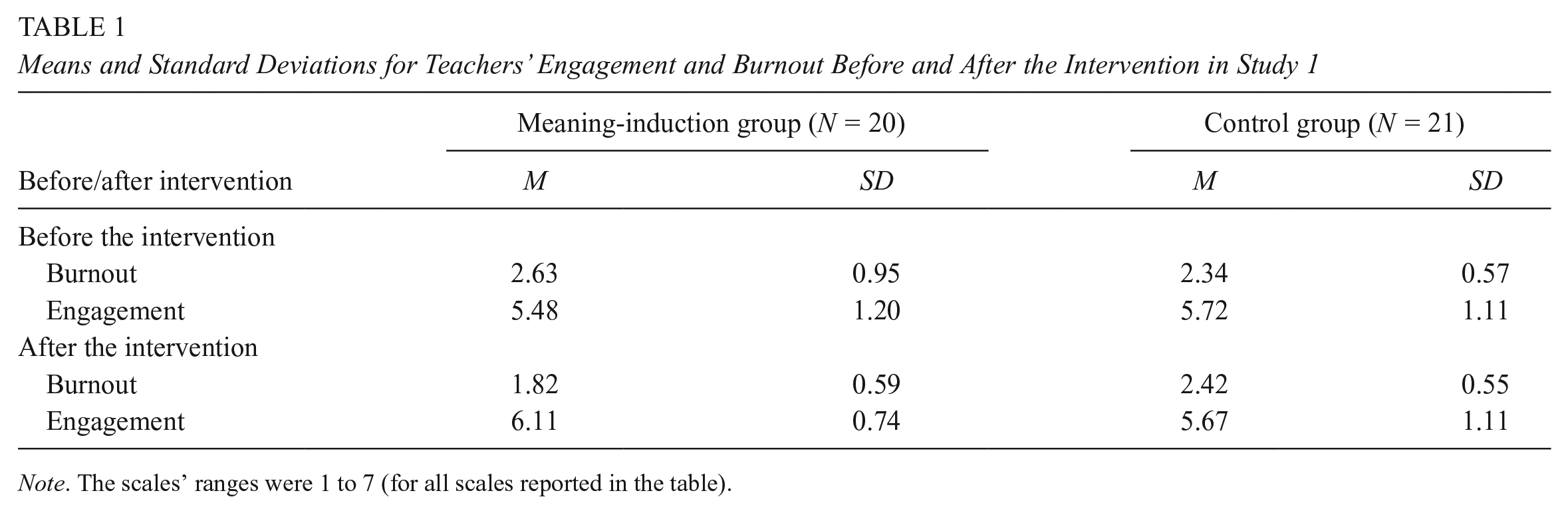
Means and standard deviations of burnout and engagement levels of teachers in the two groups before and after the intervention are presented in Table 1. To compare teachers’ burnout and engagement levels before and after the intervention in the meaningful activation condition and in the placebo condition, two one-way repeated measures analyses of variance were conducted, with IBM SPSS statistics (Version 25). Initial analyses indicated that the analysis of variance assumptions were met—there were no significant differences between the groups in the variance of the population, the samples were independent, and the samples’ distribution was normal in both groups at both times (based on Kolmogorov–Smirnov exact test—used due to the sample size).
Means and Standard Deviations for Teachers’ Engagement and Burnout Before and After the Intervention in Study 1
Note. The scales’ ranges were 1 to 7 (for all scales reported in the table).
In the case of teacher burnout, results indicated a significant effect of time, Wilks’ Lambda = .78, F(1, 23) = 6.65, p < .05;

Burnout levels before and after the 2-week intervention, in the experimental and control groups.
Along similar lines, analysis of changes in engagement indicated a significant effect of time, Wilks’s Lambda = .82, F(1, 23) = 5.02, p < .05,
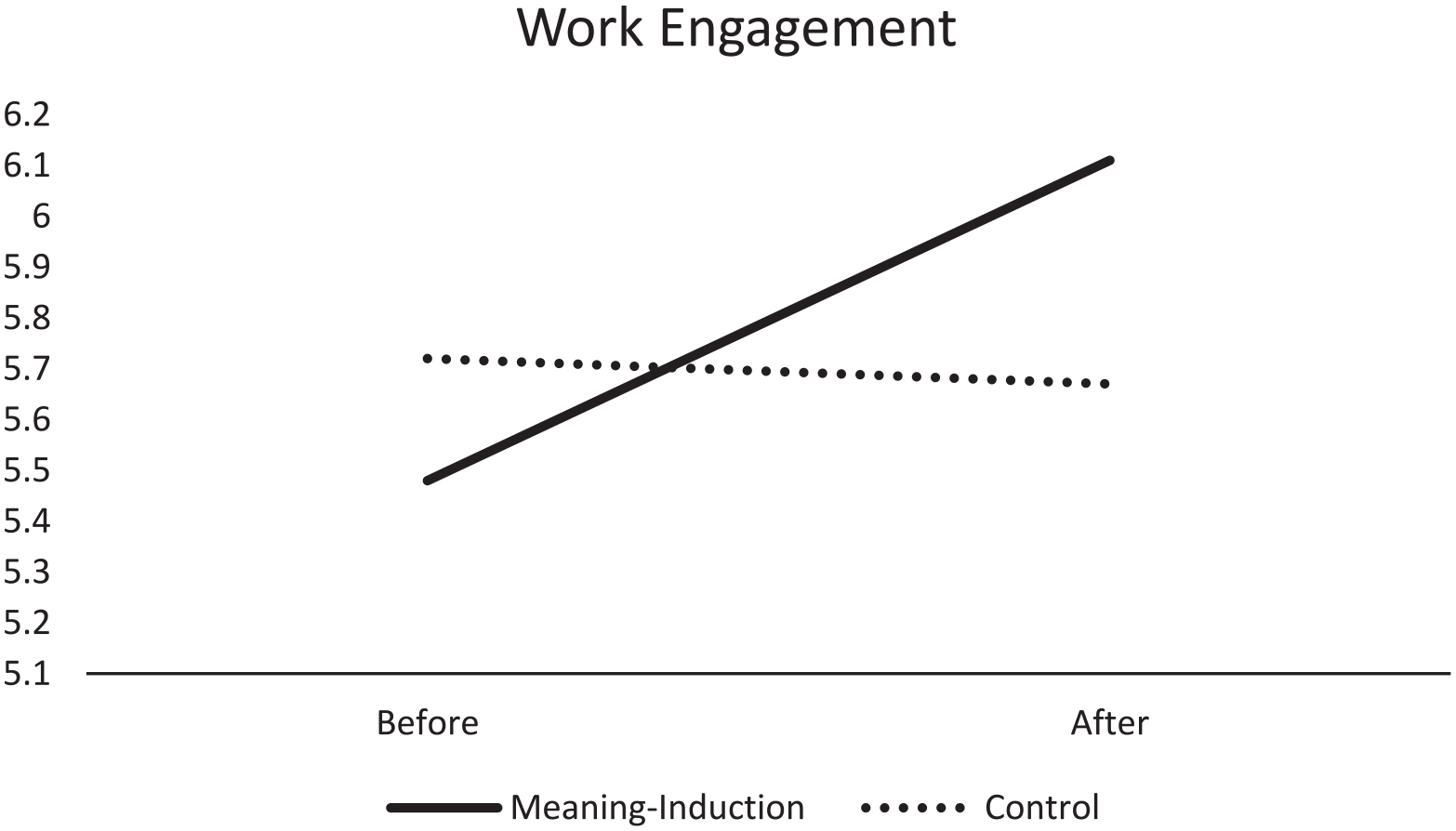
Engagement levels before and after the 2-week intervention, in the experimental and control groups.
Discussion
Study 1’s findings provide support for the hypothesized effects of teachers’ sense of meaning at work on burnout and engagement—supporting its role as a job resources (Crawford et al., 2010), and point to teachers’ perceived contribution to others (especially to students) as a core component of their sense of meaning at work. Specifically, the study showed that merely prompting teachers to think and write about meaningful occurrences at work may mitigate teachers’ burnout and enhance their engagement. In this sense, the present study also provides an encouraging outlook on fostering teachers’ sense of meaning. The positive effects of merely requesting teachers to think (and write) about their work meaningfulness suggest that modifying teachers’ (and perhaps other employees’) perception of their occupation’s prosocial impact, or only its salience in their minds, may be enough to boost their sense of meaning at work and allow them to reap the resultant benefits. These findings imply that enhancing teachers’ sense of meaning at work can be pursued by teachers themselves, and can be promoted by principals and school counselors, even when resources are limited and when organizational support is lacking. The findings implying that teachers’ sense of meaning can be altered following cognitive focus (or prompts) further point to potential benefits of establishing daily “reflection habits” that focus on meaningful events at work, or even just acknowledge them. Most teachers engage in behaviors having some positive impact on others on a daily basis. However, these deeds may be forgotten or underestimated in the intensive work schedule and in organizational practices which sometimes depersonalize children (van den Berg, 2002; Vandenberghe & Huberman, 1999). Highlighting them may remind teachers of their personal abilities and influence, and help them restore their awareness of their initial motives for teaching.
The findings also indicate that when asked about it, teachers reported contribution to others to be a major component of their daily experience of meaning at work. This is an encouraging finding, suggesting that despite the challenging circumstances, teachers still feel that they have notable positive impact on others, on a daily basis. The qualitative analysis also showed that although this positive impact is typically on students, teachers experience making a meaningful contribution to others in the school and community—colleagues, parents, and so on. Interestingly, additional sources of meaningfulness among teachers (such as personal development and belongingness) were only rarely reported (at least at the daily level). These findings point to the need for further inquiry (among preservice and in-service teachers, as well as among policy makers) about the components of teachers’ sense of meaning in different organizational and cultural contexts and may suggest the need to develop other aspects of meaningfulness in teachers’ work.
The study’s results indicated a robust effect, with high or very high observed power. However, the sample comprised only teachers in a specific population (teachers in Arab schools in Israel), and the study was conducted in two schools—in which different teachers within the school may have discussed the experimental conditions—which may have affected the results. Furthermore, the experimental design of the study did not allow exploration of daily mechanisms underlying the change that was observed at the end of the 2-week intervention. Study 2 aimed to address these issues and explore daily dynamics in teachers’ work, in a heterogenic sample of teachers.
Study 2
Study 2 was a daily-survey study, in which teachers reported their daily sense of meaning at work, engagement, and stress for 12 workdays. This methodology enables exploring daily dynamics among the study variables and examining the contribution of teachers’ reported sense of meaning at work on a certain day to changes in their engagement and stress levels on the following day. Such time precedence of daily change processes is thought to derive from a possible effect of one variable on another (e.g., Lavy et al., 2017; Qian et al., 2014). Thus, daily surveys are commonly used to assess short-term processes and daily employee experiences (e.g., Ohly et al., 2010; Sonnentag & Starzyk, 2015), enabling researchers to capture dynamics among variables and phenomena and helping them to understand mechanisms underlying employees’ experiences (and changes in these experiences) within employees’ natural settings (Bolger et al., 2003).
Daily diary studies are typically used when the explored phenomena have a component that can change on a daily basis. Two of the variables in the present study have been shown to meet this requirement: previous studies have compellingly demonstrated daily fluctuations in employees’ sense of meaning at work (Lavy & Bocker, 2018) and work engagement (e.g., Bakker & Xanthopoulou, 2009). However, job burnout is defined as a prolonged response to chronic stress (Maslach & Leiter, 2016; Yu et al., 2015) and was expected to be a more stable psychological state. Thus, I examined daily stress as a related proxy that can vary on a daily basis (e.g., Schönfeld et al., 2016).
Method
Participants
The sample size was based on Maas and Hox’s (2005) recommendations for multilevel modeling sample sizes and on published daily diary studies (e.g., Lavy & Eshet, 2018); the study comprised 60 teachers (74.2% women), ages 24 to 64 years (Mage = 39.32 years, SDage = 10.36), with tenure of 1 to 38 years (Mtenure = 13.27 years, SDtenure = 10.63), teaching in high (47%), middle (15.2%), and elementary (37.8%) schools in Israel. The teachers were Jewish (63.6%), Muslim (25.8%), Druze (6.1%), or Christian (4.5%), and had a bachelor’s degree (62.1%), master’s degree (36.4%), or another secondary education diploma (1.5%).
Measures
Teacher’s daily sense of meaning at work
This variable was assessed with the shortened Hebrew version (Littman-Ovadia & Steger, 2010) of the Work and Meaning Inventory (WAMI; Steger et al., 2012). This six-item version (Lavy & Bocker, 2018) was adopted to avert effects of participant fatigue, as is often done in daily diary studies (e.g., Lavy et al., 2017; Tims et al., 2011), and avoid items that do not fluctuate daily (e.g., I found a meaningful career). In addition, the items were rephrased to capture teachers’ daily feelings (e.g., Today, I felt that my work made a positive change in the world). Participants rated their agreement with each item on a 5-point Likert-type scale, ranging from 1 (strongly disagree) to 5 (strongly agree). The measure’s internal consistency was good (α = .85).
Teacher’s daily stress level
This was assessed as a daily proxy of burnout (e.g., Yu et al., 2015). Daily fluctuations in stress levels were assessed with a daily adaptation of two items based on the Global Measure of Percieved Stress (Cohen et al., 1983): Participants rated the extent to which they felt stress and nervousness (also translated as agitation/irritation) at their work during the day, on a 7-point scale, ranging from 1 (not at all) to 7 (a lot). The two items’ internal reliability was satisfactory (α = .78).
Teacher’s daily engagement
This variable was assessed with a slightly shortened, eight-item Hebrew version (Littman-Ovadia & Balducci, 2013) of the Utrecht Work Engagement Scale (Schaufeli et al., 2006) described above. All items were rephrased to capture teachers’ daily feelings (e.g., Today, I felt bursting with energy at work). One item was omitted as it was unsuitable for daily assessment (“I feel happy when I am working very intensely”). Teachers rated the extent to which each item reflects how they felt during the day on a 7-point Likert-type scale ranging from 1 (not at all) to 7 (very much). The scale’s internal reliability was very high (α = .97).
Procedure
Data were collected as part of a larger research project (see also Lavy, 2019). Potential participants were contacted by research assistants in schools and teacher-training meetings and were invited to participate in the study voluntarily (with no monetary compensation). On their agreement, they signed a consent form and completed a short general demographic survey. They then completed a brief daily online questionnaire for 12 workdays, following a daily email prompt each afternoon with a link to the questionnaire. Participants who failed to complete the questionnaire over more than 2 workdays were dismissed from the study. The retention rate in the study was high (~89%).
Results
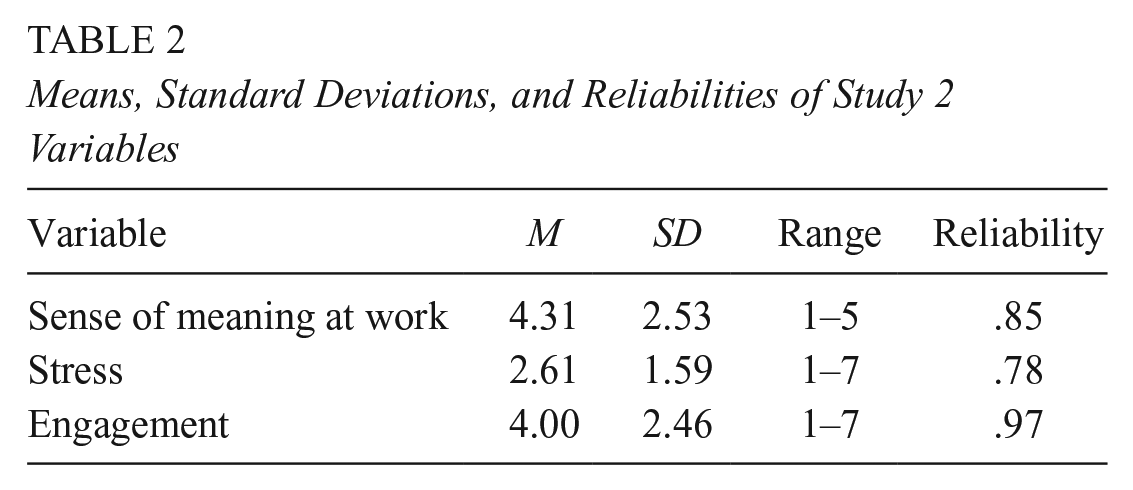
Means and standard deviations of the study variables are presented in Table 2. Due to the multilevel nature of the data, the research hypotheses were examined in a set of hierarchical linear modeling (HLM) analyses, similar to those used in other daily diary studies (e.g., Lavy et al., 2013; Sonnentag & Starzyk, 2015). The analysis was conducted using the Glimmix procedure in SAS version 9.4. The assumptions for HLM were examined graphically (using this procedure)- and were met (the residuals’ distribution was normal). The daily responses (Level 1) were nested within participants (Level 2). In the analyses, Level 1 data comprised a dependent variable (daily engagement or stress) assessed on a specific day, predicted by teachers’ daily sense of meaning at work on the previous day while controlling for previous-day values of the dependent variable (daily engagement or stress). Thus, we used a random intercepts model—in which engagement or stress was the dependent variable, and the fixed factors (entered as independent variables) were the previous-day sense of meaning and previous-day engagement/stress. This model enabled taking into account time as a factor affecting both the independent and the dependent variables and predicting the daily fluctuation in the dependent variable from the independent variable level on the previous day (this analysis was shown in previous daily-survey studies—e.g., Lavy et al., 2013; Sonnentag & Starzyk, 2015). The variables were entered into the equation uncentered to maintain scale consistency across the independent and dependent variables. The HLM unstandardized coefficients are presented in Table 3.
Means, Standard Deviations, and Reliabilities of Study 2 Variables
HLM Coefficients Predicting Daily Changes in Teachers’ Engagement and Stress From Previous-Day Sense of Meaning at Work

Note. b = parameter estimates; PD = previous day; Stress = stress and agitation.
p = .056. *p < .05. **p < .01. ***p < .001.
Results of the first analysis indicate that teachers’ sense of meaning at work on a certain day is only marginally associated with daily stress on the following day (p = .056), and, surprisingly, this association is positive: a higher sense of meaning at work on a certain day is marginally associated with increased stress on the following day. Results of the second analysis indicate that teachers’ sense of meaning at work on a specific day is significantly associated with increased work engagement on the following day (Table 3).
Discussion
Study 2 focused on the daily dynamics of teachers’ sense of meaning at work, engagement, and stress. Its results indicate that teachers’ daily sense of meaning at work is associated with increased daily work engagement on the following day, suggesting that a daily sense of meaning at work may contribute to increased engagement. Furthermore, this daily mechanism may underlie the cumulative effect of higher engagement after 2 weeks of daily boosts of a sense of meaning at work (revealed in Study 1), as it links daily fluctuations in teachers’ sense of meaning (also shown in Lavy & Bocker, 2018), with daily fluctuations in their engagement.
Surprisingly, the results also indicate that teachers’ sense of meaning at work on a specific day is also marginally associated with increased stress at work on the following day. This unexpected finding may reflect a methodological limitation indicating that a better daily proxy of burnout is required. However, it may also suggest that acknowledging the potential impact of one’s work on others (and the responsibility it encompasses) can contribute to engagement and daily stress—perhaps due to the related responsibility to others. Nevertheless, Study 1’s findings suggest that daily acknowledgment of one’s efficacy and ability to indeed contribute to others at work may mitigate possible cumulative effects of this stress and prevent burnout (which can develop from chronic experiences of stress). This explanation is also supported by previous research—for example, a study by Pines and Keinan (2005) showed how police officers’ acknowledgment of the importance of their work buffered their burnout, despite experiencing stressors during the Palestinian uprising. Furthermore, other job resources, such as teacher self-efficacy (Cao et al., 2020), may interact with teachers’ sense of meaning at work in enhancing teachers’ ability to deal with stressors without increasing their burnout. Further research on the short- and long-term effects of the sense of meaning may shed more light on these phenomena.
General Discussion
The present research findings suggest that teachers’ sense of meaning at work may decrease their burnout and increase their engagement. The first study showed that intentional daily enhancement of teachers’ sense of meaning at work for 2 weeks resulted in decreased burnout and increased engagement. The second study indicated that daily levels of teachers’ sense of meaning at work were associated with increased engagement on the following day, but they were also marginally associated with increased stress on the following day. Taken together, the results suggest that feeling that one’s work is meaningful may enhance their work engagement—probably due to the acknowledgment of its importance and potential to contribute to others. This acknowledgment may also be somewhat stressful at the daily level, but the possible adverse effects of such stress in the longer term (i.e., burnout) seem to be mitigated by understanding its value.
The effects of meaningful work have been theorized (Cartwright & Holmes, 2006) and supported, to some extent, by cross-sectional studies of employees (Fairlie, 2011) and teachers (Vandenberghe & Huberman, 1999). However, the causal effects of teachers’ sense of meaning on engagement and burnout have yet to be examined in experimental designs (and only in very limited ways in longitudinal designs), thus requiring empirical, quantitative validation. Demonstrating the causal effect of teachers’ sense of meaning at work on burnout and engagement has theoretical and practical value. It supports the notion that employees’ sense of meaning at work can function as a psychological job resource, thus adding to the list of teachers’ job resources suggested in the literature (e.g., Cao et al., 2020). As such a resource, it can benefit teachers and schools, especially when acknowledging the high frequency and severity of teacher burnout (S. M. Johnson et al., 2005; Schaufeli & Buunk, 2003). Thus, revealing teachers’ sense of meaning as a potential antidote for burnout and accelerator of teacher engagement may have critical importance to educators, students, and education institutions, highlighting the importance of acknowledging the positive prosocial impact of teachers and introducing new ways of amplifying their sense of meaning at work. This finding can be relevant to employees in other occupations but is especially crucial for teachers and employees in other human service professions, who are often experiencing job intensification, isolation, and organizational pressure for productivity (Schlichte et al., 2005; van den Berg, 2002). Thus, acknowledgment and development of teachers’ sense of meaning in various contexts (e.g., training, organizational routines, professional development) may benefit both teachers and schools (see also F. A. Korthagen, 2014). Current feedback, training, and development programs for teachers (and employees in other organizations) typically give little or no attention to these issues. The two studies presented here suggest that it may be worth discussing, acknowledging, and boosting employees’ understanding of how they contribute to others in their daily work to motivate and energize them and mitigate exhaustion and burnout.
Research Limitations and Directions for Future Studies
The research conclusions should be considered in light of its limitations as it is based on self-report measures, collected in one country, in samples comprising only participants who agreed to participate voluntarily, during relatively short time intervals (2 weeks). Although the robust results obtained in two different studies within these limitations are compelling, future studies would ideally replicate the findings in other populations, including longer term assessments and examining additional measures (e.g., physiological, behavioral, and supervisor ratings). Furthermore, it would also be beneficial to examine the unique and interactive effects of teachers’ sense of meaning at work with other job resources of teachers (both psychological resources and environmental resources), as some of these may have an interactive effect on coping with teaching demands. For example, the effects of teachers’ sense of meaning may be more substantial for teachers with higher self-efficacy and support. Nevertheless, the two studies support the notion that employees’ sense of meaning at work may be a valuable resource. Furthermore, they suggest that it may be worth pursuing research on psychological and organizational mechanisms that moderate and mediate its effects (such as personality and organizational climate) among employees in various professions and organizations.
Concluding Remarks
The present research findings highlight teachers’ sense of meaning at work as a potential resource that may be intentionally enhanced to yield benefits for teachers and their students. They suggest that the importance of acknowledging teachers’ prosocial impact, and introducing new ways of amplifying their sense of meaning at work, cannot be underestimated, especially in an era of intensification of teaching and teacher isolation, and the accompanying personal and professional challenges for educators and principals (Schlichte et al., 2005; van den Berg, 2002). The potential capacity of teachers and principals (as well as parents, colleagues, and others) to alter teachers’ sense of meaning with simple prompts of meaningful teacher deeds, as brought to light in the present paper, further suggests that teachers themselves may have some control over their sense of meaningfulness at work and can take action in combatting burnout. This awareness may prompt teachers to adopt new habits to enhance their career self-management, including recognizing and appreciating meaningful occurrences and outcomes at work. These notions are important, not only for school teachers, principals, and counselors but also for teacher trainers, who help young teachers create long-lasting habits which will serve them well in their careers. The present research findings will hopefully enhance our understanding of the core role of teachers’ sense of meaning at work in sustaining low teacher burnout for the benefit of teachers and students alike and will spur further research of the effects of teachers’ sense of meaning and the mechanisms underlying these effects.
Footnotes
Author’s Note
The author declares that she has no conflict of interests, and that the research was carried out in accordance with Declaration of Helsinki, and was approved by the Ethics Committee of the Faculty of Education at the University of Haifa, Israel.

Author
SHIRI LAVY is head of the Management of Education Systems program at the University of Haifa. She studies interpersonal relationships, character strengths, and positive education, focusing mainly on teachers’ and principals’ sense of meaning, teacher–student relationships, and development of 21st-century competencies.