




Abstract
Social media, and especially popular youth-focused platforms like TikTok, can offer a valuable window into youth experiences, including their perceptions of online learning. Building on a large-scale thematic analysis of 1,930 TikTok videos posted in March-June 2020, this study examines how young people shared their experiences of online learning during the COVID-19 pandemic. Findings indicate that youth portrayed online coursework as overwhelming and relentless against the traumatic background of the pandemic. They sought support, empathy, and authenticity from teachers, and both received and provided emotional and educational support to peers on the platform. Students’ home contexts emerged as particularly salient, making visible the intersections between young people’s home, school and social lives. By facilitating a grounded, bottom-up understanding of students’ experiences and perceptions—shared in their preferred spaces and modes of expression—this research stresses the need to attend to youth perspectives to craft more equitable and empowering educational futures.
In a short video uploaded to the popular social media application TikTok in March 2020, a teenage girl is sitting in front of a laptop, while her mother is heard in the background shouting at her in Spanish to close the computer and start cleaning. Embarrassed, the girl responds, also in Spanish: “Mom! My classmates can hear you! Mooooom! The teacher . . . The teacher can hear you!” before finally closing the laptop and laying her head over it, exasperated. A text blurb overlaid on the video reads “Online classes in a mexican household be like . . .,” and the description includes the hashtags #onlineschool, #Mexican, #Mexicanhousehold, and #Latina. The video is a humoros one, with the description reading “Haha all jokes!!!,” yet hundreds of comments posted on the video show how deeply the brief clip resonated with other youth: I THOUGHT I WAS THE ONLY ONE WORRYING ABOUT THIS Bro if i’m on the computer for more than an hour she thinks i’m not doing schoolwork and i’m doing something else instead All of us Hispanic kids are scared to take online classes . . . i’m kinda nervous lol
As the example above illustrates, social media—a vital space for youth expression and sociality (boyd, 2014; Way & Malvini Redden, 2017)—can offer a valuable window into youth experiences, attitudes, and perceptions. With the onset of the COVID-19 pandemic in spring 2020, young people all over the world have experienced a jarring transition to online learning. TikTok—an extremely popular platform among youth in the United States (Kemp, 2020) and globally (Iqbal, 2020)—has become even more salient in the lives of young people during the pandemic (Kale, 2020), as youth in lockdown have turned to TikTok to goof off (Easter, 2020; Willingham, 2020), socialize, and share their everyday experiences—including their experiences of online learning 1 (Crellin, 2020; Haasch, 2020).
This study starts from an acknowledgment that creating policy and curricula for online learning must all begin with a deep understanding of how young people are experiencing online learning in their everyday lives—and how this experience varies, as shaped by their social, cultural, and economic contexts. While more research on this topic is surely emergent, so far, academic studies have focused on the experiences of teachers (e.g., Bao, 2020; Ferdig et al., 2020; Johnson et al., 2020; Reich et al., 2020), administrators (e.g., Ferdig et al., 2020; Johnson et al., 2020), or policy makers (e.g., Bozkurt et al., 2020). Similarly, most mainstream media accounts of the lived experience of online learning during COVID-19 have been framed from the perspective of parents (e.g., Harris, 2020; Weiner, 2020) and teachers (e.g., Berwick, 2020; Wolfman-Arent, 2020). Here, I argue for the significance of examining experiences of online learning from the student perspective, as shared by youth themselves in the spaces and formats in which they choose to self-express.
Building on a large-scale qualitative analysis of almost 2,000 TikTok videos on the topic of online learning, this study examines how youth manifested and shared their experiences of online learning during the COVID-19 pandemic on youth-focused social media; in doing so, it pays particular attention to the ways in which contextual factors and educational inequalities are made salient in these artifacts. What emerges is a collective tapestry of youth perspectives around online learning, where some aspects are common to many, and some are particular to specific social identities and personal contexts. This research contributes both to the literature on online learning—more specifically, adding nuance to the emergent understanding of online education in the context of the pandemic—and to the scholarship on youth expression on social media, where it adds insight into young people’s practices of sharing their formal educational experiences in online social spaces. Furthermore, from a practical perspective, this study lays an important foundation for deriving actionable educational implications and recommendations, that are based on a bottom-up, grounded understanding of young people’s experiences, challenges, and concerns.
Theoretical Background
Online Learning in a Pandemic
In the context of the COVID-19 pandemic, the transition to online learning has happened on an unprecedented scale and pace. Across the world, both students and educators have had to adapt quickly, exposing in the process both the opportunities and challenges of this mode of delivery (Bozkurt et al., 2020). Although this article uses the term online learning, it is worth noting that the shift to online education during COVID-19 in the spring of 2020 is more accurately described as “emergency remote education” (see Bozkurt et al., 2020; Hodges et al., 2020); this distinction emphasizes the unplanned nature of such teaching, as well as the lack of adequate preparation time and staff support that generally characterize online-learning courses (Hodges et al., 2020). As instructors had to move courses online in a matter of days, without adequate time or support for curricular redesign (Hartshorne et al., 2020; Hodges et al., 2020), and against a backdrop of extreme trauma and uncertainty (Bozkurt et al., 2020; Miller, 2020; Morgan, 2020), the transition to online learning in Spring 2020 was fraught with challenges (Hartshorne et al., 2020, p. 138). Based on interviews with teachers across contexts, Reich et al. (2020) found that educators struggled with fostering student motivation online, a perceived loss of professional efficacy and burnout, and a deeply felt acknowledgment that the pandemic reified inequalities in student lives.
The challenges on the side of both instructors (and, more largely, schools) as well as students foreground the political—and politicized—aspects of education during COVID-19. As “public education has been forcibly decentralized into students’ own homes, largely disaggregated from the institutions and practices of education and instead repositioned as a form of homeschooling mediated by technology tools, edu-businesses and other institutions,” the COVID-19 pandemic has exacerbated and expanded challenges related to the political economy of education and consequences thereof (Williamson et al., 2020, pp. 108–109). Furthermore, in the United States, the shift to online learning has placed additional demands on school systems already straining from the economic fallout of COVID-19, highlighting the critical need for funding (Reber & Gordon, 2020). However, federal funding has been stalled and politicized along partisan lines, thus failing to materialize into a much-needed lifeline for schools and students alike. Research has repeatedly shown that the level of funding affects student outcomes, particularly for vulnerable or disadvantaged students (Reber & Gordon, 2020)—and this effect is likely magnified in an extreme context like the current pandemic.
Indeed, the COVID-19 crisis has brought into relief deep-set educational inequalities that are being reified with the move to online learning (Bozkurt et al., 2020; Galperin et al., 2020; Zhong, 2020). These inequalities are not just about hardware or connectivity (although these are crucial as well; see Galperin et al., 2020), but also digital literacy and the self-directed learning skills needed in order to successfully participate in online learning (Adam, 2020). Moreover, as the locus of schooling moves into the home, other increasingly salient factors include the time, digital literacy, and socioemotional support available on the side of parents (Bozkurt et al., 2020; Huffman, 2020; North, 2020; Reich & Ito, 2017), as well as the physical space and quiet environment needed for students to focus on schoolwork at home. These often pose a particular challenge for low-income families, families of color, and immigrant families (North, 2020).
Social Media as a Window Into Youth Experiences
A substantial body of research across multiple fields has investigated the significance of social media in both shaping and reflecting youth behaviors, experiences, and attitudes (see Way & Malvini Redden, 2017, for a meta-review). On the more positive side, social media platforms provide “affinity spaces” (Gee, 2004; Ito et al., 2019) for diverse participants, functioning as a “digital neighborhood” for youth online (Stevens et al., 2016). By affording collective expression for youth (Literat & Kligler-Vilenchik, 2019), social media fulfills significant needs related to belonging, identity experimentation, self-expression, social connection, and political socialization (see, e.g., boyd, 2014; Ito et al., 2009; Literat & Kligler-Vilenchik, 2019; Wargo, 2017). However, on the flip side, social media also brings up particular risks and challenges for youth, including privacy issues (Hodkinson, 2017; Marwick & boyd, 2014), potentially adverse effects on self-esteem and individuality (Michikyan & Subrahmanyam, 2012; Way & Malvini Redden, 2017), and informational challenges (Vaidhyanathan, 2018). What is more, as a growing body of research has documented, social media often runs the risk of reproducing broader power dynamics (Selwyn, 2014) and patterns of marginalization, including along racial, gender, and/or socioeconomic lines (e.g., boyd, 2014; Hargittai & Hinnant, 2008; Literat & Brough, 2019; Nemer, 2016).
In view of its prominence in youth lives, and its role in both shaping and materializing young people’s interests and perceptions, social media also represents an important methodological resource. While traditional research methods, such as interviews or focus groups, are important for eliciting youth insights, they run the risk of creating an artificial environment in which young participants seek to impress or satisfy the researcher (Buckingham, 2000; Paulhus, 1991). Furthermore, this risk is all the more salient when the topic of inquiry is one imbued with normative expectations (Buckingham, 2000), like formal education. Conversely, social media content represents aspects that youth themselves find salient and want to share, rather than observations shared about them by adult stakeholders, or prompted from them by researchers in a nonnaturalistic setting. At the same time, young people’s self-expression on social media must be understood through the lens of lifestreaming (Marwick, 2013; Wargo, 2017), as a rhetorical act that helps curate specific positions and identities, which might or might not be in line with one’s real self and experiences (Wargo, 2017). Thus, social media content might not always provide a clear view of youth’s authentic identities and practices—though it often does—but helps illuminate how young people choose to portray and share their lives online.
Despite the wealth of research using social media as a window into youth attitudes, behaviors, and perceptions, few studies (e.g., Hayman et al., 2019; Smith, 2016) have explicitly addressed youth depictions of educational experiences in these spaces—and none have done so in the specific context of online learning. Considering social media as a grassroots window into young people’s educational lives—or their deliberate portrayals thereof—thus complements the important work that has been done to center youth perspectives on both formal and informal learning (especially in the Digital Media and Learning research community: e.g., Ito et al., 2009; Jenkins et al., 2016; Watkins, 2018).
Among its unexpected implications, the COVID-19 pandemic offers a unique opportunity to study online learning, in the context of the unprecedented intersection between youth’s formal learning contexts and their informal social, familial, and technological lives. While online learning per se represents a complex blurring of boundaries between home and school (Williamson et al., 2020), it is particularly fitting to examine its framing on the social media platforms that were so central for young people’s socialization during COVID-19 (Kale, 2020). Based on a large-scale qualitative analysis of publicly posted videos about online learning shared by students on the popular video-sharing platform TikTok, this study asks, How are youth portraying their experiencing online learning during the COVID-19 pandemic, as manifested and shared on youth-focused social media? And, how are contextual factors and educational inequalities made salient in these videos?
Method
Research Site
The site for this study is TikTok, a popular social media app that allows users to create and share short looping videos. Videos are usually recorded over soundtracks chosen from a vast library of licensed music and audio clips, though creators can record original sound too. When a user opens the app, they are directed to their “For You” page, a personalized homepage that is the beating heart of the app. Beyond the #ForYou page, users can also watch content from accounts they follow or search for specific videos via soundtrack, username, keyword, or hashtag. Users are encouraged to participate in challenges (hashtag-based trends where users attempt to do the same thing, like a viral dance, a prank, or a physical challenge) or connect via duets (by remixing or building on each other’s videos). While the app features a wide variety of content, the most popular videos on the platform consist of lipsynchs, dances, and comedy skits, often around trending challenges.
With over 800 million monthly users, TikTok has experienced a meteoric rise, becoming the most downloaded app of 2020; in the United States, it has seen a 375% year-on-year growth (Sehl, 2020). The app is particularly popular with youth—13- to 24-year-olds represent 69% of the TikTok’s user base (Sehl, 2020)—and plays a significant role in young people’s social and cultural lives, both reflecting and shaping youth culture (Kale, 2020; Sehl, 2020; Willingham, 2020). In 2020, TikTok found itself at the center of political controversy, with Donald Trump seeking to ban it due to its Chinese ownership; while this move shined a further media spotlight on the app, the ban has not materialized.
Data Collection
To create the data corpus, I relied on the hashtag as a methodological tool for data selection—a practice common in online research (see, e.g., Jackson & Foucault-Welles, 2015), which allows for the selection of an intentional corpus (i.e., here, young people who wanted to share their experience with others via the deliberate use of hashtags for collective expression; Literat & Kligler-Vilenchik, 2019). To do so, I first identified the top TikTok hashtags related to online learning on the platform. These were as follows: #onlineclass (4.5 billion views 2 ), #onlineschool (520.5 million views), #onlineclasses (149.8 million views), and #onlinelearning (37.5 million views). As evidenced by these numbers, the hashtags all generated extremely high levels of engagement, confirming that the topic is indeed very popular on the platform (see also Crellin, 2020; Haasch, 2020).
While #onlineclass was the largest hashtag—likely because it was promoted by TikTok as a featured hashtag 3 —#onlineschool, the second largest hashtag, was selected as the focus of this analysis, for several reasons. First, it is a bounded data set of a large but feasible size. This is important since TikTok constraints the ability to filter or sort videos, so analyzing an entire hashtag corpus allows for full inclusion, without the need for sampling. Second, based on a preliminary analysis of all hashtags, #onlineschool featured a wider age range, in comparison to the other hashtags that seemed more focused on the higher education context. Third, the largest hashtag, #onlineclass, included more wave riding (i.e., tagging unrelated videos with popular hashtags to gain visibility; see Christensen, 2013), which may deter organic youth voice. And fourth, #onlineschool is a grassroots hashtag rather than one promoted by TikTok, thus enabling an analysis of unprompted youth participation.
Using #onlineschool to constitute the data corpus resulted in 1,930 publicly available videos 4 , all posted between March and June 2020. Since TikTok’s terms of use prohibit automated scraping, videos were analyzed within the app, taking detailed notes on video content (including contextual information like video descriptions, emojis, and hashtags), comments, and metadata (e.g., user information, date of posting, number of likes, and comments), while making use of screenshots and screen recordings to capture salient examples. Comments were treated as a complementary tool in addition to the main focus on videos. Due to the sheer volume of comments—to give a sense of this volume, the top 100 videos alone had a total of 239,590 comments—it was not feasible to analyze all comments qualitatively; rather, comments were read on salient videos, in an effort to understand how other users’ perspectives confirmed, challenged, and generally nuanced the video content.
In view of the nature of the platform and methods used, the specific ages of users represented in this study cannot be ascertained, but based on the age demographics of TikTok (Sehl, 2020) and the nature of the #onlineschool hashtag, it can be inferred that the vast majority of users are school- or college-aged youth. The age of the posters also matters from a research ethics perspective. Although all artifacts included in this study are shared publicly, I assume many of the users posting them are minors; additionally, although all data included in the study is public, I am deeply conscious of the fluidity of public–private distinctions in the online realm (franzke et al., 2020). Therefore, following recommendations on internet research (franzke et al., 2020) and, in particular, internet research with youth (Livingstone & Third, 2017), I took further precautions to protect participant privacy by replacing usernames with pseudonyms, avoiding the inclusion of any personally identifiable information, and only using screenshots where user faces are obscured or blurred. The study received institutional review board approval.
Data Analysis
Data were analyzed qualitatively, using a thematic analysis approach (Braun & Clarke, 2006), which is particularly suitable for inquiries into people’s experiences, views, and perceptions, as well as for illuminating processes of representation and meaning construction. The analytical process was driven by the goal of “identifying, analyzing and reporting patterns” in the data and describing the dataset in rich, nuanced detail (Braun & Clarke, 2006, p. 79).
Data analysis was approached inductively, where coding and theme development are determined by the content of the data (Braun & Clarke, 2006). After familiarizing myself with the corpus as a whole, in a first round of analysis I examined artifacts individually, taking notes on salient aspects in relation to the two research questions—as evidenced in video content, comments, and metadata—and marking them with simple codes (e.g., “too much homework,” “concerns about grades,” “ADHD,” “peer-to-peer support,” “hardware challenges”). In doing so, I also captured key quotes and used screenshotting and video capture to illustrate these codes. Next, examining the codes and considering the corpus collectively, I began to identify broader patterns of meaning related to youth portrayals of online learning on TikTok; in doing so, I considered not only how the data supported the dominant “story” of each theme but also how it might complicate it or depart from it in meaningful ways (Braun & Clarke, 2006).
Finally, I refined these potential themes by considering the relationships between them, splitting and combining them to ultimately coalesce these patterns into three key themes: the portrayal of online learning as overwhelming and demotivating; the desire for support and empathy, perceived as lacking from teachers but present among peers; and the newfound visibility of the home, in terms of both family dynamics and socioeconomic contexts. I present these three themes below, illustrated by relevant examples.
Findings
“Is This What Stress Feels Like?”: Online Learning as Overwhelming and Demotivating
A Perceived Increase in Workload
A core pattern across videos and comments was youths’ perception of online learning during Spring 2020 as overwhelming (i.e., too much content assigned—more so than in regular school) and relentless (i.e., requiring round-the-clock attention and long hours of work). A video posted by @owenmakes 5 and captioned “Is this what stress feels like?” spoke evocatively to this perception. “It’s midnight and I’m still doing school work,” the clip began. Interspersed with images of his home, his pet Corgi, and screenshots of a Google Calendar full of school assignments, the minute-long clip showed @owenmakes repeatedly trying and failing to do his French homework online, as the Duolingo assignment kept rejecting the pronunciation that he was recording.
In a confessional-style video, high schooler @muddyheaps complained that teachers “act like we’re some robots who’re gonna sit at the computer and do work all day. . . . This is an overwhelming amount of work.” The video resonated with the community. In comments, TikTokers echoed his feelings: I have more work online than I have in school. And every teacher gives assignments that take at least 5 hours each because they forget that they’re not my only teacher. I have 7 to deal with (@kamya) I did more work in the last 3 days than we did in class last month (@pb_and_j) one of my teachers literally said “don’t think this means you get a break, if anything your gonna get more work than usual” as if it’s our fault (@May) I get like 5 times more work now because “you have all day to do it now” (@pooh) in my district the state has said that a teacher is to assign an assignment a week and some of them are doing one a day (@nori)
Videos depicted students feeling overwhelmed by pop-up notifications from the many different platforms used for online learning, like Canvas, Zoom, or Google Classroom. Illustrating this perception, videos showed footage of students’ phones pinging with notification after notification (Figure 1, left) or screenshots of these notifications overlaid onto footage of their daily lives (Figure 1, right).

Videos show students overwhelmed by notifications about online courses.
Lack of Motivation
Related to this perception of online school as overwhelming, and likely rooted in other factors as well (the traumatic background of the pandemic, the jarring shift to online instruction, the perceived lack of support and authentic connection with teachers), a shared feeling expressed by youth on the platform was the lack of motivation to do online schoolwork (@conanisold: “It’s gotten to the point where i dont even have the motivation to COPY homework anymore!”). Illustrating this perception, a popular soundtrack within the #onlineschool corpus was a recording of a girl’s voice, that shows her getting progressively discouraged with doing online coursework: “[chipper tone:] it’s time to do my homework, it’s time to be productive! [panicked:] what the fuck is this! we didn’t learn this shit! [despondent:] my grades are gonna be sliiiiiiipping!” A testament to the connective, expressive power of soundtracks on TikTok, there were more than 37k videos using this same soundtrack (though only some were specifically tagged #onlineschool), acted out by students sitting at their respective computers.
The perceived increase in workload, coupled with students’ lack of motivation, often translated into an inability to complete assignments. An entire “genre” of videos within the #onlineschool corpus simply showed screenshots of missing assignments on Canvas or Google Classroom. One popular example (with almost half a million likes and 11k comments) was a video posted by @naala, where she just scrolls through dozens of precalculus assignments marked missing on Google Classroom (Figure 2). The video was captioned “help me please” and included the hashtags #failing #dumb #missingwork #quarantine #onlineschool. In comments, TikTokers shared how much the video resonated (@Lila: “This video is comforting knowing that I’m not the only one in the same situation. Thank you”; @AddisonKiel: “I ZOOMED straight to the comments to find comfort”) and even suggested helping her out by splitting up the work (@isabelvargas: “IF WE ALL PITCH IN AND DO  ASSIGNMENT FOR YOU WE CAN HELP U
  ”)
6
. Concern about the impact of diminished performance and motivation on students’ grades was ubiquitous, and several videos—either acted out or filmed clandestinely—showed TikTokers getting berated by parents due to their plummeting grades, or depicted their parents being phoned by teachers to talk about their children’s poor performance at school.
”)
6
. Concern about the impact of diminished performance and motivation on students’ grades was ubiquitous, and several videos—either acted out or filmed clandestinely—showed TikTokers getting berated by parents due to their plummeting grades, or depicted their parents being phoned by teachers to talk about their children’s poor performance at school.

A screenshot from @naala’s video, which scrolls through 24 missing assignments in her precalculus online classroom
Mental Health Challenges
Against the traumatic background of the COVID-19 pandemic, online learning was portrayed as taking a toll on students’ mental health. TikTokers talked about crying during online class, feeling isolated and scared. They shared how COVID-19 cases in their families and communities were affecting their academic performance: Some of us have sick people to take care of. . . . Straight As and then a global pandemic hits, family members are sick and they add 4x the assignments (@artisart) I’m having a anxiety attack because i’m scared i’m going to fail (@AzaleaEtienne) I have about 10x more work now and I have to do it all while my depression that I had under control until this returns (@Libby)
Students with learning disabilities found online learning particularly challenging, due to ADHD “prevent[ing them] from being good at time management” and sticking to a schedule. Furthermore, as @naomi wrote, “adhd makes it really hard to perceive long term consequences and it’s taking a major toll on me even tho i’m medicated.” Many videos tagged #adhd and #mentalhealth (in addition to #onlineschool) aimed to check in on fellow students in this situation, or to seek solidarity and support; captions read “please tell me i’m not the only one in this situation (@ameliabeller) and “ADHD gang is not doing okay” (@AmphibeeAssembly).
“No One Cares Abt Their Students’ Mental Health”: Seeking and Providing Support
Seeking Support From Teachers
Given the challenges mentioned in the previous theme, youth expressed a strong desire for teachers to demonstrate care and empathy. A popular video by @lollllsam used comedy to make a point about online class check-ins lacking heart and authenticity. In her skit, where @lollllsam used different props and costumes to play all characters, a teacher was shown greeting each student at the start of class with criticisms, threats of disciplinary action, and perfunctory acts of concern, instead of authentic support. In comments, fellow TikTokers expressed how relatable they found the video (“Its funny cuz my teachers literally were like ‘hi, yall doing good? Ok bye’”). As a counterexample, @ruthaudrey25’s video consisted of a compilation of footage recorded during her online courses, showing her being greeted in a warm, friendly way by her teacher at the start of every class, and greeting him back. Comments on this video marveled at “how nice [the teacher] sounds” and how they wished their teachers were similar, highlighting the desire for authentic care amid an emotionally challenging time.
Significantly, youth perceived a mismatch between teachers’ rhetoric, claiming to be empathetic and understanding, and their practice of assigning overwhelming amounts of work—more so than in regular school. For instance, @sam.jake’s video—which made this point via a dance performance, with the overlaid text “teachers saying ‘i know this is a stressful time even though THEY are the stress” (Figure 3)—struck a chord with the TikTok community, gaining 593.5k likes and 5885 comments. In comments, TikTokers noted that, due to this contradiction, teachers’ care did not appear genuine: Teachers: “i know this is a stressful time” also teachers: *proceed to assign twice the amount of work we had when we were actually going to school* (@45htk) Our teachers gave us heaps of work and now they’re starting a course called “wellbeing” which entails more work to “improve our mental health” (@CourtneyMarie)
Some comments specifically mentioned teachers’ perceived lack of empathy regarding the traumatic effect of COVID-19 in students’ personal lives: Teachers don’t know that some of us have parents who are in the hospital who have the corona and we cry everyday about it & it shows (@Brianna) @Dover8, in reply: worksheet due at 11:59 please My art teacher literally emails us that we need to do the work and when someone in our class’s family member died w corona he was like idk if i believe u and even if it’s true she still needed to turn everything “on time.” no one cares abt their students’ mental health (@sophia)

@sam.jake’s video, about the discrepancy between teachers’ rhetoric and reality
Peer-to-Peer Support
In contrast to the perceived lack of support and empathy from their teachers, and perhaps as a way to balance it out, students both sought and provided support to peers on the platform. Indeed, this sense of peer support was a running thread throughout the videos and comments and can be identified in previous examples too, such as the comments about providing comfort and mutual help on @naala’s video about missing assignments, or the mental health check-ins on videos tagged #ADHD.
Another, more explicit, way in which students on the platform tried to lend support to one another was to share tips and tricks for online learning. This vast category of videos included software or hardware “hacks,” advice for studying, and, respectively, cheating strategies. In the first type of video, “hacks” for online learning were shared as a way to save time and increase efficiency in engaging with content, given the perception of the online workload as overwhelming. For instance, a top video in the corpus (with 1.6 million likes and 5,445 comments) was @katieemerson45’s tutorial of how to use YouTube’s automated transcript function in order to search for and jump to relevant sections in assigned videos. Other videos in the tips and tricks category consisted of advice about integrating online learning into one’s daily life (e.g., sit at a desk, not on your bed; don’t have your phone nearby, because it’s too tempting; break down big tasks into smaller ones to keep procrastination at bay). And, finally, another strain of videos involved strategies for cheating. These included, for instance, how to find the answers within Google Forms quizzes by revealing the page’s source code, or how to tape notes to your screen during online proctored exams (Figure 4). These cheating strategies were often framed, in both videos and comments, as necessary in order to deal with the amount of assigned work—and must also be understood within the larger emotional and motivational impact of COVID-19 in student lives.

Videos depicting strategies for cheating in online classes.
A particularly interesting trend that illustrates mutual support within the #onlineschool corpus is that of peer-to-peer education. Some of the most popular videos in the corpus were purely didactic videos, where teens explain difficult concepts—mostly from STEM fields—to their peers, often using examples from youth popular culture to make abstract concepts more relatable and appealing. For instance, @romulus used the example of Gen Z versus boomer memes, and the likelihood that each generation would find memes funny, to explain probability (Figure 5). @Anthony_Diaz created more than 30 Google Classrooms on different high school subjects and posted a video where he invited his fellow TikTokers to join. In the caption for the video, he also asked the community for special requests and promised to go over any topic they requested. These peer-to-peer educational videos can be seen as an attempt to provide mutual support via the provision of content, when school-provided content is seen as inadequate, challenging, or unengaging. Interestingly, such videos arguably also take some of the pressure away from parents—who are generally thought to be responsible for filling in gaps and supporting students in engaging with school content—and enlist students’ own social media peers as part of academic support systems.

@romulus’s explanation of probability using Gen Z and Boomer memes.
“Online Classes in a Mexican Household Be Like . . .”: Intersections Between Students’ Home and School Lives
Making Family Life Visible
As illustrated by the video mentioned in the introduction (“Online classes in a Mexican household be like . . .”), many videos depicted, either as real footage or as reenactments, the interruptions from family members that students have to deal with while participating in online classes. With very few exceptions, these were overwhelmingly posted by minority students, and usually labeled, in captions and/or hashtags, as characteristic to that particular ethnic or immigrant context. Reflecting structural inequalities and the intersectionality of ethnicity and class, the majority of videos in this genre referred to Hispanic households, but some also depicted Indian, Filipino, and Chinese immigrant households. @samuelcovaria’s video explicitly addressed this element, by comparing “white people taking online school” (showing him smiling peacefully at his computer, over a soundtrack of relaxing music) versus “Hispanics taking online school” (trying to silence his mother, who is yelling in Spanish, out of frame).
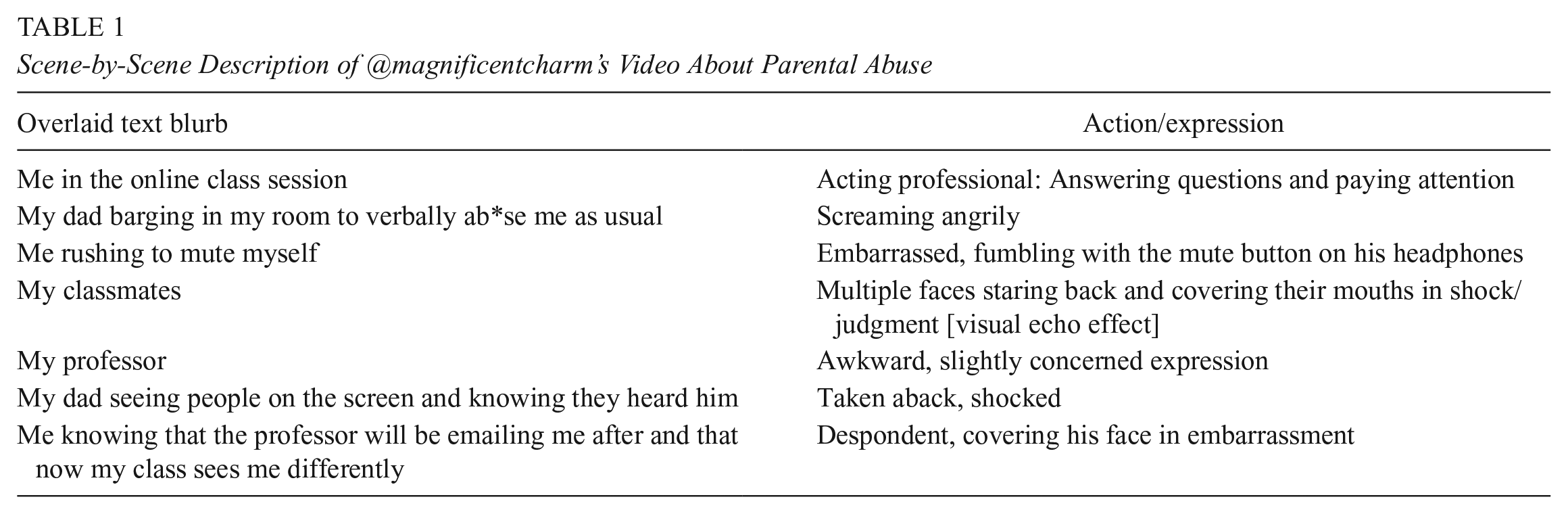
Usually videos about students’ home lives were made and shared in good fun, characterized by self-deprecating humor (though often relying on stereotypes), in line with the playful ethos of the platform. Sometimes, however, they depicted uncomfortable situations and tackled heavier subjects. In a particularly poignant, example, @magnificentcharm’s video addressed his fears that his online classmates and teacher would get a glimpse into his abusive household. The video consisted of a series of scenes, with text blurbs overlaid on different reactions played out by @magnificentcharm (see Table 1 and Figure 6). The video struck a chord with the community, garnering 8,050 likes and featuring comments like “god that hit a little too close to home” (@romeok), and “ooof and that’s a mandated reporter right there . . .” (@ItsAddison).
Scene-by-Scene Description of @magnificentcharm’s Video About Parental Abuse

A screenshot from @magnificentcharm’s video. A scene where his face is not visible was selected for privacy considerations.
Making Socioeconomic Contexts Visible
Another way in which home lives were made salient is via the socioeconomic or material contexts that shape some students’ online learning experiences. Several students complained, in videos and comments, about hardware limitations and the effects these were having on their academic performance: I used to get A’s all the time but now I gotta do everything on my phone cuz I don’t have a computer My sister (a senior) and I (college) have to share one laptop and collectively we have a total of 10 classes 6 of which are mine  (@K4456f6)
 (@Mochacchino)
Institutional solutions such as loaner laptops from school sometimes, but not always, alleviated these issues: Instead of giving me the laptop I used when I was in school, they give me a random one that doesn’t charge, missing buttons, slow, and overheats (@RayofSunshine)
Others complained about the financial difficulty of having to buy their own materials for experiments, or shared stories about the electricity (and consequently, wifi) turning off 10 minutes before a final exam was due, because of an unpaid electricity bill.
In general, students seemed highly aware of the ways in which their—and others’—home environment reflects certain socioeconomic conditions, as captured in theirs and others’ TikTok videos. For instance, a video by @camm discussed, perhaps jokingly, how a white refrigerator seen in the backdrop of a teacher’s Zoom video call was a sign of poverty. In the comments, some agreed, while others took offense: my poor self and my white refrigerator watching this like my house is worth 2mil and i still have a white fridge i thought all fridges were white . . . All of the people pressed [i.e. offended] are the ones that have white refrigerators. (@bilal) (@paromita)
 my lower class self is shaking rn [right now] (@BlackLivesMattergrace)
 (@Elizabeth)
Conversely, but also playing into this socioeconomic awareness, an entire genre of videos tagged—in addition to #onlineschool—with hashtags like #aesthetics, #routine, #vsco, 7 or #vscolifestyle, painted a very different picture (Figure 7). Posted by female Tiktokers, these videos—usually enhanced with TikTok’s Bling effect, a sparkly visual filter—depicted clean, bright study spaces in shades of white, pink, and rose gold, and prominently featured expensive brands such as Apple products and high-end makeup or clothing brands. In both content and style, these videos idealized the experience of online learning, focusing on the aesthetic of the home environment as both a status symbol and a private oasis; these videos represent the more aspirational and deliberate aspects of self-presentation on social media, which themselves are deeply tied to socioeconomic mobility (Abidin, 2018; Literat & Brough, 2019).

Examples of study spaces in videos tagged #onlineschool #aesthetic.
Discussion
This study facilitates a nuanced understanding of young people’s portrayals of online schooling during the pandemic, in youth’s own language and preferred mode of expression. While much of the content analyzed is humoristic, silly, or stylized—as per the ethos and norms of the platform itself (Easter, 2020; Literat & Kligler-Vilenchik, 2019; Rettberg, 2017)—it is an important window into young people’s emotions, voices, and perceptions (boyd, 2014; Weinstein, 2018), and their attempts to make meaning out of the present situation.
Youth’s Portrayals of Online Learning During COVID-19
In relation to the first research question, about the ways in which youth manifest and share their experiences of online learning on social media, the large-scale analysis of videos and comments indicated that, with few exceptions, the predominant sentiment toward online learning was negative. Online learning was perceived as overwhelming, both in terms of the assigned workload and the motivational and emotional/psychological challenges that further hindered youth’s productive engagement with online courses. Furthermore, the findings also show that, amid the real challenges that they are facing, students did not feel adequately cared for/about, as individuals beyond the academic sphere. To make up for this perceived lack of emotional support from teachers, there was a strong ethos of providing practical and emotional support among youth going through the collective experience of online learning in a pandemic; this latter finding confirms the significant role of social media as a helpful resource in students’ educational lives (Hayman et al., 2019; Smith, 2016).
However, it is important to understand these findings within the larger context of youth social media expression in general. First of all, the content shared by young people on social media needs to be understood through the lens of lifestreaming (Marwick, 2013; Wargo, 2017), as carefully curated “connective identity texts” (Wargo, 2017). As Marwick (2013) writes, lifestreaming creates a type of fun house mirror, casting certain aspects of life into sharp relief but obscuring others. . . . The lifestream is not a direct reflection of a person, but a strategic, edited simulacrum, one specifically configured to be viewed by an audience. (p. 211)
In this sense, the perceptions and experiences of online learning shared by youth on TikTok need to be understood as deliberately curated to create particular impressions, in line with the digital selves that young people want to project on the platform; they may be closer or farther from lived experience, or may be a chosen aspect or portion thereof. Second, while some platforms (especially lifestyle-oriented spaces like Instagram; see Hu et al., 2014) may present more idyllic aspects of youth life (Weinstein, 2018), social media fulfills an important role as a space for venting in the lives of youth (Vermeulen et al., 2018)—and “school” is an area that young people often vent about. In this sense, the challenges expressed by students in these spaces should be taken with a grain of salt, especially when it comes to a normative topic such as formal education: after all, youth are more likely to complain about formal education than extoll its merits, including on social media.
At the same time, while there is regular complaining about school on the platform, there are also expressions of real challenges and even cries for help, which need to be taken seriously. Furthermore, the sheer volume of videos voicing similar complaints, and the perceived relatability of these complaints to fellow posters and commenters, indicate that these issues were indeed meaningful and highly salient in youth lives. It is also interesting to note that the key challenges surfaced here from the student perspective (e.g., lack of motivation, trauma, a desire for authentic and supportive online relationships, equity considerations) echo the themes that emerged in Reich et al.’s (2020) analysis of teachers’ lived experiences during the pandemic, pointing to a convergence between students’ and teachers’ concerns and experiences of online learning during this time—although, based on the present data, it does not seem that students perceive this convergence.
Merging Domains and Making Home Contexts Visible
The second research question driving this study addressed the contextual factors made salient in students’ portrayals of online learning during COVID-19. Due to its large-scale methodological approach, this study was able to provide a window into diverse student identities, perspectives, and home-learning contexts; at the same time, a common thread that ran throughout the videos was students’ astute awareness of how their home contexts would be perceived by classmates and teachers.
While in regular times, youth prefer to keep domains like home and school/social life separate (boyd, 2014), online learning during the pandemic unavoidably merged these domains. As Williamson et al. (2020, p. 111) write, the COVID-19 pandemic “requires us to hold the mirror up to what happens when classroom space-time travels in the other direction, into the home environment, introducing the poly-synchronous world of learning in the digital age into the rhythms of family life.” The material, technological and socioemotional contexts of home, which might have previously been hidden from view in relation to students’ social and educational lives, now become visible—sometimes, quite literally, via technologies like Zoom. Videos in the #onlineschool corpus, both individually and as a collective corpus, were testament to these intersections. Of course, as mentioned earlier, these artifacts need to be understood as curated and deliberately crafted portrayals, often imbued with humor, that may not represent a full view of students’ authentic experiences—though some, like the examples about parental abuse, seemed quite raw and struck an honest chord with the community. At the same time, what these videos collectively illustrate is students’ (and peers’) keen awareness of the newfound visibility of the home context and how this would be perceived.
Implications and Recommendations
While these findings paint the current zeitgeist of online learning in the context of quarantine and the COVID-19 pandemic, they also speak to the future of learning. Based on this bottom-up understanding of young people’s perceptions, challenges, and concerns, one can derive implications and recommendations for more equitable and empowering educational opportunities looking ahead.
Reading across the data, from a macro perspective, what emerges is a feeling of powerlessness among students during this traumatic time. In both what they say and how they say it, there is a sense of being talked about and decided for, as students feel that so much of their life is now in others’—federal, state and local governments’, teachers’, parents’—hands. And, although this did not appear directly in the data, one must also consider to what extent students also perceive and are affected by the lack of federal support, which can be seen as yet another reminder that their needs are not understood or prioritized. A key takeaway is the need to reassure students that their voices matter, that their struggles are seen and heard, and that they are supported. A first step is to listen to students and get their input in meaningful ways, whether in the context of individual classes or at a wider school or district level, for example, by creating student focus groups to inform decision-making, or consulting with student councils or organizations. Indeed, this should be evident: We cannot design online learning for young people without deeply listening to how they experience it, and how it plays out in the context of their everyday lives.
Related to the above, it is also clear that, during the pandemic but also beyond it, students long for support and care from teachers, as well as from educational institutions and decision-makers more largely. There is a need to take into account the larger context of online learning, in terms of students’ emotional and mental bandwidth, potential trauma and loss (Miller, 2020), as well as the various challenges related to students’ home environments, as surfaced here. This necessitates the adoption of a pedagogy of care, which prioritizes student well-being and “recognize[s] and address[es] the diversity of students’ experiences and vulnerabilities” (Bozkurt et al., 2020, p. 4; see also Reich et al., 2020). Research has found that online-learning environments can adequately—and, often, quite richly and productively—support the implementation of pedagogies of care; this requires teachers to care for non-academic aspects of student life and “see” the whole student (Velasquez et al., 2013).
In practice, this also translates to a commitment to flexibility and to making reasonable adjustments, which may assuage some of the concerns and stresses mentioned by students here. While some schools relaxed certain curricular requirements and policies in the face of COVID-19 (e.g., by making some assignments optional, delaying tests, or moving to a pass/fail grading system), such policies have not been uniformly implemented (Johnson et al., 2020). Furthermore, the prominence of discussions about cheating in this data corpus also brings up the need to reconsider assessment strategies in online learning, focusing on ways to more productively surface relevant skills and make use of the affordances of the digital environment (see Barber et al., 2015). As Barber et al. illustrate, online learning necessitates not only different modes of teaching but also different modes of assessment—ideally, ones that bring into light student experiences and voices in ways that are both equitable (thinking, for instance, of the experiences students with learning disabilities, as surfaced in these findings) and empowering.
Limitations and Future Research
This study also presents a few limitations that need to be acknowledged. As mentioned earlier, it is important to keep in mind that these are young people’s carefully crafted and curated portrayals of online learning, presented for an audience of peers on social media. Therefore, they cannot necessarily be considered a full and veracious account of the collective lived experience of online learning during COVID-19. Furthermore, this research only includes users who are active on TikTok and have posted publicly using this particular hashtag on the platform; while the sample size is large, it undoubtedly excludes many salient viewpoints, including from youth who are not active on social media or who are perhaps limited in digital capacities, in line with the participation gap (Jenkins et al., 2016) that the pandemic has foregrounded.
Then, in terms of temporal context, the present study represents only a snapshot of perceptions and experiences captured at an incredibly stressful time (Hodges et al., 2020). Therefore, the findings of this study should be considered with this larger context in mind. As Hodges et al. (2020, n.p.) aptly note, the stakes of making broad assessments about online learning based on the happenings of spring 2020 are high: Online learning carries a stigma of being lower quality than face-to-face learning, despite research showing otherwise. These hurried moves online by so many institutions at once could seal the perception of online learning as a weak option, when in truth nobody making the transition to online teaching under these circumstances will truly be designing to take full advantage of the affordances and possibilities of the online format.
Students’ largely negative perceptions of online learning in the present study are testament to how quickly such a “stigma” can take root, especially as students did not seem to consider their curricular experiences during COVID-19 through the prism of emergency remote education.
Therefore, while student perceptions should continue to be a core aspect of research going forward, there is a need for more longitudinal research, and studies that investigate these dynamics outside of an emergency context. With these qualifications in mind, the analysis provided here should be seen first and foremost as a call to learn from student experiences and lift student voices in the process. Understanding the diversity and complexity of youth everyday experiences with online learning—and paying attention to contextual factors shaping these experiences—should be a core component in attempts to achieve more empowering and equitable educational futures.
Footnotes

Notes
Author
IOANA LITERAT is an assistant professor in the Communication, Media & Learning Technologies Design program at Teachers College, Columbia University. Her research examines youth online participation, with a particular focus on the intersection of civic and creative practices in online contexts.