



Abstract
Teachers participate in professional learning activities to enhance their pedagogical knowledge and share best practices—and the increasing role of technologies in education, including social media, is shifting how this professional learning occurs. The COVID-19 pandemic provided an opportunity to consider the role of social media for professional learning. Using intensive longitudinal methods, we repeatedly surveyed 14 teachers’ use of social media both before and during the pandemic (N = 386 total responses). We found patterns in social media platforms uptake and their purposes, but teachers’ use of social media was largely idiosyncratic. Also, teachers demonstrated notable shifts in social media use after the pandemic started; multilevel models indicated that teachers were more likely to use social media to connect and share, especially, as well as learn and follow, compared with before the pandemic. Higher levels of COVID-19-related family stress were also associated with more use of social media to find materials.
Teachers participate in professional learning throughout their careers to enhance their knowledge about teaching and to share best practices (Borko et al., 2010; Darling-Hammond et al., 2017; Fischer et al., 2018). Although professional learning is often conceived of in terms of improving teacher practice, it can be understood broadly as “growth in affective, social, cognitive, and identity aspects of teaching” (Trust et al., 2016, p. 16). Ensuring that there are sufficient opportunities to participate in meaningful professional learning has been shown to be a central strategy to promote an effective and responsive education system (Borko et al., 2010; Dede et al., 2008). Although professional learning often takes place in formal contexts organized by schools, districts, and other institutions, teachers have also long engaged in self-directed learning that supports their professional practice (Dede & Eisenkraft, 2016; Kyndt et al., 2016). Jones and Dexter (2014), for example, note that teachers have identified “each mode of professional learning [as] important, useful for different learning situations, and supportive of the other modes” (p. 379). A useful framework for understanding teachers’ learning is thus the professional learning network (PLN), a personalized collection of learning resources, including specific social media platforms and particular spaces within those platforms (see Trust, 2012; Trust et al., 2016).
Over the past decade, researchers have taken particular interest in teachers’ professional use of social media (Greenhow et al., 2020), and how it is incorporated into their PLNs. Social media services provide multiple platforms for teachers to support each other and facilitate the sharing of information quickly, at scale, and across geographic boundaries. Teachers have reported using a wide range of social media platforms (see Greenhow et al., 2020, for a review) for a wide range of purposes (Carpenter & Krutka, 2014, 2015). Like other educational uses of social media, teachers’ use of social media blurs distinctions between formal and informal learning (Greenhow & Lewin, 2016). Although we assume that teachers’ use of social media is self-directed, we also acknowledge that how teachers use social media often oscillates between informal and formal uses (see Greenhow & Lewin, 2016 and Jones & Dexter, 2014 for a discussion of the distinction).
The COVID-19 pandemic has provided an important opportunity to further consider teachers’ use of social media for professional learning. The pandemic created a need for additional professional learning to support the rapid deployment of emergency remote teaching (Hodges et al., 2020), especially considering the greater need for that support in underresourced areas (Aguilar et al., 2020, 2021). Notably, while the pandemic induced many stressors in the lives of most people (Centers for Disease Control and Prevention, 2020; Pfefferbaum & North, 2020), the transition to emergency remote teaching often posed additional stress factors for teachers (Klapproth et al., 2020; Košir et al., 2020; Oducado et al., 2021). From a psychological perspective, stress represents the stage in which an “individual perceives that environmental demands tax or exceed his or her adaptive capacity” (Cohen et al., 2007, p. 1685). For the transition to emergency remote teaching, environmental demands may include the (extensive) use of technologies like videoconferencing or learning management software. More generally, stressors may also relate to fears of contraction of COVID-19 or economic impacts for themselves, their family, and/or larger community (Goldfarb, 2020; Taylor et al., 2020).
Despite the scholarly community’s rapid response to the lack of extensive professional learning opportunities for the transition to emergency remote teaching (e.g., Aguilar, 2020a, 2020b; Greenhow & Chapman, 2020; Hickey et al., 2020; MacMahon et al., 2020), the pandemic disrupted established routines and contexts for professional learning where such resources could be used. Social media, however, has been shown to be useful for “just-in-time” learning during a crisis (e.g., Greenhalgh & Koehler, 2017). Thus, it is unsurprising that many teachers engaged in social media use during the pandemic (e.g., Fütterer et al., 2021; Greenhow et al., 2021; Trust et al., 2020).
In this study, we consider the social media platforms teachers used and the reported purposes for such use prior to and during the pandemic. In so doing, we lend insight into both teachers’ specific COVID-19 experiences and broader questions focused on how teachers make decisions about their social media use. Furthermore, we consider the effect that stress related to COVID-19 might have on teachers’ decisions related to social media.
Research Questions
The COVID-19 pandemic was responsible for a semiuniversal need for teachers’ professional learning. As teachers were not able to turn to in-person professional learning to adapt to new realities, and as school closures constrained impromptu exchanges with colleagues from one’s own school, many teachers turned to online social media in addition to remote professional learning provided by their employers. Hashtag-based Twitter spaces like #RemoteLearning and #RemoteTeaching (Carpenter et al., 2021; Trust et al., 2020) or #Twitterlehrerzimmer (German for “Twitter Teachers’ Lounge”; Fütterer et al., 2021) were also used by many teachers to respond to their immediate need for professional learning. Similarly, Greenhow et al. (2021) have documented how activity in the longstanding #Edchat hashtag has changed in response to the pandemic. These changes included a spike in retweeting activity in March 2020 and a shift in secondary hashtags from those related to general topics (#stem and #sketchnote) to those specifically related to the pandemic (e.g., #remotelearning and #distancelearning).
Our investigation’s primary aim is focused on capturing similar patterns over time and across the social media platforms making up teachers’ PLNs. Specifically, we capture which social media platforms teachers used for professional learning and how often they did so over the 2019–2020 academic year. We focus on the period of January 2020 to June 2020, thus encompassing social media use prior to the pandemic and during the deployment of emergency remote teaching measures. Research on education-related social media is rarely attentive to issues of time (Staudt Willet & Carpenter, 2021; Veletsianos et al., 2019), but this attention is particularly important in the context of the abrupt changes associated with the COVID-19 pandemic. We note that pandemic-related questions were added to our project once it became clear that uses of social media might shift because of emergency remote teaching. We operationalize our aims through the following research questions:
Background
Teachers’ use of social media platforms for informal professional learning has been an established phenomenon for over a decade (Greenhow et al., 2020). Online spaces offer opportunities for teachers to learn, share educational resources, and communicate with their peers despite geographic distance (Carpenter & Krutka, 2014, 2015; Dede et al., 2009). Participation in online spaces has become a common activity of many teachers (Macià & García, 2016). For instance, teachers create and use educational digital archives to share educational resources online to support their instruction (Recker et al., 2005; Recker et al., 2007). Some early studies have shown positive effects of teachers’ participation in online spaces on teacher knowledge, teaching practices, and student performance (e.g., Fishman et al., 2014; Frumin et al., 2018); however, it is important to acknowledge that there is little evidence of the direct effects of social media use, or the quality of resources teachers access through social media (Frank & Torphy, 2019; Macià & Garcia, 2016). Furthermore, some studies raise concerns about the quality of resources found on social media (e.g., Hu et al., 2018), the appropriateness of specific teacher practices on social media (Shelton et al., 2020), and conflicts between social media design decisions and educational values (Krutka & Greenhalgh, 2021; Shelton et al., 2021). Nonetheless, it is clear teachers are widely using social media and perceiving value in it (Greenhow et al., 2020). Existing and ongoing research may provide other insight into this practice (Frank & Torphy, 2019).
Teacher Needs and Professional Learning Networks
A common theoretical approach to frame social media–based teacher professional learning is the PLN (Bruguera et al., 2019; Greenhow et al., 2020). Although some define a single online space as a “PLN” (Flanigan, 2011; Trust et al., 2016), this study adopts Trust and Prestridge’s (2021) understanding of PLNs as “uniquely cultivated systems of people, spaces, and tools that assist educators in improving their teaching and learning” (p. 1). In short, a PLN is a way of describing the collection of each instance of “formal, informal, and independent modes of learning” and the ways that they “flow together . . . particularly when supported by technology” (Jones & Dexter, 2014, p. 372; see also Trust et al., 2016, for examples of convergence of these modes). Although we focus specifically on the social media elements of teachers’ PLNs in this study, the specifics of a PLN can extend beyond online spaces and resources. Even within our specific focus, we acknowledge that PLNs are driven by teachers’ individual needs and that teachers may engage in online spaces for many different reasons (Carpenter, Tani, et al., 2020; Rosenberg et al., 2020). For example, teachers may aim to find and/or share professional knowledge and educational resources, or to receive emotional support by colleagues (Carpenter & Krutka, 2014, 2015; Fütterer et al., 2021; Hur & Brush, 2009; Trust et al., 2016; Visser et al., 2014).
As “one size does not fit all” (Liu et al., 2016, p. 439), each teacher determines their own set of social media platforms to add to a sustained PLN (Trust et al., 2016). Teachers vary not only in the different social media platforms composing their PLN but also in how they use each platform. Even on the same social media platform, different spaces may be characterized by different patterns of activity. For example, different Twitter hashtags have different patterns of activity (e.g., Carpenter, Tani, et al., 2020; Greenhalgh, 2021), and chat and nonchat activity can look different within the same hashtag (e.g., Carpenter, Tani, et al., 2020; Greenhalgh et al., 2020). The activity of users also varies from individual to individual (e.g., Rosenberg et al., 2016), and teachers have different approaches to how they use social media. Some (lurkers or info-consumers) use social media platforms more passively and only read others’ posts. While lurking is a legitimate learning activity—Bozkurt et al. (2020) frame it in terms of Lave and Wenger’s (1991) legitimate peripheral participation, it should be noted that others (posters, info-networkers, self-seeking contributors, or vocationalists) use social media platforms more actively, and write content to share resources with others (Frumin et al., 2018; Prestridge, 2019; Speily et al., 2020). Consequently, each teacher’s PLN likely looks different depending on their individual needs.
Teachers’ Use of Social Media Platforms
Teachers may use a variety of different social media platforms in their PLNs (e.g., Carpenter & Green, 2017; Frank & Torphy, 2019; Trust et al., 2016), and each platform has its own affordances and challenges for learning (Bruguera et al., 2019; Frank & Torphy, 2019; Greenwood et al., 2016; Staudt Willet & Carpenter, 2020). We next describe commonly used social media platforms for teachers in the United States.
Teachers who use Facebook in their PLNs primarily do so to stay informed (Liljekvist et al., 2020) and to network and exchange ideas on specific topics related to their professional practice. However, teachers’ make challenging decisions about the scope of private information they disclose (i.e., decisions on privacy settings); when teachers disclose private information about themselves (e.g., messages from family members), this can not only have a positive effect on student–teacher relationships but also lead to a decrease in teachers’ credibility (Mazer et al., 2007). Early career teachers have also been shown to use private groups to get social support from colleagues (especially from teachers they know already outside of Facebook), particularly when dealing with challenging situations (Mercieca & Kelly, 2018). Such groups, however, have been shown to have limited professional development potential for teachers (Nelimarkka et al., 2021).
Twitter is a microblogging platform frequently included in PLNs. “Tweets,” limited to 280 Unicode characters, or audio/video messages, can be linked to specific topics using hashtags (#) or specific users (@). Twitter has been shown to enable learning processes among teachers due to the breadth and depth of available information, the dynamic display of new information, and the limited time commitments for individual posts (for summaries, see Fischer et al., 2019; Staudt Willet, 2019). In addition, teachers use Twitter for many different purposes, for example, sharing resources, collaboration with other colleagues, networking, emotional support, combat isolation (Carpenter & Krutka, 2014, 2015; Rosenberg et al., 2020; Staudt Willet, 2019).
Initial evidence suggests that teacher activities on Twitter can meet criteria for high-quality professional development such as collective participation and duration thresholds as a form of just-in-time professional learning (Fischer et al., 2019; Greenhalgh & Koehler, 2017). Teachers using Twitter are typically active on a daily basis to connect with colleagues with the same interests (Carpenter & Krutka, 2014; Fischer et al., 2019; Visser et al., 2014). Notably, teachers rarely use Twitter to design their teaching lessons or to interact with students (Carpenter & Krutka, 2014; Visser et al., 2014).
Pinterest is an online platform included in some PLNs for discovering, saving and sharing information (e.g., webpages, images, or videos, which are called “ideas” or “pins”) in the form of pin boards on specific topics (e.g., lesson plans). Users can save new pins (linked from websites or uploaded by the user or by saving from outside of Pinterest) to individual boards or save pins from other users’ boards (called repinning), follow other users or specific boards and structure boards by creating different sections. Compared with Twitter, the research base on Pinterest use in the educational context is more nascent (Carpenter et al., 2018; Greenhow & Askari, 2017; Greenhow et al., 2020; Hu et al., 2018). Still, recent work suggests that teachers use Pinterest predominantly for accessing educational resources (Carpenter et al., 2018; Hu et al., 2018).
Some teachers build parts of their PLN around Instagram, an image-focused social media platform owned by Facebook. Carpenter, Morrison, et al. (2020) report that teachers using Instagram “overwhelmingly indicated they had originally started using Instagram for non-professional purposes”; yet, over 90% of respondents to their survey reported checking Instagram for professional purposes at least once a day, and a majority of teachers identified learning from other teachers as a “major reason” for their use of the platform. Shelton et al. (2020) specifically consider the presence on Instagram of edu-influencers: “individuals who have achieved microcelebrity status . . . by promoting certain education-related products, philosophies, or practices” (p. 530). They found that the edu-influencers they studied shared promotional content and motivational content, solicited engagement, and advocated for particular classroom approaches.
Other Common Platforms
While the platforms listed above have been identified as playing an important role in teachers’ learning, it should be noted that teachers may also use other platforms for professional purposes. These include LinkedIn, Reddit, blogs, and Voxer. For example, Staudt Willet and Carpenter (2020, 2021) have noted the presence of education-related subreddits (i.e., topical discussion boards) with distinct patterns of activity on the popular website Reddit. Subreddits have been shown to serve as a “conversational space” more focused on teacher interaction and the other as a “bulletin board space” that was broadly interested in educational topics (Staudt Willet & Carpenter, 2021). Carpenter and Green (2017) have noted teachers’ use of the multimodal instant messaging platform Voxer to engage with peers and groups, and teachers have long used blogs to share about their work and experience (e.g., Greene, 2017).
Method
To answer our research questions, we collected data using intensive longitudinal methods, a research methodology that involves asking participants about their experiences at the time or near to the time they are signaled to respond to short surveys (Bolger & Laurenceau, 2013). Intensive longitudinal methods are a broad category that include many techniques, including experience sampling methods (Hektner et al., 2007; Zirkel et al., 2015), ecological momentary assessment (Shiffman et al., 2008), diary studies (Kahneman et al., 2004), and end-of-class reports (Patall et al., 2018). The primary benefit of these methods is that they allow researchers to investigate participants’ ephemeral thoughts, feelings, and behaviors in a natural context, and to see the processes that unfold over time involving these constructs (Bolger & Laurenceau, 2013). To answer our research questions, we designed a novel system for collecting data via intensive longitudinal methods called “Short Message Survey” (Lishinski & Rosenberg, 2019).
Participants
We recruited participants via social media (e.g., Twitter) and through professional networks (e.g., Teach for America Alumni) and narrowed our focus to mathematics teachers who use social media to assist their planning or teaching. We received 19 valid responses to this initial survey, which included demographic questions and questions about which social media platforms they used. From the initial pool of valid responses, 14 participants agreed to participate in the primary study. We note that our sample of 14 teachers are, by definition, a self-selected group. Consequently, our data must be contextualized and should not be generalized beyond our sample.
Most teachers in our sample were White (76.9%; n = 10). Two (15.3%) were Asian and one (7.6%) was African American. (One participant chose not to disclose their racial/ethnic background.) Ten (76.9%) participants identified as female, and three (21.4%) as male, with one person choosing not to indicate their gender. Participants’ ages ranged from 24 to 62 years, with a mean age of 39.1 years (SD = 10.4). The percentage of teachers’ students receiving free and reduced-price lunches ranged from less than 10% to more than 75%. They taught in 12 different states and were from all four census regions of the country. Teachers had varied amounts of teaching experience, ranging from 1 to 35 years, with a mean of 11.5 years (SD = 10.3). Grade levels taught ranged from Kindergarten through eighth grade, with fifth, third, and first grades being the most common.
Before the study started, teachers reported using a variety of services (see Table 1). We used these to determine which platforms we focused on in this study, namely, Twitter, Facebook, Pinterest, Instagram, LinkedIn, Reddit, and Blogs, but not Voxer.
Platforms Used to Inform Work as a Teacher

Data Collection Procedure
We developed and implemented a novel system for collecting self-reported information on teachers’ social media use. Short Message Survey (Lishinski & Rosenberg, 2019) is a Python-based application that uses the Flask web application framework. Flask uses the Application Programming Interface for Twilio (a web-based application for sending and receiving text messages) to send out text messages. In this way, Short Message Survey made it possible to carry out a study utilizing intensive longitudinal methods entirely through text messages.
The short surveys delivered via text message were designed to be completed quickly and in such a way that participants could effectively recall how they used social media for teaching. Initially, we sent eight surveys to teachers from Monday, January 31, 2020 to Friday, February 24, 2020, each Monday and Friday. Then, in response to the changing needs brought on by emergency remote teaching, we extended our data collection with an additional 22 surveys (for a total of 30), from Friday, April 17, 2020 to Monday, June 29, 2020. As a result, we considered Surveys 1 to 8 to be before the pandemic, and those from 9 to 30 to be during the pandemic. We found that surveys were completed with a median time of 1.83 minutes. 1 On average participants responded to 27.6 of the 30 possible surveys (91.9%), which is a high response rate for a study using intensive longitudinal methods (Hektner et al., 2007). We collected a total of 386 responses to surveys.
Measures
In line with previous work on professional learning (e.g., Carpenter & Krutka, 2014, 2015; Prestridge, 2019), our instrument focused on capturing how teachers used social media for professional purposes, described below.
Social Media Tool Selection
Teachers were prompted to open the survey by a text message reading “Please complete this short survey related to your recent teaching and planning:” followed by a unique survey link for each teacher and each survey date. On opening the survey, teachers were asked, “Which tools did you use this work week (M-F)? (Please check all that apply).” Monday surveys differed in that they asked, “Which tools did you use over the weekend [Saturday and Sunday]?). The tools included Facebook, Instagram, LinkedIn, Pinterest, Reddit, Twitter, teacher blogs, “other” (with a field to record responses), and “none.”
Social Media Tool Use
Using carry forward logic, teachers answered follow-up questions for the platforms they selected. We identified a list of purposes on the basis of prior research (Carpenter & Krutka, 2014, 2015; Greenhalgh et al., 2016) as well as our experiences using and studying social media. In total, we identified nine purposes:
Finding materials for class
Sharing my materials
Sharing my experiences
Learning about or reviewing curricular content
Learning about or reviewing teaching strategies
Connecting with other educators
Seeking emotional support
Following or engaging with specific organizations
Following or engaging with specific websites
To facilitate analyses, we combined these nine purposes to create three separate measures that would serve as outcome variables. Specifically, we combined purposes 2–3, 4–5, 6–7, and 8–9 on the basis of their similarity. This left us with five distinct purposes: (a) Finding, (b) Sharing, (c) Learning, (d) Connecting, and (e) Following.
COVID-19 and Technology-Related Stress
For the 22 surveys administered during the COVID-19 pandemic, we asked teachers to rate their sources of stress. The items were adapted from the psychometrically validated University Stress Scale (Stallman & Hurst; 2016) and stress items used in the Next Generation Student Success Measurement Project (UCI-MUST, 2021). Stress items were only included during Friday survey administration, as participants were asked to reflect on the stress of the previous work week. We used three items related to COVID-19-related sources of stress (i.e., self, family, and broader community). A low Cronbach’s alpha (.58) suggested that the items did not cohere as one construct, so we chose to individually analyze each COVID stress item. Items were measured using a 7-point Likert-type scale with never and every day as anchors. Teachers were asked how often “Coronavirus related to yourself,” “Coronavirus related to your family,” and “Coronavirus and your larger community/country” caused stress over the past 7 days. Both the purposes and stress measure items were posed to participants in each survey with respect to their experience over the period of time between the last and the present survey.
Data Analysis
For Research Question 1, we described what social media platforms teachers reported using through the text message–based surveys as well as the purposes for which they used them. Then, we used mixed effects models (Raudenbush & Bryk, 2002; West et al., 2014) to understand how the frequency of the five purposes changed from before the pandemic to during the pandemic (Research Question 2) and how teachers’ stress during the pandemic related to their use of social media for any of the five purposes (Research Question 3).
For the analysis of the change in teachers use of social media after the COVID-19 pandemic (Research Question 2), we estimated a series of models in which we regressed a dichotomous variable indicating whether the response was collected before or during COVID-19 (the sole independent variable) on a dichotomous variable indicating whether a teacher reported a social media platform for a specific purpose at that time point. This model was estimated for each of the social media platforms that were included in the survey. Accordingly, we specified a binomial outcome distribution for these models. The grouping variable was an identifier for the teacher, so the models are generalized linear multilevel models. For these analyses and the analyses for Research Question 3, responses were considered to be grouped within teachers (e.g., up to 30 responses were considered to be grouped within each of the 14 teachers; N = 386 total survey responses). Thus, while our statistical power at the teacher level was relatively low, our power at the individual response level was relatively high. The equation for this model is presented below for response i for teacher j:

For the analysis of the effect of teachers’ COVID-19-related stress levels on their social media use (for Research Question 3), we filtered the data set to include only the responses associated with the COVID-19 data collection period and estimated the same set of models included in Research Question 2, in which we regressed the items that served as measures of teachers’ sources of COVID-19-related stress (that served as the sole independent variable) on the same set of dichotomous variables used in the Research Question 2 analysis. We included these items for teachers’ stress in separate models (one model for each of the five purposes). We examined both the effect of stress due to COVID-19 and oneself, and the effects of stress due to COVID-19 and one’s family and the larger community and country. We also standardized the stress items to have a SD equal to one before estimating the models that included them to facilitate our interpretation of the results. The resulting models are generalized linear multilevel models with a binomial outcome distribution, again with the teacher identifier specified for the grouping variable, as in Equation 2 for response i for teacher j, using only responses collected during the COVID-19 pandemic:

We estimated the models using the lme4 R package (Bates et al., 2014) and checked their assumptions using the performance R package (Lüdecke et al., 2020). For both, we first estimated a variance components model, one with only the group term included (i.e., without the fixed effects term included) in order to estimate the intraclass correlation, which indicates how much of the variation is attributable to the grouping factor; this was found to be 0.592 for the analyses for Research Question 2, and 0.610 for the analyses for Research Question 3 (using the same dependent variable but only the responses collected during the COVID-19 period). To interpret the models, we focused on the regression coefficient (Β; for Research Question 2: of the survey period; for Research Question 3: the composite variable for stress related to COVID-19) and the p value of these coefficients. We exponentiated the regression coefficient to be an Incident Rate Ratio (IRR), and also exponentiated its standard error. Because of difficulties in interpretation related to IRRs—and greater difficulties related to the estimate in log-odds units—we presented the calculated average marginal effects (AMEs). An AME is the value (in the original units of the dependent variables) of the effect of a one-unit change in the independent variable on the dependent variable (Leeper, 2018).
Results
General Uses and Purposes of Social Media (Research Question 1)
We found that teachers’ professional uses of social media are diverse and highly specific to each teacher. Figure 1 visually represents the frequency with which each of the participants in our study used each of five social media platforms for each of five distinct purposes.

Participants’ frequency of use of social media platforms for particular purposes.
As evidenced by the different patterns within the different boxes, teachers showed a wide range of different uses of platforms for different purposes. For example, as compared with their colleagues, Participant 11 rarely used social media at all; however, when they intended to share, they typically used Facebook, and when they intended to follow, they typically relied on blogs. In contrast, Participant 7 used social media more frequently, relying heavily on blogs for all five purposes and frequently using Instagram for targeted purposes (i.e., sharing and connecting). See Figure 2 for a figure representing how these two teachers used social media.

Frequency of social media use for a subset of teachers (Respondents 7 and 11).
Although it is important to recognize the idiosyncratic nature of teachers’ social media use, there are also general trends of platform use that merit attention (see Table 2). For example, the teachers in our sample use Facebook and blogs above other social media platforms; however, there are no general purposes of social media use that stand out. Furthermore, teachers appear to associate specific platforms with particular purposes. That is, while Facebook and blogs are both used widely, Facebook appears to be used more for sharing and connecting while blogs are used more for finding and learning. Pinterest also stands out as a largely single-purpose platform (i.e., for finding).
Proportion of Instances in Which Teachers Use Specific Platforms for Specific Purposes

Platform independent from purpose. bPurpose independent from platform.
Change in Purposes of Social Media Use Due to Pandemic (Research Question 2)
Table 3 indicates differences in teachers’ purposes in the use of social media before and during the COVID-19 pandemic. In general, teachers appeared to more frequently engage in learning and following—and especially connecting and sharing—after the pandemic began. The AME for sharing indicates that the likelihood of teachers’ sharing at any one time point was around 42 percentage points higher during the pandemic, and the likelihood of teachers’ connecting appears to be 39 percentage points higher. The difference in teachers’ rates of finding before or during the pandemic was not statistically significant.
Change in Teachers Use of Social Media After the COVID-19 Pandemic

Note. IRR = incident rate ratio; AME = average marginal effect; ICC = intraclass correlation coefficient.
Impact of Stress on Social Media Use (Research Question 3)
Considering teachers’ stress levels allows further insight into how their pandemic experience may have affected their professional uses of social media. Table 4 reports on the effect of the three COVID-19-related sources of stress: that is, stress related to COVID-19 and one’s (a) self, (b) family, and (c) the larger community. When teachers experienced higher levels of stress related to COVID-19 and their family, they were more likely to use social media for finding materials for class. The AMEs here indicate the effect of a 1-SD change in stress. For example, a one-unit change in stress is associated with an AME of 0.049, indicating an approximately five percentage point increase in teachers’ likelihood of using social media to find materials when they experience a 1-SD increase in COVID-19-related stress. When teachers experienced higher levels of stress related to COVID-19 and the larger community/country, teachers experienced a three percentage point decrease in using social media for connecting (AME = −0.031, p = .39)—a purpose that has less to do with utilitarian benefits and more to do with emotional and social benefits of social media. The effect of experiencing family-related COVID-19 stressors on sharing and learning were not statistically significant but were still notable because of its magnitude and direction. When experiencing this source of stress, teachers used social media less for sharing (AME = −0.036, p = .082) but more for learning (AME = 0.035, p = .094).
Effect of Teachers’ COVID-related Stress Levels on Social Media Use
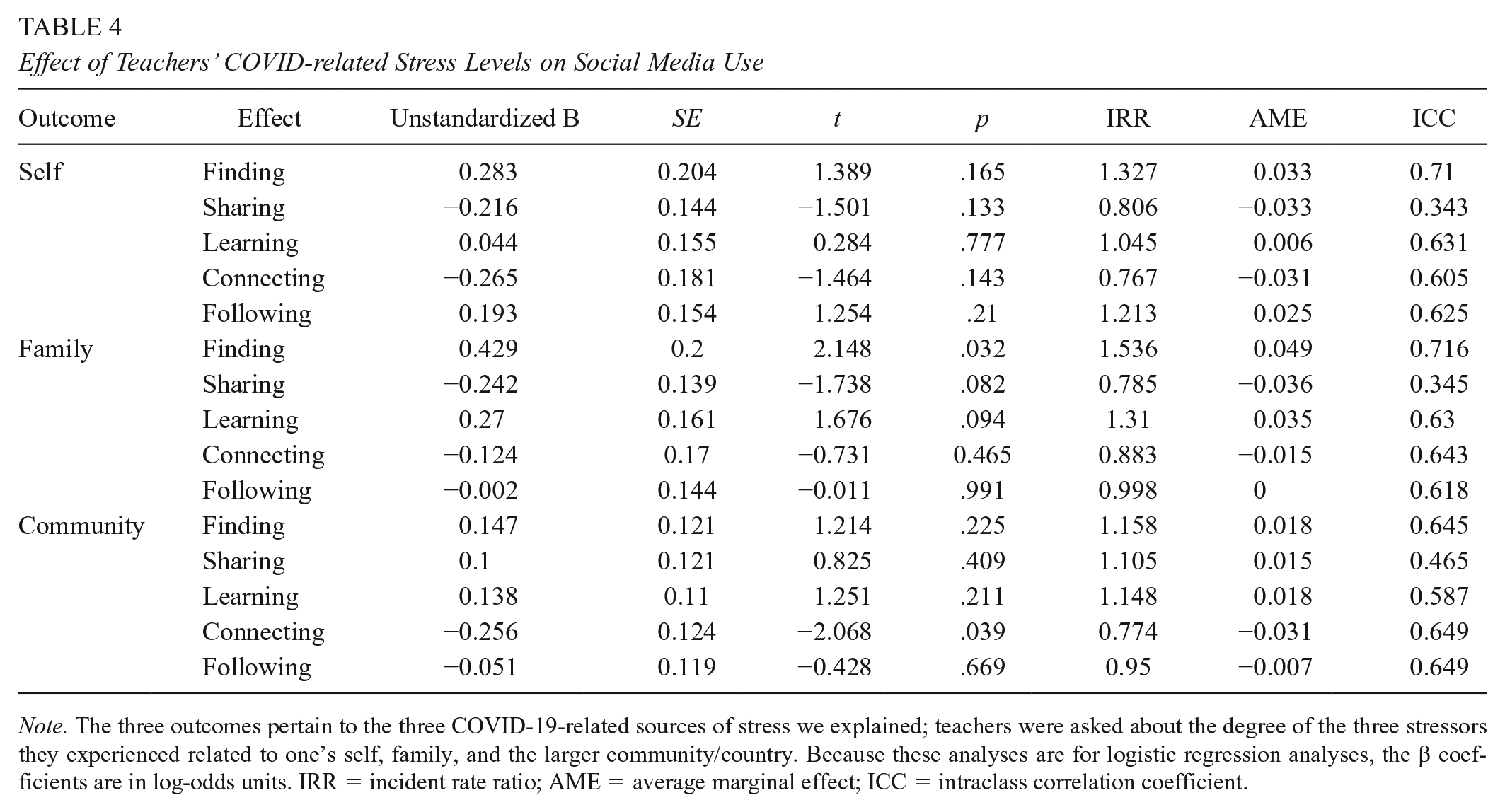
Note. The three outcomes pertain to the three COVID-19-related sources of stress we explained; teachers were asked about the degree of the three stressors they experienced related to one’s self, family, and the larger community/country. Because these analyses are for logistic regression analyses, the β coefficients are in log-odds units. IRR = incident rate ratio; AME = average marginal effect; ICC = intraclass correlation coefficient.
Notably, there were no statistically significant relationships for teachers’ social media use in connection with COVID-19 stress related to themselves. These findings suggest that teachers used social media with a greater (and lesser) frequency when they experienced stress related to their families and the larger community or country but not when they experienced stress related to themselves. (See Supplementary Appendix, available in the online version of this article, for detailed output.)
Discussion
Previous research suggests that teachers’ selection of social media platforms and spaces for their PLNs is individualized and diverse. For example, individual teachers (should) determine which social media platforms (and other resources) they incorporate into their PLNs based on their own needs (Krutka et al., 2017; Trust et al., 2016). That is, “one size does not fit all” (Liu et al., 2016, p. 439); rather, different platforms have different affordances and constraints (Staudt Willet, 2019; Staudt Willet & Carpenter, 2020), and different social media spaces demonstrate different patterns of activity (Carpenter, Tani, et al., 2020; Greenhalgh, 2021). Furthermore, teachers have reported and demonstrated a range of different purposes for their use of social media (e.g., Carpenter & Krutka, 2014, 2015; Greenhalgh et al., 2016), as well as different rates of participation in social media spaces (Rosenberg et al., 2016).
Significance
This study furthers our understanding of individualization and diversity in the social media elements of teachers’ PLNs. Furthermore, our collection of data both before and during the COVID-19 pandemic provides one account of how teachers change their PLNs in response to changes in the context around them. Our attention to both individualization and change over time allows for poignant illustrations of the idiosyncratic nature of teachers’ social media use. For example, Figure 1 demonstrates the sheer variety that characterizes our sample’s use of social media over time. Similarly, the grouping factors of our analyses for Research Questions 2 and 3 indicate that between 40% and 60% of the effects measured in each analysis are attributable to differences between individuals (rather than just observations). This suggests considerable idiosyncrasy; as teacher educators (and others) continue to introduce pre- and in-service teachers to social media (e.g., Greenhalgh et al., 2016; Gurjar, 2019), teacher educators should be careful not to prescribe particular PLNs but rather invite educators to consider which platforms and purposes might best respond to their own needs (see Krutka et al., 2017). The results also highlight patterns that add important clarification to this initial finding of individualization and diversity. The individualization of teachers’ social media can relate to teachers’ sensitivity to contextual issues such as their perceived levels of stress. For instance, our results suggest that teachers have particular needs that have arisen from the COVID-19 pandemic which aligns with previous research (e.g., exchange with colleagues or immediate need for professional learning: Fütterer et al., 2021; Greenhow et al., 2021; Trust et al., 2020). In addition, our findings expand the emerging literature base that examines teachers’ stress during the COVID-pandemic (e.g., Klapproth et al., 2020; Košir et al., 2020; Oducado et al., 2021).
This study also makes a methodological contribution for studying teachers’ professional learning. The use of intensive longitudinal methods allowed for a highly granular, intimate understanding of how individual teachers used individual platforms for individual purposes within a PLN. In this way, this study builds on past research using intensive longitudinal methods to study teachers’ diversity and individualization as well as variation in teachers’ experience in a more granular and also ecologically valid way (Reis, 2018). Using multilevel models also allows us to account for how teachers’ responses could be nested (just as repeated measures from students are often modeled as such; Raudenbush & Bryk, 2002). In this way, we were able to compare the purposes for which teachers use social media before and during an extraordinary disruption without relying on retrospective accounts. Rather, our brief surveys twice per week over more than one dozen weeks are likely to be more accurate and therefore can be used as a more valid measure than retrospective accounts (Schwarz, 2012). While intensive longitudinal methods can be administered through a variety of platforms, including mobile applications, beepers, and even pencil-and-paper surveys (Bolger & Laurenceau, 2013; Inkinen et al., 2020; Schmidt et al., 2020; Xie et al., 2019), their use is less established within teacher education research outside of studies of teachers’ emotions (e.g., Becker et al., 2014; Bieg et al., 2017; Keller, Chang, et al., 2014; Keller, Frenzel, et al., 2014). This study contributes additional understanding to the relatively novel use of experience sampling methods to study individualization and diversity in teachers’ planning, practice, and professional learning.
Teachers’ Sensitivity to Context
As previously noted, teachers in our sample showed considerable idiosyncrasy in the composition and use of their PLNs during the timeframe of this study. However, further consideration of these patterns of individualization and diversity lends further insight into the ways that teachers establish and change their PLN activity in response to specific needs in specific contexts. For example, teachers’ general preferences for particular platforms (among this sample, Facebook and blogs) suggests either attention to the particular affordances of those platforms for learning (e.g., Staudt Willet, 2019; Staudt Willet & Carpenter, 2020) or the ways those platforms converge with the other ways they already use social media (e.g., Carpenter, Morrison, et al., 2020; Greenhalgh et al., 2016). In either case, this suggests a sensitivity to one’s own social media preferences and professional needs that corresponds with scholarship on effective use of PLNs (e.g., Krutka et al., 2017).
Teachers’ sensitivity to the advantages and disadvantages of different social media platforms is complemented by their sensitivity to different purposes of PLNs (e.g., Trust et al., 2016). Although Table 2 suggests that in aggregate, teachers in our sample engaged in different purposes of social media-supported professional learning at similar levels, Figure 1 adds further nuance. Some teachers clearly prioritize some purposes over others, including different levels of consuming media (like lurkers; Romero-Hall et al., 2020) versus producing media (like edu-influencers; Shelton et al., 2020). This suggests that teachers are mindful of personal needs when using social media; Figure 1 illustrates how such needs play out for our sample of teachers, and suggest that they may find certain platforms to be better (or worse) suited for particular needs.
Finally, the clear shifts in teachers’ PLNs in response to the COVID-19 pandemic underlines even more sensitivity to context. Our data suggests that teachers in our sample changed their activity on social media in response to the pandemic. The combination of these three observations suggests considerable reflection and deliberation on the part of teachers as they use social media.
Teachers’ Pandemic Needs
Changes in teachers’ social media use in response to the pandemic lends insight into the needs that they were expressing at that time. Teachers’ use of social media is often framed primarily in terms of professional learning (and often as a response to inadequate formal learning opportunities e.g., Carpenter & Krutka, 2015), so it may be expected that teachers’ likelihood of following and learning when using social media was higher during the pandemic than prior to it. Nevertheless, we think these findings are still notable, particularly in the absence of other information about changes in teachers’ social media activity in response to the pandemic. They are also notable as most teachers had much to learn in response to remote teaching, and normal avenues of professional learning were as disrupted by the pandemic as were their classrooms. These findings provide some initial evidence that teachers may have turned to social media to bolster their professional learning during COVID-19.
There were no statistically significant relationships for teachers’ social media use in connection with COVID-19 stress related to themselves. Instead, statistically significant relationships between COVID-19 stress and social media use were tied to stress related to experienced stress related to their families and the larger community and country. This suggests a coupling between social media use and broader community participation. Furthermore, the increased likelihood of finding and learning—and decreased likelihood of connecting and sharing—in response to external stressors may help provide distinctions between more and less urgent uses of social media by teachers. That is, in difficult times, these teachers’ use of social media appears to be less about building community or online presence and more about finding immediate support in an important moment, though Greenhalgh and Koehler (2017) suggested that both occurred during a different kind of urgent moment—the Paris terrorist attacks. While the pandemic can and should be characterized differently, both events represent key inflection points in the use of social media.
That teachers’ stress levels influence their professional uses of social media recalls Trust et al.’s (2016) argument for a holistic view of teacher professional learning through social media that is attentive to “affective, social, cognitive, and identity aspects of teaching” (p. 16). More specifically, although there remain legitimate concerns about teacher-focused social media spaces (e.g., Hu et al., 2018; Krutka & Greenhalgh, 2021; Shelton et al., 2020; Shelton et al., 2021), our findings suggest that in times of stress, teachers may find the professional affordances of social media platforms particularly helpful. Thus, it is important to address these concerns in a way that considers the real stressors teachers face and the ways that social media platforms may help navigate that stress.
Limitations
Notably, our findings focus on the social media use patterns of only 14 teachers. Furthermore, these teachers were a self-selected group who opted in to participate in this study. Thus, our findings are valid for educators who are active on social media—particularly professional (digital) networks on social media from which we recruited participants. Although this precludes us from generalizing to a larger teacher population, our findings are highly granular, which enables us to understand specific patterns within teachers. Moreover, because we had collected data before the pandemic required emergency remote teaching policies, our data mirrors a pre–post, single case natural quasi-experiment for our study sample. Thus, we can attribute changes to social media use as a function of COVID-19-related pressures. That said, our study lacked the statistical power necessary to extend our multilevel analyses to including either (a) teacher-level variables or (b) variables at the levels of teachers’ schools, districts, or states, both of, which would have been helpful to understand contextual features (e.g., teacher characteristics and school and district conditions). Furthermore, because different states and districts implemented emergency remote teaching at different times, it is possible that not all teachers’ experiences lined up perfectly with the distinction we made between pre-COVID-19 and during COVID-19 activity. In addition, these analyses suffer from an omitted variable bias as we did not gather additional information on potentially influential variables such as classroom and school context, physiological data from teachers (e.g., did teachers or their immediate family contract the virus), or information teachers’ professional learning activities outside of social media. That said, both the design of an intensive longitudinal data collection and ethical consideration for asking health-related items limited the feasibility to include such variables to this study. Furthermore, this intensive longitudinal design required us to limit both the number of questions and detailed explanations added to each question. For instance, teachers were not given a definition of “stress” when inquired about their COVID-19 induced stressors. Last, we note that our analysis did not include covariates or potential confounding variables, but we also note that such an analysis would be best situated for additional follow-up studies.
Conclusion
Our findings must be contextualized to teachers’ reported social media use that occurred both before and after the transition to emergency remote teaching. Post-COVID-19 longitudinal studies might examine how the potential uptake of social media for professional learning during COVID-19 persists after the end of the pandemic. Such investigations would establish if social media use was ephemeral, or if it persists well after the pandemic. In a similar vein, additional work would do well to examine teachers’ social media use once students have returned to the classroom and relate those patterns to reported (or observed) teaching practices, as well as student performance. Doing so would help describe the nexus of a given platform’s general user affordances to its pedagogical affordances, for example, Pinterest was used for “finding,” but finding what exactly? To inform which teaching practices, if any? Qualitative work might also be used to examine how teachers used social media in depth; such work would help by describing the affordances and challenges that come with using social media to inform instructional practices.
The key affordance of our study, however, is our centering of how shifts in social media use occur during key inflection points—in this case in the months before and immediately after the COVID-19 pandemic. We examined the consequences of such shifts on teachers use of social media. Our results suggest idiosyncratic patterns of teachers’ adaption; our findings would not have been possible without intensive longitudinal methods. Notably, intensive longitudinal methods do not presuppose a static context and are instead predicated on the notion that we must measure multiple points of time over longer periods to best understand shifting (and potentially chaotic) events. Such methods are essential to study the shifting landscape of education and can help inform policy interventions developed in responses to a particular moment, be it historical or otherwise.
Supplemental Material
sj-docx-1-ero-10.1177_23328584211063898 – Supplemental material for A Different Experience in a Different Moment? Teachers’ Social Media Use Before and During the COVID-19 Pandemic
Supplemental material, sj-docx-1-ero-10.1177_23328584211063898 for A Different Experience in a Different Moment? Teachers’ Social Media Use Before and During the COVID-19 Pandemic by Stephen J. Aguilar, Joshua M. Rosenberg, Spencer P. Greenhalgh, Tim Fütterer, Alex Lishinski and Christian Fischer in AERA Open
Footnotes

Open Practices
Notes
Authors
STEPHEN J. AGUILAR is an assistant professor of education in the educational psychology concentration at the University of Southern California Rossier School of Education. He specializes in the development and evaluation of educational technologies, and how they can be used in ways that promote educational equity among ethnic and racial minority students.
JOSHUA M. ROSENBERG is an assistant professor of STEM (science, technology, engineering, and mathematics) education and faculty fellow at the Center for Enhancing Education in Mathematics and Sciences at the University of Tennessee, Knoxville. His research focuses on how learners think of and with data, particularly in science education settings.
SPENCER P. GREENHALGH is an assistant professor of information communication technology in the University of Kentucky’s School of Information Science. He focuses his research on the affordances and implications of digital contexts for teaching, learning, and other meaningful practices.
TIM FÜTTERER is a research scientist at the Hector Research Institute of Education Sciences and Psychology at the University of Tübingen, Germany. His research interests relate to the professionalization of teachers, (online) teacher training, digital technologies for teaching and learning processes, teaching effectiveness, and teachers’ reflective processes.
ALEX LISHINSKI is a postdoctoral researcher at the University of Tennessee, Knoxville, with a focus on computer science education. His current focus is on motivational and affective factors that influence student outcomes in undergraduate introductory programming courses.
CHRISTIAN FISCHER is an assistant professor of educational effectiveness at the Hector Research Institute of Education Sciences and Psychology at the University of Tübingen, Germany. His research is situated in the intersections of STEM (science, technology, engineering, and mathematics) education, teacher education, and educational technologies with a particular focus on the role of digital technologies to transform teaching and learning.
References
Supplementary Material
Please find the following supplemental material available below.
For Open Access articles published under a Creative Commons License, all supplemental material carries the same license as the article it is associated with.
For non-Open Access articles published, all supplemental material carries a non-exclusive license, and permission requests for re-use of supplemental material or any part of supplemental material shall be sent directly to the copyright owner as specified in the copyright notice associated with the article.
