



Abstract
Researchers and policymakers use certification as a metric of teaching quality in subject areas as well as subfields of education. We examined the association between having a teacher with dual certification in elementary and special education and math and reading achievement for students with disabilities (SWDs). We also examined whether dual certification related to teachers’ efficacy and job satisfaction. Using the Early Childhood Longitudinal Study: Kindergarten Class of 2010–2011, we employed ordinary least square regression models supplemented with school and child fixed effects to examine differences for children with disabilities based on certification type of their teachers in kindergarten, first, and second grades. After controlling for confounding variation at the school and child levels, we find that SWDs with teachers with dual certification score better in math. Results also suggest that teachers with dual certification exhibit more positive dispositions related to teaching SWDs.
Keywords
There is a need for effective educators to support the increasing number of students with disabilities (SWDs) in general education settings. SWDs are spending more time in general education classrooms now more than ever before (McLeskey et al., 2012; Williamson et al., 2019). Inclusion, placing SWDs in a general education setting, has been associated with positive outcomes for SWDs such as higher standardized test scores and higher graduation rates (Blackorby & Wagner, 2013; Krämer et al., 2021; Moore et al., 1998; Waldron & McLeskey, 1998). At the same time, inclusion has also been associated with negative outcomes for SWDs, including increased stigmatization and reduced expectations from teachers (Kirby, 2017), as well as negative outcomes for students without disabilities (Gottfried et al., 2016) and their teachers (Gilmour & Wehby, 2020).
Inclusion involves access to physical settings (e.g., general education classrooms) as well as general education teachers who must attend to the needs of all students (Kirby, 2017). Yet it is unclear how general education teachers’ preparation qualities do or do not relate to the academic success of SWDs in their future classrooms (Gottfried et al., 2019). Policy changes in the area of teacher certification have historically been used to influence teacher quantity as opposed to teacher quality (Brownell et al., 2010; Hutt et al., 2018), as teacher certification is a malleable policy lever that can have positive impacts on both teachers and their students (Carver-Thomas & Darling-Hammond, 2017; Darling-Hammond et al., 2001). This is relevant to ensuring the teaching workforce is prepared to support general education classrooms with a significantly greater number of SWDs (McLeskey et al., 2012; Williamson et al., 2019).
Much of the research investigating the association between teacher certification and student achievement compares traditional certification and alternative or emergency credentialing, and the findings are mixed (Clotfelter et al., 2010; Darling-Hammond et al., 2005; Goldhaber & Brewer, 2000; Wayne & Youngs, 2003). For example, Darling-Hammond et al. (2005) found that student achievement was lower when teachers did not have a standard certification, whereas Goldhaber and Brewer (2000) found no difference between alternatively certified and standard certified teachers. Here, we focus on dual certification for elementary teachers (i.e., teachers certified in both special education and elementary education). We sought to understand how dual certification is associated with academic outcomes for SWDs as well as the efficacy and job satisfaction for their teachers.
To better prepare general education teachers for working with SWDs, there has been collaboration among general and special education faculty at various teacher education programs to equip general education teachers with the knowledge necessary to support SWDs in inclusive settings (Gottfried & Kirksey, 2020). Some states have further legitimized this training in special education by incentivizing dual certification in special education in addition to another subject area, though the requirements and certification varies across states (Special Education Resource Project, n.d.).
We build on the small but growing literature on the effectiveness of dual certification in special and elementary education by using a nationally representative data set to investigate differences in academic achievement for SWDs as well as efficacy and job satisfaction of their teachers based on certification type. With that, we ask the following research questions:
For SWDs in general education classrooms, does having a teacher with dual certification associate with higher or lower academic achievement?
Is dual certification associated with differences in teacher efficacy and job satisfaction?
Background
The possession of a teaching credential is intended to be a demonstration of a certain skill level (Cavalluzzo et al., 2015; Goldhaber & Brewer, 2000). Despite the amount of money and time that goes into the credentialing process, it is still relatively unclear if the possession of a credential is impactful with regard to student achievement (Cavalluzzo et al., 2015; Clotfelter et al., 2010; Coenen et al., 2018). Given growing teacher shortages, alternative and emergency credentials have become more common (Clotfelter et al., 2010; García & Weiss, 2019a). As federal and state attention to teaching quality increases, the importance of the credentialing process has also increased (Cavalluzzo et al., 2015; Clotfelter et al., 2010). Pressures for both more and less regulation as well as for more teaching quality in the midst of teacher shortages complicate the issue further (García & Weiss, 2019b).
The perception of a credential indicating quality also exists for special education teachers although it has not been researched to the same degree as credentialing for general education teachers (Gilmour, 2020). Feng and Sass (2013) found that SWDs whose teachers were certified in special education scored better on achievement tests in both math and language arts. Furthermore, certified special education teachers were less effective than noncertified special education teachers for students without disabilities, a finding supported by prior work illustrating that teachers are less effective when teaching a content other than the one they were certified to teach (Clotfelter et al., 2010).
Last, we build on the few studies, to our knowledge, that examine the association between dual certification and academic outcomes for SWDs and dispositions and job satisfaction among teachers. First, Gilmour (2020) used an administrative data set from North Carolina collected between the 2010/2011 and 2012/2013 school years. Included in the data were students in Grades 4 through 8 who attended public schools and received special education services as indicated by having an individualized education program (IEP). Gilmour (2020) included student, teacher, and school characteristics as control variables in three separate regression models. Gilmour and Wehby (2020) also used administrative data from North Carolina but from the 2009–2010, 2010–2011, and 2012–2013 school years. Similar control variables were included across five multilevel logistic models to investigate teacher turnover. Although there is variation in ways in which teachers become dually certified (see Gilmour, 2020), it is important to more broadly understand how dual certification predicts student and teacher outcomes. Student achievement did not differ based on certification type with some exceptions. Specifically, high achieving students with learning disabilities and low achieving students with emotional/behavior disorders benefitted from having a dual certified teacher (Gilmour, 2020). While the turnover rates of teachers working with SWDs was significantly higher, this association was moderated by special education and dual certifications (Gilmour & Wehby, 2020). While Gilmour and Wehby (2020) focused on teacher turnover, we focus on teacher efficacy and job satisfaction.
Related to our second research question, Theobald et al. (2020) used teacher and student data in the state of Washington to investigate workforce outcomes, focusing on special education teachers and classrooms via factor analysis. They found that among candidates hired in public schools, being dually endorsed was related to becoming a special education teacher, but those who passed required tests in a subject area were less likely to be assigned to a special education classroom, and those who did were more likely to leave. While these findings have certain implications for special education classrooms, it is possible that dual certification may lead to better instruction in general education settings (Theobald et al., 2020).
While prior literature has primarily relied on statewide data, we expand on the existing literature by using a larger, nationally representative sample. In addition to the control variables mentioned above, we include socioemotional skills, baseline achievement, and measures of teacher efficacy and job satisfaction. Researching teacher attrition is critical but investigating mediating variables such as satisfaction are also important for understanding the psychological processes associated with leaving the teaching profession (Conley & You, 2017).
Method
Data
To compare the achievement of SWDs with and without teachers with dual certification, we used data from a nationally representative cohort of kindergarteners—the Early Childhood Longitudinal Study–Kindergarten Class of 2010–2011 (ECLS-K:2011). The National Center for Education Statistics (NCES) oversaw the compilation of these data sets, which included information about not only the kindergarteners themselves but also their parents, teachers, classrooms, and schools. Information on the ECLS-K study design and data collection procedures can be found on NCES’s website: https://nces.ed.gov/ecls/.
This study used data collected on children with disabilities whose primary placement was in general education. While the ECLS-K spans kindergarten through fifth grade, data on our key variables of interest were collected during children’s kindergarten, first grade, and second grade years of elementary school. We included children in our sample if they had an IEP on file with the school in either kindergarten, first, or second grade. We further limited our sample to children who were primarily educated in general education classrooms. We determined if a child was placed in general education based on the ECLS-K special education teacher survey, where teachers were asked whether the child’s primary placement was in general education.
With these criteria, our final analytic sample consisted of approximately N = 4,220 1 child-by-year observations, or n = 2,370 unique children observed over 3 years. When examining teacher-related outcomes, this sample is reduced to n = 3,270 teacher-by-year observations. Since the ECLS-K is a longitudinal study of children, these teacher-by-year observations also represent unique teachers observed over 3 years. Note given the relatively small sample sizes of each of the individual disability categories under the Individuals with Disabilities Education Act, it was not possible to examine by disability (Gottfried & Kirksey, in press).
Our most rigorous analytic approach, described below, accounts for all time-invariant child and school-level observed and unobserved variation that could confound any association we observed between dual certification and child and teacher outcomes. Still there were missing data on the key variables of interest. Specifically, when examining all variables of interest, the percentage of missing data for some variables ranged from 1% to 30%. Variables containing the most missing data were collected from the child’s parent, including health status, poverty status, and the number of siblings. Variables containing the least missing data were those collected directly from the children, such as assessment scores. Given that data cannot be assumed to be missing completely at random, we conducted multiple imputation to adjust for bias due to nonresponse (Woods et al., 2021). Specifically, we opted to use chained multiple imputation to account for missing observations on all variables (Royston, 2004). As some variables included as much as 30% of missing data, we imputed 30 sets of plausible values back to the sample for which there were nonzero weights based on recommendations from the multiple imputation literature (White et al., 2011). Note that sample weights were provided by NCES, and we used these weights in the imputation and in all analyses.
Outcomes
We examined two types of outcomes: academic achievement for SWDs and dispositions and job satisfaction outcomes for their teachers. First, students’ academic achievement was assessed in math and reading in both the fall and spring kindergarten as well as in the spring of first and second grade years. The mathematics assessment consisted of questions on number sense, properties, and operations; measurement; geometry and spatial sense; data analysis; and patterns, algebra, and functions. The reading assessment had questions on print familiarity, letter recognition, and recognition of common words. The reliability coefficient ranged from 0.92 to 0.99 (Tourangeau et al., 2013). In our analyses, we considered assessment scores from the spring waves to be the key outcomes for students. We include children’s scores from the kindergarten fall assessments as covariates when evaluating kindergarten spring assessments as outcomes. Similarly, we include children’s kindergarten and first grade spring assessments when evaluating first and second grade spring assessments as outcomes, respectively. In this way, we include each child’s most recent assessment as a covariate to produce value-added estimates of the association between having a teacher with a dual-credential and academic achievement.
The second set of outcomes were dispositions and job satisfaction and were collected from the children’s teachers. We examined two types of self-reported measures: views of educating SWDs and job satisfaction. On their views of educating SWDs, each spring, teachers responded to two Likert-type scale items (ranging from Strongly disagree to Strongly agree), “I am adequately trained to teach the children with disabilities who are in my class,” and “Inclusion of children with disabilities in my class has worked well.” On the same Likert-type scale, teachers were also asked several questions related to their job satisfaction, including (1) whether the teacher enjoys teaching, (2) what the teacher perceives about making a difference through teaching, and (3) whether the teacher would teach again. Following Lee et al. (1991), Renzulli et al. (2011), and Banerjee et al. (2017), we created a job satisfaction measure from these items using exploratory factor analysis. All three items loaded on a single factor with individual factor loadings exceeding 0.80. The Cronbach’s alpha coefficient was .74, which shows high interitem reliability.
Teacher Certification
In the spring wave of each year, children’s teachers reported whether they held one or more of the following teaching certifications: elementary education, special education, early childhood education, or English as a Second Language or instruction for English language learners (ELLs) or bilingual education. Following the same approach used by Gilmour (2020), we constructed indicators variables representing whether a teacher was certified in special education only or both special and elementary education, which we refer to as dual certification. In the regression analyses described below, teachers certified in elementary education alone are the reference group.
Control Measures
Research with the ECLS-K:2011 affords the opportunity to control for a rich set of characteristics on children and their families. Table 1 presents all longitudinal, time-varying control measures in this study, dividing the observations into whether children did and did not have a teacher with dual certification. These control measures can be placed into four broad categories: grade-entry skills, child characteristics, classroom characteristics, and teacher characteristics. Important to our analytic approach, these variables were collected each of the 3 years observed, which means they vary over time. Our analytic approach accounts for other variables both available and unavailable in ECLS-K that do not vary over time.
Descriptive Statistics for Main Study Variables

p < .001. **p < .01. *p < .05.
Table 1 indicates a few of these systematic differences between SWDs with and without teachers with dual certification, such as these children are more likely to have more peers with disabilities, fewer peers who are Black or Latinx, and more teachers who have a master’s degree. To avoid biasing our estimates, we control for these time-varying covariates in all regression models. Given our rich set of control variables, we also tested for issues related to multicollinearity by calculating the variance inflation factor for each covariate. All covariates were well-below the conventional recommendation of having a variance inflation factor of 5, so we proceeded without concern of multicollinearity affecting our estimates (O’Brien, 2007).
Analysis
To examine associated benefits from dual certification and academic outcomes for SWDs and dispositions and job satisfaction outcomes for their teachers, we began our analysis using ordinary least square regression with the following baseline model:

where the term Yi represents the achievement outcome, reading or math, for student i in school j in year t. The key predictor variable is DUALijt, which is a binary indicator for whether a child’s teacher held a dual certification. SPEDijt represents a binary indicator for whether a teacher held special education certification alone, which means the corresponding coefficients of β1 and β2 represent marginal differences in achievement for children with special education and dual certified teachers, respectively, compared with the achievement of children with teachers certified in elementary education alone. Xijt represents a vector of covariates as described above and illustrated in Table 1. Finally,
Fixed Effects
While using the ECLS-K allows us to control for a rich set of covariates, our baseline model does not account for school or child-level observed or unobserved factors that could be related to both our key independent variables of interest and outcome measures. One way to remove selection bias due to such factors is to use fixed effects models, an approach used by several special education researchers (Hurwitz et al., 2020; Kirksey et al., in press; Schwartz et al., 2021). To avoid instances where school-level unobserved factors could confound our estimates, we account for all time-invariant school characteristics that could affect achievement for SWDs as well as the propensity for SWDs to have teachers with dual certification by including models with school and child fixed effects with a school fixed effects model:

where
Child Fixed Effects
While an improvement from the baseline model, there remain concerns that, even after controlling for all possible school-level confounders, some child-level characteristics could be tied to be the propensity of having a teacher with dual certification and academic outcomes for SWDs. Thus, for the analysis related to academic outcomes for SWDs, we build on the school fixed effects approach with a school and child fixed effects model:

where
The school and child fixed effects model is our preferred specification for several reasons. In sum, models without these fixed effects may produce estimates that contain confounding bias from unobserved factors at the school or child level. For example, one school may have particularly effective leadership team who may seek out teachers with dual certification to support inclusion and provide support for their SWDs. At the same time, such leadership may also be effective via other academic or parent-focused initiatives known to support SWDs in reading and math. In this case, this unobserved variable, effective school leadership, would bias our results and our model would overestimate the effect of dual certification on academic outcomes for SWDs.
At the child level, there are a significant number of observed and unobserved factors are accounted for with the inclusion of child fixed effects, as tracking students over time allows us to observe how changes in achievement outcomes (while also controlling for their prior achievement) correspond to changes in whether the child has a teacher with a dual certification. In other words, our key identification of the effect of having a teacher with a dual credential comes from observing the same child who has a teacher with a dual credential in one year but not another, and comparing differences in achievement in these years. Examples of factors controlled for in a child fixed effects model includes standard time-invariant demographic characteristics such as race/ethnicity, sex, age at kindergarten entry, whether they attended prekindergarten, and more. Child fixed effects also accounts for many unobserved factors, which could relate to unmeasured parent or household characteristics or child temperament.
Sorting Test
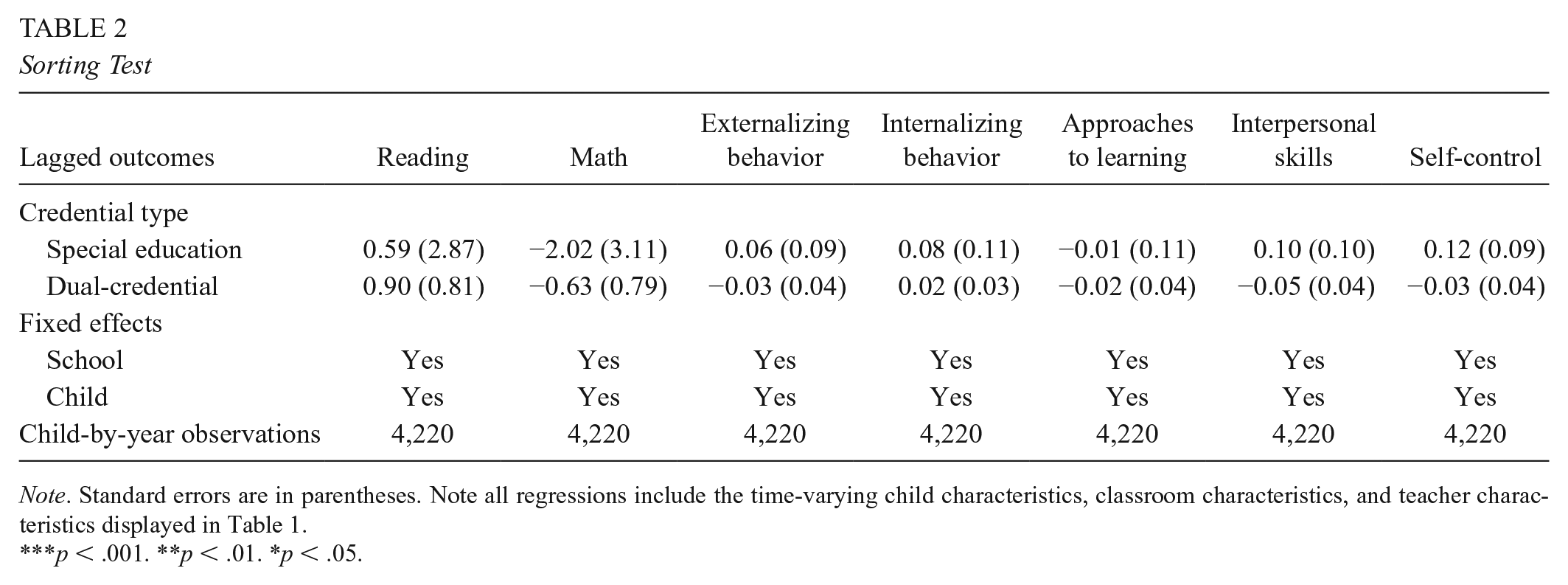
Even after controlling for all confounding variation at the school and child levels, one concern is that children with certain preexisting characteristics are more likely to have teachers with dual certification. That is, it may be the case that SWDs who are higher achieving or have different temperaments are more or less likely to be assigned a teacher with dual certification. One additional test of robustness commonly employed in works using the ECLS-K is to regress lagged measures of achievement and socioemotional measures on key variables of interest. As these measures are collected from children’s teachers at the beginning of the school year, we would not expect there to be an effect from having a teacher with dual certification on these outcomes, as we would with the spring measures. Prior to proceeding with our baseline and fixed effects analysis, we test for this sorting, and results are displayed in Table 2.
Sorting Test
Note. Standard errors are in parentheses. Note all regressions include the time-varying child characteristics, classroom characteristics, and teacher characteristics displayed in Table 1.
p < .001. **p < .01. *p < .05.
For brevity, we show effect-size estimates that indicate possible sorting of SWDs among teachers with a special education credential or a dual certification (elementary credential is the reference group) based on children’s prior academic and socioemotional skills. Note each regression incorporates previously discussed covariates and school and child fixed effects. As seen from Table 2, there was no evidence of sorting based on students’ prior academic or socioemotional skills.
Results
Research Question 1
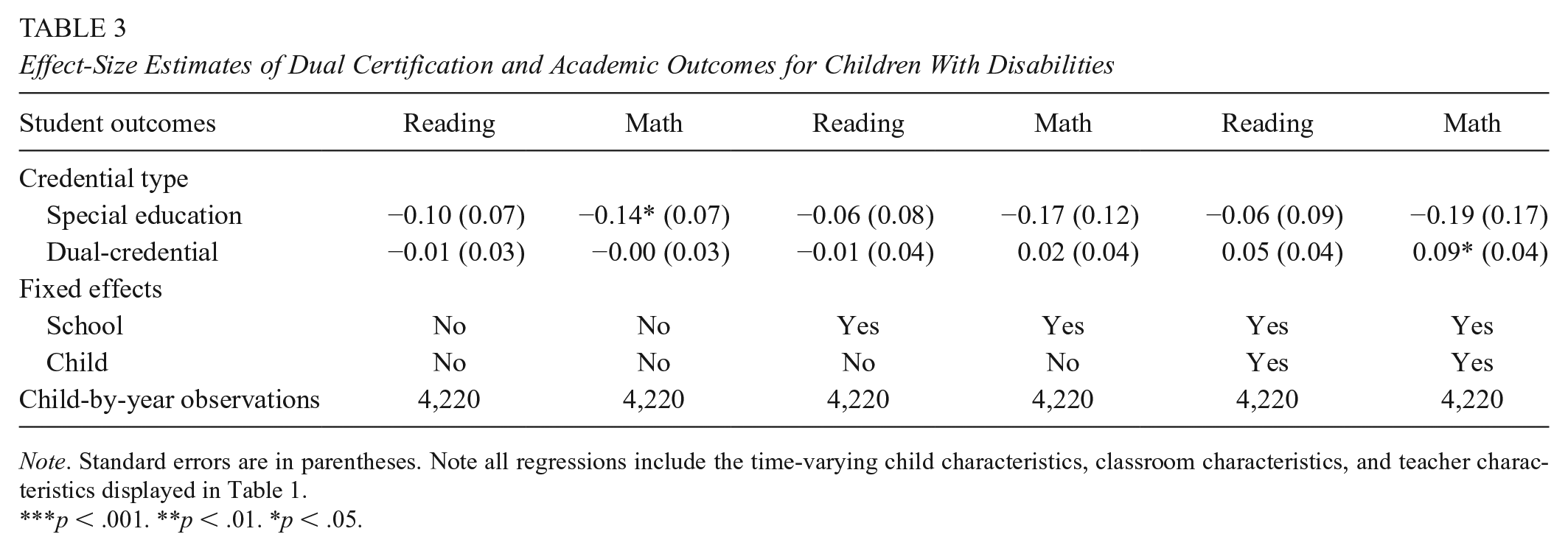
To address the first research question, Table 3 illustrates estimates from the three empirical specifications outlined above. All estimates are presented as standardized beta coefficients, which represent effect sizes similar to that of Cohen’s d (Cohen, 1988, 1992). For clarity, we present effect sizes from the key predictors related to credential type. Recall these included whether a teacher was certified in special education or both special education and elementary education (dual certification), with teachers certified in elementary education only left as the reference group. Note all models employed included the full suite of covariates outlined in Table 1.
Effect-Size Estimates of Dual Certification and Academic Outcomes for Children With Disabilities
Note. Standard errors are in parentheses. Note all regressions include the time-varying child characteristics, classroom characteristics, and teacher characteristics displayed in Table 1.
p < .001. **p < .01. *p < .05.
Looking at Table 3, columns 1 and 2 show estimates from the baseline model, columns 3 and 4 show estimates from a school fixed effects model, and columns 5 and 6 show estimates from a school and child fixed effects model. Beginning with the ordinary least square estimates, it appears that SWDs with teachers with a special education credential alone tended to exhibit worse math achievement (0.14 standard deviations) compared with SWDs with teachers with an elementary education certification. In this first model, there was no evidence that having a teacher with dual certification related to lower or higher achievement outcomes.
After accounting for observed and unobserved school-level variation, the school fixed effects models yielded null results for both reading and math outcomes. That is after controlling for these additional school-level factors, SWDs with teachers with only special education certification tended to exhibit similar academic achievement compared with SWDs with teachers with elementary education certification.
However, our preferred specification, which accounts for much greater school and child-level confounding bias, yielded different results. Turning attention to the school and child fixed effects model results presented in the last two columns, there was no statistically significant association between having a teacher with a special education certification and reading and math outcomes. However, the school and child fixed effects models yielded positive, statistically significant results linking dual certification to math outcomes for SWDs. That is, SWDs with teachers with dual certifications exhibited better math achievement outcome (0.09 standard deviations) compared with SWDs with teachers with an elementary education certification alone. Note this effect size is considered small but meaningful in educational research (Keith, 2006).
Research Question 2
To examine possible associations between credential type of teacher outcomes, we next present results related to the connection between special education and dual certification and teacher efficacy and job satisfaction. Table 4 presents effect-size results from the school fixed effects model and teacher outcomes. The first two columns include the measures of dispositions related to whether teachers felt adequately trained to work with SWDs and whether they believed inclusion of SWDs has worked well in their classroom. The outcome presented in the last column is the scale assessing teacher’s job satisfaction. In addition to controlling for school-level confounding variation, all models include time-varying classroom and teacher characteristics that are displayed in Table 1.
Effect-Size Estimates of Dual Certification and Outcomes for Teachers

Note. Standard errors are in parentheses. Note all regressions include the time-varying classroom characteristics and teacher characteristics displayed in Table 1. SWD = students with disabilities.
p < .001. **p < .01. *p < .05.
Several statistically significant results emerged. First, a very strong association emerged between having certification in special education and feeling adequately trained to work with SWDs (large effect size of 0.79). Additionally, teachers with dual certification also reported feeling more adequately trained to work with SWDs (moderate effect size 0.52) compared with teachers with elementary education certification alone.
On the other hand, we did not find evidence that teachers certified in special education were more likely to report that inclusion of SWDs has worked well in the classroom compared with reports from teachers with elementary education certification. That said, teachers with dual certification were more likely to report that inclusion of SWDs has worked well in their classrooms compared with teachers with elementary education certification alone (small effect size of 0.26).
Finally, looking at the last column of Table 4, we did not find evidence that suggests that teacher’s reports on their job satisfaction was related to their credential type.
Sensitivity Checks
To provide greater confidence in our results, we performed several additional tests to ensure our estimates were not sensitive to our treatment of missing data, the specification of the key predictor variables, or the inclusion of teachers with only special education credentials in the analyses. First, we reran our analyses without imputing the teacher certification or outcome variables. Then, we dropped the special education credential variable from the regression models, as there were quite few of these teachers who were teaching in general education. Last, we dropped all students with teachers who only had special education credentials from the analyses, and only focused on students taught by teachers with dual credentials or an elementary credential alone. In all of these tests, our results were nearly identical to those presented here, adding further confidence to our results.
Robustness Check
Note the ECLS-K data does not follow teachers in the same way that it follows children longitudinally. We rarely observed the same teacher in multiple years across the data set. Thus, while our models used to produce results displayed in Table 4 include a rich set of covariates and school fixed effects, we were not able to account for confounding variation using teacher fixed effects in the same way that we accounted for child fixed effects. As such, one concern is that teachers with varying levels of talent or motivation for teaching could be more likely to be the teachers that pursued dual certification. For instance, maybe teachers who are more likely to attain a dual certification are simply more motivated to teach, and this stronger motivation for teaching also makes them feel more adequately trained or capable of working with SWDs or that inclusion works well in their classroom.
Fortunately, the ECLS-K data set includes two near-identical items that pertained to teachers’ perceptions of their training and views on inclusion for ELLs in their classrooms. We speculate that teachers who possess some of these latent qualities (e.g., motivation) that are endogenous to attaining dual certification might report similarly on items that relate to working with SWDs and ELLs. This allows us one check to observe if dual certification in special and elementary education associates with teacher outcomes unrelated to special education.
Specifically, we examined whether having a special education or dual certification credential types related these efficacy-based items that concern teaching ELLs. Results are displayed in Table 5. We did not find evidence that certification in special education or dual certification is tied to teachers’ reports on their training or views of inclusion for ELLs.
Robustness Check

Note. Standard errors are in parentheses. Note all regressions include the time-varying classroom characteristics and teacher characteristics displayed in Table 1. ELL = English language learners.
p < .001. **p < .01. *p < .05.
Discussion
In this study, we found that dual certification is associated with positive outcomes for SWDs and their teachers. Our findings show that dual certification corresponds with academic gains in math for SWDs. We also found that teachers with dual certification felt better prepared to work with SWDs and were more likely to report that inclusion of SWDs has worked well compared with teachers certified to teach elementary school alone. Our study bolsters findings first examined by Gilmour (2020) by adding generalizability with a nationally representative sample of SWDs.
In the context of greater inclusion of SWDs in general education (Williamson et al., 2019), researchers, policymakers, and school administrators should continue to assess the benefits of increasing the number of teachers with dual certification in special and elementary education. For researchers, continuing to investigate the mechanisms underlying dual certification could reveal useful evidence of specific aspects of preparation that shows promise for supporting the academic success of SWDs and their peers in general education. Policymakers should consider expanding their promotion and support for dual certification, as our study and other research show potential for dual certification to mitigate early achievement gaps between students with and without disabilities (Gilmour, 2020). While efforts promoting dual certification are expanding, this certification type remains an uncommon pathway for teacher credentialing, especially when considering the number of SWDs spending time in general education classrooms. For administrators, our results suggest that certification type remains an important factor for new teachers and their students’ academic performance. Thus, administrators may include consideration of dual certification in decisions around hiring as well as investments in professional development for new teachers.
Teacher certification, when used as an indicator of teaching quality, is a malleable policy lever that can shape academic and nonacademic outcomes of students (Hutt et al., 2018). When considering the potential for dual certification to positively influence academic outcomes of SWDs in inclusive settings, our findings underscore the importance for researchers, policymakers, and administrators to continue to investigate ways in which dual certification can promote academic success for students. While more research is needed, teachers with dual certification may have the requisite knowledge and skills to support the learning of students without disabilities as well as know best practices for support SWDs academically, but they may also understand protocols for incorporating the necessary accommodations and others supports for SWDs in the context of a general education classroom (Gottfried et al., 2019; Gottfried & Kirksey, 2020).
Our findings surrounding teacher efficacy and satisfaction levels also have various implications. It is possible that in the dual certification process, teachers become better prepared for the realities and challenges of teaching in inclusive settings, such as coteaching. The findings of Conley and You (2017) indicate that teacher team efficacy and job design have various effects on work and career commitment and job satisfaction, all of which affects teachers’ intentions to leave. Our research, in conjunction with previous literature, suggests that dual certification can have impacts for teachers both leading up to and at the point of turnover (Gilmour & Wehby, 2020). Given the positive impacts associated with a dual certification for both students and teachers as well as the increasing number of SWDs in inclusive settings, dual certification could offer a viable pathway in preparing general education teachers to support the increasingly different set of academic needs present in general education classrooms nationwide.
Limitations and Future Research
To aid future research on the effectiveness of dual certification, we note several limitations of this study. First, we were limited by the items included in the ECLS-K. For instance, we were unable to investigate differences between various types of disabilities or associations related to specific services or accommodations outlined in a child’s IEP, as the ECLS-K does not contain the IDEA disability classifications and a limited number of variables on accommodations for students in the data set. These are variables that have gone largely unresearched (Billingsley & Bettini, 2019). We also could not examine differences by placement (e.g., general education versus pull-out or self-contained classrooms). As noted previously, the focus of the ECLS-K was on children served in general education. Additionally, while we did not find evidence suggesting certification type was linked to teacher job satisfaction, we were unable to see how a dual certification affects teaching practices or teacher retention, another pressing question for the field (Billingsley & Bettini, 2019).
More research investigating the impacts of dual certification in various contexts is needed. Specifically, the discrepancy between student achievement in math and reading warrants further investigation. It is possible that there are pedagogical differences between these two content areas that impact the way dual certified teachers teach them. A longitudinal study of greater duration that includes both students and teachers could reveal if and how dual certification benefit teachers of grade levels where academic demands vary.
Additionally, research focusing on the dual certification process is needed. Gilmour and Wehby (2020) note that in teacher education programs that result in a dual certification, there may be a condensing of the curriculum so that preservice teachers can graduate in the same amount of time. There are potential downsides to this that warrant exploration. Qualitative or mixed method case studies that focus on preservice teachers seeking dual certifications would contribute to the existing literature by highlighting the explicit experiences of preservice teachers in dual certification programs.
When interpreting our results, it is critical to remember that this research does not illustrate which latent variables, such as motivation, are common among teachers who seek out dual certification. There may be ways that these teachers are inherently different in ways unrelated to the credentialing process. We attempt to test for evidence of such differences by examining if dual certification impacts views of adequate training to support ELLs or whether inclusion for ELLs has worked well. While we find no evidence of selection issues with this test of robustness, it is still possible that people who seek out a dual certification have different outlooks for SWDs but no other groups of students. Future research should investigate why individuals choose the various dual certification pathways and in what ways they are different than those who seek out other types of credentials.
SWDs are spending more time in general education settings but this shift is not necessarily reflected in the teacher certification process. Meanwhile, there is an increasing number of SWDs and the turnover rates of special education teachers. Although the achievement gap for SWDs has been widely reported (e.g., Thurlow et al., 2016), there is little existing literature that focuses on whether dual certification can mitigate this gap. Our study suggests greater attention is warranted in this area of teacher preparation and special education.
Footnotes
Authors’ Note
Analysis files and details on data access for this article can be found at: Kirksey, Jacob. Dual certification in special and elementary education and associated benefits for students with disabilities and their teachers. Ann Arbor, MI: Inter-university Consortium for Political and Social Research [distributor], 2021-12-09. 
Notes
Authors
J. JACOB KIRKSEY is an assistant professor in the College of Education at Texas Tech University. His research is broadly focused on issues at the nexus of education and other areas of public policy, which includes student absenteeism and truancy, inclusion and special education, the ripple effects of immigration enforcement, and the teacher workforce.
MICHAEL LLOYDHAUSER is a PhD candidate in the Gevirtz Graduate School of Education at the University of California, Santa Barbara. His research focuses on teacher education with a focus on preparation to educate students with disabilities.