



Abstract
Higher education in India was caught completely unawares by the COVID-19 pandemic and the necessitated closure of educational institutions. Despite almost a decade of experience with online and distance learning at some top-tier and private institutions, the vast majority were unprepared and looked for quick solutions for different components of teaching–learning depending on the need of the hour. The immediate tool sought was a videoconferencing platform to substitute in-class lectures. With no access to a learning management system, faculty chose one platform for videoconferencing, one for interaction with students, and another for uploading class notes. Disparity in students’ access to devices and the internet presented challenges. Assessment of learning, which hitherto was largely pen and paper based, was delayed for lack of a viable solution. Experiences documented in this study demonstrate faculty resilience, but lack of institutional leadership and preparedness is starkly evident.
Higher education in India was caught completely unawares by the COVID-19 pandemic and the necessitated closure of educational institutions when a nationwide lockdown was announced on March 24, 2020. Despite almost a decade of experience with online and distance learning at some top-tier and private institutions—facilitated by the use of learning management systems (LMSs)—the vast majority were unprepared and had to look for quick solutions for different components of teaching based on the need of the hour. Three distinct categories soon emerged based on institutions’ level of preparedness and response to the pandemic: (1) prepared—These institutions were early adopters of blended learning and/or LMSs prior to the pandemic and made a relatively easy transition to remote learning; (2) quick responders—These institutions quickly responded to the situation and adopted educational technology, including in some cases an LMS; and (3) unprepared—These institutions had no prior experience with online teaching or educational technology, nor did they have access to an LMS. The vast majority of public institutions fall in this category. Faculty at these institutions had to quickly find ways to continue education during the pandemic. This study documents their transition experience.
An early United Nations report on the impact of the pandemic on education noted, “(T)he ability to respond to school closures changes dramatically with level of development . . .” (United Nations, 2020, p. 4). Because of the unprecedented speed at which the transition to remote learning was expected to be executed, Hodges et al. (2020) proposed the term, “emergency remote teaching,” to distinguish it from planned online teaching. At a U.S. based educational institution with prior institutional experience in online teaching using an LMS, faculty with no prior experience found themselves challenged by the abrupt switch to remote learning (Roy & Covelli, 2021). Basic experience with e-learning and/or prior experience using an LMS eased the emergency transition in Saudi Arabia (Alquabbani et al., 2020), Indonesia (Ardiyanto et al., 2021) and Singapore (Müller et al., 2021). Prompt institutional response facilitated an easy transition at three universities in Turkey, India, and Costa Rica (Benito et al., 2021).
The academic year in Indian higher educational institutions (HEIs) is split into odd (first and third) semesters, which run from July to December and even (second and fourth) semesters that run from January to June. March and April are midsemester at most colleges and universities and are a crucial time for many academic activities (Dutta, 2020). The nationwide lockdown imposed on March 24, 2020 to contain the spread of COVID-19 necessitated an emergency transition to online learning which presented challenges at many levels.
The University Grants Commission (UGC), the statutory body responsible for the coordination, determination, and maintenance of standards of higher education in India, immediately constituted two committees—one tasked with promoting online education and the other with issues related to examinations and academic calendar. Between March and May 2020, several initiatives to support online education were launched, including a national digital library to serve as a repository of online resources, massive open online courses (MOOCs), direct-to-home (DTH) television channels, and a YouTube channel. Institutions were advised to reschedule all ongoing university exams until after March 31. Guidelines for intermediate semester examinations and assessments, issued in end April, included the flexibility to use a combination of internal evaluation for the current semester and performance in the previous semester if available. In early July, institutions were instructed to conduct terminal semester and final year exams in offline, blended, or online mode by end September 2020.
This study documents the transition experiences of six faculty members who teach economics at different educational institutions in India. Prepandemic, they taught face-to-face, “chalk and talk.” This in itself is not unusual. Traditional lecture with a chalkboard or whiteboard is still the preferred method of economics instruction in the United States (Asarta et al., 2021). This can be attributed partly to the nature of the discipline. Economics relies heavily on graphs; economics instruction involves a significant amount of board work. What was different in the Indian scenario, however, was the exclusively offline mode for interaction and assessment as well. This posed a huge challenge for faculty who neither had prior experience in e-learning nor access to educational technology but were expected to continue education under lockdown. Teaching via livestream video is a poor substitute for in-person teaching if board work cannot be replicated. Organizing and sharing lecture notes and supplementary material is difficult without an LMS. Classroom interaction in an online environment requires reliable internet connection. Assessing student learning online requires familiarity with online testing tools. An LMS, which provides a single platform for all aspects of teaching and learning, was not available at five of the six institutions represented in this study. The sixth had an LMS in place but the faculty member, being an adjunct, had no prior experience using it. The experiences of these faculty are analyzed in the broader context of initiatives taken at the national level. Comparison with faculty experiences at other institutions that provided technical support and training during the transition is also presented.
Higher Education in India—Backdrop
The higher education sector in India comprises 51,649 institutions enrolling an estimated 37.4 million students (Government of India, 2019). This includes 993 universities that are empowered to offer degrees and 39,931 colleges which are affiliated with universities for the purpose of awarding degrees. Approximately 40% of universities and 61% of colleges are located in rural areas.
Higher education in India has traditionally comprised teaching and learning in a face-to-face setting, a framework commonly described as offline learning. Distance or remote learning was until the late 1990s synonymous with correspondence courses, the most well-known provider being Indira Gandhi National Open University (IGNOU). In addition to this central “open” university, there are 14 state open universities, 1 state private open university, and 100 “dual mode” universities which offer classes in both traditional and distance mode. In 2019, distance enrolment constituted a mere 10.62% of total enrolment in higher education (Government of India, 2019).
Formal regulation for online courses was announced by UGC only as recently as 2018. There is evidence, however, that top tier and private institutions had already been experimenting with online learning by then. The Indian Institutes of Technology (IITs) and the Indian Institute of Science (IISc), two premier and reputable institutions, had collaboratively created e-learning content and web-based courses in limited fields of study (Bansal, 2014). Barge and Londhe (2014) and Goyal and Tambe (2015) document the use of LMSs at two private institutions. Advocating investment in information and communication technologies (ICT) and the use of online learning to build human capital, Bhattacharya and Sharma (2007) had suggested possible ways to “transform the ‘digital divide’ into ‘digital opportunities.’” Still, the use of ICT and LMSs in Indian higher education is limited in its scope (the variety of courses offered) and reach (students who can take advantage of the limited course offerings).
Data on use of LMSs in Indian HEIs are hard to find. Government of India (2019) provides data on availability of computer centers and connectivity but not LMS. According to Gulzar and Leema (2015), only 45 universities were using Moodle in 2015. Cost of LMSs, infrastructure constraints, and faculty resistance were some factors contributing to the low adoption (Gulzar & Leema, 2015). Moodle Statistics (https://stats.moodle.org/) reports 6,605 registered sites in India as of March 19, 2021. None of the institutions represented in this study belong on that list.
An extended period of online teaching and learning requires, at the very minimum, access to a computer and the internet. Government of India (2020a) reports that in 2017–2018:
Only 10.7% of all households possessed a computer. The percentage of rural and urban households possessing a computer were 4.4% and 23.4%, respectively,
Among persons in the age group 15 to 29 years, approximately 24% in rural areas and 56% in urban areas were able to operate a computer,
Approximately 24% of households had internet access. This included 14.9% of rural households and 42% of urban households,
Approximately 40% of respondents in the 15 to 29 years age group reported being able to use the internet. The rural and urban proportions were 30.4% and 63.2%, respectively,
Approximately 35% of respondents in the age group 15 to 29 years reported using the internet in the 30 days prior to the date of the survey. This included access via smartphones as well as access “from any location” (pp. 240–245). The rural and urban proportions were nearly 25.3% and 57.5%, respectively.
Internet penetration in India was only 36% in 2019, comprising 26% and 51% in rural areas, respectively. Especially relevant in the context of online teaching and learning is that 99% of users accessed the internet using mobile phones (Internet and Mobile Association of India, 2019). Mobile devices can be used to deliver learning materials that students can access at any time and any place of their choosing, but materials must be designed taking into consideration the limitations of the small screen (Ally, 2004). The 100% offline mode of instruction prior to the pandemic, coupled with the minimal lead time for making the switch to online and no access to an LMS, would have severely constrained the ability of faculty to develop lessons suited for learning using a mobile phone.
Until 2018, summative assessment of student learning was based on university-conducted, standardized, in-person, “external evaluation” exams at the end of every semester. The format of question papers was decided by the Board of Studies for each subject. Question papers were sent to universities and affiliate colleges which also served as examination centers. Students were assigned examination centers that were typically different from their “home” institutions. Exams were held simultaneously at all examination centers. Answer scripts were then transported back to designated assessment centers for grading. This process was reformed in 2019 and replaced with a new system comprising 70% “internal evaluation” and 30% “external evaluation” which were still the standardized, university-wide examinations at the end of the semester (University Grants Commission, 2019). Without prior experience in online assessment, conducting internal assessments would be challenging, and standardized external examinations even more so.
Daimary (2020) surveyed 50 headmasters (equivalent to principals in U.S. schools) in the northeastern state of Assam, India, who identified the following challenges posed by e-learning during the pandemic:
Lack of e-learning resources, including access to devices and internet,
Lack of teachers skilled in ICT, and
Lack of cooperation, both from faculty and students.
The participant base in the Daimary (2020) study was school headmasters. It is conceivable, however, that these challenges were faced by HEIs as well considering the prevalence of in-class learning prepandemic.
Objective, Research Questions, and Method
The current study sought to gain insight into how the prevalence of face-to-face teaching prepandemic, combined with inexperience in e-learning and nonavailability of educational technology, affected higher education. Accordingly, it explored the following questions:
How did faculty teach prepandemic?
What training did they receive to deliver lessons remotely?
How much lead time was provided?
Without access to an LMS, how were classes held, material shared, communication with students maintained, and assessments conducted?
How much of the in-class experience were faculty able to replicate? In particular, were they able to conduct all assignments and assessments as in the prepandemic situation?
What kind of challenges did faculty and students face?
What skills and/or resources will faculty continue to use in the future?
Pedagogy and use of educational technology are interrelated and would likely have determined prepandemic teaching modalities. However, since pedagogical changes could not reasonably have been implemented during the swift transition to remote teaching, the focus of this study is on the transition experience only.
Because the emergency of the pandemic and the ensuing quick transition to online learning was a new phenomenon, a qualitative methodology was chosen. Qualitative research is both an established method of uncovering meaning and explaining phenomenon, as well as an appropriate approach when a phenomenon is new and un- or underexplored. Qualitative research seeks to illuminate and understand real-life events (Silverman, 2017). While quantitative studies measure previously identified variables, qualitative studies explore participants’ experiences and perceptions of experience, through probing, open-ended questions (Maxwell, 2005). Qualitative research serves to uncover nuances, variables, and other elements that may be useful for later quantitative comparisons (Creswell, 2013).
The study was approved by the institutional review board. Convenience sampling method was used. Higher education faculty in the lead author’s WhatsApp contacts were invited to participate in the study. Although face-to-face or video interviews were the preferred methodological approach, the emergency nature of the shift, pandemic-related travel restrictions, and the participants’ technological limitations made this impossible at the time. Instead, a structured questionnaire (see the appendix) was emailed in mid-November 2020 to eight faculty who provided informed consent and agreed to participate. To minimize researcher bias that is inherent in qualitative research (Suddaby, 2006), participants were asked to send in their responses to the second author. Six completed questionnaires were received by mid-December 2020. Qualitative responses were compiled, organized, and analyzed using thematic analysis (Braun & Clarke, 2012). Themes were then further validated through investigator triangulation (Denzin, 1978; Fusch et al., 2018) wherein an independent reviewer analyzed the data for themes. The methodological process is shown in Figure 1.

Methodological process.
The characteristics of the six institutions represented by the participating faculty are summarized in Panel A of Table 1 using a select set of parameters. The institutions are quite diverse in terms of the type and number of courses offered, funding, years since establishment, affiliation, and accreditation. 1 Panel B summarizes quantitative information for the largest enrolment course that faculty were asked to pick for their responses. Class size was heterogeneous, varying from 24 to about 100. The number of on-campus class sessions prepandemic varied from 2 to 6 days a week.
Profile of Institutions and Courses Represented in the Study: Select Parameters

Source. Institutional data were compiled from individual institution websites. Not all information was available for all institutions. Course information was provided by respondents. N/A = not available.
Indian higher education institutions are accredited by the National Assessment and Accreditation Council (NAAC; http://www.naac.gov.in/index.php/assessment-accreditation).
Findings
We classified our findings into six primary themes, many of which had additional themes and classifications within them. These are represented visually in Figure 2.
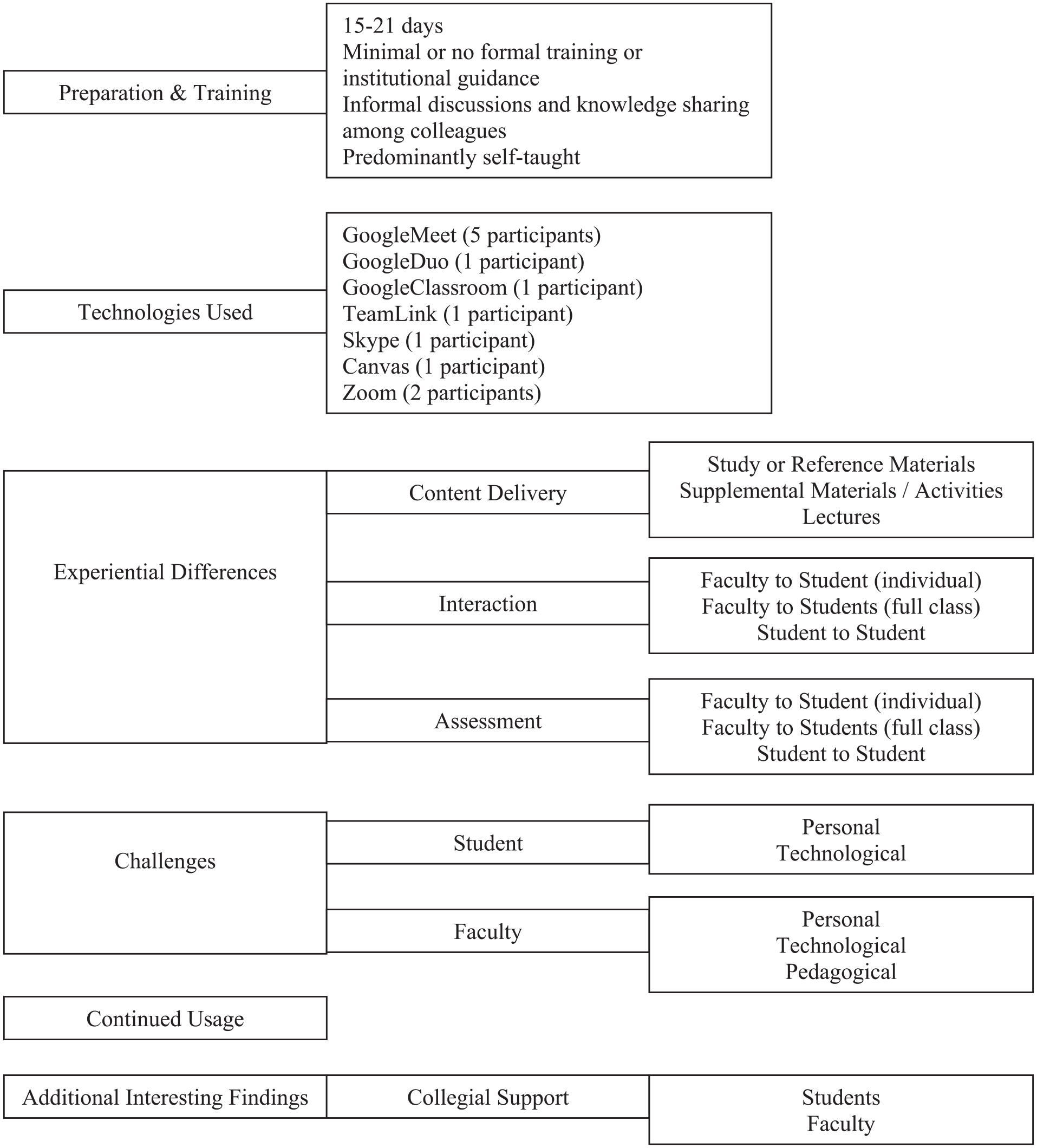
Graphical representation of themes.
Preparation and Training
Of the five participants whose institution did not have an LMS at the time the pandemic hit, four responded to our question regarding the length of time allowed to make the transition from face-to-face to online courses. Each had between 15 days and 3 weeks’ time to prepare. During that time, participants reported largely working on their own to prepare for completely online classes. Only one participant reported that their university provided some level of training that was formal and organized, designed to improve the faculty’s technical knowledge in preparation for remote teaching.
Several participants indicated that there were informal discussions and knowledge sharing between faculty members who shared “tips and tricks,” preferred platforms, technical help with specific features, and the like. However, most faculty indicated that they “personally learnt how to teach online” (Participant 3, Question 17) and that no organized and formal institutional support was provided.
One participant indicated that her university had an LMS prepandemic; however, she was not using it at the time the pandemic hit. As such, her responses were included in our analysis. For this one participant (Participant 2), although her institution had an LMS, faculty was instructed to download the free version of the Zoom app. The institution also arranged a meeting of faculty with the director and information technology staff to prepare faculty for the transition to completely online instruction; our participant followed it up with individual consultation. This participant reported only 1 week to make the transition from face-to-face to online classes.
Technologies Used
In terms of how participants conducted their courses completely online, again the technology varied widely. Participants reported using technologies listed in Figure 2 as well as tools such as WhatsApp and Facebook Messenger.
Anecdotal conversations showed that prior to the pandemic, many of the participants were unaware of LMS platforms as an option and had no conceptualization of how such a system might be of benefit. While many were familiar with videoconferencing and had heard of some software options (e.g., Skype), none had used them for educational purposes. As such, many spent significant time experimenting with various platforms before deciding which one to use. Participant 1 tried four different videoconferencing tools. Four out of the five remaining participants experimented with at least two, with only Participant 6 reporting using only one platform (response to Question 19). Participants reported choosing a platform based on (1) conversations with colleagues, (2) trial and error, and/or (3) cost. For example, two participants said they began by using Zoom, but because of the limitations of the free version, they switched to Google Meet.
Within these technologies, available features and associated adoption also varied. The “whiteboard/annotate” feature was available universally, with all six participants reporting this function available in the tool used to conduct their online courses. Only three participants reported having a “chat” feature, and only one participant reported having a “breakout room” feature.
Experiential Differences Between Face-To-Face and Online Courses
Content Delivery
Aside from the obvious lack of in-person experience, all participants desired to replicate the classroom experience as much as possible and, in particular, ensure that students received as much of the content as possible. One shared that discussions with colleagues focused on ways to help “complete the semester in such a way that the students did not lose out on the major part of the content” (Participant 6, Question 17).
Prior to the switch to full online courses, participants reported that students received study materials and other resources using in-person facilities such as from the teacher while in class, the campus library, or accessing them online. In response to Question 6, all six participants generally shared some type of additional reference material: “reference books, written notes, PDF materials” (Participant 1); “PowerPoint presentations are used to teach the students using Smartboards which are copied by the class representative in a pendrive” (Participant 2); “books and notes given by the teachers” (Participant 3); “study materials provided by faculty, texts and references either purchased by the student or borrowed from college library” (Participant 4); “books or online notes supplied by teachers” (Participant 5); and “a couple of textbooks supplemented with some recent journal articles . . . for the examples and applications of freely downloadable data sets from assignments” (Participant 6).
However, after the switch to complete online learning, only two participants assigned supplemental materials. Both used SWAYAM, an online repository of learning resources made available by the UGC.
Of interest is the fact that the institution with the LMS in place was able to integrate a videoconference platform during the lockdown. This participant ultimately used this platform for videoconferencing, sharing presentations, files, and videos, and conducting assignments that students had to complete during the class session. This participant was also able to record class sessions so that they could be replayed by students who needed review or those who were not able to attend the “live” class session, thereby reducing the content lost in a missed class and increasing opportunity for retention through material review. Compared with those participants who did not have access to an LMS, this participant seems to have more closely emulated the face-to-face classroom experience using these tools. This participant’s use of videos and assignments during class also suggests awareness about their pedagogical use.
Interaction
Usage of interaction features within a platform, even when available, varied. Three participants indicated they used the “whiteboard/annotate” feature, five reported using the “chat” feature, and one each reported using the “raise hand” and the “presentation” features (screen sharing, we believe). One participant reported using none of the features, reporting that they were “not very comfortable and as a bit cumbersome to use” (Participant 6, Question 24).
Participants reported that the synchronous class sessions served as the primary mode of communication with students. However, other ad hoc communication tools were also used. All six participants reported use of WhatsApp groups for messaging and calls. In addition, departmental email was widely used between the faculty and students for general communication and to share digital files for use during calls or chat sessions.
In addition, students communicated among themselves using a few other means. Three participants reported student use of “social media” including Facebook groups and messengers as well as the Piazza app. One participant reported the use of “class representatives” whose role appeared to be to assist students in the course. These individuals were responsible for saving materials into a flash drive for sharing, sending materials via WhatsApp or other platforms, and contacting students who did not attend a synchronous class to check in and insure they had the necessary materials and information.
Assessment
Prepandemic, assessments were pen and paper based and typically conducted in the classroom. Faculty reported, “Students were provided sheets of paper to write on” (Participant 2, Question 10), “Typically offline . . . on University assigned examination dates” (Participant 5), “Handwritten and conducted in the classroom” (Participant 6). Four of the six faculty also reported assigning group projects and term papers that students submitted in “hard copy” format.
Once the pandemic began and in-person classes were suspended, the UGC directed that all examinations be rescheduled after March 31, 2020. Subsequent guidelines noted that online exams were not universally feasible given the infrastructure constraints at the institutional level and internet availability and accessibility, especially in remote areas. Accordingly, institutions were permitted to use a combination of internal evaluation for the current semester and performance in previous semester if available.
According to responses to Question 34, which asked respondents about exams given between April and August 2020, exams were given using a variety of methods. Several participants reported that faculty uploaded or emailed questions to students immediately prior to the exam time. Students then completed the exam and submitted their responses via email. One participant shared that some students submitted answers via WhatsApp, and one reported using Google Docs. Participant 2 who was using Zoom for her class sessions shared that the assignments given were “marked as part of the continuous evaluation system” and that students emailed their answers.
In early July, institutions were instructed by the UGC to conduct terminal semester and final year exams in offline, blended, or online mode by end September. Question 35 specifically asked respondents about end-semester exams. Responses varied by each organization’s availability of technology. Participant 2, the respondent whose institution had an LMS at the time the pandemic hit, reported giving an online exam. The exam was uploaded by the course coordinator to the LMS platform which the students then completed online. One reported that no end-semester exam was given. Others reported that exams were made available online and students asked to submit via email, usually to departmental email(s). Participant 5 added that “for remotely staying underprivileged students pen and paper offline options were also available.”
In its guidance on examinations, UGC provided HEIs the latitude to adopt “alternative and simplified modes and methods of examinations” including open book exams, assignments and presentation-based assessments. In response to Question 36, “Were there any changes in how you assessed learning during the lockdown compared to previous semesters, example the questions asked on exams, etc.?,” participants had a variety of responses. One shared that “more case studies and indirect questions are given” (Participant 3). Another shared an attempt to give more conceptual questions to limit the ease of finding answers through search engines. Another shared that more emphasis was given on the analysis of the response, again potentially trying to minimize the students’ opportunity to search online for a straight empirical answer. Participant 2 reported giving an exam online via Zoom as well as conducting assessment “mainly with short answer and long answer questions. . . . Open book system was another technique of evaluation.”
Challenges
Student Challenges
The study did not survey students directly. The findings reported below summarize faculty perception of student challenges gleaned either by direct information from the student, through concerns shared by other students, or by the participants’ understanding of the student experience.
In response to Question 32, “Are you aware of any challenges your students faced (hardware, software, etc.) in making the switch to remote/online learning? If yes, please describe,” faculty shared their thoughts on student challenges. We have broken these into two classifications: personal and technological. Personal challenges include initial resistance to or struggle to mentally make the transition from face-to-face to online classes and to adopt the new reality and begin participating online. One participant shared “students initially faced difficulties in adopting system of online class, but gradually they have adopted very well” (Participant 3). Another shared that “another major challenge was space allocation within their house exclusively for their studies, and lesser time allocated for learning as they had to give time to support in chores of the house” (Participant 6). One participant shared students’ frustration with “the number of assignments they had to complete within a month, which replaced their offline exams” (Participant 2). One contributing factor to these challenges includes financial issues, as shared by two participants. These financial issues also contributed to the technological challenges.
Most technological challenges stemmed from unreliable internet connectivity, as reported by all six participants. This varied from lack of data for use on devices to limited electricity available during weather events that prevented devices from being fully charged. Reliable internet connectivity was a significant problem for those students living in more rural areas or even in distant islands. Participant 2 reported meeting with students outside of standard class times, “I had a one-to-one session using WhatsApp video call, and the backgrounds were not inside their homes but the nature outside. They travelled quite some distance to a point where there was connectivity” (Question 26).
Participants reported that students had issues with hardware as well. Three reported students did not necessarily have a laptop or desktop for online work and were using mobile phones instead. For those who had hardware, there were often issues with peripherals such as microphones not working, laptops overheating, and needed hardware repairs being impossible since shops were locked down.
Faculty Challenges
The participants themselves reported similar challenges that can be classified as “personal,” “technological,” or “pedagogical.” Some participants reported resistance, frustration, or concern about making the switch as can be seen in statements such as “initially transforming the entire teaching into online mode was a challenge” (Participant 3); “all this required more time and preparation” (Participant 6); and “I was not accustomed with this online mode” (Participant 1).
Participants also struggled with technology. One reported a lack of knowledge of or familiarity with online meeting technology, so they had to trust the input of colleagues, friends, and even their students and younger children at home to help them find and learn suitable technology. Another reported that their laptop overheated from such extensive use, and this participant had to purchase a new one to be able to successfully conduct online classes. Frustrations and challenges also stemmed from switching videoconferencing platforms. Participant 2 who switched from Zoom to Microsoft Teams was concerned about wasting class time and, as such, spent hours watching YouTube videos and practicing to be confident in their ability to operate the technology.
Other challenges arose from trying to replicate the face-to-face experience online and finding the best tools and technology to do so. One participant shared “the challenges are in hardware for board work” (Participant 6). Another reported that many times students had to attend sessions with their cameras turned off to increase bandwidth. This left the participants feeling “like teaching a blank screen with images of the students” (Participant 2).
Finally, some participants had pedagogical concerns that were a result of issues created by the pandemic. For example, several reported a change in assessment strategy (such as more case studies or a shift in exam question style to minimize the opportunity for cheating). In addition, several participants shared that student attendance was sometimes problematic due to internet connectivity issues, lack of data or internet due to financial constraints, and/or increased home obligations. Participation 6 shared that “about 60% students attended [videoconference classes]. Rest accessed the content asynchronously. The network connectivity and cost of the data was prohibitive as students and their families had not planned for this emergency” (Question 26). These were in addition to the standard events that can affect attendance such as illness (responses to Question 26). One indicated an intentional increase in asking questions to encourage students to participate and make the class more interactive.
Universally, participants shared that time for planning and preparation was a challenge given the average time of 3 weeks to be prepared to teach online.
Continued Usage
The final question on our survey asked, “Once campuses reopen and on-campus classes resume, will you continue to use any of the tools/platforms you have been using during lockdown? If yes, describe which ones and for what purpose. If not, explain why.” Five of the six participants indicated that yes, they would continue to use some tools. Two shared that they are interested in continuing to offer classes in a blended format with both face-to-face and online components. Two others shared that they would continue to use tools to share supplemental materials such as videos and to post and collect assignments. One indicated they would not use any of these new tools or platforms as the institution’s students prefer on-campus classes only.
The one participant who reported having, but not using, the LMS at the beginning of the pandemic indicated that they have already begun using the LMS for things like posting attendance, posting the “teaching plan,” and posting “total marks of continuous evaluation.” This individual indicated a plan to expand usage to include sharing of videos and using the “quiz/MCQ [multiple-choice question] feature as a method of evaluating even after offline classes resume” (Question 40, Participant 2).
Additional Interesting Findings
There were several specific examples of activities that we call “collegial support” that turned out to be helpful during the emergency switch to online courses. Some were formal processes in place prior to the switch, some were simply results of prior existing relationships and an apparent desire to help one another be successful on short notice, and some seemed to emerge during the online courses.
For example, Participant 2 reported the use of a “Course Coordinator” who was described as an individual with central ability and authority to post and access online materials. This participant shared examples wherein this coordinator was able to streamline access to information which benefited both the faculty participant and the students. For example, “the exam was put on the AmiZone LMS platform for the students by the Course Coordinator,” (Question 35), and “this was confirmed by the Class Representative and also by the Course Coordinator” (Question 26). This central role may have helped speed communication and information sharing between and among the faculty and class members. Although another participant referred to a similar position (an “academic coordinator”) (Participant 6) this participant’s responses did not discuss this individual’s unique role during the pandemic.
Participant 2 also discussed “Class Representatives.” Again, these individuals appear to be students who act as facilitators within a course. During the transition and the ensuing online classes, representatives were referenced completing activities such as contacting students who could not attend classes, inquiring about their well-being, and making sure they had access to missed information. They also copied and saved materials shared during the sessions and posted them in the various online tools for later access. This allowed the faculty participant to communicate directly with one student who could then use all the various communication tools (social media, WhatsApp, email, etc.) to reach as many of the students as possible.
Similarly, Participant 6 shared the experience of several students who did not have access to a laptop or desktop at all when the pandemic began, as they had been using the devices available to them on campus. They shared that these students struggled for “quite some time,” and that “their classmates were benevolent to share assignments and notes which they were reading over the mobile” (Question 32). Without this voluntary assistance by these individual classmates, these students may not have been able to successfully make the transition and complete the courses in the online format.
Participant 6 also shared examples of faculty colleagues and even friends sharing information and suggestions so that each of them could be successful.
The institution could not help us in any direct manner as it was a complete lockdown but informal discussions with colleagues helped . . . to complete the semester in such a way that the students did not lose out on the major part of the content. (Question 17)
Participant 4 echoed this, responding to Question 31 with “I was not aware of online meets like Zoom, Google, etc. So knowing things from colleagues, friends, and mostly the young generation (our students and our children at home) and being able to use them was a challenge.”
Discussion
Experiences with education under lockdown have not been uniform across Indian HEIs. In the introduction, we mentioned that institutions can be categorized into three groups based on their prior experience with e-learning and their response to the pandemic. A vast majority, like the six institutions represented in this study, belong in category (3): unprepared. They neither had prior experience with online learning nor an LMS in place when the pandemic struck.
Prior to the pandemic, our participating faculty taught only in a face-to-face setting. As noted earlier, this has traditionally been the preferred mode of learning in India. Distance enrolment constituted a mere 10.62% of total enrolment in higher education in India in 2019 (Government of India, 2019). Students at many Indian HEIs were thus not familiar with online learning. By comparison, 37.2% of U.S. students were enrolled in at least one distance education course in fall 2019 (U.S. Department of Education, 2020).
Traditional lectures with use of chalkboard or whiteboard were the prepandemic mode of content delivery for all six faculty in this study. Along with textbooks, supplementary material like lecture notes provided by faculty were the primary sources of content for students. This is very similar to economics instruction in the United States with one crucial difference: U.S. faculty and students’ familiarity with e-learning as evidenced in that textbooks used are online textbooks (Asarta et al., 2021).
Five of the six faculty in this study, who had no prior experience with e-learning nor access to an LMS, had between 15 days and 3 weeks to pivot to online teaching. The institutional urgency to resume education is reflective of the “. . . expectation from ministries or departments of higher education (explicitly in some cases) that teaching activity continue during closures through alternative means using distance or online modes” (World Bank, 2020, p. 2). To put the lead time in perspective, we note that Crosslin et al. (2018) propose 6 months to a full year of planning for online teaching, and a month’s time to create one full module or week of content with the support of a course design team.
The World Bank (2020) report on higher education in the South Asian Region and response to the pandemic noted, (T)here is also limited guidance for teachers on how to systematically deal with teaching-learning during the crisis . . . lack of training in the use of digital pedagogy, student assessments, and ways of supporting students remotely constrain teacher responses during the crisis. (World Bank, 2020, p. 2; italics added)
This is exemplified in our study, with four of six faculty reporting no institutional support for the transition.
The planned transition and institutional support provided by NorthCap University (NCU; Benito et al., 2021) and Mizoram University (MZU; Mishra et al., 2020), also Indian HEIs, provide a stark contrast. Both these universities were “Quick responders.” NCU, a private institution with very limited prior experience in online education, implemented a planned transition over 2 days. On Day 1, the information technology team considered all available platforms and chose Microsoft Teams since the institution had licenses for Office 365. On Day 2, all faculty members were trained in how to use Microsoft Teams (Benito et al., 2021). MZU developed its own LMS in response to the lockdown. Faculty trained themselves, but a system administrator and ICT experts were available to provide necessary assistance and manage the transition process (Mishra et al., 2020). Only Participant 2 in our study reported a somewhat comparable experience.
Prepandemic, classes were exclusively face-to-face at the institutions represented in our study. To prepare for remote teaching, the immediate tool naturally sought by faculty was a videoconferencing platform to substitute face-to-face classes. Other aspects of teaching and learning were addressed subsequently. A fragmented approach was adopted—one platform for videoconferencing (Google Meet, Microsoft Teams, Cisco WebEx), one for interaction with students (Facebook and the popular messaging app WhatsApp), and another for sharing class notes (WhatsApp, Google Classroom). The challenges faced by these faculty due to lack of experience and the nonavailability of an LMS are evident. As noted earlier, there is some evidence suggesting that basic experience with e-learning and/or prior experience using an LMS could have eased the emergency transition (Alquabbani et al., 2020; Ardiyanto et al., 2021; Müller et al., 2021).
The learning process involves student–teacher and student–student interaction. These can be incorporated effectively in a videoconferencing session using polling, annotation, breakout rooms and chat, and asynchronously via discussions and email. Our faculty had no training on tools available within videoconferencing platforms. Most of them were aware of whiteboard/annotate, chat, and breakout rooms. Only three used whiteboard/annotate to draw and illustrate graphs (so frequently used to illustrate economic concepts). Two others used PowerPoint-style presentations to deliver content. Interaction during class was limited to questions that students asked aloud or, if microphones were problematic, via chat. The interactions and discussions characteristic of face-to-face classes were severely constrained in the remote environment.
With limited classroom interaction and no access to libraries, supplementary learning material can go a long way toward supporting student-content interaction. NCU, for example, encouraged students to enroll in Coursera MOOCs that the university had licenses for (Benito at al., 2021). The World Bank (2020) report states, “In the short term, the focus should be on using, where possible, existing resources (across modalities—online and television,” and that “To do so would require curating and mapping available content to programs/courses for ease of use by teachers and students” (p. 3). UGC had made resources available to support online learning, but only two of the six faculty in our study reported using SWAYAM as supplementary material. Three others expressed confidence that the material they provided, combined with textbooks, was sufficient. In this respect, the faculty in our sample are similar to MZU faculty, only 11% of whom reported using UGC-provided resources (Mishra et al., 2020). This mismatch between supply of supplementary material at the regulatory level and lack of demand at the institutional level is intriguing.
As regards challenges faced by faculty and especially students, it is apposite to note that nationwide, accessibility and connectivity issues both created a digital divide (between urban and rural areas and by socioeconomic status) and widened the gap that already existed between private and top-tier versus public institutions. Our participants reported that internet and connectivity issues affected attendance at synchronous sessions. Asynchronous modes of communication were therefore necessary to ensure that students unable to attend synchronous classes were not disadvantaged.
Our faculty report extensively using WhatsApp and email both to share class notes and video links, and so on, and also to stay in touch with their students. Dutta (2020) also found that documents, presentations, videos, and so on, were shared via WhatsApp. MZU faculty used WhatsApp and Telegram in conjunction with their LMS because accessibility and connectivity issues prevented a large proportion of students from availing resources uploaded to the LMS (Mishra et al., 2020). Put together, the picture that emerges is one of the doubling-up of social media as an educational platform. Makumane (2021) similarly reports WhatsApp being used together with an LMS at a sub-Saharan university. To educators and students in developed countries who use an LMS for all aspects of teaching–learning, this may appear fragmented and chaotic. The long-term disadvantage of not having an LMS is that our faculty could not create a reusable collection of materials.
The pandemic widened the institutional inequalities that already existed prior. Earlier, we noted that some institutions were already using LMSs prepandemic. Teaching and learning experiences at these institutions can be expected to be very different from those represented in our study. Aristovnik et al. (2020) analyzed students’ satisfaction with remote learning based on data collected from students in 167 institutions across 133 countries. Approximately 5% of students were from five medical colleges and two management institutes in India. Thus, it can be reasonably inferred that these institutions were either “Prepared” or “Quick Responders.” Indian students reported slightly lower satisfaction with online videoconferencing and video recordings than the international average, but higher satisfaction with online presentations received from faculty as well as with written communication in forums and chats. Our study does not directly address students’ satisfaction with online learning. However, based on faculty respondents’ assessment of challenges faced by their students, together with that four of the six institutions are situated in the state of West Bengal, it may reasonably be assumed that student experiences at the HEIs represented in our study would more closely mirror those in Kapasia et al. (2020) who surveyed 232 students from the same state. They found that 74% had no experience with digital platforms prior to the pandemic. Post campus closures, about 38% continued their learning using both textbooks and e-learning while another 31% read their textbooks but did not participate in e-learning. Only 14% used laptops or computers; most (86%) participated in (accessed) their e-learning activities (resources) using a mobile phone. Over half spent less time on learning postpandemic, and about two thirds did not use any UGC-provided online learning material. Alarmingly, only about 12% reported that over half of their syllabus was covered.
There was a significant change in assessment methods during the pandemic. As noted earlier, the UGC had suggested the use of open book exams and presentation-based assessments. Our participating faculty report some use of case studies and open-book exams; whether there was any qualitative difference in the questions on the open-book exams is beyond the scope of this study. Benito et al. (2021) does not mention type of assessment but reports that approximately 60% of faculty felt assessments were as rigorous and fair; 9% felt they were less so. Reporting the open-book exam experience at the University of Delhi, an Indian HEI, Ashri and Sahoo (2021) note that unfamiliarity with the concept meant that curriculum and teaching methods were never aimed at developing the synthesis, analysis, and application skills required for open book exams.
The degree of faculty satisfaction with online teaching can be expected to be related to the level of preparedness and institutional support received. Faculty at NCU were satisfied with their experience “as an emergency measure due to COVID-19” though most “were doing this without the appropriate training or accumulated knowledge in online technology, tools, and pedagogy” (Benito et al., 2021, pp. 62–63). Most faculty felt prepared, and almost all felt that their future teaching will benefit from their online teaching experience (Benito et al., 2021). Our questionnaire did not include a question on faculty satisfaction. Five faculty in our study indicated that they would continue to use some tools they have learned, suggesting some measure of satisfaction and perhaps comfort with their use.
Conclusion
Education around the world encountered challenges in the wake of COVID-19 and the extended campus closures. Teaching and learning experiences were shaped by initial conditions and the versatility in rising to the demands of this unprecedented event. As the body of evidence grows, “success stories” of relatively easy transitions will naturally be the first to be told. Institutions that struggled will be hesitant, reluctant even, to tell their story because it reflects poorly on institutional leadership. This study aimed to address that gap. The objective was to shine a light on how faculty at such institutions rose to the challenge.
While our sample size is small and consists only of economics instructors in India, we conjecture that our findings are generalizable to many institutions in developing countries around the globe. From one perspective, the participating faculty in this study have demonstrated commendable resilience considering their lack of experience in online teaching and little institutional support for the emergency switch. We hope that more such experiences will get added to the collective evidence of the impact of COVID-19 on education.
Specific to the Indian context, the speed with which UGC responded is notable. It expeditiously launched various initiatives to support e-learning. However, our study reveals a wide gap between supply from UGC and demand from faculty and students. To the extent this is reflective of asymmetric information, it underscores the need for better information sharing between UGC and institutional leadership, and between leadership and faculty.
Some of the initial experimentation with videoconferencing platforms that our faculty underwent can be explained by their inexperience with e-learning. However, it is probably more reflective of poor institutional leadership. The willingness and ability of participating faculty to adapt quickly to a hitherto unfamiliar teaching environment is laudable. We expect that similar stories of resilience can be found in other developing and less developed countries.
Going forward, COVID-19 must be viewed as a catalyst to redesign postpandemic teaching. Much human capital has been developed, and expertise gained, in the use of some educational technology; continued use can enhance the learning experience for all students. Having experienced the conveniences of learning from home, it is conceivable that students—especially those who travel long distances to get to their college or university campuses—will seek a mix of face-to-face and online courses to accomplish learning while also having opportunities for social interaction with peers. If the skills and expertise gained during the pandemic erode, the divide in students’ educational experiences revealed by the pandemic will only widen. It is therefore encouraging that five of the six participating faculty in this study expressed their desire to continue using some tools they have learned.
Finally, and on a related note, the pandemic experience presents an opportunity to rethink pedagogy. It has long been recognized that blended learning “has the potential to transform higher education for the better” (Garrison & Vaughan, 2011, p. x). Sarkar and Biswas (2021) argues that the pandemic has set the stage for a planned transition to blended learning that can benefit students and faculty alike. Blended learning has been recommended in the 2020 National Education Policy as well (Government of India, 2020b). Adopting LMSs to support blended learning will obviate the fragmented approach implemented during the pandemic. This will require a concerted effort from the UGC, institutional leadership, and faculty. Access to online content will become easier for many students as computer labs on campus become available, reducing disparities experienced during the pandemic. To discourage faculty from returning to “chalk and talk” learning, which may seem the easier option as campuses reopen, incentives that encourage faculty to adopt blended learning and continue using educational technology will have to be designed. UGC has made a central LMS platform available (https://www.inflibnet.ac.in/ilms/index.php/home). To enable institutions to use this LMS at scale, faculty will have to be trained in multimedia content creation as well as the benefits of blended learning. To ensure that institutional leadership encourage, support, and provide such training, their incentives must be redesigned for compatibility with the vision outlined in the national education policy. As face-to-face education resumes, wide scale adoption of blended learning and LMSs will be transformational for Indian higher education. For this, institutional leadership and vision will be critical.
Footnotes
Appendix
Acknowledgements
We thank the participants for filling out the detailed questionnaire and sharing their experiences. We also thank the reviewers and editors of this journal for their comments and feedback.

Notes
Authors
SUDIPTA ROY teaches finance, statistics, and economics at the University of St. Francis in Joliet, Illinois. Her research interests are student motivation and success.
SHANNON BROWN teaches management at the University of St. Francis in Joliet, Illinois. Her scholarship focuses on organization identity and change.