



Abstract
Undergraduates’ distress has increased dramatically since the COVID-19 pandemic’s onset, raising concerns for academic achievement. Yet little is known about the mechanisms by which pandemic-related distress may affect students’ learning and performance, and consequently, how we might intervene to promote student achievement despite the continuing crisis. Across two studies with nearly 700 undergraduates, we highlight the mediating role of distraction: undergraduates higher in COVID-19 distress saw lower learning gains from an asynchronous neuroscience lesson due to increased mind wandering during the lesson. We replicate and extend this finding in Study 2: probing what pandemic-related stressors worried students and revealing systematic differences among students of marginalized identities, with largest impacts on first-generation, Latinx women. We also examined whether stress reappraisal or mindfulness practices may mitigate the observed distress-to-distraction pathway. Only mindfulness reduced mind wandering, though this did not translate to learning. We conclude with implications for practice and future research.
It is no surprise that undergraduate students are under great distress—or the discomforting, emotional psychological response to a particular stressor (Ridner, 2004)—during the novel coronavirus (COVID-19) pandemic. The pandemic has had far-reaching academic consequences, an early one for undergraduates being the need to rapidly modify their learning contexts away from in-person supports. This has transitioned to more stability in the learning context, though the medium has to date largely remained online. Though research has swiftly noted these increases in distress and warned of its impact on undergraduates’ academic performance (e.g., Soria et al., 2020), little was known about the precise mechanisms by which pandemic-related distress may affect students’ learning potential, providing little traction on strategies for best supporting learning when the stressor itself cannot be removed. Though understanding the role of social–emotional wellness is important, we here draw attention to a set of cognitive mechanisms that may underlie distress–performance relationships. We review literature drawn from learning in the context of other stressors and report data collected during the pandemic that has led us to propose a distressed-to-distraction pathway, such that COVID-19 distress may be compromising students’ learning via increased distractibility during intervals of new learning and instruction.
In two different experiments using a controlled video lesson, we show that students’ distress regarding the pandemic threatens learning by increasing their mind wandering during the lesson. In Study 2, we explore the sources of their distress, and we test whether two stress regulation strategies: mindfulness and stress reappraisal, may improve students’ learning potential by reducing the frequency of mind wandering.
Undergraduate Distress During the COVID-19 Pandemic
The COVID-19 pandemic has been reported to have increased many markers of psychological distress among undergraduate students (e.g., Wang et al., 2020; Zimmermann et al., 2020). Psychological distress is defined as the “discomforting, emotional state experienced by an individual in response to a specific stressor or demand that results in harm, either temporary or permanent, to the person” (Ridner, 2004, p. 539). Beyond simply experiencing a stressful situation, distress indicates an overwhelming amount of stress, such that one perceives themselves as unable to effectively cope with the stressor and its demands (Blascovich & Mendes, 2010; Ridner, 2004; Selye, 1956; see Amirkhan, 2012, for a similar conceptualization of distress as stress overload). Importantly, distress—or bad stress—is conceptually distinct from stress, which is neutral in valence and may have adverse (distress) or adaptive (eustress) consequences for health and well-being depending on the demand of the stressor and one’s perceived coping resources (Blascovich & Mendes, 2010; Selye, 1956). Distress or overwhelming stress encompasses chronic stress and allostatic load (prolonged demands; Amirkhan, 2012).
In turn, heightened distress may bring about changes in emotional states and mental discomfort, including increases in depression and anxiety symptomology (Ridner, 2004). In this way, distress in response to one life event is related to but not necessarily determinative of other state and trait measures of psychological impact. In fact, much recent work (reviewed below) has characterized the psychological impact of the pandemic by assessing students’ responses on measures of anxiety, depression, and/or perceived stress. However, compared with measures that aim to capture ongoing or trait-like phenomena like depression or anxiety, a fundamental aspect of distress is that it would disappear if the distressing life event ceases, or if one develops sufficient coping strategies to deal with the life event (Ridner, 2004). Therefore, in the present work, we use the term distress to best capture the maladaptive, event-specific psychological impact of the COVID-19 pandemic and its consequences on undergraduates.
Since the pandemic’s onset, undergraduates have self-reported high levels of psychological distress broadly, including heightened anxiety, depression, perceived stress, and mental health challenges (Chirikov et al., 2020; Healthy Minds Network, 2020; Son et al., 2020; Wang et al., 2020). Take, for example, findings from Son et al.’s (2020) cross-sectional study, where 71% of undergraduates sampled agreed that they had experienced “increased stress and anxiety” as a result of the pandemic. Using an instrument precisely assessing psychological distress following a specific life event (the Impact of Events Scale), Wang et al. (2020) found that undergraduates self-reported higher distress levels compared with the general adult population during the early stages of the pandemic in China.
Data from longitudinal studies of undergraduates and young adults show increases in correlates of psychological distress following the pandemic as compared with more typical years. This includes increases in perceived stress compared with 2 years prior (Shanahan et al., 2020) and increases in rates of depression and anxiety symptomology compared with the year before the pandemic (Huckins et al., 2020; Zimmermann et al., 2020). Zimmermann et al. (2020) measured undergraduates’ depression and anxiety three times prior to the pandemic (two, five, and eight months prior) and once during the beginning of the pandemic in Spring 2020. Not only did average scores on both the depression and anxiety inventories increase (37% and 17% increases from the beginning of the year, respectively), but so did the proportion of students meeting the diagnostic criteria for major depression and anxiety disorder (Zimmermann et al., 2020).
Taken together, these findings suggest that the onset of the pandemic has negatively predicted undergraduates’ distress and correlative symptomologies, and may potentially exacerbate their already declining psychological well-being. At the same time, the nature of the relationship between psychological distress and student learning has not been well understood.
Distress, Mind Wandering, and Academic Performance
Distress and Academic Performance
Increased distress during the pandemic may have serious implications for students’ academic performance. Compared with prepandemic responses in Fall 2019, a greater proportion of students in Spring 2020 believed that increases in correlates of distress—including experiences of anxiety (12% increase), depression (10% increase), and mental and emotional health challenges more generally (39% increase)—were negatively affecting their ability to perform academically (Healthy Minds Network, 2020). Student perceptions align with reality: experiencing stress overload (i.e., distress) in college has been linked to lower exam scores and higher attrition rates (Amirkhan & Kofman, 2018; see Heissel et al., 2017, for how these factors might interact with students’ marginalized identities).
Like many adults, undergraduates’ sources of distress during the pandemic have stemmed from concerns about their health and safety, potential economic consequences of the pandemic, and social isolation (e.g., Wang et al., 2020; Zimmermann et al., 2020) in addition to the burden shared by students of all ages who have had to rapidly navigate to new online learning formats and complete demanding schoolwork in new and often distracting environments. Accordingly, national and university-wide surveys of undergraduates (Chirikov et al., 2020; Hoyt et al., 2020; Kecojevic et al., 2020; Son et al., 2020; Soria et al., 2020; Zimmermann et al., 2020) and analyses of their social media content (Literat, 2021) revealed that concerns about academic success—particularly difficulties concentrating and increased distractions at home—were a primary concern for students and were positively correlated with levels of self-reported anxiety, depression, and perceived stress (Kecojevic et al., 2020). These concerns about difficulty concentrating on schoolwork have disproportionately affected women (Hoyt et al., 2020), students of lower income backgrounds (Soria et al., 2020), and racial/ethnic minorities (Literat, 2021), particularly Latinx students (Zimmermann et al., 2020).
Distress to Distraction
Despite the growing consensus that distress poses a threat to academic achievement, a critical, and to the best of our knowledge, unconsidered question is precisely how distress about the pandemic may affect learning and performance. This is information that would provide key insights for interventions to maintain students’ academic success despite the continuing crisis.
Prevailing models (e.g., Blascovich & Mendes, 2010) describe stress as a balance between one’s perceived coping resources and how demanding they believe the stressor to be. When one feels that a stressor exceeds their ability to cope (causing distress), it can pose a threat for performance across a variety of domains, including cognitive performance (Blascovich et al., 1999). When one is distressed, it becomes difficult to focus on ongoing tasks, as the personal and often negative distressing thoughts are prioritized in attention (Jamieson et al., 2012; see Mathews & MacLeod, 1994; McVay & Kane, 2010). Amirkhan and Kofman (2018) show that feeling overwhelmed with stress can induce long-term cognitive disruptions, including increased distractibility and decreased focus, much in line with undergraduates’ stated concerns during the pandemic (Chirikov et al., 2020; Hoyt et al., 2020; Kecojevic et al., 2020). Adjacent literatures examining choking under pressure and stereotype threat similarly find that negative affective experiences, like anxiety induced by distressing events, can generate intrusive, distracting worries that direct attention internally and away from the task at hand, leading to impaired test performance (see Beilock, 2008; Schmader et al., 2008) and learning (see Appel & Kronberger, 2012).
Mind Wandering
Behaviorally, these task-irrelevant cognitive intrusions may manifest as mind wandering (McVay & Kane, 2010). Mind wandering is a typically unintentional and unconscious redirection of attention from the external (e.g., an educational task) to the internal (e.g., personal concerns; Smallwood & Schooler, 2006), with consequences for test performance (see Randall et al., 2014, for a review) and potential cumulative effects for learning (see Smallwood et al., 2007). Mind wandering may be an important factor for online learning: mind wandering occurs frequently during online lectures and impairs students’ potential to learn from the lesson (Pan et al., 2020; Risko et al., 2012; see Schacter & Szpunar, 2015) and attain long-term achievement outcomes, like grades (Wammes et al., 2016b). This relation between mind wandering and learning has been tested in typical lecture contexts with little attention to the additional effects of student distress. We suggest that feeling distressed during an online lecture may further impede students’ learning potential, as mind wandering has been shown to mediate the relationship between daily life stressors (Banks & Boals, 2017) and experimentally induced stressors (Banks et al., 2015; Mrazek et al., 2011) on cognitive performance.
Stress Regulation Interventions
Thus, to maximize students’ learning potential, if distraction and mind wandering is the mechanism by which distress leads to reduced achievement, it will be important to support students in reducing the frequency of mind wandering, particularly during the pandemic when distress is elevated. One approach to reduce mind wandering is to help students monitor and redirect their attention (Szpunar, 2017): If distress leads one to divert attention inward, impairing performance, then can we help students change how they relate to their distressing thoughts so that they do not become distracting? Much research in emotion regulation has examined precisely that, finding that cognitive regulation strategies are most adaptive in academic performance contexts (see Harley et al., 2019). We test two of these strategies in Study 2: stress reappraisal and mindfulness, as these have both been shown to help students reduce their experiences of distress, maximize cognitive ability, and improve long- and short-term academic goals.
Specifically, stress reappraisal interventions aim to change how one conceptualizes stress by teaching individuals that stress is not always something to be avoided (i.e., stress does not equal distress). Rather, these interventions inform individuals of the positive, adaptive functions of stress (eustress) that can be harnessed to improve focus in performance contexts (see Crum et al., 2020). On the other hand, mindfulness interventions aim to help individuals nonjudgmentally exist in the present moment by letting go of distressing thoughts in order to preserve task-directed attention (e.g., Brunyé et al., 2013; Jha et al., 2010). Critically, both stress reappraisal (Johns et al., 2008; Schuster et al., 2015) and mindfulness interventions (Mrazek et al., 2013; see Smallwood et al., 2007) underscore the role of attention in mitigating any impacts of distress on learning and performance, making them choice candidates to aid students in attenuating mind wandering during learning.
Present Studies
A growing body of work has already shown that undergraduates, particularly students of historically marginalized identities, are under considerable distress during the pandemic and commonly report increased distractions and difficulty concentrating (e.g., Chirikov et al., 2020). Indeed, there is much concern about the extent to which the pandemic will affect academic success and achievement gaps now and in the future (Aucejo et al., 2020). However, relatively little is yet known about the precise mechanisms by which COVID-19 distress might impair students’ potential to perform and learn—information that would provide key insights for interventions to maintain students’ academic success despite the continuing crisis. Across two studies, we highlight one possible mechanism by which pandemic-related distress may immediately compromise learning potential: mind wandering. We assess students’ learning from a controlled, videotaped, online lesson—mirroring common asynchronous teaching practices. In Study 1, we measured COVID-19 distress in an undergraduate sample and report how distress threatened learning by increasing mind wandering. In Study 2, we replicate and extend findings from Study 1 by probing what students were distressed about and testing stress regulation strategies as one way to mitigate the effects of distress on mind wandering during learning.
Study 1
We had two primary aims in Study 1. First, we were interested to understand students’ experiences during the pandemic, and in particular, the extent to which students reported that the pandemic was causing them distress. Second, we explored whether and how distress had consequences for learning. We examined students’ learning from a brief video lesson and tested whether distraction may be a key mechanism in distress-related decrements in learning.
Method
Participants
Between May and June 2020, we recruited 258 students from six classes at a large public university in the western United States to participate in this study in exchange for a $20 Amazon gift card. Only the 204 (160 women, one gender unspecified) who finished the survey were included in analyses. Women were somewhat overrepresented in our sample relative to the university’s undergraduate population at large (53%; National Center for Education Statistics, n.d.). The recruited courses included two education courses (n = 54), two criminology courses (n = 99), and a biology course (n = 23). We also recruited students from a masters-level education course (n = 25). Three students did not provide course enrollment information. Participants’ self-reported race/ethnicity (44% Asian American, 31% Latinx, 15% White, 1% Black, and 9% Multiracial) largely mirrored the Hispanic-serving and Asian American Pacific Islander-serving university’s student body (37% Asian American, 25% Hispanic/Latinx, 13% White; National Center for Education Statistics, n.d.). 56% of participants were first generation university students.
Procedure
Students were informed that the purpose of the study was “to better understand the impact of course instructional strategies, as well as the unique social context and pressures during the time of the COVID-19 pandemic.” All study materials were delivered to students via Qualtrics. The study required approximately 45 minutes to complete and students were able to pause and resume the survey at their leisure. Students first provided informed consent, then completed a series of surveys assessing their pandemic-related distress and trait anxiety. Afterward, they watched the video lesson, reported on their frequency of mind wandering during the lesson, and answered questions based on the video.
Measures
COVID-19 distress
To assess students’ distress regarding the COVID-19 pandemic, we administered the 15-item Impact of Events Scale (Horowitz et al., 1979). This is a widely used measure of subjective psychological distress in response to a specific life event (Horowitz et al., 1979). On the basis of Ridner’s (2004) concept analysis and definition of distress, we chose the Impact of Events scale to measure distress as it allowed us to capture the negative, event-specific psychological impact of the pandemic without narrowing on ongoing or trait-like mental health outcomes (e.g., depression). Additionally, we chose the scale for its focus on distress specifically, rather than stress, which is too general and may have adverse or adaptive effects on performance and well-being (Selye, 1956). Last, the Impact of Events scale has been validated for use to assess COVID-19-related distress (Vanaken et al., 2020; Cronbach’s α = .75), and versions of this scale have already been used to characterize COVID-19-related distress in undergraduate samples (Vanaken et al., 2020; Wang et al., 2020).
Students used a 4-point Likert-type scale 1 (0 = not at all; 1 = rarely; 3 = sometimes; 5 = often) to report the extent to which they experienced certain thoughts or feelings toward the COVID-19 pandemic in the previous 7 days. See Table 1 for complete items as administered. Responses were summed to create a continuous measure of COVID-19 distress. A score between 0 and 25 corresponds to low-mild distress, 26 and 43 indicates moderate distress, and greater than 44 indicates severe distress. Twenty-six is the recommended cut-off for clinical treatment (Horowitz et al., 1979; Sterling, 2008). Internal consistency of the scale in this sample was satisfactory (Cronbach’s α = .87).
Items From the Impact of Events Scale

Note. The items have been modified to specifically address distress regarding the COVID-19 pandemic.
Trait anxiety
We administered the Trait subscale of the State-Trait Anxiety Inventory (Spielberger & Gorsuch, 1983) in order to conceptually separate students’ pandemic-related distress from their general tendency to be anxious. Students used a 4-point Likert-type scale (1 = almost never to 4 = almost always) to report the extent to which they had certain thoughts or feelings (e.g., “I feel like a failure”) during the prior 7 days. We reverse coded positively framed items (e.g., “I am calm, cool, collected”) then summed across the 20 items to generate a continuous trait anxiety score (Cronbach’s α = .93).
Lesson and learning
Students viewed a 14-minute neuroscience lesson in which the presenter detailed the neurological processes involved in song learning in birds and implicitly—yet not directly—drew connections to the neuroscientific underpinnings of learning in humans. Thus, though the content presented was highly technical, the implications were quite general. The brief lesson-plus-comprehension check format closely aligns with highly recommended asynchronous lecture methods common in remote learning contexts (Gewin, 2020). After the lesson, students answered six multiple-choice comprehension items. Three of the items assessed students’ recall of the lesson content. The other three items assessed students’ higher order thinking, requiring students to infer and make connections beyond what was explicitly described in the lesson (see Supplemental Materials, available in the online version of this article, for comprehension items).
Mind wandering
We assessed mind wandering during the lesson using the five-item Mind Wandering Questionnaire, modified to assess students’ mind wandering while they were watching the lesson (e.g., “During the lesson, I found myself listening with one ear and thinking about something else at the same time;” Mrazek et al., 2013). We measured mind wandering after students had watched the video lesson, but before they answered the comprehension items. Students’ responses to the items (1 = almost never to 6 = almost always) were averaged to create a continuous measure of mind wandering (Cronbach’s α= .92).
Analytic Plan
First, we describe COVID-19 distress among our sample, using analyses of variance (ANOVAs) to explore differences among demographic groups. Then, we use regression analyses to test relations among COVID-19 distress, mind wandering, and learning during the lesson. Last, we report a mediational analysis testing whether increased mind wandering served as a mechanism to explain theorized negative relations between distress and learning. Standardized beta coefficients and standard errors are reported.
Results
COVID-19 Distress
Descriptive statistics for all outcomes are provided in Table 2. Distress scores varied considerably with a slight positive skew (see Figure 1). On average, women experienced greater COVID-19 distress than men and gender-unspecified students, F(2, 201) = 3.50, p = .03, η2 = .034. First generation, F(1, 202) = 0.11, p = .74 and Latinx students, F(1, 202) = 0.39, p = .53, had similar distress to their peers. However, at the intersection of these identities, the first generation, Latinx women (FGLXW) had higher average COVID-19 distress compared with all other students, F(1, 202) = 5.73, p = .02. Forty-five percent of the sample met the criteria for moderate distress and 9% were severely distressed, a greater proportion of whom were women, χ2(2) = 11.32, p = .003.
Descriptive Statistics for All Measures in Study 1, by Self-Reported Student Identity

Note. The possible range of scores is provided for each measure. FGLXW = first generation, Latinx women.
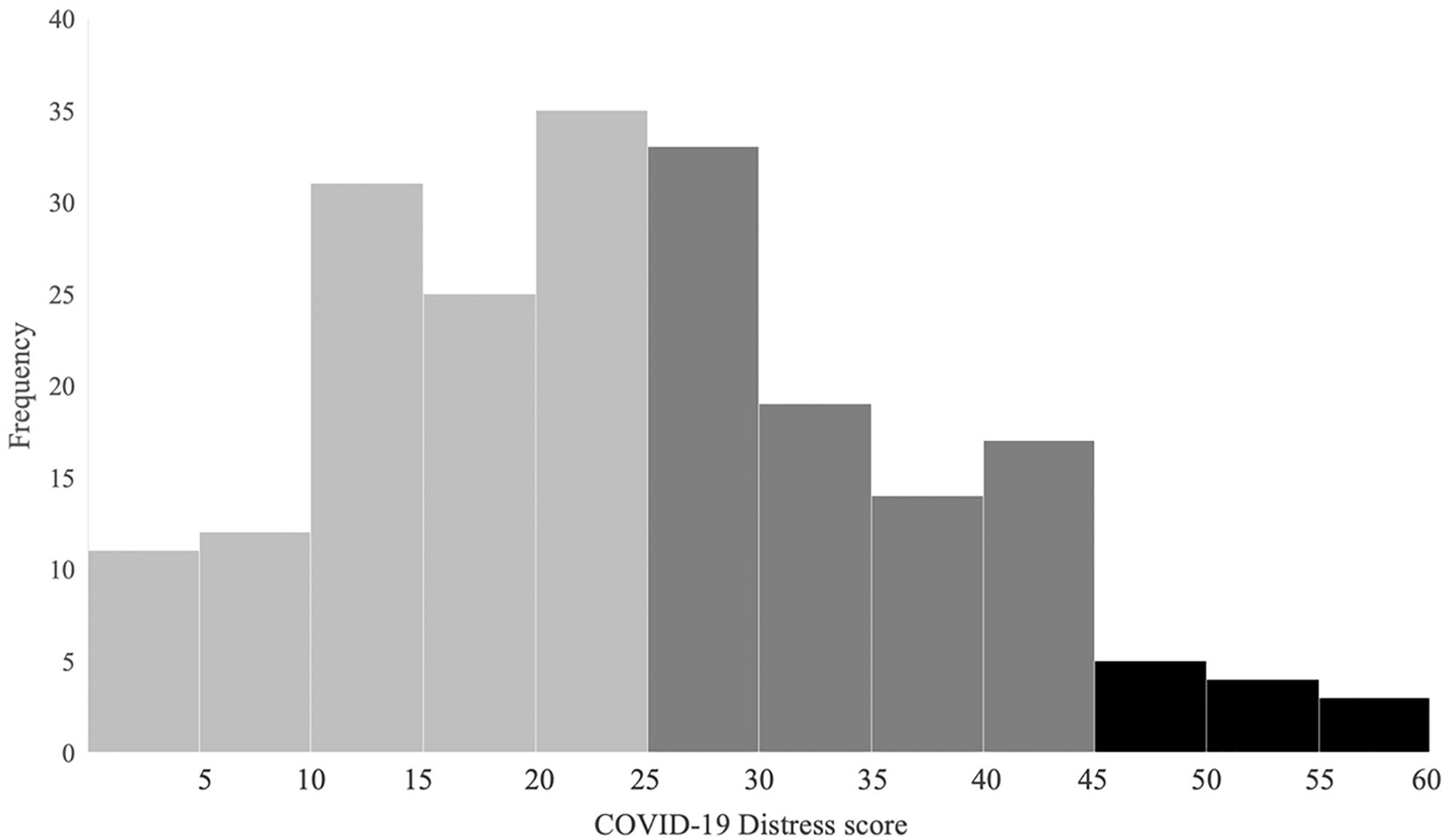
Histogram of Study 1 COVID-19 distress scores, categorized by severity of distress. Light gray indicates low-to-mild distress, medium gray indicates moderate distress, and black indicates severe distress.
Learning and Mind Wandering
Full outputs for the subsequent regression analyses are provided in Table 3. First, we examined impacts of COVID-19 distress on learning. We ran a regression analysis controlling for gender, given differences in distress, and course enrollment, given differences between courses in their accuracy on the items, F(5, 195) = 3.36, p = .006. No other baseline or demographic factors predicted mind wandering or learning. We also controlled for trait anxiety in regression analyses.
Results From the Regression Analyses of Learning From the Lesson on COVID-19 Distress (1), Mind Wandering on COVID-19 Distress (2), Learning on Mind Wandering (3), and Learning on Mind Wandering and COVID-19 Distress (4) in Study 1

Note. Standardized coefficients and standard errors (SEs) are reported. The overall models are all statistically significant: (1) F(9, 191) = 3.49, p < .001, adjusted R2 =0.10. (2) F(9, 191) = 4.09, p < .001, adjusted R2 = .12. (3) F(9, 191) = 4.48, p < .001, adjusted R2 = .14. (4) F(10, 190) = 4.62, p < .001, adjusted R2 = .15. Men and Education course 1 were included as reference categories for gender and course, respectively.
COVID-19 distress was negatively related to learning from the lesson (β = −0.22, SE = 0.07, p = .003): Those who were more distressed about COVID-19 learned less. We next tested mind wandering as a possible mechanism underlying distress-related differences in learning. A regression analysis revealed a positive relationship between COVID-19 distress and mind wandering during the lesson (β = 0.21, SE = 0.07, p = .004). Higher distressed students paid less attention to the lesson, even after controlling for their general anxious tendencies. Moreover, mind wandering during the lesson negatively predicted learning (β = −0.29, SE = 0.07, p < .001)—inattention came at a cost to learning gains. A final model simultaneously testing all predictors on learning revealed similar negative associations between mind wandering and learning (β = −0.26, SE = 0.07, p < .001) and COVID-19 distress and learning (β = −0.16, SE = 0.07, p = .03).
Mediation
Given the relations between COVID-19 distress, mind wandering, and learning, we next tested whether mind wandering may mediate the relationship between COVID-19 distress (independent variable) and learning (dependent variable), conditional on students’ gender, course enrollment, and trait anxiety using Hayes’s (2013) PROCESS model with 10,000 bootstrapped samples. We found that mind wandering during the lesson mediated the effect of COVID-19 distress on learning (β = −0.06, SE = 0.03, 95% CI [−0.11, −0.01]). After accounting for mind wandering, the magnitude of the direct effect of COVID-19 distress on learning decreased by 69% and was no longer statistically significant (β = −0.13, p = .07). This lends further evidence to suggest that distress about the pandemic might harm learning potential by co-opting attention.
Discussion
To summarize, in Study 1 we found that undergraduates—particularly FGLXW—were moderately to severely distressed about the COVID-19 pandemic on average. One in two students met the clinical criteria for treatment, and one in 10 met the criteria for extreme distress. Moreover, we found evidence to suggest that this distress was negatively related to students’ ability to learn from a brief neuroscience lesson by increasing mind wandering during instruction. These findings build on prior work establishing distraction due to mind wandering as an important mechanism underlying distress-related decrements in learning and performance (Banks & Boals, 2017; Banks et al., 2015; Mrazek et al., 2011). We add to this by showing the same pathway can explain how students’ distress regarding the COVID-19 pandemic may also affect their learning, even in one, brief learning opportunity.
Still questions remained that we wished to address in Study 2. First, though the Impact of Events Scale provided a useful assessment of global distress, it was unclear what specifically about the pandemic might have related to increases in students distress, and whether this may differ across student populations. Second, given the important mediating role of mind wandering, we next asked whether we could reduce the impact of distress on distraction by instructing students on how to regulate their feelings of stress prior to instruction.
Study 2
Recent work has called for research into how best to mitigate experiences of distress during the pandemic (Behan, 2020; Hagger et al., 2020). Two stress regulation strategies have received growing support prior to and during the pandemic: stress reappraisal and mindfulness. Each is reviewed in turn.
One strategy to alleviate the deleterious impacts of stress on performance is to reframe how we think about stress in the first place. It is commonly believed that stress is debilitating for performance (Liu et al., 2017). However, recognizing the benefits of stress and stress responses can actually promote learning and performance (Crum et al., 2020). Stress reappraisal interventions highlight the adaptive functions of moderate stress—including heightened focus, mobilization of cognitive resources, and increased blood flow to the brain—and encourage participants to think about their stress as an asset when facing a stressor (Brooks, 2013; Jamieson et al., 2010).
Stress reappraisal may promote performance by reconceptualizing stress itself as a coping resource (see Jamieson et al., 2018). In other words, though students may initially feel distressed, reappraising their sensations and perceptions means that stress would not necessarily translate to distracting thoughts and worries, lower performance, and other typically debilitating consequences of distress. Additionally, if students’ stressful and distracting thoughts are appraised as beneficial, rather than threatening, then they are less likely to engage in maladaptive coping strategies, like suppressing their thoughts and feelings, resulting in less mind wandering and improved performance (Johns et al., 2008; Schuster et al., 2015). Accumulating evidence shows that training undergraduates to reappraise their stress yields improvements in performance on stressful tests (Brooks, 2013; Jamieson et al., 2010; Jamieson et al., 2016; Johns et al., 2008) and increases in grades (Keech et al., 2018; Keech et al., 2021). These interventions are quick and oftentimes delivered via short informational videos (Crum et al., 2013; Keech et al., 2021). As such, recent work (Hagger et al., 2020) has called for researchers and practitioners alike to employ stress reappraisal strategies to reduce the psychological impact of the COVID-19 pandemic.
Another stress management strategy recommended during the pandemic is mindfulness (Behan, 2020; e.g., Sweeny et al., 2020). Mindfulness is a practice aimed at being intentionally attentive to the present moment (Bishop et al., 2004; Kabat-Zinn, 2003) and is characterized by an ethos of metacognitive monitoring, nonjudgmental acceptance, and detachment (Lindsay & Creswell, 2019; Rahl et al., 2017). Like stress reappraisal, mindfulness practices, including mindfulness-based stress reduction interventions, can reduce the impact of stress on a variety of behavioral, affective, and cognitive indices (see Brown, 2007).
Mindfulness and mind wandering are, by definition, negatively related (Mrazek et al., 2012)—one occurs in the absence of the other. Just minutes of mindfulness training can reduce the frequency and salience of mind wandering and task-irrelevant thoughts (Mrazek et al., 2012). Evidence from short and long-term interventions show that mindfulness training can promote cognitive and test performance when under high stress (Brunyé et al., 2013; Jha et al., 2010) by reducing the frequency of mind wandering (Mrazek et al., 2013). In fact, researchers have called for mindfulness training to alleviate detrimental impacts of mind wandering on academic performance (Smallwood et al., 2007).
Therefore, in Study 2, we randomly assigned some students to receive stress reappraisal or mindfulness instructions prior to watching the video lesson. Additionally, we were curious to learn more about students’ experiences during the pandemic: Specifically, what aspects of the pandemic were particularly worrisome to students. Importantly, and given prior work (Hoyt et al., 2020; Literat, 2021; Zimmermann et al., 2020), we examine whether these worries may systematically concern some students of historically marginalized backgrounds and identities more than others.
Method
Participants
This study was preregistered through the Open Science Framework (http://osf.io/kq9gp). Planned and exploratory analyses are outlined below in the Analytic Plan. Data collection for Study 2 occurred between October 2020 and March 2021, when online learning was no longer novel or in emergency implementation. A power analysis originally called for a sample size of 251 to determine a medium effect size (as we found in Study 1) between three conditions at α= .05 and power = 0.95; we oversampled to account for incomplete or inattentive student responses and the addition of a partial survey option (described below).
A total of 569 students from seven classes at two large public universities in the western United States participated in this study. Forty-nine students opted for a partial version of the survey and are analyzed separately from the remainder of the sample. Of the primary sample, students were dropped from analyses for incomplete data (n = 33), or for failing one or both of the attention checks (n = 60), for a total of 432 students (343 women, seven gender unspecified) for whom we had complete data. The undergraduate courses included four education courses (n = 71), two psychology courses (n = 275), four biology courses (n = 54), and an anthropology course (n = 27). Five students did not provide course enrollment information. Students’ self-reported race/ethnicity (44% Asian American, 35% Latinx, 10% White, 2% Black, 9% Multiracial/Other) and proportion first generation status (56% first generation) resembled Study 1 and the Hispanic-serving and Asian American Pacific Islander-serving universities’ student bodies at large.
Procedure
The procedure and measures were largely similar to Study 1. Students first completed the Impact of Events Scale (Cronbach’s α = .85), followed by the trait anxiety survey (Cronbach’s α = .93), then watched the same video neuroscience lesson, completed the Mind Wandering Questionnaire (Cronbach’s α = .92), and lastly answered the six multiple-choice comprehension items. Here, we describe the few key differences between Studies 1 and 2. First, to better understand whether our volunteer sample was representative of the student body, all recruited students were provided the option to complete the full survey or a 5-minute partial survey, which assessed demographics and general perceptions and attitudes during the pandemic. We also made two additions to the procedure prior to students watching the neuroscience lesson: First, we probed what pandemic-related concerns students were worried about. Immediately after, we manipulated stress regulation instructions for students prior to the lesson. Each modification is described next.
Measures
Partial survey
Students who volunteered to complete the approximately 45-minute survey may have been qualitatively different than the student body at large. To examine the representativeness of our sample, we offered all recruited students a 5-minute, partial survey option, which consisted of the original demographic questions from Study 1 plus four additional items assessing perceived changes in academic and personal well-being during the pandemic. All students first completed the partial survey, either for course extra credit or a $5 Amazon gift card, then were asked if they would like to continue to the full survey to receive the $20 Amazon gift card. No differences on any of the items emerged between those who completed the full or partial versions, lending some evidence to suggest that study participants who volunteered to complete the full survey were not systematically different from the student body. 2
Pandemic-related worry
Immediately following the Impact of Events Scale, we added items to assess which domains of pandemic-related concerns students found worrisome. Based on prior work (Son et al., 2020) and pilot data from Study 1, we inquired about six broad domains of concern during the pandemic: three of which captured worries about learning (technological obstacles to learning, social obstacles to learning, distractions in the learning environment) and three of which captured more general worries (health concerns, economic concerns, and social support concerns). For each of the six domains, we first asked students whether or not they worried about it, and if so, the extent to which they worried about it. The latter was measured on a 0 to 100 sliding scale (0 = not worried, 100 = very worried) and we summed across these values for each domain to create a composite worry index (range: 0–600). Then, for each domain, we posed an open-ended question where we invited students to elaborate on their worries. Though these responses are not analyzed here, we provide example quotes for descriptive purposes in Table 4.
Domains of Pandemic-Related Concerns and Example Quotes From Students’ Open-Ended Responses

Stress reappraisal and mindfulness instructions
Prior to the video neuroscience lesson, students were randomly assigned to a control condition or to one of two stress regulation conditions: Stress Reappraisal or Mindfulness. All students were informed that they would watch a video that would teach them a research-based technique to help students learn during difficult times. The videos were designed by the researchers and modelled after prior research. Each video was approximately 3 minutes in length and consisted of images, animation, and on-screen text plus narration.
Stress reappraisal and mindfulness videos consisted of the same four parts: First, we described the concern about distraction expressed by undergraduates at their institution. Then, we briefly summarized the science behind stress and distraction. Third, we defined stress reappraisal or mindfulness, and described how the strategy can reduce the impact of distress on distraction.
Critically, both videos highlighted the attention enhancing attributes of each strategy. In the stress reappraisal video (modeled after Beltzer et al., 2014; Crum et al., 2013; Jamieson et al., 2010), students were informed of the often-unconsidered adaptive side of stress–specifically, that stress hormones can activate higher order cognitive and physiological functions necessary for performance, including helping students focus their attention on what they need to learn. Students in the stress reappraisal condition were encouraged to view any distressing thoughts or feelings that may arise as adaptive when watching the video lesson. In the mindfulness video (modeled after Erisman & Roemer, 2010; Mrazek et al., 2012; Mrazek et al., 2013; Schuster et al., 2015), students were instructed to mindfully and nonjudgmentally accept and let go of any stressful thoughts or feelings. Doing so during the lesson, they were informed, would help them preserve their limited higher order cognitive functions and help them focus their attention on what they need to learn.
After the video instructions, those in the stress reappraisal and mindfulness conditions were asked to take three minutes to practice the strategy before the lesson began. Students were invited to free write about any current distressing or distracting thoughts and feelings and describe how they would apply their given strategy to mitigate these experiences during the lesson.
Those in the control condition watched a shorter video (approximately 15 seconds) that simply asked them to pay attention to the upcoming lesson. They did not free write prior to the lesson.
Strategy use and perceived efficacy
After the neuroscience lesson video, students in the mindfulness and reappraisal conditions were asked whether or not they actually attempted their instructed strategy (strategy use) and were asked to use a 7-point Likert-type scale (1 = not at all; 4 = somewhat; 7 = very much) to report how much they agreed that the strategy they learned about could be useful for improving their learning in future online courses (perceived efficacy). All students then proceeded to answer the six multiple-choice comprehension items.
Analytic Plan
The analytic plan is similar to Study 1. We first describe COVID-19 distress among our sample and use exploratory ANOVAs to explore demographic correlates of distress. Next, in another exploratory analysis, we use chi-square tests and t tests to describe students’ pandemic-related worries and examine how this too may differ among students. Then, in line with Study 1, we use multiple regression analyses to test predicted relations between distress, mind wandering, and learning from the video lesson, and test the mediational pathway. Finally, we test the effects of mindfulness and stress reappraisal instructions on students’ mind wandering and learning using regression analyses, and examine students’ perceived efficacy of each strategy with ANOVAs. We conclude with exploratory analyses of students’ implementation of each strategy, including chi-square tests, logistic regression, and an instrumental variable analysis to account for noncompliance. Standardized beta coefficients and standard errors are reported.
Results
COVID-19 Distress
Overall descriptive statistics for all measures are provided in Table 5. First, we examine students’ global COVID-19 distress (Impact of Events scale). Then, we explore their specific pandemic-related worries. Women, F(2, 429) = 2.87, p = .06, first generation students, F(1, 430) = 0.03, p = .87, and Latinx students, F(1, 430) = 0.35, p = .56, had similar average COVID-19 distress scores compared with their peers. Similarly, FGLXW had similar average distress to the sample at large, F(1, 430) = 1.18, p = .28. Fifty percent of the sample met the criteria for moderate distress and 12% were severely distressed (see Figure 2). Compared with their peers, a greater proportion of women were moderately or severely distressed, χ2(2) = 7.44, p = .02.
Descriptive Statistics for All Measures in Study 2, by Self-Reported Student Identity and Condition
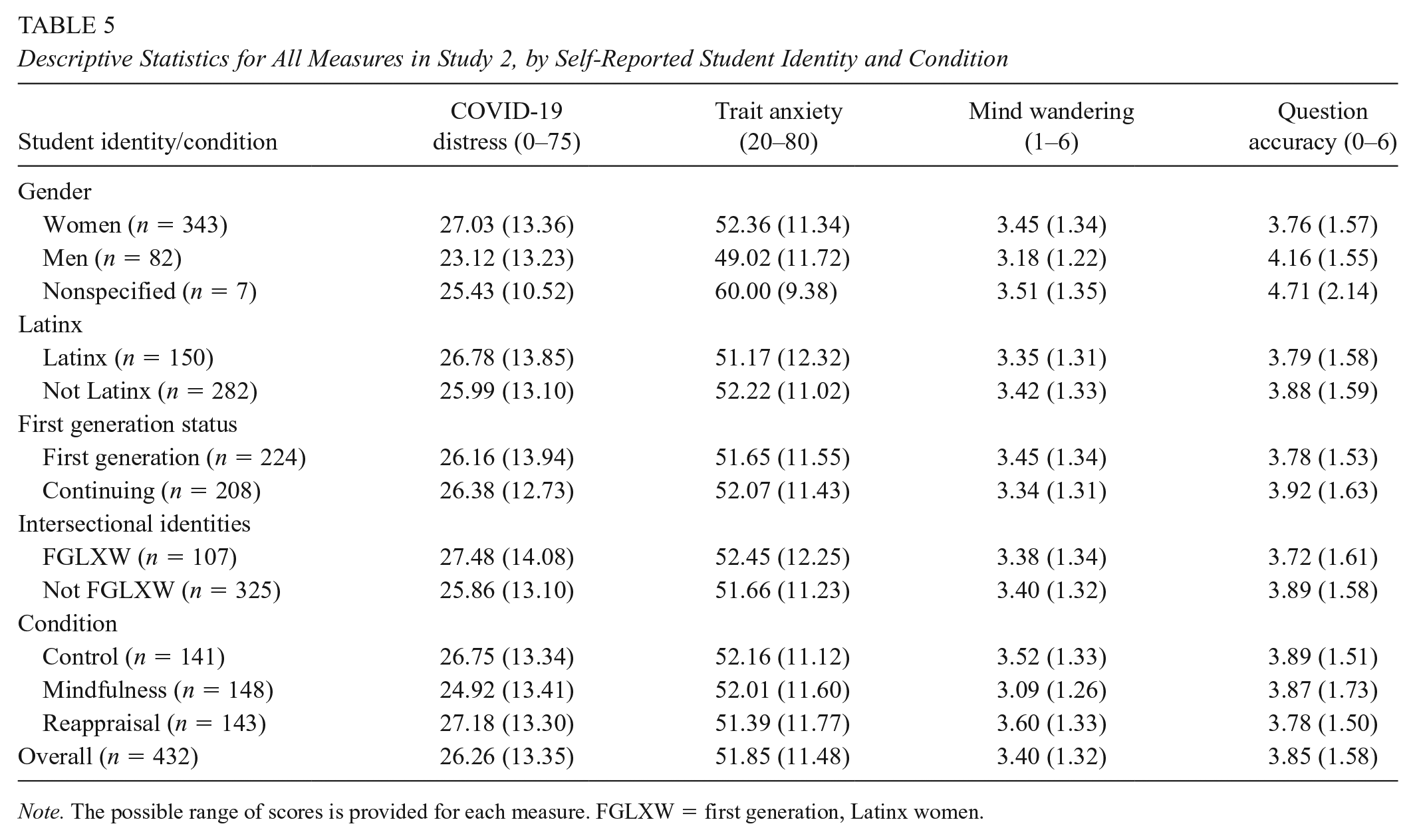
Note. The possible range of scores is provided for each measure. FGLXW = first generation, Latinx women.

Histogram of Study 2 COVID-19 distress scores, categorized by severity of distress. Light gray indicates low-to-mild distress, medium gray indicates moderate distress, and black indicates severe distress.
Pandemic-Related Worry
Data for pandemic-related worries are provided in Table 6. At least half of the sample reported worrying about each domain of concern, highlighting the pervasive impact of the pandemic. Students most commonly reported concern regarding the health of themselves and their loved ones, with 80% of the sample reporting having worried about it at some point, followed by worries about social obstacles to their learning, worry regarding finding necessary social support, and worry about distractions during learning.
Frequency of Worry About Pandemic-Related Domains by Self-Reported Student Identity

Note. Percentage values refer to the proportion of students responding yes to worrying about each pandemic-related domain. Difference? indicates a statistically significant difference between groups as measured by chi-square tests.
p < .10. *p < .05. **p < .01. ***p < .001.
These worries disproportionately affected some students more than others. Figure 3 shows students’ composite worry index by student-reported identity. Students’ worry index was positively related to their COVID-19 distress, r(430) = 0.43, p < .001. In line with gender differences in students’ general COVID-19 distress, in an exploratory analysis we found that women worried to a greater extent than men, t(423) = −2.86, p =.004, d = −0.35. We also found that Latinx students, t(430) = −2.97, p =.003, d = −0.30, and first generation students, t(430) = −3.40, p <.001, d = −0.33, were more worried than their peers. In fact, these identities intersected to predict worry: FGLXW worried to a greater extent than their peers, t(423) = −3.61, p < .001, d = −0.40.
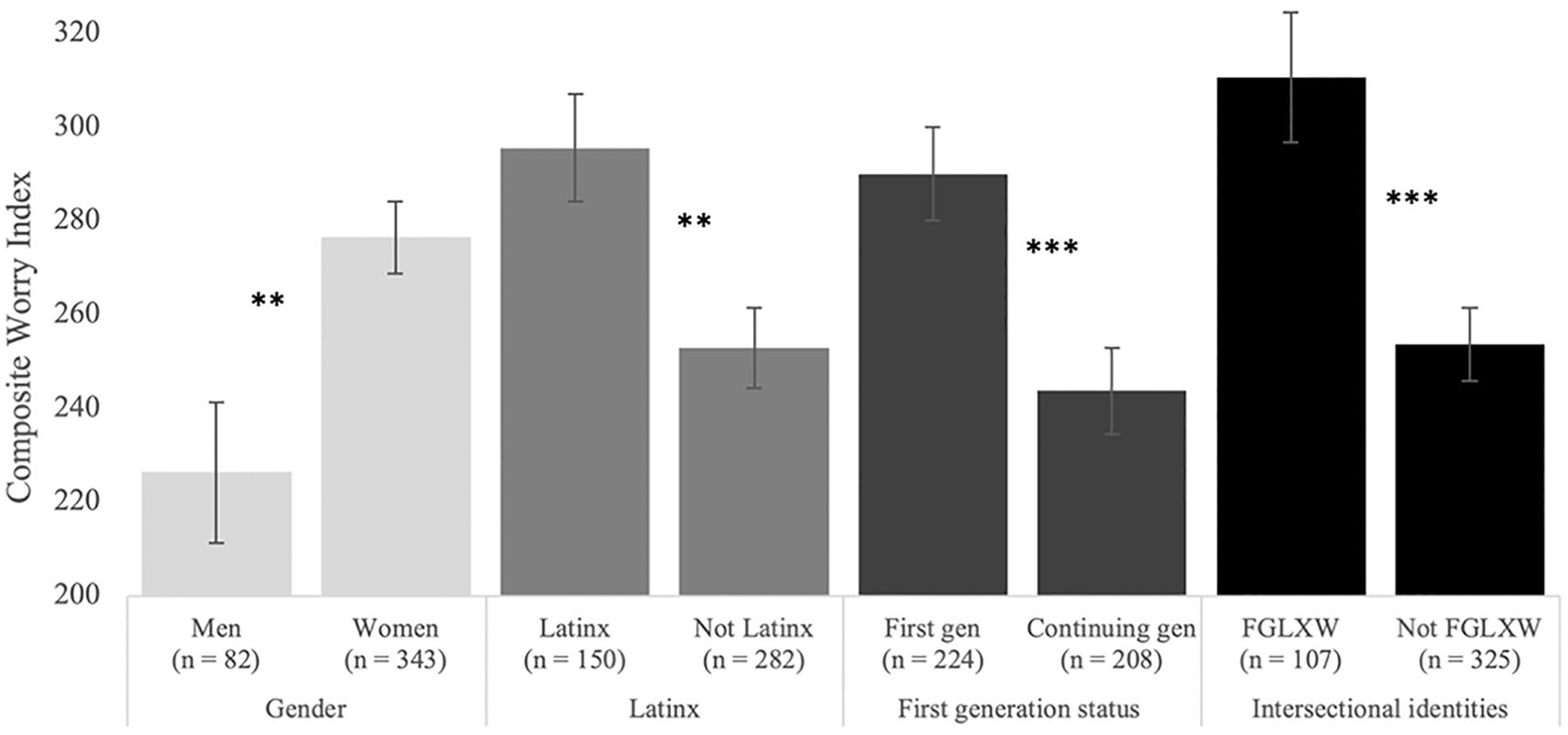
Students’ composite worry index by self-reported student identity. Error bars are ± 1 standard error of the mean. Cohen’s d effect sizes are reported in the text. FGLXW is an indicator for whether or not a student is a first generation, Latinx woman.
We next explored whether these differences in worry were specific to certain domains of pandemic-related concern. Differences by student self-reported identity were most pronounced in the domains of economic concerns and distractions (see Table 6). Again, these identities intersected to disproportionately impact FGLXW, a greater proportion of whom expressed worry about distractions while learning, χ2(1) = 8.40, p = .004, and economic consequences of the pandemic, χ2(1) = 4.78, p = .03, compared with their peers. Thus, not only do FGLXW worry to a greater extent than their peers across all pandemic-related domains, which is related to more COVID-19 distress in general, but they also worry about distractions while learning disproportionately more frequently than their peers.
Learning and mind wandering
Full regression outputs for subsequent regression analyses are provided in Table 7. Because women were more distressed (see above) and, surprisingly, learned less than their peers, F(2, 429) = 3.22, p = .04, η2 = .015, gender is included as a covariate alongside trait anxiety in all subsequent analyses (though all results held with and without gender as a covariate). No other baseline or demographic factors predicted mind wandering or learning. COVID-19 distress was not a statistically significant predictor of students’ learning (β = −0.09, SE = 0.05, p = .08), but distress did predict students’ mind wandering during the lesson (β = 0.15, SE = 0.05, p = .003). Again, greater mind wandering predicted lower learning from the lesson (β = −0.33, SE = 0.05, p < .001). When mind wandering and COVID-19 distress were both included in the same model, only mind wandering remained a statistically significant predictor of learning (β = −0.33, SE = 0.05, p < .001).
Results From the Regression Analyses of Learning from the Lesson on COVID-19 Distress (1), Mind Wandering on COVID-19 Distress (2), Learning on Mind Wandering (3), and Learning on Mind Wandering and COVID-19 Distress (4) in Study 2

Note. Standardized coefficients and standard errors are reported. The overall models are all statistically significant. (1) F(4, 427) = 3.00, p = .02, adjusted R2 = .02. (2) F(4, 427) = 10.83, p < .001, adjusted R2 = .08. (3) F(4, 427) = 15.06, p < .001, adjusted R2 = .12. (4) F(5, 426) = 12.17, p < .001, adjusted R2 = .11. Men were included as the reference category for gender.
Mediation
Using the same mediation analysis as in Study 1, we found that mind wandering mediated the relation between COVID-19 distress and learning (β = −0.05, SE = 0.02, 95% CI [−0.09, −0.02]). The direct effect was reduced by nearly half and became statistically insignificant after accounting for mind wandering (β = −0.05, p = .35). Again, this provides some support for the claim that pandemic-related distress compromised learning potential by increasing distraction.
Effects of Stress Reappraisal and Mindfulness on Mind Wandering and Learning
We next test whether the prompts to use mindfulness or stress reappraisal prior to the lesson mitigated the relations among distress, mind wandering, and learning. Gender, χ2(4) = 5.96, p = .20; first generation status, χ2(2) = 0.04, p = .98; race/ethnicity, χ2(10) = 10.75, p = .38; course enrollment, χ2(12) = 5.72, p = .93; trait anxiety, F(2, 429) = 0.18, p = .84; and COVID-19 distress levels, F(2, 429) = 1.18, p = .31, were balanced across the three conditions.
In a first model examining main effects of condition, a regression analysis revealed statistically significant differences between conditions in mind wandering (see Table 8). On average, those in the mindfulness condition reported mind wandering less frequently than those in the control (β = −0.32, SE = 0.11, p = .006) and those in the reappraisal condition (β = −0.39, SE = 0.12, p = .001). Interestingly, there were no differences in mind wandering between reappraisal and control conditions (β = 0.06, SE = 0.12, p = .57). A second model added COVID-19 distress and the trait anxiety covariate, showing expected positive associations to mind wandering. The final model tested whether condition might interact with COVID-19 distress to predict mind wandering, revealing no statistically significant interactions. This suggests that mindfulness helped all students maintain greater attention, regardless of how distressed they were.
Results From the Regression Analysis of Mind Wandering During the Lesson on Condition in Study 2
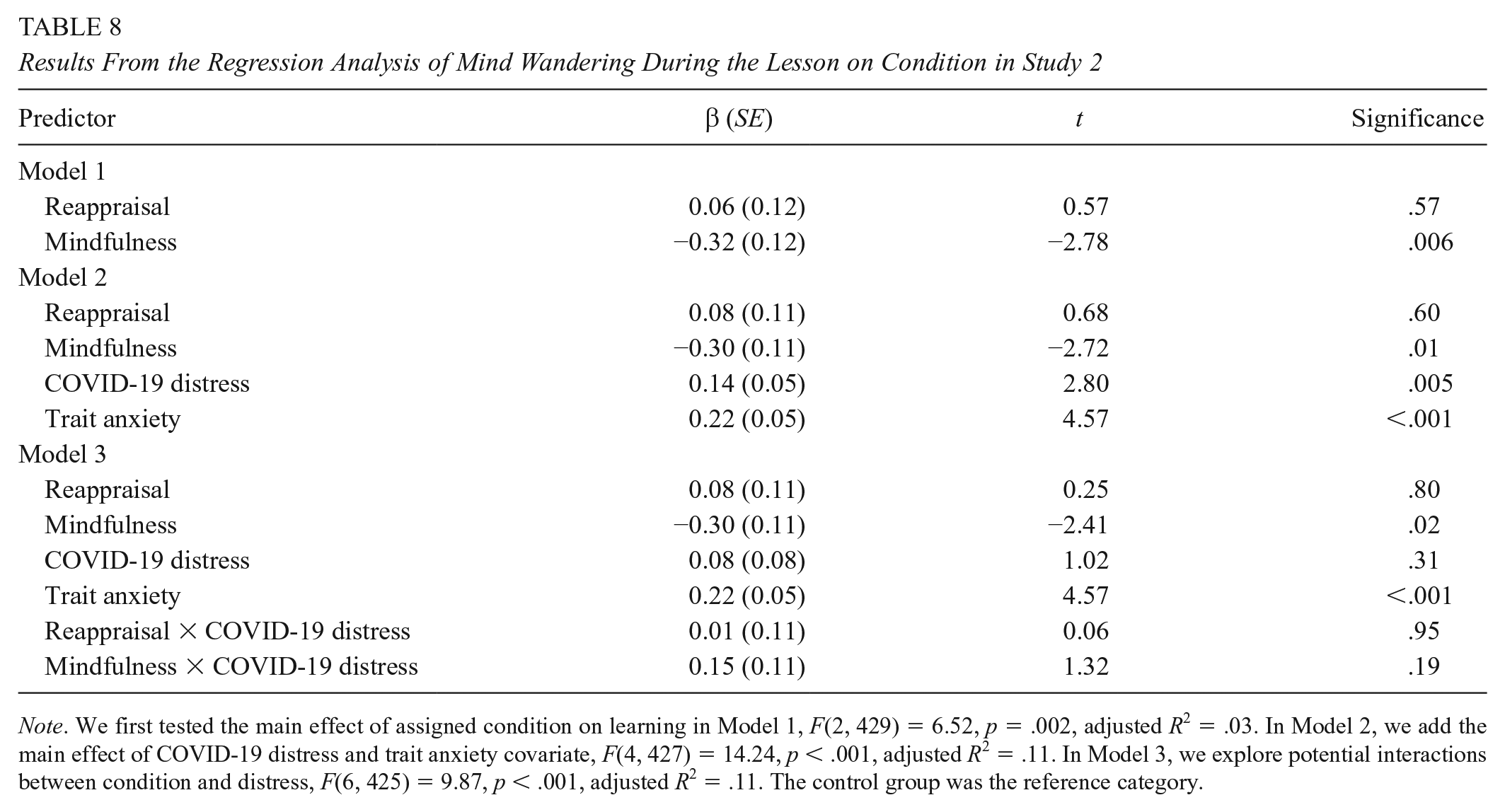
Note. We first tested the main effect of assigned condition on learning in Model 1, F(2, 429) = 6.52, p = .002, adjusted R2 = .03. In Model 2, we add the main effect of COVID-19 distress and trait anxiety covariate, F(4, 427) = 14.24, p < .001, adjusted R2 = .11. In Model 3, we explore potential interactions between condition and distress, F(6, 425) = 9.87, p < .001, adjusted R2 = .11. The control group was the reference category.
We repeated the above regression analysis with learning as the outcome (see Table 9). Though mindfulness reduced mind wandering, there was no effect of either mindfulness or reappraisal condition on learning from the lesson. Again, neither condition interacted with COVID-19 distress levels to predict learning.
Results From the Regression Analysis of Learning From the Lesson on Condition in Study 2

Note. We first tested the main effect of assigned condition on learning in Model 1, F(2, 429) = 0.19, p = .82, adjusted R2 = −.004. In Model 2, we add the main effect of COVID-19 distress and trait anxiety covariate, F(4, 427) = 1.72, p = .15, adjusted R2 = .007. In Model 3, we explore potential interactions between condition and distress, F(6, 425) = 1.60, p = .15, adjusted R2 = .008. The control group was the reference category.
Use and Perceived Efficacy of Stress Reappraisal and Mindfulness
Mean perceived efficacy across both experimental conditions was 4.85, roughly corresponding to the midpoint of the scale (somewhat useful). An ANOVA revealed no differences between mindfulness (M = 4.91, SD = 1.25) and reappraisal (M = 4.78, SD = 1.28) conditions in their perceived efficacy, F(1, 289) = 0.84, p = .36. Controlling for trait anxiety, condition did not interact with COVID-19 distress levels to predict perceived efficacy, F(1, 286) = 0.66, p = .42.
In an exploratory analysis, we sought to understand whether students actually attempted the instructed strategy during the lesson, given that the strategies were perceived as only somewhat useful on average. Those who reported that they actually used the strategy (M = 5.07, SD = 1.21) also reported finding the strategy more effective than those who did not, M = 4.20, SD = 1.19; t(289) = 5.38, p < .001, d = 0.72. Strikingly, a greater proportion of students in the mindfulness condition (86%) reported using their instructed strategy than those in the reappraisal condition, 62%; χ2(1) = 22.13, p < .001: approximately two of every five students in the reappraisal condition did not even attempt to use the strategy after instruction.
We conducted an exploratory logistic regression analysis to understand what factors were related to compliance. We regressed compliance on students’ assigned condition, COVID-19 distress levels, and their interaction, controlling for trait anxiety. Students in the mindfulness condition (odds ratio = 8.74, SE = 5.69, p = .001) and those higher in COVID-19 distress (odds ratio = 1.03, SE = 0.01, p = .04) were more likely to comply. Trait anxiety did not predict compliance (odds ratio = 0.98, SE = 0.01, p = .20); nor did condition interact with COVID-19 distress to predict compliance (odds ratio = 0.97, SE = 0.02, p = .15).
To better understand the effects of mindfulness and stress reappraisal for those who did use their instructed strategy, we conducted instrumental variable analyses using students’ compliance to mindfulness and reappraisal treatments as an instrument for assigned condition on students’ mind wandering, learning, and perceived efficacy of their strategy. All results held after accounting for students’ noncompliance (see online Supplemental Materials for full analyses). In sum, these results suggest that though mindfulness may in fact reduce distraction, other factors may be important in order for increased attention to translate to learning.
Discussion
Study 2 replicated the findings from Study 1 and included students from another university, at a later time point during the pandemic when online learning was no longer novel or in emergency implementation. We again found that COVID-19 distress impaired learning via increased mind wandering, emphasizing the important role of attention. Only mindfulness instructions, not stress reappraisal, reduced mind wandering during the lesson, though this did not necessarily translate to improvements in learning. Compared with reappraisal, participants were more likely to attempt the mindfulness intervention, which might have implications for realistic spontaneous usage in the future. This aligns with prior work showing that participants assigned to use reappraisal strategies during laboratory studies frequently report using different, uninstructed strategies (e.g., distraction, suppression; Opitz et al., 2015; Parsafar et al., 2019). Noncompliance to reappraisal is more likely when managing reactions to highly intense or distressing experiences (Opitz et al., 2015). Nonetheless, students in our study endorsed both stress regulation approaches equally, and using an instrumental variable analysis, we did not find evidence that noncompliance changed the effect of the interventions on perceived strategy efficacy nor on engagement during and learning from the lesson.
Moreover, an exploratory analysis of student worry revealed considerable differences among students. Specifically, FGLXW not only worried about a greater number of pandemic-related factors but also worried to a greater extent about these concerns than their peers, which was related to the more global measure of COVID-19 distress. Our work and others’ (Hoyt et al., 2020; Literat, 2021; Zimmermann et al., 2020) elucidate the unfortunate reality that the pandemic may potentially exacerbate inequalities in educational attainment and opportunity at the university level. The shift to remote learning has meant that women, racial/ethnic minorities, and low-income students have had to shoulder more responsibilities at home, in addition to satisfying their course requirements without the supports and assistance afforded during in-person instruction (Hoyt et al., 2020; Yip et al., 2020). In line with this, we found that experiencing distractions during learning was the pandemic-related concern with the largest and most consistent differences across gender, racial/ethnic, and first/continuing generation groups, suggesting that certain students might already be cognizant of the potential impacts of distractions on their achievement. Notably, however, FGLXW in our study did not see lower learning compared to their peers, perhaps indicative of resilience.
To combat the observed distress-to-distraction pathway, we instructed some students to use one of two research-backed stress regulation strategies: stress reappraisal and mindfulness. Both have received growing attention as effective means to reduce negative affective experiences, like distress, increase task-directed focus and attention, and improve learning. We only found that mindfulness, not reappraisal, reduced mind wandering during the lesson. Mindfulness and mind wandering are considered two sides of the same coin (Mrazek et al., 2012), yet stress reappraisal is also a tested means to reduce mind wandering (Johns et al., 2008; Schuster et al., 2015). In Study 2, we intentionally designed the videos such that mentions of focus, distraction, and attention were consistent across conditions. Nevertheless, perhaps mindfulness, with its emphasis on simply accepting and letting go of distracting thoughts, was easier to implement than reappraisal, which requires a complete reimagination of commonly held beliefs about stress and stressful experiences.
In support of this, Troy et al. (2018) asked adults to either accept or reappraise their feelings while watching a sad film. Those instructed to reappraise their feelings believed the strategy was more difficult to implement and less effective than those instructed to accept their feelings (also see Sheppes & Gross, 2011). A foundational element of mindfulness (Lindsay & Creswell, 2019), acceptance instructs against control and manipulation of emotional experience, unlike reappraisal.
In fact, adults do not commonly use reappraisal in everyday life (Brans et al., 2013; Ford & Troy, 2019; Suri et al., 2015), particularly as stressors become more intense (Sheppes et al., 2014). In a survey of undergraduates’ coping during the pandemic, Son et al. (2020) found that only 2% of students reported using reappraisal to cope with pandemic-related concerns, compared with 29% using mindfulness-like practices (e.g., breathwork). Both perceived intensity of stressor and perceived effort to implement strategies predict which stress regulation strategies individuals will adopt (Sheppes et al., 2014). This could explain why fewer students even attempted reappraisal when instructed, and why reappraisal did not lead to reduced mind wandering. Perhaps with additional practice, reappraisal would have been perceived as less demanding and more likely to be adopted (McRae et al., 2012; Ortner et al., 2016; see Sheppes & Gross, 2011).
General Discussion
Across nearly 700 undergraduate students from 13 courses within two universities, we test a pathway by which distress about the COVID-19 pandemic can compromise students’ learning by increasing the frequency that their mind wanders during instruction. This work adds to a growing literature showing that negative affective experiences during learning, like excess stress and anxiety, can divert limited attentional resources to threat-related thoughts and hinder learning potential (Jamieson et al., 2012; Schmader et al., 2008). We add to this literature, and to the recent work underscoring students’ own perceptions of pandemic-related sources of distraction as a major impediment to their academic achievement (e.g., Chirikov et al., 2020; Son et al., 2020), by exemplifying this distress-to-distraction pathway in an assessment of undergraduates’ learning during the ongoing COVID-19 crisis. We only assessed learning from one short video lesson, yet research finds that even brief instances of mind wandering during learning can impair students’ higher order reasoning and inference (Smallwood et al., 2008), creating gaps which may compound over time (Smallwood et al., 2007), Additionally, given systematic differences between students in their distress and worry, these initial differences could serve to widen achievement gaps in the long term. Last, though we find large, consistent relations between distress, mind wandering, and learning, we note that our conclusions may be somewhat limited as we did not probe precisely what students were mind wandering about during instruction. Mind wandering might not have led to decrements in learning were students distracted by thoughts relevant to the lesson (Jing et al., 2016; Wammes et al., 2016b).
Distress levels remained concerningly high across Study 1 (Spring and Summer 2020) and Study 2 (Fall 2020 and Winter 2021), suggesting that the psychological impacts of COVID-19 did not necessarily diminish as the pandemic continued, though comparisons are limited with our cross-sectional design (see Hoyt et al., 2020; Zimmermann et al., 2020, for longitudinal evidence). Nonetheless, mitigating the effect of distress on distraction will remain an important endeavor. Before the pandemic, a majority of students already believed heightened stress to be a major impediment to their academic achievement (American College Health Association, 2020), and much work has reliably documented relations between excess daily stress and cognitive performance (e.g., Banks & Boals, 2017; Banks et al., 2015). Moreover, though we have focused on video-based lessons, mind wandering reliably predicts learning during in-person instruction as well (Lindquist & McLean, 2011; Wammes et al., 2016b). Thus, researchers must continue efforts to preserve students’ attention in the face of everyday sources of distress. We posit that brief mindfulness training may be one way to reduce the effects of distress on distraction while learning, particularly when there is little time for training. Yet, attention is necessary but likely insufficient to produce long-lasting, meaningful changes in learning: motivational factors important for student engagement and learning, like interest in the material to be learned (Wammes et al., 2016a), are likely necessary to see gains in learning and thus warrant future investigation.
We pursued stress regulation strategies as one way to monitor and mitigate distraction during learning, as these interventions can be successfully administered to students at scale via brief videos, making it a feasible pedagogical intervention. However, proactive modifications to the learning environment may be more effective for reducing mind wandering and its subsequent effects on learning (see Szpunar, 2017). During both online and in-person instruction, such modifications may include low-stakes quizzes before (Pan et al., 2020) or throughout (see Schacter & Szpunar, 2015) the lesson, which can reduce mind wandering during instruction, lower test anxiety, motivate effort to learn, and improve students’ metacognitive awareness of their learning.
Supplemental Material
sj-docx-1-ero-10.1177_23328584211065721 – Supplemental material for Distressed to Distracted: Examining Undergraduate Learning and Stress Regulation During the COVID-19 Pandemic
Supplemental material, sj-docx-1-ero-10.1177_23328584211065721 for Distressed to Distracted: Examining Undergraduate Learning and Stress Regulation During the COVID-19 Pandemic by Almaz Mesghina, Joseph T. Wong, Elizabeth L. Davis, Bella S. Lerner, Bryant J. Jackson-Green and Lindsey E. Richland in AERA Open
Footnotes
Acknowledgements
This work was supported by the Institute of Education Sciences, U.S. Department of Education, under grant number R305B140048 to the first author via the University of Chicago; and the National Science Foundation, under grant number 32027447 to the last author via the University of California, Irvine. The opinions expressed are those of the authors and do not necessarily represent the views of the funders.

Notes
Authors
ALMAZ MESGHINA was at the University of Chicago and is an assistant professor of instruction in the Department of Psychology at Northwestern University. She is interested in cognition–emotion interactions and their implications for classroom learning.
JOSEPH T. WONG is a doctoral student at the University of California, Irvine, who studies teaching, learning, and educational improvement (TLEI) while specializing in digital learning and media. His research is focused on the intersection of science education, digital media, and higher-order thinking.
ELIZABETH L. DAVIS, is an associate professor at the University of California, Riverside, Department of Psychology. Her research focuses on understanding how emotion regulation relates to adaptive outcomes (e.g., learning) and maladaptive outcomes (e.g., anxiety) in childhood.
BELLA S. LERNER is a lab manager at the University of California, Irvine’s School of Education. Her research interests include utilizing techniques such as mindfulness to support positive outcomes in both academic achievement and mental health.
BRYANT J. JACKSON-GREEN is a JD/PhD student in social ecology at the University of California, Irvine. His research centers on criminal justice policy and organizational theory, as well as learning and instruction for criminal justice students.
LINDSEY E. RICHLAND, is an associate professor of education at the University of California, Irvine. Her research program takes a cognitive approach to the study of thinking, reasoning, and learning in context, including in schools, homes, and the COVID-19 pandemic.
References
Supplementary Material
Please find the following supplemental material available below.
For Open Access articles published under a Creative Commons License, all supplemental material carries the same license as the article it is associated with.
For non-Open Access articles published, all supplemental material carries a non-exclusive license, and permission requests for re-use of supplemental material or any part of supplemental material shall be sent directly to the copyright owner as specified in the copyright notice associated with the article.
