




Abstract
Whereas developing meaningful connections with students has long been documented as critical for promoting classroom engagement, teachers’ differing motives for building relationships with students remain underexplored. This study examined teachers’ social achievement goals from a multidimensional perspective in relation to teachers’ self-efficacy, teacher–student relationships, and perceived classroom engagement. Results from practicing K–12 teachers (N = 154) from across Canada showed three distinct goal orientations including social mastery-approach, social mastery-avoidance, and social ability goals (combining social ability-approach and social ability-avoidance goals). Teachers who aimed to develop better social skills with students (social mastery-approach goals) reported higher self-efficacy, better relationships with students, and greater classroom engagement. In contrast, social goal orientations focused on not losing connections with students (social mastery-avoidance goals) or being well-liked (social ability goals) did not correspond with self-efficacy or classroom outcomes. Implications concerning integrative pedagogies and growth mind-sets pertaining to relationship building were discussed.
Keywords
Although existing research has examined teacher caring and perceived autonomy support for building positive classroom climates (e.g., Ciani et al., 2010; Deci & Ryan, 2014; Pianta et al., 2012), there is limited research on teachers’ underlying motivation for developing close connections with students (social achievement goals); namely, the qualities of their social motivation (i.e., reasons). In contrast, existing research has explored teachers’ social motivation as a fixed personality trait (teacher caring; Cornelius-White, 2007) or with respect to context-driven instructional skills (autonomy-supportive teaching; Awang-Hashim et al., 2017; Niemiec & Ryan, 2009). Although previous studies have employed multidimensional conceptualizations of teachers’ instructional goal orientations (e.g., mastery/ability vs. approach/avoidance dimensions) and found differential effects on both instructional behaviors and student learning (Butler, 2007; Butler & Shibaz, 2008), teachers’ social goals have yet to be evaluated from a quality-oriented lens. To address this research gap, the present study explored the effects of teachers’ social goals, as assessed from a multidimensional perspective focused on underlying reasons, on teachers’ self-efficacy as well as their perceived quality of relationships with their students and classroom engagement.
Social Motivation in Teachers: An Achievement Goals Perspective
Effective classroom instruction is affected by not only teachers’ goals to master or demonstrate instructional proficiency but also their social goals aimed at developing meaningful relationships with students and a supportive learning environment. Whether during or outside of class, students value teachers’ efforts and commitment to reach out to them, to understand their lived experiences, and to fulfill their relatedness needs especially when they encounter learning-related challenges (McHugh et al., 2013). Although teachers’ social motivation in regards to building relationships with students has received increasing attention in teacher motivation research in recent years, existing studies have focused mainly on teachers’ affective needs (relatedness; Deci & Ryan, 2000), perceived interpersonal competencies (self-efficacy; Veldman et al., 2017), interpersonal appraisals (attributional bias toward students; Miller & Ross, 1975), or the overall perceived importance of fostering teacher–student connections (relational goals; Butler, 2012). For example, recent research has operationalized teachers’ relational goals as the perceived importance of achieving a “personal connection” with students, and developing positive, friendly, or partner-like teacher–student relationships (Daumiller et al., 2019; Daumiller et al., 2021).
Teachers’ social goals have to date been predominantly assessed as one of five key instructional goal orientations proposed by Butler (2012); a critical teaching goal addressing the importance of building meaningful teacher–student relationships. In contrast to this general social goal construct, the other goals proposed by Butler focus specifically on teaching practices as inspired by the 2 × 2 goal orientation model developed by Elliot (1999; see Elliot, 2005, for a review). According to this model, individuals in achievement settings are motivated to either improve or demonstrate their competencies (mastery vs. performance focus) and to either approach success or avoid failure (Elliot & Harackiewicz, 1996). This four-factor achievement goals framework has typically been reduced to a trichotomous model (excluding mastery-avoidance goals) that has been widely used to predict academic development in students (e.g., Skaalvik, 2018), with students’ social goals being additionally incorporated to better predict student outcomes (e.g., Ryan & Shim, 2006, 2008).
Following from this approach, Ryan and Shim (2006) applied the trichotomous model to differentiate college students’ social goals of wanting to develop close relationships with peers. Factor analytic results showed students’ social goals to be subdivided according to three factors, namely focusing on developing social skills, demonstrating social abilities, and avoiding demonstrations of social ineptitude. Moreover, students’ social development goals predicted better social adjustment (i.e., positive relations, social acceptance, personal growth), whereas social demonstration-approach and avoidance goals had negative effects on student well-being outcomes. In a follow-up study with sixth graders (Ryan & Shim, 2008), social demonstration-approach goals were again associated with poorer outcomes including more aggressive behaviors and less prosocial acts as assessed by teachers. Although students who tried to avoid being socially undesirable (i.e., social demonstration-avoidance goals) showed less aggressive behaviors, they were more self-conscious and were more likely to be perceived as socially withdrawn by their teachers. Accordingly, just as the application of the achievement goal framework contributes to a more nuanced understanding of social goals in students, it may similarly prove beneficial in helping us better understand the structure of teachers’ social goals and how they affect instructional effectiveness and teacher development.
Teachers’ Social Goals and Classroom Outcomes
Teachers’ motivation to develop meaningful relationships with students, assessed as teachers’ social goals based on the achievement goals framework, has been repeatedly demonstrated to correspond with more adaptive teaching practices and student learning. Extant literature shows that teachers who are more motivated to foster deeper connections with students provide greater social–emotional support as perceived by both themselves and their students and use more mastery-oriented instructional methods that focus on student improvement (Butler, 2012; Butler & Shibaz, 2014; H. Wang et al., 2017) and foster students’ needs for relatedness and autonomy (Butler, 2012; George & Richardson, 2019). Studies have also shown greater social goals in teachers to correspond with students viewing help-seeking as self-beneficial rather than self-threatening in nature (Butler & Shibaz, 2014) as well as better self-rated teaching quality (Daumiller et al., 2019). Teachers’ social goals have also been found to positively correspond with teachers’ own emotional well-being (e.g., positive affect, Daumiller et al., 2019; teaching-related enjoyment, H. Wang et al., 2017).
However, recent findings also show mixed effects of relational goals, with Daumiller et al. (2021) showing that although stronger relational goals in postsecondary instructors correspond with lower student boredom, they also corresponded with significantly poorer self-assessed learning in students and lower evaluations of teaching effectiveness. Nevertheless, recent research on teachers’ relational goals suggests that examining latent profiles across multiple goal subtypes may help account for otherwise mixed results. Specifically, Watt et al. (2021) found relational goals to overlap considerably with mastery-oriented instructional goals, and that assessing these goal subtypes in combination (i.e., as “task” goals) showed a consistent pattern of results whereby profiles high on task goals predicted greater instructional support and more positive school climates. Accordingly, whereas teachers’ overall social goal orientations are consistently associated with positive outcomes, recent findings highlight the importance of further exploring teachers’ social goal orientations, namely the extent to which different social goal subtypes (e.g., focusing on mastery vs. demonstrating ability) may differentially correspond with classroom and well-being outcomes.
A Multidimensional Approach to Teachers’ Social Goals
As noted above, teachers’ instructional goals have previously been differentiated according to a 2 × 2 framework (Elliot, 1999) with students’ social goals having similarly been differentiated to explore potentially differing reasons for developing social connections in class (e.g., Ryan & Shim, 2006). Similarly, teachers’ social goals could also be examined based on their underlying qualities (e.g., mastery/ability focus vs. approach/avoidance tendency). In other words, it is possible that teachers’ general instructional goal orientations could each be assessed in a more domain-specific manner, with each goal orientation (e.g., mastery-approach goals) being further specified as pertaining to developing relationships with students (e.g., social mastery-approach goals). For example, social mastery-approach goals would entail teachers’ desires to improve their social skills and relationships with students (i.e., a growth mind-set toward interpersonal competencies). As a subset of overall instructional mastery-approach goals, teachers’ social mastery-approach goals would similarly be expected to correspond with varied positive outcomes (e.g., autonomous help-seeking, more mastery-supportive instruction, greater motivation for professional development, fewer sick days; Butler, 2007; Nitsche et al., 2013; Retelsdorf et al., 2010; Retelsdorf & Günther, 2011).
In contrast, teachers’ social mastery-avoidance goals would pertain to wanting to avoid losing meaningful connections with students or a fear of not developing sufficient social skills. Although this goal type is similar to mastery-approach goals, it should not be as beneficial due to being fear-based in nature. However, due to this goal subtype not having been previously examined in existing studies on teachers’ achievement goals (e.g., excluded in Butler, 2007), the potential classroom consequences of this goal orientation are unclear. The third goal subtype, social ability-approach goals, entails a focus on demonstrating social skills to gain a positive reputation among students (teacher goals research typically replaces the term “performance” with “ability” to focus more on showing competencies than being evaluated; see Butler, 2007). As previous studies show teachers’ ability-approach goals (e.g., demonstrating instructional competencies) to have both negative outcomes (e.g., performance-oriented teaching practices such as competition, superficial learning outcomes; Retelsdorf et al., 2010; Retelsdorf & Günther, 2011) and positive outcomes (e.g., greater mastery goals in students, Dresel et al., 2013; greater teaching self-efficacy, Nitsche et al., 2011), the potential net consequences of this goal subtype for teachers are uncertain.
Last, social ability-avoidance goals involve teachers’ intentions to avoid negative perceptions from students or feeling like a failure if disliked by students. This teaching-related goal orientation tends to have negative instructional consequences (e.g., performance vs. learning-focused instruction, Retelsdorf & Günther, 2011; lower autonomy support, Butler & Shibaz, 2008) as well as poorer outcomes for teachers (e.g., lower self-efficacy, Nitsche et al., 2011; lower help-seeking, Butler, 2007; Nitsche et al., 2011; greater burnout, Nitsche et al., 2013; Retelsdorf et al., 2010). However, as previous research has also found the ability-approach and ability-avoidance teaching goal orientations to load together as a single ability-focused variable (e.g., predicting greater teaching-related anxiety and anger; H. Wang et al., 2017), it is unclear if and how this specific orientation would independently correspond with classroom outcomes when applied to teachers’ social goals. Taken together, existing research applying achievement goal theory to teachers’ instructional approaches suggests that differentiating teachers’ social motivation according to distinct underlying reasons should help us better understand the effects of teachers’ social goals on both classroom outcomes (e.g., instructional effectiveness, student learning) and teacher development (e.g., self-efficacy, well-being).
The Mediational Role of Teachers’ Self-Efficacy
Self-efficacy has consistently been recognized in the motivation literature as a crucial competency-based motivational contributor to progress and performance in educational settings. As postulated in Bandura’s social–cognitive theory, self-efficacy is the perceived confidence to conduct behaviors required for desired outcomes (Bandura, 1977). In educational research, self-efficacy in teachers has been defined as teachers’ beliefs concerning their competencies to promote student learning, motivation, and achievement through effective instruction (cf. personal self-efficacy; see Bandura, 1986; Enochs & Riggs, 1990). According to Tschannen-Moran and Woolfolk Hoy (2001), teacher self-efficacy pertains mainly to three domains: motivating students to learn (student engagement), using diverse teaching techniques (instructional strategies), and managing student misbehavior (classroom management). Although teachers’ self-efficacy for building relationships with students is not proposed by the authors as a self-efficacy subtype (see Veldman et al., 2016, for recommendations to incorporate this domain), it nevertheless shares the same overarching focus as teachers’ social goals on promoting student development by creating an emotionally supportive classroom environment. Accordingly, teachers’ social goals and self-efficacy beliefs should intersect to better explain classroom outcomes, with self-efficacy beliefs having been consistently examined in motivation research as a mediator of the effects of goal orientations on academic outcomes for students (e.g., Fan et al., 2008; Midgley et al., 1998) as well as teachers (e.g., Gorozidis & Papaioannou, 2011). 1
Whereas achievement goal orientations reflect “wanting” to succeed, self-efficacy indicates the belief that one “can” accomplish a set goal based on existing competencies. Although limited research has explored the causal relationship between these two constructs, goal orientations have consistently been proposed as plausible antecedents in achievement settings (see Midgley et al., 1998). For example, in a substantial meta-analysis by Payne et al. (2007) on the antecedents and consequences of goal orientations, the authors found consistent empirical support for their nomological framework theorizing specifically that trait goal orientations serve an antecedent of domain-specific self-efficacy in predicting long-term job performance. Existing studies have also examined self-efficacy as a consequence (rather than predictor) of instructional goals in teachers (e.g., Gorozidis & Papaioannou, 2011; Nitsche et al., 2011). Related research on teachers’ values similarly suggests that self-efficacy serves as a mediating variable such that teachers’ a priori reasons for choosing a teaching career (e.g., altruistic, external; Watt et al., 2017) necessarily serve as an antecedent to their later, context-specific self-efficacy beliefs formed by real-world occupational experiences (see Payne et al., 2007). Qualitative studies also show teachers who prioritize building relationships with students to report higher teaching effectiveness and instructional self-efficacy (e.g., Moseley et al., 2014; Nitsche et al., 2013), particularly with regard to difficult students (Veldman et al., 2016), and better student outcomes (e.g., resilience; Sosa & Gomez, 2012). Similarly, long-standing research on the fundamental role of teacher caring (i.e., striving for interpersonal connections) has consistently theorized that positive teacher–student relationships should have beneficial effects on teachers’ perceived confidence and responsibility for their teaching activities (e.g., Collier, 2005; Noddings, 1984).
Quantitative studies have commonly examined teacher self-efficacy as a consequence of contextual determinants and teachers’ instructional beliefs. For example, Zee et al. (2016) demonstrated that students’ misbehaviors have a detrimental effect on teachers’ instructional self-efficacy, with Simões and Calheiros (2019) showing teacher self-efficacy to mediate the negative effects of students’ misbehaviors on perceived classroom climate and teacher well-being. Teacher self-efficacy has also been found to mediate the effects of institutional supports (e.g., colleagues, principal) on teaching effectiveness (Sehgal et al., 2017), with Skaalvik and Skaalvik (2010) showing teacher self-efficacy to mediate effects of contextual variables (e.g., time pressure, autonomy) on job satisfaction. Similarly, teacher self-efficacy mediated the benefits of constructivist teaching beliefs on expectations for teaching success in work by Y. L. Wang et al. (2015), and has been suggested in a recent literature review to potentially mediate the positive effects of teachers’ beliefs about student-centered pedagogies on effective teaching (Lee et al., 2017; see also Fives, 2003).
With respect to empirical research from an achievement goal perspective, whereas teacher self-efficacy is often assessed as a more fluid and context-oriented construct (e.g., Duffin et al., 2012; Zee et al., 2016), teachers’ goals have been examined as stable motivational beliefs that predict career entry (e.g., Mansfield & Beltman, 2014). Similarly, recent research has examined the distal effects of teachers’ social goals on perceived student engagement as mediated by the proximal effects of teachers’ self-efficacy beliefs. More specifically, preliminary findings showing teachers self-efficacy pertaining to motivating students and managing classroom disruptions to significantly mediate the effects of teachers’ general social goals on classroom engagement as rated by teachers (Chang et al., 2021). However, as this recent research utilized the aforementioned unidimensional measure of teachers’ social goals developed by Butler (2012), the extent to which teachers’ instructional self-efficacy mediates the effects of their social goals as assessed from a multidimensional perspective has yet to be examined.
The Present Study
Given the current lack of research examining differentiated assessments of teachers’ social goals to develop meaningful relationships with students, the nature and mechanisms of effects of teachers’ social goals on classroom outcomes remain unclear. As suggested in extant literature focusing on teacher caring and motivational processes, teachers’ social goals play a significant role in carrying out effective instruction (e.g., mastery-oriented teaching) and supporting students’ social–emotional needs and academic persistence (e.g., Butler, 2012; Butler & Shibaz, 2014). Recent research with students also highlights the added value of a differentiated assessment of social goals for predicting student outcomes (e.g., Ryan & Shim, 2006, 2008), with preliminary findings with teachers showing effects of a unidimensional measure of teachers’ social goals on classroom engagement to be mediated by self-efficacy beliefs (Chang et al., 2021). Accordingly, the present research aimed to develop and evaluate a multidimensional assessment of teachers’ social goals as informed by the original 2 × 2 achievement goal framework proposed by Elliot (1999), and further assess potentially differential impacts of distinct social goal subtypes on classroom outcomes as mediated by teachers’ self-efficacy beliefs.
Moreover, two classroom outcomes were additionally included in this article following from recent suggestions to extend the scope of research on teachers’ goals beyond teaching practices and student learning (Butler & Shibaz, 2014). More specifically, quality of teacher–student relationships was assessed as an affective classroom outcome corresponding to the psychological well-being of both teachers and students (e.g., Ang, 2005; Jennings & Greenberg, 2009). Students’ classroom engagement (Skinner et al., 2009) was also evaluated as a behavioral outcome indicative of students’ academic persistence and achievement motivation (Furlong & Christenson, 2008; Skinner & Pitzer, 2012). 2 Study hypotheses concerning the differentiated social goal measures and mediational roles of self-efficacy beliefs are outlined below.
Hypothesis 1: Social Goals Predict Self-Efficacy and Classroom Outcomes
The four subtypes of teachers’ social goals were hypothesized to predict teacher self-efficacy (Hypothesis 1a). Based on existing research on teachers’ instructional goal orientations and self-efficacy beliefs (e.g., Nitsche et al., 2011), social mastery-approach goals were expected to most positively predict self-efficacy whereas social ability-avoidance goals should be a negative predictor. Given a lack of research on teachers’ social mastery-avoidance goals, and mixed findings for social ability-approach goals, there were no hypotheses for these subtypes. Teachers’ differentiated social goals were also expected to predict teacher–student relationships and classroom engagement (Hypothesis 1b). Social mastery-approach goals were expected to most strongly predict positive relationships with students and greater student engagement, opposite relations were expected for social ability-avoidance goals, and social ability-approach goals were expected to correspond with greater student engagement but not relationship quality (see Butler & Shibaz, 2008).
Hypothesis 2: Self-Efficacy Mediates Effects of Social Goals on Classroom Outcomes
Teacher self-efficacy was expected to predict better teacher–student relationships and greater students’ classroom engagement (Hypothesis 2a). In addition, consistent with previous research showing self-efficacy beliefs to mediate social goal effects in teachers (e.g., Chang et al., 2021; Gorozidis & Papaioannou, 2011), teachers’ self-efficacy beliefs were further expected to mediate the aforementioned hypothesized effects of teachers’ social goal subtypes on relationship quality and classroom engagement (Hypothesis 2b).
Method
Participants and Procedure
Canadian practicing teachers (N = 154) employed primarily in the province of Quebec (89.60%) were recruited in the 2020 winter semester to complete an online questionnaire via emails distributed by cooperating teacher associations. Participants’ average age was 41.80 years (SD = 10.17; range: 23–68 years) with an average of 15.03 years of teaching experience (SD = 8.95). Most participants were female (81.82%, n = 126) and employed across both primary schools (52.60%, n = 81) and secondary schools (42.42%, n = 65). The online questionnaire assessed demographic information and self-reported measures of teachers’ social goals, self-efficacy, perceived teacher–student relationships, and perceived classroom engagement. Participants were entered into three cash prize draws of $50 as compensation for study participation, and reviewed consent information outlining study objectives, confidentiality of responses, and freedom to withdraw prior to completing the questionnaire.
Study Measures
Multidimensional Social Goals
Five measures of teachers’ social goals were assessed in this study. First, the unidimensional social goals measure established by Butler (2012) was administered to evaluate the general importance teachers placed on developing meaningful connections with students. Second, three subtypes of social goals including mastery-approach, ability-approach, and ability-avoidance goals were assessed using scales adapted from the student measure of social goals developed by Ryan and Shim (2006). For example, each measure was adapted by replacing “friendships” with “student relationships” and “my friends” with “my students,” or replacing “popular” with “well-liked” or “respected” for ability-oriented goals. Finally, an additional measure of social mastery-avoidance goals was developed for this study based on the tenets of this achievement goal subtype proposed by Elliot (1999). Preliminary cognitive interviews were conducted prior to data collection with three practicing teachers to ensure comprehension and clarity of each new study measure.
The unidimensional social goals measure and the specific social goal subtypes (see the appendix) were each assessed using a four-item, 5-point scale (1 = do not agree at all; 5 = agree completely). The general social goals scale items reflected the overall importance placed by teachers on developing meaningful relationships with students (M = 3.66, SD = 0.67, α = .73; e.g., “As a teacher, building relationships with students is most important for me”; Butler, 2012). The social mastery-approach goals items more specifically concerned teachers’ efforts to improve their ability to connect with students (e.g., “In general, I try to develop my social skills with students”) while the social mastery-avoidance goals items reflecting teachers’ aims to avoid losing connections or not connecting with every student (e.g., “I feel unsuccessful if I do not develop meaningful relationships with each of my students”). The social ability-approach goals items assessed teachers’ motivation to demonstrate their social competence to students (e.g., “I want to be viewed by my students as a ‘cool’ teacher”), and the social ability-avoidance goals scale assessed teachers’ efforts to avoid looking socially incompetent or not being accepted by their students (e.g., “I feel unsuccessful if my students dislike me”).
Construct validity for the four specific social goal measures developed for this study were assessed via iterative confirmatory factor analyses (CFA) to verify the hypothesized goal subtypes. 3 Specific items were removed based on CFA results showing marginal loadings on the assumed latent factor (λ <. 40) including one social mastery-avoidance item, one social ability-approach item, and two social ability-avoidance items. Although the remaining item loadings proved acceptable (λ = .45–.75), an additional social ability-approach item was removed based on modification indices showing a significant cross-loading on the social mastery-approach variable. CFA results further showed social ability-approach and -avoidance goals to demonstrate a very high latent correlation (.85, p < .001), thus requiring that they need to be merged into a single social ability dimension due to multicollinearity. With these modifications applied, the final trichotomous model indicated a good fit to the data, χ2(41) = 58.96, p = .034; comparative fit index (CFI) = .94; Tucker–Lewis index (TLI) = .93; root mean square error of approximation (RMSEA) = .05; standardized root mean square residual (SRMR) = .05.
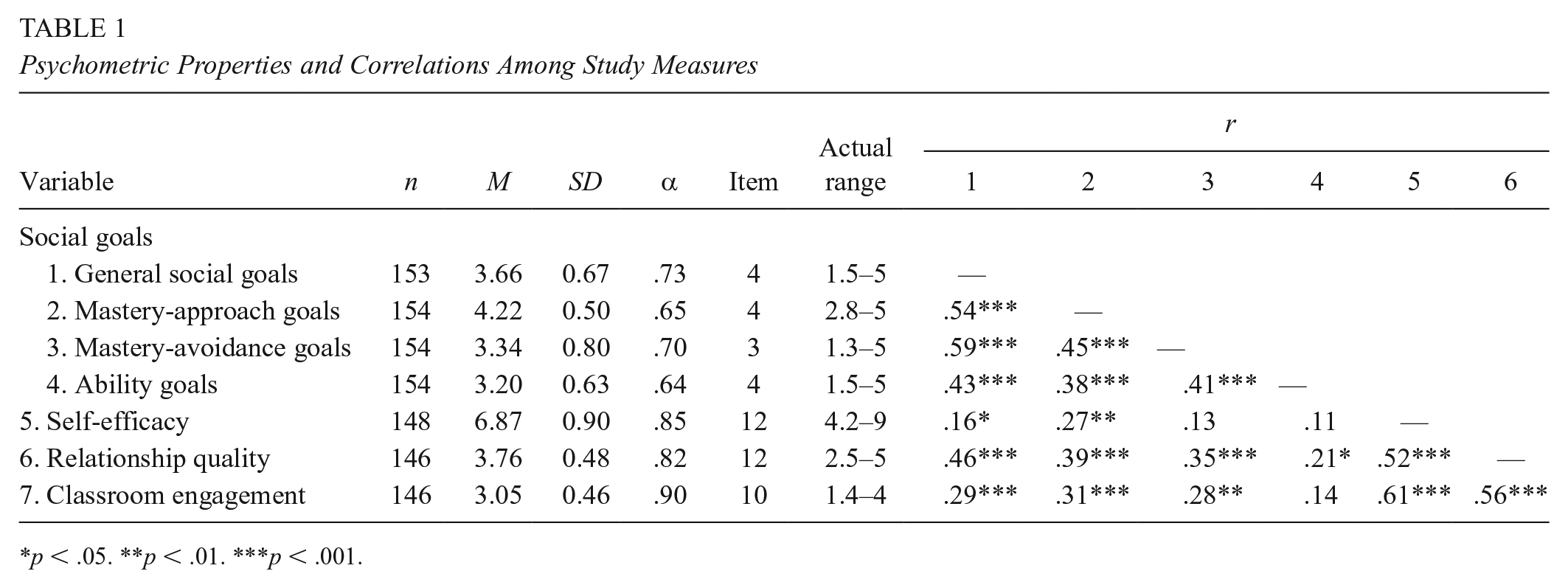
As outlined in the appendix, the final three social goals subscales assessed in the main analyses included social mastery-approach goals consisting of the four original items (M = 4.22, SD = 0.50, α = .65), social mastery-avoidance goals (three items; M = 3.34, SD = 0.80, α = .70), and social ability goals (four items including both approach and avoidance dimensions; M = 3.20, SD = 0.63, α = .64). 4 Correlational data in support of convergent validity between the social goal subtypes and the general social goals measure initially developed by Butler (2012) is presented in Table 1. As anticipated, the three social goals subtypes were positively correlated with the general goals measure, with the mastery social goal measures being more strongly correlated with the general measure as compared with social ability goals.
Psychometric Properties and Correlations Among Study Measures
p < .05. **p < .01. ***p < .001.
Self-Efficacy Beliefs
Teachers’ self-efficacy beliefs pertaining to motivating students, using varied instructional strategies, and managing challenging classroom behavior were assessed using a tripartite measure developed by Tschannen-Moran and Woolfolk Hoy (2001). This 12-item, 9-point measure (1 = nothing; 9 = a great deal) included four items per subscale and was assessed as a single variable (M = 6.87, SD = 0.90, α = .85) due to high intercorrelations among the subscales (rs = .46–.57, p < .001; for related research using a composite teacher self-efficacy measure, see Zee & Koomen, 2017). Sample self-efficacy scale items included “How much can you do to get students to believe they can do well in schoolwork?” (student engagement), “How well can you implement alternative strategies in your classroom?” (instructional strategies), and “How much can you do to calm a student who is disruptive or noisy?” (classroom management).
Perceived Teacher–Student Relationship Quality
Teachers’ perceived quality of their relationships with students was assessed using a 14-item, 5-point measure developed by Ang (2005; 1 = almost never true at all true; 5 = almost always true). Five scale items measured teachers’ satisfaction with their relationships with students (e.g., “I enjoy the students I have in my class”), five items assessed perceived student willingness to request assistance (e.g., “If my students have a problem at home, they are likely to ask for my help”), and four items measured perceived conflict with students (e.g., “If a difficult student is absent, I feel relieved”). Due to low-moderate correlations between the three subscales (rs = |.19–.48|, ps = .000–.021), a follow-up CFA evaluating a second-order model with overall teacher–student relationship quality predicted by the three latent subscale variables was evaluated. As this second-order model showed good model fit (χ2 = 77.90, degrees of freedom [df] = 51, p = .009; CFI = .96; TLI = .94; RMSEA = .06; SRMR = .07), it was subsequently used in the main analyses below to improve model parsimony (vs. evaluating relations with the three subscales independently; composite measure: M = 3.76, SD = 0.48, α = .82). 5
Perceived Classroom Engagement
Teachers’ perceptions of their students’ classroom engagement were assessed using a measure developed by Skinner et al. (2009) that consisted of 10 four-point items (1 = not at all true; 4 = very true; M = 3.05, SD = 0.46, α = .90). This scale included five items concerning students’ behavioral engagement (e.g., “In my class, my students do more than required”) as well as five items assessing students’ emotional engagement (e.g., “When working on classwork, my students seem to enjoy it”). CFA results indicated satisfactory fit for the one-factor model (χ2 = 67.72, df = 34, p = .001; CFI = .95, TLI = .94, RMSEA = .08, SRMR = .04).
Results
Preliminary Analyses
Table 1 provides descriptive statistics and correlations for all study measures. Initial differences in the three social goal subtypes were additionally examined as a function of teachers’ gender, grade level of instruction, years of experience, and the shift to online learning due to COVID (before vs. after March 13th, 2020) to determine potential covariates for our main analyses. Social mastery-avoidance goal levels were found to differ significantly by gender and grade of instruction, with females reporting stronger social mastery-avoidance social goals (M = 3.41, SD = 0.78) than males (M = 3.01, SD = 0.86), t(151) = −2.35, p = .020, and primary school teachers reporting stronger social mastery-avoidance goals (M = 3.54, SD = 0.74) than secondary school teachers (M = 3.05, SD = 0.78), t(144) = 3.93, p < .001. Social ability goals were also found to differ according to grade of instruction, with primary school teachers reporting stronger social ability goals (M = 3.33, SD = 0.63) than secondary school teachers (M = 3.02, SD = 0.60), t(144) = 3.03, p = .003. No initial differences were found in social mastery-approach goals, with no social goals measures showing significant differences as a function of years of experience, rs = |.04–.11|, p > .05, or online learning due to COVID, ts(152) = |.76–1.41|, p > .05.
In terms of initial differences across endogenous variables, years of experience was positively related to self-efficacy, r = .24, p = .004, with primary school teachers reporting higher classroom engagement (M = 3.14, SD = 0.53) than secondary school teachers (M = 2.93, SD = 0.35), t(136) = 2.84, p = .005. Interestingly, teachers reported slightly better student relationship quality after shifting to online learning due to COVID (M = 3.88, SD = 0.44) as compared with prior (M = 3.70, SD = 0.48), t(144) = −2.14, p = .034. None of the endogenous variables differed as a function of gender, ts(145) = |0.20–1.49|, p > .05, nor did self-efficacy and relationship quality differ as a function of grade of instruction, ts(138) = |1.55–1.69|, p > .05. Self-efficacy and classroom engagement did not differ as a function of COVID, ts(146) = |0.15–0.83|, p > .05, and relationship quality and classroom engagement were not correlated with years of experience, rs = |.02–.15|, p > .05.
Mediational Analysis
Structural Equation Model
The proposed mediational model examined the effects of teachers’ differentiated social goals on self-efficacy and, in turn, teacher–student relationship quality and perceived classroom engagement using Mplus 7.0 software with maximum likelihood estimation (Muthén & Muthén, 1998–2015). Given the limited sample size, item parceling was used for all endogenous variables to reduce the number of estimated parameters (i.e., self-efficacy, relationship quality subtypes, classroom engagement). Unidimensional latent variables were predicted by two parceled manifest variables that averaged across items combined based either on item order (e.g., Parcel 1: Items 1–3; Parcel 2: Items 4–5, for satisfaction with relationship quality), with the multidimensional self-efficacy variable predicted by two parcels consisting of equal representation from each subscale (Parcel 1: first half of items from each subscale; Parcel 2: second half of items from each subscale).
Figure 1 outlines the results of the final mediational model 6 that demonstrated a good fit to the data: χ2(171) = 224.98, p = .004, CFI = .952, TLI = .942, RMSEA = .045, SRMR = .062. Teachers who were more motivated to develop their social skills with students (mastery-approach goals) reported greater teaching self-efficacy (β = .52, p = .003) that, in turn, was associated with higher perceived relationship quality (β = .55, p < .001) and classroom engagement (β = .63, p < .001). In contrast, self-efficacy was not significantly predicted by social mastery-avoidance goals (β = −.14, p = .456) or social ability goals (β = −.11, p = .502). No direct effects of the social goals subtypes on either relationship quality or classroom engagement were statistically significant, including social mastery-approach goals (β = .26, p = .175; β = .07, p = .681, respectively), social mastery-avoidance goals (β = .23, p = .198; β = .23, p = .132, respectively), and social ability goals (β = .01, p = .965; β = −.07, p = .595, respectively). As for latent effect sizes, the total explained variances for the outcome measures were large in magnitude (relationship quality: 66%; classroom engagement: 51%).
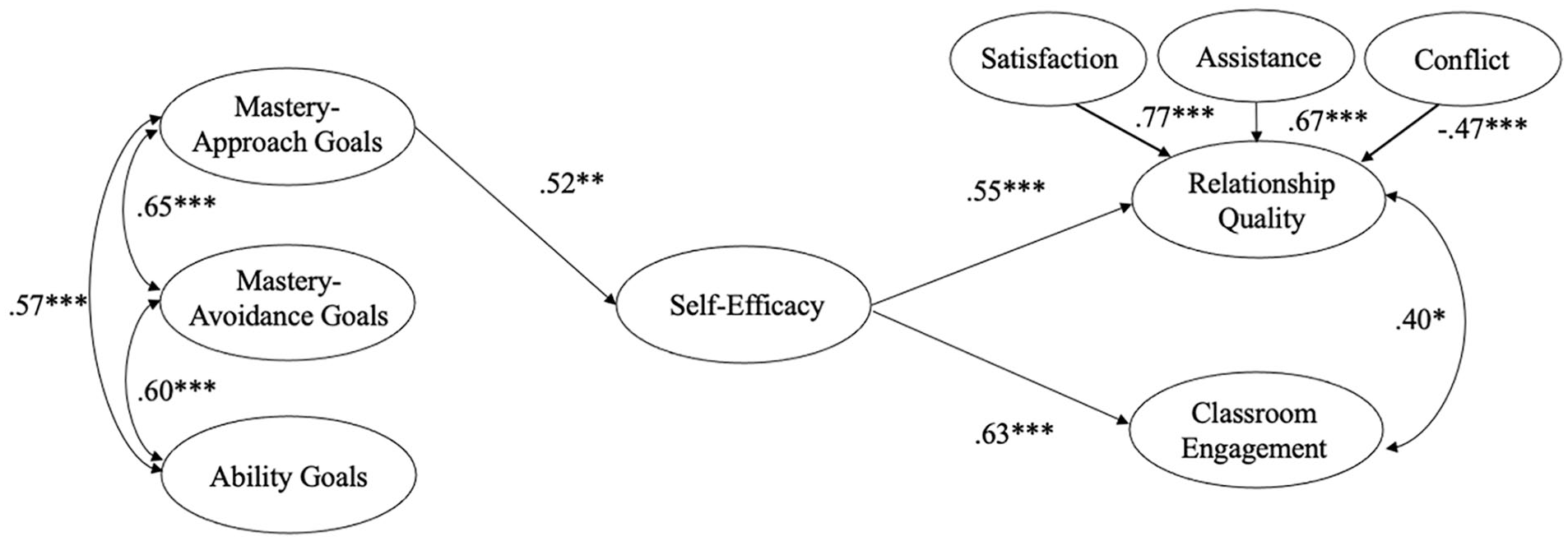
Mediational structural equation model.
Mediating Effects With Bootstrap Resampling Method
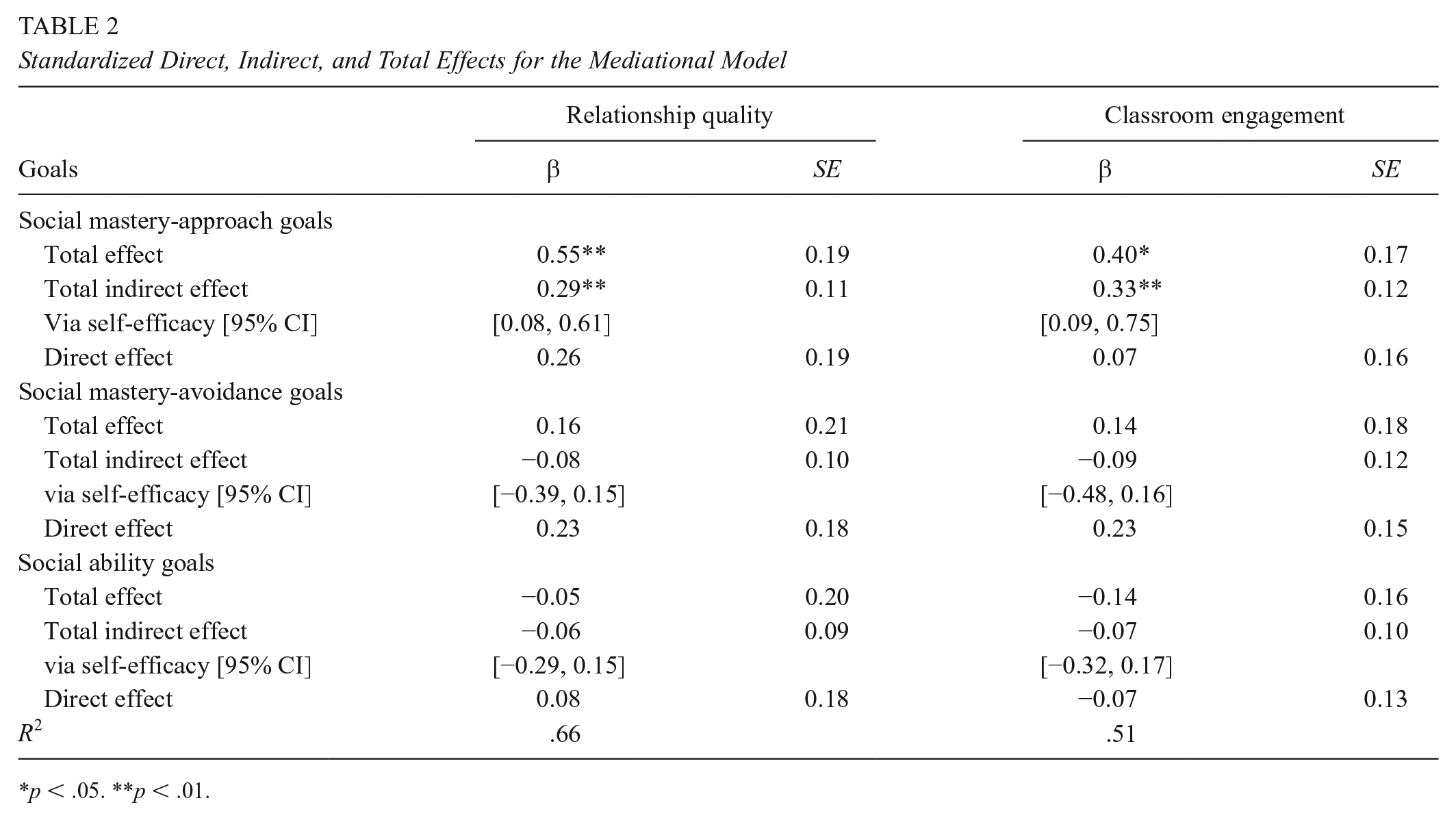
A bias-corrected bootstrapping with 5,000 iterations (95% confidence intervals [CIs]; Preacher & Hayes, 2008) was additionally conducted to examine the mediational role of teacher’s self-efficacy in the effects of teachers’ social goals on relationship quality and classroom engagement. Intervals that do not contain zeros indicate robust statistical significance for a given effect while accounting for potential floor or ceiling effects. Standardized CIs for direct, indirect, and total effects are shown in Table 2. Results showed self-efficacy beliefs to significantly mediate the relationship between social mastery-approach goals and relationship quality (β = .29, p = .007, CI [.08, .61]) as well as classroom engagement (β = .33, p = .006, CI [.09, .75]). There were no significant indirect effects of social mastery-avoidance goals nor social ability goals on relationship quality via teachers’ self-efficacy (β = −.08, p = .464, CI [−.39, .15]; β = −.09, p = .465, CI [−.29, .15], respectively). Similarly, no significant indirect relationships between either social mastery-avoidance goals or social ability goals and classroom engagement via teachers’ self-efficacy were observed (β = −.06, p = .502, CI [−.48, .16]; β = −.07, p = .500, CI [−.32, .17], respectively).
Standardized Direct, Indirect, and Total Effects for the Mediational Model
p < .05. **p < .01.
Discussion
Hypothesis 1: Effects of Teachers’ Social Goals on Self-Efficacy and Classroom Outcomes
Study findings provided partial support for Hypothesis 1a in that although teachers’ social mastery-approach goals positively corresponded with their self-efficacy beliefs as expected, teachers’ social mastery-avoidance and social ability goals did not correspond with their self-efficacy beliefs with social mastery-approach goals held constant. Teachers who reported a greater focus on improving their abilities to develop caring relationships with students (mastery-approach goals) were more likely to perceive themselves as more capable educators than those who were concerned about failing to connect with every student (mastery-avoidance goals) or how their social competencies were viewed by students (ability goals). Whereas the results of social mastery-approach goals are aligned with findings from Nitsche et al. (2011), the findings for social ability goals are not as negative as previously observed for instructional ability goals.
This lacking detrimental relationship (e.g., on relationship quality) may be due to the two ability goal subtypes factor analyzing into a single dimension (as in H. Wang et al., 2017) with the inclusion of ability-approach goals possibly mitigating the clear negative effects of ability-avoidance goals found in previous research on instructional goal orientations (e.g., Butler, 2007; Butler & Shibaz, 2008; Nitsche et al., 2011). However, the present social ability measure was not negatively associated with the composite ability approach/avoidance scale assessed by H. Wang et al. (2017) with respect to instructional goal orientations (e.g., greater negative affect). Accordingly, this further suggests that our present lack of negative findings for social ability goals in teachers may be due to the focus of the goals being social versus pedagogical in nature. More specifically, perhaps teachers being preoccupied with conveying social abilities in class is understandably less detrimental for pedagogy-related outcomes (e.g., student engagement) due to it being less relevant than being preoccupied with demonstrating one’s pedagogical abilities. In contrast, it is possible that negative implications of teachers’ social ability goals may instead be found for outcomes that do not directly pertain to student outcomes or teaching methods, such as personal well-being (e.g., due to teachers’ ability goals being associated with negative feedback and help-seeking being perceived as more psychologically threatening; Butler, 2007).
Consistent with Hypothesis 1b, teachers’ social mastery-approach goals were also most strongly associated with better levels of both perceived teacher–student relationship quality and classroom engagement. This finding is consistent with previous results demonstrating the benefits of teachers’ efforts to develop emotionally supportive relationships with students on students’ positive affect, personal development, and academic achievement (i.e., teachers as a change agent; see Lochman, 2003; McHugh et al., 2013). However, this hypothesis was only partially supported mainly due to findings for teachers’ social ability goals. Although zero-order correlations showed both teachers’ social mastery-approach and mastery-avoidance goals to correspond with better teacher–student relationships and classroom engagement (both subtypes emphasize making interpersonal connections), social ability goals were only weakly correlated with better relationship quality and were unrelated to classroom engagement.
This finding is contrary to previous studies suggesting that teachers’ ability-approach goals may be beneficial for student motivation, for example, due to greater teaching self-efficacy (Nitsche et al., 2011) or through the use of mastery-oriented methods (e.g., math instruction; Dresel et al., 2013). Once again, this finding may be due to the ability goals measure collapsing the approach and avoidance dimensions, with the typically negative effects of ability-avoidance goals preventing the potential benefits of ability-approach goals from being observed. However, it is also possible that teachers’ social ability goals did not show significant effects due to our mediating self-efficacy variable not assessing specific types of teaching. Whereas the potential student benefits of teachers’ social ability-approach goals may be observed following mastery-oriented instruction, our self-efficacy measure more generally assessed teachers’ perceived ability to use varied teaching methods (i.e., instructional strategies subscale) thus potentially obscuring beneficial effects that would otherwise have been observed with a more specific indicator of adaptive instruction (e.g., focusing on student improvement).
Hypothesis 2: Mediational Role of Teachers’ Self-Efficacy Beliefs
Hypothesis 2a was fully supported as teacher-perceived relationship quality and classroom engagement were both positively associated with teacher self-efficacy. These results thus indicate that teachers who have greater confidence in their ability to motivate students, apply various pedagogical techniques, and manage misbehavior were more likely to perceive more meaningful relationships with their students and observe greater student involvement. This pattern of results is consistent with substantial existing research showing teachers’ perceived competency for facilitating student learning to consistently contribute to positive teacher–student relationships (Hajovsky et al., 2020) as well as student achievement and well-being (for reviews, see Klassen & Tze, 2014; Zee & Koomen, 2016).
Hypothesis 2b further proposed that teachers’ self-efficacy beliefs should serve a mediating role in the relationships between the three subtypes of teachers’ social goals and the two classroom outcomes assessed. Scattered previous research suggests a positive link between teachers’ general social goals and specific instructional outcomes such as social–emotional support (Butler & Shibaz, 2008) and mastery-oriented instruction (Butler, 2012; H. Wang et al., 2017). Our findings extend these findings on teachers’ general social goals in showing a specific social goal subtype, namely mastery-approach goals (aiming to enhance social abilities), to additionally account for teachers’ perceptions of critical student outcomes via higher levels of teacher self-efficacy. In other words, teachers who focused on improving their ability to develop meaningful connections with students tended to feel more confident in their teaching abilities that, in turn, contributed to teachers perceiving stronger relationships with their students and greater levels of in-class engagement. However, Hypothesis 2b was only partially supported, as teachers who focused instead on failing to connect with every student (social mastery-avoidance goals) or showcasing their social competences (social ability goals) did not show similar positive links with self-efficacy or classroom outcomes.
Overall, our findings suggest that the underlying reasons for why teachers strive to build relationships with students are important to consider, with the benefits of teachers’ social goals being mainly evident when they reflect an incremental or growth mind-set (Dweck, 2000, 2014; Elliot, 1999). Expanding on existing research showing teachers’ instructional mastery-approach goals to correspond to various psychological benefits for teachers (e.g., Nitsche et al., 2013; Retelsdorf et al., 2010; H. Wang et al., 2017) as well as students (e.g., Butler & Shibaz, 2008, 2014), the present findings clearly demonstrate the potential benefits of teachers’ social mastery-approach goals for not only confidence in their teaching abilities (self-efficacy beliefs) but also affective and learning-related classroom outcomes (relationship quality, student engagement).
Study Implications and Limitations
Assisting students’ holistic development has become increasingly important given the increased emphasis on students’ noncognitive competencies and teachers’ relationships with difficult students (Chernyshenko et al., 2018; Moseley et al., 2014). The present findings suggest that teachers may be able to achieve such critical classroom outcomes by focusing on their potential to improve their relationships with that, in turn, should correspond with greater confidence in carrying out effective teaching. To better promote teachers’ social-learning competencies, existing research consistently highlights the importance of integrating content on teachers’ interpersonal skills into teacher education and professional development programs (see Jennings et al., 2017; Mihalas et al., 2009). In addition to training teachers to administer curricula and ensure students’ cognitive gains (i.e., test scores), greater attentions should be paid to teachers’ knowledge concerning students’ psychological needs and cultural background (Sosa & Gomez, 2012) as well as their own social–emotional competences (relationship building, emotion regulation; Furrer et al., 2014; Jennings & Greenberg, 2009). Relatedly, greater professional development content pertaining to motivationally adaptive instructional methods that rely on building meaningful student relationships is encouraged (e.g., mastery-learning and autonomy-supportive teaching techniques; Ciani et al., 2010; Ozkal, 2014), as is teacher training to better address the emotional needs of marginalized students through culturally sensitive and asset-based teaching approaches (see Gay, 2002; López, 2017; Sylva et al., 2016).
Professional development and teacher training programs are further suggested to promote teachers’ mastery-approach goals by encouraging them to adopt growth mind-sets not only in response to teaching challenges but also concerning their relationships with students (i.e., incremental beliefs; Dweck, 2006). Following from intervention studies showing teachers’ efforts to encourage growth mind-sets in class to improve students’ motivation, prosocial behaviors, and achievement (e.g., Blackwell et al., 2007; Yeager et al., 2013), interventions aimed at promoting incremental beliefs in teachers themselves have shown instructional benefits. Although these interventions generally address how teachers can view student intelligence as malleable and encourage mastery-oriented instruction (e.g., focusing on student effort and improvement over time; Richardson et al., 2020; Seaton, 2018), it is reasonable to expect that encouraging teachers to adopt incremental beliefs about their own ability to connect with students should have similar instructional benefits. Moreover, these benefits should be especially evident when teachers additionally incorporate an incremental mind-set into their on-going classroom practices (e.g., everyday social interactions; Jaffe, 2020; Seaton, 2018), promote fair educational environments that allow for equitable student participation (Thomas et al., 2019).
The present study thus incorporates multiple strengths that allow for clear practical implications, including the development of a multidimensional social goals measure for teachers validated through cognitive interviewing and factor analysis and demonstrated relations with not only related motivational variables (self-efficacy) but also critical classroom outcomes (relationship quality, classroom engagement). However, study limitations are also important to acknowledge when considering the generalizability of the findings observed. First, although the low reliabilities of the three social goal measures are consistent with prior research (Butler, 2012), more research is needed to develop better scale items that reflect teachers’ experiences concerning their reasons for developing meaningful relationships with students (e.g., in-depth focus groups).
For example, as it is possible that our ability-approach and -avoidance subscales did not differentiate due to ultimately including only two items per measure, future research on the efficacy of more elaborated self-report social goals measures is recommended to better ascertain if these subscales are indeed differentiated or best assessed as a single variable. Relatedly, future research in which more substantial self-report measures are assessed could afford the differentiation required to conduct profile analyses across social goal subtypes and provide a complementary person-centered perspective to the present variable-centered approach. Similarly, it is possible that better differentiated social goal subscales (e.g., that more clearly separate ability-approach vs. ability-avoidance goals) could also show more differentiated relations with subtypes of teachers’ self-efficacy (e.g., as assessed in Chang et al., 2021) and potentially mitigate the multicollinearity between self-efficacy subscales that required the use of a unidimensional measure in the current study.
A second issue pertains to the cross-sectional nature of the study data. Whereas our mediational structural equation modeling analysis allowed us to assess theoretically proposed direct and indirect relations between teachers’ social goal orientations, self-efficacy, classroom outcomes, it does not provide substantive evidence as to causal relationships between the study variables. Accordingly, follow-up longitudinal studies are needed to further examine the directional nature of these relationships (e.g., diary studies) and the extent to which common variance due to cross-sectional assessment may have inflated relations between study variables. Moreover, as the present study relied exclusively on self-report measures, future research is recommended to more objectively measure both teachers’ social goals (e.g., real-time, experience sampling methods) and classroom outcomes (e.g., student perceptions, independent observations) and to assess additional classroom variables that may be affected by teachers’ social goals (e.g., student achievement, teacher well-being). Finally, whereas it was theoretically assumed in the present study that teachers’ social goals represented a more domain-specific subset of their broader instructional goals, more research is needed to support this assertion. For example, future studies in which existing domain-general, instructional goal-orientation measures (e.g., Butler, 2012) are assessed alongside domain-specific measures of teachers’ social goals could help determine if the latter are indeed conceptually nested within the former (e.g., using multilevel analyses) thus providing greater empirical support for basing hypotheses concerning teachers’ social goals on findings for more general instructional goals.
In sum, the current study demonstrated the importance of differentiating teachers’ social goals according to their underlying reasons, with three resulting social goal orientations showing different relations with teaching-related confidence and student outcomes. Whereas social mastery-approach goals emphasizing the continuous development of social skills were optimal for teacher self-efficacy as well as perceived teacher–student relationship quality and student engagement, the remaining social goal subtypes showed little or no relation with these critical variables. These findings thus illustrate the importance of developing teacher training and professional development programs that encourage teachers to focus on improving their interpersonal competencies with students (i.e., a growth mind-set) as well as adopting integrative pedagogies that can help teachers connect with learners from diverse social–cultural backgrounds and better support the emotional needs of their class.
Footnotes
Appendix

| Social mastery-approach goals |
| 1. In general, I try to develop my social skills with students. |
| 2. I enjoy student relationships that help me learn new things about myself. |
| 3. I feel successful when I learn something new about how to connect with my students. |
| 4. It is important to improve the quality of my relationships with my students. |
| Social mastery-avoidance goals |
| 1. I feel unsuccessful if I do not develop meaningful relationships with each of my students. |
| 2. If I do not establish personal connections with all of my students I feel I have failed as a teacher. |
| 3. It is important to maintain close relationships with each of my students. |
| Social ability goals |
| 1. I want to be viewed by my students as a “cool” teacher. |
| 2. It is important that I am well-liked by my students. |
| 3. I feel unsuccessful if my students dislike me. |
| 4. I try not to develop a bad reputation with my students. |
Acknowledgements
This study was supported by a doctoral fellowship to Chiung-Fang Chang from the FRQSC (Fonds de recherche du Québec–Société et culture) and grant funding to Nathan C. Hall from the SSHRC (Social Sciences and Humanities Research Council of Canada: #435-2013-1099; #435-2020-0954). All study protocols reported in this article were approved by the McGill Research Ethics Board (REB, #19-10-012). There is no conflict of interest declared by the authors.

Notes
Authors
CHIUNG-FANG CHANG is a PhD candidate in the Department of Education and Counselling Psychology at McGill University. Her research focuses on practicing and preservice teachers’ motivation, instructional and well-being outcomes, as well as social–emotional competencies.
NATHAN C. HALL is an associate professor in the Department of Education and Counselling Psychology at McGill University. His research examines the role of motivation, emotions, and self-regulation in achievement, persistence, and well-being in educational settings.