



Abstract
As racialized institutions, Hispanic-serving institutions educate large portions of racially minoritized students within organizational and policy structures that advance Whiteness. This research considers how the institution-level diversity, equity, and inclusion (DEI) plans, produced in response to state-level DEI policies in Florida, California, and New York, construct narratives of intersectional diversity and a racialized Latinx identity at Hispanic-serving community colleges (HSCCs). Engaging critical discourse analysis, drawing together critical race theory and LatCrit, the analysis expands the consideration of DEI policy implementation at HSCCs. The findings illustrate the interconnectedness of state-level policy, policy implementation guidance, and institution-level discourse related to defining intersectional diversity and demographic data. Furthermore, it captures a lack of attention to racial composition among Latinx students and the limited characterization of HSI status. This study highlights how the implementation of state-level DEI policies can advance or erase the considerations of intersectionality among Latinx students.
Keywords
Advancing diversity is a central element of the discourse of U.S. higher education. Intertwined with histories of affirmative action, legal precedents, and the broader political landscape, public higher education has come to take up conversations around diversity in distinct ways to advance specific notions of diversity. Select state contexts have developed state or system-level diversity, equity, and inclusion (DEI) policies as a mechanism to drive institutional behavior. Such policies date back to the 1980s and 1990s, as in Florida and California, developed in response to affirmative action and concerns regarding racial inequity (Annual Equity Update Florida Educational Act Report, n.d.; Guichard, 1992). In recent years, states have seen a renewed focus on state-level DEI policies, such as Oregon HB 2864 established in 2017 and the SUNY DEI Policy established in 2015 (HB 2864, 2017; SUNY Diversity, Equity, and Inclusion Policy, 2015). These state-level policies all require the preparation of institution-level DEI reports. State-level DEI policies and resulting institution-level DEI reports thus become sites where institutional thoughts on diversity and racial equity are articulated. A critical review of institution-level DEI plans, situated within the state-level DEI policy context, can serve to elucidate their actual meaning and focus on advancing racial equity (Ching et al., 2018).
The discourse of racial equity constructed through institution-level DEI plans is particularly relevant for the increasing number of Hispanic-serving institutions (HSIs). The establishment of the HSI designation represented an area of interest convergence among the Latinx HEI advocates who had been lobbying for educational equity for decades (Valdez, 2015); calling attention to the growing Latinx community coupled with low Latinx participation in higher education, and national interests regarding the underfunding of institutions serving Latinx students (Santiago, 2012). Thus the 1992 federal legislation constructed the HSI designation based on theories of critical mass—the belief that once a group attains a particular proportion, their presence would shape organizational culture (Santiago, 2012). The policy construct established through the HSI designation did not require a shift in mission but instead drew on enrollment—eligibility for the HSI designation requires that 25% of students are Latinx and at least 50% are eligible for need-based aid (U.S. Department of Education, n.d.). While federal policy awards the HSI designation, state-level demographics and higher education policies shape these institutions (Garcia, 2016, 2019). As such, much is still to be understood about the institution-level implementation of state-level policy, such as DEI policy, at HSIs, including how it is informed by federal and state policy discourse.
The “arbitrary” focus of the HSI designation on enrollment coupled with increases in Latinx enrollment in higher education has resulted in the proliferation of HSIs—across a diversity of institution types (Garcia, 2019; Paredes et al., 2021). Over the nearly 30 years since their establishment, HSIs have grown from 189 to over 550 institutions—nearly 70% of these institutions are public. Among public HSIs, 61% are community colleges (Excelencia in Education, 2020, 2021b). Furthermore, while California and Texas account for nearly 50% of HSIs, 30 states have at least one HSIs (Excelencia in Education, 2021b). Beyond shifting enrollment, the federal funding available for HSIs incentivizes the pursuit of the designation. Through the Title V funding, which followed the establishment of the HSI designation (Valdez, 2015), these traditionally underresourced institutions compete for federal dollars; between 1995 and 2018, the federal funding allocation has increased from 12 million to over 124 million (Excelencia in Education, 2020; Santiago, 2012). While many HSIs have sought to serve their growing Latinx student population with intentionality, the prioritization of equity for Latinx students has not been universal (Ballysingh et al., 2017; Cuellar et al., 2017; Garcia, 2019). In focusing this analysis on the interconnection between state-level DEI policy and the ensuing institution-level DEI plans within HSIs, this work aims to center the potential for HSIs to move beyond just enrolling Latinx students toward a vision of serving.
A critical discourse analysis (CDA), anchored in the theoretical framing of critical race theory (CRT) and LatCrit, this work considers how institutional discourse advances or pushes back against a complex framing of Latinx students, focusing on the intersectional identities of Latinx students. Building on scholarship that has looked at institution-level DEI plans within specific types of institutions (Iverson, 2005, 2007) and state DEI policy contexts (Ching et al., 2018; Felix et al., 2018), this work centers Hispanic-serving community colleges (HSCCs) across New York, Florida, and California; capturing a rich variation in HSCC, both in geography, and institutional type, but also histories of serving Latinx students, to address two key questions: How do state-level DEI policies shape public HSCCs characterizations of intersectional diversity within institution-level DEI plans? How, if at all, do these institutional DEI plans construct a framing of intersectionality among Latinx students? Situating state-level policy and institution-level plans in the social practice (Fairclough, 1992) of the federal HSI designation, this work captures the interconnectedness of policy and implementation to address the gap in the literature surrounding state-level DEI policy implementation at HSIs. This analysis provides insight into how policy makers and HSI practitioners implementing DEI policy can leverage this required reporting to advance racial equity.
Review of the Literature
Diversity, Equity, and Inclusion Policy and Plans
State-Level DEI Policy
Political pressure to address inequities in higher education has pushed state-level boards and legislative counterparts to develop policies to address DEI efforts at institutions, despite policy-making landscapes that are resistant to an explicit centering of racial equity (Huber & Lapinski, 2006; Mendelberg, 2017). Tracing the discourse of the California community college state-level DEI policy—student equity policy (SEP)—Felix and Trinidad (2020) capture how racial equity is eroded over the 25 years of the policy—both through the policy and limitations constructed in the implementation discourse. Specifically, the ways that color-evasive language decentered race and the power of intermediary organizations in helping institutions develop race-conscious institutional plans. This is complemented by research examining the Florida Education Equity Act, considering the evolution of the policy and differentiated implementation across 4-year and 2-year HSIs (Casellas Connors, in press). This work speaks to the ways that state-level DEI policies, which may have been constructed to combat racial inequity, become a tool for advancing “all students.” Building on existing scholarship related to DEI policy, this research directly addresses the gap related to the interconnected nature of state-level DEI policy and the implications for institutions.
Institution-Level DEI Plans
Institution-level DEI plans and reports have become increasingly commonplace across all segments of higher education, regardless of state-level policy mandates. Iverson (2005, 2012) explores how DEI plans at land-grant institutions are not neutral, instead positioning students of color as outsiders, disadvantaged, at-risk, and deficient. In addition, institutions focused on efforts to support “shifting” demographics, using the “newness” to obscure a lack of substantive change (Iverson, 2012). At land-grant institutions, these documents perpetuate exclusionary practices on campus and reinforce inequity (Iverson, 2007). A review of 28 California Community College equity plans (Ching et al., 2018) highlights how the language prioritizing minoritized students has become increasingly vague. Furthermore, institutions differ significantly across the foci of change, strategies, and how equity gaps were calculated (Ching et al., 2018). Considering HSCCs in California, Felix et al. (2018) frame how Latinx students were centered in the discourse of inequity, facing disproportionately negative outcomes, yet were not the focus of interventions. This foundational exploration into institution-level DEI plans captures how they construct a narrative of racially minoritized students or divert attention for Latinx students despite their critical mass on campus.
Racial Equity and Intersectionality
Racial equity for Latinx students in higher education can be examined through broader histories of racialization for Latinxs. The creation of the term Hispanic served to construct a pan-ethnic group that artificially clusters identities based on linguistic and regional background (Mora, 2014). Thus, “Hispanic” became a mechanism for counting and categorizing a diverse group of individuals—crafting order in the social world in ways that privilege some groups over others. At the same time, its utility is limited, evidenced by the fact that 51% of Latinxs do not identify with the term Hispanic, illustrating how the term erases the nuances both between and within members of the Latinx community (Taylor et al., 2012).
Intersectionality contends with the erasure of a complex Latinx identity (Collins, 2015; Harris & Leonardo, 2018; Núñez, 2014). Building on the work of women of color activists such as the Combahee River Collective (1977) and Kimberlee Crenshaw (1990), intersectionality confronted how the legal landscape focused on antidiscrimination based on a single identity obscuring the experiences of Black women. Beyond the complex racioethnic nuances which inform Latinx experiences, intersectionality critiques the dominant paradigm of binaries—Black or White, male or female, rich or poor—to more broadly center the host of social identities that have been pushed to the margin; foregrounding how the salience of intersecting oppressed identities may shift based on power and social context (Delgado & Stefancic, 2017; Ledesma & Calderon, 2015; Solorzano et al., 2005). Theorizing the application of intersectionality among Latinx students, Núñez (2014) presented a model for recognizing the multiple identities, organizational, and structural elements that inform a framing of intersectionality for Latinx students. Drawing to attention the larger sociopolitical processes in which these interlocking identities operate. Protecting against the essentialization of Latinx students, intersectionality scholarship cautions that ignoring these converging identities may incorrectly identify the reason for an action or policy decision (Espino, 2012; Ladson-Billings, 2013; McCoy & Rodricks, 2015).
Racialized Organization
Racialized Organization Theory
Higher education institutions are organizations imbued with and situated within the racialized sociopolitical landscape. The intersection of race and organization theory advances a framing of racialized organizations—moving research beyond a traditionally race-neutral organizational discourse (Ray, 2019) to understand racialization at all levels within an organization. At the macro-level, state and federal policy can be understood as racialized; these policies (such as DEI policy) shape membership, categorization, and the advancement of a racialized legal landscape. Focused on the meso–organizational–level, racialized organizational theory critiques concepts of color-neutrality to acknowledge the basic idea, “all organizations are racialized and ‘inhabited’ by racialized bodies” (Ray, 2019, p. 36). Doing so articulates how racist practices can be understood as “baked in” to organizations. Contending with narratives of organizational fit in faculty hiring or the foregrounding of White normative best practices, which captures how racism is woven into institutions (Ray, 2019). Complemented by literature on Whiteness as Property (Harris, 1993), which articulates legacies of state-sanctioned exploitation (e.g., segregated schools or land seizures for land-grant institutions), it illustrates how the very foundation on which many organizations were built centers the protection of Whiteness (Ray et al., 2020). While macro-level policies have been critiqued as racialized (Bhopal, 2018; Thomas, 2017), naming organizations as racialized thus positions scholars and practitioners alike to grapple with these histories and interrogate how existing practices must acknowledge racism’s systemic and consistent presence. Only then can practitioners begin to dismantle and rebuild more racially equitable organizations.
HEIs as Racialized Organizations
The underpinnings of racialized organization theory extend to HEIs, which have served as a central site for producing knowledge that excludes communities of color and reinforces racial hierarchies (Allen & Jewell, 2002). Macro-level HSI policy saw the swift racialization of a set of institutions that had, until that moment, ostensibly been racialized and operated as White institutions (Garcia & Hudson, 2020). A process that is reproduced each year as enrollments change. The consequence of this policy can be understood at the meso-level. The resulting racialized designation constructed a “new” class of HEIs to identify and critique—based on their alignment with White normative excellence—without regard for how the institution itself is constructed by racialized contexts or operates in ways that uphold Whiteness (Garcia, 2019; Garcia & Hudson, 2020). Thus, racialization may become embedded within the institution. Federal Title V funding—funding made available based on HSI designation to support Latinx students (U.S. Department of Education, n.d.)—serves as a proof point for considering the meso-level implication of racialization in policy. Despite these HEIs reflecting increasing racial diversity and the funding guidance noting a focus on Latinx students, these funding requests, constructed at the organizational level, fail to center Latinx students, instead upholding White spaces (Vargas, 2018; Vargas & Villa-Palomino, 2018). This junction of state-policy (macro-level) and institution-level DEI plans (meso-level) threads in the literature of racialized organizations, to expand the consideration regarding how the discourse constructed through institution-level DEI plans, situated within the state-level policy landscape, contributes to the construction and erasure of intersectional racial equity—specifically a discourse of an intersectional Latinx student. To guide this analysis, this work is informed by the theoretical framing of critical race analysis, discussed below.
Critical Race Analysis
Weaving together CRT and LatCrit (CRLC) support examining the crossroads of state-level DEI policies and the resulting institution-level DEI plans at HSIs (Villalpando, 2003; Wright et al., 2018). CRLC foregrounds narratives of diversity that institutions construct and how this discourse attends to racial equity and intersectionality, specifically for Latinx students. This research builds on the foundations of Gloria Ladson-Billings and William Tate (1995) and Daniel Solórzano (1997), who argued the utility of CRT to understand persistent racial inequities in education, as well as Francisco Valdes (1997), who theorized around the development of LatCrit to center Latinx identity. CRT draws on critiques from legal scholars who saw the legal landscape as failing to advance racial and economic liberation and LatCrit centers Latinx histories of poverty, immigration, discrimination, and exclusion (Bernal, 2002; Espinoza & Harris, 1998). In doing so, LatCrit positions the significant heterogeneity regarding race and racism within the Latinx community (Nunez, 1999). As such, CRT and LatCrit work together to focus on the complex identities and experiences of the Latinx community to address the inequities produced through the legal and policy structures of HEIs. Drawing on the multidimensional framing conceptualized by Villalpando (2003), five elements fuse CRT and LatCrit (Table 1).
Aligning CRT and LatCrit
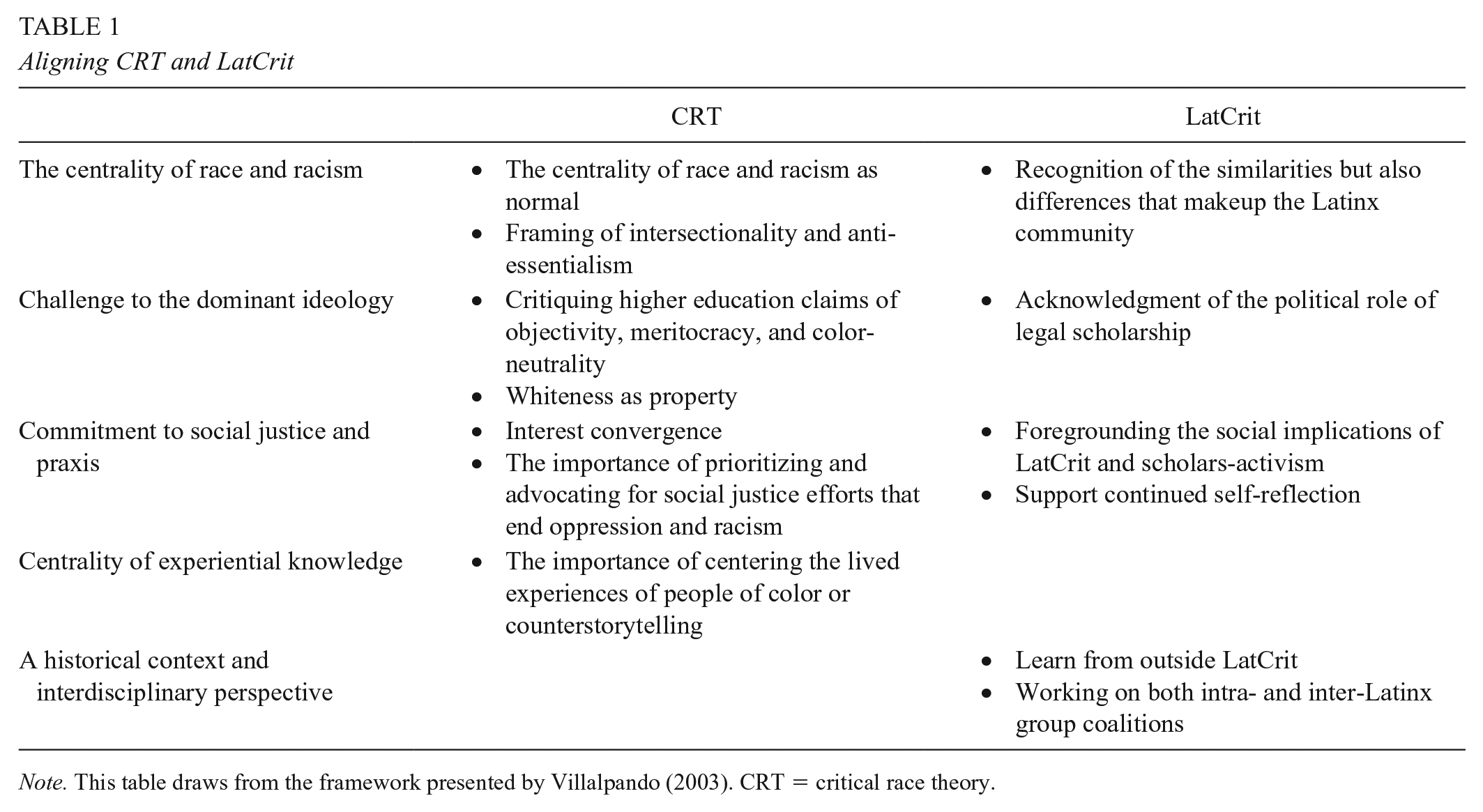
Note. This table draws from the framework presented by Villalpando (2003). CRT = critical race theory.
Three elements of this framework are focal in this work—the centrality of race, challenges to the dominant ideology, and commitment to social justice. The centrality of race and racism articulates how racism is a normal and ever-present element of the United States (Harper, 2009; Solorzano, 1997). White imaginaries advance the normalization of the inferiority of people of color, thus further articulating how power is operationalized through Whiteness (Bell, 2003; Wright et al., 2018). Intersectionality complements how racism operates alongside other forms of oppression (Crenshaw, 1990; Ladson-Billings, 2013; Valdez, 2013). To challenge the dominant ideology is to critique concepts of meritocracy and race neutrality—social mechanisms that continue narratives of racial fairness and decenter the ways racism manifests (McCoy & Rodricks, 2015). Nested within this, Whiteness as Property articulates how Whiteness protects the continued subjugation of racially minoritized identities (Harris, 1993). Finally, in the commitment to social justice and praxis, CRLC demands a commitment to practice addressing racism and oppression (Villalpando, 2003). Advancing equity is bounded by interest convergence—how the interests of people of color are advanced or seen as meriting policy when they are in alignment and of benefit to the majority (Ladson-Billings, 2013). Enlisting these core concepts allows this research to center how racial equity is advanced or reduced through the implementation of state-mandated DEI policy. CRLC frames the analysis to consider how policies are operationalized within racialized organizations, thus constricting their effort to advance equity for racially minoritized students.
Methods, Research Design, and Analysis
Methodological Approach: Critical Discourse Analysis
CDA supports examining the narratives (re)produced through text. A notable distinction of CDA from other textual analysis strategies is the integration of “three different levels of analysis: the text; the discursive practices (that is, the process of writing/speaking and reading/hearing) that create and interpret that text; and the larger social context that bears upon it” (Huckin, 1997, p. 87). Furthermore, CDA addressed the opaque or hidden discourse within texts to unpack power imbalance (Wodak & Meyer, 2015). Through CDA, this research traces the institutional texts that guide state-level DEI policy and institution-level DEI plans to examine how they engage with notions of an intersectional diversity and Latinx students.
Higher education research has traditionally applied CDA to consider “how dominant discourses construct realities that support and advance their worldview and conviction that are inherently unjust” (Martínez-Alemán, 2015, p. 20). Researchers have used CDA to consider state policy (Winkle-Wagner et al., 2014), funding (Alemán, 2006), and federal Latinx policy (Hernandez, 2013) to “identify the interconnectedness of politics and policy in education [and] to identify some of the cultural values and choices of policy” (Hernandez, 2013, p. 15). Given the embeddedness of racism, CDA is particularly relevant in examining the discourses constructed through higher education DEI plans where dominant group norms may integrate inequity into policy despite characterizing such policy as neutral, thus preserving a White hegemonic enterprise (Ward, 2017).
State Contexts
This research sits at the intersection of state/system-level DEI policy and institutional DEI plans in California (California Community Colleges [CCCS]), Florida (Florida College System [FCS]), and New York (State University of New York [SUNY] System). Summarized in Table 2, these states range from 19% to 39% Latinx, but an interrogation of the Latinx community illuminates some significant differences. While the term Latinx may present a homogenous community, the largest Latinx ethnic groups across each state differ—Cuban, Mexican, and Puerto Rican communities bring distinct histories of U.S. migration and racialization (Cobas et al., 2009; Rumbaut, 2008). Beyond ethnic identification, the Latinx community in Florida and New York is geographically bounded in several key areas, while the majority of California has significant Latinx communities (Excelencia in Education, 2021a; Florida Department of Economic Opportunity, 2014). Data such as household income can further complicate our understanding—in Florida, 16% of Latinxs live below the poverty line compared with 22% in New York (U.S. Census Bureau, 2019).
Summary of State Context and DEI Policy
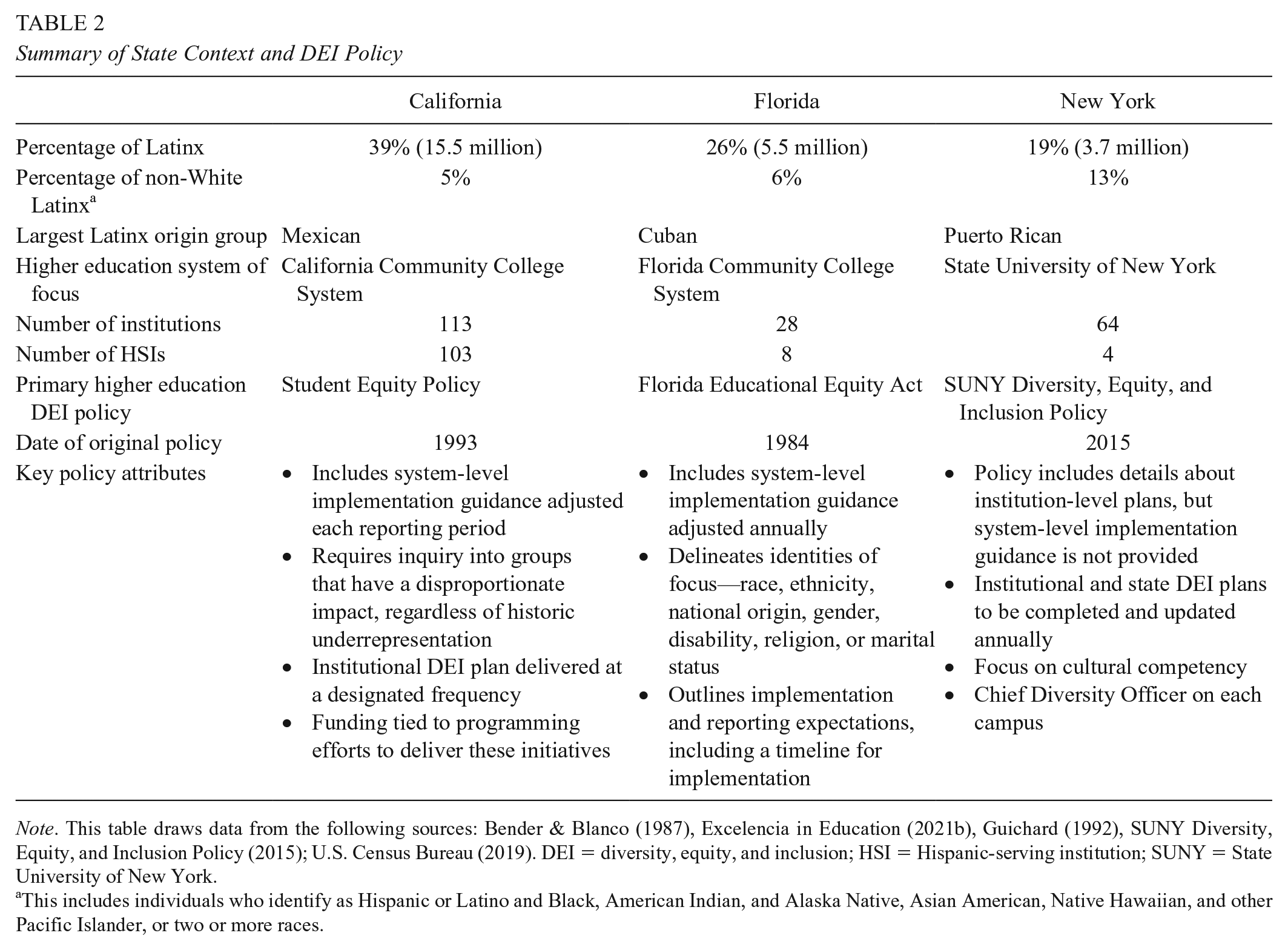
Note. This table draws data from the following sources: Bender & Blanco (1987), Excelencia in Education (2021b), Guichard (1992), SUNY Diversity, Equity, and Inclusion Policy (2015); U.S. Census Bureau (2019). DEI = diversity, equity, and inclusion; HSI = Hispanic-serving institution; SUNY = State University of New York.
This includes individuals who identify as Hispanic or Latino and Black, American Indian, and Alaska Native, Asian American, Native Hawaiian, and other Pacific Islander, or two or more races.
Much like the demographic data, these state policies reflect distinct political landscapes situated in various histories of diversity. For example, the Florida Educational Equity Act applies to K–20 with legislative direction regarding identities considered within the policy, which have been the same since the establishment of the policy in 1984 (Bender & Blanco, 1987). Alternatively, the California SEP is a state legislative policy that has purview over just the CCCS (Felix & Trinidad, 2020; Guichard, 1992). Over time, the communities of focus have shifted from a focus on ethnic minorities and disabled persons to a focus on those who experience different outcomes—thus expanding the conversation to men, veterans, and many identities that have not been historically marginalized. Finally, the most recent of the policies, the SUNY DEI policy (SUNY Diversity, Equity, and Inclusion Policy, 2015), provides a broad framing of diversity but leaves the specifics to the institutions, thus further expanding the focus of the DEI policy.
While each state contexts is distinct, and the institution-level DEI plans take up a host of names—Equity Report (Florida), Diversity, Equity, and Inclusion Plans (New York), and Integrated Plan: Basic Skills Initiative, Student Equity, and Student Success and Support Program (California)—the state-level policy directives, which require the production of an institution-level DEI plan, create the opportunities to view these documents as a body of data across distinct sociopolitical contexts.
Institutional Contexts
Focusing this analysis on institutions that engage large numbers of Latinx students, 22 HSIs were selected (see Table 3). These 22 institutions currently, or in the case of the FCS, historically are classified as community colleges. In each state, institutions were selected based on 2019 HSI enrollment data from the Center for Minority-Serving Institutions (Center for MSIs, 2019). In the FCS (n = 8) and SUNY (n = 4), all the eligible HSIs were included. SUNY was selected instead of City University of New York (CUNY) given the current policy landscape—the SUNY DEI Policy (SUNY Diversity, Equity, and Inclusion Policy, 2015) mandates the production of DEI plans at all SUNY institutions; however, a corresponding policy does not exist across all CUNY institutions. Furthermore, while SUNY includes both 2-year and 4-year institutions, at the time of this study, all HSIs were community colleges. The overwhelming majority of CCCS meet the HSI designation (103). As such, a sample of 10 institutions was selected based on student demographics (e.g., percentage Latinx and percentage racially minoritized students) and geographic characteristics (e.g., region within the state and degree of urbanization) and the availability of the Integrated Plan. The resulting institutions, two of which were Asian American Native American Pacific Islander–serving institutions, were located across the state, with at least one institution across northern, central, and southern California. Most institutions were in cities (five), while the remaining were in a suburb (four) and one rural institution.
Summary of Sample Institutions

Note. FTE = full-time equivalent; FCS = Florida College System; SUNY = State University of New York; CCCS = California Community Colleges.
These HSCCs colleges play a critical role in the education of racially minoritized students. In the FCS, HSIs educate 53% of community college students—74% of Latinx students, and 60% of Black students (The FCS, 2019). SUNY HSIs educate a smaller number of students—13%. However, the growing number of emerging HSIs will likely increase the significance of HSIs in coming years (SUNY, 2020). In comparison, in the CCCS, 48% of students are Latinx—nearly 1 million students (CCCS, 2019). While each state sample captures a distinct segment of the community college population, they all reflect the evolving role of HSIs in educating Latinx students within these three states.
Data Sources
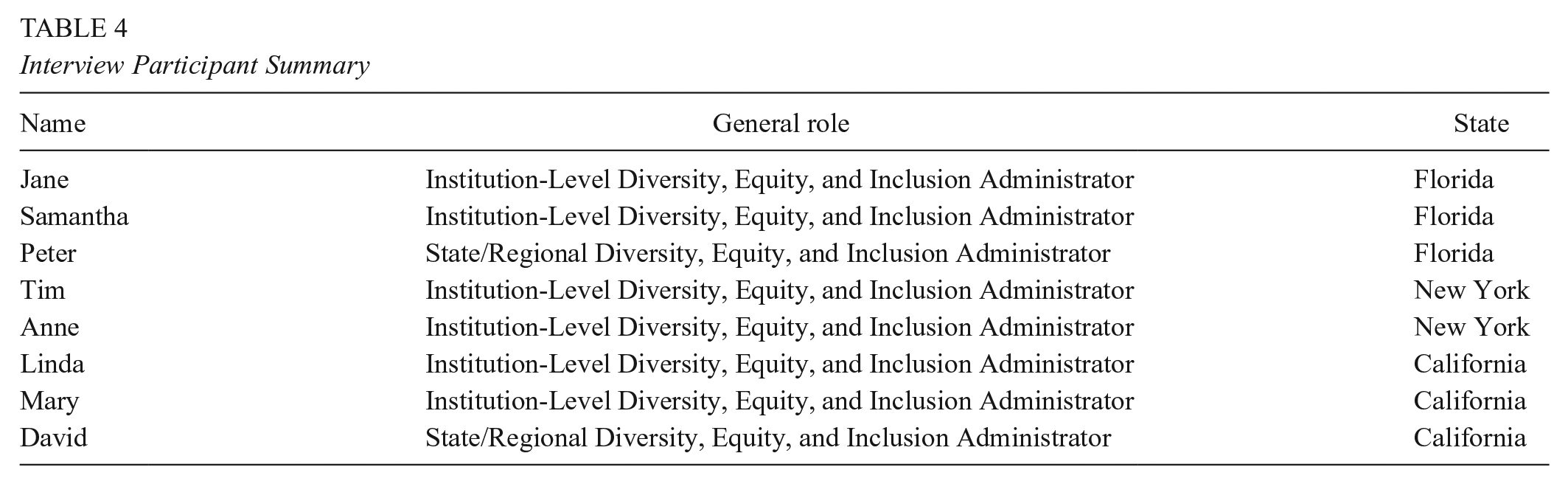
Institutional DEI plans or reports served as the primary data source for this analysis. In addition to the institutional reports, the researcher also collected two supplemental data elements. First, websites were queried at each institution to gather data related to central terms—diversity, equity, inclusion, Hispanic-serving institution/HSI, Title V, and chief diversity officer. Second, after the initial round of coding, preliminary themes were identified. Key stakeholder interviews (see Table 4) were conducted with two to three individuals in each state to gather stakeholder experience, perceptions of DEI policy, and feedback regarding preliminary themes. Participants were invited to participate based on their role as an equity officer, chief diversity officer, or other institutional or state leader responsible for DEI initiatives. Stakeholders were required to have held their role for at least 6 months. Interviews provided context to understand the policy implementation process within the state and offered stakeholder feedback. These supplemental data supported the triangulation of the analysis—refining the themes and situating these themes within the broader institutional and state policy discourse.
Interview Participant Summary
Analytic Approach
Given the rich data collected, the analysis undertook a multitiered approach to support the systematic organization, review, and analysis of the data. CDA framed the review of these data, allowing the foregrounding of the interrelationship among networks of power. Engaging CDA to consider written text and symbols through the lens of CRLC serves to counter a race-neutral position of CDA. Furthermore, CDA supports the situating of the texts within the social practice—the broader political context—and discursive practice the production, distribution, and intended consumption of texts to grapple with the broader landscape (Fairclough, 2005; Martínez-Alemán, 2015). The discursive inquiry is operationalized by the framework presented by Ana Martínez-Alemán (2015) to consider the discursive techniques embedded within texts. Summarized in Table 5, these techniques consider how power is (re)produced in documents, thus positioning policy as a form of discourse. By engaging CDA, the analysis contends with the positivist language within diversity policy to address the insidious and obscure nature of such discourse meaning “the power of dominant groups may be integrated into laws, rules, norms, habits, and even a quite general consensus” (van Dijk, 2015, p. 355). In so doing, CDA foregrounds with how policy discourses serve to create and preserve inequity.
Critical Discourse Analysis Discursive Techniques

Note. Adapted from Martínez-Alemán (2015).
Guided by the analysis framework presented by CDA, first, the supplemental data were reviewed. A single summary memo was produced for each institution to capture the emerging themes, questions, and early insights within the supplemental data. Second, the institution-level DEI plans were loaded in NVivo and reviewed in three distinct line-by-line coding phases. A preliminary review was conducted to examine how policy problems and policy solutions are constructed. Second, descriptive coding (Saldaña, 2021) was undertaken following a codebook drawn from a preliminary review of the data and a pilot study.
Additionally, CDA calls for the consideration of what is said as well as unsaid. The NVivo annotations tool was used to capture elements that seemed to be missing or in conflict with prior elements of the report. Finally, discursive techniques, framed by Martínez-Alemán (2015), were coded. This resulted in simultaneous coding (Saldaña, 2021) as several data points may have received a descriptive code—equity programming, community, teaching, race—as well as discursive technique codes. The coding process supported analytic inquiry into the emergence of various descriptive elements and discursive techniques. The intersection of the supplemental data and coded reports yielded emerging themes that were the foundation for the key informant interviews. Following the interviews, researcher memos were developed to document emerging elements of the interviews. Interviews were transcribed and revisited via memo to refine the themes further.
Positionality
Positioning the researcher as an instrument provides the opportunity to identify the researcher’s salient identities that inform this work. As an Afro-Latina scholar who worked as a DEI practitioner at the time of this research, I recognize that my racialized identity and professional lens shaped my decision to study HSIs and notions of race within these institutions. Furthermore, my professional role contributed to my ability to connect with interview participants and my framing of DEI work at HSIs. The intent of outlining my salient identities is not to suggest that these identities did not inform my work. Instead, I employed the bracketing tools of memoing and reflection to reduce potential bias and increase the study’s credibility (Creswell, 2013). The memo-writing provided valuable insights throughout the research process, such as early indication about the need to better articulate how I would attend to intersectionality. Furthermore, by threading supplemental materials and key stakeholder interviews, I sought to address the trustworthiness of the analysis (Merriam & Tisdell, 2015).
Findings
State-level DEI policies construct a discourse of intersectional diversity, particularly an intersectional consideration of Latinx students, within the institutional DEI plans at HSIs. This analysis foregrounds three primary themes: (1) the institutional discourse defining diversity and demographic data can be traced from the state policy through implementation guidance, (2) state-level policy framing informs how Latinx students are considered within institutional programing, and (3) in the absence of state-level discourse, institutions limitedly engage with the HSI designation. These three themes inform how an intersectional framework for diversity is considered and how the discourse within the institution-level DEI plans constructs a narrative of intersectionality among Latinx students.
Policy and Implementation Guidance Define Diversity
Tracing a thread from the state-level policy through the implementation guidance to the institution-level DEI plans produced as a result of the state-level policy can begin by looking at how the state policy serves to frame a definition of diversity. Each state-level policy provides some indication of how diversity is defined (see Table 6). The Florida Education Equity Act enumerates a set of social identities, in contrast with the SUNY DEI Policy, which speaks to a broader umbrella of diversity. In tracing the discourse, FCS institutions either fail to define diversity or, as FCS 8 suggests, “strategies developed to address racioethnic, gender, limited English proficiency, and disability”—mirroring the identities noted in the Florida Educational Equity Act (p. 14). Conversely, drawing from the broad definition of the SUNY DEI policy, SUNY 3 notes, “Embracing and fostering diversity encompasses a level of tolerance and respect, without judgment, for a multiplicity of traditions and cultures” (p. 3). SUNY 3 enumerates race and gender alongside military status and political affiliation, thus muddying the focus on racial equity. In echoing the state-level policy, the discursive technique of insinuation, obscuring the minimization of racial equity, as well as topicalization, producing a slant that suggests racial equity is addressed through its enumeration, bracket the institutional discourse. The discursive fibers originating in the state-level policies build a definition of diversity, resulting in the decentering of racial equity and a lack of explicit focus on intersectional identity. This discourse then permeates through the institution-level DEI plans.
State DEI Policy, a Definition of Diversity and Programming

Note. DEI = diversity, equity, and inclusion; FCS = Florida College System; SUNY = States University New York; CCCS = California Community Colleges; DFC = Division of Florida Colleges.
Continuing the thread, state-level policies are operationalized through the implementation guidance, either within the policy or standalone. Notably, the implementation guidance for the FCS and CCCS provides formulas regarding the tabulation and presentation of racial and gender diversity/inequity data (see Table 6). This demographic data becomes central to the structure of institution-level DEI plans. The data prepared by FCS looks at four racial categories—Black, Hispanic, White, other—contrasted with the CCCS which considers 16 disproportionately impacted groups, including the intersection of race and gender (CCCS, 2017). The SUNY DEI Policy does not prescribe data, instead noting a value on data—opening institutions to engage demographic data in meaningful ways. Tracing the discourse from the implementation guidance through to the institutional plans captures institutional statements, such as—“Using data generated based on the Chancellor’s Equity reporting template (outlined in the Student Equity Plan instructions)” (CCCS 6, p. 10), which employs discursive techniques of tone and power relations—positioning the certainty of the data and distancing the institution from culpability regarding these data choices. Engaging insinuation, institutional discourse at CCCS 9 notes, “In addition to our disproportionately impacted populations identified through campus-based research, the institution understand that exceptionally vulnerable populations exist outside of our research findings” (p. 18). In a more modest acknowledgment of the role of demographic data, as suggested by the state-policy, SUNY 4 suggests “a closer look at the enrollment trends shows that, over time, the percentage of minority students attending [Local] College has steadily increased” (p. 9). Doing so activates insinuation, articulating the required ongoing commitment to considering inequities, regardless of action.
State policy and the resulting implementation guidelines define diversity and the demographic data that make their way into the institution-level DEI plans. While a tacit acknowledgment of the differentiated impacts based on race and gender (CCCS, 2017) is acknowledged, the complexities of the Latinx community go largely unaddressed; notably the inattention to the intersection of race and ethnicity, despite national data which indicates a growing number of people identify as Afro-Latinx (Tamir, 2021). As a key stakeholder, David observed, “What that [state-level funding strategy] did was it didn’t realize that a person can be Hispanic, LGBTQ+, and a Veteran.” As a result, institution-level DEI plans suggest students do not embody multiple salient and oppressed identities. For Latinx students, this reductionist framing of ethnicity, originating in the state-level discourse, and making its way into the institution-level DEI plans, fails to contend with the racialized nature of the Latinx experience.
Programmatic Consideration of Intersectionality Among Latinx Students
Programming to address inequity is central to the institution-level DEI plans. Here too, the state-level DEI policies, and resulting implementation guidance, inform the institutional discourse related to DEI programs. The state-level policies present a direct call to address inequities through programs (see Table 6), yet how these institutions center Latinx students and an intersectional framework, is at the institution’s discretion. The relatively broad call for programming within the state-level policy results in institution-level DEI plans that present a range of programming focused toward Latinx students, a small amount of which takes an intersectional framing. In considering intersecting identities, institutional references such as “The college engaged in two outreach efforts in Fall 2017 and Spring 2018 relating to DACA students, who are mainly of Hispanic ethnicity” (FCS 6, p. 9) and “Leveraged funding and a focus on females and Latino students have helped to address transfer gaps for these populations” (CCCS 10, p. 9) contend with the complexity of Latinx identity. Programmatic efforts targeted toward teaching and learning also nod to a more complex consideration of Latinx students. Many, like SUNY 3, relied on existing programming, “Building on our past as the first community college in the country to require all degree-seeking students take a course on the pluralism and diversity of America” (p. 21). Others drew into focus Latinx students through faculty who “Collaborated with African-American and Latino FIG [faculty interest group] hosted by faculty members [name] and [name] to develop through research, experience, and creativity” (CCCS 2, p. 9). Thus, the state-level implementation guidance calls on institutions to identify programming to remedy inequity. However, the institutional discourse does not center Latinx students or an intersectional view of Latinx students.
Beyond these modest references to intersectional Latinx student programming, across these data, the characterizations of Latinx students rely overwhelmingly on a myopic focus on linguistic access. Institutions position their effort to support Latinx students as one of expanding access to linguistically relevant staff and program materials; a nearly singular narrative of supporting Latinx students as one of bilingual programming or discussing the translation of materials. Many institutions like SUNY 2 take this up through discussion of admission materials—“Produce Spanish language admissions and registration forms and marketing copy. Expand the number of languages to include the most common second languages spoken in [local] County” (p. 10). Alternatively, one institution suggests, “Improve print and web information to students and develop information in other languages such as Spanish through collaboration with [organization]” (CCCS 4, p. 21). The presupposition of this text discursively foregrounds the elimination of language barriers as central to supporting Latinx students. This is reinforced by narratives, such as those presented by Tim, “In the admissions office there is one, one Latino in the office, one Spanish speaking person.” While linguistic access is important, it is also central to a broader institutional obscuring of interventions that contend with an intersectional Latinx identity and greater systemic change to support Latinx students. While there is merit in broadening linguistic access through more robust institutional materials and staffing, two thirds of Latinxs identify that they speak English (Taylor et al., 2012). This race-neutral narrative limits thinking about the complex racial, ethnic, and lived experiences of Latinx students.
Positioning Latinx Students Through the HSI Designation
The state-level policies are silent regarding institutional differences, none mention any MSI status. Drawing from CDA, the analysis considers both what is said and unsaid related to the HSI designation. In constructing a narrative regarding Latinx students, institution-level DEI plans liminality engaged with a discussion of how the HSI designation served as an institutional mechanism for foregrounding intersectional Latinx student supports. Across the DEI plans, one of the primary references to the HSI designation is one of funding. Examples such as that from SUNY 4, our status as a Hispanic-Serving Institution (HSI) allows us to compete for federal funding via Title V of the Higher Education Act to bring faculty, staff, and students together to design new programs or enhance current programs focused on student engagement, retention, and graduation . . .”
begin this framing. Some complicate this slightly by suggesting, “The long-term benefits [of the HSI designation] for the College is increased in external funding, and the overall goal is to achieve higher student success rates.” Institution-level plans thus engage within connotation and topicalization to produce a slant related to the importance of the HSI designation, and it becomes one of funding. This was augmented by one stakeholder who noted, “I could approach it [HSI designation] through the money. . . . Then, it became a question of trying to go into the other areas of the conversation about embracing the designation and what it meant” (Tim [interview participant], 2019). Thus, while funding may be an entry point, it also becomes a tool for amplifying efforts to support Latinx students. However, the extent to which that shift is made has been heavily critiqued (Vargas, 2018; Vargas & Villa-Palomino, 2018).
Beyond funding, institution-level plans also reflect how HSI efforts thread across the institution—considering how HSI staff or coordinators are central to their institution-level DEI plans. This includes examples such as CCCS 10, “[a] Committee was formed . . . Chair for the SSSP Committee, Chair of the SEP and BSI committees, Vice-President of Student Affairs, Dean of Institutional Effectiveness, and Director of Hispanic Serving Institutions (HSI) Initiatives” (p. 4) which engages a narrative of power relations, positioning the embeddedness of the HSI staff, and thus programming. FCS 7 suggests, “With the HSI STEM grant entering its second year, advances are being made to increase the number of Hispanic and low-income students who enter and complete STEM certificates and degrees” (p. 25). Faculty and staff efforts related to the HSI designation are also highlighted by FCS 8, “The Faculty mentor serves as a discipline-based guide for students in developing their educational pathway and personal connections, as they prepare for graduation, transfer, and careers” (p. 21) as well as supplemental data from CCCS 2 which captures Summer Retreat for HSI Faculty—for faculty to earn a certificate in College Teaching & Learning in HSIs. Thus, a dualing narrative emerges. The HSI designation discourse produces a position of Latinx students as a path toward financial resources while at the same time, some institutions appear to expand this conversation to HSI designation as central to the institution. Missing from this framing is a complex narrative of the Latinx students that the HSI designation could advance, whether through the intentional integration of HSI efforts or the foregrounding of intersectional Latinx students in their HSI programming.
Discussion
By centering HSIs, given their essential role in educating Latinx students, this research provides a space to extend the analysis of institution-level DEI discourse at HSIs. The discourse at HSIs is located within the sociopolitical landscape of federal HSI policy and state-level DEI policy, which shape institutional rhetoric. At the federal level, the establishment of the HSI designation represents federal policy positioned as advancing equity for Latinx students yet with little attention to what that might mean (Garcia, 2016; Valdez, 2015). While institutions are required to meet enrollment designations, to access the federal dollars made available through the designation, are not coupled with a centering of Latinx students—speaking to the race neutrality of the policy (Vargas, 2018; Vargas & Villa-Palomino, 2018). Drawing down to the state policy level, across these three public higher education contexts, state-level DEI policies distanced themselves from racial equity both in the state policy and through implementation guidance, underscoring the importance of this policy juncture (J. Harris et al., 2015; Jayakumar et al., 2018). Thus, within the institution-level plans, despite referencing the inequality facing Latinx students, using enrollment and graduation outcomes, the programming and institutional policies that were presented, most often took on a language of serving “all” students, drawing many parallels to the work from Eric Felix et al. (2018). Dovetailing with prior research that has illustrated that HSI funding proposals are not targeting Latinx students (Vargas, 2018; Vargas & Villa-Palomino, 2018), state-level DEI policy discourse legitimized the construction of institution-level plans with limited strategies targeting education equity of Latinx students.
Beyond a broad characterization of diversity within CRLC, LatCrit draws attention to the differentiated impacts of distinctive oppressions, speaking to the need to contend with notions of intersectionality embedded within the broader tenet of challenging the dominant ideology (Harris et al., 2015). In doing so, LatCrit embraces intersectionality to move beyond the omnibus Latinx identity, at least partially constructed through the term Hispanic (Mora, 2014), to a more nuanced understanding of the racial and other social identities that inform Latinx student success in higher education. The federal HSI designation policy does little to address the highly heterogeneous nature of the Latinx community, thus contributing to the erasure of more intersectional views surrounding Latinx students at HSIs and beyond (Santiago, 2012; Valdez, 2015). The backdrop of federal policy has implications for the ways that HSI DEI plans engage in an essentialized framing of Latinx students, one granted acceptability through the federal discourse. At the state-level, the existence of an intersectional framework within these HSI DEI plans can be further situated through the state-level DEI policies. These state-level DEI policies often leave the intersections of ethnicity, race, gender, and other marginalized identities largely unaddressed. Within the institution-level DEI plans, beyond some consideration of gender and race, the framing of institutional data and programmatic efforts erodes how gender, class, and other social identities are layered on to these racialized experiences, thus further disenfranchising some groups (Crenshaw, 1990). Highlighting this absence contributes to the growing research within higher education that considers Afro-Latinx students (Dache et al., 2019; García-Louis & Cortes, 2020)—speaking to a broader problem of the erasure of a racialized Latinx identity.
As racialized sites, HSIs may reproduce the oppression of racially minoritized students through the engagement of color-evasive discourse within institution-level DEI plans. Specifically, leveraging the HSI designation as rhetorical signaling while also avoiding substantive change. Receipt of the HSI designation results in the public transition from an organization being racialized as White to now reflecting a minoritized identity (Garcia, 2019). In the process, the HSI designation becomes a tool for interest convergence, as we have seen in other DEI policies; HSI is evoked as a shorthand for “diversity,” yet often substantive structural change does not follow (Contreras et al., 2008). In Florida, the establishment of the Educational Equity Act was a response to the legal landscape which pushed for change despite resistance (Bender & Blanco, 1987). In the context of SUNY, the state policy development coincides with the growing national discourse of student protest surrounding racism on campus (Gose, 2018). These policies address the broader public calls for change while also contending with the pushback surrounding policies that explicitly highlights race (Felix & Trinidad, 2020; Mendelberg, 2017). The resulting essentialist discourse becomes color-neutral and removes examination of an intersectional racialized student. Thus, erasing Latinx students as complex individuals whose experiences on campus may be informed by multiple interlocking forms of oppression.
Underpinning federal, state-level, and institutional DEI policies are foundations of exclusion (Bonilla-Silva, 2017; Garcia, 2016), resulting in racial equity policy reforms that do not remedy inequity (McCoy & Rodricks, 2015; Museus et al., 2015; Valdes, 1997). Threading the interconnecting landscapes of race-neutral federal HSI policy and state-level DEI policy captures how state-level policies and implementation guidance reinforces the erasure of racial equity within institution-level DEI plans. This contributes to the limited construction of intersectionality and intersectional Latinx student supports. Across these state-level DEI policy contexts, the racialized nature of organizations speaks to the way that White normed best practices are advanced under the moniker racial equity. These documents capture the collective narrative of individual policy actors (Felix, 2021) as they work to articulate and enact policy that grapples with what it means to serve an intersectional considerations of Latinx student. As such, this work responds to calls from de Jesus Gonzalez et al. (2021) that critiques higher education scholarships’ limited consideration of policy implementation. In doing so, these data become one element in a rich conversation regarding how the institution-level DEI plans at HSIs can complicate and open an intersectional framing of Latinx students.
Implications
Within a framework of racialized organizations, these data focus on how institution-level DEI documents can serve to center an intersectional framing of diversity and, specifically, Latinx students. As such, findings from these data speak to how state-level DEI policy is taken up at HSIs, providing insight for state policy makers and institution-level practitioners.
State-Policy Implications
At the state level, DEI policy should be coupled with progress and accountability. State-level governing boards represent an often overlooked yet powerful lever in higher education (Morgan et al., 2021), with the ability to center progress related to advancing racial equity. Moving beyond the production of DEI plans to hold institutions accountable for action is needed. Doing so requires an engagement with practices from Tiffany Jones (2014, 2015; Jones et al., 2017) and others who draw attention to the differentiated role of MSIs. Including drawing from frameworks of Latinx-servingness that move beyond traditional measures of enrollment, persistence, and graduation (Garcia, 2016; Garcia & Natividad, 2018) to consider the systemic leadership change necessary.
Demographic data provided through the implementation guidance shaped the focus on racial equity and obscuring of intersectionality. The categories used are political, shaping the inclusion and exclusion of certain groups (Ford et al., 2020), and thus how diversity efforts are taken up by institutions. A critical engagement with the data used to frame institution-level DEI plans can positively shift the focus on racial equity (Byrd, 2021). Furthermore, centering intersectionality among Latinx students begins by considering race but can also leverage the multidimensional frameworks, like that presented by Anne-Marie Núñez (2014), to look at social identity and broader systems and structures. Engaging equity-minded best practices from critical quantitative scholars can support an efficacious engagement with quantitative data as the framework for racial equity inquiry.
Institution-Level Implications
Institutional leadership can play a role in furthering DEI efforts beyond the confines of state policy. Institutions can consider two practices to support a rich engagement with institution-level DEI plans that centers intersectionality for Latinx students and fully leverage their HSI designation. First, as institutions craft DEI plans, a broad cross-section of institutional leadership should be engaged to ensure that DEI efforts are embedded throughout the institution, drawing on best practices from other equity initiatives (Bensimon & Dowd, 2015; Leon & Williams, 2016). As several institutions indicated, engaging HSI leadership in this process will be critical to ensuring that the Latinx-servingness has the potential to be foregrounded. Second, as with the state policy, institutions need to center intersectionality among Latinx students, including race, class, higher education experience, language, gender, and so on, within their demographic data (Byrd, 2021). Doing so empowers institutions to target efforts in ways that align with the social identities that are most salient to students and consider the structural barriers that are producing this inequity.
Future Research
Continuing this work, scholars can engage DEI plan data longitudinally to explore shifting discourse tied to changes in the state policy and sociopolitical landscape. This research could be complemented by a deeper engagement with policy implementers across a host of different organizational types to frame how organizational structure shapes DEI plans. Doing so frames the equity reports through literature regarding racialized organizations to continue to examine the role of policy implementers within racialized organizations.
Conclusion
The ways that state policy, such as DEI policy, shape HSIs has been largely unexamined despite the significant role HSIs play in educating racially minoritized students (Garcia et al., 2019). As a public policy respons, DEI plans take on a critical role in understanding the mechanisms underway to move beyond the commodification of Latinx enrollment toward galvanizing racially equitable institutional change. The findings from these data speak to the ways that institutional DEI plans, shaped by the state-level policies, are responding to or overlooking the needs of a complex Latinx student. Furthermore, this analysis contends with the complicated nature of the ethnoracial classification of Latinx students and HEIs desire to essentialize this identity in ways that advance the dueling desire for both non-Whiteness and proximity to Whiteness. By looking at these questions from a multistate policy context, this analysis brings this research into conversation with lesser discussed HSI policy landscapes to expand an understanding of the implication of DEI plans at a range of HSIs.
Footnotes
Acknowledgements
I would like to thank Ana Martínez-Alemán who provided thoughtful feedback and guidance that shaped this manuscript. I am also grateful to the editors and anonymous reviewers for their thorough comments that have shaped the evolution of this paper.

Open Practices
Author
ISHARA CASELLAS CONNORS is an assistant professor of public service and administration at the Bush School for Government and Public Administration, Texas A&M University. She explores research related to racial equity in higher education, focused on Hispanic-serving institutions, racially minoritized institution, and the policy landscapes in which they operate.