



Abstract
While the COVID-19 pandemic affected the education of nearly all schoolchildren worldwide, pandemic-related school closures did not affect all children in equal ways. Between March and August, 2020, I interviewed 31 parents of children with disabilities as part of a larger interview study of U.S. parents of children in grades K–12. In this article, I analyze these parents’ narratives about their families’ experiences of pandemic-related remote learning to identify the particular challenges children with disabilities and their families faced with remote learning. I find that most, but not all, families struggled with remote learning, both when children’s specific needs while learning at home differed from their needs at school, and when schools failed to provide adequate accommodations and services remotely. These narratives demonstrate how children with disabilities are particularly vulnerable to the type of large-scale systemic shock to U.S. public education that the pandemic has presented.
Jackson, my kindergartner, [. . .] has support, emotional behavioral support at school. They haven’t reached out to us. They’re supposed to have! [. . .] With most special education parents, is we know that this is a unique time. We know that our kid might not get speech therapy or whatever. I mean, you know, this is a unique time in our history. And it feels like there’s not really a goal for there to be a middle ground. No one has talked to me about what services could still be afforded to Jackson, or anything. There have been zero conversations. [. . .] I think that's a little disheartening, because you would still hope they would do what they could. And that, so far, is not really happening with our school district.
In mid-March, 2020, as cases of COVID-19 began rising, schools across the United States closed their doors and rapidly pivoted to remote learning. While the pandemic affected the education of virtually all schoolchildren, it became clear early on that pandemic-related school closures did not affect all children in equal ways. As the above quote from Nadia illustrates, among those who were disproportionately affected were children with disabilities, many of whom found themselves without access to the services and accommodations they normally receive in school (Houtrow et al., 2020; Kim & Fienup, 2021). Nationwide, nearly seven million school-aged children—14% of all children in public schools—have some form of disability (Schaeffer, 2020), and children with disabilities are particularly vulnerable to the effects of disasters and other crises (Peek & Stough, 2010). How did children with disabilities fare during coronavirus-related school closures? What challenges did they, and their families, face with remote learning?
In this article, I examine the narratives of parents of children with disabilities about their experiences with coronavirus-related remote learning. Between March and August, 2020, I interviewed 112 U.S. parents of children in grades K–12, of whom 31 had at least one child with a disability. I analyze the narratives of these 31 parents, asking: What are the challenges that these children and their families experienced with remote learning during coronavirus-related school closures? And conversely, what positive experiences did these children and their families have? Such an analysis helps us better understand how children with disabilities are particularly vulnerable to the type of large-scale systemic shock to U.S. public education that the pandemic has presented.
Literature Review
Education for Students With Disabilities
Under the Individuals with Disabilities Education Act (IDEA) of 1990, the Individuals with Disabilities Education Improvement Act (IDEIA) of 2004, and Section 504 of the Rehabilitation Act of 1973, students with disabilities in the United States are entitled to services and accommodations that allow them to have “free appropriate public education in the least restrictive environment” (IDEIA, 2004). Most students who require services, therapies, and specialized instruction have these accommodations outlined in an Individualized Education Program (IEP), though students who are not eligible for an IEP due to the strict eligibility requirements of IDEA may qualify instead for what is called a 504 Plan, which has more broad eligibility (Zirkel, 2009, 2011). The IEP “serves the purpose of directing and monitoring all aspects of a student’s special education program” (Christle & Yell, 2010, p. 109). Though the student’s parent or guardian is required to participate in the IEP process, studies have found that many parents are dissatisfied with at least part of their child’s IEP (Slade et al., 2018). Some parents find the IEP process to be stressful, depersonalized, and even adversarial, and the focus on children’s deficits, rather than their strengths can be a major source of frustration for parents (Lake & Billingsley, 2000; Perry, 2021; Zeitlin & Curcic, 2014). In short, parents of children with disabilities may have entered COVID-19-related remote learning already highly attuned to ways in which their children’s needs are, or are not, being met by their schools.
Remote Learning, COVID-19, and Children With Disabilities
As schools began closing for in-person instruction in March of 2020 in order to mitigate the spread of COVID-19, individual teachers, schools, and districts struggled to understand the implications of IDEA and Section 504 for their ability to offer remote instruction (U.S. Department of Education, 2020). To address these concerns, the U.S. Department of Education issued guidance for schools, encouraging flexibility in balancing the health and safety needs of their communities with the protection of the civil rights of students with disabilities (U.S. Department of Education, 2020). However, schools across the United States varied widely in the type of remote learning they implemented, with only one third of school districts requiring teachers to provide any sort of direct instruction (Gross & Opalka, 2020), and this variation also meant that many students with disabilities were also left without adequate instruction (Kamenetz, 2020).
Various streams of literature are useful in helping us anticipate what the needs of children with disabilities during COVID-19-related remote learning may be. Research conducted prior to the COVID-19 pandemic indicates that parents have mixed feelings about the experience of remote learning even in the best of circumstances (Sorensen, 2012). Parents whose children are learning remotely often feel they need to take on a very active role in children’s remote learning, acting as “co-educators,” organizing and managing children’s schoolwork, and, occasionally, providing instruction (Garbe et al., 2020; Waters & Leong, 2014). We know very little about the specific experiences of K–12 students with disabilities with online learning prior to the COVID-19 pandemic, perhaps because remote learning at the K–12 level is relatively rare—a 2012 review, for example, identified only six empirical articles that examined online instruction for K–12 students with disabilities (Vasquez & Straub, 2012). Additionally, these few studies are limited to the experiences of those who have self-selected into distance learning, making it likely that their children are those who would be most likely to thrive in such an environment, and thus their experiences may not be particularly relevant to the pandemic context (Schuck & Lambert, 2020).
Research on the experiences with remote learning for college students with disabilities, however, is more plentiful, and may be a useful starting point in anticipating what challenges K–12 students may face, as a wider range of college students will have had access to opportunities for online learning. Research conducted prior to COVID-19 shows that while students with disabilities may find online courses to be particularly attractive because they mitigate the effects of certain accessibility issues, the potential benefits are not always realized due to the difficulties of navigating online platforms, inaccessible course design, a lack of accommodations, and/or unwillingness on the part of students to disclose disability to their instructors (Burgstahler et al., 2004; Kent et al., 2018; Kinash et al., 2004). Struggles with online courses have been found to negatively affect these students’ quality of life, increasing their stress and anxiety and lowering their self-esteem (Lambert & Dryer, 2018).
Literature on the experiences of children with disabilities in other times of crisis may also be useful in helping anticipate the needs of children with disabilities during the pandemic. Drawing on the social vulnerability model and examining research on the experiences of both children and people (usually adults) with disabilities during disasters, Peek and Stough (2010) argue that, while children in general are vulnerable to a variety of risks when disaster strikes, children with disabilities are especially so, particularly when their social and educational networks and protections are affected. Despite this vulnerability, disaster policies in U.S. schools tend not to be inclusive of the needs of children with disabilities (Boon et al., 2011). Teachers play an important role in supporting children with disabilities during crises and disasters (McAdams Ducy & Stough, 2011). Research by Christ and Christ (2006) points to the importance of supportive educators and school environments for children with disabilities during times of crisis, as those factors help protect against negative educational and behavioral effects. The fact that access to teachers and the school community has been limited during the pandemic suggests that children with disabilities may face particular educational challenges.
More than a year into the pandemic, a body of research about remote learning during the COVID-19 pandemic is now beginning to emerge. In general, younger, elementary-age children appear to have struggled more than older children with the transition to remote learning (Gayatri, 2020). While parents have reported a variety of challenges with remote learning, in one survey of 122 U.S. parents conducted in April 2020, most (over 80%) reported being generally satisfied with the support their children’s schools were providing during school closures, despite the fact that “school closures put more responsibilities on the shoulders of parents” (Garbe et al., 2020, p. 57). In that same study, however, several parents reported that special needs of their child, due to either disability or giftedness, presented a challenge to remote learning, with some of these parents noting that this was taking an emotional toll (Garbe et al., 2020).
Additionally, articles have begun to be published discussing experiences of both students with disabilities and their teachers with remote learning during COVID-19, and while these early articles are largely based on case studies and smaller scale qualitative samples, they offer insights into what we might expect to see happening for such students more broadly. The shift to remote learning for students with disabilities has introduced novel sources of stress for both students and parents, and the “unmet need for educational assistance has been staggering and challenging for families to navigate” (Houtrow et al., 2020, p. 417). Some scholars have noted that the disruption to in-person schooling has been especially challenging for those students with disabilities, like autism, that require high levels of routine and regularity (Asbury et al., 2021; Eshraghi et al., 2020; Lee, 2020). Schuck and Lambert (2020) argue that remote learning has been especially difficult for teachers whose students need high levels of support. That said, some research has indicated factors that are likely to improve the experiences of these students, such as frequent, clear communication from schools to families (Tremmel et al., 2020), training parents and caregivers to provide more specialized support (Schuck & Lambert, 2020; Tremmel et al., 2020), and regular teacher contact with students to promote engagement (Kim & Fienup, 2021). That said, not all experiences of students with disabilities have been negative; in one study, for example, while many students reported difficulty with remote learning, one third also reported experiencing improvements to accessibility during the pandemic (Toste et al., 2021). This body of literature, however, is primarily based on individual case studies or very small samples of two to three teachers or students (the one exception being Toste et al. [2021], whose study included 21 students in Grades 6–12). It is thus important that more data be gathered and examined to better capture a broader range of experiences of children of varying ages and with a variety of disabilities.
Method
The interviews analyzed in this article are drawn from a larger in-depth interview study of parental experiences with remote learning during COVID-19. Between March and August, 2020, I conducted in-depth interviews with 112 parents of children in grades K–12 across the United States. Parents were recruited using a call for participants that was circulated via email and on various social media platforms, including Twitter and Facebook. I first emailed various contacts with school-aged children and asked them to forward the call to their networks, and posted publicly on Twitter and Facebook, asking people to repost the call. I then identified several Facebook groups that had formed to support parents during the COVID-19 pandemic; I received permission from the group administrators of two of these groups to post the call for participants in the groups. Initially, my call asked broadly for U.S.-based parents of children in grades K–12 who were learning remotely, but about midway through data collection, in an attempt to maximize diversity of the sample, I amended the call to say I was especially interested in interviewing parents who were non-White, LGBTQ+ (lesbian, gay, bisexual, transgender, queer, and other), low-income, single parents, and/or essential workers. Potential participants who contacted me via email or Facebook messenger were given a link to sign up for an interview time. I did not use any exclusion criteria other than being located in the United States and having a child in grades K–12—anyone who contacted me expressing interest in being interviewed was invited to do so.
Interviews took place in two waves. In the first wave, from March to May 2020, I interviewed 88 parents. My empirical research questions for this wave were as follows: How are parents experiencing remote learning during the pandemic? What challenges and successes are they experiencing? What is their perspective on how their children’s schools and school districts are approaching remote learning? And, how is the family coping with remote learning, work, and family life during the pandemic? On a more theoretical level, the aim of the study was to gain insight into what the pandemic reveals more broadly about the relationships between families and schools. During these interviews, I asked parents how their school/district was handling remote learning, how they felt about this approach and how remote learning was going for their family, how their children felt about remote learning, how the family was doing emotionally, and what concerns, if any, the parent had about their children during this time. During the second wave of interviews, in August 2020, I interviewed 24 parents. In addition to asking similar questions to those in the first wave about their experience with remote learning in the spring, I also asked these parents about their thinking and decision-making processes about in person, hybrid, and remote learning for fall. I did this to better understand what factors parents were considering in making this decision, and how they felt about being asked (or not, in some cases), to make such a decision.
All interviews took place either over the phone or using the Zoom videoconferencing platform, per the respondent’s preference. The interviews analyzed for this article lasted between 23 and 94 minutes, with an average length of 47 minutes. All interviews were audio recorded using a digital audio recording device. Initial transcription was done using the artificial intelligence–powered transcription platform Trint; my research assistant and I then listened to each recording and edited the transcript for accuracy. The study was approved by the Institutional Review Board at the University at Albany, The State University of New York.
Of the 112 parents in the main study sample, 31 identified themselves as having at least one child with a disability (including learning disabilities, attention deficit hyperactivity disorder [ADHD], autism, Down syndrome, mental and behavioral health issues, and chronic illness). These 31 interviews are the focus of the present article. The subsample of parents of children with disabilities was disproportionately White (71%), well-educated (45.2% had a graduate degree), and high income (35.5%). Most of the parents in the subsample were women (90.3%), and just over one third were single parents. (See Table 1 for the demographic characteristics of the sample.)
Characteristics of Interview Sample

Note. N = 31. LGBQ+ = lesbian, gay, bisexual, transgender, queer, and other.
While most of the parents in the subsample had only one child with a disability, several had more than one, so a total of 41 children with disabilities are represented. These children ranged in age from 3 to 17 years, with an average age of 8.6 years. The majority (73.2%) were in Grades K–5; 9.8% were in middle school (Grades 6–8) and 9.8% in high school (Grades 9–12), while a few (7.3%) were receiving services while in Pre-K. Because disability-related concerns were not the original focus of the larger project, parents were not asked to specify their child’s disability or the nature of the services or accommodations they received, though many of the parents did volunteer at least some of this information. The most common disabilities parents named were ADD or ADHD (34.1%) and autism (17.1%); other children had various learning, behavioral, mental health, or health-related disabilities (see Table 2 for information on the children represented in the interviews).
Characteristics of Interviewees’ Children With Disabilities
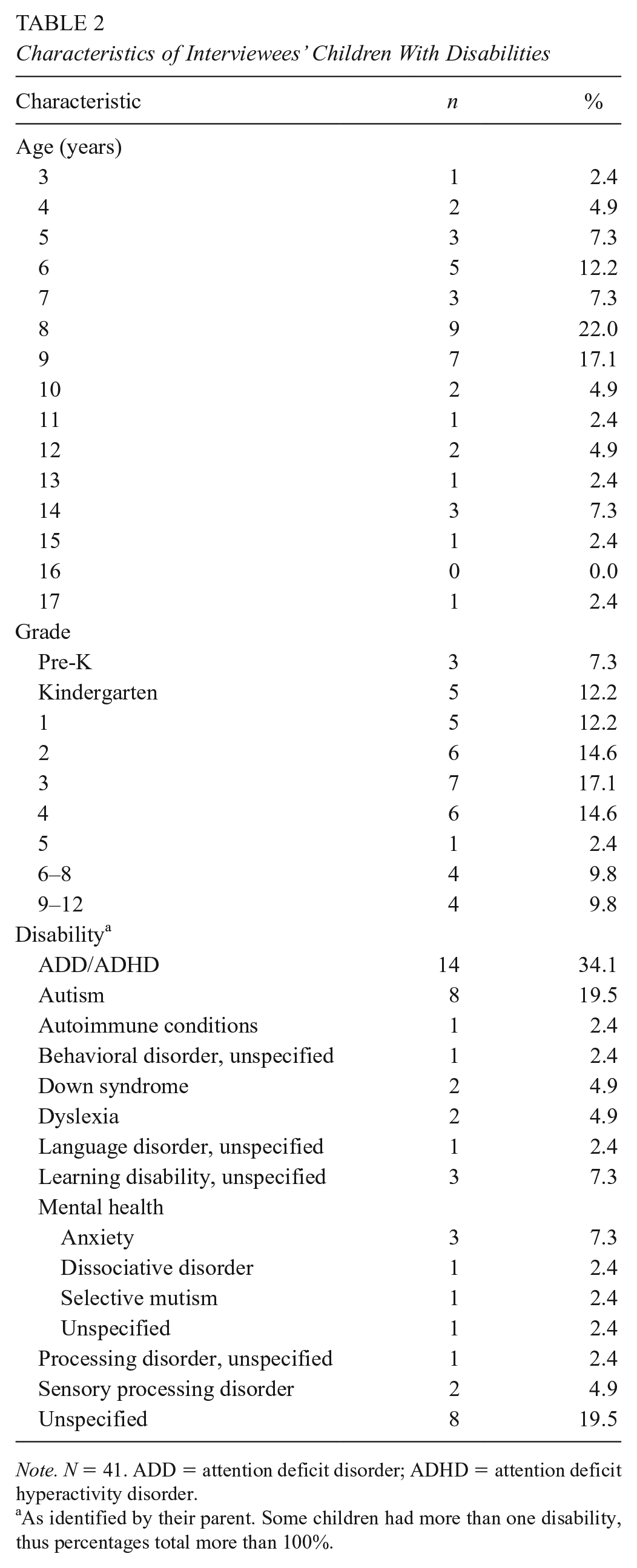
Note. N = 41. ADD = attention deficit disorder; ADHD = attention deficit hyperactivity disorder.
As identified by their parent. Some children had more than one disability, thus percentages total more than 100%.
While disability-related concerns were not the initial focus of the larger research project, it became clear as I began reading the interview transcripts that, for some parents, this was an important feature of their remote learning experience. I thus analyzed this subset of interviews, asking: What were the specific experiences of families with a child with a disability with remote learning during the pandemic? What particular challenges did these families face? What positive experiences did they have? To answer these specific questions, I analyzed the subset of 31 transcripts using a flexible coding approach, which is appropriate for use with specific, circumscribed questions and large qualitative data sets (Deterding & Waters, 2018). I began by reading these transcripts and identifying all passages that contained any discussion of disability-related topics. Once I had identified the relevant interview segments, I then carefully read those segments again, making note of patterns I saw in these discussions. From these patterns, I created a set of codes that included challenges of remote learning for children with disabilities (including subcodes related to struggles with remote learning and issues related to accommodations and services normally provided under an IEP or a 504 plan), positive experiences with remote learning, and concerns about the future. I then read through the interview segments again, hand-coding them using the above coding scheme. Below, I report specifically on the data that was coded as being about challenges and positive experiences.
Findings
Challenges
By far, the most common theme these parents discussed was the challenges their children faced with remote learning, with 24 of the 31 interviewees discussing some form of disability-related challenge. These challenges included two primary types. First, for some children, their specific needs while learning at home were different from their needs while at school, so the accommodations that worked for them in school did not necessarily apply in the same way at home. Second, several parents noted that their children’s schools struggled to provide adequate services or accommodations.
Specific Needs Related to Remote Learning
Thirteen of the parents I interviewed discussed disability-related challenges that their children (n = 17) experienced that were specific to the context of remote learning. These included struggles with disruption to routine, distractions related to siblings and home, difficulty navigating technology and various learning apps and platforms, and difficulty with different teaching modalities than what students normally experience. Most of the children that parents described having such challenges had diagnoses of autism or ADHD, though a few had other diagnoses such as Down syndrome, a learning disability, or a language disorder.
Lauren (widowed mother of three, New Hampshire) was the parent of a preschooler, a second grader, and an adult child who had just moved back home. Lauren’s 8-year-old, Shane, had autism and ADHD, and she was struggling to help him with remote learning while also taking care of her 5-year-old and working full time. To illustrate the difficulty her son was having with school, Lauren described one assignment her son had been given recently, in which he watched a 15-minute video and then had to write out (and submit) five words the video had discussed. Shane completed the assignment, and then got feedback from his teacher that it was a “good try,” but that he had not typed the right words, so he should “try again.” By then, he did not remember the video at all, so this would necessitate watching the entire video again. “Honestly,” Lauren explained, “I skipped through it, just to get to the words, so we can write it down and send it in.” Part of the problem with the assignment, Lauren felt, was in the length of the video he was expected to watch. “My second grader has autism as well as ADHD,” she said, “and trying to force him to sit down and watch a 15-minute video? That’s not setting anybody up for success.” In school, such an activity would happen with real-time interaction and feedback, during which Shane would also have the assistance of a paraprofessional. While some experts have suggested that asynchronous learning was ideal for the pandemic context due to its relative ease of use (Daniel, 2020), Lauren’s example made it clear that this is not true for all learners: both the video format and delayed feedback made things harder for Shane.
Asynchronous learning, with its accompanying lack of interaction with a teacher, was a struggle for other students, as well. Dawn (married mother of two, New York) had two children with disabilities: her 17-year-old daughter had several chronic illnesses, and her 13-year-old son was on the autism spectrum and had a language disorder. Dawn noted that her son’s language disorder is usually not too much of a problem when he is in school, but at home it has become a real challenge. Without context, body language, or tone of voice, interpreting the work on the screen has made his life harder.
She added, “he often misinterprets the assignments and then he has to do them over, and it frustrates him.” Dee (single parent of three, Indiana), noted that their 11-year-old son, who had a 504 plan for suspected ADHD, was struggling with remote learning because students were being asked to complete activities and assignments in a variety of different apps and platforms each day. “It’s sort of like the opposite of what works for him,” they said, “to have all these places he’s supposed to go to find stuff and do it.”
Some parents noted that their children were struggling far more with distraction and the ability to focus at home than they did at school; this was most often raised by parents of elementary-aged children with autism and ADHD. For example, Erin (married mother of three, Connecticut) had a 7-year-old daughter in first grade who had just recently been diagnosed with ADHD. While they had figured out some accommodations in the classroom to make the environment less distracting, distractions were basically unavoidable at home, with two younger siblings constantly competing for Erin’s attention. Jill (married mother of two, New York), whose third grader also had ADHD, mentioned that her son’s teacher said students should be spending about 1.5 to 2 hours doing schoolwork each day, but that “sometimes he and I will sit there for 5 hours.” Jill reported being more or less unable to get up from the table while her son was working, because he needed her constant presence to keep him on task. “I know at school does this stuff independently. I don’t know what it is about home.”
Lauren’s son Shane also struggled to stay focused during his classroom’s morning Zoom meeting without the aid of his usual paraprofessional. Sometimes, Lauren was able to sit with him to help, but other times she could not, because of work obligations. If Shane interrupted the class too much, his teacher would kick him out of the meeting, and he would not be allowed to return the next day, instead meeting one-on-one with the special education teacher during that time slot to “process” his behavior and review the rules about expected behavior during class meetings. “I don’t agree with that [approach] at all,” Lauren said, “because it’s a punishment, by removing his availability to peers. And any child right now, regardless of an IEP or a 504, should not be denied regular classroom accessibility.” Lauren felt that this approach violated Shane’s right to be educated in the least restrictive environment (Osborne & Dimattia, 1994; Rueda et al., 2000). But even with Lauren stepping away from her own work as much as she could during Shane’s morning meetings, she reported, he was getting kicked out about once a week.
Finally, some parents said that their children struggled due to the lack of consistency, routine, and structure that came along with remote learning. Nadia (married mother of four, Oklahoma), who had a first grader with autism and a kindergartner with ADHD, noted, “one big thing about having two neuro diverse children [. . .] is that they need some semblance of routine and normalcy. And this is already a very big challenge for them.” She later added, “So trying to build in some kind of schedule, which we have adjusted in family meetings a few different times, trying to figure out what is our new normal and what’s realistic, has been a bit tough.” Similarly, when I asked Colleen (single mother of two, Massachusetts) how the transition to remote learning went in the spring for her two daughters with Down Syndrome, she responded, “Horribly,” because “they really rely on routine and structure, both of them. They need it. They crave it. And when it was suddenly taken away, both my kids pretty much went off the rails.”
Lack of Services and Accommodations
In addition to the remote learning–specific challenges described above, some parents explained that their children’s schools struggled to figure out how to deliver accommodations and services to children with IEPs and/or 504 plans. Twenty of the parents I interviewed described some disruption to services, such as speech and occupational therapy, one-on-one aides or paraprofessionals, or read-aloud services for tests and assignments, for a total of 24 of their children. While some schools attempted the delivery of various therapies using videoconferencing, not all did. Some children received some amount of one-on-one instruction from a teacher, teacher’s aide, or paraprofessional, but none of the children who normally had full-time one-on-one assistance in school were given the same amount of assistance with remote work, and of course, none of this happened in person due to social distancing measures. As the quote from Nadia that opened this article demonstrates, this proved to be a source of concern and even frustration for some parents, even when they understood the limitations that schools were facing.
Some parents noted that their children’s services had been taken away entirely. Sydney (single mother of one, Minnesota) had a 9-year-old daughter with attention issues and dissociative disorder; while in school, her daughter would get about an hour a day of one-on-one assistance, especially with math. But since school had gone remote, Sydney said, “that’s gone.” Other parents reported that they were expected to deliver their children’s services. When I asked Carmen (married mother of two, Massachusetts), whose second grader received speech therapy at school, whether she had any concerns about her children’s academics during remote learning, she said “I do have concerns. I didn’t go to school to teach. It’s not within my realm of tools, I’d say.” She felt her limitations most acutely when it came to her daughter’s speech therapy. “They sent home a book for me to do speech with her,” she explained, “but again, I’m not really trained to do speech.” Caroline (married mother of three, Vermont) felt similarly about being asked to do speech therapy with her preschooler. She explained with laughter, “They’re like, here’s all the work that you should be doing on his IEP. And I’m like, I’m not a speech pathologist!” The need for parents to perform roles normally taken on by teachers, therapists, paraprofessionals, or aides was frustrating to these parents.
Some parents noted that they had experienced an interruption to services, but were expecting services to resume soon, despite schools being slow to get them up and running. Cheryl (single mother of one, Texas), whose second grader was dyslexic, noted that services had not started up yet, but she hoped they might eventually. Cheryl was concerned because her son had been making some noticeable progress that year, and she worried that the suspension of these services, even temporarily, would halt or even reverse some of that progress. Phoebe (married mother of two, Massachusetts) noted that the person who was most involved in providing services to her 8-year-old son Lucas, who was autistic, had been the slowest at the school to reach out. I interviewed Phoebe a full month into the school closure, but she said “I think just finally, starting next week, we’re going to have one-on-one meetings with her for Lucas. So in that sense, that’s been slow.”
Lauren had a particularly frustrating experience in which the school offered services, but in such a limited way that they were completely inaccessible to her family. Recall that Lauren was a single mother working from home while also caring for her children. Lauren explained as follows: They offered him speech, because that’s on his IEP. However, speech was only offered from nine to one, one day a week, and a parent would need to be present to be able to redirect the child and what not. And I wrote back, I’m like, “that doesn’t work with my schedule. [. . .] Is there another alternative?” And then I get a letter of written prior notice sent to me, that mom has refused speech. Well, mom did not refuse speech! Mom shared that that does not work with her work schedule!
Lauren was frustrated that, not only was her son not getting this service, the school made it seem as if she, not the school, was the one who was responsible for that.
Remote Learning as Marked by Struggle
For many of the families who described challenges with remote learning, whether these stemmed from the particularities of remote schooling or from the lack of adequate services, remote learning was a struggle. Alexandra (married mother of five, Ohio) said, “I know some other third and fourth graders are independent. Mine are proving to not be independent.” When I asked how much assistance her sons, who had ADHD, needed from her to get their schoolwork done, she responded, “total assistance. Like, I would say, ideally, I would sit at the table with them all day long”—something she could not usually do, because she had three younger children she also needed to care for. Clare (single mother of one, Washington, D.C.) also had a child with ADHD, a 6-year-old. Clare’s daughter’s principal said that the ideal was that each child would spend 2 hours a day doing learning-related things, but Clare said “I am not able to do that, with mine! I can barely get her to do 2 minutes.” Later, Clare expanded on this, saying So most mornings now, Monday through Thursday, she has a virtual class time in the morning, like a 25-minute virtual classroom time with the teacher. Beyond that, I’m just really struggling with trying to get her to focus on anything school related.
Clare felt that her daughter’s behavior had changed noticeably, explaining that “she flies into these horrible temper tantrums. And then I spend a lot of time kind of repairing both her and the house after the tantrums.” When I asked Clare how she was coping with all of this, she said “Oh, it’s awful. I can’t get any work done. I don’t have any space in my brain to focus.” Clare had a lot of anxiety “about [my daughter’s] mental health, you know, and her ability to get any kind of education during this time.”
While some parents persevered in the face of these challenges, even when it meant spending many hours each day struggling through schoolwork, others came to see remote learning as a near, or even total, failure. Dee, for example, said, “I pretty much, to be honest, somewhat wrote off the school year when this happened,” she explained. “And I was like, okay, I’m just going to work on stuff with my kids, little by little, from now until whenever we’re back in school.” Colleen said the instruction for her daughters with Down syndrome was “really bad,” and while she did not think this was the teachers’ fault, “my kids really need a lot of, like one-on-one, and of course, weren’t getting that. And so I wound up basically opting out. For all intents and purposes, we were virtual dropouts.”
Positive Experiences With Remote Learning
Of the parents I interviewed who shared experiences of remote learning that were marked by challenges and struggle, seven parents also shared positive experiences in addition to the negative, and an additional six parents only shared positive experiences related to their child’s disability. Of the six children whose parents described only positive experiences related to disability and remote learning, three were on the older side: a 12-year-old with an unspecified disability whose teachers were being very helpful, a 15-year-old with dyslexia whose teachers were providing additional support, and a 14-year-old with ADD who found the home to be far less distracting than school. The other three were all younger children (aged 4, 8, and 9 years) who seemed to their parents to be happier and/or less anxious at home than they usually were at school; two of these children specifically had anxiety-related disabilities.
Amelia (single mother of one, Pennsylvania), was one parent whose child seemed to thrive doing remote learning. She said of her son Jonah, a fourth grader with ADHD, “I actually think that online learning in a way more suits Jonah’s temperament. And I’m very happy for him to be instructed that way.” She continued, saying What I have noticed about him is that he’s so much more engaged with the world that he discovers online from gaming and YouTube and so forth. And he picks up on information and synthesizes information from that use of his time seemingly a lot more quickly than he does from formal learning at school. He also reads on his own a lot.
Abby (married mother of two, Massachusetts) said of her daughter, who had selective mutism, that everything shutting down benefited my daughter, because I was able to get her a telehealth medical appointment, that I was not able to get her before. I was able to get her on medication because of that appointment. Because of the medication, she was able to overcome some of her social anxiety and she was able to start speaking with people in school for the first time that school year.
Remote learning also gave Abby the chance to be present to support her daughter, which she felt really helped. “I think, like, just me being with her, and holding her hand while she did the video chats and the meetings, like that wouldn’t have happened in school.” Renee (married parent of four, Maryland) said that their 14-year-old has shown the biggest improvement from going virtual, because he has ADD, and is easily distracted by the public school system setup, and the classroom. And being able to just sit in the kitchen with no kids around him and just work
meant he was far more able to concentrate—so much so, that he had passed eighth grade, which they were not sure he would do. Renee noted that “I saw a change right away,” and that “I’m grateful for that.”
Not all parents had such unequivocally positive experiences as these, though. As noted above, Jill’s son Ethan was struggling to focus at home. About his teachers, however, Jill said, “I can’t say enough good things.” She worried a bit about him missing out on social interaction, but otherwise, she said, “I feel like he’s still learning and he’s still getting something out of this.” Kelsey (married mother of six, Maine) had mixed feelings about the experience of remote learning for her elementary-school children, two of whom had autism. Kelsey noted that the special education teachers at her children’s school had gone out of their way to make sure she had the tools she needed to do remote learning: Because I have two children in special education, the special education teachers are doing the bulk of my kids’ extra work. They organized food drop offs, so they get school breakfast and lunches. They organized computers. They brought me, like, a bunch of extra stuff, like I got a whiteboard and some extra tools for me to use for the children who have special education. And for my family in particular, they dropped off the laptops to my house.
Kelsey joked that the teachers were probably going out of their way to help her because she had six children and therefore always looked exhausted. But despite all this extra help, remote learning was still difficult, as Kelsey had six children at home, two of whom had services in school for autism, one of whom had an autism diagnosis and was in pre–K, and two of whom were toddler twins. Only one of her children—her 8-year-old daughter—was able to work completely independently, and her 5-year-old son requires constant direct instruction from me, the whole—anything he does, he requires me to be right there with him. Keeping him on task, helping him focus with the work, teaching him the materials, whatever it is, I need to be there, like I am a one-on-one.
Other parents also expressed appreciation for teachers and staff who were going the extra mile. In fact, the positive experiences described for 8 of 14 children were related to having good support from teachers or school staff. Alyssa (single mother of two, South Dakota) told me that her son’s teacher was giving him extra help whenever he needed it. “Because he is on an IEP, sometimes if he doesn’t completely understand it, his teacher will take the time out and do a special one-on-one Zoom class with him, and go over whatever it is,” she said. When I asked Patty (married mother of four, Illinois) whether she had any concerns about her children, academically or otherwise, she responded, “You know, I really don’t.” She went on to say how grateful she was for the support her 15-year-old son, who was dyslexic, was getting. For example, she said, right now they’re doing Romeo and Juliet, so they’ve sent him, like, all these different tutorials because he really can’t—you know how hard it is to [read] that, right? Like, Romeo and Juliet, that’s so painful, especially for the dyslexic mind, because it’s like a foreign language, you know, almost. So they’re supporting him, for sure.
Discussion
The parents I interviewed had mixed experiences of remote learning during COVID-19 for their children with disabilities. Most reported that remote learning was a struggle for their families. For some, this was because remote learning was different than in-person learning, due to, for example, difficulty navigating apps, a lack of real-time feedback and interaction, increased distractions at home, or a lack of structure. For others, their school’s inability (or unwillingness) to provide accommodations and services that children would normally receive in school was a major source of struggle; this was especially true for children who normally received one-to-one assistance and for those whose parents felt ill-equipped to assist with certain therapies. Some of these parents reported concerns that remote learning was failing their children, and a few saw it as a total failure. Of course, these parents were not the only parents I interviewed who reported challenges with remote learning, but of those other parents, few, if any, felt it was a complete failure.
That said, some of the parents who faced challenges with remote learning also reported positive experiences as well. For several of these parents, these positive experiences had to do with teachers and school staff were working hard to do what they could to assist their children. This was consistent with other research that showed improvement in the engagement of children with disabilities with remote learning when teachers offered additional support and encouragement (Kim & Fienup, 2021), and highlights the importance of frequent, clear communication between school staff and parents (Tremmel et al., 2020). Other parents reported that their children, particularly those with anxiety-related diagnoses or those who found home to be a less distracting learning environment than school, also were faring well during remote learning. A few of these parents even felt that remote learning was quite successful for their children, who seemed to be thriving in ways they did not while in person.
It is clear, then, that remote learning was more of a challenge for some children with disabilities than for others. Which children were likely to struggle more with remote learning? The parents interviewed in this study are not representative of all parents of children with disabilities, and thus their experiences are not generalizable to this population as a whole. Still, some patterns are evident in these interviews that suggest preliminary answers to this question. Parents of younger children tended to report that remote learning was more of a challenge than those whose child with a disability was older. For example, among children with ADHD, parents of younger children reported their children finding the home environment very distracting and thus struggling to stay on task, whereas one older child found home to be less distracting than school, and thus performed better during remote learning than he had earlier in the school year. Age may be a crucial factor here; research by Toste et al. (2021) demonstrating the resilience of students with disabilities during the pandemic may have captured more positive experiences specifically because the research looked at children in Grades 6 to 12, and others have noted the particular challenges that special education teachers of younger children have faced with pandemic-related remote teaching (Schuck & Lambert, 2020). Schuck and Lambert (2020) also note the particular challenges of remote teaching for “students with significant support needs.” The current study also indicates that children who had specific, intense services and accommodations in school, particularly those with one-to-one aides, seemed to struggle more due to the inability of schools to provide such services remotely. While some school districts were able to offer some degree of individual outreach and instruction for students with disabilities during school closures (see, e.g., Kim & Fienup, 2021; Tremmel et al., 2020), my interviews make clear that this was not the case for all school districts, and that even for those who were able to offer services such as one-on-one videoconferencing sessions, these are not a direct substitute for one-on-one, in-person assistance.
Limitations
The experiences shared by these parents are important for understanding the impact of coronavirus-related remote learning on children with disabilities in the United States, but there are several reasons why they should not be understood as demonstrating the full range of such experiences. One reason this is the case is that the larger project was not originally designed to specifically study the experiences of families with a child with disabilities. Because of this, care should be taken in interpreting the prevalence of each theme discussed above. Because I did not ask specific questions about disability, it is quite likely that some parents of a child with a disability may have had experiences—negative or positive—that they did not share with me. As noted earlier, not all parents shared specifics about their child’s diagnosis or the types of services they received, making it difficult to tease out the ways that type of disability and types of services shaped these children’s experiences. Further research that looks at specific disabilities is certainly warranted to help confirm, clarify, add nuance to these preliminary patterns.
Additionally, it is crucial to keep in mind the demographic makeup of the sample of parents and of their children when interpreting these findings. While the parents in this sample were predominantly White (71%), non-White children in the United States are disproportionately likely to be given a diagnosis of a disability and to be in special education programs (Ferri & Connor, 2005), and parents of color are more likely that White parents to be dissatisfied with disability-related processes such as the IEP (Burke et al., 2018; Tamzarian et al., 2012; Wilson, 2015). It is thus likely that a more racially and ethnically diverse sample would have revealed a wider range of experiences, and particularly, challenges. Further research is thus needed that examines the specific experiences of children of color with disabilities.
It is also important to keep in mind that the narratives analyzed for this article come from the parents of children with disabilities, not the children themselves. Some research has suggested that in times of crisis, “adults often do not realize the extent to which children are distressed,” as children may strategically enact ways of minimizing their stress so as not to further contribute to that of their parents (McFarlane, 1987; Peek & Fothergill, 2009, p. 40). It is possible that the challenges described by parents here are actually underreports of children’s actual struggles; further research that directly asks children with disabilities about their experiences with remote learning is therefore essential.
Additionally, school districts across the United States took a wide variety of approaches to remote learning during the early months of the pandemic, including synchronous and asynchronous approaches, and with great variation in access to, and reliance on, technology. While the qualitative approach used in this study works well to illuminate the everyday experience of remote learning for the parents interviewed, it does not allow for an understanding of which approaches were more likely to be successful than others for children with a variety of disabilities. A larger scale quantitative study that allows for such a correlational analysis would surely be of interest to researchers and school personnel alike.
Conclusion
The COVID-19 pandemic has thrown into sharp relief the ways that public schools presume a normative, abled child (Erevelles, 2000). While children with disabilities are entitled to services and accommodations under the IDEA, the process of securing these accommodations can be a struggle even under the best of circumstances. As scholar and activist David Perry (2021) has argued, “disability systems rely on artificial economies of scarcity,” meaning that schools—like other systems that serve individuals with disability—often work from a place of minimizing, rather than maximizing, the services they provide. This was clearly the case for many of the parents in this study, whose children’s services were reduced during the pandemic.
Moments of crisis can present significant challenges for children with disabilities, but they also present the opportunity to reevaluate our education system (Miles, 2013), and thus “the COVID-19 crisis gives us the opportunity to reassess what type of school we want for the future” (Colao et al., 2020, p. e370). This reimagining of schools must include a focus on children with disabilities, whose “needs should be included in future crisis planning” (Houtrow et al., 2020, p. 415) The experiences of these parents in this study suggest some ways that, when schools evaluate remote learning, both to assess their performance and to better plan for potential future shutdowns, the needs of children with disabilities can be prioritized. The parents in this study noted some challenges that stemmed from the interruption to the regular services and accommodations that students received in school, but others that arose because of the unique context of remote learning. Thus, while continuity of services for students with disabilities in times of crisis is essential, these students should also be assessed for whether new services or accommodations might be appropriate that are specific to remote learning. While it was not possible for in-person services to be offered in the early weeks and months of the pandemic, schools might consider whether in-person, in-home services could safely be offered in the event that remote learning must be used in the future (though this would surely require investment from the federal government to ensure that this would not only be available to economically privileged students). In the event that in-person, in-home services are not available, schools might consider whether allowing in-person services specifically for students with disabilities might be feasible. And finally, if that is also not deemed safe, schools should prioritize offering synchronous, remote services for students with disabilities that mimic, to the degree possible, the services they receive in-person, but that also assess and respond to emerging challenges.
Footnotes
Acknowledgements

Author
KATE HENLEY AVERETT is an assistant professor of sociology at the University at Albany, SUNY. Her research interests include gender, sexuality, parenting, and childhood, particularly as they relate to education.