




Abstract
This critical qualitative study explores Hispanic-serving institutions’ (HSIs) pursuit of racialized federal funds and theorizes the connection between grant seeking and servingness at HSIs. Specifically, the study’s guiding research question was: Why do HSIs pursue racialized Title V funding? Based on interviews with 23 institutional actors at 12 HSIs, including public Hispanic-serving community colleges and both public and private 4-year institutions, the findings suggest that HSIs vie for Title V grants for assorted and, at times, conflicting reasons. Specifically, they seek this racialized funding to (a) pool money, (b) address broad-based institutional needs, (c) signal legitimacy, and (d) support all students. Importantly, some of the reasons have little to do with immediately serving students generally or Latinx students more specifically. Thus, I argue that in their race-evasive pursuit of Title V funds, many HSIs capitalize on their Latinx students, rendering serving into $erving and ghosting the “H” and “S” in HSIs.
Keywords
Legally recognized in 1992 under the Strengthening Institutions Program of the Higher Education Act (Valdez, 2015), Hispanic-serving institutions (HSIs) broadly refer to public and private 2- and 4-year postsecondary institutions in which at least a quarter of the institution’s full-time equivalent undergraduates are Latinx, and half are eligible for federal financial aid (Santiago, 2006). With a 94% growth rate over the past decade, 569 institutions—nearly one in every five U.S. colleges and universities—classify as an HSI (Excelencia in Education [Excelencia], 2021). Spanning 30 states, the District of Columbia, and Puerto Rico, this group also encompasses an increasingly diverse set of institutions (Excelencia, 2021; Núñez et al., 2016). Illustratively, the University of California-Santa Barbara, a large, selective research university with a 25% Latinx study body, and Coastal Bend College, a small public community college with a 75% Latinx student population, are both HSIs (Excelencia, 2021).
Considering these trends and the federal government’s reluctance to define servingness beyond these enrollment criteria (Garcia & Koren, 2020), multiple scholars have questioned and helped define what “Hispanic-serving” or “servingness” means in theory and what it could or should mean in practice (e.g., Garcia, 2017, 2019; Garcia, & Okhidoi, 2015; Garcia & Zaragoza, 2020; Jones & Sáenz, 2020; Marin, 2019). Among such work, Garcia et al. (2019) conducted a systematic analysis of the HSI literature “to conceptualize what ‘servingness’ means in relation to HSIs and Latinx students” (p. 746). Finding that existing research defines servingness along four main lines—outcomes, experiences, internal organizational dimensions, and external influences—they proposed a multidimensional conceptual framework of servingness, which includes indicators of serving and structures for serving. The latter includes various organizational elements, like an institution’s HSI-related grants, advancement activities, and decision-making practices. Accordingly, among the multiple structures for serving Garcia et al. proposed, one way HSIs may serve Latinx students is by seeking extramural funding, especially Title V grants. However, a recent study found that most Title V awardees propose race-evasive 1 projects—ones framed as serving all students, not specifically Latinx students (Vargas & Villa- Palomino, 2019). Ultimately, the scant published research on Title V leaves unclear the relationship between servingness and an HSI’s grant activity. In response, this study expands the HSI scholarship by exploring HSIs’ pursuit of racialized federal funds. Specifically, this study’s guiding research question was: Why do HSIs pursue racialized Title V funds?
Background: The Title V Program
After decades of lobbying efforts on the part of groups like the Hispanic Higher Education Coalition and the Hispanic Association of Colleges and Universities (HACU), in 1995, Congress finally addressed HSIs’ chronic underfunding by affording them access to competitive grants under Title III of the Higher Education Act (Valdez, 2015). However, again at the behest of HSI advocates, in 1998, Congress enacted Title V Part A, the Developing Hispanic Serving Institutions (DHSI) Program—capacity-building grants specifically for HSIs (Valdez, 2015). Then, in 2008, Congress expanded Title V to include Part B, the Promoting Postbaccalaureate Opportunities for Hispanic Americans (PPOHA) Program—grants for HSIs with graduate or professional certificates/degrees (Aguilar-Smith, 2021). Collectively, the purpose of this two-part, competitive grant program is to advance HSIs’ institutional stability and educational quality and Latinx and Pell-eligible students’ degree attainment (Higher Education Opportunity Act, 2008). As Pineda (2010) explains, “The key assumption underlying the rationale for the Title V program . . . is that institutional-level interventions will translate into improvements in student-level outcomes” (p. xii). Importantly though, Congress does not guarantee HSIs this funding; rather, they compete for these finite funds.
Although research on Title V remains sparse, a few reports offer insight on how HSIs use this funding. In 2004, the U.S. Government Accountability Office reported that most DHSI awardees (78% and 68%, respectively) invested this money in improving their institution’s academic quality and student services and outcomes. Meanwhile, 48% awardees (48%) reported using this funding to support their institutions’ fiscal stability (U.S. Government Accountability Office, 2004). More recently, Santiago et al. (2016) analyzed DHSI awardees’ proposal abstracts and final reports from 1995–2014 and found that most recipients “invested in capacity-building efforts consistent with the intent of the program” (p. 4), with 33% investing in faculty and curriculum development, 26% in student support services, and 11% in administrative management. Notably, although these reports provide insight on the use of these grants, neither indicate if/how HSIs use this racialized federal funding to serve Latinxs directly.
A couple of recent studies, however, foreground the racialization of HSIs and Title V funding. For example, Vargas and Villa-Palomino (2019) conducted a content analysis of awarded DHSI proposal abstracts from 2009–2016 to understand the ways HSIs “explicitly and knowingly [act] as racialized institutions” (p. 402). They concluded that in HSIs’ quest to secure this funding, most deficiently portrayed and decentered Latinx students—the very students who make them eligible for this money. Connectedly, based on their quantitative analysis of student outcomes at HSIs in California, Contreras and Contreras (2015) argued that HSIs often commodify Latinx students to secure federal funding and seek Title V grants to finance wide-sweeping institutional improvements with little attention to how such projects benefit Latinx students. Tellingly, earlier work supports such an understanding. In 2007, Santiago interviewed 13 HSI presidents about Title V’s impact on Latinx student success; many explained that these grants are “not solely about Latino students” (p. 16) but benefit all students. Illustratively, one participant stated, “Our Title V grant is used to improve retention and graduation rates. We see little difference between Latinos and all students but know that there is residual impact: if we serve all our students, we will serve Latino students” (Santiago, 2007, p. 16). In sum, existing research paradoxically suggests that HSIs seek racialized Title V funding to support broad-based, race-evasive institutional efforts.
Conceptual Framework
Heeding the calls for more organizational-level analyses in higher education (Bastedo, 2012) and particularly in HSI research (Garcia, 2015, 2018), this study is concerned with HSIs as “entire entities . . . [and] with analyzing such entities holistically” (Gonzales et al., 2018, p. 507). Thus, to situate this organizational-level, ethnoracial analysis, I pulled from organizational theory literature, particularly traditional scholarship from the environmental perspective (i.e., resource dependency theory [RDT] and institutionalism) and two critical, race-conscious frameworks used to understand and study HSIs as organizations and a population. Informed by this scholarship, I sought to understand why HSIs pursue Title V funding and, in turn, theorize the connection between grant seeking and servingness at HSIs. Such a critical organizational analysis represents “a powerful entry for transformative work” (Gonzales et al., 2018, p. 507), providing an opportunity to further complexify how HSIs serve their communities (Garcia, 2015). Furthermore, by centering HSIs’ responsibility and accountability to Latinx students, specifically via racialized grants, this study is poised to offer strategies to advance educational equity and intersectional justice at HSIs (Núñez, 2014).
A Traditional Organizational Theory Perspective on Grant Seeking
To answer my research question, I turned to RDT and institutionalism. Briefly put, RDT assumes organizations are open systems affected by their environments and reliant on managerial action to minimize environmental uncertainty (Hillman et al., 2009; Pfeffer & Salancik, 2003). Therefore, amid depressed public spending on higher education (Mitchell et al., 2018; State Higher Education Executive Officers, 2020), RDT rather rationally assumes that college leaders must increasingly extract resources from their environment. Meanwhile, representing a sort of cultural resource dependency (Gonzales, 2013), institutionalism reckons with how norms, taken-for-granted rules, and institutional logics shape organizational behavior. Specifically, institutionalism foregrounds how organizations rely on tacit, immaterial cultural resources to communicate and cement their legitimacy and prestige within the higher education landscape or field (Deephouse & Suchman, 2008). Connecting this perspective to grant acquisition, Manning (2018) writes, “If a college does not obey institutional rules about what it is to look like . . . external funding sources may reject the organization as a fitting place in which to invest” (p. 118). Basically, funding agencies value an institution’s legitimacy, signaled by its adoption of recognized social and ceremonial norms (Meyer & Rowan, 1977) and conformity to isomorphic pressures (DiMaggio & Powell, 1983).
Together, RDT and institutionalism suggest that HSIs pursue grants driven by both rationalist aims and the need to bolster their legitimacy among HSIs and within the broader field. Leveraging these two environmental theories, I sought to understand HSIs’ pursuit of racialized Title V funding. Specifically, considering RDT, I wondered whether or the extent to which HSI leaders view these grants as a “neutral” external resource, simply useful in addressing existing organizational needs. In contrast, institutionalism enabled me to consider grant seeking as a social norm and legitimizing cultural resource.
A Critical, Race-Conscious Perspective on Organizations and Grant Seeking
Traditionally, RDT and institutionalism—and most organizational theories—overlook race/racism, antiblackness, and other oppressive systems’ effect on how and why organizations function (Garcia, 2018; Gonzales et al., 2018; Ray, 2019). Thus, given my research question, I leaned on two race-conscious frameworks complementary of this organizational analysis: Garcia’s (2019) conceptualization of HSIs as racialized organizations and Vargas’s (2018) notion of Title V as racialized funding. Expanding the theorization of race/racialization from the individual- to organizational-level, Garcia (2019) describes the racialization of U.S. postsecondary institutions as the rather insipid process by which society values and valorizes colleges and universities based on their institutional race, signaled by their students’ racial composition and reinscribed by “organizational structures and societal standards” (p. 8). Furthermore, integral to this process is that it normalizes or legitimizes whiteness, rendering it the dominant sociohistorical, structural ideology. In doing so, HSIs are expected to conform to white normative standards—”indicators of prestige and effectiveness grounded in whiteness” (Garcia, 2019, p. 3)—like standardized test scores, selectivity, graduation rates, and research productivity. Importantly, such measures position HSI as “underperformers” and obscure the myriad ways HSIs serve their communities (Garcia, 2019; Malcom-Piqueux & Bensimon, 2015; Núñez & Rodriguez, 2018).
Nevertheless, ensconced within the U.S higher education system, even racially minoritized institutions like HSIs uphold whiteness through their white dominant “policies, procedures, artifacts, and decision-making” (Garcia, 2019, p. 11). Indicatively, upon interviewing 59 educational leaders across nine postsecondary institutions in Texas, Sáenz et al. (2016) discovered that Latino male programming was often critiqued for not serving all students. Meanwhile, Cole (2011) found that most HSIs’ course offerings centered whiteness. Relatedly, through her case study of a newborn Hispanic-serving research university, Krsmanovic (2021) found that faculty generally recognized the value of culturally relevant/responsive curricula, but many still contended that they had to support all stakeholders, thereby suggesting that many professors, even at HSIs, are wary of decentering white normative standards.
Connected to the notion of HSIs as racialized organizations, Vargas (2018) explains that the creation of the HSI designation and Title V typify a racial project. Omi and Winant (1986) define a racial project as “simultaneously an interpretation, representation, or explanation of racial dynamics, and an effort to reorganize and redistribute resources along particular racial lines” (p. 56, italics in original). By extension, earmarked for HSIs—institutions predicated on the enrollment of racialized students (i.e., Latinxs)—Title V can be understood as racialized federal funding. Considering this, Vargas examined the association between institutional characteristics, especially HSIs’ student racial/ethnic demographics, and the likelihood of securing a Title V grant, interested in if “the anti-racist intentions of Latinx higher education leaders of the 1970s and 1980s [were] playing out in the manner they had intended—to effectively undermine Latinx educational disparities?” (Vargas, 2018, p. 2). Indeed, as grants primed to help mitigate racially patterned inequality, policy actors and equity-minded scholars must better understand HSIs’ motives for pursuing these racialized funds.
Research Design
To explore HSIs’ pursuit of Title V funding, I conducted a critical qualitative study. Critical qualitative inquiry (CQI) advances multiple goals within its emancipatory agenda, including “reveal[ing] sites for change and activism,” “[using] inquiry and activism to help people,” and “[affecting] social policy by getting critiques heard and acted on by policymakers” (Denzin, 2017, p. 9). Toward uncovering why HSIs pursue racialized Title V funds (and whom they seek to serve with this money), this approach was appropriate, as my point was to enhance HSIs’ ability to mitigate ethnoracial inequities and, particularly, better serve Latinx students. Additionally, I chose CQI because it works well with different units of analysis, including organizational-level studies like this one.
Site Selection and Description
The data for this study come from a larger research project that explored sources of inequity of the Title V Program. As part of the larger study, I interviewed 29 institutional actors across 17 HSIs—a mix of institutions that persistently pursued Title V funding from 2009–2017 (n = 12) and ones that never applied for these grants although eligible (n = 5; see Aguilar-Smith, 2021 for details). To account for HSIs’ increasing institutional diversity and complicate the often monolithic portrayal of HSIs and the communities they serve, these 17 HSIs spanned five regions of the mainland United States, including the Far West (n = 5), 2 Mideast (n = 4), Southeast (n = 1), Southwest (n = 3), and Great Lakes (n = 4) regions. Regarding sector, this sample consisted of public community colleges (n = 6) and public and private 4-year institutions (n = 7 and n = 4, respectively).
Considering this study’s focus, however, I only included data from Title V applicants—both highly persistent successful applicants ([HPSAs], n = 7) and unsuccessful applicants ([HPUAs], n = 5). Ultimately, the sample consisted of five public community colleges and seven 4-year institutions (4-year publics, n = 4; 4-year privates, n = 3), spanning the same five regions already identified. Table 1 describes the entire sample by category, sector, and region (see Supplementary Material, available in the online version of this article, for descriptive statistics of all HPUAs and HPSAs and information on sites’ grant-related infrastructure).
Sampled Institutions by Category, Sector, and Region

Data
I collected data from several sources between February and May 2020: participant interviews, organizational documents, and campus visits (n = 4). 3 For this study, I relied on interviews as the primary data source and used the documents and campus visits to understand each institution’s context better and for triangulation. HSIs organize grant-related work differently, and institutional actors knowledgeable of their campus’s engagement with the Title V Program hold varied roles. Therefore, I used purposeful sampling to recruit participants (Patton, 2015), who despite their distinctive job roles, had in some capacity: (a) helped develop a Title V grant application, (b) supported the implementation of a Title V-funded project, and/or (c) deep knowledge of their institution’s grant-seeking structure and practices. Using this approach, I conducted individual, semistructured interviews with 23 institutional actors across the 12 HSIs, speaking with one to four individuals per site for around 60 minutes. Specifically, I interviewed: nine senior administrators, seven grants office administrators, five Title V-funded staff members, and two professors. Participants’ average tenure of employment across the sample was about 10 years. Table 2 presents participant demographic information.
Participant Description
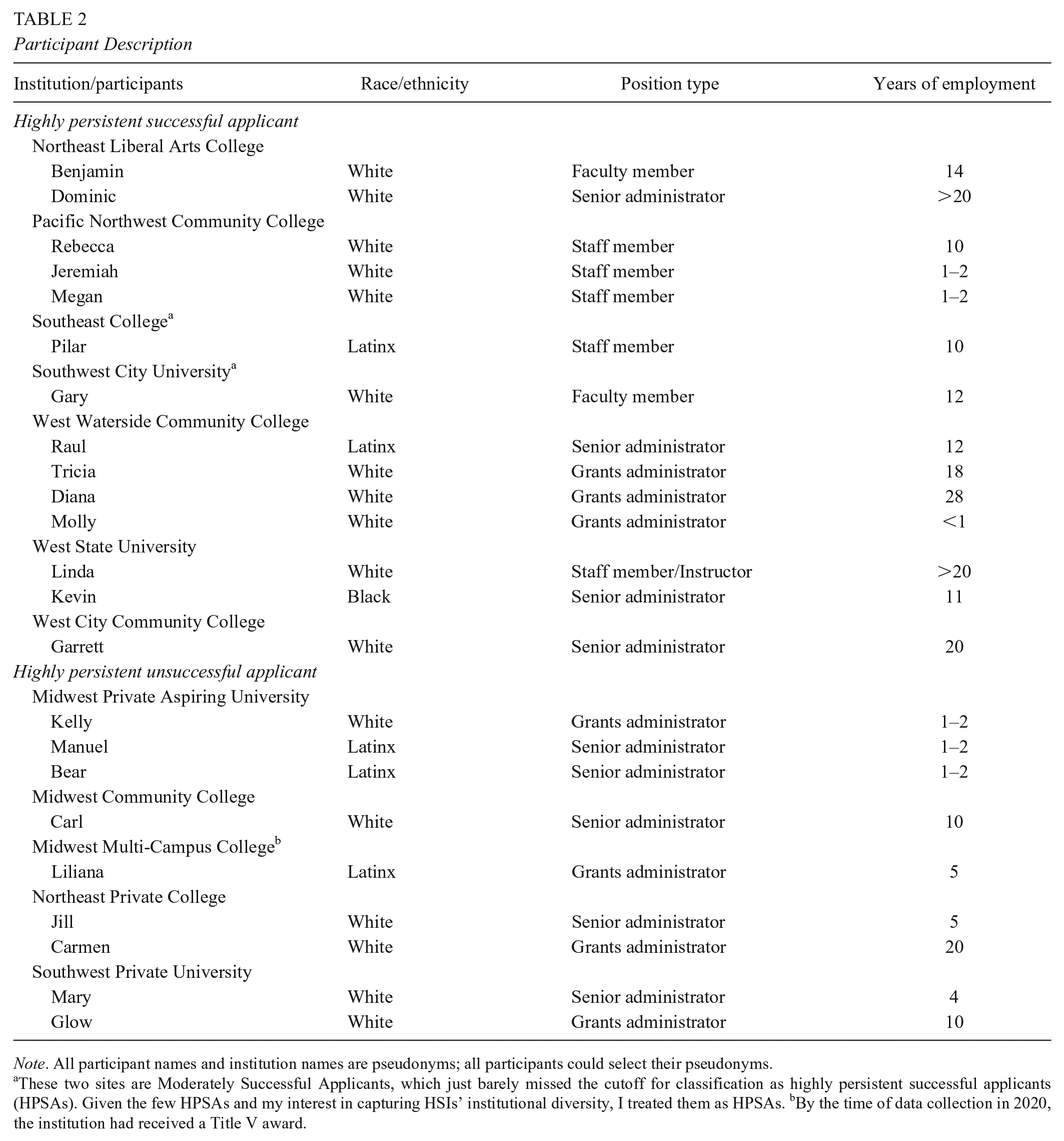
Note. All participant names and institution names are pseudonyms; all participants could select their pseudonyms.
These two sites are Moderately Successful Applicants, which just barely missed the cutoff for classification as highly persistent successful applicants (HPSAs). Given the few HPSAs and my interest in capturing HSIs’ institutional diversity, I treated them as HPSAs. bBy the time of data collection in 2020, the institution had received a Title V award.
Although participants held varied roles, interviews followed a similar format. I started with basic contextual questions to better understand participants’ backgrounds and institutions’ grant-related infrastructure. Then, I posed questions about the institution’s general grant priorities and reasons for seeking Title V grants. For example, I asked, “In deciding to prepare (and manage) any given grant, your institution and office likely give up other opportunities. With this in mind, where do you think applying for Title V grants fits within the institution and office’s priorities and activities, and why?” Afterward, I asked about the institution’s grant-seeking practices, particularly its Title V proposal preparation process. Finally, the last set of questions dealt with the benefits and challenges of grant acquisition and how to improve Title V.
I also gathered publicly available documents for each site, such as institutions’ fast fact sheets, mission statements, policies about extramural funding, HSI-related grant press releases, and, where applicable, content from their grants office. Before each interview, I reviewed these documents to gain (a) more context about the institution and (b) a sense of its prioritization of as well as capacity and readiness for grant acquisition. This groundwork also enabled me to ask more generative probing questions during the interviews.
Analytic Strategy
As is often the case in qualitative research, I began analyzing data on its collection (Miles et al., 2019). To begin, I completed a postinterview reflection using a preset online form, methodically responding to the same questions following each interview. For example, I responded to questions like: How does this interview relate to data from other sites? What was this interview’s most salient idea or theme, and why? Through this reflective exercise, I noted my initial reactions and made preliminary connections among the data (e.g., similarities and differences between HPUAs and HPSAs). On completing data collection and reading all the transcripts to gain a global understanding of the data, I followed Saldaña’s (2011) guidance and moved into a more inductive systematic analysis. Using Dedoose, I highlighted parts of the transcripts corresponding to the main components of the interview protocol and applied structural codes. I then reread the excerpts, considering how these codes connected to my research question and, in turn, informed my theorizing of the relationship between grant seeking and servingness. For instance, I considered analytical questions like: To what extent do the HSIs in this study pursue Title V grants to serve students, and which students? Through this process, I redefined and reorganized my codes and grouped similar excerpts, ultimately forming four key themes. As a point of clarity, although each theme and its constituent codes represent a specific concept, they are not seamless or inherently mutually exclusive.
Additionally, I assigned descriptors to the data in Dedoose, tagging each data source as an HPSA or HPUA and capturing its corresponding institution’s key characteristics (e.g., Carnegie classification, size, and region). Although I did not conduct a formal cross-group or cross-institutional analysis, these descriptors enabled me to analyze the data within and between groups. Specifically, they allowed me to note differences between HPUAs and HPSAs and between 2- and 4-year institutions in this study regarding their pursuit of Title V funding.
Trustworthiness
As a critical realist and a praxis-oriented researcher, I am unwedded to the notion that my work—how I design, interpret, and report my findings—is or should be objective. Indeed, I acknowledge that my identity as an equity-minded scholar and, more so, as a Latina immigrant committed to mi comunidad undergird my interest in studying and supporting HSIs. However, I also recognize “the danger of a rampant subjectivity where one finds only what one is predisposed to look for” (Lather, 1986, p. 259). Thus, I invested in “workable ways of establishing the trustworthiness of [my] data” (Lather, 1986, p. 260), engaging, for example, in reflexive journaling throughout data collection and analysis to recognize and, thus, attempt to limit potential bias (Carlson, 2010). I also relied on multiple data sources (e.g., multiple participant interviews at each site, whenever possible, and organizational documents) for triangulation (Denzin, 2012). Additionally, I conducted member checks to engage in a reciprocal negotiation of meaning with participants (Merriam & Tisdell, 2015), asking them to review their masked transcript for accuracy and indicate any portions they would like to clarify or strike from the record. Lastly, I talked through my thinking and shared drafts with two critical peers, who helped refine my analysis and findings—a trustworthiness strategy referred to as peer review/debriefing (Merriam & Tisdell, 2015).
Boundaries
Like all studies, this work has its limitations. First, despite my best efforts, I could not interview more than one individual at five sites. However, of these five, Midwest Community College had no formal grants office, and Carl, with whom I spoke, was the only person currently on staff keenly knowledgeable about the college’s experience with Title V. Similarly, Garrett at West City College had the deepest institutional knowledge of the college’s involvement in this program. Second, given the sample, it is unclear whether HSIs in Puerto Rico pursue Title V grants for similar reasons as their mainland peers and, thus, how these institutions’ grant activity relates to servingness. Relatedly, it is unclear if/how the insights of the 12 highly persistent applicants in this study reflect the entire HSI population’s pursuit of grant funding. Third, since I used data on DHSI applicants and recipients from 2009–2017 to select sites, this approach did not account for an institution’s earlier or more recent engagement/success in this program or other HSI-related grant programs (e.g., Title III-F). However, across the interviews, participants often discussed pursuing Title V funding broadly, including DHSI and PPOHA grants.
Findings
Through their responses, participants shed light on HSIs’ pursuit of Title V funding, revealing that HSIs vie for these grants for assorted reasons—some that have little to do with immediately serving students generally or Latinx students specifically. In the end, I distilled their insights regarding HSIs’ pursuit of these grants into four main themes: financial precarity, unmet institutional needs, a culture of opportunism, and above all—student support. Below, I draw on the data and integrate participant quotes to illustrate these themes.
Financial Precarity
Recognizing their institution’s dependence on external revenue streams, participants largely understood their campus’s financial footing was tenuous. Furthermore, mindful of persistent declines in state funding to higher education and heightened uncertainty due to COVID-19, participants often described Title V grants as a means of assuaging their institution’s financial precarity. For instance, Glow, a seasoned grants office administrator at Southwest Private University, remarked, Quite frankly, 3 million dollars in salary will go a long way toward our budget challenges. Every school’s had a hit from the COVID, the loss of revenue, and it’s hard to come up with your own money to do what you need to do.
While several participants (n = 7) voiced COVID-19-related concerns, most portrayed their campus’s financial precarity as an endemic issue or defining characteristic of their institution and many HSIs. Kevin, an administrator at West State University, reflects this tendency, saying, We apply for a Title V grant . . . [because] (a) the federal government recognizes that Hispanic-Serving Institutions need more support . . . and (b) because . . . when you have state[s] reducing what they give, and the inability to continue—you can’t just keep raising tuition. So, state money, tuition money, you’re still left with a hole. Title V allows you to fill that hole somewhat—not fully . . . and allow[s] us to do some very strategic, creative, and innovative things that state dollars and tuition money could never [allow].
Although approximately half of the participants explicitly acknowledged HSIs’ varied financial circumstances, Kevin, like about of third of participants, points to his university’s HSI designation as evidence of the campus’s fiscal constraints. Replete within the literature and noted across multiple interviews (n = 9), Kevin also highlights the limited ability of tuition/fees, alone, to support institutions’ financial demands. Amid such conditions, these grants function as an additional revenue stream, which helps HSIs compensate for budget shortfalls. Moreover, as Kevin’s comments indicate, HPSAs often also positioned such funding as a convenient way to explore new and innovative opportunities—a point I address further in the next theme.
Considering their campus’s pronounced financial precarity, a few participants (n = 5), namely at HPUA institutions, treated grant seeking less as welcomed “seed money to either start something, test something, or enhance an area” (Raul) and more as a survival mechanism. For instance, Carl, a senior leader at Midwest Community College, explained that the college must secure additional resources to supplement its limited revenue from tuition/fees and public dollars. Highlighting the dire need for more funding as well, Kelly, who singlehandedly manages Midwest Private Aspiring University’s grant efforts, offered, “We’re applying because we need the cash . . . We’re in a place where it’s evolve or die.” Employed at a small private 4-year college with a negligible endowment, Kelly, like Raul, views Title V grants as a way to “evolve.” Moreover, Carl and Kelly suggest that for some HSIs, this racialized funding primarily serves to keep their institutions afloat.
Altogether, many participants framed grant seeking as a vital form of revenue diversification. However, some, particularly HPSA-affiliated participants, also voiced how Title V grants enable innovation and transformation. In contrast, others, specifically a few individuals at HPUA institutions, treated these grants as a functional solution for their campus’s pressing financial constraints. Notably, however, in either case, such motives for pursuing these grants indubitably align with Title V’s expressed purpose—to build HSIs’ institutional capacity, given their chronic underfunding (Higher Education Opportunity Act, 2008).
Unmet Institutional Needs
Across interviews, participants consistently portrayed grant acquisition, particularly Title V funds, as a way to address unmet institutional needs. Specifically, they talked about these grants supporting (a) infrastructural projects (e.g., technological upgrades and building renovations); (b) student services (e.g., tutoring and peer mentoring programs); and (c) academic programs (e.g., undergraduate research opportunities and new degrees/certificates). For instance, reflecting on Northeast Private College’s grant activity, Jill, a former senior-level administrator there, explained, We would aggressively seek grants . . . [that] would help the institution do the things it needed to do. So, it wasn’t frills. It wasn’t, “Oh, boy. We have a grant. We can build a new sports center or something like that.” It was always, we have things . . . that we absolutely needed, but just couldn’t—wouldn’t—raise tuition to do.
Basically, to Jill, grant acquisition is about responding to institutional needs not addressable through tuition increases. Similarly, Dominic, a professor turned administrator, noted how a series of Title V grants enabled Northeast Liberal Arts College to develop badly needed student support services, including an immensely successful tutoring and advising program for STEM students, which “just [couldn’t be] supported by [the college’s] base budget.” In brief, as reflected in Jill and Dominic’s comments, participants typically connected grants with institutional needs, albeit with varying levels of specificity.
Notably, however, HPSA accounts often conveyed a more expansive view of institutional needs. Specifically, several participants within this group (n = 6) suggested their campus pursued Title V grants to fund “innovative” projects that, although potentially transformative to the college in general, were not acutely necessary, sustainable, or responsive to the needs of students of color or low-income students. Moreover, a few HPSA-affiliated participants (i.e., Rebecca, Megan, and Raul) commented on how their college’s supposedly innovative Title V projects, like new high-tech degree/certificate programs, sometimes misaligned with the realities of their campus environment and student needs, effectively calling into question whom and to what end these innovative projects serve. For example, Megan at Pacific Northwest Community College shared, “It has been the trend to develop these really innovative programs, which is awesome . . . but this part of the state isn’t necessarily caught up with [this] innovation.” Considering this and the college’s poor internal communication regarding Title V grants, her colleague, Rebecca, lamented how the college’s pursuit of this funding “felt like shiny object syndrome” to many campus constituents. The limited intentionality concerning grant seeking that Megan and Rebecca highlight was, in fact, a thread throughout many interviews and especially reflected in the following theme.
A Culture of Opportunism
Across multiple interviews, participants portrayed grant seeking as an institutionalized, taken-for-granted norm or expectation of the campus culture—one closely tied to legitimacy and prestige. More specifically, they seemed to link grant seeking with a culture of opportunism, collectively suggesting that some HSIs expediently pursue Title V grants given their sheer eligibility for this funding rather than to intentionally tackle a specific need. Ruminating on her 25 years of experience across several Hispanic-serving community colleges, Molly, who recently joined West Waterside Community College (an HPSA), captures this point: Do you want the idealistic answer, or do you want the real answer? There’s different perspectives to fundraising. [One perspective is] go out there and get as much money as you can, and we’ll figure out how to spend it later. [Another is] we have problems, and we need money. I think, to some extent, we do a little bit of both . . . [but] I do know people who just see dollar signs, and they don’t really care what we propose.
Her colleague, Diana, affirmed Molly’s take, noting how senior leaders sometimes tell her and others in the grants office “that want to have this funding no matter what . . . I don’t even know that they really understand the program or what the funding’s for.”
Such limited intentionality, however, was not exclusive to HPSAs. Using the following metaphor, Carmen at Northeast Private College—a long-time unsuccessful applicant—almost identically conveyed Molly and Diana’s perspective: This is like a chicken or egg thing . . . Do you think of something because the funding is available, and this is what we want? Or is it that, gosh, “We really need this, so let’s go after that funding?” It’s kind of a little bit of both.
Basically, reflecting on their vast experience, both Molly and Carmen clarify that some HSIs, including community colleges and 4-year institutions, take advantage of funding opportunities available whether they align with the institution’s mission, strategic plans, or existing needs.
Considering HSIs’ ongoing growth and institutional diversification, Benjamin, a professor at Northeast Liberal Arts College, also brought forward this notion of opportunism within grant seeking. Specifically, when describing issues with Title V, he shared, There’s some institutions who have found themselves barely meeting the cutoff, and then, of course, they immediately try to capitalize on that, but they’re otherwise fairly white institutions, majority-serving institutions with large endowments and upper-middle-class student[s] . . . This seems, to me, fairly inappropriate because if you compare [such institutions’] annual budget per student compared to, say, Northeast Liberal Arts College or most [Hispanic-serving] community colleges . . . or any of these big, true Hispanic-Serving Institutions . . . it’s just no comparison. . . . Whatever program they want to build with Title V, they can easily afford to build that program themselves. . . . They might even think that they’re becoming Hispanic-Serving by doing that . . . [but] what they’re really doing is taking limited funds away from institutions that don’t have that money otherwise.
In line with Molly and Carmen, Benjamin points out how some HSIs seek these racialized grants simply as means of pooling resources. However, his comments also speak to a broader culture of opportunism among HSIs and the potential harm of such a culture on HSIs with sincere financial limitations. Furthermore, Benjamin posits that through such opportunism, some institutions “think they’re becoming Hispanic-Serving,” and in this way, he positions grant acquisition as a legitimacy-seeking practice. Essentially, from an institutionalist perspective, Benjamin suggests some HSIs pursue this funding to signal that they’re a legitimate HSI, presumably to other HSIs, the broader HSI network (e.g., HACU), and prospective funders.
Notably, a few participants (n < 5), mainly at HPUA institutions, framed grant seeking, specifically pursuing Title V grants, as a legitimacy-seeking practice deeply embedded within their campus culture. As Glow at Southwest Private University neatly put it: “Advancing the academic reputation of the university is part of the work [of grants offices] . . . It would be very prestigious for us [to receive a Title V award].” Somewhat similarly, Carl at Midwest Community College admitted that his campus pursues Title V funding for assorted reasons: It looks good when the administration can make the claim that they’re bringing in grant money to the institution . . . That’s a reality . . . Maybe call that the politics of grant writing . . . Secondly, it does enable us . . . to really work collaboratively to think about what are our needs . . . [and what’ll] help us stand out and distinguish ourselves . . . [Considering HSI-related grants], if that money’s out there, I think the expectation is you need to pursue it because someone else is going to get it. Why should someone else get it? Our institution has a need, and we can help students with it.
Although Carl sees these grants—above all—as an opportunity to genuinely support students, he is forthcoming about the other major roles grant seeking plays at his college (and likely most HSIs). In short, participant accounts illustrated how a culture of opportunism, in varied ways, undergirds HSIs’ pursuit of grants, resulting in HSIs vying for this racialized funding whether it clearly serves their needs or whether they genuinely need it.
Above All—Student Support
Finally, most participants described a desire to serve students as a defining reason for pursuing Title V funding, but most of their comments were unspecific and nondescript and suggested serving students in a broad-based, race-evasive way. For instance, Gary, a Southwest City University professor, just said, “The institution saw [these grants] as a way to leverage additional funding and focus on addressing student success issues.” However, some participants addressed the raced nature of this funding. For instance, Rebecca at Pacific Northwest Community College offered: One of the things I hear pretty regularly when we do talk about Title V grants is this concern that what we’re doing is focusing on all students, not serving Hispanic students. This is a Hispanic-serving oriented grant, so . . . I think the focus does have to remain on what the needs are for those Hispanic students . . . [but] I think they’ll continue to pursue them just because there’s a financial need, and it’s an opportunity.
Beyond providing further evidence of a culture of opportunism, Rebecca concedes that her college may decenter the students who make them eligible for this funding. And Garrett at West City College, another HPSA community college, went further, explaining that although “the heart and soul of the work” ideally should support Latinx students, “these things are really open to everybody” given the highly litigious, politicized “world of HSIs.”
Additionally, among the few participants who directly connected this racialized funding to serving Latinx students, most deficiently and monolithically characterized them. For example, reflecting on this program, Pilar at Southeast College beamed: “It’s a great source of giving services to our students . . . especially in our college . . . a high percentage of [students] are needy, meaning their income. The majority of them are Hispanic or Black. So, they really need the services.” Similarly, beyond heeding the board of trustees’ push for grant acquisition, Liliana rationalized Midwest Multi-Campus Community College’s persistent, albeit largely unsuccessful, pursuit of Title V funds, saying: Because we do have a very high percentage of Hispanic students, and our data shows that a lot of our Hispanic students . . . are kind of trapped in dev ed for a really long time. They tend to drop out; they tend to be discouraged because they can’t progress in their regular college credit courses . . . They end up using all their financial aid . . . So, I mean, there is a need . . . here for extra, or additional, resources to support that population.
In effect, citing college data on Latinx student outcomes, Liliana positions Latinx students as the campus’s need.
Discussion
In this study, I explored a set of HSIs’ motives for grant seeking, specifically asking, “Why do HSIs pursue racialized Title V funding?” On interviewing 23 institutional actors across 12 HSIs (all highly persistent Title V applicants), I found that these HSIs pursue Title V grants for assorted reasons—some of which seem disconnected from intentionally serving Latinx students. Furthermore, although most participants viewed Title V grants as a prime opportunity to provide more student services and academic programming, they overwhelmingly overlooked the role of race/ethnicity. Worse yet, their comments often conveyed an essentialized, deficit-laden understanding of Latinx students, seemingly blaming these minoritized students for their circumstances (Valencia, 1997). Below, I discuss these findings in light of my conceptual framework, and based on participants’ insights, I theorize the connection between grant seeking and servingness at HSIs.
Opportunity or Opportunism
To recap, concerned with persistent budget cuts and trepidant about the future given COVID-19, most participants described Title V grants as means of diversifying their revenue streams and addressing institutional needs. And, others framed grant seeking as a byproduct of a larger culture of opportunism across higher education and HSIs. Importantly, these views were not mutually exclusive; participants generally proposed several reasons for grant seeking.
Considering declines in higher education spending over time (Mitchell et al., 2018; State Higher Education Executive Officers, 2020) and HSIs’ limited revenue streams, endowment holdings, and resources for institutional advancement (Calderón Galdeano et al., 2012; Drezner & Villarreal, 2015; Mulnix et al., 2004; Ortega et al., 2015), it is unsurprising that many HSIs turn to these capacity-building grants to assuage financial uncertainty and meet campus needs. However, given HSIs’ distinct environmental contexts, organizational conditions, and, in particular, their varied financial circumstances (Núñez et al., 2016; Rodríguez & Calderón Galdeano, 2015), I argue that the line between opportunity and opportunism is a fine one, especially as HSIs grow in number and further diversify. Benjamin at Northeast Liberal Arts College highlighted the conversion of opportunity to opportunism especially well when sharing his concerns over newborn HSIs, namely Hispanic-serving research universities, capitalizing on this designation to the detriment of their more resource-limited peers—a concern similarly raised in other studies (e.g., Aguilar-Smith, 2021; Cortez, 2015).
Such opportunism resonates with the organizational theory literature. In theorizing how organizations (re)produce social inequalities, Tomaskovic-Devey and Avent-Holt (2019) describe organizations as resource-pooling devices; they actively claim and work to amass resources from their environment. As explained earlier, RDT holds similar assumptions: organizations depend on, and extract resources from, their environments. In some respects, my organizational analysis upholds RDT’s core assumptions, with many participants rationally describing grant seeking as a way to mitigate uncertainty and respond to organizational needs.
At the same time, in line with institutionalism and, even more, with Garcia’s (2019) theorizing, multiple participants associated grant seeking with legitimacy and prestige grounded in whiteness. Colleges and universities’ pursuit of these status-signaling cultural resources is replete across higher education scholarship, and several HSI studies even grapple with this phenomenon. For instance, guided by a critical understanding of institutional theory, Gonzales (2013) explored how faculty at a primarily teaching-focused HSI on the U.S.–Mexico border made sense of their regional university’s Tier One aspirations—a “prestigious” status reserved for highly productive research universities. Similarly, both Doran (2015) and Deturk and Briscoe (2020) investigated how the University of Texas at San Antonio negotiated its access-oriented mission while striving for Tier One status—or prestige, again, rooted in whiteness. Especially relevant to this study, Perdomo (2019) quantitatively examined factors, including both institutional prestige and servingness, related to an HSI’s engagement in the Title V Program. Operationalizing an HSI’s prestige as its research expenditures and selectivity, she found a slightly positive association between institutional prestige and Title V engagement. That is, the more prestigious an HSI, at least in terms of these white normative standards, the more likely it is to pursue this racialized federal funding.
Interestingly, this study’s findings further suggest that some HSIs engage in this grant competition seeking to bolster their legitimacy and prestige. Notably, in analyzing participants’ responses and considering their respective institutions, Hispanic-serving community colleges and 4-year, private HSIs with limited endowments seem more inclined to pursue Title V funding in search of legitimacy and prestige than the relatively better-resourced HSIs in this study. That such institutions—ones not typically viewed as prestigious according to dominant white standards—approach grant seeking like this is understandable. As Garcia (2019) and Vargas (2018) explain and extensive research supports (e.g., Keith & Monroe, 2016; Lewis & Diamond, 2015; Moore, 2008; Shedd, 2015), proximity to whiteness is materially and immaterially advantageous. Altogether, the findings reveal that Title V grants represent more than just a “3-million-dollar boost” (Glow), holding real, legitimizing cultural value too, at least for a segment of HSIs. However, while these grants may be economically and culturally valuable, the data are less convincing of the extent to which HSIs leverage their full value for the benefit of Latinx students.
Student-Serving or $elf-Serving
Again, most participants described Title V funds as a way for their campus to serve students, seemingly reflecting a commitment to servingness at HSIs, which other studies have suggested (e.g., Flores & Leal, 2020; Flores & Park, 2015; Garcia, 2016). For example, Perdomo (2019) promisingly found a positive relationship between Title V engagement and institutional servingness (which she defined as an HSI’s HACU membership, Latinx graduation rate, and Latinx undergraduate enrollment share). Yet, given the construct’s multidimensionality, it is still unclear whether pursuing these grants actually demonstrates HSIs’ genuine servingness of Latinx students. Indeed, this study’s findings cast doubt on such an understanding. Again, although participants spoke of serving students with this money, many suggested a “subtle, institutional, and apparently nonracial” (Bonilla-Silva, 2014, p. 3) or race-evasive form of service, effectively echoing what Santiago’s (2007) conversations with HSI presidents revealed nearly 15 years ago. Furthermore, while some participants mentioned supporting Latinx students, they often only superficially connected them with this racialized funding. Highlighting some HSIs’ race-evasive pursuit of Title V grants, this study reveals a largely “hidden mechanism by which racial inequality manifests, even in [a] program with anti-racist foundations” (Vargas, 2018, p. 4).
This finding also resonates with Flores and Leal’s (2020) conceptualization of HSIs’ different orientations. Examining how the strategic plans of 19 public HSIs in Texas described serving Latinx students, they proposed three HSI orientations: Latinx-ghosting, Latinx-leaning, and Latinx-serving. Notably, they found that all Latinx-serving institutions (n = 5) had Title V funding at the time of their analysis, whereas only 63% of Latinx-leaning and 50% Latinx-ghosting institutions did. Hence, they surmised: “Title V funding may play an important role in expanding and improving educational opportunities for Latinx students” (p. 8). Although I did not systematically analyze these sites’ strategic plans, the data from this study largely evidence a Latinx-leaning orientation, as participants comments’ regarding Title V seemingly operated from a Latinx-evasive perspective. While committed to their students, they did “not specifically reference practices that are culturally or epistemologically relevant to Latinx students” (p. 8). Participants’ limited consideration of race and unidimensional understanding of Latinx students likely contributes to this issue.
In fact, only Dominic at Northeast Liberal Arts College entertained differences among Latinx students, noting that HSIs in the Northeast mainly enroll Dominican and Puerto Rican students, not Mexican/Chicanx students as is more typical of HSIs in the West and Southwest. Even then, he ignores the variation among and between Dominican and Puerto Rican students (Maldonado-Torres, 2011; Torres, 2004). Nevertheless, despite Latinxs representing an exceedingly diverse, pan-ethnic community (Núñez et al., 2013; Page, 2013), participants generally treated Latinx students as a monolith. Also, as Pilar and Liliana’s comments reflect, they often (re)produced a deficit narrative of Latinx students—one overlooking how structural inequities translate into opportunity gaps. Notably, as two Latinx-identified women, Pilar and Liliana help illustrate the pervasiveness of whiteness within higher education, which others have shown (e.g., Ahmed, 2012; Cabrera, 2018; Harris, 2019), and its stronghold even within HSIs.
Altogether, the institutions in this study, overall, illustrated how at least some HSIs persistently pursue racialized funding toward race-evasive ends. Thus, the findings demonstrate the incongruence between HSIs’ motives for seeking Title V grants and the program’s antiracist aims (i.e., to ameliorate ethnoracial inequities). Ultimately, echoing Vargas (2018), “this represents an otherwise veiled contribution to racial inequality” (p. 9).
Responding to the Call for Intersectionality
As Vargas and Villa-Palomino (2019) argued, many HSIs seem to portray Latinx students as a problem to be solved. Such “vilification” reifies unjust power relations (Roscigno, 2011) while also obfuscating institutional responsibility. Furthermore, by empowering this rhetoric of deficiency, they capitalize on this racialized funding to advance assumed student interests and their self-interests (i.e., pooling resources and signaling legitimacy). In doing so, they eschew the vast variation within the Latinx population, despite ample research demonstrating salient “lines of difference” (Davis, 2008, p. 77) among Latinxs (Núñez, 2014). Specifically, extensive research documents how Latinx students’ multiple, intersecting identities (e.g., gender, class, national belonging, language, immigration/generational status, and color/phenotypical presentation) shape their educational opportunities, experiences, and outcomes (e.g., Covarrubias, 2011; Kanno & Harklau, 2012; Keith & Monroe, 2016; Núñez et al., 2008; Ramírez, 2013). Subsequently, while Title V grants provide HSIs an opportunity to serve Latinx students in powerful ways that advance intersectional justice, it is questionable the extent to which HSIs, as a whole, make good on this potential and live into the antiracist aims of earlier Latinx advocates, who fought for this federal designation and funding (Vargas, 2018).
Implications for Practice and Research
The study’s findings offer insight for practice, illuminating possibilities for institutional actors at HSIs to enhance servingness at HSIs. For one, HSIs’ race-evasive pursuit of grants, illuminated by participants, underscores the need for HSIs to consider students’ race/ethnicity identities when seeking grants, especially racialized funding like Title V. Furthermore, participants’ race-evasive discourse and minimal, or altogether absent, consideration of students’ social identities highlight the need for HSIs to develop a more holistic understanding of their students and their intersectional needs. Without such race- and identity-consciousness, they risk underbenefitting from the opportunity HSI-related grants provide. Accordingly, beyond disaggregating standard outcomes measures by Census-based racial/ethnic categories, institutional researchers should examine variation between and among student groups and, data limitations notwithstanding, singular and joint effects of different identity markers and cross-level interactions between such markers and institutional effects (Núñez, 2014). Additionally, they should conduct interviews and/or focus groups with Latinx undergraduate and graduate students and other campus constituencies to gain further insight into Latinx students’ intersectional needs. Involving these students in this process can improve their educational outcomes (Núñez, 2014), and collectively, these efforts may equip HSIs to seek grants more intentionally and, in turn, advance servingness at these institutions.
Additionally, this study’s findings underline the importance of evaluating the role of grant acquisition and what ends it serves at HSIs, particularly when considering racialized funds. Specifically, campus leaders must assess if/how they leverage HSI-related funding to intentionally support Latinx students, even though no federal mandate currently requires evidence of demonstrative gains for Latinx students vis-à-vis these grants. Relatedly, participants’ deficit-laden notions and unnuanced take of Latinx students stress the need for campus leaders to (a) promote organization-wide learning about Latinidad and (b) provide professional development for those involved in writing and administering HSI-related grants that helps deconstruct this myopic thinking. Specifically, they could lean on organizations like the Alliance of Hispanic Serving Institution Educators for such programming or host reading groups. Intentional or not, the perpetuation of such narratives exploits the violence Latinx students have endured and absolves institutions from reckoning with their complicity in maintaining inequitable, unjust structures.
Regarding future research, while there is a body of literature on research development and administration, limited scholarship explores the role of grant seeking in higher education aside from how extramural funding increases research productivity. But with ever-decreasing spending on higher education and rising costs, grant seeking will become increasingly part of the fabric of colleges and universities, particularly HSIs. Hence, with HSIs’ growing numbers, scholars must continue to parse out the role of grant seeking in servingness at these institutions. Observational studies of the grant proposal development process, for example, could offer insight into how decision makers impact educational opportunities and, thus, servingness at HSIs. Moving forward, scholars should also lean on students’ knowledge and experiences, particularly participants of Title V-funded programming, to better understand how such institutional grants can enhance servingness at HSIs.
Additionally, as HSIs continue to grow and evolve, scholars should expand on this research by incorporating HSIs in Puerto Rico and, in time, private 2-year colleges. The 64 HSIs in Puerto Rico serve approximately 122,000 students (Excelencia, 2021). Yet the HSI scholarship largely neglects the role and contributions of these institutions (Garcia et al., 2019). Separately, in addition to racial analyses like this one, class-based or socioeconomic status-focused analyses on this topic are also needed, particularly since one of Title V’s expressed goals is to support Pell-eligible students. Finally, since grant seeking varies by institutional type (Beard, 2004; Townsend & Rosser, 2007) and context, others should closely examine differences among HSIs in terms of their mission, sector, resources, and organizational identity and their pursuit of HSI-related funding. In short, to advance servingness at HSIs, it is crucial to identify patterned differences across such characteristics and conduct more organizational-level, intersectional analyses of HSIs’ grant-seeking motives and use of grants as structures for serving.
Conclusion
This study’s findings reveal that HSIs seek grants for varied ends—to pool money, address institutional needs, gain legitimacy, and support students. But ultimately, participants’ race-evasive framing of grant seeking leads me to argue that many HSIs seem to capitalize on their Latinx students in their quest for racialized Title V dollars. Despite notable exceptions, many HSIs’ pursuit of Title V grants effectively ghosts the “H” in HSIs and distorts the “S” in HSIs from serving into $erving.
Supplemental Material
sj-docx-1-ero-10.1177_23328584211057097 – Supplemental material for Seeking to Serve or $erve? Hispanic-Serving Institutions’ Race-Evasive Pursuit of Racialized Funding
Supplemental material, sj-docx-1-ero-10.1177_23328584211057097 for Seeking to Serve or $erve? Hispanic-Serving Institutions’ Race-Evasive Pursuit of Racialized Funding by Stephanie Aguilar-Smith in AERA Open
Footnotes
Acknowledgements
Mil gracias Dianey R. Leal and Cynthia D. Villarreal for your constructive feedback; your generous insights helped strengthen my analysis and writing.

Notes
Author
STEPHANIE AGUILAR-SMITH is an assistant professor of counseling and higher education at the University of North Texas. Broadly, her research focuses on advancing educational equity and justice, particularly at Hispanic-serving institutions.
References
Supplementary Material
Please find the following supplemental material available below.
For Open Access articles published under a Creative Commons License, all supplemental material carries the same license as the article it is associated with.
For non-Open Access articles published, all supplemental material carries a non-exclusive license, and permission requests for re-use of supplemental material or any part of supplemental material shall be sent directly to the copyright owner as specified in the copyright notice associated with the article.
