



Abstract
To achieve Higher Education Act Title V funding goals, policymakers must reconsider approaches, respond to Hispanic-Serving Institution (HSI) diversity, and prioritize servingness. This study investigated HSI heterogeneity across traditional performance metrics and student-engagement indicators using data sources previously only examined independently. A multi-step TwoStep cluster analysis revealed six clusters of HSIs. The two most important predictors of cluster membership were years with an HSI designation (transitioning and established) and institution type (associate, bachelor, and special focus). Key quantitative metrics may be useful for policy actors seeking an equity-minded Title V award strategy that considers HSI heterogeneity and prioritizes HEA Title V policy aims.
Keywords
The Evolving Identities of HSI and Differentiated Funding Title V of the Higher Education Act, a unique funding vehicle for Hispanic-Serving Institutions (HSI), aims to expand opportunities, increase attainment, and enhance institutional quality and stability (Higher Education Act, 20 U.S.C., §§ 1101-1103). The key criteria for HSI designation and Title V eligibility has been “enrollment of undergraduate full-time equivalent students that is at least 25 percent Hispanic students” with at least 50% of full-time equivalent students receiving financial assistance (U.S. Department of Education, 2018, p. 1); however, enrollment alone does little to ensure the HEA Title V goals of increasing attainment and enhancing quality are achieved (Lascher, 2018; Shapiro et al., 2016). Normative measures of enrollment and graduation rates are used without regard to differences in the institutional capacity of HSIs to serve Hispanic 1 students (G. A. Garcia et al., 2019), and current policymakers lack practical ways to account for factors known to increase Hispanic student enrollment and attainment (G. A. Garcia et al., 2019; Lascher, 2018). Consequently, more than $1.6 billion has been awarded to HSIs since the establishment of Title V (U.S. Department of Education, 2009, 2017), but there is no mechanism for policymakers to differentiate Title V funding in a way that accounts for the heterogeneity of HSIs and drives servingness at the institutions (Santiago et al., 2016).
HSI researchers have appealed to policymakers to consider funding strategies that recognize the diverse body of HSIs (G. A. Garcia, 2017; Nuñez et al., 2016; Santiago et al., 2016), distinguishing between Hispanic-Enrolling and Hispanic-Serving Institutions. This distinction recognizes how Hispanic students benefit from attendance, attainment, and cultural enrichment at HSIs steeped in Latinx culture and curricula, and institutions enacting servingness in a variety of ways (Calderón Galdeano et al., 2012; G. A. Garcia, 2016; G. A. Garcia et al., 2019; G. A. Garcia & Okhidoi, 2015; Santiago et al., 2016), including student engagement (Fosnacht & Nailos, 2016; H. A. García & Garza, 2016; Santiago et al., 2017). Nonetheless, the current reality of hyperpartisian politics and the continued emphasis on easily quantifiable metrics limits the range of acceptable policy actions. Moreover, there is evidence that partisan attitudes toward racial representation in higher education is directly linked to state appropriations for colleges and universities (Taylor et al., 2020).
G. A. Garcia et al. (2019) described servingness as multidimensional, encompassing more than performance outcomes or institutional culture. HSI grants are identified as a structure for serving, and federal legislation is identified as an external influence on serving. Researchers and policymakers have been urged to consider as many variables as possible related to servingness to capture the wide range of possibilities for enacting service to Latinx students (G. A. Garcia et al., 2019). Yet it is difficult to identify, measure, and use servingness variables in a policymaking context where HSIs are treated uniformly by Title V processes.
Enrollment, retention, and graduation rates have been suggested as effective measures of serving Latinx student populations (Crisp et al., 2009; Flores & Park, 2013). However, normative measures such as these tend to be prioritized without deference to stratified educational systems that serve different populations of students, for a variety of purposes, with inequitable levels of funding (G. A. Garcia, 2019; Ison, 2022). Therefore those with roles in governance, particularly those using accountability narratives, may heavily rely on normative measures and ignore heterogeneity amongst HSIs, leading to a misguided conclusion that HSIs are substandard performers compared with Predominantly White Institutions (PWI; G. A. Garcia, 2019).
The purpose of this study was to identify a set of measures that policymakers might use in the regulation and rulemaking process to differentiate Title V funding responsive to HSI heterogeneity and to capture the range of possibilities for enacting structures for serving Latinx students, as described in G. A. Garcia et al. (2019). Other Minority Serving Institution (MSI) funding vehicles were delimited both to maintain the central focus on this unique HSI funding source, and because funding was not recently awarded, as is the case with Title III, Part F, HSI STEM (U.S. Department of Education, 2021). Given the pace of HSI growth and the importance of student success at HSIs, it is important to better understand the groupings among HSIs on a macro level and assess them through a Title V award lens. We examined the research questions:
RQ1: What clusters of Hispanic-Serving Institutions (HSIs) emerge based on organizational and population measures?
RQ2: What are the differences in student-engagement indicators between clusters?
The results of this study are significant to policymakers and scholars who may use the taxonomy to organize institutions for policymaking and research purposes. The results demonstrate important linkages between organizational and community factors, further justifying a broader conceptualization of HSIs. HSI practitioners may find value in the identification of institutional clusters to better identify institutional peers and prioritize institutional student success efforts. The study offers funding strategies which prioritize Title V in terms of goal performance, longevity, and servingness as informed by HSI cluster membership.
Trends in HSIs and Latinx Enrollment
HSIs serve one of the fastest-growing college student populations in the United States, enrolling over 2.1 million undergraduates in 2019 (Excelencia in Education [EIE], 2019a). The number of HSIs has increased from 189 to 539 over 25 years, representing nearly 20% of the higher education market (EIE, 2019a, 2019b). Until COVID-19 negatively impacted Latinx student enrollment (Hispanic Association of Colleges and Universities [HACU], 2022), Latinx student participation had increased steadily at postsecondary institutions. From 2007-2017, total college enrollment rates for Hispanic 18- to 24-year-olds increased from 25% to 39%, a gain of 14%, while gains in other racial and ethnic groups were only moderate, ranging from 3% to 4%. The share of Latinx adults aged 25 to 34 with an associate degree or higher increased by 9% in the same timeframe (National Center for Education Statistics [NCES], 2017). Problematically, this only represents 28% of the total Latinx population, and lags other racialized groups in completion proportions, with 35% of Black and 55% of White populations having completed an associate degree or higher (B. Miller, 2018). In short, since HEA policy prioritized Hispanic enrollment and attainment, organizational outcomes have been improving, but measures still lag comparison groups.
Policy frameworks which centralize Hispanic student outcomes are limited. Although prioritizing Hispanic student outcomes demonstrated performance gain, such prioritization has not been well exploited (Ching et al., 2020). Typically, when race equity was a policy concern, disparities persisted over decades and were often framed in terms of student deficiency rather than resource deficiency (Ching et al., 2020). Notably, HSIs received $3,117 per student from all federal revenue sources, while the average for all degree-granting institutions was $4,605 (HACU, 2019). Less funding per student results in decreased spending on instruction, services, and academic support (Hillman & Corral, 2017).
Hispanic postsecondary access and affordability, strategic Title V goals, are harmed by the spiral of increasing tuition, federal policy shift from grants to loans, and funding initiatives appealing primarily to middle-class families (Santos & Sáenz, 2014). Despite policy intentions to close outcome gaps for Hispanic and other racialized students, policy proposals often sought to expand existing programs, neither strategically approaching inequity nor taking an equity-minded approach to funding policy (Ching et al., 2020). Yet, in the context of widening income gaps for Latinx populations, policy solutions are “an essential condition of ensuring that institutions remain an engine of social mobility” (Santos & Sáenz, 2014, p. 414)
It is evident by the critical mass of Latinx students enrolled that HSIs stand to make an impact on Hispanic student enrollment and attainment, addressing issues of historical exclusion and access (Hagedorn et al., 2007). Moreover, the opportunity for impact will increase over time given the substantial increases in the numbers of designated institutions, those approaching designation as emerging HSIs, and Latinx student enrollment (EIE, 2019b; NCES, 2017). However, crafting an equity-minded funding policy for this diverse group of postsecondary institutions is difficult without confidently knowing the institutional sets within the policy-prescribed HSI label.
Servingness Framework and HSI Typologies
The investigation of HSI heterogeneity and its impact on Latinx students has led to the development of the multidimensional conceptual framework of servingness in HSIs and research-based typologies of Hispanic-Serving Institutions. G. A. Garcia et al. (2019) undertook the project of interrogating assumptions around serving Latinx students through a systematic review of how scholars have framed contributions of HSIs. The authors found HSI servingness was described in terms of outcomes (academic and non-academic), experiences (student and non-student), organizational dimensions (leadership and decision making, culturally relevant pedagogy and curriculum, and culturally relevant programming), and external influences (e.g., legislation within context, funding, and advocacy). The multidimensional conceptual framework of servingness in HSIs provided a strong foundation for this investigation because it identifies HSI grants as a structure for serving and federal policy as an influence on serving. Further, the framework acknowledges the impact of complex contexts such as the presence of white supremacy and the influence of external factors on the lived experiences and the educational outcomes related to HSI servingness.
This study is also informed by attempts to describe the variety among HSIs through typology. Nuñez et al. (2016) mapped the institutional diversity of HSIs, citing the growth of HSIs and the limitations of the Carnegie Classification system to understand minority-serving institutions. Researchers drew from secondary data to create a conceptual model of HSI institutional diversity, examining systematic, programmatic, constituents, resource, and environmental diversity. A typology of six institutions emerged, primarily differentiated by enrollment and geography: urban enclave community colleges, rural dispersed community colleges, big-systems 4-years, small community 4-years, Puerto Rican institutions, and health sciences schools (Nuñez et al., 2016). These findings provided policymakers crucial context about HSI heterogeneity, institutional performance, and funding distribution beyond factors identified in the policy-prescribed HSI label and recognized the important role of HSIs in advancing education (National Science Board, 2018).
Although Nuñez et al. (2016) typology marked a significant advancement in conceptualizing HSI heterogeneity for policymakers in terms of institutional and community diversity, it did not include potentially significant organizational identity measures. Organizational identity is a matter of both normative measures (e.g., access and graduation) and environmental measures (e.g. cultural connection): “Focusing solely on enrollment and graduation rates creates a limited understanding of what it means to have an identity for serving Latinx students” (G. A. Garcia, 2016, p. 118). Notably, HSI stakeholders identified the following additional values of serving as central to their organizational identity: regional focus, community commitment, dedication to access, and serving diverse students through cultural connection, co-creation, and confidence in abilities (G. A. Garcia, 2016).
Formalizing this intersection of organizational outcomes and cultural outcomes, G. A. Garcia (2017) created the Typology of Hispanic-Serving Institution Organizational Identities shaped by six indicators of an ideal Latinx-serving identity: graduation, graduate school enrollment, employment, community engagement, positive campus climate, and support programs. Applying organizational identity and cultural theory lenses to analyze data, G. A. Garcia (2017, 2019) conceptualized a typology along two axes: organizational outcomes and cultural outcomes. The vertical axis considers organizational outcomes for Latinx students, and the horizontal axis considers cultural outcomes for Latinx students. The matrix identifies four types of HSIs, Latinx-Enrolling, Latinx-Enhancing, Latinx-Producing, and Latinx-Serving, which intentionally values all types of HSIs, without addressing the types as either stage-based or ranked. G. A. Garcia’s (2017, 2019) work expands on the typology of Nuñez et al. (2016). It reinforces the heterogeneity within the HSI sector and charges federal policymakers to consider the findings in funding determinations, thus recognizing that “some HSIs are better at producing legitimized outcomes while others excel when it comes to providing a culture that enhances the postsecondary experience for Latinx students” (G. A. Garcia, 2017, p. 129).
Organizational outcomes are those affirmed in a White normative space, conceptualized as a sociohistorical and structural ideology directing a set of institutional practices, which serve some groups and exclude others (G. A. Garcia, 2019; Hurd, 2008). Such academic outcomes include graduation and persistence rates, transfer concerns (e.g., limited credit loss and numbers of transfer students), and time to graduation, which values brevity over longevity (Contreras & Contreras, 2015; G. A. Garcia, 2019; Godreau et al., 2015). The HEA designates HSIs based on normative measures alone that do not capture the diversity among and within HSIs as understood by students, faculty, and administrators at HSIs (G. A. Garcia, 2016; Santiago, 2012).
HSI-sensitive outcomes are described as cultural outcomes which centralize the racialized experiences of, and cultural ways of knowing for, Latinx students (G. A. Garcia, 2019). Cultural measures are nebulous by comparison to organizational measures and may include both demographic measures, such as community population and structural diversity, and campus environmental measures, such as student engagement, student self-efficacy, curricular cultural congruity, and campus environment (Arbelo-Marrero & Milacci, 2016; Cuellar, 2014; Gonzalez, 2010; Murakami-Ramalho et al., 2010). HSIs serve students in multiple ways including enhancement of non-cognitive outcomes, sense of belonging, and connections on campus (Dayton & Rogoff, 2013; Guardia & Evans, 2008; Sebanc et al., 2009). Ultimately the problem of conceptualizing HSIs based only on normative standards “undermines the public policy intent and spirit of the HSI designation” (Santiago, 2012, p. 165).
In this study, the cultural indicators identified by G. A. Garcia (2019) such as academic support services, course flexibility, and dependent care facilities, are quantified and included in clustering procedures. Additional variables which may capture the wide range of possibilities for enacting servingness (G. A. Garcia et al., 2019) were also included (see Supplemental Appendix). These factors are combined with those used by Nuñez et al. (2016), for instance, percent of Hispanic students, instruction expenses, etc., to better understand the groupings among HSIs on a macro level through the multidimensional conceptual framework of servingness.
Student-Engagement Indicators
The student-engagement indicators in this study, derived from the National Survey of Student Engagement (NSSE) and the Community College Survey of Student Engagement (CCSSE), seek to approximate factors indicative of campus climate and community engagement identified within the literature as measures of servingness through student-faculty interaction, collaborative learning opportunities, and supportive learning environments (Arbelo-Marrero & Milacci, 2016; Cuellar, 2014; G. A. Garcia, 2019; G. A. Garcia & Okhidoi, 2015; Gonzalez, 2010; Murakami-Ramalho et al., 2010). In this respect, the HSI context was explicitly considered in our research approach and deficit framing was avoided in the design of this study (G. A. Garcia et al., 2019). Student-engagement indicators were excluded from clustering because of limited availability and because the instruments did not centralize the racialized experiences of Latinx students, an important component of the multidimensional conceptual framework of servingness (G. A. Garcia et al., 2019). Nonetheless, NSSE and CCSSE have been used for research about Latinx student-engagement outcomes. For example, Fosnacht and Nailos (2016) found significant positive effects of HSI attendance for Latinx students in 5 of 10 benchmarks, including higher order learning, and negative effects in 2 of 10 benchmarks, including discussions with diverse others. CCSSE has been used to investigate questions of retention, transfer, and engagement (H. A. García & Garza, 2016; Roman et al., 2010; Santiago et al., 2017).
Hurtado et al. (2012) connected diversity, student identity, institutional environment, policy context, and socio-historical context in the multicontextual model for diverse learning environments (DLE). The DLE goes further than similar models by making an explicit connection between microsystems, mesosystems, and macrosystems. Specifically, the policy context “exerts pressure on institutions to act in specific ways, which in turn impact student experiences in college and postsecondary educational outcomes” (Hurtado et al., 2012, p. 93). Scholars have used the DLE as a framework to examine macrolevel impacts on microlevel outcomes (Cuellar & Johnson-Ahorlu, 2016; Hurtado et al., 2015), but the reciprocal relationship of the microlevel on the macrolevel is less explored. In this study, the use of student-engagement indicators to characterize distinctive HSI environments is relevant to the real-world authenticity of HSI cluster boundaries.
Method
We relied on pragmatism as an epistemological and methodological framework to approach this study. Pragmatism focuses on the real world understanding of a socially situated problem and abductively appraises prior work to consider future actions (Morgan, 2007). In balancing the monolithic policy approach toward HSIs (Casellas Connors, 2021), and prior qualitative research recognizing HSI individuality, we used a TwoStep clustering procedure as a segmentation method to identify measures that policymakers might use to direct Title V funding considerate of HSI heterogeneity. TwoStep cluster analysis was advantageous over k-means or hierarchical cluster analysis because it permitted both categorical and continuous data and was scalable for large datasets. TwoStep cluster analysis is commonly used in biological and medical sciences to determine natural differences within a group (Tkaczynski, 2017) and it is widely used within the social sciences in psychology, criminology, and urban planning (Tan et al., 2006).
Population and Sample
The population of the study was Hispanic-Serving Institutions in the United States. Without an authoritative source to identify HSIs, we identified HSIs by comparing the institutional lists in 2018 and 2019 from EIE, HACU, The Carnegie Classification of Institutions of Higher Education, and the U.S. Department of Education. These organizations use different criteria for HSI identification, therefore institutions found on the lists of two or more sources in the same publication year met the list agreement criteria for this study; institutions that appeared on only one of the four source lists were excluded from this study. The initial sample of 530 HSIs included associate degree granting colleges (n = 261) and bachelor’s degree granting colleges and universities (n = 269). The list of HSIs included those that were public institutions (n = 350) and private not-for-profit institutions (n = 180).
Data Selection
Data for the sample of HSIs were collected from publicly available and privately held secondary sources selected because of their value within the policymaking space and within the multidimensional framework of servingness. Organizational and Hispanic population data used for clustering were readily available through public data sources, Integrated Postsecondary Education Data System (IPEDS), U.S. Department of Education, U.S. Census Bureau, and U.S. Department of Treasury (see Supplemental Appendix). Only publicly available data relevant to HSI diversity and servingness were used in clustering procedures.
Using a sample subset, differences between clusters were determined with student-engagement indicator data to capture the wide range of possibilities for enacting service to Latinx students. Hurtado et al. (1998) offered a framework for understanding the ways Latinx students are centralized on campus, including psychological and behavioral dimensions of campus climate, both of which are included in the NSSE and CCSSE. NSSE reports on four themes: academic challenge, learning with peers, experiences with faculty, and campus environment. Likewise, CCSSE reports on five benchmarks: active and collaborative learning, student effort, academic challenge, student-faculty interaction, and support for learners. These data, while not without the limitations outlined below, were the best nationally available data to approximate the cultural outcomes, particularly since there are “several survey items that capture data regarding a student’s interaction with faculty, engagement with the university (e.g., learning community, research project), and commitments outside of the university (e.g., working for pay off campus, providing care for dependents)” (Franco & Hernández, 2018, p. 47; Kuh et al., 2007).
The psychometric properties of both instruments have been extensively examined and found to meet construct validity, reliability through multiple demographics, and temporal stability at the institutional level for more than a decade (Angell, 2009; Community College Survey of Student Engagement, 2019; Fosnacht & Gonyea, 2018; A. L. Miller et al., 2016; National Survey of Student Engagement, 2019). Nonetheless, these data are subject to the limitations of self-report and self-study (Campbell & Cabrera, 2011). NSSE and CCSSE do not centralize the racialized experiences of students at institutions (Franco & Hernández, 2018; Nora et al., 2011) and the instruments were created and maintained by centers at PWIs, subject to biases which define PWI experiences as normative. NSSE and CCSSE are private instruments which institutions may purchase for use; therefore, the data are not fully representative of the HSI population and inherently less accessible to institutions of limited means. Of the 530 HSIs in the sample, 139 of the 266 (52%) 4-year institutions were represented in the NSSE data and 156 of the 261 (60%) were represented in the CCSSE data. NSSE and CCSSE provided deidentified data, and as such, the representativeness of this subsample could not be determined; hence, the generalizability of the results of the second research question is limited to HSIs that participate in NSSE and CCSSE.
NSSE and CCSSE provide initial insight into the differences among groups of HSIs, but only among the subsample of participating HSIs, and do not substitute for qualitative work that brings voice to the experiences of students, staff, and faculty at HSIs illustrating nuances of culture and climate. Results should be interpreted with care, particularly when examining the differences among HSI groups in student-engagement indicators indicative of only HSIs which participate in NSSE and CCSSE assessments, and not generalizable to the HSI population.
Data Analysis
Data were collected and imported into the Statistical Package for Social Sciences (SPSS). Mean, standard deviation, and other descriptive statistics were calculated for all institutional cases and variables. Researchers then concluded a TwoStep cluster analysis. TwoStep cluster analysis assumes cases, or the objects that are to be clustered, have complete data profiles; it assumes values have normal distribution; and it assumes variables are independent and not highly correlated. Three cases with substantial amounts of missing data were eliminated, and no variable values were imputed (n = 527). Log-likelihood assumes continuous variables are normally distributed and categorical variables are multinomial. Researchers followed the recommendation to continue analysis in cases where assumptions were violated (IBM Corp., n.d.-b).
HSI clusters
To address the first research question regarding HSIs which emerge based on organizational and population measures, 47 publicly available variables gathered from IPEDS, the U.S. Departments of Education and of Treasury, and the U.S. Census Bureau were examined for cluster membership. TwoStep cluster analysis uses a hierarchical clustering algorithm to explore a range of possible groupings and reduce to the best number of clusters with similar profiles which are as distinct and inclusive as reasonably possible based on the Schwarz Bayesian Information Criterion (BIC; Norušis, 2012). The initial TwoStep clustering procedure segmented the sample (n = 527) into three clusters, with a silhouette measure of cohesion and separation of 0.4, which is considered fair (Norušis, 2012). The three clusters included 269 institutions and excluded 231 institutions. Thirty variables did not contribute to clustering and 17 variables contributed to clustering. The results indicated that White-normative high-performance measures such as admission rate, yield rate, and standardized testing scores were not relevant in cluster modeling, performing below the 0.50 PI level in initial clustering stages. Among the 17 variables which estimated the cluster model, 6 met the 0.50 or higher score for predictor importance as strong estimators of clustering for all institutions regardless of sector: percentage of undergraduate Hispanic students, percentage of Hispanic-student graduation with any award, percentage of Hispanic staff, annual net price, number of years with HSI designation, and percentage of Hispanic residents in the county of the institution.
Subsequent assumptions testing, including variance inflation factor for multicollinearity was conducted with VIF ranging from 1.26 to 4.68 which was within range to proceed (Akinwande et al., 2015). Secondary TwoStep cluster analysis with only these six strong predictors resulted in four clusters, including 416 of 527 institutions, with a silhouette measure of cohesion and separation of 0.50, which is considered good (Norušis, 2012).
Although promising results were observed in initial and secondary clustering procedures, cluster analysis with separate associate degree and bachelor’s degree institution files proceeded. The files were divided because clusters were heavily separated by Carnegie Classification which was consistent with previous research (Nuñez et al., 2016), and based on the literature, the six strong predictors of clustering were known to be contextually unique between associate and bachelor degree granting institutions. Therefore, using separate files we replicated TwoStep cluster analysis procedures with the previously identified six predictive variables. The final associate degree granting dataset produced a three-cluster solution with 261 institutions and a good silhouette measure of cohesion and separation of 0.60, with 7 institutions excluded from clustering; the final bachelor’s degree granting dataset produced a three-cluster solution with 197 institutions and a good silhouette measure of cohesion and separation of 0.60, with 69 institutions excluded from clustering (Norušis, 2012).
Student-engagement differences
The second research question explored differences in student-engagement indicators between clusters. A Multivariate Analysis of Variance (MANOVA) was conducted using cluster membership as the independent variable and NSSE and CCSSE indicators as the dependent variables. NSSE data were available from 52% of bachelor-degree granting HSIs, and CCSSE data were available from 60% of associate-degree granting HSIs. MANOVA analyses assume dependent variables are multivariate normally distributed within each group and the covariance matrices of each group are equal. Absence of multicollinearity was checked by conducting correlations among the dependent variables. Equality of covariance matrices was examined with Box’s M test, p = .001. Post-analysis statistics of Pillai’s trace and Wilk’s Lambda were used to assess the contribution of each dependent variable to the overall model (IBM Corp., n.d.-a). Finally, Fisher’s Least Significant Difference was used to determine significance between group differences which, when used with three groups, is protected from inflated Type 1 error (Hayter, 1986; Seaman et al., 1991).
Limitations
There are inherent limits to the results of this study. Clusters were derived from publicly available self-report data which is subject to error, and the TwoStep procedure design does not allow for cause-and-effect conclusions. Because of their lack of availability, student-engagement indicators which represent aspects of servingness, could not be used to determine cluster membership. More importantly, differences between clusters could only be determined for the subsample of HSIs which participate in NSSE and CCSSEE assessment and should not be generalized to the HSI population. Finally, the analysis was delimited to Title V eligible institutions and should not be generalized to other MSIs.
Results
The results for the first research question regarding HSIs which emerge based on organizational and population measures (see Table 1) indicated six clusters of HSIs emerged based on six publicly available data points. We created labels for the six clusters based on the two most important predictors of cluster membership: years with an HSI designation (transitioning and established) and institution type (associate degree granting, bachelor’s degree granting, and special focus). Because of its use in the literature, we chose the label transitioning to describe the HSI clusters with institutions that have been designated for 5-years on average. We chose the label established to describe the HSI clusters with institutions that have been designated as HSIs for 20-years on average. We chose the label special focus to describe HSI clusters that serve special populations or offer specialized credentials; the number of years with an HSI designation was less important for this cluster of institutions.
Publicly Available Organizational and Cultural Data Cluster Formation and Means.
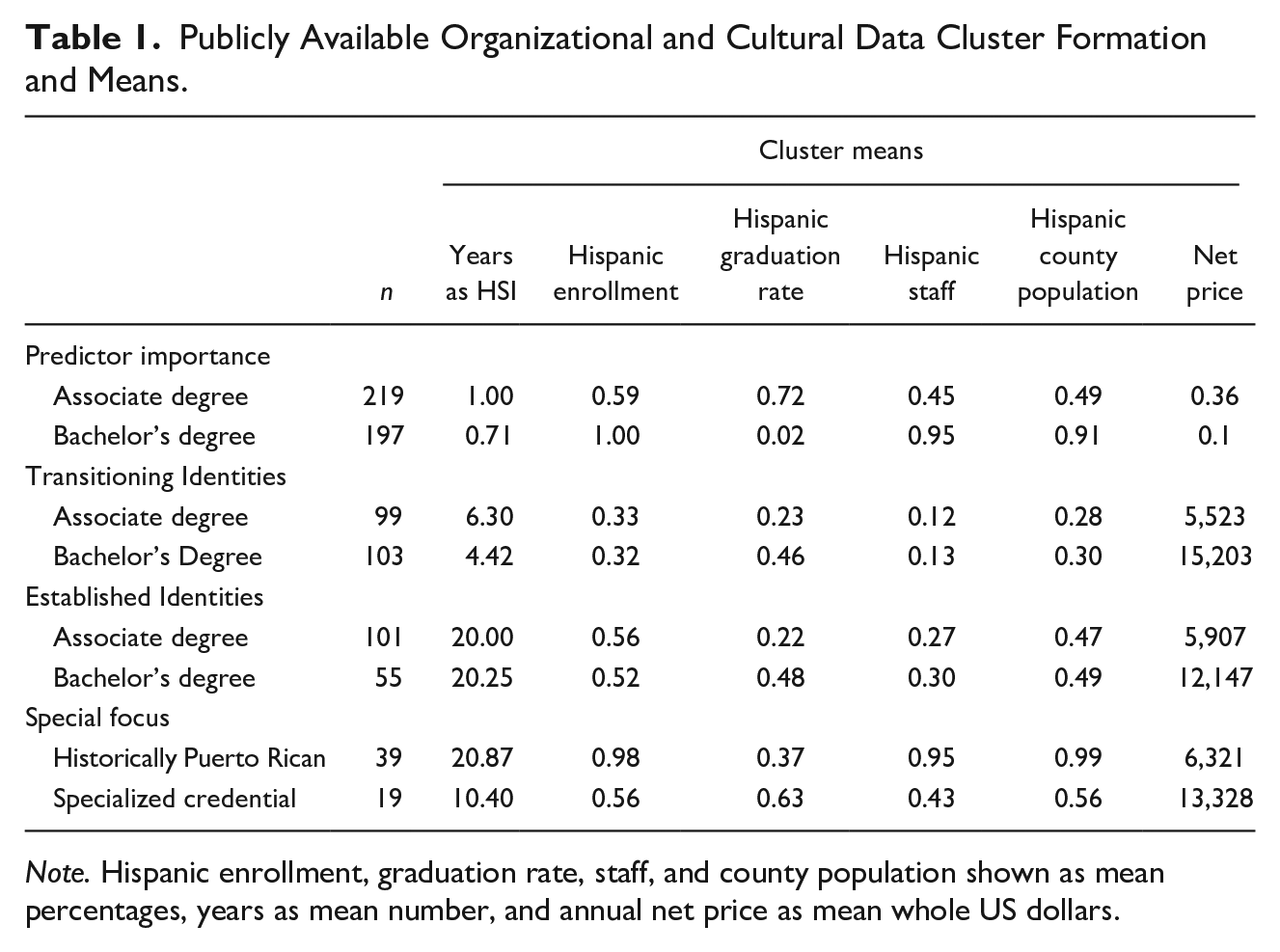
Note. Hispanic enrollment, graduation rate, staff, and county population shown as mean percentages, years as mean number, and annual net price as mean whole US dollars.
The transitioning bachelor’s and associate degree clusters were characterized by stark differences from the established bachelor’s and associate degree clusters, including the following: more recent designations as HSIs (about 5-years on average compared with 20-years on average), a lower percentage of Hispanic staff (about one-tenth compared with one-third), and smaller, but growing, Hispanic enrollment (about one-third compared with one-half). Notably, transitioning cluster institutions remain historically White and predominantly White despite the more recent HSI designation which is provided solely based on the growing Hispanic-minority student population. Transitioning and established bachelor’s and associate degree clusters had similar graduation rates. The net price of transitioning associate degree institutions was slightly lower than their established counterparts; and transitioning bachelor’s degree institutions were slightly higher than established bachelor’s degree institutions. Transitioning associate and bachelor’s degree institutions were in counties with smaller Hispanic populations than the other clusters. The most important predictors of cluster membership for associate degree institutions were years as HSI, Hispanic graduation rate, and Hispanic enrollment. The most important predictors of cluster membership for bachelor’s degree institutions were Hispanic enrollment, Hispanic staff, Hispanic county population, and years as HSI.
Historically Puerto Rican institutions included institutions designated as HSIs for 20-years on average. It had the highest Hispanic enrollment and percentage of Hispanic staff of all the clusters, and it was among the lowest net prices. However, the historically Puerto Rican cluster had lower graduation rates than institutions in the other clusters.
The specialized credential cluster included institutions whose mission was narrowly focused on specific industry sectors such as nursing or engineering. It included institutions designated as HSIs for 10-years on average. It had a higher percentage of Hispanic staff and higher graduation rates than institutions in the transitioning or established clusters. These institutions were in counties with higher Hispanic populations than institutions in the transitioning or established clusters; and they had net prices similar to bachelor’s degree institutions.
The results for the second research question on differences in student-engagement indicators between clusters indicated statistically significant differences between clusters to medium effect as detailed in Tables 2 and 3. Student-engagement indicators for each cluster reflect varying degrees of servingness regardless of the number of years with an HSI designation. MANOVA revealed cluster assignment explained a significant amount of the variance in student-engagement indicators among both the bachelor’s degree granting and the associate degree granting sub-clusters with a medium-size effect (η2 = .17). To determine student-engagement differences between clusters, we conducted one-way ANOVAs. Within the subsample of associate degree granting HSIs participating in CCSSE, significant differences existed among all five indicators, that is, active, and collaborative learning, support for learners, student effort, academic challenge, and student faculty interactions. Transitioning associate degree granting institutions indicators were significant, but only slightly, lower than their established counterparts. The most significant differences among the subsample of bachelor’s degree granting HSIs participating in NSSE were on the benchmarks of higher-order learning and discussions with diverse others. Similarly, the results indicated relatively small, but statistically significant, differences between groups.
Tests of Between-Subjects Effects With CCSSE Scales by Cluster, Ordered by Effect Size.
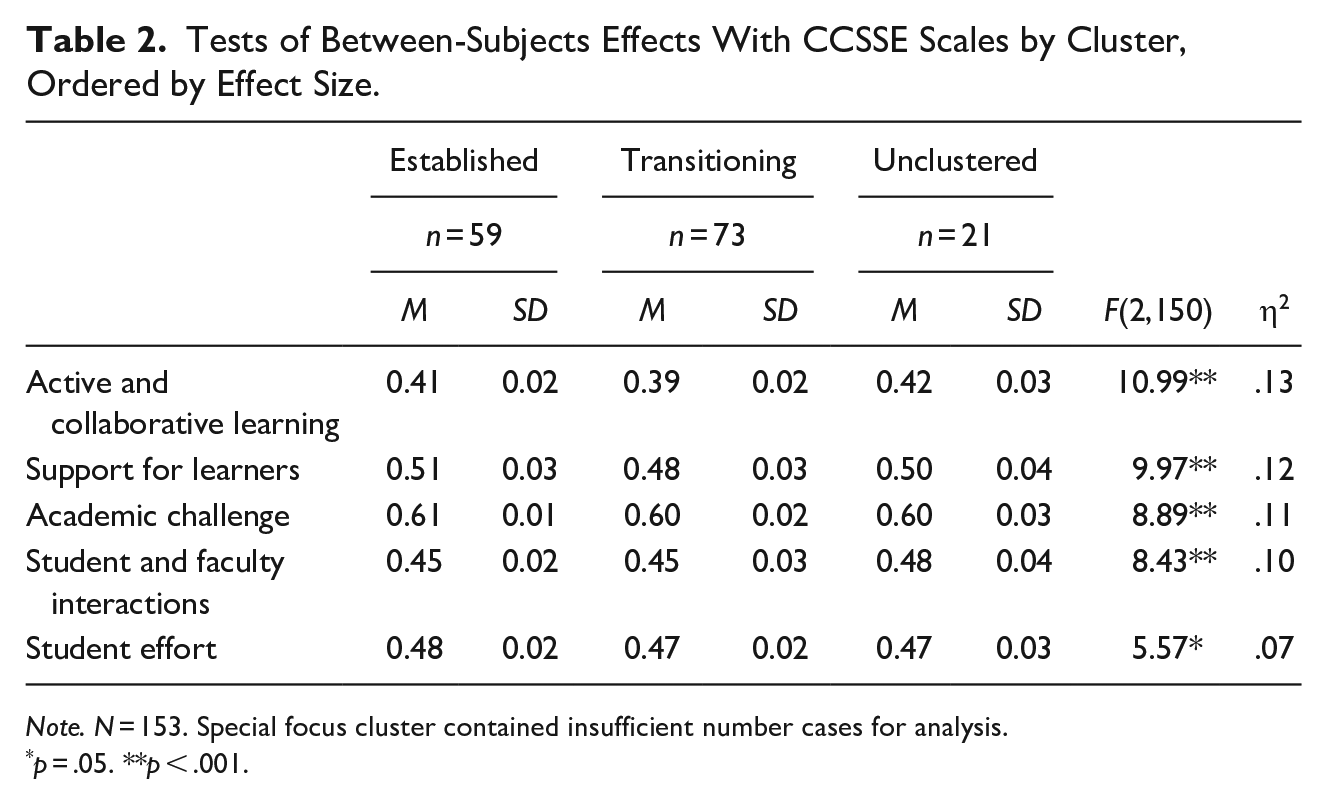
Note. N = 153. Special focus cluster contained insufficient number cases for analysis.
p = .05. **p < .001.
Tests of Between -Subjects Effects With NSSE Scales by Cluster, Ordered by Effect Size.
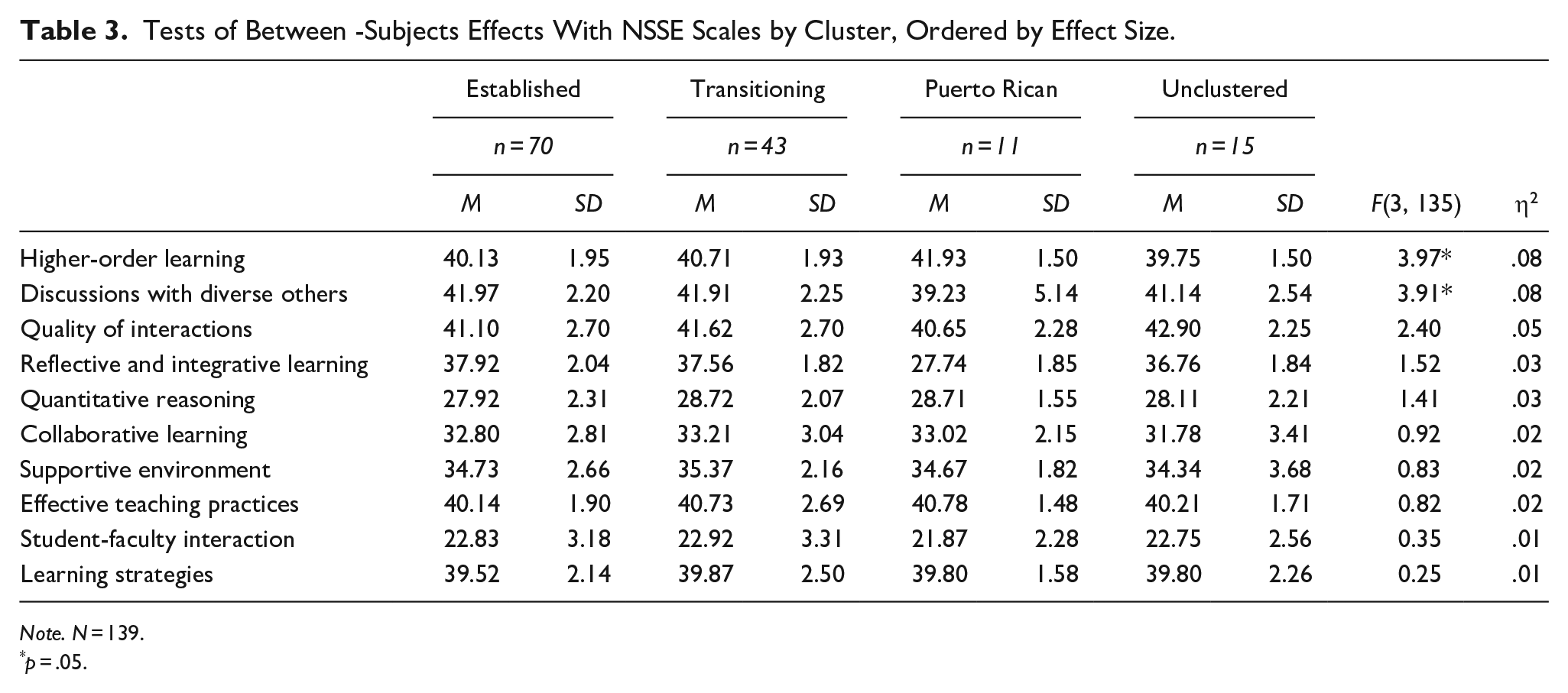
Note. N = 139.
p = .05.
Discussion
The results of this study add to HSI typology literature by combining multiple publicly available data sources that were previously only examined independently. Thus this work builds on the foundation laid by Nuñez et al. (2016) and extends the notion of clustering beyond publicly available data representing institutional diversity, and includes publicly available data representing organizational identity markers of servingness. Further, this work simplifies HSI clusters to only the most salient factors required to conceptualize HSI differences: percentage of undergraduate Hispanic students, percentage of Hispanic-student graduation with any award, percentage of Hispanic staff, annual net price, number of years with HSI designation, and percentage of Hispanic residents in the county of the institution.
Distinct HSI Clusters
Although these six most salient factors were relevant across the HSI sample, it is important to recognize they are differently weighted in predictor importance within the associate degree granting and the bachelor’s degree granting sectors, as summarized in Table 1, and expected based on the work of scholars included in the literature review. For associate degree granting institutions, years as an HSI was the most important predictor of cluster membership, followed by percentage of Hispanic-student graduation with any award and percentage of undergraduate Hispanic students enrolled. Remaining predictors of cluster membership, percentage of Hispanic staff, percentage of Hispanic residents in the county of the institution, and annual net price ranged in importance from 49% to 36%. An examination of predictor importance for associate degree institutions suggests each variable was at least moderately important and useful in directing toward cluster centers. Among bachelor’s degree granting institutions, four of the six cluster factors were robust predictors of cluster centers: Hispanic students enrolled, percentage of Hispanic staff, Hispanic county population, and years as an HSI. Two of the six cluster factors were less valuable in predictor importance: annual net price and percentage of Hispanic-student graduation.
Clusters presented in this study confirm existing literature that suggest Carnegie Classification is relevant to unpacking the heterogeneity of HSIs (Nuñez et al., 2016) but the clusters minimize the importance of geography and reinforce the importance of time in truly becoming an HSI (G. A. Garcia, 2017) given the significance of the number of years with an HSI designation measure. The historically Puerto Rican cluster reemphasizes that these institutions are unique among other HSIs, distinguished by regional and cultural characteristics (Nuñez et al., 2016). The results provide policymakers with a set of indicators to direct Title V funding in a way that considers the differences among HSIs. Two important dimensions for consideration were found to be indicative of evolving organizational and cultural identities as HSIs: number of years with an HSI designation (transitioning and established) and institution type (associate degree granting, bachelor’s degree granting, and special focus). Although we recognize these measures do not fully account for the rich, qualitative variety among HSIs, they do provide policymakers an alternative to traditional performance measures alone that fail to account for heterogeneity among HSIs.
Notably, the clustering power of traditional outcome measures were absent in this study but nonetheless remain dominant in traditional funding approaches. When normative measures were relevant, they were differently so by sector. For instance, Hispanic student graduation rates were the least predictive factor in bachelor’s degree granting cluster assignment, but strongly predictive of cluster assignment among associate degree granting institutions. The absence of predictive power of traditional outcome measures and the differences between sectors are important for policymakers and rulemakers to consider.
Scholars have long-emphasized that federal fund distributions to racialized organizations are impacted by multiple factors including social-political power, histories of advocacy, and racial demographics at the institutions (Valdez, 2015; Vargas, 2018). Ortega et al. (2015) called for public investment increases proportional to the rate of institutional increases and institutional investment into serving Latinx students. Title V awards were predictive of bachelor’s degrees awarded to Latinx students (L. Perez, 2020) yet, neither the current Title V process, nor the institutional applications for Title V funding, centralize Latinx students (Vargas & Villa-Palomino, 2019). The results undergird the claim that HSIs cannot be examined solely through either organizational or student-engagement outcomes affirmed in White normative spaces. Both types of measures must be included to adequately capture the commonality among, and the differences between, these institutions (G. A. Garcia, 2017, 2019). In addition, this study narrowed the funnel of distinction among HSIs beyond only institutional diversity, only qualitative, or only federal enrollment criteria (Nuñez et al., 2016; Santiago, 2012). Although there are dozens of possible organizational and population variables available, this study identified six relevant data points for all institution types.
G. A. Garcia et al. (2019) identified federal legislation and HSI grants as influences on, and structures for, serving. HSI leaders have emphasized community and culture alongside graduation outcomes in the Title V proposals (Boland, 2018). At this time community and culture are not equally considered by policymakers and rulemakers when prioritizing funded projects. Often among funded programs, few address the equity gap for Latinx students, most design color-blind interventions, and generally report outcomes in the aggregate (Vargas & Villa-Palomino, 2019). For instance, Vargas (2018) evaluated Title V distribution and, similar to the findings in this study, determined the number of years as an HSI was a significant factor in award selection, with established institutions receiving more funding than newly designated HSIs.
Student-Engagement Cluster Differences
Taken in whole, the findings suggest that student-engagement variables as measured by the CCSSE may matter more in the associate degree granting sector, and may provide more meaningful differences among that group, than NSSE measures provide for the bachelor’s degree granting group. Each of the five CCSSE benchmarks, active and collaborative learning, support for learners, academic challenge, student and faculty interactions, and student effort, revealed small effect, yet statistically significant, differences between established or transitioning institutional clusters (see Table 2). However, as detailed in Table 3, the effect size was smaller for differences between clusters on NSSE benchmarks. In fact, only 2 of 10 benchmarks (higher-order learning and discussion with diverse others) demonstrated cluster differences at all.
Strikingly, the group of seven associate degree granting institutions which were excluded from clusters based on the BIC had significantly higher scores for student faculty interaction than all three of the named associate degree granting clusters. The result suggests that clustering measures account for differences among the clustered institutions, but factors important to the success of Latinx students such as faculty-student interaction, (Chang, 2005; Contreras, 2018; Gloria et al., 2016) are not yet accounted for. Indeed, the relatively small number of institutions that did not cluster (7 of 261) may be statistical outliers, yet they are outliers on a factor that is critical to student-engagement and, hence, merits further investigation.
The findings regarding student-engagement differences echo a critical question raised by G. A. Garcia et al. (2019) for cases where HSI research does not use the institution as the unit of analysis. Although the CCSSE and NSSE scores are aggregated to the institution level, they are instruments which measure student-level data. An alternative interpretation of the finding that CCSSE and NSSE matter differently within their sectors is that the instruments themselves are not specific to the HSI organizational context, and therefore should not be used as evidence of an organizational servingness indicator. Nevertheless, the value of student-engagement indicators by degree-granting sector is important to further investigate because Latinx students have overwhelmingly selected associate degree granting colleges more often than bachelor’s degree granting colleges, even when other factors, such as socioeconomic status, were controlled (Calcagno et al., 2008; Gonzales, 2015; P. A. Pérez & Ceja, 2010). Collecting student-engagement data which centralizes Latinx students may be useful for Title V and other research purposes.
Finally, if pursuing separate Title V treatment, policy and rulemakers must be mindful of the power structures at play between associate degree and bachelor’s degree granting institutions. By comparison, associate degree granting colleges receive less funding per student, have smaller endowments, and serve populations with more completion obstacles (Mellow & Heelan, 2014; Mullin et al., 2015). Any funding strategy which separates financial distributions by sector should consider historical inequities, institutional needs, and create an environment in which the power of associate degree granting institutions to receive allocations is not hindered.
Implications
This study advances the understanding of the heterogeneity of HSIs from a quantitative perspective and highlights the nuances important in characterizing heterogeneity ignored by monolithic policy treatment. The measures identified by this study have potential for more targeted and effective funding support as HSIs develop an environment which affirms Latinx students. Currently, Title V funding is awarded through a competitive application process to approximately 50 institutions annually for an average of $550,000 per year per institution, renewable over 5 years (U.S. Department of Education, 2020). A review of Title V grant awards from 2019 indicated institutions in the established clusters received 58% of the total number of funding awards whereas institutions in the transitioning clusters received 16%.
To achieve HEA Title V funding goals, policymakers and rulemakers must reconsider the current approach and in favor of an approach that considers important HSI differences. The results of the study suggest potential ways to apply differentiated funding strategies to help all HSIs meet Title V goals. For example, funding for newly designated HSIs that underperform on traditional measures might prioritize additional investments in faculty/staff diversity, community engagement, or student academic support, all of which were significant cluster differentiators in our analysis. Whereas newly designated HSIs that already meet Title V performance goals might be considered for more targeted support that could deepen the institution’s connection with growing Hispanic communities within and external to the institution. Similarly, long-designated HSIs which are historically underfunded and underperform on traditional measures might be considered for targeted funding with clear plans for how additional funding would redress historic inequities and revitalize the institution. While funding for established HSIs that meet Title V performance goals might focus on institutional partnerships to sustain and build on the capacities and strengths of institutions.
Using publicly available data, clusters highlight the importance of the institutional sector (associate granting or bachelor’s granting) and the number of years an institution has been designated as an HSI in determining cluster assignment. Title V award practices could be revised to better account for distinct HSI-cluster needs to develop a Latinx-serving climate, build on a network of graduated Latinx students, improve institutional performance on traditional outcome measures, or all the preceding.
Our study suggests one way for lawmakers to consider equity in awarded funding (Vargas, 2018; Vargas & Villa-Palomino, 2019), Title V engagement (Perdomo, 2019), and differentiated strategies. Rulemaking processes rely on research in multiple ways including for instrumental, conceptual, imposed, and political use (Natow, 2022). Stakeholders must be attentive to political use as “policy actors holding different viewpoints about higher education policy have used research based on similar data, and in some cases the exact same data, to argue for vastly different types of policies” (Natow, 2022, p. 16). This is especially true in the political environment where quantifiable metrics may be the best option for lawmakers from different parties to weigh the value of incremental changes to state appropriations (Taylor et al., 2020).
Further research may investigate variables that did not cluster in this study. For example, qualitative research highlights the prominence of parity in the minds of students and staff (G. A. Garcia, 2017), however, the graduation rate parity variable was not a relevant estimator of clustering in this study. While the statistically significant differences between HSI clusters on NSSE and CCSSE benchmarks lend real-world credibility to mathematically formed clusters, the data may not be the most useful sources to analyze HSI heterogeneity. Stakeholders may engage with problem-solving to identify a course of action to better identify, collect, report, and share more Latinx-centered student-engagement data. Further research may explore regression of outcomes on continuous organizational or student-engagement outcomes. Finally, scholars may consider this method to address other sources of federal funding such as Title III or other MSI types, like HBCU or AANAPISI.
Conclusion
Since HSIs were established in federal higher education policy in 1992, institutions within the designated group have been treated uniformly, despite major differences in mission, student population, and capacity to achieve policy goals. The current study indicates the two most important predictors of HSI heterogeneity based on publicly available data: years with an HSI designation (transitioning and established) and institution type (associate degree granting, bachelor’s degree granting, and special focus). Despite their dominance in traditional funding approaches, White-normative performance measures such as admission rate, yield rate, and standardized testing scores were not at all significant in cluster assignment. The current study suggests longevity as an HSI and Carnegie Classification are two meaningful differentiators that policymakers can use to prioritize HEA goal attainment and Title V funding. Critical masses of student, staff, and county populations, net price, and graduation rates of Hispanic students matter, albeit to different degrees, in further differentiating both associate degree and bachelor’s degree granting groups. While HEA authorization remains questionable in the current political climate, incremental changes in Title V policy toward the direction of better capturing student-engagement data which centralizes Latinx students at HSIs may be achievable. Ultimately, cluster-informed HSI funding strategies may enable policymakers to take an equity-minded approach to differentiating Title V awards considerate of HSI heterogeneity and prioritizing HEA Title V policy aims.
Supplemental Material
sj-docx-1-epx-10.1177_08959048221120274 – Supplemental material for The Evolving Identities of HSI and Differentiated Funding
Supplemental material, sj-docx-1-epx-10.1177_08959048221120274 for The Evolving Identities of HSI and Differentiated Funding by Amanda K. Burbage and Chris R. Glass in Educational Policy
Footnotes
Declaration of Conflicting Interests
The author(s) declared no potential conflicts of interest with respect to the research, authorship, and/or publication of this article.
Funding
The author(s) received no financial support for the research, authorship, and/or publication of this article.

Supplemental Material
Supplemental material for this article is available online.
Notes
Author Biographies
References
Supplementary Material
Please find the following supplemental material available below.
For Open Access articles published under a Creative Commons License, all supplemental material carries the same license as the article it is associated with.
For non-Open Access articles published, all supplemental material carries a non-exclusive license, and permission requests for re-use of supplemental material or any part of supplemental material shall be sent directly to the copyright owner as specified in the copyright notice associated with the article.
