




Abstract
We explored the COVID-19 pandemic as a context for learning about the role of science in a global health crisis. In spring 2020, at the beginning of the first pandemic-related lockdown, we worked with a high school teacher to design and implement a unit on human brain and behavior science. The unit guided her 17 students in creating studies that explored personally relevant questions about the pandemic to contribute to a citizen science platform. Pre-/postsurveys, student artifacts, and student and teacher interviews showed increases in students’ fascination with science—a driver of engagement and career preference—and sense of agency as citizen scientists. Students approached science as a tool for addressing their pandemic-related concerns but were hampered by the challenges of remote schooling. These findings highlight both the opportunities of learning from a global crisis, and the need to consider how that crisis is still affecting learners.
Keywords
The COVID-19 pandemic has significantly disrupted education. Anxiety over the news, the distraction of learning away from the classroom, and personal losses due to COVID-19, have caused many students to fall behind academically (Chen et al., 2021). Yet, the pandemic also offers opportunities for students to witness and participate in science as it unfolds in real time: Scientists around the world are mobilizing to develop vaccines, and to inform public health guidelines with the latest research on the novel coronavirus and on human social behavior (Lunn et al., 2020; Van Bavel et al., 2020). This study describes the pilot implementation of a school-based citizen science program that partnered students and their teacher with scientists in human brain and behavior research. The pilot took place in an environmental science class at a private urban high school during the Spring of 2020, at the beginning of the first pandemic-related lockdown. Based on classroom and interview data, we explore the value of centering students’ inquiry on the pandemic in terms of their impressions of the role of science in a global crisis, and their experiences learning during the crisis.
Background
Students’ Understanding of the Nature and Process of Science
Beyond teaching content, science education should also develop learners’ understanding of the nature of science (NOS) and nature of science inquiry (NOSI; Linn et al., 2016; NGSS Lead States, 2013). Such an understanding recognizes science as a process of knowledge generation and validation (Abd-El-Khalick, 2013; McComas, 2010) that is highly social and centered on argumentation and critique (Ford, 2008; Latour & Woolgar, 2013; Osborne, 2010). Whereas NOS is concerned with the knowledge generated by the scientific process, NOSI is concerned with the process by which that knowledge is generated (Lederman et al., 2014).
Prior research on precollege and college-level students finds that an understanding of NOS and NOSI is related to scientific reasoning abilities and interest in science. For example, students who understand the nature of scientific knowledge are more likely to reason based on evidence (Khishfe, 2012; Mason, 2000), to engage in more sophisticated problem-solving strategies (Lin & Chiu, 2004), to develop positive attitudes toward science (Bennett et al., 2007; Vaino et al., 2012), or to express a deep motive for learning science (Liang et al., 2010).
Despite their recognized importance, students maintain naive views of NOS and NOSI (Concannon et al., 2020; Lederman et al., 2019). This may be partly due to a lack of appropriate instructional materials (Summers & Abd-El-Khalick, 2019; Wahbeh & Abd-El-Khalick, 2014), teachers’ disciplinary preparation and school culture (Abd-El-Khalick, 2014), or media representations of science (Suleski & Ibaraki, 2010). Additionally, certain countries’ science standards, including Korea, Taiwan, and the United States, fail to guide teachers and curriculum developers in supporting NOS and NOSI because these standards either do not address these ideas in sufficient detail (McComas & Nouri, 2016; Park et al., 2020), or the standards are adopted inconsistently (Summers et al., 2019).
This prior research demonstrates a need for learning experiences that support teachers in conveying accurate impressions of science. Although there is still more to learn, successful approaches have included explicit instruction on NOS (e.g., Khishfe, 2014; Khishfe & Abd-El-Khalick, 2002); engagement in scientific practices such as argumentation (P. Bell & Linn, 2000; Lehrer et al., 2008); opportunities for students to interact with professional scientists (Ruiz-Mallén et al., 2018); and instruction that is student centered, emphasizes collaborative inquiry, and occurs over sustained periods of time (Abd-El-Khalick, 2013).
The Importance of Making Science Relevant to Learners
Increasing the relevance of science to learners can lead to more equitable science education and broader science participation (National Research Council et al., 2012). Relevance, as a term used in science education, refers to the personal, societal, and/or vocational importance of science content (Kapon et al., 2018). One way to increase relevance is to make use of everyday phenomena, such that students can draw on their personal experiences to develop questions and hypotheses. Problems or phenomena that serve as the basis for students’ science investigations, and that are situated in a culture or societal issue that is relevant to learners, have been referred to as anchors (Suárez & Bell, 2019). Among other things, an effective anchor is connected to learners’ personal or everyday experiences, is observable, presents a compelling question that students are capable of investigating with adequate support, and can lead to findings that are of interest to a broader community (Penuel & Bell, 2016). In studying anchoring phenomena, students can develop an integrated understanding of the disciplinary core ideas, cross cutting concepts, and practices that are highlighted by the Next Generation Science Standards (National Academies of Sciences, Engineering, and Medicine et al., 2019; NGSS Lead States, 2013).
Developing widely usable anchored curricula can be challenging. First, there is the difficulty of balancing specific and broad relevance; that is, curricula should appeal to the particular interests and needs of many different communities, without being so broad that too few learners will find them personally relevant. Second, there is the need to balance immediate and historical relevance. Because curriculum development is labor intensive, designers tend to build on classic or historical problems in science, for which relevance is more likely to have staying power. However, this also means that students’ inquiry tends to focus on historical events or on already answered questions (Furtak & Penuel, 2019; Linn et al., 2016), which misses the opportunity for them to appreciate the contemporary relevance of science. Third, there is the tension between personal relevance and disciplinary authenticity (Kapon et al., 2018): Curriculum designers, faced with classroom time constraints and requirements around standards and content coverage, can find that what is authentic and significant to the discipline can conflict with what is personally and culturally relevant to learners.
COVID-19 as an Anchoring Phenomenon
The COVID-19 pandemic can be an opportunity for students to learn about NOSI by conducting science on a contemporary issue that has personal, global, and disciplinary relevance. Importantly, the pandemic spotlights the “open science movement,” a collective effort to increase transparency and community involvement during all stages of scientific inquiry (Fecher & Friesike, 2014). For example, the urgency to address COVID-19 treatment and prevention issues has spurred global collaborations to synthesize and share research findings and tools (Fry et al., 2020; Rempel, 2020). Moreover, the real-time development of research and public health recommendations during the pandemic has created a form of citizen science that is unique in its global coordination, as people worldwide learn follow these guidelines and contribute to containing the spread of the virus, by engaging in simple behaviors (e.g., social distancing, quarantine, hand-washing; Lee & Campbell, 2020).
While we were able to use the COVID-19 pandemic as a learning opportunity, we also acknowledge that the pandemic has devastated students, particularly those from marginalized communities (Dorn et al., 2020). The worldwide closing of schools and the transition to remote learning has only exacerbated existing problems with feeling a lack of connectedness to others in schools (Organisation for Economic Co-operation and Development, 2017). For example, isolation from teachers and peers and from an active learning environment has increased teenagers’ mental health issues including anxiety and depression (Loades et al., 2020; Miller, 2021; Singh et al., 2020). Additionally, teachers across the world reported that online learning has been less effective than in-person learning (Chen et al., 2021).
In response to these challenges, education researchers have been turning to prioritize care toward students, and to address new ethical and methodological concerns that arise in their study of learners (Kara & Khoo, 2020). For example, Matuk and colleagues (Matuk, DesPortes, Amato, et al., 2021; Matuk, DesPortes, Vasudevan, et al., 2021) created an inquiry activity in which students gathered and reflected on data on their social interactions during lockdown. In another example, researchers at Utah State University and the University of Pennsylvania introduced a fictional virus into Whyville, a virtual learning environment for middle school students to explore pandemic living conditions (Utah State University, 2021). These examples suggest the potential of the pandemic to serve as an anchoring phenomenon, while also providing ways for students to cope.
Conceptual Framework
Participatory Science Learning Through Open and Citizen Science
Our work is grounded in participatory science learning, a sociocultural perspective on learning that emphasizes authentic problems, the social negotiation of knowledge, the roles of more knowledgeable others, and students developing identities as members of a community (Barab & Hay, 2001; Gee, 2003; Koomen et al., 2018; Lave & Wenger, 1991; National Research Council et al., 2012; NGSS Lead States, 2013). In this study, we enacted a participatory science learning approach in the context of open science and citizen science, which together underscore the importance of collaborative inquiry in scientific practice.
Open science (Brinken et al., 2018) emphasizes the role of a community of practice in generating scientific knowledge. For example, researchers are encouraged to (publicly) share all aspects of their inquiry process early and often, including before data collection takes place. Many open science advocates forefront the importance of citizen science (Fecher & Friesike, 2014). Defined broadly as the engagement of the public in scientific research (Phillips et al., 2018), citizen science has been shown to significantly increase science literacy among adults in informal science learning settings (Bonney et al., 2016), enabling them to appreciate NOSI as an iterative and collaborative process by which scientific knowledge is produced.
Bonney et al. (2009) describe three categories of citizen science initiatives, which are distinguished by the nature and extent of the public’s participation: Contributory projects invite participants to contribute data for scientific research, while collaborative projects invite participants to also analyze and interpret scientific data; meanwhile, co-created projects engage both experts and nonexpert participants in all stages of a scientific inquiry project, including its conception and design. Our approach to citizen science sits at this latter end of the spectrum. By engaging students in collaborating with peers and experts to identify and pursue meaningful questions, our citizen science efforts aim to embody the ideals of both the open science movement and participatory science learning, to enhance participants’ understanding of NOS and NOSI.
Activating Science Learning Through Open and Citizen Science
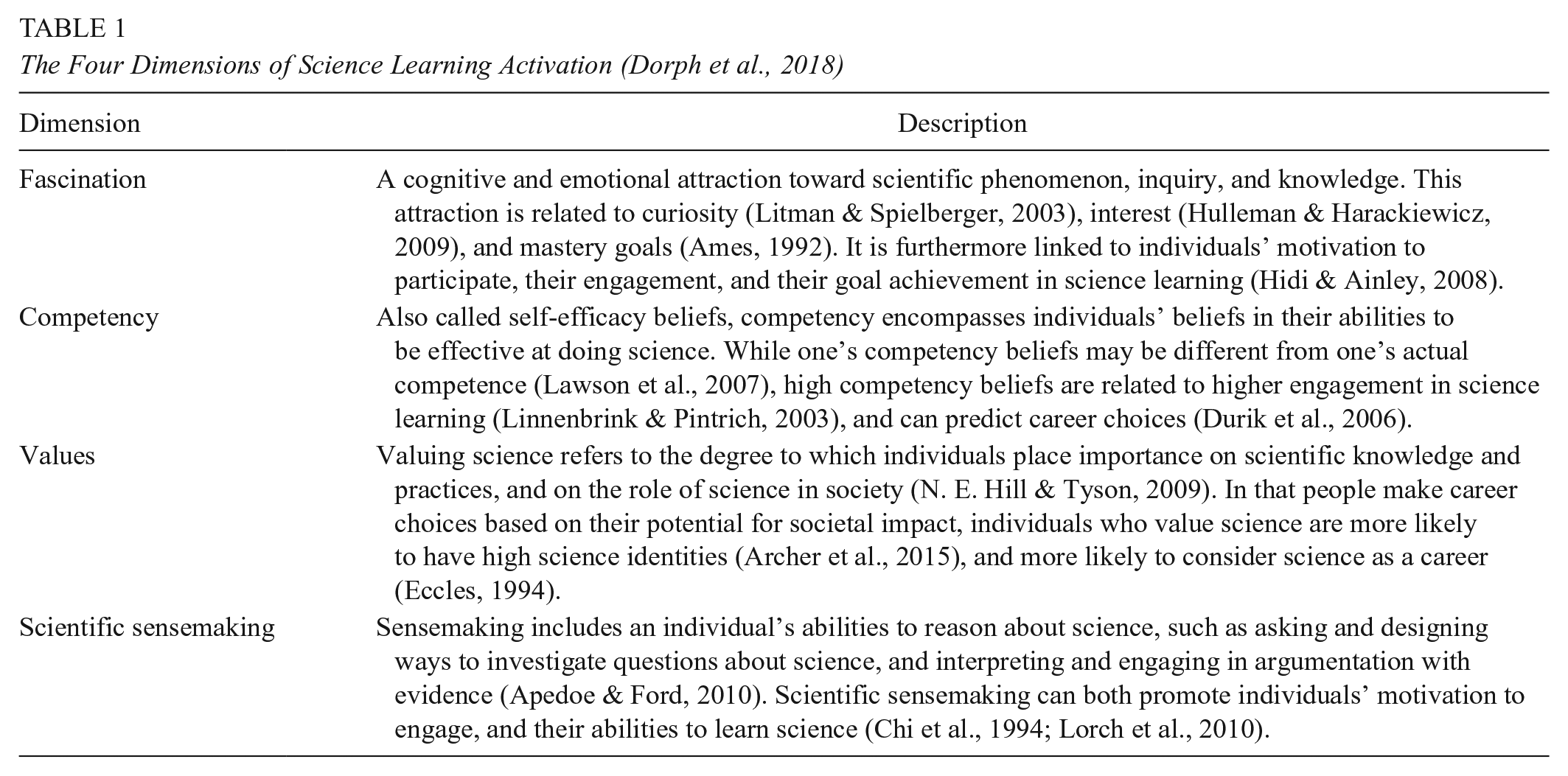
For K–12 students (ages 5–18 years), citizen science can expand their conceptions of learning beyond the time, place, and people of the classroom, and help them consider their participation as a valuable part of a collective endeavor (Harris et al., 2020). By expanding students’ views of science, we anticipate that their participation in open and citizen science will also stimulate the skills and dispositions that research has found to be key influencers of science engagement and career preferences. Collectively referred to as science learning activation (Dorph et al., 2018), these factors include fascination, competency beliefs, valuing science, and scientific sensemaking (Table 1). Thus, we view students’ participation in open and citizen science as a way to nurture their understanding of NOS and NOSI, and as a route toward science learning activation.
The Four Dimensions of Science Learning Activation (Dorph et al., 2018)
Research Questions
This study sought to understand how using an unfolding pandemic as an anchoring phenomenon in a science inquiry learning experience might enrich students’ understanding of NOSI. Specifically, we explored students’ experiences designing their own research studies on COVID-19 using a citizen science platform, with the goal of understanding their concerns and curiosities, and their views of the role of science in a public health crisis. We further sought to understand the challenges and opportunities that students and their teacher experienced in focusing on a crisis, even as they were experiencing the direct impacts of that crisis. Our research questions were
Method
Participants and Context
We partnered with an environmental science class at a small private high school (33% non-White, 29% financial aid recipients) in a large northeastern city in the United States. Students were 17 juniors and seniors enrolled in Ms. X’s environmental science course (9 males, 9 females; 17–18 years of age; 12 White, 2 Black, 1 Asian, 2 Other; see online Supplemental Material A). Ms. X partnered students into groups of four to five, based on which students she felt would work well together (Table 2).
Pseudonyms of Student Group Members

Unit Implementation and Activity Flow
MindHive is a citizen science program that uses a student–teacher–scientist partnership model (Sadler et al., 2009) to connect teachers and students with scientists to conduct human brain and behavior research. It consists of a classroom-based high school curriculum through which students learn about human brain and behavior research, and then partner with scientists to create and deploy their own research studies. This study served as a pilot test of our early MindHive curriculum ideas, which we developed in consultation with Ms. X.
At the time of our implementation in April 2020, the pandemic was prominently on students’ minds. Because of this, and due to its timely and global relevance, Ms. X and our team decided to shift from the initial planned theme of climate change anxiety to instead use the pandemic as the unit’s anchoring phenomenon. The unit took place over 11 one-hour-long class periods across 5 weeks in April 2020 (Table 3; online Supplemental Material B). It focused on supporting students in developing research proposals in the domain of cognitive psychology and neuroscience, presented broadly as human brain and behavior research. Students worked in groups of four to five to create study proposals around research questions of their choice.
Lesson Sequence and Guiding Questions

Data and Analysis
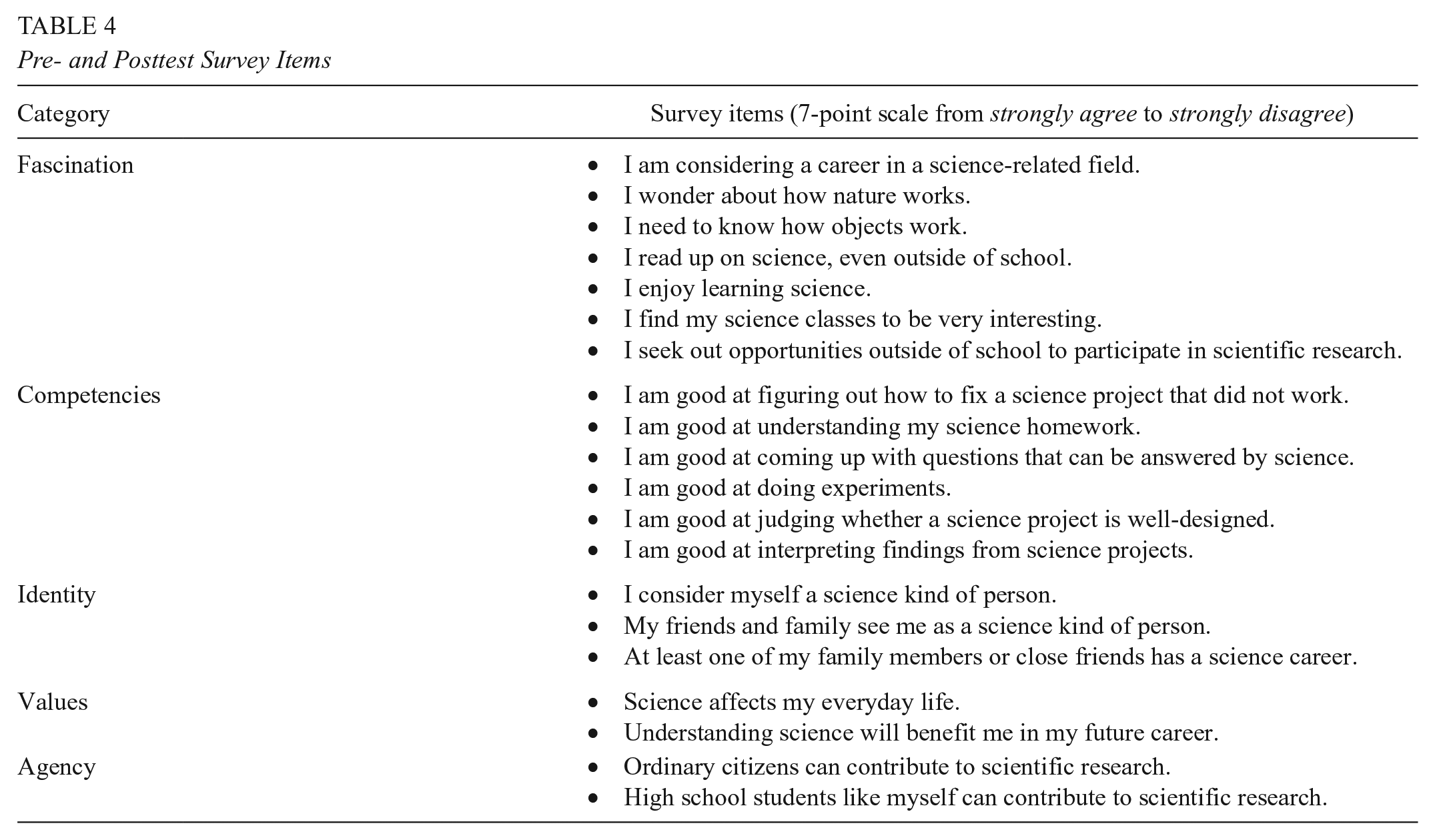
Our data included (1) a pre- and postsurvey (Table 4) of students’ self-perceived competencies, fascination, and values with regard to science; sense of agency as citizen scientists; and views of science as a participatory endeavor; (2) observations of the virtual class meetings; (3) a postimplementation interview with Ms. X and a focus group with two students, Chick and Avery; and (4) student artifacts, including students’ group research proposals; and individual written responses to journal prompts and end-of-unit reflection prompts assigned by Ms. X, and completed by 10 of the 17 students (Table 5). Survey responses were analyzed with paired Wilcoxon signed-rank tests to ascertain changes from pre to post. Meanwhile, interviews and artifacts were analyzed qualitatively to identify themes relevant to our research questions. (See online Supplemental Material C for details on this study’s data sources and analysis.)
Pre- and Posttest Survey Items
Ms. X’s Prompts for Students’ Journal Responses: Only Those Analyzed for This Study Are Shown

Findings
Our survey analysis showed that on average, all categories increased from pre to post (Table 6), but the only category that reached statistical significance was fascination with science, Z = −3.12, p = .002, r = .30, followed by a marginal change in science agency, Z = −1.96, p = .05, r = .35 (Figure 1).
Mean Survey Results by Category


Presurvey to postsurvey results by category.
Students agreed or strongly agreed in the Agency category, and this belief increased slightly over time, particularly in groups with members who showed greater engagement and group cohesion overall, as further described below in our findings for Research Question 3 (Figure 2).

Pretest to posttest changes in mean survey ratings by individual student.
Fascination increased in 13 out of 15 students (Table 7). Compared with the other categories, fascination started out with the lowest baseline score and increased the greatest amount. This trend may be attributed to students feeling that they were participating in work that is timely, relevant, and consequential, as described below in our findings for Research Question 2.
Count of Pre- to Postchanges in Survey Responses by Student

Values in science did not change significantly, however, preratings and postratings were high with almost all students agreeing that science has an impact on everyday life and that understanding science would benefit them in the future (Table 7). This finding may reflect the backgrounds of the students (Chick, e.g., described having science at the forefront of his family’s home activities), and the commitment of their teacher to conveying the importance of science.
Changes in science competency were also overall nonsignificant. At an individual level, however, this category increased among eight students, stayed the same for one student, and decreased among five students. Notably, scores tended to decrease in groups that reported greater difficulty with group communication and collaboration.
Students’ ratings on the science identities items did not significantly change over time, which suggests that their participation in this implementation did not affect their views of themselves as “a science kind of person.”
In examining changes in our exploratory item analysis of each individual question, no questions survived correction for multiple comparisons. Given the small number of participants, a lack of significant effects suggests that more statistical power is needed to reliably assess the impact of the survey at this more granular level.
Concern for the Impacts of the Pandemic on Youth
Across their journal responses, reflections, class discussions, and research proposals, students showed concern for how the pandemic was affecting students such as themselves. Asked to articulate questions about COVID-19 that they believed to be critical, or that otherwise made them curious, students’ responses covered a range of topics (Table 8), from equity in work and education (“How does [online learning] benefit some students while hindering others?”); to human psychology (“If you are an introvert and normally don’t see people, has the fact that you are now prohibited from seeing anyone strengthened your desire to see people?”); to how the government could have been better prepared (“What could have minimized the spread, panic, etc., in the United States?”); and how we should move forward (“What is the most likely time period, where life will be going back to as it was before the outbreak of COVID-19?”).
Questions About the Pandemic That Students Believed Were Important, or That Made Them Curious

Among the most prominent concerns expressed was the impact of the circumstances brought on by the pandemic on students’ mental health. In their journal responses early in the unit, all of the 14 students who responded acknowledged the overwhelming deluge of information about COVID-19 from the news media. Three of the 14 students who responded described intentional avoidance of the news due to its impact on their mental health. For example, Liam wrote “A few weeks ago I would read the New York Times coverage of the virus but I stopped as it was only hurting my mental health.”
In their reflections, four students across two different groups expressed that understanding the effects of the pandemic on youth’s mental health and well-being is one of the most urgent questions for researchers to address at the moment. In her reflection, Gloria expressed her and her peers’ curiosity about “how we as individuals and those around us are being affected by this crisis” (see online Supplemental Material D).
Similarly, Kailee had been vocal in class discussions about her concern for the impact of the pandemic on young people like herself, who rely on everyday routines for social connection. In her journal, she wrote of her interesting in understanding “how tensions in close quarters (with loved ones) can affect a person’s mental health” (see online Supplemental Material D).
In their proposals, students centered their inquiry on questions that have both societal and personal relevance. Three of the four groups focused their research questions on understanding some dimension of the impacts of the pandemic-related lockdown on youth’s emotional well-being. For example, Group 1 asked whether students felt more stressed in social isolation than under normal circumstances. Groups 3 and 4 wondered how different people’s emotional experiences varied due to the social isolation and the online school format, with Group 3 concentrating on students with histories of depression and anxiety, and Group 2 focusing on variation between personality types.
Using Brain and Behavior Research to Capture the Human Condition
Each of the four groups decided to pursue their mental health concerns through their research proposals (Table 9). In their end-of-unit reflections, it was clear that students placed value in science as a tool for understanding circumstances and predicting future trends and had used their research proposals as an opportunity to exercise their own agency to do so.
Summary of Student Groups’ Research Study Proposals

For example, Louis wrote, “I think that the research regarding mental health is especially important for how people are coping with isolation now, and how this will continue to affect them in the future.” Gary, who was interested in the impacts of students’ online learning format, wrote of the importance of understanding “how the morale and productivity of students from different age groups are being affected by zoom” (see online Supplemental Material D). Meanwhile, Asia felt that understanding human behavior could inform an understanding of the science of the virus. She wrote, “Research detailing if and how people are following the CDC’s guidelines can provide a lot of insight into how the virus is spreading.”
Six students across all four groups expressed a view of science as a tool that can additionally offer solutions to the issues they observed. For example, the proposals of Groups 1–3 aimed to reveal how the pandemic affected people differently, with the implication that this research could help inform which groups of people may require which kinds of support. As Gloria wrote in her reflection, “Once we figure out what is going on [in terms of impacts on mental health] it will be clearer how we should help and what needs to be brought to light.” Similarly, Gloria wrote of the importance of “understanding the sudden rise in mental health issues,” both for addressing how these “affect our current lifestyle,” and to “begin changing awareness now” so that “there’s more hope for the future.” Similarly, Salvador wrote that evidence of the impacts of the pandemic on stress would mean that “stress-relief strategies could be implemented in order to mitigate stress levels.”
Group 4 was especially concerned about people worsening the pandemic by not adhering to proper COVID-19 safety practices. They described behaviors such as mask-wearing, social distancing, and hand-washing to be among the most powerful things that citizens can do to protect themselves against the coronavirus. As Louis expressed, “research regarding group safety and getting entire communities to rally around safe social distancing practices is the most important” (see online Supplemental Material D).
This group felt that by better understanding how social conformity works and could be leveraged for good causes, they might use it to more effectively persuade people to follow COVID safety precautions. For example, Kyra wrote that “Mob mentality is critical to the two major threats society faces today, climate change and COVID-19. How people react to restrictions and information is critical to minimize those threats.” Her teammate Marc wrote: “If we better understand the science behind [mob mentality and groupthink], we can motivate people to make the right decisions during this pandemic.”
Together, these findings illustrate the prominence of the pandemic in students’ personal experiences, and particularly, the negative impacts that it has had on their own and their peers’ well-being. At the same time, their proposals show their desire to take control of their circumstances, their view of scientific knowledge as a way toward change, and their view of research as a tool for generating that knowledge.
The Public’s Role in Conducting Timely and Relevant Research
Students expressed an appreciation for the value that citizens can have in science conducted on an emerging phenomenon such as COVID-19. In their journal responses, 10 of the 14 students explicitly noted the conflicting information on COVID-19 that was communicated to the public, and described their mistrust of certain sources. For instance, Avery wrote, “I don’t trust the NYT [. . .] because their job is to mostly scare people.” Asia wrote, “I began to stop trusting things I was reading about COVID-19 after I found conflicting information about how to stay safe. If it comes from Trump's mouth, I do not trust it.” Seven students noted that they only trust information on scientific websites, or from reputable news sources or government agencies.
All students expressed a nuanced understanding of the need to prioritize rapid dissemination of information in a crisis, and of the potential compromise in the certainty of that information. As Gary explained in his journal, the fact that scientific knowledge evolves can be “difficult for the public to understand” (see online Supplemental Material D). Meanwhile, in 7 of the 14 responses, students expressed their own trust in science. As Liam wrote: “I believe that scientific study and trustworthy data should be one in the same.” Meanwhile, Marc noted the need for the public to understand that “results of rapid studies shouldn’t be considered as 100% foolproof, but also that they can’t [be] completely discounted from being used” (see online Supplemental Material D).
By the end of the unit, students demonstrated an appreciation for the role that communities play in making science research timely, relevant, and accurate. Across all groups, eight responses on the end-of-unit reflections noted the importance for scientists to consult a community to ensure that research best serves its needs. Gloria from Group 2 commented on the value of community involvement given the immediate and ongoing nature of COVID-19: “You want to stay informed on its [e]ffect as the crisis progresses. Because it is current there’s rapid change that you must be aware of since it can affect your research.” Louis from Group 4 explained that “The better the study fits to the specific needs of the group of people being studied, the more meaningful the data will be.” Kyra from Group 4 wrote that understanding a community’s needs can help scientists “weigh the cost/benefits of their research’s effects. For example, scientists need to weigh staying at home with the collapse of the economy and the chain of supply and demand.”
The Collaborative and Interdisciplinary Nature of Global Scientific Efforts
In terms of students’ understanding of the scientific process, two students from two groups noted that the extent of work involved in researching and preparing a study proposal was much more than they had anticipated. For instance, Sarah from Group 4 described that “it takes longer than one would think. While this task seemed pretty simple on paper, it took a lot more analysis and overall research.” This comment shows Sarah’s new awareness of the complexity of the process that precedes ideas that she and other students typically only encounter in their finished and polished forms. Kyra from Group 4 similarly wrote about her realization that existing scientific research is “very fine-tuned and in a sense whenever they are being re-created they are being peer-reviewed.”
Three responses across three groups noted surprise at the collaborative, interdisciplinary nature of human behavior research. In their comments, students demonstrated an understanding of the value of integrating multiple perspectives. As Chick from Group 1 explained, “No one person knows everything, and with more collaborators you gain more perspectives, knowledge, and ideas.” Salvador described the importance of ensuring “that teams are not operating in silos and consequently, not considering outside perspectives in their solution.” He explained that these additional perspectives are important because “understanding the demographics, economic, and political circumstances is essential in producing an effective solution that is feasible” (see online Supplemental Material D).
Five responses across all groups specifically noted a newfound appreciation for the peer review process. For example, Gloria from Group 2 wrote, “While I have peer reviewed work before, this was the first time I did it in a science class.” Meanwhile, Asia from Group 3 wrote, “I never realized the extent of the review process and I think it’s pretty amazing how many scientists can collaborate on one project” Kailee from Group 1 explained the importance of external review for avoiding bias in research. She wrote, “without peer and other expert guidance, a project can start to become incredibly personal and can have biases, regardless of the topic.”
These findings corroborate our survey results, which showed that students’ reported greater fascination with science by the end of the unit. Together, they suggest that the opportunity to engage in meaningful research gave students a broader view of what science is and how it is done, perhaps increasing their curiosity about it, and their interest in current and future scientific pursuits.
The Need for Human Connection
Even as students recognized the importance of collaboration in scientific inquiry, they found it difficult to do so while physically apart. Indeed, students focused their research on the impacts of their physical isolation from peers and of the remote learning format on their mental health. Gary wrote of his concern for the “impact that the home environment has on [people’s] ability to perform at their job or school.” Other students noted their unpreparedness for collaborating via web conferences. As Chick commented in his interview: “I didn’t have the phone numbers (. . .) to contact anyone in my group for the first 2 weeks until finally we were like, ‘OK let’s just start a group chat.’ [. . .]” (see online Supplemental Material D).
In her interview, Avery noted that infrequent opportunities to communicate with peers hindered collaboration: “Being so far away [from one another] and then only talking for like maybe 20 minutes [during class meetings] never really was helpful.” She explained how she and her peers spoke minimally to one another during the Zoom breakout room sessions. This aligns with our own observations of students’ interactions in whole and small group discussions, which required active encouragement from science mentors.
Asked to comment on her impression of her students’ engagement, Ms. X said, If I were to base it on [students’] willingness to participate in the chat, and up to the point of doing the research part, they were engaging with the ideas that we were putting out there. So that’s always a good sign.
However, she echoed Avery’s and Chick’s comments about the difficulty of engaging online with peers, and in building a sense of community virtually, particularly one in which new members—the researchers and scientists—were being introduced to the students: “I think the silence that we saw could have been Zoom-based.”
Making the Most of the Circumstances
Ms. X further noted that the group work issues she tended to notice in in-person classrooms also arose in this virtual environment.
When [students] were narrowing in on their own group proposal [. . .] the group can land somewhere, but a couple of members of the group wish their idea had been the one that was chosen. I think we saw some drop off from engagement when the leader of that group became the author of that group. So I’m curious about [how to manage] those group dynamics so that [students] both feel success in collaborating and know that they as individuals are contributing significant parts.
For these reasons, Ms. X explained that “when I do design classes and we’re designing in teams, we sometimes start with the preround of prototypes and ideas, and then the kids can switch groups if they want.” At the same time, Ms. X. admitted, “I don’t know yet how to do all that in the digital space,” and that they had done the best they could under the circumstances.
Five reflections across three of the groups mentioned the challenge of working online. Group 2 in particular struggled to coordinate their efforts before a scientist intervened to delegate work to its members. Gloria wrote of her frustration working through the distraction of collaborating over Zoom: “There wasn’t a single moment everyone was paying attention at the same time which makes it almost impossible to decide anything to move forward with.”
Asia from Group 3 similarly described the difficulty she had coordinating work with her teammates: “Especially when working with high school students, the work almost always isn’t evenly done. I found myself to be doing a lot of the work and it was hard to hold others accountable” (see online Supplemental Material D).
In her interview, Avery explained that being in a classroom setting makes things a lot more engaging and it makes things easier to follow along and stuff. But for what we had to work with I think it went pretty well. I can’t, I really don’t think it could have gone any other way.
For the most part, however, Ms. X noted that there was “a lot of delivery from adults,” referring to the lectures that she and guests from the MindHive team taught on several occasions. There were missed opportunities for personal connection, such as interjecting a lecture with small group discussion. “Even though [students] had those breakout rooms [. . .] they needed to feel more like peer-to-peer exchange,” she explained, and noted that “those points of personal connection could have emphasized some of the ideas more fully.” As she reflected, I think some of [the challenge of being online] was just the gelling of the community developed slower than it had to. And I think it took boosts of positivity when we had a laugh or, you know, when you [one of the researchers] shared an image that was meant to be funny to get people feeling lighter, that kind of stuff really matters a lot.
A Sense of Opportunity and of Missing Out
Our rapid shift in the unit’s focus toward COVID-19, alongside the shift from in-person to remote learning, left the students and the teacher with a mixed sense of the learning opportunity of this unit. It was generally felt that the unit would have been more effective had they studied it while colocated in their classroom. At the same time, they also expressed a belief that they had done the best they could under the circumstances.
One perceived missed opportunity was in how the shift to focus on COVID-19 also shifted the unit away from our participants’ original interests. As Ms. X explained in her interview, she regretted being unable to pursue her initial focus on climate anxiety. “We just made whatever in the moment work, which I think was great. But I still think it’d be cool to do the original idea” (see online Supplemental Material D).
The students in Group 2 similarly appeared reluctant to focus on COVID-19 rather than on their original interests in knowing “how personality type and traits affect what music you are gravitated to.” As they wrote early in their proposal development process, they, as a group, found it “interesting to watch as a person’s personality changes their music taste can kind of define that change. As a team, we all have different musical preferences, which intrigues us to know why and how this affects us.” However, to bring cohesion between the students’ projects and the lessons, the teacher and scientists steered this team toward a pandemic-related question, along with the rest of the class.
Another perceived missed opportunity was in not moving beyond the research proposal stage. Three students expressed disappointment that the unit had not guided them in implementing their studies to collect and analyze data. As Chick described, the project was “a good background on how to prepare for an experiment.” However, being able to take the “logical next step [. . .] to actually [. . .] send [our survey] out to the world.” Avery added: “we had the survey, we had the questions and stuff. So obviously it would have been fun to see the responses.” For students, this experience lacked a sense of closure. As Chick described, “where the project left off, it kind of feels like: ‘OK now you’re ready to go. We’re done.’ And it kind of just felt like almost like hitting a wall.”
These comments suggest that the unit may have fallen short in its attempt to highlight the equal weight that proposals have to research findings as contributions to open science communities. At the same time, they are encouraging in that they show students’ genuine curiosity about their research questions. In future research, we might emphasize how these students’ proposals will be taken up and implemented by other MindHive users, something that we were not able to show them at this early stage of our program’s development.
The Value of Participating in Real Science Inquiry
The teacher and her students valued the fact that they were doing real science and taking on agentic roles in ways that differed from their typical science learning experiences. Our analysis of students’ and the teacher’s interviews gives context to the survey findings described earlier, which showed students reported increase in their sense of agency as scientists. In their interviews, Avery and Chick described how they appreciated the break away from the typical expository approach that included lectures, workbooks and quizzes, and the chance to lead a project of their own. As Chick described, “It was kinda nice to have like a class that’s more like: ‘Here’s what you need to know,’ in like a very short lecture, and ‘now go out and do it.’” In her interview, Avery shared that: “Being able to publish your stuff like that isn’t necessarily that easy. So I think it’s a very nice platform that allows younger people to kind of get their opinions and thoughts out there.” Avery further expressed an appreciation for the balance that the program struck between providing students with agency to pursue their interests, and emphasizing the collaborative nature of citizen science: “We’re doing all the research here. We’re calling the shots in the sense that we know what we’re doing. But also, we’re all doing it together, and it’s like a super interesting learning experience.”
The students also noted their appreciation of being part of a bigger inquiry effort. On the one hand, this took the form of them both participating in, and building on, the existing studies that were part of the platform. Chick explained that these were pretty cool to do just because it allowed you to really see how real scientists are using what we’re learning about. And it kind of gave us some ideas of like, here is what we could look into based on what we’re learning, and some ideas for further research. So they served as not only really interesting things just to do, but also really interesting launching points for further research and, “where can we go from what’s here right now?”
Avery added that it was cool that we were able to see the inside of what other people were doing, and figure out how we can partake in that, and help out in a sense, even if it wasn’t on such a big scale.
Chick further noted appreciation for how the program increased the accessibility of science to research participants, who would normally have to spend significant amounts of time to both travel to physical locations and participate. Instead, “here’s a survey you can fill out in 20 minutes and you’re actually helping science by doing it” (see online Supplemental Material D).
Ms. X likewise commented on the opportunity that MindHive provided for helping students to realize the extent to which scientists were working together to understand and help the pandemic situation. For students, “that was like, ‘Oh wow, people are trying [to solve these problems],’ and you can’t see that otherwise as a young person” (see online Supplemental Material D).
Finally, students appreciated being participants in the development of a new citizen science platform. They indicated that it was not often that they had these authentic experiences, and to learn so closely alongside experts. Avery described that It’s cool to see the beginnings of something like that because you never really get to see the start of all these really big applications that people use and stuff, and to kind of see the mechanics of it all and see the people who are working to make it big and working to make it happen was really cool.
Discussion
Summary of Findings
This article described the design and implementation of a human brain and behavior curriculum designed to engage students in participatory science learning. We specifically explored the use of COVID-19 as an anchor for students to learn about citizen and open science practices and to engage in student-generated inquiry around COVID-19. Our findings demonstrate how prominently the pandemic figured into students’ experiences, and how students came to use science to attempt to address the concerns they had for themselves and their peers. Students expressed appreciation for the agency the project granted them to participate in real science inquiry; and to pursue questions that were of high personal and social relevance. The focus of the unit is moreover important given that engaging in human neuroscience and behavior content can encourage students’ lifestyle changes (Broadbent, 2014; Cameron & Chudler, 2003), and promote their abilities to evaluate scientific research encountered in media (Racine et al., 2005), both of which are especially critical in the current news climate.
Our findings also demonstrate students’ appreciation for science as an approach to generating knowledge, and one that is particularly necessary in face of an emerging crisis. Students expressed a view of the humanitarian goal of science, and an understanding of how, in a crisis such as a pandemic, this goal can be undermined by the need for rapidly disseminating findings, by the resulting conflicts between sources, and by the media distrust that these can sow. Whereas earlier research found that high school students sometimes do not recognize the importance of creativity and collaboration in science (Abd-El-Khalick, 2006; R. L. Bell et al., 2003), students in this study demonstrated an understanding of the role partnerships between scientists, communities, and government should play in ensuring that science is timely and relevant to the people it aims to serve. Their reported increased fascination with science is furthermore encouraging, given the impacts of such positive attitudes on people’s interests and confidence in science (Crawford, 2014; Takahashi & Tandoc, 2016).
Finally, our findings confirm the challenges that teachers and students were experiencing with online learning. We discuss these further below, as we reflect on our use of the pandemic as an anchoring phenomenon.
Challenges and Opportunities Associated With Using COVID-19 as an Anchoring Phenomenon
What were the advantages and disadvantages associated with using COVID-19 as an anchoring phenomenon? For students and their teacher, it was clear that the pandemic was an advantageous focus for citizen science as it demonstrated the impact of science on our daily lives, and highlighted everyone’s shared responsibility in containing the spread of the virus by following evidence-based health guidelines (Lee & Campbell, 2020). At the same time, students’ stress and anxiety due to the pandemic was palpable. Besides the common experience of social isolation and disruption, it is possible that some students were experiencing losses of friends and family members due to COVID-19. These inevitable personal challenges amid a crisis make it especially essential to consider ways to design inquiry around events that are potentially sensitive for students who are directly experiencing and being affected by them (Wilkerson, 2017).
The high personal and societal relevance of the pandemic made it an ideal anchoring phenomenon for an inquiry unit. However, the pandemic was—and still is at the time of this writing—a moving target for human brain and behavior researchers. This makes it challenging to formulate generalizable research questions that may stand the test of time, and that would make it a suitable focus for student inquiry beyond the pandemic.
Despite the learning opportunities posed by positioning COVID-19 as an anchoring phenomenon, not everyone was happy with our transition to it. For example, Group 2, initially interested in the relationship between music and personality, struggled to find shared interests under the theme of the pandemic, and to coordinate themselves to complete their work. They may have been weary of the pandemic, given the attention it was being paid in the media and in students’ homes. Even Ms. X expressed regret that prioritizing a timely topic meant abandoning her original idea to cover climate anxiety. This shows how even globally and personally relevant topics may still not be personally interesting to all.
Second, the challenges that students and teachers reported showed how unprepared the students were to collaborate remotely, but also how unprepared we were to equip students with the necessary tools and guidance. Students were less connected to one another, and less savvy about working effectively together online than we had assumed. As well, researchers and the teacher were creating a curriculum on a partially understood phenomenon, and activities for a virtual environment that we had not planned. In our rapid shift to pursue a timely topic, we had also sacrificed preparedness, an experience that resonates with other documented challenges of teaching and learning during a pandemic (Chen et al., 2021).
Likely, issues with collaboration affected students’ experience, and the quality of their research proposals. In future research we might explore the quality of students’ research proposals in terms of their abilities to identify variables, and to align their study designs with their research questions, and so forth. The current study, while not investigating these elements in detail, is important because it both shows how students learn about an emerging anchoring phenomenon, but also how we struggled and succeeded to teach and learn in the circumstances of that phenomenon. The challenges of these circumstances should not be ignored in any project that attempts to incorporate an ongoing crisis as an anchoring phenomenon.
Limitations
Among this study’s limitations is its small sample size, which impedes our ability to discern broad patterns of change in students’ survey responses, and of themes in their written reflections. Moreover, the two students who volunteered to be interviewed were also among the most engaged in class and may not have shared the same experiences as their peers. Our participants, being one class of mostly White students in a private school, and taught by an experienced, inquiry-oriented science teacher, do not represent the range of students’ and teachers’ experiences during this pandemic. Future research is needed on the challenges and opportunities that such a unit would present to underresourced students, and students in public schools, who have been disproportionately affected by the pandemic (Dorn et al., 2020).
A second limitation is with our survey. We had created and adapted the survey items to align with our research goals. However, the items were not validated and would need to be replicated to be reliable given our small sample. Additionally, categories ranged from two to seven questions and this somewhat wide range could have influenced the strength of the findings. As such, future testing of our measures and future studies using these measures are needed to maximize our confidence in the robustness of these findings.
Third, we know from observation that some students, for unknown reasons, had failed to complete homework, and to connect with their peers to contribute to their group’s project. While these occurrences may be interpreted as missing data or as failures of implementation, we consider them to be important observations of how such a unit, designed to focus on an unfolding phenomenon, fares in the unusual circumstances surrounding that phenomenon: While some students will engage with inquiry on their circumstances, others, hindered by their circumstances, will be unable.
Conclusion
This study shows the value of engaging students in collaborative science inquiry centered on an unfolding global dilemma. Findings suggest that providing real-world and timely examples of the role of open science and citizen science, in a student-centered, collaborative, and inquiry-based approach, can enrich students’ understanding of the NOS and NOSI (Abd-El-Khalick, 2013). This is in line with prior research on how students’ involvement in authentic citizen science can improve their understanding of science inquiry (Crawford, 2012) and positive attitudes toward science, technology, engineering, and mathematics (STEM; Meyer et al., 2014). This study illustrates how ongoing scientific discovery can be leveraged in (remote) STEM classrooms to teach about NOS and NOSI, and possibly, to provide learners with a sense of agency amid a global crisis.
Supplemental Material
sj-docx-1-ero-10.1177_23328584211054850 – Supplemental material for Students Learning About Science by Investigating an Unfolding Pandemic
Supplemental material, sj-docx-1-ero-10.1177_23328584211054850 for Students Learning About Science by Investigating an Unfolding Pandemic by Camillia Matuk, Rebecca Martin, Veena Vasudevan, Kim Burgas, Kim Chaloner, Ido Davidesco, Sushmita Sadhukha, Yury Shevchenko, Engin Bumbacher and Suzanne Dikker in AERA Open
Supplemental Material
sj-docx-2-ero-10.1177_23328584211054850 – Supplemental material for Students Learning About Science by Investigating an Unfolding Pandemic
Supplemental material, sj-docx-2-ero-10.1177_23328584211054850 for Students Learning About Science by Investigating an Unfolding Pandemic by Camillia Matuk, Rebecca Martin, Veena Vasudevan, Kim Burgas, Kim Chaloner, Ido Davidesco, Sushmita Sadhukha, Yury Shevchenko, Engin Bumbacher and Suzanne Dikker in AERA Open
Supplemental Material
sj-docx-3-ero-10.1177_23328584211054850 – Supplemental material for Students Learning About Science by Investigating an Unfolding Pandemic
Supplemental material, sj-docx-3-ero-10.1177_23328584211054850 for Students Learning About Science by Investigating an Unfolding Pandemic by Camillia Matuk, Rebecca Martin, Veena Vasudevan, Kim Burgas, Kim Chaloner, Ido Davidesco, Sushmita Sadhukha, Yury Shevchenko, Engin Bumbacher and Suzanne Dikker in AERA Open
Supplemental Material
sj-docx-4-ero-10.1177_23328584211054850 – Supplemental material for Students Learning About Science by Investigating an Unfolding Pandemic
Supplemental material, sj-docx-4-ero-10.1177_23328584211054850 for Students Learning About Science by Investigating an Unfolding Pandemic by Camillia Matuk, Rebecca Martin, Veena Vasudevan, Kim Burgas, Kim Chaloner, Ido Davidesco, Sushmita Sadhukha, Yury Shevchenko, Engin Bumbacher and Suzanne Dikker in AERA Open
Footnotes
Funding
This research was funded by the National Science Foundation (Award No. 1908482)
Open Practices
The data and analysis files for this article can be found at https://www.openicpsr.org/openicpsr/project/151305/version/V1/view. Inter-University Consortium for Political and Social Research [distributor], 2021-10-02 ( ).
).
Authors
CAMILLIA MATUK is an assistant professor in the Educational Communication Technology Program at New York University. She conducts design-based research on interdisciplinary STEM learning experiences, with a focus on codesign, and on developing learners’ research and data literacies.
REBECCA MARTIN is research director at the Annenberg School of Communication at the University of Pennsylvania. She researches learning and decision making across development as well as applications of neuroscience and psychology to educational contexts.
VEENA VASUDEVAN is an assistant professor of Practice in Digital Media and Learning at the University of Pittsburgh’s School of Education. She is an educational ethnographer and qualitative researcher focused on the learning, literacy, and identity practices of youth and educators from PreK–12.
KIM BURGAS is a UX (user experience) design consultant and design instructor. Her work focuses on combining human centered design processes with her passion in inclusive and accessible design, ethics in design and sensory research methods.
KIM CHALONER has been a science educator for over 25 years and is a senior administrator as well, currently at Grace Church School. Kim works with students and faculty members to create learning experiences that incorporate citizenship, science, and social justice.
IDO DAVIDESCO is an assistant professor of learning sciences at the Neag School of Education, University of Connecticut. He is interested in incorporating neuroscience methods in education research and in enhancing science learning through authentic research experiences.
SUSHMITA SADHUKHA is a PhD student in the Department of Psychological and Brain Sciences at Dartmouth College. She is interested in researching theories of shared cognitive “spaces” that allow people to establish a mutual understanding with one another.
YURY SHEVCHENKO is a research associate at the Experimental Psychology and Internet Science Group at the University of Konstanz, Germany. His interests lie in the intersection of psychology and computer science with a focus on methods and programming.
ENGIN BUMBACHER is a professor of education technology at the Teacher University Vaud, Switzerland, and member of the Expert Group for OECD PISA Innovative Assessment 2025. His research focuses on developing novel instructional and technological approaches to science inquiry and data science in K–12 schools.
SUZANNE DIKKER is a senior research scientist at the NYU–Max Planck Center for Language, Music and Emotion. Her research lies at the intersection of cognitive neuroscience, education, and installation art, with the goal to bring human brain and behavior research out of the lab, into real-world environments.
References
Supplementary Material
Please find the following supplemental material available below.
For Open Access articles published under a Creative Commons License, all supplemental material carries the same license as the article it is associated with.
For non-Open Access articles published, all supplemental material carries a non-exclusive license, and permission requests for re-use of supplemental material or any part of supplemental material shall be sent directly to the copyright owner as specified in the copyright notice associated with the article.
