




Abstract
In spring 2020, school closures were enacted to slow the spread of the COVID-19 pandemic. Students and teachers faced the challenge of organizing digital teaching and learning without sufficient time to prepare. In this study, we investigated how teachers implemented teaching from a distance and how these different implementations were associated with students’ and parents’ perceptions of teaching quality and students’ social involvement, enjoyment of learning, academic effort, and perceived competence. To this end, we examined data from 277 teachers, 3,159 students in Grades 5 to 10, and 1,688 parents who rated classes in mathematics, German language arts, and English as a foreign language during the school closures. The results showed that teachers’ implementations of distance teaching varied greatly. Teaching methods enabling social connectedness (e.g., video meetings, learning videos created by the teacher) revealed the most consistent positive associations with students’ and parents’ teaching quality ratings and students’ learning experiences.
Keywords
The only positive thing was the silence while working. Besides that, I missed the social contact very much, and of course being able to ask the teacher spontaneously when I had questions.
The worldwide school closures in spring 2020 were a huge challenge for everyone involved in school life. Students and teachers had to get used to a very different teaching and learning format, and parents were more involved than ever before in their children’s learning processes (Garbe et al., 2020). Due to the suddenness of the closures, schools had only little time to react, and thus, in most cases, there were usually no conceptualizations of what distance learning and teaching should look like during this exceptional phase (Bayrakdar & Guveli, 2020; Vodafone Foundation Germany, 2020). Consequently, it can be assumed that distance learning was implemented very differently not only across schools but also by different individual teachers, and the consequences for teaching quality and students’ learning were unknown (Helm et al., 2021; Voss & Wittwer, 2020).
For teaching and learning in distance education, several theories and guidelines for the effective implementation of distance education exist (Goos & Salomons, 2017; Graham et al., 2001; Holmberg, 1995; National Standards for Quality [NSQ], 2019). Some of these indicators (e.g., monitoring students’ learning progress and regular feedback) have also been confirmed empirically, as they have been found to be positively associated with student outcomes (e.g., Hawkins et al., 2013). These factors have been found to exhibit a great deal of overlap with indicators of face-to-face teaching quality in the school context (e.g., Doyle, 2013; Hamre & Pianta, 2010; Hattie, 2009). In such work, a framework comprising three basic domains of teaching quality was created, namely, classroom management, supportive climate, and cognitive activation, each operationalized in terms of several quality dimensions (e.g., how structured classes are or how regularly students receive feedback). This framework has been found to be relevant for a variety of student learning outcomes (Hamre & Pianta, 2010; Hattie, 2009). Therefore, in the current study, we applied the three basic domains of this teaching quality framework to systematically evaluate the quality of different distance education formats implemented during the COVID-19 pandemic as well as their associations with aspects of students’ learning experiences.
In the present study, we aimed to investigate the implementation of distance teaching and learning in secondary schools in three subjects during school closures in Germany using data collected in spring/summer 2020. First, we investigated the associations between teaching methods and students’ and their parents’ perceptions of teaching quality as well as aspects of students’ learning experiences, that is, students’ perceived competence, enjoyment of learning, academic effort, and social involvement. Second, we investigated the associations between teaching quality from the students’ and parents’ perspectives and aspects of students’ learning experiences. We aimed to provide more insight into the extent to which teachers’ teaching practices are associated with students’ learning, with important implications for similar situations in the future.
The Quality of Teaching
Teaching quality can be understood as an aspect of teaching that is provided by the teacher, but its effectiveness depends on whether and how it is accepted by the students (Doyle, 2013; Fauth et al., 2019). In the face-to-face teaching context, teaching quality has been found to be vital for a wide range of student outcomes and learning experiences, such as achievement, learning enjoyment, and academic effort (e.g., Lam et al., 2015; Wagner et al., 2016). The concept of teaching quality can be considered from two perspectives: First, one can investigate how teachers implement their lessons from an organizational perspective, with reference to the learning materials, devices, or social arrangements teachers use and apply in their teaching. For instance, does the teacher use a traditional workbook, worksheets they create themselves, or the latest technical devices? Are the lessons taught in a lecture format, or do students work in small groups? Generally, wide variability has been found in the use of different devices and methods in face-to-face teaching (Pauli & Reusser, 2003; Seidel & Shavelson, 2007); most important, these observable aspects of how lessons are organized have not been found to predict student outcomes (Hattie, 2009; Kunter et al., 2011).
Second, teaching quality can be considered with respect to different characteristics of the students’ learning process. For instance, how well does the teacher monitor the students’ work? To what extent does the teacher support the students emotionally in their learning process? From this perspective, the three domains of teaching quality offer a framework from which to describe and evaluate teaching. In this framework, classroom management, supportive climate, and cognitive activation are applied as indicators of the quality of teaching (Hamre & Pianta, 2010; Praetorius et al., 2018). Classroom management refers to an efficient way of teaching and using instructional time; it can result from, for example, the presentation of clear rules, a well-structured lesson, or the absence of disturbances (Kunter et al., 2007). Supportive climate builds on a positive student–teacher relationship and a learning environment in which, for example, students receive constructive feedback on how to improve their performance and experience the relevance of the subject matter (Brophy, 2000). Finally, cognitive activation aims to have students actively engage with the subject matter. This can be facilitated, for instance, by providing challenging tasks that clarify the connection between different concepts or by linking new learning material with prior knowledge (Lipowsky et al., 2009). The theoretical framework of the three domains of teaching quality has received empirical support from several studies (e.g., Fauth et al., 2014; Göllner et al., 2018; Jaekel et al, 2021; Kunter & Voss, 2013; Wagner et al., 2013). A large number of studies have revealed the three dimensions’ power to predict student outcomes, such as motivation, achievement, and academic self-concept (Hattie, 2009; Praetorius et al., 2018; Seidel & Shavelson, 2007; Wagner et al., 2016). Accordingly, the organizational component of teaching quality, including which devices, materials, or methods teachers use, is less important for student learning; rather, as described in this framework, what matters are the characteristics that are related to the students’ learning process. For instance, Hattie (2009) found in a meta-analysis that methods such as individual work (d = 0.04) or adapted learning methods (d = 0.19) exhibited rather small effects on students’ learning, whereas teaching characteristics such as feedback (d = 0.73) or effective practicing (d = 0.71) were much more important and yielded larger effects on students’ learning outcomes.
These two perspectives on teaching quality should be relevant and applicable to distance education during the pandemic-induced school closures. Teachers might have selected different tools and methods to implement their lessons, for instance, how work assignments were transmitted to students or whether virtual meetings took place. However, the influence of organizational aspects (e.g., teaching methods) is unclear because their deployment in distance learning situations might strongly depend on how a teacher structures and organizes lessons. For example, students are only able to ask questions or work with their classmates if the teacher provides them with the necessary structures to do so (e.g., video meetings or collaborative tasks). Furthermore, the framework of the three basic domains highlights important features that can also be helpful for evaluating the quality of distance education. As is the case for face-to-face teaching, structured lessons with clear rules, regular feedback from the teacher, and challenging tasks can be assumed to be relevant for students’ successful learning in distance learning as well.
Distance Teaching and Learning
Modern distance education is defined as “institution-based, formal education where the learning group is separated, and where interactive telecommunication systems are used to connect learners, resources, and instructors” (Simonson & Schlosser, 2009, p. 1). Typically, distance education at the K–12 level is implemented through synchronous or asynchronous text, audio, or video courses, often supplemented with print or digital learning materials (Barbour & Reeves, 2009; Malinovski et al., 2014; Watson et al., 2015). The way these formats are organized varies greatly with respect to aspects such as the overall course design (e.g., blended learning, full-time online learning), the digital tools used (e.g., email, telephone, the cloud), and the teaching methods applied (e.g., learning videos created by the teacher, group work; Burch et al., 2016; Kumi-Yeboah et al., 2018; Watson et al., 2015). For this reason, other terms, such as e-learning, virtual learning, remote learning, or web-based learning, are also commonly used, either interchangeably or to refer to specific facets of distance education (Simonson, 2019).
In countries such as the United Kingdom or the United States, distance education was regularly implemented even before the COVID-19 pandemic (National Center for Educational Statistics [NCES], 2021; Picciano et al., 2010). Therefore, there are several theories and guidelines that describe aspects of effective distance education and provide recommendations for its implementation. For instance, in his theory, Holmberg (1985, 1986, 1995) formulated principles such as “participation in decision making” or “interaction” as crucial aspects of interaction and the feeling of belonging in distance education. Keegan (1995, 1996) pointed out the reintegration of teaching in distance education, such as the artificially implemented interaction between teachers and students (for an overview of different approaches, see Simonson & Seepersaud, 2019). Furthermore, Graham et al. (2001) proposed seven principles of effective teaching in online undergraduate courses. These principles promote a clear structure with deadlines, opportunities for interaction and cooperation, meaningful feedback, and active learning, which includes, for instance, challenging tasks or project presentations. On the basis of an extensive review of research, the NSQ (2019) online teaching defined eight standards for effective online teaching, such as “digital pedagogy,” “community building,” and “learner engagement.” Each of these standards is subdivided into different indicators and underpinned with explanations and examples. For instance, one indicator of “digital pedagogy” reads: “The online teacher uses different types of tools to interact in online courses in order to nurture learner relationships, encourage learner interaction, and monitor and motivate learner engagement” (p. 12). Thus, this indicator focuses on a teacher’s interaction with their students, which enables the teacher to monitor and motivate the students. Teacher–student interactions in distance education have also been found to be important for students’ learning in several studies. For instance, teachers’ monitoring and providing supportive structures can help students regulate their learning (Cho & Shen, 2013) and enable teachers to keep abreast of their students’ learning progress (Moore & Kearsley, 2011). Moreover, in distance education, social presence and the quantity and quality of interactions not only between the teacher and students but also among the students themselves has exhibited positive associations with student outcomes and learning experiences, such as achievement, academic self-concept, and course satisfaction (Baturay & Yükseltürk, 2015; Borup et al., 2014; Cavanaugh et al., 2009; Hawkins et al., 2013; Kuo et al., 2014; Kumi-Yeboah et al., 2018; Liu & Cavanaugh, 2012; Watts, 2016). Meaningful and timely feedback to students has been found to be another important teaching characteristic for promoting students’ learning (Cavanaugh et al., 2009; Hawkins et al., 2013; Kumi-Yeboah et al., 2018; Liu & Cavanaugh, 2012). For instance, Hawkins et al. (2013) examined the associations between the quantity and quality of interactions (e.g., feedback) and the course completion rate in a virtual high school and found that high-quality and more frequent interactions increased the proportion of course completers.
Overall, previous research has identified several important aspects of effective distance education. Specifically, promoting interactions and students’ feelings of social involvement and inclusion has been found to be a core component of students’ distance learning. There is still only a little research that has systematically examined the association between different ways of implementing distance education, perceived teaching quality, and students’ learning experiences. Frameworks based on face-to-face teaching have shown a great deal of overlap with aspects of effective distance education (e.g., monitoring, feedback, and challenging tasks), but they need to be adapted to this different teaching and learning situation with its unique requirements. For this reason, we drew on the framework in our study, as it allowed us to systematically evaluate teaching quality in distance education and its associations with different implementation formats as well as students’ learning experiences.
The Present Investigation
In the present study, we sought to shed light on the question of how teaching and learning took place during the period of school closures as well as the relevance of these different implementation formats for students’ learning. Studies have examined indicators of effective teaching and learning in distance education and found aspects such as monitoring, motivation, and challenging tasks to be relevant for different aspects of students’ learning experiences. Several studies have particularly emphasized the role of students’ interactions with the teacher or with other students. In this study, we sought to contribute to this field of research by investigating which methods teachers used during the school closures in spring 2020 and how these implementation formats were associated with students’ perceptions of teaching quality. Because parents were more involved in their children’s learning processes than ever before during the period of school closures, we also took into account the parents’ perspective on teaching quality. Furthermore, we examined how the applied teaching methods as well as students’ perceptions of teaching quality were associated with several measures of students’ learning experiences. Our work addressed the following research questions:
Method
The present study was part of a larger research project about the validity of students’ teaching quality for predicting learning (Teaching Quality From the Students’ Perspective, UNITAS; Jaekel et al. 2021) which was approved by the Ministry of Culture, Youth, and Sport of Baden-Württemberg. In addition, the ethics committee of Economics and Social Sciences at the University of Tübingen confirmed that the procedures were in line with the ethical standards for research with human subjects (File number A2.5.4-074_aa).
Sample
The data for this study stemmed from the “Teaching and Learning in Distance Education (CUNITAS)” study, which was conducted in June/July 2020 in the federal state of Baden-Württemberg, Germany. The CUNITAS study examined the implementation and quality of distance education during the spring 2020 school closures in mathematics, German language arts, and English as a foreign language. A total of 3,159 students in 241 classes from Grades 5 to 12 participated in the study. A total of 52.2% of the students were female, 47.2% were male, and 0.6% were other. A tripartite system comprising lower track schools (Hauptschule/Werkrealschule), intermediate track schools (Realschule), and academic-track schools (Gymnasium) is the most common system in German states; in some states, there are also multitrack schools, which serve all school tracks in joint classes. The present sample consisted of students from all school tracks in Baden-Württemberg. Students came from five academic-track schools (n = 1,719) and seven intermediate-track and multitrack schools (n = 1,440) and provided ratings on their mathematics, German language arts, and English language classes. Additionally, a total of 227 teachers provided ratings on 327 classes (mathematics: n = 125; German language arts: n = 112; English language: n = 90). A total of 69.1% of the teachers were female, 30.4% were male, and 0.5% were other. Finally, 1,688 parents and legal guardians (mother: n = 1,348; father: n = 293; other: n = 19) rated their children’s learning situation during the school closures as well as their learning background.
Instruments
Teachers’ Ratings of Digital Tools and Teaching Methods
Teachers were asked about the digital tools they used and the teaching methods they applied during the school closure period that began in March 2020. To create a broad list of options, we referred to the current literature (Hillmayr et al., 2017; Robinson et al., 2019) and administered pretests to teachers. We used their feedback to adapt the different options that were available. Concerning their use of digital tools, teachers could choose options such as email, telephone, messaging services, or the cloud. With respect to the methods they used, they could choose from among, for example, video meetings, group work, or links to third-party learning videos. Teachers could select multiple responses to each question. The teaching methods could be categorized in terms of the degree of social presence as well as with respect to a synchronous or asynchronous implementation (Sung & Mayer, 2012; Watts, 2016). For example, whereas video meetings or meetings with students are characterized by a high social presence and take place synchronously, learning videos created by the teacher have a high social presence but take place asynchronously (Lowenthal et al., 2020).
Teaching Quality
Teaching quality from the students’ and their parents’ perspectives was assessed along the three domains of teaching quality with six quality dimensions: monitoring (e.g., “My math teacher always knew exactly what I was working on”) and structure (e.g., “Assignments and learning materials were always provided on time for math”) for classroom management; learning support (e.g., “My math teacher encouraged me to ask questions”) and feedback (e.g., “My math teacher gave me regular feedback on my tasks”) for supportive climate; challenging tasks (e.g., “My math teacher assigned tasks that I had to think about very carefully”) and practicing (e.g., “The practice exercises allowed me to see if I had mastered the material”) for cognitive activation. Each dimension was assessed with three to four items, for a total of 21 items (Supplemental Table S1, available in the online version of this article). The items from the student and parent perspectives had the same general wording, for example, “My math teacher always knew exactly what I was working on” and “The math teacher always knew exactly what my child was working on.” Most of the items had previously been used in large-scale studies, such as PISA or TIMSS (Aditomo & Köhler, 2020; Jaekel et al., 2021; Kunter & Baumert, 2006; Lüdtke et al., 2006). Additionally, we adapted the specific subject named in the items to address each of the three subjects. All items were rated on a 4-point Likert-type scale ranging from 1 (strongly disagree) to 4 (strongly agree). To keep students’ effort low but to obtain as much data as possible, students were randomly assigned to rating the subject-specific items for two out of the three subjects (mathematics: n = 1,319; German language arts: n = 1,317; and English language: n = 1,228). As we used class-averaged scores of student data for teaching quality and students’ learning experiences, the intraclass correlations (ICCs) exclusively reflected differences between teachers who taught one or more classes. Teaching quality ratings from the students’ perspective ranged from .05 (challenging tasks in English as a foreign language) to .37 (monitoring in mathematics), and from the parents’ perspective from .08 (challenging tasks in mathematics) to .37 (monitoring in mathematics; Table 1). The reliabilities of the dimensions ranged from α = .67 to α = .88 for the students’ perspective and α = .78 to α = .93 for the parents’ perspective (Table 2).
Descriptive Statistics for Teaching Quality Dimensions From the Students’ and Parents’ Perspectives for Mathematics, German Language Arts, and English as a Foreign Language

Note. ICC = intraclass correlation.
Cronbach’s Alphas for the Teaching Quality Dimensions From the Students’ and Parents’ Perspectives for Mathematics, German Language Arts, and English as a Foreign Language

Students’ Learning Experiences
We assessed students’ learning experiences in the three subjects with four scales (in the online Supplemental Table S2), which were each rated on a 4-point Likert-type scale ranging from 1 (strongly disagree) to 4 (strongly agree). Students’ perceived competence (Ramm et al., 2006) was assessed with four items (e.g., “In math class, I was also given difficult tasks”). The reliabilities of the scale were α = .76 (mathematics), α = .80 (German language arts), and α = .82 (English language). Academic effort (Jonkmann et al., 2013) was assessed with four items (e.g., “I tried hard to learn a lot”; mathematics: α = .87; German language arts: α = .88; and English language α = .90). Learning enjoyment (adapted from Ramm et al., 2006) was also assessed with four items (e.g., “I enjoyed math classes”), with good reliabilities (mathematics: α = .87; German language arts: α = .88; and English language α = .88). Finally, we assessed students’ perceived social involvement (self-development) with four items (e.g., “In math class, I experienced our class as a class community”; mathematics: α = .82; German language arts: α = .85; and English language α = .86). In terms of ICCs, students’ reports of their academic effort exhibited the lowest values (mathematics: ICC = .08; German language Arts; ICC = .08; and English language ICC = .06), whereas social involvement exhibited the highest values (mathematics: ICC = .19; German language Arts; ICC = .17; and English language: ICC = .13). Descriptive statistics are presented in Table 3.
Descriptive Statistics for Students’ Learning Experiences in Mathematics, German Language Arts, and English as a Foreign Language

Note. ICC= intraclass correlation.
Covariates
School type
We controlled for differences between school types. Therefore, we distinguished between academic-track schools (n = 5) and intermediate-track/multitrack schools (n = 7).
Class size
In our analyses, we took the class size into account. On average, 25.2 students attended one class.
Grade level
We controlled for students’ grade level. Students came from n = 85 classes from Grade 5, n = 79 classes from Grade 6, n = 70 classes from Grade 7, n = 72 classes from Grade 8, n = 73 classes from Grade 9, n = 53 classes from Grade 10, n = 29 classes from Grade 11, n = 4 classes from Grade 12.
Parental support
Because parents were heavily involved in their children’s learning, we assessed the degree of parental support in distance learning and included it as a covariate. The scale included six items each rated on a 4-point Likert-type scale ranging from 1 (strongly disagree) to 4 (strongly agree; e.g., “I managed to track my child’s learning progress”; adapted from Baumert et al., 2008). Descriptive statistics were M = 2.88, α = .90, ICC = .14.
Analyses
The data were analyzed with SPSS 24.0 for Windows and Mplus 8 (Muthén & Muthén, 1998–2017). Descriptive statistics were calculated for the variables used in the analyses and to present teachers’ reports on the digital tools and teaching methods they used. In line with our research questions, for all three subjects combined, we then inspected associations between (a) teaching methods and dimensions of teaching quality from the students’ and parents’ perspectives, (b) teaching methods and students’ learning experiences, and (c) the dimensions of teaching quality from the students’ and parents’ perspectives and students’ learning experiences. We computed multiple regressions to control for the potential impact of the covariates school type (academic-track vs. nonacademic-track), grade level (5 to 12), class size, and parental support. In analyzing the associations between teaching methods, teaching quality dimensions, and students’ learning experiences, we used the Benjamini–Hochberg procedure (Benjamini & Hochberg, 1995) to control the false discovery rate for multiple comparisons. All data analysis scripts are available for review at the following address: https://doi.org/10.3886/E148402V1.
Results
Teaching Methods Applied in Distance Learning
To gain a broader understanding of how distance teaching was implemented, we first examined the digital tools teachers reported using. The frequencies of the tools and methods the teachers used are presented in Table 4. In all subjects, teachers most frequently used email (mathematics: 86.5%; German language arts: 93.1%; English language: 99.0%) and the telephone (mathematics: 39.9%; German language arts: 44.8%; English language: 43.0%). For some tools, teachers’ reports varied between subjects: For instance, mathematics teachers used YouTube (37.6%) and the video tool BigBlueButton (15.2%) more often than teachers in German language arts (23.4% and 8.3%, respectively). This shows that distance teaching was implemented differently in different subjects.
Frequency of Digital Tool Use in Mathematics, German Language Arts, and English as a Foreign Language

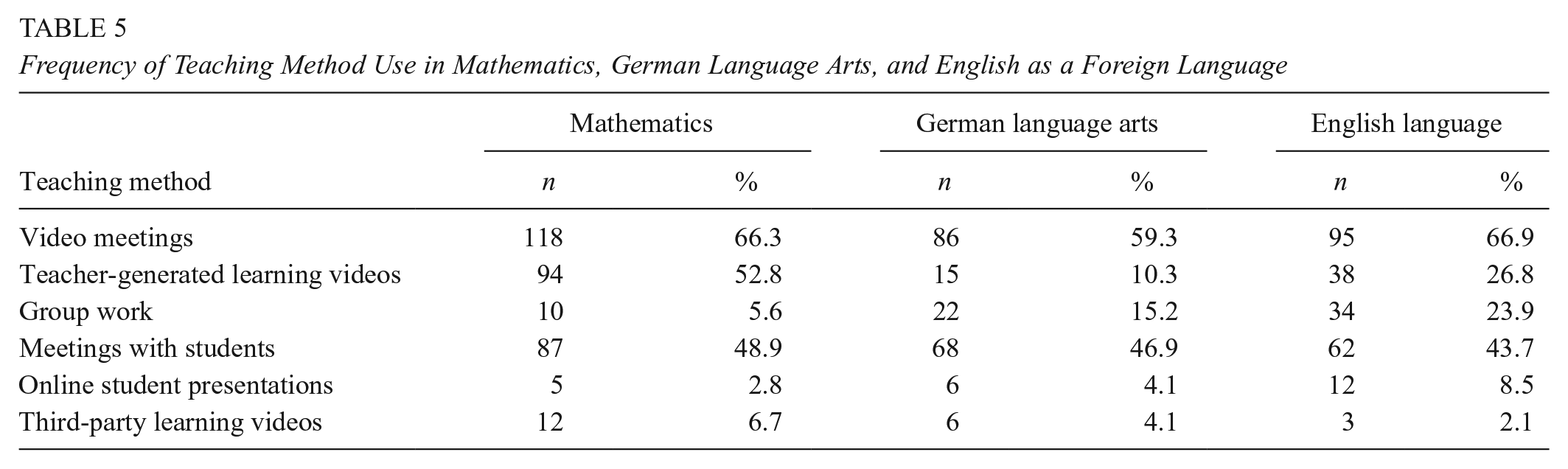
For our first research question, we then investigated which teaching methods the teachers applied during the school closures. Teachers most frequently reported that they conducted video meetings (mathematics: 66.3%; German language arts: 59.3%; English language: 66.9%) and met with single students or in small groups (mathematics: 48.9%; German language arts: 46.9.2%; English language: 43.7%; Table 5). We again found differences between subjects: For instance, 52.8% of mathematics teachers used learning videos they themselves had created, compared with 10.3% of German language arts teachers and 26.8% of English teachers. Group work was applied by 5.6% of mathematics teachers, 15.2% of German language arts teachers, and 23.9% of English teachers, again reflecting the different implementations of distance teaching in different subjects. The associations between the teaching methods and the covariates are shown in the online Supplemental Table S3.
Frequency of Teaching Method Use in Mathematics, German Language Arts, and English as a Foreign Language
Associations Between Teaching Methods and Students’ and Parents’ Perceptions of Teaching Quality
For our second research question, we investigated the associations between the applied teaching methods and students’ and parents’ perceptions of teaching quality along six quality dimensions. To do so, we computed multiple regressions to control for the context variables school type, class size, grade level, parental support, and school subject. Overall, the results revealed low to moderate associations between the applied methods and perceived teaching quality, but these associations were consistent across students’ and parents’ ratings (Tables 6 and 7). Furthermore, the results showed that video meetings and virtual meetings with single students or in small groups, which are used to foster social connectedness with and between the students, are important for how students and parents perceive whether support is being given by the teachers (learning support: .12 ≤ β ≤ .26; feedback: .12 ≤ β ≤ .21; all ps < .05). There were no or only a few statistically significant associations with the teaching methods of group work, online student presentations, and third-party learning videos for both students’ and parents’ perceptions of teaching quality. The strongest and most consistent findings were revealed for teacher-created learning videos: Whereas the use of third-party learning videos was not associated with the dimensions of teaching quality, the use of videos created by the teachers themselves was linked to higher ratings on all examined teaching quality dimensions from the students’ and parents’ perspectives (.12 ≤ β ≤ .26; all ps < .05). The results for associations of the tools they used with the teaching quality dimensions from the students’ and parents’ perspectives are presented in the online Supplemental Tables S4 and S5. The results for the associations of the teaching quality dimensions from students’ perspective with the covariates (in the online Supplemental Table S6) ranged from r = −.22 to r = .21; all ps < .05. The teaching quality dimension of practicing had the largest number of significant associations (−.17 ≤ r ≤ .15; all ps < .05). Additionally, the covariate parental support revealed significant positive associations for all teaching quality dimensions except for learning support (.12 ≤ r ≤ .21; ps < .05). The results for the associations of the teaching quality dimensions from parents’ perspective with the covariates are shown in the online Supplemental Table S7, for which the dimension of challenging tasks revealed the largest number of significant associations (−.20 ≤ r ≤ .31; all ps < .05).
Regressions of Teaching Methods on the Teaching Quality Dimensions From the Students’ Perspective

Regressions of the Teaching Methods on the Teaching Quality Dimensions From the Parents’ Perspective

Associations Between Teaching Methods and Students’ Learning Experiences
Our third research question addressed the extent to which the applied teaching methods were associated with students’ learning experiences in terms of students’ perceived competence, academic effort, enjoyment of learning, and social involvement. We found that teachers’ reports of their use of video meetings was significantly linked to higher ratings of students’ learning experiences (.12 ≤ β ≤ .39; all ps < .05; Table 8). We found only a few or even negative statistically significant associations for the teaching methods of group work, online presentations by students, and third-party learning videos (−.09 ≤ β ≤ .16; all ps < .05). Again, teacher-created learning videos were most consistently associated with students’ learning experiences (students’ perceived competence, β = .15; academic effort, β = .14; enjoyment of learning, β = .14; all ps < .05). The results for the associations between the tools teachers used and students’ learning experiences are presented in the online Supplemental Table S8. The results for the associations between students’ learning experiences and the covariates (in the online Supplemental Table S9) showed that the most consistent associations were revealed for students’ grade level (−.32 ≤ r ≤ −.18; all ps < .05) and parental support (.14 ≤ r ≤ .32; all ps < .05).
Regressions of Teaching Methods on Students’ Learning Experiences

Associations Between Teaching Quality Dimensions and Students’ Learning Experiences
To address Research Question 4, we examined the associations between students’ and their parents’ perceptions of teaching quality and students’ learning experiences (Tables 9 and 10). Overall, we found moderate associations, which ranged from β = −.24 to β = .43 from the students’ perspective and from β = −.25 to β = .53 from the parents’ perspective. Overall, we found that the dimensions of learning support and practicing revealed the most statistically significant associations (learning support: .23 < β ≤ .53; practicing: .16 ≤ β ≤ .43; all ps < .05).
Regressions of the Teaching Quality Dimensions From the Students’ Perspective on Students’ Learning Experiences

Regressions of the Teaching Quality Dimensions From the Parents’ Perspective on Students’ Learning Experiences

Discussion
The school closures due to the COVID-19 pandemic were a unique action taken worldwide to slow down the spread of the virus and ease the burden on health systems. Never before had schools been required to completely shift their teaching concepts and to deal with the organizational and legal consequences that went along with these changes. Before the pandemic-induced school closures, distance teaching and learning was implemented only in very exceptional cases in most countries (e.g., for a student with a long-term illness). Therefore, administrations, schools, and households were not prepared or equipped for the switch to a distance education setting. In the present study, we were interested in how teaching and learning took place during this unique period of time in three different subjects (mathematics, German language arts, and English as a foreign language) and how these different implementations of teaching at a distance were linked to students’ learning. Our analyses were applied to a large data set of ratings encompassing the perspectives of teachers, students, and their parents on teaching during the period of school closures. We found that the tools and methods used in digital teaching differed across teachers as well as across subjects. Furthermore, we found that teaching methods enabling social connectedness between teachers and their students as well as among the students themselves were consistently associated with more favorable reports of teaching quality by students and their parents as well as with more favorable learning experiences for students. The role of social connectedness was particularly manifested in the use of teacher-generated learning videos, for which we found positive associations with all dimensions of teaching quality from the students’ and parents’ perspectives and with nearly all aspects of students’ learning experiences. By contrast, we found no or even significantly negative associations for third-party learning videos (e.g., from YouTube). Finally, we found that the three basic domains from the teaching quality framework are suitable for evaluating students’ learning in distance education.
Implementation of Distance Education During the School Closures
Whereas distance education in the higher education setting is more common and can draw upon a broad, systematic research base, distance education at the secondary school level had comparatively rarely been previously conducted in most countries (e.g., German Federal Parliament, 2009; Watson et al., 2015). Consequently, the school closures in March 2020 provided an opportunity to learn more about distance education at the secondary school level. Overall, our findings showed a great deal of variability in the tools and teaching methods the teachers used even though teachers had the same or similar prerequisites regarding the technical equipment and the legal framework. With regard to the digital tools they used, the findings showed that teachers in all subjects used tools with which they were more familiar and that were widely available (e.g., email and telephone). In terms of teaching methods, we found that video meetings or meetings with individual students were used equally often in all subjects, whereas we found larger differences between subjects for teaching methods such as teacher-generated learning videos or group work. One explanation for this finding could be that, as in face-to-face teaching, certain methods might be perceived by teachers as more or less appropriate for different subjects and topics in distance education (Ufer et al., 2015). That is, tools and teaching methods differ in the opportunities they provide for distance teaching and learning and how they help accomplish a particular teaching objective (Richards & Rogers, 2014; Ufer et al., 2015).
Furthermore, the results offer insights into the use of synchronous and asynchronous teaching methods in distance education. Whereas some teaching methods used in the present study, such as video meetings and meetings with students, took place synchronously, methods such as the use of learning videos took place asynchronously. Previous studies have shown that both synchronous and asynchronous teaching methods are relevant for student learning (e.g., Watts, 2016), which also applies for the results in the present study.
Teaching Quality and Social Connectedness in Distance Education
The present study also investigated whether and to what extent different teaching methods in distance education were associated with well-known quality dimensions (Pauli & Reusser, 2003; Seidel & Shavelson, 2007) and aspects of students’ learning experiences in terms of perceived competence, academic effort, enjoyment of learning, and social involvement. Contrary to previous findings for face-to-face teaching (Hattie, 2009; Kunter et al., 2011), different methods were found to be relevant for the teaching quality dimensions and students’ learning experiences. Most important, we found that methods that foster social connectedness between the teacher and students as well as among students themselves were most consistently positively linked to students’ learning experiences. This might be because a feeling of social connectedness in face-to-face teaching arises from the classroom-based teaching and learning setting (Hirschy & Wilson, 2002), whereas in distance education, it needs to be actively structured and provided by the teacher (Hawkins et al., 2013; Keegan, 1995, 1996, Thurmond & Wambach, 2004). For this reason, organizational elements that are typically not associated with students’ learning in face-to-face teaching become more important in distance learning. Our results are in line with findings on the role of social presence in distance education: A variety of studies have shown that social presence in distance education has a positive impact on several student outcomes and learning experiences, such as achievement or course satisfaction (Mayer, 2005; Richardson & Swan, 2003; Sung & Mayer, 2012).
At the same time, these results suggest that teaching methods in distance education can serve other functions than the same methods in face-to-face teaching. For instance, group work in distance education means not only that students work with each other but also that they have opportunities to meet and chat with each other, thereby creating a social group context, which is otherwise rather challenging in distance learning. Therefore, teaching methods in distance education depend on the tools that are available and are used and can also serve other functions, such as social interaction (Thurmond & Wambach, 2004).
In this vein, the results for teacher-generated learning videos need to be particularly emphasized, as they serve as an impressive example of the relevance of social presence. In fact, teacher-generated learning videos showed the most consistent associations with the teaching quality dimensions and student learning experiences, whereas third-party learning videos had no or even negative associations. This is surprising, as one could argue that a large number of very professional and high-quality learning videos are available (e.g., Ranga, 2017; Richtberg & Girwidz, 2019). However, the fact that the teacher put a lot of effort into creating such videos and the resulting personal connection students might feel with their teacher carries more weight than a high-quality video made by an unfamiliar person. These findings are in line with previous research on learning videos in higher education: For instance, Diwanji et al. (2014) investigated components of effective learning videos in massive open online courses (MOOCs) in a meta-analysis. They found that videos in which the professor was visible were more engaging, perceived as less monotonous, and provided a more personal touch.
Finally, we found that, from the students’ and parents’ perspectives, the teaching quality dimensions of learning support and practicing were most consistently associated with aspects of students’ learning experiences. This might be the case because in this phase with only a little time for preparation, students might prefer to rehearse and practice what they have already learned in class instead of learning new subject matter. Also, students were rather isolated for many weeks and might have felt a need for social interaction. For this, the feeling that the teacher is interested in the students’ learning progress and wants to help students solve problems might be especially relevant from the students’ and parents’ perspectives. Furthermore, the present findings provide strong empirical support for the idea that the well-established dimensions of teaching quality can also serve as a framework for describing quality teaching in distance education (Cho & Shen, 2013; Holmberg, 1985, 1986; Kumi-Yeboah et al., 2018; NSQ, 2019).
Limitations and Further Research
The present study revealed important aspects of successful distance education at the secondary school level and highlighted the importance of connection and interaction in distance learning during pandemic-induced school closures. To our knowledge, this is the first study to investigate distance education during the unique period of COVID-19-related school closures from the students’, parents’, and teachers’ perspectives. Nevertheless, some limitations need to be considered.
Despite many advantages of online surveys (e.g., low cost and time efficiency), this method of data collection also has some disadvantages. Our sample might be biased toward schools with a greater interest in evaluating their teaching practices, in which teachers may practice at a higher quality level and be more motivated than in other schools. Furthermore, this study might have attracted people who are more tech-savvy and use technology more frequently, as such people would find it easier to participate in such an online study. In particular, parents and students who do not have digital devices or are not willing or able to complete the required technical steps may have been excluded from participating in the survey (Huebener et al., 2020). Such parents and students could have provided valuable insights into their learning situation and would also benefit from successfully implemented distance learning. Future research should consider how to reach these less accessible schools and families.
We assessed data in mathematics, German language arts, and English as a foreign language. Instruction in these three subjects was mandatory in the German federal state of Baden-Württemberg during the school closures, and the present study’s data have provided valuable insights into the different ways distance education was implemented. As we found large differences between subjects for some variables (e.g., the use of learning videos), it is possible that examining other school subjects would have revealed even more subject specificities. Therefore, it would be interesting to investigate how teaching in other subjects took place during the pandemic-induced school closures as well.
We assessed multiple aspects of students’ learning experiences, which have been shown to be associated with students’ achievement (Kunter & Voss, 2013; Lam et al., 2015; Wagner et al., 2016). Nevertheless, students’ achievement on standardized achievement tests would have been a valuable component for explaining further differences in students’ perceptions of distance learning. In future research, it would be interesting to link students’ perceived quality of distance learning with their achievement.
Finally, the present study used data collected in Germany. It would be very interesting and helpful to see how other states and countries have handled the situation to gain further insights into teaching and learning during this special phase and to learn more about how to handle similar situations in the future.
Supplemental Material
sj-docx-1-ero-10.1177_23328584211052050 – Supplemental material for Distance Teaching During the COVID-19 Crisis: Social Connectedness Matters Most for Teaching Quality and Students’ Learning
Supplemental material, sj-docx-1-ero-10.1177_23328584211052050 for Distance Teaching During the COVID-19 Crisis: Social Connectedness Matters Most for Teaching Quality and Students’ Learning by Ann-Kathrin Jaekel, Katharina Scheiter and Richard Göllner in AERA Open
Footnotes
Acknowledgements
The study was funded by German Research Foundation Grant GO 3257-1-1 awarded to Richard Göllner, Wolfgang Wagner, and Ulrich Trautwein.Ann-Kathrin Jaekel is a doctoral student at the LEAD Graduate School & Research Network [GSC1028], which was funded within the framework of the Excellence Initiative of the German federal and state governments. We posted all data analysis scripts and data on the open science framework under the following link: 
Authors
ANN-KATHRIN JAEKEL is at the University of Tübingen, Hector Research Institute of Education Sciences and Psychology. Her research interests are student ratings of teaching quality, teaching effectiveness, formulation of items to assess teaching quality.
KATHARINA SCHEITER is at the Leibniz-Institut für Wissensmedien, Tübingen and the University of Tübingen. Her research interests are cognitive processes underlying learning from multiple representations, teaching and learning with digital media.
RICHARD GÖLLNER is at the University of Tübingen, Hector Research Institute of Education Sciences and Psychology. His research interests are student ratings of teaching quality, person–situation interactions in the classroom, use of virtual realities in experimental research–learning research.
References
Supplementary Material
Please find the following supplemental material available below.
For Open Access articles published under a Creative Commons License, all supplemental material carries the same license as the article it is associated with.
For non-Open Access articles published, all supplemental material carries a non-exclusive license, and permission requests for re-use of supplemental material or any part of supplemental material shall be sent directly to the copyright owner as specified in the copyright notice associated with the article.
