




Abstract
Many students suffer from motivational problems when doing homework. To investigate whether an intervention that effectively promoted value beliefs in mathematics promoted students’ homework motivation and behavior, we analyzed data from a cluster randomized controlled study with two classroom-based relevance interventions (writing a text or evaluating quotes from interviews) with 82 classrooms and 1,978 ninth-grade students. Students’ math-specific homework motivation and behavior were assessed with homework diaries over a period of 4 weeks after the intervention. Latent growth curve analyses revealed that students in the text condition reported higher triggered interest but also lower homework completion than students in the control condition in the first week after the intervention. Students in the quotations condition reported higher utility of homework for future life, and higher homework effort directly after the intervention. The study highlights the potential of classroom-based relevance interventions to foster homework-specific outcomes, when considering situational, behavior-related measures.
Many students have trouble finishing their homework (e.g., Markow et al., 2007) or put only a little effort toward doing their assignments (e.g., Trautwein & Köller, 2003). If students like doing their homework or find it useful, they are more likely to invest effort into completing it (e.g., Trautwein & Lüdtke, 2009). Homework effort and completion can be critical factors determining students’ academic achievement (e.g., Fan et al., 2017). However, students do not necessarily perceive homework as interesting or useful (e.g., Katz et al., 2014; Warton, 2001). Motivational interventions could potentially boost homework motivation and behavior, which could be a mechanism by which motivational interventions promote students’ academic achievement. Hence, the question of how to foster students’ homework motivation and behavior is essential to ask in educational contexts.
Students’ motivation can be promoted through interventions that are aimed at helping students recognize the personal relevance of what they learn at school (e.g., Hulleman & Harackiewicz, 2009). Relevance interventions are aimed at promoting changes in students’ learning behavior such as their homework effort. However, little is known about whether these interventions affect students’ learning behavior and motivation in specific learning situations and outside the classroom.
We thus conducted a multipurpose study on the effects of a relevance intervention on students’ homework motivation and behavior. Our first purpose was to focus on a specific learning context (i.e., the homework situation) and to consider behavior-based criteria to uncover further evidence for the validity of findings concerning the effects of relevance interventions. Second, by studying the impact of motivational interventions on trajectories of students’ homework motivation and behavior in the period following the intervention, we aimed to learn more about the short-term stability of such effects. We drew on data from the Motivation in Mathematics (MoMa) study (Gaspard et al., 2021), in which two relevance interventions were implemented in a cluster randomized controlled study design with 82 German ninth-grade math classrooms (Brisson et al., 2017; Gaspard, Dicke, Flunger, Brisson, et al., 2015) to investigate three research questions. We examined whether the interventions affected students’ homework motivation and behavior directly after the intervention (Research Question 1), and whether this effect remained stable over time (Research Question 2). Moreover, we investigated whether the effect of the intervention on students’ academic achievement was mediated through their homework motivation or homework behavior (Research Question 3). In order to investigate students’ motivation directly in the homework situation, students were asked to keep homework diaries for 4 weeks after the intervention.
The Necessity to Foster Homework Motivation and Behavior
Homework is a task assigned by teachers with the purpose of providing students with extra practice on their schoolwork and thereby promoting their academic achievement (Cooper, 1989). Even though students seem to be aware that homework is an essential part of their school life, they tend to experience homework as a task that needs to be done rather than one that can be enjoyed (Xu & Yuan, 2003). Moreover, students do not necessarily complete homework assignments on a regular basis (Markow et al., 2007) and tend to vary in their homework effort (e.g., Trautwein & Köller, 2003). According to the homework model proposed by Trautwein et al. (2006), both students’ domain-specific and homework-specific motivation can predict their homework behavior and later academic achievement. For example, experiencing homework as unpleasant has been shown to be negatively associated with homework effort, which negatively predicted later achievement in mathematics (Dettmers et al., 2011). Students receiving an intervention in a domain might modify their behaviors in learning situations in and outside the classroom, due to an increase in their motivation. Thus, there is a clear need to foster students’ homework motivation and behavior, and to investigate whether homework motivation or behavior can act as mediators transmitting the effects of motivational interventions to the promotion of students’ academic achievement (see Figure 1).

Hypothesized mediation by students’ homework motivation and behavior.
So far, experimental research intervening on homework motivation and homework effort is scarce (but see Patall et al., 2010). Yet, we know from earlier research grounded in different theoretical frameworks that motivational interventions can foster durable changes in motivation and academic achievement (self-determination theory: e.g., Reeve & Cheon, 2014; implicit theories of intelligence: e.g., Blackwell et al., 2007; attribution theory: e.g., Haynes et al., 2006; expectancy-value theory: e.g., Harackiewicz et al., 2012). Often, these studies employed a long-term program implementing several motivational strategies at once (e.g., Linnenbrink-Garcia et al., 2018). Our objective was to assess the effects of a one-time motivational intervention in the classroom on students’ homework motivation and behavior across a time span of several weeks.
Dimensions of Students’ Homework Motivation
In the homework model by Trautwein et al. (2006), expectancy-value theory (Eccles et al., 1983) is utilized to conceptualize students’ homework motivation as encompassing expectancy and subjective task value. Expectancies are understood as subjective competence beliefs referring to how students evaluate their own abilities (Eccles & Wigfield, 2002). Subjective task values are defined as an individual’s reasons for engaging in a learning behavior, indicating its meaningfulness for that individual (Eccles et al., 1983). Four value components can be distinguished: attainment, utility, intrinsic value, and cost. Attainment value refers to the importance of a task for oneself or one’s identity (Eccles & Wigfield, 2002). Utility value indicates the perceived value of a task for future plans (e.g., Eccles & Wigfield, 2002). Students can perceive a task as useful for achieving their short- or their long-term goals in different life domains (e.g., school or future life; Gaspard, Dicke, Flunger, Schreier, et al., 2015). Intrinsic value refers to the enjoyment that originates from doing a task (Eccles & Wigfield, 2002) and is conceptually similar to interest. Interest can be distinguished into individual interest (i.e., a relatively enduring orientation toward certain contents or activities; Schiefele, 1991) and situational interest (an emotional state, i.e., environmentally prompted; Mitchell, 1993). Situational interest is differentiated into triggered situational interest, in which a person’s interest is aroused through a context, and maintained situational interest (e.g., Hidi & Renninger, 2006). Triggered situational interest and intrinsic value derived from a task are similar regarding the affective component of positive emotions (Tsai et al., 2008). Maintained situational interest implies repeated engagement with a task, content, or activity (Hidi & Renninger, 2006). Accordingly, intrinsic value experienced while doing homework can encompass triggered (i.e., students enjoy doing their homework) and maintained situational interest (e.g., through doing their homework, students get fascinated about a domain). Cost indicates the perceived negative consequences of engaging in a particular activity (Eccles & Wigfield, 2002), such as homework (e.g., due to high emotional costs).
Intervening on Students’ Homework Motivation With Relevance Interventions
Grounded in expectancy-value theory (Eccles et al., 1983), prior intervention research has shown that a potential powerful tool to foster motivation, engagement, and achievement is helping students find value in what they are learning through promoting the perceived utility or relevance (Hulleman & Harackiewicz, 2021). This strategy implies highlighting why an activity or a task is personally beneficial in terms of reaching personal goals (e.g., Hulleman & Harackiewicz, 2009).
Two approaches to foster perceived relevance have been previously implemented: communicating (e.g., Durik & Harackiewicz, 2007, Study 2) and self-generating utility arguments (Hulleman et al., 2010; Hulleman & Harackiewicz, 2009), both in laboratory and natural learning settings (for a review, see Lazowski & Hulleman, 2016). Both approaches have been shown to promote undergraduates’ perceived utility and interest in a specific task (Durik et al., 2015; Durik & Harackiewicz, 2007; Hulleman et al., 2010; Shechter et al., 2011), which provides support for the assumption that relevance interventions may be beneficial for raising students’ beliefs about the utility of homework and other aspects of students’ homework motivation.
The MoMa Relevance Intervention and Prior Results Concerning its Efficacy
Mathematics is a core school domain from preschool to graduation. Although math courses in secondary education can influence students’ later career options (Watt & Eccles, 2008), several studies confirmed that students consider math as less useful than other school domains and that the perceived utility of math for students’ daily life decreases as they progress through secondary school (e.g., Gaspard et al., 2017; Jacobs et al., 2002). Therefore, in the MoMa study, Gaspard, Dicke, Flunger, Brisson, et al. (2015) combined the two approaches to promote the relevance of mathematics (i.e., communicating and self-generating utility arguments; see also Brisson et al., 2017), using a between-classrooms design with 82 ninth-grade classrooms.
First, possible arguments for the relevance of mathematics were presented in math classrooms by researchers; subsequently, students elaborated on how the relevance of mathematics applied to their own lives in two distinct conditions. In the quotations condition, students worked with interview quotations that provided authentic information on the utility of math. In the text condition, students were asked to write an essay about the relevance of math to their own lives.
The effects of the interventions on students’ math-specific value beliefs, expectancy beliefs, and learning behavior were investigated with student questionnaires at a posttest after 6 weeks and at a follow-up after 5 months. Both the quotations and text condition showed positive effects on students’ utility value at posttest and follow-up. Overall, the quotations condition had stronger effects than the text condition. The quotations condition promoted attainment value, intrinsic value (at the follow-up), self-concept (at the posttest), and teacher-rated effort at the posttest and at the follow-up (see Brisson et al., 2017; Gaspard, Dicke, Flunger, Brisson, et al., 2015). Academic achievement in mathematics at the follow-up was also promoted through the quotations condition (Brisson et al., 2017). Furthermore, the classroom-based relevance intervention was effective in boosting students’ general homework-related expectancies: In earlier analyses using data assessed with student questionnaires, homework self-efficacy was shown to be positively affected by the quotations condition at the posttest and at the follow-up, and by the text condition at the follow-up (Brisson et al., 2017).
Taken together, the relevance intervention in the MoMa intervention led students to considering mathematics as more useful and might have made them realize that practicing math via homework is relevant. Empirical evidence suggests that motivational support in a domain can promote students’ domain-specific motivation but can also translate to the out-of-school context (i.e., transcontextual effects, Hagger et al., 2015), for example, the homework situation (e.g., Hagger et al., 2016; Hagger & Hamilton, 2018). A classroom-based relevance intervention might lead students to invest greater effort in their homework, which may promote their later achievement (Dettmers et al., 2011). Therefore, it is important to investigate whether the relevance interventions also promoted students’ homework motivation and behavior shortly after the intervention, and whether homework motivation or behavior mediated the effects of the relevance interventions on students’ academic achievement.
The Present Study
We drew on data from a large cluster randomized controlled study (the MoMa study) to investigate whether students’ homework motivation and homework behavior could be enhanced through a classroom-based relevance intervention. The present study focused on the short-term changes in students’ homework motivation and behavior within the first 4 weeks after receiving a relevance intervention. The short time frame after receiving an intervention can be considered as a critical period, in which students may still process the new relevance information, which may initiate a chain of effects (e.g., Goyer et al., 2017), for example, the awareness of the usefulness of homework in mathematics may increase and benefit homework-specific value beliefs and behaviors.
Through explicitly focusing on the context of the homework situation with a homework diary, new, more situational indicators of students’ motivation and behavior can be explored. Diary methods are optimally suited as an assessment method in the conditions that exist when students usually do homework because they enable ambulatory assessments (Fahrenberg et al., 2007). In order to increase ecological validity (e.g., Schmitz & Wiese, 2006), students were asked to complete the homework diary immediately after they did their homework, as long as they had worked on homework tasks.
Via latent growth curve analyses, we examined three research questions. First, we examined whether the interventions affected students’ homework motivation and behavior directly after the intervention (i.e., in the first week after having received the intervention, Research Question 1). Because previous correlational studies had revealed close associations of students’ domain-specific motivation with students’ homework motivation (e.g., Flunger et al., 2017), we expected that both intervention conditions would promote students’ homework motivation (perceived homework competence, utility of homework for future life and for school, homework cost, triggered, and maintained interest) and homework behavior (homework effort and completion). Because of the positive effects of the MoMa intervention found for the posttest and follow-up measures of domain-specific motivation (Brisson et al., 2017; Gaspard, Dicke, Flunger, Brisson, et al., 2015), we assumed that the mean levels of students’ homework motivation and homework behavior would be higher directly after the intervention (i.e., in the first week after the intervention) compared with the control group. Second, we explored whether the interventions led to a change in students’ homework motivation and behavior in the subsequent period after the intervention (Research Question 2). We expected that the positive effect of the relevance interventions would remain stable across the further weeks. Finally, we explored whether the effect of the intervention on students’ academic achievement (as already established in Brisson et al., 2017) assessed 5 months after the intervention was mediated by their homework motivation or homework behavior (Research Question 3).
Method
Sample and Procedure
The sample from the MoMa study consisted of 1,978 students with active parental consent from 82 ninth-grade classes in 25 academic track schools (Gaspard et al., 2021). The study took place in the German state of Baden-Württemberg from September 2012 to March 2013. We included 1,916 students (mean age at the beginning of the study = 14.62, agerange = 12.92–16.67 years, 53.5% female adolescents) in the analyses due to the absence of 62 students on the day of the intervention. Because we surveyed students from the highest educational track in Germany, our sample is not representative with respect to parents’ educational level in the population of ninth-grade students. More precisely, there was a positive selection: 46.6% of mothers and 47.0% of fathers held a qualification for higher education (i.e., obtained the Abitur certificate) compared with 38.3% in the population (Statistisches Bundesamt, 2013). Yet, the sample comprised students with parents from a broad range of educational backgrounds (mean socioeconomic status [SES]/Highest International Social and Economic Index [HISEI]: M = 65.33, SD = 16.14). Concerning migration background, 22.4% of students came from families with at least one parent born outside Germany (predominantly Western countries). The data of the MoMa study are available upon request at https://doi.org/10.5159/IQB_MoMa_v1.
The measures were completed with pen and paper. Students were administered questionnaires by trained research assistants before the intervention (pretest), an average of 6 weeks after the intervention (posttest), and an average of 5 months after the intervention (follow-up). Directly after the intervention, students received a homework diary which they were expected to complete on those days across the subsequent 4 weeks on which they worked on math homework. To motivate the students to keep the homework diaries across the 4 weeks, students participated in a raffle to win vouchers of up to €50 for an online retailer. Each completed diary page corresponded to a raffle ticket. Given that the majority of students had mathematics classes twice a week, most students received only two homework assignments per week (the range of homework assigned in Week 1 to Week 4 in the text condition: Mrange = 1.55–1.72; quotations condition: Mrange = 1.33–1.85; control condition: Mrange = 1.48–1.95). Students in the participating classes received different, but similar homework assignments. Their homework referred to solving tasks on exercise sheets, math books, or drawing a graph. The topics they exercised in their homework were, for instance, multiplication and potentiation, the sentence of Pythagoras, symmetry, or the theorem of intersecting lines.
The teachers (along with their classrooms) had been randomly assigned to one of two intervention conditions or a waiting control group, resulting in the following distribution of classes: quotations condition: 25 classes; text condition: 30 classes; control condition: 27 classes. As nine participating teachers had two classes each, and their classes had been assigned to the same condition, the different conditions had unequal numbers of classes.
Intervention Conditions
From October to November 2012, the intervention was delivered in the two intervention conditions by five trained female researchers (Brisson et al., 2017; Gaspard, Dicke, Flunger, Brisson, et al., 2015). The intervention encompassed both a psychoeducational presentation for the whole class and relevance-inducing tasks for students in a 90-minute lesson. The psychoeducational presentation was the same in both intervention conditions and consisted of two main parts. First, students received information about research findings on the importance of effort, interpretations of achievement-related experiences, and the impact of frame-of-reference effects on achievement in school classrooms (e.g., Trautwein et al., 2009). Subsequently, students received information about the utility of mathematics for future education, career opportunities, and leisure time activities. Next, students in both conditions worked on individual tasks that triggered them to reflect on the relevance of mathematics for their personal lives. In the quotations condition, students received six quotations from older students or young adults on the personal relevance of mathematics to their lives and were asked to evaluate these quotations (see Supplemental Material, available in the online version of this article, and Brisson et al., 2017, for further details). In the text condition, the task was to make arguments for the personal relevance of mathematics to students’ lives (currently and in the future) and to write an essay explaining these arguments.
Wait List Control Group
Classes in the wait list control condition followed regular instructions before the last measurement at the follow-up. They completed the homework diaries (without reinforcements) at the same time as the classes in the intervention conditions. After the follow-up measurement, students in the control group received the better working intervention (i.e., evaluating quotations; see, e.g., Brisson et al., 2017).
Reinforcements
In the intervention conditions, the homework diary contained two reinforcements, which were to be completed on the first day of the second week after the intervention, and on the first day of the third week after the intervention. Although the reinforcement required only very short answers, few students (232 students in the text condition and 143 students in the quotations condition) had completed both reinforcements as intended (for details, see online Supplemental Material).
As a consequence of the small fraction of students who worked seriously on the two reinforcements and the lack of randomization of the reinforcements, studying the effects of the reinforcements on students’ homework motivation and behavior is not informative about the processes at play in the whole sample. Given that we did not identify variations in the descriptive data on students’ homework motivation and behavior after completing the reinforcements in Week 2 and Week 3, we did not analyze the effects of the reinforcements further.
Measures
Student Questionnaire (Pretest)
Pretest measures were assessed either as domain-specific or homework-specific self-reports in math.
Value beliefs
Utility for future life (e.g., “I will often need math in my life”; α = .79) and utility for school (e.g., “Being good at math pays off because it is simply needed at school;” α = .52) were assessed with two items each (Gaspard, Dicke, Flunger, Schreier, et al., 2015). The utility of homework was measured with four items (e.g., “The homework tasks help me to get a better understanding of the content learned in class,” α = .71), which were adapted from Trautwein and Köller (2003). Regarding cost, both emotional cost of math and homework-specific cost were considered. Emotional cost of math was assessed with four items (e.g., “When I deal with math, I get annoyed,” α = .87; see Gaspard, Dicke, Flunger, Schreier, et al., 2015). Homework-specific cost was assessed with four items (e.g., “Math homework is a real burden to me,” α = .84), adapted from the scales developed by Gaspard, Dicke, Flunger, Schreier, et al. (2015).
Interest and intrinsic value
Both the intrinsic value of math and math interest were considered. Intrinsic value was measured with four items (e.g., “I like doing math,” α = .93; Gaspard, Dicke, Flunger, Schreier, et al., 2015). Math interest was measured with six items (e.g., “I’m interested in math,” α = .86), using a scale from Frenzel et al. (2010).
Homework self-efficacy
Homework self-efficacy was measured with four items (e.g., “When I try hard, I can solve my math homework correctly,” α = .76), which were adapted from Ramm et al. (2006).
Homework effort
Homework effort was measured with four items (e.g., “I always try to finish my math homework completely,” α = .83), adapted from Trautwein and Köller (2003).
Family background
We measured migration background, 0 (none) and 1 (immigration) if at least one parent had immigrated from another country. Moreover, we used the HISEI indicator, which considers several aspects of parent’s socioeconomic position, namely parents’ occupation, income, and education, as an index of SES. The HISEI refers to the status of the occupation and indicates parents’ socioeconomic position within the societal hierarchy.
Academic achievement
At the beginning of Grade 9, the students participated in a curriculum-based standardized math test in the federal state of Baden-Württemberg, assessing students’ math proficiency concerning numbers and algorithms, space and shapes, linking and modeling. At the follow-up, a 3-minute normed speed test was implemented, which assessed students’ fluency of solving typical mathematical operations. The validity of the speed test has been confirmed in earlier studies revealing substantial correlations with standardized, curriculum-based math tests (e.g., Schmidt et al., 2013). The reliability of the test was good (Cronbach’s α = .89).
Homework Diary Measures
The homework diary entailed seven assessments for 4 weeks. The assessment consisted of a one-page questionnaire with a total of 12 items that were identical each day (see Figure 2). First, students were questioned about their math homework (i.e., “Did you receive new math homework today?” “Did you work on math homework today?” “Did you save parts of your homework for another day?”) with a nominal response format (yes/no).

Example of the daily measurement (translated).
In case students had worked on math homework, they were asked to complete measures on their homework motivation and effort immediately after doing homework (similar to the experience-sampling method but without a reminder). To this end, eight items with a 4-point Likert-type scale ranging from 1 (completely disagree) to 4 (completely agree) were used (see below for details). The negatively worded items were recoded for ease of interpretation. The measures of the homework diary were assessed with one to two items, referring to the homework task on the respective day, which we selected and adapted from the pretest measures. Single-item measures have been shown to yield valid data (e.g., Gardner et al., 1998) and to have similar associations with external criteria compared with longer measures (Gogol et al., 2014). Information on the validity tests of the diary measures is provided in the online Supplemental Material.
The math teachers received a one-page questionnaire in which they were asked to report whether they had assigned homework and to specify which homework was assigned. The maximum number of homework assignments per week was four. Because students had only a few math classes per week, they were able to decide on which day they worked on their math class and the specific days could vary within classroom. To consider deviations in students’ homework completion from the days when they were given homework and the resulting missing data, the daily responses during the 4 weeks were aggregated into four weekly measures. At the end of each week, the teachers collected the homework diaries in closed envelopes.
Homework-specific utility value
We measured the perceived utility of homework for future life (“What I worked on today in my math homework can be of great value to me later on”) and utility of homework for school (“The math homework helped me get a better understanding of the material”) with one item each adapted from the scales for math-specific utility value beliefs by Gaspard, Dicke, Flunger, Schreier, et al. (2015).
Homework-specific situational interest
Triggered situational interest was measured with the item “I had fun doing my math homework,” which was adapted from Pekrun et al. (2002). Maintained situational interest was measured with the item “By doing today’s homework, I got interested in learning more about this topic,” which was adapted from Lewalter and Willems (2009).
Homework-specific cost
Homework-specific cost was assessed with the item “When dealing with my math homework, I got very annoyed,” which was adapted from the emotional cost scale developed by Gaspard, Dicke, Flunger, Schreier, et al. (2015).
Homework-specific competence beliefs
Perceived homework competence was measured with the item “It was hard for me to solve all tasks correctly today,” which was adapted from the Self-Description Questionnaire (Marsh, 1990).
Homework effort
Homework effort was measured with the two items “Today, I diligently worked on each homework task” and “Today, I did not take the homework tasks seriously,” which were adapted from Trautwein and Köller (2003). The reliabilities of the generated homework effort scale were satisfactory (αΤ1 = .74; αΤ2 = .77; αΤ3 = .78; αΤ4 = .81)
Homework completion
We created an index on the relative amount of the homework completed by individual students in each week (for more details, see online Supplemental Material). A student’s report on completed homework was divided by the amount of homework assigned by the teacher in the respective week to calculate the relative amount of completed homework.
Statistical Analyses
Latent Growth Curve Analyses
Via latent growth curve analyses, we examined whether the intervention had effects on students’ homework motivation and behavior. The nesting of students in classes was considered via a design-based correction of standard errors with the analysis option type is complex in Mplus 8.5 (L. K. Muthén & Muthén, 1998–2017).
First, we modeled eight unconditional growth models without predictors to evaluate the model fit and the variability in change in students’ homework motivation and behavior. In the latent growth model, a growth process is assumed to underlie students’ levels across the weekly measures of homework motivation and behavior (see Table 1). This growth process is reflected by two underlying latent factors: the latent intercept and latent slope factor (see Figure 3). Latent growth curve models enable to disentangle effects at the first measurement, directly after the intervention, and the change across time. The latent intercept factor reflects students’ mean level in a specific homework variable and its variance in the first week. The latent slope factor represents the change over time and the variance thereof. We fitted linear as well as nonlinear shape functions (Sterba, 2014) to explore which type of trajectory was most appropriate for the homework diary data. The four time-specific factor loadings of the latent intercept factor were fixed to 1. Concerning the linear growth curve, as depicted in Figure 3, the measurement paths of the growth factors were constrained to reflect the linear time trend: the factor loadings of the latent growth factor were fixed to 0 at Week 1, 1 at Week 2, 2 at Week 3, and 3 at Week 4. The means of the linear latent growth factors indicate the amount of predicted change, referring to a 1-unit change on the specified time scale. Regarding the nonlinear shape functions, the measurement paths at Weeks 2 and 3 were allowed to be estimated freely, while the first measurement path (fixed to 0) and the fourth measurement path (fixed to 3) were chosen as anchor loadings. Therefore, the nonlinear growth factors in these models indicate a change proportional to the anchor loadings, and the means of the nonlinear growth factors represent the change from the first week to the last week divided by three, which corresponds to the average change per week over the 3 weeks. Model fit was evaluated by considering the comparative fit index (CFI), the root mean square error of approximation (RMSEA), and the standardized root mean square residual (SRMR).
Descriptive Statistics for the Homework Diary Measures in the Three Conditions


MIMIC (multiple-indicator multiple-cause) model with latent intercept and latent slope factor.
The intervention effects were estimated with multiple-indicator multiple-cause (MIMIC, e.g., Jöreskog & Goldberger, 1975) models. In eight MIMIC models, multiple indicators (i.e., the observed weekly homework diary indicators across the four measurement occasions) were modelled to reflect the two latent intercept and slope factors of each respective homework outcome (see Figure 3). The latent factors were regressed on the intervention conditions and covariates. Research Question 1 was assessed by evaluating the effects of the text and quotations conditions on the latent intercept factors. Research Question 2 was assessed by evaluating the effects of the text and quotations conditions on the latent growth factors.
To yield intervention effects that were as precise as possible (Raudenbush, 1997), the models included the respective math-specific measure, homework-specific utility value, and, if available, a homework-specific indicator assessed at the pretest as covariates. Because gender differences have been found for both homework effort and homework motivation (see, e.g., Trautwein & Lüdtke, 2009), gender also was included as covariate. Given that several studies revealed that students’ study behaviors can be conditional on their family background (e.g., students with higher SES tend to show higher effort than students with lower SES; Kuehn & Landeras, 2014; Lasso De La Vega et al., 2020), students’ migration background and parents’ SES were included as further covariates. All continuous pretest measures were z-standardized prior to the analyses.
To obtain effect sizes, we used the Glass estimator (Hedges, 1981). That is, the raw coefficients of the intervention effects were divided by the standard deviation of the outcome measures in the control group at Week 1, and thus represent the adjusted differences between the intervention conditions and the control condition.
Equality constraints
The correlations of the auxiliaries with the covariates and the indicators of the latent factors were constrained to be equal across time. An annotated example input can be found in the online Supplemental Material.
Missing data
Because the homework diary was not consistently completed by all students or because of nonresponses to single items, missing data ranged from 24.1% to 63.4% for the homework diary measures (see Table 1). All models were estimated using full information maximum likelihood estimation, which has been shown to provide valid estimates for structural equation models under the missing at random assumption (e.g., Enders, 2010). We had tested whether missing data were conditional on pretest variables and further potential correlates of missingness (following Collins et al., 2001, see online Supplemental Material). Lower scores on many variables were found for students with missing data compared with students with observed data. Therefore, we assumed that the data were missing at random.
To substantiate the missing at random assumption, auxiliary variables (i.e., variables that are associated with the missingness or the variable with missing data; Schafer, 1997) can be used. We incorporated four auxiliary variables via saturated correlates models (“spider” models; Graham, 2003, see online Supplemental Material), to improve the chances to satisfy the missing at random assumption (following Enders, 2010) and to reduce estimation bias due to missingness (e.g., Collins et al., 2001).
Mediational Analyses
A precondition of mediation is that the effects of the independent variable on the mediator are significant (Baron & Kenny, 1986). We examined mediation in case we found a statistically significant intervention effect on students’ homework motivation or behavior. We specified latent growth curve models for the homework-specific variables in which we considered academic achievement as an outcome and entered the two intervention conditions as predictors of the latent intercept and slope factors of the homework variables as well as students’ math test score. In separate models, we estimated the indirect effects of the intervention on academic achievement at the follow-up through the latent intercept factors of a homework-specific variable, implementing the default in Mplus, with the model ind command, which uses the Delta method (e.g., MacKinnon et al., 2002). Using a bootstrap estimation approach with 10.000 samples, confidence intervals and standard errors for the indirect effect were estimated. Furthermore, the curriculum-based standardized math test conducted at the pretest was specified as predictor of the math test score to control for potential pretest differences.
Results
The descriptive statistics of all measures are shown in Tables 1 and 2. Details on the randomization and robustness check are provided in the online Supplemental Material.
Descriptive Statistics of the Study Variables in the Three Conditions

Note. In a randomization check on mean differences between the two intervention groups and the control group in the pretest measures, only homework cost did not demonstrate balance (for further information, see online Supplemental Material); HISEI = Highest International Social and Economic Index.
Unconditional Latent Growth Curve Models
The results of the unconditional latent growth curve models are presented in Table 3. The univariate models showed good model fit. When comparing the model fit, the models with nonlinear shape functions were shown to provide a statistically significantly better fit than the linear growth curves concerning maintained homework interest and homework cost (see online Supplemental Table S5). The estimated measurement paths deviated from the linearity assumption: Concerning maintained interest, the loadings estimated for Weeks 2 and 3 were 5.57 and 2.56, respectively. Concerning cost, the loadings estimated for Weeks 2 and 3 were 3.18 and 4.97, respectively. Therefore, we specified nonlinear shape functions in the analyses for these two homework variables. For the other six outcomes, we continued with the linear latent growth curve, given that there was no significant improvement by a nonlinear model.
Parameter Estimates and Model Fit Statistics From Latent Growth Curve Models of the Homework Diary Measures

Note. The unconditional latent growth curve models were estimated with auxiliary variables, N = 1,916. Intercept loadings across Week 1 to Week 4 = 1; slope loadings for Week 1 = 0, Week 2 = 1, Week 3 = 2, Week 4 = 3. For maintained homework interest and homework cost, shape functions were estimated for the latent growth factors; the slope loadings of Week 2 and Week 3 were freely estimated (slope loadings for Week 1 = 0, Week 4 = 3). s2 = variance; CFI = comparative fit index; RMSEA = root mean square error of approximation; SRMR = standardized root mean square residual.
p < .10. *p < .05. **p < .01. ***p < .00.
The means of the latent intercept factors indicate the level of students’ homework measures and the variances reflect students’ individual differences in the first week after the intervention (T1). The means of the linear latent growth factors indicate the amount of predicted change, referring to a 1-unit change on the specified time scale. Concerning the nonlinear latent growth curves for maintained interest and homework cost, the means of the nonlinear latent growth factors indicate the average change from the first week to the last week divided by three (i.e., the average change per week).
The parameter estimates in Table 3 show that the means and variances of the latent intercept factors were statistically significant. The means of the latent growth factors were significant for three measures. Students’ homework effort and completion decreased over time on average, whereas homework cost increased across the 4 weeks on average. Regarding the other homework measures, on average, there was only slight change over time.
Intervention Effects on Students’ Homework Motivation and Behavior
To investigate the intervention effects, we estimated MIMIC models with covariates separately for each construct, which yielded an acceptable fit regarding all outcomes (CFIrange = 0.989–1.000; RMSEArange = .000–.021; SRMRrange = .014–.019). The effects of the covariates on the latent intercept and latent growth factors of all outcomes are reported in Table 4, the effect sizes are shown in Table 5.
Effects of the Relevance Interventions and Covariates on the Latent Intercept and Slope Factors of Students’ Homework Motivation

Note. Students’ end-of-year math grade in Grade 8, scores on a standardized math achievement test, conscientiousness, and homework effort were incorporated into the models as auxiliary variables. Significant effects associated with the relevance interventions are presented in boldface. b = unstandardized regression coefficient; Gender: 0 = female, 1 = male; Immigration status: 0 (none), 1 (immigration); HISEI = Highest International Social and Economic Index.
p < .10. *p < .05. **p < .01. ***p < .001 (two-tailed p values).
Effects of the Relevance Interventions and Covariates on the Latent Intercept and Slope Factors of Students’ Homework Motivation and Behavior
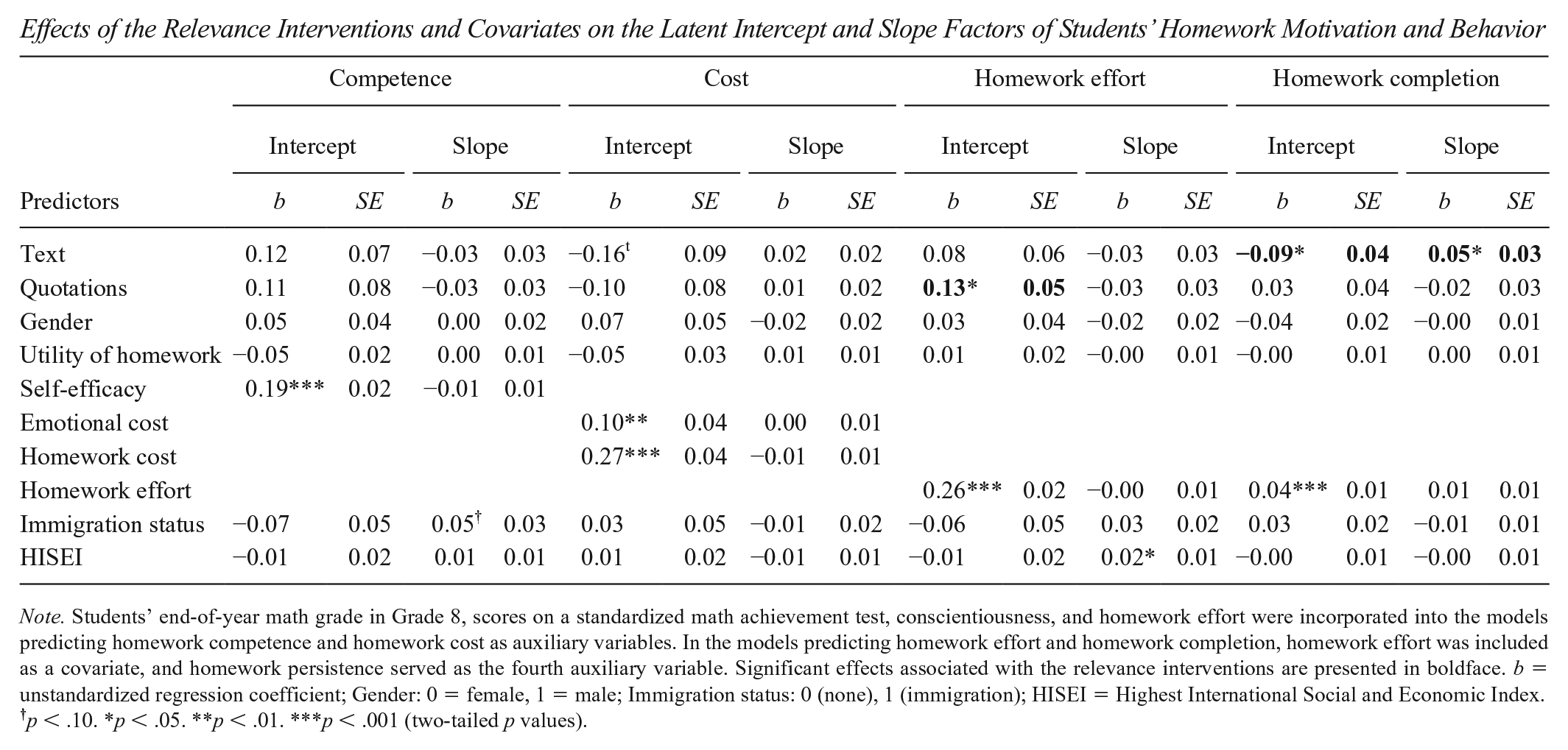
Note. Students’ end-of-year math grade in Grade 8, scores on a standardized math achievement test, conscientiousness, and homework effort were incorporated into the models predicting homework competence and homework cost as auxiliary variables. In the models predicting homework effort and homework completion, homework effort was included as a covariate, and homework persistence served as the fourth auxiliary variable. Significant effects associated with the relevance interventions are presented in boldface. b = unstandardized regression coefficient; Gender: 0 = female, 1 = male; Immigration status: 0 (none), 1 (immigration); HISEI = Highest International Social and Economic Index.
p < .10. *p < .05. **p < .01. ***p < .001 (two-tailed p values).
Effect Sizes of Intervention Effects

Note. Significant effects are presented in bold. HW = homework; ES = effect size measure (Glass estimator).
Intervention Effects in the First Week After the Intervention (Research Question 1)
To investigate whether the interventions affected students’ homework motivation and behavior directly after the intervention (Research Question 1), we inspected the intervention effects on the latent intercept factors of the homework diary variables.
Regarding situational interest, students in the text condition showed statistically significantly higher values on the latent intercept factor of triggered interest than students in the control condition (b = 0.15; p = .044; effect size [ES] = 0.18). There were no effects of the quotations condition on triggered homework interest. Regarding the utility value of homework, we found statistically significantly higher values—as compared with the control condition (b = 0.17; p = .009; ES = 0.21)—for students in the quotations condition on the latent intercept factor of utility of homework for future life. Concerning homework cost, we found marginally significant higher values—as compared with the control condition (b = −0.16; p = .062; ES = −0.19)—for students in the text condition on the latent intercept factor of utility of homework cost. There were no statistically significant differences between the study conditions regarding maintained interest, utility of homework for school, and homework competence.
Regarding homework behavior, students in the quotations condition reported statistically significantly higher values on the latent intercept of homework effort than students in the control condition (b = 0.13; p = .014; ES = 0.19). Moreover, students in the text condition reported statistically significantly lower levels on the latent intercept factor of homework completion than students in the control condition (b = −0.09; p = .039; ES = −0.33).
Intervention Effects Across Time (Research Question 2)
To examine whether the interventions affected the change in students’ homework motivation and behavior across the 4 weeks after the intervention (Research Question 2), we inspected the intervention effects on the latent growth factors. The different trajectories for each outcome are shown in Figure 4. The expected stability in the intervention effects over time was not confirmed. Although the different trajectories seem to show differences between the slopes in the distinct conditions, most of these differences were not statistically significant and an inspection of the trend suggests that the differences between the two intervention conditions and the control condition became smaller over time. More specifically, the trajectories suggest that students in the quotations and text condition reported similar levels of triggered and maintained interest, utility of homework for future life, and homework competence over time, while students in the control group exhibited an increase in these measures across the 4 weeks (see also Table 1 on the descriptive statistics of the weekly homework measures). Students’ homework effort seemed to decrease in all study conditions. One statistically significant effect was found for homework completion: The amount of homework completed decreased in all three conditions over time, but the decrease in the text condition was statistically significantly slower than the decrease in the control condition (b = 0.05; p = .039; ES = 0.19).

Trajectories of students’ homework motivation and behavior in the three study conditions.
Mediation of Intervention Effects on Academic Achievement Through Homework (Research Question 3)
To investigate whether students’ homework motivation or homework behavior mediated the effect of the relevance interventions on students’ academic achievement (Research Question 3), we considered the homework-specific variables for which we had found statistically significant intervention effects when analyzing Research Questions 1 and 2. We estimated four distinct analyses for homework-specific triggered interest, utility for future life, homework effort, and homework completion (evaluating indirect effects via the latent intercept factors) as potential mediating variables.
We did not reveal statistically significant indirect effects of the text condition on students’ academic achievement at the follow-up through the latent intercept factors of the homework diary measures (triggered interest: b = 0.01; p = .472, 95% CI [−0.012, 0.025], homework completion: b = −0.02; p = .953, 95% CI [−0.448, 0.077]). Moreover, we did not find statistically significant indirect effects of the quotations condition on students’ academic achievement at the follow-up through the latent intercept factors of the homework diary measures (utility for future life: b = −0.02; p = .223, 95% CI [−0.067, 0.002], and homework effort: b = −0.01; p = .606, 95% CI [−0.067, 0.019]).
Discussion
In the current study, we explored whether a relevance intervention in the classroom promoted students’ homework motivation and behavior and ultimately students’ academic achievement. The results showed that students in the text condition reported higher triggered interest and lower homework cost but lower homework completion than students in the control condition in the first week after the intervention. Students in the quotations condition conveyed higher utility of homework for future life, and higher homework effort in the first week after the intervention. There was no further increase in students’ homework motivation and behavior over the course of the 4 weeks but inspections of the trajectories over time suggest that in the intervention conditions, homework motivation remained fairly stable, while students in the control condition exhibited an increase in homework motivation across time. Concerning homework behavior, the trajectories suggested a decrease in homework effort and homework completion in all study conditions.
The effect sizes ranged from d = 0.18 to d = 0.21 for the indicators of homework motivation. Regarding homework behavior, the effect sizes ranged from d = −0.33 to d = 0.19. Considering conventional standards (Cohen, 1988) and educational benchmarks proposed for randomized field trials (Kraft, 2020; Yeager et al., 2019), the effects of the relevance interventions on students’ homework-specific outcomes can be interpreted as small to medium. However, the intervention was delivered in one 90-minute session in the classroom, with two small reinforcements. Thus, our study is one of the first to show that minimal classroom-based relevance interventions can extend to positive effects on students’ interest and utility beliefs in learning situations outside the classroom.
Fostering Students’ Homework Motivation and Effort
The relevance intervention implemented in the MoMa study successfully targeted the promotion of domain-specific motivation and was primarily effective in promoting math-specific utility values (Gaspard, Dicke, Flunger, Brisson, et al., 2015), which can also be observed regarding students’ homework-specific outcomes. The effects of the relevance intervention were found for interest in the homework tasks and the utility associated with the gain in mathematical knowledge that comes from doing homework. Prior experimental studies have indicated that interest and utility are closely related: Relevance interventions have been found to promote situational interest in a task (e.g., Durik et al., 2015). Working with quotations from young adults who offered new information about the utility of mathematics in the future might have created a different perspective on the meaningfulness of mathematical knowledge for students’ lives (see Gaspard, Dicke, Flunger, Brisson, et al., 2015).
Furthermore, we found positive effects of the quotations condition on students’ homework effort in the first week after the intervention. According to expectancy-value theory, utility value can be expected to be a driving factor of the effort that students put toward a given task (Wigfield & Eccles, 2002). In the present study, we found that the previously identified positive effects on effort during math lessons (see Brisson et al., 2017) extended to situations outside the classroom: Students who worked on quotations about the utility of math put more effort into their math-related homework activities compared with students who did not receive information about the utility of math.
Concerning the effects of the text condition, a positive effect was found on students’ triggered interest and negative effects were found on homework cost and homework completion in the first week after the intervention. The negative effect on homework behavior contradicts interest theory (e.g., Hidi & Harackiewicz, 2000), which would suggest that situational interest is accompanied by increased engagement. Nevertheless, regarding the development of homework completion across the 4 weeks, homework completion decreased in all conditions. The positive effect of the text condition on the latent slope of homework completion showed that the decrease in the text condition was slower than the decrease observed in the quotations and control conditions. Hagger et al. (2015) found that students’ homework-specific intrinsic motivation predicted their intentions to do mathematics homework. Accordingly, this finding could suggest that the increase in triggered situational interest directly after the intervention buffered students in the text condition from becoming behaviorally disengaged over time, compared with students in the quotations and control condition.
Implications for Homework Research
Clearly, homework motivation and behavior is in need for improvement: Many students show lower enjoyment and higher boredom and frustration regarding homework compared with other learning activities (e.g., Dettmers et al., 2011). Moreover, low homework motivation has been found to be associated with undesirable effects, such as homework procrastination (Katz et al., 2014) and low homework effort (e.g., Flunger et al., 2017), which can negatively affect students’ academic achievement (Dettmers et al., 2010).
Our study revealed many null results, and the effects of the relevance interventions on students’ academic achievement were not mediated by students’ homework motivation and behavior. These null results can be meaningful in several respects (Jacob et al., 2019). A classroom-based motivation intervention might have greater proximity to domain-specific outcomes than to homework motivation and behavior, for which its impact might be smaller. The homework situation is likely to be sensitive to contextual factors, which can weaken the effect of a classroom-based intervention. Students can decide on the time they begin and end homework, the resources and strategies they use (e.g., Xu, 2010) and the study environment. Moreover, students’ homework motivation and behavior can be influenced by the homework assignment itself (e.g., the interestingness of the material), and teachers’ homework objectives and implementation practices (e.g., Trautwein et al., 2009). Particularly, if teachers do not see homework as a means to promote academic achievement, or do not control students’ homework regularly in class, this could lead to disengagement in homework (e.g., Flunger et al., 2021), and may reduce the impact of homework on students’ academic achievement. Ultimately, this might undermine the effects of a motivation intervention on students’ homework behavior, and impede the mediation of the effects of motivational interventions on students’ academic achievement via homework motivation or behavior. However, if a motivation intervention could foster students’ homework motivation and behavior, the positive effects of a motivation intervention on students’ academic achievement might be (even) greater.
Therefore, further research is needed to investigate how homework motivation and behavior can be promoted in a more sustained way. Cooper et al. (2012) pointed to a number of factors that could help improve the homework situation, such as demographic factors, assignment characteristics, classroom follow-up strategies or home–community factors. Moreover, (perceived) competence in the homework situation has been shown to be malleable through autonomy (e.g., doing homework without help, Fernández-Alonso et al., 2015), or the provision of choices by teachers (e.g., Patall et al., 2010). Through testing combinations of various approaches, homework research could get an idea about which method works best in the homework situation.
Further open research questions refer to how motivational interventions affect day-to-day fluctuations in students’ homework motivation and behavior across domains. Students need to navigate their homework in different subjects. Completing only part of the math homework could be attributable to students’ overall time resources that day considering homework in all school domains, or by contrast to low interest in that specific assignment. Side effects of the relevance interventions were revealed concerning negative effects on the general value of German 5 months after the intervention (Gaspard et al., 2016). To investigate spillover effects, future research should study the homework behavior in distinct domains, for example, in order to identify whether students invest less effort in their homework in verbal domains, after they received a relevance intervention in a STEM-related domain.
Limitations
Although our results were in line with the assumptions derived from expectancy-value theory and empirical evidence from homework research, this study has several limitations that need to be kept in mind. First, the relevance intervention in the MoMa study was designed specifically for the domain of math and ninth-grade students. In order to explore whether a classroom-based relevance intervention is effective in further domains and for other target groups, the relevance intervention needs to be adapted to students’ age group and the domain under study. Second, although the sample size was carefully selected based on a power analysis for a cluster randomized trial with a classroom-based intervention (Gaspard, Dicke, Flunger, Brisson, et al., 2015), we had not determined the power and sample size necessary for identifying indirect effects, which consequently can be underpowered. Third, our study relied on different sources of retrospective and ambulatory self-reports as we used a student questionnaire prior to the intervention and a student diary. Future intervention research could benefit from digital tools that enable researchers to assess students’ behavior more directly, such as the online tool ASSISTments (e.g., Roschelle et al., 2016). Digital tools also offer opportunities for manipulating contextual factors in intervention studies (Roschelle et al., 2016). Fourth, in homework research, attainment value is typically not assessed. For example, Warton (2001) summarized: “attainment value (. . .) has not been considered with regard to homework. Ungraded homework in particular gives little opportunity for the student to assess task-attainment value” (p. 160). Future research should assess how doing homework offers students opportunities to deal with identity-related questions, such as confirming aspects of the self.
Conclusion
The current research showed that classroom-based relevance interventions can have effects in real-life settings outside the school context, when students are working on their homework. The study is characterized by a number of strengths. First, the study capitalized on diary measurements of students’ homework motivation and behavior, a method that can be considered to have high ecological validity (e.g., Fahrenberg et al., 2007). Second, the study followed students’ trajectories in homework motivation and behavior, relying on a considerably large sample of students across a 4-week period. Third, the study yielded new findings on the practical significance of relevance interventions for a diverse set of outcomes in a real-world setting and provided evidence for the generalizability of the effects of relevance interventions for students’ homework motivation.
Supplemental Material
sj-docx-1-ero-10.1177_23328584211052049 – Supplemental material for Relevance Interventions in the Classroom: A Means to Promote Students’ Homework Motivation and Behavior
Supplemental material, sj-docx-1-ero-10.1177_23328584211052049 for Relevance Interventions in the Classroom: A Means to Promote Students’ Homework Motivation and Behavior by Barbara Flunger, Hanna Gaspard, Isabelle Häfner, Brigitte M. Brisson, Anna-Lena Dicke, Cora Parrisius, Benjamin Nagengast and Ulrich Trautwein in AERA Open
Footnotes
Acknowledgements
This research was funded in part by German Research Foundation Grant TR 553/7-1 awarded to Ulrich Trautwein, Oliver Lüdtke, and Benjamin Nagengast and by German Research Foundation Grant FL 867/1-1 awarded to Barbara Flunger, Ulrich Trautwein, Oliver Lüdtke, and Benjamin Nagengast. Brigitte M. Brisson, Isabelle Häfner, and Hanna Gaspard were members of the Cooperative Research Training Group of the University of Education, Ludwigsburg, and the University of Tübingen, which was supported by the Ministry of Science, Research and the Arts in Baden-Württemberg. This research was supported as part of the LEAD Graduate School & Research Network [GSC1028], a project of the Excellence Initiative of the German federal and state governments, and by the Postdoc Academy of the Hector Research Institute of Education Sciences and Psychology, Tübingen, funded by the Baden-Württemberg Ministry of Science, Education and the Arts. We are also indebted to the Baden-Württemberg Stiftung for the financial support of this research project by the Eliteprogramme for Postdocs. We thank Katharina Allgaier and Evelin Herbein for their help in conducting this research. The data for this article are available upon request at  .
.
Authors
BARBARA FLUNGER is an assistant professor of education at the University of Utrecht. Her research focuses on interindividual differences in students’ motivation and their association with students’ academic outcomes.
HANNA GASPARD is currently a deputy professor at the Center for Research on Education and School Development at TU Dortmund University. Her research focuses on the development of student motivation in regular classrooms and targeted interventions to foster student motivation.
ISABELLE HÄFNER was a postdoctoral research fellow at the Hector Research Institute of Education Sciences and Psychology at the University of Tübingen. Her research focuses on parental influences on student motivation and the effectiveness of interventions to promote student motivation.
BRIGITTE M. BRISSON was a doctoral student at the Hector Research Institute of Education Sciences and Psychology at the University of Tübingen and is currently a research coordinator at the German Institute for International Educational Research in Frankfurt am Main. She is primarily interested in motivation research and in the implementation and evaluation of classroom-based motivation interventions.
ANNA-LENA DICKE is a postdoctoral research fellow at the School of Education at the University of California, Irvine. Her research focuses on understanding the influence of the educational context on students’ motivation, interests, and their career pathways.
CORA PARRISIUS is a postdoctoral research fellow at the Hector Research Institute of Education Sciences and Psychology at the University of Tübingen. She is interested in the effectiveness of motivation interventions, the educational context as created by the teacher, and their interplay in fostering students’ motivation.
BENJAMIN NAGENGAST is a professor at the Hector Research Institute of Education Sciences and Psychology at the University of Tübingen. His research interests include quantitative methods (causal inference, latent variable models, and multilevel modeling), educational effectiveness, the evaluation of educational interventions and motivation and academic self-concept.
ULRICH TRAUTWEIN is a professor at the Hector Research Institute of Education Sciences and Psychology at the University of Tübingen. His research interests include the development of student motivation, personality, academic effort, and achievement.
References
Supplementary Material
Please find the following supplemental material available below.
For Open Access articles published under a Creative Commons License, all supplemental material carries the same license as the article it is associated with.
For non-Open Access articles published, all supplemental material carries a non-exclusive license, and permission requests for re-use of supplemental material or any part of supplemental material shall be sent directly to the copyright owner as specified in the copyright notice associated with the article.
