




Abstract
The future is dependent on the STEM graduate education system, emphasizing the importance of STEM graduate programs in producing highly trained expert researchers. The cognitive apprenticeship (CA) framework provides guidance to experts (i.e., faculty) on how to explicate their knowledge through the creation of learning opportunities that foster and support students in developing expertise in a particular discipline. This review examines the current landscape of research focused on the use of the CA framework in STEM graduate education. The research suggests the CA framework is a useful and effective model for supporting faculty in cultivating rich learning opportunities for STEM graduate students.
Graduate education broadly and STEM graduate education specifically, have historically reflected a socialization model (Bragg, 1976). Socialization is the “process by which individuals acquire the values, attitudes, norms, knowledge, and skills needed to perform their roles” (Bragg, 1976, p. 6) for membership into a specific group. Other models (e.g., Lent et al., 1994; Weidman et al., 2001) extend Bragg’s work and explicate how faculty can support graduate students through the socialization process. For example, Weidman et al. (2001) advocate that there are four stages to the socialization process: anticipatory, formal, informal, and personal. As graduate students transition through each stage of socialization, they develop their role identity in the broader profession as well as their knowledge, skills, and abilities for moving into professional careers (Weidman et al., 2001). Whereas Lent et al. (1994) developed social cognitive career theory to describe individual career develop of interest, choice, and success and link these three elements to an individual’s self-efficacy beliefs, their outcome expectations, and career goals.
Although socialization is a key component for graduate education, students require additional support in transitioning from being a novice to an expert in a given field of study (Austin, 2009). The cognitive apprenticeship (CA; Brown et al., 1989; Collins et al., 1991) framework emphasizes the apprenticeship components of the socialization models, while also prioritizing the cognitive skills required to engage in advanced problem-solving tasks that are common in STEM. In contrast to the Weidman et al. (2001) framework who propose that knowledge, skills, and abilities are outcomes of the socialization process, the CA framework provides actionable ways for experts to support novices in their development. The main goal of the framework is to expose the implicit cognitive process of experts, in this case STEM faculty, so they are more transparent to students providing opportunity to observe and practice the processes (Collins & Kapur, 2014). Furthermore, the CA framework is an instructional paradigm for teaching that provides educators with guidance on how to support students by outlining a systematic approach to preparation, a way to focus guidance and provide scaffolding, and enhance student preparation for participating in a community of scholars (Austin, 2002).
CA is designed to encourage students to become experts, to explore questions experts have yet to pose, and to challenge solutions experts have yet to find (Collins et al., 1991), which is the crux of STEM graduate education. The CA framework has been implemented and studied in graduate education since the early 2000s, with several studies suggesting the CA framework may enhance the socialization process (Austin, 2009; Darabi, 2005; Exter & Ashby, 2019). The goal of this qualitative review was to examine the current landscape of empirical research utilizing the CA framework in STEM graduate education. The review was guided by the following research questions:
Background
Graduate school has been characterized as a time for students to gain experience in their chosen field alongside advanced scholars. Graduate education in the United States was initially very informal with only a handful of universities offering advanced degrees (Nerad et al., 1997). After World War I, more programs became available at more institutions along with the implementation of prescribed curricula (Hartnett & Katz, 1976). The shift also instituted standardized coursework and identified metrics such as qualifying exams in addition to the completion of an individual research study (Hartnett & Katz, 1976). Since then, the model for graduate education in the United States has consisted primarily of 2 years of scholarly study and 2 to 5 years of independent research (Hartnett & Katz, 1976; NASEM, 2018; Nerad et al., 1997; Walker et al., 2008). The most common structure for U.S. doctoral programs includes four requirements: established coursework in the discipline, research training conducted in a supervised setting, a comprehensive or qualifying exam, and the completion of an individual research project often referred to as a dissertation (Goldman & Massey, 2001; Hartnett & Katz, 1976; NASEM, 2018; Walker et al., 2008). While the specifics of each requirement can vary by discipline and institution, these requirements generally exist in some form (Austin, 2002; Hartnett & Katz, 1976).
Furthermore, graduate school is a time for students to be socialized into the scientific community and for them to acquire knowledge and skills, values and attitudes, as well as habits and modes of thought within a given field (Bragg, 1976; NASEM, 2018; Weidman et al., 2001). Specifically, STEM graduate programs have been characterized as apprenticeships that consist of lecture and laboratory experiences, seminars, examinations, research, and sometimes teaching (Council of Graduate Schools, 1990; Golde et al., 2009; Maher et al., 2013). These experiences, which are largely considered the signature pedagogies of doctoral education in U.S. universities (Golde et al., 2009; Maher et al., 2013), can vary by school, department, and supervising professor (Weidman et al., 2001). As a result, STEM graduate education can vary widely, lacking systematic and developmentally organized preparation experiences for graduate students (Austin, 2009; Austin & McDaniels, 2006). Tuma et al. (2021) found graduate students’ negative mentoring experiences to be associated with their direct mentor, research group, department, institutional factors, as well as the culture of science and academic research. Furthermore, Golde et al. (2009) notes “when the [mentor/mentee] relationship is good, it is very, very good . . . unfortunately, when the relationship is bad, it can be horrid” (p. 54). Supervisors, just like the student apprentice, need guidance on how to communicate their expert understanding, scaffold tasks accordingly, and create a community for learning.
With faculty playing such a pivotal role in STEM graduate student development, guidance, and support for STEM faculty on how to structure learning experiences and learning environments are essential for student success. Many faculty do not receive formal training or support in how to develop their graduate students beyond their own personal experiences. Faculty often model their teaching and mentoring strategies from their prior knowledge and experiences as students, and early faculty experiences within their new institutions (Andrews & Lemons, 2015; Oleson & Hora, 2014). Furthermore, faculty in STEM disciplines often have limited knowledge and prior experience with the science of how people learn and the teaching strategies that support learning (Bouwma-Gearhart, 2012; Oleson & Hora, 2014). Finally, the training and support faculty receive focuses primarily on teaching and course design and does not include support in other areas of the graduate experience such as mentoring students and creating a community of learners in their research laboratories (Bouwma-Gearhart, 2012).
Cognitive Apprenticeship Framework
The CA framework provides guidance to experts (i.e., faculty) on how to explicate their knowledge through the creation of a learning environment that fosters and supports learners in developing expertise in a particular discipline. The framework attempts to uncover the processes by which learners obtain knowledge from more experienced individuals through multiple cognitive and metacognitive skills and processes (Dennen & Burner, 2008). CA assumes that novices (i.e., students) are unable to initially accomplish learning on their own and must seek support from experts (Ahn, 2016). It is through guided support that students are able to gain practical and cultural knowledge (Lave & Wenger, 1991), gain motivation, and eventually wrestle with the ambiguity and uncertainty of complex tasks (Brown et al., 1989; Collins & Kapur, 2014). Furthermore, CA was designed to encourage students to explore questions and challenge existing solutions thus providing novices the opportunity to develop expertise (Collins et al., 1991).
The CA framework has four interconnected dimensions that support experts in making their thinking visible: Content, Methods, Sequencing, and Sociology (see Table 1). Content refers to the different types of knowledge and thinking strategies required for expertise, Methods describe teaching strategies that promote the development of expertise, Sequencing explicates the thoughtful ordering of activities to promote expertise, and Sociology accounts for the creation of a cooperative community of learning that fosters legitimate peripheral participation (Collins & Kapur, 2014).
Cognitive Apprenticeship Dimensions and Principles

Note. Adapted from Collins et al. (1991) and Collins and Kapur (2014).
Scaffolding and coaching were combined for the study. bReflection and articulation were combined for the study.
Each dimension contains a set of principles that further explicate the dimension and should be considered when constructing learning environments. For instance, Content, or the types of knowledge required for expertise, is characterized by four principles: domain knowledge, heuristic strategies, learning strategies, and control strategies. The teaching practices characteristic of the Methods dimension are designed for learners to observe, engage in, and invent or discover expert strategies (Collins et al., 1991). The six Methods principles are modeling, coaching, scaffolding, articulation, reflection, and exploration. The dimension of Sequencing structures the task for learning while preserving the meaningfulness of the task (Collins et al., 1991). Each principle of the Sequencing dimension (i.e., global before local skills, increasing complexity, and increasing diversity) supports the learner in building their understanding of expert space. The final dimension, Sociology, focuses on the social aspects of learning and learners’ intrinsic motivation in the learning environment. It consists of the principles of situated learning, community of practice, cooperation, and intrinsic motivation. The CA framework stresses the importance of learners’ legitimate peripheral participation in authentic activities (Lave & Wenger, 1991) through their engagement in a community of practice.
Although CA has been studied primarily in K–12 education, the context for which it was developed, CA is increasingly applied in higher education (i.e., undergraduate education, health professions education, and graduate education). A simple Google Scholar search retrieved over 1,100 publications referencing Collins et al. (1991) with “graduate education” (Google Scholar, 2021, July 22). In a recent review examining how STEM graduate students learn, the CA framework was found to be effective in supporting STEM graduate students through the acquisition of research and teaching skills (Blume-Kohout, 2017). Furthermore, the student–advisor relationship, a primary component of the CA framework, was found to be important for STEM graduate students’ retention, academic success, research productivity, timely completion, and socialization (Blume-Kohout, 2017; Mollica & Nemeth, 2014; O’Meara et al., 2013).
Method
This qualitative review aimed to provide a descriptive overview of the literature pertaining to the use of CA as a framework in STEM graduate education. To identify studies pertaining to CA and graduate STEM education, we searched seven electronic databases in September of 2018: Academic Search Premier, Education Full Text, ERIC, ProQuest Central, Scopus, Web of Science, and World CAT. Our search terms included “cognitive apprenticeship” + [“doctora*” or “doctoral” or “graduate” or “PhD” or “masters”] (see Table 2) and yielded 95 publications. The search terms used to identify studies about graduate students varied in order to retrieve literature that included doctoral and master’s graduate education (see Table 2). The date range for the literature search was from 1989, the year of Collins et al. initial publication of the CA framework, to September 2018, the date of the search.
Overview of Literature Search Procedure for Electronic Databases

Inclusion and Exclusion Criteria
To be included in the review, publications had to meet the following criteria: be empirical, peer-reviewed, and include STEM graduate students as study participants. Therefore, all books, book chapters, dissertations, commentaries, and other nonempirical research were excluded from the review. In addition, any study that did not include STEM graduate students from Doctor of Philosophy (PhD) or Master’s of Science (M.S.) degree programs as a part of the participant sample were excluded.
An abstract review for each of the 95 articles was conducted by two authors using the inclusion and exclusion criteria. A full text review was conducted when the abstract did not provide enough information to determine inclusion in the review. A total of 17 peer-reviewed, empirical publications focusing on CA and STEM graduate education were advanced to the full review.
Analysis
The review and coding of the included literature was an iterative process and involved two separate phases. The first phase analyzed the level of discourse that occurred surrounding how the CA theory was used in each article. This was done by using a revised version of Kumasi et al.’s (2013) theory talk continuum (Lyons et al., 2017) to determine the extent to which authors connected their work to the CA framework. This allowed for us to qualitatively analyze the extent to which the CA theory was meaningfully used in the scholarly literature. Kumsai et al. (2013) identified three levels of theory talk: major, moderate, and minimal theory talk. Minimal theory talk refers to the theory being mentioned in the introduction and not revisited later, moderate theory talk is discussed in a piece which does not report original research, and major theory talk uses the theory throughout the scholarly piece (Kumasi et al., 2013). Since our sample of literature only represented empirical research, the moderate level of theory talk was dropped as it focused on theory diversification and conversation. The 17 studies were separated into one of the remaining theory talk levels: minimal theory talk (n = 7) or major theory talk (n = 10). Table 3 identifies the descriptors for categorizing an article along the continuum of the two theory talk descriptors utilized for this review.
Theory Talk Continuum
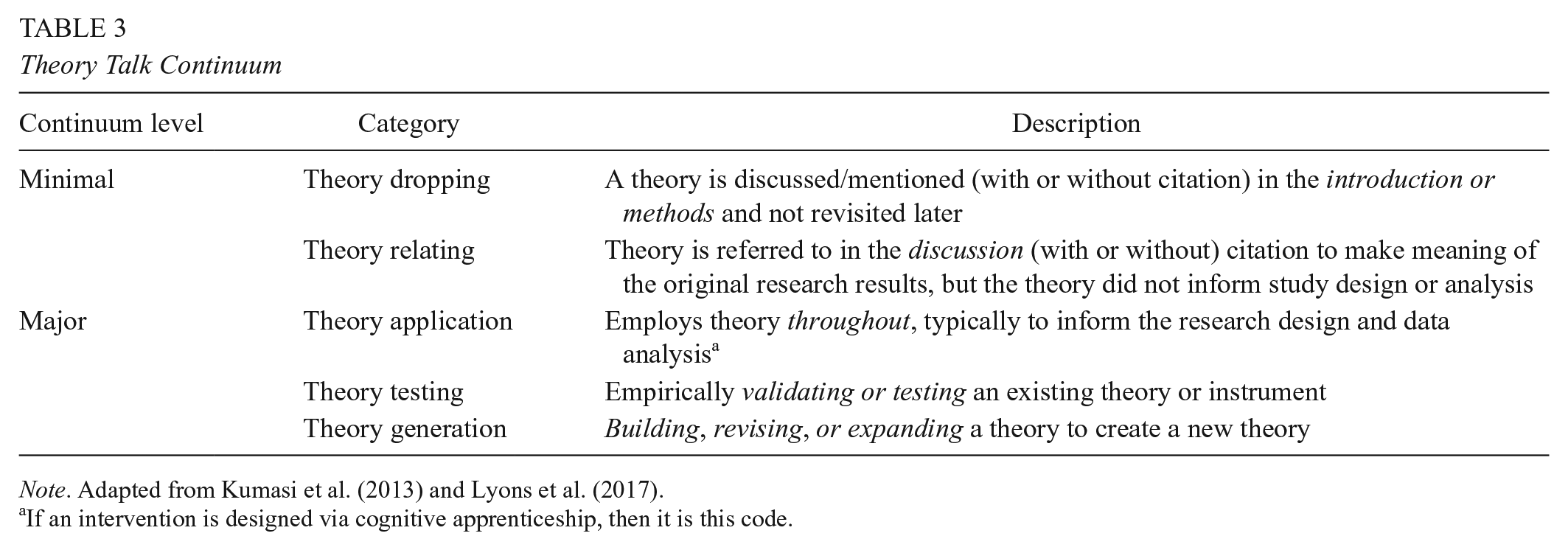
Note. Adapted from Kumasi et al. (2013) and Lyons et al. (2017).
If an intervention is designed via cognitive apprenticeship, then it is this code.
The second round of coding utilized qualitative content analysis (Hsieh & Shannon, 2005) to examine the use of the CA framework, specifically examining how the dimensions and principles were discussed in the empirical research articles. A priori codes were created from Collins et al. (1991), and Collins and Kapur’s (2014) definitions of the CA dimensions and principles and applied to the literature. This process was modelled after work conducted by Ahn (2016), who also adapted the CA framework into a codebook to describe graduate and postdoctoral researchers’ interactions with undergraduate engineering students in a research setting.
Each article was read by two independent reviewers, who coded the text of the article for theory talk and CA dimensions and principles. The two coders met after reading and coding each article to discuss the application of the codes to the literature and resolve all discrepancies. Intercoder agreement was calculated for theory talk and the application of the CA dimensions and principles for each article and an overall average for each code set was calculated. The intercoder agreement for theory talk was 100% and the overall average for the application of the CA dimensions and principles was 84%. The initial coding and resolution served as the first step in responding to the first research question, which CA dimensions and principles were emphasized in peer reviewed empirical studies. The qualitative coding software MAXQDA (Berlin, Germany) was used to capture and apply the CA dimensions and principles to each article.
After coding was complete, the applied codes or identified dimensions and principles were examined in two different ways: document frequency (e.g., the number of studies that the CA principle was found); and code frequency (e.g., overall how frequently the code appeared in the data set). These two pieces of data provided an in-depth depiction of how the authors described and utilized CA dimensions and principles within the specific context of graduate STEM education, which responds to the second research question of how the CA framework was implemented to structure STEM graduate education. For example, the Methods principle coaching/scaffolding appeared in 17 studies (100%) with 223 coded segments (15% of CA principle codes). This approach to analysis also allowed for data organization and helped identify trends and themes that emerged. To help describe the findings in the results section, “N” was used to represent the number of articles and “n” was used to represent the number of codes.
Results
General characteristics of the 17 studies that met the inclusion criteria are listed in Tables 4 and 5; the characteristics included type of theory talk (i.e., Major or Minimal) used in the study, type of graduate program(s) studied, and the year the study was published. A variety of STEM graduate students were represented in the data set: four studies focused on graduate students from a single science discipline (24%), two on technology graduate students (12%), one on engineering graduate students (6%), five studies classified participants generally as STEM graduate students (29%), and five studies had a mix of STEM and non-STEM graduate students as participants (29%). Most studies were published between 2006 and 2018 (N = 16, 94%) with one study published in 1994.
Characteristics of CA Studies
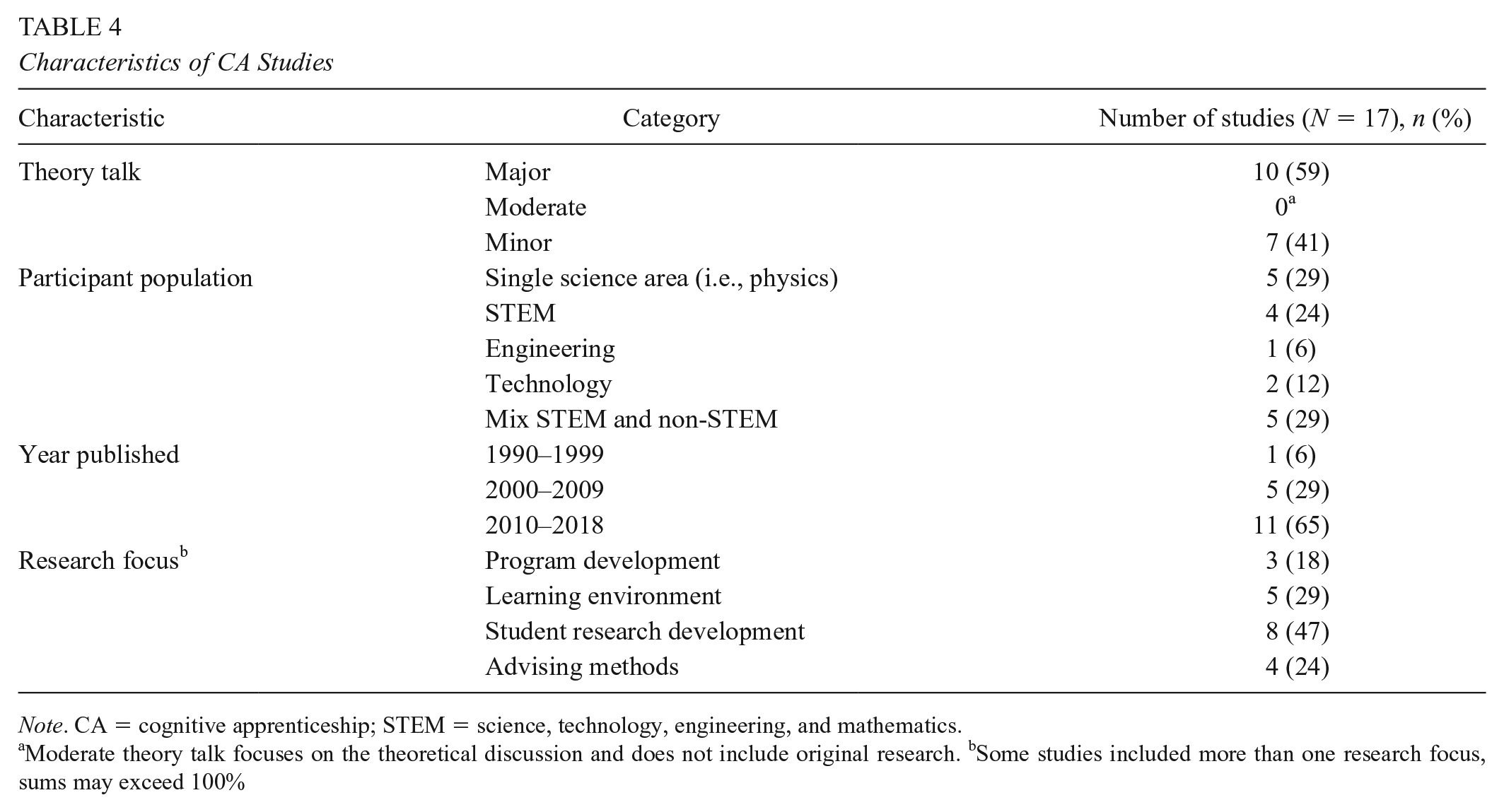
Note. CA = cognitive apprenticeship; STEM = science, technology, engineering, and mathematics.
Moderate theory talk focuses on the theoretical discussion and does not include original research. bSome studies included more than one research focus, sums may exceed 100%
Articles Included in Review

Describes participants generally as STEM, science, technology, or engineering graduate students. bDescribes degree pursued generally as graduate and does not distinguish between doctoral and master’s graduate students
The 10 studies identified as major theory talk introduced the CA framework in the article and used it to structure the learning environment. For example, Greer et al. (2016) used the CA framework to design learning activities to promote graduate student expertise. The learning activities used the methods dimensions as the main structure for their design. Yet in the findings Greer et al. (2016) connected their work to the broader CA framework, noting not only the methods used but also the sociology principles of community of practice and situated learning as being essential for doctoral student education. Whereas the seven research studies identified as minimal theory talk merely introduced the CA framework and did not provide a direct connection. For instance, the mention of the CA framework in Ge et al. (2010) work is their acknowledgement that the learning environment understudy was characterized by real world projects and clients, collaborative teamwork, and the professor used instances of CA through mentoring, coaching, and scaffolding.
The majority of the studies included in this review (N = 13, 77%) discussed all four dimensions of CA; however, the extent to which each dimension and its associated principles were emphasized varied (total number of codes applied to the data set, n = 1,461, 100%). The following frequency results (Table 1) will be presented based on the four CA dimensions document, beginning with the Content and Methods followed by the Sociology and Sequencing dimensions.
The Content dimension is defined by the types of knowledge, skills, and problem solving required for expertise. At least one of the four Content principles were identified in every study. The principles of Domain knowledge and Control strategies were readily identified within the texts. Domain knowledge, specifically, was described as important and referred to in several different ways depending on the STEM field under study (i.e., knowledge, content knowledge, and conceptual knowledge). Control strategies described the development of student problem-solving skills, or their ability to grapple with nuanced or complex ideas. Whereas the other principles, heuristic strategies and learning strategies, were not discussed as readily in the studies.
The Methods dimension (N = 17, 100%), defined as the ways to promote the development of expertise, had varied discussion regarding the six principles. For instance, the principles of Coaching/Scaffolding were acknowledged in all 17 studies and were the second most discussed principles (n = 223, 15.3%) in the texts. All seventeen studies acknowledged the important role faculty played in coaching a STEM graduate student as they developed new skills, in addition to providing discourse on the need to scaffold all students, but especially new students. The other Methods principles were identified less frequently; for instance, modeling, reflection/articulation, and exploration appeared in 11 (65%), 13 (77%), and 15 (88%) of the studies respectively and each code frequency accounted for less than 4% of all codes applied to the data.
The Sociology dimension was described in 16 of the 17 studies and was the most frequently discussed dimension within the literature (n = 544, 37%). Nearly all the research studies identified the need for students to learn skills and knowledge situated in their real-world context (situated learning), have the ability to communicate effectively with different individuals in their field (community of practice), and be able to work effectively with others to accomplish their goals (cooperation/collaboration). The three Sociology principles represent three of the most frequently described individual principles in the data. The community of practice principle was highlighted by 16 studies (94%) and had the highest individual code frequency (n = 227, 15.5%). The principle of Cooperation/Collaboration (N = 16, 94%; n = 174, 11.9%) and situated learning (N = 14, 82%; n = 143, 9.8%) were identified and discussed overall with similar frequency. It is important to note that not all studies mentioned cooperation/collaboration and situated learning by name. That is to say, students were described as working in groups or in collaboration with various partners which reflected Collins et al. (1991) and Collins and Kapur (2014) principle of Cooperation/Collaboration. Likewise, student learning experiences were described as being set in real-world contexts or students were provided with authentic projects to complete, which situated their learning in the context of their fields of study reflecting the definition of situated learning.
Finally, the Sequencing dimension, defined as the purposeful ordering of learning activities, was the least discussed CA dimension. Its three principles, Increasing Complexity, Increasing Diversity, and Global to Local Skills were rarely observed in the literature, each accounting for less than 3% of the codes applied to the data. The Sequencing dimension was often described with vague language such as, students should encounter more complexity and ambiguity as they progress through the curriculum (DeWitt & Cicalese, 2006).
Four themes emerged from the literature with regard to how the studies applied the CA framework to explore STEM graduate education. These themes were, Student Research Development, Learning Environments, Advising Methods, and Program Development. Table 6 provides an overview of the four themes. Student Research Development was the most prevalent area of study that applied the CA framework (N = 8, 47%). These studies examined student growth and acquisition of research knowledge, as well as student skill development. Five studies (29%) explored graduate STEM Learning Environments, both in the classroom and lab, and were designed using CA dimensions and principles. Four studies (24%) investigated Faculty Advising Methods, which referred to how faculty engaged with graduate students in informal capacities in order to support student progression within their STEM fields. Finally, the theme of Program Development was discussed in three studies (18%). In these studies, the authors described the design and implementation of programs that supported STEM graduate students.
Research Foci, Code Frequencies, and Example Quotes for CA Dimensions Within Graduate STEM Education Research

Note. CA = cognitive apprenticeship; STEM = science, technology, engineering, and mathematics.
Some studies included more than one research focus
A majority of the studies were characteristic of one theme; however, there were three studies (18%) that investigated two themes in a single study. For example, Belcher’s (1994) study examined nonnative English-speaking graduate student’ relationships with their academic advisors (Advising Methods) and the graduate students’ research skill development (Student Research Development). What follows is an in-depth discussion of the CA framework as presented and applied in each of the four themes.
Student Research Development
The theme of Student Research Development investigated student acquisition of general and specific research knowledge and skills. Five of the eight studies (63%) were identified as major theory talk and connected the CA framework to Student Research Development throughout their study. Whereas the three minimal theory talk studies only mentioned the CA framework in a single section and do not revisit the framework. Maher et al. (2013), major theory talk, used the CA framework to explain doctoral students’ skill development generally and found there was evidence for the “cognitive” component of the CA framework within their sample; however, the evidence for faculty use of “apprenticeship” components was questionable. They suggested the CA framework “can be particularly potent in the development of student research skills . . . but it does not occur by magic; instead, it requires deliberate action by faculty supervisors and students” (Maher et al., 2013, p. 19).
When examining how the four CA dimensions were discussed within the research focus of Student Research Development, it was found that the Content (n = 126, 26%), Methods (n = 178, 37%), and Sociology (n = 154, 32%) dimensions were discussed more frequently than the Sequencing (n = 20, 4%) dimension. The Content dimension of the CA framework was identified as essential for Student Research Development. All studies (N = 8), regardless of their specific context described the need for STEM graduate students to have exceptional Content knowledge in their research area. For example, Urquhart et al. (2016), major theory talk, found that STEM graduate students who had more exposure to primary literature in their field of study and were instructed on how to read critically demonstrated a higher ability in creating testable hypotheses, conducting data analysis, and making conclusions based on data. The Content dimension of the CA framework was found to be important for Student Research Development because it required the mentor to make their underlying cognitive processes visible, which helped the novice in advancing their understanding and externalizing their own learning processes (Feldon et al., 2015).
Every article (N = 8, 100%) identified numerous instances of the Methods dimension and its importance for Student Research Development. Urquhart et al. (2016) studied STEM graduate students’ ability to meaningfully apply relevant primary literature to one’s research. They found that the Methods utilized were essential for student progress since students “who [were] left to their own devices early in their research training did not fare well” (Urquhart et al., 2016, p. 155). Urquhart et al. (2016) also note that novice researchers “don’t know what they don’t know” (p. 154); therefore, they benefit from experienced researchers guiding and supporting them. Similarly, Feldon et al. (2016) found that students who had coauthoring experiences with their faculty mentors developed significantly higher levels of research skills than students who did not. Working closely with their faculty mentor allowed for coaching and scaffolding as well as other CA Methods to occur that supported Student Research Development.
Similar to the Methods dimension, the Sociology dimension was also identified as an important component of Student Research Development. Several studies (e.g., Maher et al., 2013; Manathunga et al., 2007; Urquhart et al., 2016) discussed the importance of students participating in the scientific community through conferences and learning how to disseminate their work among the larger scientific community. For instance, Manathunga et al. (2007), identified as a minimal theory talk, found student participation in the local and international research community was critical for student research development. In addition, a study conducted by Belcher (1994), minimal theory talk, focused on nonnative English-speaking graduate students’ relationships with their faculty advisors. Essentially, the more effective faculty and students were at cooperating, the more successful the student was at conducting, writing, and disseminating their research (Belcher, 1994). The Sequencing dimension was described substantially less within the Student Research Development theme, accounting for only 4% (n = 20) of the total codes applied to the literature.
Learning Environments
Five studies (29%) used the CA framework to develop and explore Learning Environments suitable for STEM graduate education. Three of the five studies (60%) were identified as major theory talk and used CA dimensions to design and structure the learning environments. For example, Sin (2015) explored student-centered learning and disciplinary enculturation in physics. This study focused on bridging the activities students undertake in the didactic classroom to what is expected of them in the discipline of physics, with the goal of more effectively preparing students for their transition into the workforce (Sin, 2015).
Similar to the Student Research Development theme, the Content dimension was critical for novices to gain expert understanding. DeWitt and Cicalese (2006), identified as minimal theory talk, studied the impact of integrating content knowledge about social, legal, and ethical dimensions of computing and computer security. They found that integrating these three components into a single course supported student understanding of content knowledge as well as their problem-solving skills. Ding (2008), major theory talk, suggested students could not develop their other research skills or participate in the learning community without some introductory disciplinary content knowledge.
The Methods dimension was frequently acknowledged as an essential part of creating Learning Environments in STEM graduate education. For example, Tsai (2008), identified as major theory talk, suggested that learning environments should create spaces where STEM graduate students can obtain proper guidance, receive opportunities to negotiate ideas, and reflect on their own thoughts. Specifically, providing feedback was identified as a key element for learning environments and was particularly important in spaces where students were expected to develop and create a product by the end of the course. In Ge et al.(2010), minimal theory talk, the professor implemented several principles from the Methods dimension in an open-source software development learning environment which was integral for student success. For example, the professor provided formative feedback throughout the semester, challenged teams to think creatively about their projects, and supported teams when they got stuck (Ge et al., 2010). The support mechanisms employed by the professor were reflective of the Methods dimension.
The Sociology dimension was central to studies that developed Learning Environments with 46% (n = 287) of all codes applied highlighting the dimension. All five studies emphasized the principles of the Sociology dimension: Community of Practice, Situated learning, and Cooperation/Collaboration, within the learning environment under study. Tsai (2008) and DeWitt and Cicalese (2006) found that student learning and understanding of content material was enhanced in learning environments that prioritized the Sociology dimension and they suggest educators should provide students with opportunities to solve real-life problems.
The designed learning environments were structured to highlight the importance of the social interaction among its members. For instance, DeWitt and Cicalese (2006) described the importance of bringing in guest speakers to expose students to a community of practitioners in the field of computer science and security. In the same vein, a study conducted by Ding (2008) introduced students to National Institutes of Health (NIH) officials, reviewers, and grant seekers as a way to expose students to the larger NIH community. Students also worked collaboratively with one another, which Sin (2015) refers to as collaborative learning numerous times in their exploration of the CA framework in graduate physics courses. Ge et al. (2010) also referred to students’ collaborative efforts on their software engineering projects. Similarly, DeWitt and Cicalese (2006) discussed students “working together in teams” (p. 35) and “working in small groups” (p. 38).
Researchers also focused on the application of skills obtained in the learning environment to real world practice. Notably, Ge et al. (2010) expressed that the culture of schools is disconnected from the culture of practitioner communities and that in order for current students to be successful, schools need to incorporate more workplace practices. Ge et al. (2010) designed their in-class open-source software development learning environment to simulate the professional activities and problem-solving processes students would experience in the real world. They found that the learning environment supported student identity development within the larger software engineering community (Ge et al., 2010). This was also the case for Ding (2008), who structured a grant writing course to follow NIH guidelines, thus introducing students to real-world practices in the NIH grant writing application process. Finally, discussion regarding Sequencing (n = 49, 8%) was very limited in the research focused on Learning Environments.
Advising Methods
Four studies (24%) focused on Advising Methods in STEM graduate programs. A single study (Bégin & Gérad, 2013) was identified as major theory talk, while all others were minimal. Bégin and Gérad (2013) used the CA framework to explore and describe the doctoral student experience with their faculty advisors. Their study focused exclusively on graduate students’ perception of their doctoral experience and used this data along with the CA framework to outline the types of support supervisors should provide their students (Bégin & Gérad, 2013).
All four studies included the Content (n = 45, 25%) dimension as a key component of the doctoral advising process. For instance, Gross et al. (2018), minimal theory talk, discussed the Content dimension and its principles throughout their study that focused on graduate students who had 5 or more years of engineering work experience prior to starting their graduate program. Gross et al. (2018) found that students already possessed knowledge of general techniques for accomplishing tasks within the field of engineering due to their experience in the workforce. Students with work experience had an easier time mastering the theoretical principles and techniques in their course work because they were able to relate theory to actual practice (Gross et al., 2018).
Just like the previous two themes, the Methods (n = 60, 33%) dimension was one of the most frequently discussed CA dimensions. Bégin and Gérard (2013) focused heavily on the Methods dimension noting doctoral supervision is one of the primary factors affecting doctoral degree completion and attrition rates. They surveyed hundreds of doctoral students from a variety of programs, and found doctoral students were in need of their faculty advisors to describe and demonstrate the procedures, actions, and thought processes to become an expert in their field of study (Bégin & Gérard, 2013). Roumell and Bolliger (2017), minimal theory talk, studied the supervision practices of faculty advisors of blended and distance-delivered doctorate programs. Faculty advisors were concerned their mentees were not receiving enough mentoring due to the structure of the programs, in addition to limiting the type of mentoring faculty could provide (Roumell & Bolliger, 2017). Ultimately, faculty expressed that distance students missed out on other forms of mentoring because of limited communication and other conflicts such as work schedules (Roumell & Bolliger, 2017).
Similar to the Learning Environments theme, the Sociology dimension was the most referenced dimension (n = 65, 36%) in the Advising Methods theme. All four studies highlighted the importance of Community of Practice and Situated Learning principles. Faculty advisors in Roumell and Bolliger’s (2017) study found it difficult to build effective relationships with their distance students. Advisors felt the lack of relationship could be associated with how, and the extent their students would become engaged in the professional community (Roumell & Bolliger, 2017). Gross et al. (2018) examined if having years of experience in industry influenced master’s engineering students’ outcomes. The students who had 5 or more years in industry before returning to university for a master’s degree relied heavily on their work experience which contributed positively to their learning and ability to work in groups (Gross et al., 2018). Work experience was also believed to have contributed positively to participants’ abilities to think critically about coursework (Gross et al., 2018). The connection to real-world work experience was important not only for developing student sense of belonging in the Community of Practice but also for situating students in practical learning experiences (Gross et al., 2018). Finally, the Sequencing (n = 11, 6%) dimension was rarely discussed in the four Advising Methods studies.
Program Development
Program Development reflects the design and implementation of programs created to support graduate students in some capacity. Three studies reflected this theme, with two of the three, Hwang et al. (2009) and Yerushalmi et al. (2017) also included in Student Research Development. In addition, all three studies were identified as major theory talk, using the CA framework to design the programs.
The Content dimension (n = 26, 20%) was mentioned by all three studies, but with less frequency than the Methods and Sociology dimensions. For instance, the principle of Control strategies, which are the general approaches to problem solving, was a main discussion point for the three studies. For instance, Yerushalmi et al. (2017) created a program to help facilitate better grading from physics graduate teaching assistants. The goal of the program was to help teaching assistants identify good problem-solving practices used by first year physics students for their assignments (Yerushalimi et al., 2017).
The Methods dimension (n = 61, 47%) was the most frequently discussed dimension in the three studies as the programs were developed to utilize this dimension during implementation. For instance, Hwang et al. (2009) designed a stand-alone system based on the principle of Coaching/Scaffolding in order to simulate the type of support an expert would provide a student. Whereas Yerushalmi et al. (2017) and Greer et al. (2016) used face-to-face small group discussions with an expert to coach and scaffold novice students in developing aspects of their teaching practice. In addition, all three studies used the principles of Reflection/Articulation as a way for experts to gain insight into graduate student understanding. For example, Greer et al. (2016) supported participants’ Reflection/Articulation by incorporating purposeful reflection into their program, allowing for participants to evaluate their teaching practices.
Similar to the other themes, the Sociology dimension (n = 40, 31%) was frequently referenced in Program Development. The three studies identified “real-world” or “authentic” tasks as essential features of programs developed to support STEM graduate students. This was particularly important in Hwang et al. (2009) work developing a context-aware ubiquitous learning environment to help students practice an advanced and technical research skill in a simulated, low-risk environment. In addition, the studies identified Collaboration and community formation as essential because these principles support student self-efficacy (Greer et al., 2016). Greer et al. (2016) used the Sociology dimension to establish a Community of Practice and encouraged Cooperation among participants; with the intent of supporting student self-reflection and building participant confidence. Finally, the Sequencing dimension (n = 2, 2%) was rarely mentioned in the Program Development research area.
Discussion
The research articles reviewed in this study represented a range of STEM fields that utilized the CA framework to support faculty in explicating their expertise to students. The reviewed research emphasized the CA dimensions of Content, Methods, and Sociology, with rare discussion of the Sequencing dimension. In addition, the research articles were categorized into four themes, which demonstrated how the CA framework was utilized to create opportunities for students to develop expertise in their given field (Student Research Development, Learning Environments, Advising Methods, and Program Development). Although STEM graduate programs have been characterized as apprenticeships that consist of an array of milestones, STEM graduate student experiences can vary widely and is heavily dependent on supervising faculty. With faculty assuming a pivotal role in student development, a guiding framework for how to structure student experiences could benefit both faculty and students.
Our results reveal a heavy focus on the Sociology dimension, specifically the principle of Community of Practice. Collins and Kapur (2014) define Community of Practice as the creation of a learning environment where participants actively communicate about and engage in the skills involved in expertise. Austin (2009) suggests that learning is enhanced when students are supported such as when they are a part of a community of practice. This supports the creation of spaces where STEM graduate students can work with and be supported by peers, in addition to more knowledgeable others (i.e., advanced graduate students, postdocs, and faculty). The creation of a Community of Practice leads to an individual’s sense of ownership and personal investment (Collins & Kapur, 2014), two important characteristics that are associated with motivation, a trait identified as essential for future STEM graduates (McLaughlin et al., 2019). One study stressed the importance of Community of Practice by stating, “the community within which the learner exists may have as much-if not more-of an effect on the learner as the faculty member does” (Belcher, 1994, p. 24). Furthermore, the community plays an important role in degree completion, with graduate students who achieve community integration more likely to complete their degree than those who do not integrate fully into the community (Bair & Haworth, 2004; Devos et al., 2017; Golde, 2000). In addition, Collins and Kapur (2014) stress a Community of Practice cannot be forced, it has to be fostered; acknowledging the crucial role that faculty play in the development of social communities within departments.
The Sociology principles of Situated learning and Cooperation/Collaboration were also heavily emphasized. STEM graduate students need legitimate peripheral participation (Lave & Wenger, 1991) in all aspects of their field, not just in the acquisition of knowledge and skills. Bragg (1976) suggests that faculty transmit their attitudes, values, and behavioral norms for their field both formally and informally. Formal socialization occurs through the structures established in the academic setting (i.e., research, coursework, etc.), and informally through individual advising and supervising (Bragg, 1976). Thus, suggesting that all four themes, student research development, learning environments, advising methods, and program development are associated with the socialization of learners into the local and broader field of study.
The emphasis on the Sociology dimension is promising for creating learning opportunities that support STEM graduate students’ expertise; however, Brown et al. (1989) suggest all four CA dimensions should be intentionally leveraged to optimize learning. In this review, the Sequencing dimension was rarely mentioned despite its critical role in making expert thinking visible to novices. Sequencing is defined as the keys to ordering learning activities, and having an outline helps students make sense of their current role and supports their ability to monitor their progress (Collins & Kapur, 2014). The Sequencing principle of Global before Local Skills is designed to ensure students have a clear conceptual model of a learning activity as this helps students make sense of their individual part of a larger project. Furthermore, students cannot take on complex and difficult tasks immediately, they need to be transitioned gradually (i.e., Increasing Complexity) and be given opportunities to practice in supportive environments (i.e., Increasing Diversity; Collins & Kapur, 2014). The Sequencing domain is underrepresented in the research, and STEM graduate programs and students would benefit from additional research focusing on the relationship between sequencing, skill development, and degree completion.
This review suggests the CA framework is a useful and effective model for supporting faculty in cultivating rich learning opportunities for STEM graduate students. The CA framework emphasizes four core dimensions that support faculty in explicating their expertise: a focus on several types of knowledge, use of a variety of methods to promote learning, specific sequencing of learning, and an emphasis on the social context of learning (Eberle, 2018). In other words, the CA framework provides multiple tenants that may help faculty thoughtfully structure effective and purposeful learning experiences for graduate students aimed at increasing their academic experiences.
Furthermore, Collins and Kapur (2014) suggested the CA framework supports the generalization of knowledge so that it can be used in many different settings, allowing students to apply their skills in varied contexts. This means faculty can implement key parts of the CA framework like sequencing and focusing on several types of knowledge, for example, to build deliberate learning experiences for STEM graduate students. Thus, the breadth of learning opportunities discussed in the research demonstrates the versatility of the CA framework, specifically, how faculty can implement this framework when designing STEM graduate courses (DeWitt & Cicalese, 2006; Ding, 2008; Ge et al., 2010; Sin, 2015; Tsai, 2008) to create learning opportunities that target specific research skills in addition to nonresearch skills such as teaching (Belcher 1994; Feldon et al., 2015; Feldon et al., 2016; Greer et al., 2016; Hwang et al., 2009; Maher et al., 2013; Manathunga et al., 2007; Urquhart et al., 2016; Yerushalmi et al., 2017), while highlighting the importance of advising and mentorship during graduate school which encompasses the entire doctoral student experience (Bégin & Gérard, 2013, Belcher, 1994, Gross et al., 2018, Roumell & Bolliger, 2017).
We note that Feldon et al. (2019), has suggested that STEM graduate students learn more from interactions with senior graduate students and postdocs in the laboratory compared with their faculty advisor, however, the CA framework does not advocate for a single-mentor model and instead includes communities of practice, where STEM graduate students have the opportunity to interact with their faculty advisor, senior lab members, and other researchers in the academic community. Through this community of practice, the faculty advisor may not need to train each student individually, but instead can train one or two senior members of the laboratory on a skill that those members can then teach to others. Therefore, although a faculty advisor may not implement a single-mentor model, their teachings are still proliferated through the community of practice ensuring all research projects are completed at a high standard.
While this review clearly demonstrates the utility of CA for STEM graduate training, there were also specific principles within the commonly used dimensions of the CA framework that were underutilized. For instance, from the Methods dimension, the principles of Reflection/Articulation and Exploration were rarely observed, consisting of only 3.5% and 2.9% of all codes applied to the data set. This can be contrasted with the principles of Coaching/Scaffolding, which made up 15.3% of all applied codes. This suggests that STEM graduate education relies heavily on a few methods for demonstrating knowledge and skills to students. For Collins and Kapur (2014) the teaching methods associated with the CA framework fall into three groups, each serving their own purpose in supporting the development of expertise. The principles of Coaching, Scaffolding, and Modeling help students to acquire the necessary skills through the process of observation and guidance. Whereas the underutilized principles of Reflection and Articulation are structured to support students in developing their observational skills and refining their problem-solving strategies. The third methods group consists of the principle of Exploration which is designed to encourage learner autonomy. In the current structure of U.S. graduate programs, the principles of Coaching, Scaffolding, and Modeling support students during supervised research training; however, for students to successfully complete an individual research project, more emphasis should be placed on the principles of Reflection, Articulation, and Exploration. It is imperative for students to develop and refine their observational and problem-solving strategies to contribute innovative solutions to problems that plague our world (NASEM, 2018), more research is needed to understand why these principles are underutilized and how we might better leverage them to enable student success. For instance, Reflection, Articulation, and Exploration could be examined in conjunction with self-regulated learning.
As Maher et al. (2013) noted, the CA framework does not occur without deliberate action on the part of the participants. Given the numerous calls for change within STEM graduate education (e.g., Austin, 2010), further research should explore the utility of CA for addressing needs for reform at the individual, school, and faculty level. For instance, regarding the broader STEM graduate education community, a report by the NASEM (2018) acknowledged that the current research assistantship model benefits the needs of grant funded projects rather than the educational needs of students. The NASEM (2018) report recommends an increased emphasis on education/training grants which would allow for curricular innovation, thus prompting the purposeful implementation of different educational frameworks such as CA.
At the university level, departments and faculty should consider all four CA dimensions and their associated principles throughout the STEM graduate experience. One way to support the CA implementation would be to conduct an evaluation of current structures and practices implemented in individual departments to examine the entire doctoral process (academic courses, research, advising, etc.). An evaluation would document current departmental practices, highlight how those practices map to the CA framework, and support the inclusion of additional CA principles. Finally, reflection on current practices would ensure faculty are aware of the methods they employ to support students through their graduate experience while simultaneously encouraging personal growth.
If the CA framework is to be an effective model for STEM graduate education, we must better understand how the dimensions and their principles should be leveraged to support student development across the broad range of learning opportunities graduate students encounter. A study conducted by Austin (2002) collected graduate student suggestions for how to improve graduate school preparation. Responses included more attention to regular mentoring, advising, and feedback; structured opportunities to observe, meet, and talk with peers; diverse, developmentally oriented teaching opportunities; information and guidance about faculty responsibilities; and regular and guided reflection (Austin, 2002). These student suggestions mimic and reflect the four CA dimensions and their supporting principles.
In light of a growing body of literature emphasizing the importance of more than just knowledge acquisition in graduate education (McLaughlin et al., 2019; Olsen et al., 2020), the CA framework can provide graduate faculty with guidance on how to design learning opportunities that foster skill development in STEM students. Furthermore, implementing the CA framework can extend into diverse educational settings, such as laboratories and other research settings, that are critical to the development of skills necessary for graduate education (Collins, 2006); thus, supporting more than just knowledge acquisition.
This review provides insight into the application of the CA framework in STEM graduate education, however, there were several limitations. First, this review did not assess the rigor of the studies since our aim was to assess to what extent the CA framework has been utilized in graduate STEM education, in addition to how and which CA dimensions are described in the research. Second, the databases and journals included in our search was comprehensive, however, there is still potential that our review missed relevant articles. Furthermore, there are potential discipline-based differences that need to be accounted for when discussing the application of the CA framework to STEM graduate education. In the current review, these potential discipline differences were not accounted for as majority of the articles described participants generally as “science” or “STEM” graduate students. Finally, the review was focused on CA as defined by Collins et al. (1991) and articles were only included if they contained the term “cognitive apprenticeship” in the text. This approach may have excluded articles that used elements of the CA framework without explicitly naming the framework, such as communities of practice (Wenger, 1998) or situated learning (Lave & Wenger, 1991).
Conclusion
This review suggests the CA framework is useful model for STEM graduate education because of its emphasis on creating optimal learning opportunities for students. STEM research is not just the acquisition of specialized skills that can be utilized to conduct controlled experiments but also necessitates deep thinking for problem solving and scientific discovery. Faculty are key to ensuring student success in STEM graduate education, and the CA framework is a practical guide with explicate strategies to support both faculty and students as they transition to experts.
Footnotes
Authors’ Note

Authors
LANA M. MINSHEW is currently an assistant professor at the Medical College of Wisconsin. Her research interests include learning sciences, science education, and qualitative methods.
AMANDA A. OLSEN is an assistant professor at the University of Texas–Arlington. Her research interests include learning sciences, teacher education, and quantitative methods.
JACQUELINE E. MCLAUGHLIN is an associate professor at the University of North Carolina at Chapel Hill. Her research interests include health professions education, design thinking, and mixed methods.