



Abstract
This comparative organizational ethnography examines how two physical science PhD programs, operating under state affirmative action bans, navigate legal compliance while sustaining their commitments to diversity. Drawing on inhabited institutionalism and legal endogeneity, we show how, despite similar policy and disciplinary environments, each program interpreted the law differently and constructed distinctive admissions routines. One program broadened its definition of merit to emphasize community contribution, while the other leveraged evaluative technologies to standardize evaluations, incorporating race-neutral indicators associated with broadening participation. Findings reveal how committees navigated legal ambiguity, activated local culture to enable compliant adaptation, and expanded conceptions of merit. We offer a framework of race-neutral compliance logics to advance theory on how organizations enact law while pursuing equity.
Introduction
As affirmative action bans and pressures from recent legal and policy changes reshape admissions processes, institutions are being compelled to navigate legal constraints in ways that may test or reshape their commitments to diversity. Before the US Supreme Court’s 2023 ruling in Students for Fair Admissions vs President and Fellows of Harvard College (2023) and Students for Fair Admissions vs University of North Carolina (2023), ballot initiatives and government actions had already prohibited “racial preferences” in admissions in nine states (Baker, 2019; Kaufmann, 2007). These bans have led to well-documented declines in racial diversity in selective undergraduate, graduate, and professional admissions (Garces, 2013a, 2013b; Howell, 2010), shaped not only by legal restrictions but also by how professionals interpret and enact the law (Garces et al., 2021; Liu, 2022). There is evidence that undergraduate admissions officers avoid discussions of race entirely to reduce legal exposure (Garces & Bilyalov, 2019), while acknowledging uncertainty about how to factor race into holistic assessments of applicants (Poon et al., 2023). However, a comparative historical analysis of flagship universities under state affirmative action bans reveals a story of “resistant compliance” (Foley, 2023), in which universities comply with state laws while exercising discretion within areas of legal ambiguity.
We know less about how graduate programs navigate these tensions (Posselt, 2020). Yet, graduate education plays a crucial role in shaping the leadership pipeline, with 33% of college graduates pursuing post-baccalaureate degrees (Posselt & Grodsky, 2017), which are prerequisites for many of society’s most influential positions. Fair access to graduate and professional education is integral to equal opportunity in education and the labor market.
With the SFFA decision effectively creating a national mandate for race-neutrality, studying higher education institutions affected by state-level bans is crucial to understanding variation in legal interpretation, organizational behavior, and outcomes. Such research also reveals how organizations exercise agency and adapt through innovation within legal boundaries. Public policy aimed at race-neutrality may be regarded as a constraint while also serving as a “design parameter” (Coleman & Smith, 2023), which actors can calibrate to the mission or needs of a program or discipline. This potential is important not to lose sight of, especially given the rapidly changing legal and policy environment that governs K-12 and higher education (Ngaosi & Garces, 2024). Examining contexts and processes for allocating scarce educational opportunities can sensitize us to the potential for change in the institutional values that undergird elite selection. This national shift also shaped institutional behavior during our period of observation.
This study is situated within a rapidly evolving policy environment in which institutions are navigating not only long-standing state affirmative action bans but also a growing wave of anti-DEI legislation and heightened scrutiny of equity-related practices in higher education. This period also coincided with increased federal scrutiny of diversity, equity, and inclusion initiatives through administrative guidance, investigations, and funding-related pressures, further shaping institutional perceptions of legal risk beyond state law alone (Coleman & Smith, 2023; Ngaosi & Garces, 2024). During the data collection period (2022–2023), institutions also operated amid legal uncertainty as the Supreme Court’s decision in Students for Fair Admissions vs Harvard loomed, prompting anticipatory compliance in admissions practices. As a result, the admissions processes examined here reflect not only existing legal constraints but forward-looking adjustments to an increasingly restrictive legal environment.
In this study, we examined how educational organizations navigate race-neutral admissions processes shaped by state law and policy constraints on the consideration of race. It is, effectively, an inquiry into how professionals mitigate the negative impacts of racially regressive laws, but it is also a story of redefining what constitutes merit in elite selection. As part of a larger NSF-funded project aimed at broadening participation in STEM graduate education, this paper presents comparative organizational ethnography, grounded in embedded observation and interviews of admissions committees in two PhD programs in the physical sciences located in states with laws prohibiting affirmative action. Our goal was to understand how admissions decision-makers interpret the law and enact compliance in relation to program goals under state policy constraints. The other is a more recently formed program striving to strengthen its reputation. They are theoretically useful comparisons for their differing organizational cultures, with student success and inclusion initiatives emphasized in Western’s culture but more peripheral in Eastern, despite having similar intellectual and policy contexts. The similarities and differences make them worthwhile sites to investigate how the law is interpreted and enacted.
Background and Literature
State-level restrictions on affirmative action and race-conscious admissions started with California Proposition 209 in 1996 (Kaufmann, 2007). This ballot initiative sought to eliminate state and local government affirmative action programs in public employment, education, and contracting, specifically the provision of “preferential treatment” 1 to individuals based on race, sex, color, ethnicity, or national origin (California Constitution, 1996). Eight additional states followed, with policies using very similar language (Oh et al., 2024).
These restrictions altered the admissions process and outcomes for public institutions, leading to dramatic yearly declines in enrollment of undergraduate, graduate, and professional Black, Latinx, and Native students (Garces, 2013a, 2013b; Howell, 2010). Hinrichs (2012) found reduced access for minoritized students and increased enrollment among white students in selective, flagship public universities. Others find that undergraduate admissions now favor white and high socioeconomic status (SES) applicants because they tend to hyperfocus on extracurricular activities (Jayakumar & Page, 2021, p. 1110). In 2013, the Supreme Court affirmed the claim that “no workable race-neutral alternatives would produce the educational benefits of diversity” (Fisher vs University of Texas at Austin, 2013, p. 11). Under the prevailing doctrine before Students for Fair Admissions, institutions were not required to demonstrate the absence of any race-neutral alternatives; rather, they were required to show that no workable race-neutral alternatives could achieve their diversity goals. What counted as “workable,” however, was never clearly specified, leaving institutions significant discretion and uncertainty in how the standard was interpreted and applied. Scholars have examined this question through models that substitute indicators of race with socioeconomic status (SES) and race-targeted recruiting, highlighting ongoing debates about the effectiveness of race-neutral approaches (Carnevale et al., 2014; Reardon et al., 2018). Nevertheless, universities have been motivated to develop race-neutral alternatives that are legally permissible and promote diversity (Bleemer, 2023; Schmidt, 2006). Strategies have included targeted recruitment, pipeline programs, top student percent plans, and holistic admissions (Hill et al., 2023). Although many of these race-neutral alternatives emerged in undergraduate admissions contexts, they form a critical policy backdrop for graduate programs by shaping how institutions understand legal constraints, interpret “workability,” and adapt admissions practices under race-neutral mandates, despite distinct organizational and disciplinary dynamics.
Holistic Admissions: Criteria and Processes of Evaluation
Against this backdrop, we focus on PhD admissions as a gatekeeping process that conditions access to the professoriate and careers involving knowledge production. Doctoral admissions are largely decentralized to individual degree programs, which have autonomy for application review and selection (Kent & McCarthy, 2016). Programs vary in the review criteria they use (Orfield, 2014). However, quantitative research over 25 years confirms that GRE scores, undergraduate grade point average, and undergraduate institution selectivity are consistently strong predictors of admission (Attiyeh & Attiyeh, 1997; Jones et al., 2020; Young & Caballero, 2019).
A key concern in reproducing social stratification is reliance on criteria that map onto demographic categories but are weakly associated with key academic outcomes. For example, the GRE’s relevance has long been questioned, given evidence that it does not consistently predict graduate school completion (Cureton et al., 1949; Miller et al., 2019, 2020). The most recent meta-analysis of this research finds that its predictive validity is declining as the population becomes more diverse (Feldon et al., 2023). Reliance on the GRE also privileges groups already overrepresented in doctoral education (Miller & Stassun, 2014). Therefore, as in undergraduate admissions, many graduate programs have removed test requirements (Langin, 2022). This change eliminates a barrier for underrepresented groups (Posselt et al., 2019; Gómez et al., 2021; Miller et al., 2019), but evidence is still emerging about the process and outcomes of graduate admissions without test scores (e.g., Author; Sullivan et al., 2022; Young et al., 2022).
In admissions, a more holistic approach treats merit as multidimensional, aiming to reduce biases and consider the contexts of an applicant’s barriers, opportunities, and privileges (Association of American Medical Colleges, 2010, 2014; Kent & McCarthy, 2016). Accounting for context in undergraduate admissions evaluations can increase enrollment among low-income students and students of color (Bastedo et al., 2022; Gaertner & Hart, 2013). Justice Roberts closed his majority opinion in the SFFA vs Harvard decision with an implicit endorsement of contextualization: Nothing in this opinion should be construed as prohibiting universities from considering an applicant’s discussion [in an admissions essay] of how race affected his or her life. A benefit to a student who overcame racial discrimination. . . must be tied to that student’s courage and determination or that student’s unique ability to contribute to the university. . . the student must be treated based on his or her experiences as an individual, not on the basis of race. (Students for Fair Admissions vs President and Fellows of Harvard College, 2023, pp. 39–40)
Contextualization can therefore also enable an accounting of experiences with racism without violating prohibitions on “preferential treatment” (Barceló et al., 2021; Young et al., 2022).
Research on holistic graduate and professional admissions often considers the role, if any, of race in review criteria. Wilson et al. (2018) found that considering race within a comprehensive set of criteria in biomedical sciences PhD programs increased student racial and ethnic diversity while maintaining academic outcomes consistent with pre-holistic review admissions cycles. Young et al. (2022) similarly found that holistic review practices in a highly selective physics PhD program increased racial diversity by broadening the evaluation focus from purely quantitative metrics to a more comprehensive, rubric-based approach that included socio-emotional qualities such as leadership and perseverance. Notably, this research was conducted at Michigan State University, where state law prohibited consideration of racial status. Barceló et al. (2021) found that, compared with traditional review, holistic rubrics increased the odds of selecting underrepresented students for interviews for medical school residency interviews, even when racial identity was masked from reviewers. They, too, included a broad set of qualities, including resilience and distance traveled. These studies emphasize what goes into a holistic review at post-baccalaureate levels, leaving unanswered the question of how admissions is carried out, which may be consequential for understanding variation in impacts (Posselt et al., 2025).
Theoretical Perspectives
Holistic review is not a specific policy but rather an interpretive framework that leaves decision-makers with some discretion in making admissions decisions (Coleman & Keith, 2018). In graduate education, this is especially important, as more PhD programs use a hybrid selection process for admissions into a course of learning and hiring for research and teaching assistantship positions covered by collective bargaining agreements (Posselt, 2016). In this section, we connect organizational theories about policy implementation, inhabited institutionalism, and legal endogeneity to explain how admissions committees in the same field and under similar policy constraints may take different approaches to balancing institutional aims and compliance requirements.
Organizational Policy Implementation
Theory and research on organizational policy implementation have shown that discretion, ambiguity, and local interpretation are not merely typical but inherent to how policies like bans on affirmative action in professional settings operate (Honig, 2006; Weatherley & Lipsky, 1977). In loosely coupled organizations, such as universities, decentralization is often the norm, allowing frontline actors to exercise professional autonomy that mediates the translation of formal mandates into practice (Matland, 1995; Spillane et al., 2002; Weick, 1976). As Winter (2003) explains, the success or failure of policy implementation often hinges on how frontline actors balance policy intent with practical realities on the ground. Similarly, Hill (2001) emphasizes that implementation is shaped not only by street-level discretion but also by the broader institutional environments in which actors operate. These traditions align with the street-level bureaucracy theory, but emphasize how cognition, organizational culture, and professional networks shape policy sensemaking in distributed ways, producing both intended and unintended consequences in policy enactment (Ball, 1993; Lipsky, 2010).
Building on this micro-level view, legal scholars argue that laws and policies are not self-executing but are implemented through socially constructed interpretations. That is, laws are texts, and their impact depends on how organizational actors read, internalize, and enact them (Edelman, 1992). This may be especially true where policies are ambiguous or controversial (Matland, 1995) and where policy actors construct meaning through interaction with their peers (Spillane et al., 2002). The ad hoc policy context of graduate admissions is one such setting (Klitgaard, 1985), and the interpretation required to review and discuss files effectively becomes a form of policy enactment (Lipsky, 2010; Tummers & Bekkers, 2014). These dynamics point us toward inhabited institutionalism, which highlights how institutional norms take shape through everyday interactions.
Inhabited Institutionalism
Inhabited institutionalism describes how institutionalized norms, narratives, and myths are put into practice. It has been defined in terms of “the agency of local actors to construct multiple and competing meanings through daily interactions in ways that enact the institutional environment” (Everitt & Levinson, 2014, p. 2). This definition highlights four elements: agency, meaning, interaction, and enactment, through which people “inhabit” (i.e., create life within or give life to) institutions. Reyes (2015, p. 314) operationalizes inhabited institutionalism to explain how Latino college students on two campuses within the same state system exhibited “unique styles of political expression as they inhabited Latino ethnic politics within the organizational culture of their schools.” Inhabited institutionalism describes culture as lived and enacted within specific institutional contexts. By linking organizational cultures to behavior and interpersonal interactions, inhabited institutionalism clarifies how the same policy came to life in similar or different ways. It helps us capture the localized, context-specific ways in which committee members retained agency to shape admissions practices and, perhaps, redefine merit through daily interactions within existing institutional structures and cultural, political, and legal environments.
This theory also helps us see how admissions work is both a form of policy implementation and participation in the ongoing construction (and reconstruction) of merit itself. Research and theory in this area, exploring a variety of academic contexts, converge upon the view that merit is not fixed or objective, but rather socially constructed through sensemaking and deliberative processes, locally (Posselt, 2016; Lamont, 2009; Stevens, 2009) and larger policy and social forces, nationally (Garces, 2014). These processes may reinforce or reshape institutional priorities, disciplinary norms, and other external influences (Lamont, 2009). That is, professionals do not just execute selection with a fixed notion of excellence; in doing the work of admissions, they are influenced by and influence the broader negotiation of what excellence means (Posselt, 2016; Poon et al., 2023). They inhabit merit, animate merit, and in so doing, they participate in the work of (re)creating merit as institutionalized.
How individual criteria are interpreted and integrated into admissions review helps illustrate inhabited institutionalism. Hsu and Sharkey (2025) find that test-optional policies alone may have a limited impact in changing the diversity of admitted classes unless paired with changes in how admissions is defined and rewarded. Select criteria such as “community contribution” or “distance traveled,” which some are invoking to align merit with diversity in mission-driven ways (Garces, 2014), are particularly illustrative of this process and may be integrated into rubrics (Rosinger et al., 2025; Barceló et al., 2021). In this way, inhabited institutionalism helps explain how merit is co-produced through situated judgment, organizational habitus, and meaning-making within admissions settings. Building on this cultural lens, legal endogeneity highlights how ambiguous laws are interpreted and translated into organizational routines.
Legal Endogeneity
Legal endogeneity complements inhabited institutionalism by examining how organizations make sense of and enact the law. Rather than treating legal rules as fixed mandates, legal endogeneity highlights how organizations interpret, internalize, and translate what are often ambiguous laws into compliance routines (Edelman & Suchman, 1997). Actors adopt legal norms to comply with regulations, maintain legitimacy, and avoid legal challenges (Aldashev & Zanarone, 2017). Research across various domains indicates that compliance is influenced not only by enforcement but also by legitimacy and organizational belonging (e.g., Viteri & Chávez, 2007). Empirical work that contributed to this theory examined how civil rights law is interpreted and implemented within organizations, with the aim of either disrupting or perpetuating patterns of discrimination (Edelman, 1990, 1992). Examining organizations, Edelman (1992) found that there is not necessarily a one-to-one connection between what the law states, what people perceive it to state, and ultimately what they do.
Compliance is a key theme in this work, and the empirical research underlying the theory suggests that, in some cases, compliance is largely symbolic in nature. While symbolic compliance has most often been examined in the context of civil rights legislation designed to expand rights and opportunities, we extend this framework to policy contexts that restrict the consideration of race in organizational decision-making. Organizations may adopt compliance structures, such as procedures, training, or documentation, not so much to change behavior as to signal alignment with legal expectations. On the institutionalization of race-conscious admissions, Edelman et al. (1991, pp. 74–75) assert, “Organizations react to their environments by creating symbols and ceremonies designed more to achieve legitimacy than to achieve technical goals.” For example, institutions may develop statements, committees, or rubrics that fulfill formal compliance expectations while also reflecting their broader values. Leaders’ approaches to these practices often vary based on their legal knowledge and interpretations of compliance.
Another theme concerns the ambiguity of laws and the institutional policy responses that mirror them, which allows local actors flexibility and discretion in their enactment (Suchman & Edelman, 1996). Critical policy scholars argue that ambiguity in policy design is not merely a flaw but a feature, often enabling organizations to maintain entrenched preferences while appearing to comply (Ball, 1993; Levinson et al., 2009). Because laws are often written in broad and ambiguous terms, institutional policy responses tend to mirror that ambiguity, giving organizations considerable leeway in how they implement compliance. This dynamic can work in both directions: some institutions adopt responses that symbolically signal equity while preserving traditional gatekeeping mechanisms (e.g., creating diversity offices without changing admissions criteria), while others, led by equity-driven actors, signal compliance on the surface while sustaining or innovating practices that promote diversity under race-neutral terms. In our context, legal endogeneity enabled us to examine how admissions may outwardly comply with ambiguously written, race-neutral mandates, while internal dynamics, such as committee cultures and leadership decisions, may result in forms of what Foley (2023) terms “resistant compliance.”
By connecting legal endogeneity and inhabited institutionalism, we noted that state affirmative action bans are written so broadly (i.e., against “preferential treatment”) that they can be interpreted and implemented in various ways. This theoretical integration allows us to move beyond surface-level analyses of compliance and instead interrogate how admissions committees construct compliance as a cultural practice, navigating legal constraints through localized organizational meaning-making. Therefore, we anticipated that approaches to admissions would reflect qualities of the organizational cultures (i.e., of a department, discipline, or a given year’s admissions committee) in which graduate admissions are inhabited. We anticipated that within intellectually similar departments and environments with similarly phrased affirmative action laws, different departmental histories, patterns of diversity and inclusion activity, and approaches to admissions leadership would manifest in different approaches to holistic review. Per inhabited institutionalism, we also expected that styles of interaction within committees would be a salient empirical focus.
If in today’s world one characteristic of academic institutions is that they hold in tension their competing imperatives of selectivity and inclusion, and if compliance with legal restrictions is usually symbolic, then one possible story is that graduate programs would seek to change as little as possible. This would be done to comply with the law by eliminating racial preferences, but leaving the rest of their system of preferences intact. Another possibility is that they would use this opportunity as a strategic chance to rethink their preferences, incorporating new dimensions of what constitutes excellence into their review process.
Methods
The central question guiding our study is: How do STEM graduate admissions committees balance legal compliance and social commitments through holistic review under bans on race-conscious admissions?
This study adopts a comparative organizational ethnography (Van Maanen, 2011). We understand admissions as a sociocultural and organizational practice (Everitt & Levinson, 2014) shaped by meaning-making at the intersection of institutional logics and policy mandates (Tierney, 1988). By embedding ourselves in two STEM doctoral admissions committees, we generated situated, thick descriptions (Geertz, 1973) of how race-neutral mandates are interpreted and enacted. This ethnographic orientation enabled us to trace the micro-processes of organizational meaning-making and the real-time adjustment of evaluative practices. We treat admissions not only as a technical process but as a site of contested values, interpretive flexibility, and symbolic action (Edelman, 1992; Meyer & Rowan, 1977).
Comparative Organizational Ethnography
Ethnography “seeks to find meanings of cultural phenomena by getting close to the experience of these phenomena” (Markham, 2018, p. 1134). While long-term immersive ethnography remains a hallmark of anthropology (Briggs, 1986; Geertz, 1973), we follow organizational and institutional scholars in employing a more bounded ethnographic approach, consistent with embedded fieldwork that focuses on observing situated meaning-making within specific organizational processes (Dobbin, 2009; Van Maanen, 2011). Our comparative organizational ethnographic approach prioritizes embedded observation of how interactions and cultural practices unfold within bounded institutional settings (Simmons & Smith, 2019). Previous research has documented that individual perspectives on admissions are rooted in the organizational contexts in which decisions are made, which vary in predictable ways, including their cultures and leadership (Posselt, 2016; Bruch & Feinberg, 2017). Comparing across organizations reveals how these cultures influence admissions processes in ways that may not be apparent in a single case study (Abramson & Gong, 2020; Masemann, 1982). This embedded, comparative approach afforded us four key insights into how race-neutral admissions unfolded in situ: (1) observing patterns in interactions among committee members (Angrosino, 2007); (2) understanding a phenomenon (i.e., race-neutral holistic admissions) as it unfolded in real-time (Yin, 2017; Stake, 1995); (3) investigating how committee members navigate intellectual and legal contexts; and (4) apprehending how organizational culture shapes the redefinition of merit due to changes in the law (Posselt et al, 2025). In our study, we extend comparative ethnography by applying an organizational lens and capitalizing on access to live committee deliberations. This access allowed us to analyze how legal mandates were interpreted and enacted through committee interactions, rather than relying solely on retrospective accounts.
While our primary methodological framing draws on comparative organizational ethnography, we also employed discourse-analytic techniques (Gee, 2014; Levinson et al., 2009) to deepen our analysis of committee interactions and institutional texts. Specifically, we analyzed how language was used to construct merit, justify decisions, and navigate race-neutral mandates during committee deliberations. These discourse elements were interpreted in real time, as part of our broader ethnographic attention to how organizational actors co-constructed meaning within bounded institutional settings. This approach aligns with scholarship that integrates discourse analysis into ethnographic research to capture both what is said and the cultural practices through which such talk gains significance (Schwartz-Shea & Yanow, 2013; Wodak & Meyer, 2015).
Sampling Cases and Participants
We studied two physical science departments by following their admissions processes for the 2022 to 2023 PhD admissions cycle. We recruited departments from a national network of doctoral-granting physical science programs affiliated with our NSF-supported project. To recruit departments, we employed criterion sampling (Patton, 2014), focusing on STEM doctoral programs at public universities in states with affirmative action bans. We also held three additional criteria: (1) willingness to allow us fully into their admissions process, including access to meetings and documents; (2) use of different approaches to admissions from one another; and (3) interest in a collaborative relationship whereby our findings might inform their practices, ensuring that the research was mutually beneficial.
In Fall 2022, we conducted informational interviews with graduate admissions chairs at four universities, each with varying regional and program sizes. These interviews cultivated trust with admissions chairs who would “control or influence access to participants” and private admissions meetings (Latchem-Hastings, 2019, p. 1). This approach yielded our research sites for this study, which we call Western and Eastern. We intentionally keep the actual universities vague to protect the participants and institutions. Our sample includes 12 participants across both institutions. Western’s admissions committee was made up of five faculty members and three PhD candidates. Eastern’s admissions committee included five faculty members. Interestingly, while most physical science departments have a majority of white, male, U.S.-born faculty members (Dancy & Hodari, 2023), the committees in our cases did not.
Data Collection and Sources
Data collection occurred between 2022 and 2023, while the Supreme Court’s Students for Fair Admissions decision was pending. For our participants already operating under state affirmative action bans, this federal context surfaced only intermittently. It appeared more often in follow-up interviews than in committee deliberations, as existing legal constraints and risk sensitivity shaped how openly the decision was discussed.
Our access to admissions committee members extended beyond interviews to include full observational immersion in all admissions meetings across both programs. This deep embeddedness allowed us to document deliberations and relational dynamics that are often inaccessible in studies relying solely on retrospective interviews. We observed both departments’ admissions committees via Zoom, and all committee members participated remotely. We composed systematic field notes documenting discussions of all applicants, committee interactions, and reflections on departmental culture, illuminating committee dynamics, decision-making, and selection criteria (Emerson et al., 2011). We conducted twelve interviews, including three initial informational interviews with admissions chairs during the recruitment process, and nine follow-up interviews with committee members after the final decisions were made. Interviews were theoretically motivated (Lamont & Swidler, 2014) to elicit reflections on the committee’s process, their judgment, and how they understood the implications of state policy.
In exploring the intersection of policy and practice, we analyzed departmental documents provided to us by chairs, including rubrics, spreadsheets, blank applications, and decision letters (Bowen, 2009). Drawing on our theoretical framework, which emphasizes the interplay between institutional logics and organizational adaptation, we examined how localized interpretations of law shaped the construction and application of these documents in the admissions process.
Data Analysis
Ethnography involves iterative, reflexive interpretation of data grounded in relevant contexts of data collection. Our analytic approach was grounded in interpretive ethnography, treating language, gestures, and silences as situated within institutional logics. We did not seek “truths” from participants, but rather interpretations, negotiations, and rationalizations through which actors made sense of legal mandates, equity aims, and organizational norms. We anchored our analysis in participants’ disciplinary and institutional contexts, which previous ethnographic research has documented as critical to the culture of PhD admissions decision-making (Posselt, 2016). In three rounds, we used Dedoose to practice the constant comparative method of data analysis, one site at a time (Corbin & Strauss, 2008). We analyzed transcripts and field notes line by line in open coding to identify key themes across participant perspectives (Saldaña, 2016). For instance, we developed an open code, “community contribution,” with representative quotes: “I’m looking out for whether people would help build a community and bond with each other.” Other key codes included “status quo excellence,” with corresponding quotes such as, “sometimes status quo does not make it up the list.” To support open coding, we also identified sensitizing concepts (Bowen, 2006) from our theories, including agency, meanings of admissibility and merit, interactions among committee members, and environment.
We then employed axial coding to explore relationships among categories, such as how committee members connected merit to “community contributions” and how they varied in the use of technological tools. Axial coding enabled us to group categories into broader themes related to systemic and organizational dynamics and, in some cases, disaggregate them into more specific patterns. The third round, theoretical coding, linked core categories to overarching narratives (Saldaña, 2016). We maintained a codebook throughout this three-phase process.
After coding the full corpus of data for each program, we developed narrative summaries of each case, comprising two parts: the program context and its approach to holistic review. Finally, we conducted a cross-case analysis to identify points of alignment and divergence.
Trustworthiness
We aimed for trustworthiness and rigor through several techniques. For example, two researchers were present for field observations of each committee meeting, each interview, and for peer debriefing, as advised by Lincoln and Guba (1986). We conducted member checking by sharing case summaries with committee chairs, thereby creating a reciprocal feedback loop and ensuring an accurate representation of our findings (Candela, 2019). In one program, the admissions chair shared preliminary findings with the entire admissions committee, and two people offered feedback that clarified details. Third, to maximize the benefit of diverse perspectives on our team, we drafted and shared memos following most interviews and observations to contextualize the data. Finally, given our numerous data sources, we cross-verified and validated claims and patterns by triangulating them across participants and data types (Patton, 1999).
Researcher Positionalities
The breadth of perspectives in our research team informs our research, which includes members with expertise in admissions research, the culture of STEM, and the organizational and policy analysis of higher education. Collectively, we bring professional experience in undergraduate, professional, and graduate admissions, providing multiple perspectives on the implications of this work. Our team includes women and men who identify as Black, Latinx, Asian, and white. Although we research race and selection, our identities come with distinctive interpretations and a richer collective understanding of our data. We observed this during analysis, where Black and Latinx team members noted that discussions about “community contributions” informed attention to how evaluations of “community contribution” may entail differential and often unequal labor across student groups (Lerma et al., 2020). This perspective may not have surfaced without our social identities influencing our analysis. Finally, we practiced individual and collective reflexivity by discussing how our positionalities, biases, and values influenced the research process (Watt, 2007). Our shared training in higher education policy and organizational analysis shaped how we approached admissions deliberations as situated, relational, and legally mediated practices. Our identities and prior professional experiences informed not only our interpretation but also our access, field relationships, and the questions we posed in the field. We view our subjectivity not as bias, but as a generative lens that shapes our ability to perceive hidden meanings and unspoken dynamics.
Limitations
Ethnography aims to uncover theoretical mechanisms that can be generalized to other contexts (Lamont & White, 2005; Small & Calarco, 2022). While our approach draws from ethnographic methods, we acknowledge that our study represents a form of bounded institutional ethnography (Briggs, 1986), more aligned with comparative organizational ethnography than classical anthropological immersion. With this lens, we do not consider the focus on two physical science departments a limitation. That said, the disciplinary culture of the physical sciences may limit the transferability of our findings to other fields, such as the humanities or social sciences, where norms of deliberation and discourse on diversity may differ. Future research might extend this work across varied disciplinary contexts to explore such contrasts.
When considering our roles as researchers during the observations, the presence of two outsiders in a 6- to 7-person group may be considered a limitation if it unduly influenced the discourse. In each department, one individual appeared hesitant to speak, and the discussion was notably more candid in one setting than the other. This asymmetry may reflect not only internal group dynamics but also the performative effect of being observed while discussing race-conscious policies, a setting in which legal and institutional stakes are especially high. Whether this was due primarily to our presence is unclear. In our analytic discussions, we actively reflected on such moments, treating potential observer effects not as disruptions but as analytically meaningful, particularly when they surfaced as expressions of legal awareness or procedural compliance. As Small and Calarco (2022) write, the qualitative “researcher not only collects but also produces the data, such that the data collector is explicitly in the data” (p. 22). We accept these tensions as side effects of ethnography’s power.
Finally, our immersion was temporally bounded to a single admissions cycle, limiting our ability to observe long-term cultural change, informal power dynamics, or iterative institutional learning. Nonetheless, our access to live deliberations, a typically restricted domain, afforded insights rarely visible in studies of legal compliance.
Findings
Our findings examine the cultural practices through which Western and Eastern each enacted admissions to balance social commitments and compliance with legal requirements of race neutrality. A critical strategy in both departments was introducing new review criteria that aligned with the stated program goals for broad participation while remaining consistent with race-neutral requirements. In supportive local cultures, shifting legal contexts may create space for new forms of capital to influence how prospective students are evaluated. We present each case and then offer a comparative analysis of the two programs, followed by implications.
Western University: Community-Centering Holistic Review
We begin our first ethnographic portrait at Western University, a research university recognized for innovation, commitment to social justice, and excellence in sustainability. The physical sciences department leads the discipline through its scholarly contributions while embodying the core principles of the university culture. Before the COVID-19 pandemic, they received approximately 200 applications annually, of which 12% were admitted, resulting in a 40% yield. During the observed admissions cycle, there was a marked increase in the number of applications. A systematic and holistic review process was crucial in handling the large applicant pool. Although both departments operated under the same long-standing race-neutral legal requirements, Western’s committee routinely invoked a sense of “before” and “after” in their understanding of merit and diversity.
The admissions committee consisted of a racially diverse group of five faculty members and three PhD students, led by two faculty co-chairs—one of whom was a man of color—and a white male co-chair. Western’s admissions requirements are similar to those of many physical science PhD programs, but they do not require or consider GRE scores; instead, committee members rely on other quantitative indicators, such as grades, and all applicants are required to submit a diversity statement. They also consider the contexts of these quantitative indicators, looking for what one described as “narratives of improvement” and accounting for students’ backgrounds, other responsibilities, and challenges encountered during their undergraduate careers.
The committee uses an evaluation rubric, refined over several years, to review qualitative and quantitative elements of the application. Each committee member assigns “grades” of A, B, or C and adds comments to a shared Google Sheet. Reviewers each had a limited number of A’s, B’s, and C’s they were permitted to assign to their respective subsets of applicants. While the grades and notes were not utilized independently to filter applications, they facilitated discussion during committee meetings. In the final meeting, the committee selected approximately 30 applicants to invite to campus for interviews.
Inhabiting an Inclusive Departmental Culture
In the spirit of inhabited institutionalism, we found Western’s institutional commitment to diversity and inclusion reflected in the admissions committee’s interactions with one another. The committee spent several hours deliberating together on applicants for admission and nominations for university fellowships, and preparing for the program’s 2-day interview process, which we did not observe. Nevertheless, deliberations lasted several hours, per-applicant speaking turns were time-bounded, and some members found these limits insufficient for conveying contextual nuance. Despite the time commitment and labor of admissions work, the committee members expressed care, collaboration, and trust in one another.
In fellowship deliberations, committee members repeatedly referenced university-vetted fellowship criteria and language as a taken-for-granted guide for what was legally permissible. Rather than debating whether particular evaluative dimensions might violate race-neutral mandates, members assumed that criteria embedded in centrally approved fellowship materials, such as leadership, service, and resilience, were legally permissible. This routinized reliance, reduced legal uncertainty, and allowed equity-relevant considerations to be foregrounded without explicit reference to race, embedding compliance into routine evaluative practice and shifting deliberation toward substantive judgements of merit.
For example, one interaction reflected the co-chair noticing a power differential among committee members. He paused before discussing the fourth applicant on their list and asked a graduate student on the committee to report her notes first, so “we can elevate your voice.” Another notable interaction involved the other co-chair, who tracked 2-minute discussions for each applicant while organizing and screen-sharing the spreadsheet. He explicitly asked for help facilitating the discussion, saying, “Don’t let me cut you off by trying to move on to the next one if you have more to say.” As the meeting wore on, the same co-chair expressed care by openly acknowledging that he may be rushing and apologizing, “I’m sorry I cut you off,” to the graduate student member. The student then provided an extensive summary of a candidate’s background, beginning with details such as “she is a second author on a published paper, good letters from people in the field. . .” As committee members diligently described each of their assigned applicants, the atmosphere in the Zoom room remained light, sometimes punctuated with laughter and at other times relaxed with long pauses. According to participants, the sensitivity to power dynamics and emotional climate observed among faculty is present across the department as a whole. Participants pointed to department-sponsored community events and professional development as part of the broader culture in which admissions deliberations occurred. Professors in the department also lead outreach and inclusion activities as part of their everyday work lives.
In addition to care and collaboration, an environment of trust opened opportunities to express discomfort and enact individual agency. Two faculty members had a tense exchange during the second review phase about the validity of one of their standard criteria. One, visibly flustered, asked, “What do I share about a student with only two minutes [to speak]?” Without looking away from his screen, a co-chair instructed her to report on the usual criteria: whether the applicant was worthy of a fellowship nomination, fit with the department, and had “a decent likelihood of accepting our offer.” She exclaimed, “I’m not sure how to evaluate from an application if someone is likely to come! I feel uncomfortable doing that.” For the remainder of their deliberations, while some faculty members discussed the perceived likelihood of yielding specific candidates, this individual exercised her agency by highlighting other qualities. Environments like this may offer more fertile soil for new priorities—and new selection criteria—to take root than those with rigid requirements. Extended deliberation time, facilitative leadership, and high levels of interpersonal trust allowed committee members to surface discomfort, question taken-for-granted criteria, and experiment with alternative evaluative frames without fear of sanction.
Status Quo Excellence Is Not Enough
A notable feature of admissions at Western was that the committee openly discussed how systems of power shaped their process and the perceived merits of applicants. They contextualized applicants’ opportunities and achievements without exhibiting evidence of “preferential treatment.” The committee developed a pattern of questioning the weight traditionally given to applicants with more conventional forms of privilege and opportunity, recognizing that many candidates already possessed these markers. As a result, they sought to broaden the criteria for recognizing merit, looking beyond traditional indicators of academic and research excellence to also consider potential contributions to the “community.” A chair stated that one goal of committee discussions was “to eradicate the idea that success still was defined by the status quo institutions, metrics, and ways of operating.” Referring to a student as “status quo” became a common way for committee members to communicate that they were unimpressed by an applicant with conventional credentials.
During a committee meeting, a co-chair stated, “Sometimes status quo does not make it up the list.” Weeks later, in his interview, he shared: If you look at our pool, almost a third, if not more, have a first-authored paper. Of course, that carries a considerable amount of weight, but one thing to think about is [how] privilege is assigned to whether or not you have the opportunity to do research and whether or not your mentor took the time to actually write the paper with you, because it’s clear to me that’s what’s needed to have a first author paper. . . so I felt like at least a third of the cases, there was a lot of discussion about that.
From observations and interviews, we understood status quo to refer to applicants with a high GPA, first-authored publications, who had attended selective colleges/universities, and who had the resources to participate in activities that made them an “ideal” candidate by typical standards. Beyond academic qualifications, it became clear that this committee’s conception of the ideal student included the ability to contribute positively to the graduate student community.
Contributing to Community as Capital
Contributions to “community” were frequently discussed and woven into the fabric of evaluation beyond academic metrics, leading us to propose that it operated as an emergent form of capital. Rather than being ancillary, it became a central marker of merit, particularly in a context where race could not be explicitly considered. In line with the department’s values, graduate students played a central role in surfacing and legitimizing this alternative form of merit. One graduate student explicitly stated in the first meeting, “I’m looking out for whether people would help build community and bond with each other.” Faculty followed their lead. For example, nominating a student for a prestigious fellowship, one faculty member highlighted: This student is from [a familiar university]. They have a 4.0. All the letters were amazing, like 2-3 pages, and they have done four projects. She has been a leader in the SPS and instrumental in creating positive change. One of the letters mentioned that during the pandemic, she made sure to have events and create a loving community among undergrads. Great all around. I don’t know about publications.
This example is notable for weaving efforts to “create a loving community” into a long list of qualities they already considered positive assets. Letters of recommendation often became key in identifying this emergent capital.
Graduate Students’ Cultural Leadership
Graduate students on the admissions committee exhibited direct and indirect leadership in broadening merit. A powerful series of interactions in the first hour of the first meeting exemplified this pattern. As the committee reviewed the second application on the docket, a co-chair asked the graduate student assigned to the file for their thoughts. They openly declared that their review of all applications included one central question: “Does this person value having a community? And if I felt they would do things in the department to foster bonding.” They spoke to a few academic and research qualities and mused about the applicant’s commitment to a diverse community.
By the 20th application, the sentiment was uttered once more as they admitted to reading the applications through a “lens of love.” They praised one applicant’s powerful essay, and the co-chair supported the glowing review, saying, “I concur. . . You feel full of joy and enthusiasm reading the file, and clearly, she’s well prepared.” These moments normalized the broader understanding of merit, and faculty amplified graduate students’ voices in consequential ways.
As one co-chair later reflected, graduate student members were “essential to the process being more inclusive.” He elaborated that it was “incredibly powerful” to see their willingness to ask of applicants, “What do you plan to bring to our department? Or what do you hope to find in our community?” These questions, he said, “changed the conversation about the attributes we were looking for in students.”
Graduate students themselves recognized their power and agency in this process. When asked, “Why is this work important to you?” two referenced their roles as “gatekeepers,” explicitly naming the dominant criteria that historically excluded students from STEM PhD programs: high GPAs, prestigious universities, multiple publications, and a tendency towards homophily (Posselt, 2016). One graduate student reflected on the personal tension this produced: “I have my own morals, and the admissions committee does not align with my morals.” In claiming their role as gatekeepers, they acknowledged their responsibility in shaping the composition of the incoming cohort by advocating for broader definitions of merit.
This inclusion of graduate student voices also indirectly enriched committee discussions. A co-chair shared, “Having a broader background of people reading. . . in that case, people earlier in the career path, is really useful.” The committee’s diverse backgrounds enriched their meetings. Graduate students drew on their experiences at Western to guide the review process. One shared: We know what grad student life is. And so, I would think that whether it’s conscious or not, we’re going to want to accept people that “fit in,” and I don’t think that we were explicitly like, seeing, “oh, this person is social, therefore they’ll fit in.” Like, I wasn’t looking at that. For example, if someone was like, “Oh, I like to be really involved,” and they talked about all the stuff they did in undergrad, I think I’d be like, “Okay, great!”
While the committee valued traditional markers of merit, such as grades and publications, markers of status quo excellence were necessary but insufficient for admission to Western. In the absence of a race-conscious review, graduate students played a critical role in redefining merit, thereby giving institutional form to the department’s stated aims regarding the graduate community and success. Their participation did more than just diversify the committee’s composition; they substantively altered the evaluative lens, giving institutional form to emergent definitions of merit.
Western’s admissions culture combined structured rubrics, open deliberation, and graduate student participation to broaden what counted as merit. By elevating “community contribution” as an emergent capital, the committee enacted resistant compliance within legal bounds. These practices demonstrate how local culture and leadership can foster a lawful environment to redefine excellence.
Eastern University: Compliance, Institutional Needs, and Broadening Participation
Our second ethnographic portrait takes us to Eastern University, a research institution recognized for its efforts to advance students’ economic mobility. As a young, resource-constrained department whose admissions practices developed entirely under race-neutral legal requirements in a state where affirmative action bans had been in place for years, Eastern prioritizes securing a steady pipeline of PhD students to support research productivity and fill critical teaching roles. These goals shape the admissions committee’s approach, balancing applicants’ alignment with departmental needs and adherence to external policy constraints. Eastern’s PhD program is moderately selective, typically receiving around 100 applications annually, of which 25% are admitted, resulting in a 40% yield rate. As a growing department, admissions evaluation emphasizes academic preparation, perceived research potential, and filling critical roles in labs and classrooms.
The department’s faculty composition reflects the relative homogeneity of the professoriate in STEM fields. While it boasts a faculty gender ratio far better than the discipline’s average, it remains less racially diverse. The admissions chair acknowledged this imbalance, emphasizing the department’s ongoing efforts to build a more inclusive environment while describing its culture as “more traditional.” State-mandated affirmative action bans implicitly shape decision-making and perceptions of what is possible in evaluations. As one faculty member noted, “It’s a law that says we can identify a problem, but we cannot work on that problem.” This constraint shaped how faculty used spreadsheet-based evaluative tools (e.g., color-coded spreadsheets), rubrics, and individual judgment to navigate legal boundaries while supporting broader participation goals. These mechanisms mediated decision-making in ways that reflected the committee’s simultaneous commitments to compliance, inclusion, and departmental needs.
Spreadsheet-Based Evaluative Tools and Race-Neutral Mediation
Eastern’s physics department adopted race-neutral strategies mediated by spreadsheet-based evaluative tools to manage and evaluate applicants. A carefully crafted spreadsheet and rubric served as tools to realize institutional priorities, such as diversity and enrollment needs, within the constraints of their legal environment.
Color-Coding Via Spreadsheets
An elaborate, collaborative spreadsheet was a cultural centerpiece of the admissions process, integrating applicant names, proposed advisors, academic metrics, and reviewer ratings into color-coded categories, serving as a shared evaluative infrastructure. As the admissions chair explained, “We labeled with colors [and] you can always put a separate column, and you can put a demarcation in that column, too. But it’s not as visual as having color coding. So, I like color coding for different things.” These visual aids allowed the committee to group applicants by shared priorities, including perceived diversity and likelihood of enrollment.
Presented as both an efficiency tool and a compliance mechanism, visual coding was consistent with the department’s traditional approach to decision-making. Spreadsheets and rubrics helped standardize evaluations and ensure transparency, as one faculty member explained, “The spreadsheet allowed us to try to tease out all those things.” This routinization of visual evaluation tools exemplifies how symbolic structures can serve dual purposes: efficiency and legal insulation, allowing the department to perform compliance with race-neutral mandates. However, given what they made visible on the rubric and spreadsheet, diversity discussions were often limited to what could only be signaled indirectly. These indirect signals reflected an effort to strike a balance between transparency and compliance, utilizing structured tools to navigate ambiguity.
The use of color coding in a race-neutral system highlights the tensions and complexities of designing tools that support compliance while also acknowledging institutional goals related to inclusion and broad participation. Color coding on the spreadsheet enabled the visualization of applicant characteristics, for example, by identifying students from bridge programs or first-generation pathways that often included those historically underrepresented in STEM fields. One faculty member explained that “[Bridge program] scholars should be clearly noted on the sheet,” to ensure their participation in these programs designed to broaden participation was visible in the review process. Reliance on visual cues revealed sensitivities to compliance. In one meeting, a faculty member cautioned, “It would be a bad idea to use brown” to avoid any perception of racial coding. These sensitivities underscore how compliance influenced even minor operational details, deeply embedding race-neutral mandates into the admissions process.
However, the commitment to race-neutrality extended beyond color-coding. By masking applicants’ race in application materials, the department avoided explicit discussions of social identities, sometimes to the point of producing surprise. One faculty member remarked, “I was surprised, like apparently our top-ranked student this year was Black, and I had no idea that he was Black, like I totally missed that.” This reaction is significant because it reflects how evaluative judgements were made in isolation from social contexts that shape opportunity, even as the committee expressed commitments to broad participation. In this sense, race-neutral frameworks, despite employing symbolic tools like color coding to signal diversity, can ultimately undermine the very equity goals they are intended to support at the organizational level, even when individual outcomes appear equitable. Here, the issue is not that the applicant was ranked highly without reference to race, but that race-neutral deliberation limited the committee’s capacity to connect individual evaluations to broader patterns of inequality, constraining institutional learning about how equity is produced and sustained over time.
Rubrics
If the spreadsheet was a primary tool for collective review, a rubric was a critical tool for individual review. It categorized candidates across dimensions, including previous research, coursework, letters of recommendation, personal statements, diversity impact, and an overall assessment. Scores were averaged and entered into the color-coded spreadsheet, forming the foundation for committee discussions. Like the spreadsheet, faculty described the rubric as a practical tool for ensuring fair, race-neutral evaluations. One noted, “The rubric is helpful because it does make sure that you’re considering certain things,” while another added, “The rubric is important because it helps us do the work to do it or else it becomes cumbersome.” Its standardized format also aligned with the department’s ingrained culture of compliance.
However, an open-ended “diversity impact” category gave members some agency to consider adversities, resilience, and participation in equity-oriented programs. It allowed committee members to consider applicants’ adversities, resilience, distance traveled, and participation in programs serving historically marginalized students, thereby reflecting the department’s commitment to fostering a diverse student body while adhering to race-neutral policies. As one member described, “Even if you make [the rubric] more concrete, it’s no guarantee it’s going to give you a better outcome. You still have to use judgment.” Eastern’s use of spreadsheet-based evaluative infrastructure illustrates how departmental culture and compliance can intersect. Their reliance on tools that create structure reflected the department’s emphasis on shared standards, while strategic adaptations, such as the diversity impact category, demonstrate a commitment to diversity within legal boundaries.
Enhancing Deliberation in Holistic Review
Other strategic adaptations concerned their interactions as a committee. Before attending the meetings, committee members informed us of recent changes toward a more deliberative, democratic approach to decision-making. The admissions chair’s leadership drove this transformation, in contrast to traditional hierarchical approaches common in the physical sciences. Previously described as “more ad hoc than it ought to be,” the process had relied on members uploading scores into a spreadsheet, with final decisions made by the chair with minimal discussion. That approach reflected a broader culture of compliance-driven efficiency that limited faculty agency.
In response, the new chair introduced a more structured and collaborative process involving multiple meetings to evaluate applicants collectively. One faculty member noted, “[The chair] did it in a very democratic way and solicited opinions from everyone. It didn’t look like he was the chair.” Another said, “The decision-making was fair as a result of that.” Discussions of applicants centered on the contexts of achievements and balancing metrics with a more comprehensive review. As part of this shift, members discussed the contextual factors that shape academic trajectories. One emphasized, “It’s important [to ask] why they failed Calculus the first time. . . now they have ADHD diagnosed. And now they’re doing well.” Others similarly underscored the need to interpret quantitative indicators within unequal opportunity structures, including disparities in access to test preparation. Working collectively, the committee members identified applicants who balanced academic excellence with other indicators of potential, such as overcoming adversity and contributions to diversity in the field.
Eastern’s approach—integrating deliberation, holistic review, and structured tools—demonstrated how substantive, holistic review could emerge within a compliance-driven environment. The process broadened notions of merit to include resilience and potential, and its success hinged on committee members’ judgment, agency, and shared values. Even where legal anxiety narrowed what was discussable on-record, members used a deliberative format to surface context and potential in ways that exceed the department’s prior, more purely score-driven routine.
Toward Committee Judgment and Trust Under Race-Neutral Constraints
Although formal meetings often avoided explicit discussions of diversity, compliance shaped how faculty approached diversity in applicant evaluations. One member noted, “We are not allowed to say, “Candidate X is a minority in physics, and so, therefore, we are going to give them a special boost.” But we are allowed to consider people who help bring more diversity into physics.” Committee members had to discuss diversity strategically, framing it in terms of broad contributions rather than identity markers. One faculty member reflected, “If somebody had to overcome difficulties. . . that’s, you know, wow, like really good job. . . It helps you put the grades in context, it is really important.” Acknowledging systemic inequities allowed the committee to move beyond rigid metrics and recognize resilience, adaptability, and potential.
The diversity impact category on Eastern’s rubric also proved to be a flexible tool for incorporating diversity without violating rules around preferential treatment. Rather than explicitly referencing race or gender, this category enabled faculty to evaluate applicants’ experiences and contributions to diversity broadly. One member observed, “You can even have people who, whether they themselves are in a particular underrepresented category, might still foster a more diverse environment.” As one committee member described, “It’s up to each committee member to decide how to weigh these factors,” illustrating the latitude provided to faculty members to personally interpret applicants’ stories, challenges, and contributions.
The latitude to give each reviewer agency in this category can be seen as the result of trust building over years of collaboration, which allows committee members to navigate sensitive decisions without explicitly referencing race. Faculty also frequently demonstrated trust in one another’s judgment by respecting the contextual factors that framed applicants’ achievements. For example, one faculty member noted the influence of socioeconomic inequities on standardized test preparation: “Well, I know that a person who doesn’t have a lot of money can’t really prepare for this test very well. So I need to pay attention to that.” Through their actions, committee members inhabited Eastern’s culture by balancing compliance, respect for institutional needs, and shared commitment to diversity. It nicely illustrates the principle of inhabited institutionalism, where local actors enact and adapt institutional norms. Committee members used judgment, discretion, and trust to broaden definitions of merit in ways that aligned with the department’s gradually evolving culture.
Eastern’s approach reflected a more cautious orientation. While rubrics and color-coded spreadsheets created transparency and efficiency, and deliberative reforms created modest space for contextual discussion, traditional metrics and compliance logics still dominated. Deliberative reforms under a new chair made modest space for holistic considerations, but traditional metrics and compliance logics still dominated.
Cross-Case Patterns and Divergent Logics of Compliance
Returning to the epigraphs that open this article, the cases of Western and Eastern illustrate distinct tensions that those epigraphs preview. At Western, the concern that “status quo excellence is not enough” animated efforts to broaden evaluative criteria while remaining within race-neutral constraints. At Eastern, the epigraph’s emphasis on caution and uncertainty foreshadowed the deliberative culture shaped by legal anxiety, where race-neutral compliance rendered aspects of identity difficult to see or discuss. Together, the cases show how shared legal mandates are enacted differently in practice.
Despite the similarities in legal context and a pattern of integrating new criteria into the review process, we discovered that leadership and deliberations in these departments diverged in context-specific ways. To use the words of our theory, committees inhabited environments shaped by law, institutional norms, and committee leadership, with the affirmative action ban becoming endogenous (and tacit) in the process. Throughout this discussion, we use “diversity” analytically to refer to both racial diversity and broader forms of participation and representation. In participants’ accounts, the term was also used as a race-neutral shorthand aligned with institutional mission or climate, and we note these distinctions where analytically relevant. Under the leadership of co-chairs, highly-ranked Western illustrates what Foley (2023) calls “resistant compliance”: complying fully with the law’s prohibition on racial preferences while using available discretion and ambiguity to broaden evaluative approaches. In our framework, resistant compliance is not a separate category but an orientation, expressed concretely through technocratic substitution and procedural democratization. In practice, this took shape through what we describe as technocratic substitution (using vetted rubrics and structured deliberation to support legal compliance) and procedural democratization (expanding deliberations and voting power to include graduate students). Together, these strategies lawfully created space to recognize contributions to community as legitimate merit. This represented an extension of the committee’s openness to discussing how systems of power operated within the department, including its commitment to reassessing conventional conceptions of excellence. We observed that graduate student members on this committee significantly influenced the conduct and outcomes of the review in important ways.
“Community contribution” functions as an emergent form of capital that departments recognize without explicitly invoking race. In practice, it can be operationalized through rubric criteria, letters of recommendation, and interview prompts that assess applicants’ anticipated contributions to the departmental climate, mentorship, and collaborative culture. These approaches align with legal constraints and with the specific language proposed by Supreme Court Justice Roberts in the Students for Fair Admissions decision, focusing on individualized experiences and contributions rather than group-based qualifications.
Eastern, by contrast, illustrates how organizational norms and legal ambiguity can constrain equity work, even under reform-minded leadership. While the new chair introduced procedural innovations, the department’s broader evaluative culture remained grounded in traditional merit-based metrics. Legal endogeneity helps explain this pattern: rather than overt non-compliance, committee members engaged in symbolic compliance—applying formal rubrics and technological tools in ways that emphasized standardized evaluation while also making a legally permissible space to acknowledge context-related experiences indirectly (e.g., color-coded spreadsheets) but often avoided explicit engagement with structural inequities (Dobbin & Kelly, 2007; Edelman, 1992).
The committee member’s surprise upon learning that the top-ranked applicant was Black highlights how race was not part of an evaluative frame during deliberations. This reaction revealed underlying assumptions about merit that treated academic evaluation as separate from considerations of equal opportunity.
Both departments used what could be described as holistic review, but interpretation and enactment varied by local contexts, both legal and cultural. Unlike race-conscious environments where racial status can be considered and the racial/ethnic diversity of the pool as it is being filtered, compliance with race-neutrality in these programs motivated admissions committees to rely on race-neutral indicators of broader diversity (Eastern) or to place greater weight on context-based indicators within race-neutral guidelines (Western). It raises a fundamental question: Can racial diversity be achieved through race-neutral means?
Legal Endogeneity and Legal Knowledge as Mechanisms of Divergence
Legal endogeneity theory (Edelman, 1992) explains how organizations interpret ambiguous laws by embedding them within institutional routines, often prioritizing symbolic compliance over substantive change. In the context of race-neutral admissions, this means that organizational actors may focus more on appearing legally compliant than on interrogating how equity goals are (or are not) served. Importantly, legal meaning is not simply passed down from courts or general counsel—it is co-constructed by actors with varying levels of legal knowledge, institutional authority, and normative commitments (Nielsen, 2000). To interpret the differences between Western and Eastern more precisely, we draw on the concept of legal endogeneity, which helps explain how ambiguous legal mandates are implemented through internal organizational routines rather than direct legal interpretation. In this view, law becomes “endogenized” within institutions as compliance is performed through practices such as diversity statements, rubrics, or other internal procedures—what Edelman (1992) terms symbolic structures. These practices are not always grounded in legal expertise, but over time, they come to define what compliance looks like inside an organization.
Both departments exhibited signs of legal endogeneity; yet, their internal responses to legal ambiguity diverged sharply, driven in part by differences in how faculty and staff understood the law. This brings us to a second, underexplored mechanism: variation in legal knowledge. While the literature often focuses on how organizations respond to law writ large, our findings suggest that how individual actors understand (or misunderstand) legal constraints shapes the specific form of compliance that emerges.
At Western, legal knowledge was limited or tacit. Most faculty were unaware of the statute’s specific requirements, and legal discourse rarely surfaced during deliberations. However, this did not lead to disregard for compliance. Rather, it reflected elements of resistant compliance. Here, technocratic substitution and procedural democratization served as vehicles for complying with race-neutral mandates while advancing broader notions of merit. As a result, faculty felt confident their process was compliant without needing to invoke legal language.
In contrast, Eastern’s faculty demonstrated greater awareness of the law, but this knowledge was accompanied by heightened caution. Faculty frequently discussed what not to say, avoided racial language in meetings, and relied on technocratic tools (e.g., color-coded spreadsheets, “diversity impact” rubrics) to manage perceived legal risk. The result was a procedural model of symbolic compliance that narrowed the scope of on-record discussion about race even as they attempted to honor contextual experiences with racism indirectly.
These differences suggest that legal knowledge does not operate linearly; greater knowledge does not necessarily lead to more effective or equity-oriented compliance. Instead, knowledge interacts with local culture, leadership trust, and institutional routines to produce distinct compliance logics. In Western, minimal legal knowledge was offset by confidence in institutional routines; in Eastern, heightened knowledge amplified anxiety, narrowing what was discussable or evaluable.
Taken together, these findings extend legal endogeneity theory in two ways. First, they show that compliance structures are co-constructed not only through organizational routines, but also through the informal legal literacies of frontline actors. Second, they demonstrate that variations in legal knowledge can yield materially different outcomes—a critical insight for education policy, where decentralized implementation often meets legal ambiguity. Recognizing these knowledge differentials as both constraints and opportunities is essential for understanding how race-neutral mandates shape real-world admissions work.
The Power of Chairs to Shape Evaluative Cultures
Inhabited institutionalism highlights how organizational actors construct institutional practices through interaction and meaning-making, clarifying how people and their interactions animate styles of holistic review structurally and culturally (Everitt & Levinson, 2014). In both cases, committee chairs played a pivotal role in shaping what a holistic review meant in practice. Specifically, they made intentional choices in how they reviewed and discussed applicants so that the collective work of admissions could advance commitments to diversity while maintaining compliance.
At Western, committee meetings were structured to last several hours each, creating more aggregate deliberative time than is typical in many admissions contexts, even as individual speaking windows (e.g., 2-minute limits) were experienced by some members as constraining and insufficient. They were openly surfaced and negotiated within deliberation rather than treated as fixed procedural limits. At the same time, these negotiations did not eliminate the felt constraint for all members, underscoring a persistent tension between efficiency and depth that shaped deliberation even within a comparatively supportive process. Chairs hoped this process would prevent underrepresented candidates from “falling through the cracks” within the bounds of the law as they understood it. The committee co-chairs also structured the committee to include additional graduate students as voting members, and in practice, they actively supported graduate students’ recommendations and perspectives. This structural inclusion of graduate students, uncommon in most admissions contexts, not only expanded the range of evaluative inputs but subtly redistributed power, enabling those traditionally on the margins of admissions decision-making to influence outcomes. These practices exemplify enactment, a core element of inhabited institutionalism: by shaping how and what the committee deliberated, chairs gave institutional life to alternative evaluative logics. Graduate student voices were formally integrated into decision-making and helped surface new criteria—most notably, “contributions to community”—which were institutionalized by embedding them in rubrics and interview protocols.
At Eastern, the new committee chair also sought to shape the process in equity-oriented ways. As a first-time chair, he faced a learning curve and institutional expectations to revise existing procedures. However, his relative newness in the role and limited institutional capital constrained his ability to shift entrenched practices, illustrating how organizational status and tenure shape the scope of influence even within formal leadership roles. He introduced more deliberative meetings and aimed to reduce overreliance on quantitative metrics. However, the committee’s discussions remained brief, and traditional markers of merit persisted. The chair’s efforts illustrate the constrained agency of institutional intermediaries as they navigate compliance and entrenched evaluative norms.
Across both cases, the distribution of power was stratified by role. Faculty held the most sustained authority in shaping process norms, while, despite being granted voting rights at Western, graduate students relied on faculty support to be heard. Staff voices were notably absent from decision-making forums, limiting the incorporation of operational and compliance-oriented perspectives that often mediate between policy, infrastructure, and day-to-day admissions practice, particularly those held by program-level staff who translate committee decisions into student-facing processes, something many faculty members may not have to do unless they are admitting a student. These patterns reveal that influence in admissions is not equally distributed, but rather shaped by institutional status, access to decision-making spaces, and historical precedent. Committee members shared that they felt the chair’s leadership led to a fairer process. However, with brief review meetings, they maintained—at least this year—a focus on numerical data and traditional meanings of merit. Chairs thus operated as institutional intermediaries whose discretionary authority could enable compliance to become a site of resistance—or reinforce symbolic adherence. These cases illustrate how internal power dynamics influence the possibilities for equity-oriented change, thereby embedding compliance modes within broader institutional politics.
Race-Neutral Compliance as a Spectrum
Our findings extend research and theory that use legal endogeneity, particularly in the context of how civil rights law is implemented within organizations and how organizational routines evolve under constraints (Dobbin et al., 2015; Hirsh, 2009). Our data corroborate findings that, under race-neutral policy, decision-makers are unclear about how to factor applicants’ race into their evaluations (Poon et al., 2023) and may decline even to mention race to avoid legal exposure (Garces & Bilyalov, 2019). Committee members at Eastern were especially cautious in their discussions, to the point of consonance with repressive legalism, which involves the suppression of speech beyond the bounds of the law (Garces et al., 2021).
In this sense, repressive legalism does not reflect stricter legal compliance, but rather an overextension of perceived legal risk that narrows what actors believe can be said or considered. At Eastern, this dynamic is evident in the avoidance of not only racial language but any language that alluded to a student’s identity altogether. There was also distinct attention to what not to say on the record, and a reliance on technocratic tools to manage perceived exposure.
However, our findings also show that departments found ways of complying with race-neutrality while attempting to uphold their commitments to diversity and inclusion. These adaptations align with Edelman et al.’s (1991) discussion of symbolic compliance, in the sense that legally permissible structures (e.g., rubrics, spreadsheets) both satisfied compliance expectations and provided limited channels for equity goals. At the same time, our conceptualization of technocratic substitution and procedural democratization was guided by Foley’s (2023) notion of resistant compliance, which highlights how lawful adherence can be coupled with equity-oriented discretion. In our cases, resistant compliance was not a separate category but an orientation that helps explain how these logics emerged.
Our findings also reflect another key principle of legal endogeneity theory: organizational members vary in their knowledge of the laws governing their work and, as a result, in how they implement these laws (Edelman, 1992). At Western, faculty reported minimal awareness of the legal constraints. This absence of legal discourse was not due to disregard but rather the success of leadership in routinizing compliant practices. The co-chairs had intentionally designed a structure that symbolically and substantively adhered to race-neutrality, including rubrics, discussion formats, and reliance on vetted fellowship criteria. This routinization reflects how symbolic structures can internalize legal norms, enabling committee members to engage in holistic review without directly confronting legal ambiguity. In contrast to Eastern’s visible caution, Western’s embedded compliance enabled more expansive conversations about equity, even as race remained unspeakable. Together, these patterns illustrate how ambiguous legal mandates are enacted through organizational routines, with what counts as a “literal” interpretation not existing prior to practice but instead being produced through leadership interpretations, cultural norms, and organizational sensemaking. Our framework for describing compliance strategies builds on inhabited institutionalism, highlighting how agency, meaning-making, and interaction shape the organizational enactment of law in the admissions process.
These cross-case patterns should be read as an analytically generative framework derived from two cases, not as an exhaustive inventory of race-neutral compliance strategies across graduate admissions. Our intent is to offer a portable heuristic for anticipating and interpreting committee responses under race-neutral constraints, particularly in the post-SFFA environment. These cross-case patterns suggest that race-neutral compliance is not a binary of symbolic or resistant behavior, but a spectrum of strategic enactments. We observed four related modes of institutional response. At Eastern, repressive legalism (Garces et al., 2021) shaped and reflected their culture of caution, in which speech about race was actively avoided. Simultaneously, we observed some evidence of symbolic compliance (Edelman, 1992) in the use of surface-level gestures, such as the color-coded spreadsheet, where applicants were visually flagged through proxies like bridge program participation, yet without explicit discussion of race, thereby nodding toward diversity without altering evaluative routines.
We build on prior work on technocratic compliance and bureaucratic routines (Dobbin & Kelly, 2007; March & Simon, 1958) as well as the broader theory of legal endogeneity (Edelman, 1992). We extend this by introducing what we call technocratic substitution to describe how organizations rely on infrastructures such as spreadsheets, legally vetted rubrics, and standardized language as stand-ins for compliance. Therefore, technocratic tools not only supported compliance but also functioned as lawful stand-ins for direct references to race, embedding legality into organizational routines while still enabling committees to pursue equity commitments within legal boundaries. At Western, technocratic substitution was not an avoidance out of hostility to equity. Rather, it served as a pragmatic adaptation, enabling committee members to uphold their commitments to diversity while shielding themselves and the department from potential legal exposure. Importantly, the reliance on vetted rubrics, standardized spreadsheets, and fellowship language did not shut down equity work; instead, it created a structured, legally defensible space within which such work could occur. In fact, this substitution arguably enabled Western’s committee to broaden definitions of merit, such as recognizing applicants’ expected contributions to community, in ways that might not have been possible without the safety net of these technocratic tools.
In the political context of 2022 to 2023, legitimacy required institutions to comply with the letter of race-neutral state mandates while simultaneously doing everything legally permissible to support broad participation. For participants, what might appear externally as symbolic gestures or limited procedural reforms were, in fact, experienced as sincere and lawful attempts to democratize admissions within the bounds of increasingly constrained law and policy. This is what we call procedural democratization, inspired by deliberative democratic theory, which emphasizes democratic processes as a mode of inclusion (Dryzek, 2002), to describe how committees sought to democratize admissions through process-oriented reforms, such as adding graduate students as voting members and structuring deliberations to surface diverse perspectives within race-neutral constraints.
These modes are not fixed types nor intended to be exhaustive; rather, they name recurring patterns we observed that may travel to other settings as a starting point for empirical testing and refinement. Importantly, they are not fixed types, but fluid practices shaped by context, leadership, and the meanings actors attach to equity and law. By organizing these observed behaviors into an illustrative framework—repressive legalism, symbolic compliance, technocratic substitution, and procedural democratization—we offer an analytic heuristic for understanding how admissions committees navigate race-neutral mandates (Table 1). Guided by Foley’s (2023) concept of resistant compliance, we interpret technocratic substitution and procedural democratization as lawful strategies through which committees exercised discretion to advance equity-oriented goals. At Western, these logics were most pronounced, while at Eastern, they were layered with symbolic compliance and repressive legalism, limiting their transformative potential. While we distinguish these four logics analytically, we interpret technocratic substitution and procedural democratization as expressions of resistant compliance (Foley, 2023), particularly at Western. This framework moves beyond a binary of resistant versus symbolic compliance to reveal the varied, context-specific ways in which organizational actors navigated legal ambiguity and equity commitments through evaluative routines, discursive silences, and procedural design.
Illustrative Race-Neutral Compliance Strategies Observed.
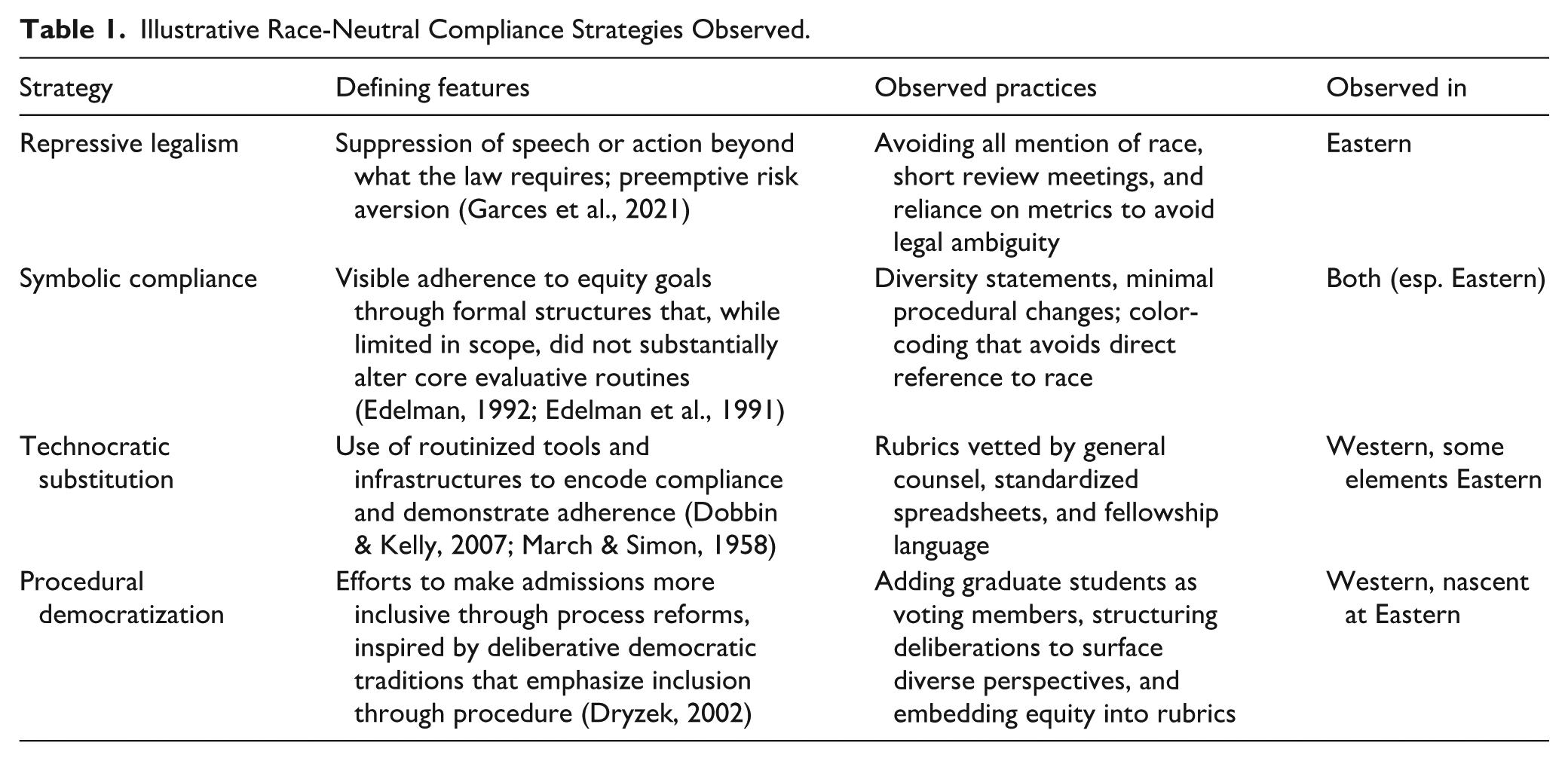
Implications
To situate our findings within the broader landscape of race-neutral admissions, we highlight implications across three domains: theory, methodology, and practice. Our analysis contributes to ongoing debates about legal compliance, organizational agency, and cultural production under constraint. As background to these implications, we note the enrollment context during our fieldwork (2022–2023). Eastern saw year-to-year fluctuations in enrollment of underrepresented students, while Western maintained relatively stable representation at levels higher than those of other physical science departments at their institution. We do not claim a causal link between these patterns and the processes we observed, but they underscore the stakes of admissions design under race-neutral mandates.
Implications for Theory
This study advances theories of legal endogeneity by demonstrating how compliance in race-neutral admissions is not simply reactive but actively constituted through organizational culture, leadership, and resources. Legal endogeneity refers to the process by which organizations internalize legal mandates through their own interpretive routines, effectively shaping how the law operates in practice. Our framework of repressive legalism, symbolic compliance, technocratic substitution, and procedural democratization extends this framework by specifying distinct compliance logics that show how law is enacted through evaluative practices rather than solely through formal policies. In particular, our introduction of technocratic substitution and procedural democratization expands the conceptual repertoire of legal endogeneity by highlighting how organizations not only perform legality symbolically but also design tools and deliberative processes that both support compliance while allowing discretionary space for inclusion-oriented evaluation. Guided by Foley’s (2023) notion of resistant compliance, we show how these logics translate discretion into lawful strategies that advance commitments to diversity. More broadly, our findings refine understandings of organizational legitimacy-seeking by illustrating how symbolic compliance, normative commitments, and evaluative culture intersect in shaping what counts as “legal” or “equitable” admissions.
Implications for Methodology
Our ethnographic approach reveals how race-neutral mandates are enacted in practice, not only through policy statements or outcomes, but through interpersonal deliberations, silences, and tensions that shape organizational culture. Rather than seeking “thick description,” we employed a bounded, comparative ethnography that embedded us in the evaluative practices of two departments. This design demonstrates the value of cross-case, same-discipline ethnography for identifying how policy implementation is filtered through local values and structures, while also highlighting what may be missed without broader immersion. By situating our observations within committee meetings, interviews, and documents, we show how ethnographic attention to process can illuminate the everyday enactment of legality and equity under constraint.
We see significant potential to adapt this approach to other domains of education policy research in which organizational processes translate law into practice. Admissions is only one example; similar bounded ethnographies could illuminate how institutions design financial aid, enforce Title IX, implement accountability metrics, or respond to curricular mandates. In these settings, focusing on interactions, documents, and deliberations can reveal how policies are inhabited, contested, and reconfigured in ways that survey data or outcome analyses alone cannot capture. We encourage future researchers to examine the “soft policy” dimensions of race-neutral compliance—and of other policy regimes—by using bounded ethnography to unpack how law and policy are made real in organizational practice.
Implications for Research
Our research has broad implications for admissions at a time of transition. This study contributes to the scholarly understanding of contemporary admissions and is unique in examining how faculty seek diversity when racial status cannot be considered as a factor. While existing research on holistic review in graduate education (e.g., Barceló et al., 2021; Wilson et al., 2018; Young et al., 2022) demonstrates its potential for increasing racial diversity, fewer studies emphasize race-neutrality as a central condition of the context for its practice (e.g., Posselt et al., 2025). We suggest that scholars pay attention to the socio-legal conditions under which holistic admissions is being carried out, how leaders make sense of and navigate these conditions, and inquire into what institutional resources can support leaders in standing for mission-driven commitments to diversity and inclusion when values are called into question.
We also hope that this work will catalyze attention to the cultural styles of other organizational processes in educational settings. For example, universities allocate financial aid, orient students, and perform various other administrative tasks. Sociological questions abound about how organizational processes reflect culture and how they can be recreated or reshaped to influence culture, even under challenging circumstances. As Coleman and Smith (2023) reminded the education community in the wake of the SFFA decisions, law provides parameters for organizational design, just as values do. We hope scholars will see in this work an example of using ethnography to explore the core sociological relationships among structure, agency, and culture. Higher education institutions can use this research to consider their salient contextual parameters and how actors utilize their agency to create culture, not just despite legal constraints, but because of them.
Implications for Admissions Policy and Practice
Our work also has various implications for admissions policy and practice. First, our analysis suggests that training in current legal requirements and understanding how seemingly neutral criteria can produce differential effects is essential. In the post-SFFA environment, this includes shared institutional guidance on how to solicit and evaluate applicants’ individualized accounts of experience (including experiences with race) without treating race as a decision criterion, and how to avoid tools or shortcuts that function as categorical proxies. Reviewers should understand what current law permits and prohibits, how racial bias can manifest in neutral criteria, and how race operates systemically within selection practices. The United States is unique in that it does not require professional development for those tasked with admissions review; however, in an increasingly litigious environment, universities may reduce their legal exposure with basic training. Such training could help decision-makers consider applicants’ backgrounds holistically while remaining compliant with the law. Institutions can help with this. Clear institutional policy and guidance can counteract the ambiguity surrounding the interpretation and implementation of legal mandates in admissions, guiding research-informed approaches to holistic admissions.
At the same time, guidance from legal offices is often shaped by institutional incentives to mitigate legal risk rather than advance equity goals. As a result, legal advice might encourage overly restrictive interpretations that exceed what the law requires. Our findings suggest the value of cross-functional training models that bring together legal counsel, faculty, admissions professionals, and graduate students to collaboratively interpret legal constraints and their implications for practice.
Second, admissions committees should proactively discuss the criteria they value in applicants, explain why they value these criteria, and outline how they will identify those qualities. Our findings highlight the importance of leaders clarifying what they want to protect and what they want to nudge. Holistic review processes may vary significantly across contexts and are given life by individuals and interactions that constitute local evaluative cultures. There may be as many styles of holistic review as there are departments that use it; our study offers two illustrative examples.
Third, collaboratively developing evaluation rubrics can facilitate moving beyond ad hoc selection processes (Klitgaard, 1985). Rubrics typically reflect shared values while allowing each reviewer to exercise autonomy and judgment. In both departments, interactions surrounding the meanings of excellence and merit influenced the integration of criteria beyond those that typically hold cache but may perpetuate inequalities, such as contextual factors like community contribution and resilience. These criteria became central to the committee’s deliberations. Thoughtful rubric design creates a shared framework that supports contextualized, holistic review while promoting accountability and transparency (Posselt et al., 2025).
Fourth, Western’s example shows how including graduate students and junior faculty as voting members can recalibrate committee norms and expand definitions of merit. It was through the graduate students’ contributions to the deliberations and the co-chairs’ creation of an open, validating space for their contributions that community contributions became an important component in defining excellence.
Finally, we encourage institutional actors to view race-neutral policy as structurally constraining but not determinative. Even in legally restricted environments, departments retain considerable agency to shape admissions culture and practice. Decentralized processes, such as admissions, involve considerable agency on the part of leaders. Even in legally restricted environments, individual actors and departments still have room to navigate, create, and refine the quality of interactions with one another and the myriad practices that constitute what has been described as the “soft policy” environment of admissions. Within the confines of ambiguous laws, actors and departments retain considerable agency to advance their commitments to diversity. By cultivating legal literacy, designing shared evaluative tools, and fostering inclusive deliberation, institutions can uphold their commitments to equity—even within the shifting terrain of race-neutral legal mandates.
Conclusion
This study examined how selective STEM PhD programs in states with affirmative action bans navigate the tension between race-neutral legal mandates and equity-driven admissions goals. Using comparative ethnography, we examined the admissions processes and evaluative cultures in two physical sciences PhD programs within two public research universities that were subject to similar affirmative action bans—one ranked near the top of its field (i.e., Western), the other moderately selective but striving (i.e., Eastern). Negotiating these tensions in practice required local design choices, leadership intervention, and the articulation of new evaluative criteria. Our findings reveal that compliance with a race-neutral policy is not uniform but rather mediated by organizational culture, leadership values, and design structures. Drawing on legal endogeneity theory, we demonstrate how ambiguity in the law invites interpretive variation, producing divergent compliance strategies across similar institutional contexts. Whether through repressive legalism, symbolic compliance, technocratic substitution, or resistant compliance, each case illustrates how law is made actionable through organizational routines. These responses are not merely defensive; they reflect strategic and, at times, aspirational interpretations of legality and equity that reshape admissions practices from within. Although our data were collected while SFFA was pending, the practices we document, which were already shaped by state bans, offer an empirically grounded preview of the kinds of organizational adaptation likely to proliferate nationally under SFFA.
Returning directly to Students for Fair Admissions (SFFA), our fieldwork captures admissions committees operating at the intersection of two policy frames: long-standing state affirmative action bans that had already normalized race-neutral routines, and SFFA, a new national constraint that reframes legal risk, public scrutiny, and institutional governance across all admissions contexts. In that sense, many practices we observed were shaped “before” SFFA but became newly consequential “under” SFFA: they show how race-neutral compliance is lived and operationalized when race cannot be treated as a decision criterion, even while institutions continue to pursue broad participation. At the same time, SFFA clarifies an important boundary that helps interpret our cases. The decision emphasizes individualized assessment and leaves room for applicants to discuss how race shaped their experiences, but it rejects decision-making that treats race (or its functional equivalent) as a basis for conferring advantage. Read through that lens, several observed practices appear to be plausible pathways forward, while others highlight risk zones that may invite heightened scrutiny.
Plausible pathways include process designs that strengthen individualized, contextual evaluation (e.g., rubric-guided deliberation; careful attention to “distance traveled,” resilience, and opportunity structures as individualized narratives; structured prompts that elicit applicants’ contributions to scientific and learning communities). These strategies align with SFFA’s emphasis on evaluating experiences and attributes rather than group membership. Potential risk zones are not the presence of equity-oriented aims per se, but the possibility that race-neutral “signals” become mechanized as categorical substitutes. For example, if proxies (including program participation flags) are treated as de facto stand-ins for race or used in ways that resemble targets rather than individualized review. Our cases suggest that “a way forward under SFFA” is less a single model than an implementation challenge: committees can expand contextual, individualized assessment, but doing so requires explicit guardrails that prevent well-intentioned tools from hardening into proxy-based classification.
A key lesson for admissions committees is the importance of clearly understanding the legal landscape to create intentional, structured processes that align with their institutional mission. This approach enables compliance with legal restrictions while advancing core values. These findings suggest that race-neutral admissions reform requires not only legal compliance but also organizational learning. Policy makers and campus leaders should invest in legal and racial literacy training, encourage structured deliberation grounded in institutional mission, and empower inclusive leadership teams to design context-sensitive admissions processes. By viewing race-neutral mandates not solely as constraints but as opportunities for cultural redesign, leaders can treat admissions as a site of process design rather than ad hoc risk mitigation. In both programs, we observed a pervasive need for a clearer understanding of the boundaries of race-neutral law. Yet, more importantly, we saw glimpses of transformation: moments when legal constraints became a catalyst for designing more intentional, equity-aligned admissions practices. As institutions face heightened scrutiny, admissions committees have a choice: to retreat into narrow formalism or to reimagine admissions as a lever for shaping the inclusive academic cultures they claim to value. By embedding equity into the very routines of evaluation, race-neutral compliance need not dilute institutional mission; it can deepen it.
Footnotes

Ethical Considerations
The University of Southern California Institutional Review Board approved the study.
Funding
The authors disclosed receipt of the following financial support for the research, authorship, and/or publication of this article: The National Science Foundation sponsors the research study.
Declaration of Conflicting Interests
The authors declared no potential conflicts of interest with respect to the research, authorship, and/or publication of this article.