



Abstract
Executive function skills are a set of cognitive processes that help individuals to engage in goal-directed behavior and have been linked to benefits in academic achievement and other learning-related outcomes. Recently, there has been interest in understanding how attending center-based preschool may relate to the development of executive function skills. This study used the nationally representative Early Childhood Longitudinal Study, Kindergarten Class of 2010–2011 (n ~ 9,270) to examine the association between preschool attendance and executive function skills in each grade of elementary school. The results of the analysis suggest small initial associations of preschool attendance with some subdomains of executive function (working memory) but not others (cognitive flexibility). These associations are heterogenous based on preschool type (i.e., public vs. private). The longitudinal analysis revealed rapid attenuation of initially positive associations, but also some indications of so-called “sleeper effects” emerged in late elementary school for working memory. Implications for research and policy are discussed.
Executive function is a set of cognitive processes that help individuals to engage in goal-directed behavior (Diamond & Lee, 2011). Current scientific understanding of executive function suggests it has three components: (1) working memory, or the ability to hold and manipulate information in our mind; (2) cognitive flexibility, or the ability to shift your attention and perspectives; and (3) inhibitory control, or the ability to remain focused on tasks when distractions are present. Interest in these skills has burgeoned in recent decades due to their positive association with students’ academic achievement and learning-related outcomes (Best et al., 2011; Cameron et al., 2012; Ursache et al., 2012; Willoughby et al., 2017; Willoughby et al., 2019). The purpose of this study was to examine the extent to which preschool attendance, 1 relative to no preschool, is associated with the development of students’ executive function skills in elementary school using a large nationally representative data set.
Given the strong correlational evidence implicating the importance of executive function skills for student outcomes, there are some critical challenges identified in the executive function literature that require attention. First, there are large differences based on students’ race and socioeconomic status in their executive function outcomes on kindergarten entry. For example, Little (2017) analyzed a nationally representative data set and found large differences in students’ executive function based on racial group membership and socioeconomic status (e.g., Black and Hispanic students entered kindergarten approximately 0.5 standard deviations (SD) behind their White peers). Other research highlights the challenges of lower levels of early executive function for later educational outcomes. This is particularly true for STEM outcomes, where research has shown that students with lower levels of early executive function are likely to have challenges in mathematics and science throughout elementary school (Morgan et al., 2019).
However, there is hope to address these challenges. Theory and related empirical work posit that preschool attendance is likely to support the development of children’s executive function skills. Executive function develops most rapidly in early childhood (Diamond & Lee, 2011) and has been shown to be malleable via interventions in early childhood (Blair, 2016; Little, 2016). Scholars have argued that preschool, in particular, can promote the structures, routines, and activities that are necessary for the promotion of executive function skills (Morrison et al., 2009; Williford et al., 2013). Furthermore, a limited peer-reviewed literature of specific preschool programs has found initial benefits of preschool attendance, relative to no preschool, for executive skills 2 (Ansari et al., 2020; 2021; Weiland & Yoshikawa, 2013). Given this theory and emergent empirical findings, it follows that center-based preschool may be beneficial in the development of children’s executive function.
To investigate this, I designed a study to examine the association between preschool attendance and direct-assessment measures of executive function. I examined the associations between center-based preschool and direct-assessment measures of executive function skills both at kindergarten entry as well as longitudinally in the spring of each elementary school grade. I also examined disaggregated measures of center-based preschool based on preschool structure (public/private) and dosage (full-time/part-time). Finally, I examined if the observed associations varied by race/ethnicity or socioeconomic status.
I find initial positive associations of preschool attendance on some subdomains of executive function (working memory, 0.07 SD) but not others (cognitive flexibility). These associations are heterogenous based on preschool setting type, but not dosage or student demographic subgroups. The longitudinal analysis revealed rapid fadeout of initially positive associations, but also some indications of so-called “sleeper effects” emerged in late elementary school for working memory, particularly for private preschool attenders.
This research makes a number of important contributions to the preschool effectiveness research and policy community. First, it provides a more holistic view of preschool effectiveness by considering executive function as an outcome. To date, the preschool effectiveness literature has largely focused on academic achievement outcomes (Bassok et al., 2019; Curran, 2019; Magnuson et al., 2007a). Second, it provides the first nationally representative estimates on the association between preschool and executive function skills. The limited studies that have also examined this association focused on two local preschool programs (Ansari et al., 2020, 2021; Weiland & Yoshikawa, 2013). Third, this study provides the first estimates of longitudinal associations between preschool attendance and executive function skills beyond kindergarten by extending to the end of elementary school. Fourth, this study examines differences in associations based on preschool setting type, dosage, and student demographic subgroups, which have been consistently linked to heterogenous associations in past preschool effectiveness research (e.g., Ansari et al., 2021; Bassok et al., 2019).
Background
Effectiveness of Preschool
A wealth of research has found that high-quality preschool programs increase school readiness and later academic, behavioral, and social outcomes, particularly among students from traditionally underserved groups (Barnett et al., 2018; Gray-Lobe et al., 2021; Phillips et al., 2017). Yet the initial benefits of preschool, primarily in terms of academic achievement assessment scores, do not reliably persist as children progress through elementary school—a pattern commonly referred to as Pre-K fadeout, though alternative terms like convergence are gaining traction 3 (Bailey et al., 2017; Li et al., 2020; Early Learning Network, 2021). Recent research has found that Pre-K fadeout may be variable based on the specific Pre-K program, state context, and outcome measures used (Gormley et al., 2018; Gray-Lobe et al., 2021; Lipsey et al., 2018), though much remains unknown. Scholars are working to make sense of the reasons for preschool fadeout and reconcile why some programs show later-life benefits on outcomes such as educational attainment, health, and crime despite frequent evidence of short-term fadeout on academic achievement outcomes (Campbell et al., 2012; Deming, 2009; Gray-Lobe et al., 2021; Heckman, 2006).
One possible explanation for the emergence of later life benefits of preschool, even in light of fadeout of short-term effects on assessment outcomes, is that the benefits of preschool are concentrated in nonacademic domains. Pinpointing what exactly these nonacademic domains are remains elusive—so much so that Gibbs et al. (2011) called them the “social policy dark matter” that leads to long-term preschool benefits. In an attempt to build evidence on the topic, recent studies of preschool effectiveness have begun to focus more on nonacademic outcomes (e.g., Bassok et al., 2019), including executive function skills specifically (Ansari et al., 2020; 2021; Weiland & Yoshikawa, 2013). It is plausible that children’s early development of executive function skills in preschool may be one mechanism through which these later life outcomes manifest. In addition to links to academic achievement (e.g., Willoughby et al., 2019), executive function skills are linked to positive behaviors (e.g., working toward goals, adaptability), good health (e.g., resisting pressure to engage in risky behaviors), and successful work (e.g., organization and planning; see Center on the Developing Child, n.d., for a review).
Heterogeneity in Preschool Effectiveness
In addition to the robust literature evaluating the effectiveness of preschool programs on student outcomes overall, some of these studies have examined the extent to which the benefits of preschool may vary for specific student subgroups, which commonly include student income and race (Ladd, 2017). Summarizing research on the differential effects of preschool for different student subgroups in a Brookings Institution Consensus Report, Ladd (2017) noted that, “pre-k programs are likely to generate larger benefits for economically disadvantaged children than for their more advantaged peers” (p. 35). In terms of student race, the results are more mixed. Ladd wrote, the effects by racial subgroup—both the positive effects for Hispanic children in some studies, and the more mixed effects for Black children—raise a number of interpretation issues that are not fully resolved in the research literature reviewed here. (p. 35)
These conclusions were drawn from an analysis of 13 high-quality preschool studies. Given the relative dearth of evidence on heterogeneity of preschool effects and the mixed results therein, I explore these differential association in the present study.
In addition to differences in preschool effectiveness based on student race and economic background, past studies have documented differences based on program characteristics. The two types of program characteristics that have available measures in the ECLS-K:2011 (Early Childhood Longitudinal Study–Kindergarten Class of 2010–2011) include whether the preschool program is public or private and whether the program is full- or part-day. Measures of classroom quality are consistently higher in publicly funded programs, leading to the hypothesis that impacts on student outcomes may be higher in these settings (Bassok et al., 2016). However, a recent study of preschool effectiveness using the ECLS-K from Bassok et al. (2019) found the opposite relationship. Specifically, they found that academic achievement scores were higher in kindergarten through third grade for students who attended private preschool programs as opposed to public preschool programs. Furthermore, the initial positive associations, while present for both preschool types, were more persistent for private preschool attenders. No studies to date have examined this relationship with direct assessment measures of executive function skills.
In terms of full-day versus part-day preschool, the evidence is mixed based on the outcome measure of interest. While the evidence often points to benefits of increased dosage of preschool for academic outcomes (e.g., Robin et al., 2006; Loeb et al., 2007), others have found that increased time in preschool is associated with increases in behavioral problems (e.g., Vandell et al., 2010). Analyzing the 1998 version of the ECLS-K, Magnuson et al. (2007a) did not find any differences between preschool dosage and student outcomes. Bassok et al. (2019) analysis of the newer ECLS-K:2011, however, did find adverse effects of full-day preschool on student problem behaviors and self-control. A related paper examined the effects of full-day versus part-day kindergarten on executive function skills for children with disabilities and found benefits of full-day kindergarten on both working memory (SD = 0.14) and cognitive flexibility (SD = 0.14; Gottfried & Little, 2017). Given the mixed nature of the findings from these studies based on outcome type and grade, I explore how this phenomenon plays out in the context of executive function skills.
Preschool and Executive Function Skills
To date, very few studies have examined the association between preschool attendance, relative to no preschool, and direct-assessment measures of executive function. 4 The first to do so was a study of the effectiveness of the Boston Public Schools Pre-K program by Weiland and Yoshikawa (2013). In this study of 2,018 students, effects of Pre-K on direct assessment measures of executive function at the beginning of kindergarten were assessed using an age-based regression discontinuity design. 5 Working memory was measured using the Digit Span task (Gathercole & Pickering, 2000), cognitive flexibility was measured using the Dimensional Change Card Sort (DCCS; Frye et al., 1995), and inhibitory control was measured using the Pencil Tap task (Diamond & Taylor, 1996). The authors found moderately sized and roughly equal impacts on the three executive function measures (Digit Span 0.23 SD, DCCS 0.27 SD, Pencil Tap 0.20 SD). In a subgroup analysis, the authors found the impacts for free or reduced lunch students were larger on the Pencil Tap and DCCS measures, but not Digit Span. In terms of race or ethnicity, the authors found that impacts were higher for Hispanic students, relative to White students, on the Pencil Tap and DCCS measures. Impacts were also higher for Asian students on the DCCS measure. A key benefit of this study is its rigorous methodological approach that enables the estimation of causal effects. A key limitation of this study is its limited generalizability since it focused only on the Boston Public Schools Pre-K program.
A more recent study, which was published in two separate papers, also assessed the correlational association between preschool and direct assessment measures of executive function (Ansari et al., 2020, 2021). Drawing on a sample of 2,581 students from large and diverse county in the southeastern United States, these authors used ordinary least squares (OLS) regression with robust controls to estimate differences in executive skills throughout kindergarten between Pre-K attenders and nonattenders. The authors measured working memory with the Digit Span task and measured inhibitory control with both the Pencil Tap task and the Head-Toes-Knees-Shoulder (H-T-K-S) task. The study did not include a measure of cognitive flexibility. In the first of these two papers, the authors summarized their findings from assessments administered in the fall of kindergarten, which was the outcome most proximal to Pre-K attendance. The authors found moderate positive associations for all outcomes, with slightly higher associations for measures of inhibitory control (Pencil Tap 0.31 SD, H-T-K-S 0.29 SD) than for the working memory measure (Digit Span 0.18 SD). This initial paper also examined differences in associations based on subgroup membership. The authors found larger associations for dual language learners on the H-T-K-S task. For low-income students, they found larger associations on the Pencil Tap and Digit Span tasks.
The second paper from this broader study followed-up with the sample at the end of kindergarten, but did not include a similar subgroup analysis. Ansari et al. (2020) found persistent associations for working memory (Digit Span 0.19 SD) but significant attenuation in the magnitude of associations (approximately 50%) for the inhibitory control measures (Pencil Tap 0.11 SD, H-T-K-S 0.15 SD). This is the first study of preschool attendance and executive function to look beyond kindergarten entry and it suggests that, at least for some subdomains of executive function, there is a familiar pattern of fadeout of initial preschool benefits once children enter elementary school (Bailey et al., 2017). In addition to providing some longitudinal insights into the persistence of preschool benefits for executive function skills through kindergarten, this study also benefits from a robust correlational study design that included a rich set of child/family contextual covariates (Schneider et al., 2007). Similar to Weiland and Yoshikawa (2013), however, a key limitation of this study is its limited generalizability beyond a large county-based Pre-K program. Finally, this study did not include a measure of cognitive flexibility. This is an important limitation because the differences in the magnitude of associations reported in the study between the measures of working memory and inhibitory control suggests there may be differential benefits of preschool attendance on executive function skills between the three subdomains of executive function (working memory, cognitive flexibility, and inhibitory control).
The Current Study
In sum, this review of the literature suggests that attending preschool likely benefits students’ early executive function skills, with larger associations accruing to Hispanic, dual language learners, and lower-income students. That said, this existing literature is sparse and limited to studies of only two local pre-K programs. To help build a more robust and generalizable body of evidence on the association between preschool attendance and executive function skills, I drew on nationally representative data from the ECLS-K:2011 to answer the following four research questions:
Method
Data for this study came from the Early Childhood Longitudinal Study, Kindergarten Class of 2010–2011 (ECLS-K:2011), which is sponsored by the National Center for Education Statistics within the Institute of Education Sciences of the U.S. Department of Education. The ECLS-K:2011 followed a nationally representative sample of students who attended kindergarten in 2010–2011 through 2015–2016, when most of the students were in fifth grade. Throughout this time period, students were regularly assessed on a range of outcomes—most notable for this study, direct-assessment measures of executive function skills. Additionally, parents, teachers, and school administrators were regularly surveyed to capture information on student and family background, teaching practices and content, and school contexts. Since the ECLS-K:2011 data collection has been fully completed, this examination of the association between preschool and executive function skills looks at outcomes both immediately following preschool at kindergarten entry as well as longitudinally though the end of fifth grade (Tourangeau et al., 2019).
The methods described in this section, including both measure selection and construction, as well as analytic approach, are based on best practices identified through a robust preschool effectiveness literature using the both cohorts of the ECLS-K to examine the association between preschool attendance and student outcomes (Ansari, 2018; Ansari & Gottfried, 2018; Bassok et al., 2019; Curran, 2019; Gottfried, 2017; Magnuson et al., 2007a, 2007b). In this study, I applied these methodological approaches to the novel outcome of executive function.
Sample
The baseline sample of the ECLS-K:2011 included 18,174 students. Consistent with Bassok et al. (2019), I retained cases that included nonmissing child assessment data, resulting in an analytic sample of 9,267. A comparison of the original and analytic samples revealed limited differences, with the analytic sample including a slightly higher percentage of White students (+ 4 percentage points) and a lower percentage of Black students (−3 percentage points). The samples were statistically the same in terms of a composite measure of socioeconomic status and all other control variables. I imputed all nonoutcome measures, including preschool attendance measures and covariates, using chained equations. 6 Multiple imputation replaces each missing value with a set of estimated values and captures the uncertainty introduced by estimating missing values (Royston, 2004). I imputed using the chained equations methodology because it allows for estimation of continuous, ordinal, and categorical variables, simultaneously. Rates of missing data ranged from <1% to 22% and I imputed 20 data sets.
All analyses were estimated using sample weights provided in the ECLS-K:2011 data files, which account for non-random selection and attrition. Weights were selected that accounted for child assessment outcomes at each wave and for parent report at baseline, when preschool attendance information was collected. 7 All analyses were run using Stata’s MI Estimate command set, which adjusts coefficients and standard errors for the variability between imputations according to the combination rules by Rubin (1976).
Measures
Preschool Attendance
Parents were surveyed at the beginning of the study about the preschool experiences of their child in the year prior to kindergarten entry. Consistent with prior ECLS-K-based studies of preschool (Ansari, 2018; Bassok et al., 2019; Claessens et al., 2014; Curran, 2019; Magnuson et al., 2007a, 2007b), I constructed multiple measures of preschool attendance. The first and primary measure was an indicator variable that equaled one if the child attended a “day care center, nursery school, preschool, or prekindergarten program” in the year before kindergarten for 5 or more hours a week. The reference category included students who did not attend center-based care in the year prior to kindergarten entry or did so for less than 5 hours a week. This measure of preschool attendance was inclusive of students who attended Head Start. 8
The second specification of the preschool attendance measure distinguished between public and private preschool. The ECLS-K:2011 survey asked parents if the center-based care their child received was a state-funded public prekindergarten. I used this survey item to disaggregate the center-based care measure into public and private preschool. A limitation of this measure is that parents may not be able to accurately indicate the correct preschool type, and, similar to other ECLS-K preschool studies, my estimates of public preschool attendance were slightly lower than estimates from the National Center for Early Education Research and the National Household Education Surveys (Bassok et al., 2019; Barnett et al., 2011).
In the third specification of the preschool attendance variable, I disaggregated center-based preschool attendance into full-time and part-time categories. Consistent with Bassok et al. (2019) and Magnuson et al. (2007a, 2007b), I defined full-time preschool as 20 or more hours a week and part-time preschool as between 5 and 20 hours per week.
Executive Function Outcomes
A unique benefit of the ECLS-K:2011 is its inclusion of direct assessment measures of the three primary components of executive function: working memory, cognitive flexibility, and inhibitory control. Working memory was measured with the Numbers Reversed task. In this task, students were asked to repeat increasingly longer sequences of orally presented numbers in reverse order. For example, if presented with 3–6–2, the student would respond correctly with 2–6–3. The task ended when students got three consecutive sequences of the same length in a row incorrect or when all sequences in the task had been completed. I used the W score available in the data file for analysis. The W score is a standardized score based on a transformation of the Rasch Ability Scale, and it provides a uniform scale of equal intervals that represents a child’s ability as well as the difficulty of the item. The Numbers Reversed task was administered in a consistent manner across all child assessment data collection waves in the ECLS-K:2011.
One limitation of the Numbers Reversed scores provided in the ECLS-K:2011 data file is the nonnormal distribution. At the baseline assessment administration, approximately 40% of students did not score above the lowest scalable score (403 for English and 393 for Spanish; Tourangeau et al., 2019). As a result, the distribution of scores is left censored. To explore the implications of this distribution on the findings, I estimated TOBIT models that were left censored at 403 in addition to the primary OLS models (see Method section; McBee, 2010). Additionally, while the W-Ability score is commonly used in the ECLK-K:2011 executive function literature (e.g., Little, 2017; Morgan et al., 2019; Ready & Reid, 2019), I also estimated models with the alternative percentile rank outcome measure to test the robustness of my findings. As I will detail in the pages that follow, the results are robust to both the TOBIT estimation and alternative percentile rank outcome checks.
Cognitive flexibility was measured with the DCCS (Zelazo, 2006). Two different versions of the DCCS were administered due to age appropriateness, with one version administered in kindergarten and first grade, and another in the second-through-fifth-grade data collection waves. In the earlier version of the DCCS, assessors presented students with a set of cards that they would ask students to sort based on evolving criteria. For example, sorting cards based on the color of the figure or the shape of the figure. In the later version, the DCCS was administered in a digital format where students continued to sort cards, but it was more complex because the sorting rules would switch more rapidly. The later version was scored not only based on accuracy of the sorting but also on reaction time.
Inhibitory control was not directly assessed in the ECLS-K:2011 until the fourth-grade data collection wave. To measure inhibitory control, the NIH Toolbox Flanker Inhibitory Control and Attention Task (Flanker) was used (Zelazo et al., 2013). In this computerized task, a row of arrows was presented and the student was asked to focus on the central arrow and indicate the direction in which it was pointed. In some cases, all arrows pointed in the same direction (congruent), but in other more complex trials, the arrows pointed in differing directions (incongruent). Similar to the computerized version of the DCCS, the Flanker score considers both the accuracy of responses as well as reaction time (Slotkin et al., 2012).
All primary outcome variables were transformed into a Z-score, with a mean of zero and an SD of 1. This enabled common interpretation of outcomes in terms of SD units. More detail about the specific assessment measures and their psychometric proprieties is available in the ECLS-K:2011 User Manual (https://nces.ed.gov/pubs2019/2019051.pdf).
Control Variables
One of the key benefits of the ECLS-K:2011 is the robust set of control variables available that I draw on to adjust for the nonrandom selection of students into preschool settings. I controlled for socioeconomic background with a composite measure that was developed for the ECLS-K:2011 that includes parents’ education, occupational prestige score, and household income. Additional control variables included student race (Asian, Black, Hispanic, White, and Other Race), gender, language other than English primarily spoken at home, two parent/guardian household, number of siblings in the household, and whether or not the student’s mother was married at the time of the student’s birth. This list of control variables is modeled after similar ECLS-K-based studies of preschool (e.g., Bassok et al., 2019; Curran, 2019). As I will detail in the following section, these control variables were also used in the generation of entropy balancing weights.
Descriptive statistics for all measures are available in Appendix A.
Analytic Strategy
Much of the existing literature that draws on the ECLS-K data sets to examine the association between preschool and student outcomes (e.g., Bassok et al., 2019; Curran, 2019; Magnuson et al., 2007b) uses OLS regression with saturated controls (Wooldridge, 2016). I follow this approach as a baseline but also build on it by weighting each regression model with entropy balancing weights. Entropy balancing is a data preprocessing method, similar to matching and propensity score methods, to achieve covariate balance in observational studies with binary treatments (Hainmueller, 2012; Ho et al., 2007). I generated the balancing weights using the ebalance command in Stata. I achieved balance on the first three moments (mean, variance, and skewness) of each of the control variable distributions.
I estimated variations of three primary regression models that corresponded to the three different specifications of the preschool attendance measures (center-based preschool, public versus private, and full-time versus part-time). The equations took the following specific forms:


where
In addition to these primary models, I also conducted subgroup analyses to explore heterogeneity in the association between preschool attendance and executive function outcomes based on socioeconomic status and race. Specifically, I fit versions of Model 1 that included interactions between the preschool variable and binary variables representing student race/ethnicity (Black, Hispanic, and Asian) and family socioeconomic status quartile. These models took the form shown in Equation 4:

In order to help assure the robustness of my findings and avoid potential Type I (false positive) errors, I applied the Benjamini–Hochberg procedure to all estimated coefficients. The Benjamini–Hochberg procedure controls the false discovery rate (FDR) using sequential modified Bonferroni correction for multiple hypothesis testing (Benjamini & Hochberg, 1995). I implemented this procedure by first ordering all of the p values from smallest to largest and assigning ranks to each value (e.g., the smallest p value had a rank of 1). I then calculated each individual p value’s Benjamini–Hochberg critical value, using the formula (i/m)Q where i is the p value rank, m is the total number of tests, and Q is the false discovery rate of 10%. Last, I only interpreted coefficients as statistically significant if the Benjamini–Hochberg critical value was less than 0.05. In the presentation of regression tables, I used common star indicators to signify traditional thresholds of statistical significance (e.g., p < .05). I then made boldface all coefficients that remained statistically significant in light of the Benjamini–Hochberg procedure.
Results
Preschool Attendance and Student Outcomes at Kindergarten Entry
I present results from the main OLS models with entropy weights that estimate associations between preschool attendance and executive function skills in Table 1. The coefficients presented in the first column of the table show the outcomes measured at kindergarten entry, which is the most proximal post-preschool outcome available in the ECLS-K:2011. I found positive and statistically significant associations between preschool attendance and students’ working memory at kindergarten entry, but nonsignificant associations for cognitive flexibility. For the general measure of center-based preschool attendance, I found that students who attended center-based preschool in the year prior to kindergarten entry began kindergarten scoring 0.07 SD higher on the numbers reversed task, on average, than their peers who did not attend preschool. When examining differences between public and private preschool, I found that this association was concentrated among private preschool attenders. Private preschool attenders scored 0.10 SD higher on the Numbers Reversed task, on average, than their peers who did not attend preschool. Both coefficients for full- and part-time preschool attenders were statistically significant and positive under the traditional p < .05 threshold, but nonsignificant when applying the more conservative Benjamini–Hochberg adjustment, which I used to as the threshold for statistical significance.
Associations Between Preschool Attendance and Executive Function Skills

Note. All models are weighted to achieve nationally representative estimates. Outcomes are standardized to a M of 0 and SD of 1. All models include the full set of control variables, entropy weights, and error is clustered by school ID. Coefficients for preschool, public/private, and full-time/part-time come from separately estimated regression models, by outcome. Boldfaced values are statistically significant under a Benjamini–Hochberg correction with a 10% false discovery rate.
p < .10. *p < .05. **p < .01. ***p < .001.
Preschool Attendance and Executive Function Skills Throughout Elementary School
I present the results of the models that estimate the persistence of preschool associations in the spring of each grade of elementary school in the remaining six columns of Table 1. I found a rapid decline in the initial positive associations of preschool for student performance on the Numbers Reversed measure of working memory. By the end of kindergarten, the magnitude of initial coefficients declined toward zero and were statistically nonsignificant. Associations remained small and nonsignificant through elementary school, with the exception of fifth grade. In the fifth grade, I found that students who attended private preschool performed 0.08 SD higher on the Numbers Reversed task, on average, than their peers who did not attend preschool. While this coefficient was the only one that was statistically significant using the Benjamini–Hochberg adjustment, the coefficients for the general measure of preschool attendance and full-time preschool attendance increased and were near the threshold of statistical significance.
In terms of cognitive flexibility, no associations were statistically significant for any outcome or any specification of the preschool measures. The same was true for the inhibitory control measure, which began in the fourth grade.
Differential Associations by Race/Ethnicity and Socioeconomic Status
I present the results of the race/ethnicity and socioeconomic status interactions in Tables 2 and 3, respectively. Looking first at Table 2, which summarizes differential associations for Black, Hispanic, and Asian students, I found no statistically significant interactions for any outcome at any time point. Turning to Table 3, which summarizes differential associations by socioeconomic quartile, I again found no statistically significant interactions for any outcome at any time point.
Preschool by Race/Ethnicity Interactions

Note. All models are weighted to achieve nationally representative estimates. Outcomes are standardized to a M of 0 and SD of 1. All models include the full set of control variables, entropy weights, and error is clustered by school ID.
p < .10. *p < .05. **p < .01. ***p < .001.
Preschool by Socioeconomic Status (SES) Quartile Interactions
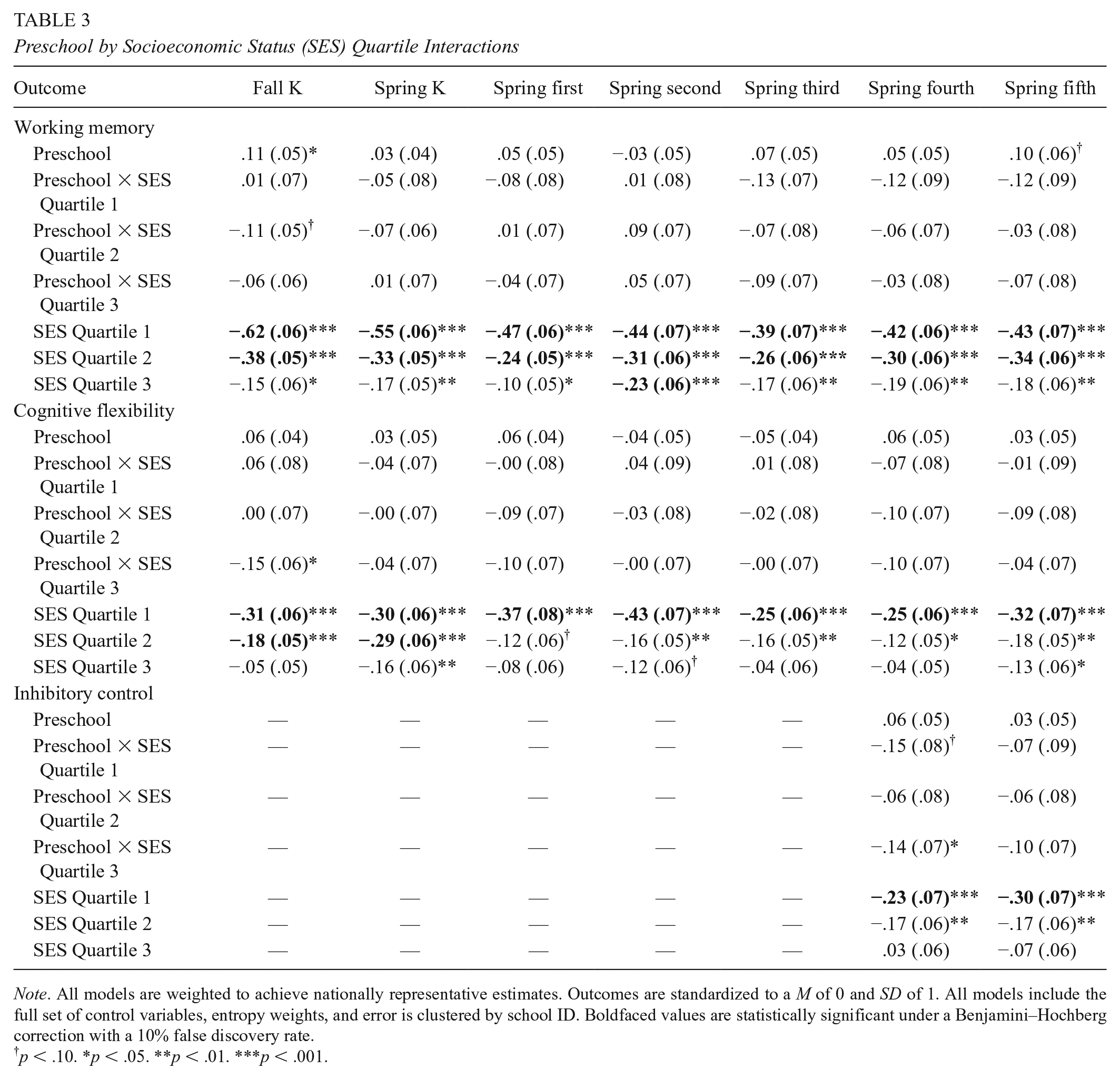
Note. All models are weighted to achieve nationally representative estimates. Outcomes are standardized to a M of 0 and SD of 1. All models include the full set of control variables, entropy weights, and error is clustered by school ID. Boldfaced values are statistically significant under a Benjamini–Hochberg correction with a 10% false discovery rate.
p < .10. *p < .05. **p < .01. ***p < .001.
Results of Sensitivity and Robustness Checks
As detailed in the Method section, I estimated a series of alternative models and outcomes to check the robustness of the main results presented in Table 1. In Appendix B, I present the results of models that used the same estimation method and outcomes as the main results but were run using list-wise deletion versus multiple imputation. Comparing these results with Table 1, the findings were consistent with the same three coefficients being statistically significant and of similar magnitude to the main results. In Appendix C, I present the results for the working memory outcome models that used the percentile rank outcome in place of the W-ability score. Again, the results were consistent with the main results. At kindergarten entry, both measures for preschool and private preschool attendance were positive, statistically significant, and of consistent magnitude to the main results. The positive association for private preschool attendance in fifth grade was of the same magnitude and statistically significant at the p < .05 level but was not significant under the Benjamini–Hochberg correction. In Appendix D, I present the results for the working memory outcome models that used TOBIT estimation with the W-ability scores left censored at the floor score of 403. Again, these results were consistent with the main results. The coefficients for private preschool attendance at school entry and in fifth grade were both statistically significant and of similar magnitude as the main results. The coefficient for center-based preschool attendance at kindergarten entry is consistent in magnitude but statistically nonsignificant under the Benjamini–Hochberg correction.
Despite some minor differences in coefficient size and marginality of statistically significance thresholds, the results from each of these three alternative estimation approaches provides a consistent story about the pattern of results: positive associations for preschool attenders and private preschool attenders at kindergarten entry in terms of working memory and the reemergence of this positive association for private preschool attenders in the spring of fifth grade.
Discussion
This study is the first to use nationally representative data to estimate the association between preschool and direct assessment measures of executive function skills throughout elementary school. While a limited set of directly related studies have also examined this association (Ansari et al., 2020, 2021; Weiland & Yoshikawa, 2013), they are limited to public Pre-K programs in two local areas. Also, these studies focused on near-term outcomes at the beginning and end of kindergarten only. This study contributes to the preschool executive function literature in two primary ways: (1) by providing nationally representative evidence of all center-based preschool attenders in the United States and (2) by focusing longitudinally on outcomes in each grade of elementary school. To summarize, I found initial benefits of preschool on some subdomains of executive function (working memory, 0.07 SD) but not others (cognitive flexibility). These associations were heterogenous based on preschool setting type (i.e., public/private), but not dosage and student demographic subgroups. The longitudinal analysis revealed rapid attenuation of initially positive associations, but also some indications of so-called “sleeper effects” emerged in late elementary school for working memory. I now discuss the implications of these key findings for research and policy.
First, related to the previous executive function-based preschool studies, the associations observed in this study are notably smaller and less uniformly positive. Across the three prior papers, all statistically significant associations ranged between 0.18 SD and 0.31 SD. In the present study, statistically significant associations in the main sample ranged between 0.07 SD and 0.10 SD. One explanation for this is that the prior studies focused on two highly regulated and publicly financed pre-K programs. Furthermore, the Boston Pre-K program is often regarded as uniquely effective relative to other public programs (Weiland & Yoshikawa, 2013). This is in contrast to the present study, which included a sample of all-center-based preschool attenders in the United States, which we know is highly varied in terms of quality (Bassok et al., 2016). The smaller magnitude of associations is more consistent with other preschool effectiveness studies using the ECLS-K. For example, Bassok et al.’s (2019) analysis of academic and social–emotional outcomes from both cohorts of the ECLS-K found statistically significant associations for preschool attendance in kindergarten ranged from −0.15 SD to 0.23 SD. 9
Related to the previous point about the Boston Pre-K program being cited as a particularly effective program is the fact that this study is limited in its focus on preschool versus no preschool without any knowledge of the specific practices and instructional tools used in the programs. There is emerging evidence that preschool programs are most effective when they use high-quality targeted curricula (vs. global curricula) that are supported with consistent coaching (Chaudry et al., 2017; Weiland et al., 2018). There are a range of specific curricular interventions, such as Opening the World of Learning, that have been developed that are linked specifically to improvements in student’s executive function skills (Diamond & Lee, 2011; Weiland & Yoshikawa, 2013). While benefits of the present study include the broad nationally representative scope, a drawback is the lack of information about the specific practices and curricular tools such as these that may enhance our understanding of how to scale programs most likely to aid in the development of executive function skills.
Also novel considering the existing executive function literature is that I found the positive associations to be concentrated among private preschool attenders and not public preschool attenders. This is notable because the three prior executive function studies were focused on publicly funded pre-K programs, not private programs (Ansari et al., 2020, 2021; Weiland & Yoshikawa, 2013). This pattern of benefits for private preschool over public preschool is consistent with other ECLS-K-based preschool studies. For example, Bassok et al. (2019) found larger associations for private preschool attenders, relative to public preschool attenders, for math and literacy outcomes. In the present study, I found a positive association between private preschool attendance and working memory at kindergarten entry (0.10 SD) but no statistically significant association for public preschool attendance.
Comparing the findings from the present study with the existing research using the ECLS-K to estimate the association between preschool attendance and student outcomes, there are a couple of additional important findings. ECLS-K-based studies have generally found near-term positive associations with academic outcomes, but mixed or negative associations with social–emotional outcomes, such as externalizing problem behaviors and self-control (Ansari, 2018; Bassok et al., 2019; Magnuson et al., 2007b). The findings from this study suggest that executive function does not fit very neatly into either trend, since I found positive associations with working memory and null associations with cognitive flexibility. One explanation for this is that the number reversed task (working memory) is more correlated with achievement than the DCCS (cognitive flexibility; e.g., Nguyen & Duncan, 2019). In the ECLS-K:2011 assessment data, the correlation in kindergarten between numbers reversed and math was 0.62 and it was 0.52 with reading. The correlation in kindergarten between the DCCS and math was 0.33 and it was 0.26 with reading. The tighter relationship between the numbers reversed scores and achievement scores may explain why a more familiar pattern of positive associations was observed for this outcome and not for the DCCS measure. That said, Weiland and Yoshikawa (2013) found significant associations at kindergarten entry with the DCCS of about a quarter of a standard deviation in their Boston study.
Turning to consider the longitudinal findings, there is less direct evidence in the existing literature to compare to. First, none of the executive function preschool studies have examined outcomes beyond the spring of kindergarten. Furthermore, only some of the ECLS-K preschool studies focused on nonexecutive function outcomes looked beyond the early elementary grades (e.g., Ansari, 2018). Regardless, the findings from this research present a familiar pattern of sharp declines in initial positive associations in the early elementary grades (Bailey et al., 2017). In fact, the so-called “fadeout” in this study was even more rapid than similar studies (e.g., Bassok et al, 2019; Magnuson et al., 2007a, 2007b), with the initial benefits for working memory completely diminishing by the end of kindergarten. However, looking beyond the early elementary grades to the end of elementary school, I did find some hints of so-called “sleeper effects” wherein initially positive associations reemerge over time (Ansari, 2018). Specifically, I found a positive association between private preschool attendance and working memory in the fifth grade (0.08 SD).
This finding of rapid attenuation of initial associations is notable in light of recent evidence comparing rates of attenuation between so-called “constrained” (e.g., letter identification) and “unconstrained” (e.g., vocabulary) skills. This research has found that unconstrained skills are more likely to be sustained longitudinally than constrained skills (McCormick et al., 2021). It is arguable that executive function skills would be considered an unconstrained skill and we would thus hypothesize that there would be less attenuation. The findings from the present study do not conform to that hypothesis, since the observed rates of attenuation were more rapid than those for academic achievement outcomes (Bassok et al., 2019). That said, limited inferences can be made by observing the trend for the singular numbers reversed measure of working memory used in this study, which is highly correlated with the mathematics assessment. Future studies should further examine the rates of attenuation of executive function outcomes that span different components of executive function (e.g., inhibitory control) and use varied measures (e.g., pencil tapping and H-T-K-S).
Study Limitations and Future Research
There are a number of important limitations of the current research that should be noted and addressed in future research. First, this study used a correlational design and all findings should be interpreted as regression-adjusted associations and not causal effects. While this approach is consistent with similar ECLS-K-based studies of preschool (e.g., Bassok et al., 2019; Curran, 2019; Magnuson et al., 2007b), the threat of selection bias based on unobserved characteristics remains. Future studies should employ designs that enable causal estimates, such as the age-based regression discontinuity approached used in Weiland and Yoshikawa’s (2013) executive function study.
Second, while a key benefit of this study is to provide a national portrait of the association between preschool and executive function, which comes with the limitation of masking vast heterogeneity in preschool quality with the preschool attendance measure. Prior research has found significant differences in preschool quality, which varies by region, state, and between individual centers (e.g., Bassok et al., 2016). This limitation is particularly apparent in the lack of consistent findings between this study and those reported in the other executive function-focused preschool studies, which took place in locale-specific public pre-K programs. We need more studies of the association between preschool and executive function skills to be conducted in different places and with different types of preschool programs to better understand the contours of this nuance. Doing so will provide policymakers with more granular information on which to make decisions and inform quality improvement efforts.
Finally, this study included only three direct assessment measures of executive functioning, and the inhibitory control measure was not captured until the fourth grade. This is unfortunate because existing research suggests that inhibitory control has a very steep developmental slope between 3 and 5 years of age (Best et al., 2009; Best & Miller, 2010).
There is also significant variability in executive function assessment tools available to measure different executive function constructs (Zelazo et al., 2013). The lack of observed associations for cognitive flexibility or inhibitory control may simply be due to these practical measurement limitations. Future studies should ensure that all constructs of executive function are measured and that multiple measures are used to help disentangle and variation based on the specific measure used.
Conclusion
This study builds on our understanding of the association between preschool attendance and direct-assessment measures of executive function by providing nationally representative estimates and taking a longitudinal view. Given the potential importance of executive skills for the development of students’ academic achievement and learning-related outcomes (Best et al., 2011; Ursache et al., 2012; Willoughby et al, 2017; Willoughby et al., 2019), continued inquiry on the role of preschool as an intervention to help boost these skills is warranted. Next steps include more longitudinal studies of preschool programs using causal designs with varied executive function measures. Future studies should also focus on understanding the specific instructional practice and tools that are most effective in promoting these skills. The accumulation of more nuanced and robust evidence will help inform policy and practice changes that can help optimize preschool interventions (e.g., dosage) to best support the development of executive function and address the inequities that currently exist based on race/ethnicity and socioeconomic status (Little, 2017).
Footnotes
Appendix
Associations Between Preschool Attendance and W-Ability Numbers Reversed Outcome Using TOBIT Estimation

| Outcome | Fall K | Spring K | Spring first | Spring second | Spring third | Spring fourth | Spring fifth |
|---|---|---|---|---|---|---|---|
| Working memory | |||||||
| Preschool | 2.41 (1.14)* | 0.25 (0.94) | 0.88 (0.66) | 0.26 (0.62) | 0.13 (0.60) | 0.12 (0.62) | 1.27 (0.61)* |
| β = 0.08 | β = 0.01 | β = 0.04 | β = 0.01 | β = 0.01 | β = 0.01 | β = 0.06 | |
| Public | 0.34 (2.01) | −1.16 (1.69) | 0.58 (1.04) | −0.03 (1.05) | 0.67 (0.83) | −1.16 (1.01) | −0.11 (0.98) |
| β = 0.01 | β = −0.04 | β = 0.02 | β = −0.00 | β = 0.03 | β = −0.06 | β = −0.01 | |
| Private |
|
1.63 (1.04) | 1.72 (0.75)* | 0.94 (0.73) | 0.18 (0.75) | 1.12 (0.69) |
|
|
|
β = 0.05 | β = 0.07 | β = 0.04 | β = 0.01 | β = 0.05 |
|
|
| Full-time | 1.78 (1.41) | 0.59 (1.13) | 0.92 (0.80) | 1.08 (0.75) | 0.39 (0.72) | 0.22 (0.76) | 1.68 (0.74)* |
| β = 0.06 | β = 0.02 | β = 0.04 | β = 0.05 | β = 0.02 | β = 0.01 | β = 0.08 | |
| Part-time | 2.66 (1.11)* | −0.46 (1.13) | 0.97 (0.81) | −0.55 (0.82) | −0.13 (0.73) | −0.16 (0.77) | 0.70 (0.77) |
| β = 0.08 | β = −0.00 | β = 0.04 | β = −0.02 | β = −0.01 | β = −0.01 | β = 0.03 | |
Note. All models are weighted to achieve nationally representative estimates. Coefficients are presented as unstandardized W-Ability scores on line one and as a proportion of a standard deviation on line two. All models include the full set of control variables, entropy weights, and error is clustered by school ID. Boldfaced values are statistically significant under a Benjamini–Hochberg correction with a 10% false discovery rate. Tobit models are left censored at the baseline score of 403.
p < .10. *p < .05. **p < .01. ***p < .001.
Funding
The author(s) disclosed receipt of the following financial support for the research, authorship, and/or publication of this article: The author acknowledges the AERA/NSF grant (NSF-DRL #1749275) received for this research.

Notes
Author
MICHAEL LITTLE is an assistant professor of educational evaluation and policy analysis at North Carolina State University. His research focuses on early childhood and early grade education policy.