




Abstract
There is increasing interest in low-cost, scalable approaches that support parent engagement in their children’s learning at home. This study examined the impact of one such approach on pre-kindergarteners’ literacy development during an academic year in a suburban public school setting that prioritized enrollment for children living in poverty. Parents were randomly assigned within children’s classrooms to receive either: (a) a language and literacy text messaging program or (b) a health and well-being text messaging program. Unexpectedly, findings indicated that children entering the school year with higher skill levels benefited from the language/literacy program while those with lower initial skill levels benefited from the health/well-being program. Although this approach shows promise in impacting some children’s literacy skills, it is clear that “one size” does not fit all families and that some families may benefit from text messages on basic needs such as sleep, nutrition, health, and behavior.
Parent engagement in young children’s learning is critical to children’s development of a host of foundational abilities that impact later school success (Paratore, Cassano, & Schickedanz, 2011; Whitehurst & Lonigan, 1998). Yet parental involvement in learning varies greatly across many factors, including socioeconomic status (SES; Henrich & Gadaire, 2008). A striking literacy gap is present between less and more economically advantaged children at pre-kindergarten entry and tends to persist into the school-age years (Chatterji, 2006). This gap can be explained in part by differences in parenting practices (Waldfogel & Washbrook, 2011). Therefore, one approach to improving children’s literacy skills is to improve parent engagement in learning at home. Efficacious parent programs are often expensive (Cates et al., 2018). Researchers recently have begun to investigate technologies as low-cost, scalable solutions for shifting parent engagement (e.g., York, Loeb, & Doss, 2018). The present study examines the impact of a 25-week text messaging program designed to engage parents of at-risk pre-kindergarteners in home activities that support early literacy and language development.
Parent Engagement in Children’s Literacy Learning
Children’s early literacy skills encompass their understandings about how books and print are organized, knowledge of letter names and sounds, early writing attempts, and sensitivity to the sound structure of spoken language (i.e., phonological awareness; Rhyner, Haebig, & West, 2009; Whitehurst & Lonigan, 1998). Strong oral language skills are highly correlated with early literacy skills and are predictive of reading achievement (National Early Literacy Panel [NELP], 2008); consequently, language is a key domain to promote alongside early literacy skills. An extensive body of research demonstrates that early home literacy activities predict children’s later reading and academic skills within preschool and through the elementary grades (e.g., Burgess, Hecht, & Lonigan, 2002; M. A. Evans, Shaw, & Bell, 2000; Inoue, Georgiou, Parrila, & Kirby, 2018; Sénéchal & LeFevre, 2014; Tamis-LeMonda, Luo, McFadden, Bandel, & Vallotton, 2017).
In this study, we focus on parent engagement in learning at home, a component of broader parent involvement frameworks (Epstein, 1995; Epstein et al., 2019) that refers to parent-child interactions that reinforce formal learning at school as well as parents’ efforts to create a home environment conducive to learning. Informal learning opportunities occur in the home as well as during shopping, recreation, and transportation or when visiting restaurants, libraries, or museums. Experts argue that to successfully prepare children for modern careers, we must take advantage of informal learning contexts rather than focusing exclusively on formal learning within the rather limited hours of the school day (Golinkoff & Hirsh-Pasek, 2016). Various national programs and policies seek to support informal learning such as the federally funded Head Start program, which emphasizes the importance of parental involvement broadly as well as parent engagement in learning at home more specifically (National Center for Families Learning, 2014; Zuckerman & Khandekar, 2010). A national evaluation of Head Start found that centers that facilitated parent involvement increased the frequency of home learning activities and enhanced academic and behavioral outcomes for children (Ansari & Gershoff, 2016).
Intensity and Costs of Parent Engagement Interventions
Evidence shows that parents can support early literacy development by engaging their children in activities such as storybook reading, talking about letters and print, helping their child write, reciting songs or rhymes, and eliciting multiple-turn conversations during everyday activities (e.g., Beals, De Temple, & Dickinson, 1994; Hindman, Skibbe, & Foster, 2014; Jordan, Snow, & Porche, 2000; Puranik, Phillips, Lonigan & Gibson, 2018). Moreover, meta-analytic reviews provide causal evidence that parenting interventions can positively impact young children’s early literacy skills (Jeynes, 2012; Manz, Hughes, Barnabas, Bracaliello, & Ginsburg-Block, 2010; Mol, Bus, De Jong, & Smeets, 2008; NELP, 2008; Reese, Sparks, & Leyva, 2010). Yet these interventions vary greatly in their intensity and costs. Several programs improve home literacy and language development with home visits from coaches (e.g., Brown & Lee, 2017; Hammer & Sawyer, 2016; Landry et al., 2017) or approaches that coach parents within pediatric waiting rooms (Cates et al., 2018). A common and effective approach to supporting home literacy is through group trainings, often offered within schools, in which parents learn how to effectively read books with their children (e.g., Anthony, Williams, Zhang, Landry, & Dunkelberger, 2014; Hackworth et al., 2017; Jeynes, 2012; Mol et al., 2008). It warrants noting that a group training approach may be problematic in that it places a significant burden of preparation on facilitators, is often poorly attended, and often requires multiple sessions (Anthony et al., 2014). Other efforts use recording devices that analyze the frequency of parent-child conversations as a method to help parents reflect on ways to have more frequent and rich conversations with their children (Gilkerson, Richards, & Topping, 2017; Suskind et al., 2016). The costs of these face-to-face programs vary from $100 for group trainings to over $3,000 per parent-child dyad; home visiting approaches cost significantly more than methods that capitalize on after-school workshops or waiting room visits (Cates et al., 2018; Knight et al., 2016). In recent years, researchers and educators have begun to explore low-cost, technology-based approaches to support parents’ early literacy interactions with their children such as online tools and mobile apps (e.g., Vroom; Galinsky, Bezos, McClelland, Carlson, & Zelazo, 2017). In the present study, we examined the extent to which a low-cost parent text messaging program, delivering messages three times per week over the course of 25 weeks, impacted pre-kindergarteners’ literacy development.
Parent Text Messaging Programs
Text messaging is a seemingly ubiquitous mode of communication worldwide, with approximately 13,000,000 texts sent every minute (Domo, 2018). The use of text messaging for communication transcends age and socioeconomic status; in fact, text messaging is the most widely used smartphone feature (Neilson, 2013; Pew Research Center, 2015). Brief text messages could empower parents with information to incrementally change behaviors. Text messages may serve to focus parents’ attention on informal learning opportunities and nudge them toward more frequently engaging their children in desirable activities (Castleman, 2015). A number of randomized control trials provide evidence of the benefits of text messaging interventions for positive adult behaviors such as: weight reduction (Patrick et al., 2009), smoking cessation (Rodgers et al., 2005), reduced alcohol consumption (Muench et al., 2017), increased savings (Karlan, McConnell, Mullainathan, & Zinman, 2016), improvements in physical activity (Fournier, d’Arripe-Longueville, & Radel, 2017), increased college attendance (Castleman & Page, 2015), and higher rates of child vaccination (Stockwell et al., 2012). Of highest relevance to the present study is a small but growing literature on using text messages to engage parents in their children’s literacy learning (e.g., Doss, Fahle, York, & Loeb, 2018; Kraft & Monti-Nussbaum, 2018; Kraft & Rogers, 2015; York et al., 2018). Although it is doubtful that a text messaging program can be a panacea for closing the achievement gap, there is some promising evidence indicating that this approach warrants further investigation.
Several studies of parent text messaging programs show impacts on children’s academic outcomes. A four-week experimental study found that when teachers communicated to high schoolers’ parents through individualized weekly one-sentence messages (via text, email, or phone, depending on preference) about students’ strengths and weaknesses, significantly more students earned summer course credit (Kraft & Rogers, 2015). Exploratory analyses indicated that impacts were due to the actionable nature of the messages (i.e., highlighting what students need to improve) as well as the influence of the text messages on the content of parent-child conversations. Another study found a text messaging program that promoted summer reading for elementary students improved reading comprehension for third- and fourth-grade children but not first and second graders (Kraft & Monti-Nussbaum, 2018). These text messages also provided parents with actionable tips to engage students in reading over the summer months, such as taking turns reading aloud. A third study examined a parent text messaging program that provided parents of kindergarten children with activities that were both personalized (i.e., explaining their child’s understanding of particular literacy skills) and differentiated (i.e., providing activities tailored to each child’s literacy level; Doss et al., 2018). This program resulted in higher child reading levels, but impacts were more pronounced for students entering the year with relatively low or relatively high skills. Interestingly, this study included a treated comparison group who received generic literacy texts, but these text messages did not appear to impact children’s literacy skills.
Although emerging research suggests promise for parent text messaging with elementary-age students (Doss et al., 2018), the present study focuses on slightly younger pre-kindergarten children because the pre-kindergarten year may represent a pivotal juncture for engaging parents in their child’s learning. Pre-kindergarten marks a major transition for most families as they prepare for their child’s move to elementary school, which typically requires identifying a new school program and preparation to ensure the child is “ready” for school. During this transition to formal schooling, families may be more open to new influences in ways that affect the child’s school trajectory (Rimm-Kauffman & Pianta, 2000). While text messaging has been used as part of broader interventions with parents of preschoolers (e.g., used as reminders; Mayer, Kalil, Oreopoulos, & Gallegos, 2015), we identified only one study that specifically examined the impact of text messages designed to improve parent-child interactions on preschoolers’ academic outcomes.
York and colleagues (2018) implemented an 8-month text messaging intervention called Ready4K! in the San Francisco Unified School District in two cohorts during the 2013–2014 and 2015–2016 school years. Over 900 parents of 4-year-olds were randomly assigned within each of 34 sites to receive the intervention. These parents received three text messages per week: (a) a fact message to provide information and motivate parents, (b) a tip message that provided specific activities that could be completed within the context of existing family routines (e.g., bath time), and (c) a growth message that provided parents encouragement and a follow-up activity. Text topics were structured as a spiral curriculum, starting simply but becoming more complex over time, with some skills revisited throughout the year. During the first cohort of the program, parents assigned to the treatment condition received language and literacy text messages that focused on skills such as alphabet knowledge, phonological awareness, vocabulary, parent-child conversations, and book-reading routines. These participants also received messages that promoted parent involvement at school (e.g., Ask your teacher about . . .) and explicitly linked to the district’s Raising a Reader program, which sent home books to children on a regular basis. In the second cohort of the program, parents assigned to the treatment condition received math (e.g., counting, shapes, patterns, number recognition) and social-emotional text messages (e.g., identifying emotions, emotion regulation, sharing, turn-taking) in addition to the language and literacy texts. The control group in both cohorts received a text message every two weeks about the school district’s vaccination requirements or kindergarten enrollment process. Curiously, findings indicated that the intervention had a significant main effect on children’s literacy outcomes only in the second cohort, when fewer literacy-related text messages were sent. Further analyses indicated that the effects across both cohorts seemed to depend on children’s level of skill at baseline; that is, children entering pre-k with a lower skill level appeared to benefit from the program. While York et al.’s (2018) study demonstrated evidence of promise for increasing young children’s literacy skills, further research is needed to understand whether language/literacy text message topics alone are sufficient to improve children’s literacy skills.
Purpose of This Study
The purpose of the present text messaging study was to extend the work by York et al. (2018) in a different context (i.e., suburban vs. urban), with a higher quantity of actionable text messages, and with a more robust treated comparison group that received an equal number of text messages. Specifically, all of our literacy text messages were actionable (rather than informational only) in that they provided parents with an activity and sample script. In addition, we developed an equal number of text messages for the comparison group to ensure effects were not due to differences in intensity alone. In an effort to make all text messages useful to parents, the comparison group was provided with information about non–literacy related topics (e.g., sleep habits, nutrition, safety, behavior). In an era where parents may be increasingly exposed to educational text messages from many public sources, it is important to contrast a literacy text messaging program with another educational text messaging program as the latter may more realistically represent “business as usual” practices.
Our research questions were two-fold:
Research Question 1: What are the effects of a language and literacy text messaging program contrasted with a health/well-being text messaging program on literacy outcomes of pre-k children enrolled in a suburban public school setting targeting enrollment for children living in poverty?
Research Question 2: Did these effects depend on children’s level of initial literacy skill?
We hypothesized that there would be a significant positive effect of the literacy text messaging program on children’s literacy skills. Despite York et al.’s (2018) prior findings that children with lower initial skills seemed to benefit most from the program, we did not have a directional hypothesis about the second research question due to the larger preschool intervention literature that reports inconsistent evidence of differential effects (e.g., Cabell et al., 2011; Hindman, Connor, Jewkes, & Morrison, 2008).
Method
Research Design and Participants
This randomized controlled trial examined the impact of a text messaging parent program on children’s literacy skill development. Data were collected in a single suburban school district in a mid-Atlantic state that prioritized public school pre-k enrollment for children deemed at risk for later academic difficulty who were not served by Head Start (i.e., family income at or below 200% of federal poverty guidelines, homelessness, parents were school dropouts, family income less than 350% of poverty for students with disabilities). Within each classroom, half of the parents were randomly assigned to receive language and literacy text messages (treatment), whereas the other half received text messages on alternate topics addressing children’s health and well-being, including safety, exercise, behavior, and nutrition (comparison). By conducting random assignment within each classroom, we controlled for classroom influences such as classroom instructional quality. This study was not preregistered.
Participants included 177 parents (mostly mothers) and their 4-year-old children (M = 53.95 months, SD = 3.74) in 13 pre-k classrooms across seven schools (range = 7−18 participating students per classroom). In six instances, children had two separate households (i.e., mother and father) who asked that both receive text messages, so 174 different families were represented in the sample. In addition, there was one instance where a parent had two children in a single classroom, so we randomly selected one child for analysis. Demographic or test data were not provided from the district for one child, so our final analysis sample was 174 children, with parents of 87 randomly assigned to each condition. Over half of the children were female (53.4%), and most were Caucasian (66.7%) or African American (21.3%), with 5.2% Hispanic. We did not find any evidence that the treatment or comparison groups differed on either child demographics or baseline literacy skills. Table 1 presents the baseline study variables by condition and for the full sample.
Descriptive Statistics by Condition for Baseline Study Variables

Students are administered Lower-Case Alphabet Recognition when they score at least 16 on the Upper-Case Alphabet Recognition task.
Students are administered Letter Sounds when they score at least 9 on the Lower-Case Alphabet Recognition task.
General Procedure
Parents were provided the opportunity to participate by classroom teachers who were informed of the program through a district meeting with the first author. Text messages were delivered for a period of 25 weeks (November 2015–April 2016) by the research team via the Signal Vine platform, and teachers did not have access to the messages nor were they aware of which parents were randomly assigned to treatment and comparison conditions. Teachers individually administered a battery of literacy assessments to students as per their usual practices prior to and after the intervention period during 2-week windows established by the school district.
Intervention Design
Treatment condition
The treatment condition consisted of text messages that focused on providing suggestions for parent-child interactions to enhance children’s language and literacy development. The program was 25 weeks in length, with 23 weeks focused on specific content. Each week featured three text messages—delivered Monday, Wednesday, and Friday—on a specific topic (e.g., expanding on child talk, encouraging name writing) that was embedded within broader categories for language and literacy domains. These categories were explicitly listed at the beginning of each text message. Language categories included: Discuss Books, Talk & Listen, Tell Stories, and Ask Questions. Literacy categories included: Teach Letters, Listen for Sounds, Rhyme, Word Play, and Write. Language and literacy categories rotated, and topics were generally sequenced to increase in complexity over time. For example, phonological awareness activities increased in difficulty over time; parents were first encouraged to have children generally listen for sounds (week 5), then play rhyming games (weeks 7 and 13), and later move to blending syllables (week 15) and identifying beginning sounds in words (week 19).
The text messaging program also included other features in addition to the tips to enhance children’s language and literacy development. First, text messages were personalized to include the child’s name and gender (e.g., “Ask Joseph to close his eyes. Knock on a table. Say, ‘Can you guess what makes that sound?’ Try different sounds.”). Second, each text message was purposefully actionable, most containing an example of what a parent might say (e.g., “Touch each letter as we name them together.”). This decision was based on prior focus groups conducted by our research team during the development phase of the program as well as research reporting that specific text messages appeared to be more beneficial than general ones (York & Loeb, 2014). Third, the initial text message each week usually included information about the importance of the week’s topic (e.g., “Reading with Sarah Grace builds your relationship,” “Talking with Todd can make him smarter,” “Singing can help Kristin learn rhyming words.”). Fourth, parents were periodically provided with reinforcement regarding their important role in their children’s development (e.g., “You are your child’s most important teacher!”). This kind of feedback was generally provided when parents responded (either yes or no) to the fourth message of the week, asking them whether they had time to do a suggested activity during the week. See the online Supplemental Material for a full set of treatment group text messages.
Comparison condition
Parents in the comparison condition received an equivalent number of health and well-being text messages throughout the 25-week period. These messages were delivered on the same schedule as the treatment condition messages, three times per week (Monday, Wednesday, Friday), with a fourth message asking whether they had time to promote a healthy habit or whether the information was useful. Similar to the treatment condition, the week’s messages stayed on a single topic (e.g., healthy drinks) within a broader category (e.g., nutrition). Categories included: Nutrition, Sleep Habits, Health, Wellness, Exercise, Behavior, Safety, Self-Confidence, Sharing, Transitions, Chores, and Bedwetting. These messages were also personalized to include child name and gender (e.g., “Set a good example by serving healthy foods that you like or eating something new so Tamara sees you enjoying what you are asking her to eat.”). Feedback was provided to parents after they answered the fourth message and discussed the importance of the parent’s role in promoting healthy habits and well-being. See the online Supplemental Material for a full set of comparison group text messages.
Intervention Fidelity Across Conditions
Parents across conditions were sent a fourth text message per week (delivered on Friday) to which they were asked to respond. They were generally asked (a) whether they had the time to implement the activity (treatment group) or promote healthy habits (comparison group) or (b) whether the information was useful to them (comparison group only). In general, parents were responsive to the text messages across conditions. Seventy-six percent (76.4%) of parents responded at least once during the intervention, and 58.6% of parents responded at least five times, providing some indication that text messages were received and implemented. Overall response rates per week ranged from 35% to 58%. Responses were overwhelmingly positive, with very few parents providing a response of not helpful or no (range per week = 1%–4%). Between treatment and comparison conditions, there were no significant differences on the number of parents responding to the text messages or the level of reported engagement with the content of the text messages, with parents in the treatment and comparison conditions providing an average of 11.78 (SD = 7.92) and 13.36 (SD = 7.95) yes responses, respectively, across the 23-week program, t(136) = −1.05, p = .30. Within the treatment condition, parents did not appear to favor language-focused or literacy-focused text messages, reporting about 7 yes responses for both types of texts. During the course of the study, 14 treatment and 13 comparison parents requested that messages stopped being delivered, but they did not remove their children from the study, and thus, these outcomes remained in our intent-to-treat analyses.
Measures
Children’s literacy skills were measured using the English version of the Phonological Awareness Literacy Screening for Preschool (PALS-PreK; Invernizzi, Sullivan, Meier, & Swank, 2004). Specifically, teachers individually assessed children’s print knowledge, phonological awareness, and early writing skills. We are unable to publish the raw data from this study because we did not receive district permission to archive the data.
Print knowledge
Specific print knowledge skills were assessed, including print-concept knowledge and alphabet knowledge. To measure print-concept knowledge, teachers administered the Print and Word Awareness task, which involves teachers sharing a book with a child and asking him or her to identify particular components, including the title, individual letters and words, and the direction print moves on a page (maximum score = 10). The PALS-PreK technical manual reports an internal consistency of .75 (Cronbach’s alpha) for this task. To measure alphabet knowledge, teachers first administered the Upper-Case Alphabet Recognition task. This task requires children to point to and say the name of the 26 upper-case letters of the alphabet displayed in random order on a single sheet of paper (maximum score = 26). Children who scored 16 or more on this task were administered the next task, Lower-Case Alphabet Recognition, which was similar to the upper-case task expect with lower-case forms (maximum score = 26). Children who scored 9 or more on the lower-case task were administered the next task, Letter Sounds, which measured knowledge of consonant sounds, short vowels, and a few digraphs (e.g., sh; maximum score = 26). The PALS-PreK technical manual reports an interrater reliability of .99 across upper- and lower-case tasks.
Phonological awareness
Children’s awareness of the sound structure of spoken language was assessed by examining children’s understanding of rhyme and beginning sounds. The Nursery Rhyme Awareness task is a cloze activity in which children are asked to fill in the missing rhyming word in a line of a common nursery rhyme (e.g., Jack be nimble, Jack be quick. Jack jump over the candle_____.; maximum score = 10; Cronbach’s alpha = .77). The Rhyme Awareness task measures children’s ability to match a target picture to a picture of a rhyming word from a series of three pictures (maximum score = 10; Cronbach’s alpha = .84). The Beginning Sound Awareness task requires children to produce the letter sound (or letter name) at the beginning of a spoken word illustrated on a picture card, with possible beginning sounds of /m/, /s/, and /b/. This task takes place in the context of a teacher-led picture sort, with three practice items serving as header cards (man, sock, bag) and cards being placed under appropriate headers. While teachers provide corrective feedback during this task, they score children’s first oral response (maximum = 10; Cronbach’s alpha = .93). To avoid confusion, teachers are asked not to administer these latter two phonological awareness measures consecutively. The PALS-PreK technical manual reports an interrater reliability of .99 for all phonological awareness tasks.
Early writing
Children’s early writing skills were measured with the PALS-PreK Name Writing task. A child is asked to draw a self-portrait and label it with his or her name. Scoring of the written name representation is based on a developmental continuum of orthographic knowledge that includes writing with scribbles, letter-like forms, some letters, and finally all letters in one’s name (maximum score = 7; interrater reliability = .99).
Results
Missing Values Analysis
There were no missing values on any of the child demographic variables. Of the 174 children in the sample, a total of 147 children (84.5%) had complete data on all of the PALS tasks for both the fall and spring assessment windows. Twenty children (11.5%) had complete data in the fall but were missing all data in the spring. Six children (3.4%) were missing all data in the fall but had complete data in the spring. One child (0.6%) had complete data in the fall and was only missing data on the Beginning Sound Awareness task in the spring. Tests of the bivariate relations of having complete data in the fall and having complete data in the spring with condition, child gender, child race, and child age were not significant (all ps > .16). Having missing data in the fall was not significantly related to PALS task scores in the spring (all ps > .25). Those missing data in the spring had significantly lower scores on all alphabet knowledge tasks in the fall than those with complete data in the spring: Upper-Case Alphabet Recognition, t(9.15) = −2.91, p = .02; Lower-Case Alphabet Recognition, t(6.06) = −4.55, p = .004; and Letter Sounds, t(15.61) = −3.95, p = .001. Scores on other PALS tasks in the fall were not significantly related to having complete data in the spring (all ps > .05).
Main Effects of the Text Messaging Program
Our primary research aim was to examine the effect of a parent text messaging program on children’s literacy development. Since the intervention was applied at the child level, all of our models are correspondingly run at the child level. All predictive models were estimated using Mplus version 8. Coefficients were obtained using full information maximum likelihood estimation. This type of estimation accounts for missing data by using all available data for each case in estimating parameters to adjust for potential bias in the estimates resulting from missing data and has been identified as one of the optimal ways to handle missing data in education research (Peugh & Enders, 2004). To accommodate for the nesting of children within classrooms, we took advantage of Mplus’s ability to adjust the standard errors of our parameter estimates to account for within-classroom dependence using a sandwich estimator.
Our first set of analyses explored the effects of the language and literacy text messaging program on gains in literacy task means. This relation was tested by predicting each spring PALS task score from a dummy code representing the treatment condition (with the comparison condition as the reference group), the standardized fall PALS task score, a dummy code for child gender, a collection of dummy codes for child race, and child age. Each PALS task was examined in a separate model. Table 2 presents the standardized coefficients for the main effect of the treatment condition in each of these models. The coefficients for the covariates were omitted from the table for the sake of parsimony but can be obtained from the authors. The variance estimate used when calculating the effect sizes is based only on those in the comparison condition to ensure that it is not influenced by the treatment. This is a standard practice when calculating effect sizes in intervention studies. The results indicate that there were main effects of the intervention on children’s early writing (i.e., Name Writing task) and phonological awareness (i.e., Nursery Rhyme Awareness task) such that those in the treatment condition showed less improvement than those in the comparison condition. However, after applying the Benjamini-Hochberg method to correct for multiple comparisons, a method less stringent than the traditional Bonferroni method, neither effect maintained significance (Benjamini & Hochberg, 1995). However, for four of the eight PALS tasks, the negative effect size was substantively meaningful (i.e., equal to or greater than an absolute value of 0.25), in favor of the health and well-being text messaging program (i.e., lower-case alphabet knowledge task, rhyming tasks, and early writing task; What Works Clearinghouse, 2017). These are small- to medium-sized effects according to the guidelines of Cohen (1992).
Main Effects of the Language and Literacy Text Messaging Program on Spring PALS Task Scores
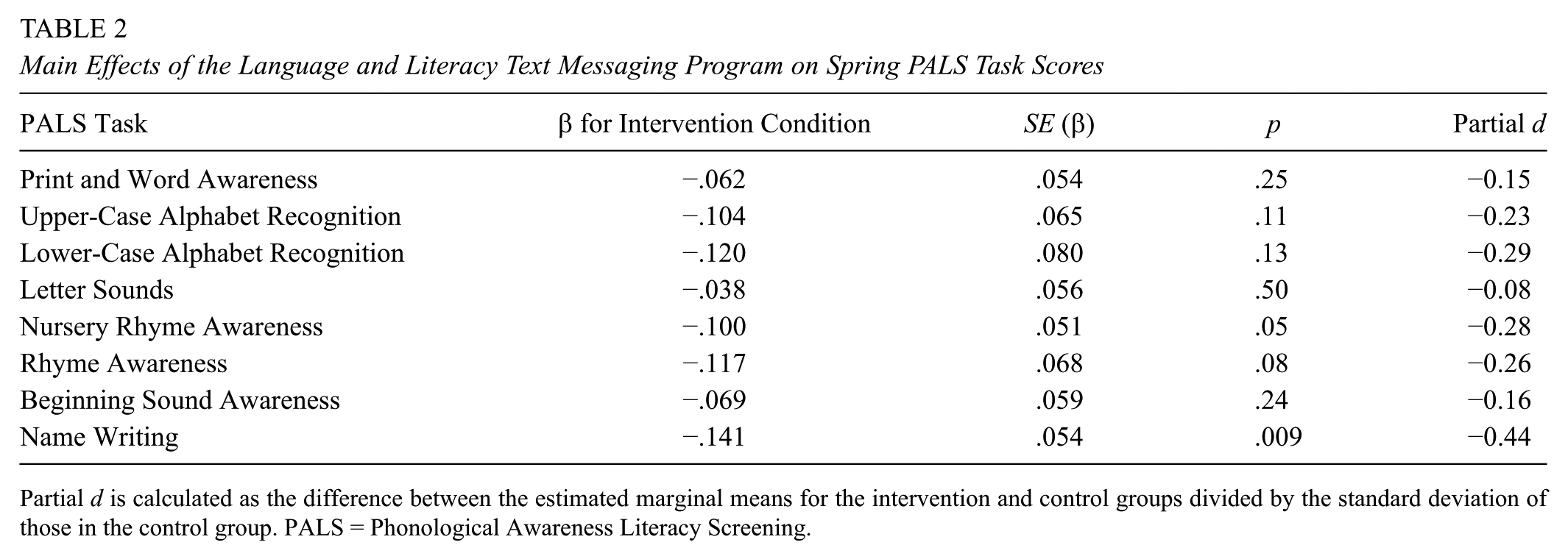
Partial d is calculated as the difference between the estimated marginal means for the intervention and control groups divided by the standard deviation of those in the control group. PALS = Phonological Awareness Literacy Screening.
Treatment by Baseline Interactions
Next, we tested the extent to which the effect of the intervention might vary with the child’s pretest score. This relation was tested by predicting each spring PALS task score from a dummy code representing the treatment condition (with the comparison condition as the reference group), the standardized fall PALS task score, the product of the condition dummy code and the standardized fall PALS task score, a dummy code for child gender, a collection of dummy codes for child race, and child age. Each PALS task was examined in a separate model. For the overall PALS fall score, 14.1% of the comparison group and 19.7% of the intervention group were less than 1 SD below the mean, whereas 16.7% of the comparison group and 21.1% of the intervention group were more than 1 SD above the mean. This suggests that our extreme groups were sufficiently large in both conditions to justify the use of the pretest scores as moderators.
Table 3 presents the standardized coefficients for the main effect of the treatment condition in each of these models. The coefficients for the demographics were omitted from the table for the sake of parsimony but can be obtained from the authors. After applying the Benjamini-Hochberg correction, we observed significant interaction effects for Print and Word Awareness, Nursery Rhyme Awareness, and Rhyme Awareness tasks, which are all illustrated in Figure 1. In all cases, children with relatively higher fall scores tended to perform better in the treatment condition, whereas those with lower fall scores tended to perform better in the comparison condition. The vertical lines in the plots delineate the regions of significance (Preacher, Curran, & Bauer, 2006) such that group comparisons at values of the fall score between the two lines are not significant and group comparisons at values less than the lower line or greater than the upper line are significant. Although the interaction for Letter Sounds was no longer significant after correcting for the Type I error rate (critical value of .025), we explored this interaction and found the same interaction pattern as the other three tasks. However, unlike the other three tasks, the comparison between the treatment and comparison groups was not significant at any specific value of the fall score.
Intervention by Fall PALS Score Interaction Effects on Spring PALS Task Scores

PALS = Phonological Awareness Literacy Screening.

Plots of significant condition by fall score interactions. (A) Print and Word Awareness. (B) Nursery Rhyme Awareness. (C) Rhyme Awareness.
Discussion
This study examined the effect of two contrasting parent text messaging programs on the early literacy skills of pre-kindergarten children. In the treatment condition, parents received texts that encouraged language and literacy interactions within the context of daily family routines. In the treated comparison condition, parents received texts that provided them with information on important developmental topics focusing on children’s health and well-being. Unexpectedly, our pattern of results suggested that the comparison condition had better literacy outcomes. This finding was qualified by a significant interaction such that children entering the school year with relatively higher skill levels appeared to benefit from the language and literacy text messaging program while children entering the school year with relatively lower skill level appeared to benefit from the health and well-being text messaging program.
Our results indicated that the health and well-being text messaging program, when compared with the language and literacy text messaging program, resulted in greater gains in children’s literacy skills over the course of the pre-kindergarten year. This pattern of results, with meaningful effect sizes across multiple measures (though nonsignificant), was unexpected not only because of past positive findings reported by York et al. (2018) for a similar language and literacy–focused text messaging program encouraging parent-child interactions but also because other targeted pre-kindergarten academic programs generally result in academic improvement in contrast to programs addressing the social-emotional skills and well-being of children only (Morris, Millenky, Raver, & Jones, 2013). However, upon close consideration, we noted this finding is somewhat consistent with York and colleagues’ reported finding for the study’s first cohort. In this cohort, parents received language and literacy messages comparable to our set of messages, with results indicating an overall negative, though nonsignificant, effect in favor of the control condition, which received placebo text messages every few weeks about nonrelated topics (e.g., immunization schedule). For their study’s second cohort, York et al. reported some findings favoring the treatment group when text messages included literacy, mathematics, and social-emotional skills. However, these positive effects appeared on two literacy subtests of the PALS-PreK measure—the Letter Sounds and Lower-Case Alphabet Recognition tasks—that were administered to only high-performing participants because this measure includes a branching structure such that children who score below a benchmark on easier subtests are not administered these harder subtests. Thus, consideration of the findings reported by York et al. should take into account this cautionary note regarding potential sample bias due to the administration guidelines for these tasks of PALS-PreK. In situating our results into the extant literature, it is important to note that York et al.’s study had a control group receiving placebo text messages, while our study featured two contrasting text messaging programs. Findings may have differed had we also included a third, placebo condition.
Although our findings suggest that children with higher initial skill levels appeared to benefit more from the language and literacy–focused program, future research should examine whether an optimal approach may combine academic topics with more basic information on positive parenting strategies to support children’s health and behavior. Indeed, York et al. (2018) demonstrated some evidence of promise in the more comprehensive text messaging program, and the authors hypothesized that rotating the domains of literacy, mathematics, and social-emotional skills may have enabled parents and children to stay engaged with the program over the 8-month program period (see also Hurwitz, Lauricella, Hanson, Raden, & Wartella, 2015). Another possible explanation of both their findings and ours is that this type of low-cost, technology-based support for informal literacy learning is only efficacious when parents are informed about and responding to the developmental needs of the whole child rather than isolating literacy skills. The comparison text messages targeting children’s health and well-being may have been of higher relevance to some parents, particularly if their children struggled with attention or behavior due to lack of sleep and routines that parents might have changed when texted information about positive parenting strategies on such topics. Ideally, any successful text messaging program should provide parents with information on evidence-based parenting strategies and thereby promote a qualitative shift in parenting practices. It is likely that parents would be more engaged and open to changing their behaviors if they perceived the program to be relevant to their needs and those of their children, and our findings suggest that preschoolers’ health and well-being is a relevant, foundational topic where families benefit from more information.
We must ask why the two types of text messaging programs in the present study appear differentially beneficial for children depending on their level of literacy skill upon entry into pre-kindergarten. There are several possible reasons for this result. First, as noted previously, the health/well-being text messaging program may have better matched the needs of children in lower end of the skill distribution. Second, children’s initial skill level could be serving as a proxy for socioeconomic status (e.g., maternal education) even within this relatively low-income group (Cabell, Justice, Logan, & Konold, 2013). Children living in poverty are more likely to suffer from a variety of risk factors, such as low-quality physical environments, inconsistent parenting, chronic stressors, poor nutrition, lack of sleep, and increased behavioral issues (Adams, Hillman, & Gaydos, 1994; Alaimo, Olson, & Frongillo, 2001; G. W. Evans, 2004; McLoyd, 1998). The health/well-being comparison text program may have effectively nudged parents to attend to ways to reduce stress, lack of sleep, or lack of exercise, which are known to impair executive functions (Diamond, 2013; Lowe, Safati, & Hall, 2017; Ludyga, Gerber, Brand, Holsboer-Trachsler, & Pühse, 2016). In turn, increased parental responsiveness to basic needs may have resulted in better academic performance (Landry et al., 2012). For example, text messages focused on healthy sleep habits may have resulted in better child ability to maintain attention or improved memory, which in turn enhanced literacy outcomes (Brock, Rimm-Kaufman, Nathanson, & Grimm, 2009; Moreau, Rouleau, & Morin, 2013).
In a similar vein, the literacy text messaging program may have better matched the needs of children entering the school year in the upper end of the skill distribution. Our literacy text messages may have unintentionally been geared toward more skilled children, who may have experienced more success with the activities and thus elicited a pattern of increased literacy interactions with their parents. There is evidence that a more differentiated literacy program tailored to skill level may be needed for the messages to serve the intended purposes of incrementally modifying parent-child interactions rather than simply serving as a nudge or reminder (Doss et al., 2018). In addition, the children at the upper end of the distribution may have gleaned more from activities as prior studies of classroom-based literacy interventions have often demonstrated that skill begets skill as children with relatively higher initial skills gain more from the treatment (Cabell et al., 2011; Ceci & Papierno, 2005; Justice et al., 2010; Penno, Wilkinson, & Moore, 2002). Further explanations for this finding are that it may have been challenging or even frustrating for parents of lower performing students to complete the suggested literacy teaching activities, whereas children with higher initial skills may have experienced greater success and pleasure when engaging in literacy teaching activities. Indeed, the parent involvement literature suggests that parents foster learning at home when they believe activities are developmentally appropriate and experience a personal sense of self-efficacy that they can help their child succeed in learning (Hoover-Dempsey & Sandler, 1997). Or, parents receiving literacy text messages may have become overly didactic and skill focused because of the emphasis on academic skills, resulting in less positive affective interactions (Baker, Mackler, Sonnenschein, & Serpell, 2001; Sonnenschein & Munsterman, 2002).
Limitations and Future Directions
There are several salient limitations of this study that warrant note, many of which are due to the low cost of the study. First, we were missing key measures that may have helped us better understand the impact of this intervention. Specifically, we did not measure children’s language skills because districts in the state in which our study took place do not typically collect language data on pre-kindergarten children. While this limitation is also present in other similar studies (e.g., York et al., 2018), half of our text messages were supporting children’s language development, and thus the omission of a language measure is a notable one and one that should be included in future research. In addition, health, cognitive, and social-emotional outcomes could have been measured to understand the potential mediating role of these skills in the relationship between informal learning and literacy achievement. We also did not obtain pre- and postintervention data regarding home literacy activities. The inclusion of some of these measures in future studies may help elucidate the reasons for the differential effects of the programs. Second, we did not try to facilitate parent involvement at school or link to resources and programs offered by the school (see York et al., 2018). Relatedly, our text messages were sent from an outside source (i.e., a text messaging service) rather than being perceived as coming from teachers, a trusted source. Teacher communication with parents to engage children in learning has been shown to be a powerful influence on their involvement (Anderson & Minke, 2007), and an educational text messaging program that featured the teacher sending the texts demonstrated positive effects on student learning (Kraft & Rogers, 2015). Future work should examine the effect of a text messaging program that is more aligned to classroom supports and delivered by classroom teachers or school personnel.
Perhaps the biggest limitation of the present study is the lack of tailoring the literacy intervention to meet the needs of parents and children. While we personalized messages with children’s names and gender, we did not personalize in ways that shared specific information about children’s level of skill or instructional needs or provide literacy activities that were differentiated to match children’s needs (Doss et al., 2018; Kraft & Rogers, 2015). Future programs may also be tailored to suit parents’ expressed needs as text messaging programs in the health field report positive effects of tailoring based on participant characteristics and situational factors (e.g., readiness for change, capacity; Lustria et al., 2013; Mistry, Sweet, Rhodes, & Latimer-Cheung, 2015; Noar, Benac, & Harris, 2007; Yan et al., 2015).
In conclusion, this study provides a cautionary note that one size seldom fits all. Parents and children seemed to respond differentially to the two conditions based on children’s initial skill levels. This study also underscores the difficulty of increasing children’s learning through this particular low-cost, scalable mechanism of text messages designed to promote positive parent-child interactions. Recent research demonstrates the viability of an alternate mechanism, namely, paying parents of preschoolers a modest sum for implementing activities ($0.50 per book reading session; Justice, Chen, Tambyraja, & Logan, 2018). It is clear that more work is needed to identify optimal approaches, and it is likely that the best solutions will employ a combination of approaches to support the diverse needs of families.
Supplemental Material
DS_10.1177_2332858419833339 – Supplemental material for Impact of a Parent Text Messaging Program on Pre-Kindergarteners’ Literacy Development
Supplemental material, DS_10.1177_2332858419833339 for Impact of a Parent Text Messaging Program on Pre-Kindergarteners’ Literacy Development by Sonia Q. Cabell, Tricia A. Zucker, Jamie DeCoster, Stefanie B. Copp and Susan Landry in AERA Open
Footnotes
Acknowledgements
We thank the district leaders, principals, teachers, children, and research staff who made this study possible. Special thanks to Maria Carlo, Heather Mui, Laura Fox, Erin Jacobs, and Xiaoning Natalie Wang for their contributions.
Funding
The research reported here was supported by the Institute of Education Sciences, U.S. Department of Education, through Grant R305A150319 to the University of Texas (PI: Tricia Zucker). The opinions expressed are those of the authors and do not represent views of the U.S. Department of Education.
Authors
References
Supplementary Material
Please find the following supplemental material available below.
For Open Access articles published under a Creative Commons License, all supplemental material carries the same license as the article it is associated with.
For non-Open Access articles published, all supplemental material carries a non-exclusive license, and permission requests for re-use of supplemental material or any part of supplemental material shall be sent directly to the copyright owner as specified in the copyright notice associated with the article.
