




Abstract
Vocational education and training (VET) is a common form of upper secondary school tracking in countries around the world. There are ongoing debates regarding the effects of this differentiation on academic and labor market outcomes; however, evidence on civic outcomes is lacking. Using a unique cohort study in Germany (N = 2461) and a doubly robust weighting approach with a rich set of baseline covariates to address selection bias, we estimated the effects of VET (relative to academic upper secondary school) on political interest, internal political efficacy, and intent to vote across 15 years of late adolescence and early adulthood. We estimated negative effects of VET on these civic outcomes, particularly as participants grew older. Implications for future research and VET policy are discussed.
Keywords
Political scientists and economists have long debated whether there are civic returns to education. However, the primary focus has been on years of schooling or educational attainment (e.g., Berinsky & Lenz, 2010; Dee, 2004; Kam & Palmer, 2008, 2011; Mayer, 2011; Milligan et al., 2004; Persson, 2013; Persson et al., 2016; Siedler, 2010; Sondheimer & Green, 2010). While this is an important initial investigation into the role of schooling for civic development, education varies beyond years or attainment.
One source of such variation is curricular tracking, which is implemented in nearly all educational systems around the world (Furuta, 2019), commonly with differentiation between academic and vocational/technical tracks after lower secondary schooling. The international research community has shown an increasing interest in the impacts of various forms of tracking on civic outcomes (Hoskins & Janmaat, 2016, 2019; Hoskins et al., 2016; Ichilov, 1991; Janmaat, 2011; Janmaat et al., 2014; Persson, 2012; Quintelier, 2010; van de Werfhorst, 2017; Witschge et al., 2019; Witschge & van de Werfhorst, 2020). However, only three peer-reviewed studies, to our knowledge, have examined the impacts of vocational tracking after lower secondary schooling on civic outcomes using longitudinal data: two in the United Kingdom and one in Sweden. While these studies have helped advance the field, they included limitations (described further below), which underscore the need for further inquiry.
Using a quasi-experimental design with rich baseline data from a cohort of German lower secondary school students, we estimated the effects of entering vocational education and training (VET; the commonly used international term) versus academic upper secondary school on several civic outcomes across 15 years of late adolescence and early adulthood. The outcomes included political interest, internal political efficacy (i.e., one’s belief that they understand and can contribute to political life), and intent to vote, which are expected to be predictive of civic participation, such as voting (e.g., Krampen, 2000; Levy & Akiva, 2019).
Tracking and Civic Development
While there are ongoing debates concerning developmental trajectories of civic attitudes across the life course, evidence suggests that adolescence and early adulthood are influential (e.g., Alwin & Krosnick, 1991; Andolina et al., 2003; Arens & Watermann, 2017; Baumert et al., 2016; Eckstein et al., 2012; Flanagan et al., 2005; Grob, 2009; Krampen, 2000; Neundorf et al., 2013; Neundorf et al., 2016; Russo & Stattin, 2017). This period clearly coincides with the time spent in schooling, which provides justification for studying the effects of VET on such outcomes.
Two primary mechanisms are discussed in the literature regarding how entering a vocational track versus academic track could cause differences in civic outcomes. The first concerns opportunities to learn. International research suggests that students in academic tracks, students with relatively higher socioeconomic status (SES), and students with higher levels of prior achievement tend to have more opportunities to learn about politics, government, and related school subjects and more opportunities to practice civic engagement (e.g., Achour & Wagner, 2019; Gökbudak & Hedtke, 2019; Ho, 2014; Hoskins & Janmaat, 2019; Ichilov, 1991; Kahne & Middaugh, 2008). Such differences in these inputs could lead to differences in student knowledge and skills, and in turn, their civic attitudes and participation.
Second, variation between tracks in peer composition may also impact students’ civic outcomes. Students in vocational tracks tend to have lower academic achievement as well as relatively lower socioeconomic status (Chmielewski, 2014; Köller et al., 2004; van de Werfhorst & Mijs, 2010; von Keyserlingk et al., 2019). Given the importance of peers and social capital for civic outcomes and the evidence of relatively lower levels of political participation among individuals from lower socioeconomic backgrounds (Beck & Jennings, 1982; Dalton, 2017; Jennings et al., 2009; van Deth et al., 2011; Verba et al., 1995), differences in peer groups between tracks may also contribute to varying student civic outcomes.
Current State of Empirical Literature
Although many educational systems around the world track students into vocational programs during upper secondary schooling, policymakers have very little evidence to refer to regarding the effects of such differentiation on student civic outcomes. A growing international literature base has certainly focused on different forms of tracking and civic outcomes (Hoskins & Janmaat, 2016, 2019; Hoskins et al., 2016; Ichilov, 1991; Janmaat, 2011; Janmaat et al., 2014; Persson, 2012; Quintelier, 2010; van de Werfhorst, 2017; Witschge et al., 2019; Witschge & van de Werfhorst, 2020), typically reporting findings in line with the argument that tracking leads to unequal civic development for students. However, only three studies, to our knowledge, have used longitudinal data to study the impacts of VET (vs. academic upper secondary school), and we focus our review on these studies.
Two recent studies in England considered the impacts of upper secondary school track on political participation. In the first, Janmaat et al. (2014) used nationally representative data (~13,000 students) from the Longitudinal Study of Young People in England to study the impact of tracking on voting behavior at age 20. They reported that those who were in a vocational track in less prestigious schools were significantly less likely to vote than those who pursued A levels in prestigious schools. Likewise, Hoskins and Janmaat (2016) used nationally representative data 1 from the Citizenship Education Longitudinal Study with a similar research question and approach to analysis, also including protesting in addition to voting. They reported that lower level vocational qualifications predicted significantly lower political participation relative to higher-level academic qualifications.
In the Swedish context, Persson (2012) collected data from 530 students (231 from vocational programs and 299 from theoretical programs) in three schools, one in each of three different municipalities. The first measurement point was at the end of comprehensive school, and the second was 1 year later. Using a difference-in-differences approach, the author estimated the effect of track on intentions for political participation. The participatory intentions included were intent to vote, a traditional participation index (party membership, contacting political representatives, writing letters, and [campaigning] for a political party), a nonparliamentary participation index (boycotting, “buycotting,” wearing a political badge, signing a petition, and demonstrating), and an illegal participation index (spray-painting, blocking traffic, and occupying buildings). The author reported that the differences in political participation that existed when students entered different types of education persisted 1 year later, concluding that variation in schooling due to tracking had no effect. However, there was some signal of effects, perhaps undetected due to a small sample size.
While the above studies have helped advance the field, limitations highlight avenues for further research. First, the studies included methodological limitations. In Janmaat et al. (2014), the authors did include measures of SES, ethnicity, and pretrack grades as covariates; however, they did not include a baseline measure of political participation (with voting at age 20 as the outcome). Rather, they relied on reading enjoyment and whether the student enrolled in history, citizenship, or geography in Grade 10. In Hoskins and Janmaat (2016), the authors did not present a model specification that includes both the treatment indicator(s) and all baseline covariates. Instead, the authors estimated/presented either incomplete specifications or specifications that included a component of the treatment (such as curriculum) or variables influenced directly by the treatment (such as their continued education or work posttreatment). Furthermore, the original study had sample attrition at about 96%, and the remaining 4% were used as the analytic sample, which raises questions about the validity of the results. In Persson (2012), the author was limited to a very small sample size with a small number of schools and only two measurement points 1 year apart. In all studies, the authors were limited to short durations for estimating effects. As such, it is an open question to what extent VET entry impacts civic outcomes in both the short term and the long term. Second, differences in reported findings may also be due to differences in educational systems (e.g., the strength/quality of VET in various countries). Sweden intensified the theoretical coursework in language and social science in vocational programs after a 1991 reform (Lindgren et al., 2019), and therefore, differences between groups may be less likely in the Swedish context. Third, these prior studies did not estimate effects on political interest nor internal political efficacy, two central outcomes that schools are equipped to impact. We address these limitations and gaps in the literature in the German context.
German Context
The typical tracking structure in Germany begins early on in lower secondary school (Grade 5), which differentiates between an academic track (Gymnasium), an intermediate track (Realschule), and a low track (Hauptschule). After lower secondary school completion (i.e., after Grade 10), students in the lower tracks typically enter one of two VET pathways (for an overview, see Protsch & Solga, 2016). Both types of VET are occupation specific (i.e., individuals train for a specific profession), and both typically require 3 to 3.5 years to complete. The academic track ends after Grade 12 or 13, leading to the university entry diploma (Abitur) and allowing students to take up university education (Baethge, 2008; Protsch & Solga, 2016). While some reforms have occurred since the time of data collection, the general structure of the upper secondary system remains largely the same today.
Several differences between upper secondary school tracks in Germany suggest the likelihood for differential civic development. First, regarding curricular differences, German VET students receive instruction in politics/civics and related areas; however, the hours of instruction tend to be lower, and the curriculum is less advanced than in the academic upper secondary schools (Zedler, 2006). Second, due to the stratification of students between the two tracks (Köller et al., 2004; Protsch & Solga, 2016; von Keyserlingk et al., 2019), and prior research on groups at risk of lower levels of civic engagement (Beck & Jennings, 1982; Dalton, 2017; Jennings et al., 2009; van Deth et al., 2011; Verba et al., 1995), peer effects are likely to be relevant. Finally, the typical vocational education pathway is quite distinct from academic education in Germany, with few students entering university education following VET, leading to further social and professional stratification following upper secondary schooling.
The Present Study
In this study, we used the case of Germany to estimate the effects of entering a VET pathway instead of academic upper secondary schooling on civic outcomes. Using a unique longitudinal cohort study, we identified those who entered either VET or academic upper secondary school after the completion of lower secondary school. We estimated the effects of this differentiation on political interest, internal political efficacy, and intent to vote at three time points during late adolescence and early adulthood. Given the differences outlined above, one would assume that the VET pathway is less equipped to foster civic development. However, we first needed to differentiate selection effects in student intake from the effects of differentiation. To do so, we employed inverse-probability-weighted regression adjustment (IPWRA) with an extensive set of pretreatment variables, including the formal selection mechanisms within the German educational system (i.e., lower secondary school track and grades), informal mechanisms for selection into tracks (e.g., SES), baseline measures of the outcome variables, and a wide range of additional covariates.
Data
The data come from the Educational Careers and Psychosocial Development in Adolescence and Young Adulthood Study (Bildungsverläufe und psychosoziale Entwicklung im Jugendalter und jungen Erwachsenenalter; BIJU). The Max Planck Institute for Human Development originally started the BIJU study during the fall of 1991 with a sample of students entering Grade 7 (Baumert et al., 1996). At the time of writing, the study included seven waves, the last in 2010. The original sample in 1991 was a stratified random sample of 7th graders from 212 schools. The sample was stratified by federal state and school type, followed by random sampling of schools within each stratum. Two classes were randomly drawn within each school. The study took place in four German states: North Rhine–Westphalia (the most populous state), Mecklenburg–West Pomerania, Saxony–Anhalt, and Berlin. Mecklenburg–West Pomerania, Saxony–Anhalt, and East Berlin were once part of the German Democratic Republic (GDR/DDR or East Germany), and North Rhine–Westphalia and West Berlin were once part of the Federal Republic of Germany (FRG/BRD or West Germany). There was oversampling of academic track schools, with all Grade 12 students being included from Wave 5 onward. Students from the original sampling were comparable to the later oversampled group, and sampling weights account for the differing sizes of the oversampled groups. Sample attrition at later waves of the BIJU study was typical for studies of this duration (Baumert et al., 2016; Becker et al., 2019). Baumert et al. (1996) provide a more detailed description of the original BIJU study, and Becker et al. (2019) provide further detail.
To estimate the effects of entering the VET pathway, we used the last four available waves of the study, starting at the end of their final year of lower secondary school (Grade 10), our baseline. The students in this cohort were in Grade 10 in 1995 and in their early 30s in 2010, the latest wave available at the time of writing. After limiting to students who entered a VET program or an academic upper secondary school as described further below, our final sample included 2,461 students (778 in VET and 1,683 in the academic track).
Measures
Descriptive statistics are presented for all variables in Tables 1 and 2. We also present the mean values for the outcomes across time by treatment and control groups in Figures 1 to 3.
Covariate Descriptive Statistics

Note. Variables without reported standard deviations are binary variables, and their means represent proportions.
Outcome Descriptive Statistics

Note. Variables without reported standard deviations are binary variables, and their means represent proportions.
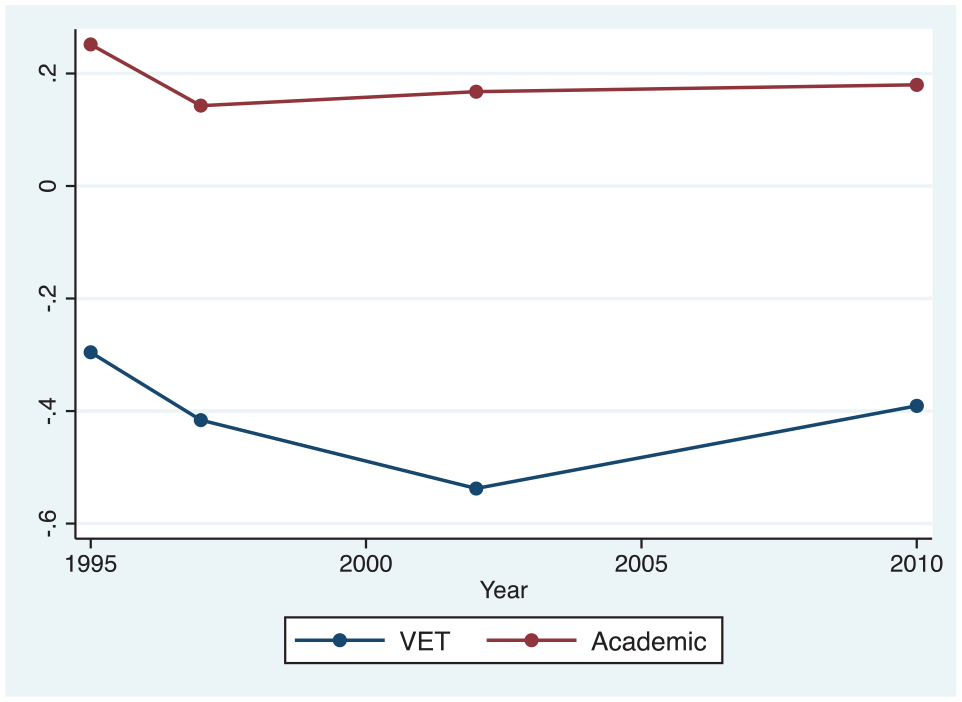
Political interest across time for vocational education and training (VET) and the academic track.

Internal political efficacy across time for vocational education and training (VET) and the academic track.

Intent to vote across time for vocational education and training (VET) and the academic track.
Outcome Variables
The outcomes in our study included political interest, internal political efficacy, and intent to vote. These outcomes were measured 2 years (1997), 5 years (2002), and 15 years (2010) after the baseline of our study (i.e., the end of lower secondary school in 1995). As mentioned previously, each of these outcomes is expected to be predictive of civic participation, including voting (e.g., Krampen, 2000; Levy & Akiva, 2019).
Political interest
To measure political interest, the survey item directly asked the respondent how interested they are in politics on a scale of 1 (not at all) to 5 (very strong).
Internal political efficacy
To measure internal political efficacy (referred to as self-concept of political competence in the original study), we used a four-item scale from prior German literature (Krampen, 1988, 1991). The scale is very similar to how the construct has been measured in American political science research (e.g., Niemi et al., 1991). Respondents rated themselves on a scale of 1 (does not apply at all) to 4 (applies entirely) on the following items: (a) “Thinking in political contexts suits me,” (b) “When it comes to discussing political problems, I can always think of something,” (c) “I understand political things easily,” and (d) “Participating in discussions about political issues is easy for me.” Reliability was high with Cronbach’s α > .9 across all waves.
Intent to vote
Respondents were asked to select or write in which political party they would vote for if the federal parliamentary (Bundestag) elections were the following day, regardless of whether they were old enough to vote. An additional response option was to not vote at all. Intended voting for any party was coded as 1 and not intending to vote was coded as 0.
VET (Treatment)
To determine whether the student entered the VET pathway, we used self-reported biography data. More specifically, students reported whether they were in an apprenticeship, vocational training, or retraining (In einer Lehre, Berufsausbildung, Umschulung) in each year between the ages of 16 and 22. The age range accommodates the range of birth years in our sample (1976—1980). To identify the control group, we included those who attained a university entry diploma (Abitur) on completion of academic upper secondary school and were not in a VET program. Very few students enter academic upper secondary school without attaining the diploma, making our approach appropriate. We do not include those who completed a VET program in addition to Abitur (in night school or Abendschule, for example) for the purposes of maintaining a clean comparison across the 15 years of the study. This is the purest distinction between vocational versus academic education within the German system. Our sample included 778 VET students and 1,683 academic upper secondary school students.
Covariates
As is discussed in the literature on selection bias, controlling for the pretreatment measure of the outcome is key (Steiner et al., 2010). Furthermore, inclusion of additional potential confounders, correlated with both the outcome and (self-) selection into the treatment, is of additional importance to obtain unbiased results (Austin et al., 2007). Therefore, we included the pretreatment measurements of our three outcome measures: political interest, internal political efficacy, and intent to vote (see above), as well as other crucial covariates to handle additional selection bias, described further below.
Lower secondary school track
This central covariate indicates whether the student was in the high track (i.e., Gymnasium) during lower secondary school. Being in the high track in lower secondary school is unquestionably predictive of continuing in the high track during upper secondary schooling and likely to be predictive of the outcomes in our study. Given similar selection mechanisms are at play when students are tracked into different school types after primary school, this is a crucial covariate in our study for addressing selection bias.
Academic achievement in core subjects and general cognitive abilities
For standardized academic achievement, we used test scores in mathematics and English. The mathematics test was composed of 34 items stemming from various national and international achievement studies (Baumert et al., 1986; Baumert et al., 1997; Travers & Westbury, 1989), with satisfactory reliability (Cronbach’s α = .76). English was similarly assessed using items from national and international studies (Baumert et al., 1986; Schrand et al., 1974; Walker, 1976), with high reliability (Cronbach’s α = .89). Although standardized achievement is not used for track allocation formally, these measures may capture information that lower secondary track or grades (both used formally in track allocation) do not and can also assist with precision in our estimates.
As nonstandardized indicators for academic achievement, we used Grade 10 mid-year grades in mathematics and German. Importantly, grades were and continue to be a primary source of information used in determining educational transitions for students in Germany. Having this information is critical for our research design. Lower secondary school grades in Germany range from 1 (very good) to 6 (unsatisfactory).
One’s intelligence may also confound our estimates. As such, we included a test of general cognitive abilities, which was assessed with the figural analogy subscales of the KFT 4–13+ (Heller et al., 1985), a slightly adapted German version of Thorndike’s Cognitive Abilities Test (Thorndike & Hagen, 1971). Reliability was high with Cronbach’s α = .88.
Socioeconomic background
Given the sorting of students between tracks based on socioeconomic background and the widely documented correlations with the studied outcomes, we included two measures in our study as proxies. For the first measure of socioeconomic background, we utilized the International Socio-Economic Index (ISEI), a measure of parent occupational prestige using a classification system based on the International Standard Classification of Occupations (ISCO-88). Parent occupations were reported by students, and we used the highest value between the two parents. Second, we included an indicator for parental education: whether neither, one, or both parents had a university degree.
Political knowledge
Absent from prior longitudinal studies of tracking and civic outcomes is a measure of political knowledge, which is also likely to be confounded with track and the studied outcomes. The test contained 13 questions, with six items on politics and the economy from former German studies (Beck & Krumm, 1990; Fend & Prester, 1986) and an additional six items from the assessment used in the first international comparative civic education study, part of the IEA Six Subject Survey (Torney et al., 1975). Arens and Watermann (2017) also provide further detail of the test. The reliability was satisfactory (KR-20 reliability = .76).
Political information behavior
As an additional control, we included student-reported political information behavior (Krampen, 1988), assessing the frequency of each of the following from 0 (never) to 5 (daily): (a) “conversations with friends, parents, and/or siblings on political topics,” (b) “reading political news in daily newspapers,” (c) “watching news programs on television,” and (d) “watching political news programs and political discussion/debates on television.” Reliability was satisfactory (Cronbach’s α = .79).
Additional demographic variables
For additional demographic variables, we included sex, an indicator for migration background (whether at least one of the parents was born abroad), federal state (i.e., Bundesland) at Grade 7, and an indicator for students in former East German territory (i.e., the GDR/DDR).
Analysis
Beyond the well-documented differences between tracks in academic achievement and SES, more politically knowledgeable, efficacious, or engaged families and students may also sort into academic upper secondary schools (evident in our sample at the baseline in Figures 1–3 and also in Table 3). The differences between the student populations that enter vocational versus academic upper secondary schooling make the study of such forms of tracking empirically challenging. Fortunately, we had access to rich baseline data to model formal and informal sorting mechanisms into the treatment, also likely to be correlated with the outcomes in our study.
Predicting Treatment (Vocational Education and Training)
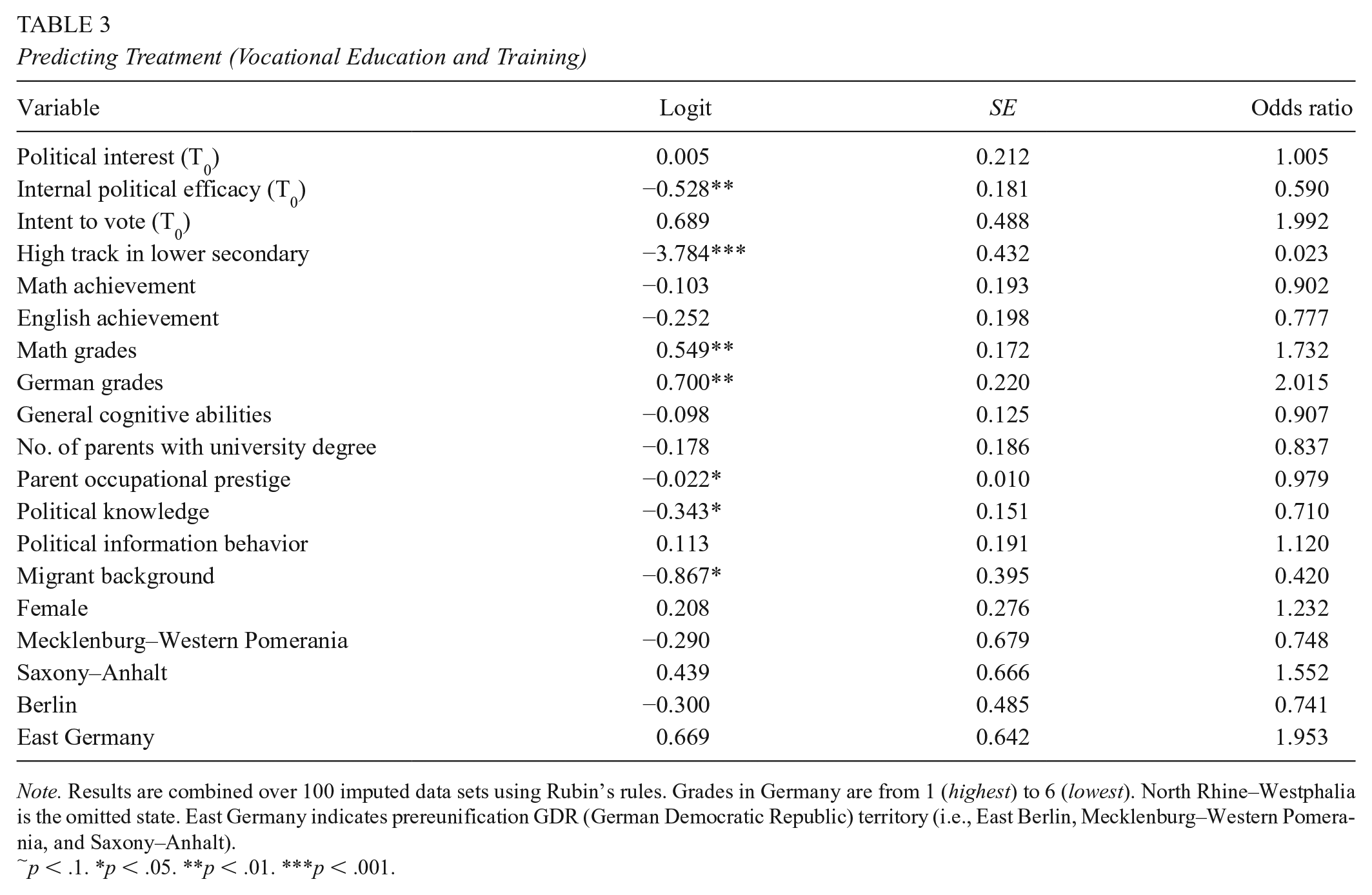
Note. Results are combined over 100 imputed data sets using Rubin’s rules. Grades in Germany are from 1 (highest) to 6 (lowest). North Rhine–Westphalia is the omitted state. East Germany indicates prereunification GDR (German Democratic Republic) territory (i.e., East Berlin, Mecklenburg–Western Pomerania, and Saxony–Anhalt).
p < .1. *p < .05. **p < .01. ***p < .001.
Given the large differences between groups at baseline, we utilized a doubly robust weighting estimator. A selection-on-observables approach, IPWRA 2 uses inverse probability weights to address the issue of only observing one potential outcome for each student. In the first step, we estimated the predicted probability of treatment for each individual in the sample based on the covariates described above, generating the inverse probability weights for the second step. With the computed weights, we estimated weighted regression models, regressing the outcome on the treatment indicator and all covariates. Typical in observational studies (and of interest in our study), we estimated the average treatment effect on the treated (i.e., VET students). We used the teffects ipwra package in Stata 16 for these analyses.
The combination of weighting and the additional regression adjustment produces the doubly robust property, should the weighting procedure not perfectly address the imbalance between treatment and control groups (Morgan & Winship, 2014). Generally, doubly robust approaches are considered superior to matching or weighting approaches without additional regression adjustment or bias correction (Abadie & Imbens, 2011; Hernán & Robins, 2020; Imbens & Wooldridge, 2009).
As with any rigorous empirical study using matching or weighting, we relied on our rich set of baseline covariates. We included all covariates described above (see Measures section for rationale on inclusion): baseline measures of the outcomes, lower secondary school track, standardized and nonstandardized measures of academic achievement in math and language, general cognitive abilities, measures of socioeconomic background, political knowledge, political information behavior, and additional demographic characteristics (sex, migration background, federal state, and an indicator for East Germany 3 ). For modeling of the continuous outcomes (political interest and internal political efficacy), we estimated linear regressions, and for the binary outcome (intent to vote), we estimated linear probability models. In addition to the standard error correction due to the multistep estimation procedure, we clustered standard errors on the originally sampled secondary school, and sampling weights were utilized across all models.
Missing Data
Missing data on several covariates and outcomes was quite high (see Tables 1 and 2). To address this and maintain needed statistical power, we employed multiple imputation. To handle the high proportion of missing data (Graham, 2009), we imputed 100 data sets using -mi impute chained- in Stata 16, with routines (both the estimation of the treatment model and outcome analyses) repeated for each imputed data set and combined thereafter using Rubin’s (1987) rules for pooling the results, with the appropriate standard error corrections. Following missing data analysis conventions (Graham, 2009), all variables used in treatment and outcome models were used in the imputation model.
Results
We sought to estimate whether entering VET versus academic upper secondary education results in deleterious effects on civic development across the life course. To do so, we needed to adjust for the large differences between groups on baseline measures of the outcomes and additional sources of selection bias. First, we display the results from a logistic regression model predicting treatment in Table 3, strictly to demonstrate selection into treatment (i.e., the VET group). As expected, being in a high track school during lower secondary education was negatively predictive of being in VET in upper secondary school, as were higher grades in lower secondary school and higher SES (at least in terms of a widely used international measure of parent occupational prestige). Political knowledge and the baseline measure of internal political efficacy were also conditionally, negatively predictive of VET, which underscores the importance of including both in our study. Pretreatment political knowledge has been unavailable in prior related studies.
In Table 4, we present the raw and inverse-probability-weighted baseline differences between treatment and control groups on all covariates. As expected, raw baseline differences between the two groups were large for baseline measures of the outcomes, whether an individual attended a high track school in lower secondary education, academic achievement in core subjects, cognitive abilities, socioeconomic background, political knowledge, and political information behavior. Several standardized mean differences were greater than one standard deviation. Weighting led to a substantial improvement in balance across these important covariates. However, balance was not perfect after weighting, highlighting the importance of further regression adjustment.
Covariate Balance Between Treatment and Control Groups for Raw and Weighted Data

Note. N = 2,461. Statistics are standardized mean differences (VET – control). Results are combined over 100 imputed data sets using Rubin’s rules. Balance statistics not available for omitted dummy categories. North Rhine–Westphalia is the omitted state. East Germany indicates prereunification GDR territory (i.e., East Berlin, Mecklenburg–Western Pomerania, and Saxony–Anhalt). VET = vocational education and training; GDR = German Democratic Republic.
Table 5 provides our main results. We estimated no statistically significant effects of VET on political interest at T1 or T2 (albeit with wide confidence intervals and some tentative evidence of signal at T2) and a large, statistically significant, negative effect of VET on political interest at T3 (d = −0.465). For internal political efficacy, the estimated effects at T1 and T2 were not statistically significant (although sizable, with wide confidence intervals), and we again estimated a large, statistically significant, negative effect of VET on internal political efficacy at T3 (d = −0.539). Finally, we estimated statistically significant, negative effects of VET on intent to vote at all three time points, ranging from a decreased probability of intending to vote of 22.5% at T1 to a decreased probability of intending to vote of about 15% at T2 and T3.
Effects of VET on Civic Outcomes Across Late Adolescence and Early Adulthood

Note. N for each model = 2,461. All covariates in Table 1 were included for estimating weights and for further regression adjustment. Robust standard errors were clustered on secondary school, and survey/sampling weights were also utilized. Results are combined over 100 imputed data sets using Rubin’s rules. Intent to vote effects were estimated using linear probability models. ATET = average treatment effect on the treated; VET = vocational education and training.
p < .1. *p < .05. **p < .01. ***p < .001.
Discussion
Our goal in this study was to estimate the effects of entering VET versus general academic upper secondary schooling in Germany on political interest, internal political efficacy, and intent to vote during late adolescence and early adulthood. With the rich set of covariates at our disposal and use of the doubly robust weighting estimator described above, we sought to address the formal and informal mechanisms of selection into treatment and additional sources of confounding, which was crucial given the earlier sorting of students into lower secondary school tracks based on grades (formally) and SES (informally) and the further sorting of students after lower secondary school.
The results from our study suggest meaningful negative effects of attending VET on this specific set of civic outcomes, particularly during early adulthood after the completion of schooling. Estimating effects later in life was an important aspect of our study, given prior longitudinal research estimated effects only in the short term, and the substantial negative effects we estimated later in life on two of the outcomes would have otherwise gone uncovered. Although the estimated effects for political interest and internal political efficacy were not statistically significant at T1 or T2, the effects on intent to vote were negative across the 3 time points. 4
By the time the individuals were in their early 30s, the two groups clearly diverged across each outcome, which we argue was due both to the differentiation in schooling, and, in turn, future opportunities and social stratification (due to the treatment). As prior scholars have highlighted, early benefits of VET for students regarding labor market outcomes may subside as time goes on and future work opportunities are constrained (Hanushek et al., 2017). Such constraints may have also led to lower interest in political life and lower political efficacy, a potential realization later in life among VET graduates that the system was working less well for them. It is also plausible that negative effects were present at T1 and T2, and we were simply unable to detect them due to statistical power, which would be in line with the consistent negative effects on voting intentions, as those who are interested and have higher internal political efficacy tend to also plan on voting.
These findings should be taken into account when considering potential benefits of VET and when developing/reforming current systems of vocational education. However, more research is needed to uncover which specific individual processes and mechanisms foster civic development, both in academic and vocational tracks and why any negative effects of VET arise at various times throughout the life course, which will assist with potential intervention.
While our study is novel, there were limitations, which suggest further avenues for future research. First, we relied on selection-on-observables in the context of clear, nonrandom sorting to treatment and control groups. In doing so, we relied on a limited area of common support for making inferences. That said, the observed variables used in this study addressed both the formal and informal mechanisms of student sorting between tracks (i.e., lower secondary track, grades, SES, etc.), in addition to adjusting for further potential confounders. The second limitation concerns external validity. Our study was focused on one German cohort from four German states at a time when students in Germany were encountering dramatic changes in society. Future research should seek to replicate our findings with more recent cohorts in Germany and in other country contexts, with larger samples to allow for more precise estimates. No prior research exists on this topic in the U.S. context, for example, and career and technical education is currently a major education policy topic.
Further extensions are also needed. We focused our study on interest, efficacy, and intent to vote. Future research should study the effects on knowledge (unavailable at later waves in our study), skills, external political efficacy, trust, and actual behaviors/participation such as voting, among others. Additional empirically rigorous research is needed to provide policy makers with guidance regarding how to maintain any benefits of VET while also fostering (and certainly not suppressing) youth civic development.
Footnotes
Acknowledgements
We thank Jesse Bruhn, Nicolas Hübner, Susanna Loeb, Susan Moffitt, and Herman van de Werfhorst for their thoughtful suggestions on earlier versions of this article. Any errors or omissions are our own. This research project was supported, in part, by the Tübingen Postdoctoral Academy for Research on Education (PACE) at the Hector Research Institute of Education Sciences and Psychology, Tübingen; PACE is funded by the Baden-Württemberg Ministry of Science, Research, and the Arts. The data files for the current study can be found at  .
.
Notes
Authors
COREY SAVAGE is a researcher at the American Institutes for Research. He studies civic education, teacher policy, and curricular reform.
MICHAEL BECKER is a professor of empirical educational research at the Center for Research on Education and School Development at the Technical University Dortmund and a research fellow at the Center for Educational Governance at the DIPF, Leibniz Institute for Research and Information in Education. He studies cognitive and socioemotional development and effects and returns of education across the life span.
JÜRGEN BAUMERT is a professor emeritus at the Max Planck Institute for Human Development and a professor of education at Humboldt University and Free University of Berlin. He studies learning and instruction, teacher expertise, development of educational systems, and cognitive and motivational development in childhood and adolescence.