




Abstract
Narrative accounts of classroom instruction suggest that external interruptions, such as intercom announcements and visits from staff, are a regular occurrence in U.S. public schools. We study the frequency, nature, duration, and consequences of external interruptions in the Providence Public School District (PPSD) using original data from a district-wide survey and classroom observations. We estimate that a typical classroom in the PPSD is interrupted more than 2,000 times per year and that these interruptions and the disruptions they cause result in the loss of between 10 and 20 days of instructional time. Several findings suggest that there exists substantial scope for reducing interruptions. Administrators appear to systematically underestimate the frequency and negative consequences of interruptions. Furthermore, interruptions vary widely across schools and are largely caused by school staff. Schools might reduce disruptions to the learning environment by creating a culture that prioritizes instructional time, instituting better communication protocols, and addressing the challenges posed by student tardiness.
Keywords
If the teacher is so important among the many items that are required for a successful school program, why are teachers seldom given more than 30 minutes of uninterrupted time to perform their very important functions? Teachers are forced to work in the midst of a continuing barrage of different interruptions. . . . It is difficult to believe that there could be such a record of interruptions—unless it were planned by someone who wanted to wreck the school program.
Eye’s (1955) sharp criticism of the frequent interruptions to classroom learning in U.S. public schools appears as relevant today as it was more than six decades ago. Sociological studies (Lortie, 1975; Paisey, 1981; Sizer, 1984) and educators’ personal accounts describe external intrusions into the classroom as a regular phenomenon in U.S. schools (Armstrong, 1995; Clavel, 2003; Elovitz, 2001, 2002; Mathews, 2007). These authors narrate in vivid terms the “exasperating” and “constant annoyance” of external interruptions that are a “pedagogical disaster” and an “insidious waste of instructional time.” Yet we still lack the systematic evidence necessary to judge whether external interruptions are an infrequent and necessary annoyance or a common and avoidable detriment to the learning environment.
We define external interruptions as intrusions from outside the classroom that are not under the direct control of classroom teachers. This definition distinguishes our focus from the large body of literature on internal interruptions caused by off-task student behavior (Little & Akin-Little, 2008; McLeod et al., 2003). Unlike internal interruptions, many external interruptions are caused by school staff and are under the direct control of the school leadership. Commonly cited examples of external interruptions include announcements made through school intercom systems, calls to classroom phones, classroom “drive-bys” by school staff, and student pullouts.
The best available evidence about the prevalence of external interruptions comes from the cross-cultural Third International Mathematics and Science Study video study of instruction from two decades ago. Stigler et al. (2000) found that outside interruptions occurred during 30% of 8th-grade mathematics lessons taught in U.S. public schools but were never once observed in Japanese classrooms. These findings have received surprisingly little attention given the potential negative effects of even brief interruptions on students’ opportunities to learn (Pianta et al., 2007) via lost instructional time and lesson momentum (Kennedy, 2005). Psychological research clearly documents the negative impacts of interruptions on cognitive performance in laboratory settings (Altmann et al., 2014; Cades, 2011; Gillie & Broadbent, 1989; Rosen et al., 2011).
In this study, we provide large-scale descriptive evidence about the frequency, nature, duration, and consequences of external interruptions to classroom learning in a medium-size U.S. urban public school district. We examine interruptions in the Providence Public School District (PPSD), working in collaboration with the district to collect original data from school climate surveys and classroom observations. More than 13,800 students, 1,500 teachers, and 70 administrators responded to a range of survey items asking about the frequency of external interruptions and the degree to which they disrupt learning. We complement these survey data with observational data and field notes collected during 63 classroom observations in five PPSD high schools. Using an original observation instrument, our research team timed and cataloged external interruptions across 10 teachers’ classrooms, while also capturing the observable consequences of these interruptions for instruction and the learning environment. We use these survey and observational data to answer three primary research questions:
How frequent are external interruptions, what causes them, and when do they occur?
How do external interruptions affect instructional time and the learning environment?
Do principals accurately perceive the frequency and consequences of external interruptions?
Our mixed-methods approach to studying external interruptions makes several contributions to the literature. Our quantitative data provide, for the first time, a precise accounting of the instructional time lost due to externally generated classroom interruptions and the resulting disruptions that these intrusions cause. We estimate that, over the course of an academic year, PPSD high school students experience more than 2,000 instances of external interruptions. Both survey and observational data suggest that these interruptions and the subsequent disruptions they cause result in the loss of between 10 and 20 days of instructional time over the course of the academic year—enough time to consider all PPSD students truant or even chronically absent (Sutphen et al., 2010).
Our qualitative field notes reveal new insights about the ways in which interruptions disrupt the learning environment. For example, we observed a frequent source of interruptions that has received little attention in the research literature—tardy and returning students who disrupt instruction when they (re)enter the classroom. We also observed how brief interruptions can create longer and distinct classroom disruptions, force teachers to have to reteach material, and lead classes to adopt habits of regularly starting late and ending early.
Our mixed-methods analysis documents how interruptions are a malleable feature of the learning environment that differs substantially across schools. Students in some PPSD schools experience three times as many interruptions as do students in other schools. Such large differences within the same district and grade levels suggest that there is considerable potential for organizational approaches to reduce the prevalence of interruptions, especially given that most interruptions are caused by school staff. One potential explanation for the lack of school-wide systems and norms for minimizing interruptions is that principals appear to systematically underestimate the frequency and negative consequences of external interruptions. We conclude by discussing a range of practical approaches that schools can employ to reduce external interruptions to classroom learning.
Taken as a whole, our study suggests that minimizing intrusions into the classroom is among the most feasible and cost-effective ways that schools can increase instructional time. Our findings also suggest that limiting these frequent interruptions may have several benefits beyond maximizing the opportunity to learn in schools. A school environment where frequent interruptions are the norm creates stress for teachers and students alike and conveys a degree of disregard for their efforts to teach and learn. Schools that buffer classrooms from external interruptions are more likely to succeed at creating an environment where both teachers and students feel respected and empowered to do their best work.
Theory and Prior Research
Foundations in the Psychological Literature
Research on the effects of interruptions has a long history in organizational and personality psychology. This literature defines an interruption as “a temporary suspension of a person’s goal-directed action” (Brixey et al., 2007, p. E30). Interruptions are loosely categorized into two groups: external and internal. External interruptions are unexpected and outside the control of an individual. In contrast, internal interruptions originate from within individuals, stemming from their own thoughts, emotional states, or physical needs. We adapt this framework to focus on classrooms as the unit of analysis where external interruptions originate from the larger school environment and are largely outside the control of individual classroom teachers. Scholars have also developed a framework for characterizing the phases of the interruptive process where (1) a primary task is interrupted, (2) an interruption lag occurs as the individual perceives the interruption and decides whether to act on it, (3) a resumption lag occurs as the individual recalls from memory the information needed to resume the primary task, and (4) the individual resumes the primary task (Baethge et al., 2015).
Psychological studies suggests that interruptions have harmful effects that extend well beyond the time lost to interruption and resumption lags. Lab experiments document the detrimental effects of interruptions on task performance, stress, and overall well-being. Studies of resumption lag show how interruptions result in additional time lost due to the effort it takes to collect one’s thoughts and resume the original task (Altmann & Trafton, 2004; Monk et al., 2008). Other lab experiments illustrate how interruptions negatively affect knowledge acquisition and the ability to recall information flexibly, particularly when completing more complex tasks (Cades, 2011; Foerde et al., 2006; Gillie & Broadbent, 1989; Rosen et al., 2011). Even brief interruptions can drastically lower performance and increase the number of errors made while completing a sequenced task (Altmann et al., 2014; Eyrolle & Cellier, 2000). However, it remains an open question about the degree to which these findings are generalizable to real-world settings such as offices and schools.
Conceptual Frameworks for Analyzing Interruptions in Schools
Scholars have applied the psychological theories of flow and volition to elucidate how and why interruptions have harmful effects in the context of formal schooling. Csikszentmihalyi’s (1990) theory of flow—a state of intense concentration, interest, and enjoyment in an activity—describes how individuals can become so focused that they become absolutely absorbed in an activity. However, this balance is fragile. In schools, disruptions stemming from classroom contexts can break students’ flow and engagement in their work (Shernoff et al., 2003). Csikszentmihalyi (2014) observed that Montessori schools are more successful at promoting engagement, in part, because in traditional schools “there is constant interruption from the loudspeaker” (p. 145). Scholars have also pointed to the importance of students’ volition within school settings in which distractions are the norm (Corno, 1993). Modern theory on volition characterizes it as the strength of will that “energizes the maintenance and engagement of intended actions” (Kuhl, 1985, p. 102). Volition serves as the psychological control process that protects students’ concentration in the face of internal and external distractions. Together, these theories illustrate how interruptions can undercut student engagement, requiring students to exhibit high degrees of volitional regulation to overcome frequent environmental distractions.
Conceptual models of teaching and learning also point to the negative effects of external interruptions in schools. Carroll’s (1963) seminal model of school learning describes the opportunity to learn as one of five key variables that shape students’ success in school. Interruptions can diminish the opportunity to learn by reducing the amount of allocated learning time that is converted into enacted learning time (Phelps et al., 2012). Interruptions can also directly affect teachers’ instructional practices in school. Mary Kennedy describes this phenomenon as the “loss of instructional momentum” in her book, Inside Teaching (2005). Drawing on extensive interviews with teachers, she writes about how small classroom distractions can easily escalate into larger ones. These disruptions to lesson momentum often required teachers to spend additional time restating directions, reviewing earlier content, and reenergizing students. Thus, interruptions can negatively affect both the potential time for learning in school and the amount of material teachers can cover.
Evidence From School Settings
Research on classroom interruptions dating back to the 1950s consistently finds that students must navigate frequent environmental distractions during the school day. Hartwell et al. (1954) worked with 307 U.S. teachers to track interruptions and found that teachers reported a high percentage to be “unnecessary” or of “questionable importance” (p. 13). Eye (1955) categorized interruptions across 40 class periods in U.S. public schools, citing frequent examples such as “the use of the public-address system at unanticipated times,” student “tardiness,” and teachers “dropping in on a neighboring teacher for a chat” (p. 36). Prewett (1956) analyzed essay responses from more than 400 U.S. teachers about the conditions that prevent them from doing their best teaching and found that interruptions were the most frequently cited challenge in the classroom. Dalton (1964) found that U.S. administrators underestimated the degree to which classrooms in their schools were disrupted by external interruptions and misidentified the most frequent types of interruptions. These studies document the long-standing challenge of external interruptions in U.S. schools.
Research by Lawrence Leonard provides more current evidence on the frequency of external interruptions to instructional time in U.S. and Canadian schools. In the first of his studies, Leonard (1999) observed 91 class periods across 12 schools in rural Western Canada and estimated that students experienced an average of 12 interruptions per school day. In follow-up studies, Leonard (2001, 2003) surveyed teachers in Saskatchewan and Louisiana and found that more than half the teachers estimated that their classes were interrupted three to four times each school day, with the majority of teachers identifying intercom announcements as the most frequent source of interruptions. Leonard (2008) also documented how administrators in Louisiana perceived that classrooms in their schools were interrupted only once or twice daily, a substantially lower rate than that commonly reported by teachers. This motivates us to further examine the degree to which administrators accurately perceive how often external interruptions occur in their schools.
Evidence on how external interruptions affect learning time remains both mixed and quite limited. Teachers’ perceptions about the effect of interruptions differ, with approximately half reporting that external interruptions are a serious problem that “impedes educational progress” and requires them to “re-teach material” while a quarter see them as a “relatively harmless fact of school life” that has “little or no manner of effect” (Leonard, 2001, 2003). In a field-based study of 58 early-career teachers in the United States, Doyle (1997) concluded that external interruptions contributed to unpredictability in the sequence of classroom events and that teachers frequently felt frustrated by interruptions. A study comparing organizational practices across U.S. schools where students exceeded versus underperformed their predicted level of achievement found that positive outlier schools were much less likely to use intercom systems or pull students out of classes (Stringfield & Teddlie, 1991). Despite this emerging empirical evidence, we still know very little about the consequences of interruptions on students’ learning environments in schools. We explore these questions here.
Research Design
Site
We study the phenomenon of outside interruptions to classrooms in the PPSD, the largest school district in Rhode Island. The PPSD serves approximately 24,000 students across 41 schools. Students in the district come from predominantly low-income families and families of color; 80% of students are eligible for free or reduced-price lunch, and 81% of students are Hispanic or African American. As shown in Table 1, the PPSD is broadly representative of other urban public school systems in the United States but serves a significantly greater percentage of Hispanic students. In comparison with other mostly rural and suburban districts in Rhode Island, schools in the PPSD have larger enrollments, more students per teacher, and a greater percentage of English-language learners.
Student Characteristics

Note. Achievement is measured based on the 2017 PARCC assessment. The mobility index measures the proportion of students who moved into or out of the school during the school year. Classes with quality teachers refers to the percent of classes within the school that are taught by highly qualified teachers. P values reported in Column 6 are t tests of the differences in average student characteristics at the school level, weighted by student enrollment. PARCC = Partnership for Assessment of Readiness for College and Careers; ELA = English-language arts; PPSD = Providence Public School District. From U.S. Department of Education, National Center for Education Statistics, Common Core of Data, “Public Elementary/Secondary School Universe Survey,” 2013–2014 (version 1a).
A recent review of the PPSD led by researchers at the Johns Hopkins Institute for Education Policy (2019) describes a struggling school system with structural deficiencies and low levels of academic instruction. Indeed, only 15% of PPSD students in Grades 3 through 10 were proficient in math, and 18% were proficient in English-language arts (ELA) on the 2016–2017 Common-Core aligned Partnership for Assessment of Readiness for College and Careers (PARCC) achievement test compared with 32% and 39%, respectively, statewide.
Sample and Data
Our study involved two primary data sources and samples: respondents to the district-administered school climate survey and PPSD high schools and high school teachers who volunteered to participate in our classroom observation study. The anonymous district climate surveys, developed by Panorama Education, are completed annually by administrators, teachers, and students in Grades 3 through 12. All versions are administered online during a common window of time between January and February. We integrated a supplemental set of questions about external interruptions into the teacher and student surveys in 2017 and into all three surveys in 2018. A total of 1,576 teachers and 13,958 students completed the survey in 2017—a 75% response rate for teachers and 73% for students. The following year, 76 administrators, 1,480 teachers, and 13,875 students took the climate survey for response rates of 75%, 72%, and 75%, respectively.
In January 2017, we recruited PPSD high school principals to participate in our observational study. Our focus on high schools was motivated by exploratory interviews with Rhode Island teachers, which suggested that external interruptions were particularly frequent and disruptive in larger high schools (see Supplemental Appendix A [available in the online version of the article] for a detailed description of the exploratory interview process). Five PPSD principals accepted, two declined, and four did not respond to our attempts to contact them.
In Figure 1, we compare the five high schools that opted to participate in our classroom observation study relative to other PPSD schools on achievement and the percentage of students eligible for free or reduced-price lunch. With the exception of the clear outlier in our sample—a selective enrollment public high school with a 30% acceptance rate—schools that agreed to participate were broadly representative of the 11 high schools in the district. As shown in Table 1, Column 6, we find two statistically significant differences between participating and nonparticipating high schools across 15 measures based on school-level t tests with limited power. Participating high schools enrolled fewer English-language learners and suspended students at lower rates than nonparticipating high schools. Proficiency rates in math and ELA at participating high schools were almost 15 percentage points higher than nonparticipating schools although these differences are not significant. These patterns suggest that schools in our observation sample faced fewer organizational challenges than other PPSD high schools and likely provide a conservative estimate of the frequency of external interruptions.

Student achievement and the percentage of students from low-income families in PPSD schools.
Principals of participating high schools nominated up to three teachers that would host observers during the 2017 spring semester. We asked principals to identify teachers that would provide a representative range of classroom environments in their school. We then approached the nominated teachers, described the purpose of our study, and coordinated directly with them to schedule observation dates. All 10 of the teachers we contacted agreed to participate in the study. In Table 2, we report on the characteristics of participating teachers and the classes they taught. Teachers were predominantly White and had an average of almost 10 years of total teaching experience and 6 years of teaching experience in their current school. Similar to our sample of participating high schools, we might expect this relatively experienced sample of teachers to provide a conservative estimate of the time lost to interruptions assuming more experienced teachers are better at keeping students on task during and after an interruption.
Characteristics of Providence Public School District High School Teachers in Observational Sample and Classes Observed

Note. Time of day of class is reported as the start of the class period.
We observed a total of 63 class periods between March 10th and June 6th. We sampled classes, observation days, and periods using a purposive approach to ensure that we obtained a broad range of instructional contexts. As shown in Table 2, our sample of observed classes represents a wide range of subjects, grade levels, periods during the day, and days of the week. On average, classes were 66 minutes long and had 14 students in attendance. Out of all classes observed, 16% were Advanced Placement classes, and 36% had a teaching assistant.
We combine these original survey and observational data with administrative data provided by the PPSD on student performance, student demographics, and school characteristics from the 2015–2016 and 2016–2017 school years. We measure achievement based on the percentage of 3rd through 10th grade students that are proficient on the PARCC assessment in math and ELA. We also predict a measure of the average student achievement at each school by applying a heteroskedastic ordered probit model to count data on the number of students that scored at each of the five performance levels on the PARCC exams (Reardon et al., 2017). These school-level means can be interpreted as averages of the underlying continuous test score distributions measured in student-level standard deviation units.
Data Collection and Instruments
District Survey
We worked with the PPSD Office of Research, Planning, and Accountability to develop and include several supplemental items on their 2017 district-wide school climate surveys inquiring about teachers’ and students’ experiences and perspectives on external classroom interruptions. Before answering survey questions about interruptions, respondents were prompted to read a brief statement describing the focus on interruptions from outside the classroom. The description provided a nonexhaustive example list that included intercom announcements, visits from other teachers or aides, telephone calls to a classroom phone, and administrator visits. The statement also clarified that the definition did not include disruptions that originated from inside the classroom due to general student misbehavior such as the use of personal cell phones.
We developed the original survey items in partnership with the PPSD and refined the questions based on feedback from cognitive interviews with current PPSD teachers and high school students about how they interpreted the survey items (Gehlbach & Brinkworth, 2011). To aid in comparisons across respondents, we used identical item stems and response anchors whenever possible. We included a similar set of questions on the 2018 district surveys, adding the items to the administrator survey as well. See Supplemental Appendix B for the full survey protocol and items we included in the 2017 and 2018 PPSD surveys.
Classroom Observations
The authors and a team of undergraduate research assistants conducted the classroom observations. At the beginning of each visit, teachers briefly introduced observers to the class without going into detail about the purpose of the study. During the class period, observers used an original data collection instrument we developed to record instances of external interruptions such as intercom announcements, calls to the classroom phone, visits or (re)entries to the classroom, and significant noise from outside. Our Classroom Interruptions Tracker allowed observers to capture the timing and duration of interruptions that occurred. Observers also documented what occurred immediately after an interruption, timing and describing any disruption caused by the interruption (see Supplemental Appendix C for the full Classroom Interruptions Tracker instrument).
We chose to track and code instances of students arriving late or returning to classes only if their (re)entry to the classroom interrupted instruction or learning in an observable way, meaning that students or the teacher visibly stopped what they were doing as a direct consequence of the (re)entry of the student. We did not track and code instances in which students or staff entered the classroom after class had begun if they did so quietly and without other students stopping their work to notice or react. This decision was grounded in a conceptual framework where interruptions are defined by an event that is perceived by others, captures their attention, and causes a lag in their effort toward the task at hand (Baethge et al., 2015). While this induced a degree of subjective judgement in our coding procedures, it also helped minimize the cognitive burden on observers of tracking frequent student movement.
We assessed the internal validity of our observation protocol by having observers conduct several observations in pairs and independently record interruptions. We used a partially crossed design where rotating pairs of raters jointly observed and coded interruptions in seven different classrooms. We estimate the interrater reliability of our count and interval codes in two ways: by calculating Pearson correlation coefficients between independent ratings of the same class and by estimating intraclass correlations to gauge the degree of variation that falls between classrooms (as opposed to within classrooms across raters; Hallgren, 2012). We find that the correlation between observers’ judgements of the frequency and average duration of interruptions are .94 and .95, respectively. Intraclass correlations are similarly high at .90 and .95, suggesting that observers were highly consistent when recording quantitative information about interruptions using the Tracker.
Analyses
We answer our research questions using a mixed-methods approach that combines insights from both quantitative and qualitative analyses. We conduct a range of descriptive analyses using data from observations and surveys to answer our first research question on the frequency, nature, and timing of external interruptions. These methods include reporting descriptive statistics and creating data visualizations such as scatter plots and bar graphs to depict frequencies and illustrate variation across schools. We also directly compare observation-based estimates of the frequency of external interruptions with survey-based estimates in the same sample of high schools as means of validating our survey data.
We examined instructional time loss by projecting estimates derived from our observational and survey data across the school year. We then explored the consequences of interruptions for the learning environment through both descriptive analyses of survey and observational data as well as qualitative analyses of data collected through exploratory interviews, informal conversations with teachers in the field, and open-ended notes from classroom observations. As a first step toward analyzing our field notes, we wrote thematic summaries of the events we observed after each school visit. We then reviewed these summaries as a research team and identified the main themes and ideas that emerged (Maxwell, 2005). We also employed both simple and partial Pearson correlations to examine the relationships between external interruptions and student achievement across all schools in our sample and within grade levels. Finally, we assessed principals’ perceptions of the frequency and time lost to interruptions by comparing their survey-based estimates with both teacher and student reports as well as our observational data. Throughout our analyses, we also drew on the insights from our field notes to inform our descriptive analyses and provide narrative examples of the events we recorded using the Classroom Interruptions Tracker.
Findings
External Interruptions in School
Frequency
Both survey reports and observational data confirm that external interruptions to classrooms are frequent during the school day. We present the incidence of external interruptions for a typical school day as reported by teachers and students on the 2018 climate survey in Table 3. On average, teachers and students estimate that they experience 11.9 and 16.3 total interruptions per day in a typical PPSD school, respectively. These averages mask substantial heterogeneity, illustrating that external interruptions to classroom learning are a much larger problem in some schools than in others. We estimate a school-level standard deviation of 4.8 total daily interruptions based on teacher reports and 4.0 interruptions based on student reports. In Figure 2, we illustrate this variation across schools and by grade level. Among the 41 schools in the district, the average frequency ranges from 4.8 to 20.7 interruptions per day, as reported by teachers. External interruptions appear to be much more common in middle and high schools than in elementary schools in the PPSD. This pattern remains the same even when we exclude tardy students who interrupt instruction when they enter the class.
Frequency of External Interruptions to Classroom Instruction

Note. Cells report average interruptions per day in a school and corresponding school-level standard deviations in parentheses as observed in the study and as reported on the 2018 district survey. n (schools) = 35 for principals. Observed interruptions per day and year are calculated by multiplying the observed number of interruptions per hour times the average hours of instruction per day (5.5 hours) and school year (990 hours). Frequency of interruptions as reported by staff and students are averages of Likert-type scale survey responses. We assign the following numeric values to ordinal survey anchor ranges: 0 = Almost never, 0.5 = Once every couple of days, 1.5 = Once or twice a day, 4 = Three to five times a day, 8 = Six to ten times a day, 15.5 = Eleven to twenty times a day, and 21 = More than twenty times a day. Reported interruptions by staff might be underreported given that teachers do not teach entire school days.

Average interruptions per day across all Providence Public School District schools.
Observational data collected by our research team in five PPSD high schools confirm that external interruptions are a common occurrence. In the 63 periods we observed, we recorded a total of 185 external interruptions. As we report in Table 3, this translates to 2.8 interruptions per hour of class, or 15.3 per school day, on average. Consistent with survey results, we also find substantial variation in the frequency of classroom interruptions across the five schools in our observation sample, ranging from as low as 8.7 to as high as 24.3. Our observation-based estimates also provide supporting evidence of the validity of teachers’ and students’ self-reports on the climate survey. Our average observation-based estimate of 15.3 interruptions per school day is in line with teachers’ and students’ self-reported estimates of 13.9 and 12.3 in these five high schools.
Types
Our detailed observational data from PPSD high schools reveal five major categories of external interruptions. These include three commonly thought of interruptions: intercom announcements, calls to classroom phones, and visits by teachers, staff, and administrators. We also observed frequent interruptions caused by students who (re)entered class in a disruptive way after class had started because they were tardy, left class to use the bathroom, or were pulled out of class by other teachers or staff. Students from other classes also interrupted to deliver notes or make requests on behalf of staff members and to attempt to visit with friends.
As shown in Figure 3, Panel A, students entering the class late were a major source of additional disturbances to classroom learning. Among the five high schools in our observation sample, students arriving late to class amounted to 38% of all observed external interruptions. In many classrooms, locked doors required late and returning students to knock and a teacher or student to stop what they were doing and open the door. Late students often resulted in taking the teacher away from whole-class instruction to orient the student to the current task. We also observed several instances where the tardy student was unclear about how to engage with the lesson mid-period and began to distract other students around them with off-topic conversations. In other instances, a student would arrive late and take a moment to explain what had happened to the teacher. These sometimes became back and forth conversations that resulted in the teacher sending the student to the main office to return with a formal note.
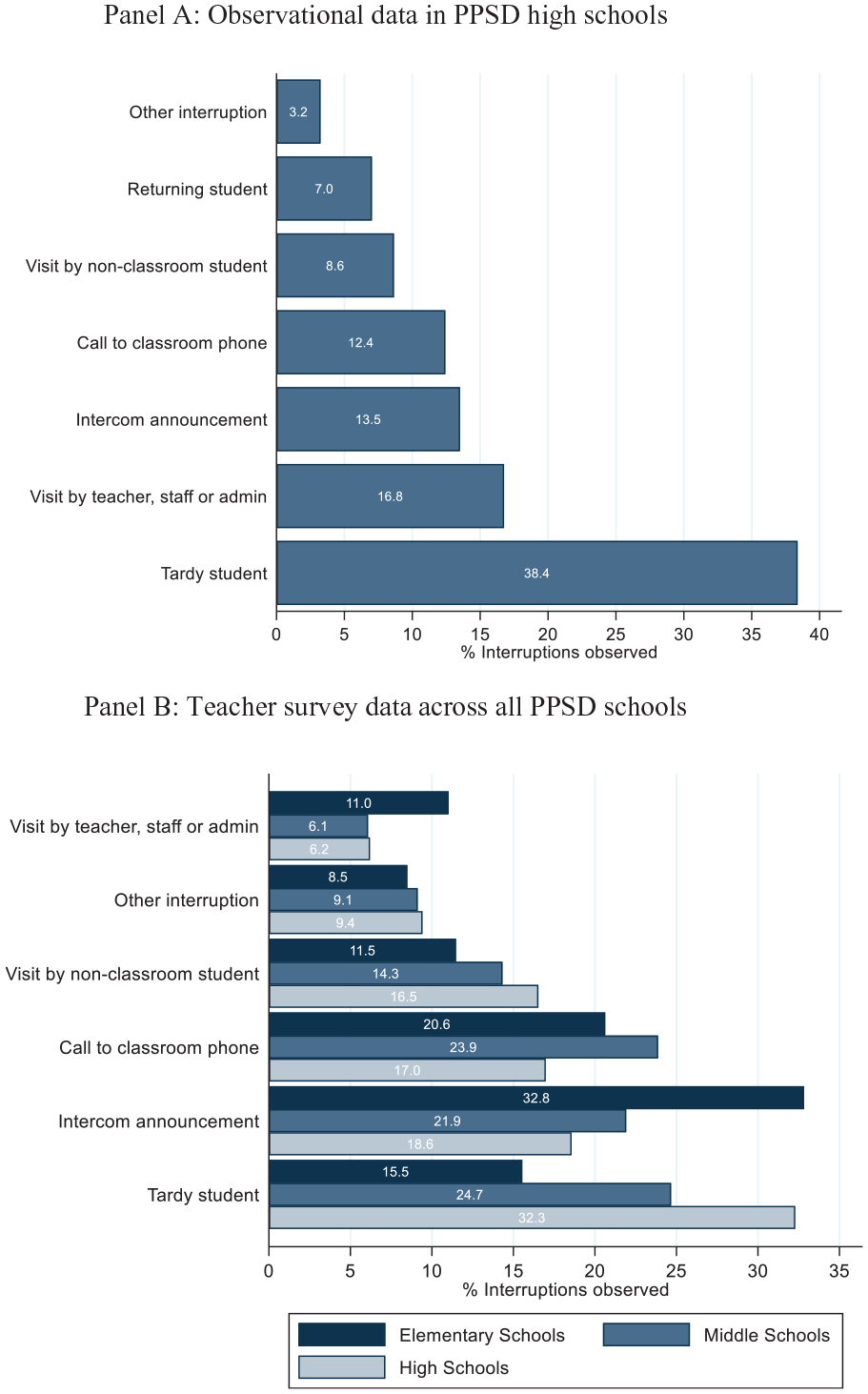
Proportion of external interruptions by type. (Panel A) Observational data in PPSD high schools. (Panel B) Teacher survey data across all PPSD schools.
The second most common form of external interruptions we observed were visits by other teachers, staff, and administrators (17%). There is value in an open-door culture where administrators conduct frequent observation and feedback cycles with teachers. However, none of the classroom “drive-bys” we observed were visits by district or school administrators for the purpose of observing teachers’ instruction. Instead, teachers knocked on classroom doors to borrow materials or look for students to provide them with make-up work or have them take an exam. School staff such as guidance counselors, teachers’ aids, and secretaries visited to get teachers’ signatures on forms, deliver messages to students, or pull them out of class.
Intercom announcements were the third most common type of interruption at 14%. The content of intercom announcements ranged widely and included school-wide announcements about sports, social events, bus passes, and one request to hold students in class for security reasons; grade-specific events such as field trips, college fairs, or upcoming testing; and individual information such as the names of students who had detention or were missing permission slips as well as requests for individual students to come to the office or for a teacher to call the office. Our field notes suggest that more than half of the announcements we heard were not relevant for the students or teachers in the classes we observed.
Calls to classroom phones were also common, comprising 12% of the interruptions we observed. Some of the purposes for phone calls were to ask about whether a student was present in class, to ask to speak to a student to inform them about detention, and to ask for classroom supplies and materials such as extra textbooks, chairs, and laptop carts. Students were also called out of class frequently to meet with their college counselors, deliver materials to another class, turn in a permission slip, or take an exam they had missed. Visits by students who were not members of the class (9%), students returning to class from being pulled out or going to the bathroom (7%), and other outside interruptions (3%) comprised the remaining portion of interruptions. We also observed five instances when teachers left their classes to address loud outside noise in the hallways.
Data on the frequency of specific external interruptions from the district climate survey largely support these findings from the field. As shown in Figure 3, Panel B, both middle school and high school teachers identified late students as the most common form of interruption. In elementary schools, where overall interruptions are less frequent, intercom announcements appear to be the most common form of interruptions. In fact, intercom announcements and calls to classroom phones were ranked in the top three types of interruptions across all three school levels. One notable difference is that teachers reported that visits by other teachers, staff, and administrators were among the least frequent types of interruptions, suggesting that these types of interruptions might be more common during the spring months we observed when testing and college counseling meetings occur more frequently. Open-ended responses by principals, teachers, and students describing other types of interruptions that occurred through the school day included the following:
Fire/intruder drills
Special assemblies
Early student pickups
Student pullouts for sports or clubs
Janitorial disruptions
Street/traffic noise
Classroom volunteers/teacher aids
Hallway fights or other disruptions
Make-up tests
Administrator walkthroughs
Extra students added to classes in the absence of substitutes
Ambulance/police sirens
Technology issues/computer cart
Timing
In the high school classrooms we observed, external interruptions occurred across entire periods and throughout the school day. We report the average total frequency of interruptions by the hour of the school day and portion of the class period in Panels A and B of Figure 4. Interruptions were most likely to occur in the first and last hours of the day. From 8 a.m. to 9 a.m. and 2 p.m. to 3 p.m., classrooms were interrupted more than twice per hour, whereas in other hours of the day, classrooms were interrupted between 1 and 1.5 times per hour, on average. Tardy students were an acute problem in the first period and then declined throughout the rest of the school day. Intercom announcements occurred most frequently in the afternoon, particularly during the last period. During a given class period, interruptions occurred most frequently at the beginning of class. More than 45% of all interruptions took place during the first third of the class period, driven by tardy students. However, intercom announcements and other interruptions occurred regularly throughout a class period. These data on the timing of interruptions suggest that classes were interrupted regularly and unexpectedly both throughout class periods and across the school day.

Timing of interruptions in Providence Public School District high schools. (Panel A) Interruptions across a school day. (Panel B) Interruptions across a class period.
Disruptions to Classroom Learning
Both observational and survey data suggest that even small interruptions can lead to big disruptions that negatively affect both classroom learning environments and students’ opportunities to learn. More than 50% of the interruptions we observed resulted in subsequent disruptions that extended lost learning time beyond the interruption itself. In Figure 5, we report on the most common types of disruptions that occurred following an interruption. These disruption types are not mutually exclusive; often interruptions led to students being off task and then the teacher having to pause the lesson to regain the attention of the students. In almost half of the disruptions we observed, teachers had to delay resuming their lesson to address misdirected attention or inappropriate behavior. Students speaking loudly about nonacademic topics (often commenting on the interruption) occurred in almost 30% of the disruptions. In 9% of the cases, students stopped their work and were either idle, waiting for the teacher to resume the lesson, or were off task as the teacher tried to restart class. In 7% of the observed disruptions, students got up from their seats and walked around the classroom, and in another 7%, students left the classroom for no apparent reason.

Types of disruptions in Providence Public School District high schools.
About 15% of all classroom interruptions led to disruptions that continued to visibly interfere with instruction and students’ focus for the remainder of the class period. These lasting consequences included students remaining disengaged from the lesson (50% of all instances with a prolonged disruption), students continuously distracting each other (25%), the teacher altering or not being able to finish a lesson (14%), and students being forced to leave the class (11%).
District survey data further illustrate the spillover effects of interruptions. As shown in Figure 6, 45% of teachers and 43% of students reported on district-wide surveys that interruptions were at least somewhat of an interference to learning. We also find that in schools where interruptions were more frequent, teachers were more likely to report that interruptions were detrimental to learning. In schools that averaged at least 17 interruptions per day (n schools = 6), more than 64% of teachers reported that interruptions at least somewhat interfered with instruction. In schools that average less than six interruptions per day (n schools = 7), only 21% of teachers surveyed reported that interruptions were at least somewhat of an interference. These patterns reflect a strong school-level correlation—0.80—between the frequency of interruptions and their perceived interference with the learning.
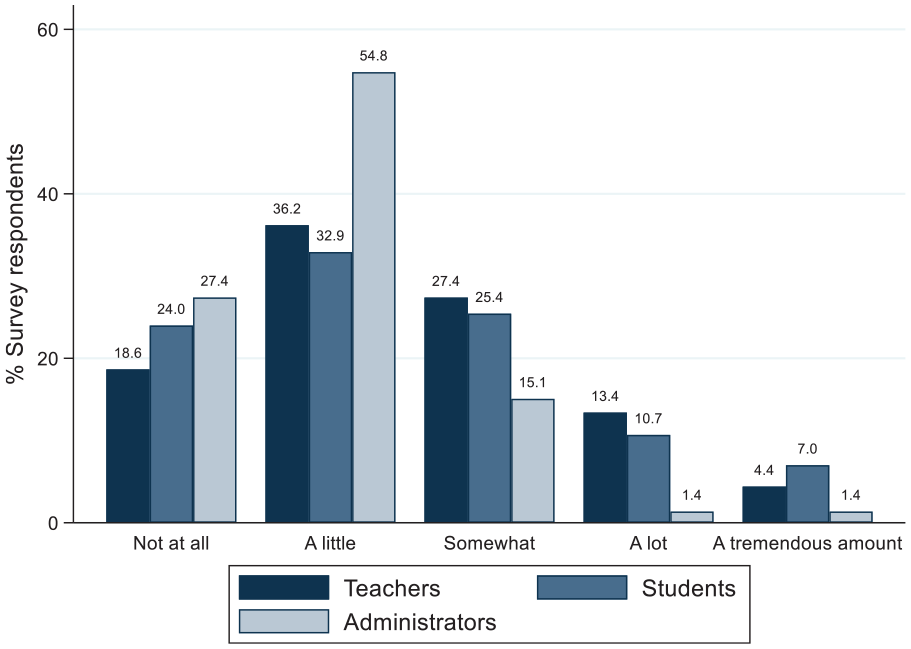
Perceived degree to which interruptions interfere with learning in the classroom across all Providence Public School District schools.
Finally, we find a consistent negative relationship between the frequency of external interruptions and student achievement. Panels A and B of Figure 7 illustrate the school-level relationships between the frequency of interruptions as reported by teachers and average achievement in Math and ELA. Across all PPSD schools, we find a partial correlation between achievement and frequency of interruptions of −0.53 in math and −0.48 in ELA conditional on grade levels (−0.34 math and −0.24 in ELA when excluding the selective enrollment in high school). These strong negative relationships persist even when we exclude tardy students and focus on interruptions largely caused by the school staff (−0.41 math and −0.38 ELA). Perhaps most telling is the absence of schools that are both high achieving and that have high interruption rates (i.e., in the upper right quadrant of Figure 7). Although these correlations are far from evidence of a causal relationship, they are consistent with the psychological literature that shows how interruptions can have significant negative effects on task performance and knowledge acquisition.

The relationships between student achievement and the frequency of interruptions per day in PPSD schools. (Panel A) Math achievement. (Panel B) ELA achievement.
Lost Instructional Time
Detailed time records from our field notes and teachers’ survey responses indicate that external interruptions are a major source of lost learning time in the PPSD. In Table 4, we report on the instructional time lost due to classroom interruptions across the high schools in our observation sample. The interruptions we observed lasted an average of 41 seconds. Subsequent disruptions, when they occurred, consumed another 57 seconds on average. Given that 50% of interruptions were followed by a disruption, the average length of time lost for each interruption and possible subsequent disruption was 71 seconds.
Instructional Time Lost Due to Interruptions and Disruptions

Note. Cells report averages and corresponding school-level standard deviations in parentheses. The estimated duration of a disruption is an average of all instances in which we observed a disruption occur. Time lost estimates are calculated by multiplying the average time lost per interruption and any subsequent disruptions that occurred by the observed number of interruptions per hour. We multiply this figure by the average hours of instruction per day (5.5 hours) and school year (990 hours) in Providence Public School District high schools. Teacher and principal average time lost estimates in a school are based on responses to the 2018 district survey. n (schools) = 31 for principals.
The duration of interruptions and subsequent disruptions, when they occur, differ meaningfully across interruption type as shown in Figure 8. Consistent with teachers’ perspectives from our exploratory interviews, calls to classroom phones were the most disruptive form of interruption as measured by total instructional time lost—almost 2 minutes per instance. Calls to classroom phones required teachers to move across the classroom to answer the phone, take the call, and then often fulfill a request. In many instances, this diversion of teachers’ attention provided ample time for students to become off task, requiring teachers to spend additional time regaining the class’s focus.
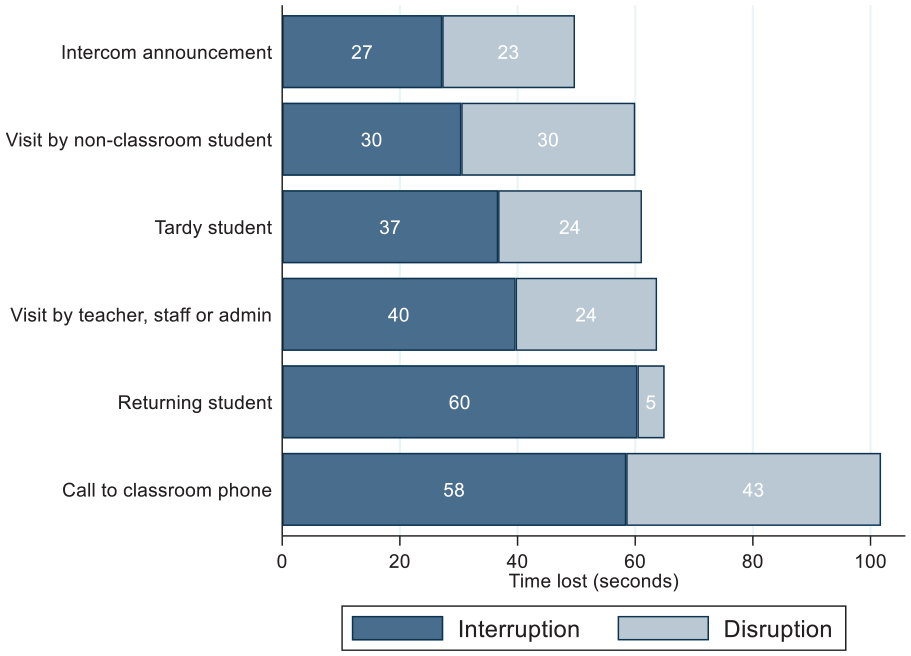
Time loss by interruption type in Providence Public School District high schools.
We estimate the total amount of learning time lost due to interruptions based on these field-based records of the frequency and duration of interruptions and the additional time it takes students and teachers to regain their focus. This involves scaling the total average time lost per 60 minutes of class across a full school day (5.5 hours of actual class time) and academic year (180 days). As reported in Table 4, we project that across an academic year students lose 54.5 hours of instructional time, or nearly 10 days, due to external interruptions. The majority of this time is due to external interruptions that are largely under the direct control of schools such as intercom announcements, classroom phone calls, and classroom visits. Even when we remove students entering the class late in a disruptive way from this estimate, we find that a total of 6.7 days of instructional time are lost to external interruptions. These are likely conservative estimates given that even when students outwardly appear to return to their work, they can experience a further delay in refocusing their attention and remembering where they left off (Altmann & Trafton, 2004; Monk et al., 2008).
Teachers’ survey-based estimates further suggest that our field-based estimates may substantially understate the full amount of lost instructional time. We asked teachers to estimate how many minutes in a typical 60-minute class are lost because of outside interruptions. Teachers’ responses suggest that, in the typical PPSD school, an average of almost 7 minutes are lost to external interruptions in each class. Again, we find substantial heterogeneity across schools with a school-level standard deviation of almost 2 minutes. These findings translate to an average of 113.9 total hours, or a staggering 20.7 days, of lost instructional time across the school year. Survey-based estimates also suggest that the amount of lost learning time per 60 minutes are very similar across middle and high school (7.24 minutes vs. 7.43 minutes), with elementary schools only modestly lower (6.51 minutes).
Shortening Class Periods
Field notes and informal discussions with the teachers we observed suggest that regular external interruptions also led to the de facto shortening of some class periods. In several of the classrooms we observed, teachers waited to start instruction until 5 minutes or more after the period had begun. This was often because only a handful of students were present in class when the bell rang, particularly during first period. Teachers reported that starting the lesson on time and then having to pause to repeatedly reorient students who trickled into class was more disruptive than starting late. Our observational data confirmed this challenge; we observed numerous instances when students entered class late and required individualized help to catch up. In many instances, these students quickly fell behind and disengaged from the lesson, distracting fellow classmates.
Intercom announcements further reinforced this pattern of late starts and often informally signaled the end of class before the period was over. In one classroom we observed that students and the teacher often spent the first minutes of class on small minutia, waiting for scheduled announcements to end before engaging in focused work. This happened despite the fact that announcements occurred sometimes 5 minutes or more after the beginning of class. Even more common was the loss of the last 5 to 10 minutes of the final period of the day during which some schools made daily announcements. Students would pack up their belongings when announcements began and then sit waiting for the period to end, even if the announcements finished several minutes before the end of class. Even a conservative calculation would suggest that these late starts and early endings increase lost learning time by an order of magnitude in schools where they are the norm.
Teacher and Student Frustration
In addition to lost time, frequent external interruptions can communicate an implicit disregard for the value of teachers’ work and students’ learning. We heard time and again in our exploratory interviews and informal conversations with PPSD teachers that they felt devalued when external interruptions were a regular occurrence. One teacher we spoke with commented on how irritating it was that her school would make regular announcements seeking volunteers to cover classes when teachers were absent. Another teacher spoke with frustration about the length of daily announcements during class that often included detailed sports scores and game synopses. Teachers also emphasized, and we observed, how students were annoyed by announcements that were not relevant to them.
Teachers felt disrespected by their peers and other staff members who interrupted their classes with impunity. They described how these “drive-bys” disregarded their instructional priorities and authority over their classroom. Teachers were resentful of the additional effort it took them to get students back on track after students’ attention was distracted by unnecessary interruptions. They saw interruptions as a convenient practice for school staff and administrators that placed an unnecessary burden on teachers. In these ways, the small indignities of regular interruptions can add up to be a major source of frustration for teachers and students.
Administrators’ Perceptions
Survey data suggest that school administrators substantially underestimate the frequency and negative effects of external interruptions in their own schools. As reported in Table 3, principals reported an average of 8.8 external interruptions per day relative to 11.9 for teachers and 16.3 for students. These differences are unlikely to be caused by differential perceptions about what constitutes an external interruption given that all respondents read the same definition, answered identical items, and reported on the frequency of individual types of interruptions. In the high schools we observed, administrators estimated 58% fewer interruptions per day than we recorded using the Tracker tool (6.4 vs. 15.3).
Administrators also perceived that external interruptions interfered with learning in their schools much less than teachers and students did. Only 17% of administrators reported that external interruptions “somewhat” interfered with learning, compared with 45% of teachers and 43% of students (see Figure 5). Similarly, administrators estimated that substantially less time was lost to external interruptions than teachers—4.5 minutes per hour compared with 6.9 minutes for teachers. These inaccurate perceptions by administrators are consistent with previous research (Dalton, 1964; Leonard, 2008) and likely help explain why persistent interruptions to classroom learning go unaddressed.
Discussion
Our findings add strong empirical support to existing narrative accounts about the deleterious effects of external interruptions on classroom instruction and the learning environment. We complement existing evidence from lab-based studies by examining interruptions in an ecologically authentic context—inside actual classrooms. We also build on the pioneering work of Leonard (1999, 2001, 2003, 2008) by providing the most detailed empirical evidence to date on the frequency, nature, duration, and consequences of external interruptions.
Our research serves to illustrate the multiple ways in which seemingly small interruptions can have a “snowballing” effect, disrupting instruction and distracting students’ focus for much of the remainder of the period. At the most basic level, interruptions take away from time in class. More importantly, they provide an opening for further disruptions to the classroom learning environment (Varley & Busher, 1989). In some instances, disruptions were a continuation of the issue raised by the interruption, while in others the interruption provided a window for students to engage in off-task behavior. As Matthew Clavel (2003), a teacher in the South Bronx, described, “After each disruption had run its course, I had to fight to establish order again.”
Teachers’ concern over losing lesson momentum likely reflects the cognitive tax that small interruptions can levy on students’ learning. We know from the psychological literature that even small interruptions can negatively affect information recall and task performance (Altmann et al., 2014; Cades, 2011; Foerde et al., 2006; Gillie & Broadbent, 1989; Rosen et al., 2011). Recent research has also documented the harmful effects of auditory distractions on students’ reading comprehension (Guerra et al., 2021). Beyond these cognitive effects, we also find suggestive evidence that regular interruptions lead some teachers to delay the start of class and some students to stop engaging in class well before the period ends. These types of unintended consequences amplify the negative effects of brief interruptions.
Several factors likely explain our findings that administrators misperceive the extent to which external interruptions occur in their schools. Most basically, principals may not observe the full range of ways in which classes are interrupted because they do not work inside classrooms. They hear the intercom announcements but do not experience classroom “drive-bys” or phone calls in the same way. Bounded attention and self-enhancement motive may also contribute to principals’ inaccurate beliefs. Principals may have trouble sustaining the attention needed to keep an accurate running tally of external interruptions given their focus on other priorities throughout the day (Simons & Chabris, 1999). They also are likely motivated to see their schools in a positive light given how central their work is to their identities (Sedikides et al., 2003).
Recommendations for Policy and Practice
An encouraging result from our study is that frequent interruptions are not a necessary feature of schooling. Even within the PPSD, we observed schools where external interruptions were the exception rather than the norm. Most of the types of external interruptions we observed were also directly under the control of administrators and often caused by school staff. Many interruptions were unnecessary, the result of poorly designed or altogether absent systems for streamlining school communication. Thus, there appears to be ample scope for substantially reducing external classroom interruptions.
Our findings suggest that school leaders can minimize external interruptions by creating a culture that prioritizes instructional time, instituting better communication protocols, and addressing the challenges posed by student tardiness. As Theodore Sizer (1984) wrote in Horace’s Compromise, Public address systems are the most malevolent intruder into the thinking taking place in public school classrooms since the invention of the flickering light. In the name of efficient management, they regularly eviscerate good teaching. They are a symbol of misplaced priorities, of schools that fail to value conditions for serious intellectual activity. (p. 174)
Administrators could start by cutting the cord of the school intercom system or prohibiting unscheduled intercom announcements. Teachers reported that the majority (52%) of intercom announcements were unscheduled. Schools could also substantially circumscribe the type of announcements that are allowed over the intercom system. Distracting hundreds of students to call one student to the front office is educational malpractice. Some schools use daily assemblies and advisory periods as alternative ways to make announcements and deliver information to individual students. Others use online platforms that house grades, general announcements, and a calendar on which students keep track of sporting and social events. Schools might also reduce or eliminate calls to classroom phones and classroom visits by shifting all nonurgent communication with teachers to email or texts.
Teachers also have a key role to play in reducing external interruptions in their schools. Teachers can make this problem more salient to their school leaders by tracking interruptions and discussing the data with school leadership teams. Detailed data can help inform efforts to take collective action and decide which external interruptions are necessary and which should be eliminated. This process might empower teachers to feel comfortable saying no to some requests for materials or to pull students from class (Partin, 1987). Teachers might also designate a student to answer classroom phones and place signs on their doors requesting that visitors leave a note rather than knock or pop-in. Establishing and upholding school-wide norms about when and for what purposes intercom announcements, phone calls, and classroom visits are acceptable is the collective responsibility of all school members.
Limitations
While our study provides a unique window into the phenomenon of external classroom interruptions, it is based on an urban school district facing a number of challenges. Our findings likely have more limited external validity for districts in distinctly different settings, although it is notable that the frequency of interruptions in the PPSD is surprisingly similar to the rate of interruptions Leonard (1999) observed more than 20 years ago in rural Canadian public schools. Our study also characterizes time lost during class as lost instructional time, implicitly assuming that all class time is being used effectively for learning. A more precise characterization might be to describe our estimates as lost possible instructional time (Phelps et al., 2012). Our estimates of time lost per interruption type are also endemic to the sample of teachers we observed and the students who attend the PPSD. The length of interruptions and the disruptions they cause depend on a variety of contextual factors such as the instructional practices used by teachers, the level of student engagement, the overall classroom culture, and teachers’ ability to prevent and minimize interruptions.
Implications for Future Research
Future research will be central for understanding the prevalence of external interruptions in other contexts and the organizational practices that limit these interruptions. Our findings also point to the need to study how interruptions might systematically affect teachers’ pedagogical choices. It is possible that frequent interruptions lead teachers to prioritize approaches that are more robust to frequent interruptions, such as individual work, and eschew more enriching whole-class discussion or group work. We see these questions as particularly fruitful areas for mixed-methods research that explores teachers’ and students’ experiences through in-depth interviews and participant data collection. Finally, experimental evaluations of interventions aimed at reducing interruptions will be critical for identifying what works as well as estimating the direct effects of interruptions on student achievement.
Conclusions
Teachers and scholars have written compelling accounts about the deleterious effects of outside interruptions on instruction and student engagement. However, limited systematic information exists about the magnitude of this problem or its consequences. This study documents that external interruptions are a regular feature of the school day in a midsized urban school district and that these interruptions cause substantial disruptions to the learning environment and lost instructional time.
Although the challenges posed by frequent external interruptions are real, administrators and teachers have considerable agency in addressing them. Part of the solution is school-level systems and practices designed to shift communication to platforms and times other than when classes are in session. Equally important is establishing collective school norms that, as one PPSD teacher urged, “Hold instructional time sacred.” Clearly some interruptions are necessary and even desirable. Teachers benefit from classroom observations, students benefit when they receive individualized support, and everyone benefits from being prepared for emergencies. But these types of interruptions are the exception rather than the norm. Reducing unnecessary intrusions into classrooms is a simple and almost costless way to increase instructional time. Failing to better understand and reduce unnecessary external interruptions will continue to allow the cumulative total of these small intrusions to “wreck the school program.”
Supplemental Material
sj-docx-1-ero-10.1177_23328584211028856 – Supplemental material for The Big Problem With Little Interruptions to Classroom Learning
Supplemental material, sj-docx-1-ero-10.1177_23328584211028856 for The Big Problem With Little Interruptions to Classroom Learning by Matthew A. Kraft and Manuel Monti-Nussbaum in AERA Open
Footnotes
Acknowledgements
This study would not have been possible without the support and assistance of the Providence Public Schools, including Marco Andrade, Jessica Cigna, Jennifer Stoudt, Lindsay Lanteri, and the PPSD principals and teachers, who invited us into their classrooms. We would like to thank Jenna Knueppel, Sarah Lettes, Marianna McMurdock, Anna Meyer, Ruby Miller-Gootnick, Harrison Neuret, Sarah Newberger, Sarah Novikoff, and Suvy Qin for their excellent research assistance.

Authors
MATTHEW A. KRAFT is an associate professor of education and economics at Brown University, PO Box 1938, Providence RI, 02912; email:
MANUEL MONTI-NUSSBAUM is a senior behavioral scientist at The Behaviouralist; email:
References
Supplementary Material
Please find the following supplemental material available below.
For Open Access articles published under a Creative Commons License, all supplemental material carries the same license as the article it is associated with.
For non-Open Access articles published, all supplemental material carries a non-exclusive license, and permission requests for re-use of supplemental material or any part of supplemental material shall be sent directly to the copyright owner as specified in the copyright notice associated with the article.
