



Abstract
This paper concerns seeing; specifically, what should and what can be seen in a classroom situation in a progressive school in Paris. It focuses on a lesson given in a foreign cultural context and the possibility of documenting it and reconstructing it: first, as far as possible, unaffectedly and out of context, to achieve comparative and interpretative classroom research. The emphasis will be on the way the subject matter is set up and the role the learners assume. It will become apparent that technical recordings, which are helpful in allowing literal transcriptions and descriptions, tempt us into abandoning objectiveness, thereby overlooking certain facts and circumstances. Only contextual information that is subsequently acquired, and repeated considerations of the actions/practices of individual participants, will allow for a new perspective of observations. It is the possibility of videography that renders actions and reactions ‘visible’, revealing that which had formerly gone unnoticed.
Keywords
Preliminary remark
The central concerns of this study are underpinned by these words, conveyed to many university students and attributable to the modern French architect, Le Corbusier: ‘We must always say what we see, but above all and more difficult, we must always see what we see’ (Le Corbusier, 1962: 7).
This paper concentrates on seeing, on what should and what can be seen, albeit in a different field of interest to that of Le Corbusier. It concerns school lessons and the possibility of documenting them. The following disclosed findings are part of an interpretative classroom research study, drawing on various cultural contexts. For the purposes of this study, culture is considered to involve a negotiation of meanings, and, in this sense, interpretative patterns are also, always, cultural patterns of interpretation. The description of a classroom situation in a school in Paris is not explicitly compared to a teaching situation in Germany; however, the situation can be related to other observations of lessons in Germany and in France. 1 In this sense an individual can, therefore, nevertheless speak of a comparative perspective. It must furthermore be assumed that observation, documentation and interpretation are influenced by constructions of meaning and implicit knowledge gained from research into an individual’s ‘own’ cultural context. A German–French research workshop, as well as regular binational exchanges, enabled the relativization of attributions, dramatizations and essentializations of what is perceived as strange or unexpected in other cultures or fields of reference (see Fritzsche, 2013: 199; see also Schriewer, 2013). This form of reflective teaching research implies that researchers must constantly reflect upon their attitude and position during the research process (see Bourdieu and Wacquant, 1992; Friebertshäuser, 2006; Schelle, 2013b). These are challenges that the qualitative reconstructive research has to contend with (see Hummrich and Rademacher, 2013). Videographies seem to provide special opportunities for understanding and interpreting foreign cultural practices, which may irritate an individual’s own ‘well-loved’ perspectives (which permanently accompany their interpretations and comparisons).
Given the assumption that it is individual pupils who give plausibility to lessons, specific attention must be given to their activities. The focus here will be on the way the subject matter is set up (‘Gegenstandskonstituierung’), and the role the learners can thereby assume (for the reciprocity between setting up the subject matter on the one hand and the pupils on the other hand, see Reh and Ricken, 2012: 52; Schelle, 2013a, 2013b).
Classroom learning is here considered as an interactive process; a continuous endeavour to be understood, and to understand others. It can be observed that pupils perceive as well as respond differently to a teaching subject, and that hermeneutic efforts are necessary to acquire new and unfamiliar meanings (see Schelle, 2003, 2010).
This paper is based on the author’s own classroom observations over a period of more than twenty years in Germany, in different parts of France (Burgundy and Paris) since 2006, and more recently also in Senegal (Dakar). During the course of these observations, undertaken whilst working in different cultural settings, it became apparent that recordings (e.g. videographies) as documents of ‘foreign’ practices are indeed helpful in creating descriptions and literal transcriptions, but however tempt us into abandoning objectivity, thereby overlooking certain facts and circumstances. A culturally universal code of perception does not seem to exist (see Meyer, 2011).
Seeing, observing and interpreting with the aim of preventing hurried judgments is one of the main concerns here (see Rumpf, 2004; Schelle, 2003); in the case study presented below, however, this was possibly not successfully achieved at the first attempt.
On observation and observing
In the context of methodological interpretative teaching research, it can be expected that any observation is largely selective and subjective, and that, as Luhmann posits, this is differentiation, ‘[…] that any observation is not only a matter of perspective, but inherently paradoxical’ (Reh, 2012a: 3), since it reproduces the ‘own blind spot’ which the observation cannot see (Reh, 2012a: 7). 2
‘The observer produces a difference by describing. Observations are only able to describe the object of the observation; anything not in the focus is therefore in the observation’s blind spot’ (Reh, 2012a: 17). With this in mind it can therefore be assumed that observations always focus on and describe only one side of the coin. This fact must be given particular attention in other cultural contexts. As will be shown below, videos, which give the option to look at ‘foreign’ practices repeatedly, offer possibilities to uncover these blind spots.
The researcher needs to be aware of all this and try to come to terms with it. A sampling method, which is perfectly suited to reconstructive methods, can facilitate the process: ‘Recordings are to some extent ‘natural’ protocols and thus in any case to be preferable to descriptions made by intelligent subjects, as the latter have always been influenced by a usually biased interpretation’ (Oevermann, 2002: 20). Researchers are ‘theoretically’ well prepared for observations, as most researchers are able to draw on many years of experience in observation situations (see Schelle et al., 2010). However, it must be pointed out that these are mainly observations in an individual’s ‘own’ language/mother tongue, in an individual’s ‘own’ country, i.e. where an individual was born and grew up, attended school and university, and is working. In short: in a familiar setting, in learning environments for which explanations and interpretative patterns in an individual’s ‘own’ language are available and which help to describe and to explain individuals and their actions ‘in our own words’. The seemingly self-evident pervades individuals’ observations, even if one and the same situation demands different protocols. Beck and Scholz (1995) call this: ‘attitude of perception. A certain attitude supports certain ways of seeing and these in turn support certain attitudes. […] The two of us, Gertrud Beck and Gerold Scholz, sat, observed and made notes in the same class at the same time. With some protocols, however, a reader might think we were describing two different classes’ (19).
Observing and interpreting ‘unfamiliar’ forms of expression
Yet, unfamiliar, ‘foreign’ contexts, different language environments, and other locales with different social and cultural practices and traditions, require seeing and perceiving the world differently, not least in order to become acquainted with this new environment. And, despite all universalisms and similarities, objects, actions etc., which individuals believe they are seeing, and which they believe they are able to describe, turn into enigmas, enigmas which they are not able to solve with the explanations and interpretations currently available to them. For instance, it has been observed that pupils in Senegal speak simultaneously, sometimes at the teacher’s request, sometimes apparently not. Outsiders may have a hard time discerning the logic behind this behaviour (see Beck, 2011).
According to Cappai (2010), reconstructive methods for the analysis and interpretation of documents are particularly sensitive to phenomena relating to foreign cultures and to differences: ‘Research in foreign cultures relies on a complex strategy, which requires that different sources of information and types of data are taken into consideration. Besides the reconstruction of the participants’ meaning constructions, socio-structural information as well as ethnographic and historical knowledge have become necessary requisites for social scientists’ (151).
Moreover, it is important for observers to adopt an attitude of understanding which takes into account ‘which forms of expressions and interpretations are created by the participants (themselves)’ in order to avoid the possibility that ‘we take our own cultural background, our own standards and values as the benchmark. But can this ever be entirely avoided?’ (Schelle, 2003: 112).
Observers, and this is the thesis of this paper, tend to explain the world according to their own unique foundational experiences. These explanations are, however, heavily influenced by the systems of meaning and value that the observers grew up with. For example, in a micro-ethnographic case study on conversations among the Wolof, an ethnic group in Senegal, Christian Meyer showed that ‘the cultural practice of perception is not universally applied’ (Meyer, 2011: 112). ‘The interacting participants see each other from the periphery, but there is no reciprocal eye contact’ (Meyer, 2011: 107). Eye contact is hardly an instrument for coordinating a conversation here; instead, the participants establish contact with each other through physical contact (see Meyer, 2011: 111). In particular, the Wolof people seem to be able to hear sounds better. This may be highly relevant for reconstructive research which considers education as an interactive and, thus, communicative process and hence relies substantially on observation (i.e. observing people who in turn observe others).
It appears that looking and observing have been incorporated in the same way as not-looking and not-observing; and even videography, which makes it possible to view video-recordings over and over again, is no guarantee of an impartial eye and an unbiased description. Notwithstanding that the scenes captured by the video camera itself are highly selective, with the camera either being handled by somebody searching for something or mounted on a tripod and targeted (for detailed information, see Reh, 2012b).
Observation and videography
In the context of the present study, the author had an eye-opening experience which led her to fall back on videography for analysis more than she had done previously when reconstructing lessons. The approach outlined here, which usually uses ‘video data to complete transcriptions of verbal interactions’ (Reh, 2012b: 164), differs from ways of dealing with videography in, for example, the area of ethnographic studies in which scientific authors use cameras as a ‘caméra stylo’ (camera-pen), in order to ‘record their observations in the form of audio-visual field notes’ (Mohn, 2010: 154). As a form of ‘condensed showing’ (Mohn, 2010: 154), the use of handheld cameras is a common practice among ethnographic researchers, who (depending on the specific research question) focus flexibly on situations and practices. The method of video documentary and film interpretation is particularly well- developed (for more details, see Bohnsack, 2011). Following this design, Fritzsche and Wagner-Willi established different levels of transcriptions in order to reconstruct their interactions as well as the material and the corporal constellations reflected in them, and their respective meanings (see Reh, 2012b: 156). The methodology applied in this present study also differs from those studies that use video data as a primary source, rather than as a tool for analysis, and whose authors load recordings on the internet (see Hecht, 2013; see also Reichertz and Englert, 2011, whose publication is accompanied by a DVD). Whatever value is attached to videography in the respective setting, ‘with the camera, the research field does not get ‘more secure’, but gains in potential for discovery’ (Mohn 2010: 154). At the same time, however, videography produces the above-mentioned blind spots (selectivity, differentiation, the invisible) and, due to its complexity, the visual material can never be completely reconstructed in detail. All publications in the field of videography first require a skilled researcher to lessen their complexity; for instance (as is the case here), the format is still pictures/photograms which again puts further ‘limits to the interpretation’ (see Bohnsack, 2011: 151ff; see also Reichertz and Englert, 2011: 14ff).
Case study: origin and description of the document
At the end of 2010, the author carried out a project in the field of natural sciences/biology (Module Sciences 4ième/3ième) together with Nina Meister, at a progressive school in France. The pedagogical focal points of this school comprised proximity to nature and life, holistic learning, practices orientated towards the children, as well as integration. During a double period, nine female and nine male pupils were split into small groups and asked to prepare presentations on different parts of the human body and their respective functions (stomach, muscles, mouth, ears, eyes, intestine, kidney and liver). The aim was to then bring these presentations together into a single presentation. The small groups worked largely autonomously on different tasks: some using a microscope and others doing additional research outside the classroom. The teacher was available to answer questions and to provide advice and suggestions, but was not constantly present in the classroom. For one group of pupils – Jacques and Gregor, who were assigned to work on the functions of the muscles – the teacher brought along a dead frog.
Since ‘visual materials as manifestations of human activity […] are produced in a specific context’, the reasons behind and the functions and circumstances of the videography’s production are of interest (Froschauer and Lueger, 2007: 430). The camera was placed at the back of the classroom and mounted on a tripod, in order to attract as little attention as possible. In this way, the pupils’ activities and their handling of the subject matter (as evidence of a particular learning culture) should remain largely undisturbed. Seen in this way, the final positioning of the camera was a pragmatic decision. The videography was primarily meant to help create transcripts using verbatim quotes and scenic descriptions. In such an approach teaching is conceived ‘as a sequence of verbal interaction’ (Reh, 2012b: 154). At that time, the implications of the constructions that would result from the camera positioning could not be foreseen.
An audio-recording device was additionally set up on one side of the room. After videoing the greeting by the teacher and the introduction to the lesson, the camera was positioned to capture one to two group tables which were not too close to it, thus allowing the events to be monitored clearly. In other words, different aspects were weighed against one another and decisions were made, which eventually resulted in a focus on one particular group. Consequently, the other participants automatically fell out of the study’s field of perception and the researcher’s observation and a good portion of the activities occurring in the classroom remained invisible. It was realised over the course of the lesson that there was something special happening on the group table that had been focused on, something that also caught the other pupils’ attention. This gave another reason to maintain the focus on this particular group. It may well be that the act of videoing the lesson, as well as having the two scientists in the room led both the pupils and the teacher ‘to feel observed (Reh, 2012b: 165).
It should be noted that the photograms featured below are, in a way, ‘minutes of the moment’ (Froschauer and Lueger 2007: 433). They are, again, the selected images out of the study’s initial selection and they are furthermore modified for the purpose of anonymization. Consequently, another observation is added to the observed observation (a pupil observing something is observed by the camera at the level of a ‘second-order observation’; see Luhmann, 1995: 92ff). The blind spots (that which escapes our observation) accumulate and give rise to a suggestive power (of that which is distinguished) during the observation, which is hard to control.
In the context of the present research, a question concerning the way the subject matter is set up and the role taken up by the pupils – the kind of learning opportunity given to Jacques and Gregor by the frog presented by the teacher – bears some comment and clarification (see Combe and Gebhard, 2007, 2012). This comment and clarification is given below.
Details on the observation and the set-up of the learning subject
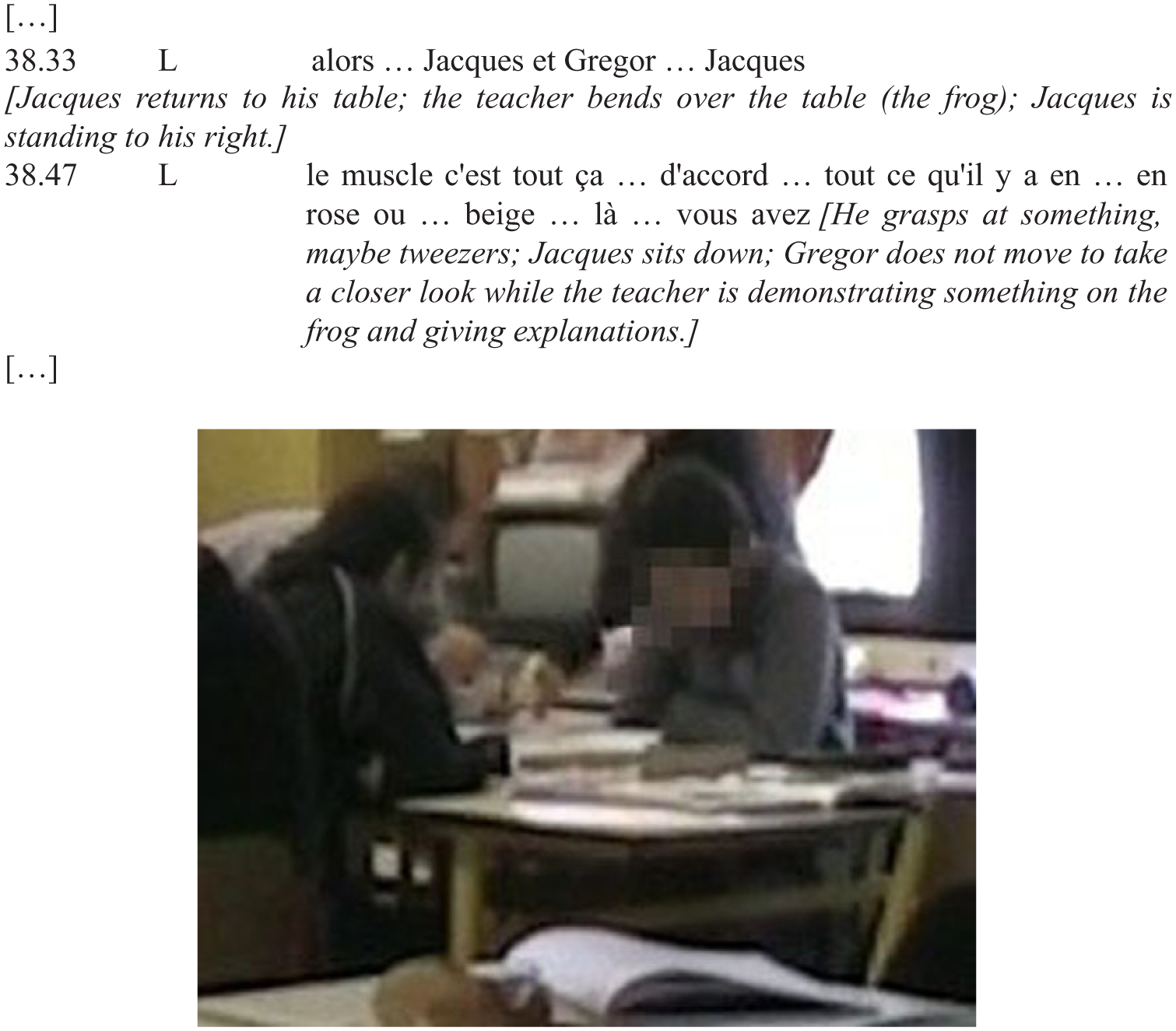
Several groups were working in a room reserved for science classes; high levels of activity alternated with rest periods. Jacques and Gregor, who hardly spoke to each other, directed little attention towards the frog. Over the course of the videoed part of the lesson (according to the study notes), a careful treatment of the lifeless animal body was observed. Upon further inquiry it was learned that the teacher obtained the frog at a butcher’s shop that supplies the school. The teacher repeatedly turned towards the pupils, trying to draw their attention to the frog and to its muscles in particular, in order to show them how they move and what they need to do to be able to observe the muscle activity.
To illustrate (Figure 1):
Teacher speaking to the pupils.
At a later point, about 25 minutes prior to the end of the lesson, the teacher returns to the two pupils’ table. He asks them how the muscles contract (L: comment les muscles font fléchir) and why they are swelling (L: et pourquoi les muscles se gonflent). To the pupil’s reply: ‘in order to speed up’ (Sm: pour se précipiter), he responds: ‘no’ (L: non, c‘est pourquoi il le fait, sinon, normalement…). At the same time, according to the transcription, ‘the teacher bends his knees slightly; he keeps them bent’. The pupil now suggests: ‘it is for strength’ (Sm: c‘est pour la puissance). As if to confirm that this is the right reply, the teacher repeats this remark (L: c‘est pour la puissance). He then demonstrates a muscle contraction with the frog; another pupil joins them. Gregor, who is also sitting at the table, does not take a closer look at this demonstration, but, just as before, looks down at his notes.
A first interpretation
It is evident that the pupils’ involvement in the learning experience is not driven solely by the presence of the skinned frog. It is rather the teacher who tries to capture the pupils’ attention and advance the learning process via gestures and demonstration (as basic operations of didactics). The two pupils do not seem to be motivated by the dead animal. May there be reasons why they keep a certain distance from the ‘subject matter’? 3 .
Is it perhaps that the muscular movement is hardly discernible in the inanimate frog? Do the pupils feel inhibited because the situation is too far removed from experiences they are used to? Does the object irritate the pupils, rather than incite them to have a closer look? Does the frog cause real ‘discomfort’ (see Combe and Gebhard, 2012: 13, 21; see also Waldenfels, 2002)?
What does all this mean in light of the progressive educational programme of the school and the philosophy of project-based learning, which focuses explicitly on direct contact with nature and hands-on nature-based learning? Have the pupils perhaps lost interest in the frog due to too many similar school exercises? Are the pupils not captivated by the problem at hand (see Rumpf, 2004)? Is this an emergence of what can be observed over and over again in school- and project-based learning (see Combe et al., 2000), i.e. an unexpectedly great ‘distance between the pupils’ personal world on the one hand and the subject-specific world of the lesson on the other hand’ (as Combe and Gebhard, 2012: 61 put it with reference to Ziehe)?
The teacher tries to find out why the pupils have not understood the object of the exercise. He offers them explanations and demonstrations (for example by demonstrating movements). He is concerned with, as Strobel-Eisele (2003) puts it, the ‘factual dimension of teaching’ and ensures his pupils are acquiring ‘relevant knowledge’, so he aims at ‘bridging the distance towards the learner’ (259). However, as Combe and Gebhard (2012) state, ‘everybody must produce the meaning and significance of the learning subject on his or her own; this is a highly individual process, an independent and constructive operation and drafting process which cannot be delegated’ (2012: 8).
Later, in a feedback interview with the teacher, after he had read the interpretation, it was learned that he had suggested the practical work on the frog to Jacques and Gregor, with the expectation that they would come up with their own questions when dealing with the lifeless animal. The documented sequences (and also other sections of the transcript) reveal that the co-constructive processes between the pupils obviously follow a different kind of logic, and that the adolescents thereby established their ‘own’ order of the lesson (see Reh et al., 2011).
In the course of this interview he also mentioned, in passing, that one of the boys, Gregor, is autistic and that there might have been indications of this during the observation. A French colleague, who had made the observation of the lesson possible and who had attended the feedback discussion, asked whether Gregor had even touched the frog at all (see Montandon and Schelle, 2013). This gave rise to the question of whether the interpretation, which was based on the principles of objective hermeneutics (see Oevermann, 2002; Wernet, 2000; for the interpretation of documents from foreign cultural contexts, see in particular Dersch and Oevermann, 1994), had consequently lost its validity and needed to be revised. In the next section the video is reconsidered.
Reconsidering the video
A number of project members, including those who had viewed the material in order to make transcripts of the recordings, were, like the author, certain that the pupils had been rather distant in their approach to the lifeless animal. Bearing Gregor’s particular situation in mind, the video as well as the transcript were reviewed. One scene that previously had not been accorded much importance (even though they were included in the transcript), was considered.
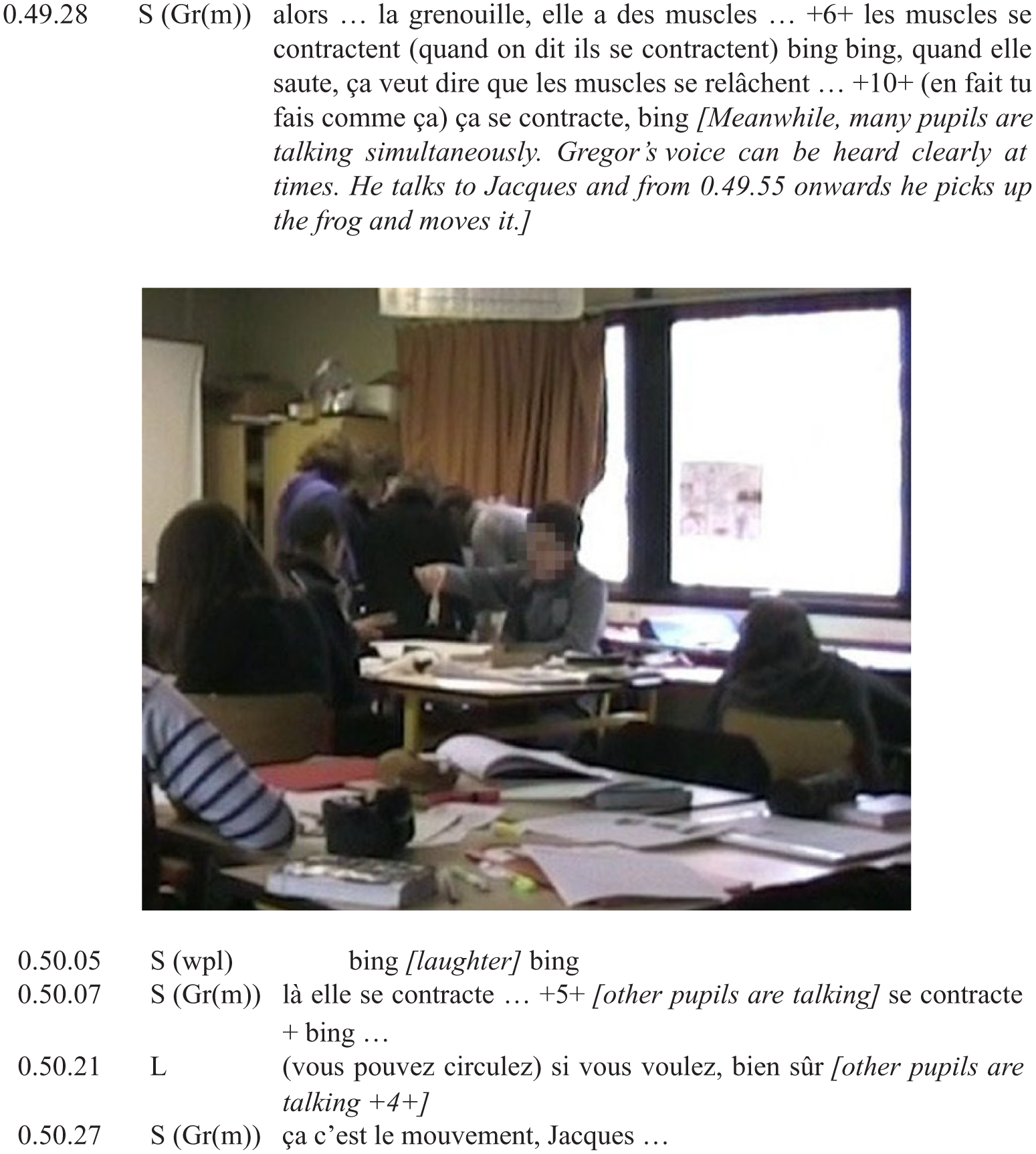
Why had this scene been ignored? Perhaps because it fit with previous viewing habits and followed the logic of the author’s expectations and of her own discomfort when looking at the inanimate frog (wondering what the schoolchildren might do with the dead skinned frog). This irritation was confirmed by the thought of what was being observed: a posture which keeps a distance and a tendency to turn away from the ‘subject matter’. However, the frog, or rather what was left of the skinned animal (probably touched with bare fingers rather than with the available tweezers?) is dangling from Gregor’s outstretched arm – a gesture which includes perhaps both disgust and pleasure. After the feedback interview with the teacher and the additional information concerning Gregor it was concluded that what had been observed was less a sign of Gregor distancing himself from the ‘subject matter’ than him approaching it. What had been observed was an approximation, which was not to be expected from this pupil. In contrast with the corresponding transcript, his fellow pupil Jacques is not only addressed by name, but is also physically visible in the video/photogram. But what does he turn his attention to? Does he not react to his classmate’s gesture of showing? How and in what manner does one pupil address the other? How do they view each other; what do they represent to one other? It appears as if the gesture of showing, the movement of the frog (as indicated in the description of the transcript), are observed only by the camera or even performed for it. The other pupils who can be seen in the photogram are preoccupied with other things.
The experience outlined here accentuates the importance of the body and the subject matter being learned and of sensory impressions which turn into concrete gestures. The role of the teacher as an external observer of the relationship between subject and object (see Montandon, 2013 in reference to the individual pupils’ approach to the object in instrumental lessons), should be taken into greater account than has been the case in text-based teaching research. Such corporeal practices should be described in more detail and should be interpreted in terms of the way the subject matter is set up, as well as in terms of the role the participants assume (see Fritzsche, 2013; Reh and Ricken, 2012). As in hermeneutic text interpretation, where the principle is to stay true to the literal meaning and the sequentiality of texts (see Wernet, 2000), the observation and description of corporeal practices must not lead to false conclusions regarding the pupils’ motivation/ambitions. Such observations are an important source of information regarding what is actually going on. They also provide valid information regarding which opportunities the pupils who are being observed seize, and which they let pass with regard to both the subject matter and the other pupils in the classroom, who are themselves co-constructing the lesson.
In summary (Figure 2):
Pupil picking up the frog.
The reconstructed structure of meaning remains – also from the teacher’s point of view – essentially unaffected by the additional information and observations. This may possibly also be due to the fact that this analysis – in the sense of a school-educational case study – focused on pedagogical and didactic practices and on classroom interaction, rather than on the ‘case of Gregor’ (see Wernet, 2006: 184). Usually, it is ‘not a problem’ for qualitative teaching research that ‘we cannot read the pupils’ or teachers’ minds, since both pedagogical interaction and learning are understood and observed as social phenomena. By means of the concrete study of a single case, it [i.e. qualitative teaching research] can show what happens and what works out in the classroom and how it fares’ (Reh, 2012b: 153). On the basis of the video it is possible to sequentially and chronologically describe what Jacques and Gregor were doing with the frog, if and when they touched, examined or ignored it. For this purpose, more sequences would have to be viewed and interpreted to arrive at detailed statements as to what logic the proceedings and co-constructive processes of the pupils follow, who, according to the teacher, prepared a convincing presentation on the muscular system of the human body at the end of the project.
Implications for classroom observations and video recordings
Not only do various possible readings have to be developed when interpreting pictures/photograms and texts from different cultural contexts (see Reichertz and Englert, 2011; see also Bohnsack, 2011), but (proceeding from the assumption that sensory perception is not culturally universal, see above) new ways of seeing must be cultivated, with regard to the interpretations a participant suggests with a certain posture or gesture such as an outstretched arm. This would be in line with German ethnographic school research that asks how the actors in a classroom generate a school and learning culture as a shared reality with their interdepending activities (see Wiesemann, 2011: 169).
Videos should be developed in mixed research teams and should be viewed and interpreted – as in the present case study – in French–German working groups. From the recording of data onwards, mixed teams could work systematically and comparatively in so far as constructions and latent structures of meaning could be made explicit against the background of an individual’s own socialization (see Kokemohr, 2008; Schelle, 2012).
Froschauer and Lueger’s suggestion regarding intercultural analyses of films and their reception goes in a similar direction: ‘It therefore makes sense to form intercultural teams for the interpretation’ (2007: 435). In this context, hermeneutic analytical methods such as objective hermeneutics are considered to be particularly suited for the interpretation of artefacts such as pictures and films (see Froschauer and Lueger, 2007: 437).
What this implies in terms of the present videotaped lesson is that the sequences should be examined in more detail in order to note the actions and reactions which can be observed when two pupils have something to show one another, thereby automatically addressing each other (see Reh, 2012b: 164). Or, as Reh and Ricken (2012: 42) put it: ‘how and as whom one is addressed explicitly or implicitly by whom in front of whom’ in order to trace the reciprocity of the subject matter and its subjectification.
Additionally, the question arises whether this particular case of two different worlds confronting each other in the classroom (the pupils’ personal world and the expert/subject-specific world represented by the teacher) is evidence of inclusive education. This in turn would mean that the French progressive school, where the lesson, which was recorded, took place, is definitely able to live up to its claim of integration. This case study presents perhaps a successful example of inclusive education, considering the fact that it is not common practice in France to attach any particular significance to the learners’ ethnic or cultural background or other individual attributes.
Attempting to reconstruct the learning experience of two pupils using a skinned frog (while taking into account the additional contextual information about Gregor) pulled the focus of the observation onto Gregor. This was only possible because videography enabled the current study to make actions and reactions which had so far gone unnoticed ‘visible’ and which in turn made it possible to detect some ‘blind spots’. Nevertheless, this research should not become oblivious to the fact that other facts and actions relating to the lesson did not fall within the predetermined sphere of observation. It still remains difficult to see what an individual sees and to describe what the individual sees.
Footnotes
Funding
This research received no specific grant from any funding agency in the public, commercial, or not-for-profit sectors.