




Abstract
Implementation of university-based animal-assisted stress-prevention programs is increasing despite limited knowledge about impacts on students’ academic success. This randomized trial (
Keywords
The prevalence of college students’ mental health symptoms and disorders is rising (Hunt & Eisenberg, 2010). Although their etiology is complex, high rates of academic stress and lack of coping skills are thought to play a role (Grant et al., 2014). There is evidence to suggest that the physiological consequences of academic stress exposure directly compromises students’ executive functioning (EF) and achievement goals (Cerqueira et al., 2007), which are essential to academic success. Since academic stress is considered an inevitable part of college life, it is important that universities identify effective programs that improve students’ stress management skills, strengthen EF, and promote adaptive attitudes toward learning.
One approach that has been enthusiastically received by university administrators and students is the use of animal visitation programs (AVPs). Established on nearly 1,000 U.S. college campuses (Crossman & Kazdin, 2015), most AVPs provide the student population the opportunity to engage in 5 to 35 minutes of interaction with specially trained therapy dogs and handlers. There is promising evidence to suggest that participating in AVPs improves students’ mood states (Grajfoner et al., 2017; Pendry, Carr, Roeter, et al., 2018), lowers perceived stress (Barker et al., 2016; Binfet, 2017; Crossman et al., 2015), and significantly lowers student cortisol levels in response to just 10-minutes of hands-on petting (Pendry & Vandagriff, 2019). While recent findings are encouraging, significant gaps in our knowledge about the efficacy of animal-assisted programs remain.
Gaps in Literature
First, we know little about for whom exposure to college-based animal-assisted interventions (AAIs) are most effective, as very few studies have explored which factors may moderate their efficacy. Most AVPs are implemented with a universal focus, rather than targeting individuals at-risk for academic failure. On the other hand, universal interventions are likely to contain a mixture of individuals with varying levels of functioning and well-being (Greenberg & Abenavoli, 2017), including ones with existing stress-related pathology, a history of academic failure, and other factors that challenge academic performance. In fact, some have argued that at-risk students are more likely to seek out AAIs precisely because they are experiencing high levels of perceived stress but also hesitant to seek treatment (Center for Collegiate Mental Health, 2019; Lipson et al., 2019). Moreover, there is prior evidence suggesting that individuals with mental health issues may differentially respond to interventions targeting stress-related symptoms (Hofmann et al., 2010; Sin & Lyubomirsky, 2009), including recent college-based AVPs. For example, recent evidence showed that clinically depressed students reported higher levels of irritability, depression, and anxiety while waiting in line for their turn to interact with program animals compared with nondepressed students (Pendry, Vandagriff, et al., 2019). Given that animal-assisted activities (AAAs) tend to be facilitated by volunteer organizations with limited capacity in providing animal-handler teams, conducting AAIs in ways that are most effective and limit undue stress on animal teams is imperative. As such, understanding the role of students’ characteristics that potentially moderate the efficacy of intervention effects is a reasonable endeavor.
Second, while there has been a call in the AAI literature to examine effects of AVPs in educational settings (Gee et al., 2017), there are few causal studies that have examined effects on cognitive skills associated with college students’ academic success. This shortcoming is also reflected in the prevention science literature that features several meta-analyses on university-based stress-prevention programs using a wide variety of modalities (e.g., psychoeducational, cognitive–behavioral, relaxation, mindfulness) but not AAIs (Conley et al., 2015; Regehr et al., 2013). This is unfortunate as the inclusion in meta-analyses (Conley et al., 2015; Regehr et al., 2013) of outcome variables informed by cognitive processes, such as coping techniques, rational beliefs, self-awareness and regulation, academic engagement, and time management clearly illustrates an appreciation for the important role of cognitive processes in coping with stress, reducing physiological dysregulation, and the development of stress-related psychopathology. In fact, echoing the importance of working memory—an example of cognition-based executive functions and a foundation of the ability of coping with stress through the use of cognitive appraisal (Andreotti et al., 2013)—university administrators and researchers have set out to enhance executive function skills to improve students’ coping and regulating emotions (Bettis et al., 2017). Results examining the efficacy of these interventions have demonstrated significant positive associations between measures of executive function and coping, as well as negative associations between executive function and post intervention symptoms of psychopathology. Most important, results suggested that improvements in coping skills may be achieved through improvements in EF (Bettis et al., 2017). These studies provide a strong rationale for examining whether the effects of college-based stress management programs on strengthening EF can be enhanced by incorporating AAAs.
Last, we do not know whether more frequent interaction with animals leads to greater cumulative benefits than those obtained through AVPs, which are characterized by one-time, short, casual exposures. This question is particularly relevant as studies examining the efficacy of more traditional college-based stress-prevention programs (Bettis et al., 2017; Conley et al., 2015; Regehr et al., 2013) tend to include a significant portion of programs featuring frequent, regular engagement in programming activities offered over a period of weeks or months, whereas the AAI literature—barring very few exceptions (Binfet et al., 2017; Silas et al., 2019)—is dominated by studies examining relatively short, one-time exposures. Similarly, no prior studies have examined whether regular exposure to college-based AAAs provides benefits for college students over and above the effects expected from exposure to more traditional, evidence-based stress management approaches.
Current Study Rationale and Objective
The main goal of the current study was to address these gaps by conducting a randomized trial to determine whether, under which conditions, and for whom, a university-based animal-assisted program provides an effective approach to promote students’ cognitive skills relevant for academic success. To answer this question, we randomly assigned undergraduate students to one of three 4-week academic stress management programs featuring varying combinations of exposure to human–animal interaction (HAI) and evidence-based academic stress management (ASM) content presentations delivered didactically and through engagement in activities. Each condition entailed attending a series of four, 60-minute, once-weekly workshops, focused on a theme relevant to academic stress prevention, including academic stress management, motivation and goal setting, improving sleep, and coping with test anxiety. Given our objective to examine for whom incorporating AAAs is most beneficial, we recruited a sample of typically developing students and at-risk students (e.g., students who endorsed having experienced a mental health condition, academic deficiency, learning disability, and/or suicidal ideation) to examine the effects of varying levels HAI with registered therapy dogs and stress management content presentations by risk status.
The primary outcome of interest was EF, which refers to three types of highly, interrelated brain functions, including working memory, mental flexibility, and inhibitory control, which underlie a wide variety of cognitive skills relevant to stress exposure, coping, the development of mental health issues and academic success. EF is of interest as it informs cognitive skills such as paying attention, organizing, planning and prioritizing, starting tasks and staying focused on them to completion, understanding different points of view, regulating emotions, and self-monitoring (Diamond, 2013), which have implications for academic functioning. In addition to evidence demonstrating their importance in college-based intervention research as a pathway toward increased coping with stress, these outcomes are often examined as primary outcomes of interest for their links to psychopathology, including depression (Snyder, 2013) and anxiety (Snyder et al., 2014). According to Gee et al. (2017), HAI can enhance academic success both directly or indirectly through enhancements in EF. According to their model, HAI may affect EF through increased self-regulation and stress coping, or through the promotion of social behaviors, increased calmness, and reduced fear and anxiety. In addition, HAI is thought to enhance EF by enhancing students’ motivation and self-efficacy, or by increasing their engagement, self-awareness, and attention. In sum, the bidirectional links between stress, coping, and EF are well supported, suggesting that interventions focused on stress management through relaxation, increased coping, cognitive training, or HAI could contribute to improvements in EF, achievement goals, and ultimately academic success.
Method
This study was conducted on a 4-year, residential public university with a land grant mission with required residency on campus for freshman. All protocols were approved by the university’s institutional animal care and use committee and institutional review board. Informed consent was obtained in-person by the principal investigator.
Recruitment and Participant Risk Status
Undergraduate students were invited to attend informational meetings promoted through announcements, university publications, and student services (i.e., dean of students’ office, counseling and psychological services, access center) where researchers described the study procedures. Inclusion criteria were (1) enrollment at the university, (2) at least 18 years of age, (3) competent in the English language, (4) available during days and times of prescheduled program sessions, (5) willing to be blinded and randomized to conditions, and (6) lacking a history of engaging in harm to animals. Interested students completed consent forms before completing a screening survey, which was later used to assign a risk indicator based on participants’ endorsements of one of the following statements: formerly or presently declared academically deficient, diagnosed mental condition/disorder, considered suicide or self-harm, and/or receiving classroom accommodations for learning disorder(s) (N = 121). These include academically deficient students whose semester or cumulative GPA (grade point average) dropped below 2.0 and who are required as part of their reinstatement process to participate in programs offered through student support services or campus health services. Students risk status was not identifiable to the students’ themselves, program facilitators, or staff and were merely assigned for analytic rather than intervention or treatment purposes. Given our interest in modeling treatment effects moderated by risk status, we aimed to recruit a sample of at least 30% at-risk students.
On screening, we invited N = 349 students who met the inclusion requirements through email and requested confirmation of formal study enrollment until reaching our projected HAI capacity, which was based on four students per handler–dog team and a maximum of seven handler–dog teams per session. Total study enrollment included N = 309 participants, who were subsequently scheduled for baseline assessments and program sessions. Participants included in analyses are those that completed baseline assessments and at least one program session (N = 309). Included participants (see flowchart, Figure 1) were primarily White (n = 62.1%), female (n = 249), freshman (Nfreshman = 160, Nsophomore = 67, Njunior = 42, Nsenior = 19, Nunknown = 19),Mage = 19 years and 2 months, and were enrolled in an average of 15.2 credits.
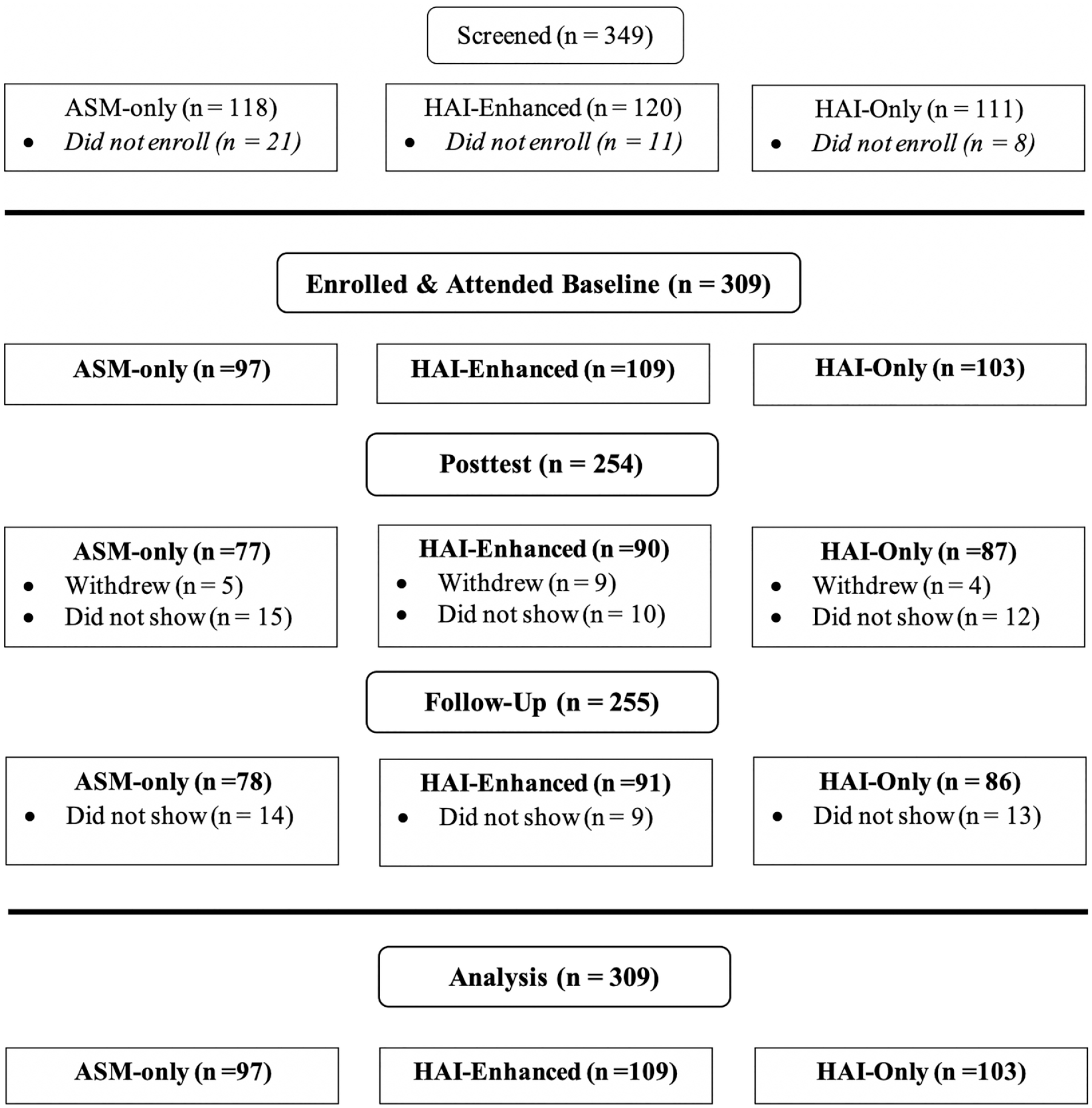
Flow diagram describing recruitment, screening, enrollment, randomization, and study completion
Procedure
Student study participation spanned a period of 12 weeks starting with completing baseline assessments (Week 1), followed by four consecutive weeks of 1-hour-long program sessions (Weeks 2–5), followed by posttest assessments (Week 6), a hiatus of 6 weeks, and follow-up assessments (Week 12). Students were randomly assigned to one of three conditions featuring exposure to various combinations of HAI and evidence-based ASM presentations. Students assigned to the ASM condition engaged in a 4-week series of workshops, based on content originally developed and implemented by the university, focused on didactic evidence-based content presentations (e.g., slide presentations featuring evidence-based approaches toward stress management delivered by a master-level health educator), and guided activities focused on enhancing self-regulation (e.g., progressive muscle relaxation, deep breathing, meditation, replacing negative self-talk with positive self-talk), and metacognitive skill training (e.g., time management, test-taking skills, study planning, prioritization exercises). The ASM condition was created by combining four existing, stand-alone stress management workshops regularly offered at the university into a 4-week-long program. Constituting a valuable and challenging comparison condition, the ASM sessions were consistently conducted by the same educators responsible for teaching these programs on campus, as such constituting a treatment as usual condition. This condition did not include any exposure to AAAs (N = 97; 0% HAI). Detailed descriptions and citations of the evidence underlying the content for each session are provided below.
Students assigned to the human–animal interaction condition (HAI-O) featured semistructured HAI sessions during which students engaged in AAAs (e.g., petting, relaxation activities, meditation, discussion with peers) with registered therapy dogs and their handlers for the entire program period without any exposure to evidence-based ASM content (N = 103; 100% HAI).
Students assigned to the enhanced human–animal interaction condition (HAI-E) divided their time equally between engaging in a modified ASM curriculum using the same but shortened evidence-based content and activities described above (e.g., self-regulation, metacognitive skill development) taught by the same educators, and exposure to AAAs, during which students interacted with the same registered therapy dogs and their handlers as featured in the HAI-O condition (N = 109; 50% HAI).
Assessments and program sessions were conducted separately by condition, on a consistent day of the week to prevent spillover effects or treatment diffusion. To avoid condition-specific attrition, all participants, including those in the ASM condition, were told they would experience an opportunity to interact with animals, but that the timing and amount of HAI would vary, as such blinding them to the expected ratio of HAI. HAI was provided to the ASM condition after completion of all outcome assessments. Participants received $60 USD for completing assessments, which were prorated at $20 USD per assessment.
Description of Human–Animal Interaction
Participants in the HAI conditions interacted with registered therapy handler–dog teams with Pet Partners (2019). Teams consisted of 16 male dogs (15 neutered, one intact) and 11 female dogs (eight spayed, three intact; Mage = 4 years, Agemaximum = 12 years, Ageminimum = 6 months). The majority were labrador retrievers (n = 10), mixed breeds (n = 6), and golden retrievers (n = 3; nother = 8). On average, dogs had been registered with Pet Partners for 1.95 years and participated in 3.6 hours of therapy work per week. Handlers were mostly female (N = 24; Mage = 49.67), with 2.34 years of experience.
Setting
All program sessions occurred in the same large, carpeted conference room, which featured a large center table, and comfortable sofas and chairs arranged to form seven segmented sitting areas on the perimeter. On days when sessions featured HAI, handler–dog teams were assigned an individual area (station), which featured the team’s own blanket and toys, as well as a water bowl accessible at all times. Participants arrived 5 to 30 minutes before program sessions started and waited in the hallway out of view of animals, who arrived using a different entry. This allowed for the teams to get acclimated well before engaging with programs participants. Participants assigned to the HAI-E and HAI-O conditions engaged with handler–dog teams in groups of four to five students while being reminded to minimize crowding of the animals. Hand sanitizer was provided and reminders to use it were provided by program facilitators.
Description of Session Outlines, Activities, and Themes
Each weekly session featured a different theme related to promoting academic success, including academic stress management (Week 1), motivation and goal setting (Week 2), benefits of sleep (Week 3), and test anxiety (Week 4). At the start of each session, following an opportunity for a brief meet and greet, students assigned to the ASM condition received 20 minutes of evidence-based content through slide presentations. These presentations were interactive encouraging participants to answer questions posed by the facilitator, as well as share examples and experiences in the larger group setting. Next, ASM participants engaged in a 10-minute-long guided activity for which participants may have moved to smaller sitting areas for four to five participants featuring comfortable couches and chairs. The focus of activities varied between timed, scripted, and guided mindfulness, meditation, relaxation, and/or visualizations. They would then return to the center table where they received 10 minutes of additional themed content before returning to seated areas for 10 minutes of guided discussion and reflection activities centered on two or three reflection and discussion questions using scripts and terminology introduced during content presentations (i.e., think about a process-oriented goal; how can you reframe this stressor?). Following the second activity, participants in the ASM condition spent the remaining 10 minutes of the program back at the conference table engaging in shared reflection about the activities, receiving information and additional resources, and closing remarks.
Participants in the HAI-E condition began each session with 10 minutes of HAI during which they had an opportunity to meet and greet animal–handler teams of their choice. Participants were prompted to rotate between stations every 3 to 4 minutes. Next, participants were asked to seat themselves at the center table where they received 10 minutes of evidence-based content through slide presentations. The content presented was identical to content presented in the ASM condition although it was presented in summarized form. These presentations were also interactive encouraging participants to answer questions posed by the facilitator, as well as share examples and experiences in the larger group setting. Using similar scripts and terms used in the ASM condition, participants next engaged in two 10-minute-long guided activities, including either guided mindfulness, meditation, relaxation, and/or visualizations followed by small-group, semistructured discussions, or vice versa. Added to these scripts were explicit instructions to pet the dogs throughout the activities, as well as mindfully “experiencing” the animal they were interacting with. Like those in the ASM condition, participants returned to the center table in between these guided activities, where they received additional 10 minutes of themed content. Following the second activity, participants spent the remaining 10 minutes of the program back at the conference table engaging in shared reflection about the activities, receiving information and resources, and closing remarks. During the 1-hour-long session, participants were thus engaged in 30 minutes of HAI.
Participants in the HAI-O condition spent the first 20 minutes of each session engaged in a meet and greet session during which they were prompted to rotate dog–handler teams every 5 minutes. Next, participants engaged in a10-minute guided activity focused on mindfulness, meditation, relaxation, and/or a visualization activity, which like in the HAI-E condition was guided by scripts, including explicit instructions to pet the dogs throughout the activities as well as mindfully “experiencing” the animal they were interacting with. This activity was followed by a 10-minute reflection activity where participants discussed their experience with the activity. Following this, participants engaged in 20 minutes of small-group, facilitator-led reflection, and discussions during which they rotated between animal-handler teams twice. Discussions were focused loosely on the weekly theme using modified terminology reflecting general speech (i.e., “think about a reasonable goal”) and participants were encouraged to remain in proximity and physical touch with the animal. Participants spent the entire 60 minutes in the presence of animals without receiving any formal instruction or content presentations.
Session 1: Academic Stress Management
Students in the ASM and HAI-E conditions received instruction on manifestations of stress and effective self-care practices to manage stress, including effects on the body and behaviors (Calabrese, 2008; Mayo Clinic Staff, 2016; Yerkes & Dodson, 1908); cognitive coping skills (Lutgendorf et al., 1998), such as positive reframing (Stoeber & Janssen, 2011), as well as emphasizing the importance of self-compassion and goal regulation (Neely et al., 2009); and overall self-care (Myers et al., 2012). Participants in all conditions were guided through a breathing and body scan exercise (Cho et al., 2016), while students in the HAI conditions also received instruction on “experiencing” the dog they were with. The discussion activities varied slightly between condition assignments, with the ASM condition focused on identifying and reframing current stressors, and the HAI conditions focused on how animals may help us manage stress.
Session 2: Motivation and Goal Setting
Students in the ASM and HAI-E conditions received instruction on motivation and goal setting, including information on successful and unsuccessful goal setting behaviors, changing behaviors to support goal attainment, and the power of their mind-set. Pragmatic approaches to identifying and setting goals such as S.M.A.R.T. (Specific, Measurable, Attainable, Realistic, Timely) goal setting (Lawlor & Hornyak, 2012; Morisano et al., 2010), as well as the importance of focusing on the process of attaining the goal rather than only the outcome (Gollwitzer & Sheeran, 2006; Kappes & Oettingen, 2011) were shared with participants. Students received information on adapting their behaviors to support goal completion such as establishing goal-directed behaviors and habits (Aarts & Dijksterhuis, 2000) and ways to reduce decision fatigue (Vohs et al., 2008) during stressful and busy times. Finally, the importance of enhancing one’s awareness and mind-set toward academic challenges was reviewed, reintroducing and applying concepts from the first session such as engaging in self-talk toward goal completion and expanding this discussion reviewing the benefits of approaching challenges with the belief that you are capable of growth (Dweck et al., 2014; Mueller & Dweck, 1998). The discussion activity in the ASM condition focused on setting attainable academic goals, addressing the anticipated steps necessary, and identifying behavioral modifications toward goals completion. The HAI-E condition engaged in a similar discussion while in sitting with and petting the animals. The HAI-O condition discussed a reasonable academic goal for the semester, why that goal was meaningful, and what barriers they may encounter toward successful completion. Participants in each condition were guided through a visualization exercise (Rawolle et al., 2017), during which they were encouraged to witness themselves going through the steps they explored during discussion, concluding with successful completion. For HAI conditions, this exercise was conducted while sitting and petting the dogs.
Session 3: Benefits of Sleep
Students in the ASM and HAI-E conditions received instruction on the importance and benefits of healthy sleeping habits. Content sessions included discussion on how much sleep students are getting versus the amount of healthy sleep needed (Hirshkowitz et al., 2015), what happens in the body while we sleep and why it is important (National Sleep Foundation, n.d.), the effects of sleep deprivation, and common barriers college students may experience and how to overcome those barriers, for example, establishing a bedtime routine or healthy sleep environment (Lund et al., 2010; Pacheco, n.d.). For their mindfulness activity, all participants were guided through a progressive muscle relaxation meditation (McCallie et al., 2006). For participants in the HAI conditions, they completed this meditation while sitting and petting the dogs. Group discussions focused on exploring students’ current sleep environments and actions they would be willing to take to improve their sleep environment. As with previous discussion activities, students in the HAI conditions conducted their discussion in the presence of the dogs.
Session 4: Test Anxiety
Students in the ASM and HAI-E conditions received information about test anxiety. This content included what test anxiety is, how it can manifest physically and mentally, and the subsequent problems test anxiety can promote in students (Zeidner, 2010). Students were also informed about how changing perception of tasks can alter their present experience (Keller et al., 2012), and how to identify internal and external influences and focusing on making changes in areas within their control (Pineles & Mineka, 2005). All participants engaged in a 5-minute visualization task intended to evoke feelings of stress and anxiety about an upcoming exam they were worried about. For students in the content conditions this visualization was conducted around the central table, only students in the HAI-O condition engaged with the dogs for this exercise. Following this visualization, they were then guided through a 10-minute stress release meditation and visualization that incorporated techniques previously used in prior sessions to interrupt disruptive thoughts and feelings, encourage a calm state, and visualize successfully completing their exam (Cho et al., 2016; Feldman et al., 2010). For students assigned to HAI conditions, the stress release activity was conducted in the presence of animals and students were regularly prompted to think about the dog’s calming presence. All students discussed their experience with the activity and how they could utilize the skills practiced in the various mindfulness activities throughout the four program weeks to manage and/or interrupt experiences of stress and anxiety.
Program Fidelity
Program sessions were highly structured, and content was presented using memorized scripts. The same facilitators presented across conditions to prevent internal validity threats due to history, that is, variation in facilitation quality rather than differences in the ratio between amount of HAI and content presentations. All sessions featuring HAI were video recorded via seven different simultaneous camera angles. No unexpected events or unintended harms were reported or observed. On average students attended 3.6 out of 4 sessions; attendance rates by session were similar throughout the program and condition with 85.4% attending Session 1 (ASM = 83.5%, HAI-E = 89.8%, HAI-O = 82.7%), 79.9% attending Session 2 (ASM = 78.3%, HAI-E = 75%, HAI-O = 86.5%), 76.7% of students attending Session 3 (ASM = 78.3%, HAI-E = 76.9%, HAI-O = 75%), and 77.7% attending Session 4 (ASM = 72.2%, HAI-E = 82.4%, HAI-O = 77.9%).
Measures
Dependent Variable: Executive Function
The Behavior Rating Inventory of Executive Function–Adult (age 18+ years; BRIEF-A; Roth et al., 2005) was used to assess EF at baseline, posttest, and follow-up. The BRIEF-A is a standardized measure consisting of 75 items within nine nonoverlapping clinical scales that measure various aspects of adult EF and self-regulation in the person’s everyday environment. The BRIEF-A has demonstrated high internal consistency (Cronbach’s α = .96; Roth et al., 2005). It yields an overall score, the Global Executive Composite, which is a composite of two subscale index scores: Behavioral Regulation Index (BRI) and Metacognition Index (MI). The MI measures an adult’s ability to solve problems in a systematic way by using skills involving planning, organization, and holding information in working memory. The BRI measures a respondent’s ability to regulate their behavior and emotional responses. Composite and Index scores at each time-point were converted to T scores based on the standardization sample (M = 50, SD = 10), with higher T scores indicative of greater presence of EF problems, that is, worse EF (Roth et al., 2005). It is important to note that while the quantitative analyses were conducted in keeping with this orientation and presented as such in the accompanying tables and figures, to enable a more intuitive interpretation, the narrative presentation of results describes findings in terms of “improvements” in EF or higher levels of EF—rather than “decreases in EF dysfunction/problems or lower levels of EF.”
Control Variable: Negative Emotion State During Assessment
To prevent confounding by potential variation in students’ momentary mood states by condition, participants reported on their emotional state at the start of each assessment session. Reports used in the present study were utilized in several prior studies (Papp et al., 2009, 2012), including in AVP settings (Pendry, Carr, Roeter, et al., 2018; Pendry, Carr, & Vandagriff, 2018; Pendry, Vandagriff, et al., 2019). The 2-minute, 25-item survey asked participants to endorse on a 4-point scale, ranging from 0 (not at all) to 3 (very much), the extent to which they were feeling various emotions at that moment. A factor analysis of survey items resulted in four latent constructs, including content (e.g., calm, at peace, joyful, positive, at ease; α = .89), anxious (e.g., stressed, overwhelmed, worried, anxious, tense; α = .87), irritable (e.g., frustrated, aggravated, agitated, irritable, pissed off; α = .88), and depressed (e.g., depressed, sad, discouraged, unhappy, alone; α = .86), which were reverse scored when applicable (i.e., content), standardized and averaged into a composite score for a negative emotion state for each participant.
Power Calculations and Sample Size
Given that Cohen’s d effect sizes have ranged from as small as 0.2 to as large as 1.2 in AAI work (see Maujean et al., 2015, for a review), we plotted the necessary sample size using G-Power software (Faul et al., 2007, 2009) to achieve adequate power over a range of effect sizes corresponding to Cohen’s d values ranging from 0.2 through 1.2 while considering main and interaction effects. Given the three-condition structure of our study and our interest in exploring interactions between condition and risk status (a 2 × 3 between-groups factorial design testing mean differences) with several covariates the total sample size needed to conduct these analyses ranged from a low of 100 to a high of 210 to maintain power of .80 examining main effects. The sample size for at-risk students of N = 121 and a total of N = 309 provides adequate statistical power needed to detect these effects as such reducing risk of type II error.
Analytic Approach
After providing descriptive statistics of sample characteristics and study variables, confirming assumptions of normality, we examined differences in distributions of key demographic and outcomes variables by condition and risk status at each assessment time-point. We then examined whether differences in attendance and attrition were present by condition and risk status and tested whether sample demographic characteristics varied by rates of assessment participation at posttest and follow-up. Next, multivariate regression analyses were used to answers two research questions. The first research question focused on understanding whether there were differences in students’ levels of EF by risk status (0, 1) and treatment condition (e.g., ASM, HAI-E, HAI-O) after program completion (posttest). The second question examined whether differences in potential treatment effects by risk status and condition were present 6 weeks later (at follow-up, assessed at 12 weeks).
Analyses were conducted using IBM Statistics Software, Version 26, with multiple imputation and the PROCESS, Version 3.5 macro (Hayes, 2012, 2018), to test the significance of interactions and model slopes of interaction functions graphically. To reduce potential bias in treatment effects arising from premature dropout and/or noncompliance to the study treatment, we used an intention-to-treat approach and multiple imputation by including all enrolled randomized participants who attended baseline assessments of outcome variables of interest. We conducted multiple imputation using a Markov Chain Monte Carlo algorithm known as fully conditional specification, a custom Bayesian regression imputation method in which a chain of regression equations is used to impute variables with missing data one by one. We used a maximum number of 10 iterations and set constraints to restrict the imputation analyses to variables with less than 25% maximum percentage of missing values with a focus on independent and dependent variables of interest in final models—excluding interaction terms. The role of variables in the imputation model was customized to impute and predict when correlations with other variables were statistically significant and percentage of missing data was below 15%. Variables not meeting these criteria were imputed but not used as predictors. A total of five imputations and pooled estimates were generated.
Using the PROCESS macro, indicator variables for each condition, for example, whether in the ASM condition (0, 1), whether in the HAI-E condition (0, 1), whether in the HAI-O condition (0, 1), whether identified as at-risk (0, 1) and interaction terms created by multiplying indicators for each condition with risk status, we modeled the contributions of the main and interaction effects of risk status by treatment condition using multivariate regression analyses. Analyses controlled for baseline level of the outcome examined, age, gender, and negative emotion assessed immediately preceding the relevant assessment session. The analyses were conducted with the at-risk students in the ASM condition serving as the reference category. Significant interaction effects were graphically modeled by plotting participants’ outcomes by risk status and condition using the PROCESS macro; significance of these slopes was tested, and effect sizes and mean levels calculated. Based on pooled estimates, we interpret contributions of interaction effects of the presence of risk status and treatment condition for all three aspects of EF at posttest and then, using identical models, at follow-up.
Results
Distribution of Study Variables by Condition, Risk Status, and Assessment Period
An examination of the distribution of demographic and risk indicator variables across the three treatment conditions revealed that risk status, χ2(2, N = 309) = 1.01, p = .60, and gender, χ2(2, N = 309) = .161, p = .92, were equally distributed across treatment conditions. Based on an analysis of variance with a Bonferroni correction we found no significant differences in mean levels of age, F(2,306) = 2.21, p = .11, or total credit enrollment, F(2,306) = 0.25, p = .78, by assigned treatment condition. There were also no significant differences by condition at baseline for the global executive composite for executive function, F(2,306) = 1.29, p = .28, MI, F(2,306) = 1.56, p = .21, or the BRI, F(2,306) = .80,p = .45.
Next, we examined participation in posttest and follow-up assessments, as well as calculated overall retention and attrition rates. Overall, the total percentage of study participants lost to formal withdrawal was less than 1% (attrition: ASM = 5%, HAI-E = 8%, HAI-O = 4%). This led to an overall retention rate for attending posttest assessment of 82% (ASM = 79%, HAI-E = 82.5%, HAI-O = 84%) and 83% at follow-up assessment (ASM = 80%, HAI-E = 83%, HAI-O = 83%). An examination of who remained enrolled but did not attend was 88% at both posttest (ASM = 84.5%, HAI-E = 91%, HAI-O = 88%) and follow-up assessments (ASM = 85.5%, HAI-E = 92%, HAI-O = 87%). To ensure that potential results were not influenced by systematic attrition by condition, we examined the distribution of participants’ characteristics again at posttest and follow-up. At posttest, participants’ characteristics remained equally distributed across conditions by risk status χ2(2, N = 254) = 2.08, p = .35, and gender, χ2(2, N = 254) = 0.248, p = .88, as well as mean levels of age, F(2, 251) = .2.43, p = .09, and credits enrolled, F(2, 251) = 0.433, p = .65; and at follow-up risk status, χ2(2, N = 255) = 3.22, p = 0.20; gender, χ2(2,N = 255) = 0.18, p = 0.92; age, F(2,252) = 0.18, p = .84; and enrolled credits, F(2,252) = .240, p = .79, were still equally distributed suggesting no selective attrition occurred. Additional analyses revealed no evidence to suggest that participants’ total session attendance varied due to condition allocation, F(2,306) = 0.29, p = .75, risk status, F(2,306) = 1.68, p = .18, or a combination of condition and risk status, F(5,303) = 1.20, p = .31. Additionally, chi-square difference testing determined participation in specific program sessions was not dependent on condition for Session 1, χ2(2, N = 309) = 2.58, p = .28; Session 2, χ2(2, N = 309) = 4.62, p = .10; Session 3, χ2(2, N = 309) = 0.32, p = .85; or Session 4, χ2(2, N = 309) = 3.10, p = .21. Together these findings suggest that the study did not experience differential attrition due to participant characteristics or treatment condition.
Effects of Condition and Risk on Executive Functioning at Posttest
Model fit statistics of the multiple linear regression analyses, F(9,299) = 29.59, p < .001, R2 = .471, indicated there was a significant effect on students’ global EF between the participants’ baseline global executive function score, treatment condition, risk status, and their interactions at posttest (Table 1, Model 1). Findings demonstrate that risk status significantly moderates the effect of the HAI-O condition on global EF at posttest, Β = −4.74, p = .018, while no interaction effects were found for at-risk students in the HAI-E condition, Β = −1.24, p = .533. Examination of slopes indicate a significant slope of the simple regression function, b = −4.53, t(299) = −2.90, p = .004, showing that at-risk participants in the HAI-O condition experienced significantly higher EF at posttest compared with those in the ASM condition with a medium effect size (d = 0.53; Table 2). Baseline levels of global EF, Β = .619, p < .001, and average negative mood at assessment, Β = 1.45, p = .001, were also significant predictors in the model.
Regression Analyses Modeling Moderation Effects of Risk Status by Treatment Condition on Executive Functioning at Posttest With the ASM Condition Serving as the Reference Condition

Note. Higher T scores indicative of greater presence of EF problems (i.e., worse EF). Model statistics represent pooled imputation estimates. Final models presented control for participant age, sex, and average negative mood at time of assessment. ASM = academic stress management; SE Β = standardized error for the unstandardized coefficient; GEC = Global Executive Composite; HAI-E = enhanced human–animal interaction condition; HAI-O = human–animal interaction condition; EF = executive functioning; MI = Metacognition Index; BRI = Behavioral Regulation Index.
p < .05. ***p < .001. †p < .10.
Predicted Means of Executive Function Problems, SDs, and Effect Sizes by Condition and Risk Status at Posttest

Note. Higher T scores indicative of greater presence of EF problems (i.e., worse EF). Cohen’s d values presented as absolute values. ASM = academic stress management; HAI-E = enhanced human–animal interaction condition; HAI-O = human–animal interaction condition; EF = executive functioning.
p < .05. †p < .10.
Using the same model, model fit statistics, F(9,299) = 35.56, p < .001, R2 = .517 (Table 1, Model 1a), and results show a significant interaction effect of students in the HAI-O condition on metacognition at posttest, Β = −4.88, p = .013, and confirmed by a significant slope of the simple regression function, b = −4.38, t(299) = −2.86, p = .005, suggesting that at-risk participants in the HAI-O condition experienced significantly higher metacognition at posttest (d = 0.52) compared with at-risk students in the ASM condition (Table 2). Baseline levels of metacognition, Β = .641, p < .001, and negative mood at assessment, Β = 1.26, p = .003, were also significant predictors in the model. While model statistics on behavioral regulation were significant, F(9,299) = 23.65, p < .001, R2 = .416, interaction effects between risk status and the HAI-O condition were merely trending toward significance (Β = −3.70, p = .069; d = 0.43; Table 1, Model 1b). Means for each outcome by treatment condition and risk status along with effects sizes for each comparison condition at posttest are presented in Table 2. Regression functions of interactions and mean scores on each outcome by condition and risk status are presented graphically in Figure 2.

Interaction between risk status and treatment condition on global EF, metacognition, and behavioral regulation at posttest
Effects of Condition and Risk on Executive Functioning at Follow-Up
Model fit statistics for global EF at follow up, F(9,299) = 28.18, p < .001, R2 = .459, and results indicate that at-risk students assigned to the HAI-O condition experienced significantly higher global EF (Β = −4.48, p = .028; Table 3, Model 1) compared with those in the ASM condition (d = 0.47; Table 4) as indicated by a significant slope of the simple regression function, b = −4.01, t(299) = −2.50, p = .013 (Figure 3). Baseline levels of global EF, Β = .529, p < .001, and average negative mood at follow-up assessment, Β = 3.53, p < .001, were also significant predictors in the model. Given the observed differences between scores of at-risk students in the HAI-O and HAI-E conditions as indicated by the effect sizes, we conducted additional regression analyses using the HAI-E condition as the reference condition. Findings showed that at-risk students in the HAI-O condition also experienced significantly higher global EF, Β = −4.99, p = .011 (shown only in text) compared with students in the HAI-E condition (d = 0.44). Overall, these results indicated that any exposure to ASM content—even when presented in combination with HAI—was less effective at improving EF of at-risk students at follow-up rather than exposure to HAI alone.
Regression Analyses Modeling Moderation Effects of Risk Status by Treatment Condition on Executive Functioning at Follow-Up With the ASM Condition Serving as the Reference Condition

Note. Higher T scores indicative of greater presence of EF problems (i.e., worse EF). Model statistics represent pooled imputation estimates. Final models presented control for participant age, sex, and average negative mood at time of assessment. ASM = academic stress management; SE Β = standardized error for the unstandardized coefficient; GEC = global executive composite; HAI-E = enhanced human–animal interaction condition; HAI-O = human–animal interaction condition; EF = executive functioning; MI = Metacognition Index; BRI = Behavioral Regulation Index.
p < .05. ** p < .01. ***p < .001, †p < .10.
Predicted Means of Executive Function Problems, SDs, and Effect Sizes by Condition and Risk Status at Follow-Up
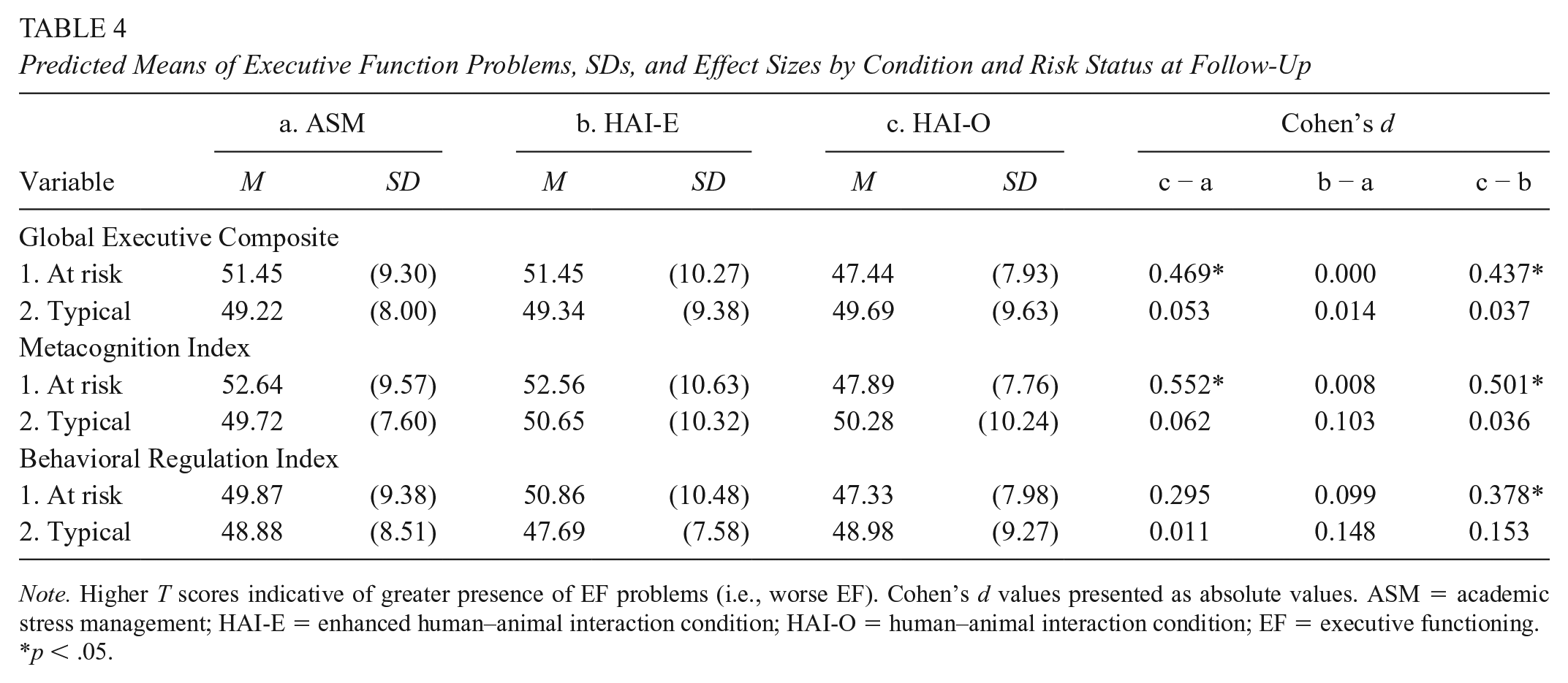
Note. Higher T scores indicative of greater presence of EF problems (i.e., worse EF). Cohen’s d values presented as absolute values. ASM = academic stress management; HAI-E = enhanced human–animal interaction condition; HAI-O = human–animal interaction condition; EF = executive functioning.
p < .05.
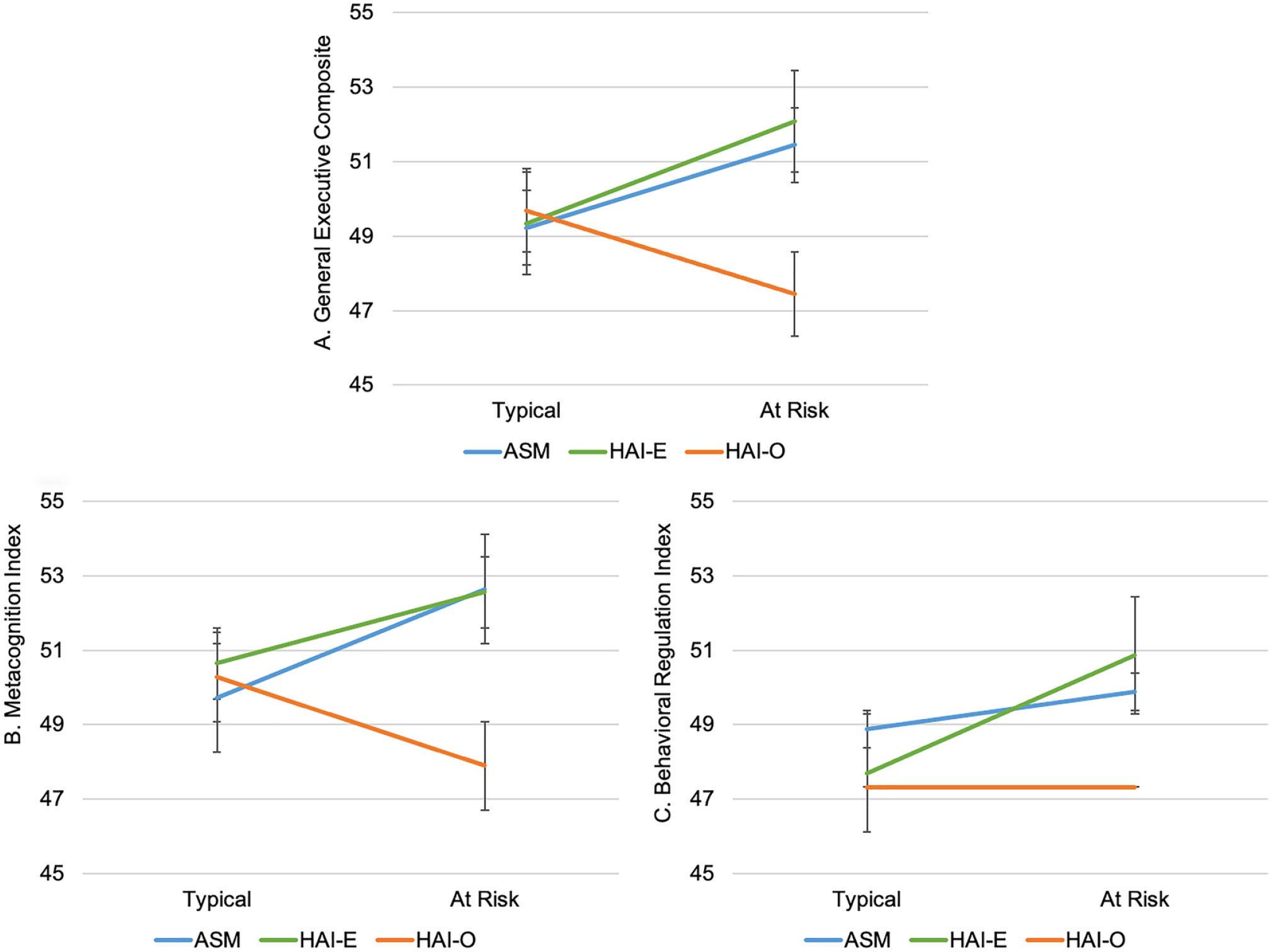
Interaction between risk status and treatment condition on global EF, metacognition, and behavioral regulation at follow-up
Model statistics predicting metacognition at follow-up were significant, F(9,299) = 32.98, p < .001, R2 = .498, and results indicate that at-risk students assigned to the HAI-O condition experienced significantly higher metacognition, Β = −5.31, p = .009 (Table 3, Model 1a), compared with those in the ASM condition as confirmed by a significant slope of the simple regression function, b = −4.75, t(299) = −2.96, p = .003, with a medium effect (d = 0.55; Table 4, Figure 3). Additional regression modeling using the HAI-E condition as the reference condition showed that at-risk students in the HAI-O condition also experienced significantly higher metacognition, Β = −4.30, p = .029 (shown only in text), compared with students in the HAI-E condition (d = 0.50). Overall, the results suggested that exposure to ASM content—even in combination with HAI—detracted from enhancements in global EF and metacognition of at-risk students.
Last, the model predicting behavioral regulation at follow-up, F(9,299) = 20.73, p < .001, R2 = .384 (Table 3, Model 1b), showed no significant interaction effects for risk and condition between the ASM and the HAI-O, Β = −2.65, p = .203, or HAI-E conditions, Β = 2.17, p = .297, suggesting only significant contributions of baseline levels of the behavioral regulation, Β = 0.456, p < .001, and average negative mood at follow-up, Β = 3.15, p < .001. Findings however showed that at-risk students in the HAI-O condition experienced significantly higher levels of behavioral regulation, Β = −4.80, p = .017 (shown only in text), compared with students in the HAI-E condition (d = 0.38).
The trajectories of students’ EF scores by risk status and condition (Figure 4) indicate a clear pattern suggesting that participation in the interventions decreased participants’ EF problems over time and that gains in EF were most pronounced for at-risk participants in the HAI-O condition.

Predicted means of executive function problems by condition and risk status at pretest, posttest, and follow-up
Discussion
This is the first study to examine whether incorporating various levels of HAI into a 4-week-long evidence-based stress-prevention program improved EF in typical and at-risk college students. The study employed an experimental design comparing effects of three different combinations of HAI and evidence-based academic stress management content ranging from engaging in HAI exclusively, half of the time, to not at all. Results showed significant improvements in global EF and metacognition were achieved particularly for at-risk students who exclusively interacted with therapy dogs over a 4-week period, compared with at-risk students who received only evidence-based academic stress management content. This study suggests that targeting improvement of at-risk students’ EF and metacognition through stress management content presentations may not be efficacious. In fact, a trend emerged suggesting that providing HAI in combination with content presentations is a less effective approach for enhancing at-risk students’ global EF compared with providing HAI exclusively.
The benefit of focusing exclusively on HAI to enhance EF in at-risk college students was maintained over time. At-risk students who exclusively interacted with animals had significantly better EF and metacognition 6 weeks after program completion compared with those exposed to ASM content presentations only. Interestingly, at-risk students who engaged only in HAI also had significantly higher levels of EF across all domains compared with those at-risk students who spend their programming time engaged in an equal combination of HAI and ASM content presentations. In sum, findings showed that any engagement with evidence-based ASM content presentations, even at reduced levels, may have counteracted the potential beneficial effects of HAI exposure. Interestingly, results showed that incorporating HAI into stress management programming, either by offering it exclusively or in combination with evidence-based content presentations did not differentially affect typical students’ EF nor did either type of intervention significantly affect typical students’ targeted outcomes. Potential explanations for these findings are described below.
Overall, the findings suggest that at-risk college students’ EF can be enhanced through programming focused on interacting with animals. These finding are consistent with Diamond’s theory of programmatic improvements to EF (Diamond, 2012, 2013), which has been used to predict the ways in which interacting with animals has the potential to improve EF (Ling et al., 2016). The HAI-O condition, in the current study, appears to have most fostered an environment consistent with these indirect influencers of EF albeit exclusively for at-risk students.
The observed improvements in EF suggest that the amount of exposure to HAI embedded in the intervention is of paramount importance depending on the target population. Although this study did not test mediating mechanisms potentially underlying the effects of infusing HAI on EF, the observed effects on EF in at-risk students could be attributed to the fact that the interventions featuring the highest levels of HAI most distracted these students from potential negative stressful thoughts, which may have enhanced their EF through mechanisms described above. For example, AAIs are thought to provide students with a novel, exciting, and enjoyable experience (Jau & Hodgson, 2018), which may foster opportunities for momentary reprieves from negative thoughts related to mood disorders (Reinecke, 2006) as such contributing to a calm relaxed state known to enhance EF. In addition, while it has been established that pets provide social support for their owners, researchers theorize that some of these same supportive features may be present in AAIs, particularly when individuals are provided opportunities for repeated HAI exposure (Serpell et al., 2017). It is thus possible that at-risk students may have perceived an increased sense of social support or been more susceptible to the effects of increased social support provided by the animal. In addition, it is possible that HAI may have enhanced at-risk students’ quality of social interactions with peers and handlers through a shared sense of enjoyment. Also, the relaxed, calm state may have supported the development of other adaptive behaviors informing executive function skills such as problem solving, decision making, and creative and critical thinking (Sahu & Gupta, 2013) which we know were significantly lower at baseline in at-risk students. This may also explain why the effects of HAI only exposures showed more pronounced effects at follow-up for at-risk students on global EF and metacognition compared with sessions that incorporated stress management information. In fact, a prior study found that students expressed that interacting with animals was relaxing and enjoyable, while receiving information was stressful or redundant (Pendry, Kuzara, et al., 2019). Although risk status was not considered in those findings, some students expressed that receiving information only served to conjure thoughts of stressful situations or realities without providing a means of remedying the source of the stress.
While this interpretation supports the lack of significant improvements in at-risk students’ EF in conditions without HAI, it is speculative. It is possible that the ASM content presentations may have had the effect of increasing participant focus on academic challenges that would likely include a corresponding increase in fear, anxiety, and stress as such counteracting any positive effects experienced through social connection, social support, or knowledge. Similarly, even in the condition that featured 50% HAI, the effect of this increased engagement with academic stress and discussion about links between lack of coping skills, stress exposure, and psychopathology may have counteracted any positive indirect influence of interacting with the dog.
We note that the fact that no significant improvements were experienced other than in the HAI condition was unexpected, given that the existing stress management workshops were based on evidence-based approaches. However, while these workshops had been conducted on campus on a regular basis and were required for students facing reinstatement due to academic failure, they were taught in a stand-alone format, rather than as a series. It is thus possible that the frequency of engaging with stress management content only may have played a role in their lower-than-expected efficacy.
Strengths and Limitations
In addition to random assignment to conditions, the study design featured several strengths. Not only did this study examine effects of various levels of HAI, but it also used a robust comparison method by comparing it to the impact of an evidence-based stress-prevention approach currently utilized by the university. Moreover, the use of consistent facilitation staff, scripts, timing, and reviews of video-recorded sessions limited the influence of potentially confounding variables due to unintended variation within and between conditions beyond the intended treatment, that is, ratio of HAI and content. In addition, while most studies examining college-based AVPs have focused on relatively short, single-visit exposures to HAI, an important strength of this work is that it examined prolonged, regular exposures over a 4-week period. This study is innovative as it focuses on enhancing students’ EF, which captures the cognitive process underlying behavior and regulation skills directly related to academic performance and success, an outcome not commonly featured in AAI research. In our opinion, the most important strength of this work is that it compared treatment efficacy on typical students to those at-risk for academic failure, a population of great interest and concern to university administrators and counselors alike. As such, this work provides valuable translational evidence about for whom and under what conditions university-based AVPs are most efficacious in a time when universities are forced to come up with creative solutions to serve at-risk students in a context of increased demand and limited treatment capacity.
Limitations include the overrepresentation of female participants in our sample. While the sample is representative of students likely to take up these programs, it leaves out a significant portion of the average college student population. In addition, study participants who are willing to participate in a study on HAI may have higher level of interest in interaction with animals than students in the general student population. As such, this study speaks mostly to students who are willing to engage in HAI and who may believe in the positive effects of HAI. Additionally, our design does not identify the mechanisms underlying our results including the lack of program effects in the condition focused on evidence-based content. It may be that program facilitators did not adequately encourage students to use the stress management tools, or it may be that those who did not receive HAI contact were distracted by thoughts of when they would receive animal contact. Replicating the study and further examination of the underlying mechanisms is warranted before encouraging implementation of the featured program approaches for these populations.
Conclusion
Overall, the findings suggest that at-risk students experienced improved executive function after repeated exposure to petting dogs compared with at-risk students assigned to engage in a series of stress management lectures and activities using a didactic approach. Given that these findings were generated in collaboration with a highly skilled group of registered therapy teams, future research should be conducted before we can confidently generalize these findings. That said, the results of the current study provide evidence that interacting with therapy dogs and their handlers, but not exposure to formalized stress management content, improves EF for university students who have been classified at high risk for academic failure.
Footnotes
Acknowledgements
We would like to acknowledge Victoria Braun, Stephanie Roeter, and the other health promotion specialists from Washington State University Health and Wellness Services who conducted the program’s content-based academic stress management presentations. Additionally, we would like to acknowledge Palouse Paws, the local Pet Partners Organization, for their human and canine volunteers who participated in each student visitation session. Special recognition goes to graduate student Stephanie Kuzara for her efforts with all elements of data collection and management and program implementation. We also thank all the Pet PALS study volunteers, research assistants, and participants, without whom this study would not have been possible.
Funding
This work was supported by a grant provided to the first author through the WALTHAM Human–Animal Interaction Collaborative Research Program.
Authors
PATRICIA PENDRY is an associate professor of Human Development and a graduate faculty in prevention science, Washington State University. Patricia’s research takes a biobehavioral approach toward examining effects of animal-assisted interventions in educational settings to enhance academic success.
ALEXA M. CARR is a doctoral candidate in prevention science, Washington State University. Alexa’s research examines animal-assisted interventions in educational settings.
JAYMIE L. VANDAGRIFF is a doctoral candidate in prevention science at Washington State University, an interdisciplinary program housed in the Department of Human Development. Her work focuses on implementation and evaluation of prevention programs targeting college student mental health.
NANCY GEE is the director of the Center for Human–Animal Interaction, Virginia Commonwealth University. Nancy studies longer-term effects of human and animal interaction on health and well-being.