



Abstract
Introduction
Autism is a life-long neurodevelopmental condition defined by strengths or challenges in social-communication and stereotyped behaviors (Lord et al., 2020). The characteristics and traits of autism are highly heterogeneous with strengths or challenges manifesting to varying degrees in social communication and interaction skills, repetitive behaviors, restricted interests, and sensory sensitivities. Additionally, autism may be accompanied by varying levels of intellect (above average intelligence to severe intellectual disability), language skills (fluent to non-speaking), and adaptive functioning (independent to requiring substantial support). Furthermore, autistic people have a higher probability of physical and mental health conditions when compared with their neurotypical peers. Common co-occurring physical health conditions include obesity (Forde et al., 2022; Kahathuduwa et al., 2019; Sammels et al., 2022; Zheng et al., 2017), epilepsy (Forde et al., 2022; Liu et al., 2022; Lukmanji et al., 2019), sleep disorders (Forde et al., 2022; Morgan et al., 2020), and gastrointestinal disturbances (Forde et al., 2022; Leader et al., 2022). Common co-occurring mental health conditions include anxiety (Forde et al., 2022; Hollocks et al., 2019; Hossain et al., 2020; Lai et al., 2019), obsessive-compulsive disorder (Forde et al., 2022; Hollocks et al., 2019; Lai et al., 2019), attention-deficit/hyperactivity disorder (Hossain et al., 2020; Lai et al., 2019), and depressive disorders (Hollocks et al., 2019; Hossain et al., 2020; Hudson et al., 2019; Lai et al., 2019). Due to the unknown etiology of autism, autism itself cannot be treated. Instead, support services focus on improving quality of life or challenges.
Animal-assisted interventions (AAIs) are one support service popular among families with autistic children. It is thought that the key mechanism responsible for improved outcomes in AAIs is the natural therapeutic ability of animals to create a feeling of safety, comfort, mood elevation, and reduced stress (Beetz, 2017). Additionally, it is believed that positive interactions with animals may translate to fostering social connections with humans (Beetz, 2017). Further, autistic children may prefer interaction with animals over humans or objects (Prothmann et al., 2009; Valiyamattam et al., 2020), and therefore AAIs may instinctively align with the specific strengths and support needs of this population. A 2021 systematic review demonstrated that the literature on AAIs for autism doubled in just 5 years, from 42 studies before 2015 to 85 studies by 2020 and concluded that AAIs show potential to grow social interaction skills, communication, and language skills for autistic populations (Nieforth et al., 2021).
A less recognized therapeutic benefit of interacting with animals may be that animals inspire physical movement. For example, research has shown that dog owners are more likely to participate in recreational walking and have greater odds of meeting physical activity guidelines compared to non-owners (Westgarth et al., 2019). Physical activity is widely accepted as an evidence-based practice to improve numerous physical and mental health conditions for the general population. In autistic populations, physical activity is also an evidence-based practice that provides opportunities to grow social skills and communication (Huang et al., 2020; Zhao & Chen, 2018), motor skills (Healy et al., 2018; Huang et al., 2020; Ruggeri et al., 2020), sleep quality and executive functioning (Tse et al., 2019), reduce stereotyped behaviors (Ferreira et al., 2019), and improve muscular strength and endurance (Healy et al., 2018). Additionally, physical activity is an important component of preventing and reducing obesity (Kahathuduwa et al., 2019), anxiety (Hossain et al., 2020), and depressive disorders (Hudson et al., 2019), all of which are prevalent in the autistic population. In short, physical activity could be a powerful adjunct tool that positively affects the core characteristics and traits of autism, as well as common co-occurring conditions simultaneously (Toscano et al., 2021). Importantly, many AAIs for autism are centered on physical activities that involve animals, such as horseback riding. However, how much physical movement occurs during AAIs is unknown. Given the overlap between the benefits of AAIs and the benefits of physical activity for autistic populations, physical movement that occurs during AAIs could explain some of their benefits. The animal–human connection and physical activity could be the two key mechanisms of change, acting in concert.
If interacting with animals inspires physical movement and that movement is a key mechanism of action, then AAIs for this population could be developed based on key principles of physical activity intervention design to maximize intervention effectiveness. Therefore, the primary purpose of this systematic review is to quantify the extent to which AAIs for autism involve physical activity. The secondary purpose is to describe the physical activity dose (i.e., type, frequency, intensity, duration) delivered in AAIs that involve physical activity. We hypothesize that many AAIs for autism are physical activity interventions not labeled or designed as such.
Methods
Eligibility
The protocol for this systematic literature review followed the PRISMA-P (preferred reporting items for systematic review and meta-analysis protocols) guidelines (Page et al., 2021). Studies were included if they met the following criteria: published in a peer-reviewed journal in English between January 2016 and May 2022; participants were diagnosed with autism; the intervention was animal assisted. Studies were excluded if they were not published in English; were not an intervention (e.g., systematic reviews, meta-analyses, book reviews, editorials, book chapters); or did not include any outcome measures involving direct assessment of participants (e.g., reported only participant, parental, or caregiver perceptions). For the purposes of this review, intervention is defined as a study with an experimental component that involved either an intervention and control group, or a pre/post design. Also excluded were theses, dissertations, and conference presentations or abstracts. Institutional Review Board approval was not required for this study.
Search protocol
Five databases were searched to obtain the studies analyzed in this systematic review: PubMed, ERIC, Web of Science, PsycINFO, and CINAHL. The search strategy was applied to all five databases and paired each level 1 search term with all the level 2 search terms. Level 1 search terms included “autism spectrum disorder” or “asd” or “autism” or “autistic disorder” or “autistic.” Level 2 search terms included “Equine therapy” or “Hippotherapy” or “Service horse” or “Assistance horse” or “Therapy horse” or “Equine assisted” or “Service dog” or “Dog assisted” or “Dog facilitated” or “Dog therapy” or “Assistance dog” or “Canine assisted” or “Canine facilitated” or “Dolphin assisted” or “Dolphin therapy” or “Animal facilitated” or “animal therapy” or “assistance animal” or “companion animal” or “therapy animal” or “Pet assisted” or “Pet facilitated” or “therapy pet” or “therapy with animal” or “human animal” or “animal assisted” or “therapeutic riding.”
Data extraction
Data were collected via RAYYAN, an online platform that allows multiple reviewers to screen studies by title, abstract, and full text (Ouzzani et al., 2016). Data were initially imported into RAYYAN by the lead researcher. The lead researcher and a research assistant, who were blinded to each other, were initially screened by title and abstract. This initial screening resulted in less than a 3% (Cohen's k: 0.70) disagreement among the two researchers. The disagreements were settled by the lead researcher. A full-text review was then conducted for inclusion or exclusion by the lead researcher. Once an article was included, a full review of the reference list was completed to search for other articles that met the inclusion criteria. Data were initially extracted by the lead researcher and verified by the research assistant. Data extracted included: (1) study characteristics (authors and year of publication, study design, sample size, age, race and location); (2) intervention details (study duration and frequency, assistance animal species, and outcomes assessed and outcome measurement tools); (3) results (reported by overall directionality); and (4) physical activity details (presence of physical activity [yes, maybe, no] and physical activity dose [type, frequency, intensity, duration]).
Evaluation of physical activity
We first assessed if physical activity was present. We used the following definition of physical activity to determine whether it was present in included studies: “any bodily movement produced by skeletal muscles that results in energy expenditure” (Caspersen et al., 1985). If a study involved physical activity, we next extracted information on type, frequency, and duration. The Compendium of Physical Activities (Ainsworth et al., 2011) was used to determine the intensity of physical activities. The Compendium of Physical Activities provides the absolute intensity level for hundreds of different physical activities in the form of metabolic equivalents (METs). The standard definition of a MET is the ratio of a working metabolic rate to a standard resting metabolic rate of 1.0, allowing activities to be classified by intensity level. Light-intensity physical activity ranges from 1.6 to 2.9 METs; moderate intensity ranges from 3.0 to 6.0 METs; and vigorous intensity is classified as ≥6.0 METs (Ainsworth et al., 2011). For example, brisk walking has a MET value of 4.3 and is considered moderate intensity, whereas playing recreational soccer has a MET value of 7.0 and is considered vigorous intensity. Using these standard definitions, we classified the physical activities from each included study as light, moderate, or vigorous intensity.
Results
A total of 1,949 articles were identified through database searches. Following the removal of duplicates, 1,919 articles were eligible for initial screening by title and abstract. Two independent reviewers excluded 1,869 articles during the initial screening, leaving 50 articles eligible for full-text review. Twelve articles were excluded during the full-text review, leaving 35 articles for inclusion. An additional three articles were identified from the reference lists of included articles for a total of 38 articles eligible for inclusion. Figure 1 provides a flow diagram of the article screening process.
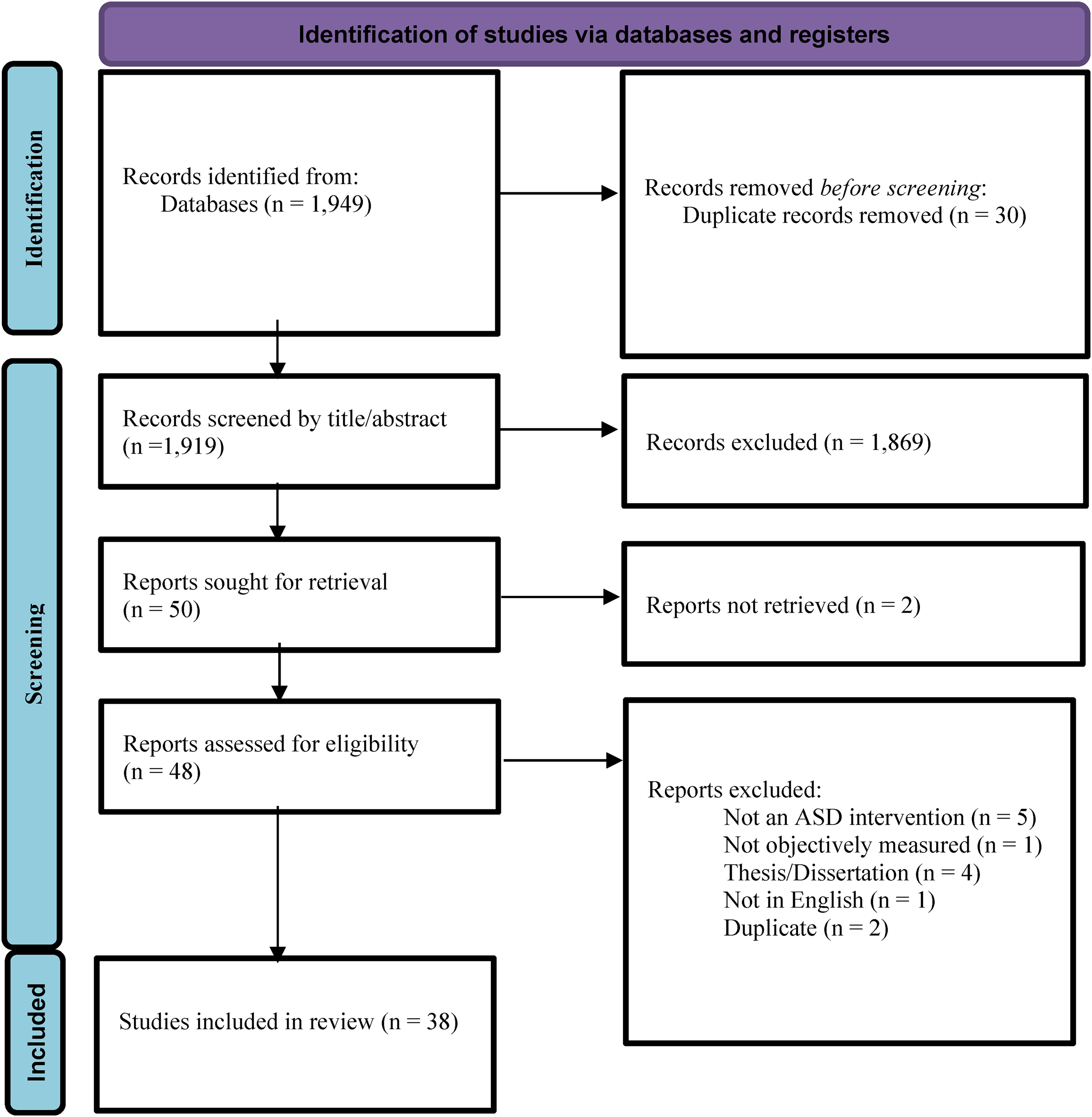
PRISMA flow diagram.
Study design characteristics
Of the 38 included studies, 58% (n = 22) used a study design that included a control or comparison group, while 42% (n = 16) used a single-arm (pre–post) design. Sample sizes ranged from 2 to 73 participants. Twenty-nine percent of studies (n = 11) had ten or fewer participants; 32% (n = 12) had between 11 and 25 participants; 26% (n = 10) had between 26 and 50 participants; and 13% (n = 5) had 51 or more participants. Most studies, 60% (n = 23), focused on children and adolescents (ages 6–17 years) while 11% (n = 4) focused on preschool-aged children (ages 3–5), 11% (n = 4) focused on adults (ages 18–64 years), and 18% (n = 7) included participants across several age groups. No studies focused only on older adults (ages 65+ years). In total, 978 enrolled participants, ranging in age from 3 to 60 years, were included in this systematic review. Table 1 provides a complete characteristics summary of included articles.
Characteristics of included studies.

Autism characteristics and traits & measurement tools
Across the included 38 studies, there were 30 different characteristics and traits assessed using 65 different outcome measurement tools. Social functioning, social skills, and social communication were the most common behavioral characteristics and traits assessed, measured in just under 30% of included studies. The most common measurement tools were the Vineland Adaptive Behavior Scale and Social Responsiveness Scale. However, 51 measurement tools were only used once across the included studies. Table 1 provides a summary of autism characteristics and traits assessed and outcome measurement tools.
Animal-assistance species
Four species of animals were involved in the 38 included studies. Horses (n = 17) and dogs (n = 17) were featured in 90% of the studies (45% each). The remaining 10% included a cat (n = 1) (Carlisle et al., 2021) and dolphins (n = 3) (Ashtari & Sheikh, 2018; R. Griffioen et al., 2019; Hernández-Espeso et al., 2021).
Physical activity presence
Physical activity was present in 82% (n = 31) of the included studies and not present in 13% (n = 5) (Carlisle et al., 2021; R. Griffioen et al., 2019; Jorgenson et al., 2020; Protopopova et al., 2019; Uccheddu et al., 2019). Two studies did not include enough information in the intervention description to determine if physical activity was present (Germone et al., 2019; Leung et al., 2022). When looking at physical activity by animal-assistance type, all studies with horses involved physical activity. The one cat-assisted study did not involve physical activity. The findings were mixed for interventions with dolphins and dogs. Two of the three studies involving dolphins included physical activity. For dogs, physical activity was present in 12 studies, not present in three studies, and could not be determined in two studies.
Physical activity dose: type, intensity, and volume—horses
All 17 studies that used horses as the assistance animal included physical activity. Physical activity types ranged from horseback riding to horse related chores and care. All physical activity types were considered moderate-to-vigorous intensity according to the Compendium, with MET values ranging from 3.8 to 7.3 METs. See Table 2 for the physical activity types described in each intervention and corresponding intensity estimates. No studies included physical activities considered to be light intensity.
Physical activity intensity estimates in studies involving horses.

MET value estimates are provided by the Physical Activity Compendium (Ainsworth et al., 2011).
Physical activity volume is determined by duration and frequency. Intervention duration was highly heterogeneous between studies, ranging from 5 weeks to 6 months. Session frequency was either one or two times per week. Session duration also varied between studies, ranging from 30 to 120 min. See Table 1 for a summary of physical activity duration and frequency in studies involving horses.
Physical activity dose: type, intensity, and volume—dolphins
Two of the three studies that used dolphins as the assistance animal included physical activity (Ashtari & Sheikh, 2018; Hernández-Espeso et al., 2021). All physical activity types centered around swimming and were considered moderate-to-vigorous intensity according to the Compendium, with MET values ranging from 3.5 to 9.8 METs. See Table 3 for the physical activity types described in dolphin interventions and their corresponding intensity estimates. No studies included physical activities considered to be light intensity.
Physical activity intensity estimates in studies involving dolphins.

For the two dolphin studies that involved physical activity, the dosage varied. One study had 16 sessions with the session frequency unspecified, while the other had a duration of 10 weeks and a frequency of three 45-min sessions per week. See Table 1 for a summary of physical activity duration and frequency in studies involving dolphins.
Physical activity dose: type, intensity, and volume—dogs
Twelve of the 17 studies where a dog was used in the intervention included physical activity. Physical activity types centered on playing with or running/walking with the dog. When assessing for intensity levels, according to the Compendium, five studies included physical activity types considered light intensity, ranging from 2.3 to 2.8 METs while seven studies included physical activity types considered light to moderate intensity, ranging from 2.3 to 5.0 METs. See Table 4 for the physical activity types described in each intervention and corresponding intensity estimates. No studies included physical activities considered to be vigorous intensity.
Physical activity intensity estimates in studies involving dogs.

Of the 12 dog studies that involved physical activity, only eight studies were clear in reporting dosage. Intervention duration ranged from 6 weeks to 4 months, session frequency ranged from 1 to 2 times per week, and session duration ranged from 30 to 60 min. See Table 1 for a summary of physical activity duration and frequency in studies involving dogs.
Discussion
The current systematic review found that a large majority of AAIs for autism involve physical activity. For reference, one AAI that contained no physical activity involved children reading a book out loud either with or without a dog present (Uccheddu et al., 2019). Physical activity types included horseback riding and chores with horses, swimming with dolphins, and walking, active play, and care for dogs. Intervention duration and session frequency significantly varied across studies. Most commonly intervention duration lasted between 6 and 12 weeks, session frequency was 1–2 times per week, and session duration was between 30 and 60 min per session. Interventions with horses and dolphins involved moderate-to-vigorous intensity physical activity while dog-assisted interventions were light-intensity physical activity.
The findings of this review support our hypothesis that AAIs for autism involve physical activity. However, they do not confirm that physical activity is a primary mechanism driving the benefits of AAIs. To determine this, carefully designed studies must compare AAIs with and without physical activity. When this is not possible (i.e., horseback riding interventions that inherently involve physical activity), statistical mediation methods should quantify the role of physical activity along the causal pathway. If it is demonstrated that physical activity is largely or even partially driving the benefits of AAIs, AAIs can be designed based on exercise prescription principles to maximize effectiveness. Current U.S. physical activity guidelines for children, adolescents, and adults without disabilities are highlighted in Supplemental Table 5. The guidelines focus on physical activity volume and frequency (e.g., minimum 60 min per day for youth), as well as intensity (minimum intensity for health benefits is considered “moderate” intensity, roughly equivalent to a brisk walk). It is recommended that children, adolescents, and adults with disabilities meet the key physical activity guidelines to the best of their abilities and when their disability precludes them from meeting the guidelines, they should be as active as possible and avoid inactivity.
Exercise is a physical activity that is planned, structured, and repetitive with a focus on improving health or fitness (Dasso, 2019). Exercise physiologists design exercise programs based on the FITT principle. The FITT principle is a set of general guidelines used to safely build exercise prescriptions – Frequency (how often), Intensity (how much or how difficult), Time (how long or duration), and Type (what type) (Gordon et al., 2010). The FITT components for a given exercise program are selected based on the target population and goal of the program (e.g., improve cardiovascular fitness, improve muscular strength, lose weight, improve balance), and are guided by evidence of safety and effectiveness.
The one AAI designed based on exercise prescription principles was tested by Abadi and colleagues. Abadi et al. built a physical activity intervention and incorporated a therapy dog to see if the presence of and interaction with the dog would increase physical activity (participants served as their own controls). Their results indicate that with the presence of the dog, participants spent more time in light physical activity (13% more minutes) and less time in sedentary behavior (22% fewer sedentary minutes). While no difference was found for moderate-to-vigorous physical activity, Abadi et al. demonstrated that it is feasible for assistance animals to increase physical activity while also reducing sedentary time. In addition to AAIs involving physical activity (hereafter, AAI-PAs) designed to maximize physical activity within weekly or bi-weekly therapy sessions, AAI-PAs designed to increase overall lifestyle-physical activity levels could be even more impactful for improving autistic characteristics or traits. To our knowledge, no studies to date have taken this approach.
Future AAI-PAs for autism should design their exercise component based on the specific outcomes they are interested in targeting. While physical activity is an evidence-based practice for addressing autistic characteristics, traits, or co-occurring conditions, the dose–response relationship between physical activity and these different outcomes varies. For example, emerging research indicates that high-intensity physical activity may exacerbate stereotypic behaviors while low to moderate physical activity offers a significant reduction in stereotypic behaviors (Ferreira et al., 2019). Therefore, an AAI-PA designed to reduce stereotypic behaviors should focus on low to moderate-intensity physical activity. More research examining the dose–response relationship between physical activity and other autistic characteristics or traits (e.g., executive functioning, social-communication) is needed.
This review found that horses and dogs are the most popular assistance animal in AAIs for autism. Further, all the horse studies and most of the dog studies (70%) included physical activity. Both species offer strengths and weaknesses as an assistance animal in AAI-PAs for autism that are scalable for high reach. Horses as family pets are limited by cost (expensive to purchase and care for) and scalability (not many American households include a horse). Additionally, as a therapeutic service, horses are limited in reach by cost (not often covered by health insurance) and location (mostly rural areas). However, a significant strength of interventions involving horses is the popularity and acceptance of therapeutic equine services for autistic populations. There is already an existing infrastructure of therapeutic equine centers throughout the United States providing support to those with autism (PATH, 2020). These centers could be leveraged as an environment to increase physical activity levels, contributing to the total amount of physical activity needed to meet the physical activity guidelines.
Dogs as family pets are also limited by cost, but they are significantly less expensive than horses. Their scalability potential is also much larger with a significant number of American households already owning a dog (Applebaum et al., 2023). However, owning a dog as a family pet is a significant commitment and while dogs can adapt to both rural and city dwelling, the breed, size, and energy level of the dog needs to be matched to individual lifestyles. There are also housing-related barriers (e.g., rent restrictions) which could prevent individual dog ownership. Loaner-dog programs could help reach individuals who cannot own a family dog due to financial or housing restrictions (often low-income/underserved populations). Loaner-dog programs could take various shapes, such as shelter dog fostering and/or walking programs, or community programs in which volunteers help community members who need assistance with dog walking and other pet care activities. For example, one innovative pilot intervention paired employees with shelter dogs to walk together for 30 min during their lunchbreak, thereby increasing opportunities to be physically active (Sartore-Baldwin et al., 2019).
Notably, many of the dog studies included in this review involved light-intensity physical activity (compared with moderate-to-vigorous intensity physical activity in the horse and dolphin studies). Although the physical activity guidelines recommend at least moderate-intensity physical activity to achieve health benefits, there is growing recognition of the health benefits of light-intensity physical activity especially for populations that are currently inactive (Füzéki et al., 2017). Further light physical activity when compared to moderate-to-vigorous physical activity, is more accessible to people of all ages and fitness levels, while not feeling like “exercise.” Therefore, companion animals in the home or loaner-dog programs that allow for regular physical activity is worth exploring to increase physical activity levels among autistics.
Only one AAI included in this review involved cats (Carlisle et al., 2021), and it did not involve physical activity. Pet cats have received much less interest in the scientific literature for their role in supporting physical activity than pet dogs, likely because they are not traditionally walked on leashes as dogs are. However, cats are less expensive and intensive to care for than dogs, and therefore creative interventions that leverage the cat–owner bond to promote physical activity could help reach individuals and families with barriers to dog ownership. Interventions could promote leash walking or active play with pet cats, but they could also pair a daily cat care activity, like feeding the cat, with a physical activity routine. A study by Maranda et al. had adolescents with type I diabetes pair medication with feeding a pet fish (Maranda et al., 2015). This novel intervention found an improvement in glycemic control by associating pet care behavior with personal health care. Cats could be leveraged in the same manner to break up sedentary behavior or increase light physical activity.
It should be noted that AAIs for autism are not yet considered to be an evidenced-based practice. Efficacy is not yet fully understood, with meta-analyses finding small improvements in social interaction and communication (Dimolareva & Dunn, 2021) and small-to-medium improvements in adaptive functioning (Droboniku & Mychailyszyn, 2021). However, with many families turning to alternative support services, it is imperative that the AAI field move toward becoming an evidence-based practice. Nieforth et al. (2021) call for the field to develop a standardized intervention design with a developed protocol to assess outcomes, further stating that the field needs to improve methodological rigor. The findings of the current review echo this sentiment, particularly regarding measurement. Within the 38 articles included in this review, 30 different characteristics and traits were assessed using 65 different outcome measurement tools with 51 of the measurement tools only used once. This aligns with the findings of a 2019 systematic review that focused on classifying the appropriateness and usage frequency of outcome measurement tools for autism and found that within 406 clinical trials, 475 measurement tools were used, with 69% only used once (Provenzani et al., 2020). The authors concluded that because of the still unknown phenomenology of autism there may be no single tool capable of assessing changes in outcome measures (Provenzani et al., 2020). While work continues to discover the most reliable tools to assess changes in autistic characteristics and traits, we contend that physical activity measurement could become a common thread weaved through AAIs for autism. Physical activity measurement tools, which have been validated to assess physical activity, could begin to bring consistency to the field and lay a foundation of methodological rigor to build upon. A concise physical activity measurement protocol infused into AAI-PAs could help move the field toward stronger methodological rigor. Once there is a consistent, validated outcome measure identified for use in future AAI-PAs, researchers can begin to untangle the relationships between human–animal interaction, physical activity, and their interaction with each other and with the characteristics and traits of autism.
Strengths and limitations
The major strength of this study is that it is the first to systematically investigate and quantify the extent to which physical activity is involved in AAIs for autism. In doing so, this study brings a novel (kinesiology) perspective to understanding possible mechanisms of change in AAIs for this population. This systematic review stands to make a meaningful contribution to the literature and serves as a call to action for more interdisciplinary work between experts in autism, human–animal interaction, and kinesiology to improve design, effectiveness, and reach of AAIs for autism. A key limitation of this study is that it is impossible to know the actual physical activity dose participants received in the included studies, with the exception of the one study that measured physical activity (Abadi et al., 2022). The findings of this systematic review should be interpreted within that context.
Future directions
Future research should be directed at testing physical activity as a mechanism of action in AAIs for autism. This could be accomplished by using physical activity measurement methods and comparing AAIs with and without physical activity, as well as using statistical methods to test for mediation effects. Additionally, it is imperative that research focus on the dose–response relationship between physical activity and various outcomes for this population. Specifically, research should determine the physical activity dose (i.e., volume, intensity) most appropriate for each characteristic or trait of autism. Without knowing the most appropriate dose of physical activity for improving a characteristic or trait, it is possible that interventions unintentionally exacerbate the characteristic or trait instead of supporting or improving it. Future research should design AAIs as physical activity interventions not only to target specific characteristics or traits of autism, but also to improve overall health outcomes, such as cardiovascular health and weight status. This should be done regardless of whether physical activity is determined to be a key mechanism of change for autistic traits and characteristics. Finally, we would like to acknowledge the importance of the well-being of the assistance animals involved in AAIs. Future research should be designed with the health and well-being of the animals as a top priority and should include statements as to how this was accomplished.
Conclusion
People with autism across all age groups have lower levels of physical activity when compared to their neurotypical peers. Physical activity is widely accepted as essential for growth and development of children, as well as for better physical and mental health outcomes throughout the lifespan. We conclude that AAIs for autism largely involve physical activity but are not designed as physical activity interventions and physical activity is not measured. Future AAIs for this population can be designed as animal-assisted physical activity interventions, leveraging the human–animal bond to capitalize on the benefits of physical activity for both overall health and characteristics and traits of autism.
Supplemental Material
sj-docx-1-ndy-10.1177_27546330241249880 - Supplemental material for The role of physical activity in animal-assisted interventions for autism: A systematic review
Supplemental material, sj-docx-1-ndy-10.1177_27546330241249880 for The role of physical activity in animal-assisted interventions for autism: A systematic review by Ann-Marie Sylvia, Sofiya Alhassan and Katie Potter in Neurodiversity
Footnotes
Declaration of conflicting interests
The authors declared no potential conflicts of interest with respect to the research, authorship, and/or publication of this article.
Funding
The authors received no financial support for the research, authorship, and/or publication of this article.

Supplemental material
Supplemental material for this article is available online.
References
Supplementary Material
Please find the following supplemental material available below.
For Open Access articles published under a Creative Commons License, all supplemental material carries the same license as the article it is associated with.
For non-Open Access articles published, all supplemental material carries a non-exclusive license, and permission requests for re-use of supplemental material or any part of supplemental material shall be sent directly to the copyright owner as specified in the copyright notice associated with the article.
