




Abstract
Numerous studies have explored the labor market of school principals, documenting high turnover rates and voicing concerns regarding labor supply. However, little is known about the staffing challenges in rural schools and what promotes applicants to apply for and be hired for principalship in these locales. In partnership with the Wisconsin Education Career Access Network, we examine the principal labor dynamics in rural schools using statewide job-openings and application information. Results indicate that all rural communities—rural fringe, rural distant, and rural remote—receive comparable numbers of applications, as compared with urban districts. Female candidates and candidates of color are significantly less likely to apply to rural districts, while experience working in the same district is a considerable advantage to being hired. Additionally, higher student poverty is associated with fewer principal applicants in rural schools. These results indicate the need for policies better attuned to subtle differences in rural contexts.
Introduction
Numerous studies view principals as key enablers of school improvement (Day et al., 2016; DeMatthews, 2018; Leithwood et al., 2010). As school leaders, principals affect the quality of instruction students receive by recruiting and retaining effective teachers (Boyd, Grossman, et al., 2011; Ladd, 2011), providing professional development programs for existing teachers (Sebastian & Allensworth, 2012), and building a strong school climate (Burkhauser, 2017). Effective principals thus contribute significantly—either directly or indirectly—to students’ learning, achievement, attendance, and graduation rates, particularly in high-poverty schools (Bartanen, 2020; Branch et al., 2012; Chiang et al., 2016; Coelli & Green, 2012; Dhuey & Smith, 2014; Grissom et al., 2017; Horng et al., 2010). Despite their inspiring influence on students and schools, the turnover rate among principals is alarming (Bartanen et al., 2019; Rangel, 2018). One in five principals leaves their positions annually, and about one in two is not retained after their third year. These statistics exceed the average rate of teacher turnover (Goldring & Taie, 2018; Latterman & Steffes, 2017). Scholars reveal that the challenges of staffing principal positions are exacerbated in areas serving high-poverty or low-achieving student populations (DeAngelis & White, 2011; Pijanowski et al., 2009; Rangel, 2018).
Despite increasing attention given to principals, relatively little is known about the labor dynamics of the position (e.g., recruiting, hiring, and retaining) in rural schools. While nearly one in five students lives in rural areas in the United States (Showalter et al., 2019), most studies focus on the nature of the principal labor market in urban settings, which skews the general understanding of rural principal labor market issues (L. Johnson et al., 2014; Myung et al., 2011). This emphasis leads to policy recommendations for rural schools that are typically rooted in metropolitan and urban-centric perspectives (Biddle & Berliner, 2002). Furthermore, the few studies that examine principal staffing in rural areas (Browne-Ferrigno & Allen, 2006; Cruzeiro & Boone, 2009; DeAngelis & White, 2011; Roza, 2003) rely largely on descriptive surveys (Roza, 2003), perceptions of superintendents (Cruzeiro & Boone, 2009), or administrative turnover statistics (DeAngelis & White, 2011).
Research and media discourse frequently portray rural schools as homogeneous communities, although most are dissimilar in student composition, size, structure, and proximity to a city (Budge, 2006; Cromartie & Bucholtz, 2008; Tieken, 2017). Proximity to an urban area closely correlates with more educational resources, such as advanced course offerings for students (Lavalley, 2018), professional development for teachers (Howley & Howley, 2005), and the qualifications of the hiring pool (Holme et al., 2018). For example, rural fringe, a region less than or equal to 5 miles from an urban area, tends to possess more educational resources than a rural remote region, which is greater than 25 miles from an urban area (J. Johnson & Howley, 2015). Nonetheless, policies and research inquiries have given little attention to rural locales in general and these nuanced differences specifically, resulting in recommendations that are often unresponsive to rural needs (Budge, 2006; Tieken, 2017). For example, scholars point out that the school turnaround models endorsed by the federal School Improvement Grants are incompatible with the rural labor market contexts and, thus, make it difficult for rural schools to receive necessary resources (Miller, 2012).
To close these gaps in the literature, we use statewide job openings and application data that include the majority of school leadership job market activity in Wisconsin from 2014 through 2016. Application data were combined with administrative staffing records, thereby including most applicants who apply for and are ultimately appointed to principal positions, along with their demographic characteristics and employment histories. We merge the data with district-level information from the Common Core Data and the Stanford Education Data Archive. In this study, only school principals are considered, excluding other school leadership and administrative roles. The following research questions are developed: (1) How many applications do rural schools receive for vacancies at the principal position? (2) Does the application pool differ according to rural community (rural fringe, rural distant, and rural remote)? (3) What district-level characteristics are associated with the size of the application pool? (4) Which applicant characteristics relate to being hired as principals in rural schools?
Background
Rural School Principals
Principals encounter complex daily tasks in their efforts to articulate visions and goals, motivate teachers, allocate resources, discipline students, and develop organizational structures in order to foster an effective learning environment (Day et al., 2016; DeMatthews, 2018; Quinn, 2002; Sebastian & Allensworth, 2012). Principals host and attend various meetings, many of which are unexpected, interacting with multiple stakeholders (Grissom et al., 2015; Horng et al., 2010). Sebastian et al. (2018) reveal that principals’ daily work is characterized by “long hours, numerous tasks, a frenzied pace, brevity, and fragmentation” (p. 52), culminating in severe time constraints during their workday. Moreover, previous studies on principals’ time use demonstrate that they wrestle with multiple tasks and that their time and work management are associated with both job stress and student performance (Grissom et al., 2015; Horng et al., 2010). Federal programs, such as Race to the Top, have recognized the importance of principals and recommended that school districts, particularly those with chronically low-performing schools, hire and retain principals with strong leadership skills (J. Johnson & Howley, 2015; U.S. Department of Education, 2009).
Principals in rural areas are often required to be flexible and versatile in their school operations, wrestling not only with declining student enrollments (Lavalley, 2018) and limited resources (Baker et al., 2014) but also due to geographic isolation, high teacher turnover (Azano & Stewart, 2015; Holme et al., 2018), and lack of professional development opportunities (Howley & Howley, 2005; Knapczyk et al., 2001). Moreover, rural principals often serve as leaders of multiple schools (Clarke & Stevens, 2006) and sometimes teach students across multiple grade levels (Preston et al., 2013).
Rural school principals often live, relate to, and participate in a rural lifestyle and culture (Budge, 2006). While rural communities tend to have high levels of social cohesion and a strong sense of belonging, which build strong school–community bonds, many rural principals experience a lack of privacy and often respond to out-of-school needs. Some researchers describe the professional lives of school leaders as “never off duty” (Cruzeiro & Boone, 2009, p. 7) or “public property” (Lock et al., 2012, p. 70), with community members expecting principals to be on call 24 hours a day. Thus, superintendents experience difficulties in filling principal vacancies (Pijanowski et al., 2009). As a result, some rural schools hire applicants with little or no administrative experience (Clarke & Stevens, 2009; Connelly & Tirozzi, 2008). To address these challenges, scholars suggest that developing sustainable leadership in rural areas should be a national priority (Hargreaves & Fink, 2006).
Although prior literature captures the common challenges to rural principals, scholars note that rural schools are far from similar in resources, size, and struggles (Eppley, 2009; Fowles et al., 2014; Latterman & Steffes, 2017). These differences may have diverse policy implications for rural schools; in particular, their distance from urban areas is closely related to their ability to take advantage of academic programs for students and professional development for teachers (Azano & Stewart, 2015; Baker et al., 2014; Lavalley, 2018). Moreover, over the past two decades, rural schools have experienced increased enrollment among minority populations (L. Johnson et al., 2014). For example, approximately one in five rural residents identified as Latinx (L. Johnson et al., 2014), and in some southern states, more than half of all Black students are enrolled in rural schools (Morris & Monroe, 2009). Not surprisingly, scholars have emphasized the variability across rural communities between and within states (J. Johnson & Howley, 2015).
Research on rural labor markets outside of education also agrees that it is unsatisfactory to describe rural communities as homogeneous, considering continuing industrial restructuring and rapid demographic shifts (Nelson et al., 2014). Research documents that such changes in rural labor markets are not uniform across geographic regions (Thiede et al., 2018). Despite the variability across rural communities, their proximity to urban areas is closely related to professional development opportunities for educators (Howley & Howley, 2005), resources (J. Johnson & Howley, 2015), course offerings for students (Lavalley, 2018), and the quantity of educator preparation programs (Goff et al., 2020). Nonetheless, education research tends to oversimplify rural communities as homogeneous, yielding disharmonized monolithic policies (J. Johnson & Howley, 2015).
To better account for such nuances, the National Center for Education Statistics (NCES) has worked with the Census Bureau to create a locale classification system that relies on proximity to an urbanized area, dividing the term rural into three subcategories (Geverdt, 2015). Rural fringe districts are located less than or equal to 5 miles from an urbanized area. Rural distant districts are located more than 5 miles but less than or equal to 25 miles from an urbanized area, while rural remote districts are located more than 25 miles from an urbanized area. The significant difference between rural and suburban areas is that rural territory is outside an urbanized area, while suburban territory is outside a principal city but inside an urbanized area, within a certain population (Geverdt, 2015). These contexts lead to different school systems, quality of teachers, and student learning needs (J. Johnson & Howley, 2015; Latterman & Steffes, 2017). While research has documented unique advantages and challenges to rural schools (J. Johnson & Howley, 2015; Petrin et al., 2014), no studies have explored how distance from an urban area operates in the labor dynamics of principals in rural schools.
Application and Hiring Patterns
Principal application and hiring patterns have long been a conundrum, largely due to the lack of available job application data. As a result, little evidence exists concerning how district characteristics relate to the number of applications they receive, while research attests that schools with large concentrations of low-achieving students, high-poverty students, or students of color experience high turnover rates (Rangel, 2018; Yan, 2020). If these factors account for the variation in the number of applications across schools, policymakers should provide greater support and resources to those schools for the recruitment of applicants and retention of educators. Additionally, given that the distribution of educators across schools is a result of both supply and demand sides, it is important to explore supply- (e.g., applicants’ decisions to apply for jobs in particular districts) and demand-related factors (e.g., districts’ hiring preferences) in the principal labor markets (Engel et al., 2014).
Limited studies have used survey or application data suggesting that teacher applicants focus on district characteristics (e.g., proportion of free lunch-eligible students, racial/ethnic composition) and familiar contexts (e.g., geographical distance to where they live) when deciding where to apply (Cannata, 2010). Boyd, Lankford, et al. (2011) document that schools prefer to hire teachers with higher qualifications (e.g., more years of experience, college competitiveness). Focusing on the applicant pool in Chicago Public Schools, Engel et al. (2014) find that substantial variation exists in the number of applicants across schools and that teachers are less likely to apply to poorer schools. Goldhaber et al. (2020) investigate teacher staffing challenges in rural California and conclude that rural schools experience substantially higher staffing challenges as compared with urban districts. These prior studies provide valuable insight into the school characteristics (e.g., the proportion of students in poverty) that influence prospective teachers’ preference and how strongly the geographic location of a school explains the size of the applicant pool for a teacher vacancy. While prospective principals may be influenced by the same factors and the geographic location of a school, no study has yet examined such issues in the principal labor market, particularly in rural settings, using large-scale applications-to-hiring data. Prior studies have documented the limited number of applicants and hiring challenges of principals in rural schools (Roza, 2003; Versland, 2013); nonetheless, they tend to rely heavily on survey and interview data, which are vulnerable to sampling and response biases.
In addition, the investigation of application and hiring patterns allows us to better understand principal pipelines and suggest evidence-based policy decisions. While rural schools have a higher proportion of male principals and a lower proportion of principals of color than do urban schools (Beesley & Clark, 2015), it is unknown whether application pools are less diverse or if rural school districts tend to hire applicants with particular characteristics. Similarly, while rural community members prefer principals who understand their cultural and social contexts (Browne-Ferrigno & Allen, 2006; Preston et al., 2013), it is unknown whether applicants who have a close affiliation with the school community (e.g., working in the same district) are more likely to apply for principal positions, if the districts prefer to hire those candidates, or some combination thereof. Understanding these factors is crucial for developing sound recruitment policies, because, if diverse applicants are not applying to rural schools, encouraging women and applicants of color for principal positions must receive increased emphasis in policy and practice. Conversely, if the applicant pool is diverse, appropriate policy considerations should emphasize ways to improve hiring decisions. To the best of our knowledge, this is the first study using statewide vacancy application data to understand the labor dynamics of school principals in rural contexts.
Method
Data
Located in the northern Midwest, Wisconsin is the 25th largest U.S. state in land area, with a total population of about 6 million. According to the census definition, 97% of Wisconsin’s land area is rural, but only 30% of the population lives in rural areas (Jones & Ewald, 2017). Based on Wisconsin school and staffing records, as of 2016, 55% of all school districts in the state are classified as rural, 36% of all schools in the state are located in rural, 25% of all teachers work in rural schools, and 23% of all students in the state attend rural schools. While these proportions are smaller than Wisconsin’s share of rural land area, these figures suggest that rural schools contribute significantly to Wisconsin’s public education. Table 1 further illustrates that, compared with rural districts in other states, Wisconsin’s rural districts produce higher student performance on standardized tests, smaller portions of low-income students and students of color, and lower student populations, with comparable numbers of students in special education and pupil–teacher ratios. Additionally, Wisconsin is one of 12 states that provides less funding to rural districts than to urban and suburban districts, while many states allocate a disproportionately larger share of school funding to rural school districts due to the relatively higher costs of equipping and managing them (Showalter et al., 2019). The similarities and differences between districts across different states suggest that caution should be taken in the interpretation and generalization of study results, aligning with the notion that rural schools are not only diverse within states but also between them (Lavalley, 2018; Morris& Monroe, 2009).
Characteristics of Rural Districts Across the States

Note. Means and standard deviations are for the year 2016. Standard deviations are in parenthesis. Data sources are the Common Core Data and the Stanford Education Data Archive (SEDA). Student enrollment in SEDA only covers students from third grade through eighth grade. FRL = free or reduced-price lunch; ELL = English language learner.
We use statewide vacancy and application data covering most job market activities from the demand (districts) and supply (principal candidates) sides for 2014 through 2016 in Wisconsin. 1 These data, provided by the Wisconsin Education Career Access Network (WECAN), include a wide range of information not only concerning the characteristics of vacancies (e.g., which districts post positions, what and when the positions are posted, and how many applicants apply to each vacancy) but also regarding the applicants (e.g., years of educational experience, certifications, how many applications each applicant submitted). As of 2016, 83% of districts are using the WECAN system to post job vacancies; consequently, most principal candidates search and apply for positions through the system. These data are merged with staffing records administered by the Wisconsin Department of Public Instruction to identify hiring results and work experiences (e.g., where the applicants worked before submitting applications, whether the applicants have leadership experience within 3 years). In some analyses, we supplement the application data with information on district-level characteristics from the Common Core Data and the Stanford Education Data Archive.
Table 2 presents summary statistics, illustrating the disaggregation of the data by rural and urban designations. The NCES defines locales as city, suburban, town, or rural; however, instead of using the term city, we use the term urban to align with previous studies. Additionally, we divide “rural” into three subcategories—rural fringe, rural distant, and rural remote—based on the NCES locale framework (Geverdt, 2015). Throughout the study, “urban” is utilized as a comparison group, given that urban schools are well-known for struggling with school staffing (Guin, 2004; Ingersoll, 2001). 2 This comparison between rural and urban facilitates understanding of the labor dynamics of school leadership in both contexts.
Summary Statistics

Note. Sample means and standard deviations are for the years 2014 to 2016. Standard deviations are in parentheses. Rural: Census-defined rural territory that is away from an urbanized area and an urban cluster. Rural fringe: Census-defined rural territory that is less than or equal to 5 miles from an urbanized area, as well as rural territory that is less than or equal to 2.5 miles from an urban cluster. Rural distant: Census-defined rural territory that is more than 5 miles but less than or equal to 25 miles from an urbanized area, as well as rural territory that is more than 2.5 miles but less than or equal to 10 miles from an urban cluster. Rural remote: Census-defined rural territory that is more than 25 miles from an urbanized area and more than 10 miles from an urban cluster. Urban: Territory inside an urbanized area and inside a principal city. FRL = free or reduced-price lunch; ELL = English language learner.
As shown in Table 2, rural districts receive fewer applications from female candidates for leadership vacancies (41%) compared with vacancies in urban districts (52%). 3 The further vacancies are from urban areas, the smaller the proportion of female candidates. Applications from people of color constitute 2.4% of applications for rural vacancies, and the proportion of urban vacancies is nearly five times greater. As with female candidates, the proportion of candidates of color decreases as the distance from urban areas increases. Clear differences in teaching experience between the location categories are not identified. Within the 3 years before submitting applications, candidates who apply to rural vacancies possess slightly more years of principal experience (0.31 years) than those who apply to urban vacancies (0.27 years), while the trend is reversed for years of assistant principal experience (0.17 vs. 0.20 years). As with gender and race/ethnicity, both years of leadership experience decline with greater distance from urban areas. Years of experience within the same district are nearly six times greater for candidates who apply to urban vacancies than for those who apply to rural vacancies. It is important to note, when interpreting the differences in years of experience, that the unit of analysis used is the number of applications, and not that of applicants. This gap is largely attributable to the difference in the number of educators between urban and rural districts. According to the staffing records from 2016, the average number of teachers in urban districts is 488, while that in rural districts is only 68. We also find that urban vacancies have 6.14 applications from the same district on an average, while rural vacancies have only 1.19 applications. Since the unit of analysis in the summary statistics is the application level, a higher number of principal candidates from the same district in urban vacancies leads to a higher average of years of same-district experience.
With regard to vacancy-level characteristics (shown in Table 2), rural vacancies correspond with higher student achievement scores than urban vacancies (0.16 vs. −0.11), and the score is higher when the rural vacancies are closer to urban areas (0.22 in rural fringe, 0.17 in rural distant, and 0.07 in rural remote areas). Rural vacancies show smaller proportions of students eligible for free or reduced-price lunch (FRL), students of color, English language learner (ELL) students, and special education students than urban vacancies, while notable variations exist within the rural communities. For example, the proportion of students eligible for FRL increases the further rural districts are from urban areas (33% in rural fringe, 38% in rural distant, and 49% in rural remote areas). The overall population of students is higher in urban vacancies than in rural vacancies. The per pupil expenditure (PPE), adjusted by the 2016 consumer price index for inflation, is slightly greater in rural vacancies than in urban ones. PPE increases the further vacancies are from urban areas. Principal salaries are slightly higher in rural vacancies than in urban ones, while the pupil–teacher ratio is higher in urban vacancies. 4
Empirical Framework
To explore the first research question, we examine the number of applications per vacancy by locale. First, we provide a descriptive portrayal in rural, urban, suburban, and town districts, as categorized by the NCES. To explore whether the application patterns differ by specific types of rural communities—rural fringe, rural distant, and rural remote—a graph contrasting the number of applications by the subcategories and urban areas is presented. Because mean values are likely to be affected by outliers when a vacancy receives a massive number of applications, we use box plots that display median values as well as dispersion and skewness in the data.
To address the second research question, differences in the application pool within rural communities, we run the regression models in the application level as follows:

where the outcome (
The third research question explores the organizational factors related to the number of leadership applications across locales. The following regression is estimated via OLS 5 :

where
For the fourth research question, in which individual factors are relevant for candidates to be hired, we run logistic regression models at the application level of the following form:

where the outcome (Y) represents the log odds of being hired for an applicant who submits an application
We anticipate that the likelihood of being hired is a function of applicants’ individual characteristics, as suggested in previous research on teacher retention and hiring (Boyd, Lankford, et al., 2011; Engel et al., 2014). Given that rural education leadership is a male and/or White-dominated field (Fuller et al., 2018; Hollingworth & Dude, 2009), female applicants and applicants of color may be less likely to be hired as principals. Rural schools may place value on more years of teaching and leadership experiences when deciding whom to hire for school improvement. Furthermore, they may prefer applicants who have previously worked in the school, as they may establish an (in)formal network and hence better understand the historical and social context of the school (Browne-Ferrigno & Allen, 2006; Preston et al., 2013). The inclusion of the number of applications an applicant submitted to the model controls for different application patterns of applicants with particular characteristics. For instance, candidates of color may submit fewer applications to rural vacancies than urban vacancies, which may affect the hiring outcomes in both areas.
For vacancy fixed effects, by constraining the variance to only that within vacancies, this modeling approach more closely reflects the underlying process where a principal candidate competes with other candidates who apply to the same vacancy and hiring decisions are made relative only to other candidates in the applicant pool. This strategy also mitigates the bias resulting from unobservable vacancy-level characteristics (e.g., when the vacancy is posted, how many applicants apply to the vacancy, whether the vacancy is planned ahead or unexpected), and district-level characteristics (e.g., district climate and size). Standard errors at the vacancy level are clustered due to the nested nature of the data (multiple applications within a vacancy), and the log odds results are converted into odds ratios for ease of interpretation. To identify which factors are statistically significant for both rural and urban districts and whether the estimated magnitudes differ by location, we divide the sample into two groups (rural and urban) and run the same logistic regression model. Additionally, we divide the rural group into specific rural communities (rural fringe, rural distant, rural remote) to clarify which factors are dominant across locales.
Findings
Recruiting Principal Candidates: Number of Applications
We find that rural districts receive the same number or more applications than school districts in urban areas. As illustrated in Figure 1, the median number of applications that a principal vacancy in rural districts receives is 44.5, whereas urban districts receive around 36 applications. Suburban districts receive 52 applications and town districts receive 39. 6
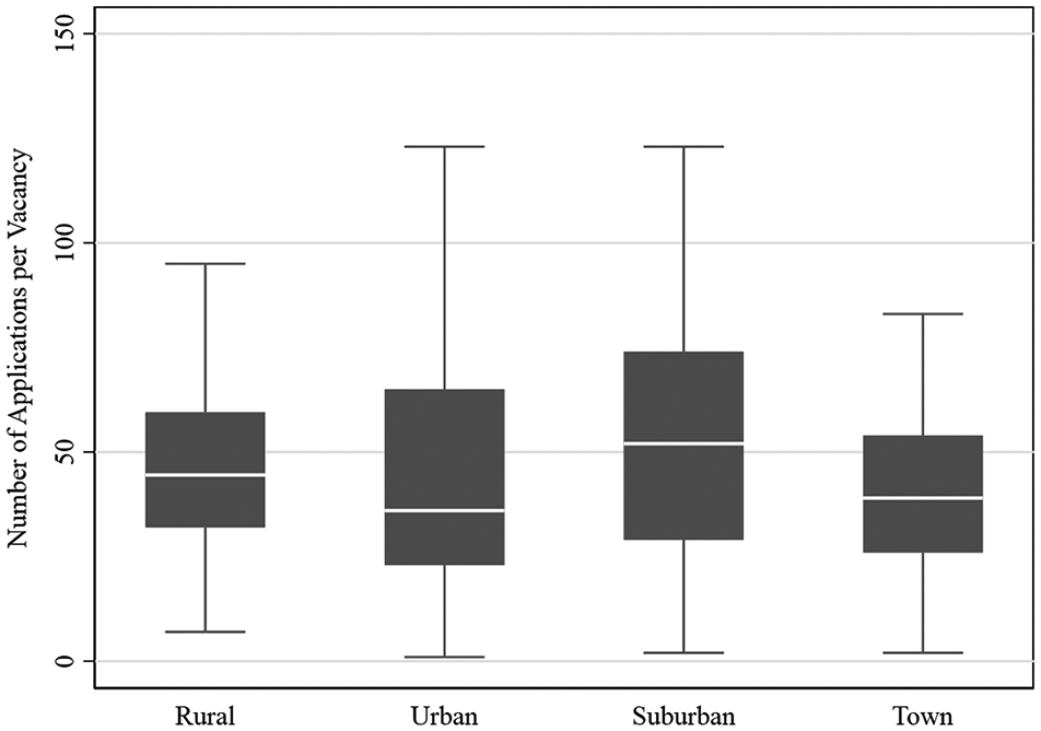
Number of applications per vacancy.
We further explore whether patterns in the size of the application pool differ by rural classification: rural fringe, rural distant, and rural remote. Marked differences in the number of applications across the rural types are discovered, as shown in Figure 2. The farther a principal vacancy is from urban areas, the more the number of applications decreases. A principal vacancy in rural fringe, which is no more than 5 miles from urban areas, receives a greater number of applications (51) than other rural communities, as well as urban districts (36). Rural distant receives 45.5 applications per school principal vacancy. Finally, among the rural subtypes, rural remote receives the fewest applications (36), which is similar to the pattern in urban districts. Overall, Figure 2 shows that the farther a district is from an urbanized area, the greater the number of applicants is reduced. Although rural remote receives the fewest applicants, they still receive more than 30 applications per vacancy on median value.

Number of applications per vacancy by rural subtypes.
One concern may be that principal applicants show different application patterns between rural and urban areas. For example, applicants who apply to rural vacancies might submit more applications than those who apply to urban vacancies, because job openings may not become available as often in rural areas. From 2014 to 2016, nearly 28% of urban schools post principal positions at least once, with only 14% of rural schools posting the same positions. However, candidates in urban areas apply an average of 2.85 times within a given time period, while those in rural areas apply to an average of 2.40 times, refuting the possibility that candidates vying for rural positions likely apply to every available position due to limited job availability. We also find that the number of applications per candidate is similar across specific types of rural communities—rural fringe, rural distant, and rural remote.
Differences in the Application Pool
To address the second research question—whether there is a difference in the characteristics of principal applicants based on the location of the school districts—we run two logistic regression models, focusing on two locale types (rural and urban) and four types (rural fringe, rural distant, rural remote, and urban), respectively. The reference group consists of urban vacancies in both models.
Table 3 shows a clear tendency that rural vacancies receive a smaller number of applications from female candidates. Applications from female candidates in rural areas are 11.2 percentage points fewer than those with urban vacancies. Additionally, regardless of the distance to urban areas, rural communities tend to receive fewer applications from female candidates than did urban communities with vacancies (p < .001). Like gender, rural districts receive 8.9 percentage points fewer applications from candidates of color than urban vacancies do (p < .001). This trend is consistent when comparing other rural communities with urban districts (from 8.5 percentage points decrease in rural fringe to 9.7 percentage points decrease in rural remote areas). The third outcome pertains to teaching experience, which is a continuous variable. Candidates for rural vacancies have more years of experience than candidates for urban vacancies, although the magnitude of the difference (0.52 years) is small. The fourth outcome is years of principal experience in Wisconsin public schools, within 3 years of application. Candidates for rural vacancies have slightly more years of principal experience than candidates for urban vacancies, but this difference is not statistically significant below the 5% level of significance. However, candidates who apply to rural fringe vacancies have more principal experience than those applying to urban positions. The fifth outcome is years of assistant principal experience within the 3 years prior to submitting applications. No statistical significance between rural and urban areas is discovered, while candidates of rural remote vacancies have fewer years of assistant principal experience than those of urban vacancies. The sixth outcome is work experience within 3 years of the job posting in the same district where a vacancy is posted. Candidates for rural positions have fewer years of the same-district experience (0.28 years) than those applying for urban principal positions. These differences are consistent when comparing the urban applicants with those of all other rural communities.
Application Pool Differences in Rural and Urban Vacancies

Note. Column (a) and (b) are linear probability model, while column (c) through (f) are ordinary least square model. All specifications include the number of applications an applicant has sent out to other vacancies in the same time period and year fixed effects. Urban is the reference group. Standard errors clustered at the applicant-level are in parenthesis. The locale definitions are identical to those in Table 2. AP = assistant principal.
p < .1. *p < .05. **p < .01. ***p < .001.
District Characteristics Attracting Principal Applicants
The third research question examines which organizational factors are relevant for the number of applications for the school principal position in rural districts. For comparison, we run the same regression model, using a sample of urban districts. Prior work demonstrates that rural teacher labor markets differ from nonrural labor markets in meaningful ways (Miller, 2012). Thus, it is important to explore which district characteristics, particularly in rural contexts, are associated with an increase in the number of applications. This approach is congruent with Engel et al. (2014), who explore which school characteristics are important predictors of where teacher applicants apply in Chicago, and Goldhaber et al. (2020), who examine which district characteristics are associated with staffing challenges in rural California. The district-level characteristics are further divided into fixed characteristics (e.g., student composition) and malleable features (e.g., salary and pupil–teacher ratio) for suitable policy implications (Viano et al., 2020). Given that districts primarily post a vacancy for their needs, and that rural districts in Wisconsin are small (having only three schools on average), so that there are few meaningful variations in the organizational characteristics between schools within a rural district, district characteristics rather than school characteristics are emphasized.
Table 4 shows that, among the district characteristics, only the proportion of FRL students in the district is significantly associated with the number of applications in rural districts. Specifically, a 1 percentage point increase of the FRL status is related to a 0.56 decrease in the number of applications in the district, holding other covariates constant. Other variables, such as student achievement, student enrollment, proportion of students of color, PPE, principal salary, and pupil–teacher ratio, show no discernible differences in the number of applicants to rural districts.
Relationships Between Number of Applications and District-Level Characteristics
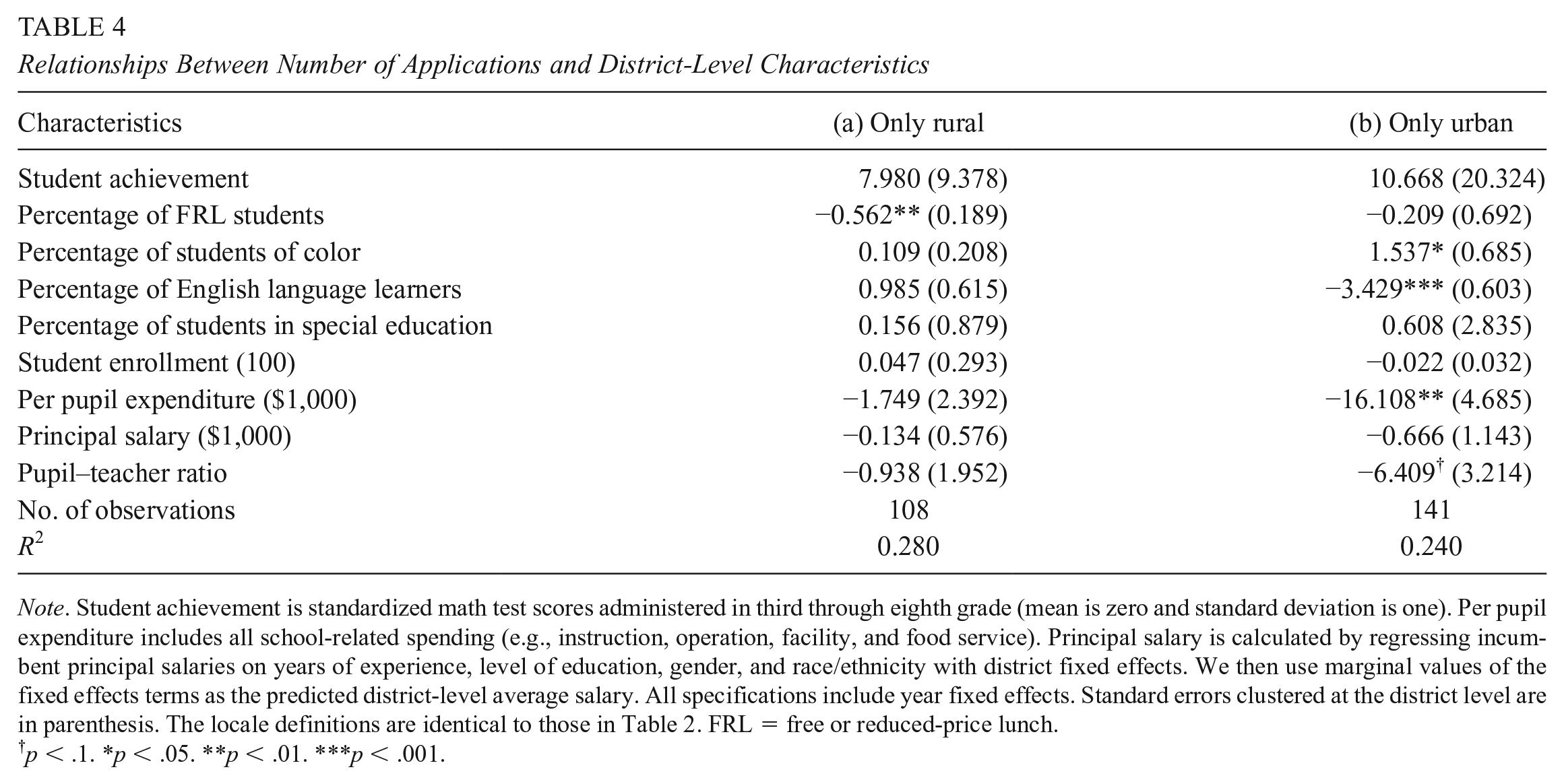
Note. Student achievement is standardized math test scores administered in third through eighth grade (mean is zero and standard deviation is one). Per pupil expenditure includes all school-related spending (e.g., instruction, operation, facility, and food service). Principal salary is calculated by regressing incumbent principal salaries on years of experience, level of education, gender, and race/ethnicity with district fixed effects. We then use marginal values of the fixed effects terms as the predicted district-level average salary. All specifications include year fixed effects. Standard errors clustered at the district level are in parenthesis. The locale definitions are identical to those in Table 2. FRL = free or reduced-price lunch.
p < .1. *p < .05. **p < .01. ***p < .001.
In urban districts, the proportion of FRL students is not associated with the number of applications received. Instead, the share of students of color, the share of ELL students, and PPE in the district are associated with the number of applications to urban vacancies. To illustrate, a 1 percentage point increase of students of color is associated with a 1.54 increase in the number of applications for the vacancy. One percentage point increase of the ELL students relates to a 3.43 decrease in the number of applications. A $1,000 dollar increase in PPE is associated with a 16.1 decrease in the number of applications. One possible interpretation for this result is that the greater the PPE, the higher the poverty level in school districts. Because poor districts are more likely to receive a large amount of state and federal funding, such as Title 1 funds, higher PPE indicates particular districts where principal applicants may prefer not to work (Rangel, 2018; Yan, 2020). Although revealing the exact mechanism is beyond the scope of this study, the high correlation (r = 0.80) between the share of FRL students and PPE in urban districts may support this scenario.
Overall findings suggest that district factors associated with the number of applications differ according to the vacancy location. 7 In rural vacancies, the variation in the number of applications is partly explained by the proportion of students in poverty in the district, while in urban variables, the number of applications is associated with the proportions of students of color, ELL students, and PPE in the district. Variables such as student achievement, the share of special education students, principal salary, and pupil–teacher ratios are not associated with the variation in the number of applications for either rural or urban vacancies.
Individual Characteristics Related to Being Hired
We explore which individual characteristics are relevant for principal candidates to be hired in rural districts, as shown in Table 5. 8 Importantly, our findings should be interpreted as associations rather than causations, although the inclusion of vacancy fixed effects mitigates biases resulting from unobservable vacancy-level characteristics. These results are also conditional on an individual applying for a position. Gender is unrelated to hiring in rural locales overall. Interestingly, female applicants are more likely to be hired in rural remote vacancies (odds-ratio: 4.244). While the magnitude is large, the findings need to be interpreted with caution, as they may be largely attributable to the modest sample size (505 observations) and the small proportion of female candidates (38%) compared with other locales.
Applicant Characteristics Related to Being Hired (Odds Ratios)

Note. All specifications include vacancy and year fixed effects. We also control for the number of applications an applicant has submitted to other vacancies in the same time period to account for different application patterns by individual characteristics. Standard errors clustered at the vacancy level are in parenthesis. The locale definitions are identical to those in Table 2.
p < .1. *p < .05. **p < .01. ***p < .001.
Applicants of color who apply to a vacancy in rural fringe and rural remote areas are less likely to be hired, although there seems to be no difference in rural vacancies overall. The extremely low odds ratios (0.000) in the two areas are likely attributable to the fact that very few applicants of color apply to those vacancies, combined with low rates of subsequent employment, which is a product of not being offered a position or electing not to accept an offer of hire. Descriptively, 3% and 1% of applications are from applicants of color in the rural fringe and rural remote, respectively, and the staffing record does not indicate any hired cases.
Teaching experience is not notably associated with the probability of being hired as a principal in rural or urban districts. Focusing on vacancies and corresponding applications in rural fringe districts, findings reveal more years of teaching experience are related to a decrease in the probability of being hired. In particular, the odds of being hired are 0.925 times as great as a 1-year increase in teaching experience, holding all other covariates constant at their mean.
Principal candidates who have former principal experience within 3 years are more likely to be hired at a principal position in both rural and urban districts. In rural districts, the odds of being hired for applicants are 1.297 times as great as a 1-year increase in principal experience. In urban districts, the odds of being hired for applicants are 1.986 times as great as a 1-year increase in principal experience. Considering specific rural communities, a similar tendency in rural fringe districts suggests the odds of being hired for applicants are 1.425 times greater as a 1-year increase in principal experience.
Assistant principal experience within 3 years of application is not associated with hiring outcomes in rural vacancies overall, while the odds of being hired for applicants in rural distant areas are 1.449 times as great as a 1-year increase in assistant principal experience. In urban districts, the odds of being hired are 1.359 times as large as a 1-year increase in assistant principal experience. This result suggests that assistant principal experience may be highly valued in urban areas in the process of principal hiring.
Finally, we learn that principal candidates who have worked in the same district where they apply is the most powerful factor for the prediction of being hired. In rural districts, the odds of being hired for applicants are 1.869 times as great as a 1-year increase in the experience of the same district where they apply. In urban districts, the odds of being hired for applicants are 1.875 times as great as a 1-year increase in the same-district experience. Focusing on specific rural communities, it is noted that the magnitudes of the estimates vary slightly, while the odds ratios are all positively associated with the probability of being hired. In rural distant districts, the odds of being hired are 1.518 times as great as a 1-year increase in the same-district experience. Similarly, in rural remote districts, the odds of being hired for applicants are 2.694 times as great as a 1-year increase in the same-district experience.
Our results build on the literature relating to principal hiring and sorting (Clotfelter et al., 2006; Grissom et al., 2019; Loeb et al., 2010) by exploring hiring results within the application pool. Grissom et al. (2019) demonstrate, using administrative data from Tennessee, that newly minted principals in rural schools have less leadership experience than principals in other areas. However, they do not find such differences in nationally representative data from the Schools and Staffing Survey. By contrast, our findings suggest that more leadership experience is associated with the higher probability of being hired in Wisconsin’s rural schools. While Grissom et al. (2019) contribute to our understanding of principal sorting depending on geographic contexts, we focus on the hiring dynamics by using the pool of applicants, and show that rural schools also place strong emphasis on leadership experience in the hiring process. Further studies should use a rich set of labor market information, including administrative records and application-to-hiring data, to investigate the labor dynamics of rural principals and suggest appropriate policy implications that are responsive to principal staffing challenges in rural schools.
One would raise concerns that a strong relationship between the same-district experience of principal candidates and their hiring outcomes may reflect that the principal markets seem to be publicly open, but the final selection is predetermined to favor a particular internal candidate. We find that 19% of rural vacancies were filled by applicants who had worked in the same districts within 3 years of application, while 60% of urban vacancies were filled by internal candidates. The greater portion of internal hiring in urban districts may be attributed to the large district size (e.g., many staff who could apply to leadership positions). However, these large portions of internal hiring do not stand for the closed labor markets of rural principals. If the hypothesis would be true, most vacancies that have only a single same-district applicant should hire the internal candidate because the districts already decide who they want to fill the position and encourage the internal nominee to apply for. We find that 36% of rural vacancies have only a single same-district applicant, while the corresponding percentage in urban areas is 4.4%. Among these vacancies that have only a single same-district applicant, 18.8% of the applicants were hired in rural areas 9 (25% in rural fringe, 15% in rural distant, and 25% in rural remote), while 25% of the applicants were hired in urban areas. We further find that 22% of the single same-district applicants for a rural vacancy did not apply for any other principal positions. These descriptive findings confirm that the rural principal labor market operates under an open competitive process whereby districts choose favored applicants from within the applicant pool, although internal hiring is one of the primary strategies utilized by both rural and urban hiring bodies.
Discussion
Although education researchers have paid increasing attention to the importance of recruiting and retaining principals, staffing challenges related to school leadership, such as high turnover rates and principal sorting, are a continuing issue in the nation’s K–12 schools (Bartanen et al., 2019; Gates et al., 2006; Grissom et al., 2019; Papa & Baxter, 2005; Rangel, 2018). Prior studies have recognized the distinct challenges that rural schools experience in the principal hiring process (Roza, 2003) and have raised concerns regarding the few applications that rural schools receive (Versland, 2013). Despite such concerns and the rhetoric surrounding principal shortages, this study finds that there is no shortage of principal applicants. In particular, the number of applicants to rural and urban leadership vacancies is comparable, and openings in remote rural districts often exceed 30 applicants per vacancy. In fact, application pools tend to be smaller the further districts are from urbanized areas. Considering the sizable discrepancy in the number of applications received by rural communities based on locale, policy solutions and approaches should be responsive and sensitive to their context. For example, education policies targeting staffing challenges, such as “Grow your own” programs and financial incentives for principals, need to be more focused on geographically isolated rural schools (e.g., rural remote), rather than broad rural areas.
Differences in applicants’ characteristics by locale are evident. While years of teaching and leadership experience are less prominent features, a trend where female candidates and candidates of color are significantly less likely to apply for leadership vacancies in rural districts appears clear. For applicants of color, this pattern is exacerbated as districts are located further from urban centers, to the point where urban districts see more than 12 times as many applicants of color than do remote rural districts. In fact, while educators in the state of Wisconsin comprise about 74% female teachers and 5% teachers of color, applicants for rural principalships comprise of only 40% of females and 2% of individuals from racial and ethnic minorities. Rural fringe and rural remote areas have not hired a single applicant of color within the past 3 years. Previous studies have identified difficulties for females and applicants of color endeavoring to “break into” a male and/or White-dominated field in educational leadership (Hollingworth & Dude, 2009; Hoobler et al., 2009). Empirical studies also confirm a “glass ceiling,” in that Black and female candidates are less likely to be promoted to school leadership and have to wait longer for promotion as compared with White and male candidates (Bailes & Guthery, 2020). Research has also highlighted that the lack of appropriate role models, mentors, and leadership opportunities for female educators and educators of color is among the most common reasons some women and teachers of color are not applying for principalships (Fuller et al., 2018; Hoyt & Simon, 2011). Unfortunately, our data do not provide information on whether districts are not offering positions, or if applicants have declined offers and sought positions elsewhere. Further, it is discovered that female applicants have a higher probability of being hired in remote rural communities. This finding underscores the heterogeneity and variability across rural locales, revealing the necessity for additional research to better understand the factors that encourage or discourage female applicants and applicants of color in applying for rural school principalships, as well as the factors that motivate or discourage hiring authorities from offering them positions.
In addition, this study indicates that hiring internal candidates is a common practice in districts across all locales. Principal applicants who apply for a vacancy in school systems where they have previously worked are more likely to be hired. Internal promotion to fill vacancies higher within the organizational structure is a common practice (DeVaro et al., 2019), and schools have been utilizing such an approach to strengthen their leadership cadre and to staff their schools with high-quality leaders (Joseph, 2009). By providing well-thought-out leadership experience or internship opportunities, internal candidates can not only acquire licensing and credentials but also gain practical knowledge about the issues that specific rural schools encounter, and can refine their leadership abilities to meet those particular needs. While hiring within the district has its advantages, most vacancies that have only a single same-district applicant do not always hire the internal candidate. In fact, of these vacancies, about 25% (urban) and 20% (rural) of internal applicants are hired, respectively. This implies that while internal experience is a strong predictor for hiring, rural districts do not exclusively hire internal applicants, which also indicates that both rural and urban principal labor markets have relatively open competitive processes. Nevertheless, more research is needed to understand internal hiring and its effectiveness on employee retention and student outcomes.
Finally, it is evident that prospective rural principals prefer not to work in schools that serve a high concentration of students from low-income households. This mirrors teacher labor market literature suggesting that schools with concentrations of students of color, students from low-income families, or low-achieving students are more likely to experience difficulty attracting and retaining effective teachers (Elfers et al., 2006; Engel et al., 2014). While rural and urban districts experience similar challenges, such as student poverty and access to education resources (Baker et al., 2014; Guin, 2004), the solutions or policies from urban studies cannot be unilaterally applied to rural contexts since the mechanisms, and therefore the appropriate remedies, are distinct depending on the locale. Poverty, for example, tends to be highly concentrated in urban districts, and more diffuse in rural districts. Homelessness plagues both locales, yet the antecedents and available supports differ substantially (Edwards et al., 2009). Access to the internet and problems associated with a lack thereof appear differently in rural and urban districts (LaRose et al., 2007). The challenges to recruitment in rural contexts also involve aspects of social and cultural dissonance, even when race is not an issue (Hurley, 1992; Morford, 2002). Challenges include a misalignment between the types of amenities offered and the amenities desired across locales (Monk, 2007), limitations in leadership preparation (Drummond & Halsey, 2014), and scale-related constraints that require principals to engage a broader swath of responsibilities with fewer organizational supports (Tholkes & Sederberg, 1990). While some solutions, such as increased compensation (Cowan & Goldhaber, 2018), may apply across locales, other solutions are likely to be more effective when tailored to locale-specific challenges.
Implications for Practice
While more research is needed to understand the complex dynamics of the rural labor market, this study provides two implications for practice that districts can employ with relatively little effort and expense. First, the districts can revise and improve their hiring processes. Rural schools can be more intentional when they post their vacancies, for how long, and when to offer positions. Though rural schools receive as many or more applications than other locales, this does not mean that the districts will ultimately hire their desired candidate. In fact, applicants often apply to multiple locales and districts for principalship. Prior studies have shown that if an applicant receives multiple offers, they are likely to accept an offer from the school with the most resources (Boyd, Lankford et al., 2011), a school with the least struggling students (Boyd et al., 2013), or a school in a suburban locale (Jacob, 2007). Considering that districts compete with one another to recruit and staff the most effective principals, early planning for principal succession and decision making can help attract and ensure the most desirable candidate.
Second, to diversify the application pool, rural districts need to intentionally seek, mentor, and encourage female teachers and teachers of color in their districts. Rural schools have been developing their own principal preparation programs such as “Grow your own” (GYO) to strengthen their principal pipeline (Versland, 2013). However, its focus has been largely on addressing the staffing issue of the district, rather than diversifying the prospective principal workforce. In addition, while the literature has documented the positive role that female applicants and applicants of color may bring to make school successful (Fuller et al., 2018), principals tend to favor applicants of their own race, and generally prefer men over women (Myung et al., 2011). Acknowledging the reality that individual decisions whether or not to apply for principalship and where to apply are never made in a vacuum (Hill et al., 2016), such intentional efforts and encouragement to diversify the district’s application pool should be made to achieve gender and racial parity between principals, teachers, and students. Fortunately, such programs have been shown to be inexpensive if the school district is training large numbers of administrative candidates annually (Joseph, 2009).
Limitations and Future Research
There are several notable limitations that accompany our findings. First, although we observe who apply and is hired in particular vacancies, no insight is gained into the detailed hiring process. Specifically, we have no information regarding which candidates receive interview offers, accept interviews, receive final offers, or accept offers. Thus, this study cannot determine if individuals who are ultimately hired represent a district’s first (or last) choice, or if the interviewing district is the candidate’s first (or last) choice. Such information would lead to a clearer understanding of the shortage in terms of quality and principal-sorting issues. The second limitation pertains to generalizability; specifically, the population of Wisconsin is overwhelmingly White in rural locales. It is unlikely that our findings—specifically those pertaining to race—could be generalized to a context such as rural Alabama or Mississippi, where considerations of racial isolation are less of an issue. Thus, additional research in different states is required to help leaders in education and policymakers to better understand the different challenges that rural schools encounter. Third, the characteristics or demographics of school districts may moderate the application pool or hiring decisions of principal applicants of color. For example, districts with higher proportions of students of color are more likely to hire principals of color. Further research in this area can help the academy not only better depict the rural labor market but also understand the complexity and diverse contexts of rural schools. Last, owing to the lack of school-level characteristics, we are unable to explore how school-level characteristics relate to the rural school principal labor market. While most rural schools in Wisconsin have an average of only three school buildings and are less likely to post and/or fill vacancies for multiple principal positions in a single year, such research, for instance, may reveal whether principals might express within-district preferences to fill vacancies. Additional research on the principal labor market that can address the above limitations is necessary to further support rural school districts.
Footnotes
Appendix
Applicant Characteristics Related to Being Hired (Linear Probability Model With Limited Sample)

| Applicant Characteristics | (a) Rural | (b) Rural fringe | (c) Rural distant | (d) Rural remote | (e) Urban |
|---|---|---|---|---|---|
| Female | 0.004 (0.005) | −0.001 (0.008) | 0.001 (0.006) | 0.035* (0.014) | 0.005 (0.006) |
| Applicants of color | −0.015 (0.013) | −0.019** (0.007) | −0.008 (0.022) | −0.030* (0.014) | 0.018 † (0.010) |
| Teaching experience | −0.000 (0.000) | −0.001* (0.000) | −0.000 (0.000) | −0.000 (0.001) | 0.000 (0.000) |
| Principal experience within 3 years | 0.007 † (0.004) | 0.012 † (0.007) | 0.005 (0.005) | −0.001 (0.007) | 0.034*** (0.005) |
| Assistant principal experience within 3 years | 0.007 (0.005) | −0.003 (0.004) | 0.013 † (0.008) | 0.014 (0.030) | 0.015** (0.005) |
| Same-district experience within 3 years | 0.055*** (0.015) | 0.076* (0.030) | 0.033 † (0.018) | 0.100* (0.043) | 0.042*** (0.006) |
| No. of Observations | 4,170 | 1,228 | 2,437 | 505 | 4,140 |
| R 2 | 0.040 | 0.067 | 0.025 | 0.107 | 0.183 |
Note. All specifications include vacancy and year fixed effects. We also control for the number of applications an applicant has submitted to other vacancies in the same time period to account for different application patterns by individual characteristics. Standard errors clustered at the vacancy level are in parenthesis. The locale definitions are identical to those in Table 2.
p < .1. *p < .05. **p < .01. ***p < .001.
1.
The period 2014 to 2016 is the latest data based on our contract with WECAN.
2.
The NCES classifies urban into three subtypes—urban large, urban midsize, and urban small—by population. As of 2016, there is one urban large district (Milwaukee Public Schools), two urban midsize districts (Madison Metropolitan School District and Green Bay Area Public School District), and 14 urban small school districts in Wisconsin. These 17 urban districts account for 24% of schools, 27% of teachers, and 29% of students, respectively. Milwaukee Public Schools, the largest urban district, has 75,749 students, while the smallest urban district, Onalaska School District, has 3,155 students.
3.
One applicant could apply for multiple vacancies, which may account for differences in summary statistics between applicant and application level. We show the summary results for the application level because we focus on how application pools vary by locale (Research Question 2) and how the hiring probability differs conditional on candidate characteristics for a specific vacancy (Research Question 4). Additionally, we find that the summary statistics are similar to the results for the applicant level. The results are available from authors on request.
4.
We use predicted district-level average salary because we do not know the exact salary that a candidate could receive from each vacancy to which they applied. Using administrative staffing records, we first regress individual principal salaries on years of experience, level of education, gender, and race/ethnicity with district fixed effects. We then use the marginal values of the fixed-effects terms as the district-level average salary.
5.
Because the number of applications is a count variable, a Poisson model is the appropriate approach to accommodate the nature of the dependent variable. We find that the Poisson results are statistically consistent with the OLS results. We also find that the results are consistent with the OLS results when transforming the dependent variable into natural logarithmic form. We use the OLS results for ease of interpretation. Both Poisson and log-transformed results are available from authors on request.
6.
We find consistent tendencies when breaking down the applications by year (2014 to 2016) and using mean values. These results are available from authors on request.
7.
We could not run the separate regression models by specific types of rural communities because our sample sizes are too small for adequate precision (29 vacancies of rural fringe, 58 vacancies of rural distant, and 21 vacancies of rural remote). Instead, we employed interaction models using all rural and urban samples, as shown in  . The results show that there are considerable differences in the district characteristics related to the number of applications across locales.
8.
Because we employ a logistic regression model with vacancy fixed effects, vacancies are dropped if the hiring results are not identified (e.g., the hiring result of all applicants is coded as zero in a vacancy). This case may happen if a district decides not to recruit a candidate from the application pool or for other reasons. Thus, the number of samples decreases compared with other analyses in this study. We run linear probability models with vacancy fixed effects to verify whether the sample exclusion makes differences in our findings, shown in Tables A2 and A3. Table A2 does not exclude those vacancies with unidentified hiring results, while Table A3 uses the same observations as in (dropping those unidentified vacancies). We confirm that our main results are robust to both alternative results.
9.
Out of the only same-district applicants, only 3% were hired in a different district, while the rest of them (78%) were not hired against any other vacancies.
Authors
MINSEOK YANG is a doctoral candidate in the Department of Educational Leadership and Policy Analysis at the University of Wisconsin–Madison. His research interests include market-based school reforms, teachers’ unions, and educator labor markets, with a focus on marginalized populations and communities.
SE WOONG LEE is an assistant professor in the Educational Leadership and Policy Analysis Department at University of Missouri–Columbia. His research primarily focuses on analyzing important aspects of education policy, particularly on educator labor market, educator effectiveness, and educator quality.
PETER T. GOFF is an assistant professor in the Department of Educational Leadership and Policy Analysis at the University of Wisconsin–Madison. His current research projects examine teacher assignment practices, the impact of within-school teacher mobility on instructional growth, differential selection by gender/race in the leadership labor market, teacher–school matching, and quantifying educator labor supply.