




Abstract
Also known as “free tuition,” college promise programs are emerging across the United States as a potential mechanism for improving college access and affordability, Whether these initiatives are an effective use of resources depends on whether programs advance societal goals for equity and efficiency. Although some emerging research explores the role of program design, few studies have probed how program design and resource investments influence program outcomes, efficiency, and equity. To address this knowledge gap, this study draws on case studies of programs that offer free tuition to attend four community colleges. Findings illustrate how program outcomes, efficiency, and equity may be influenced by the criteria used to determine program eligibility and the resources invested in the financial award and other program components. We hope the findings are useful to policymakers and institutional leaders, as they strive to allocate resources to advance both efficiency and equity.
Also known as “free tuition,” college promise programs are emerging across the United States as potential mechanisms for improving college access and affordability (Dowd et al., 2020; Perna & Leigh, 2018). Promise programs have a goal of promoting educational attainment, a financial award above and beyond existing federal and state grant aid, and place-based student eligibility requirements in lieu of or in addition to financial need or academic achievement (Perna & Smith, 2020b). As of April 2019, at least 24 states have moved toward implementing some type of statewide program (College Promise Campaign, 2019). In November 2019, 121 programs were active in California alone (Rauner & Smith, 2020). Most Democratic candidates for the 2020 U.S. presidential election had proposals for free public undergraduate college or community college (National Association of Student Financial Aid Administrators, 2020).
Although polls indicate support (Hartig, 2020), policymakers and institutional leaders should consider more than political popularity. Investing resources to improve educational attainment can generate considerable economic and noneconomic benefits to individuals and communities (McMahon, 2009). Yet not all interventions raise attainment (Damon & Glewwe, 2011). And, resource investments have opportunity costs (Levin et al., 2018). Resources invested in a promise program cannot be used for other purposes.
A growing body of research uses quasiexperimental methods to examine whether promise programs improve students’ college-related outcomes. Research shows that the Kalamazoo Promise and other place-based scholarship programs increase college enrollment and completion (Bartik et al., 2017; Swanson et al., 2020). Some studies find that programs that provide a financial award to attend a community college increase enrollment (Li & Gándara, 2020), but others show this type of program is unrelated to educational attainment of a county (Ruiz et al., 2020).
Although useful, these studies do not explain how programs achieve particular outcomes. They also do not examine whether programs meet two societal goals for program effectiveness: efficiency and equity (DesJardins, 2002; Dowd & Shieh, 2013). Efficiency considers not just outcomes but also resources used to achieve outcomes and seeks to produce the greatest outcomes with the fewest resources (Dowd & Shieh, 2013). Equity considers who benefits from a program and how resources are distributed across individuals.
Efficiency and equity are linked (Baum, 2007; DesJardins, 2002). To close gaps in college-related outcomes across groups and provide equal access to higher education’s many benefits (Ma et al., 2019; McMahon, 2009), resources should be allocated to ensure that all people have the opportunity to enroll and succeed in college. Resource allocation should recognize structural disparities in access to high-quality academic preparation, financial resources for paying college costs, and information and support to navigate the nation’s higher education system, as these differences contribute to disparities in college-related outcomes (Perna, 2006). Equitable allocation accounts for some students having greater need for support than others (Melguizo et al., 2017). At the same time, especially when resources are finite, equity cannot be achieved without using available resources efficiently (Baum, 2007; DesJardins, 2002).
The effects of a promise program on student outcomes, and the implications for efficiency and equity, depend on program design and resource investments (Harris et al., 2020; Perna & Smith, 2020a). Promise programs take many forms. Programs may be sponsored by state governments and local communities, provide financial awards based on need, academic merit, or neither, and provide financial awards to attend different institutional types (Miller-Adams, 2015; Perna & Leigh, 2018).
Although some emerging research explores program design (e.g., Harris et al., 2020), few studies have probed how design and resource investments influence program outcomes, efficiency, and equity. To address this knowledge gap, this study draws on case studies of programs that offer free tuition to attend four community colleges. Findings illustrate how outcomes, efficiency, and equity may be influenced by eligibility requirements and resources invested in the financial award and other program components. Findings have implications for policymakers and institutional leaders who seek to allocate resources to advance efficiency and equity.
Guiding Perspectives
Typically studies of efficiency use benefit–cost analysis and related methodologies to identify outcomes achieved from an investment. These analyses compare a monetization of benefits produced with the estimated cost of resources used. The monetary benefits of a promise program include increases in earnings and taxes paid when individuals enroll and complete college because of the program. Resources are “ingredients” used by programs and include budgeted costs, as well as opportunity costs of personnel, facilities, materials, and other inputs (Hummel-Rossi & Ashdown, 2002; Levin et al., 2018).
Research shows the benefits of some programs exceed the costs (Miller-Adams, 2015). Bartik et al. (2016) found net benefits for the Kalamazoo Promise, with higher benefit–cost ratios for non-Whites and lower benefit–cost ratios for lower income students. Page, Iriti, et al. (2019) estimated that future benefits to individuals and taxpayers of the Pittsburgh Promise would exceed the $25 million spent on financial awards. These programs’ contributions may be even higher, as many benefits of higher education (e.g., increased civic engagement) cannot be monetized (McMahon, 2009).
Estimates of net benefits for the Kalamazoo Promise and Pittsburgh Promise are likely not transferable, as these programs differ from others in ways that may influence program outcomes, characteristics of recipients, and costs. The Kalamazoo Promise requires students to attend district schools from kindergarten through high school graduation to be eligible for the maximum financial award, does not reduce the award by other grant aid (i.e., “first dollar”), and allows students to use the award at public 4-year institutions across the state (Bartik et al., 2016). Comparatively, the Tennessee Promise, for example, requires students to apply as high school seniors, provides a financial award that is reduced by other grant aid (i.e., “last dollar”), and limits use of the award to attendance at community and technical colleges (House & Dell, 2020; Meehan et al., 2019).
At the crux of economic efficiency studies—and likely more useful than the actual benefit–cost calculation—is a specification of how an intervention leads to various outcomes and all resources used to achieve outcomes (Levin et al., 2018). Promise programs have the potential to increase student outcomes by providing a financial award that reduces costs of attendance, clear message that college is affordable, and other supports that enable students to enter and progress through higher education (Perna, 2016). Research demonstrates the positive effects on college enrollment, persistence, and completion of interventions that provide need-based grant aid (Castleman & Long, 2013; Goldrick-Rab et al., 2015); generous grant aid along with a clear, targeted message of eligibility (Dynarski et al., 2018); and comprehensive student supports (Iriti et al., 2018; Page, Kehoe, et al., 2019). Programs may also produce longer term increases in college-related outcomes if they improve the college-going culture and academic preparation of feeder high schools. Programs may also increase the monetary benefits associated with higher education if they improve local economic development and, consequently, raise local employment rates, wages, and taxes paid (Miller-Adams, 2015).
While these studies suggest why a program may influence outcomes, few have explored how a program with particular features actually influences outcomes. In a randomized controlled trial, Harris et al. (2020) found that the Milwaukee Degree Project, a program that offered one cohort of ninth graders attending selected public high schools up to $12,000 to pay tuition and fees at a community college and designated 4-year institutions, had no effect on college enrollment. Drawing on interview data, the authors attribute this finding to academic eligibility requirements that were too high for most students to achieve and the absence of mechanisms to help students learn about the program and meet eligibility requirements.
Harris et al.’s (2020) findings suggest that program design and resource allocation may have implications for efficiency, as well as equity. Equity is defined as the distribution of program resources across individuals (DesJardins, 2002). This distribution is determined by program eligibility requirements and characteristics of resources provided (Dowd & Shieh, 2013).
We focus on vertical equity (DesJardins, 2002). Whereas horizontal equity allocates similar resources across students (e.g., state appropriations based on per full-time equivalent enrollment), vertical equity allocates resources to recognize differences in the need for assistance. Vertical equity realizes that access to higher education is structurally unequal (DesJardins, 2002; Dowd & Shieh, 2013). To advance vertical equity, programs should allocate resources to students with the greatest financial or educational need (Perna et al., 2018; Poutré & Voight, 2018). Programs that limit eligibility based on academic achievement, length of residency, and completion of community service may exacerbate inequity by distributing resources to individuals who have the means to complete these requirements (Dowd et al., 2020).
While critics raise concerns about equity implications of promise programs (Dowd et al., 2020; Perna et al., 2018 ), little is known about how program design and resource investments together influence outcomes, efficiency, and vertical equity in particular settings. Because understanding the resources used to achieve program outcomes requires deep “familiarity with the intervention” (Levin et al., 2018, p. 62), we use case study methods (Yin, 2014) to address this knowledge gap.
Method
Drawing on equity and efficiency frameworks (DesJardins, 2002; Dowd et al., 2020; Dowd & Shieh, 2013), we use case studies of programs that provide free tuition to attend four community colleges to address the following questions:
What are the potential ways that selected college promise programs may influence student outcomes?
What criteria determine eligibility for selected programs? What are the implications for equity and efficiency?
What resources do selected programs invest in the financial award and other aspects of the program? What are the implications for equity and efficiency?
Case Selection
Data come from case studies of programs that provide free tuition to attend four community colleges. We focus on programs that promise free tuition at a single community college, a fast-growing category of programs (Perna & Leigh, 2018). Selecting programs in one category controls for some differences in program design, target population, and resources. Focusing on programs at community colleges recognizes the role of this sector in educating historically underrepresented students (Cohen et al., 2014) and the resource constrained environments in which community colleges operate (Dowd et al., 2020).
Using the Penn AHEAD College Promise database (Perna & Leigh, 2016), we identified programs offering free tuition to attend a community college and were established in 2015 or earlier (n = 40). We then purposefully selected programs in different state, local, and institutional contexts. The studied programs offer free tuition to attend four community colleges (referred to by pseudonyms): Northeast (urban, northeastern state), Rural (rural, mid-Atlantic state), Midwest (urban, midwestern state), and West (urban, western state).
We focused on programs intended to increase enrollment in academic degree programs for new high school graduates. Two of the community colleges also offer free tuition to other groups. Rural has provided awards to high school graduates enrolled in degree-granting academic programs since 2006 and high school graduates participating in occupational or workforce programs since 2010. Midwest first provided free tuition to new high school graduates in 2016 and in 2018 began providing awards to high school graduates aged 24 years and older with some college credit through its Adult Promise. One program (West) provided awards since 2008 but at the time of our site visits was transitioning to a citywide program. Our analyses focus on the program operating at the time of data collection, as details of the citywide program were still emerging.
Neither program characteristics nor state and local contexts are static. For instance, Midwest initially modeled its eligibility requirements after the Tennessee Promise, but, according to one staff member, made changes after realizing some requirements “didn’t make any sense whatsoever.” In the first 2 years, Midwest eliminated a high school attendance requirement, adjusted academic and income requirements, and shifted deadlines. These changes suggest the utility of examining how program design and resource investments influence outcomes, efficiency, and equity rather than calculating a single economic efficiency measure.
Data Collection and Analysis
We collected and analyzed data from multiple sources for each case before conducting cross-case analyses (Yin, 2014). We analyzed publicly available data to develop a preliminary understanding of program characteristics, goals, and outcomes, as well as state, local, and institutional contexts. Aspects of the state and local context included demographic, economic, and political characteristics, and policies and practices pertaining to tuition setting and financial aid. For institutions, we collected information on mission, leadership, governance, programs, and enrollment. Data sources included program reports and websites, institutional strategic plans and websites, local government budgets and reports, federal databases (e.g., U.S. Census), and state policy documents.
Members of the research team conducted 2 multiday visits to Rural (November 2018, April 2019) and West (October 2018, January 2019), one multiday visit to Midwest (March 2019), and several single/partial day visits to Northeast and feeder high schools (September 2018 through June 2019). Two to four members of the team (including at least one author) participated in each visit. Visits included individual and group interviews with program funders, leaders, and staff; administrators and staff at the community colleges and feeder high schools; high school students; and program recipients. We visited both feeder high schools for Rural, two of four feeder high schools for West, and two feeder high schools for Midwest’s new high school graduates program. For Northeast, we visited two public high schools and two feeder charter schools with high numbers of promise recipients.
Semistructured interview and focus group questions centered on program history and evolution, goals, eligibility criteria, participants, financial award, other supports, administration, costs, and intended and unintended outcomes, and were adapted to explore insights from previsit preparation. The number of interviewees per case ranged from 30 to 54, for 153 total interviewees (see Table 1).
Number of Individuals Who Participated in Individual and Group Interviews by Institution and Stakeholder Category

We produced a case report for each institution. The three authors independently engaged in open coding of one case to identify topical threads and group threads into larger themes (Saldaña, 2013). The three authors compared emerging themes and resolved disagreements. Each author then led coding of one of the remaining cases, utilizing codes from the first case and allowing others to emerge. For each case, multiple drafts were reviewed and revised by the three authors with additional feedback from other team members. To further increase trustworthiness of findings, we obtained and included additional information from case liaisons and other sources to triangulate and improve understanding of emerging themes (Merriam, 2015). We also conducted member checks (Merriam, 2015; Yin, 2014), asking a liaison at each institution to review a near-final report and using feedback to correct misinterpretations and add nuance. Feedback was minor.
We engaged in cross-case analysis to address the research questions. The first two authors engaged in an iterative process of coding, reviewing codes and themes, and revising interpretations and presentations. The third author participated in review and discussion of emerging findings. The three authors worked together to resolve discrepancies.
Coding was guided by examinations of equity and efficiency in educational interventions (e.g., DesJardins, 2002; Dowd & Shieh, 2013), tenets of benefit–cost analysis (Levin & Belfield, 2015), and ingredients approach to identifying resources (Levin et al., 2018). Initial codes also considered characteristics of promise programs identified in descriptive studies (e.g., Miller-Adams, 2015; Perna & Leigh, 2018). After allowing additional codes to emerge, final codes focused on eligibility requirements, characteristics of the financial award and other program components, resources used, and potential outcomes for those who did and did not meet eligibility requirements.
Findings
Our findings focus on explaining how program design and resource investments influence outcomes, efficiency, and equity. Figure 1 maps the relationships among eligibility requirements, resource investments, and student outcomes that emerged from our analyses. Findings suggest the selected programs may influence enrollment and postenrollment outcomes for individuals who do and do not meet eligibility criteria. Program effects on student outcomes appear to depend on requirements to initially receive and keep the financial award, and resources provided before and after students enroll.

Conceptual model of relationships between eligibility requirements, program resources, and student outcomes.
Potential Program Outcomes
Findings suggest that promise programs may have six potential outcomes for students, depending on eligibility requirements and resource investments. While research typically focuses on participant outcomes, our attention to resource allocation suggests that programs may also influence outcomes for students who do not meet eligibility requirements. The six potential outcomes described below are examples of possible paths depicted more generally by Figure 1. Whether these outcomes represent improvements in vertical equity will depend on the characteristics of students whose outcomes are influenced. Whether these outcomes represent efficient resource use will depend on whether outcomes are better than what would have been achieved in the absence of the program.
Programs May Increase Enrollment Among Those Who Meet Eligibility Requirements
The selected programs may have encouraged enrollment for some students who would not have otherwise enrolled. Comments from students at Rural, Midwest, and West suggest programs may increase enrollment among students who are unsure if they are “college material” or what they want to study. A Rural program participant summarizes this potential program contribution: I know it’s really cool that I can go to Rural, close to home, and save money so I can figure out what I want to do, instead of going somewhere else and maybe doing something I don’t want to do, wasting time and money there.
Available data do not reveal whether students who enroll without specific educational goals make satisfactory academic progress and persist to degree completion. As discussed in subsequent sections, the effects of programs on postenrollment outcomes may depend on other program resource investments.
Programs May Provide Resources to Students Who Would Have Enrolled Even Without the Program
For all studied programs, some individuals who meet eligibility requirements and receive program resources would have attended the community college even without the program. At all four institutions, some recipients reported intending to enroll before learning of the program. A recipient of the Rural promise would have attended without the scholarship, as he “signed to play baseball in December” of his high school senior year. A recipient at Northeast states he was “set on going here, from junior year, because it was just kind of how I thought. I figured I would get my associate’s here, and transfer to another school.”
Individuals who participated in other college-transition programs may have also attended the institution without the promise program. Some feeder high schools have federal TRIO programs (e.g., Upward Bound) and programs sponsored by nonprofit organizations. Two colleges (Northeast and West) have Student Support Services and other programs to support students after they enroll. A recipient of West’s program questions the incremental contributions of the promise program given the availability of other supports: You are saying, would we apply [to West], if we didn’t have the [Promise]? Yeah. Most definitely. I get a lot of help from TRIO, and I also do have financial aid. I don’t think I’d have a problem if I did not receive the [Promise].
Programs May Shift Enrollment From Another Institution
Like other studies (Carruthers & Fox, 2016; Dynarski et al., 2018), our findings suggest programs may shift enrollment of some students to the institution at which the financial award may be used. A Rural administrator recognizes this possibility, stating, “Oftentimes, a lot of those students were going. They weren’t coming here. They were going elsewhere.” A Rural promise recipient speculates that, without the program: “Personally, I wouldn’t have come here, I [would’ve] just went straight to” a local 4-year public university.
Some students report enrolling in the community college to reduce out-of-pocket costs and achieve longer term degree goals. A West promise recipient explains, When I was a [high school] freshman, at first I was thinking of being a physical therapist [. . .] And, that was when I was like, “Oh, man, this is a pretty good job. But, like, it’s a master’s.” [. . .] And that’s when I thought, that’s when I started thinking of becoming like an IT specialist or an IT manager. They didn’t need like, a master’s, but you can pursue, like, say, lower education, like a lower degree other than a master’s. And IT managers get like a lot of money. But when I heard about [Promise] and how they can help pay for tuition, now on my mind, I’m still thinking of becoming a PT.
The effects of attending a community college rather than a 4-year institution on degree completion (and other outcomes like total debt) may depend on other supports (e.g., advising) and mechanisms to help students transfer without loss of credit. While Rural students and staff frequently mentioned the institution’s articulated pathways with a nearby 4-year institution, few students at the other community colleges mentioned specific transfer pathways.
Programs May Increase Enrollment Among Students Who Do Not Meet Eligibility Requirements
Programs may also increase enrollment among students who do not meet eligibility requirements. Suggesting this possibility, after Midwest’s Adult Promise was established, the increase in enrollment of adult students exceeded the number of Adult Promise recipients. A senior Midwest administrator explains, We had 1,000 students who actually qualified [for Adult Promise]. We had more than that who actually came anyway. We know they didn’t qualify. They’re like, “I’m just coming anyway, because it makes sense. I should have done this before anyway.”
Programs May Improve Postenrollment Outcomes of Ineligible Students
Programs may improve academic progress, persistence, and degree completion for students at the college who are ineligible for the program if the program creates improvements in other institutional supports. Suggesting that a program may increase the resources provided to all students, a Midwest administrator believes insights gained from implementing their promise programs led to other reforms: And so now we’re changing the bookstore to have more open source. Like, this is crazy, we’re not going to have them go into debt over books. [. . .] We’re really trying to get them jobs as well as internships. We said that, “The other part of the deal is, if you come in, we’ll find you a job and internship in your field that you’re studying. So, at least you’ll have working experience as you go along. And we’re going to pay you above the minimum wage.”
Programs May Decrease Postenrollment Outcomes of Ineligible Students
Programs may decrease academic progress, persistence, and degree completion for students who are ineligible if the program reduces resources and supports available to these students. Whether investing resources to assist recipients can come without harming nonrecipients may depend on whether new personnel are added and whether personnel can deliver a program without reducing time allocated to other activities. A Northeast administrator reports that promise-related tasks were added to existing responsibilities and recognizes that personnel “are giving up something,” stating, “We didn’t hire any additional staff. Let me say it that way. But whenever you take a quarter or whatever percentage of someone’s time, they obviously are giving up something.”
Suggesting that program implementation may shift institutional resources, a West administrator believes a colleague now spends more time supporting students who enroll and less time reaching out to new students. She speculates that this shift may have not only long-term benefits but also potential negative consequences: Obviously when we have a program like this, it is costly. It takes resources away from other things. For example, [staff] is responsible for first year experience. It’s a relatively new focus for her. She was mostly outreach. As we looked as a college at—we can get them in the door, but then we don’t have, other than student life providing some programming, we don’t have sort of a deliberative way of thinking about how we keep them going [. . .] We’ve really diverted her to this program.
Institutions may also shift resources in response to changes in characteristics of enrolled program recipients. Like programs at the other institutions, the West Promise is available only to students who enroll full-time in the fall after high school graduation. Median age is lower for West recipients (18–19 years) than for all full-time students (23 years) and all enrolled students (28 years). A Midwest administrator speculates that enrolling more full-time, traditional-age students may require more institutional resources for athletics and other changes: “Traditionally, we had 30-year-olds in the class, and now you have 18- and 19-year-olds. . . . How are you going to provide engagement? Now we have athletic scholarships for a couple sports.”
To date, the magnitude of these potential effects is likely small, as few students have met eligibility requirements. Table 2 shows that, in fall 2017, recipients of programs targeted to new high school graduates (all of which require full-time enrollment immediately from high school) represented 12% of first-time, full-time students at Northeast, 14% at Midwest, and 37% at Rural. At West, where first-time, full-time students represent less than 3% of total enrollment, promise recipients represented 84% of first-time, full-time students. Resource shifts are also unlikely at institutions like Rural that enrolled high shares of full-time students before program implementation (62% in 2003).
Enrollment in Promise Programs Relative to Institutional Enrollment: Fall 2017

Note. Enrollment numbers as reported by Integrated Postsecondary Education Data System: recipients as reported by each institution.
Numbers are rounded to mask institutional identity. bFor Midwest, promise recipients represents the total number of students meeting eligibility requirements (i.e., “qualifiers”). Not all recipients received institutional funding. Midwest numbers exclude Adult Promise recipients.
Eligibility Criteria
Programs determine who receives resources by setting eligibility requirements. The requirements of studied programs (see Table 3) include the following: place (e.g., place of residence, high school attended); demographics (e.g., age); financial (e.g., family income, Free Applications for Federal Student Aid [FAFSA] completion); application form and fee; precollege academic (e.g., high school GPA); and college enrollment (e.g., fall after high school graduation; full-time). While many requirements determine initial eligibility, requirements pertaining to academic progress (e.g., grade point average; credit accumulation) and completion of advising and other activities determine continued eligibility postenrollment.
Eligibility Requirements for Programs Offered by the Four Selected Institutions

Note. Eligibility requirements listed as of fall 2019. HS = high school; FAFSA = Free Applications for Federal Student Aid; AGI = adjusted gross income; ACT = American College Testing; GPA = grade point average.
Implications of eligibility requirements for equity and efficiency depend on the requirement. For instance, requiring a program application restricts participation to students who complete this requirement, but may increase program knowledge and encourage students to meet other requirements. Three institutions (Rural, Midwest, and West) require students to complete a one-page application before a specified deadline as well as an application for institutional admission. Northeast initially required a program application but now identifies eligible students from among those who complete the institution’s general admission application. Perhaps because they do not complete a program application, Northeast students reported not knowing about the program until contacted by staff. One recipient explained, So, it was the summer, and someone called me. I think it was [advisor], and she was like, “Oh, you’re a scholarship recipient, are you coming to the banquet?” And I was like, “What banquet? What scholarship?” And so I came that day that they told me about it, and they had me sign papers. But I never applied for any of it.
Assuming eligibility requirements are enforced, the number of requirements may also influence characteristics of program recipients. Reflecting on their program’s requirements, a Midwest employee suggests that too many requirements may exclude some students who could benefit: Some students just became frustrated. Like, “Oh, my God. I heard this on the radio. I saw this on the news. I saw the president’s press conference and you all made it seem so simple. Like, free tuition, come on in.” And it’s like, “And, we need the following items. In order to get that, you got to do these two things. In order to get that, you need to do those three things.” And some students say, “Why? What’s happening here? Forget it. I’m done.”
Without acknowledging selection bias, staff at each institution believe that some eligibility requirements will produce higher completion rates. This focus on completion suggests an attempt to structure programs to demonstrate efficient resource use. Northeast administrators report requiring recipients to participate in advising because of an “accumulation of research pointing community colleges in particular directions.” Staff at all four institutions assert that requiring full-time enrollment will improve completion rates. In a representative comment, a Midwest administrator stated, “Full-time enrollment was never a question for us. The data’s there. You enroll full-time, your likelihood of success goes up significantly.”
At the same time, administrators recognize that full-time enrollment may be difficult for low-income students and thus may have negative implications for vertical equity. A West administrator explained, We have a lot of students who are low-income, or for other reasons want to or need to work while they’re in college. And so we have a lot of students where it may be easier for them to do less than full time. Our scholarship does require it partially because research shows that full time will help retention rates. But that is, for sure, a struggle.
Similarly, precollege academic eligibility requirements may enable a program to report higher outcomes for participants (implying greater efficiency), but reduce equity by allocating resources to relatively advantaged students. Northeast limits eligibility to students who meet college-placement requirements. Administrators argue that this requirement recognizes that students who need remedial education tend to have low academic outcomes, whereas students who enter college ready tend to complete degrees.
We know that if a student comes in college ready, meaning at the English 101 level, and they’re full time, they’re more likely to complete and remain full time, I should say. They are more likely to complete within that two, two and a half year time span, taking 12 credits. Some take 15, but most take 12.
Rural and West do not have precollege academic eligibility requirements. This approach may not only distribute resources to students from underserved groups but also result in low rates of persistence and completion, especially if resources are not provided to support recipients’ academic progress and persistence. A West leader acknowledges that, although the program has increased enrollment, some enrolled students are academically unprepared.
First year we got about 50% of their senior class who had come, which was tremendous. That continued for a couple years, and we were feeling really great. We’re like, “Our enrollment, our matriculation from this high school is fantastic.” Continued to see it was underrepresented students, students who wouldn’t have gone to college without this. And then we realized, it’s students who wouldn’t have gone to college without this, so their levels of academic preparedness were low.
Resources Invested
The primary resource that program administrators and other stakeholders identify is the financial award. Applying an ingredients approach reveals other program resources, including personnel, facilities, and materials. Resources may come from external sources (e.g., Federal Pell Grants, local appropriations/taxpayers, donors to an institution’s foundation) and institutional reallocations (e.g., shifting staff time). Resources may be allocated to students before and after enrollment. Resource investment may influence program costs, as well as program participation and other student outcomes.
Financial Award
By offering last-dollar scholarships, all four institutions leverage federal and state grants to reduce their institutional financial outlay. West, Midwest, and Northeast use funds raised from their foundations to cover costs of the financial award, while Rural uses funds from county appropriations. When the institutional outlay exceeds the amount provided by these sources, institutions reduce other categories of expenditures to pay the costs.
Although data documenting institutional costs of the financial award have important limitations, 1 these costs clearly vary. In the most recent year for which we have data, Northeast expended approximately $140,000 in institutional resources for promise scholarships, whereas Midwest spent more than $600,000. Variations stem from differences in program uptake, characteristics of the award, including costs covered and approach to determining the award, and eligibility requirements. For example, West promises “free tuition,” while the other three institutions cover tuition and general fees. Northeast provides an award for up to 3 years. Rural covers tuition for up to 64 credit hours, as well as developmental coursework, but not for repeated courses. West initially covered tuition for the first year of enrollment and in 2018–2019 expanded to cover the second year. Midwest modified its award for new high school graduates from “2 years” to 75 credits to better align with time students were taking complete an associate degree.
Institutional approaches to the financial award may have implications for vertical equity. Institutions reduce their costs of the award by requiring FAFSA completion. Yet this requirement prevents undocumented students from receiving program resources (except in states, like Washington, that have a financial aid application specifically for these students). A designer of Northeast’s program explains that requiring the FAFSA leverages available federal and state grants and “stretch[es] the [institution’s] resources as far as possible:” Obviously, if this wasn’t a last dollar, already there’s three billion dollars of Pell money left on the table every year. So, if you’re eligible and we don’t take it ‘cause we’re giving you a full scholarship, that just never made sense to me. So it always made sense to be able to stretch the resources as far as possible.
All four institutions use a last-dollar approach to determine the financial award. As such, federal and state grants are applied before the institution’s expenditure is calculated. Northeast provides a minimum financial award ($300) to students who meet eligibility requirements but have their tuition and fees covered by federal and state grants.
Unlike first-dollar approaches, last-dollar approaches provide fewer institutional dollars to students from low-income families than high-income families. A Northeast administrator acknowledges that the institutional award would be higher with a first-dollar approach: “The average [institutional] award from this scholarship is under $1,000. And, of course, if it were a first-dollar scholarship, it would be over $6,000.” A leader in the West College System recognizes that low-income recipients do not receive any institutional funding from its scholarship but believes a first-dollar approach is cost-prohibitive.
We know that, for many of our low-income students, their costs are really going to be covered already by either state need-based grant, Pell, or College Bound if they’ve signed up in junior high. And so we don’t have funding for a first-dollar scholarship. We’d love to have a first-dollar scholarship.
For programs that restrict eligibility to Pell recipients, require the FAFSA, and use a last-dollar approach, average institutional cost per recipient will be less than published tuition. In 2017–2018, the average Pell Grant received by full-time students nationwide ($4,010) exceeded published tuition and fees for full-time students at Rural ($3,948) and represented more than 75% of published tuition and fees for full-time students at Northeast ($5,142), Midwest ($4,491), and West ($4,515). At all four institutions, published tuition and fees in 2017–2018 were less than the sum of the average Pell grant and average state grant (Table 4).
Estimated Average Institutional Cost of Promise Award for the “Average,” Aided Student: Academic Year 2017–2018
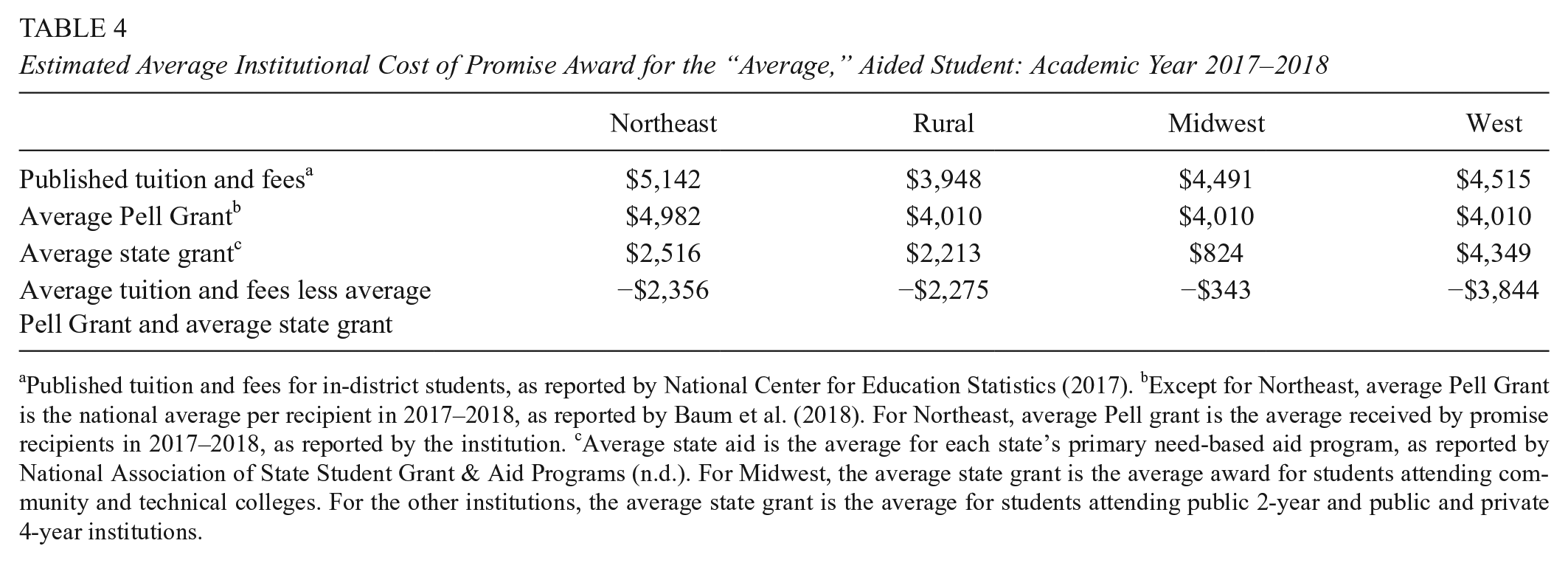
Published tuition and fees for in-district students, as reported by National Center for Education Statistics (2017). bExcept for Northeast, average Pell Grant is the national average per recipient in 2017–2018, as reported by Baum et al. (2018). For Northeast, average Pell grant is the average received by promise recipients in 2017–2018, as reported by the institution. cAverage state aid is the average for each state’s primary need-based aid program, as reported by National Association of State Student Grant & Aid Programs (n.d.). For Midwest, the average state grant is the average award for students attending community and technical colleges. For the other institutions, the average state grant is the average for students attending public 2-year and public and private 4-year institutions.
Personnel
Programs also vary in personnel resource investments, which may have implications for equity and efficiency. For example, the four institutions make different personnel investments in oversight. At Northeast, a “playbook team” composed of representatives from advancement, enrollment management, and student services meets regularly to review program implementation and identify adjustments. Midwest has two cross-department leadership teams: a seven-member steering committee and a larger “comprehensive quality review” team.
Investing personnel in oversight may contribute to programmatic and institutional changes that improve student outcomes. A Midwest administrator perceives the institutional changes that come from regular meetings of staff across functional areas: We developed our Promise weekly team where it really is a member from each core team, where we’re really looking at where students are within the process, and troubleshooting any issues. If we’re seeing students are having barriers in getting through the default process or they’re not getting through the admissions process. We’re really looking at data and the students on a weekly level, and then who is doing what.
Investing resources in data collection and analysis may generate information needed to track student experiences and identify changes that improve outcomes for those eligible for a program and reduce harm for those who are not. A Rural staff member described limitations in institutional approaches to tracking program outcomes, noting that she “really should just start over, [but] there’s just no time.” West administrators also note the absence of early systematic attention to data collection and analysis. One stated, “I had ten years of data that I was backtracking into, which was about 1,800 students that we had to look up and try to figure out what was going on.”
Personnel resources may more directly improve vertical equity if they help students from underserved groups meet eligibility requirements. For example, at all four programs, stakeholders perceive that the FAFSA is one of the biggest barriers to eligibility. Investing resources in a “FAFSA completion night” may help low-income students meet this requirement.
Personnel may also be allocated to recruit participants. This investment may help students from underserved groups meet eligibility requirements and consequently receive other program resources. The potential effectiveness of allocating personnel to recruit students is suggested by West, where 84% of first-time, full-time students receive the program. West hired student support specialists and obtained space for specialists to meet with students at feeder high schools. A West administrator describes how staff help students meet the application deadline and other eligibility requirements: We figured out, basically, what we really needed students to accomplish. [. . .] And then really pushed our outreach to students to get them ready to meet those milestones. So, an example would be that our application was due, I think February 1st it was due, and we spent pretty much between December and January in the classrooms just really focusing on getting them to do the application.
Personnel resources may also improve equity and efficiency if they help students from underrepresented groups maintain eligibility and stay enrolled. A Midwest administrator believes few recipients lose eligibility because staff assist those at risk for not meeting academic progress requirements: Because we’re very intentional about our outreach. And, so, even before mid-semester we’re running reports to see where students are. Are they even meeting the C average in their classes? If they’re not, then there’s outreach that’s happening and reaching out to the students, scheduling appointments, getting them in, talking to them to see, “Hey, what’s going on?”
Other personnel allocations may not only increase program costs but also improve student outcomes. Two institutions require recipients to meet with advisors (Midwest Adult Promise, West). Suggesting that providing support may improve student outcomes, a former West administrator reports that, after requiring students to participate in a summer bridge program and other support services, persistence rates improved, After we started the Readiness Academy, [recipients] had a higher percentage of fall to winter persistence rate than our overall population. We really think that was because of the work we did up front in their high school. That bootcamp, then they had . . . their staff coaching them and monitoring their performance.
Facilities
Facilities may also influence the distribution of program resources and outcomes achieved. West obtained space at feeder high schools for student support specialists to hold office hours, meet with students, and conduct presentations. Specialists use computers available in these spaces to help students complete applications for the scholarship, institutional admission, and financial aid.
Facilities may also encourage program recipients to use available institutional support after they enroll at a college. At Midwest a “promise support office” provides a known physical location for an office technician and case manager to work with program recipients. A Midwest administrator perceives that, with this office, recipients know where to go for support: Our office does have a dedicated assistant in that space, and we’ve assigned one of our advisors to work at that space through [counseling] team. They do have, direct from high school students do have, a place to go for that level support.
Materials
Investing in materials and other communication-related activities may improve program awareness among eligible students and other relevant stakeholders (e.g., high school staff, parents). The studied programs provide program-related information via college and high school websites, program applications, posters, brochures, postcards, and newspaper advertisements. Northeast created a YouTube video featuring its president and program recipients.
To create a comprehensive marketing approach, Midwest allocates resources to share information via websites, digital marketing, community-based institutions, and community events. Midwest administrators and students suggest this investment may encourage enrollment among those who would not have enrolled without the program. One student reports, When I saw the information with the newspaper and stuff, that it had, I was like, “Oh. Maybe this would be something I could consider.” Again, like, financially, I’m like, “I don’t know how I’m going to be able to afford it, going back to school.” Because, I mean, that was also something that was holding me back too was financially. I don’t know how I would be able to do it. So inquiring based on the different things that were put out in the newspaper, I was like, “Well, if this is the case, maybe I’ll be able to do it.”
The potential positive effects of investing in marketing may be greater when personnel also invest time engaging with students in other ways. A Midwest administrator suggests the potential benefits of staff assistance, even when students are ineligible: One quick [piece of advice] would be potentially to be prepared for students who don’t meet all the criteria that you set forth, but want to come back to college and how do you help them. We talk a lot here about, well, there’s the qualifiers and then the applicants who we worked with to find a way to make college happen. That is a significant number of people who ultimately didn’t meet every single criterion, but they came to the college and we were able to find some other way to make it happen.
Discussion
To advance societal goals (DesJardins, 2002), promise programs should efficiently use resources to improve outcomes while also increasing vertical equity. Efficiency is important given resource constraints, especially at community colleges (Dowd et al., 2020), and opportunity costs of resource investments. Whether resources come from new dollars (e.g., foundation-funded scholarships) or from reducing resources provided to other initiatives, resources used for a promise program cannot be used for other purposes. Improving vertical equity is also important, given persisting differences in college enrollment and completion (Ma et al., 2019).
Drawing on case studies of programs offered by four community colleges, our findings demonstrate how eligibility requirements and resource allocations may influence efficiency and equity. Future research should test identified relationships and explore the applicability of the emergent conceptual model for other types of promise programs, including programs offering awards to attend a larger set of institutions.
From our findings, we offer four recommendations for policymakers and practitioners. First, stakeholders should recognize that promise programs may have different outcomes for different groups. Research typically examines whether a program improves outcomes for individuals who meet eligibility requirements or receive a grant or other program resources (e.g., Swanson et al., 2020). Some studies have considered whether programs shift enrollments from 2- to 4-year institutions (e.g., Gurantz, 2020). Our exploration suggests that programs may provide resources that cause students who would not have otherwise attended college to enroll. But, programs may also provide resources to students who, in the absence of the program, would still have enrolled. And, programs may provide resources to students who would have otherwise enrolled elsewhere. Programs may also influence persistence, transfer, and degree attainment of other enrolled students, depending on resource allocations change supports available to them.
Some argue that promise programs may increase attainment by improving the college going culture and programming of K–12 schools (e.g., Miller-Adams, 2015). Our study suggests programs may influence student outcomes by altering resource allocations and other aspects of the destination community college. For example, when no new staff are hired, program personnel may reduce time spent on other institutional functions. This shift may reduce resources and outcomes for those who are ineligible for the program. On the other hand, implementing a program may lead to changes that improve outcomes for all enrolled students. Our findings suggest that stakeholders should consider how programs may positively and negatively influence enrollment and postenrollment outcomes for students who do and do not meet eligibility requirements.
Second, as noted by others (Jones & Berger, 2018; Mishory, 2018; Perna et al., 2018), stakeholders should recognize the equity and efficiency implications of a last-dollar financial award. Together, the average Pell Grant and average award from a state’s largest need-based grant program exceed published tuition and fees for full-time students at all four institutions. As such, students with the lowest family incomes receive no new funding from these last-dollar programs. Low-income students also receive no help with nontuition costs of attendance including books and food, costs that are known to limit engagement and success of low-income students at community colleges (Goldrick-Rab, 2010; Peters et al., 2018). In short, the resources that the studied institutions are investing in financial awards are not improving vertical equity. This approach may also represent an inefficient use of resources if institutional dollars are received by students who would have enrolled without the program.
Third, building on prior research (e.g., Dowd & Shieh, 2013; Millett et al., 2018), programs should recognize the implications of eligibility requirements for vertical equity and efficiency. Eligibility requirements determine who can receive program resources. In this study, administrators expect that some requirements (e.g., full-time enrollment) are associated with better student outcomes and thus represent an efficient use of resources, without acknowledging selection effects. At the same time, they also recognize that these requirements may negatively influence vertical equity. For example, academic requirements may not only enable programs to report high rates of academic progress for recipients but also allocate resources to relatively advantaged students. Limiting eligibility to students who would have enrolled and persisted without a program is also an inefficient resource allocation.
Finally, although these examples suggest tension between efficiency and equity, our findings suggest that institutional resources can be allocated to attenuate the negative effects of eligibility requirements on participation for students from underserved groups and improve outcomes for recipients. Administrators should recognize the full range of resources that may be used by programs and the potential implications of these investments. Applying an ingredients approach reveals the other resources, beyond a financial award, that may also be used (Levin et al., 2018).
Promise programs can invest resources to communicate information to potential participants, assist students with meeting initial and continuing eligibility requirements, and provide academic and social support to help students persist after initial enrollment. Allocating resources to marketing may help those who meet eligibility requirements (and other stakeholders like school counselors) learn about a program and use it. Designating facilities for a program may help participants know where to receive support. Allocating personnel to provide summer transition programming may improve recipients’ college readiness. Designating personnel to provide academic support to enrolled recipients may reduce the negative equity implications of requirements like minimum GPA and provide students who enroll because of the program assistance needed to persist. These findings align with other research documenting the positive effects of cohort-building activities and other supports on promise participants’ outcomes (Iriti et al., 2018; Weiss et al., 2019).
Our results also suggest the benefits to equity and efficiency of allocating personnel and other resources to data collection and evaluation. Personnel and other resource constraints are persisting barriers to robust evaluation (Bussey et al., 2019), especially at community colleges (Morest & Jenkins, 2007). This study suggests that investments in data and evaluation, as well as program oversight, may increase availability and use of data to inform programmatic changes, improve outcomes for recipients, and reduce potential harm to outcomes of nonrecipients.
Conclusion
With the importance of higher education to individuals and society (McMahon, 2009), we need interventions that ensure that all people have the opportunity to participate in and benefit from high-quality higher education. As college promise programs continue to be considered and developed, we urge stakeholders to consider how programs can advance vertical equity and efficiency (Dowd & Shieh, 2013). Promise programs may advance vertical equity by investing resources in a financial award that reduces costs of attendance for low-income students and creating eligibility requirements that permit students from underserved groups to receive program resources. Programs may advance equity and efficiency by investing in personnel and other supports that enable students from underserved groups to meet eligibility requirements, enroll, persist, transfer, and complete.
Footnotes
Acknowledgements
This project was supported by a subcontract from Research for Action (RFA) that was funded by the Bill & Melinda Gates Foundation. The content is solely the responsibility of the authors and does not necessarily represent the views of the funders. RFA led the larger examination of state and local college promise programs from which this study is derived. RFA colleagues (Victoria Ballerini, Kri Burkander, Kate Callahan, Shanell Hagood, Dan Kent, Kasey Meehan, and Kate Shaw) provided feedback on the selection of cases selected for this article and interview protocols, assisted with on-site data collection, coordinated debriefing meetings, and engaged in discussion of initial emerging themes. We also appreciate the assistance with data collection and preparation provided by students at the University of Pennsylvania: Abigail Dym, Nathan Jiang, Brent Nagamine, Sydney Osifeso, Elysia Pan, and Sean Saxon. An earlier version of this article was presented at the annual meeting of the Association of Education Finance and Policy.

Notes
Authors
LAURA W. PERNA is GSE Centennial Presidential Professor of Education and Vice Provost for Faculty at the University of Pennsylvania. Recent publications include “Improving Research-Based Knowledge of College Promise Programs” (with Edward Smith, 2020, AERA); “Taking It to the Streets: The Role of Scholarship in Advocacy and Advocacy in Scholarship” (2018, Johns Hopkins University Press); and “The Attainment Agenda: State Policy Leadership for Higher Education” (with Joni Finney, 2014, Johns Hopkins University Press).
JEREMY WRIGHT-KIM is a PhD candidate in Higher Education at University of Pennsylvania’s Graduate School of Education. His research broadly focuses on federal, state, and institutional policies and practices that exacerbate or attenuate stratification in higher education, with a particular focus on the community college sector.
ELAINE W. LEIGH is a PhD candidate in Higher Education at University of Pennsylvania’s Graduate School of Education. Her research interests include policies and practices that address inequities in postsecondary access and completion for underrepresented students across the P–20 pipeline and the role of postsecondary education in community and economic development.