




Abstract
Recent scholarship has highlighted the phenomenon of urban public school closures and their effects on student academic outcomes. However, we know little about the broader impact of closures, particularly on teachers who are also displaced by closure. We assess labor market outcomes for over 15,000 teachers in nearly 700 Texas schools displaced by closure between 2003 and 2015. Using a unique administrative data set, we find that closures were associated with an increased likelihood of teachers leaving teaching as well as changing school districts. Notably, teachers in charters that closed were particularly likely to leave. In addition, closures appear to push out senior teachers and worsen the already substantial underrepresentation of Black teachers.
Introduction
Facilitated by declining enrollments, academic failure in an era of test-based accountability, and federal and other policies incentivizing closures as a reform strategy, school closures have become an increasingly common phenomenon. Indeed, over the past decade, an average of 1,707 schools closed each year in the United States, displacing roughly 250,000 students annually (U.S. Department of Education, n.d.). Moreover, such statistics, narrowly focused on displaced students, likely underestimate the broader impact of closures, which also affect neighboring schools that may accommodate influxes of new students, communities in which schools are embedded, and teachers and other school employees.
Scholarly attention to the issue of school closures has burgeoned over the past decade, with most work examining the impact of closures on displaced students. To date, research has focused on closures in declining urban cores of the Rust Belt in the Midwest (de la Torre & Gwynne, 2009), cities in the Northeast such as Philadelphia (Steinberg & MacDonald, 2019), as well as in post-Katrina Gulf states such as Louisiana (Sacerdote, 2012). Findings regarding the impact of closures on the educational outcomes of students is mixed. Notably, the impact of closures on student achievement, attainment, disciple, and attendance appears to vary substantially across contexts and depends on policy design and implementation (e.g., Brummet, 2014; Carlson & Lavertu, 2015; Gordon et al., 2018; Stroub & Richards, 2020).
In this study, we draw attention to the impact of school closures on another key population: teachers. We study this issue in the context of Texas, which has relatively quietly shuttered nearly a thousand schools since 2000, despite being one of the most populous and fastest growing states in the nation (U.S. Census Bureau, 2018). Using 17 years of data from the state of Texas, we provide initial peer-reviewed evidence of the impact of school closures on teacher labor market outcomes. It should be noted that Texas also closed a handful of schools in the aftermath of Hurricane Harvey in 2017; however, in this study, we focus exclusively on school closures that occurred prior to the hurricane.
While emerging research has documented mixed but often concerning evidence regarding the impact of closures on students, our results highlight the broader labor market impact of closures beyond students. Indeed, our findings suggest that closures were associated with substantial increases in rates of teachers leaving teaching—particularly charter teachers. Moreover, we find that closures were associated with increases in mobility across district boundaries. Consistent with prior literature on the impact of closures on students (e.g., Stroub & Richards, 2020), we find that Black teachers are particularly likely to be displaced by school closures (Clotfelter et al., 2007; Darling-Hammond, 2000). Moreover, we find that Black teachers were particularly likely to leave teaching after closures. Finally, we find that more senior teachers, who are often the most effective teachers (Boyd et al., 2009; Clotfelter et al., 2007), were particularly likely to leave.
Literature Review
A growing body of literature has explored the impact of school closure on the academic outcomes of displaced students. Several studies have examined the impact of closures on student test scores, graduation rates, attendance, and neighboring schools that absorb displaced students, finding mixed evidence for the effects of closures on students’ educational outcomes (Beuchert et al., 2018; Bross et al., 2016; Brummet, 2014; Carlson & Lavertu, 2015; de la Torre & Gwynne, 2009; Engberg et al., 2012; Gordon et al., 2018; Kemple, 2015; Steinberg & MacDonald, 2019; Stroub & Richards, 2020). While scholars have come to somewhat different conclusions regarding the overall effect of closures on academic achievement in different contexts and using different methodologies, recent work suggests that the relative quality of the schools that closed and to which displaced students transferred are important moderators of the effect of closures on student outcomes (e.g., Bifulco & Schwegman, 2020; Bross et al., 2016; Brummet, 2014; Carlson & Lavertu, 2015; De Haan et al., 2016; de la Torre & Gwynne 2009; Engberg et al., 2012; Stroub & Richards, 2020).
In contrast to the burgeoning literature on the impact of school closures on students, very few empirical studies have directly examined the consequences of school closures for displaced teachers. This gap in the literature is troubling given that scholars have often drawn attention to the potential negative impact that closing schools might have on teachers. Indeed, concerns have been raised over the role that looming closure decisions, as well as the actual shuttering of campuses might play in diminishing the quality of teachers’ work environments and disrupting the relationships they build with students over time (de la Torre & Gwynne, 2009; Jack & Sludden, 2013; Sunderman & Payne, 2009). Moreover, teachers themselves are often vocal critics of school closures, and teachers’ unions in districts such as Chicago Public Schools have gone so far as to take legal action against school districts’ closure plans (Bouboushian, 2015; Harrington, 2019; Perez, 2018; Terry, 2017).
We are aware of only one empirical paper directly examining the relationship between school closures and teacher labor market decisions. In their recent working paper examining 66 elementary school closures in North Carolina between 2002 and 2013, Hill and Jones (2018) found that displaced teachers were significantly more likely to leave teaching in the years leading up to a closure as well as in the year immediately after the closure occurred. However, most displaced teachers displayed a preference to remain in the school until it closed, rather than leaving early in anticipation of a closure. When displaced teachers did stay in the profession, they were far more likely to stay within the same district, rather than moving to a new district altogether. Importantly, Hill and Jones (2018) also find that experienced teachers and Black teachers were nearly twice as likely to leave teaching after being displaced by a closure than White teachers. Taken together, these findings are consistent with the concerns of critics of closure, and suggest that closure may play a role in prompting teachers to leave the profession.
The Current Study
In this study, we examine the impact of nearly 700 school closures on teachers in Texas, drawing attention to the types of teachers displaced by closures and their subsequent labor market decisions. We examine the impact of school closure on two key teacher labor market outcomes, including: (1) leaving teaching in Texas public schools and (2) changing to a different public school district in Texas. We also attend to variability in the effects of closures on teachers by estimating differential effects based on school type (i.e., traditional vs. charter), teacher preparation pathway (i.e., traditional vs. alternative), school performance (i.e., % passing state tests), teacher race/ethnicity, and teacher experience. We estimate these effects by using coarsened exact matching (CEM) techniques paired with fixed effects linear probability models. Together, our analyses provide the most comprehensive view to date of closure effects on the teacher labor market.
Method
To investigate the effects of Texas’s school closures on the labor market outcomes of teachers, we use a unique administrative data set on all teachers in the state of Texas from 2000 to 2017. We couple this administrative data with data on the timing of public school closures derived from the National Center for Education Statistics Common Core of Data. We discuss our data, procedures for identifying school closures, the analytic sample of teachers, and analytic strategy at length below.
Data
Our analyses center on teacher administrative records from the state of Texas from the 1999–2000 to 2016–2017 academic years. These data were obtained directly from the Texas Education Agency and supplemented with teacher certification data from the State Board of Educator Certification (SBEC). Overall, we have records on 848,507 teachers that taught in the state of Texas over the 17–year study period, accounting for a total of 5,877,647 unique teacher × year observations. Our analyses focus on teachers employed in schools that closed and comparison teachers matched on an array of school-level characteristics.
Identification of Closed Schools
We identified Texas schools that closed each year using reported school status and enrollment data from the National Center for Education Statistics Common Core of Data. Though our data range from 2000 to 2017, because we track teachers for 2 years prior to each closure year, and 2 years after each closure year, our study is limited to school closures that occurred between 2003 and 2015.
We include both traditional public schools and charter schools in our analysis, and independently examine whether the impact of closures vary by school sector. While we retained charter schools, we limit our sample of closed schools to public schools classified as “regular,” that is, schools that were not specialized alternative schools, juvenile justice schools or special education schools. While most schools that closed were classified as elementary, middle, or secondary schools, a handful of schools that closed were “K–12,” early elementary schools, or schools with other nontraditional grade arrangements. Given the wide range of possible grade configurations, it can be difficult to match this small subset of schools. Finally, Texas did not report school accountability metrics for the 2012–2013 school year because the state was transitioning to a new accountability test. Given that school performance is a key dimension on which we matched schools, we opted to drop all schools that experienced a closure in the 2012–2013 school year.
After application of these criteria, our final sample includes 706 regular public schools (both traditional and charter) that closed between 2003 and 2015, which employed 19,886 teachers. Our comparison group, prior to matching, comprises 7,792 schools employing over 600,000 teachers. This sample of closed and nonclosed schools accounts for 80% of all public schools that existed in Texas over the study period. Table 1 reports the characteristics of schools in the study sample.
Characteristics of Closed and Nonclosed Schools—Before and After Matching

Characteristics of Closed Schools
Consistent with prior work and with the motivating impulses for closures, Table 1 demonstrates that closed schools in Texas tended to be substantially lower achieving, enrol more free and reduced-price lunch eligible students, and enroll fewer students overall than schools that remained open. Contrary to the conventional framing of school closures being a predominantly urban phenomenon, however, closures in Texas have occurred primarily in rural areas (38.5%). Finally, although the vast majority of Texas’ closures were traditional public schools (92.4%), charter schools were 1.4 times more likely to close than their more traditional counterparts.
Empirical Strategy
As the descriptive statistics referenced above suggest, schools affected by closures differ from those unaffected by closures in systematic ways. We address these systematic differences via two complementary methods: (1) CEM and (2) fixed-effects estimation. Because closures are campus-level policies and have been linked to chronic under enrollment and low academic performances, we first address the systematic differences between closed and nonclosed campuses by matching our sample of closed campuses to a subset of nonclosed campuses that are identical on an array of observable characteristics, notably enrollment size and academic performance. To further account for any systematic differences between the schools and teachers affected by closures and those that are not, all subsequent analyses on the matched sample of teachers also include a series of teacher, cohort, and campus fixed effects. Specifically, we estimate a series of linear probability models on the matched sample of teachers, predicting teacher labor market outcomes as a function of being displaced by a closure.
Coarsened Exact Matching
We employ CEM procedures to match closed campuses to an appropriate comparison group of nonclosed campuses. CEM and other associated monotonic imbalance bounding methods have several key advantages over more traditional matching approaches such as matching on propensity scores (Iacus et al., 2011). First, while traditional techniques require rather intensive postmatch balance checks, CEM allows users to specify the maximum balance ex ante. Second, unlike other methods (e.g., Mahalanobis and propensity score matching), adjusting the maximum imbalance on one variable has no impact on the maximum imbalance of any other variables (Iacus et al., 2012). Third, a growing body of evidence suggests that CEM frequently outperforms traditional matching methods in terms of reduction of imbalance, model dependence, and estimation error (Iacus et al., 2009, 2011).
Matching procedure
We exactly match each closed campus to a nonclosed campus on an array of school-level characteristics. First, campuses are matched exactly on year—for example, a campus that experienced a closure in 2008 is matched to a nonclosed campus in 2008. In addition to year, we match campuses on the array of characteristics outlined in Table 1, including grade level, charter status, Texas statewide accountability status (i.e., met or did not meet state standards), locality (i.e., city, suburban, rural), enrolment size, and the proportion of free/reduced-price lunch students. In terms of accountability status, we use the state’s accountability indicator derived from aggregate student performance on the Texas Assessment of Knowledge and Skills (TAKS) and, after 2012, the State of Texas Assessments of Academic Readiness (STAAR) tests.
Match diagnostics
Overall, our procedure matched 92.0% of closed campuses to a nonclosed campus, resulting in a final sample of 676 closed campuses, employing 15,049 teachers. Our final comparison sample of 676 nonclosed campuses employed 17,190 teachers. By design, CEM minimizes the necessity of balance checking, because it generates exact matches based on categorical variables and specified bins for continuous variables. Indeed, Table 1 demonstrates that after matching, closed campuses were identical to their nonclosed counterparts in terms of all categorical covariates and nearly identical in terms of the binned continuous variable (% free and reduced-price lunch eligible).
Final Analytic Sample of Teachers
Table 2 reports characteristics of our final analytic sample of teachers after matching, as compared with all teachers in closed and comparison schools before matching.
Characteristics of Final Analytic Sample of Teachers

Prior to matching, teachers in schools that closed differed from those in schools that remained open in key ways. First, displaced and nondisplaced teachers differed in terms of their certification type, that is, whether they were certified via a traditional or alternative program. Because we do not have data on teachers who were certified prior to 1999, we classify teachers who were teaching prior to 1999 whose certification type is unknown as “pre-2000.” Traditionally certified teachers were less likely to be displaced by closures: While traditionally certified teachers accounted for 37.0% of the teaching force in nonclosed schools, they accounted for under one third of all teachers in schools that closed (31.7%). Second, displaced and nondisplaced teachers differed in terms of their experience. Very experienced teachers (20+ years) were more likely to be displaced by closures: While these veteran teachers accounted for 22.6% of the teaching force in nonclosed schools, they accounted for 27.4% of all teachers in schools that closed, an increase of over 20%. Finally, displaced and nondisplaced teachers differed in terms of their race/ethnicity. Notably, Black teachers were systematically overrepresented among the displaced: While just 10.2% of all Texas teachers are Black, over twice that share (24.6%) of teachers displaced by closure were Black. It should be noted that we use the term “Hispanic” in the table rather than Latinx throughout our findings because it corresponds with the racial classification used in Texas’ statewide data.
After matching by school characteristics, these differences between displaced and nondisplaced teachers were substantially attenuated on all dimensions, particularly in terms of teacher certification type, years of experience, and race/ethnicity.
Outcomes
We estimate the impact of closures on two key labor market outcomes: (1) leaving teaching, meaning a teacher was no longer employed as a public school teacher in Texas and (2) changing districts, meaning a teacher continued teaching but in a different school district. For each outcome, we track teachers annually, for the 2 years before a closure and for the 2 years immediately following a closure.
Importantly, because our data are limited to teachers who are teaching in Texas public schools—traditional and charter—we cannot track teachers into the private school labor market. Nor can we track teachers who left Texas but continued teaching in other states. As such, our left teaching measure only captures teachers that dropped out of the Texas public school system from one year to the next, and is thus not capable of distinguishing between teachers that merely left Texas public schools, versus those that left the profession of teaching entirely. Of course, teachers that leave Texas Public Schools do not necessarily leave forever. Indeed, perhaps it is difficult for displaced teachers to find work immediately. If this is the case, then we might expect displaced teachers to leave teaching after experiencing a closure but return once their employment situation has stabilized. As such, we conduct supplemental analyses to assess the extent to which displaced teachers return to Texas Public Schools after a year-long hiatus.
Table 3 reports the unadjusted share of teachers that left teaching and changed districts over the study period. Teachers in schools that closed were significantly more likely to leave teaching and move to a new district than teachers in schools that did not close. Teacher in schools that closed were 4.4 percentage points (35%) more likely to leave teaching in Texas than teachers in schools that remained open. Likewise, teachers in schools that closed were 3.1 percentage points (66.0%) more likely to move to another district than teachers in schools that remained open.
Teacher Labor Market Outcomes in the Following Year—Before and After Matching

Model Specification
Consistent with the prior closure literature on students (e.g., Stroub & Richards, 2020) and teachers (e.g., Hill & Jones, 2018), we estimate the impact of closures on teachers’ likelihood of leaving the teaching in Texas and changing districts vis-à-vis a matched sample of teachers in schools that did not close using a series of linear probability models combined with teacher, cohort, and school fixed effects, and robust standard errors, clustered at the school level.
Linear probability models are simply ordinary least squares regression models estimated using a dichotomous outcome. While categorical outcomes are more traditionally estimated using logistic regression via maximum likelihood estimation, linear probability models have several advantages over logistic regression in this context. First, linear regression by least squares is faster and computationally less demanding than maximum likelihood estimation in logistic regression (Angrist & Pischke, 2009; Hellevick, 2009; Long, 1997). This is particularly true when large numbers of fixed effects are being estimated, as is the case in our analyses.
Second, because odds ratios in logistic regression are not very intuitive, they are often challenging for readers to interpret. As such, we prefer to present the results of logistic regression models in terms of average partial or marginal effects (Norton & Dowd, 2018). Such estimates are much more intuitive because they can be interpreted in probabilistic terms (i.e., a one-unit change in the independent variable is associated with an X percentage point change in the dependent variable). Because the estimation of such effects is not feasible in the context of our sample and volume of fixed-effects specifications, we elect to use linear probability models with cluster-robust standard errors in lieu of logistic models with average marginal or partial effects.
As Hill and Jones (2018) note, because closure announcements are sometimes made years in advance of the actual closure, teachers may preemptively respond to the threat of school closure, rather than respond retroactively to the closure itself. As such, the characteristics and composition of a school in the year it closes may not be very representative of what the school looked like even 1 or 2 years prior. To account for this fact, our models predicting labor market outcome are estimated with several treatment indicators, capturing the effect of being displaced by a closure 2 years prior, 1 year prior, 1 year after, and 2 years after. Our models take the following general form:

Where
The predictor of interest, CLOSE, captures whether teacher i in school s, and cohort c experienced a closure in year t. In the context of a linear probability model, the effect of interest
In addition to estimating the overall effect of closure on teacher labor market decisions, we also examine the extent to which the effects of closures are moderated by teacher and school characteristics. Specifically, we focus on the interaction between school closure and school type (i.e., charter or regular public school), teacher certification type, school performance, teacher race/ethnicity, and teacher experience.
Results
Leaving Teaching
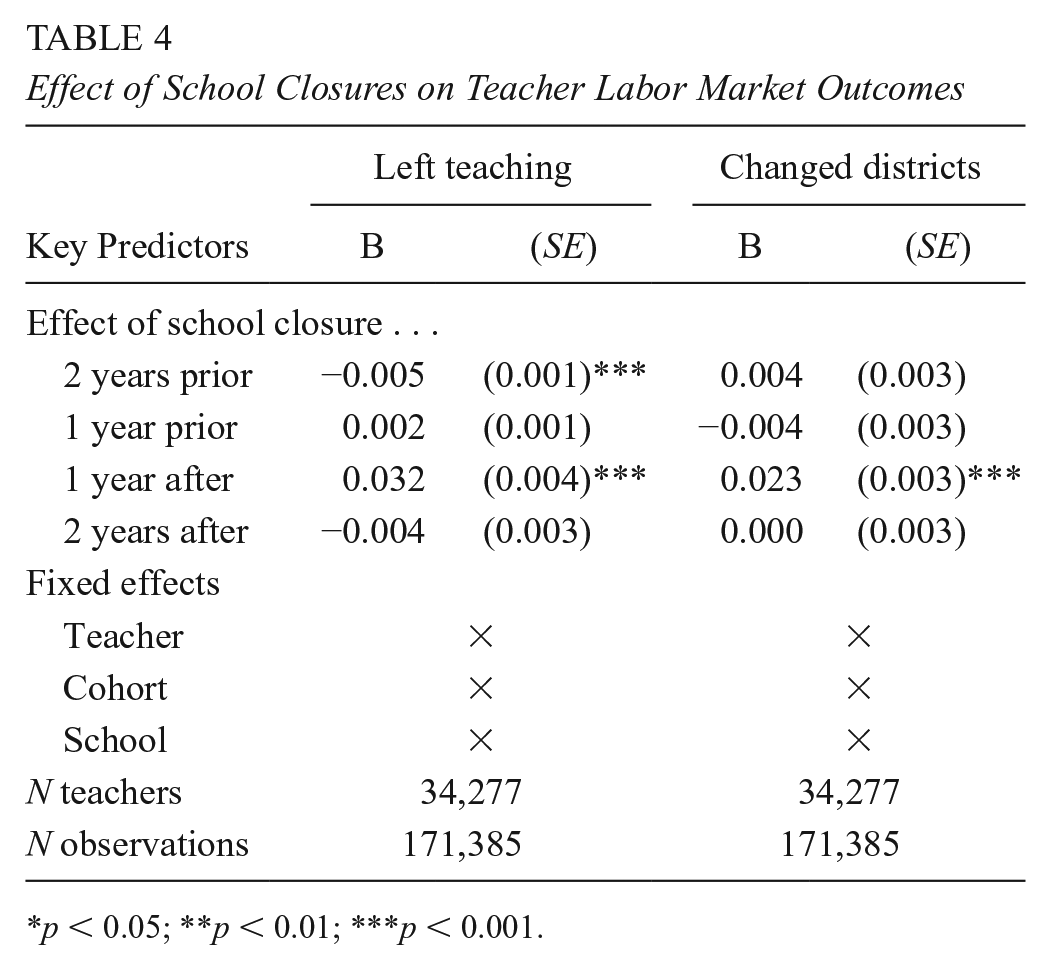
Table 4 reports coefficients from linear probability models estimating the relationship between closures and teacher likelihood of leaving public school teaching in Texas in the 2 years prior to and 2 years after closure. As discussed above, these models are calculated with teacher, cohort, and school fixed effects and are estimated with cluster robust standard errors. Overall, teachers displaced by closure were significantly more likely to leave teaching in the year immediately following a closure than teachers not displaced by closure, ceteris paribus. Teachers who experienced closure were 3.2 percentage points more likely to leave teaching in the year immediately following a closure as their similar peer teachers. For a typical teacher, this constitutes an increase in the probability of leaving teaching of 20.1%. However, teachers were no more likely to leave teaching 2 years after closure.
Effect of School Closures on Teacher Labor Market Outcomes
p < 0.05; **p < 0.01; ***p < 0.001.
Table 4 demonstrates that teachers displaced by closure were not more likely to leave teaching in the years leading up to a school closure, although they were slightly less likely (0.5 percentage points) to leave teaching 2 years prior to closure. Thus, we did not observe any anticipatory effects of closure on teacher behavior—that is, wherein teachers were more likely to leave in the years immediately prior to closure in anticipation of the closure. Moreover, this corroborates the notion that observed increase in teachers leaving the profession are attributable to the closures themselves, rather than unobserved differences between the teachers and schools that experienced closures and teachers and schools that did not experience closures.
For reasons outlined above, Table 4 presents results of linear probability models; however, estimates from linear probability models may be problematic owing to nonnormal and heteroskedastic errors and may produce predicted values outside the acceptable range (Allison, 2017). As such, we also estimated parallel binary logistic models. Marginal effects from binary logistic models produced nearly identical estimates for the association between closures and the odds of teachers leaving teaching.
It is possible that teachers displaced by closure may return to teaching after taking a year off of teaching, particularly if they learn of the school’s closure late in the academic year. As Table 3 demonstrates, we find that 13.9% of teachers that left teaching after closure did return 2 years after closure, compared with 12.3% of teachers that left teaching who did not experience a closure. Thus, teachers who experienced closures were slightly more likely to take a year off of teaching. However, the vast majority of teachers that left teaching after closure (more than 6 in 7) did not return to teaching.
Heterogeneity in Effects
While closures were associated with increased rates of leaving teaching overall, Table 5 demonstrates that teachers’ likelihood of leaving teaching varied across school and teacher characteristics.
Effect of School Closures on Teacher Labor Market Outcomes by School/Teacher Characteristics

p < 0.05; **p < 0.01; ***p < 0.001.
Notably, the association between closure and leaving teaching was particularly pronounced for charter teachers. Teachers in charters that closed were 13.2 percentage points more likely to leave teaching in the year after closure as teachers in traditional public schools that closed. In addition, the likelihood of teachers leaving teaching was related to school performance. Thus, teachers who were displaced from higher-performing schools were less likely to leave teaching in the year after closure than teachers who were displaced from lower-performing schools, as measured by the percentage of students passing the state test. In terms of magnitude, a teacher in a school with 70% of students passing the state test was 1.4 percentage points more likely to leave teaching in the year after closure than a teacher in a school with 80% of students passing the state test.
The likelihood of leaving teaching after closure was also significantly related to key teacher characteristics, including teacher race/ethnicity and teacher experience. Notably, White and Hispanic teachers were 6.5 percentage points and 7.7 percentage points less likely to leave teaching after closure than Black teachers, respectively. Thus, Black teachers, who are already underrepresented in Texas schools and who were disproportionately affected by closure, were also significantly more likely to leave teaching as a result of closure than White and Hispanic teachers.
The likelihood of leaving teaching after closure also depends on teachers’ years of experience. Indeed, very senior teachers with more than 20 years of experience were significantly more likely to leave teaching after closure than novice teachers. Indeed, while teachers with 20 or more years of experience more likely to leave teaching overall, they were 4.0 percentage points more likely to leave teaching after closure than novice teachers. Interestingly, teachers’ likelihood of leaving teaching was not significantly related to their certification type (i.e., traditional or alternative).
Changing Districts
Table 4 reports coefficients from linear probability models estimating the relationship between closures and teacher likelihood of leaving public school teaching in Texas in the 2 years prior to and 2 years after closure. Overall, teachers displaced by closure were significantly more likely to change districts in the year immediately following a closure than teachers not displaced by closure, ceteris paribus. Teachers who experienced closure were 2.3 percentage points more likely to change districts in the year immediately following a closure as their similar peer teachers. For a typical teacher, this constitutes an increase in the probability of changing districts of 39.7%. However, teachers were no more likely to move to a new district 2 years after closure.
Table 4 demonstrates that teachers displaced by closure were not more likely to change districts in the years leading up to a school closure than their similar nondisplaced peers. Thus, we did not observe any anticipatory effects of closure on teacher’s changing districts. Again, this corroborates the notion that observed increase in teachers likelihood of changing districts are attributable to the closures themselves, rather than unobserved differences between the teachers and schools that experienced closures and teachers and schools that did not experience closures. As above, however, we also estimated parallel binary logistic models. Marginal effects from binary logistic models produced nearly identical estimates for the association between closures and the odds of teachers changing districts.
Heterogeneity in Effects
While closures were associated with increased rates of changing districts overall, Table 5 demonstrates that teachers’ likelihood of changing districts varied across school and teacher characteristics.
Again, the association between closure and changing districts was particularly pronounced for charter teachers. Teachers in charters that closed were 15.0 percentage points more likely to change districts in the year after closure as teachers in traditional public schools that closed. Overall, teachers in charters were more than twice as likely to teach in a new district after closure as teachers in traditional public schools. This is perhaps not surprising given that most charters in Texas operate as independent school districts: Thus, in many cases, charter teachers necessarily had to transfer to new districts to remain in the profession. However, teachers in traditional public schools who elect to stay may have fewer incentives to transfer to a new district given, for example, that they would likely lose seniority and years of experience toward retirement.
In addition, the likelihood of teachers changing districts was related to school performance. Thus, teachers who were displaced from higher-performing schools were less likely to change districts in the year after closure than teachers who were displaced from lower performing schools, as measured by the percentage of students passing the state test. In terms of magnitude, the effect was relatively small, with a teacher in a school with 70% of students passing the state test was 0.7 percentage points more likely to leave teaching in the year after closure than a teacher in a school with 80% of students passing the state test.
The likelihood of changing districts after closure was also significantly related to key teacher characteristics, including teacher race/ethnicity and teacher experience. Notably, White and Hispanic teachers were 5.9 percentage points and 5.2 percentage points less likely to change districts after closure than Black teachers, respectively. This further underscores the impact of closures on Black teachers, who are both particularly likely to leave teaching and to transfer to new districts after closure.
We also find that the effect of closures on teachers departing the profession depends on teacher years of experience and certification type. More senior teachers who experienced closures, particularly those with more than 20 years of experience, were less likely to change to new districts than novice teachers. Again, this is perhaps not surprising given that more senior teachers have more years vested in their existing school districts. Additionally, displaced teachers who were alternatively certified were 3.3 percentage points more likely to change districts after closure than traditionally certified teachers who were displaced. This may be attributable in part to the fact that charter schools, which are often single-school districts, disproportionately employ many alternatively certified teachers in Texas.
Discussion
A growing body of work has examined the impact of school closures on student outcomes. However, there has been scant attention to the effects of closures on teachers who were also displaced. In this study, we provide initial peer-reviewed evidence of the impact of closures on teacher labor market decisions, drawing on data from nearly 700 closures in Texas over a 17-year period. Our results highlight the impact of closures beyond students: Closures were associated roughly a one-quarter increase in the probability of a teacher leaving teaching in Texas. In addition, closures are associated with more than a one-third increase in the probability of a teacher changing to a new school district. While one in every seven teachers that left teaching in the year immediately following closure returned to teaching 2 years after closure, the vast majority of teachers were still not employed as a teacher 2 years after closure. As such, closures serve to introduce further instability into already highly mobile teacher labor markets.
Just as previous research has documented closures have disproportionately displaced students of color—particularly Black students—we find that the impact of closures has also been disproportionately borne by Black teachers. Moreover, Black teachers displaced by closure are substantially more likely to leave teaching and to change to new districts than White or Hispanic teachers. This racial/ethnic dimension of school closures is particularly concerning given the extent to which teachers of color are underrepresented in public schools nationally and in Texas as well as higher turnover rates observed for Black teachers (Lindsay et al., 2017). Despite increased attention to recruitment and retention of teachers of color, 61% of all Texas teachers are White, as compared with just 28.5% of students (Texas Education Agency, 2016). While this is concerning ipso facto, it is particularly troubling considering emerging evidence emphasizing the benefits of race-matched teachers for students of color (Carver-Thomas & Darling-Hammond, 2017; Dee, 2004, 2005; Egalite et al., 2015; Yarnell & Bohrnstedt, 2017).
In addition, we find that senior teachers with over 20 years of experience, whom previous research has found are often the highest performing (e.g., Hanushek et al., 2004), have the highest propensity to leave teaching after closures. While our data do not permit us to link teachers to student-level outcomes or assess how closures are related to teacher effectiveness, the finding that closures prompt senior teachers to leave is consistent with Hill and Jones’s (2018) finding that more effective teachers, as measured via value added models, were particularly likely to depart after closures. Together these findings raise concerns about the potential for closures to weaken the teaching workforce in a profession already marked by high attrition and mobility. Notably, more senior teachers—with 4 or more years of experience—are less likely to change districts after closures, which is perhaps not surprising given that more senior teachers have more years vested in their existing school districts.
Furthermore, consistent with prior research that has focused on the impact of charter closures in Ohio and Texas (Carlson & Lavertu, 2016; Stroub & Richards, 2020), we find that charter schools are more likely to close than traditional public schools—although the majority of closures in Texas and the vast majority of affected teachers are from traditional public schools. We find that charter teachers have a substantially higher propensity to leave the profession and, not surprisingly, their school districts than their traditional public school counterparts (Miron & Applegate, 2007; Stuit & Smith, 2012). Moreover, these effects were quite large: Teachers in charters were 13 percentage points more likely to leave teaching and 15 percentage points more likely to change districts as teachers in traditional public schools that closed.
Our findings provide initial insights into the understudied impact of closures beyond student outcomes and underscore the extent to which closures complicate existing challenges in recruiting and retaining high-quality and diverse workforce. However, there are some limitations to the findings that should be acknowledged. First, while our results suggest that closures may prompt higher rates of attrition, it is unclear why teachers are leaving teaching. In terminology popularized by McNeal (1997) for high school dropouts, are teachers being “pushed out or pulled out”? More precisely, are they leaving teaching because they are undesirable candidates and cannot find new jobs or because they are highly desirable candidates with more rewarding or lucrative opportunities outside of teaching? This is a key distinction with differential implications for policy. Further research, particularly qualitative work, may seek to disentangle the decision-making processes of teachers.
In addition, as noted above, we lack data on teacher effectiveness (e.g., teacher value–added scores) that would be useful in quantifying the loss (or gain) to schools as a result of teacher departures. It is also important to note that because our data are limited to public schools, it is possible that a share of teachers may have stayed in the profession but continue to teach in private schools. Finally, as we note above, because Texas does not document reasons for closures, we cannot analyze how effects vary by closure rationale. For example, in work on student effects, there is evidence that suggests that closures on the basis of school achievement may have more positive effects on student outcomes than closures solely on the basis of student enrollments (e.g., Stroub & Richards, 2020).
Our findings highlight the importance of policy solutions to retain teachers in the profession and in high needs districts after closures. Work on the impact of closures on students have found falling student achievement in the year prior to closure (Brummet, 2014; de la Torre & Gwynne, 2009) and Kirshner et al. (2010) described the school closure experience for students as plagued by struggle and confusion (see also Gordon et al., 2018). The psychological effects of such uncertainty are also likely pronounced among teachers, whose professional livelihoods are directly affected. Toward that end, districts may wish to focus on clear chains of communication and reform to keep student scores from dropping in the announcement year and retaining teachers who tend to be more experienced in the profession. Our work suggests that once a school is slated for closure, districts need to be intentional in retaining teachers, particularly diverse and more experienced teachers, particularly those who have demonstrated a willingness to teach in challenging high-need schools.
Footnotes
Acknowledgements
The research presented here utilizes confidential data from the State of Texas supplied by the Texas Education Agency (TEA) and State Board of Educator Certification (SBEC). The views expressed are those of the authors and should not be attributed to TEA, SBEC or any of the funders or supporting organizations mentioned herein. Any errors are attributable to the authors alone. Funding for this project was provided in part by the Spencer Foundation under Grant No. 201400164.
Authors
MEREDITH P. RICHARDS is an associate professor at Southern Methodist University. Her research focuses on exploring the effects of educational policies on equity and stratification in schools and situating policies in their metropolitan and geographic contexts.
KORI J. STROUB is a research scientist at the Houston Education Research Consortium at Rice University. His research examines the causes and consequences of racial/ethnic and socioeconomic inequality in education, with a particular emphasis on the effects that integration and choice policies have on school segregation and educational outcomes.
SARAH GUTHERY is an assistant professor in the Department of Curriculum and Instruction at Texas A&M University–Commerce. Her work centers on new teacher pay, teacher sorting across schools, and new teacher quality.