




Abstract
High teacher turnover imposes numerous burdens on the schools and districts from which teachers depart. Some of these burdens are explicit and take the form of recruiting, hiring, and training costs. Others are more hidden and take the form of changes to the composition and quality of the teaching staff. This study focuses on the latter. We ask how schools respond to spells of high teacher turnover and assess organizational and human capital effects. Our analysis uses two decades of administrative data on math and English language arts middle school teachers in North Carolina to determine school responses to turnover across different policy environments and macroeconomic climates. Based on models controlling for school contexts and trends, we find that turnover has marked, and lasting, negative consequences for the quality of the instructional staff and student achievement. Our results highlight the need for heightened policy attention to school-specific issues of teacher retention.
Introduction
Much has been written about the high rates of teacher turnover in K–12 schools (Carver-Thomas & Darling-Hammond, 2017). “Turnover” refers to the change in the number of teachers from one year to the next in a particular school setting. Although some turnover of staff is natural and desirable, and occurs in all occupations, high rates of turnover are often of particular concern in the field of K–12 education. High turnover can contribute, for example, to teacher shortages if it reflects the departure of teachers from the profession or from schools in specific locations or subject areas as teachers move among schools or districts. Moreover, a high turnover rate of teachers in a particular school may reduce the quality of education the school can offer, with resulting adverse impacts on outcomes for the school’s students. Student outcomes will be adversely affected, for example, if turnover leads to a mix of teachers with weaker average qualifications, a set of teachers with limited experience working together toward the school’s educational mission, or if the school is unable to replace all the teachers who leave (Ingersoll, 2001). Finally, teacher turnover inevitably imposes financial human resource costs on schools or local school districts because of the need to hire replacement teachers.
In this article, we focus on what we refer to as the hidden costs of teacher turnover, namely its effects on the quality of instruction, as measured by the qualifications of the pool of teachers and class size. In particular, we are interested in how schools respond to the loss of teachers, especially teachers of core subjects. Such responses are potentially relevant not only for student outcomes and the smooth operation of the school in the immediate period (including for student achievement, about which we provide some information at the end of the article) but also potentially for subsequent periods if the replacement teachers are themselves likely to depart at higher rates. A better understanding of how schools respond to sustained periods of teacher turnover is directly relevant for policy.
We use school-level data from North Carolina on math and English language arts (ELA) teachers at the middle school level to provide new empirical evidence on how individual schools respond to teacher turnover, both on average and across school contexts. A school may respond to the loss of teachers in a particular year or subject by increasing class sizes, either as a chosen strategy or because of its inability to hire replacement teachers. Alternatively, a school may respond by replacing the teachers who leave with other teachers, either from within the school or from outside the school. If the replacement teachers are more qualified than the ones they replace, in terms of either their instructional effectiveness or their ability to work with others toward the institutional mission of the school, or both, the change could be beneficial for students. In contrast, if the replacement teachers are less qualified than the ones they replace along either or both dimensions, the change will be detrimental to student outcomes and to the smooth operation of the school.
This study is grounded in the ongoing debate among researchers about the extent to which teacher turnover is likely to strengthen or weaken the mix of teachers in individual schools. As we discuss below in the literature review, much of the existing research on this topic focuses on the quality of the teachers who leave, with at most limited attention to the quality of the replacement teachers. Our strategy is to explore the net effect of departures and new arrivals by estimating how the number and mix of teachers change at the school level in response to the turnover of core teachers in middle schools.
Thus, the main research aim of the present study is to analyze the net effect of turnover, defined primarily as how the composition of teachers changes in middle schools in response to the departure of existing teachers. A second aim is to determine how the effects of turnover vary across the types or locations of schools, or across time periods characterized by different rates of student enrollment growth or decline, and strong and weak macroeconomic climates. A third aim is to explore achievement effects of teacher turnover at the middle school level, supplementing earlier studies that document adverse effects of teacher turnover on student test scores at the grade level (Hanushek et al., 2016; Henry & Redding, 2018; Ronfeldt et al., 2013).
With respect to our main research question, we first find little evidence that schools respond to turnover of middle school math and ELA teachers by increasing class sizes, a finding that may reflect in part North Carolina’s system of funding teaching slots. At the same time, we consistently find that the loss of math or ELA teachers at the school level leads to larger shares of teachers with limited experience or those who are lateral entrants or have provisional licenses. Furthermore, the evidence suggests that turnover also leads to higher shares of teachers not certified in the specified subject and, in some instances, of teachers with lower average licensure test scores. Each of these measures of teacher qualifications has been shown, at least in some studies, to signify less effectiveness in the classroom. Moreover, greater shares of such teachers may adversely affect the ability of teachers to work together as a group to promote the school’s educational mission. Greater shares may also contribute to higher future turnover rates, given that departure rates for members of these categories of teachers tend to be high.
With regard to the second research question, we find that the adverse effects of turnover on a school’s composition of teachers rise linearly with the rate of turnover and are higher in high-poverty schools, in schools geographically isolated from teacher preparation programs, and during periods of student enrollment growth. Finally, we document adverse effects of teacher turnover on student achievement.
The bottom line is that in addition to the direct financial burden that turnover imposes on schools and districts in the form of recruiting costs (Barnes et al., 2007), high rates of teacher turnover at the school level impose indirect costs through changes in the mix of teachers in a school. These changes to the mix of teachers have adverse effects on student achievement and also tend to exacerbate turnover in future years. Hence, it would behoove policymakers to take actions to reduce teacher turnover at the school level.
The next section provides the context for this study by summarizing some of the relevant literature. The following section describes the data and our methodology. In the final two sections, we present the results and briefly discuss their policy implications.
Context and Literature Review
How teacher turnover will affect the composition and quality of teachers in a school depends in part on the quality of teachers who leave a school relative to those who remain. In addition, it depends on the quality of replacement teachers. With a few exceptions, most of the existing empirical research on teacher attrition at the school level examines the first issue alone, with little or no attention to the second. Moreover, many of the studies rely on value-added measures of teacher effectiveness. Such measures refer to how effective a teacher is in raising the test scores of their students in core areas, such as math and reading, for which students take standardized tests on an annual basis.
One of the most interesting, albeit nongeneralizable, pieces of evidence for the potential for teacher turnover to improve the quality of the teacher workforce as measured by their value added comes from Washington, D.C. As part of its performance assessment and incentive system, called IMPACT, the district introduced a formal evaluation system, which then led to the firing of the lowest-performing teachers and the sanctioning of other teachers, some of whom then voluntarily left. A careful study of the first year of the program showed that the district was able to replace the teachers who left as part of the program with more effective teachers (Adnot et al., 2017), implying that the teacher turnover induced by the program generated positive outcomes. The positive results are not directly generalizable to other districts, however, because, as part of its reform strategy, the district offered a substantial increase in teacher salaries and also benefited from a large supply of potential teachers in the area. Without that context, the results might not have been so positive.
More descriptively, a growing consensus among many empirical researchers who rely on value-added models of teacher quality is that teachers who leave a school are less effective than those who remain (Boyd et al., 2005; Feng & Sass, 2017; Goldhaber et al., 2011; Hanushek & Rivkin, 2010). In addition, some studies show that the relative effectiveness of stayers as compared with leavers may be highest in schools with large proportions of low-achieving students (Clotfelter et al., 2008; Hanushek & Rivkin, 2007). These findings suggest that policymakers would do well to encourage low-performing teachers to leave—provided, however, that they can be replaced with higher-quality teachers (Hanushek et al., 2016). Yet surprisingly few studies have been able to shed much light on the quality of replacements. Indeed, within the context of value-added models of effectiveness, it is often difficult to calculate the effectiveness of replacement teachers given that many of them are likely to be new to the profession or district and therefore have too few years of student test score results to analyze.
An alternative proxy for teacher effectiveness, such as a teacher’s licensure test score, generates a different pattern of departure and associated policy recommendations. Hendricks (2016), for example, finds that once teachers have a few years of experience, those with higher licensure scores are more likely to leave a district or the profession than their peers with lower licensure scores. This pattern of attrition among nonnovice teachers would support the case for policies specifically designed to retain high-ability teachers (in Hendricks’s case, specifically those with high licensure test scores). The goal would be to give them an opportunity to become more effective as they continue to gain experience and to make productive use of the training and experience they already have.
We do not use value-added measures of teacher quality in this study largely because their validity and reliability suffer when only limited test score data are available for departing or their replacement teachers. Moreover, an exclusive reliance on student test scores for measuring teacher quality may be too narrow given our goal of determining how teacher turnover affects the quality of the school’s teaching environment. Although value-added measures do predict student long-term success (Chetty et al., 2014), they still miss teacher contributions to the many non–test score outcomes that also contribute to long-term success (Jackson, 2018). 1 For the purpose of this study, we focus on the composition of teachers in a school where teachers are characterized by four types of credentials: years of teaching experience, training (alternative certification or provisional license vs. traditional preservice training), licensure test scores, and whether or not they are teaching the subject in which they are certified. In addition, we explore the extent to which schools respond to the loss of teachers by increasing class sizes.
These measured teacher qualifications represent important facets of school quality. Teachers with less experience in the classroom are on average much less effective at improving student outcomes than their more experienced counterparts (Ladd & Sorensen, 2017; Papay & Kraft, 2015; Wiswall, 2013), and they have high rates of turnover. Teachers who enter the profession through lateral entry or a provisional license also exhibit weaker teaching performance. Although some early studies based on other states concluded that alternatively certified teachers were no less effective than traditionally certified teachers (Kane et al., 2008; Sefter & Mayer, 2003), more recent studies of North Carolina teachers have documented small negative effects (Clotfelter et al., 2010; Henry et al., 2014). Moreover, alternatively certified teachers are more likely to subsequently leave teaching (Redding & Henry, 2018; Redding & Smith, 2016). Although the merit of using teacher credentials to proxy for teacher quality is debated (Goldhaber, 2008; Kane et al., 2008), licensure exam scores and certification in the taught subject are also generally correlated with enhanced student learning (Clotfelter et al., 2010; Goldhaber, 2007). Finally, smaller class sizes can yield lasting benefits for students (e.g., Angrist & Lavy, 1999; Krueger, 1999). If high teacher turnover were either to reduce the proportion of highly qualified teachers working in the school or to increase average class size, it would likely be to the detriment of education quality. With our supplemental analysis of the relationship between teacher turnover and student test scores, we directly test whether student learning suffers as a consequence of periods of sustained teacher turnover.
Data and Methods
We use longitudinal administrative data from the North Carolina Education Research Data Center. With this information, we can track individual teachers matched to specific classrooms and schools for a time period of 22 years—from the 1994–1995 school year to the 2015–2016 school year. This data set contains a number of files at the student, teacher, classroom, and school levels, from which we extract relevant measures to create a final merged data set.
We restrict the sample to teachers of math and ELA in the middle school Grades 6 through 8. Within a school, the teachers of math (or ELA) in these grades are likely to teach similar types of material, may work together to offer a coherent curriculum, and, to some extent, may be interchangeable. Importantly, the departure of one of them is likely to affect the others. Turnover of teachers within these clearly defined subject groups, which conveniently also correspond to student-tested subjects, should allow clear interpretation of the effects of turnover. We further restrict the sample to teachers of only yearlong courses that do not combine multiple subjects and to cohorts with at least three teachers teaching that subject in the school that year. 2
The data set begins with a single observation for every math or ELA classroom for each year, which generates approximately 600,000 total observations, or around 300,000 per subject. Each classroom is matched to its primary instructor. We merge in instructor-specific information on their licensure area code, type of teaching certification, teacher licensure exam scores (Praxis), and years of experience. We also merge in information on students, including total number of students in the classroom and proportion by race and gender. We collect information specific to each school, including the geographic location and the proportion of students eligible for free/reduced-price lunch.
We specify five outcome measures designed to capture the following three categories of school response to teacher turnover: (1) changing the average qualifications of teachers through hiring or replacement; (2) shifting teachers within the school to subject areas that are not their primary area; and/or (3) combining class sections and increasing class size. Corresponding to the first category, we observe the proportion of teachers with three or fewer years of experience; the proportion of teachers with lateral or provisional licenses; and the average teacher licensure exam score measured in standard deviations (SD). Corresponding to the second category, we observe the proportion of teachers who are not certified in the subject they are teaching. And corresponding to the third type of response, we observe average class size. All outcome measures are calculated at the subject, school, and year levels. For example, to calculate the proportion of teachers who are novice, we divide the number of teachers in school j, subject s with three or fewer years of experience at time t by the total number of teachers in school j, subject s at time t. This means that, in contrast to earlier studies on the topic, we are not examining the characteristics of teachers leaving, or of teachers coming in, but rather the aggregate net effects of turnover on the full group of math and ELA teachers at the school.
The teacher turnover rate is our primary independent variable of interest. Because we are exploring the impacts of teacher departure on teachers of related subjects at the same school, we calculate teacher turnover at the school, subject, and year levels. This contrasts with Ronfeldt et al. (2013), who define both teacher attrition and teacher entry at the grade level. The use of school- and subject-level measures makes sense in the context of middle school math and ELA courses because teachers often teach across multiple grade levels and/or switch back and forth across grades.
3
At school j in subject s, turnover is calculated as the number of teachers who left between school year

This variable incorporates no information on why a teacher leaves the school and makes no distinction between a teacher leaving the profession or simply moving to a different school. As noted by Papay et al. (2017), counting teachers who leave a school temporarily and return in a later year in the turnover measure leads to misleadingly high turnover rates. This type of departure could represent personal leave or lapses in administrative records and is likely to be less disruptive to schools than teachers leaving for good. Therefore, we only count a teacher under
Recent research emphasizes the importance of measuring the long-term instability of schools with longitudinal turnover data for understanding the cumulative effects of turnover on schools (Holme et al., 2018). 5 Although prior research typically used an annual turnover rate, we hypothesize that school administrators are more likely to respond to sustained periods of high turnover. Accordingly, we calculate a 3-year running average of teacher turnover for each subject within each school:

We also examine alternative dynamic specifications of turnover by incorporating multiple lagged annual turnover rates (see Appendix Figure A1), and we test the sensitivity of our results to different moving averages (Appendix Table A1) and to the exclusion of outlier turnover years that could possibly skew the moving average (Appendix Table A2). All of our turnover measures include departure events both at the end of the school year and during the school year, from which we would expect particularly detrimental impacts on student learning (Henry & Redding, 2018).
Since both the independent and the dependent variables of interest vary at the school-subject rather than the classroom level, we collapse the student- and classroom-level data set to one observation for all math classrooms and one observation for all ELA classrooms for each year within each school. For most of the analyses, we also exclude the 1995, 1996, and 1997 school years since average turnover from the prior 3 years can only be calculated from the 1998 school year forward. This exclusion still allows a 19-year panel of data and results in a new, collapsed sample size of 15,640 observations, or 7,820 for each subject. 6
Table 1 provides the summary statistics for the resulting analytical data set. One can note that, on average across math and ELA middle school classrooms, 21% of teachers have three or fewer years of experience, 12% have lateral or provisional licenses, and 29% are teaching outside their subject of certification. Licensure exam scores of middle school math and ELA teachers are on average 0.13 SD below the mean for all teachers. 7 The average class size for this sample is 19.9 students.
Summary Statistics of Analytical Sample of Middle School Math and ELA Teachers

Note. Observations are at the school-subject-year level averaged across subject classrooms in Grades 6 through 8; the sample is restricted to the analytic sample (years for which average 3-year turnover can be calculated). Other minor sample restrictions to remove outliers are described in the main text. SD = standard deviation; ED = economically disadvantaged; ELA = English language arts.
The student characteristics listed for our sample match those of the North Carolina middle school population during this time period. 8 In recent years, the Hispanic student population and the number of students eligible for free/reduced-price lunch have increased, suggesting that we need to control for demographic changes in the student population in our estimating models. Certain student measures, including special education placement and limited English proficiency status, are only available for select years in the data set, so we cannot include them in the final analysis. Of particular interest to this study, the average 3-year teacher turnover rate across math and ELA is 26%, with an SD of 13 percentage points. For the average middle school, this translates into approximately 2.4 math teachers and 2.9 ELA teachers departing each year.
Trends and Patterns of Turnover in North Carolina Schools
We begin by describing the trends in teacher attrition and mobility in North Carolina over the course of the past two decades. As shown in Figure 1, the average 3-year turnover rate of middle school math and ELA teachers of around 26% masks the variation over our analysis period. The figure shows that the average school teacher turnover rate fluctuated between 20% and 30%, with a clear drop in teacher turnover during the economic recession (years 2008–2012). Since the recession, turnover rates have steadily climbed again, reaching their peak in the 2016 school year. Although this graph represents only middle school teachers of math and ELA subjects, the trends roughly approximate those for the entire teacher sample of North Carolina.

Average 3-year teacher turnover rate by year, 1998–2016.
Prior research documents that teacher turnover is not distributed evenly across school settings (Carver-Thomas & Darling Hammond, 2017). This is certainly the case in our sample, where approximately half the variance in turnover exists across schools and the other half exists within schools over time. Table 2 shows how average turnover rates vary by student economic disadvantage, school academic performance, and geographic location. We classify schools into quartiles based on the school’s median proportion of students who were economically disadvantaged across the full time period. We classify schools into performance tertiles based on their average reading and math test scores observed in the first year. We classify community types—urban, suburban/town, and rural—based on the National Center for Education Statistics urban-centric locale codes. And finally, we classify schools by proximity to institutions of higher education with a teacher preparation program (TPP), using travel times calculated with a geographic routing algorithm (Weber & Péclat, 2016).
Average Turnover Rates by School Characteristics

Note. Turnover rate is the average 3-year turnover rate scaled from 0 to 1. TPP = teacher preparation program. Community type is defined by National Center for Education Statistics urban-centric locale codes; school performance is defined by tertiles of average math and reading scores in the first year of data; and distance to the nearest major TPP is calculated using the Weber and Péclat (2016) algorithm.
Across all school types, those with more concentrated student poverty have higher rates of teacher turnover (30.6% for the top quartile as compared with 23.8% for the bottom quartile). Likewise, urban schools experience overall higher teacher turnover than those in rural regions, confirming that urban areas experience more within-district “churning” of teachers (Atteberry et al., 2017; Lankford et al., 2002). This pattern reflects how teachers are more likely to leave schools when there are many neighboring school options and more employment opportunities outside teaching. To the extent that teacher departure negatively affects school environments and instructional quality, the statistics in Table 2 suggest that such costs will accrue disproportionately to lower-performing schools serving economically disadvantaged students. Moreover, any such detrimental effects may accumulate over time.
Empirical Strategy
To estimate the plausible causal effects of subject-specific teacher turnover on the composition of teachers and average classroom characteristics at the school level, we must be alert to four primary empirical concerns. First, observable and unobservable characteristics of schools may contribute both to higher teacher turnover and to the composition of the teacher workforce, creating potential omitted-variable bias. We anticipate that such mechanisms would lead the estimated effects of turnover to be upward biased in a naive ordinary least squares model. That is likely to be the case whenever a school characteristic that is associated with poor working conditions generates high rates of teacher departure and also makes it difficult for the school to attract high-quality replacements. Second, even if we account for the relevant school characteristics, internal or external “shocks” to schools during the observed time period may generate other biases. For example, the arrival of a new principal at a school may induce many teachers to leave and also have other consequences for the school environment and instructional effectiveness. The third and fourth concerns arise in the context of choosing the appropriate parametric form and lag structure for estimating the effects of teacher turnover. Failure to capture nonlinearities in how the turnover rate shapes school outcomes or failure to consider the dynamic impacts of periods of high turnover over time could limit the usefulness of our findings.
In this section, we detail the empirical approach, with attention to these four empirical challenges. Our preferred model (Model 1) estimates the effect of the 3-year rate of teacher turnover on school-subject–level outcomes, using the within-school variation in turnover levels over time. In this way, we can account for any observable or unobservable, time-invariant school differences that could affect both turnover levels and the dependent variables:

In this equation, Yjsdt is the outcome measured in subject s at school j in district d during year t.
By including school and year fixed effects, we account for any time-invariant characteristics of schools and any statewide, time-specific shocks that would affect all schools. The effect of turnover is therefore identified using the within-school variation in the levels of recent teacher turnover from year to year. To further control for any simultaneous events or trends that may occur at the district level, we also include district-by-year fixed effects (115 districts by 19 years). The estimated
We develop an alternative model (Model 2) to further address the second empirical concern, namely that school-specific time trends or shocks could bias estimated effects of teacher turnover. This second approach exploits the fact that each school-year observation in our sample contains two separate teacher turnover measures, one for math teachers at that school and one for ELA teachers. Because of these two measures, we can add the school-by-year interaction term fixed effects and still have variation in turnover from the differential turnover rates across subjects within a single year in the same school. For example, if a school loses several math teachers in year

This equation is identical to Model 1, with the replacement of district-by-year fixed effects with school-by-year fixed effects
The overall empirical approach has reasonable identifying assumptions. Model 1 requires changes in teacher turnover across years to be exogenous to unobservable, school-specific, time-varying factors, conditional on district-by-year effects and observed changes in student composition. Model 2 requires teacher turnover shocks in one subject to not affect teachers in a different subject. To the extent that there are spillovers in turnover effects across subjects, our overall estimates would be attenuated. Together these estimation strategies are capable of constructing a causal narrative of how schools respond to sustained periods of teacher departure.
Findings
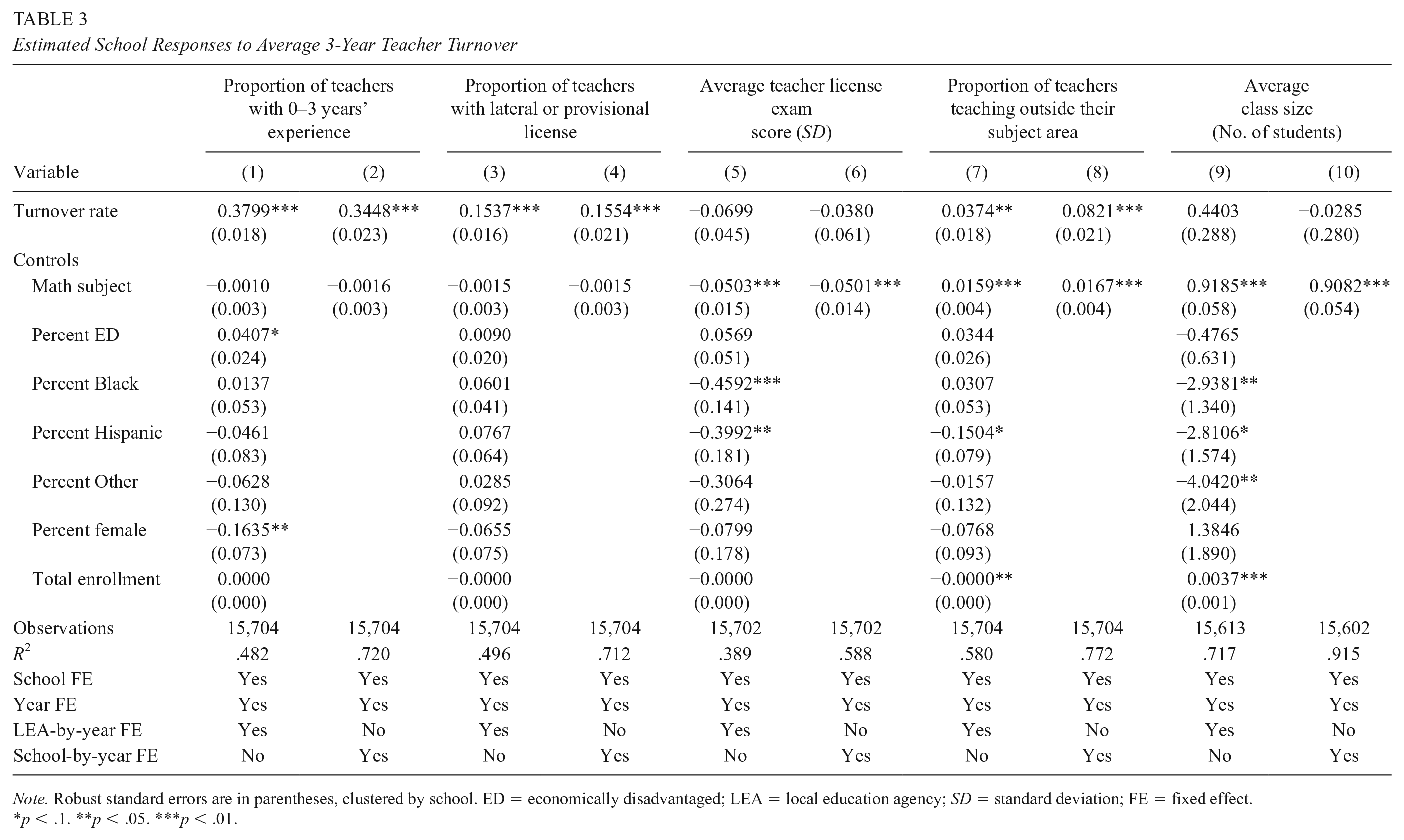
Table 3 shows our main findings about how the departure of teachers affects the schools they leave behind. Each set of two columns represents an outcome of interest, and within that outcome the first column provides estimates from Model 1 (with school- and district-by-year fixed effects), and the second column provides estimates from Model 2 (with school-by-year fixed effects). The predictor variable of interest is specified as the average turnover rate from the prior three school years, which ranges from 0 to 1. Therefore, each coefficient represents the estimated effect of increasing teacher turnover from 0% to 100%, which is outside the normal range of year-to-year changes in average turnover rates. In the text, we translate them as appropriate to reflect more reasonable changes.
Estimated School Responses to Average 3-Year Teacher Turnover
Note. Robust standard errors are in parentheses, clustered by school. ED = economically disadvantaged; LEA = local education agency; SD = standard deviation; FE = fixed effect.
p < .1. **p < .05. ***p < .01.
As shown in columns 1 and 2, we find, not surprisingly, that teacher turnover increases the proportion of teachers with three or fewer years of experience in the school, and that the estimate is statistically significant. The estimated coefficient on the turnover rate of 0.380 (p < .01) in Model 1, represents an increase of 38 percentage points in the proportion of novice teachers. 9 By calculation, a more moderate increase in average teacher turnover of 10 percentage points would increase the proportion of novice teachers at that school by 3.8 percentage points, from a baseline average of 21%. Model 2 confirms the findings from Model 1, with a coefficient of .345 (p < .01). In addition, as shown in columns 3 and 4, higher teacher turnover rates also significantly increase the proportions of teachers with lateral or provisional licenses (coefficients = 0.154 and 0.155, respectively). An increase in teacher turnover of 10 percentage points would raise the proportion of teachers with either lateral or provisional licenses by 1.5 percentage points (p < .01), from a baseline average of 12%. These effects on the shares of novice teachers and teachers with lateral or provisional licenses represent substantive—and educationally undesirable—changes in the overall composition of teachers working in a school.
The patterns in columns 5 and 6, which indicate how teacher turnover affects the average teacher licensure exam scores of the teaching staff at the school, measured in SD units, are less conclusive. The negative coefficients of −0.070 and −0.038 suggest that turnover reduces teacher quality, but these associations are not statistically significant. More convincingly, turnover appears to increase the proportion of teachers instructing outside their main subject area of certification, as indicated by the statistically significant coefficients of 0.037 (p < 0.05) in Model 1 (column 7) and 0.082 (p < .01) in Model 2 (column 8). The latter coefficient implies that a rise in teacher turnover of 10 percentage points increases the proportion of the school’s teaching staff teaching outside their subject area by about 0.8 percentage point. Relative to the average of 29% of teachers teaching outside their subject area, this is a modest effect size but still relevant as partial evidence of disruption of the instructional environment within a school.
The final regression models estimate the effects of teacher turnover on average class size within a particular school and subject, presented in Table 3, columns 9 and 10. We uncover no effect of teacher turnover on average class size, with a positive coefficient of 0.440 for Model 1 and a negative coefficient of −0.029 in Model 2, neither of them significant. This result suggests that when middle schools in North Carolina lose math or ELA teachers, they are likely able to replace those teachers, albeit with teachers with weaker qualifications, as indicated in the prior columns, and do not often combine class sections or operate without teachers in certain subjects for extended periods of time. This null finding with respect to class size is not surprising given that math and ELA are core subjects with state end-of-grade tests and the state has requirements for maximum course size.
The following sections report the estimated impacts of heightened teacher turnover within particular school contexts or time periods. From this point forward, we present only estimates from the preferred, Model 1 specification since the two models generate consistent results.
Differential Effects by School Characteristics
As described above, and documented in Table 2, some schools are more likely to experience higher teacher attrition than others based on their location or the characteristics of their students. Here, we seek to understand the extent to which schools facing constraints based on their location or level of student disadvantage respond differently to teacher departure. The types of schools considered are (1) those serving primarily economically disadvantaged students, (2) those classified as low performing academically, and (3) those geographically far from a major TPP. 10 We test for heterogeneous effects for each outcome by interacting the 3-year average turnover measure with an indicator of school type.
Most of the compositional changes in teachers resulting from high teacher turnover—including changes in the proportion of teachers with little experience, and in average teacher licensure scores—do not differ by school type (see Appendix Tables A3 to A5). This finding implies that teacher turnover affects many aspects of school environments in a consistent manner across different contexts. The one exception is changes in the proportion of teachers who are lateral entrants or have a provisional license. Figure 2 displays the results for this outcome variable.

Changes in the proportion of teachers with lateral entry or provisional license in response to turnover, by school characteristics.
The figure shows that the effect of turnover in the highest-poverty schools (defined as schools in the top quartile of percentage of economically disadvantaged students) on the proportion of lateral entrants or teachers with provisional licenses is 8.7 percentage points larger (p < .01) than the corresponding effect in all other schools. The effect is likewise 14.5 percentage points larger (p < .01) in low-performing schools (defined as schools in the bottom tertile of test performance in the baseline year) than in high-performing schools. And finally, using distance to the nearest TPP as a proxy for the strength of the supply of new teachers, we find that a school that is located more than 1 hour away from a TPP increases the share of such teachers in response to teacher turnover by 10.9 percentage points (p < .1). In summary, it appears that harder-to-staff schools with more disadvantaged students, lower academic performance, and fewer nearby TPPs must depend more than other schools on unlicensed teachers to fill their vacant positions.
Effects of Turnover by Time Period
We have already documented that turnover rates of math and ELA teachers varied over time, with a big drop during the recession and subsequent rise since 2012 (see Figure 1). Here we explore the extent to which turnover rates differentially affected the mix of a school’s math and ELA teachers over time. One might expect, for example, that teacher turnover might have had smaller adverse effects on a school’s mix of teachers during the recession, when turnover rates were low and declining. To that end, we divide the sample period into a prerecession period from 1996 to 2008, a recession period from 2009 to 2012, and a postrecession period from 2013 to 2016.
We begin by describing the trends that might have a bearing on the estimated effects of turnover. Figure 3 indicates that the number of middle school students increased quite steadily from 1996 to 2003, declined between 2005 and 2009, and then increased through the present. The number of math and ELA teachers grew in parallel with the rapid growth in student enrollment from 1996 to 2003 but did not keep pace during more recent years. Appendix Table A6 documents corresponding trends in the characteristics of teachers during the three periods, with a general trend toward lower average qualifications at the same time when the state’s average teacher salary dropped to one of the lowest in the nation (National Education Association, 2019).

Percent cumulative change in student enrollment and teacher counts, 1997–2016.
By themselves, however, these trends do not answer the question of whether a specified rate of teacher turnover had larger adverse effects on the composition of teaching staff at some points during the study period than at others. To explore that question, we estimate models in which we interact the turnover rate with indicator variables for the time periods and test for statistically significant differences in effects by period. The selected results shown in Table 4 are based on equations that are not only comparable to our basic models for each of the separate dependent variables but also include the turnover rate interacted with the 2009–2012 period and the 2013–2016 period. The first row of coefficients are the estimated effects of turnover during the period 1996–2008. During this prerecession period, turnover led to higher proportions of teachers with 0 to 3 years of experience, those who were lateral entrants, or those who were teaching outside their main subject area (but again no effect on class size). The large magnitude of turnover effects during this base time period may in part reflect the contemporaneous rapid growth in student enrollment (see Figure 3), which would put pressure on schools to not only replace existing teachers but also hire new ones. We hypothesize that this heightened statewide demand for teachers could make finding ones with strong qualifications more challenging.
Estimated School Responses to Teacher Turnover by Time Period

Note. Robust standard errors are in parentheses, clustered by school. FE = fixed effect; LEA = local education agency. Coefficients on control variables are not shown.
p < .1. **p < .05. ***p < .01.
The second row of Table 4 indicates that the effects on the mix of teachers defined by two of these measures were smaller during the recessionary period 2009–2012. 11 In particular, during that period, schools responded to teacher turnover by relying less on lateral entry or provisional teachers than during the prior years and less on teachers teaching outside their subject area. The drop in overall turnover rates brought on by the recession (see Figure 1) likely contributes to these dampened effects. Even in this period, however, the net effect (calculated by adding the coefficients in the first two rows) of turnover during the recession was to increase the proportions of novice teachers and lateral entry/provisional teachers. During the 2013 to 2016 period, turnover led to smaller increases in the proportion of novice teachers but otherwise statistically similar effects on the composition of teachers as in the baseline time period.
In sum, during the economic recession, teacher turnover dropped by nearly 6 percentage points and resulted in somewhat smaller adverse effects on the mix of middle school math and ELA teachers relative to the other two periods. However, the recession clearly does not fully account for the overall adverse effects reported in earlier sections of this article. 12
Robustness Tests
We perform several robustness tests to explore the validity and/or limitations of our empirical models. First, we note that teachers with lateral and provisional licenses represent a diverse group. A proportion of these teachers without formal licenses in North Carolina enter teaching through the Teach for America (TFA) program. Whereas lateral entry and provisionally licensed teachers are typically less effective than fully licensed teachers, TFA teachers may be more effective in the classroom than other teachers with the same levels of experience (e.g., Xu et al., 2011). For this reason, it is important to tease out whether our estimated turnover effects are driven by increased TFA teacher placement or by an increase in other supply sources of teachers. Appendix Table A7 presents results replicated from all the primary models in Table 3 but with the sample restricted to districts for which less than 1% of teachers are TFA. 13 For each outcome, the coefficients on turnover are nearly identical to those in the results from the full sample of school districts, and in some cases they are larger in magnitude.
Second, our primary estimates of the effects of teacher turnover rely on 3-year moving averages of turnover. This approach reflects the assumption that 3-year average turnover will better reflect how cumulative teacher departures affect school environments than 1-year turnover rates. We test directly through a distributed lag model how the 1-year turnover rates from the prior 5 years separately affect teacher characteristics in the current year. Across the two outcome measures with the largest overall effects—proportion of novice teachers and proportion of teachers with lateral/provisional licenses—turnover from the preceding year has the largest effect on these indicators, with effect sizes shrinking in each additional year prior (eventually to 0 by Year 5). Results from this analysis are presented graphically in Appendix Figure A1. Building on these patterns, we also test the sensitivity of our results to different moving averages (Appendix Table A1) and to the exclusion of outlier turnover years that could potentially skew the moving average (Appendix Table A2).
Third, one may wonder whether there may be a threshold of the turnover rate under which turnover is not particularly harmful or perhaps may even be beneficial to schools. We estimate alternative models for all outcomes as a function of quintiles of teacher turnover to investigate the potential for nonlinearities (Appendix Table A8). The graphical results in Appendix Figure A3 highlight the coefficients for the proportion of novice teachers and proportion of laterally/provisionally licensed teachers and illustrate that the relation between turnover and composition of teachers is fairly linear across the distribution.
And finally, we explore a falsification test of whether future turnover predicts current outcomes. To do so, we replicate Model 1 but replace the average turnover rate from time t − 3 to time t − 1 with the average turnover rate from time t + 1 to time t + 3. If future turnover were associated with current outcomes, it could arouse concern that teacher turnover and teacher qualification variables are merely trending together within schools rather than turnover causing the changes to teacher qualifications. However, as can be seen in Appendix Table A9, there are no significant associations between future teacher turnover and any of the four teacher qualification variables. There is one significant association between future turnover and current average class size, suggesting that having higher average class size in time t predicts lower levels of teacher departure at time t + 1 to t + 3.
Effects of Turnover on Student Achievement
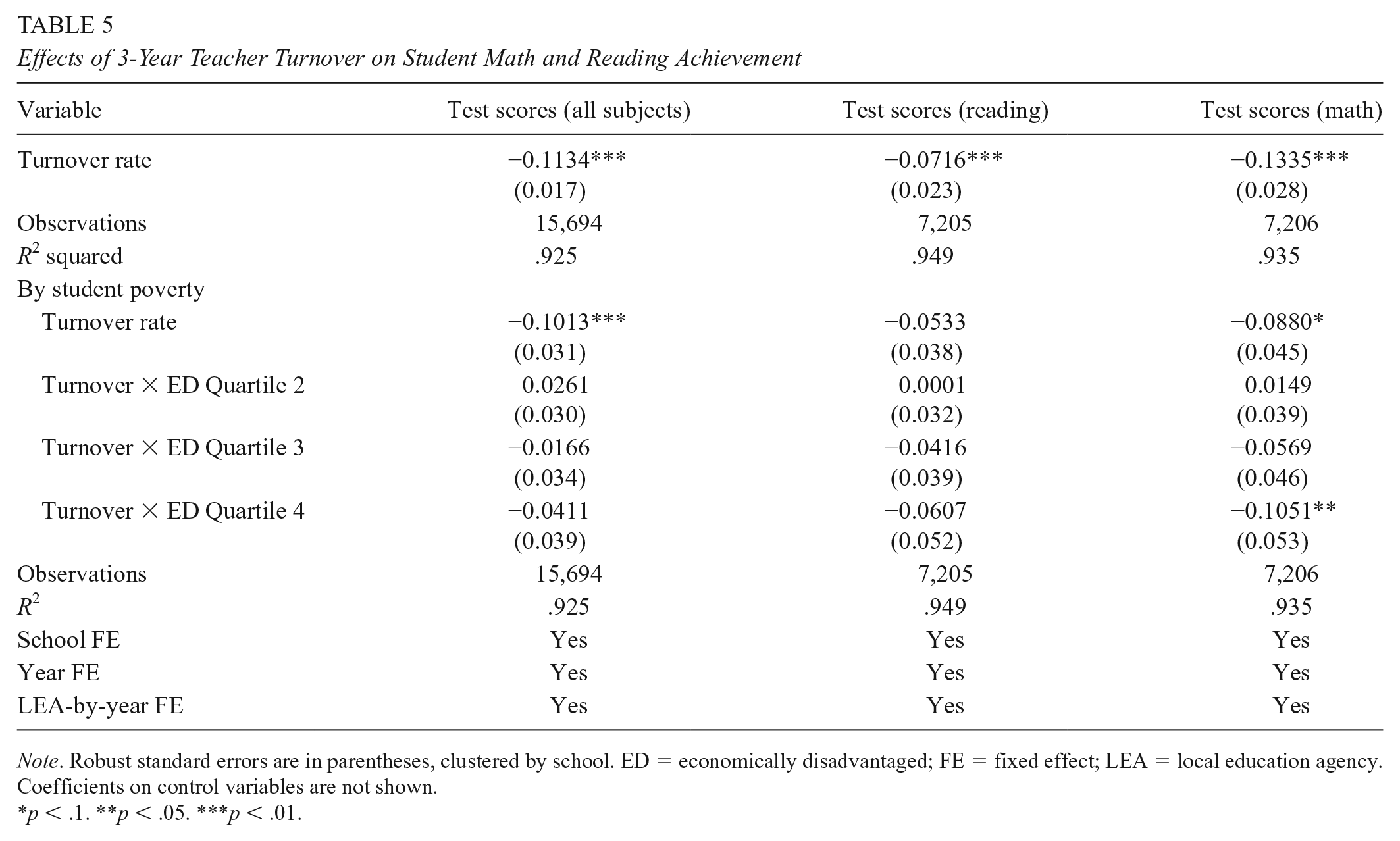
We have claimed that changes in the average qualifications of teachers in a school resulting from high turnover are likely to be detrimental to student learning. Given our data linking student records to specific teachers and schools, we can test this claim directly. As with the teacher qualification outcome measures, we calculate averages of student achievement for each school-year-subject unit. Table 5 presents Model 1 estimates from a regression of average student achievement on the 3-year turnover rate (again with school- and district-by-year fixed effects and time-varying controls). In column 1, we show that an increase in subject-specific teacher turnover by 100 percentage points decreases test scores in that subject by 0.11 SD (p < .01). A more moderate increase in turnover by 10 percentage points would decrease test scores by 0.011 SD. When we separate out the results by average reading test scores regressed on ELA teacher turnover and average math test scores regressed on math teacher turnover, a similar pattern emerges, though it is more pronounced in math. An increase in turnover of 10 percentage points leads to reductions of 0.007 SD in reading performance and 0.013 SD in math performance, both statistically significant at the .01 level.
Effects of 3-Year Teacher Turnover on Student Math and Reading Achievement
Note. Robust standard errors are in parentheses, clustered by school. ED = economically disadvantaged; FE = fixed effect; LEA = local education agency. Coefficients on control variables are not shown.
p < .1. **p < .05. ***p < .01.
In short, we confirm that periods of high turnover have an adverse effect on student academic outcomes. It is tricky to compare directly the magnitude of these effect sizes with that in prior studies given our use of a 3-year average subject-specific turnover measure. Ronfeldt et al. (2013) conclude that an increase in annual grade-specific teacher turnover of 10 percentage points would reduce reading scores by 0.005 SD and math scores by 0.009 SD, which are slightly smaller in magnitude than our subject-specific effects from 3-year average turnover. We also confirm the finding of Ronfeldt et al. that the effects of turnover on student achievement are largest in schools with mostly economically disadvantaged students (second panel of Table 5). The changing composition of teachers following turnover events stands out as a likely mechanism of such effects, although others are certainly possible.
Concluding Discussion
This study confirms that a high rate of teacher turnover at the school level raises significant policy concerns. Our analysis differs from those of other researchers by drawing attention to how the departure of teachers from a school adversely affects the composition of the school’s teachers in subsequent years. Specifically, we focus neither on those who leave a school nor on those who join but rather on the net effect of the two types of flows. We document that the turnover of teachers in math and ELA classes in North Carolina middle schools from the late 1990s to 2016 increased the schools’ share of math and ELA teachers with low levels of experience, without full licensure, and without certification in the given subject in subsequent years. All else held constant, these teacher characteristics are widely believed to signal lower quality of education for students. And indeed, our findings confirm significant drops in student math and reading scores as a consequence of the turnover of math and ELA middle school teachers.
High-poverty, low-performing, and geographically isolated schools are all more likely to rely on lateral entry and provisional teachers in response to turnover than the average school. A careful analysis of how rates of teacher turnover and characteristics of the teaching workforce shifted before, during, and after the economic recession further illuminates how the impacts of turnover differ across contexts. Under the pressure of student enrollment growth between 1996 and 2005, teacher turnover led to some of the largest negative consequences for schools. In the midst of the economic recession, however, turnover had more limited adverse effects as teachers were significantly less likely to leave their positions. Since 2012, the rapidly rising turnover rate, the growth in class sizes, and the increased use of teachers with lateral entry or provisional licenses should concern North Carolina policymakers.
This study is not the first to document that teacher turnover reduces student achievement as measured by test scores (Hanushek et al., 2016; Henry & Redding, 2018; Ronfeldt et al., 2013). Our new findings help explain these effects and, in the process, generate broader implications for the immediate and ongoing capacities of schools experiencing high rates of turnover. In particular, the compositional effects of turnover that we report are likely to be detrimental in two ways, apart from their direct harm to instructional quality and student learning. The influx of new and inexperienced teachers could disrupt and interfere with the development of a coherent program of education within the school. Although some of that disruption would occur regardless of the characteristics of the replacement teachers relative to the departing teachers, it is likely magnified when the new teachers have lesser qualifications and experience than the departing teachers, as is the case in North Carolina middle schools. Finally, that compositional change may lead to greater turnover in subsequent years because of the greater proclivity of the identified groups of teachers than others to leave a school (Redding & Henry, 2018; Redding & Smith, 2016).
The potential for higher subsequent turnover strengthens the case for policymakers to address directly the challenges posed by high teacher turnover. A full discussion of such targeted policies is beyond the scope of this article, but they might include improving school working conditions (Loeb et al., 2005; Simon & Johnson, 2015), promoting strong school leadership (Kraft et al., 2016; Ladd, 2011), offering differential pay in hard-to-staff schools (Clotfelter et al., 2008; Clotfelter et al., 2011; Fulbeck, 2014), providing high-quality mentoring and induction for new teachers, and retaining experienced teachers through professional development or shared decision-making roles. Each of these approaches is likely to be more effective in some contexts than in others, no single one of them is a panacea by itself, and their effects will depend on how well they are implemented. Nonetheless they illustrate the types of targeted programs needed to address the serious educational problem of teacher turnover.
Footnotes
Appendix
Falsification Test: Current School Responses to Future Teacher Turnover

| Variable | Proportion of novice teachers (1) | Proportion of teachers with lateral or provisional license (2) | Average licensure score (3) | Proportion of teachers teaching outside their subject area (4) | Average class size (5) |
|---|---|---|---|---|---|
| Future turnover rate | 0.0345(0.026) | 0.0146(0.020) | 0.0489(0.065) | 0.0132(0.023) | −0.8023**(0.341) |
| Observations | 12,614 | 12,614 | 12,554 | 12,614 | 12,248 |
| R 2 | .398 | .451 | .398 | .549 | .756 |
| Control variables | Yes | Yes | Yes | Yes | Yes |
| School FE | Yes | Yes | Yes | Yes | Yes |
| Year FE | Yes | Yes | Yes | Yes | Yes |
| LEA-by-year FE | Yes | Yes | Yes | Yes | Yes |
Note. Robust standard errors are in parentheses, clustered by school. LEA = local education agency; FE = fixed effect. Future turnover rate defined as average turnover in years t + 1 through t + 3. Coefficients on control variables are omitted.
Acknowledgements
This work was supported by the National Center for Analysis of Longitudinal Data in Education Research. We are extremely grateful to Alisa Chapman at the University of California, Chapel Hill, for numerous conversations and insights that guided the early development of this article. We also appreciate the comments received from participants at the Association of Education Finance and Policy session on teacher working conditions and the annual CALDER conference.

Notes
Authors
LUCY C. SORENSEN is an assistant professor in the Rockefeller College of Public Affairs and Policy at University at Albany, State University of New York. Her research focuses on K–12 education policy, human development, and social inequality.
HELEN F. LADD is the Susan B. King Professor Emerita of Public Policy and Economics at Duke University. Her research focuses on school finance and accountability, teacher labor markets, school choice, and early-childhood programs.